TECHNOLOGICAL UPGRADING AND DISTRIBUTED
KNOWLEDGE BASES
Paul L. Robertson ([email protected])
Keith Smith
Australian Innovation Research Centre, University of Tasmania Private Bag 108, Hobart, 7001, Tasmania, Australia
1.
Introduction
Established industries, which constitute by far the largest share of the manufacturing and service sectors in most developed economies, are on balance reasonably innovative. They engage in frequent changes in both product and process technologies which, although perhaps less spectacular (in a literal sense) than some of the innovations in newer industries, contribute substantially to their own productivity and competitiveness and to better macroeconomic performance. Through innovation, established industries not only benefit themselves but, in their role as consumers of new products and new ideas, they are also significant contributors to the growth of high-technology industries. The ability of established industries to engage in frequent technological upgrading is an important determinant of prosperity in economies at all levels of development and should be a major pre-occupation of both managers and policy makers (Robertson, et al., 2003; Robertson and Patel, forthcoming).
In following innovative paths, firms in most established industries – sectors that have been offering variations on essentially the same product for many years and have gone through long periods of evolutionary change – do not engage extensively in formal Research and Development (R&D) activities as generally defined (Kreinsen, et al., 2006).1 As a result,
1 This is not invariably true. Some industries that have been around for long periods, such as automobiles and
they are generally classed as “Medium-Low” and “Low” Technology by traditional metrics such as the often-cited OECD system of classification based on percentages of sales revenues that firms in an industry devote to R&D expenditures (Hatzichronoglou, 1997). Thus one of the great areas of debate, which we address in this paper, is where and how firms in established industries are nevertheless able to locate sources of technological knowledge which they then adapt to achieve their own aims even though many of these techniques were originally developed in other industries, perhaps for quite different uses.
In the sections that follow, we look at the issues surrounding technological upgrading from a number of different but related perspectives. We examine knowledge flows in general in Section 2, and then in the following section discuss the reliance of established industries on distributed knowledge bases, that is on the many and diverse sources of knowledge that they must often bring together and align to suit their own purposes. Section 4 is devoted to a case study of distributed knowledge bases in the Food Processing sector. Several different models or schema for mapping distributed technological knowledge are then outlined in Section 5. Finally, firm-level and policy implications are discussed in the Conclusion.
2.
The Importance of Distributed Knowledge
The economics of innovation has always focused on learning, just as public policies for science, technology and innovation have always been aimed primarily at creating and diffusing knowledge. In recent years, however, learning and knowledge have attracted increasing attention as a result of claims that knowledge-intensive industries are now at the core of growth, and that we are now entering a new type of knowledge-driven economy or even a completely new form of ‘knowledge society’.
have taken a very narrow view of this question, identifying the knowledge economy with a highly restricted group of economic activities. These activities tend to be characterised either as those directly involving the creation and transmission of information, or as those associated with high levels of direct R&D, high rates of patenting, and direct links to extensive scientific publishing. This approach to the knowledge economy has two basic limitations. First, it takes a narrow view of the cognitive characteristics of knowledge, focusing on the use of knowledge that is formally created via investment in R&D, thus obscuring the fact that other knowledge forms may exist, with different but economically important characteristics. Second, the focus on direct creation of knowledge tends to obscure the complexity of economic processes, which in practice involve interdependence and the flow of knowledge between activities.
Our argument is that a ‘distributed knowledge base’, one that goes beyond internal sources to draw widely from other firms and institutions, forms the basis for innovation in most industries. As levels of R&D are very low in much of the economy, the use of distributed knowledge is, in fact, the main source of new ideas and techniques, especially in low- and medium-technology (LMT) firms.
The Meaning of Knowledge
Concern about the role of knowledge in the economy is hardly new. For instance, Karl Marx argued that a distinguishing feature of mid-nineteenth century capitalism was ‘the conscious application of science’, and he explicitly treated separation of the conception and execution of tasks (that is, of a knowledge function) as central to mechanisation. In a fascinating Appendix to Capital Vol I, drafted in the early 1860s, Marx (1976 [1867], 1024) wrote :
ends, technology, etc. and similarly, through the enormous increase of scale corresponding to such developments (for it is only socialized labour that is capable of applying the general products of human development, such as mathematics, to the immediate process of production; and, conversely, progress in these sciences presupposes a certain level of material production).
In discussing the knowledge economy we are limited by the absence of a coherent definition, let alone theoretical concept, of this term: it is at best a widely-used metaphor, rather than a clear concept. The OECD (1995, 7) has spoken of knowledge based economies in very general terms, as meaning ‘those which are directly based on the production, distribution and use of knowledge and information’. This definition is a good example of the problems of the term, for it seems to cover everything and nothing: All economies are in some way based on knowledge, but it is hard to think that any are directly based on knowledge, if that means the production and distribution of knowledge and information products.
truth content, and that has been the domain of the philosophy of science. At another point on the spectrum, knowledge may involve simply the transmission of data in the context of comprehensible practical guidelines for use. These differences correspond to psychological or cognitive differences in those who ‘know’. At one extreme knowledge requires a transformative internalising of some new principle, and at the other it simply involves accessing an intelligible account of how to do something. Such differences – and of course much finer categories could be pointed to - are important in determining what we are talking about with respect to knowledge, but they are often ignored within the literature. Related to this is the matter of institutions. At whatever level we think about the nature of knowledge, institutions are required as generative frameworks and as a kind of social memory (the latter being a precondition for transmission), and these too are of very different forms. The reason for making these very preliminary distinctions is that, because the literature rarely makes any attempt to grapple with such dimensions of knowledge itself, it is often able to slide between very different implicit notions of knowledge, and this is one of the many imprecisions that make the notion of ‘knowledge economy’ so rhetorical rather than analytically useful.
Knowledge-Intensive Industries?
Before moving to a discussion of knowledge in industry, it is necessary to make a diversion via the concept of ‘high-technology’. In much policy analysis it is common to use the terms 'high-technology' or 'knowledge intensive industries' in a somewhat loose way, as though in fact they are both meaningful and interchangeable terms. But we ought to remember that the term ‘high technology’ is a rather recent invention, and that its meaning is far from clear.
intensities, with those (such as ICT or pharmaceuticals) spending more than 4 per cent of turnover being classified as high-technology, those spending between 1 and 4 percent of turnover (such as vehicles or chemicals) being classified as medium-tech, and those spending less than 1 per cent (such as textiles or food) as 'low tech'. In fact the OECD discussion of this classification was rather careful, and offered many qualifications. Chief among these is the point that direct R&D is but one indicator of knowledge content, and that technology intensity is not mapped solely by R&D. Unfortunately the qualifications were forgotten in practice, and this classification has taken on a life of its own; it is widely used, both in policy circles and in the press, as a basis for talking about knowledge-intensive as opposed to traditional or non-knowledge-intensive industries.
This is a serious problem, since the OECD classification as it is used rests on only one indicator, namely intramural R&D. This is open to two important objections. First, it is by no means the only measure of knowledge-creating activities. Second, it ignores the fact that the knowledge that is relevant to an industry may be distributed across many sectors or agents: thus a low-R&D industry may well be a major user of knowledge generated elsewhere. This issue will be discussed in a more empirical manner below.
Even so it is not clear that this classification helps us, even in a limited analysis of trends. One great problem is that the high-tech sector thus defined is small, and there are therefore some difficulties in arguing that it is driving the growth process. In the OECD, the high-tech sector is no more than 3 per cent of GDP even in the U.S.A. (Robertson and Patel, forthcoming).2 It is hard to see how either the direct or indirect impacts of such a small component of output could have a significant effect on overall economic growth. Most discussions of the role of high-tech are conducted in terms of share analyses. This can easily
confuse matters. In virtually all of the OECD economies the share of high-tech in total manufacturing has risen in the longer term, and this is widely used as an argument for the claim that such industries are central to growth. However, this is complicated by the fact that the share of manufacturing in total output has been in long-term decline3. It is not uncommon to see quite sweeping claims made for the high-tech sector which are not supported by readily available evidence. For example, OECD’s Knowledge Based Economy (1995, 9) claims that ‘Output and employment are expanding fastest in high-technology industries, such as computers, electronics and aerospace’. But the OECD’s own ‘Scoreboard of Indicators’ actually shows long-term negative growth rates of employment in high-tech manufacturing in eleven of fifteen OECD countries for which data are presented (including the USA, where high-tech employment declined at a faster rate than manufacturing employment generally).4
Despite these basic problems, the high-medium-low-tech approach has been extended, to divide the medium-tech category into medium-high and medium-low technology industries (Hatzichronoglou, 1997). Such classificatory manoeuvres cannot, however, alter the fundamental limitations of the category, and ought to cause us to question the identification of knowledge intensive and high-tech industries.
Firms and Industry Expenditures on Knowledge Creation
Although much analysis of knowledge creation rests on R&D data, particularly intramural R&D carried out by firms, it is mistaken to over-identify knowledge creation with intramural
3 It may also be complicated by the fact that some sections of ICT and other high tech sectors have become less
exotic in a technological sense as they have aged but continue to be considered as cutting-edge in statistical surveys. At the same time, other, newer, activities have been added to the high tech category. Thus without an occasional but rigorous pruning, the proportion of activity classed as high tech would continue to grow even if the proportion of technologically new activities in reality remains the same or even decreases.
4 Similarly, Grinstein and Goldman (2006,:121) have recently written that ‘Technology firms occupy a central
R&D, partly for conceptual and partly for practical reasons. Conceptually, R&D data tend to rest on a view of innovation that overemphasizes the discovery of new scientific or technical principles as the point of departure of an innovation process (an approach sometimes called the 'linear model' of innovation) (Kline and Rosenberg, 1986). It sees innovation as a set of development stages originating in research, and it is this prior significance of research that licences using R&D as a key knowledge indicator. From a practical point of view, the definitions of R&D in the OECD's Frascati Manual (OECD, 1993), which structure R&D data collection in OECD economies, exclude a wide range of activities that involve the creation or use of new knowledge in innovation.5
By contrast, modern innovation theory sees knowledge creation in a much more diffuse way. Firstly, innovation rests not on discovery but on learning. Learning need not necessarily imply discovery of new technical or scientific principles, and can equally be based on activities which recombine or adapt existing forms of knowledge. This in turn implies that activities such as design and trial production (which is a form of engineering experimentation) can be knowledge-generating activities. A second key emphasis in modern innovation analysis is on the external environment of the firm. Firms interact with other institutions in a range of ways, including purchase of intermediate or capital goods embodying knowledge. The installation and operation of such new equipment is also knowledge-creating. Then there is the purchase of licences to use protected knowledge.
5 On a strict reading, the Frascati Manual’s definition of research would have to include things like market
Finally, firms seek to explore their markets. Given that innovations are economic implementations of new ideas, then the exploration and understanding of markets, and the use of market information to shape the creation of new products, are central to innovation. These points imply a more complex view of innovation in which ideas concerning the properties of markets are a framework for the recombination and creation knowledge via a range of activities. In this framework R&D is important, but tends to be seen as a problem-solving activity in the context of innovation processes, rather than an initiating act of discovery.
Some of these points are illustrated by data taken from the third round (1998-2000) of the European Union’s Community Innovation Survey (CIS) (OECD, 2005, 38-39). The CIS revealed that around a third of Small and Medium Size Enterprises6 (SMEs) – the great majority of which were Low and Medium Technology firms in established sectors – developed innovations in-house, but this did not necessarily involve formal R&D activities.7
They also engaged even more extensively in ‘non-technological’ innovative activities such as new product design and ‘advanced management techniques’. As these figures do not included innovations embodied in new machinery and other inputs, however, the full scope of innovative activity undertaken by SMEs would have been considerably greater.
The Role of Knowledge and Learning in Innovation Across Industries
How do capital investment, intermediate good acquisition and non-R&D expenditures relate to the structure of knowledge in an industry? Most analyses of learning have focused on analysing the characteristics of learning processes, or on the broad types of knowledge that
6 Firms with fewer than 250 employees.
7 As Hirsch-Kreinsen, et al (2006) have shown, because of problems of definition, many of the innovative
are involved, rather than on the specific content and structure of industrial knowledge bases. This has led innovation theorists to explore such aspects of learning as cumulativeness, tacitness, and interactivity, or such issues as the institutional structure of knowledge creation across economies. Others, such as Lundvall and Johnson (1994), have explored the components of knowledge and firm-level competence – distinguishing between specific factual information, knowledge of basic scientific principles, specific and selective social knowledge and practical skills and capabilities. But these approaches do not focus on the actual content of the knowledge base of a firm or industry, or on how it is organized institutionally.
How, then, can the knowledge content of an industry be understood and described? We can distinguish between three areas of production-relevant knowledge, namely firm-specific knowledge, sector or product-field firm-specific knowledge, and generally applicable knowledge.8 At the firm level, the knowledge bases of particular firms may highly localised,
and specific to very specialised product characteristics, either in firms with one or a few technologies which they understand well and which form the basis of their competitive position; or they may be more broadly based in multi-technology firms or firms with complex products (Granstrand, et al., 1997; Patel and Pavitt, 1998). Secondly there are knowledge bases at the level of the industry or product-field. At this level, modern innovation analysis emphasises the fact that industries often share particular scientific and technological parameters; there are shared intellectual understandings concerning the technical functions, performance characteristics, use of materials and so on of products.9 This part of the industrial knowledge base is public (not in the sense that it is produced by the public sector,
8This kind of differentiation goes back quite a long way in economics, but has been significantly developed in
recent years (for an early account, see W. Salter (1966: 13-16).
but public in the sense that it is accessible knowledge which in principle available to all firms): It is a body of knowledge and practice, which shapes the performance of all firms in an industry. Of course this knowledge base does not exist in a vacuum. It is developed, maintained and disseminated by institutions of various kinds, and it requires resources (often on a large scale). Finally, there are widely applicable knowledge bases, of which the most important technically is the general scientific knowledge base. This is itself highly differentiated internally and of widely varying relevance for industrial production; but some fields - such as molecular biology, solid-state physics, genetics or inorganic chemistry - have close connections with major industrial sectors.
3.
Distributed Knowledge Bases in Established Industries
The argument above suggests that the relevant knowledge base for many industries is not internal to the industry, but is distributed across a range of technologies, actors and industries.10 Thus a ‘distributed knowledge base’ is a systemically coherent set of knowledges, maintained across an economically and/or socially integrated set of agents and institutions. In general, enterprises do not depend on a single technology or on single sources of technological knowledge. They must blend knowledge that is distributed among various knowledge bases according to such factors as industrial source, geographical location, intellectual (scientific or technical) location, social location and chronology. Although the relative importance of these may vary from enterprise to enterprise and sector to sector, innovation management in a dynamic environment consists largely of finding efficient ways of detecting, comprehending and mixing and integrating distributed knowledge to achieve
10 The use of the word ‘distributed’ has become popular in recent years to describe something that has multiple
outcomes that are economically efficient and lead to acceptable social outcomes both within enterprises and in broader societal and political contexts.
Although some authors (Coombs and Metcalfe, 2000; Coombs, et al., 2003) concentrate on distributed activity that is formally structured – through joint ventures, strategic alliances, conscious outsourcing, and other well-defined organizational forms – we contend that distributed knowledge bases are often inchoate in important ways. As we discuss in Section 5, because of uncertainty and uneven distributions of knowledge, it is often difficult to know where to look for appropriate knowledge, if indeed there is any reason to suppose that such knowledge currently exists. The chains through which knowledge is conveyed may have several links, and not all chains are interconnected. Even when knowledge is ‘in the air’, a particular firm may not be breathing in the right spot to inhale it.
The extent to which knowledge is distributed depends on many elements. Some sectors, especially science-based ones that were launched comparatively recently, may find that most of their new knowledge is developed internally or in a few easily identifiable locations that are known to operate on the leading edge of their field.11 This is less likely to be true, however, for the great mass of sectors that have been established for longer periods and may be affected by relatively frequent incremental changes that derive from diverse sources including users, suppliers and competitors, as well as through internal developments. These established sectors may also be affected by less common but more dramatic fundamental or radical changes which again could emanate from many directions. Furthermore, the nature of knowledge acquisition and use may vary according to how the issue is defined. A different picture is likely to emerge if a supply chain as a whole is investigated rather than one or two links in the chain. Finally, the importance of particular
11 Firms in new, highly-innovative sectors may not really participate in supply chains in the usual sense of the
contributions to knowledge is also a matter of perspective: The development of a new generation of chips that drives some chips manufacturers out of business and raises others to industrial leadership may only result in a minor if useful improvement in performance when the chip is used in an existing complex assembly such as a car or a washing machine.
The management of distributed knowledge in established sectors presents distinct challenges. The firms in these sectors are generally well-placed in a static sense in that they have mastered their existing technologies and established strong ties (Granovetter, 1973) with suppliers and customers that allow them easy access to many types of incremental improvement. On the other hand, firms may find that their strengths in knowledge management become weaknesses if the rate of potential innovation accelerates. Firms accustomed to operating in comparatively static environments may have become complacent and not bothered to develop sufficient absorptive capacity (Cohen and Levinthal, 1990) to be able to detect useful developments in areas beyond those that they have traditionally mined for knowledge. Similarly, they may be inept at exploiting weak ties (Granovetter, 1973) with institutions or people that they have not frequently dealt with in the past. Finally, their success in existing environments may be grounded in routines that prove to be inflexible in the face of changing requirements (Nelson and Winter, 1982; Leonard-Barton, 1992).
As research and development activities as traditionally defined are only minor contributors to change in many established industries (Hirsch-Kreinsen, et al., 2006), innovations are often based on knowledge that originates outside the enterprise.12 In some
cases, firms may find it relatively simple to acquire the fruits of new knowledge from other sectors because it is embodied in equipment or other inputs that the firms can purchase. In other cases, however, firms may not be able to outsource knowledge acquisition because outsiders do not understand their problems and opportunities as well as the firms themselves. As a result, in dynamic environments firms need to develop absorptive capacity to access knowledge directly (as well as to increase their ‘receptive capacity’ (Robertson, et at, 2003) by acquiring a range of other capabilities needed for successful implementation of change). As new knowledge may come from widely distributed sources, this is a difficult problem to manage because, in order to contain costs, firms are forced to gamble on which sources will turn out to be most profitable.
Firms in established industries may also face problems in trying to mix different vintages of technology. Both products and processes tend to evolve over time as incremental improvements are fitted into existing patterns and procedures. Where there is conscious modularity and design rules have been laid down (Sanchez and Mahoney, 1996; Baldwin and Clark, 2000), some changes may be effected through an easy substitution of new components for older ones, but such seamlessness is not always possible. This forces managers to rethink existing practices in order to make the best use of new developments. Knock-on effects from small changes may, as a result, be significant. Moreover, when potential improvements of several kinds become available almost simultaneously but have been developed in different
12 This is also true of many small and medium-sized enterprises (SMEs) that are too small to be able to afford
environments that are not subject to the same sets of design rules, managers may be forced to choose among them because of incompatibility.
In addition, the uncertainties imposed by widely distributed knowledge open opportunities for strategic initiatives as managers look for niches in which some types of innovation are especially sought after while others offer less advantage. Specialisation in knowledge acquisition is therefore possible, but carries a risk of generating technological inflexibility if neglected areas turn out subsequently to be competitively vital.
Finally, the presence of distributed knowledge can have important institutional effects. Government policy may need to be flexible to deal with range of strategic alternatives. In some cases, for example, improved absorptive capacity may offer a better payoff than increased R&D. Similarly, firms might be encouraged to outsource some of their technological requirements to cooperative ventures including industry or government research facilities. These institutions must offer technical credibility, however, by addressing the problems faced by businesses without trying to impose centralised straight-jackets on the strategic initiatives of individual firms.
4.
Case Study: Food Processing
Embodied and Disembodied Flows of Technology
Inter-agent or inter-industry flows conventionally take two basic forms, ‘embodied’ and ‘disembodied’. Embodied flows involve knowledge incorporated in machinery and equipment. Disembodied flows involve the use of knowledge, transmitted through scientific and technical literature, consultancy, education systems, movement of personnel and so on.
The basis of embodied flows is the fact that most research-intensive industries (such as the advanced materials sector, the chemicals sector, or the ICT complex) develop products that are used within other industries. Such products enter as capital or intermediate inputs into the production processes of other firms and industries: that is, as machines and equipment, or as components and materials.13 When this happens, performance improvements generated in one firm or industry therefore show up as productivity or quality improvements in another. The point here is that technological competition leads rather directly to the inter-industry diffusion of technologies, and therefore to the inter-industry use of the knowledge which is ‘embodied’ in these technologies. The receiving industry must of course develop the skills and competences to use these advanced knowledge-based technologies. Competitiveness within ‘receiving’ industries depends heavily on the ability to access and use such technologies.14
Shifting Bases of Internal R&D
The range of technologies used by firms in established sectors has increased substantially in recent decades (Granstrand et al., 1997). Table 1 is based on the U.S. patenting activities of
13 Embodied knowledge cannot necessarily be slotted into an existing framework on a turn-key basis. On the
contrary, for both product and process technologies, embodied knowledge may lead users to make substantial adjustments that involve significant development (and sometimes scientific research) activities on their part.
14 ‘Sending’ industries also face problems in locating the full range of customers who might be interested in
more than 500 of the technologically most active firms in the world. It shows clearly that patenting by these firms, which was already diverse, tended to shift even further away from core technologies between 1981 and 2000.15 Not surprisingly, the fields that gained the most
were in the fast developing areas of drugs and biotechnology and electronics, even among firms whose core businesses were in neither of these areas. To cope with this increasing reliance on distributed knowledge, firms in many industries have had to broaden their technological activities to deal extensively with areas that were previously of comparatively little importance.
Table 1. Changing Technological competencies of 500 large firms: 1981 to 2000 (percentage shares).
Product Groups Chemicals Drugs Biotechnology & Electrical Electronics & Machinery & Process Transport
81-90 91-00 81-90 91-00 81-90 91-00 81-90 91-00 81-90 91-00
Aerospace & Defence 10.7 9.8 0.3 0.5 32.0 33.2 47.6 46.0 7.2 8.3
Chemicals 47.0 45.6 14.3 16.2 8.0 8.2 26.7 25.7 0.2 0.7
Electrical/Electronics 6.6 5.5 0.1 0.2 61.7 67.4 28.5 24.3 1.1 1.2
Food, Drink & Tobacco 8.1 8.6 10.7 25.9 2.6 2.1 30.2 24.7 0.1 0.1
Instruments 2.2 3.0 0.6 2.9 47.4 42.4 47.9 49.7 0.7 0.7
IT Related 1.9 1.4 0.0 0.0 74.2 83.2 20.8 14.4 1.2 0.5
Machinery 5.0 4.6 0.3 0.5 21.1 22.7 54.5 52.8 5.4 5.5
Materials 50.5 48.9 2.2 2.9 9.0 11.9 31.3 31.1 0.3 0.6
Metals 21.7 22.1 1.5 3.1 11.9 16.8 56.9 49.5 2.3 3.1
Mining & Petroleum 42.9 45.7 3.2 3.0 5.5 5.3 45.8 44.4 0.9 0.5
Motor Vehicles & parts 3.3 3.3 0.0 0.1 21.2 26.3 45.3 43.2 25.2 22.9
Paper 19.1 25.1 1.9 2.0 12.3 7.5 38.6 37.2 0.3 0.2
Pharmaceuticals 33.7 23.2 46.0 60.1 2.7 1.7 15.1 13.0 0.0 0.0
Photography &Photocopy 11.0 8.5 1.6 0.9 63.3 67.6 22.8 21.5 0.0 0.0
Rubber & Plastics 50.0 54.0 3.2 2.1 6.1 5.0 32.8 31.5 2.0 2.0
Telecommunications 5.2 1.8 0.1 0.1 72.2 82.9 21.2 14.4 0.4 0.3
Source: Robertson and Patel, forthcoming.
Food Processing
The food processing sector provides an excellent case study of the growing importance of distributed knowledge. For centuries, technological change has been common
15 There is a residual category containing all the patents that are not in these five categories. Consequently, the
[image:17.595.73.515.346.597.2]along the many links in the food processing value chain. Many episodes were the result of trial and error involving techniques developed to deal with animals or plants, but science has also played an important role since Liebig’s discovery of the uses of nitrogen in fertilizer in the first half of the nineteenth century. Selective breeding of domestic animals – horses, cattle, sheep, pigs and dogs – has been common for centuries, producing better performance characteristics. Fruits, vegetables and grain have also been selectively bred to produce better characteristics in terms of yield, appropriateness for various climates, and suitability for other factors such as mechanical picking.
In terms of processing proper, improvements have been made to reduce disease (for example, pasteurisation) as well as to increase product longevity and thereby allow wider distribution. Tinning, developed in the early years of the nineteenth century, was followed by refrigeration and freezing later in the century. These innovations were then combined with transportation improvements, in shipping and railways, to allow the world map in food production to be redrawn as extensive agriculture to serve European markets was now possible in North and South America, Africa and the antipodes. In addition to permitting traditional European meats to be imported more cheaply, refrigeration also allowed fresh tropical fruit including bananas to be sold in Europe on a large scale for the first time.
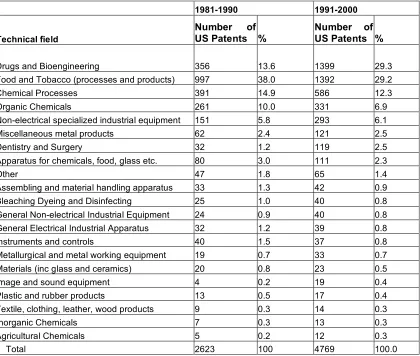
per cent of the total to 29.2 per cent, and the share of patents related to chemicals and chemical processes also declined – although in all cases absolute numbers of patents granted actually increased. The major change was in patents within the ‘drugs and bioengineering’ class, which nearly quadrupled from one decade to the next, thereby increasing their share from 13.6 per cent to 29.3 per cent. Given the recent growth in relevance of bioengineering for agriculture and food processing, this is not surprising, but it does mark a major acquisition of new scientific and technical skills in a sector that is evolving rapidly despite its long history.
Table 2. Changing Technological competencies of Large Firms in Food: 1981 to 2000
1981-1990 1991-2000
Technical field
Number of US Patents %
Number of US Patents %
Drugs and Bioengineering 356 13.6 1399 29.3
Food and Tobacco (processes and products) 997 38.0 1392 29.2
Chemical Processes 391 14.9 586 12.3
Organic Chemicals 261 10.0 331 6.9
Non-electrical specialized industrial equipment 151 5.8 293 6.1
Miscellaneous metal products 62 2.4 121 2.5
Dentistry and Surgery 32 1.2 119 2.5
Apparatus for chemicals, food, glass etc. 80 3.0 111 2.3
Other 47 1.8 65 1.4
Assembling and material handling apparatus 33 1.3 42 0.9
Bleaching Dyeing and Disinfecting 25 1.0 40 0.8
General Non-electrical Industrial Equipment 24 0.9 40 0.8
General Electrical Industrial Apparatus 32 1.2 39 0.8
Instruments and controls 40 1.5 37 0.8
Metallurgical and metal working equipment 19 0.7 33 0.7
Materials (inc glass and ceramics) 20 0.8 23 0.5
Image and sound equipment 4 0.2 19 0.4
Plastic and rubber products 13 0.5 17 0.4
Textile, clothing, leather, wood products 9 0.3 14 0.3
Inorganic Chemicals 7 0.3 13 0.3
Agricultural Chemicals 5 0.2 12 0.3
Total 2623 100 4769 100.0
If anything, these figures probably understate the penetration of new technologies into food and related industries, and in particular into food processing, as such technologies are also being imported as embodied technology from firms in other industries, for example from manufacturers of packaging products and processing equipment. Food processing is only part of a long chain of production, all aspects of which are subject to improvements in quality and customer satisfaction (Peri, 2005). The span of issues covered is formidable because, as was pointed in the first issue of the journal Innovative Food Science and Emerging Technologies,
Food science and technology by nature are multidisciplinary. Many publications cover two or more of a range of disciplines, such as nutrition, microbiology, structure, physics (high pressure, ultrasound), electrical engineering (pulsing electric fields, radiofrequency heating), protein and lipid chemistry and membrane technology (Lelieveld, 2000).
Fishing and Fish Farming and Meat Processing
by such advanced inputs, but are also arguably drivers of change in the sectors that produce such inputs.
The disembodied flows and spillovers are also significant. Underlying the technologies for fishing and fish farming mentioned above are advanced research-based knowledges. Ship development and management relies on fluid mechanics, hydrodynamics, cybernetic systems, and so on. Sonar systems rely on complex acoustic research. Computer systems and the wide range of IT applications in fisheries rest on computer architectures, programming research and development, and ultimately on research in solid-state physics. Even fishponds rest on wave analysis, CAD/CAM design systems, etc. Within fish-farming the fish themselves can potentially be transgenic (resting ultimately on research in genetics and molecular biology), and feeding and health systems have complex biotechnology and pharmaceutical inputs. In other words a wide range of background knowledges, often developed in the university sector, flows into fishing: mathematical algorithms for optimal control, molecular biology, and a wide range of sub-disciplines in physics for example.
A similar breadth of scientific and technological fields underpins innovation in the very old industry of meat processing. The abstracts of papers presented at the 52nd International Congress of Meat Science and Technology testify to the wide range of fields that now contribute to innovation (Troy, et al., 2006). Extended sessions were devoted to ‘Meat Quality – Genomics and Biotechnology’ (17 papers) and ‘Meat Quality – Muscle Biology and Biochemistry” (28 papers). ‘Hot Topics’ included ‘Polarimetric Ohmic Probes for the Assessment of Meat Aging’; ‘Investigating the Behavioural Properties of Adipose Tissues using Confocal Laser Scanning Microscopy’; and ‘Influence of Pelvic Suspension
Improvements in Packaging
The extent to which both the meat and fish sectors have been affected by changes in the field of packaging give a taste of the breadth of current developments in the industry. Food packaging presents major challenges and opportunities for food processors, as reflected in the many papers on packaging and preservation reported by Troy, et al. (2006). The current use of non-biodegradable polymers such as polyvinyl chloride leads to major disposal problems and vulnerability to increases in petroleum prices (Bucci et al., 2005). In addition, alternative forms of packaging may increase the shelf-life of products, reducing the importance of speed in transportation. Potentially, prolonged shelf-life can also lead to a broadening of markets and may therefore further increase the trend to global supply that was begun in the nineteenth century, as well as offering the prospect of enhanced economies of scale. If, for instance, improved packaging could make it possible to sell refrigerated, rather than frozen, Norwegian or New Zealand fish in distant markets, this would, at least in theory, lead to greater demand and higher prices for producers in Norway and New Zealand (and to overlapping markets and the generation of new types of competition among suppliers that were formerly confined to discrete markets).
similar outcome (longer shelf-life with reduced use of non-biodegradable packaging) but one that is being pursued from a different scientific base. By creating a mucilage-based coating derived from prickly pear cacti, scientists have been able to create an edible coating for strawberries that also offers the possibility of reducing losses during handling and transport.
As technologies enter into the food processing supply chain at different points as well as from different sources, the possibilities for change are manifold. In the early stages of the chain, for example, new processes such as fish farming and new products (or modified versions of existing products) can lead to cost reductions that then force changes in subsequent stages such as distribution, and the same applies to changes in other links that then reverberate throughout the chain. Taken together, these pose considerable challenges for firms that need to coordinate responses to change. Food processors must be aware of developments in food production, packaging and transportation as well as in the technologies that their own firms use directly.
5.
Alternative ways of Mapping Knowledge Distributions
answer these questions accurately for specific cases rather than relying on broad a priori models.
A single map, however, is unlikely to capture all of the important dimensions in a distributed knowledge base. Restricting the investigation to formal channels of knowledge transmission could miss important flows travelling through informal channels. Looking at knowledge as ideas and concepts overlooks embodied flows. Using only regional or sectoral frameworks is likewise inadequate – or at least it may be, since the relative importance of each type of channel can differ depending on a firm’s particular situation. Furthermore, investigation should take in potential as well as actual channels since important improvements may be secured by removing barriers to knowledge transmission. In this section, we therefore discuss a few of the diverse practical issues that surround mapping.
Knowledge Transmission through Formal Channels
Alliances and Networks
The principal channels for disseminating knowledge include consciously established federations of firms and other relevant institutions. Among the many organisational forms in this category are strategic alliances and joint ventures, sometimes between firms but also between firms and government or university research institutions. Formal outsourcing is another alternative (Coombs and Metcalfe, 2000). Although many of these relationships are dyadic or involve a limited number of carefully chosen participants, wider networks (often under government aegis) may also be formalised.16 If flows among participants occur only through formally established channels, then they are relatively easy to track. For various reasons, however, this may be an unrealistic assumption for two reasons. Not only are the
relationships and networks less than hermetic in many cases, allowing knowledge to enter from and exit to parties that are not part of the formal relationships, but people who are formally associated with the various parties to a relationship may also communicate with each other through informal channels. Indeed, these informal exchanges can encourage knowledge to flow through, as well as within, a relationship. Tracking and controlling knowledge flows by examining the organisation charts of formally established relationships may therefore distort what is happening.
Modular Chains
Innovation processes may be deliberately broken into chunks, not in order to facilitate knowledge flows but to make them less necessary. If the various components of an artifact or the stages of a development project can be separated from each other and then linked by standardised interfaces, new developments affecting each component or stage can be undertaken independently in the expectation that they will be capable of being brought together smoothly even though the people working in each area are largely ignorant of what is happening in other areas or in the artifact or project viewed as a whole.17
When used appropriately, modularity is an unquestionably useful exercise of the division of labour because it reduces the amount of knowledge and information needed by many of the participants in a project and often makes it easier to undertake various stages simultaneously. There are also major limitations to the use of modular formats, however, because they tend to optimise the performance of individual components rather than of entire systems. Modularity favours incremental, easily contained, patterns of innovation but standardised interfaces, if they are achievable at all, may be incompatible with major
17 Sanchez and Mahoney (1996). A much fuller explanation of conditions under which modularity may be
innovations. An insistence on modular design patterns, therefore, can foreclose many valuable options, ones whose benefits outweigh the costs of abandoning modularity (Langlois and Robertson, 2003). Furthermore, when the product is even moderately complex, modularity (specialisation) makes it necessary to bring the parts together (integration). Systems integrators, perhaps an outside contractor or the customer itself, must be able to assemble the outcomes of the various subprojects and ensure that they are, in fact, compatible and perform adequately. As the customers must ultimately live with the consequences, they must ‘know more than they make’ (Brusoni, Prencipe and Pavitt, 2001, 597) in order make sure that the initial designs, the intermediate deliverables and the final assemblies all perform as hoped (Brusoni and Prencipe, 2001a and 2001b; Brusoni, Prencipe and Pavitt, 2001). Thus, despite the economizing on knowledge that modularity permits, systems integrators need to be able to manage distributed knowledge effectively.18
Knowledge Transmission through Informal Channels
Use of alliances, outsourcing and modularity all fit into a neo-classical world in which uncertainty is unimportant, allowing firms to gather knowledge by using easily identifiable sources and then making agreements for transfer. In many cases, however, knowledge is more difficult to locate because (a) an organisation seeking knowledge (a problem-holder) does not know where to look, and/or (b) an organisation that has appropriate knowledge (a solution-holder) does not know that it might be useful in certain cases. All of this assumes, of course, that the knowledge already exists; when new knowledge must be created, the degree of uncertainty increases whether formal or informal channels are used.
Informal Networks
18 On the basis of their study of R&D projects in the North Sea petroleum industry, however, Acha and
Granovetter (1985) argues plausibly that all organisations are embedded in their wider environments through the social connections of their members. This occurs through participation in networks that may be so ill-defined or informal that participants do not even know that they exist. Networks vary from dense to lightly populated. Even within a network, density may be very high among one or more sets of members and low in other parts (Acha and Cusmano, 2005). The variations may be a reflection of the extent of the social capital of the members, with participation in a high density section reflecting substantial social capital (Walker, et al., 1997). The strength of the ties between members of the network is also likely to be affected, however, with strong ties prevailing in high density sections but weaker ties existing among members in low density sections and between members in low and high density areas (Granovetter, 1973). As a result, the kinds of knowledge flows that a firm enjoys from membership in a network may be of substantially different levels of value to the firm, particularly since membership requires active nurturing and management to yield a good return (Walker, et al., 1997; Kogut, 2000).
Acha and Cusmano (2005) point out networks may also be semi-structured as in the case of the R&D activities of firms in the North Sea petroleum sector. They have tracked a number of ‘components’ in the larger network. Relationships among the members of each component are co-ordinated by what they term ‘nexus agents’. These are, in effect, general contractors employed by the major operators to provide ‘integrated solutions’ to particular problems. They, in turn, hire other operators within the network on a shifting basis determined at least in part through competitive bidding as well as expertise.
Communities of Practice
Communities of practice (or, in a more generalised form, constellations of practice) are another informal type of network. In this case, membership comes through socialisation acquired by the playing of a functional role within a given organisation. Thus the orthopaedic surgeons in a particular hospital can be said to belong to a community of practice while all orthopaedic surgeons operating with the same country would be members of a constellation of practice whose members are more loosely tied than within their more immediate environments. Communities (and, to a lesser degree, constellations) of practice are important for both generating and diffusing knowledge as well as for enforcing standards. But because the membership of a community of practice may be relatively narrow, in fields or sectors in which knowledge is being generated widely the members must also be open to the permeation of externally generated knowledge or run a risk of becoming isolated and outdated in their practices (Wenger, 1998; Wenger, et al., 2002).
Network Overlap
extensively explored for nearly twenty years (Lundvall, 1992; Nelson, 1993) but has proved hard to operationalise at the level of the firm. Technological Systems (Carlsson and Stankiewicz, 1991) centre on the role of techno-economic relationships in the innovation process. Many of the underlying concepts of Regional Systems of Innovation can be traced back to Marshall (1920 and earlier editions). More recently, the study of regional systems has gained popularity through surveys of Silicon Valley (Saxenian, 1994) and broader conceptual statements (Storper, 1997). Finally, studies of Sectoral Systems of Innovation have gained momentum in recent years (e.g. Malerba, 2004). All of these have been attempts to codify activities that have been evident for decades if not centuries. Moreover, all four of these sets of studies lead to results that are messy in the sense that individual experiences vary considerably no matter what dimension is under scrutiny.19
The pervasiveness of distributed knowledge bases accounts for much of this messiness since different firms belong to different, if overlapping, networks as a result of many factors including different social connections, perhaps derived from using different suppliers and catering for different customers. The outlooks and training of owners and managers also vary across firms in the same sector or region and among firms using similar technologies and drawing on similar scientific bases.
In any case, it is naïve to believe that the study of any particular dimension or network structure can adequately capture how knowledge bases are managed in respect to innovation.20 Any firm operates in a region or regions, belongs to a sector or sectors, and employs one or more technologies. And conditions will often vary across firms because of
19 For example, Malerba (2004, 2005) notes the high degree of variations among the sectors that he and his
colleagues have mapped..
20 Groenewegen and van der Steen (2006) discuss layering within each type of innovation system. This suggests
their own internal characteristics. A global firm will probably be differently placed in many of these types of networks than a highly localised firm would be (which is not to deny that even one plant SMEs can also be embedded in international networks in important way). Similarly, multi product and single product firms may have access to different knowledge bases, although this can be altered to some extent by investments in absorptive capacity.
The Importance of Time
Time can enter into innovation in two respects. Firms, sectors, industries, technologies and even scientific paradigms may be path dependent as a result of irreversibilities and other factors. Nevertheless, these patterns can also be expected to vary over time because of innovations in knowledge, changes in competitive patterns, strategic initiatives and other factors. When this happens, the network relationships of firms can change substantially over comparatively short periods. The outcomes can include convergence of the knowledge bases of firms and sectors, perhaps because of the diffusion of a systemic innovation or the expansion of a market that allows more firms to compete, but also (and quite possibly simultaneously) there can be divergence when a firm or group of firms innovate and strike out on a new path to which others do not yet have access or have not bothered to follow (Robertson and Langlois, 1995; Walker, et al., 1997; Coombs, et al., 2003).
6.
Conclusion
important and under which circumstances. Theorising and modeling are likely to generate empty boxes if they are not grounded in detailed empirical findings.
An obvious place to begin is by mapping the knowledge bases of individual firms in relation to particular products, exploring the sectoral, regional, technological, intra-firm, embodied and other sources of knowledge while also identifying the roles of national and international flows. As the knowledge bases of firms are idiosyncratic, the next stage would be to compare the experiences of a substantial number of firms in order to determine the importance of each of these sources. It might turn out, for example, that regional knowledge bases are relatively unimportant in some cases and that knowledge enters into the region primarily through other routes.21 Similarly, regional, national or technological systems can outweigh sectoral considerations in some instances. But these relationships can only be shown by examining a substantial number of cases: theorising alone is not enough.
Detailed maps of this sort are essential for good firm management as well as for formulating sound policies because, in the course of studying complex knowledge flows, they can also identify strengths and weaknesses. In particular, structural holes affecting whole sectors and regions as well as particular firms can be located. Short-cuts in existing lengthy flows can be found and entirely new routes opened.
The law of diminishing returns must be recognised, however, as search costs would surely put the detailed mapping and analysis of knowledge flows for all firms beyond the capacity not only of firms but of governments. Sampling strategies need to be developed in order to maximise the value of mapping exercises. In the end, it is likely that only a very limited number of firms and sectors could be explored in depth. The information gathered,
21 This is often the case among Australian academic researchers. In many fields of study, collaborations are
however, could be used together with the results of the broader, but necessarily more shallow, innovation surveys that many governments have conducted in recent years. This would also enable analysts to generate a far richer picture of how distributed knowledge bases are currently managed as well as offering better insights into how management could be improved in certain cases.
Implementation of any broad policies will require subtlety if the findings of Malerba and his colleagues (Malerba, 2004) for sectors are an accurate indicator of the scale of variation that is likely to be found. Policy flexibility would be called for to avoid undesirable22 rupturing of the existing relationships of firms in established industries as well as to create new relationships that fill gaps of real importance and are not redundant or impractical.
22 Not all existing relationships are desirable, of course, and mapping would also be useful in identifying cases
REFERENCES
ABS (2006). Patterns of Innovation in Australian Businesses 2003 (Canberra: Australian Bureau of Statistics).
Acha, Virginia and Cusmano, Lucia (2005). “Governance and Co0Ordination of Distributed Innovation Processes: Patterns of R&D Co-Operation in the Upstream Petroleum Industry”, Economics of Innovation and New Technology 14: 1-21.
Baldwin, Carliss Y. and Clark, Kim B. (2000). Design Rules: The Power of Modularity, vol. 1 (Cambridge, Ma.: MIT Press).
Brusoni, Stefano and Prencipe, Andrea (2001a). “Unpacking the Black Box of Modularity: Technologies, Products and Organizations”, Industrial and Corporate Change 10: 179-205.
Brusoni, Stefano and Prencipe, Andrea (2001b). “Managing Knowledge in Loosely Coupled Networks: Exploring the Links between Product and Knowledge Dynamics”, Journal of Management Studies 38: 1019-1035.
Brusoni, Stefano, Prencipe, Andrea and Pavitt, Keith (2001). “Knowledge Specialization, Organizational Coupling, and the Boundaries of the Firm: Why Do Firms Know More Than They Make?”, Administrative Science Quarterly 46: 597-621.
Bucci, D. Z., Tavares, L.B.B., Sells, I. (2005). “PHB Packaging for the Storage of Food Products”, Polymer Testing 20: 1-8.
Burt, Ronald S. (1992). Structural Holes: The Social Structure of Competition (Cambridge, Ma.: Harvard University Press).
Cannarsi, M., Baiiano, A., Marino, R., Sinigaglia,M., Del Nobile, M.A. (2005). “Use of Biodegradable Films for Fresh Cut Beef Steaks Packaging”, Meat Science 70: 259-65. Carlsson, Bo (2006). “Internationalization of Innovation Systems: A Survey of the
Literature”, Research Policy 35: 56-67.
Chesbrough, Henry (2003). Open Innovation: The New Imperative for Creating and Profiting from Technology (Boston: Harvard University Press).
Cohen, W. M. and Levinthal, D. A. (1990). “Absorptive Capacity: A New Perspective on Learning and Innovation”, Administrative Science Quarterly 35: 128-152.
Coombs, Rod, Harvey, Mark, and Tether, Bruce S. (2003). “Analysing Distributed Processing of Provision and Distribution”, Industrial and Corporate Change 12: 1125-1155.
Dahmén, E. (1989). “’Development Blocks’ in Industrial Economics”, in B. Carlsson, ed., Industrial Dynamics: Technological, Organizational, and Structural Change in Industries and Firms (Boston and Dordrecht: Kluwer).
DeBresson, Chris and Amesse, Fernand (1991). “Networks of Innovators: A Review and Introduction to the Issue”, Research Policy 20: 363-379.
Del-Valle, V, Hernández-Muñoz, P.. Guarda, A. Galotto M. J. (2005). “Development of a Cactus-Mucilage Edible Coating (Opuntia ficus indica) and its Application to Extending Strawberry (Fragaria Ananassa) Shelf Life”, Food Chemistry 9: 751-756. Edgerton, David (2007). The Shock of the Old: Technology and Global History since 1900
(New York: Oxford University Press).
Grabher, Gernot (1993). The Embedded Firm: On the Socioeconomics of Industrial Networks (London: Routledge).
Granovetter, Mark S. (1973). “The Strength of Weak Ties”, American Journal of Sociology 78: 1360-1380.
Granovetter, Mark (1985). “Economic Action and Social Structure: The Problem of Embeddedness”, American Journal of Sociology 78: 1360-1380.
Granstrand, Ove, Patel, Pari, and Pavitt, Keith (1997). “Multi-Technology Corporations: Why They Have ‘Distributed Rather than ‘Distinctive Core’ Competencies, California Management Review 39: 8-25.
Grinstein, Amir and Goldman, Arieh (2006). “Characterizing the technology firm: An exploratory study”, Research Policy 35: 121-143.
Grownewegen, John and van der Steen, Marianne (2006). “The Evolution of National Innovation Systems”, Journal of Economic Issues 40: 277-285.
Hatzichronoglou, T. (1997). “Revisions of the high technology sector and product classification”, OECD, STI Working Papers, 1997/2.
Hirsch-Kreinsen, Hartmut, Jacobson, David and Robertson, Paul L. (2006). “’Low-Tech’ Industries: Innovativeness and Development Perspectives – A Summary of a European Research Project”, Prometheus 224: 3-22.
Kline, Stephen J. and Rosenberg, Nathan (1986), “An Overview of Innovation”, in Ralph Landau and Nathan Rosenberg, eds., The Positive Sum Strategy (Washington: National Academy Press).
Kogut, Bruce (2000). “The Network as Knowledge: Generative Rules and the Emergence of Structure”, Strategic Management Journal 21: 405-425.
Langlois, Richard N. and Robertson, Paul L. (2003). “Commentary”, in R. Garud, A. Kumaraswamy, and Richard N. Langlois, Managing in the Modular Age: Architectures, Networks, and Organizations (Oxford: Blackwell), 101-113.
Lelieveld, H. (2000). “Foreword”, Innovative Food Science and Emerging Technologies 1, 3. Leonard-Barton, Dorothy (1992). “Core Capabilities and Core Rigidities: A Paradox in
Managing New Product Development”, Strategic Management Journal 13: 111-125. Lundvall, B.Å. And Johnson, B (1994). “The Learning Economy”, Journal of Industry
Studies 1: 23-42.
Lundvall, B.Å. (1992). National Systems of Innovaton: Towards a Theory of Innovation and Interactive Learning (London: Francis Pinter).
Malerba, Franco (2004). “Sector Systems of Innovation: Concepts and Issues”, in Franco Malerba, ed., Sectoral Systems of Innovation: Concepts, Issues and Analyses of Six Major Sectors in Europe (Cambridge: Cambridge University Press), 9-41.
Malerba, Franco (2005). “Sectoral Systems: How and Why Innovation Differs across Sectors”, in Jan Fagerberg, David C. Mowery, and Richard R. Nelson, eds., The Oxford Handbook of Innovation (Oxford: Oxford University Press), 380-406.
Marshall, Alfred (1920). Principles of Economics, 8th ed., (London: Macmillan). Marx, Karl (1976 [1883]). Capital, Vol. 1 (Harmondsworth: Penguin).
Nelson, Richard R. (1987). Understanding Technological Change as an Evolutionary Process (Amsterdam: North Holland).
Nelson, Richard R. (1993). National Innovation Systems: A Comparative Analysis (Oxford: Oxford University Press).
Nelson, Richard R. and Winter, Sidney G. (1982). An Evolutionary Theory of Economic Change (Cambridge, Ma.: Harvard University Press).
OECD (1984). OECD Science and Technology Indicators, No. 2: R&D, Innovation and Competitiveness (Paris: Organisation for Economic Cooperation and Development).
OECD (1993). Proposed Standard Practice for Surveys of Research and Experimental Development (‘Frascati Manual’) (Paris: OECD).
OECD (1995). The Knowledge Based Economy, OEC/GD (96) 102 (Paris: OECD). OECD (2005). OECD Science, Technology and Industry Scoreboard (Paris: OECD). Patel, Pari and Pavitt, Keith (1998). “The Wide (and Increasing) Spread of Technological
Peri, C. (2005). “The universe of food quality”, Food Quality and Preference, (in press). Robertson, Paul L. (1998). “Information, Similar and Complementary Assets, and Innovation
Policy”, in Nicolai J. Foss and Brian J. Loasby, eds., Economic Organization, Capabilities and Co-ordination: Essays in Honour of G. B. Richardson (London, Routledge): 261-288.
Robertson, Paul L. and Patel, Parimal R, (forthcoming). “New Wine in Old Bottles. Technological Diffusion in Developed Economies”, (revised submission under consideration by Research Policy).
Robertson, Paul L., Pol, Eduardo, and Carroll, Peter (2003). “Receptive Capacity of Established Industries as a Limiting Factor in the Economy’s Rate of Innovation”, Industry and Innovation 10: 457-474.
Salter, W. E. G. (1966). Productivity and Technical Change, 2nd ed. (Cambridge: Cambridge University Press).
Sanchez, Ron and Mahoney, Joseph T. (1996). “Modularity, Flexibility, and Knowledge Management in Product and Organizational Design”, Strategic Management Journal 17: 63-76.
Saxenian, AnnaLee (1994). Regionjal Advantage: Culture and Competition in Silicon Valley and Route 128 (Cambridge, Ma.: Harvard University Press).
Storper, Michael (1997). The Regional World: Territorial Development in a Global Economy (New York: The Guilford Press).
Troy, Declan, Pearce, Rachel, Byrne, Briege and Kerry, Joseph (2006). 521nd International Congress of Meat Science and Technology: Harnessing and Exploiting Global Opportunies (Wageningen, the Netherlands: Wageningen Academic Publishers).
Walker, Gordon, Kogut, Bruce, and Shan Weijian (1997). “Social Capital, Structural Holes and the Formation of an Industry Network” 8: 109-125.
Wenger, Etienne (1998). Communities of Practice: Learning, Meaning, and Identity (Cambridge: Cambridge University Press).