Developing a Culturally Competent Model of Occupational Therapy in Bulgaria and Kosovo Hannah M. Thomas
Honors Thesis Proposal School of Education
University of North Carolina at Chapel Hill 2017
Approved by:
Dr. Kristin Papoi- Thesis Advisor
_____________________________________________
Dr. Sharon Palsha- Thesis Supervisor _____________________________________________
Dana Pettygrove- Thesis Second Reader
Abstract
This paper approaches the implementation of occupational therapy (OT) through a culturally competent framework specifically in Bulgaria and Kosovo. The review of the literature examined international initiatives where western-based OT was implemented into various developing communities. Through a culturally competent framework, a compilation of
differences between western and Majority World cultures pertaining to OT were organized into five categories: space and time, mentalities of self-identity, community responsibility, religious philosophies, and opportunity access. The research component of this study included interviews with two leaders in the field of OT implementation in Bulgaria and Kosovo. The participants were asked questions regarding the development of OT in their respective countries through a culturally competent framework. The results were found to be consistent regarding the themes of mentalities of self-identity, community responsibility, and opportunity access. Two themes from the literature review that did not emerge were space and time and religious philosophies. Finally, three new themes emerged from the participant interviews: understanding context, creativity and resourcefulness, and autonomy in development. Based on these themes, a revised framework was created that provides context for future initiatives of OT implementation in developing
communities.
Contents
Introduction 5
Culturally Competent Occupational Therapy 6
Contextual Background: The Balkans 8
Research Questions 10
Literature Review 10
Origin of Occupational Therapy 11
Space and Time 13
Mentalities of Self-Identity 15
Community Responsibility 17
Religious Philosophies 18
Opportunity Access 20
Table 1 22
Methodology and Methods 23
Interview Participants and Context 24
Obtaining Institutional Review Board Approval 25
Data Collection Methods 25
Role of Researcher 27
Results 28
Theme I: Existing Literature “Mentalities of Self-Identity” 29
Theme II: Existing Literature “Community Responsibility” 30 Theme III: Existing Literature “Opportunity Access” 33 Theme IV: New Theme “Understanding Context” 37 Theme V: New Theme “Creativity and Resourcefulness” 39 Theme VI: New Themes “Autonomy in Development” 40 Table 2 42
Discussion 44 Summary of Interview Results 44 Limitations of the Study 49 Implication for Further Research 51 Implications for the Field of OT 53 Conclusion 54
References 56
Appendix A 59
Developing a Culturally Competent Model of Occupational Therapy in Bulgaria and Kosovo Occupational Therapy (OT), a profession started in the early 1920s in both America and the UK (Söderback, 2014), has far-reaching effects in almost every sphere of life. It is known as a “womb to tomb” profession because it strives to improve the quality of life through all ages.
An occupational therapist can be found anywhere from the trauma unit at a hospital to a specialized out-patient clinic to working with patients in their homes.
This eclectic, innovative, and essential profession has the common goal of helping individuals regain their independence in both mental and physical aspects of life. By using occupations as a means for facilitating rehabilitation, occupational therapists incorporate activities that are closely connected to a patient’s daily life to encourage the healing process.
In countless ways, OT has been the embodiment of empowering and changing lives in the western world. But as we shift our attention to numerous developing nations, we see this positive influence diminish to near non-existence. Countries in the Majority World have for centuries suffered from a stark deficit in resources.1 These resources range from fresh water to
unemployment, but also encompass a society’s inability to access efficient health care. OT falls into this category of therapy that underserved communities often do not have at their disposal (Söderback, 2014).
As we progress into the 21st century, the ability to reach out and create connections between countries, even continents, is becoming ever more feasible. Westcott and Whitcombe (2003) describe this concept of globalization as “living in an ever-shrinking world” (p. 328). As of 2017, there are 96 countries across the world that are members of the World Federation of
1 The Majority World refers to all of the underdeveloped countries in the world considered as a
Occupational Therapy (World Federation of Occupational Therapy, 2016, para 1). Beyond this, there have been countless initiatives spearheaded by various organizations in an effort to promote OT in developing countries. For example, Haaneke Van Bruggen, professor at the University of Dalhousie, commented on a project co-organized by the European Union and ENOTHE (European Network of OT in Higher Education) to establish four bachelor’s degree programs in Eastern Europe saying, “It is obvious that the societal demand is great for
developing an academic based discipline as Occupational Therapy with impact on a European scale” (Bruggen 2012, p. 426). Slowly yet surely the importance of implementing OT into the medical infrastructures of developing communities is being realized… and it is precisely here
where problems begin to present themselves.
Culturally Competent Occupational Therapy
With good intention, many western-based initiatives have crossed borders into Majority World countries to provide OT services and train local practitioners in the field. Clinics have been established, universities have been started, and curricula have been written. Unfortunately, research shows that simply transplanting a western model of OT into a developing community renders treatment largely ineffective (Bourke-Taylor & Hudson, 2005). The differences in culture, societal structure, and occupation often creates disconnect with a field of therapy that, at its core, was developed for an Anglo-Saxon, middle class society (Borthwick & Busaidy, 2012). The main focus of OT has always been to build on the use of occupations to improve
individuals’ quality of life. But first and foremost, culture has the power to dictate and color the
way in which occupations function. For this reason, it is imperative for occupational therapists to develop a deep understanding of culture to be effective. This is the meaning of cultural
effective OT practice” (p. 155). OT in the western world is centered around individualism,
self-empowerment, success, achievement, binary concepts of time, and so forth. These constructs all result in challenges when it comes to cross-cultural interventions. A small glimpse at the
complexity of these challenges includes: understanding when therapy occurs in a setting saturated with community ties and positions of power, navigating cultures where clients view themselves as members of a larger community instead of single entities striving for
independence, knowing how to combat gender occupational discrepancies, and being thoughtful when approaching therapy in a country structured around devout religion.
Culturally competent OT is the understanding of another culture to the extent where challenges like the ones above can be illuminated and understood. It also requires that practitioners take an introspective approach to their own backgrounds. Dillard et al. (1992) defines cultural competence as involving “an awareness of, sensitivity to, and knowledge of the meaning of culture … [including] willingness to learn about cultural issues, including one’s own cultural biases” (p. 722). Awareness of one’s own culture is equally as important in the process
of cultural competence. It forces us to confront our implicit biases and stereotypes, and by doing this we are better able to approach other cultures humbly and with an openness to learn.
Literature is clear that the need for OT is great in the developing world and research has shown that OT has the potential to improve standards of living for marginalized communities in unimaginable ways (Krefting, 1992). Research has also shown that our current model of western OT is inappropriate in many cultural contexts (Hopton & Stoneley, 2006). However, there is an immense gap in research-based OT that explains how to specifically approach these issues. This paper provides insight into culturally competent OT in developing communities by
Contextual Background: The Balkans
The Balkan countries of Bulgaria and Kosovo are both in unique stages of implementing OT into their medical infrastructures. They provide a unique lens to the questions around
culturally competent OT practices explored in this paper because they are based in eastern European cultures that differ on many levels from that of the United States. I draw on my own personal experiences that include spending a summer abroad where I traveled to Bulgaria to specifically research OT initiatives, as well as having spent several of my middle and high school years living in Kosovo.
Bulgaria is a country in southeastern Europe that borders the Black Sea. Its population is around 7.2 million people and the primary religion is Eastern Orthodoxy. The overwhelming effects of the fall of Communism (1944-1990) are still evident and the process of
de-institutionalization has drastically affected the lives of many children with disabilities. From my experience, these traumatic national events that resulted in the negligence of individuals with disabilities create a space where OT is much needed.
Kosovo is a smaller country to the west of Bulgaria. Its population is just shy of 2 million people and the primary religion is Muslim (96%). The effects of the war that Kosovo fought against Serbia in 1999 to gain independence have left a notable mark on the country. The displacement of tens of thousands of Albanian people, the destruction of resources, and the murder of millions still impacts today’s society of Kosovo. OT is being implemented in an effort to help with this reality.
My junior year of high school I met a young, Albanian girl named Flutura.2 She was 12 years old and had been diagnosed since birth with cerebral palsy and severe epilepsy. We became fast friends and I started to visit her home weekly in a small Kosovar village. Sitting on the floor of her room playing her favorite game of cards, my eyes opened to the true disadvantages that people with disabilities face in Kosovo. Flutura dropped out of school in the 5th grade. There are no specialized schools or programs for children with disabilities in Kosovo and after a couple years she fell too far behind. Flutura receives no physical, speech, or occupational therapy. There are no clinics that provide these
services in her village or any of the surrounding towns. She does not participate in any day programs, support groups, or specialized camps. If she walks outside her home her environment is not adapted in any aspect to meet her needs. In many ways, it seems as though society has shut her out. But Flutura has her family and they adore her. Her mother is her primary caretaker and, although she has no formal therapy training, she has created countless effective intervention methods. Flutura has learned counting, letters, memorization, spatial referencing and so much more. She frequently enjoys trips to her dozens of cousins, aunts, and uncles who always welcome her with loving smiles and open arms. Beyond a shadow of a doubt, she will always be cared and provided for. I am often in awe when I think of this intelligent, loving, joyful girl. Flutura is living in a society that presents her with challenges at every turn… and yet she thrives.
I include this excerpt to highlight the ways in which large-scale issues, such as lack of OT services, have real and harsh consequences in the everyday lives of individuals. Stories like
Flutura’s are one of the primary reasons for my passion and pursuit of the current topic. This
reality lays the foundation for the following research questions.
Research Questions
This paper attempts to answer three specific research questions regarding OT in the developing world and how to approach this emerging field through a culturally responsive framework. These questions are:
1. What are the cultural factors within Bulgaria and Kosovo that do not overlap with the western goals of occupational therapy?
2. How do OT leaders in Bulgaria and Kosovo describe their experiences of implementing OT in their countries?
3. What successful techniques can be gleaned from other international initiatives to promote culturally competent OT?
To answer these questions data was gathered from existing literature, personal experience, and two interviews with local OT practitioners in Bulgaria and Kosovo.
Comparisons were drawn between Bulgaria and Kosovo regarding the uniquely different stages of OT development they are in. Furthermore, the rich experiences and cultural insights from other areas of the developing world were compiled into a table in an effort to provide a broader framework of OT that goes beyond the western world. The methodology chapter will outline the data collection methods in specific detail.
Literature Review
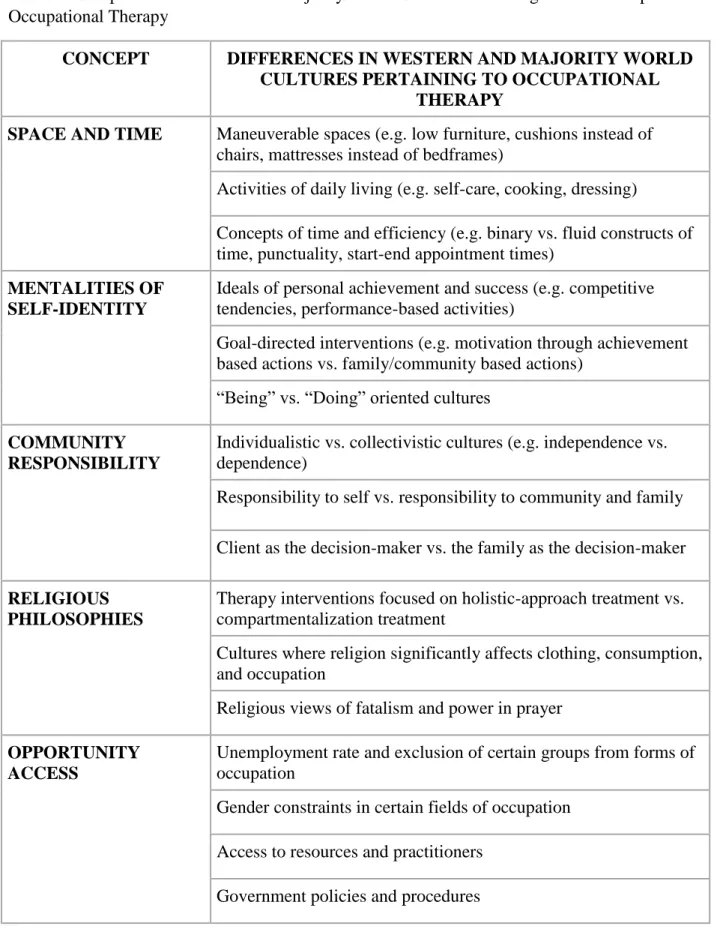
and time, mentalities of self-identity, community responsibility, religious philosophies, and opportunity access. These categories will walk through specific western interventions that do not overlap with the cultural ideologies of certain developing countries. The prior literature that will be explored draws on international initiatives of implementing OT in China, Oman, South Africa, Guatemala and Europe. Each of these regions around the world experienced OT implementation uniquely and serves to provide the current study with specific insight into the benefits and drawbacks of the process. The impact that culture has had on the effectiveness of therapy is a key theme that will be investigated. Lastly, a comprehensive table will be provided that presents a framework of each of these categories and concepts for the following research and methodology of exploring OT in Bulgaria and Kosovo through a culturally competent context.
Origin of Occupational Therapy
Based on the literature, how can the phrase “occupational therapy” be defined? As explained by Söderback (2014) the practice of OT is focused on two main terms: occupational work and activities of daily living (ADL). The purpose of OT is to remove the barriers that inhibit an individual from fully participating through these occupations in their various spheres of life. Barriers are created through disability, sickness, injury, or impairment (Söderback, 2015). The encompassing of this profession has rarely been stated more beautifully or succinctly then Thibeault (2014) who writes, “Occupational therapists are artisans of meaning, enabling clients and communities alike to give shape to what matters most” (p. 19). An occupational therapist accomplishes this goal through OT intervention (OTIs), therapeutic objectives, and frequent evaluations (Söderback, 2014).
movement and the arts-and-crafts movement. Adolph Meyer, Herbert Hall, and William Dunton are considered the founders of OT due to the discovery of the beneficial manner in which manual labor counteracted the effect of industrialization. They believed that creative work could “help reconstruct one’s sense of self” (Clark et al., 1998, pp. 14-15). OT was established as an official
profession in the United States through the foundation of the American Occupational Therapy Association (AOTA). Expanding into an international framework, the World Federation of Occupational Therapy (WFOT) was established in Stockholm in 1952 (Söderback, 2014).
As OT has expanded beyond western boarders, there has been a need to look at the essence of the profession with a critical eye. Many unanswered questions have arisen that question the core values of OT and its ability to successfully adapt to different countries and client populations. Research conducted by Hocking and Whiteford (1995) analyzed the seven core values of OT to determine if they held true in countries outside the west. These core values are altruism, dignity, equality, freedom, justice, prudence and truth. Hocking and Whiteford (1995) argued that five out of these seven core values do not apply to certain cultures. The researchers used the example of freedom as being a concept in western society that is valued and sought after as a basic human right. They countered that this definition is not true of all cultures by stating, “Individual freedom, however, is not a meaningful concern for those cultural groups
compensated for. To categorize everyone as equal is not only naïve, but also refuses to acknowledge a daily reality that many people face. Hocking proceeds to illuminate aspects of the remaining three OT values, altruism, dignity, and prudence, that also do not line up with many cultures outside the west. Research such as this uncovers the theoretical concerns with western-based OT. The following literature review takes these concepts and explores the lived experiences of implementing OT into specific developing countries.
Space and Time
OT functions within several different spheres, one of which is space and time. Space can be defined as the physical surrounding or environment where one works, lives and plays. Space incorporates the tangible objects within these environments that one interacts with daily. Time is the measure with which one functions in space. Time determines the rhythm of activities of daily living. It is the pacemaker of interactions.
meant adapting therapy treatments to be successful in a new and different space. While western goals of OT focus on the necessary positioning, maneuvering, and transferring within high tables, bedframes, and chairs, OT in Oman needed to adapt all of these processes in order to be successful. A quote from one of the interviewees states, “For an occupational therapist this is
even more challenging, how do they help the client, for example, transfer from a wheelchair to a mattress on the floor?” (Busaidy & Borthwick, 2012, p. 158).
OT in Oman also faced challenges related to activities of daily living within these spaces. Another intervention that many occupational therapists in the western world are trained for involves aiding clients in self-care (e.g. dressings, washing, eating). Each of these activities are colored by Omani culture that permeates deep into the structure of Omani life. Occupational therapists ran into problems when dressing and washing occurred across gender lines. Because of both religious and cultural mentalities, it was not socially acceptable for male occupational therapists to aid female clients in these interventions and vice versa. Dressing also presented new challenges. As a result of Islam beliefs, the dress code for both men and women were specific and intricate. Women were expected to wear head coverings and long dresses, while men’s
outfits commonly had a series of small buttons that posed fine motor skill difficulties (Busaidy & Borthwick, 2012). These examples of daily life in Oman provide a practical depiction of the need for OT to be easily adaptable in order to effectively improve the quality of individual’s lives.
key. This idea of time shifts when looked at in many countries outside the west. Often, time is viewed as a flexible construct that does not take top priority. Additionally, how a community functions in time shifts depending on the time of day and time of year (e.g. rest hours, cultural holidays). Referring to countries outside the western world, Awaad (2003) states, “Concepts of time and punctuality and future time orientation may also be very different” (p. 359). Therefore, an understanding of how specific countries view time is beneficial to OT interventions. This affects the way a therapist approaches start and end times of therapy sessions, the efficiency and productivity a therapist expects out of therapy, and understanding times of the day/year that require a shift in expectations for therapy.
Mentalities of Self-Identity
The second category where we see major differences between OT in the western versus developing world is mentalities of self-identity. Self-identity is the way in which an individual describes themselves. This includes characteristics and actions that define a person, as well as beliefs onto which an individual strongly holds. It can also be used to explain one’s outlook on life. Mentalities shape the way in which tasks and challenges are approached and through what lens these outcomes are measured.
result in tangible markers of success. The same is true for goal-directed interventions. The foundation of OT is rooted in the idea that people’s mentalities will be focused around achievement-based actions with the expectation that clear objectives will be met and a future plan will be made. When measureable goals are the primary incentive for therapy, cultures outside of the west run into problems. In many of these non-western countries, family and community responsibilities act as primary sources of motivation. “Honouring the family,
acquiescence to the decisions of others and passivity may be regarded as healthy adaptations to life changes” (Awaad, 2003, p. 359). This concept will be explored in greater depth in the next section.
Another marker of self-identity emerges from a qualitative study that interviewed occupational therapists regarding their lived cross-cultural experiences (Humbert et al., 2011). Findings from the study’s thematic analysis was a concept the researchers coined “spirit of the people”. This idea suggests that in developing communities there is an “optimism, hope and strength of the people in… economically disadvantaged areas” (Humbert et al, 2011, p. 301).
This apparent resilience is often the result of prevailing against deep oppression and conflict. Experiences such as these result in the shaping of self-identity.
Finally, we have the “being” versus “doing” mentality that is touched upon by Bonder et
understand that mentalities of self-identity are unique to the culture and country in which they are found. While these perceptions constantly evolve with time, occupational therapists should be prepared to place themselves in client’s shoes in order to understand, to some degree, their outlook on life.
Community Responsibility
largely a western construct that “believes in an internal locus of control… and expects that people will take a personal responsibility and be active in the pursuit of wellness” (p. 359). This
is not always the case, as was described by the South African community studied by Watson. Another culture that looks at personal versus community dynamics is found in Oman. This Middle Eastern country notes that having a collective identity compared to the individualistic identities of the West, shifts where one’s responsibility lies. It is not uncommon in Arab cultures for the collective needs of the family to take precedence above the needs of an individual and for this to be viewed as a way to honor the family (Busaidy & Borthwick, 2012). Power relations within the family are often a key aspect to understand as an OT. Often there is a patriarchal hierarchy within family structures that affects the decisions a client makes. In collective communities, an occupational therapist is not solely working with the client, but also with the family as a whole. Societies, like in Oman, often place families as the sole provider and nurturer of disabled or sick family members. Taking on this duty results in families being deeply involved in the rehabilitation process (Busaidy & Borthwick, 2012). This method of approaching OT intervention is termed family-centered partnerships by Wray & Mortenson (2011). By establishing a strong rapport with families through trust, respect, and communication, therapists can improve the quality of therapy for all parties involved (Wray & Mortenson, 2011).
Religious Philosophies
world and their purpose in it. Often times, religion centers on ideas that endeavor to teach humans how to live life to the full.
Hopton & Stoneley (2006) take a comprehensive approach to western OT philosophy compared to Chinese culture. They came up with several key differences that were rooted in the Chinese philosophies of Confucianism, Taoism, and Buddhism. These religions played a key role to the foundation of Chinese culture and, therefore, continue to color the worldview of the majority of the population. Religion can act as the primary driver behind the concepts already discussed above of interdependence, family-oriented societies, space and time. Religion also results in new differences like the Chinese perspective on holistic approach. Approaching therapy holistically means treating a person as a whole and using a wide range of therapy interventions to help a client regain their health. This concept is very important in China and differs from western OT treatments that compartmentalize the issue and assess treatment “based purely on occupational performance” (Hopton & Stoneley, 2006, p. 387). Another facet of
religion that affects therapy is the Chinese philosophy of balance. For western OT, balance is a direct measure of the frequency and reliability of therapy interventions that occur. On the other hand, religious elements like the Yin and Yang teach that balance is a broader, universal concept. Balance in Chinese therapy means pursuing harmony between the body and nature (Hopton & Stoneley, 2006).
Oman also places females and males within specific roles in society. When remarking on the central role of religion in therapy, Busaidy & Borthwick, (2012) state, “It was considered to permeate every facet of life and could be both harnessed to therapeutic advantage and yet present therapy with considerable difficulties” (p. 160). One difficulty is seen through the concept of “fatalism”. This idea is taught in the Islamic faith as accepting disability as the will of Allah.
From a western perspective this can be viewed as complacency in disability, which hinders the success of therapy to improve an individual’s quality of life. Along with fatalism, there is also
the belief in the power of prayer and, therefore, the positive outlook that an individual’s situation can be improved (Busaidy & Borthwick, 2012).
Opportunity Access
Another social factor that is closely tied to exclusion from occupation is the gender roles within certain communities. Bonder et al. (2004) comment that in many cultures the roles that women and men have are “rigidly defined” (p. 165), citing an example of this in Guatemala where women’s occupations are confined to weaving, raising children, and house work.
Additionally, women leave the majority of leadership roles to the men, as well as, jobs in the field and town. These facts are important to know as an occupational therapist in order to work effectively within the boundaries that a community has pre-established.
Lastly, occupational therapists must also learn to work within the bounds of a community that struggles with lack of resources and employment opportunities. Krefting (1992) states that before establishing an effective OT program, practitioners must assess the ability of a community to sustain the profession: “The ability to sustain the profession is determined by the need for occupational therapy services compared with and in relation to other health services, the availability of an appropriate government infrastructure, and the ability to create realistic employment opportunities” (p. 759). All these elements stem from government policies and
procedures that significantly affect both OT implementation, as well as, the access to resources and employment opportunities available to OT clients.
Table 1. Comparison of Western and Majority World Cultures Pertaining to the Development of Occupational Therapy
CONCEPT DIFFERENCES IN WESTERN AND MAJORITY WORLD
CULTURES PERTAINING TO OCCUPATIONAL THERAPY
SPACE AND TIME Maneuverable spaces (e.g. low furniture, cushions instead of
chairs, mattresses instead of bedframes)
Activities of daily living (e.g. self-care, cooking, dressing)
Concepts of time and efficiency (e.g. binary vs. fluid constructs of time, punctuality, start-end appointment times)
MENTALITIES OF SELF-IDENTITY
Ideals of personal achievement and success (e.g. competitive tendencies, performance-based activities)
Goal-directed interventions (e.g. motivation through achievement based actions vs. family/community based actions)
“Being” vs. “Doing” oriented cultures
COMMUNITY RESPONSIBILITY
Individualistic vs. collectivistic cultures (e.g. independence vs. dependence)
Responsibility to self vs. responsibility to community and family
Client as the decision-maker vs. the family as the decision-maker
RELIGIOUS PHILOSOPHIES
Therapy interventions focused on holistic-approach treatment vs. compartmentalization treatment
Cultures where religion significantly affects clothing, consumption, and occupation
Religious views of fatalism and power in prayer
OPPORTUNITY ACCESS
Unemployment rate and exclusion of certain groups from forms of occupation
Gender constraints in certain fields of occupation
Access to resources and practitioners
Methodology and Methods
This chapter outlines the study’s qualitative research design which features in-depth
interviews with influential leaders in the field of occupational therapy (OT) in Bulgaria and Kosovo. These interviews illuminate the valuable and unique perspectives of non-Western practitioners regarding the successes and challenges of implementing a new profession into the medical infrastructures of their developing communities. To review, the three research questions that the study seeks to answer are:
1. What are the cultural factors within Bulgaria and Kosovo that do not overlap with the western goals of occupational therapy?
2. How do OT leaders in Bulgaria and Kosovo describe their experiences of implementing OT in their countries?
3. What successful techniques can be gleaned from other international initiatives to promote culturally competent OT?
The purpose of this study was to research the implementation of OT in Bulgaria and Kosovo through a culturally competent framework. In order to answer the question of how OT has been established in these countries and in what way culture has shaped this process, research was conducted in the form of in-depth, qualitative interviews. In addition to these interviews, I drew on my own personal experience working with occupational therapists in Bulgaria and Kosovo to add to the credibility of the findings. I spent the summer of 2016 shadowing,
my research. After researching various international initiatives to implement OT into developing countries, I compiled the main challenges into the five categories of: space and time, mentalities of self-identity, community responsibility, religious philosophies, and opportunity access. It was through this framework that I conducted my research in both the in-depth interviewing and coding of data.
The forthcoming section provides an overview of the study’s overall research design, followed by a discussion of the participants’ demographics to provide contextual grounding. It
continues with a presentation of the materials, as well as the data collection methods and data analysis and coding procedures. Finally, my role as a researcher is discussed.
Interview Participants and Context
The sample population of this study consisted of two OT practitioners who were purposefully selected because they are individuals who are knowledgeable about both OT and their respective cultures of Bulgaria and Kosovo. Additionally, a factor in selection was that I was acquainted with both of the participants since they served as supervisors during my time researching and interning in the Balkans during the summer of 2016.
The first participant, Dianna Ullrich, is an American occupational therapist practitioner who completed her degree in OT in the United Kingdom (UK).3 She is currently working on her doctorate degree in the field. She has lived more than a decade in Kosovo, initially as a relief and development international worker. In 2004, after realizing that OT did not exist anywhere in the country, she opened up the first OT clinic. Soon after, she helped establish the first OT
department in the private health college, Kolegji-Heimerer. She is currently a practitioner,
professor, member of the board of directors, and the head commissioner for the Kosovo OT licensing committee.
The second participant was Liliya Todorova, who is the Vice Dean of Public Health and Health Care at the University of Ruse, Bulgaria. She received her license to teach OT through a program established by the European Network of Occupational Therapy in Higher Education (ENOTHE). The purpose of the program was to implement OT in the Balkans through a 28-week educational model that prepared trainers to be OT professors. Todorova was a member of this cohort and became one the first OT professors in Bulgaria.
Obtaining Institutional Review Board Approval
This study was approved for submission to the University of North Carolina at Chapel Hill’s (UNC) Institutional Review Board (IRB) by UNC’s School of Education Dean’s Office on
January 2017. The proposal was then submitted to the non-biomedical University of North Carolina Institutional Review Board (IRB) for approval. It was reviewed by the Office of Human Research Ethics and was determined to be exempt from further review according to the
regulatory category cited under 45 CFR 46.101(b) on June 13th, 2017. The IRB number is 17-1132. The researcher and faculty advisor both completed the Conflict of Interest disclosures. The study was classified as Level II Data Security. Appropriate measures were taken to secure all data on a password protected file server that can only be accessed through a secure network connection in compliance with IRB’s security data requirements.
Data Collection Methods
interview, and a consent form. A copy of this email and consent form can be found in Appendix A.
The interview questionnaire that was used to conduct the research consisted of sixteen primary questions. The interviews were purposely structured in an open-ended style and intended to follow along with the participants’ progression of thought. Because of this, the interviews
differ in length, progression, and which topics were focused more heavily on. The purpose of structuring the interviews in this manner gave the participants the ability to focus more heavily on topics they deemed most important. This format gave the participants the freedom to answer the research questions by delving into their own rich personal experiences. A copy of the interview questionnaire can be found in Appendix B.
To conduct the in-depth interviews, Skype video call was used. This enabled face-to-face contact despite being in vastly different locations and allowed these international phone calls to be free of charge. The 6-hour time change was taken into account. To record the interviews, MP3 Skype Recorder was downloaded to the laptop in use. As a backup, the Voice Memos application on the iPhone 5s was used. Each interview was transcribed by the researcher using Windows Media Player. To ensure efficiency and accuracy, the play speed of the recording was set to 0.6.
Data Analysis Methods
uploaded in the form of two documents onto the software and a second pass of coding was conducted. In this round, the data was categorized under specific topics and codes based on the words and phrases of the participants (e.g. empowerment, client-centered). Twenty codes were compiled by the end of the second pass, with each code having one to ten participant quotes categorized under it. The “auto-coding” feature in ATLAS.ti was used to find the frequency that
key words were used throughout the data. This feature assisted in distinguishing which quotes and phrases needed to be filed under which codes.
An important feature of ATLAS.ti that was utilized throughout the entire coding process was the “memos” function. The researcher created memos as a form of note taking to document
personal thoughts and connections that were developing throughout the coding process. These memos included titles, links to specific quotes and codes, and the reflections of the researcher in paragraph form pertaining to the connections between the data and greater research questions of the study. These memos were used as a spring board for writing the final discussion chapter.
The network function in ATLAS.ti was crucial for the final coding step. With the pre-established codes, the researcher then determined what patterns and combinations could be drawn from the existing data. Creating a network is a visual representation of how codes are linked together and the frequency in which they appear in the data. The visual conceptualization of the data, using the organic network layout, allowed the researcher to determine six major themes that could be extrapolated from the data. These six themes provide the framework for the forthcoming results discussed in the next chapter.
Role of Researcher
growing up immersed in, primarily, Albanian culture significantly shaped my worldview. I began first grade in the Albanian school system and learned the Albanian language from an early age. My closest friendships, my neighborhood, my school system and my community were all Albanian, and because of this, I experienced many of the things discussed in the interviews first-hand. I saw my friends suffer from a lack of resources when in need of therapy or medical
attention. I waited in lines at the government buildings trying to work my way through all the red tape, policies, and procedures. I interacted with foreigners who came in with little understanding of the culture at hand and attempted to make sweeping changes. I experienced the close, tight-knit community where you feel known by everyone on your street.
I believe these experiences of living in both Albania and the United States shaped the framework through which I see the world for the better, but I am well aware that I carry biases along with that. I know that I can view western influence on developing communities with a critical eye. Furthermore, half of the interview data focused on the country of Bulgaria. While geographically Bulgaria is less than 400 miles from Kosovo, the culture and language of this country are completely different. Because of this, the only experience I have had with Bulgarian culture was the occasional skiing trips we took there as a family and the month I spent during the summer of 2016 interning in Bulgarian OT clinics. I do not have extensive knowledge of
Bulgarian culture and, therefore, tried to approach research concerning this area with a culturally competent mindset myself, humbly and respectfully.
Results
The main research question that set the foundation for each interview focused on what cultural factors within Bulgaria and Kosovo do not overlap with the western goals of OT. These answers were compared with Table 1 in the literature review chapter that summarizes other international initiatives of implementing OT and the cultural challenges and differences that they faced. The following results sections is divided into two main categories based on Table 1: themes that fall into the categories of Table 1, including mentalities of self-identity, community responsibility, and opportunity access, and new themes that are unique to the present data and were not touched upon in the review of the literature. These themes include understanding context, creativity and resourcefulness, and autonomy in development. A revised table that incorporates both the original and newly discovered themes will be presented at the end of this chapter.
Theme I: Existing Literature “Mentalities of Self-Identity”
The first theme that emerged in the current study that was also covered in the review of the literature is mentalities of self-identity. These are distinct characteristics that define
For a female what it would look like for OT is not necessarily that she gets back to work if she’s working outside the home, but that she is able to continue her role as the wife and the provider inside the house because that is her primary way of contributing to the community as a whole.
Understanding mentalities that shape the roles of clients in a community is crucial to effective OT treatment. By knowing this information, therapists are able to tailor rehabilitation to meet the needs of specific roles that individuals will need to assume.
Another aspect of self-identity that is explicitly stated by Ullrich depicts the emphasis that Kosovars place on honesty, vulnerability and trust.
Another thing too is [Kosovars] appreciate people who are honest and allow themselves to be vulnerable… because there is a total lack of trust in this culture, people don’t trust each other, they’re very on guard when they meet someone new.
These characteristics are key pieces in creating a more comprehensive picture of how a
community functions. While overarching values are constantly shifting and evolving, therapists must stay in step with the changes of a culture in order to remain relevant in therapy.
Theme II: Existing Literature “Community Responsibility”
The second theme from the current study that was heavily touched upon in the literature review as well, is the idea of community responsibility. Both OT professionals talked about four primary strands within this larger theme: individualistic vs. collectivistic cultures, empowerment of the client and family, positions of power, and gender roles.
Kosovo are Albanians) and Bulgarian society. Ullrich, an OT practitioner in Kosovo, sets the stage for this topic by stating:
Another area that is a theory of mine… is the difference between collectivism and individualistic cultures. This is a collectivist culture. Because we have such an emphasis on increasing independence in the U.S. I’ve found that here that is not necessarily the top
priority when it comes to personal self-care… So it’s a different approach that we would have to take.
Ullrich further makes known the importance of this cultural feature by planning to address it as a topic in her current doctoral PhD. This concept was prominent across both interviews, describing both Bulgaria and Kosovo as strongly collectivism cultures. Todorova, leader in the OT department in Bulgaria, described the necessity of incorporating family into therapy intervention as opposed to just focusing on the individual. “Bulgarian culture is not as much focused on the individual. The role of the family is quite high here. One of the differences and greatest challenges that we face here is how to involve the family.”
When asked what shifts needs to be made from therapy intervention in an individualist society to therapy intervention in a collectivism society, Ullrich also emphasizes the role of the family like Todorova by saying:
You bring in the families. So instead of the individual being the client, the family becomes the client. Because in western society, the main goal is to be able to still to contribute something. In collectivist culture, their main goal is to make sure their
Empowerment of the client/family. The role of the family continued to be a key topic present in the participants’ interview comments as discussions related to the empowerment of the family and client (often viewed as one and the same) came up eight times throughout both
interviews. Ullrich describes the importance of enabling families to take ownership of their own therapy:
So one of the visions of OT here in Kosovo is to empower families and patients to have the freedom to make choices regarding their rehabilitation, their health treatment, and to educate them as far as letting them know they can get back to work, they can re-engage in the activities they used to have before illness/injury.
Ullrich explains that giving control to the families and clients is crucial especially as a therapist coming from a western culture and attempting to implement OT into a developing community. She humbly states that open communication is a healthy first step in the right direction:
You need to know the questions to ask of Kosovars. You need to not make any assumptions what so ever without talking to Kosovars and getting their advice and respecting them as the advice-givers. Respecting that they know more than you do regarding the culture and the way things should be run.
Positions of power. The importance of empowering families/clients throughout therapy
in Bulgaria and Kosovo is explained by the hierarchy of positions of power in these
Families here are not used to being involved in the decision-making, in the planning, in the work. They look at all therapists as experts and that the expert is doing what is necessary to be done. The family is more like passive recipient. This is something that in fact we struggle with- how to involve the families.
Ullrich also describes this challenge in very similar ways occurring in Kosovo:
Kosovo historically has run off of the medical-health model so it’s very much been a hierarchy where the doctor is the key person and whatever the doctor says goes. There has been no empowering of the family members or even the clients to take responsibility and to have the choice to speak into their treatment and their involvement.
To further clarify, Ullrich gives specific examples of therapists withholding home-regime exercises from patients so that they are unable to continue therapy on their own, forcing them to rely solely on the expertise of therapists while in session. Her closing thoughts on this topic touch on the importance of letting go of the boss-like mentality as a therapist and giving ownership to clients as self-enablers.
Theme III: Existing Literature “Opportunity Access”
The third theme that was prominent in both the literature review and current data involved issues of opportunity access. This includes all factors that significantly affect the process of implementing OT into a community. The interviews presented four main strands within this theme: lack of resources and practitioners, difficulties with the Ministry of Health, and the representation of false images of OT to the public.
categorized as developing countries and, therefore, the present issues that start on national levels have large impacts in the way OT functions in each country. Ullrich gives a detailed example of resource restriction specifically related to adaptive equipment used in OT practices. In Kosovo the access to adaptive equipment is limited because health insurance often does not cover the cost. Furthermore, producers of adaptive equipment, which is primarily plastic, are all out of country. The cost for these rehabilitation companies to ship their equipment to Kosovo, including the high 28% tax that is incurred while going through customs, makes it pricey and
unreasonable. Ullrich continues on to say that the positive result of limited resources is an increase in creativity and modification, which is a connection that will be discussed more extensively in Theme IV:
Almost everything we do we have to modify. Because there isn’t the normal rehab
equipment we have had to make most things ourselves or adapt. We don’t even have Thera-Put here so it’s like using regular kids’ Play-Doh or making our own out of flour. While discussing the lack of resources in Bulgaria with Todorova, the discussion of lack of occupational therapists inevitably followed. “The resources are always very restricted. Especially in the area of social services in Bulgaria they are quite low. This is also one of the reasons why we don’t have enough occupational therapists.” Todorova gave several reasons for
the lack of occupational therapists in Bulgaria. She stressed the importance of increasing the recognition of the profession. Simply put, if more students know about OT as a profession, the number of graduates will increase and, ultimately, the number of practitioners will increase.
Although new students are graduating and the number of graduates increases every year… still the number of those who are working remains 30-35. And the reason is that
some of them leave the profession because they are paid very low. As a whole, in the area of the social services… people leave their jobs because they really are very underpaid.
This is one of the biggest challenges.
By explaining this Todorova highlights that despite the great need in the community for OT services, external circumstances, such as low wages, are stifling the growth of the profession.
Difficulties with the Ministry of Health. One of the greatest challenges that OT has faced in both Bulgaria and Kosovo is related to the Ministry of Health. As an entity of the government, this department is in charge of monitoring all things healthcare related concerning its citizens. In many ways, the Ministry of Health is the gateway through which anything concerning OT must pass to be officially recognized.
In Kosovo, the Ministry of Health was the force behind shutting down Ullrich’s first OT clinic. This event was the first of many battles fought for OT to become officially recognized in the country. The most pressing current issue involves the Ministry of Health licensing
committee. Ullrich commented, “The process of licensing has happened except the government has been shut down and that is holding us back from getting a final signature of approval from the licensing committee.”
agents of social support that explain what these services look like and who practitioners in these services are.”
In Todorova’s opinion, gaining this full recognition is the solution to increasing national recognition of OT, increasing salaries, and increasing the number of practitioners. She notes:
Our goal is to include OT as an obligatory member in these services and, once we become an obligatory member, the government is required to employee occupational therapists. This will provide more positions, while at the same time, we continue to provide more occupational therapists to fill these positions.
False images of OT. The last major topic seen in the interviewees’ comments that hinders the opportunity for OT to be accessed in Bulgarian and Albanian communities is the false image that is sometimes spread about OT. In Kosovo this confusion starts with the way OT is classified by the Ministry of Health. Ullrich states that on the professional and social level alike, OT is often confused with other therapy fields.
The only time OT is mentioned anywhere in the [Ministry of Health] documents is one point on the document for “Qualification for Licensing of Institutions” and it is under physical therapy… That has been something we’ve found, the Ministry of Health views
OT as being under the umbrella of physical therapy. So we’ve had to do a lot of re-programing of the understanding of what OT is here.
While this same issue exists in Bulgaria, Todorova also mentions confusion that has stemmed from several private Medical Universities in the area. The private universities in the country contain “occupational therapy” majors but are not true accredited programs.
On the other hand, there is also quite a lot of misunderstanding because there is another profession which is called medical rehabilitative ergoterapia (the Bulgarian word for occupational therapy) … It is developed in the Medical Universities and they bring quite
a lot of misunderstanding in the country.
The professors and graduates from these private Medical Universities promote a false image of OT. The differences in the teaching of “OT” in these programs and, hence, the differences in the way these graduates practice “OT” creates a disconnect with the social perception of what OT truly is.
The next three themes presented are topics found extensively in the current study that were not found in the literature review. These themes are topics that both OTs who were interviewed, through their personal experiences, found vital to successfully implementing OT into a new community, in this case Kosovo and Bulgaria. These themes include understanding context, creativity and resourcefulness, and autonomy in development.
Theme IV: New Theme “Understanding Context”
Both OTs when interviewed noted the need to understand context in order to successfully integrate OT in the Balkan countries. Throughout the participant interviews the concept of contextual cultural knowledge surfaced over and over again. To help conceptualize the complexity of this issue, the topic of understanding context was subdivided into cultural ineptitude and solutions through cultural knowledge.
states that these individuals take their role, frame of reference, and all their understanding of how OT functions from their native culture and try to put it into the Kosovo box. Unfortunately, it does not work that way. She concludes, “It’s all because [they] don’t understand the culture or how things work here. Nor are [they] willing to listen and be open to the cultural truths and reality here.”
In Bulgaria, Todorova describes a similar perspective when it comes to what causes examples of cultural ineptitude:
There are many cases were professionals and people from some European countries or the U.S. go to places where OT is not developed and they start teaching what they know. They are trying to bring their program to that place, but it usually doesn’t work.
As seen from the review of the literature, the concept of “teaching what you know” is at the core of many ill-functioning therapeutic interventions. Todorova explains that simply coming in with a desire to teach what you know in a new community is not enough. This must be preceded with an understanding and knowledge of the culture and then a modification of what you know to be relevant to that culture.
Solutions through cultural knowledge. While the examples of OT being developed
through culturally insensitive means are prevalent, both participants gave valuable guidance on how to develop deep cultural knowledge in order to avoid ineffective examples like the ones above. Ullrich passionately listed several steps of action that each OT practitioner should take for effective therapy including, language, postures of humility, and simply spending time in a
culture.
know the culture… That’s a big thing. It helps to actually live in the culture for a while. It definitely helps to learn the language as well. That’s a huge plus… It respects them. It puts ownership on them.
OT implementation in Bulgaria, on the other hand, has largely been a local effort. Todorova’s perspective on this issue is equally valuable and provides an example of how
practitioners with ingrained cultural knowledge easily avoid challenges in these areas. One example of how cultural knowledge is greatly beneficial can be seen when Todorova describes the particular setting they chose to concentrate OT implementation in.
When we started implementing the profession, we started mainly in the social area for two reasons. One is pragmatic, the hospitals and clinical settings are a very closed area, only for medical profession… The other reason is there are quite a lot of new social services open at the moment… so the area of a community-based social service is growing and we find the right place for OT is there.
What enabled these pioneers in Bulgarian OT development to make such an informed decision was their understanding of the unique cultural lay of the land.
Theme V: New Theme “Creativity and Resourcefulness”
Two defining characteristics of the new OT programs in both Bulgaria and Kosovo are creativity and resourcefulness. The data portrays this in several layers, from larger university systems, to professors, to therapy practitioners in the field, to students. As seen in the second theme, the limitations of resources are part of the incentive for developing and focusing on these skills. Ullrich describes the importance of developing resourcefulness from an academic
concept of creative hand-craft. More importantly, these modules go a step further than just teaching craft skills, they have their students build and create items they could use in real-life therapy sessions.
So instead of making it into a handcraft lesson, it’s about the modality that they would
use with clients. They basically have to come up with their own adaptive device that they have to create and use themselves. So that’s one difference between here and there- to get
students to think about their own adaptive devices.
The University of Ruse also focuses on fostering skills of resourcefulness and
adaptability in their students. Todorova gives an example of the stark difference between the way the Bulgarian students in her program function compared to the foreign exchange students that come from more developed, western countries.
We had students from the Netherlands this year and they are used to the fact that everything is exactly planned. Well, here it is not possible to plan everything in detail. Sometimes it doesn’t happen the way you planned, so you have to be quite flexible and to
look for new solutions all the time… They said, in a way, it is more challenging and situations are not so calm. Sometimes it stretches you but, on the other hand, it keeps you alert, flexible, resourceful and creative.
Theme VI: New Theme “Autonomy in Development”
The final theme found in the data was focused on the importance of implementing OT as a profession independent from the influence of others. Both participants discussed the
Developing independently. Todorova makes a bold statement that she has never experienced a time when OT has not been relevant or applicable in her cultural setting. She elaborates on this further by explaining in detail the method in which their OT program was established. The OT program in Bulgaria was started by a European Network of Occupational Therapy for Higher Education (ENOTHE) project in 2003. The coordinator of the project for Bulgaria, a practitioner from the Netherlands, guided them through the process while still allowing them to have complete autonomy on however they saw best fit to undertake the development of OT in the Balkan context. Todorova speaks highly of this coordinator while explaining the details of what this process looked like:
When you get something from abroad it usually doesn’t fit in your context. [The ENOTHE coordinator] told us, “You have to build your program so that you can fulfill
that program. Look at your university. Look at the needs in your country and city. Look at how your university fits these needs”. So we really tried to make the program in order to use the resources of our university so that we can meet the needs in the community. Through this method, Todorova describes a community where OT is made relevant to Bulgarian culture because it has been created to fit that culture from the very beginning. While the University of Ruse was provided with a general framework from ENOTHE for OT
implementation, they were not given anything specific like a curriculum. Instead they were encouraged to develop one on their own. When asked what advice would she give to other initiatives to implement OT into a developing community, Todorova stated:
Developing sustainability. Ullrich, on the other hand, approaches autonomy in
development through a sustainability perspective. To her one of the most important aspect of a thriving OT program is that it is ultimately run by local practitioners of the area.
You have to come in with the end goal or outcome that you are coming in to replace yourself with Kosovar personnel. In other words, your job is not to be the boss but to empower them to take ownership of the profession. In doing that, you need to be able to let go and sit back and watch them make mistakes and recover from mistakes too.
Ullrich practices what she preachers by having near future plans to take a step down from her leadership roles in the OT department and to have a Kosovar take her place. She plans to then transition into a support role of continuing education for occupational therapists.
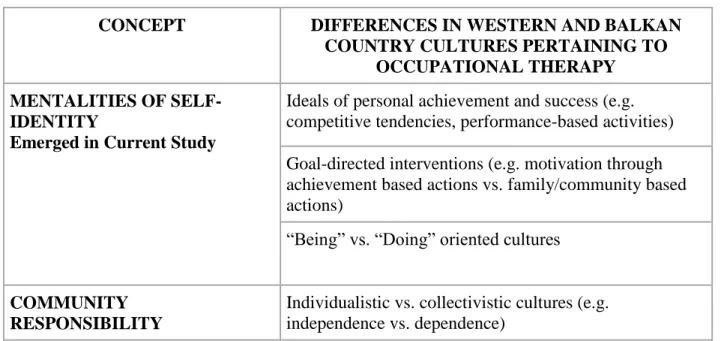
Table 2 presents a summary of the comparison of western and Balkan country cultures pertaining to the development of OT. Three themes from the existing literature were found. Three new themes emerged. Two themes from the existing literature did not emerge in the interviews.
Table 2. Comparison of Western and Balkan Country Cultures Pertaining to the Development of
Occupational Therapy
CONCEPT DIFFERENCES IN WESTERN AND BALKAN
COUNTRY CULTURES PERTAINING TO OCCUPATIONAL THERAPY
MENTALITIES OF SELF-IDENTITY
Emerged in Current Study
Ideals of personal achievement and success (e.g. competitive tendencies, performance-based activities) Goal-directed interventions (e.g. motivation through achievement based actions vs. family/community based actions)
“Being” vs. “Doing” oriented cultures
COMMUNITY RESPONSIBILITY
Emerged in Current Study Responsibility to self vs. responsibility to community and family
Client as the decision-maker vs. the family as the decision-maker
OPPORTUNITY ACCESS Emerged in Current Study
Unemployment rate and exclusion of certain groups from forms of occupation
Gender constraints in certain fields of occupation Access to resources and practitioners
Government policies and procedures
UNDERSTANDING CONTEXT New Theme Emerged in Current Study
Practitioners possessing vs. not possessing a thorough understanding of the culture
Approaching a culture different from your own with humility and respectfulness
CREATIVITY AND RESOURCEFULLNESS
New Theme Emerged in Current Study
An OT program being characterized by adaptability, flexibility and innovation due to the availability of resources
AUTONOMY IN DEVELOPMENT
New Theme Emerged in Current Study
Implementing an OT program to be relevant to the cultural setting vs. forcing the cultural setting to fit into the predetermined OT framework
Establishing an OT program to function sustainably through establishing local leadership
SPACE AND TIME
Did not Emerge in Current Study
Maneuverable spaces (e.g. low furniture, cushions instead of chairs, mattresses instead of bedframes)
Activities of daily living (e.g. self-care, cooking, dressing)
Concepts of time and efficiency (e.g. binary vs. fluid constructs of time, punctuality, start-end appointment times)
RELIGIOUS PHILOSOPHIES Did not Emerge in Current Study
Therapy interventions focused on holistic-approach treatment vs. compartmentalization treatment Cultures where religion significantly affects clothing, consumption, and occupation
Discussion
The purpose of this study was to examine the most effective methods for implementing occupational therapy (OT) into a developing community. Prior to conducting research, a review of the literature was completed to examine other international initiatives that attempted to
implement OT as a new profession in developing country. These findings were then compared to two interviews conducted with leading OT practitioners in the Balkan countries of Bulgaria and Kosovo.
Summary of Interview Results
The results that emerged from the interviews were, in part, consistent with the review of the literature. However, there were new findings that emerged and two themes that were
identified from the literature review were not touched upon in the current study’s interviews. Mentalities of self-identity, community responsibility, and opportunity access were themes that presented themselves in both prior literature and the interviews. In addition to these themes, understanding context, creativity and resourcefulness, and autonomy in development were new themes that were discussed in the interviews but not found in the review of the literature. Lastly, themes of space and time and religious philosophies were topics that emerged in prior literature but not in the current study. This discussion chapter will include an analysis of these findings, implications for the field of OT, limitations of the study, and suggestions for further research.
Reflection on Themes that Emerged in the Current Study and Literature Review
Mentalities of self-identity. Mentalities of self-identity was a theme that presented itself throughout the entire interview. In a way, a great deal of the things discussed by Ullrich and Todorova demonstrate the values, characteristics, and outlooks that these two communities possess. Furthermore, Ullrich provides specific examples of motivation through
family/community based actions, as well as, self-identity that is shaped by societal gender roles. Todorova also describes similar reliance and value found in knowing an individual’s role and purpose in the greater community. These concepts are consistent with the review of the literature when Awaad (2003) states that honoring the family and community responsibility act as primary sources of motivation in many non-western countries. There were other areas in the prior
literature that discussed “being” vs. “doing” oriented cultures, competitive tendencies, and
performance-based activities. These themes were not seen in the interviews and lead to certain gaps in the research that are implications for further research.
Community responsibility. When discussing the idea of community responsibility with
Ullrich, she used the phrases individualistic versus collectivistic cultures. This idea that a
framework, the individual in need receives the most effective treatment. By understanding this concept of family-as-client in collectivistic cultures, occupational therapists utilize the strong family support structures already in place to their best advantage.
Within collectivistic cultures another interesting concept is identifying the client’s
primary incentive for therapy. Awaad (2003) states that in western cultures, therapy assumes that individuals have an “internal locus of control”, or a personal drive for achieving wellness.
Ullrich echoes this idea when she states that in western society the goal in therapy is to be able to contribute as an individual, whereas, in cultures like Kosovo, the main goal in therapy is to contribute as a community. Through these findings, the importance of knowing “who” the client is and “what” their incentive for effective therapy is proves to be invaluable information for
effective rehabilitation.
Opportunity access. The concept of opportunity access was also a theme that emerged in
the prior literature and participant interviews. Opportunity access includes any social, economic, or financial factors that significantly affect a community and, therefore, affect the ability of that community to implement OT. While both the literature and participant interviews touch upon unemployment, there were certain inconsistencies in the populations that were addressed. Bruggen (2012) focuses on the percentage of unemployment within the disability community, whereas the participants Ullrich and Todorova focus on the levels of unemployment within the social services sector, more specifically within OT. Both types of unemployment are significant. The first affects the development of OT as a profession, whereas the second affects the
effectiveness of OT when trying to rehabilitate clients into the workforce.
gender that are explored focus more heavily on the roles of husbands and wives inside the home rather than the different access to opportunity that males and females face. Moreover, when it comes to topics of opportunity access, Ullrich and Todorova largely focus on the government policies and procedures that make implementing OT into the community so difficult, which is an area that is lacking in the review of the literature.
Reflection on New Themes that Emerged in the Current Study
Three themes emerged throughout the interviews that were not present in the review of the literature included understanding context, creativity and resourcefulness, and autonomy in development. These exciting new findings are products of insights and wisdom gleaned from Ullrich and Todorova’s lived, personal experiences with OT implementation in the Balkans.
Understanding context. Understanding context is possibly the single most important
theme that emerged from the current study. Todorova and Ullrich explain this concept as developing a thorough understanding of the culture at hand through immersion in language learning, open communication with the local community, and spending a significant amount of time living in the community. Beyond these tangible methods of gaining cultural knowledge, both OT practitioners emphasize more abstract characteristics and personality traits that prove beneficial. These include approaching the local community with a posture of humbleness, respecting them as advice-givers, and viewing yourself as a guest.