A Semantic Framework for Priority-based Service
Matching in Pervasive Environments
Ayomi Bandara1, Terry Payne1, David De Roure1, and Tim Lewis2 1 University of Southampton, Southampton, UK
{hmab02r, trp, dder}@ecs.soton.ac.uk,
2 Telecommunications Research Laboratory, Toshiba Research Europe Ltd, Bristol, UK
Abstract. The increasing popularity of personal wireless devices has raised new demands for the efficient discovery of heterogeneous devices and services in per-vasive environments. The existing approaches such as Jini [1], UPnP [8], etc., describe services at a syntactic level and the matching mechanisms in these ap-proaches are limited to syntactic comparisons based on attributes or interfaces. In order to overcome the limitations in these approaches, there has been an increased interest in the use of semantic description and matching techniques to support effective service discovery. This paper proposes a semantic matching approach which facilitates the discovery of device-based services in a pervasive environ-ment; the approach provides a ranking facility that orders services according to their suitability and also considers priorities placed on individual requirements in a request during the matching process. The evaluation studies have shown that the matcher results correlate reasonably well with human judgement.
1
Introduction
With the current trends in the electronic world, devices of increasing heterogeneity are being introduced into pervasive environments. These vary from headsets to mobile phones, PDAs and laptops; each of which offer a plethora of services. This has raised new demands for the discovery of devices and their services in a dynamically changing environment. The existing device description and discovery solutions (such as UPnP [8], Jini [1], etc.), characterise the services by using predefined service categories and fixed attribute value pairs; also the matching mechanisms in these approaches are lim-ited to string comparisons or key-word based searches. Since discovery is not supported by any form of inferencing, such approaches will be unable to identify a match between logically equivalent services that have syntactically different descriptions.
With recent trends in the Semantic Web, there has been an increased interest in the use of ontologies to describe services and the use of logical reasoning mechanisms to support service matching. The advantage of such frameworks include the ability to extend and adapt the vocabulary used to describe services and to harness the inferential benefits of logical reasoning over such descriptions. Recently, a number of semantic matching approaches have been developed (targeted at different domains), which try to address various limitations in traditional discovery techniques in order to come up with a pragmatic solution to meet the challenges in the service discovery arena.
not clear from the literature. In both these approaches, the matching process does not perform any form of match ranking. There have also been a number of efforts that use description logic (DL) based approaches for semantically matching web services. For example the matchmaking framework presented in [5] uses a DAML-S based ontology for describing the services. A DL reasoner has been used to compute the matches for a given request. The matches are classified into one of its five “degrees of match” (namely Exact, Plug-In, Subsume, Intersection and Disjoint) by computing the subsumption re-lationship of the request description w.r.t. all the advertisement descriptions. No ranking is performed in the matching process, although the match class suggesting the ‘degree of match’ gives an indication of how ‘good’ a match is.
The above mentioned semantic matching approaches provide important directions in overcoming the limitations present in traditional syntactic approaches to service dis-covery. However, these solutions still have limitations and overlooked issues that need to be addressed; particularly these approaches do not have an effective ranking criterion to facilitate the ordering of potential matches, according to their suitability to satisfy the request under concern. Also these approaches do not facilitate priorities/ weights on the individual requirements and thus the matching process will consider that all re-quirements have equal priority.
In this paper we propose a pragmatic approach, that facilitates the effective match-ing of resource requests and advertisements in pervasive environments. This semanti-cally compares the request against the available services and provides a ranked list of most suitable services. The rank will indicate the appropriateness of a service to satisfy a given request and thus provides a valuable decision support for the service seeker, in selecting the most suitable service. The matching process also considers the priori-ties/ weights on the individual requirements of a request; this helps capture any context dependencies involved and subjective preferences of the resource seeker. This is an im-portant facility in any matching system since in many practical scenarios certain service requirements will be more important than others and therefore priority-based matching can produce results that can better meet the users expectations. An OWL ontology is used to describe the services and a Description Logic reasoner is used to support the background reasoning tasks in the matching process. The remainder of this paper is organised as follows: Section 2 discusses the motivation behind the proposed matching framework and identifies the requirements of a pragmatic approach for matching per-vasive resources. Section 3 briefly describes the methodology behind the matchmaking framework. Section 4 discusses the prototype implementation of the service matching approach in a pervasive scenario and presents the initial evaluation results. The con-cluding remarks and future directions of this work are discussed in section 5.
2
Motivating Factors
There are several desirable properties that must be present in an effective service match-ing framework. In this section we discuss these along with the motivatmatch-ing reasons be-hind them.
Semantic Description and Matching: An ontological approach for the
higher level concepts. Semantic matching approaches supported by logical reasoning mechanisms will be able to identify a match between logically equivalent services that have syntactically different descriptions and therefore can offer flexibility in how the service advertisements and requests are described.
Match Ranking: Ranking refers to the ordering of the available advertisements
in the order of their suitability to satisfy the given request. In the absence of an exact match, a requester might be willing to consider other advertisements that are closer to the request and thus the ranking will be useful in gaining an understanding of the ap-propriateness of the advertisement. Most existing matchmaking solutions do not have an effective criterion to rank the available services according to their suitability. Provid-ing a rankProvid-ing mechanism that will rank the advertisements on the basis of how well it satisfies the properties specified in the request, is one of the main objectives behind the proposed matching framework.
Approximate Matching: Offering approximate matching, is one of the core
objec-tives of semantic matching. i.e. services that deviate from the request in certain aspects should not be discarded but must be ranked or classified appropriately to indicate the suitability. In the current semantic matching approaches [5], [6], the suitability of the advertisement have been determined using subsumption reasoning based on the taxo-nomic relation between the concepts. However we argue that subsumption reasoning alone is not sufficient in determining similarity for the purpose of resource matching. Depending on the concept involved, reasoning based on the taxonomy alone, will not accurately reflect the similarity between concepts. For example, consider the concept
Processor; assume there is a request for a computer that has processor Pentium4 and
advertisements of computers with processors Pentium3 and Pentium1. Both Pentium3 and Pentium1 will be disjoint from the originally requested concept of Pentium4, but a requester will consider Pentium3 to be a better match than Pentium1 and will be ranked higher. Thus the type of attribute involved in the individual requirement of a request will have to be considered in approximating and ranking of advertisements. Section 3 de-scribes the types of attributes and the approach taken in judging the similarity between them for the purpose of ranking.
Priority-based Matching The current matchmaking researches do not consider any
priorities or preferences that a user/agent may be having with respect to various at-tributes or properties of a service (except in [6]). In many practical scenarios certain requirements/ attributes in a request will be more important than others, either due to the context involved or the subjective preferences of the user. In such cases, facilitat-ing priority-handlfacilitat-ing in the matchfacilitat-ing process will produce match results that are more relevant and suitable for the context involved. For example, consider two users look-ing for a printer; considerlook-ing the time to service and quality properties of the printer, both may want to take the printouts as quick as possible and with the highest quality possible. But a user who wants to rush off to a meeting in the next five minutes will definitely be more concerned about the time factor and be willing to compromise on quality. But a user who is working at leisure, will not mind waiting in order to obtain a more quality print. Thus in cases like this it is vital to consider the importance placed on the properties of the service by a user, by taking into account the priorities of the attributes.
that property. For example consider the case where a resource seeker needs to utilise a computer to run an application which will only run on the operating system Win-dowsXP; he will specify the operating system requirement in the request along with the other desirable characteristics. In the context involved the operating system property is a mandatory requirement and hence the resource seeker will not need to consider any available computers which deviates with respect to the operating system requirement (no matter how good it is with respect to other attributes). Hence this needs to be taken into account in the matching process and the available resources that deviate from this strict requirement must not be included in the result set (or ranked as the worst matches). Priority matching is applicable when a resource seeker has varying importance placed on the individual property requirements of the request. Strict matching can in fact be considered as a specific case of priority matching.
This factor will be taken into account in the proposed work by giving a service re-quester the option of placing priorities/ weights on the specified attributes of the service request. These weights will be considered in the matching process during the ranking of advertisements.
3
The Semantic Matching Methodology
3.1 Service Description
In order to facilitate the use of logical reasoning over the service descriptions, we de-scribe the requests and advertisements in the Web Ontology Language (OWL).
A request will typically consist of several sub requirements to be satisfied. Each individual requirement will specify: the description of the requirement (which is the resource characteristic the resource seekers expect in a resource, for the their needs to be satisfied) and the priority or weight of that individual requirement, which will be a decimal value that indicates the relative importance of the particular requirement. The priority value can also be used to indicate if the requirement considered is a mandatory requirement; i.e. if the requirement should be strictly satisfied in an advertisement for the requester to consider it as a potential match. The description of an individual re-quirement will include the property or attribute the requesters are interested in and the ideal value desired.
The request will take the form of:
Request≡(Req1)(Req2). . .(Reqn)
whereReqiis an individual requirement. The requirement in turn can take the form of:
Req(= 1hasDescription.RD)(= 1hasP riority.P riorityV alue)
whereRDis the requirement description, which can be either a named concept or an existential restriction of the form,∃p.Cwhere p is a role and C is a named concept or a complex concept. For describing eachRD, an ontology that describes the services in the domain concerned can be used. TheP riorityV alueindicates the relative im-portance of the individual requirement in the request. This is a decimal value defined between 0 and 1. In addition, to indicate that the requirement is a mandatory require-ment that must be strictly met in any potential match, theP riorityV alueis defined as 2. The resource seeker must pick the appropriateP riorityV alue(according to these pre-defined values) for each individual requirement, to indicate its relative importance. The resource provider will specify all the relevant characteristics of the available resource in the resource advertisement. The advertisement can take the form of:
3.2 Ranking Process
As mentioned previously a request will consist of a number of individual requirements along with their priority values. The presence of any mandatory requirements that must be fully satisfied by any potential match will also be indicated by using the appropriate priority value as mentioned in 3.1. In the matching process, the available resource will be checked to see if each mandatory individual requirement (RD) is satisfied in the advertisement description. If the mandatory requirement(s) are met, then the advertise-ment will be evaluated through approximate matching.
In approximate matching, the available resources should be evaluated according to how well it satisfies each individual requirement specified in a request; i.e. the match-ing engine should quantify the extent to which each individual requirement description (RD) is satisfied by the resource advertisement. For this, the matching engine will check how similar the advertisement is with respect to each non-mandatory require-ment (RD) specified in the request; the similarity will be determined depending on the semantic deviation of the expected value in request and the available value in advertise-ment for the same requireadvertise-ment, and a score will be assigned accordingly (Scorei).
Each characteristic specified in the request (RD) can be a named concept(CR) or an existential restriction (∃p.CR). If it is a named concept, similarity will be compared be-tween the corresponding concepts in request and advertisement (Similarity(CR, CA)). If it is an existential restriction, the corresponding existential restriction(s) will be found in the advertisement (∃p.CA) and the similarity will be compared between the corre-sponding concepts in request and advertisement. If it is a composite concept the simi-larity will be judged recursively. The score (Scorei) for each individual characteristic in the request will be assigned depending on this similarity.
The degree of similarity between concepts will be determined depending on the type of concept or attribute involved; determination of similarity between concepts will be discussed later in this section. A score (Scorei) is assigned for each sub-requirement (RD) specified in the request. The score for the advertisement (match score) will be determined by using the weighted average of these individual scores (the weight will be the corresponding priority value of each individual requirement).
M atchScore=ni=1wi.Scorei÷ni=1wi
wherewi andScoreiis the priority value and the score of the sub-requirementRDi. The overall score for the advertisement provides an indication of how good the adver-tisement is in satisfying the given request. The score for an adveradver-tisement will in turn be used as the basis for ranking; the highest score will receive the highest rank and so on.
The attributes in a resource description are categorized into three types, for the purpose of approximating and judging similarity within individual requirements. These are:
Type 1 Attributes: Attributes involving symbolic concepts for which judging
Type 2 Attributes: Attributes involving symbolic concepts for which judging
sim-ilarity using the taxonomic relation is not sufficient. For example Processor and
Dis-play Technology concepts fall into this category. Hence in our work, if we wanted to
find similarity between different Processor Types for example, the features/ properties of the Processors such as Clock Speed, Manufactured-By etc. will have to be used in measuring the similarity. However measuring similarity between concepts is out of the scope of the current work and we assume that the knowledge of similarities between such concepts is available to us (measured by using an available similarity measure-ment approach such as [7], and available as domain knowledge in the ontology) and can be accessed by the matchmaking process.
Type 3 Attributes: When the attributes are numeric (integer or decimal) the degree
of similarity between the requested and advertised attribute values must be determined depending on the level of deviation. This deviation can be determined by using either a fuzzy membership function or by computing the percentage deviation from the original requested value.
Subsumption Relation Similarity Score
CAandCBrefer to the same concept 1.0
CAis a super concept ofCB t(where0< t <1)
CBis a super concept ofCA 1.0
CA,CBare not equivalent and do not have a subsumption relation 0.0
Table 1. Assignment of similarity scores when Subsumption Relation is considered.
4
Application of the Matching Framework in a Pervasive Context
The matching framework presented in the previous sections has been implemented in a pervasive context for matching of device based services. The service requesters seek to utilise specific devices and their services depending on their functionality. The ad-vertisements and the individual requirements in a request are described using the De-vice Ontology presented in [3] (available at http://www.ecs.soton.ac.uk/ ˜hmab02r/DeviceOnt/DevOntology.owl). This facilitates the description of
features and functionalities of the devices and their services. The necessary ontolo-gies were developed with the Prot´eg´e ontology editor. The matching engine was imple-mented in Java and the Pellet DL reasoner in combination with the Pellet-API is used to facilitate the necessary reasoning tasks during the matching process.
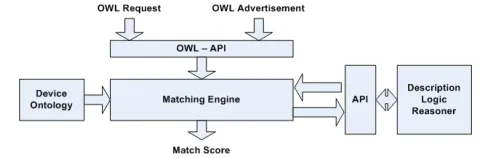
Figure 1 illustrates the architecture of the matching system. Once the matching sys-tem receives the OWL descriptions of the advertisements and request, it checks for the consistency of the descriptions. If they are consistent the matching process begins. Each advertisement is compared with the request using the matching mechanism presented before and depending on the suitability of the advertisement to satisfy the request a score is assigned to the advertisement. Once all the advertisements are compared and scored, the advertisements are ranked on the basis of the score they have received. Then the system returns the advertisements along with their rankings.
process, while facilitating the use of semantic descriptions and reasoning mechanisms to provide effective description and matching of services. For example, the matching process could always run centrally on the network and the devices could communicate through the network as appropriate.
Fig. 1. The Matching System
4.1 Matching Example
We illustrate the application of the proposed matching approach with the use of the fol-lowing example. We assume a scenario where a user in a pervasive environment seeks a printer with certain characteristics. The request concerned is a Colour, Laser Printer, that can print on the paper size A2. We also assume that the Paper Size A2 is the most important (highest priority) attribute under the context involved and that the other two attributes (the Print Technology being Laser and the Colour printing capability) are of lesser priority. The priority values or weights for the three attributes are assigned as 0.6 for the paper size attribute and 0.2 for both the other attributes (the printing colour and printer technology). Since the request is for a Printer, this is stated as a mandatory requirement with priority value 2.0. The request will be described in description logic notation as:
Request
∃hasRequirement(Requirement ∃hasP riority.= 2.0
∃hasRequirementDescription.RD1)
∃hasRequirement(Requirement ∃hasP riority.= 0.6
∃hasRequirementDescription.RD2)
∃hasRequirement(Requirement ∃hasP riority.= 0.2
∃hasRequirementDescription.RD3)
∃hasRequirement(Requirement ∃hasP riority.= 0.2
∃hasRequirementDescription.RD4)
RD1≡ptr:P rinter
RD2≡ ∃dev:hasHardwareDescription
(dev:HardwareDescription ∃ptr:hasP aperSize . ptr:A2)
RD3≡ ∃dev:hasHardwareDescription
(dev:HardwareDescription ∃ptr:hasP rintT echnology . ptr:Laser) RD4≡ ∃dev:hasHardwareDescription
(dev:HardwareDescription ∃ptr:hasP rintingColour . ptr:Colour)
four. The available advertisements are:
Advert1 ptr:P rinter ∃dev:hasHardwareDescription
(dev:HardwareDescription ∃ptr:hasP aperSize . ptr:A2
∃ptr:hasP rintT echnology . ptr:Laser∃ptr:hasP rintingColour . ptr:BW)
Advert2 ptr:P rinter ∃dev:hasHardwareDescription
(dev:HardwareDescription ∃ptr:hasP aperSize . ptr:A2
∃ptr : hasP rintT echnology . ptr : Laser ∃ptr : hasP rintingColour . ptr : Colour)
Advert3 ptr:P rinter ∃dev:hasHardwareDescription
(dev:HardwareDescription ∃ptr:hasP aperSize . ptr:A2
∃ptr : hasP rintT echnology . ptr : Inkjet ∃ptr : hasP rintingColour . ptr : BW)
.. .
Advert12 ptr:P rinter ∃dev:hasHardwareDescription
(dev:HardwareDescription ∃ptr:hasP aperSize . ptr:A4
∃ptr : hasP rintT echnology . ptr : Inkjet ∃ptr : hasP rintingColour . ptr : BW)
Considering the attributes involved in this example: The Paper Size attribute is a Type-2 attribute and we assume that the similarity values between A2, A3 and A2, A4 are given as 0.6 and 0.25. Printer Technology attribute is also a Type-2 attribute and the similarity values between Laser and Inkjet is 0.7. Printing Colour is a Type-1 attribute where the concept Colour is defined as a subclass of the concept Black White (since all colour printers can print black & white as well). Therefore considering Advert12, this satisfies the mandatory requirement of being a Printer and therefore will proceed through to the approximate matching process. This will get subscores of 0.25, 0.7 and 0.6 for the attributes of Paper Size, Printer Technology and Printing Colour. By consid-ering the weighted average of these subscore values (using the corresponding priority values of the attributes as weights), the Advert will get a match score of .41. Similarly the other advertisements can be evaluated in the same way and by considering the match score, the advertisements could be ranked accordingly.
4.2 Evaluation
The effectiveness of the proposed matching approach is evaluated by comparing the results of the matching system with human perception. This is done by comparing the results obtained through the matching system with the rankings provided by domain users that rank the available resources in the same scenario.
consider them for utilising for the specified need. For each experiment, at least 10 sub-jects were involved and the rankings provided were averaged (to minimise the effects of subjective judgements) for the purpose of comparison with the matchmaker results. Each experiment was designed to test a different aspect of the matching framework.
To judge the degree of conformance of the match results to human perception, the matcher ranking is compared with the average human ranking (obtained for the same experiment) using graphical illustration of the plots and the measurement of standard deviation. It was generally observed in all the experiments that the matcher results were reasonably close to the average human ranking.
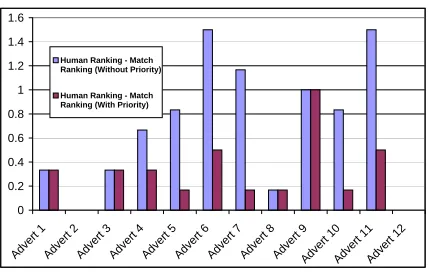
Due to space limitations, the detailed results of all the experiments in this evalu-ation exercise will not be presented in this paper. However, to give an indicevalu-ation of how well the matcher ranking conforms to human judgement, and to show that consid-ering priorities on individual requirements during the matching process improves the effectiveness of the matching system, we present the results obtained for the example scenario discussed in Section 4.1. The average human ranking has been obtained for this scenario through a human study and compared with the results obtained from the proposed priority-based matcher. To illustrate how close the matcher ranking is to the average human ranking, we have computed the difference between the matcher rank and the average human rank and this is graphically illustrated in Figure 2; the y axis of the figure depicts the difference in the rankings. For the sake of comparison, the results were also obtained from the matcher when no priorities are considered (i.e. when all the requirements are assumed to have equal priority/ weight). The difference between this and the human rank is also computed and is illustrated in the Figure 2. Through the observation of these plots we can see that the matcher rank with priority consideration is closer to the human ranking than in the case where priority is not considered. The standard deviation between the matcher ranking (without priority consideration) and the average human ranking is 7.19%. The same value for the matcher rank with pri-ority consideration is 3.35%. This shows that including the priorities in the individual requirements and considering them in the matching process will allow the matcher to produce results that better suit the context involved and that conform to human judge-ment.
5
Conclusions & Future Work
In this paper we have proposed a semantic approach that provides effective matching of resources in a pervasive environment. The approach facilitates the ranking of po-tential matches in the order of their suitability to satisfy the request, which aids the users of the matching system to identify the order in which they should consider the returned matches. The ranking mechanism overcomes the limitations present in match-ers which uses subsumption reasoning alone. The matching framework also facilitates the specification of priorities in the service request and incorporates priority handling in the matching system; this helps to identify the relative importance of the individual requirements in a request and also to indicate whether certain requirements are manda-tory and thus should be strictly met in any potential match. Hence the matching system can produce results that better suit the context involved and the subjective preferences of service seekers. The involvement of match ranking and the priority handling are both important and useful additions to the existing work on service matching.
0 0.2 0.4 0.6 0.8 1 1.2 1.4 1.6
Adve rt1
Adve rt2
Adve rt3
Adve rt4
Adve rt5
Adve rt6
Adve rt7
Adve rt8
Adve rt9
Adve rt10
Adve rt11
Adve rt12
Human Ranking - Match Ranking (Without Priority)
[image:10.612.201.416.84.222.2]Human Ranking - Match Ranking (With Priority)
Fig. 2. The Difference Between the Averaged Human Ranking and the Matcher Rank-ings
a human user study and initial results indicate that the matcher results correlate well with human perception. As part of the future work of this research, we plan to formally evaluate the performance of the proposed approach to justify that any compromise in performance resulting from the involvement of an ontological description and reasoning mechanism, is outweighed by the benefits gained from semantic matching. Specifically we plan to investigate the scalability and the performance of the matching approach, in terms of the number of advertisements involved in the matching process and the size of the resource request (in terms of the number of individual requirements).
Acknowledgements: This research is funded and supported by the
Telecommunica-tions Research Laboratory of Toshiba Research Europe Ltd.
References
1. K. Arnold, B. OSullivan, R. W. Scheifler, and A. Wollrath J. Waldo. The Jini Specification. Addison-Wesley, 1999.
2. S. Avancha, A. Joshi, and T. Finin. Enhancing the bluetooth service discovery protocol. Tech-nical report, University of Maryland Baltimore County, 2001.
3. A. Bandara, T.R. Payne, D. de Roure, and G. Clemo. An ontological framework for semantic description of devices (poster). In 3rd Int. Semantic Web Conference (ISWC 2004), 2004. 4. D. Chakraborty, F. Perich, S. Avancha, and A. Joshi. Dreggie: Semantic service discovery
for m-commerce applications. In Workshop on Reliable and Secure Applications in Mobile Environment, Symposium on Reliable Distributed Systems, 2001.
5. L. Li and I. Horrocks. A software framework for matchmaking based on semantic web tech-nology. In Proc. of the Twelfth Int. World Wide Web Conference, pages 331–339. ACM, 2003. 6. M. Paolucci, T. Kawamura, T.R. Payne, and K.P. Sycara. Semantic matching of web services
capabilities. In Int. Semantic Web Conference, pages 333–347, 2002.