Abstract— In this paper an adaptive thresholding methods
for removing additive white Gaussian noise from digital images are introduced. Some of the denoising algorithms perform thresholding of the wavelet coefficients, which have been affected by additive white Gaussian noise, by retaining only large coefficients and setting the rest to zero. However, their performance is not sufficiently effective as they are not spatially adaptive. But Curvelet are a non-adaptive technique for multi-scale object representation. Curvelet transform employed in the proposed scheme provides sparse decomposition as compared to the wavelet transform methods which being non geometrical lack sparsely and fail to show optimal rate of convergence. The proposed algorithm succeeded in providing improved denoising performance to recover the shape of edges and important detailed components. Simulation results proved that the proposed method can obtain a better image estimate than the wavelet based restoration methods.
Index Terms — Curvelet, Gaussian noise, Thresholding, Wavelet.
I. INTRODUCTION
An image is often corrupted by noise in its acquition and transmission. Image denoising is used to remove the additive noise while retaining as much as possible the important signal features. Thresholding is a simple non-linear technique [8], which operates on one wavelet coefficient at a time. In its most basic form, each coefficient is thresholded by comparing against threshold, if the coefficient is smaller than threshold, set to zero; otherwise it is kept or modified. Replacing the small noisy coefficients by zero and inverse wavelet transform on the result may lead to reconstruction with the essential signal characteristics and with less noise.
Curvelet transform is a new multi scale transform used as an effective tool in image denoising [1]. Compared to wavelet, Curvelet can represent any discontinuity in image more effectively with very few amounts of non-zero coefficients. This is because of wavelet transform generate non-zero value for three discontinuities: Horizontal, Vertical and diagonal. But for any curve discontinuity it will generate three different non-zero coefficients for each discontinuity. Discontinuities across a simple curve affect all the wavelets coefficients on the curve. So wavelet can only capture limited directional information. Compare to that Curvelet transform can handle such discontinuity more precisely because it localized in scale, position and orientation. Compare to wavelet, Curvelet pyramid contains elements with a very high degree of directional specificity.
Curvelet coefficients have different scales and angles. Energy of these coefficients is different for different coefficients based on angle and scale. Here we have represent the image using dominant directional subbands of particular scale and then after we will describe the effect of rotation on such dominant coefficients. It has been shown that, for denoising problems, the curvelet transform approach outputs a PSNR comparable to that obtained via the undecimated wavelets transform [7], but the curvelet reconstruction does not contain as many disturbing artifacts along edges that one sees in wavelet reconstructions. Although the results obtained by simply thresholding the curvelet expansion are encouraging, there is of course ample room for further improvement [11].
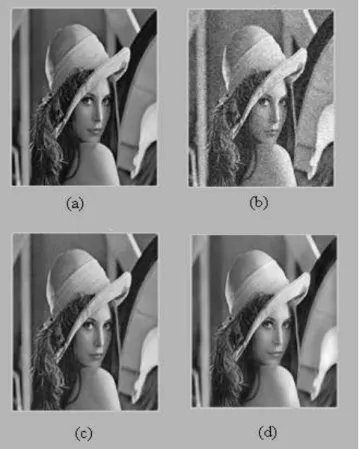
A quick inspection of the residual images resulting from the Lena image filtering (a hard thresholding and soft thresholding has been applied with both transforms) for both the wavelet and curvelet transforms reveals the presence of very different features.
II. WAVELETTRANSFORM
Wavelet transform has been recognized as a powerful tool in a wide range of applications, including image/video processing, numerical analysis, and telecommunication.
A. Orthogonal Wavelet
Orthogonal filters lead to orthogonal wavelet basis functions; hence, the resulting wavelet transform is energy preserving. This implies that the mean square error (MSE) introduced during the quantization of the DWT coefficients is equal to the MSE in the reconstructed signal. This is desirable since it implies that the quantizer can be designed in the transform domain to take advantage of the wavelet decomposition structure [3]. For orthogonal filter banks, the synthesis filters are transposes of analysis filters. However in the case of biorthogonal wavelets, the basic functions are not orthogonal and thus not energy preserving. Hence we use orthonormality parameter (OP) to measure the wavelet’s deviation from orthonormality [6].
The result is a set of details, each corresponding to an average timescale that doubles at each level, and an approximation. The details have a special property called orthogonality, which means that they are completely independent of each other and therefore can be added together in any sequence. Furthermore, the variances can be
Wavelet and Curvelet based Thresholding
Techniques for Image Denoising
1
added together to obtain the variance of the original signal.
Fig. 1: Orthogonal Decomposition
B. DWT
Discrete wavelet transform (DWT) algorithms have become standard tools for discrete-time signal and image processing in several areas in research and industry. As DWT provides both frequency and location information of the analyzed signal, it is constantly used to solve and treat more and more advanced problems [9].It is a multi-resolution analysis to represent a signal in terms of its frequency components. DWT projects a signal on different approximation spaces with different levels of resolution. Each of these includes another approach at half resolution. The difference between the two levels is captured by the spaces called the subspaces of detail. If the signal behaves smoothly, the difference between two successive projections of the signal is very small and therefore the Figure1 detail coefficients will be small or zero.
Fig. 2: 2D DWT
III. CURVELETTRANSFORM
The curvelet transform has gone through two major revisions. It was first introduced to use a complex series of steps involving the Ridgelet analysis of the radon transform of an image [4]. Curvelet aims to deal with interesting
phenomena occurring along curved edges in a 2D image. Curvelet needs fewer coefficients for representation, and the edge produced from curvelet is smoother than wavelet edge.
A. Fast Discrete Curvelet transform via wrapping
The wrapping based curvelet transform is a multiscale pyramid which consists of several subbands at different scales consisting of different orientations and positions in the frequency domain. At a high frequency level, curvelets are so fine and looks like a needle shaped element and they are non-directional coarse elements at low frequency level.
The curvelet transform is a multiscale transform such as
wavelet, with frame elements indexed by scale and location parameters. Wavelets are only suitable for objects with point singularities, Ridgelets are only suitable for objects with line singularities, while curvelets have directional parameters and its pyramid contains elements with a very high degree of directional specificity. The elements obey a special scaling law, where the length and the width of frame elements support are linked using width ≈ l e n g t h2
[2] . Discrete curvelet transform in the spectral domain utilizes the advantages of FFT. During FFT, both image and curvelet at a given scale and orientation are transformed into the Fourier domain.
The convolution of the curvelet with the image in the spatial domain then becomes their product in the Fourier domain. At the end of this computation process, a set of curvelet coefficients are obtained by applying IFFT to the spectral product. This set contains curvelet coefficients in ascending order of the scales and orientations.
IV. PROPOSED WORK
In the tests reported here, simple thresholding of the curvelet coefficients is very competitive with “state of the art” techniques based on wavelets, including thresholding of decimated or undecimated wavelet transforms and also including tree-based Bayesian posterior mean methods. Moreover, the curvelet constructions exhibit higher perceptual quality than wavelet-based reconstructions, offering visually sharper images and, in particular, higher quality recovery of edges and of faint linear and curvilinear features. Existing theory for curvelet transforms suggests that these new approaches can outperform wavelet methods in certain image reconstruction problems. The empirical results reported here are in encouraging agreement.
with size n x n can have a Curvelet transform of
(Log2 N-3) level, for n = 128 level of Curvelet transform
will be 4.
For any Curvelet decomposed image at any scale with different direction, two peak energy level always remain with each other. This is because the energy of the dominant orientation of an image usually spreads between two neighboring subbands
V. PROPOSEDALGORITHM
• Step1: Read an image.
• Step2: Take Forward Curvelet Transform of an image. • Step3: Perform Fast Discrete Curvelet Transform. • Step4: Add noise to the original image.
• Step5: Create an array of original image:
• Step6: Compute the inverse Fourier Transform for Step5. • Step7: Compute the Norm of curvelet.
• Step8: Perform Step2 for noisy image;
• Step9: Apply Thresholding (Hard or Soft) for all the coefficients.
• Step10: Take Inverse Curvelet Transform. • Step11: Calculate Signal-Noise-Ratio using,
SNR = 20 log (Desired Signal / level of noise) (1)
• Step12: Calculate Peak-Signal-to-Noise Ratio.
To compute the PSNR, the block first calculates the mean-squared error using the following equation:
MSE=∑M, N [I1 (m, n) - I2 (m, n)] 2 / M*N (2)
M and N are the number of rows and columns in the input images, respectively. Then the block computes the PSNR using the following equation:
PSNR=10log10 (R2 / MSE) (3)
R is the maximum fluctuation in the input image.
VI. THRESHOLD SELECTION
The key parameter in the thresholding process is the choice of the threshold value (or values, as mentioned earlier). Several different methods for choosing a threshold exist; users can manually choose a threshold value, or a thresholding algorithm can compute a value automatically, which is known as automatic thresholding. One method that is relatively simple, does not require much specific knowledge of the image, and is robust against image noise, is the following iterative method [8]:
1. An initial threshold (T) is chosen; this can be done
randomly or according to any other method desired.
2. The image is segmented into object and background
pixels as described above, creating two sets:
1. G1 = {f (m, n): f (m, n) > T} (object pixels)
2. G2 = {f (m, n): f (m, n) ≤ T} (background
pixels) (note, f (m, n) is the value of the pixel located in the column, row)
3. The average of each set is computed.
1. m1 = average value of G1
2. m2 = average value of G2
4. A new threshold is created that is the average of m1
and m2.
. T’ = (m1 + m2) / 2
(4)
5. Go back to step2, now using the new threshold computed in step four, keep repeating until the new threshold matches the one before it (i.e. until convergence has been reached).
A. Hard Thresholding
Hard thresholding sets any coefficient less than or equal to the threshold to zero [8]. Hard thresholding is used to suppress the noise we apply the following nonlinear transform to the empirical wavelet coefficients:
F(x) = x.I (|x|>t) (5)
Where x is a noisy image and t is a certain threshold. The choice of the threshold is a very delicate and important statistical problem.
B. Soft Thresholding
The only difference between the hard and the soft thresholding procedures are in the choice of the nonlinear transform on the empirical wavelet coefficients [5]. For soft thresholding the following nonlinear transform is used:
S(x) =sign(x) (|x|-t) I (|x|>t) (6)
where x is a noisy image and t is a threshold. The menu provides you with all possibilities for choosing the threshold and exploring the data. Soft thresholding not only smooths the time series, but moves it toward zero.
VII. LITERATURESURVEY
A. Related Work
There have been several other developments of directional wavelet systems in recent years with the same goal, namely a better analysis and an optimal representation of directional features of signals in higher dimensions. None of these approaches has reached the same publicity as the curvelet transform. However, we want to mention shortly some of these developments and also describe their relationship to curvelets.
asymptotic mean square error of reconstruction than wavelet methods .
The interesting aspect of the curvelet scheme is the fact that each generation of refinement leads to a doubling of the spatial resolution as well as a doubling of the angular resolution [10]. This aspect where the number of resolvable features directions increases with scale is very deferent from wavelet and associated approaches.
VIII. EXPERIMENTAL RESULTS
The curvelet transform is suitable for representing the edges, while the wavelet transform is more useful in expressing the image details. This is because that both the curvelet and wavelet multiresolution ideas are playing with a limited dictionary. The curvelet basis with directional structure cannot catch essences of the image details such as texture or angles.
Curvelet constructions require a rotation operation and correspond to a partition of the 2D frequency plane based on polar coordinates. This property makes the curvelet idea simple in the continuous case but causes problems in the
implementation for discrete images. In particular,
approaching critical sampling seems difficult in discretized constructions of curvelets.
The performance of the proposed thresholding methods is evaluated and compared with that of soft, hard thresholding schemes using wavelets [8]. Gaussian noise was added to the classical digital images and the curvelet coefficients are processed by soft and hard thresholding functions. The performance of denoising is evaluated using Peak Signal-to-Noise Ratio (PSNR) and Signal-to-Noise Ratio (SNR)
Table1. Comparison of hard and soft thresholding in wavelet and curvelet domain
Fig. 3: (a) original image, (b) additive Gaussian noise, (c) hard threshold and (d) soft threshold in wavelet domain.
IX. CONCLUSION
In the proposed approach, features of wavelet and curvelet transform are utilized separately for enhancement. Therefore, it is not affecting true edges in denoising process. It is observed that improvement in SNR is not at the cost of blurring the edges of denoised image which is also evident from other performance indices like SSIM (Structural Similarity).
The main novelty of proposed approach lies in removal of fuzzy noise from homogeneous region, resulting in better smoothness in background while keeping the image information preserved. It can be seen from the results that for almost all denoised images used here with various Gaussian noise level, there is similar rate of improvement in SNR, PSNR and SSIM as compared to other recent techniques like WT, WT1, CT, and CT1.
Further, in the proposed approach there is not only improvement in this noise suppression parameter but also improvement in edge preservation factor for images like Lena, Barbara and synthetic image. Finally, it is concluded that for all varieties of the images used here, the proposed approach outperforms other approaches used for comparison in terms of image denoising.
X. FUTUREWORK
A new denoising technique based on adaptive selection of thresholds to suppress noisy curvelet transform coefficients is presented. Due to multiresolution dictionary, the maxima of the curvelet transform coefficients vary and so the threshold operator is designed to produce as many local threshold values as are the scales. The proposed method efficiently adapts to noise characteristics for different scales and reduces the noise while preserving edges in the image. The thresholding function chosen are the hard and soft thresholds and the proposed expression is tested against them. From the restored images it can be visually depicted that the edges and texture are well preserved taking the advantage of the fact that curvelets being geometrical very well align themselves to the contours of the edges. Numerical experiments show the good performance of the proposed method in comparison to wavelet based decomposition. Further works involve extending the proposed method to various classes of images which are different from natural images. Another important issue is to test the performance on higher resolution images.
The multiresolution geometric analysis technique with curvelets as basic functions is verified as being effective in many fields. However, there are some challenging problems for future work.
The computational cost of the curvelet transform is higher than that of wavelets, especially in terms of 3D problems. However, the theory and application of the 3D curvelets are burgeoning areas of research, and it is possible that more efficient curvelet-like transforms will be developed in the near future. Currently, a fast message passing
interface-based parallel implementation can somewhat reduce the cost. How to build a fast orthogonal curvelet transform is still open.
REFERENCES
[1] Candès.E.J., and Donoho.D.L, Curvelets – A Surprisingly Effective Non-adaptive Representation for Objects with Edges; Curve and Surface Fitting: Saint Malo 1999
[2] Candes.E., Demanet.L, Donoho.D, Ying.L, Fast discrete curvelet transforms, Multiscale Model. Simul, 5 (3), 861-899 (2006).
[3] Daubechies I., Ten lectures on wavelets, Philadelphia, PA: SIAM, 1992.
[4] Donoho.D D.L., and Duncan M.R., Digital Curvelet Transform: Strategy, Implementation and Experiments; Technical Report, Stanford University 1999
[5] Donoho.D.L., “De-noising by soft-Thresholding,” Dept of Statistics, Stanford University, 1992.
[6] Gao. X., Nguyen. T., Strang.G, A study of two-channel complex-valued filters banks and wavelets with orthogonality and symmetry properties, IEEE Trans. Signal Process, 50 (4), 824-833 (2002).
[7] Gyaourova.A., Klamath’s., and Fodor. I. K., “Undecimated curvelet transforms for image de- noising,”LawrencelivermoreNationalLaboratory, Tech.Rep.UCRL-ID-150931, 2002.
[8] Li.Q, and He. C., 2006. Application of wavelet threshold to image denoising, Proceedings of the 1st IEEE International Conference on Innovative Computing, Information Control, pp: 693-696. DOI: 10.1109/ICICIC.2006.238.
[9] Rao.R.M., and Bopardikar.A.S, Wavelet Transforms, Introduction to Theory and Applications
[10] Li.S, Yang.B, Multifocus image fusion by combining curvelet and wavelet transform. Pattern Recognition Letters 29 (2008) 1295–1301.
[11] Yussif.A.A.A., Darwish.A.A, A.M.M.Madbouly., Curvelet Image Denoising based on Threshold IJCSNS International Journal of Computer Science and Network Security.Vol.11 NO.1, Jan 2010.
[12] Ying.L., Demanet.L., Candes.E., 2D Discrete Curvelet Transform, Proc. of SPIE Wavelets XI, Vol. 5914, pp. 591413, San Diego, CA, 2005.