An Optimized-Hierarchy-Aided Approximate
Log-MAP Detector for MIMO Systems
Jos Akhtman,
Member, IEEE
, Andreas Wolfgang,
Member, IEEE
,
Sheng Chen,
Senior Member, IEEE
, and Lajos Hanzo,
Fellow, IEEE
Abstract— In this paper we propose a novel Space Division Multiplexing (SDM) detection method. The proposed technique constitutes a list search method and may be regarded as an advanced extension of the Sphere Decoder (SD). Our method may be employed in the so-called over-loaded scenario, where the number of transmit antenna elements exceeds that of the receive antenna elements. Furthermore, it is suitable for high-throughput, non-constant modulus modulation schemes, such as 16 and 64-QAM. We introduce a series of optimization rules which facilitate a substantial reduction in computational complexity. More specifically, we demonstrate that the method proposed, which we refer to as the Soft-output OPtimized HIEr-archy (SOPHIE)-aided SDM detector exhibits the near-optimum performance of Log-MAP SDM detector in all considered scenar-ios. The associated computational complexity, which we control using two complexity-control parameters, is substantially lower than that imposed by all previously proposed methods.
Index Terms— Bell Labs layered space-time (BLAST), fading channels, maximum likelihood (ML) detection, smart antennas, sphere decoding, turbo codes, wireless communications.
I. INTRODUCTION
T
HE relevant information-theoretical analysis predicts [1] that substantial capacity gains are achievable in wireless communication systems employing a Multiple Input Multiple Output (MIMO) architecture using multiple antennas. Ad-ditionally, the employment of a MIMO architecture allows for the efficient exploitation of the spatial diversity available in a wireless MIMO environment, thus improving both the system’s transmission integrity, as well as capacity.The most potent space-time detection method found in the literature is constituted by the Sphere Decoder (SD) [2], which is capable of achieving the optimum performance of the Maximum Likelihood (ML) detector at a relatively low computational complexity. The SD was first proposed for employment in the context of space-time processing in [3]. The complex-valued version of the sphere decoder was proposed by Hochwald and ten Brink in [4]. The subject was
Manuscript received September 9, 2005; revised March 13, 2006; accepted July 10, 2006. The associate editor coordinating the review of this paper and approving it for publication was D. Huang. The work reported in this paper has formed part of the Wireless Enabling Techniques work area of the Core 3 Research Programme of the Virtual Centre of Excellence in Mobile and Personal Communications, Mobile VCE, www.mobilevce.com, whose funding support, including that of EPSRC, is gratefully acknowledged. Fully detailed technical reports on this research are available to Industrial Members of Mobile VCE.
The authors are with the School of ECS, Univ. of Southampton, SO17 1BJ, UK (e-mail: [email protected]; [email protected]; [email protected]; [email protected]).
Digital Object Identifier 10.1109/TWC.2007.05710.
further investigated by Damenet al.in [5]. Subsequently, an improved version of the Complex Sphere Decoder (CSD) was advocated by Phamet al. in [6].
Furthermore, CSD-aided detection was considered by Cui and Tellambura et al. in the context of a joint channel estimation and data detection scheme considered in [7], while a revised version of the CSD method, namely the so-called Multistage Sphere Decoding (MSD) was introduced in [8]. The generalized version of the sphere decoder, which is suitable for employment in rank-deficient MIMO systems supporting more transmitters than the number of receive antennas was introduced by Damen et al. in [9] and further refined by Cui and Tellambura in [10]. Additional variant of the sphere decoder algorithm with improved search radius was contributed by Zhao and Giannakis in [11].
Against this background, in this paper we propose a novel SDM detection method, which we refer to as the Soft-output OPtimized HIErarchy (SOPHIE) Spatial Division Multiplex-ing (SDM) detector. The proposed method may be regarded as an advanced extension of the SD methods portrayed in [6] and [10].
More specifically, our method can be employed in the above-mentioned rank-deficient and hence overloaded sce-nario, where the number of transmit antenna elements exceeds that of the receive antenna elements. Furthermore our scheme is suitable for high-throughput modulation schemes such as 16- and 64-QAM. We introduce a list of optimization rules, which facilitate the achievement of the near optimum BER performance of a Log-MAP detector at a relatively low com-putational complexity. The trade-off between the achievable BER performance and the associated computational complex-ity is controlled using two parameters. The proposed detection method exhibits two major advantages over all previously proposed techniques:
1) The bit-related soft information, which facilitates the achievement of near-optimum Log-MAP performance, is attained at the expense of a modest complexity increase over that of hard-decision ML detection. 2) Our method exhibits a particularly low polynomial
com-plexity in both the low- and high-SNR regions. In the critical range of SNR values, which corresponds to the “waterfall” region of the BER versus SNR curve, the detection complexity versus the number of transmit antennas remains exponential. Nevertheless, we demonstrate that the complexity can be dramatically reduced at the cost of a minor BER degradation.
The rest of this paper is structured as follows. The OHRSA-aided SDM detection methods considered are outlined in Section II. Specifically, in Section II-A we derive the OHRSA-aided ML SDM detector, which benefits from the optimal performance of the ML SDM detector [12], while exhibiting a relatively low computational complexity. To elaborate a little further, in Section II-B we derive a bit-wise OHRSA-aided ML SDM detector, which allows us to apply the OHRSA method of Section II in high-throughput modulation schemes, such as M-QAM [12].
In Section II-C our discourse evolves further by deducing the OHRSA-aided Log-MAP SDM detector, which allows for an efficient evaluation of the soft-bit information and therefore results in highly efficient turbo decoding1. Unfortunately, how-ever, in comparison to the OHRSA-aided ML SDM detector of Section II-B, the OHRSA-aided Log-MAP SDM detector of Section II-C exhibits a substantially higher complexity. Consequently, in Section II-D we derive an approximate Log-MAP method, namely the SOPHIE SDM detector. The SOPHIE SDM detector combines the advantages of both the OHRSA-aided ML and OHRSA-aided Log-MAP SDM detectors of Sections II-B and II-C, respectively. Specifically, it exhibits a similar performance to that of the optimal Log-MAP detector, while imposing a relatively modest complexity. The computational complexity as well as the achievable per-formance of the SOPHIE SDM detector of Section II-D are quantified in Section III-B. Finally, our conclusions are offered in Section IV.
II. OPTIMIZEDHIERARCHYREDUCEDSEARCH ALGORITHM(OHRSA) SDM DETECTION
A. OHRSA-Aided ML Detection
We commence our discourse by deriving an OHRSA-aided ML SDM detection method for a constant-modulus modulation scheme, such as M-PSK, where the transmitted symbols s satisfy the condition of |s|2 = 1, ∀s ∈ M, and Mdenotes the set ofM complex-valued constellation points. In the next section, we will then demonstrate that the method derived is equally applicable for high-throughput multi-level modulation schemes, such as M-QAM.
Our system model is given by
y=Hs+w, (1)
where y,s andw are the received signal, transmitted signal and Gaussian noise vectors, respectively, whileHis(nr×mt)
-dimensional MIMO channel matrix. As outlined in [12] , the ML SDM detector provides an mt-antenna-based estimated
signal vector candidate ˆs, which maximizes the objective function defined as the conditional a posteriori probability functionP{ˇs|y,H}over the setMmt of legitimate solutions.
More explicitly, we have
ˆ
s= arg max ˇ
s∈MmtP{ˇs|y,H}, (2) 1Part of the material discussed in Sections II and II-C will also appear
in [13], where we discuss the benefits of the soft-input-soft-output iterative MIMO detection.
where Mmt is the set of all possible mt-dimensional
can-didate symbol vectors of the mt-antenna-based transmitted
signal vector s. More specifically, we have
Mmt =ˇs= (ˇs
1,· · · ,sˇmt)T; ˇsi∈ M
. (3)
Furthermore, it was shown in [12] that we have
P{ˇs|y,H}=Aexp
− 1 σ2w
y−Hˇs2, (4)
where A is a constant, which is independent of any of the values {ˇsi}i=1,···,mt, while σw2 denotes the Gaussian noise
variance. Thus, it may be shown [12] that the probabil-ity maximization problem of Equation (2) is equivalent to the corresponding Euclidean distance minimization problem. Specifically, we have
ˆs= arg min ˇ
s∈Mmty−Hˇs
2, (5)
where the probability-based objective function of Equation (2) is substituted by the objective function determined by the Euclidean distance between the received signal vectory and the corresponding product of the channel matrix H with the
a prioricandidate of the transmitted signal vectorˇs∈ Mmt.
Consequently, our detection method relies on the observa-tion, which was first considered in [10] and may be summa-rized in the following lemma.
Lemma 1: The ML solution of Equation (2) of a noisy
linear problem described by Equation (1), where s satisfies |s|2= 1, is given by
ˆ
s= arg min ˇs∈Mmt
U(ˇs−ˆx)2, (6)
where U is an upper-triangular matrix having positive real-valued elements on the main diagonal and satisfying
UHU= (HHH+σ2
wI), (7)
while
ˆ
x= (HHH+σ2
wI)−1HHy (8)
is the unconstrained MMSE estimate of the transmitted signal vector s, which was derived in [12] .
Note: Observe that Lemma 1 imposes no constraints
on the dimensions, or rank of the matrix H of the linear system described by Equation (1). This property is particularly important, since it enables us to apply our proposed detection technique to the scenario of over-loaded systems, where the number of transmit antenna elements exceeds that of the receive antenna elements.
Proof of Lemma 1: It is evident that in contrast to the
matrix HHH, the matrix (HHH+σw2I) of Equation (6) is
always Hermitian and positively definite, regardless of the rank of the channel matrix H associated with the particular MIMO channel realization encountered. Consequently, it may be represented as the product of an upper-triangular matrix
Let U be the matrix generated by the Cholesky decompo-sition of the Hermitian positive definite matrix(HHH+σw2I)
of Equation (7). More specifically, we have
UHU= (HHH+σ2
wI), (9)
where U is an upper-triangular matrix having positive real-valued elements on its main diagonal.
Upon expanding the objective function of Equation (6) and subsequently invoking Equation (7) we obtain
J(ˇs) =U(ˇs−xˆ)2
= (ˇs−xˆ)HUHU(ˇs−xˆ) = (ˇs−xˆ)H(HHH+σ2
wI)(ˇs−xˆ)
= ˇsH(HHH+σ2
wI)ˇs−xˆH(HHH+σ2wI)ˇs
−ˇsH(HHH+σ2
wI)ˆx+ ˆxH(HHH+σw2I)ˆx. (10)
Furthermore, substituting Equation (8) into (10) yields
J(ˇs) = ˇsHHHHˇs−yHHˇs−ˇsHHHy
+σ2
wˇsHˇs+yHH(HHH+σw2I)−1HHy
=y−Hˇs2+σ2
wˇsHˇs+yH(H(HHH+σw2I)−1HH−I)y
ψ
.
(11)
Observe that in the case of a system employing a constant-modulus modulation scheme, such as M-PSK, where we have ˇsHˇs = 1, ψ of Equation (11) constitutes a real-valued scalar and its value does not depend on the argument ˇs of the minimization problem formulated in Equation (6). Con-sequently, the minimization of the objective functionJ(ˇs)of Equation (11) can be reduced to the minimization of the term y−Hˇs2, which renders it equivalent to the minimization
problem of Equation (5). This completes the proof.
Using Lemma 1, in particular the fact that the matrix U is an upper-triangular matrix, the objective function J(ˇs) of Equation (11) may be reformulated as follows
J(ˇs) =U(ˇs−ˆx)2= (ˇs−ˆx)HUHU(ˇs−xˆ)
=
mt
i=1
mt
j=i
uij(ˇsj−xˆj) 2
=
mt
i=1
φi(ˇsi), (12)
whereJ(ˇs)andφi(ˇsi)are positive real-valued cost and
sub-cost functions, respectively. Elaborating a little further we have
φi(ˇsi) =
mt
j=i
uij(ˇsj−xˆj) 2
=uii(ˇsi−xˆi) +
mt
j=i+1
uij(ˇsj−xˆj)
ai
2. (13)
Note that the term ai is a complex-valued scalar, which is
independent of the specific symbol valuesˇiof theith element
of thea prioricandidate signal vectorˇs.
Furthermore, let Ji(ˇsi) be a Cumulative Sub-Cost (CSC)
function recursively defined as
Jmt(ˇsmt) =φmt(ˇsmt) =|umtmt(ˇsmt−xˆmt)|2 (14a)
Ji(ˇsi) =Ji+1(ˇsi+1) +φi(ˇsi), i=mt−1,· · ·,1,
(14b)
where we define the candidate subvector asˇsi= [ˇsi,· · ·,sˇmt].
Clearly,Ji(ˇsi)exhibits the following properties
J(ˇs) =J1(ˇs1)> J2(ˇs2)>· · ·> Jmt(ˇsmt)>0 (15a)
Ji(ˇsi) =Ji({sˇj}, j=i,· · ·, mt) (15b)
for all possible realizations ofˆx∈Cmt andˇs∈ Mmt, where
the space Cmt contains all possible unconstrained MMSE
estimatesxˆ of the transmitted signal vectors.
Equations (15a) and (15b) enable us to employ a highly ef-ficient reduced search algorithm, which decreases the number of objective function evaluations of the minimization problem outlined in Equation (6) to a small fraction of the set Mmt.
This reduced-complexity search algorithm is outlined in the next section.
1) Search Strategy: Firstly, we commence the recursive
search process with the evaluation of the CSC function value Jmt(ˇsmt)of Equation (14a). Secondly, at each recursive step
i of the search algorithm proposed we stipulate a series of hypotheses concerning the value of the M-ary transmitted symbol si associated with the ith transmit antenna element
and subsequently calculate the conditioned sub-cost function Ji(ˇsi)of Equation (14b), whereˇsi = (ˇsi,· · ·,ˇsmt)T denotes
the subvector of the mt-antenna-based candidate vector ˇs
comprising only the indices higher than or equal to i. Fur-thermore, for each tentatively assumed value ofsˇiwe execute
a successive recursive search step i−1, which is conditioned on the hypotheses made in all preceding recursive stepsj = i,· · ·, mt. As substantiated by Equations (13) and (14b), the
value of the CSC function Ji(ˇsi) is dependent only on the
values of the elements{ˇsj}j=i,···,mt of thea prioricandidate
signal vectorˇs, which are hypothesized from stepj =mtup to the present stepiof our recursive process. At each arrival at the stepi= 1 of the recursive process, a complete candidate vector ˇsis hypothesized and the corresponding value of the cost function J(ˇs)formulated in Equation (12) is evaluated.
Observe that the recursive hierarchical search procedure described above may be employed to perform an exhaustive search through all possible values of the transmitted signal vector ˇs and the resultant search process is guaranteed to arrive at the ML solutionˇsML, which minimizes the value of the cost functionJ(ˇs)of Equation (12). Fortunately however, as opposed to other ML search schemes, the search process described above can be readily optimized, resulting in a dramatic reduction of the associated computational complex-ity. Specifically, the potential optimization complexity gain originates from the fact that most of the hierarchical search branches can be discarded at an early stage of the recursive search process. The corresponding optimization rules proposed may be outlined as follows.
Rule 1: We reorder the system model of Equation (1)
as suggested in [15]. Specifically, we apply the best-first
detection strategy outlined in [2], [5], [12], which implies that the transmitted signal vector components are detected in the decreasing order of the associated channel quality. As it was advocated in [12], the quality of the channel associated with the ith element of the transmitted signal vector s is determined by the norm of the ith column of the channel matrix H. Consequently, for the sake of applying the
are sorted in the increasing order of their norm. Thus, the resultant, column-reordered channel matrixH complies with the following criterion
(H)12≤ (H)
22≤ · · · ≤ (H)mt2, (16)
where(H)i denotes theith column of the channel matrixH.
Note that the elements of the transmitted signal vectorsare reordered correspondingly, but their original order has to be reinstated in the final stage of the detection process.
Rule 2: We employ the Schnorr-Euchner search
strat-egy [16]. More specifically, at each recursive detection index i = mt,· · ·,1, the potential candidate values {cm}m=1,···,M ∈ M of the transmitted signal componentsi
are considered in the increasing order of the corresponding value of the sub-cost function φi(ˇsi) = φi(cm,ˇsi+1) of
Equation (13), where we have
φi(c1,ˇsi+1)<· · ·< φi(cm,ˇsi+1)<· · ·< φi(cM,ˇsi+1),
and according to Equation (13)
φi(cm,ˇsi+1) =|uii(cm−xˆi) +ai|2 =uii|cm−ˆxi+ ai
u2ii
|2. (17)
Consequently, the more likely candidates cm of the ith
el-ement of the transmitted signal vector s are examined first. Observe that the sorting criterion of Equation (17) may also be interpreted as a biased Euclidean distance of the candidate constellation pointcmfrom the unconstrained MMSE estimate
ˆ
xi of the transmitted signal componentsi.
Rule 3: We define a cut-off value of the cost function
Jmin = min{J(ˇs)} as the minimum value of the total cost
function obtained up to the present point of the search process. Consequently, at each arrival at step i = 1 of the recursive search process, thecut-off value of the cost function is updated as follows
Jmin= min{Jmin, J(ˇs)}. (18)
Rule 4: Finally, at each recursive detection step i, only
the high probability search branches corresponding to the highly likely symbol candidates cm resulting in low values
of the CSC function obeying Ji(cm) < Jmin are pursued.
Furthermore, as follows from the sorting criterion of the optimization Rule 2, as soon as the inequalityJi(cm)> Jmin
is encountered, the search loop at the ith detection step is discontinued.
Given the cost-functions of Equation (12) and the appro-priately ordered matrix H of Equation (1), the proposed algorithm may be viewed as a specific manifestation of a tree search algorithm [17]. Another example of a tree search algorithm commonly employed in the design of communi-cation systems constitutes the well-known Viterbi algorithm [18], [19]. More specifically, the sub-cost function values of Equation (13) may be regarded as being analogous to the the branch metrics, while the CSC values of Equation (14) as accumulated path metrics. It should be noted however, that the OHRSA-ML algorithm described here and the classic tree-search-based Viterbi algorithm exhibit substantial differences. Specifically, the Viterbi algorithm assumes that the branch
TABLE I
EXAMPLES OFQUANTIZATIONVECTORS
Modulation scheme qT
BPSK [1]
QPSK √1
2[1, j]
16QAM √1
10[1, 1j, 2, 2j]
64QAM √1
42[1, 1j, 2, 2j, 4,4j]
metric is a function of the system states constituting one par-ticular state transition, which is equivalent to the assumption of having a diagonal matrixUin Equation (7). Evidently, this requirement cannot be satisfied by our generic MIMO system. Consequently, the tree-search-based Viterbi algorithm cannot be applied to the search problem described above.
B. Bitwise OHRSA ML Detection
In this section we generalize the result obtained in Sec-tion II-A to the case of systems employing high-throughput modulation schemes, namelyM-QAM, where each modulated symbol belongs to a discrete phasor constellation M = {cm}m=1,···,M. It is evident that each phasor point cm of
an M-QAM constellation map may be represented as the inner product of a unique bit-based vector dm = {dml =
−1,1}l=1,···,b and the corresponding quantisation vector q.
Specifically, we have
cm=qTdm. (19)
Some examples of the quantization vectors corresponding to the modulation schemes of QPSK, 16-QAM and 64-QAM are portrayed in Table I.
Furthermore, we define a (bmt×mt)-dimensional
quan-tization matrix Q = I⊗ q, where I is an (mt × mt)
-dimensional identity matrix and q is the aforementioned
quantization vector, while⊗denotes thematrix direct product
[20]. Consequently the M-QAM-modulated signal vector s may be represented as
s=Qt, (21)
wheret= [tT1,· · ·,tTmt]T is a column supervector comprising
the bit-based vectorstiassociated with each transmitted signal vector component si. Substituting Equation (21) into the system model of Equation (1) yields
y=HQt+w. (22)
Moreover, sincetis a real-valued vector, we can elaborate a bit further and deduce a real-valued system model as follows
˜ y=
R{y} I{y}
=
R{HQ} I{HQ}
t+
R{w} I{w}
= ˜Ht+ ˜w,
(23)
where H˜ is a real-valued (2nr×bmt)-dimensional bitwise
channel matrix. Observe in Equation (22) that the requirement of having constant-modulus symbols is satisfied by the mod-ified system model of Equation (22), since we have|ti|2= 1
Algorithm 1Bit-Wise OHRSA-aided ML SDM Detector
˜ H=
R{HQ} I{HQ}
(20a)
Sort{H˜}, such that ( ˜H)12≤ · · · ≤ ( ˜H)r2 (20b) G= ( ˜HHH˜ +σ2
wI) (20c)
U=CholeskyDecomposition(G) (20d)
ˆ
x=G−1H˜Hy˜ (20e)
Calculate Jr (20f)
Unsort{ˆt} (20g)
function Calculate Ji (20h)
ai=
mt
j=i+1
uij(ˇtj−xˆj) (20i)
Sort{d}, such thatφi(d1)< φi(d2), (20j)
where φi(d) =|uii(d−xˆi) +ai|2 (20k)
for m= 1,2 do (20l)
ˇ
ti=dm (20m)
Ji=Ji+1+φi(ˇti) (20n)
if Ji< Jmin then (20o)
if i >0 then Calculate Ji−1 (20p)
else
Jmin=J0 (20q)
ˆt= ˇt (20r)
end if end if end for end function
C. OHRSA-Aided Log-MAP Detection
Subsequently, the derivation of an expression for the eval-uation of the soft-bit information associated with the bit estimates of the bitwise ML detector of Section II-B is given in [12]. More specifically, the soft-bit value associated with the ith bit of estimated signal vectorˆt is determined by the log-likelihood ratio (LLR) function defined in [21] as
Li= log
ˇ
t∈M1;r i P
˜ y|ˇt,H˜
ˇ
t∈M−1;r i P
˜ y|ˇt,H˜
, (24)
where we define the constrained subsetMd;ri of the transmit-ted bitwise signal candidatesˇtas follows
Md;ri =ˇt= (ˇt1,· · · ,ˇtr)T; ˇtj∈ {−1,1}forj=i, ˇti=d
. (25)
The direct calculation of the accumulate a posteriori con-ditional probabilities in the nominator and denominator of Equation (24) may have an excessive complexity in practice.
Fortunately, as advocated in [12], the expression in Equa-tion (24) can be closely approximated as follows
Li≈log
P
˜ y|ˆt1
i,H˜
P
˜ y|ˆt−1
i ,H˜
, (26)
where we define the constrained ML estimate
ˆtd
i = arg max ˇt∈Md;r
i P
˜ y|ˇt,H˜
, d=−1,1. (27)
As suggested by the nature of Equation (26), the detection process employing the objective function determined by Equa-tions (26) and (27) is usually referred to as the Logarithmic MaximumA Posteriori(Log-MAP) probability detector.
A practical version of the Log-MAP detector may be derived as follows. Substituting Equation (4) into (26) yields
Li ≈ 1
σw2
y˜−H˜ˆt−1
i 2− y˜−H˜ˆt1i2
, (28)
where we have
ˆ td
i = arg minˇ
t∈Md;r i
y˜−H˜ˇt2, d=−1,1, (29)
and again,Md;ri denotes the specific subset of the entire set Mr of bitwise signal vector candidates, which comprises the
bit valued={−1,1}at the ith bit position.
Furthermore, substituting the bitwise objective function of Equation (11) into (28) yields
Li≈ 1
σ2w
J(ˆt−i1)−J(ˆt1i)
, (30)
where ˆtd
i and the corresponding cost function value J(ˆtdi)
may be obtained by applying the constrained OHRSA-aided ML detection method of Algorithm 1.
Consequently, the evaluation of the bitwise Log-MAP es-timates of the transmitted bitwise signal vector t involves repetitive evaluation of2rconstrained ML estimatesˆtb
i along
with the associated2rvalues of the objective functionJ(ˆtb
i).
D. Soft-Output OHRSA-Aided Approximate Log-MAP Detec-tion
Let us define the (r×2)-dimensional Bitwise Minimum Cost (BMC) function matrix ˆJhaving elements as follows
ˆ
Jid=J(ˆtdi), i= 1,· · ·, r, d=−1,1, (31)
whereˆtd
i is defined by Equation (29). Using the BMC matrix
of Equation (31), Equation (30) may also be expressed in a vectorial form as
L= 1
σ2w
(ˆJ)1−(ˆJ)2, (32)
where, as before, (ˆJ)b denotes thedth column of the matrix ˆ
Jhaving elements defined by Equation (31).
Consequently, in order to evaluate the bit-related soft in-formation we have to populate the BMC matrix ˆJ of Equa-tion (31) with the corresponding values of the cost funcEqua-tion of Equation (31). Observe, that the evaluation of the ML estimate
ˆ
0(0)
1(0.16) 6(0.27)
2(0.20) 5(6.45)
3(0.21) 4(1.21)
(a)
0(0)
1(0.16) 6(0.27)
2(0.20) 5(6.45)
3(0.21) 4(1.21)
7(0.31) 8(8.73)
(b)
0(0)
1(0.16) 6(0.27)
2(0.20) 5(6.45)
3(0.21) 4(1.21)
7(0.31) 10(8.73)
8(0.33) 9(1.25)
[image:6.567.56.514.53.168.2](c)
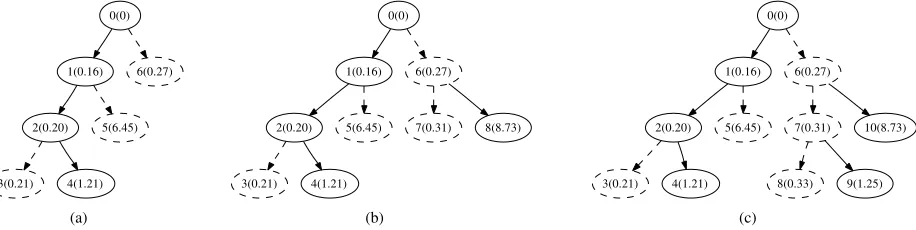
Fig. 1. Example of the search trees formed by the modified OHRSA-ML SDM detector of Algorithm 2 using different values of the parameterρ, namely, (a)ρ= 1.0, (b)1.3and (c)2.0. We consider a system employing BPSK modulation, mt =nr = 3transmit and receive antennas and encountering an average SNR of 10dB. The labels indicate the order of evaluation, as well as the corresponding valueJi(ˇsi)of the CSC function of Equation (14), as seen in the brackets.
corresponding minimum value of the cost function associated with the ML estimate, such that we have
Jib=J(ˆt), i= 1,· · ·, r, b= ˆti. (33)
Subsequently, let us introduce the following adjustments to Algorithm 1. Firstly, we introduce an additional parameter ρ, which we refer to as the search radius factor. More specifically, the parameterρ allows us to control the rate of convergence for the tree search process of Algorithm 1 and affects the cut-off value of a CSC function, which limits the passage of the recursive search process throughlow-likelihood
search branches having a CSC function valueJi(ˇti)in excess
ofρJmin, as opposed toJmin. Thus, the following rule replaces
Rule 4 of Section II-A.1.
Rule 4a: At each recursive detection level i, only the
high-probability search branches corresponding to the highly likely symbol candidates dm resulting in low values of
the CSC function obeying Ji(dm) < ρJmin are pursued.
Furthermore, as follows from the sorting criterion of the optimization Rule 2, as soon as the inequalityJi(dm)> ρJmin
is satisfied, the search loop at theith recursive detection level is discontinued.
Secondly, we introduce an additional rule, which facilitates the evaluation of the elements of the BMC matrix Jˆ of Equation (31). Explicitly, we postulate Rule 5.
Rule 5: At each arrival at the bottom of the search tree,
which corresponds to search level 1, the resultant value of the branch cost functionJ(ˇt)is utilized to populate the elements of the BMC matrixJˆ, which correspond to the bitwise signal components ˇti comprising the obtained signal candidate ˇt.
Namely, we have
ˆ
Jid= min{Jˆid, J(ˇt)}, i= 1,· · ·, r, d= ˇti. (34)
Subsequently, we suggest that the evaluation of the BMC matrix Jˆ, which is performed in the process of the ML search of Algorithm 1 extended by Rule 4a and using Rule 5 will allow us to provide reliable soft-bit information, while imposing a relatively low computational complexity. The main rationale of this assumption will be outlined in our quantitative complexity and performance analysis portrayed in Section III-B.
As we will further demonstrate in Section III-B, the resul-tant approximate Log-MAP SDM detector exhibits a particu-larly low complexity at high SNR values. On the other hand,
at low SNR values the associated complexity substantially increases. Consequently, in order to control the computational complexity at low SNR values, we introduce an additional complexity-control parameter, namely the search resolution
parameter γ. Our aim is to avoid the computationally
de-manding and yet inefficient detection of the specific signal components, which have their signal energy well below the noise floor. More specifically, we modify Equation (20p) of Algorithm 1 according to Rule 6.
Rule 6: The branching of the tree search described by
Algorithm 1 is truncated, if the SNR associated with the corresponding signal component is lower than the value of the search resolution parameterγ. In other words, the search along a given branch is truncated if we have H˜σ2i2
w < γ. Upon applying Rules 4, 5 and 6 in the context of the OHRSA-ML method of Algorithm 1, we arrive at an
ap-proximate OHRSA-Log-MAP SDM detector, which avoids
the repetitive search required by the OHRSA-Log-MAP SDM detector of Section II-C.
The search tree diagram generated by applying the approxi-mateOHRSA-Log-MAP SDM detector described above in the scenario of using BPSK and employingmt=nr= 3transmit
and receive antennas as well as assuming ρ = 1.0,1.3 and ρ= 2.0 are depicted in Figs. 1 (a), (b) and (c), respectively. Observe that the higher the value of ρ, the slower the con-vergence of the search process is. The suitable value of the search radius factorρmay be found empirically and its exact value within a sensible range has in fact little effect on the attainable performance and the associated complexity of the proposed algorithm. The impact of the choice of the particular value of the parameter ρon both the BER performance and computational complexity is further analysed in Section III-B. The resultant OHRSA-aided approximate Log-MAP SDM detector, which we refer to as the Soft-output OPtimized HIEr-archy (SOPHIE) SDM detector is summarized in Algorithm 2.
III. QUANTITATIVEANALYSIS
A. SDM-OFDM System Model
In order to illustrate a practical application example of the detection method proposed, let us consider an SDM-OFDM wireless communication system employing mt transmit and
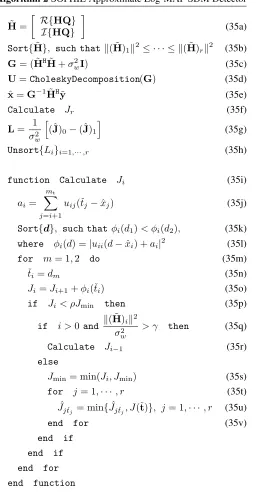
Algorithm 2SOPHIE Approximate Log-MAP SDM Detector
˜ H=
R{HQ} I{HQ}
(35a)
Sort{H˜}, such that ( ˜H)12≤ · · · ≤ ( ˜H)r2 (35b) G= ( ˜HHH˜ +σ2
wI) (35c)
U=CholeskyDecomposition(G) (35d)
ˆ
x=G−1H˜Hy˜ (35e)
Calculate Jr (35f)
L= 1
σw2
(ˆJ)0−(ˆJ)1 (35g)
Unsort{Li}i=1,···,r (35h)
function Calculate Ji (35i)
ai=
mt
j=i+1
uij(ˇtj−xˆj) (35j)
Sort{d}, such thatφi(d1)< φi(d2), (35k)
where φi(d) =|uii(d−xˆi) +ai|2 (35l)
for m= 1,2 do (35m)
ˇ
ti=dm (35n)
Ji=Ji+1+φi(ˇti) (35o)
if Ji< ρJmin then (35p)
if i >0 and ( ˜H)i
2
σ2w
> γ then (35q)
Calculate Ji−1 (35r)
else
Jmin= min(Ji, Jmin) (35s)
for j= 1,· · ·, r (35t)
ˆ
Jjˇtj = min{
ˆ
Jjˇtj, J(ˇt)}, j= 1,· · · , r (35u)
end for (35v)
end if end if end for end function
The orthogonal multi-carrier structure of our SDM-OFDM transceiver allows us to characterise the broadband frequency-selective channel considered as an OFDM subcarrier-related vector of flat-fading Channel Transfer Function (CTF) coeffi-cients. For each OFDM symbolnand subcarrierkthe MIMO channel is characterized by a (nr×mt)-dimensional matrix H[n, k] of the CTF coefficients associated with the different propagation links, such that the elementHij[n, k]of the CTF
matrixH[n, k]corresponds to the propagation link connecting the jth transmit andith receive antennas [12].
Consequently, our simulations were performed in the base-band frequency domain. We assume having a total base-bandwidth of 800kHz. The OFDM system utilises 128 orthogonal sub-carriers. For forward error correction (FEC) we use 12-rate
turbo coding [19] employing two constraint-length K = 3 Recursive Systematic Convolutional (RSC) component codes [22]. The octally represented RCS generator polynomials of (7,5) were used. The transmitted information bits are inter-leaved over 8 subsequent OFDM symbols. Furthermore, we employ the eight-path urban non-line-of-sight Bug Rayleigh-fading channel model characterised in [23]. We assumed a block-fading channel, having an OFDM-symbol-normalized Doppler frequency of 0.1. Finally, throughout this section we stipulate the assumption of perfect channel knowledge, where the knowledge of the frequency-domain subcarrier-related coefficients H[n, k] is deemed to be available in the receiver.
B. Complexity and Performance Analysis
The direct calculation of the complexity associated with
the SOPHIEof Algorithm 2 is somewhat challenging, since
the complexity is a random variable, which is a function of several parameters, such as the numbers mt and nr of the
transmit and receive antennas, the average SNR encountered as well as the values of the complexity-control parametersρ andγin Algorithm 2. Therefore, we statistically characterize the corresponding complexity using computer simulations.
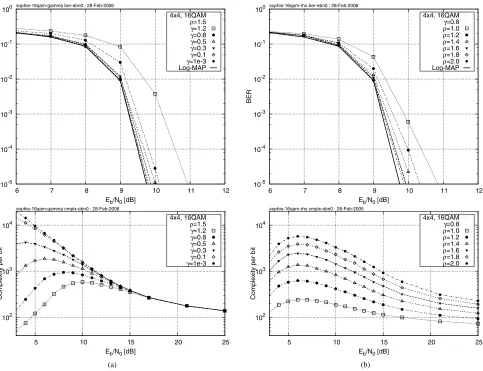
Fig. 2 characterises the achievable performance as well as the associated computational complexity exhibited by the
4×4 16QAM-SDM-OFDMsystem employing theSOPHIE
SDM detector of Algorithm 2. More specifically, we analyse the associated performance versus complexity trade-offs of using various values of the search radius factor and search resolution parametersρandγ, respectively. In Fig. 2(a) we can observe how the achievable BER performance (top) and the corresponding computational complexity depend on the value of the parameterγ. Using the results depicted in Fig. 2(a) we may conclude that the optimum choice of the search resolution parameter γ lies in the range of 0.5−0.8, where we have a minor BER versus SNR performance degradation of less than 0.5 dB, while achieving up to two orders of magnitude complexity reduction at low SNR values, when compared to the full-complexity SOPHIE algorithm assumingγ= 0.
On the other hand, Fig. 2(b) portrays both the achievable BER performance and the associated complexity of the 4×
4 16QAM-SDM-OFDM system for different values of the
search radius factor parameter ρ. We may conclude that the optimum trade-off between the attainable BER performance and the associated complexity is achieved, when the value of the search radius factor parameter ρ lies in the range of
1.3−1.5, where the BER performance degradation imposed does not exceed 0.5 dB, while the associated computational complexity is reduced by more than an order of magnitude, when compared to large values ofρ, such as for instanceρ=
2.0.
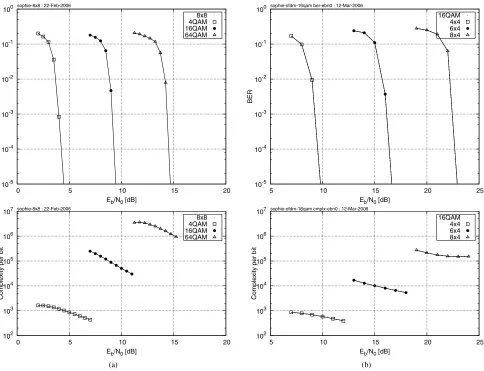
Furthermore, Fig. 4(a) demonstrates both the BER per-formance (top) and the associated computational complexity exhibited by the(8×8)4, 16 and 64QAM SDM-OFDM sys-tems employing the SOPHIESDM detector of Algorithm 2 and assuming ρ= 1.3,γ= 0.8.
[image:7.567.31.288.61.564.2]10-5 10-4 10-3 10-2 10-1 100
6 7 8 9 10 11 12
BER
Eb/N0 [dB] sophie-16qam-gamma ber-ebn0 : 28-Feb-2006
4x4, 16QAM ρ=1.5 γ=1.2 γ=0.8 γ=0.5 γ=0.3 γ=0.1 γ=1e-3 Log-MAP
102 103 104
5 10 15 20 25
Complexity per bit
Eb/N0 [dB] sophie-16qam-gamma cmplx-ebn0 : 28-Feb-2006
4x4, 16QAM ρ=1.5 γ=1.2 γ=0.8 γ=0.5 γ=0.3 γ=0.1 γ=1e-3
(a)
10-5 10-4 10-3 10-2 10-1 100
6 7 8 9 10 11 12
BER
Eb/N0 [dB] sophie-16qam-rho ber-ebn0 : 28-Feb-2006
4x4, 16QAM γ=0.8 ρ=1.0 ρ=1.2 ρ=1.4 ρ=1.6 ρ=1.8 ρ=2.0 Log-MAP
102 103 104
5 10 15 20 25
Complexity per bit
Eb/N0 [dB] sophie-16qam-rho cmplx-ebn0 : 28-Feb-2006
4x4, 16QAM γ=0.8 ρ=1.0 ρ=1.2 ρ=1.4 ρ=1.6 ρ=1.8 ρ=2.0
[image:8.567.43.526.52.423.2](b)
Fig. 2. Bit Error Rate(top) and the associatedcomputational complexity per detected bit(botom) exhibited by the4×416QAM-SDM-OFDMsystem employing theSOPHIESDM detector of Algorithm 2 and assuming different values of the search resolution and search radius parameters (a)γand (b)ρ, respectively. The abscissa represents the averageEb/N0 recorded at the receive antenna elements.
having a constant number ofnr= 4receive antenna elements in terms of its ability to detect the multiplexed signals ar-riving from various numbers of transmit antenna elements. Specifically, we aim for exploring the performance of the SOPHIE SDM detector in the overloaded system scenario, where the number of transmit antenna elements exceeds that of the receiver elements and thus we havemt> nr.
Indeed, the BER curves portrayed in Fig. 4 (top) confirm the near-Log-MAP performance of theSOPHIESDM detector of Algorithm 2 in both systems employing high-throughput mod-ulation schemes as well as in the rank-deficientoverloaded
system scenario.
Finally, Fig. 3 characterizes the computational complexity imposed by the SOPHIE SDM detector of Algorithm 2 as a function of the numbermt = nr of transmit and receive
antennas. More specifically, we consider three ranges of SNR values: low SNRs, the critical SNR, which corresponds to the “waterfall” region of the BER versus SNR curve, as well as high SNRs, which corresponds to the error-free detection region. In Fig. 3 we may observe that the computational com-plexity imposed by the SOPHIE detector increases according to a polynomial law as a function of the number of transmit antennas for both high and low SNRs.
100 101 102 103 104 105
2 4 6 8 10 12
Complexity
mt=nr
sophie-4qam-cmplx-fl : 12-Mar-2006
SNR=0dB SNR=4dB SNR=12dB ρ=1.3, γ=0.8
Fig. 3. Computational Complexity, imposed by the MIMO-OFDM system employing the SOPHIE SDM detector of Algorithm 2 and assumingρ= 1.3,
γ = 0.8. The complexity is quantified in terms of total number of real additions and multiplications as a function of the numbermt=nrof transmit and receive antennas.
IV. CONCLUSION
[image:8.567.306.529.481.624.2]detector proposed closely approaches the optimum perfor-mance of the Log-MAP detector while imposing a dramat-ically lower computational complexity. Our method is read-ily applicable to OFDM systems employing high-throughput modulation schemes, such asM-QAM. Additionally, the SO-PHIE detector may be employed in the over-loaded scenario, where the number of transmit antenna elements exceeds that of the receive antenna elements, while the associated compu-tational complexity increases only moderately even in heavily overloaded scenarios and is almost independent of the number of receive antennas. The method proposed maintains the near-optimal performance of the Log-MAP SDM detector even in the heavily over-loaded scenarios.
REFERENCES
[1] A. Goldsmith, S. A. Jafar, N. Jindal, and S. Vishwanath, “Capacity limits of MIMO channels,”IEEE J. Select. Areas Commun., vol. 21, no. 5, pp. 684–702, June 2003.
[2] U. Fincke and M. Pohst, “Improved method for calculating vector of short length in a lattice, including a complexity analysis,” Math. Comput., vol. 44, pp. 463–471, Apr. 1985.
[3] M. O. Damen, A. Chkeif, and J.-C. Belfiore, “Lattice code decoder for space-time codes,”IEEE Commun. Lett., pp. 161–163, May 2000. [4] B. Hochwald and S. ten Brink, “Achieving near-capacity on a
multiple-antenna channel,”IEEE Trans. Commun., vol. 51, no. 3, pp. 389–399, Mar. 2003.
[5] M. O. Damen, H. E. Gamal, and G. Caier, “On maximum-likelihood detection and the search for closest lattice point,”IEEE Trans. Inform. Theory, vol. 49, no. 10, pp. 2389–2402, Oct. 2003.
[6] D. Pham, K. R. Pattipati, P. K. Willet, and J. Luo, “An improved complex sphere decoder for V-BLAST systems,”IEEE Signal Processing Lett., vol. 11, no. 9, pp. 748–751, Sep. 2004.
[7] T. Cui and C. Tellambura, “Joint channel estimation and data detec-tion for OFDM systems via sphere decoding,” inProc. IEEE Global Telecommun. Conf., Nov.–Dec. 2004, vol. 6, pp. 3656–3660.
[8] ——, “Approximate ML detection for MIMO systems using multistage sphere decoding,”IEEE Signal Processing Lett., vol. 12, no. 3, pp. 222– 225, Mar. 2005.
[9] M. Damen, K. Abed-Meraim, and J.-C. Belfiore, “Generalised sphere decoder for asymmetrical space-time communication architecture,”
IEEE Electron. Lett., vol. 36, no. 2, pp. 166–167, Jan. 2000.
[10] T. Cui and C. Tellambura, “An efficient generalized sphere decoder for rank-deficient MIMO systems,”IEEE Commun. Lett., vol. 9, no. 5, pp. 423–425, May 2005.
[11] W. Zhao and G. Giannakis, “Sphere decoding algorithms with improved radius search,”IEEE Trans. Commun., vol. 53, no. 7, pp. 1104–1109, July 2005.
[12] L. Hanzo, M. Münster, B. J. Choi, and T. Keller,OFDM and MC-CDMA for Broadband Multi-User Communications, WLANs and Broadcasting. New York: John Wiley and IEEE Press, 2003.
[13] A. Wolfgang, J. Akhtman, S. Chen, and L. Hanzo, “Iterative MIMO detection for rank-deficient systems,” IEEE Signal Processing Lett., vol. 13, no. 11, pp. 699–702, Nov. 2006
[14] J. E. Gentle,Numerical Linear Algebra for Applications in Statistics. Berlin: Springer-Verlag, 1998.
[15] M. K. Varanasi, “Decision feedback multiuser detection: A systematic approach,”IEEE Trans. Inform. Theory, vol. 45, pp. 219–240, Jan. 1999. [16] C.-P. Schnorr and M. Euchner, “Lattice basis reduction: Improved practical algorithms and solving subset sum problems.” In Fundamen-tals of Computation Theory, pp. 68–85, 1991. [Online.] Available:
citeseer.ist.psu.edu/schnorr93lattice.html
[17] G. Valiente,Algorithms on Trees and Graphs. New York: Springer, 2002.
[18] A. Viterbi, CDMA: Principles of Spread Spectrum Communication. Reading MA: Addison-Wesley, 1995.
[19] L. Hanzo, T. H. Liew, and B. L. Yeap,Turbo Coding, Turbo Equalisation and Space-Time Coding. Chichester, UK; Piscataway, NJ, USA: John Wiley and IEEE Press, 2002. [Online.] Available: http:// www-mobile.ecs.soton.ac.uk
[20] R. D. Schafer,An Introduction to Nonassociative Algebras. New York: Dover, 1996.
[21] T. Moon and W. Stirling, Mathematical Methods and Algorithms for Signal Processing. Upper Saddle River, NJ: Prentice Hall, 2000.
[22] H. Holma and A. Toskala, eds., WCDMA for UMTS : Radio Access for Third Generation Mobile Communications. Chichester, UK: John Wiley and Sons, Ltd., 2000.
[23] S. Bug, C. Wengerter, I. Gaspard, and R. Jakoby, “Channel model based on comprehensive measurements for DVB-T mobile applications,” in
Proc. IEEE Instrumentation Measurements Technol. Conf., May 2001, vol. 1, pp. 544–548.
Jos Akhtman(M’00) received the B.Sc. degree in Physics and Mathematics in 2000 from the Hebrew University of Jerusalem, Israel. From 2000 to 2002 he was working as a Research Engineer in VYYO Ltd., Jerusalem, Israel. He is currently working towards the Ph.D. degree in the Communications Group, School of Electronics and Computer Science at the University of Southampton, UK. His major subject of interest is optimization algorithms for ad-vanced multi-antenna multi-carrier communication systems. Specifically, iterative channel estimation, detection, space-time processing and turbo transceiver architecture.
Andreas Wolfgang (M’03) was born in Germany, in 1977. He received the Dipl. Ing. degree in electrical engineering from Karlsruhe University of Technology, Karlsruhe, Germany, in 2003, and is currently pursuing the Ph.D. degree at the University of Southampton, Southampton, U.K. His primary research interests include wideband communication systems, iterative detection as well as nonlinear signal processing.
10-5 10-4 10-3 10-2 10-1 100
0 5 10 15 20
BER
Eb/N0 [dB] sophie-8x8 : 22-Feb-2006
8x8 4QAM 16QAM 64QAM
102 103 104 105 106 107
0 5 10 15 20
Complexity per bit
Eb/N0 [dB] sophie-8x8 : 22-Feb-2006
8x8 4QAM 16QAM 64QAM
(a)
10-5 10-4 10-3 10-2 10-1 100
5 10 15 20 25
BER
Eb/N0 [dB] sophie-ofdm-16qam ber-ebn0 : 12-Mar-2006
16QAM 4x4 6x4 8x4
102 103 104 105 106 107
5 10 15 20 25
Complexity per bit
Eb/N0 [dB] sophie-ofdm-16qam cmplx-ebn0 : 12-Mar-2006
16QAM 4x4 6x4 8x4
[image:10.567.42.526.52.423.2](b)
Fig. 4. Bit Error Rate(top) and the associatedcomputational complexity per detected bit(botom) exhibited by theSDM-OFDMsystem employing the
SOPHIESDM detector of Algorithm 2 and assumingρ= 1.3,γ= 0.8. (a)8×8system employing 4, 16 and 64 QAM, and (b) 16QAM system employing a fixed number of 4 receive antennas, as well as 4, 6 and 8 transmit antennas. The abscissa represents the averageEb/N0 recorded at the receive antenna elements.
Lajos Hanzo (M’91-SM’92-F’04) Fellow of the Royal Academy of Engineering, received his first-class degree in electronics in 1976 and his doctorate in 1983. In 2004 he was awarded the Doctor of Sci-ences (DSc) degree by the University of Southamp-ton, UK. During his career in telecommunications he has held various research and academic posts in Hungary, Germany and the UK. Since 1986 he has been with the Department of Electronics and Computer Science, University of Southampton, UK, where he holds the chair in telecommunications. He co-authored 15 books totalling 10,000 pages on mobile radio communications, published in excess of 700 research papers, organised and chaired conferences, presented various keynote and overview lectures and has been awarded
a number of distinctions. Currently he heads an academic research team, working on a range of research projects in the field of wireless multimedia communications sponsored by industry, the Engineering and Physical Sciences Research Council (EPSRC) UK, the European IST Programme and the Mobile Virtual Centre of Excellence (VCE), UK. He is an enthusiastic supporter of industrial and academic liaison and he offers a range of industrial courses. Lajos is also an IEEE Distinguished Lecturer of both the Communications as well as the Vehicular Technology Society, and is a Fellow of both the IEEE and the IEE. He is an editorial board member of the PROCEEDINGS OF THE