Rochester Institute of Technology
RIT Scholar Works
Theses
Thesis/Dissertation Collections
12-12-1975
Illuminated Porcelain Forms
Janet Kellner
Follow this and additional works at:
http://scholarworks.rit.edu/theses
Recommended Citation
ILLUMINATED PORCELAIN fORMS
8y
Janet R. Kellner
Candidate for the Master of fine Arts
iA the College of fine and Applied Arts
of the Rochester Institute of Technology
Advisors.
Hobart Cowles
Tarrant Clements
Thomas Kekic
ACKNOWLEDGEMENTS
For
the great many people who contributed tothis work in large ways and small.
Ingrid & Steven
Bogel,
Wendy Bond,
BonnieBuck,
Burnell Foam
Company,
Calgon,
IanCalvert,
TarrantA Jacque
Clements,
JackCohen,
HobartCowles,
Sandy
< BobCygan,
J. W.Dant,
Sandy Dwiggins,
ThomasA.
Edison,
EmpireElectric,
NinaGaby,
NinaGelardi,
Nancy Ghertner,
JeffGreenham,
Jim & Sue Halvorson <StRambler,
Judy Hanauer,
LisaHeller,
Pat &Barry
Hincks,
TomKekic,
Bob &Peg Kellner,
Wendy
Lewis,
Larry
Livolsi,
Jean & GeorgeMcDade,
Peter & AliceMcWalters,
Neko-chan,
StanNogaj
ofR,
F.
Communications,
Barbara J. Percy-The"Typing
Lady",
JanPettit,
LeonRussell,
RobertSchmitz,
HowardShapiro,
Yaffa
Sikorsky,
Judy
Salomon,
GeneStephens,
CarlTABLE
OFCONTENTS
PAGE
LIST OF
ILLUSTRATIONS
viSTUDY IN
TRANSLUCENCY
1RESOLUTION OF
FORMS
15IDEAS FOR THE
FUTURE.
,21
RESOURCE
INFORMATION
22LIST OF ILLUSTRATIONS
PAGE
FIGURE 1 iii
FIGURE 2 2
FIGURE 3 2
FIGURE 4 4
FIGURE
5 6FIGURE 6 8
FIGURE 7 12
FIGURE 8 12
FIGURE 9 13
FIGURE 10 13
FIGURE 11 1*
FIGURE 12 1^
FIGURE 13 1?
FIGURE 14 I7
FIGURE 15 I8
FIGURE 16 18
FIGURE 17 19
FIGURE 18 I9
FIGURE 19
20
Porcelain has a quality of
translucency
which isseldom used as a vehicle for illumination.
I was interested in
developing
this quality intolight
forms,
and upon the suggestion of Robert Schmitzbegan working with candle
lanterns.
I threw round pots,turned them upside
down,
used tools to carve the clay,pins to pierce the surface, and wax resist and a wet
sponge to thin certain areas.
Aesthetically
theselanterns were unpleasant and the heat from the candle was
so intense that all the globes cracked. Yet I discovered
a great deal about the manipulation of the clay in creat
ing
translucency.After the technical difficulties with the candle
globes, I felt that a small incandescent light bulb
shielded
by
a porcelain shell might not cause the problemsthat I had previously encountered.
By
using nylonflocking
wedged into the clay
body
I was able to roll very thinsheets of clay that could be handled without
tearing.
Idraped the thin pieces of clay over a bisque mold that was
used in conjunction with the mechanical part of a plastic
night-light.
By
using the actual fixture as a moldform,
I found it much easier to install the plastic part afterthe porcelain had been
fired.
Using
thethinning
techniquesI had employed in the candle globes, I found the porcelain
imagined.
Hairline
scratches inthe
clay, sulfates,lusters,
and decals were accentuated when the
night lights were
lit.
I
especially
enjoyedthe
subtle water color qualities of thesulfates
that
softened thelight.
At the same time
that
I wasdoing
these nightlights,
I
becamefascinated
withfabric
that had been soaked in slipand retained it's cloth-like quality after
firing.
I made aslip using Calgon as a
deflocculant
since I was told itwas suitable as an electrolyte, as it was a water softener.
I must have added too much Calgon to the slip
for
the firedmaterial had a
totally
glass-like surface and some portionswere
transparent.
Discovering
that the Calgon would fluxthe clay's surface was extremely helpful in later work.
I was more interested in the actual sculptural forms
of fiber and slip than in experiments with slips and
additions of dsf
locculants.
Therefore,
I used a commerciallyprepared white-burning slip that had a
firing
range fromcone 04 to cone
2.
I sewed small muslin bags of three tofour
inches inheight,
which I then soaked in slip andstretched over another identical plastic
bag
filled withperlite. Deflocculated slip contains less water and would
have less shrinkage and supposedly
help
eliminate crackingduring
drying. I also released perlite from the plasticbag
during
thistime.
The only place that cracks appearedwas at the stress points where the folds of cloth held a
1.
Calgon(Trademark)
i sodium hexameta phosphate(NaP03>6,
4
^7Wtmffi
r ;, .
...-'.'y-.-f
z
':
Fig.
4 White-burning cone02-4 commercial slip saturated In muslin bag. The perlite
stuffing fused
during
the firing. Size
[image:12.524.18.519.13.726.2]greater concentration of
slip. I
fired
these to cone 2and when the kiln was opened I was excited. The bags had
cracked.
There
was afragile
beauty
in these strangeshapes.
The
fused
perlite was caughtduring
its escapefrom the
bag.
I could nottell
if thesplitting was
caused
by
stress in the seams or whether the perlite hadexpanded and cracked the surface, since it had not burned
out as I though it would. I also tested a nylon stocking
stuffed with perlite and painted with slip.
These
stockingshapes were paper thin but on the whole, displayed less
cracking than the muslin.
I considered the possibilities of using translucent
porcelain and
fiberglass
bags,
so I purchased a commercialporcelain,
Bell's
cone 6 White Orchid casting slip, andsewed the
fiberglass
bags.
The muslin had been so fragileand I knew that
fiberglass
wouldfuse.
I hoped it wouldstrengthen the structure. I repeated the same procedure of
sewing fiberglass
bags,
plastic bags and using perlite as afilling.
This
time there was more surface cracking. HobartCowles
reminded me that porcelain slip would have morefragility
than the slip I had previously used. Upon hisrecommendations, I tested flint to
help
cut down theshrinkage, and binders to toughen the clay.
Testing
from5 to
25%
flint added to the slip, I found some reductionI settled on
15%
flint
as aregular addition to porcelain
slip. I experimented with
binders
such asPolyox, Glutrin,
Karo syrup and starch.
For
my purposes
the Karo
wasbest.
It
made the elipslightly runny
sothat
it would easilyspray through the
spray
gun and did harden the clay.The
Polyox is worth
mentioning
since itturned
the slip to agummy, sticky, and somewhat stretchable clay, which could
be a study in
itself.
Even
with the additions offlint
and Karo syrup the slip cracked on the
bags,
but I decidedto fire them anyway. I used an electric
kiln,
fired tocone 2 even though it was a cone 6 slip.
Starting
thesetests at cone
2,
I found theforms
vitreous and translucentwith only a slight slumping, but at cone 6 the forms
flattened completely.
Interestingly
enough, the fiberglassfused
and sealed the cracksleaving
a solid but stillfragile bag.
Thedrapery
fiberglass used washeavily
textured,
a quality I founddistracting
and thefragility
made
it impractical.
Any
of the bags over six inches inheight collapsed
during
thefiring
cycle, so size was alimitation.
I did complete several which were mounted onplexiglas boxes and illuminated with a seven watt, Christmas
tree,
lightbulb.
I needed alternatives. I wanted to create
larger,
more
interesting
and more durable shapes. I came acrosssome non-reticulated, urethane foam
(l/8
inchthick)
thathad been given to me
by
a student. This thin sheeting wasused
to
pack delicateinstruments.
I
sewed and tested itthe way I had the other materials. I noticed it stretched
as
I
pulledit
over thebag
mold and I haddifficulty
pokingholes in it with my
fingers.
There
was no cracking apparentin the
drying.
The
foam seemed to contract as the porcelainslip contracted. Needless to say I was excited and proceeded
to fire
it.
It held together excellently.After a month of searching, I found the foam and began
sewing like mad.
This
time the forms weredifferent.
Mostwere from 10 to 16 inches tall and resembled asparagus stalks,
having
more exaggerated bulboustops.
As I was pulling theseover the plastic forms I was poking too many holes in the
surface.
Larry
Livolsi suggested using the air compressorto
blow-up
the bags. With thehelp
of IanCalvert,
weconstructed a Y-shaped hose unit. One of the hoses went into
the
bag
shape and the other into the spray gun.Using
aplastic
bag
tied over thehose,
I pulled the slip-saturatedfoam over the plastic and turned on the air.
To
prevent theballoon from exploding, I pierced the plastic and a steady
stream of air maintained the expanded shape. I also sprayed
slip onto the surface to secure a stronger
form.
The bagsdried with no apparent cracking and the surface was almost
as hard as a bisque pot. The
day
before myfiring
I sprayedthe surfaces with Calgon and water, using 20 ml. of Calgon
to
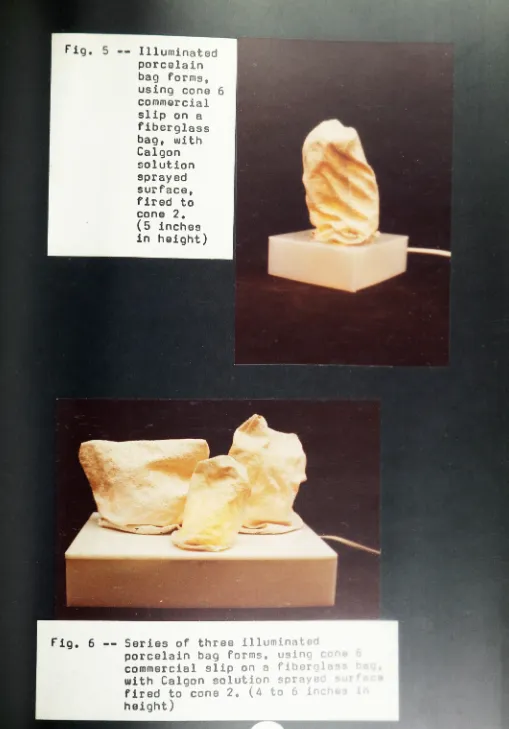
100 ml. of water. I had been getting a satin matte surfaceFig.
5Illuminated
porcelain
bag
forms,
using cone 6 commercial
solution
Fig.
6 -- Series of three illuminatedporcelain
bag
forms,
using cccommercial slip on a fiberql
with Calgon solution spray
fired to cone
2.
(4
to 6 in [image:16.524.8.517.10.739.2]Stacking
the 16
cubicfoot,
Alpine
kiln provedto be
an
interesting
experience.I
propped
many
of the pieces upwith soft fire brick and stuffed others with
Fibrefrax,
aCarborundum
Corporation
product used forinsulating
kilns.
After the cone 2 oxidation
firing,
I opened the door of thekiln to find
every
piecelying
in a pile on theshelf.
As
I sorted
through
thewreckage,
I found several bulbs thatwere still
intact despite their
drop
to thefloor.
Theseams were split,
exposing
theinterior
wall ofclay that
resembled the texture of the
foam.
As
I examined the shards,I
realized thathairline
cracks must have occurred, and without the support of
fiberglass
the structure crumbled. I didsave a few that were in recognizable pieces to photograph as
a record of my
tests.
At that point I
felt
the only alternative was to combinefoam and
fiberglass.
There
was a possibility the foam withits elastic quality and the
fiberglass
with its fusion couldwork
together.
My
new sewn forms were foam with afiberglass
liner.
Again I soaked thebags,
blew them up, sprayed slipand
fired
them in an electric kiln. I chose the electrickiln
thinking
that the radiant heat would not be as hard onthe pieces as the direct flame of the gas kiln had been.
The fiberglass
held up, but the foam pulled away and lookedlike
peeling paint. Despite theirfragility,
I kept severalof the forms that pleased me.
saved
didn't
seem of much use to me.Looking
through thebook
Nature
As Designerby
Butel
Bager
forinspiration,
I began to sketch plant-likeforms.
Using hand-building
techniques and wheel
throwing,
I constructed porcelain andearthenware tree trunk shapes. One particular piece was
thrown in sections with porcelain and resembled a horn.
Others were coil constructed earthenware bases that bloated
and split apart in the
firing.
The recycled earthenware Iused was over-vitrified at cone 5 and should have been fired
at a lower
temperature.
I left a pattern of holes in thesetrunk-like bases since I intended to use metal
tubing
asbranches and to cap each branch with a light bulb and shade.
Suzanne Halvorson had suggested using vegetable shapes as
shades. The idea appealed to me and I made plaster molds
of every strange squash I could
find.
The thin porcelainshades were exciting and I could envision these all working
together.
However I decided not to pursue these formsbecause of the whole range of electrical problems inherent
in my
designs.
I decided to take an ordinary clay
box,
push holesin the sides and then force thin sheets of clay through
the openings from the inside. I began with porcelain
boxes,
earthenware and raku. After I had fired the earthenware
in sawdust and the porcelain to cone
10,
the difference inshrinkage was so vast that the porcelain inserts did not
cover the holes even though shrinkage had been considered.
I had wanted to work with
two
different
claybodies
using
the
contrasting
elements ofeach. I
found
some contrastin using Jane
Peiser's
additionsfor
colored porcelain.All
the colors, exceptgreen,
weretranslucent
when thecolorants were used with the
Cornell
porcelain.The
glazed
portions of these colored clays combined with
light,
presenteda vivid
image.
Glazing
was not essential indetermining
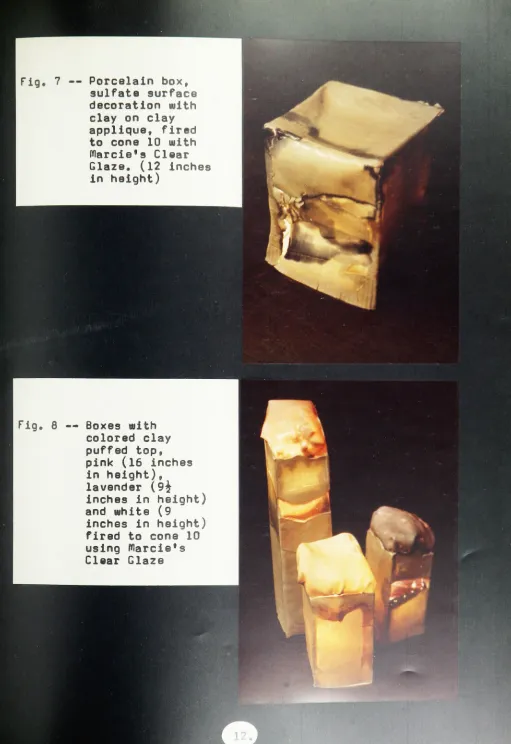
Fig. 7 Porcelain
box,
sulfate surface decoration with
clay on clay
applique, fired to cone 10 with
Marcie's Clear Glaze.
(12
inchesin
height)
Fig.
8 Boxes with colored clay puffedtop,
pink
(16
inches inheight),
lavender
(9^
inches in
height)
and white
(9
inches in
height)
fired to cone 10
using Marcie's
[image:20.524.6.517.7.751.2]Fig. 9 Porcelain shapes
using urethane
foam forms
impregnated with commercial cone 6
slip and sprayed with Calgon
solution and
fired to cone
2.
The ba3a is
uncooked tapioca
adharad to the
surface.
(16
inches in
height)
Fig.
10 Datail of Figure9,
tha taxture of the
foam is evident in
tha interior of the
[image:22.524.8.521.10.729.2]Fig.
11 Porcelainstructures
using urethane foam lined with
fiberglass,
then soaked with commercial
cone 6 slip, sprayed with
Calgon solution
and fired to cone
2.
Stuffed
quilted muslin
[image:23.524.11.516.15.729.2]While I had foam
bag
pieces stillhiding
on myshelves and the
horn-shaped
forms gathering dust inthe corner, Tom Kekic came to see me. He ignored my
recent
boxes,
and examined the foam shapes recommendingthat these become part of environments inside plastic
boxes.
Rather than putting the light inside the clay,the light could be directed from underneath each assemblage.
I gathered all the bags together and designed clear plexi
glass boxes that would fit into black plastic bases.
The very first foam asparagus shapes were glued
to the base with silicone glue and at the suggestion of
Nina
Gaby,
I used tapioca to build up the floor around thegrouping which is illuminated
by
two miniature fluorescentlamps.
Each group presented different problems. The
combination foam and fiberglass
family
seemed to fit intoa muslin quilt with small cloth puffs growing around the
porcelain. The cloth and clay have much the same warm
color when illuminated.
Using
fluorescent lights whichare cool
burning
helped eliminate the need for ventilationin the base.
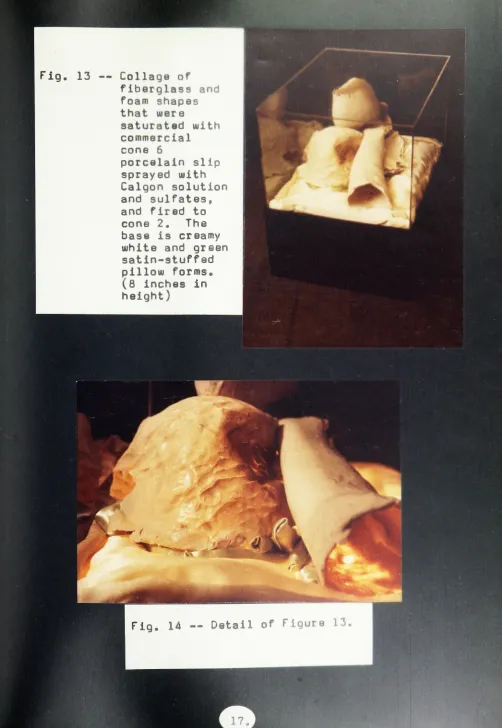
Another collage of clay that had been sprayed with
Calgon and sulfates demanded a satin base to complement
the satin surface of the piece. With each environment
I could not
help
alluding to images of similar cloth shapesgrowing around the clay.
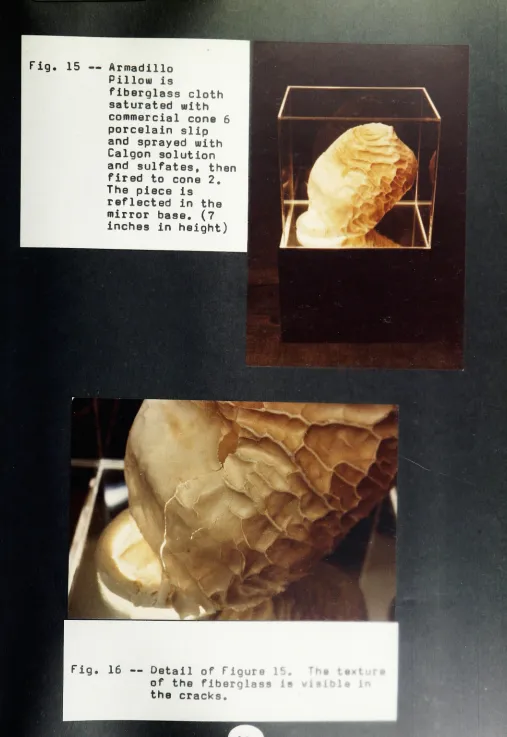
Armadillo Pillow
is afond
namefor
a piece thatis simply mounted on a mirror.
The
clay has crackedinto scale-like shapes which are supported
by
delicatefibers of glass.
The
porcelainhorn-shaped
forms were stilldemanding
some consideration.
Luckily
I had not thrown these awaywhen the original idea had not worked. A thin sheet of
porcelain formed into a puff and fit into the
top
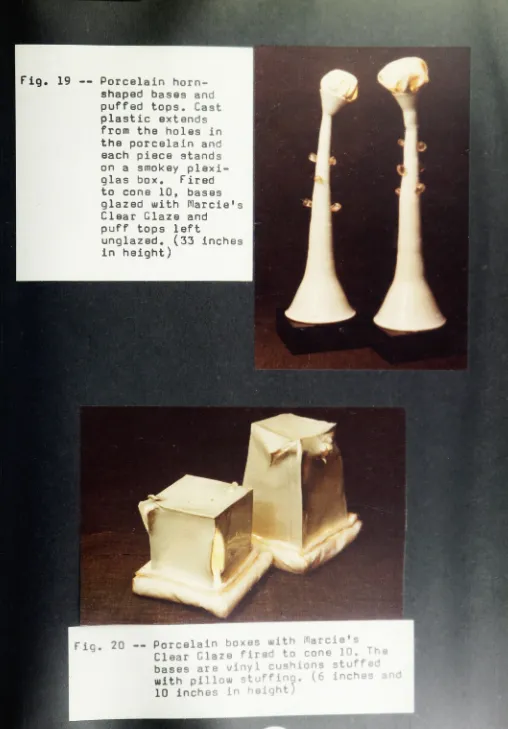
of thehorn solved one problem. Later clear cast resin extrusions
were inserted into the existing
holes.
A light in thetop
and one on the smoky plexiglas base completed the
form.
Since I used incandescent lights in these pieces, I was
concerned about heat build up. The pieces were tested
for heat
during
eight to twelve hour cycles with noapparent problems except that the clay became quite warm
to the
touch.
Selecting
the three boxes to represent this studywas more difficult than I had thought. The construction
of the proper bases was the problem. Two of the porcelain
boxes have soft bases of vinyl stuffed with pillow stuffing
and the third has no visible base. I am not entirely pleased
with these solutions and feel the need for further considera
Fig.
13 -- Collage of fiberglass andfoam shapes
that were
saturated with
commercial cone 6
porcelain slip
sprayed with
Calgon solution
and sulfates,
and fired to cone
2.
Thebase is creamy
white and green
satin-stuffed pillow
forms.
(8
inches inheight)
V
0
[image:26.524.11.513.15.743.2]Fig.
15Armadillo
Pillow isfiberglass
clothsaturated with
commercial cone 6
porcelain slip
and sprayed with
Calgon
solutionand
sulfates, then
fired
to cone2.
The piece is
reflected in the
mirror
base.
(7
inches
inheight)
mmm
Hi
i wmm . SffiBHSHn wbS9Fig.
16 Detail of Figureof the fiberglass
the cracks.
text
[image:27.524.9.516.7.744.2]Fig.
17 Urethane foamwas
impregnated
with cone 6
commercial
porcelain slip
and sprayed
with Calgon
solution, then
fired to cone 2
(7
inches inheight)
Fig. 18 Another view of Figure 17.
[image:28.524.8.514.13.738.2]Fig.
19 Porcelain horn-shaped bases and puffed tops. Cast plastic extends from the holes in the porcelain and each piece standson a smokey plexi-glas box. Fired to cone
10,
basesglazed with Marcie's Clear Glaze and
puff tops left
unglazed.
(33
inches inheight)
f|ll|f
^
J
f
Fig. 20 Porcelain boxes with Marcie s
[image:29.524.8.516.10.739.2]In the summer
(1975)
HowardShapiro,
a visitinginstructor at
R.I.T.,
gave us the problem of constructingclay baskets. I attempted a large
(22
inch)
wheel-builtbasket. I had planned to complete it with a neon handle. I
thinned the inside of the pot to form canals opposite one
another that would conduct the neon
tubing
to the transformerin the base. The canals would
hopefully
be translucent andone would be able to see the neon through the walls of the
clay.
Unfortunately
the glaze crawled and holes in thebottom sealed
by
excess glaze pooling in the bottom. Theneon-lighted basket is a problem I still wish to solve.
Large forms in porcelain with neon present a real challenge
to me.
Neon's
flexibility
and coolburning
qualities provokea multitude of ideas. When the problems of containing light
in the combination clay-foam sculpture is resolved, neon will
be the perfect complement to the forms.
As a result of my work in illuminated sculptures, I have
discovered some challenges for the future.
I would like to explore the possibilities
of illuminated
wall plaques and resolve the effective use of colored clays in
conjunction with light.
The thesis involvement has shown me that the results
are not the end but only stimulus for the future.
Cornell
Porcelain Cone 9-10Grolleg
China
Clay..
55 poundsFlint
12 poundsCuster Feldspar
....20 poundsPyrophyllite ..13 pounds
Jane Peiser's additions for colored clays
pink.
8%
commercial pink stain(Standard
CeramicCo.)
yellow ...8# commercial Naples yellow stain
Standard Ceramic
Co.)
I!
yellow only in oxidation)green. ,.,$% green chrome oxide
blue...
,%% to 1? cobalt carbonateor
2.3$
blue stain(Standard
CeramicCo.)
lavender.
5%
pink stain and%%
cobalt carbonateSulfates - grams added to 100 cc. cool water
cobalt sulfate 42.26 grams
copper sulfate...25.00 grams
chromium sulfate 12.35 grams
iron sulfate 32.90 grams
manganous sulfate... ....67.76 grams
nickel chloride.... 42.46 grams
Marcie's Clear
GlazeCone
9-10(better
at10)
Cornwall
Stone.,..
20 gramsSpodumene 18 grams
Dolomite.
.. 20 gramsEdgar
PlasticKaolin....
10 gramsGeorgia Kaolin 10 grams
Flint
25 gramsFrit
3191... . 5 gramsWhite Orchid Porcelain
Slip
- Cone 6Bell Ceramics
P.O.
Box 697Clermont,
Florida 32711To purchase in quantity
Dollman Ceramic Supplies 663 walden Avenue
Buffalo,
New York Phonei(716)
894-0084Glutrint Robeson
Processing
Company
Erie,
PennsylvaniaPolyoxt Union Carbide Corporation
Chemicals & Plastics
270
Park AvenueNew
York,
N.Y. 10017Buffalo Officei
(716)
837-6450Nylon
flockingiCraft
Service
337
University
Avenue
Rochester,
New York 14607Phonei
325-5547
Fiberglassi
(cloth
and chopped strand)Penfield Chemical
Products64
Whitney
RoadPenfield,
New YorkPhones
566-5461
Plexiglas
boxesi(made
according to specifications) Wards Plastic Center Incorporated556 Lyell Avenue
Rochester,
New YorkPhonei 458-3227
Glaze stainst Standard Ceramic
Supply
Company
P.
0.
Box 4435Pittsburgh,
Pennsylvania 15205Calgon -
Test
by
volume SurfaceQuality
10 ml Calgon to 100 ml water - slight gloss
20 ml Calgon to 100 ml water - satin matte
BIBLIOGRAPHY
Bager,
Butel,
Nature AsDesigner,
Van NostrandReinhold
Company,
NewYork,
1966