and Proof Techniques
.
White Rose Research Online URL for this paper:
http://eprints.whiterose.ac.uk/95289/
Version: Accepted Version
Article:
Brucker, A.D., Brügger, L. and Wolff, B. (2015) Formal Firewall Conformance Testing: An
Application of Test and Proof Techniques. Software Testing, Verification and Reliability, 25
(1). pp. 34-71. ISSN 0960-0833
https://doi.org/10.1002/stvr.1544
This is the peer reviewed version of the following article: Brucker . D., Brügger L., and
Wolff B. (2014), Formal firewall conformance testing: an application of test and proof
techniques, Softw. Test. Verif. Reliab., 25, 34–71,, which has been published in final form
at http://dx.doi.org/10.1002/stvr.1544. This article may be used for non-commercial
purposes in accordance with Wiley Terms and Conditions for Self-Archiving
(http://olabout.wiley.com/WileyCDA/Section/id-820227.html#terms).
[email protected] https://eprints.whiterose.ac.uk/ Reuse
Unless indicated otherwise, fulltext items are protected by copyright with all rights reserved. The copyright exception in section 29 of the Copyright, Designs and Patents Act 1988 allows the making of a single copy solely for the purpose of non-commercial research or private study within the limits of fair dealing. The publisher or other rights-holder may allow further reproduction and re-use of this version - refer to the White Rose Research Online record for this item. Where records identify the publisher as the copyright holder, users can verify any specific terms of use on the publisher’s website.
Takedown
If you consider content in White Rose Research Online to be in breach of UK law, please notify us by
c 2014 W ile y. This is the author’ s version of the w ork. It is posted at http://www .bruck er .ch/ bibliograph y/abstract/bruck er .ea- formal- fw- testing-2014 by permission of W ile y for your personal use. Not for redistrib ution. The definiti ve version w as published in Softwar e T esting , V erification & Reliability (STVR) , pp. 1– 38 ,2014, doi: 10.1002/stvr .1544 .
Published online in Wiley InterScience (www.interscience.wiley.com). DOI: 10.1002/stvr
Formal firewall conformance testing: an application of test and
proof techniques
Achim D. Brucker
1,∗,†, Lukas Brügger
2and
Burkhart Wolff
31SAP SE, Vincenz-Priessnitz-Str. 1, 76131 Karlsruhe, Germany 2
Information Security,ETHZurich, 8092 Zurich, Switzerland
3Université Paris-Sud, Laboratoire de Recherche en Informatique (LRI, Bât 650), 91893 Orsay Cedex, France
SUMMARY
Firewalls are an important means to secure critical ICT infrastructures. As configurable off-the-shelf
products, the effectiveness of a firewall crucially depends on both the correctness of the implementation itself as well as the correct configuration. While testing the implementation can be done once by the manufacturer, the configuration needs to be tested for each application individually. This is particularly challenging as the configuration, implementing a firewall policy, is inherently complex, hard to understand, administrated by different stakeholders and thus difficult to validate. This paper presents a formal model of both stateless
and stateful firewalls (packet filters), including NAT, to which a specification-based conformance test
case generation approach is applied. Furthermore, a verified optimisation technique for this approach is presented: starting from a formal model for stateless firewalls, a collection of semantics-preserving policy transformation rules and an algorithm that optimizes the specification with respect of the number of test cases required for path coverage of the model are derived. We extend an existing approach that integrates verification and testing, that is, tests and proofs to support conformance testing of network policies. The presented approach is supported by a test framework that allows to test actual firewalls using the test cases generated on the basis of the formal model. Finally, a report on several larger case studies is presented.
Copyright c2014 John Wiley & Sons, Ltd.
Received 6 August 2012; Revised 24 June 2014; Accepted 16 July 2014
KEY WORDS: model-based testing; conformance testing; security testing; firewall; specification-based
testing; testing cloud infrastructure; transformation for testability;HOL-TESTGEN; test
and proof; security configuration testing
1. INTRODUCTION
Because of its connected life, the modern world is increasingly depending on secure implementa-tions and configuraimplementa-tions of network infrastructures. As building blocks of the latter, firewalls are playing a central role in ensuring the overallsecurityof networked applications.
Firewalls, routers applying NAT and similar networking systems suffer from the same quality problems as other complex software. Jennifer Rexford mentioned in her keynote atPOPL2012 that high-end firewalls consist of more than 20 million lines of code comprising components written in Ada as well as LISP. However, the testing techniques discussed here are of wider interest to all network infrastructure operators that need to ensure the security and reliability of their infrastructures across system changes such as system upgrades or hardware replacements. This is because firewalls and routers are active network elements that can filter and rewrite network traffic based on configurable rules. Theconfigurationby appropriate rule sets implements a security policy or links networks together.
Thus, it is, firstly, important to test both the implementation of a firewall and, secondly, the correct configuration for each use. While the former can be done once and for all by the firewall vendor, the latter needs to be done by the customer for each and every installation. In practice, an extensive compliance test of firewall configurations is often neglected, even if the security risk of wrong configurations is high:
NSA found that inappropriate or incorrect security configurations (most often caused by
configuration errors at the local base level) were responsible for 80 percent of Air Force
vulnerabilities. [16, p. 55]
A particular variant of configuration testing is the test ofcollections of firewalls and routers for their combined behaviour. This is an important scenario for at least two different reasons: first, the security of cloud offerings (for any variant of cloud computing, for example, infrastructure-as-a-service, platform-as-a-infrastructure-as-a-service, software-as-a-service) relies on securely separated network segments and thus on correctly configured routers and firewalls. Consequently, the approach discussed in this paper is applicable to any cloud data centre and can support any cloud company in offering secure services to their customers. Second, firewall policies change over time, sometimes modified by different administrators, who may belong todifferentstake-holders enforcing their own security interests. Depending on the concrete testing scenario, a firewall policy can play the role of a program (‘Does a firewall interpret its configuration file correctly?’) or the role of a policy specification (‘Is protocolxpossible fromatob?’). For both implementation integration tests as well as configuration tests, the technique presented in this paper can be used to generate runtime testers used in ‘hardware-in-the-loop’ scenarios during installation and maintenance.
Several approaches for the generation of test cases are well known: while unit-test-oriented test generation methods essentially use preconditions and post-conditions of system operation specifications,sequence-test-oriented approaches essentially use temporal specifications or automata based specifications of system behaviour. Usually, firewalls combine both aspects: whereas firewall policies are static, the underlyingnetwork protocolsmay depend on protocol states which some policies are aware of. This combination of complexity and criticality makes firewalls a challenging and rewarding target forsecurity testingin the sense of theISO29199 specification [29, Section 4.36], that is, conformance testing of security properties. While there is an overlap of the detectable vulnerabilities, this form of conformance testing complements penetration testing approaches that simulate an attacker trying to circumvent security infrastructures.
In this paper, a formal model of firewall policies as packet filtering functions or transformations over them in HOLis presented. Thus, the presented approach can cover data-oriented as well as temporal security policies. On the basis of this formal model,HOL-TESTGEN[7,11] automatically generates abstract test cases. From the latter, concrete test driver can be derived that can be used for both testing firewall implementations as well as network configurations.
While applying HOL-TESTGEN ‘out-of-the-box’ to these kind of model works for smaller policies, it does not scale well to policies of practically relevant size, that is, common rule sets with several hundred rules in medium-sized company networks. The situation is particularly worsened if the underlying state is evolving over time (as in stateful firewalls). To overcome this technical difficulty, a policy transformation strategy that transforms a given policy into a functionally equivalent one while improving the effectiveness of test generation by orders of magnitude is developed. The theorem-prover-based approach allows both to formally prove the correctness of this policy transformation, as well as integrating it into the symbolic computations ofHOL-TESTGEN.
Summing up, this paper has the following main contributions:
1. a formal model of stateless and stateful firewall policies, instantiating the generic Unified Policy Framework (UPF) [12],
2. a specification-based test generation approach that can be used for testing the correctness of firewall implementations as well as testing that a concrete configuration of a network complies to a given policy specification,
4. a combination of unit and sequence test strategies, providing an efficient test technique for stateful firewalls, and
5. a domain-specific test tool built on top of HOL-TESTGEN that increases the degree of automation as well as the effectiveness ofHOL-TESTGEN. This test tool provides an infra-structure for test execution and tracing on real firewalls and networks.
This paper extends the previous work of the authors [6, 8, 10, 13, 14] in several aspects: first, partial solutions previously modelled directly in HOLare integrated in the UPF, which allows to highlight common principles. Second, the firewall policy model is extended significantly to include different network models (address representations) as well as pervasive support of NAT. Third, an investigation on the role of the optimisation on the equivalence classes underlying the test generation is added. And, finally, an empirical evaluation covering various aspects of the optimized test generation procedure is provided.
The rest of the paper is structured as follows: after an introduction of the preliminaries, that is, Isabelle/HOLand theHOL-TESTGENapproach (Section 2), we discuss the formal model of stateless firewall policies inSection 3. InSection 5we extend this model to stateful firewall policies.Section 4
presents the transformation of stateless firewall policies and discusses its effect on the underlying equivalence classes. Before the discussion of empirical results inSection 7, we describe our domain-specific test framework in Section 6. Finally, we discuss related work and draw conclusions in
Section 8.
The presented domain-specific test tool as well as all proofs and examples presented in this paper are part of the HOL-TESTGEN distribution, which can be downloaded from the website:
http://www.brucker.ch/projects/hol-testgen/.
2. FORMAL AND TECHNICAL BACKGROUND
2.1. Isabelle and higher-order logic
Isabelle [34] is agenerictheorem prover. New object logics can be introduced by specifying their syntax and natural deduction inference rules. Among other logics, Isabelle supports first-order logic, Zermelo-Fraenkel set theory and the instance for Church’s higher-order logic HOL, which is the basis ofHOL-TESTGEN and which is introduced in this section. Moreover, Isabelle is also a generic system framework (roughly comparable with Eclipse) which offers editing, modelling, code generation, document generation and (as mentioned) theorem proving facilities, to the extent that some users use it just as programming environment forSMLor to write papers over checked mathematical content to generate LATEX output. Many users know only the theorem proving language Isar for structured proofs and are more or less unaware that this is a particular configuration of the system, that can be easily extended. This is what the HOL-TESTGENsystem underlying this work technically is: an extended Isabelle/HOLconfiguration providing specialized commands for a document-centric model-based test generation method.
Higher-order logic(HOL) [2,17] is a classical logic based on a simple type system. It provides the usual logical connectives such as _∧_, _→_,¬_ as well as the object-logical quantifiers∀x. P x
and ∃x. P x; in contrast to first-order logic, quantifiers may range over arbitrary types, including total functionsf::α⇒β.HOLis centred around extensional equality _=_::α⇒α⇒bool.HOL is more expressive than first-order logic, because, for example, induction schemes can be expressed inside the logic. Being based on a polymorphically typed λ-calculus, HOL can be viewed as a combination of a programming language such as SML or Haskell, and a specification language providing powerful logical quantifiers ranging over elementary and function types.
For example, typed sets are built in the Isabelle libraries conservatively on top of the kernel ofHOL as functions tobool; consequently, the constant definitions for set comprehension and membership are as follows (to increase readability, the presentation is slightly simplified):
type_synonym αset =α⇒bool
definition Collect :: (α⇒bool)⇒αset — set comprehension
where Collect S =S
definition member ::α⇒αset⇒bool — membership test
where member s S =S s
(1)
Isabelle’s powerful syntax engine is instructed to accept the notation{x|P}forCollect λ x. Pand
the notations∈Sformember s S. As can be inferred from the example, constant definitions are axioms that introduce a fresh constant symbol by some closed, non-recursive expressions; these types of axioms are logically safe because they work like an abbreviation. The syntactic side conditions of the axioms are mechanically checked, of course. It is straightforward to express the usual operations on sets such as _∪_,_∩_::αset⇒αset⇒αset as conservative extensions, too, while the rules of typed set theory are derived by proofs from these definitions.
Similarly, a logical compiler is invoked for the following statements introducing the types option and list:
datatype αoption = None|Someα
datatype αlist = Nil|Cons α(αlist) (2)
Here, [] and a#l are alternative syntax for Nil and Cons a l; moreover, [a, b, c] is defined as alternative syntax for a#b#c#[]. Similarly, the option type shown previously is given a different notation:αoptionis written asα⊥,Noneas⊥, andSomeX asxXy. Internally, recursive datatype definitions are represented by type- and constant definitions. Besides theconstructorsNone,Some, NilandCons, the aforementioned statement defines implicitly the match-operationcase xof ⊥ ⇒
F |xay⇒G a, respectively,case xof []⇒F |(a#r)⇒G a r. From the internal definitions (not shown here), many properties are automatically derived like distinctness[]6=a#t, injectivity of the
constructors or induction schemes. Finally, there is a parser for primitive and well-founded recursive function definition syntax. For example, thesortoperation can be defined by
fun ins :: [α:: linorder, αlist]⇒αlist
where ins x[ ] = [x]
ins x(y#ys) = ifx < ythenx#y#yselsey#(ins x ys)
(3)
fun sort :: (α:: linorder) list⇒αlist
where sort [ ] = [ ]
sort(x#xs) = ins x(sortxs)
(4)
which is again compiled internally to constant and type definitions. Here,α:: linorderrequires that the typeαis a member of thetype classlinorder. Thus, the operationsortworks on arbitrary lists of type(α:: linorder) liston which a linear ordering is defined. The internal (non-recursive) constant definition for the operations insand sortis quite involved and requires a termination proof with respect to a well-founded ordering constructed by a heuristic. Nevertheless, the logical compiler will finally derive all the equations in the aforementioned statements from this definition and makes them available for automated simplification.
On these conservative definition principles, the Isabelle/HOLlibrary provides a large collection of theories such as sets, lists, Cartesian products α×β and disjoint type sumsα+β, multisets, orderings and various arithmetic theories, which only contain rules derived from conservative definitions.
The theory of partial functions is of particular importance for this paper. As prerequisite, we introduce the function p_q:α
⊥ ⇒α as the inverse of x_y (unspecified for ⊥). Partial functions
dictionaries; theemptymap is defined by⊘ ≡λ x.⊥, and the update operation, writtenp(x7→t), by
λ y. ify=xthenxtyelsep y. Finally, the override operation on maps, writtenp1⊕p2, is defined by
λ x. casep1xof⊥ ⇒p2x|xXy⇒xXy. This definition incorporates a first-fit-strategy, while the standard Isabelle/HOLoperator _++_ implements a last-fit strategy.
Finally, Isabelle/HOLmanages a set ofexecutable types and operators, that is, types and operators for which a compilation toSML, OCaml, Scala, or Haskell is possible. Setups for arithmetic types such as int have been done; moreover, any datatype and any recursive function is included in this executable set (providing that they only consist of executable operators). Similarly, Isabelle manages a large set of (higher-order) rewrite rules in which recursive function definitions are included. The Isabelle simplifier provides also a highly potent procedure for computing normal forms of specifications and deciding many fragments of theories underlying the constraints to be processed when constructing test theorems.
2.2. The HOL-TestGen workflow and system architecture
HOL-TESTGEN(Figure 1) is an interactive, that is, semi-automated, test tool for specification-based tests built upon Isabelle/HOL. While Isabelle/HOLis usually seen as ‘proof assistant’, it is used in this context as a document centric modelling environment for the domain specific background theory of a test (thetest theory), for stating and logically transforming test goals (thetest specifications), as well as for the test generation method implemented by Isabelle’s tactic procedures. In a nutshell, the test generation method consists of the following:
1. atest case generationphase, which is essentially an equivalence partitioning procedure of the input/output relation based on aCNF-like normal form computation,
2. atest data selectionphase, which essentially uses a combination of constraint solvers using random test generation and the integratedSMT-solver Z3 [18],
3. a test execution phase, which reuses the Isabelle/HOL code generators to convert the instantiated test cases to test driver code that is run against a firewall or a network.
[image:6.595.123.471.471.670.2]A detailed account on the symbolic computation performed by the test case generation and test selection procedures is contained in [7]; its description in detail is out of the scope of this paper. For the remainder of this paper, a high-level view suffices: the test case generation is anequivalence partitioningmethod combined with a variable splitting technique that can be seen as an(abstract) syntax testingin the sense of theISO29199 specification [29, Sec. 5.2.1 and 5.2.4].
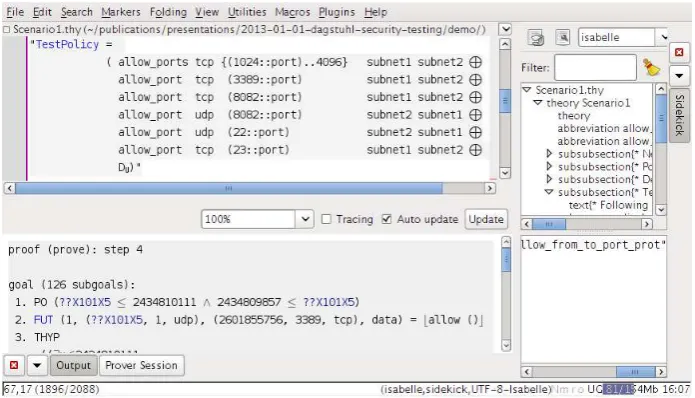
Figure 1. AHOL-TESTGENsession showing the jEdit-based Isabelle Interface. The upper-left sub-window
The equivalence partitioning separates the input/output relation of a programme under test (PUT), usually specified by pre-conditions and post-conditions, into classes for which the tester has
reasons to believe thatPUTwill treat them the same. Technically, this is achieved by converting the
test specification into a normal form calledTNFE, which resembles a conjunctive normal formCNF. TNFis an acronym forTesting Normal Form, andEis the underling theory of the literals occurring its clause. In our concrete application, E consists of logical rules, arithmetic simplification rules, rules concerning policy simplification and symbolic evaluation (all proven correct with respect to the given theories). Equivalence classes correspond to clauses that are synonym to test cases.
The abstract syntax testing method splits equivalence classes in an interleaved way with the normalization process. Technically, it performs case splitting, which replaces variables in the clauses by terms (so to speak, abstract syntax skeletons, which may again contain variables for holes to be filled in later in the process). For example, a variable of type list is replaced by[],[a],[a, b], and [a, b, c]@lfor given test-depth k=3.
Test cases, that is, clauses in normal form, are converted to test data by solving the constraints on input variables of thePUT modulo the underlying theory E. Test cases that are unsatisfiable with respect toE represent empty equivalence classes and are eliminated.Section 4.8 contains a
discussion ofHOL-TESTGEN’s coverage criteria and their relation to policy coverage.
2.3. The unified policy framework
The UPF [14] is a generic framework for policy modelling with the primary goal of being used for test case generation. The interested reader is referred to [12] for an application of UPF to large scale access control policies in the health care domain; a comprehensive treatment is also contained in the reference manual coming with the distribution on the HOL-TESTGEN website (http://www.brucker.ch/projects/hol-testgen/).UPFis based on the following four principles:
1. policies are represented asfunctions(rather than relations), 2. policy combination avoids conflicts by construction, 3. the decision type is three-valued (allow, deny, undefined),
4. the output type does not only contain the decision but also a ‘slot’ for arbitrary result data. Formally, the concept of a policy is specified as a partial function from some input to a decision value and additional some output. Partial functions are used because elementary policies are described by partial system behaviour, which are glued together by operators such as function override and functional composition.
type_synonym α7→β =α ⇀ βdecision (5)
where the enumeration typedecisionis
datatype α decision = allow α|deny α (6)
As policies are partial functions or ‘maps’, the notions of adomaindomp::α ⇀ β⇒αsetand arangeranp:: [α ⇀ β]⇒βsetcan be inherited from the Isabelle library.
Inspired by the Z notation [38], there is the concept of domain restriction _⊳_ and range restriction_⊲_, defined as:
definition _⊳_ ::αset⇒α7→β⇒α7→β
where S ⊳ p =λ x. ifx∈Sthenp xelse⊥ definition _⊲_ ::α7→β ⇒β decision set⇒α7→β
where p ⊲ S =λ x. if the (p x)
∈Sthenp xelse⊥
(7)
The operator ‘the’ strips off theSome, if it exists. Otherwise the range restriction is underspecified. There are many operators that change the result of applying the policy to a particular element. The essential one is theupdate:
p(x7→t) =λ y. ify=xthen⌊t⌋elsep y (8)
• The empty policy; undefined for all elements:∅=λ x.⊥
• A policy allowing everything, written asAff, orAU if the additional output is unit (defined asλ x.⌊allow()⌋).
• A policy denying everything, written asDff, orDU if the additional output is unit.
The most often used approach to define individual rules is to define a rule as a refinement of one of the elementary policies, by using a domain restriction. As an example,
(Alice,obj1,read) ⊳ AU (9)
Finally, rules can be combined to policies in three different ways:
• Override operators: used for policies of the same type, written as _⊕i_.
• Parallel combination operators: used for the parallel composition of policies of potentially different type, written as _⊗i_.
• Sequential combination operators: used for the sequential composition of policies of potentially different type, written as _◦i_.
All three combinators exist in four variants, depending on how the decisions of the constituent policies are to be combined. For example, the _⊗2_ operator is the parallel combination operator
where the decision of the second policy is used.
Several interesting algebraic properties are proved forUPFoperators. For example, distributivity
(P1⊕P2)⊗P3= (P1⊗P3)⊕(P2⊗P3) (10)
OtherUPFconcepts are introduced in this paper on-the-fly when needed.
3. STATELESS FIREWALLS
This section introduces a formal model of stateless firewall policies as an instantiation of theUPF.
3.1. An introduction to stateless firewalls
Amessagethat should be sent from networkAto networkBis split into severalpackets. A packet contains parts of the content of the message and routing information. The routing information of a packet mainly contains its source and its destination address.
Astateless firewall, also called a stateless packet filter, filters (i. e. rejects or allows) traffic from one network to another on the basis of certain criteria as for example on its source and destination address. Thepolicyis the specification (or configuration) of the firewall and describes which packets should be denied and which should be allowed.
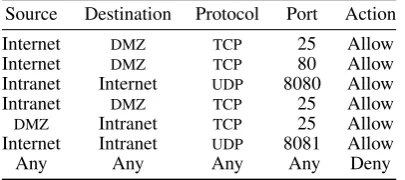
Table Ishows a firewall policy as it can be found in security textbooks for a common firewall setup separating three networks: the external Internet, the internal network that has to be protected (intranet) and an intermediate network, theDMZ. TheDMZis usually used for servers that should be accessible both from the outside (Internet) and from the internal network (intranet) and thus are governed by a more relaxed policy than the intranet. Such a table-based presentation of a policy (Table I) uses a first-fit matching strategy, that is, the first match overrides later ones. For example, aTCPpacket from the Internet to the intranet is rejected as it only matches the last line of the table, whereas a TCPpacket on port 25 from the intranet to the DMZ is allowed. Lines in such a table are also calledrules; together, they describe thepolicyof a firewall. In general, a single rule can, conceptually, be understood as a (simple) policy. As the formal model of firewall policies based on UPF provides powerful operators for combining policies, a complex policy can be constructed by combining simpler policies. Thus, the formal model does not need to distinguish policies and rules. Consequently, in this paper, the terms policy and rules are used synonymously.
Table I. A simple firewall policy separating three networks.
Source Destination Protocol Port Action
Internet DMZ TCP 25 Allow
Internet DMZ TCP 80 Allow
Intranet Internet UDP 8080 Allow
Intranet DMZ TCP 25 Allow
DMZ Intranet TCP 25 Allow
Internet Intranet UDP 8081 Allow
Any Any Any Any Deny
Such a policy table uses a first-fit pattern matching strategy, that is, the first match overrides
later ones. For example, aTCP packet from the Internet to the intranet is rejected (it only
matches the last line of the table), whereas aUDPpacket on port 8081 is allowed.
3.2. A model of networks
A stateless firewall takes as input a single network packet and statically decides what should be done with it, independently of what has happened before. Thus, all the information common firewalls use to make that decision need to be modelled. To accommodate for the large number of different kinds and models of firewalls, the model is kept generic, also reflecting the need for different kinds of test scenarios.
3.2.1. Network addresses. A network address is used to specify origin and destination of a packet. Depending on the test scenario one has in mind, different kinds of address representations might be desired. While at times, it might be enough to specify the host, at other times, specific host addresses including port numbers are required. For this reason, arbitrary address representation is allowed by declaring the unconstrained type class α adr. The use of a type class allows one to formalize most aspects of the network communication without relying on a concrete representation of network addresses.
Typically, an address consists of a specification of the network and, optionally, a port number and a protocol indication, which can be combined to tuples. Using Isabelle’s type class mechanism, there are constants provided for these parts, that further theories can make use of. Address representations that want to use these theories need to provide definitions for those constants.
In the following, some example address representations are provided. First, three possible network representations are presented, which can arbitrarily be combined with a port number and protocol formalization:
• Datatype: Many policies do not differentiate the different hosts within a network. Thus, instead of modelling single addresses, it is often sufficient to only specify the network a host is being part of. This can, for example, be done by modelling all the relevant networks as an element of a fixed datatype, as in
datatype networks = internet|intranet|dmz (11)
The advantage of this representation is its simplicity; the state explosion during test case generation can be minimized. An additional post-processing step after test data generation must be used to randomly choose a specific host within a network.
The expressiblity of the models however, is limited: several hosts within a network cannot be distinguish and the (sub-)networks must not be overlapping. Thus, this model can only be used in rather simple scenarios.
• IPv4:Another address format tries to stay as close to reality as possible:IPv4 addresses are directly modelled as a four-tuple of Integers.
type_synonym ip = int×int×int×int (12)
Moreover, network masks can be specified directly. This expressiveness comes with a price, however, as also the complexity is larger. Instead of one variable for each host, there are four. This makes test case and test data generation much slower.
• Integer:There is a good trade-off between the last two models: modelling an address as a single Integer:
type_synonym ip′ = int (13)
This model is as expressive as the IPv4 model: a four-tuple of Integers can always be transformed into a single Integer (after all, an IPv4 address is a 32-Bit Integer). Compared with the IPv4 model, the state space is reduced significantly, which allows for a deeper exploration of the test space.
These network representations can be combined with the concepts of source ports, destination ports and protocols, that is, depending on the purpose of the model, an address can be modelled as an element of a network or it can be refined with either a pair of source and destination ports, a protocol, or both. These concepts can be modelled as follows:
• Ports: A common requirement for firewall policy models is port numbers. They can be modelled as Integers.
type_synonym port = int (14)
• Protocols: If it is required to model a policy that discriminates packets according to the transport layer protocol, those can also be modelled as part of an address. Usually, the number of such protocols is quite small; thus it is best modelled as a datatype:
datatype protocol = tcp|udp (15)
At first sight, it might be surprising to model the protocol as part of an address. However, this choice allows to keep the generic model as clean and simple as possible.
For the sake of simplicity, only one address representation is used throughout the rest of this paper: an address is a tuple consisting of two Integers and a protocol indication. The first Integer is denoting a host (encoding itsIPaddress), the second one the port number:
type_synonym address = int
datatype protocol = tcp|udp
type_synonym port = int
type_synonym adrIP = address×protocol×port
(16)
This representation has turned out to be the most effective one throughout the experiments. Of course, the formalizations and tests work for other representations equally well.
For the sake of simplicity, the same format for the source and destination address of a packet is required. This means that for the protocol field, which needs to be the same for both addresses, only one should be considered and the other one ignored.
3.2.2. Networks. A network (or sub-network) is essentially a set of addresses. To allow some further modelling possibilities, they are defined as sets of sets of addresses—making it simpler to define some networks forming together one bigger network. Thus, a network consists of a set of networks, and a network of a set of addresses:
type_synonym αnet = (α:: adr) set set (17)
For checking whether a given address is part of a network, the following operator is defined:
definition _⊏_ :: (α:: adr)⇒αnet⇒bool
3.2.3. Packets. Next to its origin and destination, little more information needs to be encoded into a packet: an identifier (as an Integer) and a generic content. Both are mostly of use later for stateful firewalls and can be set to some default dummy value when restricting testing to stateless firewalls. In the end, a packet is
type_synonym (α, β) packet = id×(α:: adr) × (α:: adr) × βcontent (19)
Further, there exist projectors, for example,getId, for accessing the components of a packet.
3.3. A model of stateless firewall policies
A firewall policy takes as input a packet and returns a decision value (either allow or deny) and a possibly transformed packet (in the case ofNAT).
On the basis of the core language provided by theUPF, domain-specific combinators for defining rules for firewalls and forNATdone by routers are introduced. While some of the rules are for all kinds of packets, others are only applicable for more specific address representations, for example, only those containing port numbers.
3.3.1. Stateless packet filtering rules. A stateless packet filtering rule takes as input a network packet and either allows or denies this packet. There is no address translation or anything similar performed. Thus, the type of such a rule is
(α, β) packet7→unit (20)
where the type unit consists of only one element written ‘()’. It is used for policies having no special output apart from the decision.
The default operator that denies all traffic can be defined directly (the dual DU is defined analogously):
definition DU:: (α, β) packet7→unit
where DU =λ x.xdeny ()y (21)
Starting from these elementary policies, more complex combinators can be defined. An example of a typical combinator for such a policy is the following one that can be used to model a rule that allows all the traffic between two networks. It is defined by a domain restriction of the allow-everything combinator to those packets having their origin (src_net) and destination (dest_net) in
the given networks:
definition allow_from_to ::α:: adr net⇒α:: adr net⇒(α, β) packet7→unit
where allow_from_to src_net dest_net
={(pa|getSrc pa⊏src_net)∧(getDest pa⊏dest_net)}⊳allow_all (22)
wheregetSrc(getDest) allow to access the source (destination) address of a packet. This combinator can then be used to formalize a rule such as
allow_from_to intranet internet (23)
A stateless packet filtering policy usually consists of an often very large number of such rules, which are processed in a first-fit manner and a default rule being used when no other rule matches. The operation override _⊕_::α ⇀ β ⇒α ⇀ β⇒α ⇀ β (cf. Section 2.1) allows elementary policies (rules) to be combined to more complex ones in a first-fit manner, for example,
p1⊕ · · · ⊕pn⊕DU (24)
where the last rule serves as ‘catch-all’ (for a given functionf producing the default return value, if
The configuration table of Table I is ready to be translated one-to-one into the combinator language of the model just presented:
definition Policy = allow_port_from_to internet dmz tcp 25
⊕allow_port_from_to internet dmz tcp 80
⊕allow_port_from_to intranet internet udp 8080
⊕allow_port_from_to intranet dmz tcp 25
⊕allow_port_from_to dmz inranet tcp 993
⊕allow_port_from_to internet intranet udp 8081
⊕DU
(25)
whereallow_port_from_toallows traffic from one network to another network only for a specific protocol and destination port. This combinator is defined similarly toallow_from_to(Fact 22).
3.3.2. Network address translation rules. Common firewalls or routers often perform some kind of NAT, where either the source or the destination address of a packet is transformed when passing the firewall. There is a wide range of possible transformations, for example,
• allIPaddresses in a given range are transformed to a static one,
• allIPaddresses in a given range are transformed (pretty randomly) to a pool of addresses, or
• allIPaddresses in a given range are transformed, as well as their ports. The latter is called PAT.
The policy type for these kinds of rules is
type_synonym NAT_Policy = (α:: adr, β) packet7→(α, β) packet set (26)
These rules allow all packets in their domain, but additionally return a set of packets in their decision, which denote the valid packet transformations. A received packet is legitimate if it matches any element of this set. A typicalNATrule, performingNAT to pool transformation on the source address, is
definition nat2pool_IntPort :: address set⇒address set
⇒(adrIP, β) packet7→(adrIP, β) packet set
where nat2pool_IntPortsrcs transl =
λ p. if (getSrcAdrp)∈srcs thenxallow{(i,(s1, s2), d, c)|
(i= getIdp∧s1∈transl∧s2= getSrcPortp ∧d= getDestp∧c= getContentp)}y else ⊥
(27)
3.3.3. Combining policies. A real firewall usually performs several activities in parallel, for example, filtering and network address translations. If such a policy needs to be tested, it is necessary to generate test data for a combination of policies of a different type.
policy only:
definition _⊗2_ :: (α7→β)⇒(γ7→δ)⇒(α×γ7→β×δ) where p1⊗2p2=λ(x, y).(casep1xof
xallowd1y⇒(casep2yof
xallowd2y⇒xallow(d1, d2)y
|xdenyd2y⇒xdeny(d1, d2)y
| ⊥ ⇒ ⊥)
|xdenyd1y⇒(casep2yof
xallowd2y⇒xallow(d1, d2)y
|xdenyd2y⇒xdeny(d1, d2)y
| ⊥ ⇒ ⊥)
| ⊥ ⇒ ⊥)
(28)
It may be necessary to adapt the input type or output type of a policy to a more refined context. This boils down to variants of functional composition for functions that do not have the format of a policy. With the standard function composition _◦_, it is possible to change the input domain of a policyp:: (β 7→γ)top◦f:: (α7→γ), provided that f is a coercion function of typeα⇒β. The
same effect can be achieved for the range with the◦f-operator.
These combination combinators can be used to combine a stateless packet filtering policy with a policy governing network address translation. Assume the policies have the following type:
Filter :: (adrIP, β) packet7→unit (29)
and a network address translation policy of type:
NAT :: (adrIP, β) packet7→((adrIP, β) packet) set (30) Their combination is
definition Policy :: (adrIP, β) packet7→((adrIP, β) packet) set
where Policy = (λ(x, y). x)◦f(NAT⊗2Filter)◦(λ x.(x, x))
(31)
The first coercion function throws away the return value of the second policy (which is just unit), the second one assures that instead of a pair of packets for the input, only one is kept.
3.4. Testing stateless firewalls
The test specificationfor the stateless firewall case is now within reach: for every packet x, the firewall under test (FUT)has the same behaviour as specified in the just formalized policy:
testspectest: FUT x= Policy x (32)
Usually, this test specification is extended by predicates ensuring that only valid test data (e. g. no negative numbers in theIPaddresses) will be generated, and that the content fields will be set to some default value. Another predicate can ensure that only packets which cross network boundaries are considered.
Before applying the test case generation algorithm, (recall Section 2.2), the test specification needs to be transformed. The granularity of the test space partitioning is determined by how much of the definition are unfolded before the algorithm is applied; for example, the networks could be kept closed, or completely unfolded. Much more test data would be produced in the latter case.
The algorithm will return a set of abstract test cases. Test data generation instantiates each of them to concrete values using constraint and random solving mechanisms. Next are two examples of test data for a filtering policy, where the first is a packet meant to be rejected by the firewall, while the second one should be passed:
1. FUT(12,(2,1,tcp),(1002,80,tcp),content) =xdeny ()y 2. FUT(8,(1002,1,udp),(2,8080,udp),content) =xallow ()y
4. NORMALIZING POLICIES
A common characteristic of ‘real’ policies is that they consist of a large number of rules. To overcome the inherent state explosion of the underlying model-exploration technique, a few new optimisation ideas have to be added; as will be seen later, these will also help to overcome the apparent drawback of using a powerful modelling language such as HOL, which is more distant to efficient computation and deduction than, say, a limited form of first-order logic with suitable instrumentation (‘triggers’) for, say, anSMTsolver such as Z3 [18].
A key observation is that semantically equivalent policies can be formulated in many syntactically different ways. Moreover, parts of them can be redundant. Consider the following case, where allow_port_from_to is the combinator allowing all packets of a specific protocol on a specific destination port between two networks:
lemmaredundant_allowPort:
deny_from_to x y⊕allow_port_from_to x y pr po= deny_from_to x y (33)
The expression on the left corresponds roughly to a nesting of if-then-else-expressions where the inner branches of the second branch are never reached: consequently they represent unfeasible parts that would, if not eliminated beforehand, eventually result in path conditions (in the model) that have to be proven unfeasible in the general CNF-normalization procedure. The experiments show that in practice these situations occur often in various different disguises.
Of course, the rule shown previously could be used directly by the Isabelle simplifier (a rewriting-based decision procedure); however, it turns out that a certain strategy in applying these and similar rules is necessary and a non-deterministic simplification procedure is insufficient for this purposes. In the following, a normalization procedure for firewall policies is presented that consists of nine different policy transformation procedures. First, an abstract syntax for the firewall policy language is presented, and next transformations on policies are reformulated as a particular syntactic transformation process. The advantage of this technique—sometimes called reification in the literature—is that local transformations on the syntax as well as the entire normalization strategy can be definedinsideHOL, as an ordinary function definition, and semantical correctness of local transformations as well as the entire normalization can beverifiedby formal proof.
4.1. Reification of policies and correct policy transformations
For the transformations, an abstract syntax called policy syntax is introduced. For the sake of conciseness, only a few core combinators are presented here.
datatype (α, β) Comb = DenyAll
|DenyFromTo α α
.. .
|AllowPort α α β
|Conc ((α, β) Comb) ((α, β) Comb)
(34)
The infix notation _⊕S_ is used for the constructorConc _ _. This abstract syntax is linked to the semantics described in the previous sections by a semantic interpretation functionC:
funC :: (adrIPnet,protocol×port) Comb⇒(adrIP,Content) packet7→unit
where
C DenyAll =DU
C (DenyFromTo x y) = deny_from_to x y
..
. ... ...
C (AllowPort x y(pr, po)) = allow_port_from_to x y pr po
C (x⊕Sy) = C x⊕C y
(35)
Definition 4.1(Policy transformation)
Apolicy transformationT for a policy syntaxP:: (α, β) Combis a function takingP as input and
returning a list[P1, . . . , Pn] :: (α, β) Comb list, which is interpreted asP1⊕S· · · ⊕SPn, and where the domains of allPiare pairwise disjoint, with the possible exception ofPn.
Definition 4.2(Semantic correctness of policy transformations)
A policy transformationT iscorrectif and only if for all policy syntaxP:: (α, β) Combit holds:
C P = foldl (_⊕_) ⊘(map C (T P))
=⊘ ⊕(CP1)⊕ · · · ⊕(CPn) whereT P = [P1, . . . , Pn],
(36)
using the standardmap and foldfunctions on lists and the empty map ⊘. As abbreviation for transforming a list of policy syntax into a single policy, the following operator is defined
definitionlist2policyl= foldl (_⊕_) ⊘l (37)
The normalization procedure is constructed from correct transformation rules only; it is a particular advantage of the approach that the correctness of the entire procedure can be, and is, formally verified.
4.2. Technique of normalization
There are in general three kinds of strategies a (correct) transformation procedure might employ to ensure the transformed policy is better suited for test case generation:
1. Eliminate redundant rules: rules that are shadowed by others are never fired and can therefore be removed from the model as redundant.
2. Combine similar rules to a single one: for example, instead of a sequence of rules for one particular element, a single rule might allow a range containing all these elements.
3. Pre-partition the test space: often, policies consist of several independent parts, which might be processed individually. For example, rulesP1 andP2 mightpartially overlap, such that
cutting the domain into onlyP1, onlyP2, and mixed is advantageous.
The first point can be justified in all cases semantically, because it is easy to see that it does not even change the test cases or partitions because only vacuous (empty) test partitions are removed. This is in contrast to the second one, where the price has to be payed that test partitions are joined and therefore (because for each non-vacuous partition, one test is selected) the coverage with respect to the original policy is reduced. The last point, finally, is very domain-specific and must be applied with care.
As mentioned earlier, only correct transformations are used. For a number of rules, however, correctness can only be established under some preconditions of the target to be transformed; for this reason, the overall normalization must be organized into a total of nine phases, where each phase establishes stronger invariants than the previous one. This also explains why an organization into just a set of rewriting rules to be put in the Isabelle simplifier is impossible and must be replaced by a process that applies these rules according to a strategy.
Furthermore, the transformation procedure is presented in a way such that it can be integrated into the HOL-TESTGEN methodology. To achieve a pre-partitioning of the test space, the test specification must be rewritten into a set of test specifications, where each element considers only one part of the original specification. Technically, this can be achieved by rewriting the original test specification into a conjunction, which is later transformed into a sequence of subgoals, each processed individually by the test case generation algorithm. This technique is only correct if it can be assured that each test specification is creating test cases for the relevant domain only. From this fact stems the requirement that the domains of the sub-policies need to be pairwise distinct.
Recall that in general the format of a test specification is as follows:
First, the following function is required, which transforms the conclusion of such a test specification into a conjunction of individual specifications if provided a list of policies.
fun FUTList :: (α7→β)⇒α⇒(α7→β) list⇒bool where
FUTList FUTx(p#ps) = (x∈domp−→(FUTx=p x))
∧(FUTList FUTxps) FUTList FUTx[] = true
(39)
The theorem
theoremdistrFUTL:
assumesa1: x∈domP anda2: (list2policy PL) =P
anda3: FUTList FUTxPL
shows FUTx=P x
(40)
is most crucial for the entire technique: it can be applied in a test specification to execute the transformation of the test specification into a conjunction of test specifications. Because this is stated and proved as a theorem, the transformation is guaranteed to be correct, given that two assumptions (preconditions) hold:
(a1) the domain of the original policy must be universal (the policy must be defined everywhere, that is, not yielding⊥) and
(a2) the semantical equivalence of the original policy with the list of sub-policies as stated in
Fact 36must hold.
For the common special case where there is a default rule at the end of the policy, an alternative version ofFUTListexists, ensuring that the domain of the last sub-policy is the universe minus the domains of the other sub-policies.
In the following, first some elementary transformation rules are presented, followed by a detailed description of one notable transformation procedures. Next, a complete normalization procedure for stateless firewall policies consisting of a couple of transformation functions applied in sequence is presented. Finally, the effect of the normalization procedure on a small example is presented. The section concludes with observations on coverage.
4.3. Elementary transformation rules
A large collection of elementary policy transformation rules can be proved correct. For example, it can be shown that a shadowed rule is redundant, the _⊕S_ operator is associative, and in many cases, commutativity holds:
C (DenyAll⊕Sa) = C DenyAll (41)
C((a⊕Sb)⊕Sc) = C(a⊕S(b⊕Sc)) (42) C(AllowPort x y a⊕SAllowPort x y b) = C(AllowPort x y b⊕SAllowPort x y a) (43)
C(DenyFromTo x y⊕SDenyFromTo u v)
= C(DenyFromTo u v⊕SDenyFromTo x y) (44)
dom(C a)∩dom(C b) ={}=⇒C(a⊕Sb) = C(b⊕Sa) (45)
The proofs of these theorems are trivial to establish by the simplifier provided in Isabelle.
4.4. A transformation procedure
The sorting phase is formalized as a function mapping a list of syntactic policy operators (called combinators) to a list of combinators sorted according to the following principles:
• If there is aDenyAll, it should be at the last place.
• Rules dealing with the same set of networks should be grouped together, with theDenyAll’s coming after theAllowPort’s.
These principles motivate a pre-ordering, which is not unique in general, but which can be completed to an ordering (satisfying reflexivity, transitivity and anti-symmetry) under certain side conditions to be discussed later. Formally, a smaller relation is defined on policy syntax:
fun smaller :: (αset) list⇒(α, β) Comb⇒(α, β) Comb⇒bool where
smaller l x DenyAll = (x6=DU) smaller l DenyAll x = false smaller l x y = (x=y)∨
if bothNet x= bothNet y
then casex of
DenyFromTo a b⇒y= DenyFromTo b a
|_⇒true
else pos (bothNet x)l
≤ pos (bothNet y)l
(46)
Here,bothNetreturns the set of the source and destination network of a rule, andposreturns the position of an element within a list. The variable l in the aforementioned definition is a list of network sets. The ordering of this list determines which group of rules is treated as smaller than another. For the correctness of the transformation, the concrete ordering of this list is irrelevant, but it is required that all the sets of network pairs of a policy are in this list. This requirement is formalized in a predicate calledall_in_list. There are circumstances not directly related to testing, where the ordering of this list might become relevant. This would allow one to transform a policy into a semantically equivalent one, where certain classes of rules (for example, those dealing with the most frequently appearing traffic) will be considered earlier by the firewall.
Instead of smaller l x y it is also possible to write x≤ly. With this ordering, a version of the sorting function can be supplied—similar to Fact 3—with the ordering as explicit argument sort ≤l S; this represents the core algorithm of the transformation phase. Of course, in practice, a more efficient algorithm than the just insertion sort shown in this presentation is chosen.
All the proofs about the semantical correctness of the sorting transformation, some of which are outlined in the succeeding text, merely require the fact that the sorting algorithm returns a sorted list, such that any sorting algorithm may be used as long as it can be proved that it is returning a list that is sorted according to the aforementionedsorteddefinition. One of the main prerequisites for such a proof is to show that the ordering relation is transitive, reflexive and anti-symmetric. This is true as long as all the network pairs that appear in the policy are in the listl.
Next, one has to prove that the sorting transformation is semantics-preserving. The following assumptions are made about the input policy:
• singleComb: the policy is given as a list of single rules.
• allNetsDistinct: all the networks are either equal or disjoint.
• wellformed_policy1: there is exactly oneDenyAlland it is at the last position.
• wellformed_policy3: the domain of anyAllowPortFromTorule is disjoint from all the rules appearing on the left of it.
same set of rules (but not necessarily in the same order), the first rule that matchesxinpis the same
as ins.
theoremC_eq_Sets_mr:
assumessets_eq: setp= sets
andwp1_p: wellformed_policy1 p andwp1_s: wellformed_policy1 s
andwp3_p: wellformed_policy3 p andwp3_s: wellformed_policy3 s
andaND: allNetsDistinct p
andSC: singleComb p
shows matching_rule x p= matching_rule x s
(47)
In the succeeding text, a proof sketch of the aforementioned theorem (Fact 47) is presented, which is also proven formally in Isabelle. A case distinction overmatching_rule x presults in two cases: this expression can either be⊥orxyy:
1. ⊥. This case is shown by contradiction. As there is aDenyAll, which matches all packets, the matching rule ofxcannot be⊥.
2. xyy. This is shown by case distinction ony, that is, on the matching rule. By definition of the Combdatatype, there are four possibilities:
• DenyAll: if the matching rule isDenyAll, there is no other rule inpthat matches, as it
is necessarily the rule considered last. Thus, as the two sets are equal, there is no other rule insthat matches either. AsDenyAllis ins, this has to be the matching rule ins.
• DenyFromTo a b: if this is the matching rule in p, there cannot be another rule in p
that matches: as the networks are disjoint and the onlyDenyAllis the last considered rule, the only possibility is an AllowPort a b c, for some c. However, because of wellformed_policy3, such a rule can only be on the left of the matching rule as their domains are not disjoint. But if it were on the left, the allow-rule would be the matching rule. Thus, by contradiction, there is no such rule. Because such a rule does not exist in
p, it does not exist inseither. AsDenyFromTo a bis ins, this has to be the matching rule ins.
• AllowPort a b c: the proof of this subgoal is very similar to the previous one: the only alternative rule that could match is the corresponding DenyFromTo a b, but if this rule appears on the left of the matching rule; this would contradict the wellformedness conditions. Therefore, this has to be the matching rule also ins.
• a⊕Sb: this case is ruled out by the wellformedness conditions.
The formal proof of this lemma can be found in the appendix. Having proofs that any sorted list of rules conforms to the conditions after sorting if the input list does, the main correctness theorem of the sorting transformation is established:
lemmaC_eq_sorted:
assumesail: all_in_list p l
andwp1: wellformed_policy1 p
andwp3: wellformed_policy3 p
andaND: allNetsDistinct p
andSC: singleComb p
shows C (list2policy(sort (≤p)l)) = C(list2policy p)
Thus, there is a sorting transformation for policies that is proven to be semantics-preserving given that some well-specified conditions hold for the input policy.
4.5. The normalization procedure
The result of the nine phases is a list of policies, in which:
• each element of the list contains a policy that completely specifies the blocking behaviour between two networks, and
• there are no shadowed rules.
This result is desirable because the test case generation for rules between networks A and B
is independent of the rules that specify the behaviour for traffic flowing between networksC and
D. Thus, the different segments of the policy can be processed individually. The normalization procedure does not aim at minimizing the number of rules. While it does remove unnecessary ones, it also adds new ones, enabling a policy to be split into several independent parts.
The following two restrictions are imposed on the input policies:
• Each policy must contain aDenyAllrule. If this restriction was to be lifted, theinsertDenies phase would have to be adjusted accordingly.
• For each pair of networksn1andn2, the networks are either disjoint or equal. If this restriction
was to be lifted, some additional phases would be required before the start of the normalization procedure presented in the succeeding text. This rule would split single rules into several rules by splitting up the networks such that they are all pairwise disjoint or equal. Such a transformation is clearly semantics-preserving and the condition would hold after these phases.
The full procedure is defined as follows:
definitionnormalizep= (removeAllDuplicates◦insertDenies
◦separate◦(sort ≤Nets_List p) ◦removeShadowRules2◦remdups
◦removeShadowRules3◦insertDeny
◦removeShadowRules1◦policy2list)p
(48)
The nine transformation phases of the normalization procedure and their preconditions are next discussed in more detail. The preconditions are necessary to establish the correctness theorem for the overall procedure:
theoremC_eq_normalize:
assumesa1: member DenyAll p anda2: allNetsDistinct p
shows C(list2policy(normalize p)) = C p
(49)
The proof of this theorem combines the local correctness results of the single transformations (e. g. the sorting phase result described in the previous section) while discharging their preconditions using invariance properties of the previous transformations. The nine transformations are as follows:
1. policy2list: transforms a policy into a list of single rules. The result does not contain policies
composed via _⊕S_, that is, the propertysingleCombis established.
2. removeShadowRules1: removes all the rules that appear after aDenyAll. The transformation preservessingleComband establisheswellformed_policy1, stating that there is aDenyAllat the end of the policy.
3. removeShadowRules3: removes all rules with an empty domain; they never match any packet. It maintains all previous invariants and does not establish any required new one. 4. remdups: removes duplicate rules. Only the first rule appearing in the list remains. As policies
are evaluated from left to right, it can easily be shown that this transformation preserves the semantics.
5. removeShadowRules2: removes all rules allowing the traffic on a specific port between two networks, where an earlier rule already denies all the traffic between them. This function maintains the earlier invariants, and establisheswellformed_policy3, the invariant necessary for the sorting function to be correct. It ensures that the domain of anAllowPortFromTorule is disjoint from all the rules appearing on the left of it.
7. separate: transforms the list of single combinators into a list of policies. Each of those
policies contains all the rules between two networks (in both directions). WhilesingleComb is invalidated by this transformation, all the others are maintained. Two important additional properties hold after this transformation:
• OnlyTwoNets: each policy treats at most two different networks.
• separated: the domains of the policies are pairwise disjoint (except fromDenyAll). This follows from the fact that the rules were already grouped.
8. insertDenies: is the only phase where additional rules are inserted. At the end of each policy,
the two rules denying all traffic between those two networks in both directions are added. As new rules are added here, the proof of semantic equivalence is relatively involved. The main part consists of proving the property thatseparatedis maintained with this transformation. This phase is only semantics-preserving because of the initial requirement that the policy has aDenyAll. Only after this phase the traffic between two networks is characterized completely by the corresponding policy.
9. removeAllDuplicates: removes superfluous duplicate DenyFromTos introduced by the previous phase.
After the last phase, the result is a list of policies that satisfies the requirements stated in the beginning of this section. Using the correctness of the transformations, it is straightforward to prove semantic equivalence of the full normalization. In the end, the individual elements of the returned list are policies on their own and can be processed individually byHOL-TESTGEN. Thus, the set of test cases for the full policy is decomposed into the set of test cases of the smaller policies.
4.6. Example
In the following, the effect of the normalization procedure on the running example policy (Fact 25) is presented. Recall that the original policy contains seven rules restricting the traffic between three networks; After applying the normalization procedure, there are the following policies:
1. AllowPort intranet dmz (tcp,25)⊕S AllowPort dmz intranet (tcp,25) ⊕S DenyFromTo dmz intranet⊕SDenyFromTo intranet dmz
2. AllowPort intranet internet (udp,8080)⊕SAllowPort internet intranet (udp,8081) ⊕S DenyFromTo intranet internet⊕SDenyFromTo internet intranet
3. AllowPort internet dmz (tcp,80)⊕SAllowPort internet dmz (tcp,25) ⊕SDenyFromTo internet dmz⊕SDenyFromTo dmz internet
4. DenyAll
Summing up, the process results in four policies with a total of 13 rules. The number of generated test cases shrinks from 60 to 12, the required time reduces from 400 to about 2 seconds (including normalization).
4.7. Distributivity of transformations
Firewall policies are often created by a parallel composition of smaller policies. As this might lead to a large state explosion hindering efficient test case generation, the question arises how transformations can be used together with parallel compositions.
Of course, it is possible to devise a transformation procedure for a parallel combined policy. However, this is in many cases not easy achievable and not compatible with the goal of a modular modelling approach. Much better would be to have transformation procedures for the smaller policy parts and the means to transfer these transformations over parallel compositions.
Transformation procedures can be distributed over parallel compositions such as _⊗2_ (Fact 28)
thanks to distributivity laws holding over these operators:
Assume a policy under test being created as a combination of policiesP andQ, and a correct
transformationT transformingPinto the list[P1, P2, . . . , PN]. Then, for policies that are combined in parallel such asP⊗2Q, the following theorem holds:
(CP)⊗2Q= list2policy[CP1⊗2Q, . . . ,CPN⊗2Q]
This gives rise to a transformation strategy for policies consisting of many parts executed in parallel: define transformation procedures for the individual policies, which in the end will lead to a transformed combined policy. Of course, the number of final sub-policies might grow very large when transformation procedures are being executed on several constituent policies, as all the sub-policies are paired. For this reason, it is sensible to have transformations which are similar in the sense that they create similar domains for their sub-policies. In that way, most domains of the combined sub-policies are empty, and those elements can be eliminated later.
4.8. Excursion: test coverage, test size and policy normalization effects
HOL-TESTGENis centred around the idea to construct a test for each feasible (i. e. satisfiable) test case; this corresponds to a one-to-one non-empty equivalence class coverage in the sense of the ISO 29199 specification [29, par 5.2.1.3, case 1.a]. The standard states explicitly its unawareness on syntax testing coverage criteria; in the case ofHOL-TESTGEN, [7] propose the notion of a one-to-one-coverage to the normal formTNFEd, wheredis the abstract syntax tree depth up to which variables belonging to a given set of types are split.
The question arises, even if policies are shown to be semantically equivalent, what is the impact on the set of generated tests? Experiments (Section 7) reveal that the tests generated from policies and their optimized counterparts are obviously not identical; it can therefore not be taken for granted that the equivalence partitioning before and after normalization is related.
To shed some light on the nature of the optimizing effect of policy normalization, the effect of the generic equivalence partitioning process in the specific domain of security policies is studied. The simplestUPFconstructors for elementaryUPFpolicies are⊘,p(x7→t), andp1⊕p2. A policyplike ⊘(x17→t1)(x27→t2)(x37→t3)is converted by unfolding definitions (Section 2.1) to
λ y. ify=x1thenxt1yelse ify=x2thenxt2yelse ify=x3thenxt3yelse⊥ (51)
that is, a cascade of nested conditional expressions. As part of the background theoryE, test case generation uses case split rules for conditionals such as
P(ifCthen DelseE)≡(C→P(D)∧(¬C→P(D)) (52)
which brings the aforementionedFact 51for the test specificationp z=rinto the form:
z=x1 →xt1y=r∧
z6=x1∧z=x2 →xt2y=r∧
z6=x1∧z6=x2∧z=x3 →xt3y=r∧
z6=x1∧z6=x2∧z6=x3 → ⊥=r
(53)
which is close to a CNF with four conjoints, that is, four test cases. Domain-specific policy combinators such asallow_port_from_toare also built from conditionals, only that the condition is significantly more complex and involves arithmetic and set theoretic reasoning. For the override, the conditionals of the one policy are crafted into the final else branch of the other; this gives rise to the following simple meta-function that provides a tight bound for the number of test cases implied by a policy:|Jp(x7→t)K|=|JpK|+ 1and|Jp1⊕p2K|=|Jp1K|+|Jp2K|. It is easy to check that the
operators of the product family such as _⊗2_ and the sequential policy compositions family such
as _op_ behave multiplicative on test cases, which explains the exponential effect over the length of test sequences over stateful policies to be discussed in the next section.
thatβ is simple and not again a datatype requiring case splitting. Thus, for smalldand a fixedE
(essentially,HOL+UPF+ domain-specific combinator theory), the result is a natural interpretation of the generated tests. Thetest hypothesis([7] and [22]) underlying the test selection are somewhat ‘reasonable’ assumptions. This is especially true for the uniformity hypothesis (here, pick one instance of the path condition; if the test passes, the system conforms to the specification for all instances of this path). For theregularity hypothesis,there is no need because for a stateless firewall, the involved data structures of policies are all non-recursive.
After explaining the construction of the equivalence classes, that is, the test cases, as clauses in theCNF-derivation of policies, the question how the optimization affects their number and relative size can be addressed. The following situations may occur:
1. a policy is shadowed or a duplicate. This corresponds to empty equivalence classes, that is, conjoints that reduce to truebecause the premise of the implications become falsein the underlying theoryE. This is the most common case, which does not change the number of feasible test casesat all.
2. two policiesp1andp2are ‘adjacent’ equivalence classes, that is, there is a more general one
pxthat subsumes both and the union of the domains of both are exactlydompx. In this case, the number of test cases decreases by one.
3. two policiesp1 andp2 overlap, that is,domp1∩domp16={}. In this case, policy splitting
may be applied that transformp1⊕p2intop′1⊕p
′
2⊕p
′
3 such that the domains of thep
′ i are distinct. The number of test cases increases by one.
The key observation is now that the latter situation calledpolicy splitmay only arise a small and bounded number of times during the process.
Generally speaking, the number of policy splits depends on the number of networks and the number of policy rulesR. In particular, the number of splits grows, firstly, at most linearly with the number of networksS, that is, specified networks are never split into smaller units. Secondly, every rule of a policy can at most overlap with all other rules. Thus, the number of policy splits grows at most withN2of the initial policy. In case there are more overlapping rules than networks
S, there must be shadowed or duplicates rules. Thus, in this case the overall number of policy splits is at most equal to the number of networksS. Similarly, if there are more networks as overlapping rules,
only the overlapping rules are split.
Thus, the number of equivalence classes grows after normalization in the worst case by at most min(S, N2
)and decreases in the average case substantially. In most practical scenarios, a policy contains much more rules than networks, thus the number of splits is usually restricted byS.
Summing up, the selected test data may be different, but the equivalence partitioning after optimization is related in the following way: in general, it is a coarser partitioning in the sense that non-empty partitions in original policy are either maintained or fused with adjacent partitions during optimization. However, there is a usually small number of exceptions where an equivalence class is split into smaller classes during this process.
5. STATEFUL FIREWALLS