Original Research Article
Assessment of the Effectiveness of Planned Teaching
on Knowledge Regarding Physical and Psychological
Women Abuse Among Teenage Girls in Selected
College
Ms. Anuradha Anilrao Wankhade
Assistant Professor, Dr. Panjabrao Deshmukh Nursing Institute, Shivaji Nagar, Amravati-444603
ABSTRACT
Background: Violence against women is a manifestation of historically unequal power relations between men and women, which have led to domination over and discrimination against women by men and to the prevention of the full advancement of women.
Materials and methods: The research approach adopted for the study was one group pre-test and post-test research design. The study comprises of 60 teenage girls of selected college who fulfilled inclusive criteria selected by Probability sampling technique in thatsimple random sampling technique was used to select the sample by lottery method. Structured knowledge questionnaire was used for data collection. The content Validity of the tool was established in consultation with guide and 14 experts from the field of community health nursing and mental health nursing. Reliability of Structured questionnaire was calculated using split half method. Formal permission was obtained from concerned authority from selected college for data collection. Data were tabulated and analyzed.
Results: The study revealed that the pre test mean score among teenage girls was 10(35.71%) and post test score up was 17.85(63.75%) in the evaluation. Result interpreted that there was a significant increase in knowledge level of teenage girls after administration of planned teaching program. It is evident that the calculated „t‟ value was greater than the table value of „t‟ at 0.05 level. This indicates that planned teaching was effective in improving the knowledge of the teenage girls. The study also revealed that there is a significant association between demographic characteristics, such as age, Religion (caste), Type of family, place of residence, previous knowledge about women abuse with the knowledge score.
Conclusion: The study was done to assess the effectiveness of planned teaching on knowledge regarding physical and psychological women abuse among teenage girls. The result of this study shows that the most of the teenage girls had excellent knowledge after administration of planned teaching. The study also revealed that there is a significant association between demographic characteristics such as age, Religion (caste), Type of family, place of residence, previous knowledge about women abuse with the knowledge score. This study will help the teenage girls to find type of abuse and take action on them to improve knowledge regarding physical and psychological women abuse.
Key Words: knowledge, physical and psychological women abuse, domestic violence
INTRODUCTION
“Abuse is never a onetime event”. Many people who are being abused do not see themselves as victims. Also, abusers do not see themselves as being abusive. People often think of domestic violence as physical violence, such as hitting. However, domestic violence takes other forms, such as
psychological, emotional, or sexual abuse. [1]
Domestic abuse defined as chronic mistreatment in marriage, families, dating and other intimate relationships can include
emotionally abusive behavior.
domestic relationships is nearly always preceded and accompanied by psychological abuse. [2]
The numbers alone are stunning: nearly 1 in 5 women or almost 22 million have been raped in their lifetimes and the numbers don‟t begin to tell the whole story. They don‟t tell of the physical, emotional and psychological scars that a victim can carry for life. They don‟t speak to the betrayal and broken trust when the attacker is a friend, a trusted colleague, or a family member. And they don‟t give voice to the courage of survivors who work every day to put their lives back together. [3]
According to World Health Organization, violence against women puts an undue burden on health care services, as women who have suffered violence are more likely to need health services and at higher cost, compared to women who have not suffered violence. [4]
A study was carried out on domestic violence against women in the Government of Norway “combating the gender based violence in the south Caucasus” project in 2009. Implementing partners of the research
were the Americas Commercial
Transportation (ACT) research and the centre for social science at the Javakhishvili Tbilisi state university. In the 21st century, public consolidation against all forms of domestic violence has become a pressing issue. Although domestic violence is considered a human rights, violation and Georgian society is becoming increasingly open and intolerant against this problem, studies show that domestic violence is a widespread phenomena throughout Georgia. 78 % of women still consider that domestic violence issues can be discussed within family only, while 34 % of women justify men battering their wives in certain cases and do not regard as it as a violation of law. Violence against women is a public issue and encompasses virtually all spheres of public relations. It influences various spheres of social life, including public health, protection of juvenile‟s rights and social and economic welfare. Studies
conducted reveal the complexity of domestic violence character, variety of its causes and need for inter sectoral cooperation and multi-pronged approach in addressing the issue. [5]
The National crime records bureau report of India states a reported crime rate of 46 per 100,000, rape rate of 2 per 100,000, dowry homicide rate of 0.7 per 100,000 and the rate of domestic cruelty by husband or his relatives as 5.9 per 100,000. [6]
These reported rates are significantly smaller than the reported intimate partner domestic violence rates in many countries, [7]
such as the United States (590 per 100,000) and reported homicide (6.2 per 100,000 globally), [8] crime and rape incidence rates per 100,000 women for most nations tracked by the United Nations. [9] According to a national family and health survey, total lifetime prevalence of domestic violence was 33.5% and 8.5% for sexual violence among women aged 15-49.The instance of violence was reported to be lowest among Buddhist and Jain women, and highest among Muslim women in India. [10]
A 2014 study in the lancet reports that the reported sexual violence rate in India is among the lowest in the world, the large population of India means that the violence affects 27·5 million women over their lifetime. [11]
experienced spousal physical or sexual violence from their current husband or if currently not married, their most recent husband. 18% report spousal emotional violence. Only 1% of married women have ever initiated violence against their husband. [12]
Problem Statement
“Assessment of the effectiveness of planned teaching on knowledge regarding physical and psychological women abuse among teenage girls in selected college”.
Objectives of the Study
1. To assess the existing knowledge regarding physical and psychological women abuse among teenage girls. 2. To evaluate the effectiveness of planned
teaching on knowledge regarding physical and psychological women abuse among teenage girls.
MATERIALS AND METHODS
The research approach adopted for the study was one group pre-test and post-test research design. The study comprises of 60 teenage girls of selected college who fulfilled inclusive criteria selected by Probability sampling technique in that simple random sampling technique was used to select the sample by lottery method. Structured knowledge questionnaire was
used for data collection. The content Validity of the tool was established in consultation with guide and 14 experts from the field of community health nursing and mental health nursing. Reliability of Structured questionnaire was calculated using split half method. The reliability was found to be 0.804 which indicated that tool was reliable. Formal permission was obtained from concerned authority from selected college for data collection.
Hypotheses
H0: There is no significant difference between the pre-test and post test knowledge regarding physical and psychological women abuse among teenage girls which is measured by structured questionnaire at p<0.05 level of significance.
H1: There is significant difference between the pre-test and post test knowledge regarding physical and psychological women abuse among teenage girls which is measured by structured questionnaire at p<0.05 level of significance.
RESULTS & DISCUSSION
Analysis and interpretation is based on the objectives of the study. The analysis was done with the both descriptive and inferential statistics.
Section I: Distribution of teenage girls according to their demographic characteristics.
Table 1: Frequency and percentage distribution of demographic variables among teenage girls. n=60
Sr. no Variable Variable information Frequency Percentages (%)
1 Age 16 0 0
17 22 36.66
18 31 51.66
19 7 11.66
2 Religion (Caste) OBC 25 41.66
SC 18 30
Open 1 1.66
ST 4 6.66
NT 12 20
3 Type of family Joint 42 70
Nuclear 18 30
4 Monthly income ( family) in Rupees <10,000 40 66.66 10,000-20,000 9 15 20,000 and more 11 18.33
5 Place of residence Urban 0 0
Rural 60 100
Slum 0 0
6 Previous knowledge about women abuse Yes 35 58.33
No 25 41.66
7 Source of information TV 29 82.85
Section II: Assessment of existing knowledge regarding physical and psychological women abuse
Table 2: Distribution of sample with regard to pre-test knowledge regarding physical and psychological women abuse. n=60
Level of knowledge score
Percentage score
Pre-Test
Frequency Percentage Inadequate ≤ 50% 49 81.67 Moderate 51-70% 11 18.33 Adequate >70% 0 0.00
Section III: Analysis of effectiveness of planned teaching on knowledge regarding physical and psychological women abuse
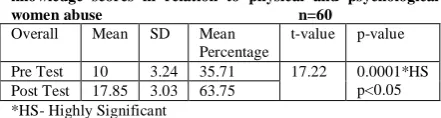
Table 3: Significance of difference between in pre and post-test knowledge scores in relation to physical and psychological
women abuse n=60
Overall Mean SD Mean Percentage
t-value p-value
Pre Test 10 3.24 35.71 17.22 0.0001*HS p<0.05 Post Test 17.85 3.03 63.75
*HS- Highly Significant
Table no. 4.4: Comparison of knowledge score in pre-test and post-test n=60
Level of knowledge score
Percentage Score
Pre Test Post Test F % F % Inadequate ≤ 50% 49 81.67 6 10.00 Moderate 51-75% 11 18.33 11 18.33 Adequate >75% 0 0 43 71.67
Total 60 100 60 100
Table no.4.5: Aspect wise pre-test and post-test mean knowledge scores regarding physical and psychological women abuse n=60
Aspects Respondents level of knowledge score Paired‟t‟ value Pre Test Post Test
Mean % SD Mean % SD
Physical and psychological women abuse 33.4 11.83 61.45 11.01 17.15*HS Prevention on physical and psychological women abuse 46.33 18.95 74.33 21.18 8.08*HS
Combines 10 3.24 17.85 3.03 17.22
*HS: Highly significant at p<0.05% level of significance
The findings of the study were discussed based on the objectives stated as below. 1) To assess the existing knowledge regarding physical and psychological women abuse among teenage girls. 2) To evaluate the effectiveness of planned teaching on knowledge regarding physical and psychological women abuse among teenage girls.
With regards to the first objective of the study, the study result shows that 49 (81.67%) of teenage girls had inadequate level of knowledge score, 11 (18.33%) had moderate knowledge and no one had adequate level of knowledge score. The total mean pre-test knowledge score was 10 with standard deviation ± 3.24. The study reported that the result regarding level of knowledge regarding physical and psychological women abuse among teenage girls was inadequate.
With regards to second objective of the study, result shows that in pre-test 49 (81.67%) had inadequate knowledge, 11 (18.33%) had moderate knowledge and no one had adequate level of knowledge score. In post-test, majority of the teenage girls 43 (71.67%) had adequate knowledge, 11 (18.33%) had moderate and only 6 (10.00%)
had inadequate knowledge. The overall mean knowledge scores of pre-test and post-test reveal that the post-test mean knowledge score was higher 17.85 with standard deviation of ± 3.03 when compared with pre-test mean knowledge score value which was 10 with standard deviation ± 3.24. The study showed that planned teaching was found effective in increasing the knowledge of the teenage girls regarding physical and psychological women abuse.
violence will be improving after planned teaching programme those who attained.
CONCLUSION
After the detailed analysis, the study leads to following conclusions:
The researcher concluded that the pre-test and post-test mean knowledge score regarding physical and psychological women abuse among teenage girls was 10 and 17.85, respectively. The teenage girls had inadequate knowledge regarding physical and psychological women abuse. The planned teaching brought out improvement in their knowledge regarding physical and psychological women abuse.
REFERENCES
1. Oakland country coordinating council
against domestic violence handbook.
http://www.domesticviolence.org/2015
2. Maiuro, Roland D, O'Leary, Daniel K.
Psychological Abuse in Violent Domestic Relations. New York: Springer Publishing Company; 2000 p 197. ISBN 0-8261-1374-5.
3. Hayward, Ruth F. (In Press) Breaking the
Earthenware Jar: Lessons from South Asia to End Violence against Women. New York: UNICEF.
4. Black MC, Basile KC, Breiding MJ, Smith
SG, Walters ML, Merrick MT, et al. The National Intimate Partner and Sexual
Violence Survey (NISVS): Summary
Report. Atlanta, GA: National Center for Injury Prevention and Control, Centers for Disease Control and Prevention. 2010.
5. WHO Factsheet ''Violence against women''.
World Health Organization. 2011.
6. National Crimes Record Bureau, Crime in
India 2012 - Statistics Government of India (May 2013)
7. Harrendorf S, Heiskanen M, Malby S,
International Statistics On Crime And Justice United Nations Office on Drugs & Crime. 2012.
8. Intimate Partner Violence, Bureau of Justice
Statistics, US Department of Justice, 1993– 2010. p 10.
9. Global Study on Homicide, United Nations
Office on Drugs and Crime, 2013. p. 12, ISBN 978-92-1-054205-0.
10. Gender Equality and Women's
Empowerment in India. National Family
Health Survey. International Institute for
Population Sciences.
11. Anita Raj, Lotus McDougal. Sexual
violence and rape in India. The Lancet. Volume 383, Issue 9920, P865, March 08, 2014.
12. The Cluster Database at the statistics
department was available for the research. There are about 16,500 clusters in the database. India: Ministry of Home Affairs New Delhi: 2007 National Crime Records Bureau, New Delhi.
******