Electron-phonon interaction in
Low-dimensional Systems
A thesis submitted for the degree
of Doctor of Philosophy of
the Australian National University
In-Keun Oh
Statement
This thesis reports the work carried out while I was a student in th e D ep art m ent of Theoretical Physics, Research School of Physical Sciences and Engineering of the A ustralian N ational University between M arch 1992 and Septem ber 1995, under th e supervision of Dr. J. M ahanty and Dr. M. P. Das.
C hapter 1 is an introduction, C hapter 2 and p art of C hapter 3 contain m ostly review m aterials, whereas C hapters 4, 5, and 6, and Appendices A, B.2, and C present work done under the supervision of Dr. J. M ahanty and Dr. M. P. Das.
None of the work reported here has been subm itted to any in stitu tio n of learning for any degree.
Acknowledgements
My interest in the topic of my work has arisen through collaboration with
Dr. J. Mahanty. I would like to thank one of my two supervisors, Dr. J. Mahanty,
who has guided me in the ways of physics with kindness, interest and happiness
even though he himself suffered great hardship when his lovely wife, the late Mrs.
Sarojini Mahanty, passed away on the 28th of November 1994. He encouraged and
supported me at every stage of my study. He has been guide and teacher in a per
sonal sense; his friendship and encouragement have been invaluable. Unfortunately,
he retired at the final stage of my research because of his cancer. He is still fighting
his cancer. I wish him good health.
It is a pleasure to acknowledge my other supervisor, Dr. M. P. Das, for the
stimulus and invaluable discussions and suggestions. He also guided me throughout
my research, and supported me when I struck trouble.
I thank former head of department Dr. B. A. Robson, now Associate Direc
tor of the Research School of Physical Sciences and Engineering, for his assistance,
kindness and warmth. Financial support for my work has been provided by the
Australian National University and by the Harry Triguboff AM Research Syndi
cate. I thank my friend Graeme B. Honner for proofreading the manuscript and
suggesting useful corrections.
A bstract
Low-dimensional electronic systems in sem iconductor h eterostructures, with th e associated practical applications and basic scientific interest, have recently re ceived a lot of attention. This thesis consists of studies of th e electron-acoustic phonon interaction in low-dimensional system s, and has proceeded under th e su pervision of Dr. Jay M ahanty and Dr. M ukunda Das during the period from 5th of M arch, 1992, to 5th of Septem ber, 1995, at the A ustralian N ational University.
The aim of th e research is to a tte m p t to construct m ore feasible models for th e electron-phonon interaction, and to explain experim ental results for phonon generation in low-dimensional systems. In this context, this thesis deals w ith the strength of th e electron-acoustic-phonon coupling, and w ith the acoustic phonon generation due to electronic transitions in low-dimensional systems. As m odel cal culations, idealized deformable jellium and G aA s/G aA lA s heterostructures are cho sen. Furtherm ore, only one-phonon processes, in which a single phonon is em itted or absorbed, are considered.
m aterials for understanding theory and results presented in later C hapters. C hap ter 4 gives the dependence of deform ation potential coupling on th e dim ensionality of a solid, where an idealised deformable jellium is considered, and also provides in detail deform ation potential coupling constants in sem iconductor heterostructures. C h ap ter 5 deals with phonon emissions from a 2DEG in G aA s/G aA lA s heterostruc tures. A m echanism for deform ation coupling, which may explain th e experim ental results for phonon emissions in sem iconductor heterostructures, is provided. We give num erical calculations for th e intensity of phonons em itted from a 2DEG in G aA s/G aA lA s heterostructures using the elastic G reen’s functions and a m odel de form ation potential for the systems. In Appendices, some m athem atical details are given, and th e elastic G reen’s functions for an overlayer system w ith a semi-infinite su b strate are also derived.
This work has been supported by an ANU PhD scholarship and the H arry Triguboff AM Research Syndicate.
Most of m aterial presented in C hapter 4 has been published as: In-Keun Oh, J. M ahanty, and M. P. Das
Deformation Potentials in 2D- and 3D-deformable jellium
J o u rn a l o f P h y sics: C o n d en sed M a tte r 6, 4897 (1994)P arts of th e work described in C hapters 4 and 5 have been presented in: The 6TH A PPC and the 11TH AIP Congress, Griffith University, Brisbane, QLD. (4th - 7th July, 1994)
In-Keun Oh, J. M ahanty, and M. P. Das
Dependence of the Strength of the Deformation Potential
on the Dimensionality of the Solid
ANZIP 19th Condensed M atter Physics M eeting, Charles S tu rt University, W agga Wagga, NSW (7th - 10th February, 1995)
In-Keun Oh and J. M ahanty
Papers, covering th e m aterials presented in C hapter 5 including Appendix B.2, are under preparation for publication:
In-Keun Oh, M. P. Das, and J. M ahanty
Phonon emission in a GaAs/GaAlAs heterojunction
In-Keun Oh, M. P. Das, and J. M ahanty
Contents
1 I n tr o d u c tio n 1
1.1 Introductory remarks on low-dimensional s y s te m s ...
1
1.2 General remarks on the electron-phonon in te ra c tio n ...
5
1.3 Remarks on phonon generation via electron-phonon interactions . .
8
1.4 Scope of the t h e s i s ...
10
2 T h e H a m ilto n ia n for S o lid s 11
2.1 Introduction to the model Hamiltonian for solids...
11
2.2 P h o n o n s ...
13
2.3 Electrons in solids...
19
2.4 Electron-phonon interactions in so lid s...
21
2.5 Effect of dimensionality on the electronic bands of a s o lid ...
24
3 E le c tr o n -a c o u stic P h o n o n C o u p lin g 30
3.1 Introduction...
30
3.2 Thermodynamic functions and thermal variables...
32
3.3 Continuum approximation for lattice v ib r a tio n s ...
34
3.4 Surface and interface acoustic m o d e s ...
38
3.5 Deformation potential c o u p lin g ...
38
3.5.1
Effect of strain on energy eigenvalues...
41
3.6 Piezoelectric coupling...
45
V l l l
4 E le c tr o n -p h o n o n In te r a ctio n in 2 D - and 3 D - D e fo rm a b le J e lliu m 49
4.1
Introduction...
49
4.2 Hamiltonian for a deformable jellium in Hartree-Fock approximation 51
4.3 Effect of strain on energy eigenvalues...
55
4.4 Comments on semiconductor h e te ro stru ctu res...
61
4.5 D iscussion...
64
5 P h o n o n E m issio n from S e m ic o n d u c to r H e te r o s tr u c tu r e s 66
5.1
Introduction...
66
5.2 Theory of phonon em ission...
68
5.3 Elastic and piezoelectric constants in heterostructures...
72
5.3.1
Elastic c o n s ta n ts ...
74
5.3.2
Piezoelectric c o n s ta n ts ...
77
5.4 Source force density due to electronic transitions...
78
5.5 Phonon emissions in GaAs/GaAlAs heterostructures ...
82
5.5.1
Phonon emissions in a GaAs/GaAlAs single heterojunction . 85
5.5.2
Phonon emissions in a GaAs/GaAlAs single quantum well . 88
5.6 D iscussion...
91
6 C o n c lu d in g R em a rk s 94 A In te g r a tio n A ss o c ia te d E n e r g y -m o m e n tu m C o n ser v a tio n in 2 D 96 B E la stic G r e e n ’s F u n ctio n 99
B.l The elastic Green’s function for an isotropic h a lf-s p a c e ... 101
B.2 The elastic Green’s function for an overlayer with a semi-infinite
su b stra te ... 103
CHAPTER 1
Introduction
1.1 Introductory remarks on low-dimensional systems
There has been astonishing progress using m odern techniques in the ep itax ial growth of m aterials [Weisbuch (1987)], such as m olecular-beam epitaxy (M BE), m etal-organic chemical vapor deposition (M 0C V D ), liquid-phase epitaxy (L PE ), m igration enhanced epitaxy (M EE), hot-wall epitaxy (H W E), hydride vapor tra n s p o rt, and so on. Such techniques have m ade it possible to construct sem iconduc to r devices and nanom eter-scale heterostructures w ith accurately tailored physical
p r o p e r tie s , and to p ro d u c e new high quality low-dimensional m aterial stru ctu res (he. heterostructures) such as heterojunctions, quantum wells, superlattices, quan tu m wires, quantum dots, etc., which give rise to several interesting and unusual phenom ena. Low-dimensional systems* have therefore a ttra c te d atten tio n from the points of view of both basic research, and technological applications.
One of th e most interesting structures is the two-dim ensional system in which the charge carriers are free to move in a plane and have quantized energy levels in the direction perpendicular to the plane. These two-dim ensional system s have received a lot of atten tio n and our understanding has progressed significantly during the last couple of decades [Ando et al (1982), Beeby et al (1991)]. Q uantum wires are exam ples of one-dimensional systems in which th e charge carriers move freely in one direction and have quantized energy levels for th e other two perpendicular directions. Q uantum dots are examples of zero-dimensional systems in which the
*The dimensionality of a system (i . e. a solid) refers to the dimension in which the charge
1. Introduction
2electronic energies are quantized in all three mutually perpendicular directions.
The quantum dot seems to mimic an artificial atom with several electrons without
a nuclear centre.
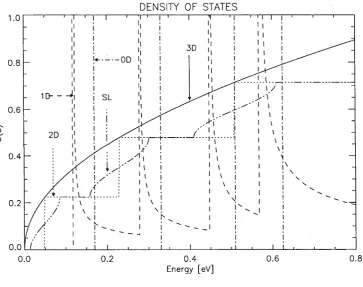
The dependence of physical properties on the dimensionality of the solid can
be drastic. A good example is the electronic density of states which is shown in
Figure 1.1 [Esaki (1990)]. The density of states is a parabolic curve
E 1^2
for 3D, a
step-like curve for 2D, a peaked curve
Yln{E — Em — En)~ll 2
for ID, and a delta
DENSITY OF STATES
*---OD
0 .4 Energy [eV]
Figure 1.1: The dependence of the density of states on the dimensionality of
the electronic system.
[image:10.563.122.486.289.576.2]1. Introduction
3DIMENSIONLESS POLARIZATION FUNCTION
V = q / kr
Figure 1.2: The dependence of the polarization function on the dimensional ity of the solid.
[image:11.563.142.462.145.400.2] [image:11.563.86.522.490.671.2]1. Introduction
4
shown in Figure 1.3 [Bastard (1988)] where the calculations are carried out at zero
temperature. The mobility anomalies occur when the Fermi energy coincides with
the beginning of the first excited subband
(i.e. second subband). In experiments,
the mobility drops gradually rather than sharply because of thermal and collisional
broadening.
Low-dimensional systems are usually realized near the surfaces of materials
exposed to vacuum or interfaces between different materials. Such surfaces and
interfaces influence the lattice vibrations of the materials. The lattice vibrations are
periodic displacement of atomic constituents of materials about their equilibrium
positions. They give rise to waves propagating along the surfaces or interfaces.
Quantization of lattice vibrations give rise to phonons. Reflection, refraction, and
localization of waves are common effects of the existence of surfaces and interfaces
in materials.
1. Introduction
5
Djafari-Rouhani
et al (1994)] by using elastic Green’s function methods, and inter
face response theory which is equivalent to the surface Green’s function matching
(SGFM) method developed by Garcia-Moliner and coworkers [Garcia-Moliner and
Flores (1979), Dobrzynski
et al (1987), Garcia-Moliner and Velasco (1992)].
There has been a great deal of experimental and theoretical research on the
electronic properties of low-dimensional systems. The electronic band structures of
the low-dimensional systems have been investigated using several calculation tech
niques such as the variational wave function method [Fang and Howard (1966)],
tight binding method [Schulman and McGill (1979), Bastard (1988)], LCAO method
[Schulman and Chang (1981)], pseudopotential formalism [Jaros and Wong (1984)],
Kronig-Penney model [Esaki and Tsu (1970)], self-consistent method using the den
sity functional theory [Stern (1972), Stern and Das Sarma (1984), Marmorkos and
Das Sarma (1993), Xu (1992), Xu and Mahanty (1994a)], etc. The self-consistent
calculation and the variational wave function methods are applicable to heterostruc
tures containing free charge carriers. The variational wave function, Kronig-Penney,
and self-consistent calculation methods use the envelope function approach with po
tential line-ups (confinement potentials) based on the bulk band structures of the
materials. The tight-binding, pseudo-potential and LCAO methods are microscopic
approaches based on the atomic wave functions.
Another electronic property thoroughly studied is the mobility of charge
carriers, which is very important in determining the electronic and vibrational
properties of practical devices. Also, the quantum Hall effect occuring in the two-
dimensional electron gas has been investigated by measuring conductivity and by
using phonon spectroscopy of the 2DEG [Eisenstein
et al (1986)].
1.2 General remarks on the electron-phonon interaction
absorp-1. Introduction
6tion of a phonon, (3) the emission and reabsorption of virtual phonons by electrons
or the emission and reabsorption of virtual electron-hole pairs by phonons, and (4)
an effective electron-electron interaction by exchange of a virtual phonon. The pro
cesses (1) and (2) are of first order whereas and (3) and (4) are of second order in
the sense of a perturbation expansion. The process of absorption of a phonon with
a consequent electronic transition leads to the attenuation of sound waves when the
sound waves propagate in a conducting crystal. The emission of a phonon with an
electronic transition is related to phonon generation, amplification of sound waves,
and electrical resistance. The emission and reabsorption of virtual phonons by
electrons bring about a shift of the one-electron energy
(i.e. renormalization of the
electron mass) and the emission and reabsorption of virtual electron-hole pairs by
phonons give rise to a shift in phonon frequency (i.e. renormalization of the phonon
frequency). The attractive effective electron-electron interaction in superconduc
tivity theory has its origin in the electron-electron interaction by exchange of a
virtual phonon. Thus the electron-phonon interaction plays an important role in
electrical and thermal transport processes, in the renormalizations of electron effec
tive mass and phonon frequency, in superconductor theory, in phonon generation,
and in amplification and attenuation of sound waves. It also plays an important
role in the Peierls phase transition as discussed below [see next page].
When external fields such as an electric field with or without a magnetic
field, and a temperature gradient are applied to a solid, the equilibrium between
the electrons and ions is disturbed and the external fields give rise to electrical or
thermal transport. Such transport processes are described by several complicated
interaction mechanisms in addition to the electron-phonon interaction. The trans
port properties of solids can be determined from the Boltzmann equation. The
contribution of the electron-phonon interaction to the transport processes can be
estimated by solving the Boltzmann equation with only electron-phonon scattering
taken into account. In the transport process the contribution to the scattering
of charge carriers with phonon emissions brings about the electrical resistance of
materials (electrical transport).
1. Introduction
7
leads to the attenuation of sound waves (or phonon decay) via the absorption of
phonons by electrons when the drift velocity of the electrons is less than that of
the sound waves. Conversely, the amplification of sound waves occurs when the
drift velocity of the electrons exceeds the sound velocity of the solid. In the theory
of superconductivity, the effective attraction between two electrons near the Fermi
surface can occur due to the electron-phonon interaction; electrons exchange a
virtual phonon which causes bound pairs of electrons to form.
Several experiments have been carried out on phonon generation and ampli
fication using techniques such as drift-field pulse (or current-pulse) [Hutson
et al
(1961)], heat-pulse [von Gutfeld and Nethercot (1964)], electromagnetic radiation
[Houck
et al (1967)] and pulsed optical pumping [Ulbrich
et al (1980)]. These tech
niques are related to electron-phonon interactions. There are two main causes of
phonon generation via electron-phonon interactions. The first is as in the traveling
wave amplifiers in which the drift velocity of charge carriers exceeds the velocity
of phonons. The second is the laser (or maser) type of amplification in which non-
radiative downward electronic transitions are induced via optical pumping, where
the phonon frequency is the same as energy difference between the two electronic
states undergoing the transition. There are several other phonon generation tech
niques [see, e.g., Tucker and Rampton (1972)] using magnetostriction, piezoelectric
transducer, paramagnetic resonance, piezoelectric surface excitation method, mag
netic field pumping (spin-phonon interaction) [Tucker (1961)], and so on.
The Peierls phase transition occurs in solids with a partially filled electronic
band when a distortion (Peierls distortion) of the lattice causes an energy gap
to appear at the Fermi surface. The distortion leads to the metal becoming an
insulator. Zhang
et al (1993) theoretically derived an expression for the Peierls
phase temperature Tp
by using deformation potential theory in a ID conductor such
as TTF-TCNQ, where they claim the Peierls phase temperature
(Tp
oc exp[— Jy],
E:deformation potential) is dominated by the electron-phonon interaction [Zhang
1. Introduction
81.3 Remarks on phonon generation via electron-phonon in
teractions
Over the last forty years, there has been considerable interest in phonon
generation in solids. In the early stages of phonon (ultrasonic waves) generation,
piezoelectric materials such as quartz, CdS, and ZnO were employed using resonant
transducer technique. This technique requires a very thin wafer where attenua
tion of sound waves can be severe. As mentioned in the previous section, there
are several techniques for phonon generation depending on the particular phonon
couplings,
e.g. electron-phonon coupling, electron-magnon coupling, spin-phonon
coupling, etc.
The effect of conduction electrons on the attenuation of acoustic waves
in metals has been investigated by several authors [Pippard (1955, 1960), Hol
stein (1959), Khan and Allen (1987)] since Bommel first measured the ultrasonic
attenuation in lead [Bommel (1954)]. Parmenter predicted theoretically the acous
toelectric effect, which is the generation of an electric current due to a traveling
acoustic wave. The effect occurs in both metals and semiconductors [Parmenter
(1953)]. The acoustoelectric effect was further developed both theoretically [Wein-
reich (1956)] and experimentally [Weinreich
et al (1959)], and was first observed in
germanium [Weinreich and White (1957)] by Weinreich and coworkers. Weinreich
suggested that the acoustoelectric effect could be used to calculate the amount of
attenuation of acoustic waves [Weinreich (1957)]. With the investigation of the
attenuation of acoustic waves using the acoustoelectric effect, the possibility of
the generation of acoustic waves by charge carriers was suggested by Weinreich
based on the deformation potential coupling between electrons and phonons in
semiconductors [Weinreich (1956)]. Also, the generation of ultrasonic waves via
electron-phonon interactions was theoretically predicted by Tolpygo and Uritskii in
1956. Thenceforth there has been considerable interest in phonon generation using
electronic transitions between two electronic states, where the phonon frequency
corresponds to the energy difference between the electronic states involved.
1. Introduction
9
electronic transitions may provide a tunable ultrasonic source because the phonon
frequency depends on the energy difference between the electronic levels undergoing
the transition. From the theoretical point of view, the characteristics of phonon
generation in a system can give clues for fundamental understanding on electronic
structure, electron-phonon coupling, phonon dispersion in the system, and so on.
Hutson and coworkers [Hutson
et al (1961)] achieved experimentally the amplifica
tion of ultrasonic waves in a piezoelectric crystal by using a dc drift-field pulse. The
concept of the amplification of acoustic phonons has been extended to semimetals
using magnetoresistance, which is an electrical resistance due to electron-phonon
interactions under the application of electric and magnetic fields [Esaki (1962),
Dumke and Haering (1962)]. Pomerantz (1964) observed phonon amplification in
germanium; in this case, the deformation potential plays an important role in the
electron-phonon interaction. Direct generation of ultrasound by electromagnetic
radiation in metals has also been studied by several authors [Houck
et al (1967),
Chimenti
et al (1974), Ram Mohan
et al (1979), Feyder
et al (1982)].
1. Introduction 10
greater th an LA signal for Si M OSFETS, a G aA s/A lG aA s heterojunction, and G aA s/A lG aA s quantum wells.
To fully describe the phonon generation via electron-phonon interactions in a solid, it is im p o rtan t to have some crucial inform ation such as th e deform a tion potential, piezoelectric coupling, and electron distribution, while to describe th e tran sp o rt processes, it is necessary to have com plicated inform ation such as deform ation potential processes, polar scattering processes, piezoelectric scattering processes, im purity scattering processes, electron-electron scattering processes, etc. Therefore, it is more straightforw ard to study the phonon generation rath er th an the tran sp o rt processes for research on the electron-phonon interaction.
1.4 Scope of the thesis
CHAPTER 2
The Hamiltonian for Solids
2.1 Introduction to the model Hamiltonian for solids
Basically, the complete way to investigate the properties of solids would be the
quantum-mechanical treatment, based on solving the Schrödinger equation of the
system concerned. Unfortunately, it is not possible to exactly solve the Schrödinger
equation of any solid system because in any system there are an enormous number
of particles(~ 1023) and several complicated interactions between them. One or
more approximations are therefore essential in any investigation of the properties
of a solid. Before introducing any approximation, it is important to construct a
proper Hamiltonian for the solid. For completeness, we discuss some very basic
aspects of electrons, phonons, and their interaction in the following sections.
The Hamiltonian of a solid is made up of the kinetic energy of all particles in
the solid and their interaction energies. The electrons in the solid can usually be
classified into two groups [Madelung (1978)]—the valence electrons which mediate
the chemical bond, and the core electrons which are tightly bound in the closed
shells of the lattice ions and which scarcely influence the properties of the solid.
Therefore, we can approximately consider the valence electrons and the lattice ions
as independent constituents. A suitable model of the total Hamiltonian for the
solid is then [Haug (1972)]
on
T Tfg
iT
^~(-ion—el •> (2.1)t
P 2
2. The Hamiltonian for Solids
12Hei = T el + Vel = J 2 ^ - + E
, 2m
“ I r -
- r,
e2and
where
is the momentum of the
i-th ion,
Mi is the mass of i-th
ion, and
Vion
is
the interaction of the collection of ions, which is assumed to be through the direct
ion-ion coupling
Vion-ion(R^ — R*/) that depends only on the distance between pairs
of ions. Here we neglect ion-ion interactions beyond two body interaction.
Vt\ is the
interaction of the valence electrons via the Coulomb interaction.
Tiion-ei describes
the interaction between the electrons and ions. In this approximation, we have
neglected the structure of ions and coupling between the closed-shell electrons on
different ions. It is not possible to rigorously solve the Schrödinger equation for
the total Hamiltonian (2.1). There are several possible choices of approximations,
depending on the physical circumstances and the behaviour of the solid to be stud
ied. Following Born and Oppenheimer [e.g. see Haug (1972), Jones and March
(1973)], the total Hamiltonian can be divided into two components—that dealing
with the motion of the valence electrons together with stationary ions, and that
dealing with the motion of the ions. From the viewpoint of the electrons, the ions
appear nearly stationary because the ions respond only slowly to a change in the
electron configuration, while the electrons respond adiabatically to a change in the
positions of the ions [Jones and March (1973)]. So the Schrödinger equation for the
electrons can be approximated by
in which the coordinates {R^} of the ions are taken as fixed parameters, and where
he
stands for all the quantum numbers describing the electrons. The wavefunctions
form a complete set in
r
space. Therefore the total wavefunction
can be
nc{{
r,}, {R*})<M{r,}, {Rf}) = £*({R€} )M { r ,} , {R<}),
(2.2)
with
2. The Hamiltonian for Solids
13expanded in term s of the
Vtot =
X ^
a(«, {R^})^«({r2}, {R/}).
K
where A denotes all the quantum num bers for the to tal ions. The to tal Schrödinger equation is now given by
'hCtot'&tot — Stot^tot- (2.3)
Taking th e inner product w ith 4>* of both sides of equation (2.3), we have
(Id-ion + Sk)<~p a(k, {R^}) + C,kk'({R ^})v:,a(/c/5 { R 4 ) — ZtotTa(*0 {R^})? (2.4)
K1
where
C ^ ({ R ,} ) -
A
kkI({
R,}) +
BKK.({
R/}),
w ith
*«-({»<}) = - E ^
T he first term (Tiion + £«) in th e left side of equation (2.4) is th e effective H am il tonian Tip of the ions which is given by
T ip — T ion + Tdon + £« = T i on + V ? J J .
The second term in the left side of equation (2.4) corresponds to the electron- phonon interactions which can be ignored in the adiabatic approxim ation. Thus th e Schrödinger equation for the total system in the adiabatic approxim ation is given by
TCP<Pa(«, {R<?}) = £t0*(A)^A(«h {R^})- (2.5)
2.2 Phonons
2. The Ham iltonian for Solids 14
are always a function of the positions of th e ions. So far we have used to refer to th e positions of the ions in which t stands for the lattice position and the basis atom positions together. Generally, the positions of the ions in a solid w ith N unit cells and r basis atom s in each unit cell, can be described by
R to = 4 R a , ( £ = 1, — , iV ; a = l , - - - , r )
where R^ is the Bravais lattice vector and R a denotes th e vector from the Bravais lattice site to the a th basis atom . Let us now consider a small ionic displacem ent
from th e equilibrium position R^a :
R&*(0 — R&* + U (2-6)
w ith
U fo = + U a ,
where is th e displacem ent of the cell as a whole and u a is a relative displacem ent of th e a -th basis atom . From equation (2.6) we have
— V Uf,
Thus th e kinetic energy of the ions is given by
Tw«.
= E ^r«L,
(2-7)
ia i Z
where M a is the mass of the a th basis atom and i is a C artesian coordinate index. We expand the to tal potential energy of the ions in a Taylor series in powers of th e displacem ent u^ai and term in ate the expansion at th e first non-vanishing term w ithin th e harm onic approxim ation. The first term in th e expansion is a constant corresponding to the static equilibrium energy and m ay be chosen as zero in the dynam ics of lattice vibrations.
= V £ "(R ? J +
\
E
(2.8)
Zia i i 'a 'i '
w ith
i'a 'i' /id 0 ,p0 \
Via i y ^ i a i ^ i ' a ' )
2. The Hamiltonian for Solids
15where is called atom ic force constant (coupling constant) which is th e force in th e z-direction on the a th atom in the £th unit cell when th e a /th atom in the Uth cell is displaced by unit distance in th e z'-direction. The equation of m otion is derived classically from equations (2.7) and (2.8)
M aiila,
=
-=
"E
(2.10)
O U ta i
The coupling constants have the following properties:
(1) Because V i s a second-order differential, equation (2.9) gives
y j l 'a 'i ' __ -\)la i ’'lo ti — Vl ,a ,i'
( 2 h as lattice translational invariance which means th a t depends only on (R ° — R ° = R j j and not on R °, R° separately. Thus we have
V £ f ' = V ( m ) ä ,
(3) U nder a rigid body displacem ent of th e lattice (z.e., all U£ai are independent of £: a ) , there is no acceleration. Therefore, from equation (2.10) we have
E e ' = y v K r = o l a rna
Let us now consider a periodic solution of the equation of m otion (2.10),
utai
= —d=-u>o,'(q)e'(q'R° - “<* (2.11)v -M. (X
where u>a;(q) is independent of R °. S ubstituting equation (2.11) into equation (2.10), we obtain
^
oi(q) = E - 7 = ^ = = V " ''e iq 'R?'-RS>u;0.,,(q) = £ ^ '( q j w ^ t q )
(2.12)
l ' a 'i ' V M a M a ' a>i,
where
Dai (q)
1
\J MaM ai
£ v £ f V q-(R? '-R?' =l'1
\J MaMai
E V(m)S;*'e*q'Ry (2.13)and has the H erm itian property
2. The Hamiltonian for Solids
16
The equations (2.12) give the secular equation
-
= 0,
involving a 3r x 3r determinant which has 3r eigenvalues, u;A(q)(A = l , - - -, 3r ) .
The eigenvalues correspond to the longitudinal and transverse acoustic waves when
the lattice has one basis in the unit cell, and in addition, the longitudinal and
transverse optical waves when the lattice has more than one basis in the unit cell.
The equation
cj = u A(q ) (A = 1, • • •, 3 r)
is called the phonon dispersion relation of the solid. Since
D®'/ {q) is Hermitian,
the eigenvalues are real
wA<q) = “ A(-q)> (2 -14)
which implies time reversal symmetry. To each ur\(q) corresponds an eigenvector
eli (q)satisfying
“ \(q )eiA q ) = S ■
Dm‘,(q)eiv(q)-
(2-15)
a 'i'
The eigenvectors
contain a suitable phase factor depending on
a to describe
the motion of the different atoms in the unit cell. They are complex, and obey
both orthonormality and completeness relations:
Y
em)>K(q)em- ](q)
= <$AA'(orthonormality)
(2.16)
a i
Y
e^'}*(q)e^,(q) =
6aa>6u>
(completeness).
A
Multiplying equation (2.15) by e^*(q) and summing over
a and
i with the use of
the orthonormality, we obtain
w a(<1 ) = I ] e i A;) * ( q ) I > “ ' ' ' ( q ) e ^ ( q ) .
a 'i'
ai
For the displacement
we now have a solution of the equation of motion (2.10),
2. The Hamiltonian for Solids
17Any lattice displacem ent is a linear com bination of the eigenvectors of the dynam ical m atrix
«fai = _ 7 ^ F ^ <5 ^ q ’ ^ e“d <3)e’q R ° > (2-18) y / l \ M a qA
where Q\(c[,t) f°r different q and A are called norm al coordinates, including the tim e-dependent exponential factor in equation (2.17). Since th e displacem ent U(ai m ust be real, we have
= e i h q ) < 3 A ( q , 0
-This is satisfied by the requirem ents
em*(q) = eS }( - q )
and Q\(<bt) =(2.19)
Let us now consider the effective H am iltonian Ttph for the lattice vibrations
n ph
= E ^ r « L + J E
(2.20)
ta i Z Z ta i t 'a 'i '
In order to express the H am iltonian in term s of the norm al coordinates, Q \ ( q, £), we need th e following condition in addition to the equations (2.13), (2.14), (2.15), (2.16), and (2.19)
E ei(q+q,)-R? = « E
(2.21)
t Gm
where G m is a reciprocal lattice vector, and any phonon wave vector (z.e. q and q') m ust be inside the first Brillouin zone. Because q + q ' can not equal a nonzero reciprocal lattice vector, we have only q -f q ' = 0 in equation (2.21). Thus th e H am iltonian Ttph becomes
Kph = \
q> 0ÖA(q,t)
+ ^ ( q ) Q j ( q , *)] (2-22) qAThe coupled H am iltonian (2.20) is now replaced by the decoupled H am iltonian (2.22). From the Lagrangian L = T — V, th e conjugate m om entum P\(c[,t) is given by
d L
2. The Hamiltonian for Solids 18
Thus the H am iltonian (2.20) can be w ritten
n ph = \ X ][P A (q, 0 P A(q, t) + u x( q ) Q x(q, t ) Q x(q, *)]
qA
and th e equation of m otion from Px ( q , t ) = —d7iph / d Q x( q , t) is
Qx(qH)-\-^l{q)Q\(qH)
=0
which is ju st a simple harm onic oscillator of frequency cj\(q ). Introducing creation and annihilation operators aj^(q),
o>\(q)
for phonons byQ*(q,
t) =
+ d ( - q ) e _“ *(q)‘]
(2-23)
P M = ( - q ) e - ^ (q)< - a A(q )e ^ « D '] the H am iltonian (2.22), is given by
Wpk = E
qAa l ( q ) a A(q) + ^ x ( q ) ,
in which th e creation and annihilation operators for th e phonons satisfy the com m u tatio n relations,
[f l A ( q ) j )] — ^A.A'^q.q'
and th e to tal energy of phonon system is given by
£pk =
E « ’ + b ^ x ( q ) ,
E < A)
qA ^ qA
where riq^ is th e phonon occupation num ber and N ph is th e to tal num ber of phonons in the system . For a system in therm al equilibrium , the average num ber of phonons in th e state (q, A) is given by the Bose-Einstein distribution
< niA) > =
e hux( q ) / k BT _ I1and th e average energy due to phonons in the state (q, A) is
2. The Hamiltonian for Solids
19
2.3 Electrons in solids
Let us first consider the ground state of Ne
electrons in a solid when the ions
are in their equilibrium positions {R°}. From equation (2.2) the Hamiltonian for
the
N
electrons in the solid is given by
* . = E £ + £ K°(r.) + E ^
(2-24)
i % i < j I i i q I
with
q°(r,) = E K » n - e i ( r , - R ? ) .
I
If we choose a wavefunction $ of
Tie as a determinant (Slater determinant)
* ( ! , - • • , We)
1
v ^ T
^l(l*l,CTl)
i p N e {
ri,cri)
^i(rjve,^Ne)
^ N e i ^ N e , & N e )
where
cr
indicates the spin of the electron, then using the variational principle we
can write the one-electron Schrödinger equation in the Hartree-Fock form,
- £ v 2 + v »
-
e /
Pi*') ~ PnF(r,r')
|r — r'|
dr'
^ n ( r ) =EnxJjn(r)
(2.25)
with
H r) = - e E l V ’n(r)!2
(2.26)
n
p
HFn(r, r')
Y '
f e ( r')V,n(r')V’;(r)^ n '(r)
T
Ä (r)V ’n(r)
spin||
(2.27)
where
p(r) is the electron density and
p^F{r, r') is the exchange charge density.
The one-electron Schrödinger equation can self-consistently be solved using equa
tions (2.25), (2.26), and (2.27) with the exchange interaction. Furthermore, taking
into account the correlation interaction in addition to the exchange interaction,
the Schrödinger equation can self-consistently be solved using the density func
tional theory (e.g. local density functional theory). Generally, the one-electron
Schrödinger equation in the solid is described by
V>n(r) =
Enipn(
r)
(2.28)
2. The Hamiltonian for Solids 20
where H(r) contains not only the periodic potential Ve° due to the ions alone, but also effects due to th e interaction of the electron w ith all the other electrons (e.g., th e th ird term of equation (2.25) in the HF approxim ation). The effective one- electron potential in the solid has the periodicity of the underlying Bravais lattice w ith lattice vector R°;
V( r + R °) = V(r) = £ V ‘f / (r - ,
icy.
where is the effective interaction of an electron w ith both a ion and the other electrons. The eigenfunctions of th e one-electron H am iltonian are generally given as Bloch functions w ith a spin wavefunction x ^ ) ?
< /w ( r ) = elk‘r wnka ( r)x ( ^ ) (2-29)
w ith
unk(T(r + R °) = u nka(r) for any R ? ,
and the corresponding eigenvalues have the form E no{k) where n denotes th e band index, a th e spin, and k the wave vector of th e electron. In this one-electron approx im ation, th e electrons in the solid occupy one-electron states. Introducing creation and annihilation operators c^k(T, cnka for th e electrons, th e system of electrons can be described by
CnkoVW r) , ^ = ' £ , Ci k < r C k < r ( r ) ,
n k a nk<7
which give the appropriate Bloch wave second-quantized H am iltonian for th e elec trons
Tie — E ncr (k)cnk£7cnkCT . nkcr
Here th e creation and annihilation operators satisfy the anticom m utation relations
{ Cnkcr i Cn ' k la ' 1 = ^ra.n'^k.k' ^ a ,a ' •
T he to tal energy of the electrons in the solid is given by
2. The Hamiltonian for Solids 21
w ith
nk a
where N e is th e to tal num ber of electrons and n®ko. is the electron occupation num ber. If the electrons are in therm al equilibrium , the average num ber of electrons in the Bloch state (n,
k,
<r) is given by th e Fermi-Dirac distributionn n ka = < Cnk a Cn k a > = e [(#nCT(k) - E F) / k BT] _j_ ]_
where E p is the Fermi energy and T is the tem perature.
2.4 Electron-phonon interactions in solids
Let us now consider the electron-phonon interactions whose H am iltonian is included in equation (2.4). In fact, the electron-phonon interaction term in equation (2.4), which was neglected in the adiabatic approxim ation, plays a m ajor role in properties other th an th e energy eigenvalues of the ions, e.g. the tran sp o rt of charge carriers, phonon emission, etc. In addition, there are some unusual effects th a t arise when electrons move in system s of reduced dimensionality. T he electron-phonon interaction in th e solid determ ines the m atrix elem ent for a sim ultaneous transition of th e ions and the electrons
M (A ',/c';A ,« ) =
J
v*AI( E , R t ) C KK'( I l e ) ¥ A( K , R e ) d R £, (2.30)2. The Hamiltonian for Solids 22
V(r) = E
- R&0 = E [V 5"(r - R ? J -
• W e'" ( r - R ° J
la la
= V°(r) - E u <« ' V V ‘/ f (r - R ° J .
la
The second term on the right is the H am iltonian for the electron-phonon interaction. Thus th e electron-phonon interaction H am iltonian is given by
H ep =
8
V
(
r) = V (r) - V » = ~ E « f a - V ^ " ( r - « & , ) • (2-31)£a
In order to find th e m atrix elem ent of th e electronic transition from (n, k, <r) to ( n ^ k ', cr'), it is convenient to express V*/* as a Fourier series,
v : / f (r
- R ° J =E
(K)e*K-<r - R?>. (2.32) KFrom equations (2.18), (2.23), and (2.32), the electron-phonon interaction H am il tonian (2.31) can be w ritten as
Hcv = -
E - 7 ^ = E Cx(q)e*(<1- K)'R? e « (q ) • (t/c)Ve! " ( « ) e iK r .
la V ^ M a qA
Sum m ing over f and using the relation
E ' ! M t ! = T W G . ,
I Gm
where G m denotes a reciprocal lattice vector, we can calculate th e m atrix elem ent of th e tran sitio n from ( n ,k ,( j) to (n', k',cr');
< n ' , k ' , ( j ' \ H ep\ n , k , ( T > =
J
il>*,kl(7l(r)H epipnk<T( r ) d r .Thus, using equation (2.23) for Qa(h) we can w rite H ep for a norm al process (G m= 0) in second-quantized form as
H e p ^ \ f f e p \ l p > ^ M \ a n a ' n ' ] t q [ Q J\ ( Q ) T C lA( H ) ] c n/jc_|_qcr/Cn ]t(7
Acrner'n'kq
2. T he H a m ilto n ia n fo r Solids 23
‘ Acmij'n'kq
= -*E
JV7»
•K if/(q)[q- 4 A)(q)l
2 M „o > A( q )
X / u»',q+ka'(r K ,k < A r ) < X ( 0 I X M > * •
L e t us n o w c a lc u la te th e p r o b a b ilit y o f an e le c tro n ic t r a n s it io n fr o m a s ta te |k >
to a s ta te |k -j- q > in th e sam e e le c tro n ic b a n d a n d th e s p in c o n s e rv a tio n process.
U s in g F e r m i’ s g o ld e n r u le th e tr a n s itio n p r o b a b ilit y is g iv e n b y
Onr
A
2
W(i -> / ) = — |< S\Hep\i >| S(Ef - Ei).
U s in g th e fo llo w in g m a t r ix e le m e n ts
^ 77k+q d~ ^ nq ^ ^ lck + q Ck GA (q ) |77k + q ’77k> 77q ^ >
= ^ ( 1 “ n k + q ) n k n q } 5 E f - E i = E (k + q ) - £ ( k ) - h u x (q )
( fo r a b s o rp tio n o f a p h o n o n )
a n d
< n k+q + - ! ; n - q + 1 IC k + q C k ® ^ - q ) l n k-H|) n k i n - q >
= \ / ( ! - n k + q ) n k ( n<- q + ! ) > Ei ~ Ei = E(k + q ) - # ( k ) + f t^ A( q )
(fo r e m is s io n o f a p h o n o n )
w e h ave
W {k
w h e re
1 \ 27T
k + q) = T
■ Akq ( 1 - " k + q ) n k { n q ^ ( £ ( k + q ) - £ ( k ) - ß w A( q ) )+ ( n - q + l) < 5 ( £ ( k + q ) - E (k ) + ftw A( q ) ) }
M x k * = ( q ) [ q • e “A)(q)1
2. The Ham iltonian for Solids 24
2.5 Effect of dimensionality on the electronic bands of a solid
As m entioned in C hapter 1, the dim ensionality of a solid m eans the dimension in which th e charge carriers in the solid are free to move. The dim ension m ay be less th an th a t of th e bulk sem iconductor (3D) due to quantum confinement produced at interfaces between different sem iconductors as in sem iconductor heterostructures. This Section deals w ith th e effect of dim ensionality on the electronic band stru ctu re of these heterostructures. For a heterostructure w ith no free charge carries, it generally suffices to use the envelope function m ethod, which is a textbook quantum m echanics problem [Bastard (1988)], using a known band line-up from th e bulk band stru ctu re of of th e m aterial. For heterostructures w ith free charge carriers e.g., m odulation-doped heterostructures, self-consistent calculations are required.
Here we consider a heterostructure whose potential depends only on th e x 3-direction, as in 2D system s, and whose states are built up from th e same ex trem a in both types of layers. However, if the heterostructure is built from the different band ex trem a in the two layers, we can not use th e envelope function approxim ation but use microscopic m ethods such as tight-binding or pseudopotential m ethod. Once the eigenstates of th e bulk sem iconductors, which compose the heterostructure, are known, th e electronic band stru ctu re of the heterostructure can be determ ined from th e envelope function framework [Bastard (1988)]. In the envelope function framework, th e electron wave function can be expressed in term s of th e Bloch functions of th e edge (e.g. ko) under consideration
where A 0 is th e area of the sample and k (| is the 2D wave vector m easured from the band ex trem a k 0. Then the envelope wave function (« (^3) satisfies th e one dim ensional Schrödinger and Poisson equations:
V’M = F A = e’k"'r“n,k„(r)C„(^3)
n V A 0
h2 d
1
d
2 d x 3 m , (x
(2.33)
2. The Hamiltonian for Solids 25
where Vc( x 3) is the confinement potential and Vs.c(^3) is the self-consistent po ten
tial. The energy eigenvalue and electron charge density are given by
^ n ( k | | ) — ^ n , k o T E n +
2m*(x3)
w ith
p (x 3) = —e[ ^ n n I Cn(^s) I2 + N a (^3) - N f (ar3) ] ,
n o ccu p ied
_ ( (m* IcbT /ttH2) ln[l + e ^ F En)/kBT] if T ^ 0
n " = i (m*J*K2) ( E F - E n) Q ( E F if T 0 ’
(2.35)
where n n is th e areal concentration of electrons in th e n-th subband, and are th e acceptor and donor concentrations respectively, E p is the Fermi energy of th e electrons, i?n,k0 is th e n-th band edge energy at th e zone centre, and E n is th e n-th subband energy. The dependence of the effective mass m* on position is hardly distinguishable from the band non-parabolicity of host m aterials [Bastard (1988)]. In a parabolic band approxim ation, the energy eigenvalues are given by
w ith
En{
k||) —£n,k0 + En +
^ K . E.r i2 D _ n 7.2
^K.E. —
(2.36)
2 ml *31 > where th e subband energy E n satisfies
h 2 d2
+ Vc(x3) C n ( ^ 3 ) E n ( ^ n { x 3 )
2m* dx \
and m* is the in-plane effective mass in the n-th subband, defined by 1
(2.37)
“ T m*
= /
J d^3I Cn(^s) T
m i x s ) ' The confinement potential may be expressed as
K (z3) = A E cf ( x 3) + Vs.c(^3) +
vxc(x3)
(2.38)2. The Hamiltonian for Solids
26
(1984)], GaAs-Gax-^Al^As quantum wells [Marmorkos and Das Sarma (1993)], and
5-doped AlGaAs-GaAs-AlGaAs single quantum wells [Xu and Mahanty (1994a)].
The analytic form of the exchange-correlation potential (in units of the effective
Rydberg,
Ry* = (e2/8
tt£
clb ) is given by
Vxc(x3) = -[1 4- 0.7734^ ln(l + — )] —
z 1 rs 7rctrs
(2.39)
with
• - ( * ) '
_ i
V " =
rs[x3) = l
- 7 TaB
n(x3)
Here
aB = (iTT£h2/m*e2) is the effective Bohr radius. The electronic band struc
ture can be evaluated self-consistently through the equations (2.33), (2.34), (2.35),
(2.38), and (2.39).
In Si surface inversion layers and modulation doped GaAlAs/GaAs hetero
junctions, the band bending has a quasi-triangular shape near the surface and the
interface. In these cases, we can use a triangular potential approximation. The
simplest approach to the confinement potential is the exact triangular potential
which gives a constant electric field
Fs
and an exact solution for the wave functions
[Stern (1972), Ando
et al (1982)]:
V c ( x3 ) -
oo
for £3 < 0
eFsx 3
for
x 3 > 0
F, =
e(Adepi + N
s)/£
aat the interface
eAdepiI&A
the depletion layer contribution only
e( Adept + As/2 ) /
£
aaverage field in the inversion layer
(2.40)
(2.41)
(n{x 3)+t = Ai
/2<eFsy /3
V h2 X 3 ~
eF*
where
N s
and Adept are the areal electron concentrations in the inversion layer
and the depletion charge concentration in the depletion layer of the well region
respectively, and where
£
ais the dielectric constant in the well side, and Ai is the
Airy function. Then the energy eigenvalues are approximately given by
1 / 3
E n
«
2 ml
\^KeFs(n + 3/4)
2 / 3rz = 0,1,2,*
(2.42)
**In equation (2.3) of reference [Marmorkos and Das Sarma, (1993)], there is a misprint. The superscript in the equation should read —
2. The Hamiltonian for Solids 27
Furtherm ore, a simple analytic variational wave function m ethod using the Fang- Howard trial wave function [Fang and Howard (1966)] is available. In Si inversion layers, a triangular well w ith an infinite barrier is most widely used [Ando et al (1982)] w ith th e Fang-Howard wave function:
{ (63/2 ) 1/2£3 exp( —
for x 3 < 0 bx3/2) for £3 > 0
From the m inim ization of the to tal energy per electron, we have the lowest subband energy E 0 for the exact triangular potential model (2.40);
w ith
h 2b2 3eF< u 8m* ^ b
/6 m * e F sx 1 / 3
" v h 2 )
(2.43)
(2.44)
and for th e quasi-triangular potential Vc{x3) — Vd(x3) + Vs( x 3) + V/(x3) which is given in the reference [Ando et al (1982)], we have
F _ h 2b2 3e27Vdepi ^0 — x—r +
8m* eAb
6e2N a 33 e
(
-e2b
EAb2 16e^6 e aT eb \2>2itea
with
b = ---I2m*ze2— (A^depl + — A^s)1 1 .. '
1 / 3
(2.45)
(2.46) eAh ' v' ' 32
where N a is the acceptor charge concentrations and Eb is th e dielectric constant
in the barrier region. The image potential contribution (i.e. V/, the last term in equation (2.45)) and a p art of the depletion layer potential contribution {i.e. the th ird term in equation (2.45)) are neglected to find the m inim ization p aram eter b in equation (2.46).
In m odulation doped G aA lA s/G aA s heterojunctions [see Figure 2.1], pene tratio n of electrons into the GaAlAs barrier occurs because the height of th e barrier in G aA lA s/G aA s heterojunctions is much sm aller th an th a t in Si inversion layers. The modified Fang-Howard wave function used for G aA lA s/G aA s heterojunctions is then [Ando (1982), B astard (1984, 1988)]:
2. The Ham iltonian for Solids 28
Here M , M ', and zq can be determ ined from the usual boundary and norm alization conditions in term s of the two independent variational param eters, b and b'. As an approxim ation, th e standard wave-function penetration in the barrier, 6', has been taken in the form [Bastard (1988)]:
VACUUM LEVEL
o-o-e-oo-G-2 DEG
p-type
GaAs E |
o ooooooooooopo
n-type GaAlAs
Figure 2.1: Band-extrema configurations in a selectively modulation-doped GaAlAs/GaAs single heterojunction (A) before charge transfer (B) after charge transfer. Ec and Ev are the conduction- and valence- band edges. Eo and Ei are the subbands, and Ep is the Fermi energy. E* and E?g are the band gaps in GaAlAs and GaAs, respectively. AEC and A E V are the conduction band offset and the valence band offset.
b' = 2i '2m BA E c
where m*B is the effective mass in GaAlAs layer. From th e boundary and norm al ization conditions, we have
zo
b + b'(m*A/ m B)
M = I —i
y
1/22
1 4- bzo -f 2 ^ Z 0 f l + y M ' - Mzq [image:36.563.97.491.193.398.2]2. The Ham iltonian for Solids 29
where m*A is th e effective mass in GaAs layer. Then we obtain the lowest subband energy as
where the variational param eter b is determ ined from the following m inim ization condition of the to tal energy per electron:
The m odulation doping technique makes it possible to obtain conducting charge carriers in high-purity, -mobility, and -perform ance sem iconductor devices due to the spatial separation between charge carriers in th e channel and im purity atom s in th e barrier m aterial. However, th e charge m obility is lim ited by several scattering m echanism s whose contributions to the m obility can be determ ined by using electronic wave functions as m entioned above, and interaction H am iltonians depending on scattering mechanisms. One of the im p o rtan t m echanism s is the electron-phonon interaction which is more im p o rtan t in phonon emissions from electronic transitions in low-dimensional system . The effect of electron-phonon coupling on low-dim ensionality will be discussed in C hapter 4.
CHAPTER 3
Electron-acoustic Phonon Coupling
3.1 Introduction
Low-dimensional systems have the interesting applicability both to basic
research (e.g.
2D physics, quantum Hall effect, etc.) and to high-performance
devices
(e.g. MOSFET, HEMT, TEGFET, etc) [Weisbuch (1987)]. It therefore
becomes very important to understand the various basic mechanisms related to the
physical properties in low-dimensional systems. As pointed out in Chapter 1 one of
the most important mechanisms is the electron-acoustic phonon interaction which
is closely related to the electron mobility and the mechanical wave (i.e.
phonon)
generation in low-dimensional systems. We shall consider the problems of electron-
acoustic phonon couplings in the context of phonon generation.
In semiconductors whose lattices lack inversion symmetry such as GaAs, CdS,
and ZnO, both the deformation potential coupling and the piezoelectric coupling
play an important role in the electron-acoustic phonon interaction [Mahan (1972,
1990), Ridley (1993)]. In general, the relative strengths of the couplings vary from
material to material. For example, it has been found that in n-doped GaAs the
piezoelectric coupling does not dominate because electric fields are shielded out by
free charge carriers to nearly within the Debye length [Kaufmann
et al (1994)]. In
the long wavelength region, the screening due to conduction electrons contributes
quite significantly to the phonon frequencies, while the screening in the short wave
length region does not [Agarwal and Kachhava (1993)].
3. Electron-acoustic Phonon Coupling 31
shall also discuss the relations between this coupling and the equations of m otion for the acoustic (or elastic) and electric fields. F irst, we consider th e basic equa tions, which will be used in the following Sections, for the electron-acoustic phonon interactions. W hen acoustic waves are generated due to electronic transitions in non-piezoelectric sem iconductors such as Si and Ge, the to tal Lagrangian density in a quasistatic approxim ation can be separated into th e elastic kinetic p art Ck,
th e elastic potential p art Cl, the electric p art C o, and the deform ation potential coupling p art Cd in the following form:
w ith
and
= Ck + Cl + Cd + Cd (3.1)
1 ( 3 u \ 2
C,< - 2 pm ^ dt j (3.2)
r-L = :
u
(3.3)CD = l E - D - / > f V (3-4)
Cd = —n e(r, f)E : u (3.5)
E = — V<p V • D = p f = —e n e ,
where pm is the mass density of the m aterial, u is the displacem ent vector, u the second rank strain tensor*, T the second rank stress tensor, E the electric field vector, D the electric displacem ent vector, p f the free electron density, (p th e elec tro sta tic potential, n e th e num ber density of electrons undergoing the transition, and where E is the second rank deform ation potential tensor. Double dot product represents sum m ation over pairs of subscripts [see, e.p., equation (3.35)]. For a piezoelectric m aterial, the stress tensor and the electric displacem ent vector, which will be discussed in detail in Sections 3.2 and 3.3, are expressed as
T = C E : u - E . h , (3.6)
D = £ ' E + fe (3.7)
3. Electron-acoustic Phonon Coupling 32
where h is the th ird rank piezoelectric tensor and C E is th e fourth rank elastic tensor at constant electric field. From equations (3.1) through (3.7), th e Lagrangian density for th e piezoelectric sem iconductor, when electronic transitions occur, may be expressed in the form
C = \p m (-77-^ — - ( C E : u) : u + E • h : u
2
\ d t )
2 V~ ~ ~ ~+ — n eH : u . (3.8)
In the next section the therm odynam ic functions and therm al variables will be discussed. Section 3.3 deals w ith continuum approxim ation for lattice vibrations. In Section 3.4 we give a brief discussion of interface effects on acoustic waves. Sections 3.5 and 3.6 deal w ith deform ation potential and piezoelectric couplings, respectively. Finally, we give brief com m ents on electron-phonon couplings in low dimensions in Section 3.7.
3.2 Thermodynamic functions and thermal variables
There are several possible choices for therm odynam ic functions depending on the independent variables of interest. The Gibbs function G and th e electric Gibbs function* G2 are m ost frequently used for a piezoelectric crystal [Mason (1966)]. Let
us choose th e electric Gibbs function in which th e stresses, electric displacem ents, and th e entropy are the dependent variables while th e strains, electric fields, and tem p eratu re are the independent ones. In this case, we m ay express th e electric Gibbs function and its differential form as
G2 — U — E mD m — o T
dG2 = Tijduij — D md E m — crdT (3-9)
where U is the internal energy, E m are th e com ponents of the electric field, D m are th e com ponents of the electric displacem ent, o is th e entropy, and T is the te m p eratu re in th e crystal. From the differential form of the electric Gibbs function



![Figure 3.3: Scattering rates for LA phonons in OD, ID, and 2D systems, (Lz = lOnm, T=4 K, for InGaAs/InP) [Bockelmann (1994)].](https://thumb-us.123doks.com/thumbv2/123dok_us/7905811.188911/55.563.197.422.168.479/figure-scattering-rates-phonons-systems-lonm-ingaas-bockelmann.webp)