This is a repository copy of 'Just another incentive scheme': a qualitative interview study of a local pay-for-performance scheme for primary care.
White Rose Research Online URL for this paper: http://eprints.whiterose.ac.uk/81464/
Article:
Hackett, JEC, Glidewell, L, West, R et al. (3 more authors) (2014) 'Just another incentive scheme': a qualitative interview study of a local pay-for-performance scheme for primary care. BMC Family Practice, 15 (168). ISSN 1471-2296
https://doi.org/10.1186/s12875-014-0168-7
[email protected] https://eprints.whiterose.ac.uk/ Reuse
Unless indicated otherwise, fulltext items are protected by copyright with all rights reserved. The copyright exception in section 29 of the Copyright, Designs and Patents Act 1988 allows the making of a single copy solely for the purpose of non-commercial research or private study within the limits of fair dealing. The publisher or other rights-holder may allow further reproduction and re-use of this version - refer to the White Rose Research Online record for this item. Where records identify the publisher as the copyright holder, users can verify any specific terms of use on the publisher’s website.
Takedown
If you consider content in White Rose Research Online to be in breach of UK law, please notify us by
1
‘Just another incentive scheme.’
A qualitative interview study of a
1
local pay-for-performance scheme for primary care
2
Julia Hackett,1§ Liz Glidewell,1 Robert West,1 Paul Carder,2 Tim Doran,3 Robbie 3
Foy.1 4
5
1Leeds Institute of Health Sciences, University of Leeds, Charles Thackrah Building, 6
101 Clarendon Road, Leeds, UK 7
2West and South Yorkshire and Bassetlaw Commissioning Support Unit, Douglas 8
Mill, Bowling Old Lane, Bradford, UK 9
3Department of Health Sciences, University of York, Rowntree Building, York, UK 10
11
§Corresponding author 12
13
Email addresses:
14
Hackett J [email protected]
15
Glidewell L [email protected]
16
West R [email protected]
17
Carder P [email protected]
18
Doran T [email protected] 19
Foy R [email protected]
20
21
2
Abstract
23
Background
24
A range of policy initiatives have addressed inequalities in healthcare and health 25
outcomes. Local pay-for-performance schemes for primary care have been 26
advocated as means of enhancing clinical ownership of the quality agenda and 27
better targeting local need compared with national schemes such as the UK Quality 28
and Outcomes Framework (QOF). We investigated whether professionals’ 29
experience of a local scheme in one English National Health Service (NHS) former 30
primary care trust (PCT) differed from that of the national QOF in relation to the goal 31
of reducing inequalities. 32
Methods
33
We conducted retrospective semi-structured interviews with primary care 34
professionals implementing the scheme and those involved in its development. We 35
purposively sampled practices with varying levels of population socio-economic 36
deprivation and achievement. Interviews explored perceptions of the scheme and 37
indicators, likely mechanisms of influence on practice, perceived benefits and harms, 38
and how future schemes could be improved. We used a framework approach to 39
analysis. 40
Results
41
Thirty-eight professionals from 16 general practices and six professionals involved in 42
developing local indicators participated. Our findings cover four themes: ownership, 43
credibility of the indicators, influences on behaviour, and exacerbated tensions. We 44
3
or experiences different from the national scheme. Although the indicators and their 46
evidence base were seldom actively questioned, doubts were expressed about their 47
focus on health promotion given that eventual benefits relied upon patient action and 48
availability of local resources. Whilst practices serving more affluent populations 49
reported status and patient benefit as motivators for participating in the scheme, 50
those serving more deprived populations highlighted financial reward. The scheme 51
exacerbated tensions between patient and professional consultation agendas, 52
general practitioners benefitting directly from incentives and nurses who did much of 53
the work, and practices serving more and less affluent populations which faced 54
different challenges in achieving targets. 55
Conclusions
56
The contentious nature of pay-for-performance was not necessarily reduced by local 57
adaptation. Those developing future schemes should consider differential rewards 58
and supportive resources for practices serving more deprived populations, and 59
employing a wider range of levers to promote professional understanding and 60
ownership of indicators. 61
62
Keywords: primary health care; pay-for-performance; financial incentives; social 63
4
Background
65
Evidence is accumulating that the establishment in 2004 of the Quality and 66
Outcomes Framework (QOF) as a pay-for-performance scheme for UK primary care 67
has not fulfilled all hopes and expectations [1]. Not only is there a problematic 68
evidence base [2], but its effects appear mixed [3] with persistent variations in the 69
quality of primary care [4] and concerns that QOF may have undermined 70
professionals’ intrinsic motivation, patient-centeredness, and continuity of care [3, 5-71
9]. Professionals are reluctant to engage in quality improvement initiatives perceived 72
as ineffective or even harmful [10], including pay-for-performance schemes 73
misaligned with professional values [1, 6, 11-13]. The Darzi Review of quality 74
improvement in the National Health Service (NHS) placed much emphasis on 75
engaging professionals [14]. At a local level, active involvement of professionals is 76
presumed essential in promoting ownership, providing that perceived benefits of 77
change compensate for the effort required [15-17]. At face value, the establishment 78
of pay-for-performance schemes with locally negotiated indicators offered 79
advantages over the national scheme, as means of promoting clinical ownership by 80
addressing local health priorities and enhancing the effects of incentives [18]. 81
We evaluated a scheme in one former PCT which was particularly motivated by the 82
need to address inequalities in healthcare provision and outcomes. The scheme ran 83
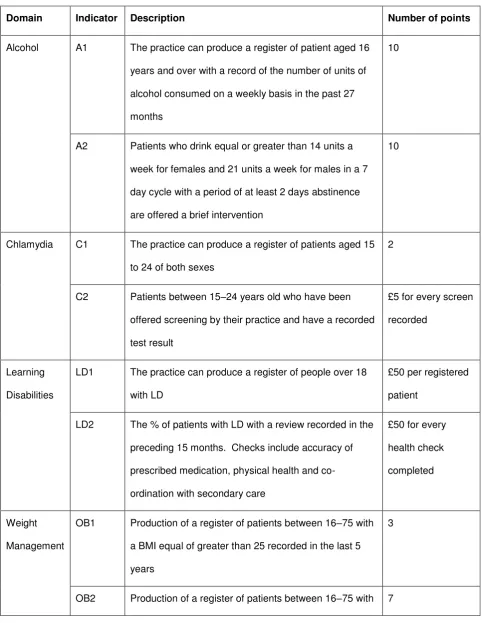
over 2007-11 at a cost of £3 million, and targeted five health priorities: alcohol; 84
learning disabilities; chlamydia; obesity; and osteoporosis (Table 1). The selection of 85
priorities, indicators and payment thresholds were negotiated between the PCT and 86
local health care providers, approved by the Local Medical Committee, and reviewed 87
and refined over the lifetime of the scheme. Our accompanying paper provides more 88
5
between practices serving less and more deprived patients were modest during the 90
first year of the scheme and closed over time for one and widened for one of the 16 91
indicators and possibly two other indicators. In addition, larger practices and those 92
serving more affluent areas earned more income per patient than smaller practices 93
and those serving more deprived areas. 94
These mixed findings somewhat contrasted with longitudinal analyses of the national 95
QOF which indicated that initial gaps in achievement between practices in deprived 96
and affluent areas these closed over time [20]. It was disappointing that a local 97
initiative intended to overcome the disadvantages of the national scheme did not 98
reduce inequalities as intended, 99
We undertook a qualitative study, in parallel to our above quantitative analysis, to 100
explore primary care professionals’ experience of the local QOF, including 101
perceptions of the scheme and indicators, likely mechanisms of influence on 102
practice, and perceived benefits and harms. We investigated whether professionals’ 103
experience of the local QOF did differ from that of the national QOF in relation to the 104
goal of reducing inequalities. 105
106
Methods
107
Design and setting
108
We undertook a retrospective semi-structured interview study within NHS Bradford 109
6
Participants
111
We initially invited managers from all 83 practices to nominate themselves and other 112
practice staff to participate in interviews. We then purposively selected practices 113
according to practice population socio-economic profiles (deprived or not) and local 114
QOF achievement (high or low achievement). We then used snowballing to further 115
recruit participants through asking those interviewed to nominate additional practices 116
or participants. We also invited six PCT and practice professionals involved in 117
developing the scheme. 118
Data collection and analysis
119
Following consent, a social scientist researcher (JH) conducted face-to-face 120
interviews at venues of participants’ choice (usually at work) over August 2011 to 121
June 2012. We reimbursed participants for their time and advised them that 122
responses would be treated confidentially. Interviews explored whether perceptions 123
of the indicators, mechanisms by which it influenced practice, benefits and harms, 124
and how future iterations of such schemes could be improved (Topic guide, 125
Appendix 1). 126
All interviews were recorded and transcribed verbatim. Transcripts were 127
anonymised and checked for accuracy. We used NVivo 8 to manage interview data 128
and a thematic framework approach to analysis [21]. Five transcripts were double 129
coded by (JH, LG and RF) and a coding schedule was developed (Appendix 2). JH 130
coded the remainder of the transcripts. Data were initially coded deductively to 131
areas pre-specified in the topic guide; further codes emerged from the data 132
inductively. Codes were grouped to form overarching themes which were iteratively 133
7
new codes had emerged. We compared and contrasted accounts from high and low 135
deprivation and high and low achieving practices, and sought discrepant accounts. 136
Ethical review
137
The study was approved by National Research Ethics Service East Midlands- 138
Nottingham 2 Committee (11/EM/0184). 139
140
Results
141
We interviewed 44 professionals involved in developing or implementing the local 142
scheme. Primary care staff from 16 practices participated in the interviews, eight of 143
these practices having been identified through snowballing. Eight practices served 144
relatively socio-economically deprived populations and 12 had relatively high local 145
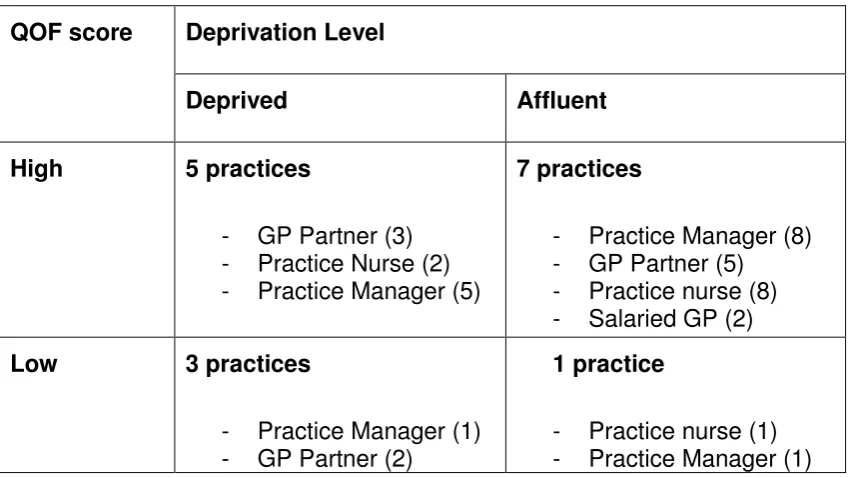
QOF achievement (Table 2). Of the 38 practice staff interviewed, there were 15 146
practice managers, 10 GP partners, two salaried GPs, and 11 practice nurses. The 147
six additional participants who had been involved in developing the scheme 148
comprised four PCT managers, one salaried GP, and one practice nurse. Thirty-149
three participants were female and 24 worked full-time. Median interview length was 150
44 minutes (range 18 to 88 minutes). 151
We report our findings in four overarching themes: credibility of the locally negotiated 152
indicators; ownership; influences on behaviour; and exacerbated tensions. Where 153
evident, we compare and contrast findings according to participants’ practice 154
population socioeconomic status and achievement, and involvement in scheme 155
development. 156
8
Credibility of the indicators
158
The local scheme developers had sought to target locally relevant and, largely, 159
public health issues absent from the national QOF. Professionals perceived the 160
limited evidence base underpinning such indicators as less of an issue than practical 161
considerations around their implementation. Hence, the evidence base was often 162
taken at face value, especially by practice nurses: 163
‘We appreciate that it is evidence based, obviously we wouldn’t be been 164
asked to do anything that wasn’t.’ (P11, practice nurse, high performer, 165
affluent area) 166
‘I don’t know if I was told about the evidence, we should say, “What’s the 167
evidence behind this?” but we’re too busy.’ (P37, practice nurse, high 168
performer, deprived area) 169
Professionals appeared more preoccupied by their lack of control in achieving 170
indicator targets, especially if dependent upon patient cooperation: 171
‘I can see why the alcohol and obesity were thought of as important, I get 172
the clinical reason but I’m not sure that it worked in the real world. People 173
thought we’d get them inand we’d do this, but the fact is that they don’t 174
come in and you don’t capture them and so it doesn’t work.’ (P19, practice 175
manager, high performer, affluent area) 176
Limited availability of appropriate, supportive resources needed to address such 177
problems further undermined confidence in these targets. 178
‘We’ve got a smoking cessation advisor within the practice, but there isn’t 179
9
services unless someone’s quite bad.’ (P12, salaried GP, high performer, 181
affluent area) 182
There was a range of opinion about relevance to local need, with the indicators being 183
seen as more salient to relatively deprived populations. 184
“It was certainly developed based on looking at measureable things that 185
were relevant to our population.’ (P36, GP partner, low performer, 186
deprived area) 187
In contrast, professionals from practices in affluent areas questioned the value of 188
certain indicators to their population. 189
‘The alcohol one for example for us is almost a bit of a waste of time, 190
because our patients don’t fall into that category.’ (P11, practice nurse, 191
high performer, affluent area) 192
193
Ownership
194
No clear sense emerged that the local pay-for-performance scheme was particularly 195
distinctive and offered anything over and above the existing national QOF. This was 196
partly because the scheme actually addressed national priorities. 197
‘We know too many people are overweight so in that sense it was targeted 198
at areas where we had a particular problem…I’m not aware that we had a 199
specific problem with osteoporosis in Bradford, likewise with learning 200
disabilities, I don’t think we’ve got any more of an issue than other areas. 201
There may have been other Bradford specific issues that we could have 202
10
another incentive scheme, and didn’t really think of it as bespoke.’ (P6, 204
scheme developer) 205
Ultimately then, practices tended not to differentiate between national and local 206
schemes, especially high performers. 207
‘It makes me feel no different, it’s just all part of my job, whether it’s a local 208
thing or national, it makes no difference.’ (P19, practice manager, high 209
performer, affluent area) 210
One practice manager in a low performing practice went further in stating that the 211
national scheme was more important. 212
‘We were always aware it (the local scheme) was there but we didn’t feel it 213
was as important as the (national) QOF.’ (P39, practice manager, low 214
performer, affluent area) 215
Participants implicitly defined ‘local’ in different ways, including at the practice, 216
cluster of practices, and PCT levels. 217
‘I think smaller cluster groups, because generally you’ll have an area such 218
as ourselves here with about twelve surgeries where we’ve all got similar 219
problems, so I think it would have helped if practices were grouped rather 220
than it being a generic local QOF.’ (P14, practice manager, low performer, 221
deprived area) 222
There was a further suggestion that ‘buy-in’ might be greater if the identification of at 223
least a limited number of priorities were delegated to practice level. 224
‘From the start you’d be making them own it because you’d be saying 225
“right, here’s a bit of money, you tell us how you want to spend it as a 226
11
immediately because they’ve come up with the marker.’ (P10, practice 228
manager, high performer, affluent area) 229
Some participants expressed views that initial dissemination was insufficient and a 230
familiarisation period would have helped embed targeted behaviours. 231
‘If we’d been told a bit more we might have been more engaged.’ (P23, 232
practice nurse, high performer, affluent area) 233
‘If we had time to play about with it and start to monitor our own performance 234
that would be really useful.’ (P10, practice manager, high performer, affluent 235
area) 236
237
Influences on behaviour
238
The scheme seemed to influence adherence to the targets primarily through 239
motivational means, supported by other mechanisms. Motivations were extrinsically 240
and intrinsically driven. 241
Professionals from practices serving both affluent and deprived populations felt the 242
scheme legitimised their intrinsic motivation to improve patient outcomes. 243
‘It’s a massive motivation to know that the patients out there are getting 244
the care that they need.’ (P39, practice manager, low performer, affluent 245
area) 246
Others, particularly practices serving more deprived populations, appeared to be 247
directly amenable to financial reward as an extrinsic driver. 248
‘We’re so hard up at the moment, so desperate for income wherever we 249
12
probably as much a driver…even if we didn’t necessarily buy in completely 251
to the clinical benefit, it was worth doing to try and earn the money 252
because we needed to.’ (P33, practice manager, high performer, deprived 253
area) 254
However, there were concerns that financial rewards from the scheme may not have 255
been worth the effort involved in achieving targets and that the scheme did not 256
directly target most of the people actually doing this additional work. 257
‘Yes it’s more money for the practice but the majority of people in general 258
practice are paid by the practice and they just see it’s more work for them 259
to do, certainly our practice staff used to think of it [Local QOF] as a huge 260
amount of work’ (P4, scheme developer) 261
For practice managers and GPs in affluent high-performing practices, competition 262
and implicit threats to status also emerged as motivators. 263
‘It does feel a bit like a competition with other surgeries, I don’t know how 264
others feel but I wouldn’t like to come last in our locality.’ (P19, practice 265
manager, high performer, affluent area) 266
There were three other ways in which the scheme appeared to influence clinical 267
behaviour. Firstly, several high-performing practices and one low-performer had 268
adapted templates provided by the PCT to support processes of care and recording 269
in consultations. Practitioners from these practices considered that such prompts 270
had been helpful. 271
‘Before the patients come in you know that you have to do these things, so 272
it is a motivation. If the reminder didn’t come up, you wouldn’t remember 273
13
Secondly, some health professionals and developers of the scheme felt that it 275
promoted standardised care and believed that adherence to the indicators had 276
become routine practice. Consultation templates supported this setting of new 277
norms within clinical routines. 278
‘Once we start doing something, it does change your practice and you carry 279
on. The learning disabilities, because we saw the value of it we’ve kept the 280
template, we’re still doing the checks, so I think because we put in all that 281
initial time and resource, actually then each year it will get less, so we’re 282
happy to carry that on. I think where we’ve seen that there’s clinical benefit, 283
once you start doing it, it becomes habit.’ (P27, salaried GP, high performer, 284
affluent area) 285
Thirdly, the social influence of having a member of practice staff as the champion for 286
the scheme promoted engagement. 287
‘It’s having someone that’s responsible for it, it’s their baby, they’ve got an 288
interest in it, and they will drive it through. That’s what you need if you 289
want to achieve with these things you need a champion, someone who will 290
champion it for you.’ (P33, practice manager, high performer, affluent 291
area) 292
Exacerbated tensions
293
The scheme exacerbated tensions at three levels: between patients and 294
professionals within consultations; between doctors and nurses within practices; and 295
between affluent and deprived population practices within the PCT. 296
Perceived pressure to focus on targets and ‘box ticking’ during consultations both 297
14
‘A lot of patients know I’m ticking a box and they shouldn’t feel like that, a 299
patient shouldn’t have to come to a surgery and then I just say, “Oh can I 300
ask you this”, “Oh yeah you’re just ticking, ticking that box.” They shouldn’t 301
feel like that.’ (P40, practice nurse, low performer, affluent area) 302
This generated conflict between GP and patient agendas, which many also 303
recognised as a consequence of the national QOF. 304
‘It distracts from the consultation and it can leave you know feeling a bit 305
confused and perhaps as though that, the thing that the patient regards as 306
the problem hasn’t been addressed properly.’ (P6, scheme developer) 307
There were also concerns about adding more and more into consultations: 308
‘The consensus among a lot of the GP’s was that it moved away from 309
being patient centred to doctor centred consultations in that we never 310
actually got round to why the patient really had come to see us if we spent 311
so much time on QOF. There was a lot of discussion around running out 312
of time and then running over, and the impact that that had on the patient, 313
the practice and then personally. (P29, GP partner, high performer, 314
affluent area) 315
The scheme augmented perceptions of unfair distributions of workloads and 316
remuneration within practices, particularly between nursing and medical staff. Some 317
nurses were keen to emphasize that they did not think that they should receive 318
additional money for doing their job. 319
‘We’re paid money to do that anyway, why is it that there’s extra money 320
15
carrot should be dangled to a health professional, personally I find it 322
immoral.’ (P37, practice nurse, high performer, deprived area) 323
However, several nurses were openly critical of the fact that whilst they did most of 324
the work, it was the GPs who benefitted financially. 325
‘I think we feel that we do a lot of work towards the QOF and we probably 326
feel as though we ought to recompensed, if we had a bonus that was 327
specifically because we knew that we’d hit QOF targets. I think people feel 328
well why should only certain parts of the team get it when everybody’s 329
worked as hard towards it?’ (P11, practice nurse, high performer, affluent 330
area) 331
Amongst practices serving relatively affluent and deprived populations, there was an 332
opinion that the scheme risked widening inequalities between ‘us and them’ if 333
universally applied, as opposed to focusing on practices and populations with most 334
scope for improvement: 335
‘You’ll always get this top lot that will sign up to it all, always do it, know 336
how to do it, cause they’re whizzes. But you’ve always got the laggards at 337
the bottom. They’re the ones that really need to be doing the local QOF. 338
It really should have been targeted at those practices first.’ (P13, practice 339
manager, high performer, affluent area) 340
341
Discussion
342
Contrary to aspirations, this local pay-for-performance scheme did not engender any 343
distinctive sense of ownership nor avoid any of the conflicts associated with the 344
16
specifically locally-owned priorities; subsequent to the initiation of this scheme, three 346
out of the five health priorities had been included in the national QOF. Although the 347
indicators and their evidence base were seldom actively questioned, doubts were 348
expressed about their focus on health promotion given that eventual benefits relied 349
upon patient action and the availability of local resources (e.g. for alcohol or weight 350
problems). 351
Whilst practices serving more affluent populations focused on status and patient 352
benefit as motivators for participating in the scheme, those serving more deprived 353
populations also highlighted financial reward. However, the scheme appeared to 354
influence behaviour through a range of mechanisms beyond extrinsic reward such as 355
standardisation of patient care, practice champions and computerised prompts. 356
Unintended consequences included the exacerbation of tensions at three levels: 357
between patient and professional consultation agendas; between GPs seen as 358
benefitting directly from incentives and nurses who did much of the work; and 359
between practices serving more affluent populations where targets might be easier 360
to achieve and those serving more deprived populations. 361
There has been relatively little evaluation of local pay-for-performance schemes, 362
which are likely to continue emerging in various forms [18]. We identified similar 363
themes to qualitative studies of the national QOF scheme, including the credibility of 364
incentivised targets, tensions within consultations, changing professional identity and 365
roles, and inequities in the workload and remuneration balance among practice staff 366
[5-9, 22-25]. These suggest that the local scheme was not viewed or experienced 367
differently by targeted professionals and, taken with our findings suggesting sparse 368
ownership, casts doubt upon the notion that such a scheme achieved greater 369
17
Kristensen et al of a national pay-for-performance initiative which centred on locally 371
negotiated indicators [26]. This also found a gap between the policy intention of 372
creating locally-owned indicators and actual experience of the initiative. 373
Interventions aiming to improve the quality of care are often conceived and 374
implemented based on a hopeful set of assumptions about professional behaviour 375
and contexts [27].Like others, we found that this scheme appeared to operate in a 376
number of ways, beyond the direct influence of financial incentives [6, 22, 28]. 377
Hence, the range of explicit and implicit behaviour change techniques associated 378
with pay-for-performance schemes, such as social influence and competition, 379
underline the need to conceptualise and evaluate them as complex interventions [29-380
31]. Again, the notion of local ownership did not emerge as a strong additional driver 381
for change in our evaluation. 382
Our study limitations included the experiences of an intervention from the one former 383
PCT, the characteristics of participating practices, study participants and timing, and 384
the risk of social desirability bias. First, this study took place in one geographical 385
area and studied one local pay-for-performance scheme, thereby limiting 386
generalizability to other areas and schemes. Second, although we sought a range of 387
practice characteristics for our sample, we found that our participants under-388
represented poorer performing practices. This could have affected the balance of 389
views and experiences, potentially towards an emphasis on positive experiences. 390
However, we encountered sceptical beliefs across the range of participants, even 391
amongst scheme developers. Third, we examined perspectives of both those 392
targeted by the scheme and its developers, and encountered little divergence of 393
views. We might have identified more differences had we been able to capture the 394
18
were unable to identify further information on how the indicators were ‘evidenced,’ 396
which may have influenced perceived credibility. Fourth, we were aware that 397
professionals interviewed might tend to express socially desirable opinions or 398
behaviours. This could have steered responses either way – towards being seen 399
either to favour the scheme or critical of the PCT. We emphasized the anonymity 400
and confidentiality of study participation, and the interviews did not aim to judge 401
professional performance. 402
Potential indicators require testing for key attributes such as acceptability and 403
feasibility before they can be rolled out nationally [32]. Glasziou and colleagues 404
proposed nine criteria to help judge whether incentive schemes are likely to do more 405
good than harm [33]. Three of these seem particularly relevant viewed through the 406
lens of health professionals targeted by a local scheme: whether the desired clinical 407
action improves patient outcomes; whether benefits clearly outweigh any unintended 408
harmful effects, and at an acceptable cost; and whether systems and structures 409
needed for change are in place. 410
The Bradford and Airedale scheme’s focus on public health priorities – in contrast to 411
the national QOF which largely focuses on clinical monitoring and treatment – 412
illustrates some of the challenges inherent in fulfilling these criteria. Some health 413
professionals believed that the local preventive targets could be cost-effective in the 414
long-term. Others expressed uncertainty about their ‘real world’ effects, reflecting 415
wider doubts about their roles and competencies in promoting health [34-36] and 416
concerns that attainment depended upon patient adherence or supporting resources 417
in the wider community. Any perceived benefits may have been outweighed by 418
unintended knock-on effects on a range of professional and patient relationships 419
19
“Localism” is regularly recycled as a theme in NHS policy-making [37]. In order to 421
increase clinical autonomy and therefore have maximal impact upon patient care, 422
there are continuing calls for greater professional involvement in developing pay-for-423
performance indicators [38]. This is order to increase professional buy-in with such 424
schemes and ensure that indicators are developed from within and not imposed from 425
the outside [26]. Yet it is difficult to get beyond such rhetoric in practice, particularly 426
in generating and implementing performance targets which are perceived as locally 427
relevant and owned. Professionals tend to voice opinions about the need for more 428
involvement in developing targets and their dissemination. In reality, there are only 429
so many consultations, working groups or educational events that they can actually 430
participate in. Furthermore, local groups are unlikely to have access to similar levels 431
of resources, such as those possessed by the National Institute for Care Excellence, 432
to derive robust, evidence-based indicators. There is a case for further efforts to 433
ensure that the underlying goals of performance targets are communicated to 434
targeted professionals and aligned with professional values, especially as a means 435
of overcoming some of the passive acceptance we found [11, 12, 22]. There is a 436
growing and increasingly robust evidence base on interventions to change 437
professional practice for policy-makers and quality improvement leaders to draw 438
upon [39]. 439
Pay-for-performance itself has a problematic evidence base, with a Cochrane 440
Review concluding there is “insufficient evidence to support or not support the use of 441
financial incentives to improve the quality of primary health care” [2]. Given that one 442
of the intentions of such schemes is often to reduce inequalities in health outcomes, 443
any future local schemes may need to recognise the greater difficulties faced by 444
20
suggested as a stronger motivator in such practices, the achievement of indicators 446
may also depend upon resources already available within practices and the wider 447
community. Persuasion about patient benefit and social comparison were also 448
critical levers, or implicit co-interventions. Pay for performance represents an 449
inherently complex intervention with variable effects according to context, the nature 450
of the behaviours targeted, and co-interventions, all of which need to be taken into 451
account in planning and evaluating such schemes [28, 41]. 452
Policy-makers should not under-estimate the difficulties faced in promoting 453
ownership of local pay-for-performance schemes. Incentives alone are often 454
insufficient to bring about change; significant progress is likely to depend upon multi-455
level approaches which launch and coordinate action across all levels of healthcare 456
systems (individual, team, organisational and wider system) [42]. These approaches 457
should draw upon evidence-based interventions to improve practice [39], tailored to 458
identified barriers to change. The costs of efforts to promote engagement with local 459
pay-for-performance schemes need to be considered against realistic appraisals of 460
their likely effects and alternative strategies. 461
462
Conclusion
463
We found little difference in the experience of a local pay-for-performance scheme 464
compared to a national scheme. Together, with the limited evidence of professional 465
ownership, it is hard to argue that it offered distinct advantages over and above the 466
existing national QOF scheme. Future developments of similar schemes should 467
21
populations, and consider a wider range of levers to promote professional 469
understanding and ownership of indicators. 470
471
List of abbreviations
472
PCT – Primary Care Trust 473
QOF – Quality and Outcomes Framework 474
GP – General Practitioner 475
NHS – National Health Service 476
477
Competing interests
478
All authors declare that they have no competing interests. 479
480
Author contributions
481
LG, RF, RW, PC and TD conceived the original idea for the study. JH collected data 482
and conducted the analyses. All authors contributed to the interpretation of the 483
analyses. JH, LG, and RF drafted the manuscript, and all authors read and 484
approved the final manuscript. 485
486
487
Acknowledgements
22
This paper summarises independent research funded by the National Institute for 489
Health Research (NIHR) under its Research for Patient Benefit Programme (Grant 490
Reference Number PB-PG-0909-20081). The views expressed are those of the 491
authors and not necessarily those of the NHS, the NIHR or the Department of 492
Health. 493
We thank staff from participating practices who contributed to the project, the former 494
NHS Airedale and Bradford, Health On The Streets (our public and patient 495
involvement partner); and Wendy Hobson and Sandra Holliday, Leeds Institute of 496
23
References
1. Roland M: Linking physician pay to quality of care: a major experiment in the UK.The New England Journal of Medicine 2004, 351:1448-1454.
2. Scott A, Sivey P, Ait Ouakrim D, Willenberg L, Naccarella L, Furler J, Young D: The effect of financial incentives on the quality of health care
provided by primary care physicians (Review).Cochrane database of
Systematic Reviews 2011.
3. Campbell SM, Reeves D, Kontopantelis E, Sibbald B, Roland M: Effects of Pay for Performance on the Quality of Primary Care in England.New
England Journal of Medicine 2009, 361:368-378.
4. Steel N, Bachmann M, Maisley S, Shekelle P, Breeze E, Marmot M: Self reported receipt of care consistent with 32 quality indicators: national population survey of adults aged 50 or more in England.BMJ 2008, 337.
5. Checkland K, Harrison S, McDonald R, Grant S, Campbell SM, Guthrie B:
Biomedicine, holism and general medical practice: responses to the 2004 General Practitioner contract.Sociology of Health and Illness 2008,
30:788-803.
6. McDonald R, Harrison S, Checkland K, Campbell S, Roland M: Impact of financial incentives on clinical autonomy and internal motivation in primary care: ethnographic study.BMJ 2007, 334:1333-1334.
7. Maisey S, Steel N, Marsh R, Gillam S, Fleetcroft R, Howe A: Effects of payment for performance in primary care: qualitative interview study.
Journal of Health Services Research & Policy 2008, 13:133-139.
8. Hannon KL, Lester HE, Campbell SM: Patients' views of pay for performance in primary care: a qualitative study.British Journal of
General Practice 2012, 62:e322-e328.
9. Checkland K, McDonald R, Harrison S: Ticking Boxes and Changing the Social World: Data Collection and the New UK General Practice
Contract.Social Policy and Administration 2007, 41:693-710.
10. Davies H, Powell A, Rushmer R: Healthcare professionals' views on clinician engagement in quality improvement. (Foundation TH ed. London; 2007.
11. Bokhour BG, Burgess JF, Hook JM, White B, Berlowitz D, Guldin MR,
Meterko M, Young GJ: Incentive Implementation in Physician Practices: A Qualitative Study of Practice Executive Perspectives on Pay for
Performance.Medical Care Research and Review 2006, 63:73S-95S.
12. Spooner A, Chapple A, Roland M: What makes British general
practitioners take part in a quality improvement scheme?Journal of Health Services Research & Policy 2001, 6:145-150.
24
14. DoH: Department of Health: High Quality Care for All. London; 2008.
15. Flood A: The impact of organisational and managerial factors on the quality of care in health care organisations.Medical Care Research and Review 1994, 51:381-428.
16. Harvey G, Kitson A: Achieving improvement through quality: an evaluation of key factors in the implementation process.Journal of
Advanced Nursing 1996, 24:185-195.
17. Locock L: Healthcare redesign: meaning, origins and application.Quality and Safety in Health Care 2003, 12:53-58.
18. Millett C, Majeed A, Huckvale C, Car J: Going local: devolving national pay for performance programmes.BMJ 2011, 342.
19. Glidewell L, West R, Hackett J, Carder P, Doran T, Foy R: Does a local financial incentive scheme reduce inequalities in the delivery of clinical care in a socially deprived community? A longitudinal data analysis.
BMC Family Practice under review.
20. Ashworth M, Schofield P, Doran T, Cookson R, Sutton M, Seed PT, Howe A, Fleetcroft R: The Public Health Impact score: a new measure of public health effectiveness for general practices in England.The British Journal of General Practice 2013, 63.
21. Spencer L, Ritchie J, O'Connor W: Analysis: Practices, Principles and Processes. In Qualitative Research Practice: A Guide for Social Science
Students and Researchers. London: SAGE Publications; 2003
22. Campbell SM, McDonald R, Lester H: The Experience of Pay for
Performance in English Family Practice: A Qualitative Study.The Annals of Family Medicine 2008, 6:228-234.
23. McGregor W, Jabareen H, O'Donnell CA, Mercer SW, Watt GCM: Impact of the 2004 GMS contract on practice nurses: a qualitative study.British Journal of General Practice 2008, 58:711-719.
24. Crossman S: Practice nurses' needs for education since the advent of the new GMS.Practice Nursing 2006, 17.
25. Chew-Graham C, Hunter C, Langer S, Stenhoff A, Drinkwater J, Guthrie E, Salmon P: How QOF is shaping primary care review consultations: a longitudinal qualitative study.BMC Family Practice 2013, 14.
26. Kristensen S, McDonald R, Sutton M: Should pay-for-performance schemes be locally designed? evidence from the commissioning for quality and innovation (CQUIN) framework.Journal of Health Services Research and Policy 2013, 18.
27. Grol R: Beliefs and evidence in changing clinical practice.BMJ 1997, 315.
28. Gillam SJ, Siriwardena AN, Steel N: Pay-for-Performance in the United Kingdom: Impact of the Quality and Outcomes Framework—A
Systematic Review.The Annals of Family Medicine 2012, 10:461-468.
29. Craig P, Dieppe P, Macintyre S, Michie S, Nazareth I, Petticrew M:
25
30. Shojania KG, Grimshaw JM: Evidence-based quality improvement: the state of the science.Health Affairs 2005, 24:138-150.
31. Conrad DA, Christianson JB: Penetrating the "black box": financial
incentives for enhancing the quality of physician services. Medical Care
Research Review 2004, 61.
32. Campbell S, Kontopantelis E, Hannon K, Burke M, Barber A, Lester H:
Framework and indicator testing protocol for developing and piloting quality indicators for the UK quality and outcomes framework.BMC Family Practice 2011, 12:1471-2296.
33. Glasziou P, Buchan H, Del Mar C, Doust J, Harris M, Knight R, Scott A, Scott I, Stockwell A: When financial incentives do more good than harm: a checklist.BMJ 2012, 345.
34. Wechsler H, Levine S, Idelson R, Rohman M, Taylor J: The physician's role in health promotion - A survey of primary-care practitioners.The New
England Journal of Medicine 1983, 308:97-100.
35. Orlandi MA: Promoting health and preventing disease in health care settings: An analysis of barriers.Preventive Medicine 1987, 16:119-130.
36. Calnan M, Cant S, Williams S, Killoran A: Involvement of the primary health care team in coronary heart disease prevention.The British Journal of General Practice 1994, 44:224-228.
37. Klein R: The New Politics of the National Health Service. London: Longman Publishing Group; 1995.
38. Lester H, Matharu T, Mohammed M, Lester D, Foskett-Tharby R:
Implementation of pay for performance in primary care: a qualitative study 8 years after introduction.British Journal of General Practice 2013.
39. Grimshaw JM, Eccles MP, Lavis JN, Hill SJ, Squires J: Knowledge translation of research findings.Implementation Science 2012, 7.
40. Barnett K, Mercer SW, Norbury M, Watt G, Wyke S, Guthrie B: Epidemiology of multimorbidity and implications for health care, research, and medical education: a cross-sectional study.Lancet 2012, 380:37-43.
41. Guthrie B, Morales D: What happens when pay for performance stops?
BMJ 2014, 348.
26
Tables
Table 1: Indicators for the local pay-for-performance scheme
Domain Indicator Description Number of points
Alcohol A1 The practice can produce a register of patient aged 16
years and over with a record of the number of units of
alcohol consumed on a weekly basis in the past 27
months
10
A2 Patients who drink equal or greater than 14 units a
week for females and 21 units a week for males in a 7
day cycle with a period of at least 2 days abstinence
are offered a brief intervention
10
Chlamydia C1 The practice can produce a register of patients aged 15
to 24 of both sexes
2
C2 Patients between 15–24 years old who have been
offered screening by their practice and have a recorded
test result
£5 for every screen
recorded
Learning
Disabilities
LD1 The practice can produce a register of people over 18
with LD
£50 per registered
patient
LD2 The % of patients with LD with a review recorded in the
preceding 15 months. Checks include accuracy of
prescribed medication, physical health and
co-ordination with secondary care
£50 for every
health check
completed
Weight
Management
OB1 Production of a register of patients between 16–75 with
a BMI equal of greater than 25 recorded in the last 5
years
3
27
a BMI equal of greater than 25 recorded in the last 15
months
OB3 Patients with a BMI equal or greater than 25 receive
appropriate intervention in the past 15 months
20
Osteoporosis OST1 Production of a register of female patients aged 65–74
with a fracture in the previous 15 months
2
OST2 Female patients 65–74 that have had a fracture are
referred for a BMD scan
4
OST3 The practice can produce a register of male and female
patients aged 16–74 years who have received at least
one repeat prescription for oral prednisolone in the
previous 6 months
2
OST4 The % of patients on register (OST 3) who have a
record of a DXA scan being performed at any time or a
referral for a DXA scan in the previous 15 months
5
OST5 The percentage of patients on register (OST 4) who
have a record of a DXA scan being performed at any
time, or a referral for a DXA scan in the previous 15
months, or have been assessed for osteoporosis risk 2
OST6 The practice can produce a register of male and female
patients aged 75 years and over who have had a
fragility fracture of the vertebrae, hip, wrist, or humerus
since their 75th Birthday
2
OST7 The percentage of male and female patients aged 75
years and over who have had a fragility fracture of the
vertebrae, hip, wrist, or humerus since their 75th
Birthday, who have been assessed and treated for
Osteoporosis risk ever
28
Table 2: Spread of practices and practice staff across performance and deprivation*
QOF score Deprivation Level
Deprived Affluent
High 5 practices
- GP Partner (3) - Practice Nurse (2) - Practice Manager (5)
7 practices
- Practice Manager (8) - GP Partner (5)
- Practice nurse (8) - Salaried GP (2)
Low 3 practices
- Practice Manager (1) - GP Partner (2)
1 practice
- Practice nurse (1) - Practice Manager (1)
*In addition, there were six other people interviewed who were involved with the
development of the local scheme: four PCT members, one salaried GP, and one
29
Appendix 1:
Topic guide
Section Types of questions/prompts
Background What is your professional background?
How many years have you been qualified?
How many sessions do you work in a usual week?
How would you describe your role in the practice?
General What has your involvement been in developing the local QOF?
What has your involvement been in implementing the local QOF
within your practice?
Your opinions
Appropriateness of
incentivised targets
Robustness/credibility of evidence base
Costs
Relevance Clinical benefit
Local population needs
Fairness of indicators Distribution of workload
Scope for gaming
Implications for tackling inequalities
Acceptability of targets Compare to national targets
How does the local scheme work?
How does the scheme
influence what you do?
Ownership of change / engagement
Motivation (intrinsic and extrinsic)
30
Organisational means employed to achieve targets
Consequences Effect on practice staff and consultations
- Benefits and unintended consequences
Effect on patients and patient care
- Benefits and unintended consequences
Change required to achieve targets
Are you still maintaining these targets even though the scheme
has ended?
How could local QOF be
modified and/or
improved?
How it should be introduced
How implemented on a day to day basis in the practice
Local versus national benefits and harms?
31
Appendix 2:
Coding schedule
Deductive coding to areas taken from
literature
Inductive codes emerging from
interviews
Iterative refining of deductive and inductive codes and themes
Final themes
Influences on behaviour: Motivation:
Patient benefit
Practitioner motivation:
Financial reward Patient benefit
Competition with other practices
Influences on behaviour
Ownership of change Motivation (intrinsic and extrinsic) Social comparison Organisational means Support among practices Financial reward
Relevance: Opinions:
Don’t agree with localisation Lack of
knowledge/interest in evidence
Attitudes towards the scheme:
Role of general practice
Acceptance/rejection of an externally defined way of working Faith in the evidence Clinical benefit Local population needs Clinical value Credibility Prevalence Fairness: Distribution of workload
Scope for gaming Implications for tackling inequalities
Uneven workload Minimal change The bigger picture Failed to address inequalities Adjusting role of general practice
Appropriateness of incentivised targets: Credibility:
Other guidelines Clinical value Conflict with/supported by prevalence in population Credibility of the locally negotiated indicators Robustness of evidence base Costs Conflict with professional identity Conflict among practice staff Conflict with patient benefit
Funding improves credibility
Acceptability: Effect on
professionals:
Created an uneven workload
Effect on patients:
Standardised care
Effect on consultations:
Adapt templates as aids
Embedded behaviour Required minimal change
Effects of
implementing a local scheme:
Allowed local issues to be addressed
Caused inequalities
Exacerbating tensions
Compare to national QOF
Just another income stream
Conflicting credibility with NQOF
Consequences:
Effect on practice staff
Effect on patients and patient care
Adapt consultations Impact on patient experience Time pressure Conflicting agendas Distracting in consultations Embedded behaviour Standardised care Consultation consequences
Target became routine practice
Recommendations: Recommendations:
LoQOF champion Patient involvement Bottom up approach Based at cluster level Outside support Protected learning time for all staff Data support
Experience of engagement:
Highlight available external support for data extraction and management
Familiarisation period before data collection
Ownership
How it should be introduced
Local versus national benefits and harms
Evolving assessment process