This is a repository copy of Age-Related Deficits in Visuospatial Memory Are due to
Changes in Preparatory Set and Eye-Hand Coordination.
White Rose Research Online URL for this paper:
http://eprints.whiterose.ac.uk/87836/
Version: Accepted Version
Article:
Burke, MRF, Poyser, C and Schiessl, I (2015) Age-Related Deficits in Visuospatial Memory
Are due to Changes in Preparatory Set and Eye-Hand Coordination. Journals of
Gerontology Series B: Psychological Sciences and Social Sciences, 70 (5). 682 - 690.
ISSN 1079-5014
https://doi.org/10.1093/geronb/gbu027
[email protected] https://eprints.whiterose.ac.uk/ Reuse
Unless indicated otherwise, fulltext items are protected by copyright with all rights reserved. The copyright exception in section 29 of the Copyright, Designs and Patents Act 1988 allows the making of a single copy solely for the purpose of non-commercial research or private study within the limits of fair dealing. The publisher or other rights-holder may allow further reproduction and re-use of this version - refer to the White Rose Research Online record for this item. Where records identify the publisher as the copyright holder, users can verify any specific terms of use on the publisher’s website.
Takedown
If you consider content in White Rose Research Online to be in breach of UK law, please notify us by
Visuo-spatial memory age-related deficits are due to changes in preparatory set and
eye-hand coordination.
Burke MR1, Poyser, C1 and Schiessl I2
1 Institute of Psychological Sciences, University of Leeds, U.K.
2 Faculty of Life Sciences, University of Manchester, U.K.
Corresponding Author: Dr Melanie Burke
Institute of Psychological Sciences,
Faculty of Medicine and Health,
University of Leeds,
Leeds, LS2 9JT. U.K.
Tel: 0113 3435738
E-mail: [email protected]
Keywords: Ageing, Attention, Corsi task, Eye movements, Hand Movements, Motor Control,
Abstract
Healthy ageing is associated with a decline in visuospatial working memory. The nature of the
changes leading to this decline in response of the eye and/or hand is still under debate. This
study aims to establish if impairments observed in performance to cognitive tasks, are due to
actual cognitive effects or are caused by motor related eye-hand coordination. We implemented
a computerized version of the Corsi-span task. The eye and touch responses of healthy young
and older adults were recorded to a series of remembered targets on a screen. Results revealed
differences in fixation strategies between the young and old with increasing cognitive demand
that resulted in a higher error rates in the older group. We observed increasing reaction times
and durations between fixations and touches to targets, with increasing memory load and
delays in both the eye and hand in the older adults. Our results show older adults have difficulty
maintaining a preparatory set for durations longer than seconds and with increases in
memory load. Attentional differences cannot account for our results and differences in age
groups appear principally memory related. We find older adults reveal poorer eye-hand
coordination that is further confounded by increasing delay and complexity.
Introduction
A cognitive mechanism which has generated great interest in the field of healthy ageing is
working memory (WM). First described by Baddeley and Hitch (1974), WM is a short term
memory system, which has limited capacity in the number of items held, but represents an
individual s ability to store manipulate and retrieve information. One component of the WM
model is the visuo-spatial sketchpad, which is specialised for maintaining and storing visual and
spatial information (Garden, Cornoldi, & Logie, 2002). Behavioural studies have demonstrated
that spatial WM abilities decline (Elliott, Cherry, Brown, Smitherman, Jazwinski, Yu, &
have a detrimental effect on WM which plays a central role in human cognition (Carpenter &
Just, 1989). Several studies have also identified that healthy ageing has a more detrimental
effect on visuo-spatial working memory (VSWM) compared to other WM components such as
verbal WM (Tubi & Calev, 1989; Fiore, Borella, Mammarella, & Beni, 2012; Jenkins, Myerson,
Joerding, & Hale, 2000). Performance in older adults (OA) demonstrate slower processing of
spatial information (Meadmore, Dror, & Bucks, 2009), and reduced efficiency of encoding
spatial stimuli when compared to younger adults (YA) (Hartley, Speer, Jonides, Reutoer-Lorenz,
& Smith, 2001). Ageing can also result in a decline in VSWM maintenance compared to YA,
which shows a further decline with an increase in task demand (Kessels, Meulenbroek,
Fernández, Olde & Rikkert, 2010); like increase in set size (Chen, Hale, & Myerson, 2003; Plude,
Hoyer and Lazar, 1982 and delay Gazzaley Cooney Rissman D Esposito . Current
literature suggests that OA fail to preserve details in visual tasks over time, when compared to
YA (Sweeney, Rosano, Berman & Luna, 2001).
Gazzaley (2011) proposed that the age-related decline in WM performance may be the
consequence of impaired attentional processing. To address the effects of memory on motor
performance and to control for possible attentional differences between age groups, the
proposed study used a computerized version of the Corsi block-tapping (span) task (Corsi,
1972). This task is a popular approach for investigating spatial WM and involves remembering a
series of blocks (targets) that have been touched by an experimenter. After a delay, participants
are instructed to reproduce the same sequence of spatial locations (Corsi, 1972).
Cross-culturally, OA perform significantly worse in this task compared to YA (Hedden, Park, Nisbett, Ji,
Jing, & Jiao, 2002; Myerson, Emery, White, & Hale, 2003). The current study applied a
computerised version of the Corsi span task that has been used previously in YA (Burke, Allen &
Gonzalez, 2012). The performance of YA in this previous study, revealed a significant decline
with increasing target number (set-size), and with sequential (position and order) compared to
simultaneous (position only) target presentations. In addition, no delay between the target
manipulation looked at colour versus shape change for object identification that was designed
to induce easy versus more challenging detection respectively; however, this manipulation had
little effect in the movement parameters of both eye and hand in YA (Burke et al., 2012).
In addition there are also a number of motor changes that occur as we age including balance and
gait deficits (for review see Seidler, Bernard, Burutolu, Fling, Gordon et al., 2010). Reaction time
in general across both eye and hand movements also increase. When the goal of a motor
response is known the brain can prepare for this movement and facilitate the timing and
accuracy of the movement. This gradual build-up of activity in the brain in the anticipation of an
oculomotor response is collectively known as preparatory set (Hebb, 1972; Evarts, Shinoda
and Wise, 1984). Although there is plenty of neurophysiological and behavioural evidence for
the origin of this preparatory set and its relationship to level of activity in the superior
colliculus and frontal eye fields in monkeys and YA (Everling and Munoz, 2000; Connolly,
Goodale, Menon and Munoz, 2002), little is known about how this mechanism changes with age
or cognitive demand. Here we compare the performance of YA versus OA in a computerized
Corsi task to establish how the differences that emerge in cognition during healthy ageing, affect
motor preparation and performance of the hand and eye.
Method
Participants
16 healthy YA between age of 20 and 26 (mean age 22.8 ± 2.8; 8 females) and 16 healthy OA
aged between 60 and 79 (mean age 69.8 ± 6.8; 9 females) were recruited. All participants were
right-handed and had no known neurological disorders or colour-blindness, and had normal or
corrected-to-normal vision. All participants completed consent forms prior to the experiment
and performed a visual acuity test. Only the OA answered a shortened but validated 9 item
Schultz-Larsen, Lamholt & Kreiner, 2007) to rule out any abnormal age-related deficits in
memory. The authors received ethical approval for this study from the University of Leeds.
Materials
A MagicTouch USB touch screen (Keytec Ltd was connected to a CRT monitor (Iiyama,
1024 x 786 resolution, 75Hz), and linked with an EyeLink 1000 (SR Research Ltd) tower
mounted eye-tracking system via Experimental Builder software (SR Research Ltd). Participants
were seated comfortably 37cm away from the CRT monitor with their chin and head on padded
rests to minimize head movements. We recorded eye movements at 1000Hz, and touch
responses at 75Hz throughout the experiment. 75Hz translates to a display timing precision of
13ms which is much smaller than any of the effects we describe below. Experiment Builder
software was used to create the experimental stimuli, while Data Viewer was used to analyse
the experiment (both SR Research Ltd).
Stimuli and Design
Our experimental design included 4 main conditions: Colour (C), Colour Change (CC), Shape (S),
and Shape Change (SC), with 3 delays: 0, 5 and 10 seconds and 4 set-size: 2, 3, 4 or 5 targets.
Each of the 4 experimental conditions were presented in blocks of 24 trials (24 x 4 = 96 trials in
total for each participant) resulting 8 repetitions of each delay, and 6 repetitions of each set-size
for each block. The 4 main conditions (C, CC, S and SC) were pseudo-randomized between
participants to avoid order effects.
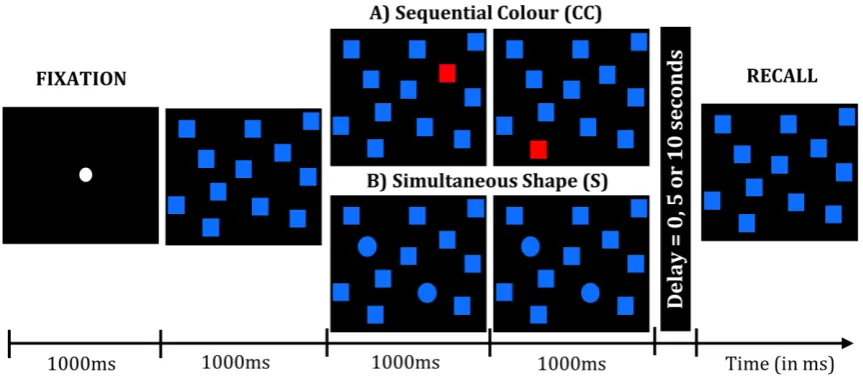
For all conditions, each trial started with a fixation point placed on a black computer screen for
1000ms, prior to the appearance of twelve blue squares (60x60 pixels or 22mm2 box on the
screen) in fixed positions across the monitor (Figure 1). After 1000ms, a number (between 2
and 5) of these squares either 1) changed colour (red) or 2) changed shape (circle) and did so
either a) simultaneous presentations (duration in seconds = 1*number of targets) or b)
(0, 5 or 10 seconds) the 12 blue squares re-appeared and the participant was required to touch
the remembered locations of the changed items either in the right order (1b and 2b) or any
order (1a and 2a) During the recall screen a beep and brief disappearance of the touched
target indicated that participants had met the necessary requirements of placing their touch
responses exactly within the boundaries of the blue square. Touch responses required to be
placed within boundaries of the blue square for the program to accept it as a true response. This
signalled to the participant that their response had been recorded.
For the colour conditions (C and CC) some of the blue squares changed from blue to red, an
obvious difference requiring low attention, while the shape conditions (S and SC) saw some of
the blue squares change to circles, a less salient difference demanding higher levels of attention.
Target presentations either obligated participants to remember the target changes in the
specific temporal order that they were presented in (CC and SC) or just the location (C and S)
(See Figure 1).
Participants could take short breaks between blocks of 24 trials, to reduce fatigue and minimise
dark adaptation. All recorded eye and touch data, alongside any touch errors, were collated for
[image:7.595.76.508.492.685.2]offline analysis.
Figure 1: A diagrammatic representation of 2 of the 4 possible conditions; a sequential colour
respectively. Participants initially fixated a central fixation target before 12 blue squares
appeared and either: (i) change colour one by one (CC) or display all the changed targets
together (C) or (ii) change shape sequentially (SS) or simultaneously (S). Each target change
was presented for 1 second and therefore if 3 items changed sequentially or together the total
duration would be 3 seconds. After target presentation the blank delay screen appeared for 0, 5
or 10 seconds prior to the recall screen where subjects made their touch responses to the
remembered locations.
Data Analysis
The eye movement parameters investigated included: 1) Region of Interest analysis: how long
participants spent looking at the targets that changed colour or location during the trial as a
percentage of overall trial length (excluding delay time) to provide an estimate of encoding time
on targets; 2) Eye start reaction time: the time taken from the onset of the recall screen to the
onset of the first saccade; and 3) Eye pacing interval: mean time participants fixated within a
1cm window (~2° of visual angle) on the recall screen before a saccade was made to another
location on the screen. This fixation was determined using a pre-defined velocity and
acceleration algorithm from EyeLink (SR Research Lt, Canada) to define saccade onset (Stampe,
1993). For the touch response the following parameters were investigated: 1) Touch start
contact time: time taken for participants to touch the first target after the onset of the recall
screen; 2) Touch pacing interval: mean time between touches on targets on the screen from
finger touch-down to next finger touch-down, after the first target has been touched (1); and 3)
Touch errors: number of touch responses that were not made to the correct target as a
percentage of overall number of presented targets.
Single repeated-measures ANOVA was used for all the eye movement parameters and the
results separated into the following factors: (i) age (young and old), (ii) condition (C, CC, S and
SC), (iii) delay (0, 5000, or 10000ms) and, (iv) set-size (2-5 targets). The same was done for the
with Bonferroni corrected post-hoc tests. A significance level of p<0.05 was established for all
statistical analyses.
The data was further segregated into results in which an error was made, and results where the
response was correct (i.e. hits versus misses) for eye and hand reaction times and pacing
intervals. Due to the small number of errors made by the younger participants data was
collapsed across set-size and the attentional manipulation of colour and shape, leaving the
comparison of simultaneous versus sequential conditions only for each age group and for hits
versus misses. A 2 x 2 x 2 repeated-measures analysis was performed for Age (Young versus
Old), Correct (Hit versus Miss) and Condition (Simultaneous versus Sequential) to establish if
errors were due to the differing fixation strategies used and if this strategy differed between the
age groups.
Results
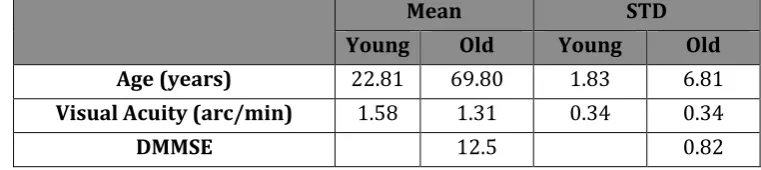
The visual acuity task and DMMSE scores (table 1) were recorded prior to the experiment to
ensure participants reached the minimum requirement. All recruited participants achieved
on the scale (mean 12.5) from a maximum score of 13. Table 2 reports all main effects and
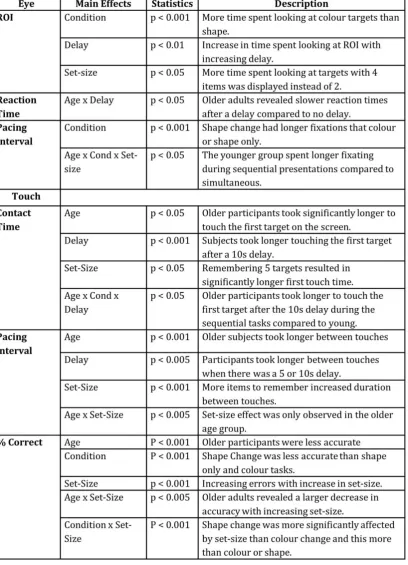
interactions found in this study.
[image:9.595.104.485.564.649.2]
Table 1.
Mean STD
Young Old Young Old
Age (years) 22.81 69.80 1.83 6.81
Visual Acuity (arc/min) 1.58 1.31 0.34 0.34
DMMSE 12.5 0.82
Table 1:Means and Standard Deviations for all 32 willing participants with regards to age, and
scores for visual acuity and DMMSE.
Regions of Interest (ROI): No significant difference between age groups in the mean amount of
time spent looking at regions of interest (targets that changed colour or shape)as a percentage
of overall trial time (excluding the delay) was found. However, both age groups revealed a
significant difference between conditions (F(3,15) p 2=0.706) that was mainly
driven by colour versus shape change comparisons (p = 0.01) with all participants spending
longer within the relevant targets in the shape change condition. A significant effect of delay
(F(2,7 p 2=0.886) was observed with the pairwise comparison revealing all
delays were significantly different (p < 0.05) and people spent longer looking in the ROI with
increasing delay duration. Finally, a small effect of set-size was observed in both age groups
(F(3,6) p 2 = 0.739) that was mainly driven by the 2 targets versus the 4 target
Table 2
Table 2: Significant main effects and interactions (with p values) are shown for all parameters
Eye Reaction Time: The time taken for the eye to look towards the first target from recall
screen onset was measured, and is defined as the eye reaction time (figure 2A). A significant
interaction between age x delay (F(2,23) p 2 = 0.316) showed that there was a
significant difference in eye RT between the no delay and the delay conditions in the OA (p <
0.001 for both 5 and 10 comparisons with 0), but no effect was observed in the younger group.
OA took longer to initiate the first saccade when a 5 or 10 second delay was implemented. The
Further analysis of the hits versus misses revealed all subjects regardless of age or complexity
of the task (i.e. both simultaneous and sequential) made faster initial eye reaction times with a
subsequent MISS (F(1,6) = p 2= 0.795) than a HIT.
Eye Pacing Interval between saccades and standard error (in ms) during recall are illustrated
in Figure 2B. A significant effect of condition (F(3, 15) p 2 = 0.706) was found,
that showed shape change had significantly longer fixation durations than colour and shape
when they did not change (p<0.005, p<0.001). An interaction between age x condition x set-size
(F(9,9) p 2 = 0.814) suggests that the differences in condition were entirely driven
by the younger group fixating longer during the sequential conditions (CC and SC) when
compared with the simultaneous conditions (p<0.05 for all comparisons).
Figure 3 reveals that eye pacing interval is generally longer for misses than for hits F(1,5)
p 2=0.790) and that there are differences between the age groups in eye pacing
interval (F(1,5) p 2=0.827) with the young showing longer fixations. The
interaction between the age groups and the condition (simultaneous versus sequential)
revealed a trend (F(1,5) p 2 = 0.514) in that the younger group had differing eye
pacing intervals for the simultaneous and sequential tasks, whereas older groups revealed the
same interval for both. We suspect this latter effect did not reach significance due to power
[Figure 3 here]
Touch Responses
Touch start contact time: A significant difference in the touch responses between the age
groups to the first target was found (F(1,15) p 2 = 0.35) revealing OA had a
significantly longer initial RT when making their first touch to a target on the recall screen
(figure 4A). The delay revealed a significant difference (F(2,14) p 2 = 0.69) that
was principally driven by differences between the 10s and the other delay conditions (p <
0.001). A main effect of set-size (F(3,13) p 2 = 0.54), where remembering 5 targets
resulted in longer touch RT than remembering 2, 3 or 4 (all p < 0.05) was also observed. These
main effects however are better explained via the interactions that we found between age x
delay (F(2,14) p 2 = 0.55), condition x delay (F(6,10) p 2 = 0.84), and
age x condition x delay (F(6,10) p 2 = 0.71). This revealed that in the 10 second
delay during sequential tasks (SC and CC) the OA had significantly longer reaction times to
touch the first target than YA. We found a significant interaction between Age and the Correct
versus the incorrect responses (F(1,6) p 2 = 0.739) in that )in that both groups
were slower during miss trials, but this difference was much greater for older adults.
Touch pacing interval: Looking at the touch pacing interval we found a number of significant
took significantly longer between touches than YA (figure 4B). A significant effect of delay was
found (F(2,27) p 2=0.35) where participants took longer between touches during
the 5 and 10 second delay compared to the no delay condition (p=0.002 and p=0.028
respectively). Finally, increasing the set-size resulted in a significant difference (F(3, 26) = 8.53, p
2=0.496) in which remembering 3, 4 or 5 items resulted in a significantly longer
duration between touches when compared to only 2 items to remember (p=0.008, p=0.001 and
p < 0.001 respectively). We also observed a significant interaction between age and set-size
(F(3,26) p 2 = 0.43), that showed this effect of set-size only in the OA (p < 0.05 for
all set-size comparisons, apart from between 2 and 3 where p = 0.91). There were no significant
effects between hits and misses in the touch pacing responses or between age groups.
[Figure 4 here]
Percentage Correct: The percentage of correct responses to the targets revealed significant
main effect differences between age groups (F(1,31) p 2 = 0.591), condition
(F(3,29) p 2 = 0.788) and set-size (F(3,29) p 2 = 0.782). OA produced
more errors in touching the targets than YA. Across all participants a reduction in accuracy was
observed in the shape change versus all other conditions (p < 0.001) and more errors were
made with increasing set-size (p < 0.001 for all comparisons apart from 2 versus 3 items when p
< 0.05). Significant interactions were observed between age x set-size (F(3,29) p 2
= 0.4) (Figure 5A) where OA revealed increasing errors with increasing set-size. We also found a
condition x set-size (F(9,23) p 2 = 0.85) effect for both age groups that revealed
significantly poorer accuracy with set-size in the colour change and shape change conditions,
when compared to the colour and shape only conditions. This effect was highly significant (p <
0.005), in all but 1 comparison (2 versus 3 set-size) in both age groups (p > 0.05). In general all
subjects found sequential versus simultaneous tasks more difficult and shape harder than
Coordination between Eye and Touch responses: In order to assess coupling (coordination)
between the eye and hand for each condition we subtracted eye RT from touch RT and
calculated a mean difference between the eye movement onset and the touch movement onset
for each participant. The results show a highly significant effect of age (F(1,29) = 11.26, p = 0.002,
2 = 0.28), condition (F(3,27) p 2 = 0.27), delay (F(2,28) p 2 =
0.48) and set-size (F(3,27) p 2 = 0.43). We also found an interaction between age
x condition x delay (F(6, 24) = 3.29, p = 0.017 2 = 0.45) where OA revealed a larger difference
between the eye and hand RT with the 10 second delay. This larger difference was most
pronounced in the shape change and colour change condition when the complexity of the task
was greater, and the effect was principally observed in the response of the hand (see figure 5B).
[Figure 5 here]
Discussion
1) Effects of Age on Eye Movement Parameters
This study focuses on the comparison between OA and YA s performance of the eye and hand, to
manipulations in of both memory and attention. This novel approach for age group comparisons
has provided new evidence to suggest YA use differing eye movement strategies depending on
task complexity and take longer between fixations with increasing attentional and memory
demands. The OA revealed a different fixation duration strategy to the YA, in which similar
fixation durations were implemented across all attentional and memory manipulations (Figure
2B). Further analysis into these fixation strategies suggested longer fixation durations resulted
in more errors in the YA. The overall amount of time looking at the targets was equivalent for
both age groups as the ROI analysis revealed, but the OA exhibited more saccades. This
ultimately results in poorer retrieval with OA showing a decrease in % correct (Figure 5A). Our
than the YA (Williams, Zacks and Henderson, 2009; Ho, Scialfa, Caird & Graw, 2001).
Furthermore, the longer fixation durations reported for the OA in these previous studies are in
line with the ranges reported here, which provides further support for a more automatic
approach of processing. Based on these findings we suggest that YA adopt longer fixation
strategies to aid in retrieval dependent on the task (i.e. when the task is more complex),
whereas OA appear to use a common strategy independent of the task demand (see figure 5).
This suggestion is supported but the further analyses on the eye pacing interval for correct
versus incorrect trials. We found that older participants tend to show shorter fixations for
correct versus incorrect trials n both simultaneous and sequential tasks. Younger adults show
substantially longer eye pacing interval for misses with sequential tasks, but no difference was
observed in simultaneous tasks indicative of the use of differing encoding strategies.
We found OA were slower to initialize their first saccade to the targets on the recall screen, and
that they were even slower when a delay (5 or 10 seconds) was introduced between the
presentation and recall screen. This slower reaction time in the eye movements of OA is a
common finding (Cerella, 1985; Abel Troost and Dell Osso, 1983; Warabi, Kase & Kato, 1984),
and is thought to be principally due to changes in the efficiency of the neuron firing and a shift
in brain activity from posterior to more frontal brain regions during ageing (Raemaeker, Vink,
van den Heuvel, Kahn, & Ramsey, 2006). Recent evidence suggests that deterioration of the
corpus callosum during ageing also contributes to longer response times due to lack of
inhibition in the non-dominant hemisphere (Langan, Peltier, Bo, Fling, Welsh and Seidler, 2010).
In our task, only the OA revealed an increase in RT with the increase in delay duration possibly
indicating issues with maintaining a preparatory set1. Connolly, Goodale, Goltz, & Munoz
(2002) found a relationship between the frontal eye field activity and reaction time with higher
activity resulting in a shorter reaction time. This area (alongside other frontal areas) is thought
to be vital in preparatory set activity for generation of saccadic eye movements (Nagel,
1A preparatory set can be considered equivalent to holding a motor plan in working memory until the
Sprenger, Lencer, Kömpf, Siebner and Heide, 2008). Thus our results suggest that the deficits
observed in frontal activity during healthy ageing could account for problems in maintaining a
preparatory set during a delay and hence is the cause of the increase in RT of the eye with
increasing delay.
2) Effects of Age on Touch Parameters
Differences in touch responses to the recall screen, between our age groups, were clear in all
behavioural measures. The contact time for making the first touch to the recall screen was
significantly increased when a delay was introduced in the OA. This delay in RT could be due to
the decline in inhibitory control with ageing since poor inhibition can result in the revoking of a
prepared or initiated motor response (Coxon, Van Impe, Wenderoth & Swinnen, 2012) (an
effect also observed in the reaction time of the eye). Furthermore, initial touch contact time was
further increased in the sequential task when compared to the simultaneous presentation in
this older cohort during the 10 second delay. We show OA took longer to react to the recall
screen when the delay between encoding and recall reached 10 seconds (Figure 5A). We found
that during this longer delay remembering both order and position (CC and SC) further
amplified this effect in the OA. This effect was also observed in the reaction time of the eye with
an age x delay interaction. It has been suggested that OA are more cautious and require more
time to think about their answers (Veiel, Storandt & Abrams, 2006). Others have found storage
or capacity problems may results in more recall errors (Peich, Husain & Bays, 2013), but may
not explain the longer response times. Therefore increasing task difficulty may increase
uncertainty in performance and ultimately increase their time to respond. In-line with this
finding, we found that the touch pacing interval was significantly longer in the OA, with
additional increases in duration between touches with increasing set-size and delay duration.
Both findings interpreted together provide further evidence that OA have problems maintaining
a preparatory set for both the eye and hand when delays are introduced. Slower initial
effect clearly. Furthermore, we found that older adults show much greater increase in touch RT
when they subsequently miss the target compared to when they are correct. Thus, longer
preparation times (or reaction times) are also associated with worse performance.
The increase in self-pacing interval observed in the hand with increasing set-size supports the
notion that OA need more preparation time in-between touches to accurately select the correct
targets when more targets are introduced, suggesting creating the preparatory set may also be
problematic. This issue with preparedness is in agreement with an earlier study (Lahtela, Niemi
& Kuusela, 1985), where participants needed to turn either a right or left switch to identify
target appearance. However, in contrast to the findings presented here, Lahtela and colleagues
(1985) find a reduction in RT in the OA with increasing delay. This former study used 3
randomly presented inter-stimulus intervals (2, 4 and 6 seconds) which could suggest that
shorter delay intervals may initially improve RT in some tasks. Our study finds OA have most
difficulty in maintaining a preparatory set when the delay reaches 10 seconds. Our novel
approach has also provided new evidence that a delay interval of 10 seconds significantly
amplifies the touch start times in complex tasks (SC and CC) in OA. Although the effect is present
in more simple tasks (S and C), it is not as robust.
Unlike previous studies, we also have details of self-pacing intervals between touches which
further provide opportunities to interrogate how the memory capacity (set-size) and retention
intervals affect this measure. Increasing the number of targets to be remembered slows the
pacing interval in OA in both eye and hand suggesting longer motor preparation is needed
between each touch when compared to YA. This effect of cognitive load on contact time is now
well established in the literature and has been found to be dependent on the amount of
information to process (Norman and Bobrow, 1975). In-line with this we found the number of
errors to targets on the recall screen was significantly greater for the OA (figure 5), particularly
with increasing set-size. Thus, our data provides evidence that as we age our preparatory set
retention interval. We suggest that accuracy is sacrificed rather than timing with an increase in
memory capacity (set-size) in OA; whereas an increase in the retention period (delay)
principally affects the reaction time of the response (i.e. timing). We found no affects specific to
our attentional manipulation of colour versus shape indicating that attention for colour or shape
is not significantly altered during healthy ageing.
3) Eye-hand coordination during healthy ageing
To investigate the temporal link between eye and hand in our task, we looked at the lag of the
hand behind the eye to the recall screen after the 0, 5 or 10 second delay. Overall, we found a
longer lag between the eye and hand in OA. This difference was significantly increased with the
10 second delay in the sequential tasks.The difference between the first eye movement and the
subsequent first touch movement was ~1000ms in the YA, whereas OA revealed a longer
difference between the eye and touch of ~1600ms. This indicates that additional motor delays
are observed in OA when translating responses downstream into a hand response compared to
the YA. We suggest that OA are adversely affected in coordinating the eye-hand during tasks
with higher cognitive demands (i.e. sequential task and memory delay) that results in an
increased rise in lag. Optimal reaction time differences between the eye and hand to aid
coordination has been found to be around 200ms (Wilmut, Wann and Brown, 2006) during
saccadic tasks, and around 75 120ms in tracking tasks (Miall and Reckess, 2002). Our lag time
of 1000ms in the YA is considerably longer than these, but is comparable with other studies
using time to contact (Warabi, Noda & Kato, 1986) instead of initiation of movement (reaction
time). Our task included a greater cognitive (memory and attention) component, which
inevitably would also contribute to longer processing and recall times (see Lavie, 2005 for a
review). These results suggest that, although we have noted a number of cognitive effects
between age groups, some of the differences can be attributed down-stream in the processing of
the hand movement. Increasing complexity of the task results in a longer temporal gap between
performance. This can be interpreted as a reduction in coordination between these modalities.
Interestingly, we find coordination between eye and hand significantly deteriorates with
increasing cognitive effort in the OA, but not in the YA. This could indicate a competing resource
issue as both the cognitive demand of the task and the motor demand for eye-hand coordination
require memory, motor and attention circuits in the brain (Crawford, Medendorp & Marotta,
2004). We suggest that increasing the cognitive effort consequently increased the amount of
mental resources required, which ultimately negatively affects hand and eye coordination in OA.
It is clear that OA have a smaller mental resource pool and hence their capacity is more easily
exceeded, resulting in a decline of performance that is not observed in the YA (Levitt, Fugelsang,
& Crossley 2006).
Conclusions
This study contributes to our understanding of changes in motor preparedness or preparatory
set during healthy ageing. The increases in reaction time of the eye and hand in OA when a 10
second delay was introduced demonstrates issues in maintaining retaining a preparatory set
for these modalities. Additionally, increases in durations between fixations and touches and
decreasing accuracy with increasing set-size provide further evidence that OA may have
problems in accessing these preparatory sets during recall, creating uncertainty in their
response. We find that complexity of the task plays a factor in the initial hand reaction time, but
only when in conjunction with long delays. It is interesting to note that manipulations made in
delay durations affected the initial timing of the eye and hand responses (i.e. reaction time),
whereas capacity manipulations (set-size) affected accuracy measures, suggesting that the
storage of temporal and spatial information are segregated mechanisms in the brain, and are
differentially affected by age. Finally, our results show that eye-hand coordination significantly
deteriorates with increasing cognitive demand in elderly participants, and that OA fail to adjust
Acknowledgements: We would like to acknowledge Rachael Starkey for her contribution to the
testing of participants and collecting of data for this project. In addition, we would like to thank
all the participants who willing gave their time to this project.
Word count: (excluding reference, abstract and captions)
References
Abel L A Troost B T Dell Osso L F The effects of age on normal saccadic
characteristics and their variability. Vision Research, 23, 33-37.
Baddeley, A. D., & Hitch, G. (1974). Working Memory. In G. A. Bower (Ed.), The Psychology of
learning and motivation: Advances in research and theory (Vol. 8, pp. 47-89). NY: Academic Press.
Burke, M.R., Allen, R. J., & Gonzalez, C. C. (2012). Eye and hand movements during
reconstruction of spatial memory. Perception, 41, 803-18.
Carpenter, P. A., & Just, M. A. (1989). The role of working memory in language comprehension.
In D. Klahr & K. Kotovsky (Eds.), Complex information processing: The impact of Herbert A. Simon
(pp. 31 68). Hillsdale, NJ: Erlbaum.
Cerella, J. (1985) Information processing rates in the elderly. Psychological Bulletin, 98(1):
67-83.
Chen, J., Hale, S., & Myerson, J. (2003). Effects of Domain, Retention Interval, and Information
Load on Young and Older Adults Visuospatial Working Memory. Aging Neuropsychology and
Cognition, 10, 122-133.
Connolly, J.D., Goodale, M.A., Goltz, H.C. & Munoz, D.P. (2002) fMRI activation in the human
frontal eye field is correlated with reaction time. J Neurophysio., 94(1): 605-611.
Connolly, J.D., Goodale, M.A., Menon, R.S. & Munoz, D.P. (2002) Human fMRI evidence for the
neural correlates of preparatory set. Nature Neuroscience, 5(12):1345-1352.
Corsi, P.M. (1972). Human memory and the medial temporal region of the brain Unpublished
Coxon, J. P., Van Impe, A., Wenderoth, N., & Swinnen, C. P. (2012). Aging and inhibitory control of
action: cortico-subthalamic connection strength predicts stopping performance. The Journal of
Neuroscience, 32, 8401-8412.
Crawford, J. D., Medendorp, W. P., & Marotta, J. J. (2004). Spatial Transformations for Eye Hand
Coordination. Journal of Neurophysiology, 92, 10-19.
Dobbs, A. R., & Rule, B. G. (1989). Adult age differences in working memory. Psychology and
Aging, 4, 500-503.
Elliott, E. M., Cherry, K. E., Brown, J. S., Smitherman, E. A., Jazwinski, S. M., Yu, Q., & Volaufova, J.
(2011). Working memory in the oldest-old: evidence from output serial position curves. Memory
& Cognition, 39, 1423-1434.
Evarts, E. Shinoda, Y. Wise, S (1984) Neurophysiological approaches to higher brain functions.
Wiley, New York.
Everling, S. Munoz, D.P. (2000) Neuronal correlates for preparatory set associated with
pro-saccades and anti-pro-saccades in the primate frontal eye field. Journal of Neuroscience, 20(1):
387-400.
Falkenstein, M., Yordanova, J., & Kolev, V. (2006). Effects of aging on slowing of motor-response
generation. International Journal of Psychophysiology, 59, 22-29.
Fiore, F., Borella, E., Mammarella, I. C., & Beni, R. D. (2012). Age differences in verbal and
visuo-spatial working memory updating: Evidence from analysis of serial position curves. Memory, 20,
14-27
Garden, S., Cornoldi, C., & Logie, R. H. (2002). Visuo-Spatial Working Memory in Navigation.
Applied Cognitive Psychology, 16, 35-50.
Gazzaley A Cooney J W Rissman J D Esposito M Top-down suppression deficit
underlies working memory impairment in normal aging. Nat Neurosci., 8(1): 1298-1300.
Gazzaley A )n uence of early attentional modulation on working memory.
Hartley, A. A., Speer, N., Jonides, J., Reuter-Lorenz, P., & Smith, E.E. (2001). Is the
dissociability of working memory systems for name identity, visual-object identity,
and spatial location maintained in old age? Neuropsychology, 15, 3 17.
Hebb D.O. (1972) Textbook of physiology. Saunders, Philadelphia
Hedden, T., Park, D. C., Nisbett, R., Ji, L-J., Jing, Q., & Jiao, S. (2002). Cultural Variation in Verbal
Versus Spatial Neuropsychological Function Across the Life Span. Neuropsychology, 16, 65 73.
Ho, G., Scialfa, C. T., Caird, J. K., & Graw, T. (2001). Visual Search for Traffic Signs: The Effects of
Clutter, Luminance, and Aging. Human Factors, 43, 194-207.
Jenkins, L., Myerson, J., Joerding, J. A., & Hale, S. (2000). Converging evidence that visuospatial
cognition is more age-sensitive than verbal cognition. Psychology and Aging, 15, 157-175.
Kessels, R. P., Meulenbroek, O., Fernández, G., & Olde Rikkert, M. G. (2010). Spatial working
memory in aging and mild cognitive impairment: effects of task load and contextual cueing.
Neuropsychology, Development, and Cognition: Section B, Aging, Neuropsychology and Cognition,
17, 556 574.
Lahtela, K., Niemi, P., & Kuusela, V. (1985). Adult visual choice-reaction time, age, sex and
preparedness. Scandinavian Journal of Psychology, 26, 357-362.
Langan, J., Peltier, S. J., Bo, J., Fling, B. W., Welsh, R. C., & Seidler, R. D. (2010). Functional
implications of age differences in motor system connectivity. Frontiers in Systems Neuroscience,
4, 1-11.
Lavie, N. (2005). Distracted and confused?: Selective attention under load. Trends in Cognitive
Sciences, 9, 75- 82.
Levitt, T., Fugelsang, J., & Crossley, M. (2006). Processing Speed, Attentional Capacity, and
Age-Related Memory Change. Experimental Aging Research, 32, 263 295.
Meadmore, K. L., Dror, I. E., & Bucks, R. S. (2009). Lateralisation of spatial processing and age.
Laterality: Asymmetries of Body, Brain and Cognition, 14, 17-29. Miall, R. C., & Reckess, G. Z.
(2002). The Cerebellum and the Timing of Coordinated Eye and Hand Tracking. Brain and
Miall, C., Reckess, G.Z. (2002) The cerebellum and the timing of coordinated eye and hand
tracking. Brain and Cognition, 48(1): 212-226.
Myerson, J., Emery, L., White, D. A., & Hale, S. (2003). Effects of Age, Domain, and Processing
Demands on Memory Span: Evidence for Differential Decline. Aging Neuropsychology and
Cognition, 10, 20 27.
Nagel, M., Sprenger, A., Lencer, R., Kömpf, D., Siebner, H., & Heide, W. (2008). Distributed
representations of the "preparatory set" in the frontal oculomotor system: a TMS study. BMC
Neuroscience, 9, 89.
Norman, D.A., Bobrow, D.G. (1975) On data-limited and resource limited processes. Cognitive
Psychology, 7: 44-64.
Plude, D.J. Hoyer, W.J. and Lazar, J. (1982) Age, response complexity, and target consistency in
visual search. Exp Brain Res., 8(2): 99-102
Schultz-Larsen, K., Lamholt, R.K., Kreiner S. (2007) Mini-Mental state examination: a short form
of MMSE was as accurate as the original MMSE in predicting dementia. J Clin Epidemial,
60:260-267.
Seidler, R.D. Bernard, J.A. Burutolu, T.B. Fling, B.W. Gordon, M.T. Gwin, J.T. Kwak, Y. Lipps, D.B.
(2010) Motor control of aging: links to age-related brain structural, functional, and biochemical
effects. Neuroscience Biobehavioural Review, 34(5): 721-733.
Stampe, D.A. (1993) Heuritic filtering and reliable calibration methods for video-based pupil
tracking systems. Behavior Research Methods, Instruments and Computers, 25(2): 137-142.
Sweeney. J.A., Rosano, C., Berman R.A., Luna, B. (2001) Inhibitory control of attention declines
more than working memory during normal aging. Neurobiology of Aging. 22: 39-47.
Tubi, N., & Calev, A. (1989). Verbal and visuospatial recall by younger and older subjects: Use of
matched tasks. Psychology and Aging, 4, 493-495.
Veiel, L. L., Storandt, M., & Abrams, R. A. (2006). Visual Search for Change in Older Adults.
Warabi, T., Kase, M., & Kato, T. (1984). Effect of aging on the accuracy of visually guided saccadic
eye movement. Annals of Neurology, 16, 449-454.
Warabi, T., Noda, H., & Kato, T. (1986). Effect of Aging on Sensorimotor Functions of Eye and
Hand Movements. Experimental Neurology, 92, 686-697.
Williams, C, C., Zacks, R. T., & Henderson, J. M. (2009). Age differences in what is viewed and
remembered in complex conjunction search. The Quarterly Journal of Experimental Psychology,
62, 946-966.
Wilmut, K., Wann, J. P., & Brown, J. H. (2006). How active gaze informs the hand in sequential