This is a repository copy of
Optimization of Brownian ratchets for the manipulation of
charged components within supported lipid bilayers
.
White Rose Research Online URL for this paper:
http://eprints.whiterose.ac.uk/87250/
Version: Published Version
Article:
Roth, JS, Zhang, Y, Bao, P et al. (3 more authors) (2015) Optimization of Brownian
ratchets for the manipulation of charged components within supported lipid bilayers.
Applied Physics Letters, 106 (18). 183703. ISSN 0003-6951
https://doi.org/10.1063/1.4919801
[email protected] https://eprints.whiterose.ac.uk/ Reuse
Unless indicated otherwise, fulltext items are protected by copyright with all rights reserved. The copyright exception in section 29 of the Copyright, Designs and Patents Act 1988 allows the making of a single copy solely for the purpose of non-commercial research or private study within the limits of fair dealing. The publisher or other rights-holder may allow further reproduction and re-use of this version - refer to the White Rose Research Online record for this item. Where records identify the publisher as the copyright holder, users can verify any specific terms of use on the publisher’s website.
Takedown
If you consider content in White Rose Research Online to be in breach of UK law, please notify us by
Optimization of Brownian ratchets for the manipulation of charged components within
supported lipid bilayers
J. S. Roth, Y. Zhang, P. Bao, M. R. Cheetham, X. Han, and S. D. Evans
Citation: Applied Physics Letters 106, 183703 (2015); doi: 10.1063/1.4919801 View online: http://dx.doi.org/10.1063/1.4919801
View Table of Contents: http://scitation.aip.org/content/aip/journal/apl/106/18?ver=pdfcov Published by the AIP Publishing
Articles you may be interested in
Single molecule diffusion in critical lipid bilayers
J. Chem. Phys. 137, 215104 (2012); 10.1063/1.4768956
Diffusion of water and selected atoms in DMPC lipid bilayer membranes J. Chem. Phys. 137, 204910 (2012); 10.1063/1.4767568
Communication: Consistent picture of lateral subdiffusion in lipid bilayers: Molecular dynamics simulation and exact results
J. Chem. Phys. 135, 141105 (2011); 10.1063/1.3651800
Density imbalances and free energy of lipid transfer in supported lipid bilayers J. Chem. Phys. 131, 175104 (2009); 10.1063/1.3262315
Optimization of Brownian ratchets for the manipulation of charged
components within supported lipid bilayers
J. S.Roth,1Y.Zhang,2P.Bao,1M. R.Cheetham,1,a)X.Han,2and S. D.Evans1,b) 1School of Physics and Astronomy, University of Leeds, Leeds LS2 9JT, United Kingdom
2School of Chemical Engineering and Technology, Harbin Institute of Technology, Harbin 150001, China
(Received 27 August 2014; accepted 24 April 2015; published online 5 May 2015)
In probability theory, there is a counter-intuitive result that it is possible to construct a winning strategy from two individually losing (or at most breaking-even) “games” by alternating between them. The work presented here demonstrates the application of this principle to supported lipid bilayers (SLBs) in order to create directed motion of charged lipid components in the membrane, which was achieved through the use of “Brownian ratchets” in patterned SLBs. Both a finite element analysis model and an experimental setup have been used to investigate the role of key parameters for the operation of these ratchets: (1) the asymmetry of the ratchet teeth and (2) the relation of the ratchet height to the period of the applied electric field. Importantly, we find that the efficiency of the ratchet for a given charged species is dependent on the diffusion coefficient. This opens the possibility for separation of membrane species according to their size or viscous drag coefficient within the membrane.VC 2015 AIP Publishing LLC.
[http://dx.doi.org/10.1063/1.4919801]
Probability theory often presents unexpected or counter-intuitive results whenever there is scope for correlation between two events or states.1 One such example that has appeared in various guises over the years, and has more recently been dubbed “Parrondo’s Paradox” in game theory demonstrates the possibility of constructing a winning strat-egy from two individually losing “games.”2This seemingly contradictory result appears due to correlation of the two games, whereby at least one of them is dependent upon the result of the other. Principles such as this have sparked sig-nificant interest in a wide range of scientific disciplines,3–5 and have been used to create flashing ratchet potentials,6 where diffusion and a ratchet potential were used to generate a net movement (so-called “Brownian ratchets”).7 Through the use of asymmetric ratchets, this has been the basis for several different applications, some noteworthy examples including DNA transport and analysis,8,9 particle separa-tion,10,11and sorting or directed motion in lipid bilayers.12–14 Lipid membranes are ubiquitous in eukaryotic cells for compartmentalizing internal organelles and for separating the interior of the cell from the external environment. Perhaps unsurprisingly, lipid membranes and proteins con-tained within them are the target of numerous drugs and there is therefore significant interest in understanding how the function of such proteins relates to their structure and spatio-temporal behavior. However, the delicate nature of many membrane proteins makes them difficult to study out-side of their native environment. Solid-supported lipid bilayers (SLBs) provide an excellent biomimetic platform for studying aspects of cell behavior as well as for the devel-opment of biological diagnostic and sensing systems. High-level spatio-temporal control would offer distinct advantages
for studying protein/peptide interactions with membranes, protein/membrane protein interactions, protein crystalliza-tion, and provide important tools for drug screening. Since many membrane components are electrically charged, exter-nal electric (and hydrodynamic flow) fields can provide a driving force for the motion of components based on electro-phoresis, electroosmosis, and hydrodynamic flow.14–18 This provides scope for the “in-membrane” transport and separa-tion based on the charge of a component. It is still difficult however to sort based upon other properties such as mobility or diffusion coefficient. Brownian ratchets could overcome this issue if they are suitably designed.
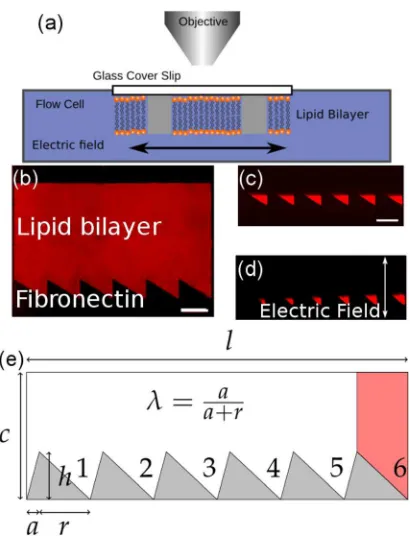
Patterned lipid bilayers were formed in a two-stage process; first, a monolayer of fibronectin protein was micro-contact printed (lCP) onto a glass surface using a polydime-thylsiloxane (PDMS) stamp.12,19–21 The protein resists the adsorption of lipid molecules such that in the second stage when thelCP protein layer was incubated in a lipid vesicle suspension SLBs were only formed in the “bare” glass regions, i.e., where there is no protein, the fluorescence image is shown in Fig.1(b). This approach allowed patterned bilayers to be formed with high fidelity and with feature sizes down to 1lm. Fig. 1 shows an example of the patterned structures used in this study. They essentially consist of an asymmetric saw-tooth on one side and a planar surface on the opposite side. The lipid mixture used to form the bilayer contained a small fraction of charged fluorescently labeled lipids, which can either be in a region of free diffusion or concentrated in the tooth of a ratchet. This somewhat resem-bles the idea of a flashing potential whereby a ratchet is alter-nately switched on and off.8,22 Here, the transition between the two regions is made through the application of an exter-nal electric field, which either drives charged lipid into the ratchet, concentrating it in the teeth, or driving it back out, thereby allowing free diffusion once the charged lipid has traversed to a point slightly above the top of the teeth. a)Present address: Chemistry Research Laboratory, University of Oxford,
Oxford OX1 3TA, United Kingdom.
b)
Electronic mail: [email protected]
0003-6951/2015/106(18)/183703/4/$30.00 106, 183703-1 VC2015 AIP Publishing LLC
Because of the asymmetry of the teeth, iteration of this pro-cess results in a net movement of the charged lipid fraction. In these studies, we show how the efficiency of the ratchet is influenced by both the asymmetry and height of the teeth.
The asymmetry of the ratchet is defined by k, the ratio ofatoaþr, whereais the width of the “rising” edge of the tooth andris the width of the “falling” edge of the tooth. In contrast to our previous designs for transport of species in a membrane,14,23 we chose the width of the ratchet c to be much larger thanh, so that the average distance travelled by the charged lipid during the drift time t is smaller than c. This ensures only “free” diffusion and ratcheting due to a single ratchet are being considered. To vary the distance travelled by the charged lipid, the time t for which the charged lipid is driven out of the ratchet was varied. All other parameters were kept constant, and for the experimen-tal part we always usedaþr¼135lm. An overview of the design and all relevant parameters is given in Fig.1(e).
The asymmetry parameter k of the ratchet was varied from 0 (a¼0, right triangle) to 0.5 (a¼r, symmetric). Larger values forkcan also be defined, but by swapping a
and r these problems can be mapped back to the range 0a0:5. We have investigated the problem by calculat-ing the build-up of charged material over time in the end tooth (labelled as 6 in Fig. 1(e)) by solving the Nernst-Planck equation using finite element analysis (FEA). Fig.2
shows the calculated build-up of the charged species in tooth 6 as a function of the number of cycles for different values ofk. For a symmetric ratchet,a¼r, the amount of charged material remains the same in each tooth over all the cycles (black curve). However, as the asymmetry is increased the
build-up in the final tooth increases, and therefore, effective ratcheting is improved with the most effective design being the ratchet with highest asymmetry (grey curve).
Lipid bilayers were formed via vesicle fusion from a 99.975 mol. % POPC and 0.025 mol. % Texas Red DHPE lipid mix, onto glass coverslips pre-patterned with fibronectin.14,23,24 After bilayer formation, excess vesicles were rinsed away and the solution in the flow cell was changed from PBS buffer to MilliQ water to minimize electro-osmotic contributions to the motion of the charged component. Electrophoresis was then used to move the charged Texas Red DHPE species by apply-ing an AC electric field of 62 V cm1. The electric field was initially applied such that all charged material was driven into the ratchet, as shown in Fig.1(b)before and Fig.1(c)after the first cycle. Then alternating cycles of driving the lipid out of the teeth for a time t and re-concentrating it for 16 min were started. The time of re-concentration was chosen to be larger thantand constant in all cases to ensure that the charged lipid is fully concentrated into the teeth of the ratchet independent of the previously chosen timet.
To compare the calculated values with results obtained from experiments, we defined the electrophoretic mobility of Texas Red DHPE to be
l¼a D
kBT
(1)
with the diffusion coefficient D¼1:5lm2s1 and the drag parametera¼0:6.25
We then compared the relative concen-tration over 26 cycles. Another way of measuring the effi-ciency is to use the dimensionless Peclet number, which is defined as the ratio of the advective transport rate to the dif-fusive transport rate. In the case of Brownian ratchets, this is the ratio of the time averaged velocity multiplied by a char-acteristic length to the dispersion in the ratchet.26,27 In this case, we preferred to use the relative concentration after a given number of cycles as this is an important factor when working towards membrane protein crystallization.
Fig.3shows the experimental data points for the build-up of lipid in each tooth after 26 cycles for the different asymmetries k. The relative concentration is defined as the concentration at the end of the experiment over the initial
[image:4.612.72.277.50.318.2]FIG. 1. (a) Schematic of the experimental setup, (b) Fluorescence image of a patterned lipid bilayer (99.975 mol. % POPC, 0.025 mol. % Texas Red DHPE) before application of an electric field, (c) and (d) of the ratchet region after the first and last (16th) cycle of applied electric field, (e) Schematic of the pattern with indicated parameters and the integration area for the final trap in red is shown. Scale bars are 100lm.
FIG. 2. Calculated concentration of charged membrane component in tooth 6, normalised to the initial concentration. The plot shows the effect of tooth asymmetry parameter,k. The shape of the ratchets for the different values of
kis shown on the right.
[image:4.612.316.560.52.208.2]concentration. The results from the FEA calculations are shown as solid lines and follow the experimental data sets quite closely. It is evident that the most significant changes occur in the first and in the final teeth, where depletion and accumulation occur, respectively. The other teeth mainly act as transporters and can be considered to act as a molecular pump. With increasingkand therefore decreasing asymme-try, the efficiency of the ratchet reduces until it reaches zero, i.e., indicating no net transport for a symmetric saw-tooth geometry and the relative concentrations remain at 1 for both experiment and calculation.
Another parameter that will greatly influence the behav-ior of the ratchet is the ratio of the heighthof the teeth to the distance the lipid travels in the timetthat the electric field is applied for. If the electric field does not drive the charged material out of the ratchet or the cycle is too fast compared to the lateral diffusion time then the ratchet will have only a minimal effect (or even a negative effect). Equally if the electric field is applied for too long a time period, free diffu-sion will play a too significant role and “back” diffudiffu-sion from the current tooth into the previous tooth will degrade
ratcheting efficiency. It seems intuitive to tune the time dur-ing which the charged material is moved out of the ratchet such that the “center of mass” of the charged lipid reaches the tip of the tooth during the timet, but not much further.
The distanceh0
travelled by the center of mass in a time
tcan be written as
h0
¼lEt¼aDE
kBT
t: (2)
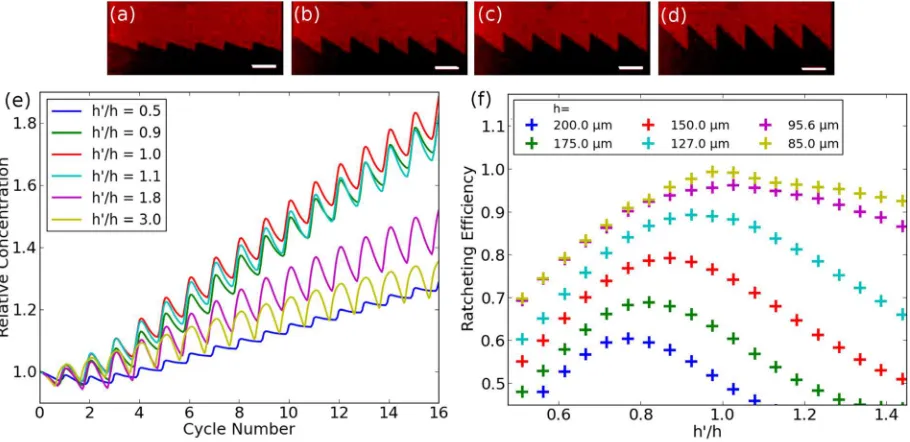
This distance can also be expressed as a fraction of the ratchet heighth, to produce a dimensionless value relating to the efficiency of the ratchet. In Fig.4(e), we plot the relative concentration in tooth 6 as a function of cycle number for different values of h0=h
; it can be seen that the optimum increase in intensity occurs for a ratio of 1, for a ratchet height of 85lm. Even slight changes from this value decrease the efficiency of the ratchet, as can be seen from the plots forh0=
h¼0:9 and 1.1. Although the amount of ma-terial diffusing over a tooth to the right increases with tand therefore with larger h0
, this also leads to an increase in “back” diffusion diminishing any positive effect gained by a largert. Fig.4(f)shows the calculated efficiency for different ratios ofh0=h
for several given ratchet heights where the effi-ciencyEis defined as
E¼ ncf
tþt0 (3)
withnis the normalization factor,cfis the final relative con-centration in the last tooth, and t0
is the time for which the charged components are driven into the ratchet. For different values of h, the optimum value of h0=
[image:5.612.80.268.54.189.2]hshifts slightly. The higher the ratchet is, the smaller is the optimum h0=hratio. This is due to diffusion happening while the charged compo-nents are moved out of the ratchet. For higher ratchets, there is more time for free diffusion and therefore for the spread-ing of the charged components.
FIG. 3. Relative concentration of the charged membrane component Texas Red DHPE in the different ratchets. Experimental results (points) and FEA calculations (solid lines) for the relative increase in each of the teeth are all shown after 26 cycles.
FIG. 4. Fluorescence image of ratchets with heightshof 42.5, 85, 96, and 128lm left to right, respectively (top). Relative increase in the final ratchet vs. cycle number for ratios ofh0=h between 0.5 and 3 (bottom left). For (e), h was set to be 127.5lm (h0=h¼0:5), 85lm (h0=h¼0:9;1:0;1:1), or 42.5lm (h0=h¼1:8;3:0). (f) The efficiency of different ratchet heights for different ratios ofh0=his shown.
[image:5.612.80.535.513.734.2]To compare the calculated results with experimental data, ratchets with four different values forhwere fabricated. Each ratchet was then subjected to three different time val-uestresulting in 12 different values for the ratioh0=
h. Fig.5
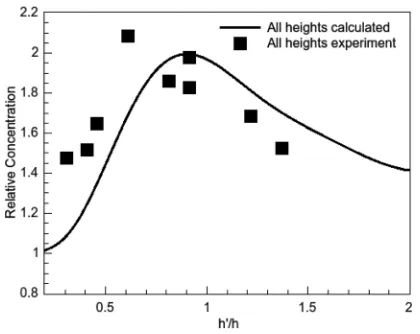
shows a plot of the relative increase in concentration in the last tooth versus h0=
h. Three of the four heights (85lm, 95.6lm, and 127lm) follow an almost universal profile with the exception of the ratchet with teeth of the smallest height (h¼45lm) (data not shown), as can be seen when comparing the efficiency profiles in Fig.4(f) for the ratchet heights from 85lm to 127lm. For Fig. 5, the calculated results have been combined into one curve (solid line) and the experimental results are plotted as squares.
The asymmetry of the peak in Fig. 5arises due to the asymmetry in the distribution of the charged lipid, induced by the asymmetry of the tooth. While the lipid is being driven out of the tooth, it is free to diffuse to the left but not to the right (due to the confining wall on the right). Therefore, the lipid can diffuse away from the barrier, to the left, for a longer time than it can diffuse into the next ratchet on its right, as it has to clear the height of the barrier before being able to diffuse into the next region to the right. The concentration increase observed ash0=
happroaches 1, from less than 1, is due to some charged lipid moving faster than the center of mass and escaping the barrier, even though the majority of the lipid does not move beyond the top of the tooth. The amount of lipid able to do this gets larger the closerh0=
his close to 1. The decrease in relative concentra-tion for values ofh0=
h>1 is due to “back” diffusion. This occurs if the distance travelled above the ratchet (h0
h) becomes comparable to the tooth lengthr. Asris larger than
hand the movement in the direction ofhis aided by the elec-tric field, whereas the movement in the direction ofrhappens only through diffusion, an asymmetry of the peak arises.
In summary, we have shown the application of Brownian ratchets in a lipid bilayer and investigated the transport behavior of the ratchet for different sets of parameters. It was shown that a fully asymmetric ratchet (k¼0) is most efficient and that the amount of free diffusion happening should be limited such that the ratio of “forward” diffusion to “back” diffusion is maximised. Therefore, the combination of ratchet height and period of the electric field should be such that
h0=h¼
1, as shown in both FEA calculations and experiment. The efficiency of the pattern could further be improved by choosing the parameterato be a small negative number.
As can be seen from Eq.(2),h0 depends linearly onD. Therefore, instead of varyingt,the results presented here can also be used to separate membrane components based on their respective diffusion coefficient. Ratchet height handt
can be chosen such that for the first diffusion coefficient ratcheting is very efficient while for the second one the ratchet is inefficient. Thus, efficient transport of only one of the components can be achieved, effectively separating based on diffusion coefficient.
The results presented here demonstrate the key parame-ters for optimal ratchet design for the controlled in-membrane manipulation of in-membrane components. It is anticipated that careful consideration of these design param-eters will help lead to improved systems for separation and concentration of membrane attached and integral membrane proteins and of charged lipid and lipopeptides.
This work was supported by the Engineering and Physical Sciences Research Council Programme Grant (EP/ I012060/1), the British council/Chinese Ministry of Education Grant No. 10401. J.S.R. is grateful to the EPSRC for the provision of a DTG studentship.
1
A. P. Flitney and D. Abbott,Phys. Rev. A65, 062318 (2002). 2
G. P. Harmer and D. Abbott,Nature402, 864 (1999). 3
F. A. Reed,Genetics176, 1923 (2007).
4R. Toral,Fluctuation Noise Lett.02, L305 (2002). 5
P. Amengual, A. Allison, R. Toral, and D. Abbott,Proc. R. Soc. London, Ser. A460, 2269 (2004).
6R. D. Astumian and M. Bier,Phys. Rev. Lett.72, 1766 (1994). 7
S. Verleger, A. Grimm, C. Kreuter, H. M. Tan, J. A. van Kan, A. Erbe, E. Scheer, and J. R. C. van der Maarel,Lab Chip12, 1238 (2012).
8
J. S. Bader, R. W. Hammond, S. A. Henck, M. W. Deem, G. A. McDermott, J. M. Bustillo, J. W. Simpson, G. T. Mulhern, and J. M. Rothberg,Proc. Natl. Acad. Sci. U.S.A.96, 13165 (1999).
9L. R. Huang, E. C. Cox, R. H. Austin, and J. C. Sturm,Anal. Chem.75,
6963 (2003).
10
S. Matthias and F. M€uller,Nature424, 53 (2003).
11R. D. Astumian and I. Der
enyl,Phys. Rev. E58, 7781 (1998).
12
A. van Oudenaarden and S. G. Boxer,Science285, 1046 (1999). 13
T. Motegi, H. Nabika, and K. Murakoshi,Langmuir28, 6656 (2012). 14M. R. Cheetham, J. P. Bramble, D. G. G. McMillan, L. Krzeminski, X.
Han, B. R. G. Johnson, R. J. Bushby, P. D. Olmsted, L. J. C. Jeuken, S. J. Marritt, J. N. Butt, and S. D. Evans,J. Am. Chem. Soc.133, 6521 (2011).
15
P. J€onsson, J. P. Beech, J. O. Tegenfeldt, and F. H€o€ok,Langmuir25, 6279
(2009).
16P. J
€
onsson, A. Gunnarsson, and F. H€o€ok,Anal. Chem.83, 604 (2010).
17
J. T. Groves and S. G. Boxer,Acc. Chem. Res.35, 149 (2002). 18
X. Han, M. R. Cheetham, K. Sheikh, P. D. Olmsted, R. J. Bushby, and S. D. Evans,Integr. Biol.1, 205 (2009).
19
A. Bernard, E. Delamarche, H. Schmid, B. Michel, H. R. Bosshard, and H. Biebuyck,Langmuir14, 2225 (1998).
20
A. Bernard, J. P. Renault, B. Michel, H. R. Bosshard, and E. Delamarche,
Adv. Mater.12, 1067 (2000).
21
L. Kung, L. Kam, J. S. Hovis, and S. G. Boxer,Langmuir16, 6773 (2000). 22
Y. A. Makhnovskii, V. M. Rozenbaum, D. Y. Yang, S. H. Lin, and T. Y. Tsong,Phys. Rev. E69, 21102 (2004).
23
P. Bao, M. R. Cheetham, J. S. Roth, A. C. Blakeston, R. J. Bushby, and S. D. Evans,Anal. Chem.84, 10702 (2012).
24
R. P. Richter, R. Berat, and A. R. Brisson,Langmuir22, 3497 (2006). 25
J. T. Groves and S. G. Boxer,Biophys. J.69, 1972 (1995).
26H. Linke, M. T. Downton, and M. J. Zuckermann, Chaos 15, 026111
(2005).
[image:6.612.70.280.52.219.2]27H.-Y. Wang and J.-D. Bao,Physica A374, 33 (2007).
FIG. 5. Relative concentration vs.h0=h, showing a peak at the expected value of 1 for three of the four different ratchet heights.