This is a repository copy of Working with children to develop dimensions for a preference based generic paediatric health related quality of life measure.
White Rose Research Online URL for this paper: http://eprints.whiterose.ac.uk/42973/
Monograph:
Stevens, K. (2010) Working with children to develop dimensions for a preference based generic paediatric health related quality of life measure. Discussion Paper. Qualitative Health Research
HEDS Discussion Paper 08/04
[email protected] Reuse
Unless indicated otherwise, fulltext items are protected by copyright with all rights reserved. The copyright exception in section 29 of the Copyright, Designs and Patents Act 1988 allows the making of a single copy solely for the purpose of non-commercial research or private study within the limits of fair dealing. The publisher or other rights-holder may allow further reproduction and re-use of this version - refer to the White Rose Research Online record for this item. Where records identify the publisher as the copyright holder, users can verify any specific terms of use on the publisher’s website.
Takedown
If you consider content in White Rose Research Online to be in breach of UK law, please notify us by
HEDS Discussion Paper 08/04
Disclaimer:
This is a Discussion Paper produced and published by the Health Economics and Decision Science (HEDS) Section at the School of Health and Related Research (ScHARR), University of Sheffield. HEDS Discussion Papers are intended to provide information and encourage discussion on a topic in advance of formal publication. They represent only the views of the authors, and do not necessarily reflect the views or approval of the sponsors.
White Rose Repository URL for this paper:
Once a version of Discussion Paper content is published in a peer-reviewed journal, this typically supersedes the Discussion Paper and readers are invited to cite the published version in preference to the original version.
Published paper
Stevens KJ. Working with children to develop dimensions for a preference-based, generic, pediatric health-related quality-of-life measure. Qualitative Health Research 2010;20:340-51.
H
H
e
e
a
a
l
l
t
t
h
h
E
E
c
c
o
o
n
n
o
o
m
m
i
i
c
c
s
s
a
a
n
n
d
d
D
D
e
e
c
c
i
i
s
s
i
i
o
o
n
n
S
S
c
c
i
i
e
e
n
n
c
c
e
e
D
D
i
i
s
s
c
c
u
u
s
s
s
s
i
i
o
o
n
n
P
P
a
a
p
p
e
e
r
r
S
S
e
e
r
r
i
i
e
e
s
s
No. 08/04
Working with children to develop dimensions for a
preference based generic paediatric health related quality of
life measure.
Katherine Stevens
Corresponding author: Katherine Stevens
Health Economics and Decision Science
School of Health and Related Research, University of Sheffield, Regent Court, 30 Regent Street
Sheffield S1 4DA, UK
Telephone: 0114 222 0841 Fax: 0114 272 4095
Email: [email protected]
This series is intended to promote discussion and to provide information about work in progress. The views expressed in this series are those of the authors, and should not be quoted without their permission. Comments are welcome, and should be sent to the corresponding author.
Acknowledgements
I wish to thank Professors John Brazier and Christopher McCabe for their
advice and support in this work and Dr Alicia O’Cathain for her invaluable
advice and comments on the analysis and the manuscript.
Thanks also go to The Children and Young People’s Directorate at Sheffield
City Council, the staff of Firs Hill Community Primary School and Hunters Bar
Junior School, to the parents who gave their consent, to the staff at the
schools and to all the children who took part in the interviews.
This work was funded as part of an MRC Special Training Fellowship in
Abstract
The use of preference based measures (PBM) of health related quality of life
(HRQoL) in National Health Service (NHS) decision making is becoming more
common. PBMs allow the calculation of quality adjusted life years which can
then be used in economic evaluation as part of the decision making process.
Research in the field of paediatric PBMs is lacking. This work is the first stage
in the development of a generic paediatric PBM of HRQoL for use in
economic evaluation.
To identify the dimensions of HRQoL for inclusion in the instrument, 74
qualitative interviews were carried out with children aged 7-11 years, to find
out how their health affects their lives. The children were divided into two age
groups (7-9 years and 9-11 years). Each age group was sampled and
analysed independently to explore whether these age groups have a common
HRQoL framework. Sampling was purposive, trying to balance primarily for
level of health within age, with gender and ethnicity as secondary criteria.
A wide range of health conditions, both acute and chronic were covered in the
interviews and children were successfully able to articulate how their health
affects their lives.
Thematic content analysis of the data identified ten dimensions of HRQoL
relevant to each population, nine of which were the same in each group,
giving 11 dimensions in total for the combined group. The dimensions cover
social, emotional and physical aspects of HRQoL in common with other
including dimensions on sleep, feeling jealous and feeling tired/weak and not
including dimensions related to treatment/procedures and wider family or
behavioural issues.
Key Words: Economic evaluation, quality of life, paediatric, preference based
Introduction
Use of economic evaluation to aid resource allocation decision making in the
UK National Health Service (NHS) is widespread and has increased over
recent years especially since the introduction of NICE (The National Institute
for Health and Clinical Excellence) (NICE 2004). Cost utility analysis, a form
of economic evaluation, allows comparison of healthcare interventions both
within and between disease areas by using outcome measures that combine
length of life and QoL into a single summary measure, conventionally the
quality adjusted life year (QALY). There are preference based measures
(PBM) that are widely used for this purpose in adults, such as the EQ-5D
(Dolan 1997) or the SF-6D (Brazier, Roberts & Deverill 2002), however
research in the paediatric field is more limited (McCabe 2003). PBMs can
improve and assist decision making within the NHS by providing information
on the benefits of an intervention in a common metric, allowing decision
makers to assess the cost effectiveness of interventions. This paper reports
the first stage in the development of a new preference based measure of
HRQoL for children.
Background
Adult measures are not really suitable for use in paediatric populations as the
dimensions may not be appropriate or pertinent to children and the response
scales, wording and format may also not be appropriate. (Eiser & Morse
Existing generic paediatric HRQoL measures are limited in terms of their use
in cost utility analysis. With the exception of the Health Utilities Index 2
(HUI2), they are not preference based, meaning that the calculation of QALYs
from them is not directly possible.
Their descriptive systems vary widely in terms of the definition of QoL used
and hence their content. (McCabe 2003) It could be argued that some
measures contain items that are not relevant for health care resource
allocation decisions, for example items on clothes or toys which are related to
income rather than health. Some measures have many items, for example the
Child Health Questionnaire (CHQ), (Health Act 2007) which makes it difficult
to incorporate preferences and hence use the instrument in economic
evaluation. (McCabe 2003)
Existing measures also vary in terms of the age they are intended for, some
covering a wide age range and some much narrower. (Eiser & Morse 2001)
There is very little evidence about whether there are common HRQoL
frameworks across age groups, for example, the dimensions of HRQoL
important to a 16 year old may be very different to that of a 9 year old. This
has long been recognised in the literature. (Petrou 2003)
The content of existing measures is generated from a mixture of literature
reviews, expert opinion and interviews with relevant populations, including
parents, children, paediatricians or other experts. No paediatric PBM to date
tended to be involved at a later stage, testing the items or wording. It is rare
that children are used to develop the descriptive system itself without some
other influence, for example prompting with existing literature or items, input
of parents or clinicians. Parents have often been asked as proxies about the
HRQoL of children, but there is evidence that parent’s views are affected by
their own health status, knowledge, experience and expectations. (Petrou
2003)
There is evidence that children can provide information about their HRQoL.
Riley et al (Riley 2004) report that children can self report on their health,
even as young as age 6, with more reliability and validity as age increases, as
long as the questionnaire is age appropriate. Whilst this does not specifically
provide evidence that they can give information for the purposes of
developing the content of a descriptive system, it does suggest that children
are able to report on their own health and may understand what we mean by
health.
There is a growing recognition that children have their own unique views and
a right to express them in matters affecting them (Article 12 of the United
Nations Convention on the Rights of the Child) (UN 2007) and children are
now taken more seriously as providers of data, with researchers actively
seeking their views.
In general, quality of life (QoL) and patient reported outcome (PRO) measures
use the literature and views of experts. (Fitzpatrick, Davey, Buxton & Jones
1998) Recently the involvement of patients and lay people has been
encouraged in developing PRO measures. (Food and Drug Administration
2006) By involving the population the measure is intended for, a greater
content validity and relevance is likely to be achieved. It also gives a greater
insight into the language and terminology used by the target respondents,
ensuring the vocabulary of the measure is appropriate. (McColl 2005) These
are strong arguments for using children as the population to develop a
descriptive system.
This paper reports on the first part of research to develop a new generic
paediatric PBM of HRQoL for use in paediatric health care resource allocation
decisions. It is the first paediatric PBM that has been developed using bottom
up methods with children only.
The main constraint in designing a descriptive system for economic evaluation
is that the health states defined by the system should be amenable to
valuation. Health state classification systems that have dimensions with
ordinal levels fit this criteria well. The most widely used generic descriptive
systems range from five to nine dimensions. (Brazier, Ratcliffe, Salomon &
Tsuchiya 2007) This is a practical constraint on the number of dimensions
within a descriptive system as it is unlikely that respondents would be able to
handle a larger number when undertaking valuation exercises. Non PBMs of
HRQoL do not have to operate within these constraints and hence can have
dimensions of HRQoL pertinent to children and future work will reduce these
to meet valuation constraints.
There is no agreement in the literature on a definition of QoL or HRQoL,
although QoL is often defined as multidimensional, covering physical,
emotional and social domains. (Eiser & Morse 2001) Many existing adult and
paediatric instruments cover these areas(Dolan 1997), (Brazier et al 2002),
(Landgraf 2005). This work takes the perspective that the measure is for
paediatric health care resource allocation decisions, therefore it needs to
capture how health affects children’s everyday lives by capturing changes that
are important, appropriate and relevant to children due to a change in health.
It is being developed as a HRQoL measure, in that the dimensions are related
to health and not other areas such as income or family environment. It
explores the consequences of a health problem on a child’s life, rather than
being symptom based.
The measure is being developed for children age seven to eleven years as
this avoids some of the developmental issues that would occur with children
under five and keeps the focus within a reasonably tight age span.
Methods
The main aim of this study was to identify the dimensions of HRQoL relevant
to this population for the purposes of developing a generic PBM of HRQoL. A
second aim was to explore whether there is a common HRQoL framework
Sampling
Qualitative interviews were undertaken with children aged seven to eleven
years in two schools in Sheffield. The schools were chosen in collaboration
with the Children and Young People’s Directorate at Sheffield City Council
and were chosen to represent the diversity of children in Sheffield in terms of
ethnicity and social class. The characteristics of the schools are given in
Table 1 along with comparative Sheffield and National data. Both schools
have an equal mix of gender and sit either side of the median in terms of a
key indicator of deprivation - eligibility for free school meals, and total special
educational needs. The percentage of ethnic minority children and percentage
with a first language other than English are above the median for Sheffield
and the UK in both schools.
All parents of children in both schools were sent a letter explaining the nature
of the study, an information leaflet and a consent form asking to approach
their child to take part. Parents were asked to rate the health of their child
using five levels (excellent, very good, good, fair and poor). This information
was then used for sampling. The children were split into two age groups;
Y3+Y4 (seven to nine years) and Y5+Y6 (nine to eleven years) and a
sampling frame was applied to the two groups separately. From the returned
consent forms children were sampled purposively. The primary sampling
criteria was age, followed by level of health to try and ensure that the views of
a full range of experiences of health was covered. Secondary criteria were
independently to explore whether they share the same HRQoL frameworks, in
terms of the dimensions they generate.
Interviews
Children were interviewed in school in a suitable place such as the library or
the dining room, so they could concentrate and no one else could hear them.
Children received an information leaflet and read through this with the
interviewer and had the opportunity to ask questions. A warm up exercise was
undertaken to make the child feel relaxed and comfortable which involved
making a name badge with a sticker. Children were asked if they preferred to
do the interviews in a one to one situation or a small group, as talking about
health problems can be a sensitive area.
A semi structured interview was held, which asked about any health problems
children had and how they affect their life, using a topic guide developed to
include probing to make sure both acute and chronic health problems were
recognised as valid and that all areas of children’s lives were thought about,
for example, how their health affected their lives (at home and school). The
format of the interview was firstly to ask the child about any health problems
they had and then ask for some basic descriptive information, in order to
engage them and get them thinking about their health. Then, when the child
had described the nature of the health problem, further questions were asked
as to how their health affected their lives. Probing was necessary in the
interviews, both for making sure the child thought about how their health
make sure all their health problems were included. This was achieved using
prompts such as how does this affect you at school, have you been to the
doctor, do you take any medicines and have you been off school recently due
to your health. The interviews were designed to understand and explore the
consequences of a health problem on the lives of children, rather than just the
symptoms a health problem may produce. These consequences then form the
dimensions of HRQoL. The use of closed questions was avoided, even
though children prefer this type of questioning, since it is poor interview
technique and limits the data obtained. Instead, open questions, for example
“how did that affect you” and “why did it make you feel like that” were used, in
order to encourage children to give more depth and explanation to their
answers.
All interviews were carried out by the author, recorded and transcribed
verbatim and continued until saturation was reached. The position of the
researcher was neutral, in that no influences from existing paediatric
measures of HRQoL were brought to the interviews. It was left to the children
to determine how they felt their health affected their lives.
Ethical approval and research governance for the study was obtained from
The University of Sheffield.
Analysis
The analysis was guided by the research question; how does health affect
Thematic content analysis was undertaken using Framework, an approach
developed by the National Centre for Social Research (Ritchie & Lewis 2005).
This provides a systematic thematic way of summarizing and classifying data.
It involved several stages, the first was to review the data by rereading and
relistening to all the interviews in order to be become more familiar with the
data. During this process, recurring themes and ideas were identified as they
occurred and a thematic framework was devised by grouping these into main
themes and sub themes. All interviews were then coded according to this
framework, with the aid of NVIVO software. (QSR International) The data
were charted, producing a matrix of sub themes and respondents, where each
row in the matrix was a respondent and each column was a sub theme. This
matrix summarized and synthesized each sub theme, taking care to retain the
terminology and language of the children. All data was charted in this way.
Each sub theme was then reviewed and explanations behind the affected
areas of HRQoL explored. Relationships between themes and sub themes
were explored and mapped and dimensions were generated by exploring the
consequences of a health problem on a child’s life. For example, an ear
infection may mean that the child cannot hear well, which then means that
they cannot hear as well in lessons, affecting their schoolwork. In this case,
school work would become a dimension. Dimensions were intended to be
mutually exclusive.
The analysis was overseen by an experienced and independent qualitative
Results
Response
School A had a 9.5% response rate and school B a 35% response rate from
the parents. Thirty three interviews were carried out with seven to nine year
old children and forty one interviews were carried out with nine to eleven year
olds, giving a total of seventy four interviews on seventy five children (one
was carried out as a pair). All children requested the interviews be one to one
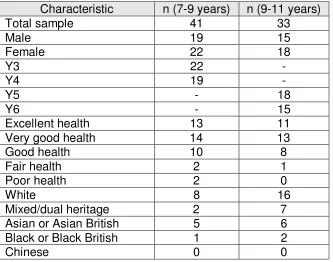
apart from one pair. Tables 2 and 3 show the characteristics of the groups. A
good balance of gender and ethnicity was achieved, however there were few
children with fair or poor health due to a lack of children with these levels of
health in the sample.
Interviews
Children concentrated well during the interviews, the warm up exercise
worked very well and children seemed to feel relaxed and at ease with the
interviewer. The consent process was very helpful for explaining to children
what the research was about and what was involved and some children raised
questions prompted by this. Some children commented that they had enjoyed
the interview. No children asked to stop the interview and no bad feedback or
experiences were reported. Interviews varied in length from 4 to 26 minutes.
Saturation was reached in both age groups. Despite increasing the number of
interviews and specifically trying to target children with poorer health, no new
was needed, but this has increased the confidence that saturation was
reached.
A range of health problems arose in the interviews, covering both chronic
conditions such as asthma, epilepsy, allergies and eczema, and acute
conditions such as flu, infections and headaches. Some were minor and some
more serious, for example some cases of eczema required hospital treatment.
Some conditions also arose that involved hospitalisation, including pneumonia
and muscle growth problems. Many conditions required treatment via the GP,
such as hay fever, ear infections and chicken pox and some required hospital
visits, such as losing feeling in the legs, severe asthma and broken bones.
Analysis
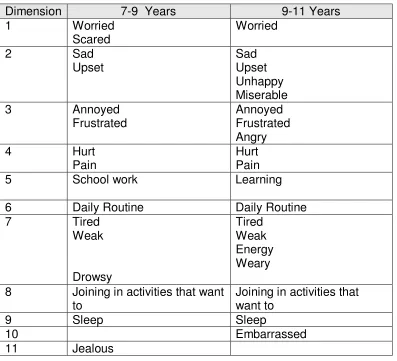
The analysis generated ten dimensions which are broadly similar between the
2 age groups, with the exception of the final dimension. They are listed in
Table 3. The results reported here are from both groups.
1. Worrying
This dimension stemmed from feelings of worry about their health or illness
and what was going to happen to them, both in the short and long term, for
example worrying about whether their health would get worse and worrying
that they would always have the health problem. There was also worry
because of the physical symptoms, for example when breathing was
restricted due to an asthma attack or bleeding from eczema. Some children
allergy, they were worried about what would happen if they had a reaction.
The younger children tended to talk more about being scared or nervous,
sometimes from people looking at them because of their health and they were
also scared because of the physical effects of their health. Older children just
talked about it in terms of being worried. For example:
Child: Sometimes it’s hard to breathe, when you’re breathing up or
down sometimes a little … (unclear)… sometimes when I get
tired it’s hard.
Interviewer: It’s hard to breathe, how does that make you feel?
Child: A bit worried.
Interviewer: A bit worried, why do you get worried?
Child: Cos sometimes like err you don’t know what to do.
(B127, male, 11, very good health)
Child: Because sometimes I worry what’s going to happen to me.
(B12, male, 8, very good health)
Child: I felt like really, really worried, worry me, like, um it felt really
scratchy and itchy just really worried like it’s never gonna stop
(B33, female, 8, fair health)
2. Feeling sad or unhappy
There were several reasons for feeling sad, miserable, upset or unhappy.
Some children said it was because they felt unwell and experiencing the
physical symptoms made them feel sad. Some children felt sad when they
couldn’t do things they would normally do, like going to school, seeing their
friends or doing activities they normally did. Some children felt sad when they
were teased because of their health. All these reasons occurred in both age
groups and the language was the same apart from older children using the
term miserable in addition to sad, unhappy and upset.
Child: I just felt unhappy because I’m missing things that I normally do
on the weekend.
(A22, female, 10, excellent health)
Child: Yeh it stopped me skipping cos I can’t skip with one arm.
Interviewer No, how did that make you feel?
Child: Upset because I like skipping.
(A8, female, 8, good health)
Interviewer: And can you tell me about that, what’s it feel like, when you get
Child: It just gets all squeezed up and I just keep on rubbing it and it
just feels, it just feels hurt and I don’t want it to happen but it just
does happen.
Interviewer: And how does it make you feel?
Child: Unhappy, actually.
Interviewer: Unhappy, why does it make you feel unhappy?
Child: Because it hurts and I don’t want it to hurt actually.
(A13, female, 9, good health)
3. Feeling angry, annoyed or frustrated
This dimension arose from a variety of reasons for feeling angry, annoyed or
frustrated. In some cases, physical symptoms caused children to feel
annoyed or frustrated. Some children also got annoyed because their health
affected their everyday activities or things that they did, including sleeping,
eating and being able to concentrate. Some younger children also mentioned
being annoyed because of having to apply medication and also having to go
to hospital for tests.
Interviewer: You couldn’t breathe. And what does that feel like when you
Child: I get really frustrated.
Interviewer: Why is it frustrating?
Child: Because you wanna breathe and I can’t breathe.
(A17, male, 9, very good health)
Child: I had to get into the bath and put a glove on and then I had to
put a plastic bag on and then you’ve got soap and I it’s just
really annoying because I couldn’t really do very much and, then
I couldn’t play football and then like I couldn’t do very much stuff
basically and I didn’t like it.
(B97, female, 10, excellent health)
Child: It was really annoying I couldn’t go to sleep at night, cos I was
coughing.
(B3, male, 8, good health)
4. Hurting/pain
Many different health problems led to pain of different degrees. Sometimes
their skin. In other cases pain came about through physical symptoms like a
sore throat, an asthma attack, tummy ache, headaches or coughing. Other
children talked about the pain of treatments they have to have in hospital.
Others talked of pain when they undertook specific activities, such as pain
when they walked on their sore feet. The same reasons and issues came up
in both age groups and both age groups used the same terminology,
describing it as hurt or pain.
Child: Umm it’s like whenever you swallow there’s like it’s horrible it’s
like a dry but sharp pain
(B106, female, 11, excellent health)
Child: It’s like, it was like I couldn’t breathe properly and when I tried to
breathe in it really hurt my chest.
(B110, female, 11, good health)
5. Learning/schoolwork
There were many issues to do with school and they all led to the same
outcome, in that problems around concentration, being absent from school
because of health and not being able to manage work, led to schoolwork and
learning being affected. Some children said that their physical symptoms
meant they were not able to concentrate, which meant they couldn’t learn.
This included pain or itching or being tired. Other children said that when they
missing their lessons, or in some cases it was because they were unwell at
school and had to miss lessons. Some children described how problems with
vision, hearing and speech all led to them having difficulty in lessons, so it
affected their schoolwork, for example not being able to hear the teacher or
see the board properly. The same issues arose for both age groups, however
the younger children talked about their work or school work, often naming
specific parts of it such as writing or drawing, whereas the older children
tended to extend this by saying it affected their learning in general.
Child: I’d just sit down and be coughing a lot and disturb the class, I
wouldn’t be learning because I’d be concentrating on my cough
instead of learning.
(A18, male, 10, good health)
Child: cos I can’t concentrate on my work its like, it all just goes all over
blurry so I close my eyes and then I look back and it goes ok but
then like it hurts my eyes.
(B97, female, 10, excellent health)
Child: It affects me kinda like speaking because all your mouth dries
Interviewer: And what does that affect when you can’t speak, how does that
affect you?
Child: I can’t answer any answers at school or anything.
(B7, female, 8, excellent health)
6. Daily routine (eating, bathing, dressing, getting ready, moving around)
There were many issues around children’s daily routine, including being able
to have a bath and wash themselves, being able to get dressed and get ready
for school. Some children found it took longer to get ready for school as they
had to take their medication. Some children had problems undertaking other
daily tasks including picking things up, and getting out of bed. In addition,
issues arose around not being able to eat, for example if children had a sore
throat or stomach ache, then they would not be able to eat what they normally
would. Some children did not eat so they wouldn’t be sick and some children
lost their appetite when their health was not good.
Some children had problems moving around, for example going up and down
stairs or getting around places. The issues were the same in both age groups.
Neither age group talked about a daily routine, but instead talked about the
individual tasks that they would normally have to do as part of their everyday
life. The younger children sometimes broke it down into smaller tasks, for
example specifically talking about difficulties with cleaning their teeth, rather
Interviewer: How did it affect you when you had your leg like that in the
things that you do everyday?
Child: Well it’s hard to get up the stairs, that was the main thing so I
had to crawl up the stairs but…
(B122, male, 10, good health)
Interviewer: And how does it affect you at home?
Child: Umm it takes a bit longer to get ready for school.
Interviewer: Why’s that?
Child: Erm, because I’ve got lots of things to do to get ready I don’t
have to just brush my teeth and then that’s it I have to my
(unclear) brush my teeth and then I have to do this special thing
with my teeth.
(B70, male, 10, very good health)
Child: Getting dressed was quite hard.
Child: Yeh, cos I had to stretch my arm a bit to get something on, like a
jumper, I had to stretch my arm a bit and then it hurted.
(A14, male, 9, good health)
7. Feeling weak/weary/tired
Issues arose around feeling weak and not having any energy to do things,
Some children didn’t want to do anything because they had no energy, or
because of how they felt when they had symptoms, for example, a headache.
Some children felt tired and for different reasons, sometimes it was because
their health problem made them feel like going to sleep, sometimes it was
because their sleep had been affected. Some children had to rest more or
sleep more. Older children talked more about having enough energy to do
things and feeling weary. Younger children sometimes described feeling
drowsy.
Child: I felt really weak so I couldn’t really do a lot of activities that took
lots of energy cos I didn’t really have a lot of energy at that time.
(B110, female, 11, good health)
Child: Well it was like a fluey sort of cold or something, I was really
tired and I just fell asleep on the couch. I just sort of felt ill and
just stayed on the couch for a week.
Child: Err, well I usually have to have like a rest on the sofa cos it feels
really bad and tiring.
(B22, female, 8, good health)
8. Able to join in activities that they want to (e.g. playing out with
friends, sports)
There were a lot of issues that arose around being able to join in activities that
children wanted to do. These activities included playing with or being with
their friends, playing out, going on trips, or joining in activities or sports that
they wanted to. In some cases children could still play out, but their health
made it difficult. Some children had to miss out on sports because they had
hurt themselves or they were in pain. In some cases children couldn’t do
physical activity as it set off their illness. In some cases they could still join in
but found it harder. Some children said they couldn’t play much because they
were in hospital. Other children described how they missed their friends when
they were poorly. In some cases this was because they were off school or in
hospital. The issues were the same for both age groups.
Child: It affects me because at home I can’t do nothing cos I
sometimes I like playing with my brother’s and sisters on the
road or outside and I have to stay inside and do nothing.
Child: Yeah I wasn’t able to join in with things that I normally do like
tennis and football and stuff like that.
(B114, male, 11, very good health)
Child: I didn’t get to meet with some of my best friends and play games
with them.
(B42, male, 9, very good health)
9. Sleep
Sleep emerged as an issue among children for different reasons. Some
children found it difficult to get to sleep, some couldn’t sleep because they
were worried, others because of symptoms, such as coughing or being sick.
Some children experienced broken sleep, in some cases this would really
affect their sleep as they couldn’t get back to sleep and in other cases not so
much. Some children really struggled with sleep when all they wanted to do
was go to sleep and other children hated going to bed because they knew
they would not be able to sleep and would have to lie there alone. This had
consequences for the next day, when children felt tired and found it difficult to
get up for school and concentrate. Some children couldn’t sleep at all and
some children woke early. These issues arose in both age groups and were
described in very similar ways.
Child: Oh that was horrible, it was absolutely horrible, you couldn’t go
mouth and tried breathing out of your mouth you swallowed
because my mouth would be all dry in the middle of the night
and I’d have to swallow and it wasn’t very nice
(B106, female, 11, excellent health)
Child: Yeah I couldn’t sleep cos it really hurt my throat when I slept, so
I couldn’t sleep at all.
(B110, female, 11, good health)
Child: In the night I wake up because I’m scratching it.
Interviewer: And how does that feel?
Child: Horrible because I can’t get back to sleep.
(B28, male, 9, excellent health)
Child: when um I kept being sick in the night and then, um, I didn’t get
much sleep then cos I just had to kept waking up and stuff yeh.
(A15, female, 9, good health)
This dimension arose in the older children. Some children said they were
teased because of their appearance, in some cases because of their figure. In
some cases, children were embarrassed about their appearance and took
action to cover it up. Children didn’t like crying or being sick at school because
they felt embarrassed. Children also talked about how their appearance
bothered them because of their health, for example because of having to wear
glasses, or when they had visible health symptoms or had to take medication
for example they were embarrassed when other people saw their eczema.
Child: but because of my figure, but, because of my figure, because
my bones are quite heavy so, I’m quite big so sometimes I get a
bit teased about that
(A20,female, 11, very good health)
Child: cos everyone sees you in the class and you feel a bit
embarrassed.
(B108, female, 10, very good health)
Child: sometimes I forget to cream my legs and I get a bit embarrassed
in P.E.
(B82, female, 10, good health)
This arose in the younger children and was similar in some ways to the
embarrassed dimension that arose in the older group, however it was not as
strong. Some of the issues children raised were hinting at being embarrassed.
Children felt jealous of others as they didn’t want to have their health problem
and wanted to be like others who didn’t have any problems. They also felt
jealous when they couldn’t join in activities that others could because of their
health.
Child: because like I think other peoples legs and arms are not like that
I wish mine weren’t like that and things like that.
Interviewer: How does it make you feel?
Child: Umm a bit jealous because like, people, um other people don’t
have it on their body, I wish I was the same as them because
I’m like the only person who has eczema on my body in my
family and be like thinking like well how come she’s got it.
(B33, female, 8, fair health)
Child: sometimes I feel I wish I didn’t wear them, sometimes yeah
(A15, female, 9, good health)
One overall theme that arose was the idea of being normal, or children
how they differed from this, for example, saying they couldn’t do what they
would normally do when they were well, or couldn’t do what other children
their age do. They also sometimes expressed a desire to be like other
children who didn’t have the health problems they had or to be what they
described as normal, meaning free of the health problem.
Discussion
This qualitative study has generated a wide range of dimensions of HRQoL.
There were many reasons why the dimensions emerged, as different health
problems could result in the same impact on HRQoL. For example, if a child’s
hearing was affected, it sometimes meant they found lessons difficult as they
couldn’t hear the teacher and it also meant they had some pain in their ear.
Other children had an allergy which affected their lessons because their
concentration was affected and they were scratching which also gave rise to
pain. Also, breathlessness led to children feeling worried and frustrated.
Most dimensions arose from children across the range of levels of health and
through both acute and chronic health problems. However, feeling scared or
worried seemed to arise mainly in children who had chronic health problems
such as asthma or eczema who worried about when their symptoms came
back and what would happen to them. Embarrassment arose mainly through
health problems which gave rise to visible symptoms such as rashes, or came
Quite often, the way in which children thought about these dimensions was in
terms of the overall theme of a departure from normal, meaning children were
thinking of what a usual role would be for a child of their age and then thinking
how they differed from this.
Although the dimensions are intended to be mutually exclusive, there are
relationships between them, for example, not being able to join in activities
may make a child feel sad, or being in pain may mean that a child may not be
able to sleep. This is perfectly acceptable for a HRQoL measure as it is often
the case that people have problems on several dimensions at once. Although
the dimensions may be related through these problems, they are still different
dimensions of HRQoL and reflect the differing impact of problems on
children’s lives.
This work has some evidence that there is a similar HRQoL framework for
7-11 years old children as the same dimensions (except one) arose from each
group. Even though the language and terminology used by the age groups
sometimes differed, they were describing the same concepts. This gives
confidence that one measure can be developed, however more work is
required on the appropriate wording to use, to make sure it is suitable for all
ages.
The interviews worked best in a one to one setting as sometimes children
would be discussing sensitive information. The format of the interview worked
information about their health and then went on to talk about how it affected
them in their lives. This research has demonstrated that it is feasible to
interview children about their health and that they are able to understand and
describe how health affects their lives.
The dimensions identified include many of the areas of HRQoL covered in
widely used adult PBMs, such as the SF-6D (Brazier et al 2002) and the
EQ-5D (Dolan 1997), such as physical, emotional and social aspects. For
example, the EQ-5D contains a pain dimension and an anxiety/depression
dimension. Whilst not described in the same terms, the worrying and
sad/unhappy dimensions in this work are similar in concept to the latter.
Similarly the SF-6D contains dimensions on pain, mental health, vitality, social
functioning, physical functioning and role limitations. Some of the dimensions
developed in this work, such as feeling tired or weak and joining in activities,
seem similar in concept to vitality and social and physical functioning. The
dimensions also conform to the World Health Organization (WHO)
classification of health. (WHO, 1948)
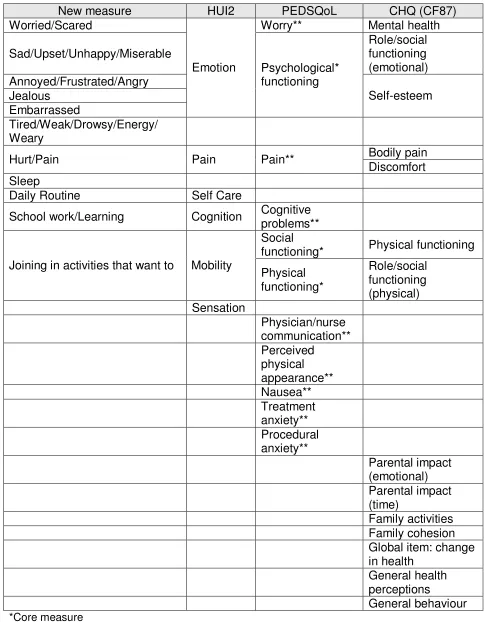
Table 4 lists the dimensions of the most frequently used generic paediatric
instruments in the literature, the PEDSQOL, the Child Health Questionnaire
(CHQ) and the HUI2 along with those of the new measure. It shows some
similarity in coverage but also some important differences. The HUI 2
(Torrance, Feeny, Furlong, Barr, Zhang & Wang 1996) is the only existing
paediatric generic PBM. It takes a functioning “within skin” approach. For
and speech. The dimensions developed in this study go beyond this, in that
the consequences of hearing and vision problems were looked at, for example
in joining in activities or being able to manage their school work. Whilst there
are some similarities to the dimensions developed here, for example pain and
daily routine, there are many differences, for example the HUI2 does not
include sleep, jealous, embarrassed and tired/weak.
The PEDSQoL (Varni, Seid & Rode 1999) goes beyond how health affects
children in that it includes areas such as physician/nurse communication. The
CHQ (Eiser & Morse 2001) includes more than HRQoL with dimensions
related to the family, for example family activities and family cohesion and
includes a behaviour dimension. There are also some similarities with the
dimensions developed here, for example pain and emotions.
The qualitative approach taken here of directly looking for dimensions and the
explanations behind them is similar to that taken by Grewal (Grewal, Lewis,
Flynn, Brown, Bond & Coast 2006) in their development of a generic QoL
measure for older people. In this work, they conceptually grouped data into
mutually exclusive attributes of QoL. It is in contrast to the more common
approach taken in the instrument development literature, where large lists of
items are generated and then a technique such as factor analysis is used to
develop dimensions (Drotar Schwartz, Palermo & Burant 2006), (Riley,
Forrest, Rebok, Starfield, Green, Robertson et al 2004). The qualitative
dimension and levels within these in order to construct a health state
classification.
There was breadth of coverage in terms of acute and chronic health problems
in the sample, although it is acknowledged that there are gaps at the lower
end, in that there were comparatively fewer interviews carried out on children
whose health was rated as fair or poor. This is not surprising given that the
population was recruited through schools and so tended to exclude those
children who are in hospital or not in mainstream education.
There was a notable difference in response rates between the schools. There
could be many reasons for this, including the fact that school A has 67% of
pupils with a first language other than English and in many cases, the parents
do not speak English, and therefore may not have read/understood the letter
and information leaflet asking for consent to approach their child.
It is acknowledged that the population interviewed in this research all come
from Sheffield and it is not certain that the results of this will apply nationally.
However the breadth of socio economic diversity reached in the sampling
should ensure that the measure is likely to be applicable more widely than
Sheffield and this is something that can be tested in future research.
Involving children in developing the content of the descriptive system helps
ensure content and face validity as it should be comprehensive in its coverage
and Drug Administration guidelines on patient-reported outcome measures,
which recommend that development of paediatric instruments should consider
age-related vocabulary and language comprehension, and fairly narrow age
groupings should be used to account for developmental differences. (Food
and Drug Administration 2006)
These dimensions are intended to form a generic measure and need to be
suitable for a wide range of conditions and health problems found in the
general paediatric population. It may be that the measure does not perform so
well in more serious paediatric health conditions, as the measure has been
developed on a relatively healthy sample. Future work testing the measure on
clinical populations will help to determine how well the measure performs in
different patient groups.
The next stage of this research is to produce a health state classification
system based on these dimensions which is amenable to valuation.
Conclusion
This work has identified the ways in which children age 7-11 years say health
affects their lives. A range of dimensions of HRQoL emerged, covering
physical, social and emotional aspects. The dimensions have been developed
directly from the relevant population, increasing the content and face validity.
There was also no influence from any other source, such as parents,
teachers, medical professionals or the literature as bottom up methods were
provide information on HRQoL and gives some evidence of a stable
framework across age. Further work is needed to develop a health state
classification system that is amenable to valuation and to test it in different
References
Brazier J., Roberts J.,& Deverill M. (2002). The estimation of a preference based measure of health from the SF-36. Journal Health Economics, 21 (2), 271-292.
Brazier J., Ratcliffe J., Salomon J., & Tsuchiya A. (2007). Measuring and Valuing Health Benefits for Economic Evaluation. Oxford University Press.
Dolan, P. (1997). Modelling valuations for EuroQol Health States. Medical Care, 35, 1095-1108.
Drotar D., Schwartz L., Palermo T M., & Burant C. (2006). Factor Structure of the Child Health Questionnaire-Parent Form in Pediatric Populations. Journal of Pediatric Psychology, 31(2):127-138.
Eiser C., & Morse R. (2001). Quality-of-life measures in chronic diseases of childhood. Health Technology Assessment. 5(4).
Food and Drug Administration, U.S. Department of Health and Human
Services. (February 2006). Guidance for Industry, Patient-Reported Outcome Measures: Use in Medical Product Development to Support Labeling Claims. Draft Guidance.
Fitzpatrick R., Davey C., Buxton MJ., Jones DR. (1998). Evaluating patient-based outcome measures for use in clinical trials. Health Technology Assessment. 2(14).
Grewal I., Lewis J., Flynn T., Brown J., Bond J., & Coast J. (2006).
Developing attributes for a generic quality of life measure for older people: Preferences or capabilities? Social Science and Medicine, 62: 1891-1901.
http://www.healthact.com/chq.html Accessed 22/08/07
Landgraf J M. (2005). Practical considerations in the measurement of HRQoL in child/adolescent clinical trials. In Fayers P., & Hays R(Ed.), Assessing Quality of Life in Clinical Trials. 2nd edition. Oxford University Press.
McCabe C. (May 2003). Estimating preference weights for paediatric health state classification (HUI2) and a comparison of methods. Ph.D.Thesis. The University of Sheffield.
McColl E. (2005). Developing questionnaires. In Fayers P., & Hays R (Ed.),
Assessing Quality of Life in Clinical Trials. 2nd edition. Oxford University Press.
NVIVO7 QSR International
Petrou S. (2003). Methodological issues raised by preference-based
approaches to measuring the health status of children. Health Economics. 12: 697-702.
Riley AW. (2004). Evidence that school-age children can self-report on their health. Ambulatory Pediatrics; 4(4):371-376.
Riley A W., Forrest C B., Rebok G W., Starfield B., Green B F., Robertson J A., & Friello P. (2004). The Child Report Form of the CHIP-Child Edition, Reliability and Validity. Medical Care. 42(3).
Ritchie L, Lewis J. (Ed.) (2005). Qualitative Research Practice; A Guide for Social Science Students and Researchers. SAGE publications, London.
Torrance GW., Feeny DH., Furlong WJ., Barr RD., Zhang Y., & Wang Q. (1996). A multi-attribute utility function for a comprehensive health status classification system: Health Utilities Mark 2. Medical Care; 34(7):702-722.
http://www.article12.org/pdf/UNCRC%20Official%20Document.pdf Accessed 08/02/07
Varni JW., Seid M., & Rode CA. (1999). The PEDsQL: Measurement model for the pediatric quality of life inventory. Medical Care; 37(2):126-139.
Table 1: Characteristics of the Schools
Gender NCY**3-6 (age 7-11 years)
% boys 51.13% Sheffield
LEA+ % girls 48.87%
% boys 54.58% School A+
% girls 45.42% % boys 46.34% School B+
% girls 53.66% % boys 51.22% National+
% girls 48.78%
Eligible for Free School Meals (%) Total SEN* (%) Ethnic Minority (NCY** 1 to 6) (%)
First Language other than English
(NCY** 1-6) (%)
LEA+ 19.1% 21.0% 21.4% 13.5%
School A+ 25.00% 27.00% 83.10% 68.90%
School B+ 9.50% 16.00% 36.00% 18.20%
Median for
Sheffield+ 13.64% 21.18% 11.25% 2.33%
National++ 16.98% 17.28% 20.6% 12.5%
+Source: Pupil Level Annual School Census (PLASC) as of January 2006.
PLASC is a census of all children in the school system.
++
Source: http://www.dfes.gov.uk/rsgateway/DB/SFR/s000682/index.shtml Accessed 20/12/2007
http://www.dfes.gov.uk/rsgateway/DB/SFR/s000744/UPDATEDSFR30_2007.pdf Accessed 20/12/2007
Table 2: Characteristics of the Samples
Characteristic n (7-9 years) n (9-11 years)
Total sample 41 33
Male 19 15
Female 22 18
Y3 22 -
Y4 19 -
Y5 - 18
Y6 - 15
Excellent health 13 11
Very good health 14 13
Good health 10 8
Fair health 2 1
Poor health 2 0
White 8 16
Mixed/dual heritage 2 7
Asian or Asian British 5 6
Black or Black British 1 2
Table 3: Dimensions of HRQoL
Dimension 7-9 Years 9-11 Years
1 Worried
Scared
Worried
2 Sad
Upset
Sad Upset Unhappy Miserable
3 Annoyed
Frustrated
Annoyed Frustrated Angry
4 Hurt
Pain
Hurt Pain
5 School work Learning
6 Daily Routine Daily Routine
7 Tired
Weak Drowsy Tired Weak Energy Weary
8 Joining in activities that want to
Joining in activities that want to
9 Sleep Sleep
10 Embarrassed
Table 4Comparison of dimensions with three existing paediatric generic instruments
New measure HUI2 PEDSQoL CHQ (CF87)
Worried/Scared Worry** Mental health
Sad/Upset/Unhappy/Miserable Role/social functioning (emotional) Annoyed/Frustrated/Angry Jealous Embarrassed
Emotion Psychological* functioning
Self-esteem
Tired/Weak/Drowsy/Energy/ Weary
Bodily pain
Hurt/Pain Pain Pain**
Discomfort Sleep
Daily Routine Self Care
School work/Learning Cognition Cognitive problems** Social
functioning* Physical functioning Joining in activities that want to Mobility
Physical functioning* Role/social functioning (physical) Sensation Physician/nurse communication** Perceived physical appearance** Nausea** Treatment anxiety** Procedural anxiety** Parental impact (emotional) Parental impact (time) Family activities Family cohesion Global item: change in health
General health perceptions
General behaviour
*Core measure