
Learning to Generate and Refine
Object Proposals
Haoyang Zhang
A thesis submitted for the degree of
Doctor of Philosophy
The Australian National University
May 2018
c
Except where otherwise indicated, this thesis is my own original work.
Acknowledgments
First of all, I would like to thank my primary supervisor, Dr. Xuming He. I specially thank Xuming for introducing me to the research world. Xuming is an excellent researcher with solid background in computer vision and machine learning. He is conscientious, responsible and cooperative, often giving me valuable detailed advice on my research. I learnt a great deal from Xuming, including the research methods, experiment design, paper reading and writing skills, idea demonstration and a body of knowledge in computer visionetc. Without his invaluable help and support, it is impossible for me to complete my PhD.
I am also grateful for my other supervisory panel members: Lexing Xie, Miao-miao Liu, Laurent Kneip and Fatih Porikli. Thank you very much for the support and discussion. A special thanks goes to Lexing, who brought me the opportunity of studying in Australia in the beginning and helped me finish my PhD in the end.
I would also like to thank my friends at Data61/NICTA and ANU: Weipeng Xu, Buyu Liu, Wei Zhuo, Fang Wang, Hongtao Yang, Hao Zhou, Wenbing Huang and Tong Zhang. Thank you for helping me in my life, sharing joys with me and supporting me. Weipeng gave me a lot of help when I arrived in Australia and shared me with many interesting things. Hao, Wenbing and Tong are fun to play with and we enjoyed many memorable dinners, which helped me go through those tough days.
I also acknowledge the Australian National University (ANU), and Data61 / Na-tional Information and Communication Technology Australia (NICTA), Common-wealth Scientific and Industrial Research Organisation (CSIRO), for providing me scholarships to undertake the research for my PhD studies.
Finally, I thank my family members for all the love and understanding.
Abstract
Visual object recognition is a fundamental and challenging problem in computer vision. To build a practical recognition system, one is first confronted with high computation complexity due to an enormous search space from an image, which is caused by large variations in object appearance, pose and mutual occlusion, as well as other environmental factors. To reduce the search complexity, a moderate set of image regions that are likely to contain an object, regardless of its category, are usu-ally first generated in modern object recognition subsystems. These possible object regions are called object proposals, object hypotheses or object candidates, which can be used for down-stream classification or global reasoning in many different vision tasks like object detection, segmentation and tracking,etc.
This thesis addresses the problem of object proposal generation, including bound-ing box and segment proposal generation, in real-world scenarios. In particular, we investigate the representation learning in object proposal generation with 3D cues and contextual information, aiming to propose higher-quality object candidates which have higher object recall, better boundary coverage and lower number. We focus on three main issues: 1)how can we incorporate additional geometric and high-level semantic context information into the proposal generation for stereo images? 2) how do we generate object segment proposals for stereo images with learning repre-sentations and learning grouping process? and 3) how can we learn a context-driven representation to refine segment proposals efficiently?
In this thesis, we propose a series of solutions to address each of the raised prob-lems. We first propose a semantic context and depth-aware object proposal genera-tion method. We design a set of new cues to encode the objectness, and then train an efficient random forest classifier to re-rank the initial proposals and linear regres-sors to fine-tune their locations. Next, we extend the task to the segment proposal generation in the same setting and develop a learning-based segment proposal gen-eration method for stereo images. Our method makes use of learned deep features and designed geometric features to represent a region and learns a similarity net-work to guide the superpixel grouping process. We also learn a ranking netnet-work to predict the objectness score for each segment proposal. To address the third problem, we take a transformation-based approach to improve the quality of a given segment candidate pool based on context information. We propose an efficient deep network that learns affine transformations to warp an initial object mask towards nearby ob-ject region, based on a novel feature pooling strategy. Finally, we extend our affine warping approach to address the object-mask alignment problem and particularly the problem of refining a set of segment proposals. We design an end-to-end deep spatial transformer network that learns free-form deformations (FFDs) to non-rigidly warp the shape mask towards the ground truth, based on a multi-level dual mask
viii
Contents
Acknowledgments v
Abstract vii
1 Introduction 1
1.1 Overview . . . 1
1.2 Main Issues in Object Proposal Generation . . . 5
1.3 Our Methods . . . 7
1.4 Thesis Outline . . . 11
1.5 Thesis Contributions . . . 13
2 Literature Review 15 2.1 Object Proposal in Computer Vision . . . 15
2.2 Early Stage Object Proposal Generation . . . 18
2.2.1 Object Bounding Box Proposal Generation . . . 18
2.2.2 Object Segment Proposal Generation . . . 20
2.3 3D Reconstruction . . . 23
2.3.1 Disparity Estimation . . . 23
2.3.2 Point Cloud Generation . . . 24
2.4 Convolutional Neural Networks . . . 24
2.5 CNN-based Object Proposal Generation . . . 28
2.5.1 Object Bounding Box Proposal Generation . . . 29
2.5.2 Object Segment Proposal Generation . . . 30
2.6 Modelling and Learning Spatial Transforms . . . 30
2.6.1 Bounding Box Regression . . . 31
2.6.2 Spatial Transformer Network . . . 32
2.6.3 Free-Form Deformation Model . . . 34
2.7 Datasets and Evaluation . . . 35
2.7.1 Datasets . . . 35
2.7.2 Evaluation Metrics . . . 38
2.8 Summary . . . 39
3 Semantic Context and Depth-aware Object Proposal Generation 41 3.1 Introduction . . . 41
3.2 Our Approach . . . 43
3.2.1 Preprocessing . . . 43
3.2.2 Object and Context Features . . . 43
x Contents
3.2.3 Re-rank Proposals . . . 44
3.2.4 Bounding Box Regression . . . 45
3.3 Experiments . . . 45
3.3.1 Object Proposal Generation . . . 45
3.3.2 Ablation Study . . . 47
3.3.3 Object Detection . . . 48
3.4 Conclusion . . . 49
4 Learning to Generate Object Segment Proposals with Multi-modal Cues 51 4.1 Introduction . . . 51
4.2 Our Method . . . 53
4.2.1 Initial Segmentation Hierarchy Generation . . . 53
4.2.2 Multi-modal Region Representation . . . 53
4.2.3 Similarity Network . . . 55
4.2.4 Hierarchical and Combinatorial Grouping . . . 56
4.2.5 Ranking Network . . . 57
4.3 Experiments . . . 58
4.3.1 Dataset . . . 59
4.3.2 Evaluation Measures . . . 59
4.3.3 Baseline and State-of-the-Art . . . 60
4.3.4 Segmentation Results . . . 61
4.3.5 Bounding Box Results . . . 63
4.4 Conclusion . . . 63
5 Learning Spatial Transforms for Refining Object Segment Proposals 65 5.1 Introduction . . . 65
5.2 Our Approach . . . 67
5.2.1 Refinement by Affine Transformation . . . 68
5.2.2 Affine Transformation Regression Network . . . 69
5.2.3 Network Training . . . 71
5.3 Experiments . . . 71
5.3.1 Dataset . . . 71
5.3.2 Evaluation Metrics and Protocols . . . 72
5.3.3 Results . . . 72
5.3.4 Ablation Study . . . 76
5.4 Conclusion . . . 77
6 Deep Free-Form Deformation Network for Object-Mask Registration 81 6.1 Introduction . . . 81
6.2 Deep Free-form Deformation Network . . . 83
6.2.1 Convolutional Features and Mask Pooling . . . 83
6.2.2 Free-form Deformation Transformer . . . 84
6.2.3 Network Details and Training . . . 86
Contents xi
6.3.1 Evaluation Metrics and Protocols . . . 88
6.3.2 Results . . . 88
6.3.3 Ablation Study . . . 93
6.3.4 Object Detection . . . 93
6.3.5 Longitudinal Comparison . . . 94
6.4 Conclusion . . . 94
7 Conclusion and Future Direction 101 7.1 Main Contributions . . . 101
7.2 Perspectives for Future Work . . . 102
7.2.1 3D Object Proposals . . . 102
7.2.2 Generating Object Segment Proposals with Semantic Boundary Estimation . . . 103
List of Figures
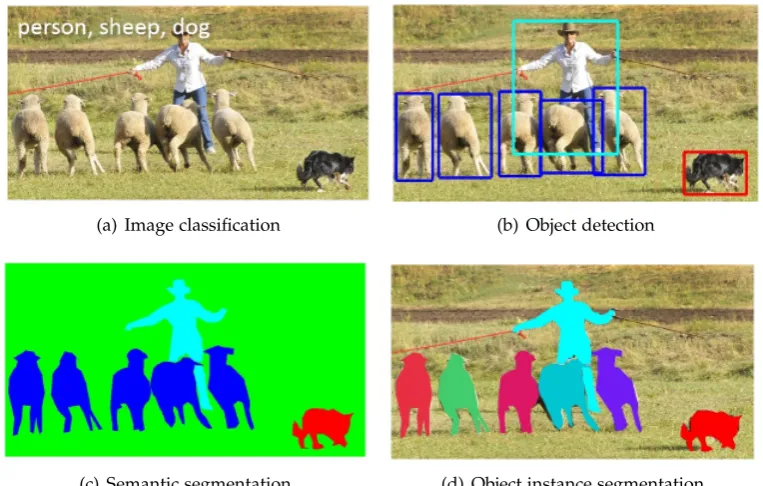
1.1 Illustration of four different levels of object recognition in computer vision: (a) image classification, (b) object detection, (c) semantic seg-mentation and (d) object instance segseg-mentation. Image taken from [1].
. . . 1
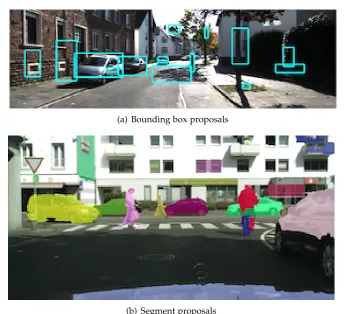
1.2 Illustration of object proposals: (a) bounding box proposals and (b) segment proposals. . . 3
1.3 Overview of our approach for semantic context and depth-aware object proposal generation. The input are a pair of stereo images and an initial set of proposals. We extract three types of object and context cues, and use them to re-rank the proposals and refine their locations. . 8
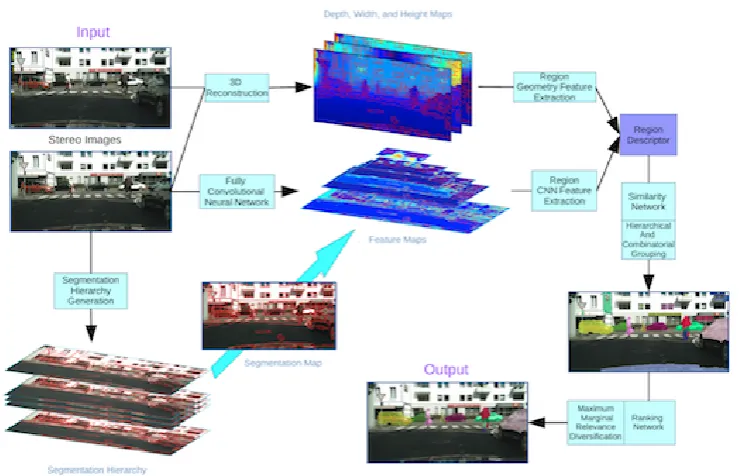
1.4 Illustration of our system for learning to generate object segment pro-posals with multi-modal cues. Our system takes as input a pair of stereo images and outputs segment proposals. For each region in the segmentation hierarchy, we extract geometric and CNN features to represent it. Those adjacent regions are iteratively merged, which is guided by a similarity network. We select those single and merged regions as object proposals and rank them based on a ranking network. 9
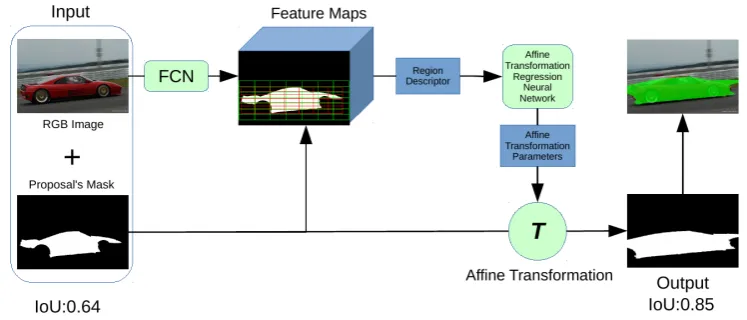
1.5 Model structure of our approach for learning spatial transforms for re-fining object segment proposals. Our system takes as input an image and initial segment proposals. It first extracts deep features to describe a segment and feeds the descriptor into a regression network to esti-mate an affine transformation. We then apply the affine transformation to the segment mask to obtain the warped mask. . . 10
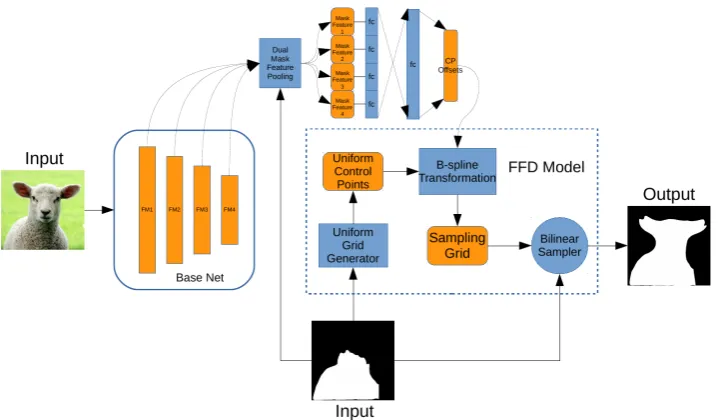
1.6 Overview of our deep FFD network for object-mask alignment. The entire network consists of two modules: the first computes the con-volutional feature maps and extracts mask features using dual mask pooling, and the second predicts the FFD transform and warps the input mask onto the target object. . . 11
2.1 Comparison between early stage and modern object detection . . . 16
2.2 Schematic depiction of the detection cascade proposed in [2] . . . 16
2.3 Multi-task Network Cascades for instance-aware semantic segmenta-tion [3]. At the top right corner is a simplified illustrasegmenta-tion. . . 18
xiv LIST OF FIGURES
2.4 Idea property of an objectness measure. The objectness measure should score the blue windows, partially covering the objects, lower than the groundtruth windows (green), and even lower the red windows
con-taining only stuff [4]. . . 19
2.5 The pipeline of multiscale combinatorial grouping (MCG) [5]. . . 21
2.6 Illustration of the typical structure of a CNN (AlexNet [6]). . . 25
2.7 Depiction of hypercolumn representation. The hypercolumn feature at a pixel is the vector of activations of all units that lie above that pixel [7]. 27 2.8 Fast RCNN architecture [8]. . . 27
2.9 Illustration of the convolutional feature masking [9]. . . 28
2.10 Illustration of the RPN proposed in faster RCNN [10]. . . 29
2.11 DeepMask network architecture [11]. . . 30
2.12 SharpMask network architecture [12]. . . 31
2.13 Illustration of bounding box regression. The learned regressors predict the offsets between the detection box (red) and the groundtruth box (green). . . 32
2.14 The architecture of a spatial transformer module [13]. U represents the inpute feature map, while V is the warped output feature Map. . . 33
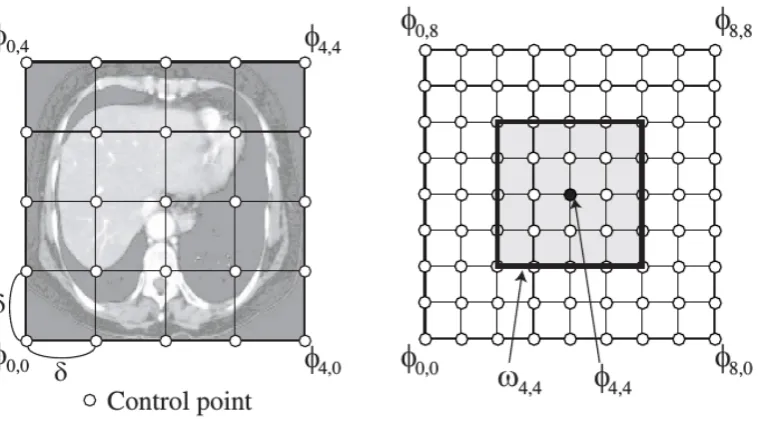
2.15 B-spline free-form deformations (FFDs). (a) Deformations of a floating image are performed by manipulating an overlaying mesh of control points and (b) a control point affects points only inside its 4δ×4δ neighborhood domain. Images taken from [14] . . . 34
2.16 Examples for image and ground truth annotations in KITTI-object dataset [15]. . . 36
2.17 Examples for the dataset of Cityscapes[16]. Top: RGB images. Bot-tom: instance-level segmentation ground truth. . . 37
2.18 Examples for image and ground truth annotations in PASCAL VOC dataset [17, 18]. Top: RGB images. Bottom: instance-level segmenta-tion ground truth. . . 37
2.19 Examples for image and ground truth annotations inMSCOCOdataset [1]. Top: RGB images. Bottom:instance-level segmentation ground truth. . 38
3.1 Overview of our object proposal generation pipeline. The input are a pair of stereo images and an initial set of proposals. We extract three types of object and context cues, and use them to re-rank the proposals and refine their locations. . . 42
3.2 The design of semantic context feature, which shows the partition of a bounding box for computing the label histogram. See text for details. . 44
LIST OF FIGURES xv
3.4 Ablation study of our features on proposal re-ranking and bounding box regression. (a): Effectiveness of features on the object proposals re-ranking, (b): Effectiveness of features on the bounding box regression (100 proposals) and (c): Effectiveness of features on the bounding box regression (1,000 proposals). . . 47
3.5 Qualitative examples of our object proposals. Green, cyan and yellow bounding boxes are the ground truth, initial proposals and the refined proposals respectively. Red indicates the false positives. Numbers are the new objectness scores. . . 48
4.1 Overview: Our system takes as input a pair of stereo images. We first
generate a segmentation hierarchy, compute the convolutional feature maps and reconstruct the 3D scene. Then, we extract descriptors for regions in the segmentation hierarchy. Next, we iteratively merge ad-jacent regions based on their affinity score predicted by a similarity network to generate object proposals. Finally, we rank these object proposals through a ranking network and diversify the ranking. . . 52
4.2 Left: Illustration of “domain of influence” and feature masking. D1∼D9
red rectangles are the domains of influence of activations A1∼A9 in
pool5layer. The yellow mask is a region and only A2, A4, A5, A6 and
A8 are activated by this region, as over half of their domains of influ-ence are overlapped by this region. Right:Illustration of combinatorial grouping. Singletons: R1∼R13. Pairs: (R2,R6). Triplets: (R3,R5,R8). . . 55
4.3 Illustration of the Cityscapes dataset.Top:RGB images. Bottom: instance-level ground truth. . . 59
4.4 Recall vs. number of proposals under different IoU thresholds. . . 61
4.5 AR vs. number of object proposals: (a) overall, (b) small objects, (c) medium objects and (d) large objects. . . 62
4.6 AR vs. number of object proposals for Bounding Box proposals. . . 63
4.7 Qualitative examples of our object proposals.Left:Ground truth. Right:
Our best proposals. . . 64
5.1 Overview of our segment proposal refinement pipeline. We propose to learn a regression network to warp initial segment candidates towards the groundtruth objects. . . 66
xvi LIST OF FIGURES
5.3 Left:The design of our mask feature pooling scheme for the region around an segment mask. We extract two types of features for a seg-ment, denoted by the red and green grids respectively. See text for details. Right: The architecture of our regression network, which has four fully-connected layers and outputs 7 affine transformation param-eters. . . 69 5.4 Results on Cityscapes: (a) and (c): average recall vs. number of
pro-posals; (b): recall vs. different IoU thresholds for 1,000 propro-posals; (d), (e) and (f): Recall vs. number of proposals under different IoU thresh-olds (0.5, 0.6 and 0.7 respectively). . . 73 5.5 Results on PASCAL VOC: (a) and (c): average recall vs. number of
proposals; (b): recall vs. different IoU thresholds for 1,000 proposals; (d),(e) and (f): Recall vs. number of proposals under different IoU thresholds (0.5, 0.6 and 0.7 respectively). . . 75 5.6 Qualitative results onCityscapes. Red: original proposal’s mask. Green:
transformed mask. . . 78 5.7 Qualitative results on PASCAl VOC. Red: original proposal’s mask.
Green: transformed mask. . . 79 5.8 Qualitative results on PASCAl VOC. Red: original proposal’s mask.
Green: transformed mask. . . 80
6.1 An illustration of the object-mask alignment problem and the transfor-mation implemented by the deep free-form defortransfor-mation network. . . . 82 6.2 An overview of our deep FFD network for object-mask alignment. The
entire network consists of two modules: the first computes the con-volutional feature maps and extracts mask features using dual mask pooling, while the second predicts the FFD transform and warps the input mask onto the target object. . . 83 6.3 The dual mask feature pooling pipeline in our FFD network. Here
only a single level of convolutional maps is shown. Note that we use much finer grid partition than the standard RoI pooling. . . 84 6.4 Illustration of FFD defined on a binary mask. Left is the original mask
with uniformly spaced control points; Right is the deformed mask with displaced control points. . . 85 6.5 Segment proposal refinement results on Cityscapes: (a) AR vs.
num-ber of proposals; (b), (c) and (d) recall vs. IoU threshold with different number of proposals. . . 89 6.6 Segment proposal refinement results on PASCAL VOC: (a) AR vs.
number of proposals; (b), (c) and (d) recall vs. IoU threshold with different number of proposals. . . 90 6.7 Segment proposal refinement results onMSCOCO: (a) AR vs. number
LIST OF FIGURES xvii
6.8 Qualitative examples for segment proposal refinement onCityscapes. Red: original object mask. Green: aligned mask. . . 95 6.9 Qualitative examples for segment proposal refinement onCityscapes.
Red: original object mask. Green: aligned mask. . . 96 6.10 Qualitative results onPASCAl VOC. Red: original object mask. Green:
aligned mask. . . 97 6.11 Qualitative results onPASCAl VOC. Red: original object mask. Green:
aligned mask. . . 98 6.12 Qualitative results on MSCOCO. Red: original object mask. Green:
List of Tables
3.1 Average Precision (%) of object detection on the test subset with top 1,000 proposals. We use the class-agnostic version of 3DOP and our approach to generate the proposals respectively. (’Mod’ means Mod-erate.) . . . 48
4.1 AR at different number of proposals(100, 1,000, 5,000 and total num-ber of proposals(N)), overall AUC (AR averaged across all proposal counts) and also AUC at different scales (small, medium and large objects denoted by superscripts S,M and L). . . 60
5.1 The IoU scores before and after applying the oracle affine transfor-mation to the initial segment proposals and their relative gains. The ’mean PGIoU’ denotes the average IoU score of the original propos-als, while the ’mean RGIoU’ is the average IoU score of the warped proposals. . . 68
5.2 Quantitative results on Cityscapes: AR at different number of pro-posals (10, 100 and 1,000) and AUC (AR averaged across all proposal counts). . . 74
5.3 Quantitative results onPASCAL VOC:AR at different number of pro-posals (10, 100 and 1,000) and AUC (AR averaged across all proposal counts). . . 76 5.4 Statistics for the improvements in the quality of DeepMask
propos-als with different initial IoU scores on Cityscapes(Top) andPASCAL VOC(Bottom). . . 76
6.1 Quantitative results of segment proposal refinement on Cityscapes: AR at different number of proposals (10, 100 and 1,000). . . 88 6.2 Quantitative results of segment proposal refinement onPASCAL VOC
: AR at different number of proposals (10, 100 and 1,000). . . 91
6.3 Quantitative results of segment proposal refinement on MSCOCO : AR at different number of proposals (10, 100 and 1,000). . . 91
6.4 Statistics for the improvements in the quality of MNC proposals with different initial IoU scores on PASCAL VOC. The ’mean PGIoU’ de-notes the average IoU score of the original proposals, while the ’mean RGIoU’ is the average IoU score of the warped proposals. . . 91
xx LIST OF TABLES
6.5 Fast RCNN results onPASCAL VOC: mAP at different IoU thresholds (0.5 and 0.75) and average mAP across IoU thresholds (0.5:0.05:0.95) with 1,000 proposals. . . 93 6.6 Longitudinal comparison of our segment proposal methods onCityscapes
Chapter1
Introduction
1
.
1
Overview
Object recognition is a core function of human vision system and also a fundamental task in computer vision. By simply looking at an image, we can easily separate all the objects present on it and recognize them effortlessly. To endow a computer with such functions, researchers have made great endeavour in the past fifty years. Despite the exciting progress that the community has made, however, it is still particularly difficult and challenging to build such a computer system to achieve human-level performance and efficiency in a generic environment.
(a) Image classification (b) Object detection
[image:21.595.127.509.434.677.2](c) Semantic segmentation (d) Object instance segmentation
Figure 1.1: Illustration of four different levels of object recognition in computer vi-sion: (a) image classification, (b) object detection, (c) semantic segmentation and (d)
object instance segmentation. Image taken from [1].
2 Introduction
The main difficulty of object recognition lies in the large variations of visual ob-jects, including object appearance, viewpoint, size, pose, occlusion and illumination. This leads to a vast search space to find a match between image evidence and object models. To design an algorithm to handle all these situations, we have to confront with the serious problem of high computational complexity. Take object detection (see Figure 1.1(b)) for example. As one of the sub-tasks of object recognition, object detection aims to localize each of target objects in an image with a bounding box and assign a class label to each box. Until recently, the most successful object detection algorithms employ the well-known "sliding window" paradigm, in which object de-tectors are applied at every object location and scale of an image [19, 20, 2] to detect all different target objects. In general, it requires to test 106∼107windows per image for multi-scale detection. With the ever increasing complexity of the classifiers, the computation cost of the detection algorithms grows significantly and applying the complex classifiers to millions of windows becomes extremely inefficient.
By contrast, humans can rapidly detect and recognize objects. One reason is that human vision system works with an efficient mechanism. Instead of processing a whole scene at once, humans tend to first focus attention on a selected subset of parts in the visual space and then move the fovea to other related parts to build up an internal interpretation of the whole scene [21, 22, 23]. This visual attention mechanism significantly decreases the task complexity as it puts the resources of visual processing only on the objects of interest and ignores those irrelevant visual clutters. At the same time, evidence from cognitive psychology [24, 25] and neu-robiology [26, 27] also shows that humans visual system tends to pay attention to possible object locations before reasoning them in detail. This efficient mechanism in human visual perception suggests that before identifying the objects in an image it is reasonable to produce a small set of possible objects, that is, object proposals, object hypotheses or object candidates.
§1.1 Overview 3
(a) Bounding box proposals
[image:23.595.145.490.104.418.2](b) Segment proposals
Figure 1.2: Illustration of object proposals: (a) bounding box proposals and (b) seg-ment proposals.
the positive and negative examples is considerably lower than that in the traditional sliding-window methods , and with a relatively smaller training set, the classifier is able to focus on the class boundary region. Therefore, the training of classifiers turns to be more easy and effective, boosting the system performance further [8].
The initial success of the bounding box proposal in object detection has inspired the research of generating the segment proposal, which pushes the boundaries of object proposal research further. Compared with bounding box proposals, segment proposals take the form of segmentation masks and seek to identify the spatial ex-tent of objects, so they are more informative but more challenging to generate. Seg-ment proposals are usually used in the task of object instance segSeg-mentation (see Fig-ure 1.1(d)) whose goal is to not only detect all objects in an image but also segment each object instance, which is hence more difficult. The use of segment proposals makes the pipeline of instance segmentation share the similar paradigm of object de-tection. In this way, the advance in object detection can be easily applied to instance segmentation after minor modifications. This brings recent rapid progress in object instance segmentation.
4 Introduction
object proposal has played a vital role in many vision tasks, such as object detection [32, 8, 10], object instance segmentation [33, 3, 9] and visual object tracking [34, 35], which has far exceeded its original application scope. In general, an object proposal generation method should have the following properties: (1) high recall, ideally all target objects should be recalled by the generated object proposals, (2) low count, the high recall should be obtained using a relatively modest number of object proposals, (3) good precision, proposed object regions, regardless of bounding boxes or seg-ment masks, should match the object as accurately as possible and (4) computational efficiency.
Recent years, while the progresses in object proposal generation have improved the performance of object recognition tasks, there are still two serious limitations in the prior proposal methods. First, unlike the human visual system, most object proposal approaches focus on 2D images and are unable to make use of multi-modal cues, e.g. the depth cue, as well as additional semantic information. In addition, in contrast to the bounding box candidate generation, generating accurate object segment proposals is still an extremely challenging task due to the large variations in the object boundaries. Especially when the number of proposals is small and the IoU threshold is high, the segment proposals usually present very low recall rates. Since the recall rate of object proposals imposes an upper bound for the instance segmentation accuracy, this obviously has an adverse impact on this task that most unrecalled object cannot be detected.
In this thesis, we focus on developing algorithms to produce high-quality ob-ject proposals, especially the segment proposals. First, we aim to extend the obob-ject proposal generation to stereo images, which has not been extensively investigated. We would like to explore the geometric information provided by stereo images as well as semantic context from scene labelling in object proposal generation. Our research question is whether these two types of high-level information can help im-prove the recall rate of object proposals and at the same time reduce the number of proposals. Second, we intend to introduce the representation learning and similarity learning into the segment proposal generation. We will investigate if the features and the grouping strategy learned by deep networks can benefit segment proposal generation. Finally, we target at improving the precision of object proposals through warping based on contextual information. We will study the method to refine either bounding box proposals or segment proposals by changing their locations or their shapes so that they become closer to their ground truth.
§1.2 Main Issues in Object Proposal Generation 5
1
.
2
Main Issues in Object Proposal Generation
We first summarize the prior approaches to generating bounding box candidates and segment proposals, which will facilitate our discussion below.
To generate bounding box proposals, the widely adopted strategy is a window-scoring method. It generates object proposals by window-scoring each candidate window according to how likely it is to contain an object, that is, assigning an objectness score (the probability of containing an object) to each candidate window. After that, certain number of them are chosen as object proposals by using a threshold. In order to perform efficiently, such a method usually employs a simple classifier and simple features to compute the objectness score for each candidate window [4, 36, 37]. In the early stage, this method generally utilizes multiple hand-crafted low-level cues such as colour, edge, location, size and gradient to calculate the objectness score. With the prevalence of convolutional neural networks (CNNs) at present, more powerful learned deep features are used to train a predictor of objectness score for candidate windows [38, 39]. Alternatively, the bounding box proposal can also be obtained by taking the tight box enclosing a segment proposal.
Compared to producing bounding box proposals, generating object segment pro-posals entails both object-level localization and pixelwise perceptual grouping, which is more challenging. Given an image, the space of all possible segments that can be obtained is extremely large, which means a sliding-segment approach that selects a specified shape of segment to slide across the image is not realistic. So most early works usually rely on perceptual grouping methods that attempt to generate mul-tiple segments which are likely to correspond to objects. These methods can be separated into two main categories:(1) superpixel merging [40, 5], where multiple over-segmentations are merged into region proposals according to various heuristics and (2) seed segmentation [31, 41, 42], where multiple segmentation problems with diverse seeds are solved to generate a foreground-background segmentation for each seed and these segmentation masks are taken as segment proposals. More recent approaches use deep convolutional networks to learn the feature representation and directly predict class-agnostic object masks [3, 11] from image patches, which obtain impressive performance. Most of segment proposal methods also learn a regressor to estimate how likely a segment cover an object, i.e. output an objectness score for each segment proposal.
In this thesis, we aim to address several main limitations in the existing object proposal generation methods, and propose the following three research problems in order to handle wider scope of real-world scenarios and further improve the proposal qualities.
1) Generating object proposals with geometric features and semantic context.
6 Introduction
in the RGB space and extract color, edge and sizeetc. features to compute objectness scores. They rarely investigate the setting of stereo images and exploit semantic con-textual information. The low-level intensity-based information can be an indicator of an object to certain extent, but it can be insufficient and ambiguous in challenging scenarios. On the other hand, the spatial locations of object instances need to satisfy certain geometric/physical constraints and have close relations to their neighbouring object classes, such as supporting relation and relative size. Take cars for example, although they varies in appearance, cars generally have a typical size and tend to occur on the road. Hence, we argue that geometric and semantic context cues can benefit the proposal generation and further improve their quality. Additionally, high-level abstract semantic representation learned by deep neural networks is a strong discriminative cue to separate the object from the background. Therefore, integrating deep features into the framework of object proposal generation is also able to boost its performance. These arguments bring the first problem: how do we incorporate additional geometric and high-level semantic context information into the proposal generation for stereo images?
2) Generating object segment proposals for stereo images with learning
repre-sentations and learning grouping process. Most object segment proposal methods
which adopt the superpixel grouping pipeline decide whether merge two adjacent superpixels or not according to the edge strength or the similarity between these two superpixels. They usually represent superpixels using low-level image features like size, location, shape and color, and based on these cues they compute the edge strength or the similarity between adjacent superpixels. These features only capture the local properties of the superpixel and fail to encode the global and context infor-mation of the image, which probably bring inaccuracy into the superpixel merging process. On the other hand, convolutional neural networks (CNN) show great power in feature representation learning. Its multiple layers naturally represent different level of features. The earlier layers represent simple aspects of the image, such as edges and colors, while the latter layers describe increasingly sophisticated aspects of the image, such as shapes and patterns. This makes the multiple level features learned by CNN quite suitable to represent a superpixel. Moreover, geometric fea-tures are informative in separating objects from the background, but most of segment proposal methods rarely incorporate geometric features into their framework. There-fore, in order to generate better segment proposals through superpixel merging for stereo images, we first need to solve these problems: how to learn feature represen-tations for superpixels with the CNN? and what geometric features need to extract for superpixels?
§1.3 Our Methods 7
would be very difficult to design effective superpixel similarity metrics in this setting. Further, since similar superpixels may come from different object instances, we need an effective mechanism to make sure not to merge them in the grouping process. To overcome these difficulties, we would ask: Can we design a network to learn such a grouping process?
3) Learning to refine object segment proposals. More recent approaches to
gen-erating object segment proposals learn deep networks to produce binary masks from the image directly, showing impressive performance. Nevertheless, learning such a direct mapping from images to segments has shown to be challenging, which usu-ally produces object masks lacking good boundary alignment and requires post-processing to improve their quality. To generate better object proposals, an alter-native approach is to refine an initial set of object proposals produced by existing methods through warping them to improve their alignment precision. Such a strat-egy enables us to use the initial proposal as a starting point and learn additional feature representations for improving their qualities. Hence it is more flexible. In addition, as it aims to minimize the residual error between the initial proposals and the ground truth, the problem of refinement is conceptually simpler than solving the original task, especially for generating segment proposals. However, only a few attempts have been made to improve the quality of initial segment proposals. One possible reason is that, unlike bounding boxes, segments have arbitrary shapes and hence it is difficult to model the deformations between the segment proposal and its groundtruth mask. Thus, to implement the idea of refining the segment propos-als through warping, we need to solve the following problems: how can we model the deformations between the object segment and its groundtruth mask? Can we design deep networks to predict the underlying spatial transforms, including affine transformations and free-form deformations in this context?
These aforementioned issues and the solutions provided constitute the center of this thesis. The following section will provide an overview of our solutions to these problems.
1
.
3
Our Methods
To solve the problems discussed above, we propose a series of approaches based on multi-cue fusion and representation learning. In what follows, we will give an overview of each approach and briefly describe the modules of each method.
1) Semantic context and depth-aware object proposal generation. To benefit
informa-8 Introduction
Figure 1.3: Overview of our approach for semantic context and depth-aware object proposal generation. The input are a pair of stereo images and an initial set of proposals. We extract three types of object and context cues, and use them to re-rank
the proposals and refine their locations.
tion.
Concretely, we consider the following three kinds of objectness cues. First, we use the noisy depth computed from the stero images to estimate a set of geometric features on each object candidate; second, we design a semantic context feature to describe the surrounding object class distribution, which is computed from a noisy semantic labelling; finally, we extract a CNN feature from each object candidate. We then fuse these object and context cues to re-rank and relocate the initial object candidates. In particular, based on those features, we train a classifier to predict a new objectness score for each candidate, and regressors to adjust the location of its bounding box. An overview of our method is illustrated in Figure 1.3.
2) Learning to generate object segment proposals with multi-modal cues. To
make use of learned deep features and geometric information, we propose a learning-based object segment proposal generation method for stereo images. We take an al-ternative deep learning approach to efficiently incorporate the depth cues computed from the stereo, and learn an iterative merging process for generating a diverse set of high-quality region proposals. Unlike the previous global approaches that learn an image-to-mask mapping, we mainly focus on learning a representation for object-driven perceptual grouping, which is an easier problem due to its local nature and potential to be modelled by a simpler network. More importantly, it enables us to de-sign a late fusion strategy to incorporate the noisy depth cues into grouping without retraining the full deep network pipeline.
tak-§1.3 Our Methods 9
Figure 1.4: Illustration of our system for learning to generate object segment pro-posals with multi-modal cues. Our system takes as input a pair of stereo images and outputs segment proposals. For each region in the segmentation hierarchy, we extract geometric and CNN features to represent it. Those adjacent regions are iter-atively merged, which is guided by a similarity network. We select those single and
merged regions as object proposals and rank them based on a ranking network.
ing single, pair, triple and 4-tuple neighboring segments from the hierarchies. We then learn a ranking network to predict the objectness score of each region proposal. Our similarity and ranking network use a combination of learned deep features for appearance and designed geometric features for depth cue. While the similarity net-work predicts how likely two regions belong to the same object instance or the same background class, the ranking network estimates the overlap ratio with respect to the ground truth for each candidate region. The illustration of our system is shown in Figure 1.4.
3) Learning spatial transforms for refining object segment proposals. An
al-ternative approach to generating better object proposals is to refine an initial set of object segments produced by existing methods. To realize this idea, we propose an efficient object segment refinement method that learns spatial transforms to improve the pixel-level accuracy of the object proposals. Our method takes both image and initial object masks as input, and predicts a spatial affine transformation in 2D image plane for each mask, which is then used to warp the corresponding mask into a more accurate object segment candidate.
10 Introduction
Figure 1.5: Model structure of our approach for learning spatial transforms for re-fining object segment proposals. Our system takes as input an image and initial segment proposals. It first extracts deep features to describe a segment and feeds the descriptor into a regression network to estimate an affine transformation. We then
apply the affine transformation to the segment mask to obtain the warped mask.
improving the mask accuracy. Given the input image, we first extract a hypercol-umn feature representation to represent the multi-scale image cues. On these feature maps, we design a novel mask pooling scheme that incorporates cues from both an initial object segment and its spatial context. The pooled features are fed into a four-layer neural network, which outputs affine transformation parameters for warping the object mask. To train the regression network, we precompute the affine trans-formations from the initial object masks to their corresponding groundtruth masks based on nonrigid registration, which are used as our regression targets. Our model structure is displayed in Figure 1.5.
4) Learning deep free-form deformation network for object-mask registration.
As affine transformations can only capture coarse global deformations and the pro-posed previous entire system cannot be trained in an end-to-end fashion, there are limitations in the last approach. To overcome these limitations, we propose a deep free-form deformation (FFD) network to address the more general object-mask align-ment problem and apply this network to the task of refining segalign-ment proposals. Given an input image containing the target object and an initial mask, our approach learns a non-rigid 2D transform that warps the mask onto the target object, which can generate much better aligned proposals than those obtained through affine transfor-mations. To achieve this, we design a novel spatial transformer network that predicts a free-form deformation transform and applies the non-rigid transform to the input mask to generate a better alignment between the mask and object.
§1.4 Thesis Outline 11
Figure 1.6: Overview of our deep FFD network for object-mask alignment. The entire network consists of two modules: the first computes the convolutional feature maps and extracts mask features using dual mask pooling, and the second predicts the
FFD transform and warps the input mask onto the target object.
object, we develop a multi-level dual mask feature pooling method to capture the misalignment between the mask and object. Based on the multi-level features, the second network module predicts a free-form deformation (FFD) transform parame-terized by the offsets of predefined control points through regression. It then applies the B-spline based FFD transform to the initial mask based on a grid generator and a bilinear sampler, which produces the final warped object mask. As those two net-work modules are differentiable, we can train the entire deformation netnet-work in an end-to-end fashion using a L2matching loss. An overview of our deep FFD network
is shown in Figure 1.6.
1
.
4
Thesis Outline
12 Introduction
Chapter 3 addresses the problem of incorporating geometric information and semantic context into the object bounding box proposal generation for stereo images. Unlike existing methods which mostly rely on image-based or depth features to generate object candidates, we propose to incorporate additional geometric and high-level semantic context information into the proposal generation. Our method starts from an initial object proposal set, and encode objectness for each proposal using three types of features , including a CNN feature, a geometric feature computed from a dense depth map, and a semantic context feature from pixel-wise scene labelling. We then train an efficient random forest classifier to re-rank the initial proposals and a set of linear regressors to fine-tune the location of each proposal. Experiments on the KITTI dataset show that our approach significantly improves the quality of the initial proposals and achieves the state-of-the-art performance using only a fraction of original object candidates.
Chapter 4 proposes a learning-based object segment proposal generation method for stereo images. In contrast to existing methods which mostly rely on low-level appearance cue and hand-crafted similarity functions to group segments, our method makes use of learned deep features and designed geometric features to represent a region, as well as a learned similarity network to guide the grouping process. Given an initial segmentation hierarchy, we sequentially merge adjacent regions in each level based on their affinity measured by the similarity network. This merging process generates new segmentation hierarchies, which are then used to produce a pool of regional proposals by taking region singletons, pairs, triplets and 4-tuples from them. In addition, we learn a ranking network that predicts the objectness score of each regional proposal and diversify the ranking based on Maximum Marginal Relevance measures. Experiments on the Cityscapes dataset show that our approach performs significantly better than the baseline and the previous state-of-the-art.
Chapter 5 addresses the problem of object segment proposal refinement. In con-trast to prior work that predicts binary segment masks from images, we take an alternative refinement approach to improve the quality of a given segment candidate pool. In particular, we propose an efficient deep network that learns 2D spatial trans-forms to warp an initial object mask towards nearby object region. We formulate this segment refinement task as a regression problem and design a novel feature pooling strategy in our deep network to predict an affine transformation for each object mask. We evaluate our method extensively on two challenging public benchmarks and ap-ply our refinement network to three different initial segment proposal settings. Our results show sizable improvements in average recall across all the settings, achieving the state-of-the-art performances.
§1.5 Thesis Contributions 13
pooling strategy. The FFD transforms are based on B-splines and parameterized by the offsets of predefined control points, which are differentiable. Therefore, we are able to train the entire network in an end-to-end manner based on L2matching loss.
We evaluate our FFD network on a challenging object-mask alignment task, which aims to refine a set of object segment proposals, and our approach achieves the state-of-the-art performance on the Cityscapes, the PASCAL VOC and the MSCOCO datasets.
Chapter 7 summarizes the main content of this thesis and discusses future direc-tions for research in object proposal generation.
1
.
5
Thesis Contributions
Object proposal generation is a research area with rapid progresses. In this thesis, we extend the proposal generation from single modality to multi-modalities, intro-duce the representation learning and similarity learning into the segment proposal generation, and design deep networks to refine segment proposals through warping them. The thesis contributions are summarized as follows:
• We propose a new pipeline to generate object bounding box proposals for stereo images based on additional geometric and semantic context cues. We also intro-duce the location regression into the object bounding box proposal generation.
This work has been published at ICIP 2016 [43]
• We develop an alternative deep learning approach to the object segment pro-posal generation for stereo images. The proposed framework allows us to train a similarity network to make use of both learned deep features and designed geometric features to group image pixels into meaningful objects. We also de-sign a ranking network to evaluate the quality of each segment proposal.
This work has been published at ACCV 2016 [44]
• We propose a novel refinement method that learns spatial transforms for im-proving the quality of object segment proposals. We design and train an effi-cient deep network to predict the instance-level affine transformations, based on hypercolumn feature and mask pooling, which can be used to warp the corresponding mask into a more accurate object segment candidate.
This work has been published at WACV 2017 [45]
14 Introduction
and its corresponding object, and is fully differentiable that can be trained in an end-to-end manner.
Chapter2
Literature Review
Object proposal generation aims to produce a set of high-quality object candidates that have high recall rates, low counts and good boundary coverage in an image. It has evolved rapidly since being recently proposed recent years and has become a core component in many vision tasks, like object detection and object instance segmentation.
In this chapter, we will first review different vision tasks in which object proposals play an important part. Then we discuss early work on object proposal generation and categorize them according to the form of the proposal. One is the bounding box proposal generation, while the other is the segment proposal generation.Next, we briefly describe 3D reconstruction, mainly focusing on disparity estimation for stereo images. After that, we discuss the convolutional neural network (CNN) and feature representation learning. Following the discussion of the CNN, we review modern CNN-based approaches to object proposal generation. Finally, we discuss the work on modelling and learning spatial transforms, establishing the basis for warping the object proposals.
2
.
1
Object Proposal in Computer Vision
Object DetectionObject proposal originates from the practical need of object
detec-tion. Object detection, one of the fundamental challenges in computer vision, aims to detect instances of semantic objects of a certain class (such as humans, buildings, or cars) in digital images or videos. The dominant framework for object detection over the past decade has been the sliding window paradigm (Figure 2.1(a)), in which object classification is performed at every location and scale in an image [2, 19, 20].
The works in [19, 20] represent the typical sliding-window object detection sys-tem. They extract HoG features for every window at different image scales and then classify each window using learned classifiers. Since the extraction of HoG features is not efficient and millions of windows need to be processed, the time consumed by such a pipeline in the testing stage tends to be quite high.
By contrast, Viola and Jones [2] propose a rapid cascade of classifiers for face detection (see Figure 2.2). They first use extremely simple and efficient classifiers to discard most of those windows that are unlikely to contain a face and then process
16 Literature Review
(a) The pipeline of early object detection under sliding window paradigm
(b) The pipeline of modern object detection using object proposals
Figure 2.1: Comparison between early stage and modern object detection
Figure 2.2: Schematic depiction of the detection cascade proposed in [2] .
the left promising windows with a sequence of more complex classifiers. This strat-egy, which is quite similar to the core idea of object proposal, dramatically increases the speed of the face detection system.
With the development of object detection, more and more complex classifiers are used. This brings the improvement on detection accuracy, but inevitably increases the computational burden. To reduce the runtime complexity, one approach is to decrease the cost of classification, such as using efficient implementation of kernel method [47, 48]. Another approach is to reduce the number of windows to be eval-uated by the complex classifier [2, 49, 50]. This approach first runs a very efficient classifier over all windows and only keeps a few highly scored windows for evalu-ation by the complex classifier. This idea leads to the emergence of the object pro-posal [4]. Because of the successful use of object propro-posals, the traditional pipeline of object detection has been less broadly used than its modern version, illustrated in Figure 2.1(b), where object proposal generation plays a core role.
§2.1 Object Proposal in Computer Vision 17
achieves a significant gain in object detection performance compared to classic slid-ing window methods. Since then, most state-of-the-art object detection algorithms rely on object proposals, which facilitates the fast advance of object proposal genera-tion. The improved version of RCNN, faster RCNN [10] further proposes a regional proposal network (RPN) to generate object proposals, which are classified by another deep network adopted from fast RCNN [8]. The rapid progress in object detection consolidates the core role of object proposals and pushes object proposal generation to advance further.
Object Instance SegmentationCompared with object detection, object instance
seg-mentation, which aims to segment out every instance of each object category in an image, is a more challenging task. It requires identifying each object instance in the form of a mask rather than a bounding box, providing more accurate localization information of an object than the object detection.
Prior work on instance segmentation usually starts from bounding box detections.
Yanget al. [51] combine top-down deformable shape priors with bottom-up grouping
constraints to produce high-quality object segmentations, based on the output of object detection. Parkhiet al. [52] use the template-based model to detect a distinctive part for the class and then detect the rest of that object via segmentation using image specific information learned from that part. In [53], Dai et al. first detect the object using a modified version of the DPM detector [20] and then predict which pixels are part of the object based on color and edge information. Fidler et al. [54] propose a DPM model that exploits region-based segmentation by allowing every detection to select a segment from a pool of segment candidates.
Instead of starting from the detector output, another method direction is to align a shape mask to object instances. Early work on level-set based segmentation starts from an initial contour and iteratively evolves the contour toward the target object by minimizing a functional energy function [55]. More recent approaches tend to use initial masks as a prior in inferring object segmentation. Kuettelet al. [56, 57] transfer segmentation masks from training windows that are visually alike to windows in the test image. He and Gould [58] develop an exemplar-based approach to the task of instance segmentation, in which a set of reference image/shape masks are used to find multiple objects based on discriminatively trained Exemplar-SVMs. Tighe and Lazebnik [59] employ the similar method for scene segmentation. [60] first generates a set of class-specific figure-ground segmentation masks for a human body, and then matches, aligns and fuses shape priors generated from data with these region masks to get a better segmentation of people. However, these methods share similar prob-lems that fining a similar exemplar in the training set is always time-consuming and transferring a mask from training images to test images tends to generate inaccurate masks for the target objects. In Chapter 6, we propose a free-form deformation net-work that learns non-rigid transformations to register the shape mask onto the target object, which is more efficient and effective.
18 Literature Review
Figure 2.3: Multi-task Network Cascades for instance-aware semantic segmenta-tion [3]. At the top right corner is a simplified illustrasegmenta-tion.
to do object instance segmentation. Hariharan et al. [33] use MCG [5] to generate segment proposals and then extract two types of CNN features from each segment, followed by segment classification and refinement. In [9], Daiet al. follow the similar pipeline to [33] but design a feature masking technique to extract CNN features for segment proposals. Dai et al. [3] further propose a multi-task network cascade for instance segmentation (see Figure 2.3 for their network architecture), in which the first two stages generate generic bounding box proposals as well as an object segment for each bounding box, and then classify these object segments in the final stage.
The proposal-based object instance segmentation paradigm enables this task to benefit from the rapid advance in object detection, as they share similar pipeline through the object proposals. This leads to the great progress in this area and also attracts a lot of attention into the research of object segment proposal generation.
2
.
2
Early Stage Object Proposal Generation
Although object proposal generation is a relatively new research topic in the context of deep learning, much progress has been made in this direction/area and a lot of algorithms have been proposed in recent years. In the early stage, most proposal approaches use hand-crafted low-level features or manually designed strategies to produce object proposals. Along with the widespread use of CNN in computer vision, the object proposal generation has also stepped into the CNN era, beginning to rely on learned feature representation. In this section we mainly review the early stage object proposal generation methods and divide them into two categories: object bounding box proposal generation and object segment proposal generation.
2.2.1 Object Bounding Box Proposal Generation
§2.2 Early Stage Object Proposal Generation 19
Figure 2.4: Idea property of an objectness measure. The objectness measure should score the blue windows, partially covering the objects, lower than the groundtruth
windows (green), and even lower the red windows containing only stuff [4].
how likely it is to contain an object. The objectness score is in general output by a learned classifier or a designed score function. Given a score threshold, those windows that have scores higher than the threshold are kept as object proposals.
Objectness[4] is one of the earliest well-known proposal approaches. In this work,
Alexe et al. propose a classification framework to compute an objectness score for each sliding window (see Figure 2.4). They compute the objectness score using mul-tiple image cues, such as color, edge, location, size and the superpixels straddling. Among these cues, the superpixels straddling is most discriminative and has also been adopted in other approaches [63, 64]. The superpixels straddling cue measures for all superpixelssthe degree by which they straddle a windoww
SS(ω,θSS) =1−
∑
s∈S(θSS)
min(|s\ω|,|s∩ω|)
|ω| (2.1)
whereS(θSS)is a set of superpixels obtained with a segmentation parameterθSS. For
each superpixels, Equation 2.1 calculates its area|s∩ω|insideω and its area|s\ω|
outsideω. The minimum of the two contributes to the sum in this equation.
Rahtu[61] builds on the idea of ’Objectness’ and learns a cascade layer to efficiently
rank proposals. Their algorithm starts with a large set of bounding boxes composed by superpixel windows and a large number of sampled boxes. Then they extract proposed objectness features from these initial windows. Finally, they estimate the objectness score for each candidate window using a structured output ranking objec-tive function.
Zhang[62] also employs a cascade of classifier to generate proposals. They first train
a set of ranking SVMs separately for each scale and each aspect-ratio of the window and then rank all proposals output from the first stage.
20 Literature Review
Randomized SEEDS[63] exploits multiple superpixel maps to compute the
object-ness score for each of temporal windows. They use the intersection of several su-perpixel partitions to estimate the boundaries, based on which they design a simple object proposal metric similar to the superpixels straddling from Objectness [4]. This method, however, has a low computation efficiency.
EdgeBoxes [37] proposes a simple objectness score that measures the number of
edges which are wholly contained in a bounding box. They compute the objectness score also in a sliding window pattern. They further design a search strategy to tune the density of bounding boxes according to the desired intersection over union (IoU) threshold. This method is elegant and has been widely used.
Chen[64] proposes a bounding box refinement method using the cue of superpixels straddling [4]. They first align initial bounding boxes with boundaries preserved by superpixels and then expand each bounding box according to the straddling degrees of superpixels. They achieve sizeable improvements over several existing methods.
3DOP [65] generates 3D object proposals for stereo images. They design an MRF framework to exploit object size priors, ground plane as well as several depth features to produce object proposals in 3D space. However, they focus on the class-dependent object proposals and do not consider the semantic context information.
Except 3DOP [65], early stage object bounding box proposal methods mainly work on the single modality, and focus on low- or mid-level image features, which are insufficient and ambiguous to predict the objectness score. On the other hand, objects existing the physical world need to satisfy certain geometric/physical con-straints. For example, cars and persons have certain sizes and usually stand on supporting planes. Hence, geometric information tends to be a strong indicator of how likely a certain area contains an object. In addition, objects have close rela-tions to their neighbouring object/background classes, such as cars usually occur on the road and bicycles tend to be on the ground plane. Semantic context can help to remove ambiguities caused by local appearance information. Therefore, we be-lieve that the geometric information and the semantic context cues can benefit the proposal generation and further improve proposals’ quality, which inspires our first work that generates object candidates with geometric feature and context cues for stereo images.
2.2.2 Object Segment Proposal Generation
§2.2 Early Stage Object Proposal Generation 21
Figure 2.5: The pipeline of multiscale combinatorial grouping (MCG) [5].
be achieved by solving multiple segmentations with diverse seeds or by merging superpixels in multiple over-segmentations.
CPMC [31] places multiple seeds on an image grid and solves a constrained para-metric min-cut problem for each seed to compute figure-ground object hypotheses. To reduce the redundancy of the proposals, they remove a large part of propos-als through maximum relevance ranking and diversification. This approach outper-forms significantly previous low-level segmentation methods, but solving a sequence of CPMC problems is quite inefficient.
Endres[66] generates a segmentation hierarchy from occlusion boundaries and
itera-tively performs graph-cut on superpixel affinity graphs with a variety of parameters to produce segments. These initial segments are then ranked based on multiple cues. This method achieves good boundary alignment but it is time-consuming.
SelectiveSearch [40] iteratively groups superpixels into a segmentation hierarchy
and selects the segments from the hierarchy as object proposals. In order to diver-sify the pool of segments, they generate multiple segmentation hierarchies using a variety of grouping criteria and complementary colour spaces. Because of its good performance in terms of recall and quality, it has been broadly used in many top-performing object detection algorithms as the proposal method. But this method lacks an effective way of estimating proposal importance.
RandomizedPrim’s [67] can be seen as a modified version of SelectiveSearch. It
further introduces a randomised superpixel merging process which learns superpixel similarity measures to diversify the grouping results. However, it cannot attain high object recalls.
pro-22 Literature Review
posals by identifying certain level sets of the distance transforms. This method, however, is unable to assign scores to proposals.
Rantalankila [68] combines the superpixel merging with graph cut segmentations.
They first generate a part set of proposals by taking regions from a segmentation hierarchy and then perform CPMC [31] on an intermediate level of the hierarchy to obtain a complementary set of proposals. The results, however, are inferior to state-of-the-art.
Rigor[69] is similar to CPMC [31] but speeds it by pre-computing a graph for solving
multiple grape cut problems. But the higher efficiency is obtained at the cost of lower object recalls.
LGO [70] shares the same spirit of SelectiveSearch [40], except that they use differ-ent features and train a Random Forest to guide the grouping process. This brings better object recalls, indicating learning a grouping process is beneficial to proposal generation.
MCG [5] generates multi-scale segmentation hierarchies based on [71] and takes a subset of singletons, pairs, triplets and 4-tuples from the hierarchies as object pro-posals. MCG shows high performance in terms of recall and quality and is widely used as the proposal method in many instance segmentation systems. However, this algorithm runs slowly. The overview is shown in Figure 2.5.
Lee[72] proposes a parametric energy function for structured multiple output learn-ing and combines multiple mid-level cues to yield segment proposals by grouplearn-ing superpixels under this framework. But the performance of this method is inferior to the state-of-the-art in terms of object recall rate and object proposal accuracy.
Wang [73] follows the similar paradigm to SelectiveSearch, but learns complemen-tary superpixel merging strategies so that errors generated in one merging strategy can be corrected by the others. Results show that additional learned grouping pro-cess enables this method to achieve better object recalls.
LPO[41] trains an ensemble of complementary figure-ground segmentation models and performs bottom-up segmentation by applying each model on the image to pro-duce segment proposals. This algorithm can recall more small objects at the cost of complex learning process.
Bleyer [74] designs an iterative labeling strategy to segment object proposals from
stereo images. It makes use of depth information to identify the extent of objects. It can work with stereo images, however, it is computationally expensive.
§2.3 3D Reconstruction 23
and edge etc. low-level features to represent a superpixel tends to bring ambigu-ity into the perceptual grouping. For example, an image of a cat with a colourful coat may be segmented into many meaningless parts just according to color infor-mation and these parts are hardly to regroup into a cat just using low-level image features. On the other hand, high-level semantic information provides more stable cue to merge superpixels into a meaningful object. Although the parts of the coat of the cat have different colours, they all belong to this cat. Therefore, incorporat-ing high-level semantic features into the descriptor of a superpixel will benefit the grouping process. In addition, the early superpixel grouping methods seldom di-rectly learn the similarity measures of superpixels from the data. Instead, most of them use pre-defined similarity metrics, such as boundary strengths, to guide the grouping process, which lacks global context support and may be ineffective. We believe that a learning method for computing the similarity will be more effective, as it can better adapt to the data distribution. From these arguments, we propose a deep learning-based segment proposal approach that learns to group neighboring image regions into meaningful objects for stereo images in our second work.
2
.
3
3
D Reconstruction
To extract geometric cues for an object in stereo images, we need first reconstruct the scene from stereo images. As this is not our focus, we briefly introduce the methods used in our work to estimate the disparity map and simply describe the calculation of converting the disparity map into the point cloud.
2.3.1 Disparity Estimation
Given a pair of rectified stereo images, estimating the disparity map generally needs the following four steps [75]:
1 matching cost computation;
2 cost aggregation;
3 disparity computation / optimization; and
4 disparity refinement.
24 Literature Review
that, the disparity map is determined by selecting for each pixel the disparity that corresponds to the minimum cost. Finally, to obtain sub-pixel estimation, a quadratic curve is fitted via the neighboring costs.
To preserve the boundary of different image segments and smooth the disparity map got from SGM method, [77] further inputs the results got from SGM into a slanted plane smoothing system [79]. We use the output from this system as our final disparity map.
Even though post-processing stages that impose smoothness and handle disparity discontinuities and occlusions have been proposed in most algorithms for disparity estimation, the produced disparity maps still tend to be quite noisy due to occlusions or textureless regions. In order to extract robust geometric features from those noisy depth maps, we have manually designed different groups of 3D features to encode object geometric properties, which we will detail in specific work.
2.3.2 Point Cloud Generation
Given the disparity map and calibration parameters of stereo cameras, we can easily covert the disparity map into a dense depth map and then a point cloud representa-tion of the scene.
Formally, let f be the focal length of the cameras, let b be the distance between the stereo cameras (the stereo baseline) and letd be the disparity. Then the depth of the point in the scene under the coordinate system defined by the reference image,
z, can be computed by the following equation
z= b
df (2.2)
With the depthzcalculated, the widthxand heightyof this point from the center of the scene can be got by below equations
x = u−uc
f z, y=
v−vc
f z (2.3)
where uandvare the pixel row and column locations in the 2D image respectively, whileucandvcdenote the center of the 2D image.
2
.
4
Convolutional Neural Networks
Recently, the Convolutional Neural Network (CNN) has swept the computer vision community, with state-of-the-art performance for many vision tasks [6, 32, 80, 81]. The object proposal generation can also benefit from the CNN, and in this section we review those studies that are related to feature representation learning and deep feature extraction. In addition, our methods are built on top of several deep learning techniques, which will be briefly described simultaneously.
![Figure 2.8: Fast RCNN architecture [8].](https://thumb-us.123doks.com/thumbv2/123dok_us/8046717.222445/47.595.156.473.121.328/figure-fast-rcnn-architecture.webp)
![Figure 2.9: Illustration of the convolutional feature masking [9].](https://thumb-us.123doks.com/thumbv2/123dok_us/8046717.222445/48.595.105.441.107.475/figure-illustration-convolutional-feature-masking.webp)
![Figure 2.12: SharpMask network architecture [12].](https://thumb-us.123doks.com/thumbv2/123dok_us/8046717.222445/51.595.156.475.117.427/figure-sharpmask-network-architecture.webp)
![Figure 2.16: Examples for image and ground truth annotations in KITTI-objectdataset [15].](https://thumb-us.123doks.com/thumbv2/123dok_us/8046717.222445/56.595.75.479.102.348/figure-examples-image-ground-truth-annotations-kitti-objectdataset.webp)
