NUCLEAR SPECTROSCOPY
IN THE 2s-ld SHELL
by
Philip Reginald Gardner
A thesis submitted to
The Australian National University for the degree of
PREFACE
The work described in this thesis was carried out in the Department of Nuclear Physics of the Australian National University under the supervision of Dr. R.H. Spear.
The experiment to measure lifetimes of excited states in 27A1 was undertaken as part of a research program in progress at the time of my joining the department. The experimental work was carried out jointly by Dr. R.H. Spear, Dr. C.J. Piluso and myself. The Doppler shift analysis of the data was done by myself under the guidance of Dr. Piluso.
The gamma-ray polarisation studies of 27A1 were initiated by Dr. Spear and carried out jointly by him, Dr. A.M. Baxter, Dr. R.A.I. Bell, Dr. L.E. Carlson, Dr. D.C. Kean and myself. The data reduction was per formed by myself with considerable assistance from Dr. T.R. Ophel. The light nucleus group as a whole gave much advice on problems associated with the analysis.
The experiments to study levels in 32S arose out of discussions between Dr. Spear, Dr. Carlson and Professor D.C. Peaslee. The study of the 5.80 MeV level was performed by Dr. Spear, Dr. Carlson, Dr. C.E. Moss and myself with the bulk of the data analysis being undertaken by myself.
The measurement of gamma-ray decay schemes of levels of 32S involved Dr. Spear, Dr. Moss, Dr. Baxter, Dr. Carlson and myself with some assistance from Mr. F. Ahmad. The data from this experiment was analysed jointly by Dr. Moss and myself with Dr. Moss taking the major role.
of the 6.58 MeV level which was handled by Dr. Kean, all the analyses
were performed by myself.
The work described in this thesis has appeared or will appear in the following publications:
(1) Lifetimes of Excited States in 27A1 via the Reaction 12C ( 160,p)27Al,
P.R. Gardner, C.J. Piluso and R.H. Spear,
Australian National University Report No. ANU-P/535 (1971).
(2) Polarisation Studies of Ground-State Radiation from the 2.21 and 2.73 MeV Levels of 27A1,
P.R. Gardner, A.M. Baxter, R.A.I. Bell, L.E. Carlson, D.C. Kean, T.R. Ophel and R.H. Spear,
to be published in Aust. J. Phys.
(3) The 5.80 MeV State of 32S,
P.R. Gardner, C.E. Moss, R.H. Spear and L.E. Carlson, Aust. J. Phys., 25 (1972) 659.
(4) Gamma-Ray Decay Schemes of Levels at Intermediate Energies in 32S,
C.E. Moss, R.H. Spear, F. Ahmad, A.M. Baxter, L.E. Carlson and P.R. Gardner,
Aust. J. Phys., 26 (1973) 17.
(5) Spin-Parity Combinations in 32S,
P.R. Gardner, D.C. Kean, R.H. Spear, A.M. Baxter, R.A.I. Bell and L.E. Carlson,
to be published in Aust. J. Phys.
iii
of Dr. Ophel, Dr. Bell and Dr. Carlson, the lineshape fitting program of Dr. Ophel, the Doppler shift programs of Dr. Piluso and Dr. Carlson, the gamma-ray angular distribution program of Dr. Bell, the transmission coefficient program of Dr. D.J. Baugh and the "MANDY" program of Dr. E. Sheldon. Some small routines were written by Dr. Piluso, Dr. Carlson, Dr. Moss and myself, for specific calculations, but no major programs were required to be written by myself.
of the past and present members of the light nucleus group, whose names have appeared above and I gratefully acknowledge this. Special thanks must go to Dr. Spear for his guidance and able supervision. I also thank Dr. Carlson and Dr. Kean for the constructive criticism they have given me during the writing of this thesis. I am indebted to my wife, Vanessa, for the many hours she has spent in preparing the diagrams and to Mr. M, Doobov for undertaking the proof reading.
Professor Sir Ernest W. Titterton for the opportunity of working in this department, and the Australian National University for the award of a Postgraduate Research Scholarship.
No part of this thesis has been submitted for a degree at any other University.
I have received considerable assistance and guidance from all
Finally, I would like to thank Professor J.O. Newton and
P.R. GARDNER.
Canberra,
iv
TABLE OF CONTENTS
PREFACE
1
ABSTRACT viii
CHAPTER 1. NUCLEAR MODELS
1-1 Application of the Shell Model to the 2s-ld Shell 1
1-1.1 Nuclei near closed shells 1
1-1.2 Nuclei with several nucleons in the 2s-ld shell 2
1-2 Collective Behaviour in the 2s-ld Shell 7
1-2.1 Rotational behaviour 8
1-2.2 Nilsson states 14
1-2.3 Vibrational behaviour 17
1-2.4 Weak and intermediate coupling 19
1-3 Other Models Applied to the 2s-ld Shell 20
1-3.1 The Davydov-Filippov model 20
1-3.2 The Hartree-Fock method 21
1-4 Summary 22
CHAPTER 2. EXPERIMENTAL TECHNIQUES
2-1 Doppler Shift Attenuation Method (DSAM) for Nuclear 24
Lifetime Determination
2-1.1 Introduction 24
2-1.2 Electronic stopping 26
2-1.3 Nuclear stopping 29
2-1.4 Qualitative features of F(t) 30
2-1.5 Calculation of F(x) 31
Experimental configurations for DSAM experiments
V
2-2 Gamma-Ray Angular Distributions
2-2.1 Introduction
2-2.2 Angular distributions of gamma rays following nuclear reactions
2-2.3 The Rose and Brink angular distribution formulae 2-2.4 Solid angle attenuation coefficients
2-2.5 Gamma-ray linear polarization
2-5 The A.N.U. Double Focussing Magnetic Spectrometer
2-3.1 General properties
2-3.2 Magnetic field production and measurement
2-3.3 Advantages and uses of the double focussing type spectrometer
CHAPTER 3. GAMMA-RAY STUDIES IN 27A1 27 3-1 Application of Nuclear Models to A1
3-1.1 Strong coupling model 3-1.2 Weak coupling model
27 3-1.3 Shell model calculations in A1
27
3-1.4 Other approaches to the A1 problem 3-1.5 Motivation for the present work
3-2 Lifetimes of Excited States in " A1 via the Reaction 12C(160,p)27Al
3-2.1 Introduction
3-2.2 Experimental procedure 3-2.3 Data analysis
36
36 38
40 41 42
44
45 45 47
49 49 51 53 54 55
55
55 56 58
v i
5-5 Polarization Studies of Ground-State Radiation from the 62 2.21 and 2.75 MeV Levels of 27A1
5-5.1 Introduction 62
5-5.2 The Compton polarimeter 64
5-5.5 The polarimeter electronic system 66
5-5.4 Calibration of the polarimeter 67
5-5.5 Measurement of the polarization of the 2.21 and 2.75 70 27
MeV ground-state transition gamma rays of A1
5-5.6 Discussion 72
5-4 Summary 77
CHAPTER 4. SPECTROSCOPIC STUDIES IN '52S 52
4-1 Application of Nuclear Models to S 79
4-1.1 Introduction 79
4-1.2 The inverted coexistence model 79
4-1.5 The asymmetric rotator model 80
4-1.4 The vibrational model 81
4-1.5 Particle-hole calculations in °2S 85
4-1.6 Shell model calculations in ^2S 85
4-1.7 Motivation for the present work 84
52
4-2 A Study of the 5.80 MeV Level of S 85
4-2.1 Introduction 85
4-2.2 Lifetime measurement 86
4-2.5 Angular distribution measurements 92
4-2.4 Measurement of the decay scheme 95
Summary and discussion 96
v i i
4-3 Gamma-Ray Decay Schemes of Levels at Intermediate 98 Energies in
4-3.1 Introduction 98
4-3.2 Experimental procedure 98
4-3.3 Analysis of the data 99
4-3.4 Results 100
4-3.5 Discussion 101
4-3.6 Conclusion 106
4-4 Spin-Parity Combinations in ^ S 106
4-4.1 Introduction 106
4-4.2 A study of the reaction ^ S ( a , a ‘) 3^S 107
32 32
4-4.3 Magnetic analysis of the reaction S(p,p’) S 110 32
4-4.4 Gamma-ray decay scheme of the 6.58 MeV level of S 111
4-4.5 Discussion 113
4-5 Summary and Discussion 113
4-5.1 Summary of present information on spins and 115 32
parities of S levels between 5.40 and 7.12 MeV
4-5.2 Discussion in terms of the intermediate coupling 118 model
4-5.3 The shell model 118
4-5.4 The vibrational model 119
4-5.5 Outstanding experimental information required 122
CHAPTER 5. CONCLUSION 127
viii
ABSTRACT
The properties of excited states of 27A1 and 32S have been investigated by various techniques of gamma-ray and charged particle spectroscopy.
Chapter I describes several nuclear models which have had some success in describing the known properties of nuclei in the 2s-ld shell. Brief reviews of attempts to describe 27A1 and 32S in terms of nuclear models are given in chapters 3 and 4.
The principles and theory behind the Doppler shift attenuation method (DSAM) and gamma-ray angular distribution and polarisation experi ments are outlined in chapter 2,together with a brief description of the 61 cm double focussing magnetic spectrometer.
Lifetimes of the 1.01, 2.21, 2.73, 3.00, 4.51 and 5.50 MeV levels of 27A1, populated via the reaction 12CC160,p)27A 1 , have been
measured using the DSAM. The experiments are described in chapter 3
and the results are in good agreement with previous ones obtained with
the DSAM. The present result (<: 7 fs) for the 5.50 MeV level and
the previous result 10 fs, Vo 71) for the 7.44 MeV level are discussed
in terms of the rotational model.
The (E2/M1) mixing ratios of the ground-state gamma-ray tran sitions from the 2.21 and 2.73 MeV levels of 27A1 have been measured using a three-crystal Compton polarimeter in order to resolve dis crepancies between previous experimental results for the 2.73 MeV
transition. The results are discussed in terms of the nuclear models
that have been applied to low-lying levels of 27A1.
Chapter 3 contains descriptions of experiments to measure
properties of excited states of 32S. Studies of the reaction
ix
energy of 5798.2 ± 1.0 keV, a mean lifetime of 14 ± 7 fs, and a spin of
1. Particle-gamma coincidence studies of the reaction 32S (p,p'y)32S
indicate that the state decays 100% to the 0+ ground state, with all other possible transitions having intensities £ 2% of the ground-state transition.
The reaction 32S (p,p'y)32S has been studied with a 12.7 * 10.2 cm Nal(Tl) gamma-ray detector in conjunction with a 61 cm double focussing magnetic spectrometer to determine the gamma-ray decay schemes of all known levels in 32S between the excitation of 5.40 and 7.15 MeV.
Inelastically scattered alpha particles from the reaction 32S(a,a’)32S have been studied with solid state counters at extreme backward angles in order to determine spin-parity combinations for
levels in 32S at excitation energies E^ up to 7.15 MeV. The results
are consistent with those spins and parities which are well established, show that the 5.80 MeV spin 1 state has negative parity, and reduce the range of possible values of spin and parity for the 6.41, 6.67, 6.76
and 6.85 MeV levels. A previously unreported natural parity level was
found at = 6.58 MeV. Magnetic analysis of the reaction 32S(p,p')32S
confirmed the existence of this level, and established its excitation
energy as 6.581 ± 0.003 MeV; particle-gamma coincidence studies showed
that the level decays predominantly by gamma-ray transitions to the 2.23 MeV 2+ state.
The results obtained from the above experiments involving 32S are discussed in terms of the nuclear models that have been applied to this nucleus.
1 CHAPTER 1.
NUCLEAR MODELS
The nuclei studied in the work described in this thesis lie
in the 2s-Id shell. The purpose of this chapter is to describe
various nuclear models and their degrees of success in accounting for the properties of the nuclei in various regions throughout the 2s-ld shell.
1-1 APPLICATION OF THE SHELL MODEL TO THE 2s-Id SHELL
1-1.1 Nuclei near closed shells
Nuclei near closed shells, i.e., with one particle in a orbit outside a doubly-magic 160 core or one "hole" in the 2s-ld shell, are most likely to be amenable to description by the extreme
single-particle model (espm). In this model it is assumed that the
effect of each particle interacting with all the others in the nucleus can be represented by a spherically symmetric potential acting on each
particle individually. Including the effects of a strong inverted spin-
orbit interaction accounts for the closing of shells at the so-called "magic numbers". The neutrons and protons in the nucleus are assumed to independently occupy quantum states |n£j> in the potential according to the Pauli Principle in a manner analogous with the filling of
electron states in an atom. The individual nucleons are paired off in
such a way that the properties of the nucleus are attributed to the last unpaired nucleon.
'
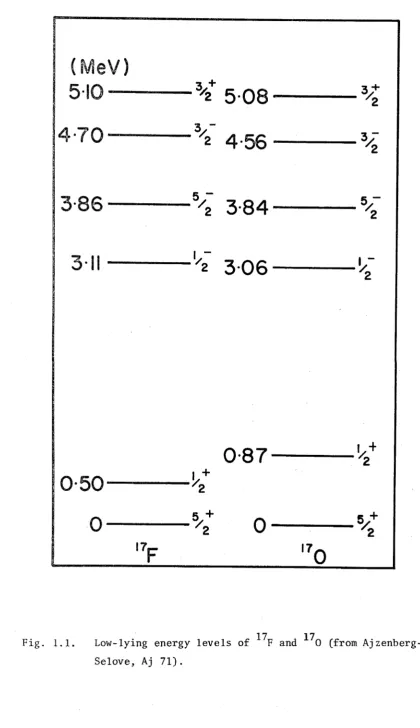
2
5
08
2
4-56
2
3
06
[image:13.543.56.477.73.802.2]2
an inert l50 doubly-magic core. The ground states both have J77 = 5/2+
as predicted by the simple model. The l/2+ and 3/2+ levels can be
attributed to the excitation of the odd nucleon from the ld^ 9 to the
2s^ 2 and l d ^ ^ orbits respectively. Their excitation energies yield
the magnitudes of the ld^ 2 - ^ 3/? splittings and the ld,_^9 -
separations for a single neutron and proton outside an 160 core. This
information is useful when using a more sophisticated model to consider
more than one particle in the 2s-ld shell, as will be shown in the next
section. The negative parity states can be thought of as arising from
collective excitation of the core (Bi 68) or excitation of a core nucleon
to the l d ^ ^ or ^si/2 orbits leaving a l p ^ ^ "bole" with particle-like
properties (So 66).
The possibility of core excitation in 170 or 17F demonstrates that the 160 core may not necessarily be completely inert. The
magnetic dipole moment of 170 is - 1.89 nm which is close to the value
-1.91 nm for a single neutron as predicted by the espm. However,
the electric quadrupole moment, instead of being negligibly small as expected for a single neutron and a spherical core, takes on the finite
value of -0.027 barns. This shows that even the doubly-magic 160 core
becomes non-spherical under the influence of a single extra-core nucleon. This will be discussed further in the next section.
In nuclei with more than one particle in the 2s-ld shell the espm fails to explain dynamical properties other than the ground-state
angular momenta. A more sophisticated model is needed which allows all
particles outside a closed shell to contribute to the nuclear properties and which includes the effects of residual particle-particle interactions.
1-1.2 Nuclei with several nucleons in the 2s-ld shell.
3
2 s - l d s h e l l i t i s n e c e s s a r y t o assume t h a t t h e n u c l e a r f i e l d e x p e r i e n c e d
by a p a r t i c l e i n t h e n u c l e u s c o n s i s t s o f t h r e e p a r t s , nam ely ,
The f i r s t te rm i s t h e c e n t r a l p o t e n t i a l , t h e seco n d r e p r e s e n t s t h e s p i n -
o r b i t i n t e r a c t i o n w h ile t h e t h i r d te r m d e s c r i b e s t h e r e s i d u a l i n t e r a c t i o n
o f t h e two-body t y p e among k p a r t i c l e s o u t s i d e a c l o s e d s h e l l .
The n u c l e a r wave f u n c t i o n s a r e t h e n w r i t t e n i n te r m s o f p r o d u c t s
o f t h e espm wave f u n c t i o n s f o r t h e k e x t r a - c o r e n u c l e o n s . The P a u l i
P r i n c i p l e demands t h e wave f u n c t i o n s t o be a n t i s y m m e t r i c on exchange
o f s p a c e or s p i n c o - o r d i n a t e s f o r any p a i r o f i d e n t i c a l n u c l e o n s . For
ex am p le, t h e p r o d u c t wave f u n c t i o n d e s c r i b i n g a s t a t e c o n s i s t i n g o f two
p a r t i c l e s (1) and (2) w ith e q u a l j i s
one can s e e t h a t a n t i s y m m e t r i c wave f u n c t i o n s e x i s t o n ly f o r even J ,
t h e t o t a l a n g u l a r momentum o f t h e n u c l e u s . F o r k p a r t i c l e s t h e wave
f u n c t i o n s can be r e p r e s e n t e d by S l a t e r d e t e r m i n a n t s c o r r e s p o n d i n g t o a
p a r t i c u l a r c o n f i g u r a t i o n , e . g . ,
Vk = V
CD
♦v
(r)Ci-l?
♦JVi k Crik)
1( 1 . 1) .
M ^ H C r p = u n ( r 1) u n ( r 2) y ( j jmM-m|JM)(|) (l)<|),M_m(2) ( 1 .2 )
m J J
where u ^ r ) and 4>j m a r e t h e r a d i a l and s p i n wave f u n c t i o n s r e s p e c t i v e l y .
From t h e symmetry p r o p e r t y o f t h e C le b sc h -G o rd a n c o e f f i c i e n t s ,
h (rd W
--- W
4
The possible degeneracy between different states \p of the k particles will be removed by the effect of the residual interaction Vik(rj k ) ‘ states ¥ of the nucleus produced by diagonalization
of the nuclear matrix elements of V.. (r.. ) are mixtures of the various configurations ifj. The residual interaction tends to couple the orbital and spin angular momenta together in an L-S coupling scheme while the spin-orbit interaction tends to result in jj coupling so that inclusion of both interactions may lead to wave functions intermediate between L-S and jj coupling. Generally, jj coupling predominates in heavy nuclei where the _£*s_ force becomes relatively stronger and is generally used in considering the 2s-ld shell.
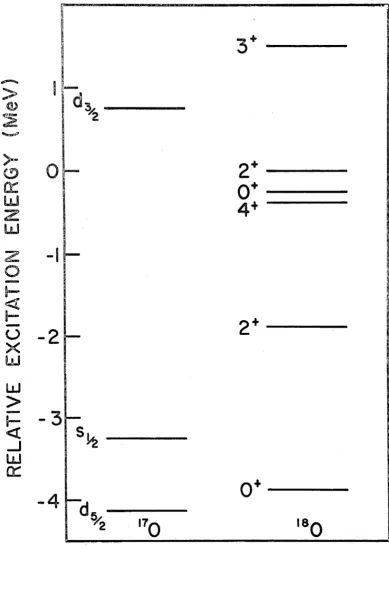
Consider now examples of such calculations on nuclei in the 2s-ld shell. Fig. 1.2 (Me 68) compares the low-lying experimental levels of 170 and 180. The zero of energy has been adjusted in each case so that the two sets of energy levels correspond. This was done by taking into account the contribution of the 150 ground-state binding energy and the single-particle energy to the ground state. The levels in 180 were computed by Pandya (Pa 63) from configuration mixtures of the ldr/0 and 2 s s t a t e s present in 170 from which the single-particle
information was obtained. These give rise to states with the following total isospin T and angular momentum J values:
Configuration 1 J
Cd5/2>2 1 0,2,4
('S l/2') 1 0
^d 5/2,Sl/2^ 1 2,3
R
E
L
A
T
IV
E
EX
CI
TAT
IO
N
ENER
GY
(M
e
V
)
17 18
[image:17.543.88.478.62.664.2]5
at 1.5 MeV relative excitation energy on the scale shown in fig. 1.2. In the limited configuration space assumed,eight two-body matrix
elements arise from which can be constructed three and four-body matrix elements for 190 and 20O.
Arima et al. fAr 68) have carried out similar calculations in terms of the (25^^, l d ^ ^ ^ configuration where n = 2-4 for the
isotopes 18»!9,20o^ 18, I9,20p an(j 2°Ne< The residual nucleon-nucleon interaction was parameterized in terms of the two-body matrix elements which were varied until a best fit to the experimental levels was
obtained. The resulting wave functions were used to compute static and
dynamic nuclear properties.
Wildenthal et al. (Wi 681 treat nuclei with 20^A^28
by the same procedure, allowing the particles outside the 160 core to
occupy and ^-s i/2 orbits. The l d ^ 2 orbit was excluded because of
the difficulty in handling the matrix elements. The upper region of the 2s-Id shell has been considered by Glaudemans et al. (G1 64) by
including configurations of particles in the 2 s ^ 2 and l d ^ 2 orbits outside an inert 28Si core in order to limit the complexity of the
calculations. Such a truncation of the configuration space gave rise
to discrepancies with observed moments and transition rates. Ern£
(Er 66) treated nuclei in the range 33S to ^ C a by assuming an inert
32S core. Goldstein and Talmi (Go 56) and Pandya (Pa 56) have derived
levels in 38C1 in terms of those of 40K by calculating a linear relationship between the energy levels of the two configurations
^ 3/2^ f7/2 and d3/2f7/2*
Wildenthal et al. (Wi 71) have also performed shell model calculations on the properties of positive parity states of nuclei
with A = 30 - 35 . For these calculations they have used configurations
(Is)4 ( l p ) ( l d r . ) (2s ) (Id . ) for which n > 10 and claim good
6
agreement between calculated energy levels and spectroscopic factors and
experimental data. These authors also claim satisfactory agreement with
many available data on electric quadrupole observables if effective
charges of 0.5e are added to the proton and neutron. Reference to this
work is made in chapter 4 with respect to 32S.
Shell model calculations have been carried out recently by de Voigt et al. (Vo 72) and Wildenthal and McGrory (Wi 72) for masses A = 27, 28 and 29 using the truncated ^ ^ ^ 2 ^ s l / 2 ^ 3 / 2 con^^-Sura't^on
space. De Voigt et al. calculated electromagnetic transition rates
and multipole moments, while Wildenthal and McGrory calculated energy levels, single-nucleon spectroscopic factors and electromagnetic
transition rates. The generally good agreement between the results and experimental data suggest that shell model techniques are capable of providing a comprehensive and quantitative explanation of nuclear
structure in this region of the 2s-ld shell. Further reference is made to these works in chapter 3 in connection with 27A1.
In general, however, although reasonable agreement can be achieved using the shell model between calculated and experimental energy levels for nuclei in the 2s-Id shell, the agreement between predicted and observed electromagnetic transition rates and multipole moments is often poor. This is usually because of the necessity to
limit the configuration spaces used in the calculations in order that they may be reasonably well handled when the number of active particles
becomes large. Whitehead (Wh 72) has attempted to get round this
problem by making use of the so-called Lanczos iterative procedure to diagonalize matrices that consider all possible particles in the
2s-ld shell. Such large scale shell model calculations give good
agreement with experiment for the case of low-lying levels in
that a simpler model which considers the collective motions of many
nucleons may be useful in treating nuclei well away from closed shells. 7
1-2 COLLECTIVE BEHAVIOUR IN THE 2s-Id SHELL
As mentioned previously, moving away from closed shells one
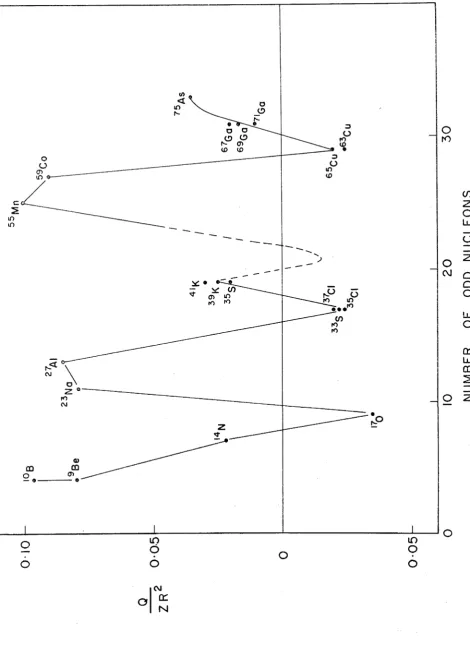
encounters deformations of nuclear shapes in the 2s-Id shell. This is
illustrated in fig. 1.3 which shows the trend of the observed (En 66)
ground-state quadrupole moments Q. These are given (Pr 62) in terms
of the intrinsic quadrupole moment Q as
p is the nuclear charge density and dV is the volume element. Eqn. 1.4
»2 ’2 * 2
demonstrates that a prolate deformation (z ^ x + y ) results in a
that of the ground-state quadrupole moments. The trend of the deformation
throughout the 2s-Id shell from spherical, through prolate, reaching a
maximum at A * 23, and oblate at A = 28 to spherical again was first
ascribed by Rainwater (Ra 50) to the polarizing effect of the
"outer" nucleons on the core. This tends to deform the core and was
later discussed by Mottelson (Mo 60) in terms of the long-range
component of the nucleon-nucleon force tending to align the extra-core
nucleons in opposition to the short-range component producing pairing
effects and tending to maintain a spherical shape. The systematic
o
0 (J + l) (2J + 3)
(1.4)
where K is the projection of J along the symmetry axis z ’,
positive value for Qq while an oblate deformation produces a negative
0
1
0
O r o
O
0J
o
o
o
CM
(T N
Fig. 1.3. Trend of observed ground-state quadrupole moments in light to medium weight nuclei (from Enge, En 66). The
2
scale factor 1/ZR takes into account the increasing size of the nuclei; Z is the nuclear charge and R is the average nuclear radius.
NUMB
ER
O
K
O
D
D
N
U
C
L
E
O
N
[image:21.543.48.519.27.683.2]8
variation of nuclear shape in the 2s-ld shell has also been discussed by Hirko (Hi 69, Hi 69a), Mermaz et al. (Me 69) and Nakai et al. (Na 70).
In these regions of large deformation it is to be expected that a model considering collective motions of many nucleons may be more successful in explaining observed nuclear properties than the spherical shell model with limited configuration spaces.
In even-even nuclei near closed shells or regions of sphericity, surface vibrational modes give rise to many of the low-lying levels.
Away from closed shells where nuclei possess permanent deformations rotational motions become important, producing smaller excitations than vibrational modes. This is especially true for large deformations where the moments of inertia become large.
An odd A nucleus can be described in terms of the collective model as either a single particle strongly coupled to a deformed core
(Nilsson model) where, in contrast to the shell model, both core and single particle can undergo excitations, or as a single particle weakly coupled to spherical core (weak coupling model).
1-2.1 Rotational behaviour
Bands of rotational energy levels in an even-even nucleus are produced by successive increments in its rotational angular momentum
while preserving the nuclear shape. Such levels belonging to a band
based on the ground state, have the following characteristics:
(1) the excitation energies are proportional to J(J+1)
(2) the spins and parities J71 have the sequence 0+, 2+ , 4+ ....
(3) enhanced E2 transition rates occur in gamma decay.
9
i n t h e 2 s - l d s h e l l , a s i n t h e c a s e o f 2l+Mg (Br 68) an d 20Ne (Ku 6 7 ) .
I n a n odd A d e f o r m e d n u c l e u s , t h e e x t r a p a r t i c l e moves i n t h e
d e f o r m e d p o t e n t i a l o f t h e c o r e whose r o t a t i o n s a r e s l o w c o mp a r e d t o t h e
p a r t i c l e m o t i o n . I f t h e n u c l e u s i s s t r o n g l y d e f o r m e d t h a n i t s r o t a t i o n a l
e x c i t a t i o n s w i l l b e s m a l l an d c a n b e r e g a r d e d a s p e r t u r b a t i o n s o f t h e
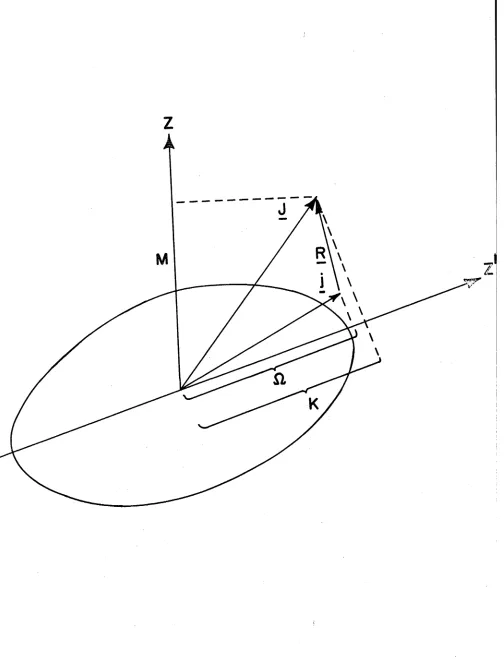
s i n g l e - p a r t i c l e s t a t e s . The a n g u l a r momentum c o u p l i n g scheme i s shown
i n f i g . 1 . 4 f o r a n u c l e o n w i t h t o t a l a n g u l a r momentum j_ c o u p l e d t o a n
e v e n - e v e n s p h e r o i d a l c o r e w i t h r o t a t i o n a l a n g u l a r momentum R_ and an
a x i s o f s ymme tr y z ' . J i s t h e t o t a l r e s u l t a n t a n g u l a r momentum an d
and K a r e t h e p r o j e c t i o n s o f j_ and J r e s p e c t i v e l y on t h e z ’ a x i s .
M i s t h e p r o j e c t i o n o f J on t h e s p a c e f i x e d a x i s z . R o t a t i o n a b o u t a
s y mme tr y a x i s i s m e a n i n g l e s s i n q u a n t u m m e c h a n i c s s i n c e i t c a n n o t b e
d e t e c t e d . Hence R i s p e r p e n d i c u l a r t o z ' and K = ft. The H a m i l t o n i a n
f o r t h e a b o v e s y s t e m c o n s i s t s o f t h r e e p a r t s :
H
r o t + T P + V ( r ) ( 1 . 5 )
w h e r e H _ i s t h e r o t a t i o n a l H a m i l t o n i a n , T i s t h e s i n g l e - p a r t i c l e
r o t p r
k i n e t i c e n e r g y an d V ( r ) i s t h e d e f o r m e d p o t e n t i a l e x p e r i e n c e d b y t h e
p a r t i c l e . The r o t a t i o n a l H a m i l t o n i a n i s
r o t 2<f> -
t V - i
2<}>2
(j - i ) (1.6)w h e r e <j? i s t h e moment o f i n e r t i a a b o u t t h e a x i s o f r o t a t i o n .
E x p a n d i n g H^o t g i v e s
H
r o t 2(J>
n
2 ( J 2 + j 2 . 2K2 - J +jJb
( 1 . 7 )w h e r e K = J ^ ' , J + = J x f + i J ^ ' and j + = j ^ ’ + i j y . ' .
z
Fig. 1.4. Schematic diagram showing the coupling of a particle
[image:24.543.39.544.58.725.2]10
(1.8)
where ( 1 .9 )
r e l a t e s t o t h e m o tio n o f t h e p a r t i c l e
and H
r p c (1.10)
i s a n a lo g o u s t o t h e c l a s s i c a l C o r i o l i s f o r c e , c o u p l i n g p a r t i c l e and
c o r e m o t i o n s . B ecause t h e o p e r a t o r s J+ h av e n o n - v a n i s h i n g m a t r i x
e l e m e n t s b e tw ee n s t a t e s w i t h K d i f f e r i n g by one u n i t t h e r p c te r m m ixes
r o t a t i o n a l b an d s o f d i f f e r e n t K. However, i n t h e l i m i t o f s t r o n g
c o u p l i n g t h e r p c te rm i s s m a ll and can b e t r e a t e d by p e r t u r b a t i o n t h e o r y
and K r e m a in s a good quantum number.
t h e s p h e r i c a l h a rm o n ic s u n d e r f i n i t e r o t a t i o n s . Thus t h e n u c l e a r wave
f u n c t i o n s w i l l have t h e form (Me 68)
where 0, and ip a r e t h e E u l e r a n g l e s s p e c i f y i n g t h e o r i e n t a t i o n o f t h e
p r i n c i p a l a x e s o f t h e d efo rm e d n u c l e u s and y ^ ( r ) i s t h e wave f u n c t i o n
d e s c r i b i n g t h e c o n f i g u r a t i o n o f t h e e x t r a p a r t i c l e r e l a t i v e t o t h e
p r i n c i p a l a x e s . The i n v a r i a n c e o f a s p h e r o i d a l s h ap e u n d e r r o t a t i o n
t h r o u g h 180° means t h a t e q n . 1.11 must be r e w r i t t e n as
The e i g e n f u n c t i o n s o f H a r e t h e D f u n c t i o n s which t r a n s f o r m
(1.11)
The e i g e n v a l u e s o f ( 1 .1 2 ) i n t h e l i m i t o f a t i g h t l y bound p a r t i c l e and
11
(1.13)
where a, the decoupling parameter, corresponds to a partial decoupling
of the particle motion from the rotator and is given by
J = K.
The assumption that the Coriolis mixing may be small
enough to be treated by perturbation theory breaks down in the 2s-Id
shell where the magnitude of the rpc term approaches that of the
separation of the intrinsic levels. Malik and Scholz (Ma 67) have
approached this problem by including the Coriolis term in the
Hamiltonian and diagonalizing it exactly. The y include in their calcula
tions mixtures of all six single-particle and single-hole bands in the
2s-ld shell and obtain good fits to low-lying energy levels.
deformed rotating core and, in a manner similar to eqn. 1.12 for an
odd A nucleus may be written
If the nucleus possesses axial symmetry then K = 0 because the rotation
R is about an axis perpendicular to the symmetry axis. The energy
eigenvalues of eqn. 1.15 are
a =
c-)* <xn = -V
2
It I
x q
= v2>
(1.14).J takes on the values in (1.13) of K, K+l, K+2 States with
energies Ej. form a rotational band with a first member having
The wave function for an even-even nucleus is that for the
j JMK> (1.15).
12
The g r o u n d - s t a t e r o t a t i o n a l band w i t h K = 0 w i l l have t h e f a m i l i a r l e v e l
scheme g i v e n by
c h 2 , rT . . ( 1 . 1 6 ' '
EJ = 2 j J ( J + 1 )
For K = 0 t h e wave f u n c t i o n (eqn. 1 .1 5 ) v a n i s h e s f o r J odd and h a s
p o s i t i v e p a r i t y f o r J e v e n . Thus t h e s p i n s and p a r i t i e s o f t h e g ro u n d
-+ 4* + “f*
s t a t e r o t a t i o n a l band h av e t h e s e q u e n c e J = 0 , 2 , 4 , 6 ... For
K f 0, c o r r e s p o n d i n g t o r o t a t i o n a l ban d s b u i l t on c o r e e x c i t e d s t a t e s , J may t a k e on a l l i n t e g e r v a l u e s .
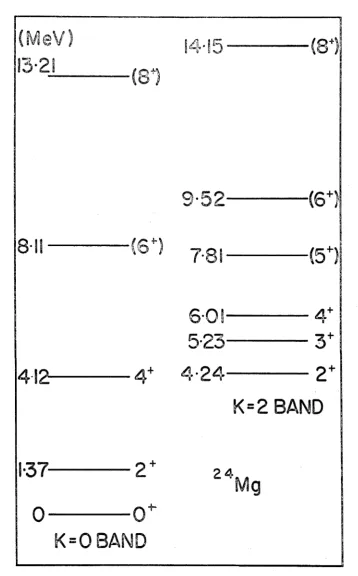
As an example o f p o s s i b l e r o t a t i o n a l b an d s i n e v e n - e v e n
n u c l e i i n t h e 2 s - I d s h e l l , f i g . 1 .5 shows t h e e n e r g y l e v e l s o f 24Mg and
f i g . 1 .6 shows p l o t s o f t h e e n e r g i e s o f s e l e c t e d l e v e l s a g a i n s t J ( J + 1 ) .
I t i s a p p a r e n t t h a t t h e r e i s s t r o n g e v i d e n c e f o r two r o t a t i o n a l bands
i n 24Mg b a s e d on K = 0 and K = 2. T h is n u c l e u s i s known t o be i n a
r e g i o n o f l a r g e p r o l a t e d e f o r m a t i o n from t h e s i g n s and m a g n itu d e s o f
q u a d r u p o le moments i n t h e A ~ 24 r e g i o n . F i t t i n g eqn. 1.16* t o e x p e r i
m e n tal e n e r g y l e v e l s y i e l d s t h e v a l u e o f <j>, t h e moment o f i n e r t i a .
For t h e c a s e o f 24Mg t h e moments o f i n e r t i a a r e found t o l i e c l o s e t o
t h o s e o f a r i g i d body. In h e a v i e r n u c l e i <|) i s fou n d t o be i n t e r m e d i a t e
i n v a l u e b e tw ee n t h a t o f a r i g i d body and t h a t f o r a d r o p o f
i r r o t a t i o n a l f l u i d .
The e l e c t r o m a g n e t i c p r o p e r t i e s p r e d i c t e d by t h e r o t a t i o n a l
model a r e a c r i t i c a l t e s t o f i t s v a l i d i t y and, i n p a r t i c u l a r , must be
a b l e t o a c c o u n t f o r t h e l a r g e E2 t r a n s i t i o n r a t e s s e e n i n e v e n - e v e n
n u c l e i . The t r a n s i t i o n r a t e T f o r gamma d eca y i s p r o p o r t i o n a l t o t h e
s q u a r e o f t h e m a t r i x e le m e n t b etw een t h e i n i t i a l and f i n a l s t a t e s
| j Mx> and IJ 2M2> anc* t *le mul t i P o l e o p e r a t o r Q ^ . The s u p e r s c r i p t
Fig. 1
(MeV)
14-15--- — (8+}j
13-21
—9-52
(6*J
8 II — ---
7-8
S---— m
6-0!
---
—
4 + ^
5-23---
— 3+
A
IO
A+
4-9/9 +
4
•nr £.*r
c.K=2 BAND
1-37—
--- 2 +
2 4 ft4Mg
0
—
---( T
K
=
0 BAND
.5. Rotational energy levels belonging to K = 0 and K = 2
24
[image:28.543.118.477.78.655.2]E
X
C
IT
A
T
IO
N
E
N
E
R
G
Y
(M
e
V
)
J
0
2
3
4
5
6
7
8
J(J+I)
[image:29.543.59.489.114.782.2]13
emitted photon has angular momentum L and projection m then conservation
of angular momentum requires £ L £ J , + J 7 and m = The
parity change is 7T~7T0 = (-)~\ The transition rate T can be expressed
in terms of the so-called reduced matrix element B (crL, J ^-+J9) given
(Pr 62) by
= C2J1+1)“1 i<J2M 2*Q Ln,lJ lM l> l2 (1.17) M 1M 2
Then
8tt(L+l) ; AE \ 2L+1
LM
L ( (2L+1) ! ! ) % i U c I
B(ctL) (1.18)
where AE = E^-E^, the energy change involved in the transition.
Transition rates are usually expressed in terms of the values,
in Weisskopf units (W.u.), established using the extreme single-particle
model and assuming an infinite square-well potential with a radius
R = r^A . These are given (En 66) for electric and magnetic transitions
as
-1
T (E, L) 4 . 4 (L+l)
L ((2L+1) ! ! y
Ev \2L+1
lL+3 197 1
d2l m 2l
R x 10 sec
(1.19)
T (M, L) 1.9 (L+l) j 3
L((2L+1)!!)2 iL+3
i-M
l 197 i
2 L+l
d2L-2 in21 -1
R x 10 sec
The within-band E2 transition rates are found to be simply related by
Clebsch-Gordan vector addition coefficients because the intrinsic
nuclear structure is the same for all members of a rotational band.
The cross-band transition rates are similarly related as they involve
14
expressed as follows (for within-band transitions)
B(E2,J-hJ\K+K) = 1I7 e2Q^|(j2 K0|j'K) |2 (1.20)
where Qq , the intrinsic quadrupole moment, is defined in eqn. 1.4. Eqn. 1.20 shows that, for nuclei in regions of large deformation in the 2s-ld shell, within-band E2 transition rates will be considerably
enhanced over the single-particle estimate. Cross-band transitions
involve a change in the intrinsic structure of the nucleus and will be characteristically of the order of one single-particle unit.
Cross-band transitions are governed by the so-called K selection rule, i.e.,
L * IKf - K| = AK
This rule may be understood by considering transitions between a K = 2
and K = 0 band. At least two units of angular momentum are involved in
such a transition in order to change the intrinsic nuclear structure. Thus, even if the spins of the initial and final states only differ by 0 or 1 the transition cannot occur by dipole radiation.
1-2.2 Nilsson states
The Nilsson model is analogous to the spherical shell model but assumes an axially symmetric deformed potential in which single
particle states are filled. Such a description has been successful
for many odd A nuclei in the 2s-ld shell.
15
H .. = H + C£«s + D £ 2 (1.24)
nil o --- '
where H is the harmonic oscillator Hamiltonian o
H = + V^m(o)2x 2 + w 2y 2 + w 2z2) ,
C£-s is the spin-orbit interaction term and D£2 is a term producing a potential intermediate between that of a square well and and a harmonic oscillator. In the case of axial symmetry
ü) 2 = co 2 (1 + 2/j6) = a) 2, a) 2 = a) 2 (1 - ^6) (1.25)
x o y z o 0
where w
o m°(1 - 4/362 - i^ « 3)’ 76 (1-26),
5 is a deformation parameter (approximately equal to ~ , R and K
R + AR being the minor and major axes of an ellipsoid), and co° = a) (6 = 0).
o o
The approach adopted by Nilsson (Ni 55) was to diagonalize the matrix whose elements are
nm \)j H .n nil m dr (1.27)
16
labelled by |N£AE>. The new states were labelled by the triad |Nn A>
where N and A are as above and n v is the oscillator number corresponding
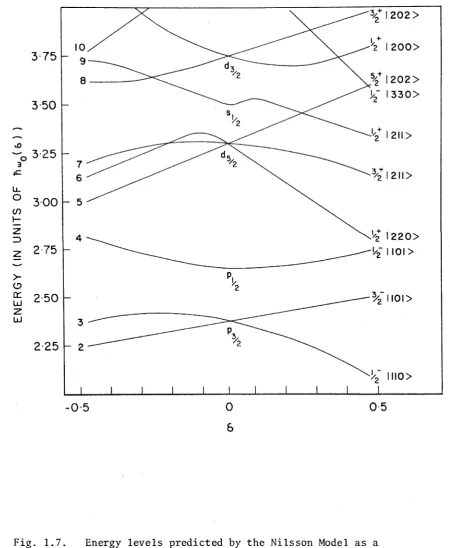
to the number of nodes along the axis of symmetry. Fig. 1.7 shows
Nilsson single-particle levels plotted against the deformation parameter
6. Each level is labelled by K^, |NnvA> and a Nilsson orbit number.
The Nilsson model has been successfully applied to odd A
19 31
nuclei throughout the region of large deformation from F to P.
The general applicability of the model in the 2s-ld shell has been
discussed by Bhatt (Bh 62). As illustrative examples, Pilt (Pi 72)
77 _ . 2 1
has reported experimental evidence for a K = 1/2 band in Ne based
on a lp^/2 Nilsson orbit number 4; Poletti et al. (Po 69)
and Maier et al. (Ma 70) discuss experimental results in terms of rotational levels in 2^Na, i.e., a K = 1/2 band based on Nilsson
orbit nine and a = 3/2+ band based on Nilsson orbit seven. However,
the agreement between experimental and theoretical electromagnetic properties is only fair.
The Nilsson model provides a good description of properties
25 25
of excited states in the mirror nuclei Mg and Al. Kean and
Ollerhead (Ke 72) show that while the known properties of the ground- state and K^ = l/2+ band in 2SMg are in good agreement with the
IT +
rotational model, poorer agreement is achieved for higher K = 1/2 and 1/2" bands whose cross-band transitions appear to violate the K
selection rule. Al is difficult to describe in terms of a simple
model but much of the available data suggests that the level scheme
of Al may be interpreted in terms of the Nilsson model assuming a
E
N
E
R
G
Y
(I
N
U
N
IT
S
O
F
'2 I 2 0 0 >
k~ I 3 3 0 >
3
25
u r 1 1 0 1 >
y2 1101 >
-
0-5
0
0 5
&
Fig. 1.7. E n e r g y levels p r e d i c t e d b y t h e N i l s s o n M o d e l as a
[image:34.543.56.507.197.746.2]17
1-2.5 Vibrational behaviour
As mentioned previously, nuclei lying between regions of large deformation and closed shells can be expected to exhibit low- lying levels arising from vibrations of the equilibrium shape. Evidence for such behaviour is found in the region around A ~ 32 of the 2s-Id shell.
The vibrational model likens the nucleus to a drop of incompressible liquid whose surface can be described by
R = Ro (l +
I
a Y^(e ,<)>)) (1.21)Ay
The are spherical harmonics and Ay represent the collective degrees
of freedom. The Hamiltonian of vibrations about this nuclear surface
is
Hvib
(
1.
22)
B plays the part of the moment of inertia with respect to a change
in deformation while represents the degree of resistance to
deformation. The phonons have angular momentum A with component y
along some space fixed axis, parity (-)^ and frequency w =
A
The energy eigenvalues of are the harmonic oscillator energies
E = E + y (n + l/2)fiaK , where n is the number of phonons in
o , Ay A Ay
Ay
the Ay mode of vibration. Dipole (A = 1) vibrations are not likely
to occur because they would involve a displacement of the centre of gravity which would only happen under the action of external forces. The lowest mode of vibration is normally quadrupole (A = 2), thus the
7T +
first excited states of vibrational nuclei are expected to have J = 2 .
18
F ig . 1 .8 shows t h e p r e d i c t e d e n e r g y l e v e l d ia g ra m o f e v e n - e v e n n u c l e i
l i k e l y t o d i s p l a y v i b r a t i o n a l b e h a v i o u r . Two q u a d r u p o le p h o n o n s,
f o r i n s t a n c e , may c o u p l e t o g i v e l e v e l s w ith J = 0 , 2 , and 4 .
The c e n t r e o f g r a v i t y o f t h i s t r i p l e t would be a t an e n e r g y a p p r o x i m a t e l y
t w i c e t h a t o f t h e one-phonon 2+ s t a t e . T h i s k in d o f b e h a v i o u r has
been seen i n many e v e n - e v e n n u c l e i (Ei 6 4 ) .
In t h e 2 s - l d s h e l l r o t a t i o n a l and v i b r a t i o n a l e x c i t a t i o n s
a r e e x p e c te d t o be o f s i m i l a r m a g n itu d e b e c a u s e t h e s m a ll moments o f
i n e r t i a i n c r e a s e t h e r o t a t i o n a l l e v e l s e p a r a t i o n ( s e e eq n . 1 . 1 7 ) .
Thus r o t a t i o n - v i b r a t i o n c o u p l i n g can le a d t o band m ix in g and r o t a t i o n a l
ban d s b a sed on v i b r a t i o n a l s t a t e s w i l l be a p p r e c i a b l y d i f f e r e n t from
t h o s e o f t h e sy m m etric r o t a t o r .
Enhanced e l e c t r i c t r a n s i t i o n r a t e s a r e e x p e c te d t o o c c u r i n
v i b r a t i o n a l n u c l e i s i n c e t h e whole n u c l e a r c h a r g e i s i n v o l v e d i n t h e
E
v i b r a t i o n . The e l e c t r i c m u l t i p o l e o p e r a t o r Q can a n n i h i l a t e one
phonon o f o r d e r Thus t h e 2+ member o f t h e tw o - q u a d r u p o le phonon
+ + “4“
t r i p l e t w i t h J = 0 , 2 , and 4 would be e x p e c te d t o d e c a y s t r o n g l y
t o t h e o n e - q u a d r u p o l e phonon 2+ s t a t e r a t h e r t h a n t o t h e g round z e r o -
phonon s t a t e d i r e c t l y . The r a t i o o f B(E2) v a l u e s f o r t h e t r a n s i t i o n s
betw een t h e seco n d 2+ s t a t e (2*) and f i r s t 2+ s t a t e (2*) and betw een
t h e f i r s t 2+ and ground s t a t e s i s g iv e n by
B(E2: 2* + 2*)
--- --- — = 2 ( 1 . 2 3 ) . B(E2: 2* -* 0+)
The t r a n s i t i o n (2* -> 0+) i s u s u a l l y s t r o n g l y enhanced o v e r t h e s i n g l e
p a r t i c l e e s t i m a t e .
32
C h a p t e r 4 d i s c u s s e s t h e p r o p e r t i e s o f S and d e m o n s t r a t e s
0 ,2 ,3 ,4 ,6 V : - ' :
__________________________ .
3 -PHONON
,0,2,3
4 ,6 *
(X = 4 )
HEXADECAPOLE
(X =3)
OCTUPOLE
4 +
„ --- 4
0 , 2 , 4 +
--- 2 *
--- «---
q
+
2 -PHONON
I -PHONON
0 +
ZERO PHONON
0 +PURE
QUADRUPOLE
VIBRATIONAL
VIBRATIONAL
STATES IN
REAL NUCLEI
HIGHER ORDER
VIBRATIONS
[image:37.543.85.509.209.762.2]19
1 - 2 . 4 Weak and i n t e r m e d i a t e c o u p l i n g
As m e n tio n e d a t t h e b e g i n n i n g o f t h i s s e c t i o n , n u c l e i p o s s e s s i n g
s m a ll d e f o r m a t i o n s can be r e g a r d e d as a s i n g l e p a r t i c l e w eak ly c o u p l e d t o
an e v e n - e v e n c o r e whose c o l l e c t i v e e x c i t a t i o n s a r e p r e d o m i n a n t l y
v i b r a t i o n a l . The H a m i lto n i a n o f s u ch a s y stem i s
H H
c i n t ( 1 .2 8 )
where Hc i s t h e H a m i lto n i a n f o r t h e v i b r a t i n g c o r e , H^ i s t h e s p h e r i c a l
s h e l l model s i n g l e - p a r t i c l e H a m i lto n i a n and H^ r e p r e s e n t s t h e
p a r t i c l e - c o r e i n t e r a c t i o n . N e g l e c t i n g p a r t i c l e - s u r f a c e i n t e r a c t i o n s
e n a b l e s t h e n u c l e a r wave f u n c t i o n t o be w r i t t e n as a p r o d u c t o f
s i n g l e - p a r t i c l e and v i b r a t i n g c o r e wave f u n c t i o n s .
In t h e weak c o u p l i n g model l e v e l s a r e c o n s t r u c t e d i n an
odd A n u c l e u s e i t h e r by e x c i t i n g t h e odd n u c l e o n t o h i g h e r s i n g l e
p a r t i c l e s t a t e s o r by e x c i t i n g t h e c o r e . The l a t t e r k i n d w i l l i n c l u d e
a l o w - l y i n g m u l t i p l e t w i t h a n g u l a r momentum J g iv e n by | j — 2 1 $ J £ j+ 2
a r i s i n g from q u a d r u p o le c o r e v i b r a t i o n s . A tte m p ts have b een made t o
a p p l y t h e weak c o u p l i n g model t o t h e A ~ 28 r e g i o n o f t h e 2 s - I d s h e l l
where t h e c o r e d e f o r m a t i o n s a r e known t o p a s s from p r o l a t e t o o b l a t e . 27
Thankappan (Th 66) h as d i s c u s s e d A1 i n te r m s o f a d ^ . ^ p r o t o n h o l e 28
w eakly c o u p le d t o a S i c o r e . Good a g r e e m e n t i s o b t a i n e d b etw een
c a l c u l a t e d and e x p e r i m e n t a l E2 t r a n s i t i o n p r o b a b i l i t i e s b u t t h e t r e a t
ment i s l e s s s u c c e s s f u l f o r Ml t r a n s i t i o n r a t e s .
In t h e u p p e r r e g i o n o f t h e 2 s - l d s h e l l t h e p a r t i c l e - c o r e
c o u p l i n g s t r e n g t h may be i n t e r m e d i a t e b etw een t h o s e assumed i n t h e weak
c o u p l i n g and N i l s s o n model p i c t u r e s . T h i s o c c u r s when t h e s e p a r a t i o n s
o f t h e e x c i t e d c o r e and s i n g l e - p a r t i c l e l e v e l s a r e o f s i m i l a r m a g n itu d e s .
20
core-vibrational states and a diagonalization procedure is required. Such a procedure has been carried out by Caste1 and Stewart (Ca 70)
29 31 35
for “ Si, "P and Cl with moderate success, and by Castel et al. 52
(Ca 71) for “S in which vibrational modes are coupled to one particle-one hole and two particle-two hole states. This is discussed further in Chapter 4.
1-3 OTHER MODELS APPLIED TO THE 2s-ld SHELL
1-3.1 The Davydov-Filippov model
In the rotational models described in section 1-2 it was universally assumed that the even-even nuclear core possessed axial symmetry. In the Davydov-Filippov model this assumption is relaxed and a Hamiltonian is used (Da 58) with three unequal moments of inertia with respect to the three space- fixed axes. The Hamiltonian for an asymmetric rotator may be written (Ro 67).
3 ti2J 2
l
—A=1 2<j)^
3 Ajf
I
_A---A=1 2sin2 (y - ^ - )
(1.29)
21
two for J = 5, etc. In particular, it should be noted that this model,
like the vibrational model, predicts two low-lying 2+ levels in an even-even nucleus. Thibaud et al. (Th 69) have applied the model in preference to the vibrational model to describe the level scheme of
(see chapter 4) .
1-3.2 The Hartree-Fock method
The Hartree-Fock method is a variational technique in which the nuclear ground-state wave function is described as a determinant of single-particle wave functions computed in a self-consistent
potential. The derivation of such a potential is performed in a manner
analogous to the Hartree method for computing atomic fields; a given
particle is assumed to move in the average spherically symmetric field
arising from all the other particles in the system. In the case of
a nucleus these could be all the nucleons or just those outside a
supposedly inert core. The ground-state wave function is expressed as
a superposition of basis states |a>
|1> =
l Xjcc>
( 1 . 3 0 )a
where the superposition coefficients are normalised to unity and are able to be varied to achieve a minimum in the expectation value E of
the many-body Hamiltonian. This gives rise to a determinant of
Hartree-Fock states |l>.
Such calculations were first carried out in the 2s-ld shell by Kelson (Ke 63) who considered axially symmetric solutions for nucleons
outside an inert spherical closed (ls-lp) shell. Maintaining j ’ as
2 2.
the sense that all nucleons were included in the calculations. Their
results produced solutions (prolate, oblate and spherical) for each of
12 28 32
the three closed subshell nuclei C, Si and S. The minimum-energy
12 28
solutions corresponded to oblate shapes for C and Si but prolate
3?
for S. Banerjee et al. (Ba 69) have performed Hartree-Fock calcula
tions which predict the following shapes for nuclei in the 2s-ld shell:
2o 24
Ne (prolate spheroid), Mg(triaxial ellipsoid), “ Si(oblate spheroid),
32 36
S(triaxial ellipsoid) and Ar(prolate spheroid). The Hartree-Fock
12
calculations of Zofka and Ripka (Zo 71) on N = Z nuclei between C
40 20 24 36
and ' Ca favour deformed solutions for Ne, Mg and Ar but spherical
- 1 2 r 28c . , 32c
ones for C, Si and S.
1-4 SUMMARY
Because of the many-body nature of the nuclear system, it is necessary to resort to models of the nucleus in order to be able to establish a quantitative explanation of the available experimental
data and predict properties yet to be measured. Several such models
have been briefly described in this chapter, together with the degrees of success achieved in their application to nuclei in the 2s-ld shell.
The shell model is naturally most successful in considering a few particles outside spherical closed ^ 0 or ^ C a shells, but modern computing techniques have enabled sufficient numbers of active particles to be considered that shell model calculations have been successfully applied throughout the 2s-ld shell, particularly by B.H.
Wildenthal and his collaborators. Indeed, many of the collective
properties described by the rotational and vibrational models have been reproduced by these calculations.
25
o f l a r g e p e rm a n e n t d e f o r m a t i o n , w h i l e t h e v i b r a t i o n a l model i s most
r e l e v a n t t o s p h e r i c a l n u c l e i . In t r a n s i t i o n r e g i o n s o f n u c l e a r s h a p e ,
n u c l e a r p r o p e r t i e s may be s u c c e s s f u l l y d e s c r i b e d i n te rm s o f r o t a t i o n -
v i b r a t i o n c o u p l i n g . The weak c o u p l i n g model may be a p p l i e d t o ev en -o d d
n u c l e i w ith a s p h e r i c a l e v e n - e v e n n e i g h b o u r . In t h i s r e g a r d , H a r t r e e -
Fock c a l c u l a t i o n s have b een v e r y u s e f u l i n u n d e r s t a n d i n g t h e t r e n d
o f n u c l e a r s h a p e s t h r o u g h o u t t h e 2 s - l d s h e l l .
C h a p t e r s 3 and 4 d e s c r i b e e x p e r i m e n t s t o m e asu re p r o p e r t i e s
27 32
o f A1 and S and t h e i n t e r p r e t a t i o n o f t h e r e s u l t s i n te rm s o f t h e
24
CHAPTER 2 .
EXPERIMENTAL TECHNIQUES
This chapter contains brief descriptions of the techniques used in experiments discussed in chapters 3 and 4, together with
some appropriate theoretical background.
2-1 DOPPLER SHIFT ATTENUATION METHOD (DSAM) FOR NUCLEAR LIFETIME
DETERMINATION
2-1.1 Introduction
It can be shown that, if a source of gamma rays is moving with velocity v, the gamma rays will be observed to have the energy
E(6) = Eq (1 + £ cose), £ « 1 (2.1)
where 0 is the angle between the source velocity and the direction of
gamma-ray emission and Eq is the (unshifted) energy of the gamma ray as
seen by a detector at rest relative to the source. If the source of
radiation is travelling in a medium, it will be slowed down by collisions within the medium and the Doppler shift will become dependent on time,
since the instantaneous velocity is time dependent. Hence
E (0,t) = Eo (l + cos0) (2.2)
where v(t) is the velocity of the source at the time of gamma-ray emission.
25
to a state with lifetime x following a nuclear reaction. At t = 0 the recoil velocity is v(0). If x is much less than the time taken for the recoiling ion to be stopped in the medium, gamma decay will occur before the nucleus has had a chance to slow down and the full Doppler shift will be observed. If, however, x is much greater than the slowing down time, gamma decay will occur after the nucleus has stopped and a zero Doppler shift will be observed. For nuclear lifetimes between these two extremes, the Doppler shift will be attenuated by a factor F(x) ranging in value between zero and unity.
The probability p(t) for decay of the nucleus at time t is
1 — —
P(t)
= -e T, at which time the velocity is v(t). The mean energy of gamma rays emitted by many such nuclei is<E(0)>
E(0,t)dt
dt
= E (1 + cose F(x))
o c
where
F(x)
(2.3)
(2.4)
(2.5).
26
F(t) =
\
(2.5').The basis of the DSAM is, therefore, to determine nuclear lifetimes
through a measurement of F (t). Eqn. 2.5 demonstrates that the solution
of this problem requires a knowledge of the processes involved in the
slowing down of heavy ions in a medium; these are collisions between
the moving ion and atoms in the stopping medium (unfortunately termed nuclear stopping) and collisions between the moving ion and atomic
electrons in the stopping medium (electronic stopping). These two
mechanisms are, for certain ranges of energy, both significant con tributors to the slowing down process and are described in more detail in the following sections.
2-1.2 Electronic stopping
If an atom enters a stopping medium at velocities much greater than the orbital velocities of its electrons, these will be quickly stripped off and the bare nucleus will proceed through the medium. Slowing down will then occur by collisions with the atomic electrons
of the stopping medium. Because the nuclear mass is very much greater
than the electronic mass, there will be very little change in the
direction of motion. Energy will be transferred to the electrons in
the form of excitation to higher energy states or ejection out of the
atomic orbitals leaving an ionised atom. Simple arguments can show
that the stopping power due to such a mechanism has the form
dE
dX 2 (2.6)
m v e
where is the atomic number of the incoming ion, m g and e are the
27
volume in the stopping medium. The dimensionless constant B contains
the more complicated dependence on Z , m and v and is usually a slowly
varying logarithmic expression; Bohr (Bo 13), Bethe (Be 30) and
Bloch (B1 33) have calculated slightly differing forms for B using
different starting points and assumptions.
When the nucleus has slowed to a velocity comparable to the 2
0
highest electron orbital velocity (v « — Z^), the probability for
electron capture becomes finite. As the moving ion further slows
down, the processes of electron loss and capture will continuously
occur with the probability of electron loss decreasing and the
probability of electron capture increasing as the ion velocity decreases
to match those of successive electron orbitals.
The theoretical treatment of the electronic stopping mechanisms
is complicated and has been described by Lindhard et al. in a series of
papers (Li 53, 54, 61, 63 and 68) and Blaugrund (Bl 66). To make the
formulae less cumbersome, they introduce the following dimensionless
variables which, ignoring the proportionality constants, have the
following correspondence:
t(time) = 0
E(energy) = e
x (length) = p
m(mass) = ff[ .
Using the Thomas-Fermi model for the atom, they found that, in the
e
2
^velocity range v £ v^ ~ , the electronic stopping power is
proportional to velocity and is given by