© 2017, IRJET | Impact Factor value: 5.181 | ISO 9001:2008 Certified Journal | Page 2307
Effect of Fertilizers on Soil Strength
Varsha C Paul
1, Jiss K Abraham
21
M.tech, Geomechanics and Structures, Department of Civil Engineering, Saintgits College of Engineering,
Kottayam, Kerala, India.
2
Assistant Professor, Department of Civil Engineering, Saintgits College of Engineering, Kottayam, Kerala, India
---***---Abstract -
Due to high population growth the naturalresources are reducing and it reflects in the availability of land for the construction. In this situation most of the cultivation lands were converting in to construction sites. In the case of cultivation land once cultivated large scale and for that the chemical fertilizers, mostly NPK fertilizers were widely used. Later construction was done in this chemical mixed soil. NPK fertilizer applied to the soil to increase crop yield modifies the soil properties. This modified soil behaves differently from the parent soil. So it is becomes necessary to study the chemically treated soil to understand how NPK fertilizer affects the engineering properties of soil. So it is necessary to check the chemical content in soil and how it affects the geotechnical parameters of soil. In consequence of the effects of synthetic fertilizer on the physical properties of soil, this paper appraises the geotechnical properties of clay modified with NPK fertilizer and also the three main chemicals present in fertilizer (Nitrogen, Phosphorus and Potassium) separately. Analysis of test results showed that the chemical content influence the liquid limit, plastic limit and shear strength of the clay.
Key Words: Nitrogen, NPK fertilizer, Phosphorus,
Potassium, Shear strength1. INTRODUCTION
Due to high population growth the natural resources are reducing and it reflects in the availability of land for the construction. In this situation most of the cultivation land was converting in to construction sites. In the case of cultivation land once cultivated large scale and for that the chemical fertilizers, mostly NPK fertilizers were widely used. Later construction was done in this chemical mixed soil. When we apply the chemical fertilizer in field it increases the crop production and also alters the soil properties. This chemical mixed soil will behave differently from the natural soil. So it became necessary to study on the nature of this chemical mixed soil and how it affects the geotechnical properties of soil such as physical and engineering properties of soil. This study appraises the geotechnical properties of soil treated with NPK fertilizer and also with the major chemicals present in the fertilizer (Nitrogen, Phosphorus, and Potassium).
Ezeokonkwo conducted laboratory test on soil treated with NPK 20-10-5fertilizer at various percentage. The study
shows that the addition of synthetic fertilizer reduces the shear strength and permeability of soil [3]. Prakash et al made study on shear strength of acid and base treated soil. The result showed that the addition of acid decreases the strength of soil whereas the base increases the strength [9]. Dr. Vinod Dubey, Dr. A. K. Patel conducted a study in M.P on which how the Continues use of fertilizer effect the crop yield and soil properties. It was found that over use of fertilizer affect the plant strength and soil balance. The phosphorous is immobile in soil and nitrogen converts into nitrates. The potassium remains in the soil in large quantity because the crops absorbed fewer amounts [10].
For this study the sample was collected from Kuttanad region in Kerala. It’s an agricultural land in Kerala which situates below the sea level and shows problematic soil. This is perhaps the only region in the world where farming is done 1.5 to 2 m below sea level. Kuttanad is known as the rice bowl of Kerala was the cultivation done in large scale using the chemical fertilizers. For long years the cultivation using chemical fertilizer leads in the increase of chemical content in soil for a large scale. The increase in population and the development of this area has demanded construction activities. The soil in this region is black or grey marine clay
The chemical use alters the natural properties of soil. It reduces the plant reproduction capacity and increase the alkanity of soil. The engineering properties of soils modified with chemical fertilizer are lacking especially on the shear strength, compaction, and consolidation characteristics. In proffering geotechnical solutions in chemical fertilizer modified soils, the engineer must have adequate information on the engineering properties of such soils.
This study aims at studying strength variation in soil on the application of chemical fertilizer and also to check which chemical in the fertilizer shows the maximum strength change.
2. MATERIALS
2.1 Soil
© 2017, IRJET | Impact Factor value: 5.181 | ISO 9001:2008 Certified Journal | Page 2308
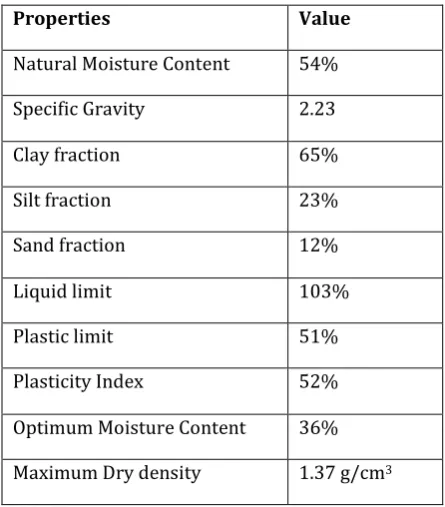
were conducted on this soil to check the Engineering and [image:2.595.50.273.179.433.2]physical properties of the sample. The sample was divided in to three groups and the initial tests were conducted and the average value was taken. The test details are given in table 1.
Table -1: Natural Properties of clay
Properties Value
Natural Moisture Content 54%
Specific Gravity 2.23
Clay fraction 65%
Silt fraction 23%
Sand fraction 12%
Liquid limit 103%
Plastic limit 51%
Plasticity Index 52%
Optimum Moisture Content 36%
Maximum Dry density 1.37 g/cm3
2.2 Nitrogen
For the test purposes Ammonia was used. It contains 82% of nitrogen. The liquid nitrogen should be kept at low temperature. It should be kept at vacuum flasks and should be transported without much evaporative loss. So for the convenience ammonia was used. Ammonia was added in different percentage namely 1%, 2%, 4%, and 8% by weight.
2.3 Phosphorous
For the test sodium phosphate was used because of the highly explosive nature of phosphorus. It contains 75% of phosphorus. It was added in different percentage namely 1%, 2%, 4%, and 8% by weight.
2.4 Potassium
For the test potassium chloride was used because of its highly reactive nature, elemental potassium must be handled with extreme care. It contains 85% of potassium. It was added in different percentage namely 1%, 2%, 4%, and 8% by weight.
2.5 Fertilizer
For the test Ammonium phosphate was used. It is a 20-20-13 fertilizer. It was added in different percentage namely 5%, 10%, 15%, and 20% by weight.
3. EXPERIMENTAL PROGRAM
15 soil samples were collected from various paddy fields of Kuttanad to test the NPK values present in the soil. The tests were conducted at Agricultural University, Mannuthy, Thrissur. The average amounts of chemicals from 15 soil samples are shown in table 2. These results were used to fix the percentage of chemicals that should be added in the clay.
The experimental study involves Atterberg’s limit and Triaxial with varying percentage of fertilizer namely 5%, 10%, 15%, and 20% and also for chemicals of varying percentage of 1%, 2%, 4%, and 8%.
Table -2: Chemicals Present in Soil
Properties Value
pH 4.7
Organic Carbon 1.18%
Phosphorus 1.04x10⁻⁴ g/cc Potassium 1.5x10⁻⁴ g/cc
Nitrogen 0.45%
3.1
Atterberg’s Limits Test
Consistency test was performed on the clay sample contain different percentage of fertilizer and chemicals. From this test the consistency characteristics of the samples were studied. The consistency test was conducted as per IS: 2720 (part 5) – 1985. The test results were shown in chart 1, chart 2, chart 3, chart 4, chart 5 and chart 6.
[image:2.595.319.549.471.613.2]© 2017, IRJET | Impact Factor value: 5.181 | ISO 9001:2008 Certified Journal | Page 2309
Chart -2: Plastic limit (PL) results for chemicals added inclay
Chart -3: Plasticity Index (PI) results for chemicals added in clay
Chart -4: Liquid limit (LL) results for fertilizer added in clay
Chart -5: Plastic limit (PL) results for fertilizer added in clay
Chart -6: Plasticity Index (PI) results for fertilizer added in clay
3.2 Triaxial Test
© 2017, IRJET | Impact Factor value: 5.181 | ISO 9001:2008 Certified Journal | Page 2310
Chart -7: Cohesion (C) value for chemicals added in clayChart -8: Angle of internal friction (φ) value for chemicals added in clay
Chart -9: Cohesion (C) value for fertilizer added in clay
Chart -10: Angle of internal friction (φ) value for fertilizer added in clay
4. EXPERIMENTAL PROGRAM
From the test results almost all values including liquid limit, plastic limit, plasticity index, cohesion and angle of internal friction are reducing and the settlement of soil increasing. This shows the indication of weakening of the soil under the usage of fertilizer. The use of fertilizer accelerates the crop production but it alters the soil geotechnical properties and reduces the strength. Under the treatment of fertilizer the maximum percentage of fertilizer added was 20%. For this percentage from the initial value of soil the liquid limit was reduced to 30% and the plastic limit and plasticity index were reduced to 18% and 12% respectively. In the case of angle of internal friction at first the value was increased and the decreased. For maximum percentage of fertilizer the value reduced to 2 degrees. The cohesion reduced to 0.6 kg/cm2.
There are mainly three chemicals in fertilizer namely Nitrogen, Phosphorous and Potassium. So the reduction in the values may due to these chemicals. From the results the Phosphorous and Nitrogen have not much reduction in results.
It may due to when the fertilizer added to soil the moisture contain in the soil melts the fertilizer and breakdown it. The phosphorous react with the chemicals present in soil such as calcium, iron, etc... And make the compounds. Only a small percentage will react with soil particles. In this it reacts with fine particles more than the coarse particles. It breaks down the soil particles and reduces the bond between the soil particles.
© 2017, IRJET | Impact Factor value: 5.181 | ISO 9001:2008 Certified Journal | Page 2311
When it comes to the case of Potassium, plant not absorbsmuch potassium from the soil. So a major amount that applied through the fertilizer will remain in the soil itself. When it comes contact with water it gets oxides and attaches on the soil particles and forms a outer layer on the soil particles. So this reduces the water absorption of the soil and also reduces the cohesion between the soil particles. This results in the reduction in the soil strength. From the three chemicals Potassium will remain more in the soil than the others. So the strength reduction due to the use of fertilizer can be say that it is the reduction due the potassium content in the fertilizer. Accumulation of these chemicals for many years may cause large reduction in the soil strength which should be checked before the construction on the fields.
5. CONCLUSIONS
From the study it was found that the addition of fertilizer to soil affects the Atterberg’s limits properties of the soil. It reduces the liquid limit and the plastic limit of soil. The soil gets saturated within small amount of water. From the liquid limit value 20% of fertilizer was added it shows a 30% reduction in L.L and also the variation shows by Nitrogen, Phosphorous and Potassium for the addition of 8% are 64%, 28% and 60% respectively. In the case of plastic limit 20% of fertilizer was added it shows an 18% reduction in P.L and also the variation shows by Nitrogen, Phosphorous and Potassium for the addition of 8% are 22%, 6% and 24% respectively.
The increase in fertilizer also reduces the cohesion and angle of internal friction between the soil particles. It indicates in the reduction in the soil strength. From the cohesion value the Potassium shows a great variation of 49%. The less variation shown by Nitrogen 27%. In the case of angle of internal friction for Nitrogen initially the value was increased and then it reduced. For other chemicals the value gets reduced.
From the three major chemicals in fertilizer potassium shows much variation in test results. The potassium in soil reacts with water and gets oxides. This potassium oxide attaches on the surface of clay particles. This may reduce the surface area of clay particles to absorb the water. When the potassium oxide attach on the clay particles it may also reduce the cohesion between the particles. The nitrogen and phosphorous show less variation. When Nitrogen added to soil it converts in to nitrates. This nitrate is highly soluble in water and leaches in to ground water.
REFERENCES
[1] Anderson, D and Brown, K. W, “Effect of Organic Fluids on the Productivity of Clay Spoil Land”, Report on FAO/Sida Consultations, pp: 30, 1974.
[2] Browning, G. M and Milan, F. M, “Rate of Application of Organic Matter to Soil Aggregation”, Proceedings Soil Science Society of America, 6, pp: 77-97, 1941.
[3] Ezeokonkwo, J. C, “Engineering Properties of NPK Fertilizer Modified Soil”, Journal of Emerging Trends in Engineering and Applied Sciences, 2015.
[4] Gregory P. Broderick and David E. Daniel, “Stabilizing Compacted Clay Against Chemical Attack”, Journal of Geotechnical Engineering, Vol. 116, No. 10, October, 1990. ©ASCE.
[5] Hazamaah Nur Hamzah, Mohd Mustafa Al Bakri Abdullah and Heah Cheng Yong, “Correlation of the Na2SiO3 to NaOH Ratios and Solid to Liquid Ratios to the Kedah’s Soil Strength”, MATEC Web of Conferences 7 01071 (2016).
[6] Honghua Zhao, Louis Ge, Thomas M. Petry, and Yi-Zhen Sun, “Effects of Chemical Stabilizers on an Expansive Clay”, KSCE Journal of Civil Engineering (2014). [7] M. A. A. Mahamud and Buddhima Indraratna,
“Stabilization of an erodible soil using chemical admixtures”, International Conference on Geotechnical Engineering, 2010.
[8] Michel D Ransom, Ganga M Hettiarachchi and Gary M Pierzynski, “In Situ Stabilization of Soil Using Phosphorus and Manganese Oxide”, ACS Publications, September 29, 2000.
[9] S. Prakash, Dr. P. D. Arumairaj, “Effects of Acid and Base Contamination on Geotechnical Properties of Clay”, International Journal of Science and Research (IJSR), May 2015.