XVI. THE PERSONAL ORNAMENTS
N.J. Chang
INTRODUCTION
D
URING the excavation of -Nong Nor, a wide range of personal ornaments was recovered, both in terms of form and material used. This chapter will provide a descriptive typology, in order to facilitate an understanding of the relationships between graves on the basis of age, gender and location within the cemetery. It fIrst divides the ornaments on the basis of class, and then form. Following Kenoyer (1991:82), the following classes were identifIed:1. Bead - any object that is perforated along its major axis, generally worn on a cord or a wire, sewn onto clothing or used as an ornament.
2. Pendant - any object that is perforated or scored at one end, or otherwise hung from one end, and is hung or attached to a cord or a wire, sewn onto clothing or used as an ornament (italics mine).
3. Bangle - any circlet (closed or open) made of a continuous homogenous material that can be worn on the arm.
4. Bracelet - any circlet made of components such as beads, chain or cord, etc. that can be worn on the arm.;,
5. Anklet - any circlet made of components such as beads, chain or cord, etc that can be worn on the ankle.
6. Solid Anklet - any circlet (closed or open) made of a continuous homogeneous material that can be worn on the ankle.
7. Necklace - any circlet made of components such as beads, chain or cord, etc. that can be worn around the neck.
8. Earring - any object, either of a homogeneous material or of composite manufacture, that is attached to, or hung from, the ear.
9. Miscellaneous - any object for which the primary purpose is ornamental but which does not fIt into the previously defIned groups.
Artefacts within these classes have been further subdivided according to material and form, and will be described by incorporating the following variables:
Radial
I
Height(length)
<::
,
Radial , Width , .... ",1
~Inner
:\J
Diameter,
,
[image:2.568.98.500.73.597.2],
... __ - - Outer Diameter ---I"'~'
uter Edge
0071
Surface~ ~
\
/Ventral Surface
If a flange appears on one surface only.
Radial Section
Circular cross-section Length (radial height)
Truncated
Perforation
B
Faceted
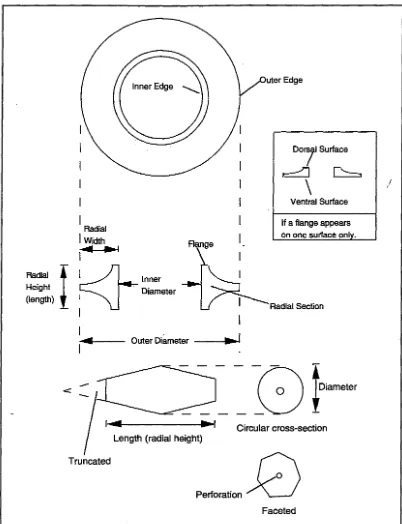
FIG. 78. Schematic illustration depicting descriptive terminology for bangles and beads. The bead shown in longitudinal section is biconical in shape
THE PERSONAL ORNAMENTS 267
Catalogue number (cat.) - the identification number for each artefact.
Context within the site. Most involve a burial (B), but some were found in layers within the site (L). Material was identified by eye and under hand-lens and stereoscope magnification. G. Mason has identified many of the materials, and Dr A. Reay has identified the tin and limestone-marble bangles.
Decoration - a simple description of any decoration on the surface of the artefact. This was very rare.
Dimensions recorded varied with the artefact type. Figure 78 illustrates those recorded for ban-gles and beads, as well as the relevant terminology. In cases of corroded or otherwise irregular artefacts, measurements were taken at the least corroded or most 'representative' points. For rigid artefacts, where the diameter varied, the largest measurement was taken. Second diameter meas-urements were always taken at right angles to the first. All measmeas-urements were recorded in milli-metres.
BEADS
Various schemes have been proposed for the classification of prehistoric beads (Beck 1928, BennyhoffandHughes 1987, King 1990, Kenoyer 1991, Pilditch 1993). A relatively simple scheme has been used, based upon Pilditch's methodology at Ban Na Di and Khok Phanom Di (pilditch 1986, 1993).
Shell
The vast majority of beads at Nong Nor are made of shell, and have been assigned four forms: disc, barrel, long barrel and spherical-carinated.
Disc Beads. These beads have a circular cross-section (transverse section) and a rectangular
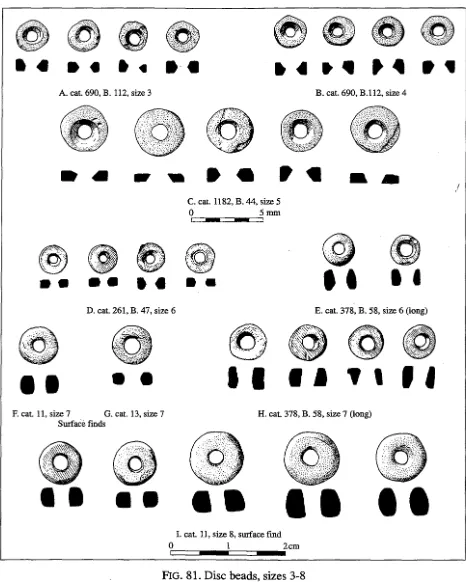
long-itudinal section. In Kenoyer's (1991) terminology, they would ideally have a length measuring less than one third their diameter. However, length (or thickness) is more variable at Nong Nor, and for some is greater than one third the diameter. The designation of these as disc beads is based on their inclusion in strings where they fall at one end of a continuous scale of variation. One interesting example is cat. 378, identified as a belt, from B 58. This includes a large proportion of thick disc beads, all with relatively large perforations (one third or more of the total diameter). These were made from a thick-shelled bivalve, probably tridacna, suggesting that material signifi-cantly affects form.
The beads were passed through a graded series of sieves to establish the size distribution. In part, this was an attempt to replicate a technique employed by Pilditch (1993) at Khok Phanom Di.
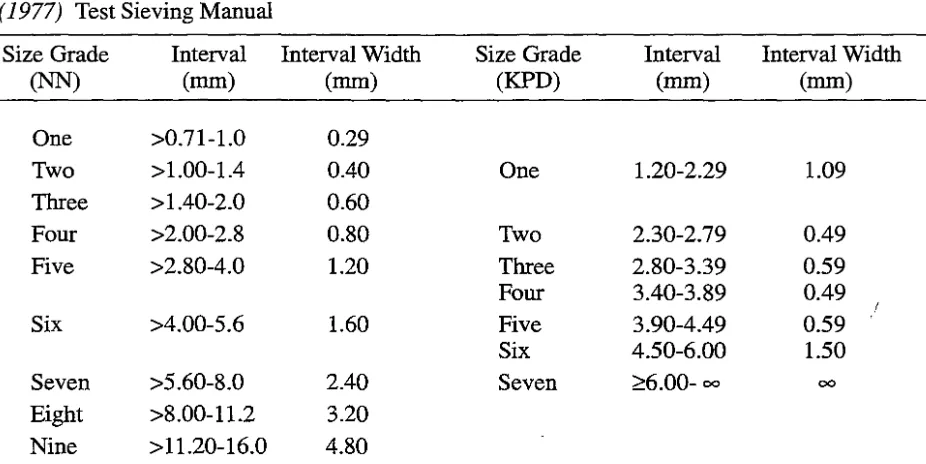
Table 13. The relationship between Nong Nor and Khok Phanom Di sieve series. The Phi (¢) series (NN) can be extended, and further subdivisions made, according to table 3.7 in Endecotts (1977) Test Sieving Manual
Size Grade Interval Interval Width Size Grade Interval Interval Width
(NN) (mm) (mm) (KPD) (mm) (nun)
One >0.71-1.0 0.29
Two >1.00-1.4 0.40 One 1.20-2.29 1.09
Three >1.40-2.0 0.60
Four >2.00-2.8 0.80 Two 2.30-2.79 0.49
Five >2.80-4.0 1.20 Three 2.80-3.39 0.59
Four 3.40-3.89 0.49
Six >4.00-5.6 1.60 Five 3.90-4.49 0.59
Six 4.50-6.00 1.50
Seven >5.60-8.0 2.40 Seven ~6.00-00 00
Eight >8.00-11.2 3.20
Nine >11.20-16.0 4.80
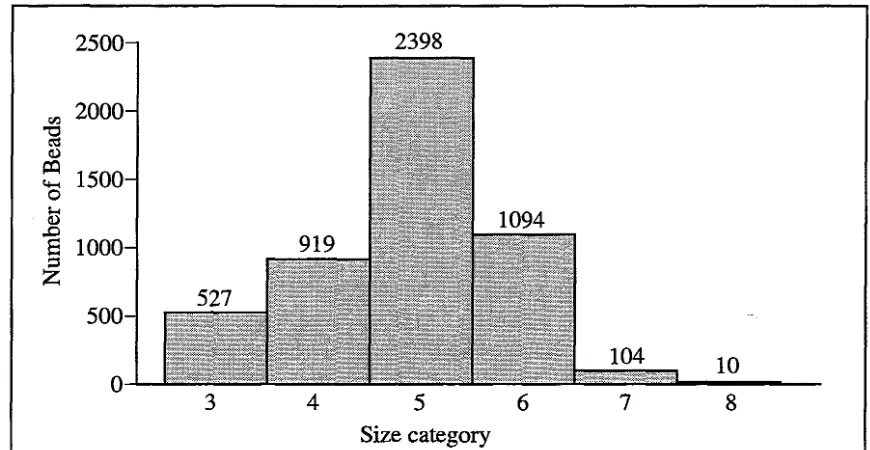
A total of 5474 disc beads have been analysed, of which 4766 are associated with burials, the remainder being found on the surface or loose within the midden. None fell through the 1.4 mm (-0.5 0) sieve and the maximum diameter (measured directly) is about 12.8 mm. Over 40 per cent were retained in the 2.8 mm (-1.50) sieve. That is, they have a maximum dimension between 2.8-4.0 mm (Fig. 79). Discounting those where size could not be determined, a normal distribution is indicated.
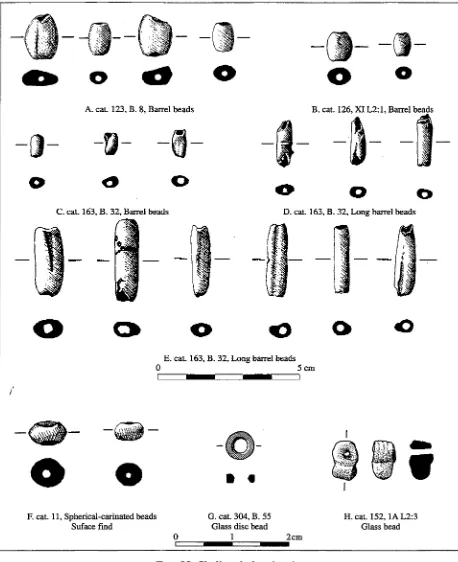
Barrel Beads. This term has been widely used, yet it is poorly defined in the archaeological literature. The level of variation that may be included, for example, has not been specified. At Nong Nor this term includes classic barrel-shaped beads with truncated elliptical longitudinal sections and circular transverse sections as well as cylinders and shorter, almost spherical, beads. Beads with curving longitudinal sections mayor may not be truncated at the ends. Cross-sections vary from blunt triangular to circular and elliptical and in some cases are quite flat. Some are very regular in section and carefully finished, but others received little such treatment.
Long Barrel Beads. Almost all these beads come from a single artefact (a necklace in B 32, cat. 163). These are best considered a sub-type of the barrel beads where the ratio oflength/width is ~
2.5. Figure 80 indicates why this ratio value is chosen to differentiate barrel and long barrel beads. Spherical-Carinated Beads. There are thirteen beads of this distinctive form. They are nearly spherical with a carination running around the equator (where perforations occupy the poles). Length is usually slightly shorter than diameter, producing, in effect, a very short bicone.
Stone Beads
[image:4.568.50.513.101.333.2],-.
THE PERSONAL ORNAMENTS 269
2398
500
104 10
o
3 4 5 6 7 8
[image:5.564.76.511.75.300.2]Size category
FIG. 79. The distribution of disc beads, sorted by size category. A normal distribution is indicated, centred on size 5 (also, 422 beads were unable to be assigned to a size category)
Frequency 140 120 100 /80 60 40 20 0
LO LO LO ... LO
C\I "- C\I
0
0 0 ...
LO
...
barrel beads
LO
"-•
C\I LO C\I
C\I Ratio Category
long barrel beads
LO
C\I
•
LO
"-C\I
('I) LO
C\I
('I)
LO
('I)
[image:5.564.62.528.363.588.2]former are found in three forms, sub-spherical, barrel and faceted-barreL Serpentines occur in spherical and faceted-barrel forms.
Serpentine Beads
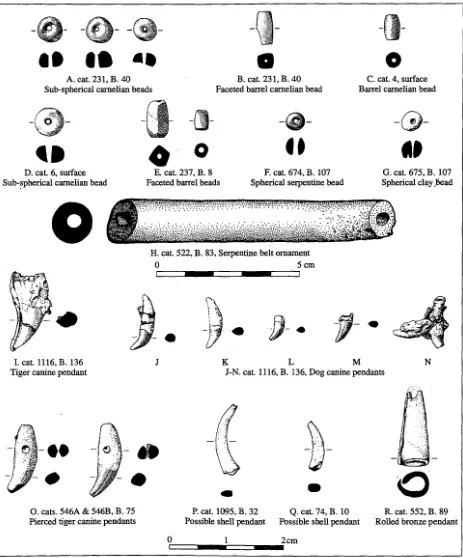
Spherical. A single bead in black serpentine was associated with B 107. It was neatly fInished. Faceted-barrel. Two beads were found in the mouth of B 8. Neither is carefully finished, both exhibiting irregular polygonal transverse sections.
Carnelian Beads
Sub-spherical. Three beads were found with B 40, shaped as if a sphere were squashed by pres-sure from both ends. The perforations are relatively large and crudely formed.
Barrel. One bead was collected as a surface find. It was neatly finished with a symmetrical long
i-tudinal section, circular transverse section and finely drilled perforation. I
Faceted-barrel. One bead, found with B 40, together with the three sub-spherical beads. It' was neatly finished with a fine and well-formed perforation. The transverse section is square with rounded comers.
Stone belt ornament
This cylindrical serpentine ornament was found in the pelvis region of B 83. It is bead-like in shape, very long (99 rom), tapering slightly to one end and cut diagonally across the long axis at the ends. It is perforated longitudinally.
TABLE14. Stone barrel beads ofform 1-4
Form Cat. No. Context Material L. D.1 D.2 P.D.
1 4 Surface Carnelian 9.10 5.65 5.65 1.30
2 231a B40 Carnelian 12.15 6.05 5.80 1.20
2 237a B8 Serpentine 13.50 7.00 7.25 2.65
2 237b B8 Serpentine 7.35 5.15 5.65 2.35
3 6 Surface Carnelian 6.60 10.10 2.00
3 231b B40 Carnelian 6.20 9.80 9.60 1.85
3 231c B40 Carnelian 5.80 9.15 9.40 2.20
3 231d B40 Carnelian 5.15 8.40 8.50 2.00
3 674 B107 Serpentine 6.10 6.40 6.25 2.00
4 522 B 83 Serpentine 99.00 14.20 14.00 5.10
L.: Length, D.1: Diameter 1, D.2 : Diameter 2, P.D.: Perforation Diameter
Glass beads
THE PERSONAL ORNAMENTS 271
Disc. A single opaque, brick-orange coloured bead found during post-excavation cleaning of the femur of B 56.
Clay beads
Spherical. A single sandy-brown coloured bead was included in B 107.
TABLE 15. Glass and clay beads
Form Cat. No. Context Material Colour L. D.1 D.2 P.D.
1 152 AI-AL2:3 Glass Opaque powdery green 4.15 4.70 7.30 1.55
1 223 Al-l L2:3 Glass Opaque sandy yellow 4.50 4.20 4.25 1.20
1 950 A12 disturbed Glass Opaque blue/green 3.45 3.90 3.90 1.50
2 304 B56 Glass Opaque brick orangelbrown 1.60 5.20 2.55
3 675 B 107 Clay Yellowlbrown 6.40 6.70 7.45 1.20
L: Length, D.1: Diameter 1, D.2: Diameter 2, P.D.: Perforation Diameter
Beads as composite artefacts
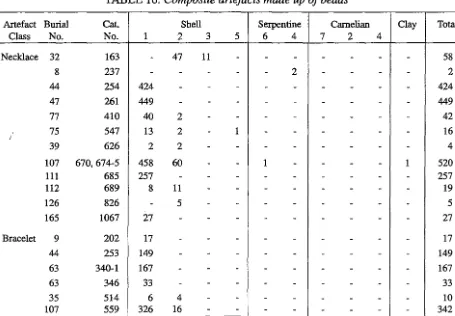
Beads are usually components of composite artefacts (Table 16). Identification of such ornaments was based predominantly on their location with respect to the body. These identifications may be insecure. For example, those identified as belts may actually have been attached to clothing. The general lack of ordered arrangement of the beads when excavated argues against this interpreta-tion; Garanger (1972: figs. 47, 104, 162 and 181) has shown the expected patterning when em-broidered disc beads are encountered during excavation. However, the level of disturbance at Nong Nor may preclude the survival of such arrangements. In any case, such clear patterning was not noted during excavation and a level of ambiguity persists.
Table 16 indicates that disc beads are by far the most numerous components of composite artefacts, less than half of those recovered have anything else and only four have no disc beads. Only three artefacts have significant numbers of non-disc shell beads and two of these also in-clu(le very large numbers of disc beads. One spherical-carinated bead is represented in situ. Beads of materials other than shell are rare in these composite artefacts.
PENDANTS
This is a conspicuous class at Nong Nor. Initially it was difficult to decide whether these should be considered separately from the beads, because most are perforated along their length rather than at one end. However, these artefacts are found in the chest or neck area in a position indicating that they hung vertically, rather than horizontally as a bead. As well as shell, pendants are made of bronze and perforated animal teeth.
Shell
@@co
o@o
• • • • t
4 • . •• 4 • •
J
4 • •
A. cat. 690, B. 112, size 3 B. cat. 690, B.112, size 4
0000
••
-
....
~
.
-@~@
••••••
D. cat. 261, B. 47, size 6
I I
•
•
F. cat. 11, size 7 G. cat. 13, size 7 Surface fmds
0\
I I
--C. cat. 1182, B. 44, size 5
o
5mm! -
_!
••
@
, I
E. cat. 378, B. 58, size 6 (long)
I''''''
H. cat. 378, B. 58, size 7 (long)
o
••
••
1. cat. 11, size 8, surface fmd
o
1 2cmI
FIG. 81. Disc beads, sizes 3-8
[image:8.564.28.494.66.648.2]/
THE PERSONAL ORNAMENTS 273
-(I, -
.:.-(J-o
0
A. cat. 123, B. 8, Barrel beads
-rJ-
-:.~~
:~
-,
o
o
o
o
o
c. cat. 163, B. 32, Barrel beads D. cat. 163, B. 32, Long barrel beads
o
o
o
E. cat. 163, B. 32, Long barrel beads
o
5cm-<3-o
-w-o
F. cat. 11, Spherical-carinated beads Suface fmd
o
I-0-•
•
G. cat. 304, B. 55 Glass disc bead
1 2cm
FIG. 82. Shell and glass beads
o
[image:9.558.65.523.73.635.2]It
Ie
••
a
A. cat. 231, B. 40 Sub-spherical carnelian beads
B. cat 231, B. 40 Faceted barrel carnelian bead
4-D. cat 6, surface
Sub-~pherical carnelian bead
o
o
o
E. cat 237, B. 8 Faceted barrel beads
ft
F. cat. 674, B. 107 Spherical serpentine bead
H. cat. 522, B. 83, Serpentine belt ornament
o
5cmJ K L
-~.
-l8
o
c. cat. 4, surface Barrel carnelian bead
M
G. cat. 675, B. 107 Spherical claY,Y>ead
N
I. cat. 1116, B. 136
Tiger canine pendant J-N. cat. 1116, B. 136, Dog canine pendants
-
..
-.
•
.-o. cats. 546A & 546B, B. 75
Pierced tiger canine pendants
-P. cat. 1095, B. 32 Possible shell pendant•
Q. cat. 74, B. 10 Possible shell pendant
0CI ==~
.... i====-....
2cmo
R. cat. 552, B. 89 Rolled bronze pendant
[image:10.565.49.512.72.630.2]THE PERSONAL ORNAMENTS 275 outline giving the effect of a scimitar blade rather than a symmetrical pendulum. They recall Poulsen's (1987) 'Long Units (class 5D)' from Tonga, ascribed to tridacna on the basis of the surviving hinge of the shell (ibid, pers. comm.). This feature is repeated in the Nong Nor exam-ples. Poulsen has noted parallels in Fiji and the Mariana Islands (ibid, 199-200) and Samrong Sen, Cambodia (Mansuy 1902). A similar artefact has recently been recovered from the Balobok rock shelter site in the southern Philippines (Ronquillo et al. 1993: plate 13b).
Although the Nong Nor examples are all of the same basic form, they can be sub-divided on the basis of the nature of the perforation.
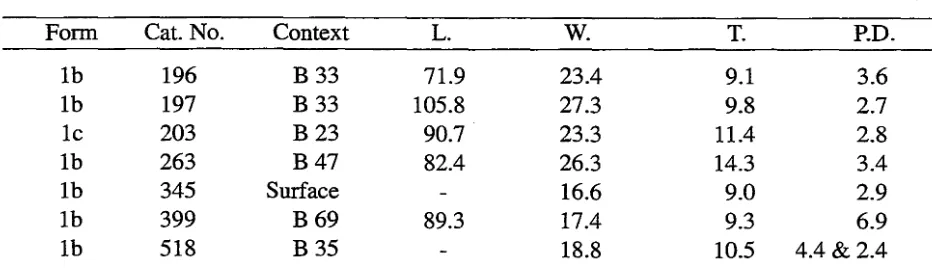
Form 1 a, End drilled. These are perforated diagonally from the end to one side, with a perforation length of c. 5-10 mm. As they are only pierced at one end, they were intended to be worn as pendants. Poulsen's 'units', by contrast, were perforated at both ends.
[image:11.564.65.520.329.645.2]Form Ib, Length drilled. These have been perforated longitudinally. X-ray analysis has shown that some perforations are remarkably straight and regular in width. Others have been drilled more than once, with the holes not meeting. Some of the holes are filled, or lined, with bronze and one pendant had been repaired with bronze 'wire'. This had involved three sets of paired holes being drilled, two on one face and one on the other.
TABLE 16. Composite artefacts made up of beads
Artefact Burial Cat. Shell Serpentine Carnelian Clay Total
Class No. No. 1 2 3 5 6 4 7 2 4
Necklace 32 163 - 47 11 - - - 58
8 237 - - - 2 - - - - 2
44 254 424 - - - - - - - - - 424
47 261 449 - - - 449
77 410 40 2 - - - 42
75 547 13 2 - 1 - - - 16
i 39 626 2 2 - - - 4
107 670,674-5 458 60 - - 1 - - - - 1 520 111 685 257 - - - 257
112 689 8 11 - - - 19
126 826 - 5 - - - 5
165 1067 27 - - - - - 27
Bracelet 9 202 17 - - - - - - - 17
44 253 149 - - - - - - - - - 149
63 340-1 167 - - - 167
63 346 33 - - - - - - 33
35 514 6 4 - - - - - - - - 10
TABLE 16 (cant.)
Artefact Burial Cat. Shell Serpentine Carnelian Clay Total
Class No. No. 1 2 3 5 6 4 7 2 4
107 667 186 - - - - - - - - - 186
III 684 106 - - - 106
112 690 78 - - - - 78
165 1068 60 - - - - - - - - - 60
Belt 58 378 49
-
- - - 4936 438 550 64 - - - - - - - - 614
39 443 138 - - - - - - - 138
107 668 186 - - - 186
90 737-8 77 - - - /77
Anklet 37 213 4 - - - 4
25 214 27 - - - - - - - 27
Head
Ornament 40 231 - - - - - - 3 - 1 - 4
Bead Forms - 1: disc, 2: barrel, 3: long-barrel, 4: faceted-barrel, 5: spherical-carinated; 6: spherical, 7: sub-spherical
Although drilled longitudinally, the placement of these artefacts in relation to the body comInns that they were worn as pendants.
Form 1 c, Double drilled. A single pendant -that has been perforated longitudinally as well as diagonally at the thinner end.
[image:12.564.41.507.514.648.2]Form 2, Claw or canine form. This form is rectangular in cross-section, tapering from a roughly finished thick end to a more regular thin end. They do not appear to come to a point and there is no evidence of perforation. However, binding at the thicker end would be effective. It is also possible that these are bangle fragments. Tridacna shell is the most likely material.
TABLE 17. Shell pendants
Form Cat. No. Context L. W. T. P.O.
Ib 196 B 33 71.9 23.4 9.1 3.6
Ib 197 B 33 105.8 27.3 9.8 2.7
lc 203 B23 90.7 23.3 11.4 2.8
Ib 263 B47 82.4 26.3 14.3 3.4
Ib 345 Surface 16.6 9.0 2.9
Ib 399 B69 89.3 17.4 9.3 6.9
...
THE PERSONAL ORNAMENTS 277TABLE 17 (cont.)
Form Cat. No. Context L.
w.
T. P.D.1b 519 B 35 57.7 20.5 7.2 3.1
1b 615 B98 114.5 23.4 11.8 3.1
1a 624 B 105 112.8 21.0 10.2 & 13.0 2.4
1a 742 B 109 109.0 24.8 15.8 2.3
1b 1008 B 163 108.0 27.0 13.8 2.4
2 74 BlO 35.0 9.0-5.3 8.2 -4.4
2 1095 B32 52.8 11.8-5.4 7.2-3.1
L: length, W: width, T: thickness P.D.: perforation diameter Bronze
Cat. 552, B 89. A single bronze pendant has been recovered. It consists of a rectangle of bronze rolled into a tapering tube. The bottom is open and the top, closed. An eyelet, or suspension loop, is found at the closed end. The original metal sheet was about 3-4 mm thick (length: 53.0 mm, width: 22.8 mm, perforation diameter 3.2 mm).
Animal tooth
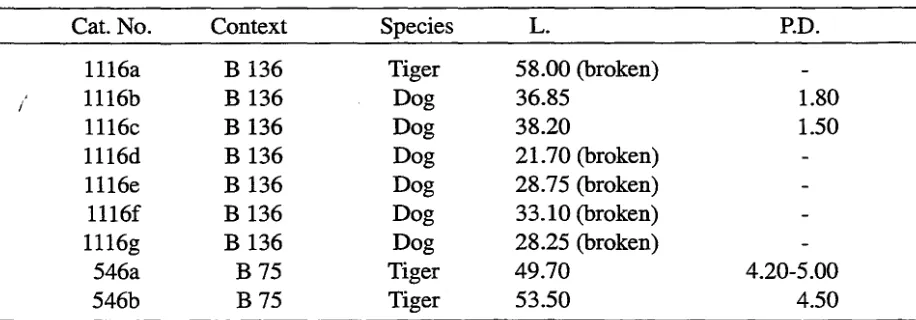
[image:13.565.64.530.79.226.2]Canines of dog (Canis familiaris ) and tiger (Panthera tigris) are present. Some have been drilled for suspension through the root, near to the base of the enamel. On others the root has broken off and it is impossible to know if they had been similarly treated.
TABLE 18. Animal canine tooth pendants
Cat. No. Context Species L.
1116a B 136 Tiger 58.00 (broken)
, 1116b B 136 Dog 36.85
I
1116c B 136 Dog 38.20
1116d B 136 Dog 21.70 (broken)
1116e B 136 Dog 28.75 (broken)
1116f B 136 Dog 33.10 (broken)
1116g B 136 Dog 28.25 (broken)
546a B75 Tiger 49.70
546b B75 Tiger 53.50
L: Length, P.D.: Perforation Diameter
Pendants as composite artefacts
P.D.
1.80 1.50
4.20-5.00 4.50
[image:13.565.65.523.413.573.2]A. cat. 196, B. 33 form 1B
B. cat. 197, B. 33 form 1B
c. cat. 203, B. 33 form lC
D. cat. 263, B. 47 form IB
•
G. cats. 518-9, B. 35 H. cat. 615, B. 98 1. cat. 624, B. 105 J. cat. 742, B. 109 form lA forms 1B form IB form lA
o
lOcm-
FIG. 84. Shell pendants-
-
--E. cat. 345 F. cat. 399, B. 69 form 1B form IB
~~
~
THE PERSONAL ORNAMENTS 279
pendants. Cat. 1116 is a necklace made up of six dog and one tiger canine. Cat. 546 is a necklace combining two tiger canines. Cats. 196 and 197 are a pair of form 1 shell pendants, associated with a single burial, and are interpreted as components of a single necklace. The same is true for cats. 518 and 519.
BANGLES
In sorting the Khok Phanom Di artefacts Pilditch (1993) was prompted to begin a comprehensive classification scheme for 'Southeast Asian Disc/Bangle Forms'. In the interest of consistency the Nong Nor artefacts are similarly classified. However, due in part to the addition of bronze as a material at Nong Nor, additional classes are employed. Most of Pilditch's 12 basic 'styles' are further subdivided (e.g. style 1, la, Ib etc.). These subdivisions are not used here as their basis is debatable; the criteria may be site specific. Pilditch's scheme, including the styles created to in-clude Nong Nor (styles 13-21), can be summarised as follows (for descriptive terminology see figure 78).
Style 1 discs with L-shaped radial sections formed by a single flange around the inner edge. Subdivisions include discs with perforations too small to be worn as bangles (less than 3.5 cm) and artefacts with no perforation at all, the 'flange' becoming a horn-like projection in the centre of the disc. These variations are absent at Nong Nor.
Style 2 discs with T-shaped radial sections formed by concentric flanges on either side of the inner edge.
Style 3 discs with triangular radial sections, the long sides of which are deeply concave (the short side formed by the inner edge).
Style 4 discs with triangular radial sections. The internal to external diameter ratio is 1:1.75-2. This results in a heavier bangle that projects further out from the arm when worn. In some speci-mens the triangular radial section has been truncated at the outer edge.
Style 5 discs with triangular radial sections. The internal to external diameter ratio is 1:<1.75, resulting in a lighter weight, less projecting, bangle. In some bangles the triangular radial section has been truncated at the outer edge.
Style 6 discs with rectangular radial sections, modified by single or double bevels at the outer edge. Internal to external diameter ratio is 1:~1.5, and the radial width to depth ratio is 1:~4,
resulting in a heavy bangle that projects considerably from the arm when worn.
Style 7 discs with rectangular radial sections, modified by single or double bevels at the outer edge. The internal to external diameter ratio is 1:<1.5, resulting in a lighter, less projecting, bangle than style 6. Variations of radial width to depth ratios occur, but width is always greater than depth.
Style 8 discs with a rectangular radial section; unbevelled and approaching square. The radial width to depth ratio is 1:> 1.25-:52. Variations in absolute radial dimensions occur.
Style 9 discs with rectangular radial sections; unbevelled. The radial depth to width ratio is 1 :>2. Variations in absolute radial dimensions occur.
Style 11 bands with rectangular radial sections. Radial width to depth ratio is > 1.25: 1, resulting in a bangle orientated along the arm, not projecting, when worn. Variations in absolute radial dimen-sions occur.
Style 12 discs with concave arcs removed from the outer edge producing a star shape in plan view. Other features vary.
Style 13 discs with right-angled triangular radial sections, the long side of which curves convexly from the inner to the outer edge. Variations in absolute radial dimensions occur.
Style 14 discs with D-shaped radial sections in which the straight side is formed by the inner edge. The inner to outer diameter ratio is 1:~1.5, resulting in a heavy bangle.
Style 15 discs with D-shaped radial sections in which the straight side is formed by the inner edge. The inner to outer diameter ratio is 1:<1.5. resulting in a relatively light bangle.
Style 16 discs with approximately square radial sections; though the exact form round the circum-ference and between artefacts varies, due to the natural form of the original gastropod (e.g./conus
or trochus shells). '
Style 17 bands with approximately rectangular radial sections in which the ratio of radial width to radial depth is 1:>2. The exact form varies with the natural form of the original shell (e.g. conus or trochus shells).
Style 18 discs with circular radial sections. The internal to external diameter ratio varies.
Style 19 bands with a rectangular radial section in which the ratio of radial width to height is about 2: 1. A very light form, 3 rom is a typical measurement for radial width, and the inner to outer diameter ratio is 1:<1.5.
Style 20 bands with a very small rectangular or D-shaped radial section, 1.5 rom (width) by 3 rom (length) being typical dimensions, resembling a wire. Inner to outer diameter ratio is 1:<1.5. Style 21 bands with a rectangular radial seotion where the radial width to depth ratio is >1.25:1. There is a concave depression around the outside edge. Inner to outer diameter ratio is 1:<1.5.
Shell Bangles
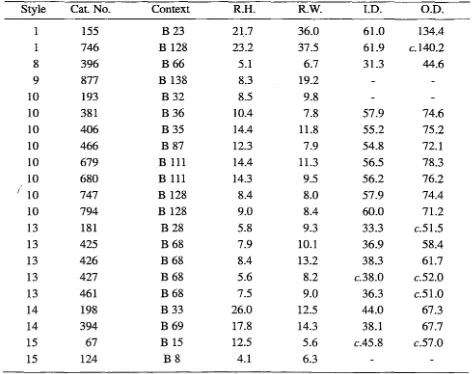
The shell bangles occur in a variety of forms. They were manufactured from two basic materials, a large bivalve, probably tridacna, and one or more gastropod species, probably conus. Six styles are recognised (Tables 19-20, Figs. 85-87).
Style 1. Only two bangles are present, manufactured from tridacna shell. Both are large artefacts with perforations consistent with use as bangles. While the cross section sweeps sharply up from the outer edge to the top of the flange, the flange itself is not clearly demarcated. These would have been impressive personal adornments.
Style 9. Cat. 877, B 138 is the only example. It is a fragment only and was probably relocated from the midden deposit during the interment of B 138.
..
:," THE PERSONAL ORNAMENTS 281
Style 13. These appear similar to style 1. They show basically the same radial section except that the curve of the upper surface is convex, from the inner down to the outer edge. At Nong Nor, these bangles are small and always associated with infant burials, whereas the style 1 examples are relatively very large.
Style 14. Manufactured from tridacna shell, these two D-sectioned bangles are massive artefacts, especially as both are associated with child burials (reflected in the internal diameters -less than 50mm).
Style 15. Of the five bangles only cat. 741 is complete, it is also set apart by a carved notch on the outer edge identical to the style 10 bangles. All are manufactured from tridacna.
[image:17.563.57.529.276.650.2]Style 16. Seven artefacts are present. Variable solidity of the bangles suggests that more than one species is being employed, though all are within the Conus genus. Cat. 354 was associated with a young adult burial, the rest with infants and children.
TABLE 19. Shell bangles - tridacna and conus
Style Cat. No. Context R.H. R.W. LD. O.D.
1 155 B23 21.7 36.0 61.0 134.4
1 746 B 128 23.2 37.5 61.9 c.140.2
8 396 B 66 5.1 6.7 31.3 44.6
9 877 B 138 8.3 19.2
10 193 B 32 8.5 9.8
10 381 B 36 10.4 7.8 57.9 74.6
10 406 B 35 14.4 11.8 55.2 75.2
10 466 B 87 12.3 7.9 54.8 72.1
10 679 B 111 14.4 11.3 56.5 78.3
10 680 B 111 14.3 9.5 56.2 76.2
110 747 B 128 8.4 8.0 57.9 74.4
10 794 B 128 9.0 8.4 60.0 71.2
13 181 B28 5.8 9.3 33.3 c.51.5
13 425 B 68 7.9 10.1 36.9 58.4
13 426 B 68 8.4 13.2 38.3 61.7
13 427 B 68 5.6 8.2 c.38.0 c.52.0
13 461 B 68 7.5 9.0 36.3 c.51.0
14 198 B 33 26.0 12.5 44.0 67.3
14 394 B 69 17.8 14.3 38.1 67.7
15 67 B 15 12.5 5.6 c.45.8 c.57.0
TABLE 19 (cont.)
Style Cat. No. Context RH. RW. LD. O.D.
15 293 A1-B, L2:2 8.1 6.3
15 741 B90 12.7 7.9 53.5 68.8
15 793 B 118 10.9 5.6
16 258 B 50 8.1 8.1 36.9 51.5
16 354 B 56 14.5 12.6 34.8 57.6
16 465 A3:42,L2:2 7.7 10.8 c.46.0 c.67.0
16 748 B 130 14.2 9.3 31.4 49.7
16 1088 Xl, surface 13.2 9.4 35.8 52.7
16 1089 A1-A,L2:2 7.0
-
/16 1092 B 50 8.1 8.3
17 280 B49 32.1 13.5 41.5 67.8
R.H.: Radial Height, R.W.: Radial Width, I.D.: Inner Diameter, D.D.: Outer Diameter
[image:18.564.41.511.80.296.2]Fragmentary. Cat. 193 is from a relatively lightweight bangle with a nearly square radial section. The complete bangle was probably a style 10 (above). Cats. 300 and 347 are from fairly thick bands, with the latter being irregularly formed. Cat. 339 is probably a fragment from a style 16 shell bangle, but appears to have had the original spiral architecture·ground away. Cat. 474 is probably from a T-sectioned or simple disc form.
TABLE 20. Shell bangles -fragmentary
Cat. No. Context Material RH.
300 A3L1 Tridacna ? 14.4
339 B 63 Conus? 11.7
347- A3:16L2:1 Tridacna ? 19.3
474 B 73 Shell ?
R.H.: Radial Height, R.W.: Radial Width
Stone Bangles
RW.
9.0 3.9 10.1
There are two forms of stone bangle in a variety of raw materials, including serpentine, marble and talc (Tables 21-23, Figs. 88-91).
[image:18.564.42.508.422.507.2].'
THE PERSONAL ORNAMENTS 283
B. cat. 746, B. 128, style 1
A. cat. ISS, B. 23, style 1
C. cat. 181, B. 28 style 13 ;'
G. cat. 461, B. 68 style 13
D. cat. 425, B. 68 style 13
g
....
:.:..-7 .
. f' . _ .
... ,.. . .
...-. ... .".
H. cat. 396, B. 66 style 8
E. cat. 426, B. 68 style 13
-I. cat. 877, B. 138 style 9
o
10cm---
--FIG. 85. Shell bangles; styles 1,8,9, 10 and 13
F. cat. 427, B. 68 style 13
J. cat. 381, B. 36 style 10
A. cat. 406, B. 35 style 10
D. cat. 680, B. 111 style 10
H. cat. 198, B. 33 style 14
B. cat. 466, B. 87 style 10
c. cat. 679, B. 111 style 10
•
o
E. cat. 747, B. 128 style 10
I. cat. 394, B. 69 style 14
•
F. cat. 794, B. 128 style 10J. cat. 741, B. 90 style 15
10 em
-
--
--FIG. 86. Shell bangles; styles 10, 14 and 15
/
•
G. cat. 193, B. 32style 10
A. cat. 67, B. 15 style 15
F. cat. 258, B. 50 style 16
)
I. cat. 1092, B. 50 (two views)
style 16
THE PERSONAL ORNAMENTS
If
:~
.
-~-
'\ [B. cat. 293 AI-B, L2:2
style 15
c. cat. 793, B. 110 style 15
D. cat. 339, B. 63 fragmentary
E. cat. 1089 AI-A, L2:2 style 16
J. cat. 748, B. 130 style 16
G. cat. 354, B. 56 style 16
K. cat. 1088, Xl, surface style 16
o
10cm--
-
--H. cat. 465, A3:42, L2:2 style 16
L. cat. 280, B. 49 style 17
FIG. 87. Shell bangles; styles 15, 16 and 17
TABLE 21. Marble bangles of style 4
Cat. No. Context RH. RW. I.D. O.D.
262 B47
271 B44
370 B 35 8.6 19.3 c.58.0 c.92.0
379 B 36 7.4 23.7 54.7 99.0
380 B 36 8.1 19.2 54.0 89.0
382 B 36 8.2 22.9 57.4 103.3
383 B 36 7.9 24.0 53.4 101.2
386 B 39 8.4 19.9 56.3 97.8
387 B 39 8.3 15.6 60.5 88.2
388 B39 7.1 19.8 53.3 99.5 /
"--447 B77 6.1 24.8 55.5 105.2
448 B77 6.4 20.0 55.5 96.0
449 B77 8.6 23.4 59.1 104.2
450 B77 8.5 23:4 56.7 101.2
623 B 105 7.7 21.2 57.4 98.6
656 B 111 9.4 20.9 59.6 100.3
664 B 106 8.2 20.6 55.9 94.9
752 B 128 7.8 23.0 c.59.0 c.103.0
753 B 128 9.3 22.4 c.51.4 c.97.0
755 B 128 10.2 21.0 c.58.0 c.98.0
1025 B 165 9.9 21.2 55.0 97.3
1059 B 165 7.3 20.0 54.9 94.7
R.H.: Radial Height, R.W.: Radial Width, LD.: Inner Diameter, O.D.: Outer Diameter
Style 2. At Nong Nor the degree of demarcation of the flanges from the main body in these T-sectioned bangles is variable. In some, both the flange and the main body of the radial section are thin and platelike, and the demarcation between them is clear~y defined; i.e. very close to a true T-shape. On others the flange is very low (less than 5 mm), and merges with the main body in such a way that no point of demarcation can be identified.
TABLE 22. Stone bangles - style 2, T-section
Cat. No. Context Stone RH.1 RH.2 RW. I.D. O.D.
316 B53 Marble 13.0 6.3 23.6 c.57.0 c.97.0
332 A3:55, L2:1 Serpentine 8.6 5.2 17.2
[image:22.558.45.506.568.648.2]THE PERSONAL ORNAMENTS 287
TABLE 22 (cont.)
Cat. No. Context Stone RH.1 RH.2 RW. I.D. O.D.
495 B 83 Serpentine 9.3 3.0 13.1 50.8 76.7
662 BIll Serpentine 17.3 7.7 21.9 54.8 97.0
697 B 109 Serpentine 8.9 7.0 22.4 c.57.0 c.111.0
792 B 127 Marble 9.0 4.1 28.6 c.58.0 c.115.0
802 B 123 Marble c.8.0
890 B 136 Marble 15.4 6.2 15.0 55.8 c.83.4
943 B 149 Talc 6.9 3.8 29.4 c.57.7 c.115.6
944 B 149 Serpentine 14.3 4.5 18.0 59.2 94.4
1087 B83 Serpentine 13.6 4.2 18.3 c.51.7 c.88.0
R.H.1: Radial Height 1, R.H.2: Radial Height 2, R. W.: Radial Width, J.D.: Inner Diameter, O.D.: Outer Diameter
[image:23.564.47.512.78.265.2]Fragmentary. Three fragmentary artefacts have been recovered. Although width and thickness measurements are given for cat. 1243, it is impossible from the fragments present, to know which radial dimension is represented by either figure.
TABLE 23. Stone bangles -fragmentary
Cat. No. Context Stone RH. RW.
292 Xl, L2:2 Marble?
1090 B 56 Serpentine
1243 B 136 Marble? 1.9 10.9
R.H.: Radial Height, R.w.: Radial width
Bronze
Bronze is a third raw material employed in bangle manufacture. It is found in seven main styles (Figs. 91-:-94, Table 24).
Style 2, T-sectioned. One very large T-shaped bangle of this form was recovered (cat. 604, B 105). The flanges and body are clearly demarcated and well defined. This artefact clearly recalls style 2 bangles in stone.
Style 11, Simple Band. This is by far the most common form. The radial section is narrow and deep, with typical dimensions of c.9 mm (height) and c.3 mm (width). A possible join, where the circlet has been closed, is often visible as a diagonal lump of corrosion.
[image:23.564.134.409.357.442.2]~
A. cat. 231, B. 44
D. cat. 379, B. 36
G. cat. 383, B. 36
B. cat. 262, B. 47
E. cat. 380, B. 36
..
..
0 H. cat. 386, B. 39 10 ern
- -
-
-
-FIG. 88. Marble bangles of style 4
c. cat. 370, B. 35
I
F. cat. 382, B. 36
..
A. cat. 388, B. 39
D. cat. 448, B. 77
G. cat. 656, B. III
THE PERSONAL ORNAMENTS
B. cat. 447, B. 77
E. cat. 450, B. 77
o
H. cat. 752, B. 128lOem
.-~
...
--.-~...
--.-~...
--~~...
----~...
--FIG. 89. Marble bangles of style 4 (cont.)
289
C. cat. 449, B. 77
F. cat. 623, B. 105
..
A. cat. 1059, B. 165, style 4 B. cat. 1025, B. 165, style 4
D. cat. 755, B. 128, style 4 E. cat. 128, B. 25, style 2
G. cat. 495, B. 83, style 2 H. cat. 1087, B. 83, style 2
o
10 em--
-
--C. cat. 753, B. 128:lstyle 4
F. cat. 316, B. 53, style 2
•
1. cat. 617, B. 109, style 2•
I
A. cat. 662, B. 111 style 2
THE PERSONAL ORNAMENTS
~
rl
/
/':'<" ";"".
.'
l~
..
..-/".j~
..
~~~
.•
--~
B. cat. 792, B. 127 style 2
C. cat. 890, B. 136 style 2
F. cat. 284, Xl, L2:3 style 2
---..
..---;'
D. cat. 943, B. 149 style 2
H. cat. 671, B. 112, style 18
o
•
E. cat. 944, B. 149 style 2
L cat. 672, B. 112, style 18 lOem
--
-
--G. cat. 62, B. 13 style 2
•
FIG. 91. Stone bangles of style 2 and bronze bangles of style 18
TABLE 24. The bronze bangles
Form Cat. No. Context RH. RW. I.C. Form Cat. No. Context RH. RW. I.e.
11 11 11 11 11 11 11 11 11 11 11 11 11 11 11 11 11 11 11 11 11 11 11 11 11 11 11 11 11 11 11 11
8 surface 6.7 2.9 11
11 11 11 11 11 11 11 11
29 B 7 9.0 2.6
38 B 7 9.4 2.9
59 B 12 5.0 2.0
95 Xl, surface 11.2 3.8 97 Xl, surface 9.1 2.2
102 AI, L2:2 6.5 2.2
117 X1,L2:1 11.8 4.2
204 B 25 9.2 4.6
227 B 43 8.1 2.3 129.0 11
301 A3, LI 10.8 2.8 11
309 A3:28 L2:1 11.9 3.2 11
335 A3:55 L2:1 7.0 2.7 11
360 B 56 6.6 2.9 11
384 B 39 9.2 3.3 207.0 18
385 B 39 9.6 3.0 *176.0 18
389 B 35 8.8 3.5 184.0 2
390 B 35 8.0 3.0 185.0 20
391 B 35 8.3 3.4 *177.0 20
392 B 35 7.4 3.3 *178.0 20
393 B 35 7.2 2.9 202.0 20
419 B 80 9.7 3.9 20
457 B 84 10.6 4.0 20
467 A3:44 L2:2 12.0 4.2 20
475 A3:15 L2:3 10.4 3.7 20
488 A3:41 L2:2 9.4 3.8 20
492 A3:41 L2:2 7.6 2.5 20
515 A3:28 L2:3 9.8 3.9 15
517 B 35 8.8 3.5 15
520 A3:30 L2:2 11.0 4.3 15
525 B 96 10.6 3.3 15
539 B92 9.2 2.2 15
966 B 147 9.7
967 B 147 6.8
999 B 147 8.7
1000 B 147 11.4
1001 B 147 11.4
1096 BIll 7.1
1097 B 35 8.6
1098 A3:28, L2:1 7.3
1100 A3:69, L2:1 4.6
1102
1103
1104
1105
1107
B 97? 7.0
Xl, L2:1 9.2
B 25 10.5
B 43 7.8
AI-B L2:2 6.8
3.2 *173.0
3.0 192.0
2.3
2.1 168.0
1.9 170.0
2.7 *183.0
3.1 *179.0
2.1 2.2 2.2 4.6 4.1 2.7 2.6
671 B 112 8.3 6.8 218.0
672 B 112 8.7 7.3 213.0
604 B 105 20.6 36.4 195.0
205 A1-D L2:3 c.1.5 c.1.5
283 B 48 2.3 1.8
305 B 55? 2.4 1. 7
326 A3:69 L2: 1 2.6 1.5
350 A3:46 sfce. 3.3 1.6
433 A3:58 L2:2 3.4 1.8
460 A3:55 LIb:1 3.0 1.6
464 A3:59 L2:2 3.0 1.3
470 A3:59 L2:2 3.0 1.6
1101 surface 2.0 1.4
3 surface 5.7 3.1
32 A1-AL2:1 5.3 3.1
36 A1-AL2:1 5.8 4.4
47 A1-D L2:1 4.3 3.3
THE PERSONAL ORNAMENTS 293
TABLE 24 (cont.)
Form Cat. No. Context RH. RW.
I.e.
Form Cat. No. Context RH. RW. I.C.11 661 BIll 7.6 3.1 200.5 15 123 B8 5.5 2.6
11 796 B65 8.6 4.1 *257.0 15 281 B48 5.9 3.3
11 830 B 116 7.2 2.5 15 337 A3:30 L2:1 5.4 3.5
11 873 B 138 11.1 1.8 15 486 A3:44L2:3 5.1 2.8
11 882 B 147 11.1 2.3 19 48 A1-DL2:1 5.5 2.9
11 963 B 147 11.0 2.0 172.0 19 89 A1-eL2:1 6.4 3.2
11 964 B 147 7.6 2.7 21 1099 B84 10.4 3.5
11 965 B 147 11.4 1.8 166.0
R.H.: Radial height, R.W.: Radial width, I.e.: Inner circumference, * measurements taken from incomplete bangles
Style 15, D-sectioned. These have a O-shaped radial section with the flat side of the '0' formed by the inner edge of the bangle. Indications are that they were lightweight bands with the inner diameter large relative to the radial dimensions. Some longer fragments show the longitudinal curvature expected in a bangle.
Style 19, Double Wire. The fragments recovered give the impression of two wires, each almost square in section, fused together along one side. A complete bangle would resemble two thin bands fused side by side. Once again, only fragments are present and it is possible that they are not bangles at all, or perhaps represent remnants of more complex forms, for example spiral bangles (see the spiral forms in tin, discussed below).
Style 20, Wire. Only one of these collections of fine wire-like bronze fragments was confidently associated with a burial. The radial sections generally resemble a flattened '0' with typical dimen-sions being 1.5 mm (width) by 3 mm (length). As none is complete, it remains possible that they are not bangles but needles, wires (Maddin and Weng 1984) or some other utilitarian artefact. Style f1, Concave Band. A single fragment with a radial section similar to the simple bands (form
1) described above, but with a concave depression around the outside edge.
Fragmentary. Cat. 1010 & Cat. 1048, B 117. The fragments are so small and broken that no likely form can be reconstructed.
None of the artefacts represented by styles 15, 19, 20 and 21 is complete and it remains possible they are not bangles at all. The most questionable are those assigned to style 20. Con-versely, the curvature of style 15 specimens is consistent with their being bangles. Most of these bangles were not associated with burials, so interpretations cannot be confirmed by their location. Very few other types of bronze artefact have been identified, so that an interpretation as bangles remains the most likely.
Tin
/ :
-H-t
'0" .. '
A. cat. 95, Xl surface
/1
II
1/
-a-I
II\ \
\\
B. cat 97, Xl surface
c. cat 102 A1,L2:2
--
---/ '
,-, / / '
/ /
I /
1/
I r
h
-\ \
,\\
\\
,\
'\.'\.
,'-D. cat 59, B. 12 E. cat. 204, B. 25
F. cat 389, B. 35 G. cat 390, B. 35 H. cats. 390-91, B. 35
L cat 393, B. 35
~
II
,.
M. cat. 385, B. 39
t
J. cat. 517, B. 35
N. cat. 796, B. 65
K. cat 1092, B. 35 L. cat. 384, B. 39
t
-~-
I
-~-o. cat. 419, B. 80 P. cat. 457, B. 84 Q. cat. 539, B. 92
o
10 em~~
...
----
...
---
...
--~~...
--~~...
--FIG. 92. Bronze bangles, style 11
[image:30.560.49.510.62.633.2]THE PERSONAL ORNAMENTS
A. cat. 525, B. 96 B. cat. 661, B. 111 C. cat. 1096, B. 111
,
E. cat 873, B. 138 F. cat. 963, B. 147 G. cat. 964, B. 147
/ I. cat. 966, B. 147 J. cat. 967, B. 147
K. cat. 999, B. 147
I
M. cat. 1001, B. 147 N. cat. 882, B. 147
o
10cm---
--FIG. 93. Bronze bangles, style 11 (cont.)
295
D. cat. 830, B. 116
H. cat. 965, B. 147
~
I
~.
-~-
•
A. cat. 3, surface style 15
-i- ·
G. cat. 283, B. 48 style 20
,
J
»
-~
..•
•
•
B. cat. 101 C cat. 281, B. 48 D. cat. 337 A1-A,L2:1
style 15
\\
U •
(J
H. cat. 350, B. 55 style 20
style 15 A3:30,L2:1
\J
~
D
-I. cat. 464 A3:59,L2:2
style 20
style 15
i
- .-
,
E. cat. 48 A1-D,L2:1
~
Yj
style 19.-~-
.
J. cat. 470 A3:59,L2:2
style 20
o
5cm-
.
M. cat. 551, B. 86, tin
~
'{:y "i.'.'~'."
...•--- ;t··~ .... ~··
-,- "
,.
-~-
,
F. cat. 89 A1-C, L2;1
style 19
K. cat. 1101 surface style 20
•
N. cat. 550, B. 86, tin o. cat. 1190, B. 49, tin
L. cat. 604, B. 105, style 2
o
10cm---
--FIG. 94. Bronze bangles, styles 15, 19,20 & 2 and three tin bangles
"
THE PERSONAL ORNAMENTS 297
[image:33.561.45.507.170.231.2]They can be assigned to style 18 on the basis of radial section, but may be a special example due to the spiral form. A third possible bangle fragment was recovered from B 49. The radial dimen-sions appear similar, although only fragments remain. It is impossible to tell if the complete arte-fact was of spiral form. Two other fragments were recovered, near the wrists of B 154, and are interpreted as bangles. They are exceedingly fragmentary and no form can be reconstructed.
TABLE 25. Tin bangles
Cat. No. Context RH. RW. Cat. No. Context RH. R.W.
550 B 86 c.ll.0 c.ll.0 1190 B49 10.2 12.1
551 B86 10.2 10.3 925 B 154
R.H.: Radial Height, R.W.: Radial Width Discussion
Two points can be made about the bangles as a whole. There are few matching forms in different materials, the T-shaped bronze and stone bangles being the only clear examples (style 2). This is interesting as more such parallels may have been expected. Second, we should note the standard character of some of these forms, in particular the style 10 shell bangles, the style 4 stone bangles (and to a lesser degree the style 2 stone bangles) and the style 11 bronze bangles. The fIrst two of these forms appear to be unique to Nong Nor. The third (the T-sectioned bangles) represent a form that is widespread across Southeast Asia. The style 11 bronze bangles may also represent a wide-spread form.
ANKLETS
A single flake of tin was found in the ankle area of B 154 (cat. 921). Its location has prompted the identifIcation.
EARRINGS
Artefacts most likely to be earrings are present in most of the materials already noted at Nong Nor.
Shell Earrings
Two forms are present (Fig. 95, Table 26). None was found in a burial context, and their designa-tion as earrings cannot be supported by contextual evidence.
structure of the original shell still visible, even though it has been considerably modified. This last artefact appears to have been burnt.
Serpentine and Nephrite Earrings
Two forms are present. (Fig. 95, Table 27).
Form 1, D-shaped keyholed. While the shell earrings were circular these are generally D-shaped. The straighter edge is thicker than the curved one. A hole is drilled centrally (usually from both sides) and a slot cut, joining the hole with the centre of the curved edge in such a way as to resemble a keyhole. The serpentine example is amber-yellow in colour and the serpentine/nephrite artefacts range from a pale mottled green through to a dark, evenly-hued black-green; no two appear the same colour. Two of these stand out. Cat. 805 haS been made from part of aT-sectioned bangle, as has cat. 477. This specimen has a second hole at one end which has been filled with bronze, it also appears to have been burnt. The bronze may have been a deliberate decoration, a
suspension device or the means of repairing the original bangle. ,I
[image:34.564.62.530.317.459.2]Form 2, Barrel Bead. A single artefact was recovered. Cat. 245 was originally classified as a stone bead, However closer examination reveals a slot cut diagonally down the side in exactly the same way as the earrings. The form is similar to a short barrel bead with flat (truncated) ends.
TABLE 26. Shell earrings-ofform 1
Cat. No. Context Shell L.
w.
Th. LD. S.W.11 surface Tridacna 29.1 29.1 3.7 11.5 2.8
81 Xl surface Tridacna 32.4 32.3 8.4 14.9 2.5
376 A3:89 L2:1 Conus 25.2 25.0 5.6 8.5 3.0
377 A3:2L2:2 Tridacna 17.9 17.78 5.7 5.2 3.2
745 A5L1a Tridacna 20.3 20.0 3.7 11.0 2.0
33 A1-D L2:1 Conus 36.2 6.1 9.4
132 A1-AL2:2 Conus 3.0
L.: Length,
w.:
Width, Th.: Thickness, I.D.: Inner Diameter, S.W.: Slot WidthTABLE 27. Stone earrings offorms 1 and 2
Form Cat. No. Context Material L.
w.
Th.1 Th.2 LD. S.W.1 477 B 84 Serpentine 32.9 24.8 2.2 5.2 5.8 2.0
1 655 BIll Serpentine 35.3 28.8 4.8 5.4 3.2
1 805 B 123 Nephrite 45.4 22.5 2.0 7.9 3.7 2.6
1 895 B 86 Serpentine 21.0 17.7 6.8 6.6 2.9
1 1078 B44 Serpentine 23.9 17.4 5.0 4.0 2.3
2 ~, 245 B44 Serpentine 14.7 14.1 9.1 6.1 2.0
THE PERSONAL ORNAMENTS 299
Bronze
This item might be an earring (B 147, cat. 998). It comprises a strip of bronze of similar radial dimensions to the form 1 bronze bangles, and was found in close proximity to a number of the same. However it is not a closed circlet but has been bent into a U-shape and could have been worn as an earring. The other possibility is that it is a broken bangle, however, it seems too short. Also, there is little other evidence for the defonnation or 'killing' of mortuary jewellery at Nong Nor.
Tin
Form 1, Simple Ring. A single earring, cat. 652, was recovered from B 105. Although poorly preserved, it appears to be a simple ring with a circular radial section of c.7 mm diameter. Cat.
1108 is a fragment of tin associated with B 45 (radial depth: 4.75 mm, radial width: 5.65 mm). Fragmentary. Some possible flecks of tin were found near the skull ofB 163 (cat. 1054).
RAW MATERIAL AND MANUFACTURING DEBRIS
A number of tridacna shell artefacts provide evidence for local manufacture (Figs. 95-96, Tables 28-29). Two forms are present.
Flaked Blanks. These are a variety of roughly-flaked circular discs. Some have relatively flat surfaces, being one of the planar faces or occurring along part of the outer edge and forming an 'end' . One was partially ground to a more regular, circular shape round part of the circumference. Diameters vary considerably and none is large, suggesting that these were blanks for children's bangles. All come from a single burial cache except cat. 516, which is an irregular block rather than an obvious preform.
[image:35.558.46.506.503.631.2]Bangle cores/truncated cones. These are all cylinders with a slightly tapering longitudinal sec-tion. One is very short. The most interesting is cat. 531. A circular groove was deeply cut into the thinner end to form a ring and a small core. The artisan had then begun to saw round the outside to separate the ring from the main block. It is not known whether the other examples resulted from, or were destined to be subject to, the same treatment.. D~&meters are again small and it seems likely tpat these artefacts are re-used bangle cores (Ciarla 1992).
TABLE 28. The shell bangle blanks
Cat. No. Context M.D. M.Th. Cat. No. Context M.D. M.Th.
498 B 87 35.4 15.4 504 B 87 55.6 19.0
499 B87 33.0 16.7 505 B 87 55.4 21.0
500 B87 34.2 12.4 506 B 87 52.9 15.1
501 B 87 33.5 9.9 507 B 87 53.4 18.0
502 B87 30.6 11.0 508 B 87 52.0 19.5
503 B87 47.9 15.3 516 A3:28 L2:3 32.0 , 19.0
A. cat. 11 surface
•
B. cat. 81•
Xl, surface••
...
---
-
,.
II.
.
-C. cat. 33 D. cat. 132 E. cat. 376 F. cat. 377 G. cat. 745 AI-D, L2:1 AI-A, L2:2 A3:89, L2:I A3:2, L2:2 A5, Lla
Shell earrings, fonn 1
(50
." . . ... ,
",.... ' . " ::.:;.'~ '". ... ." ::
. : :::::: ....
T
-@-/
..
--H. cat. 477, B. 84 I. cat. 895, B. 86 J. cat. 655, B. 111 K. cat. 805, B. 123 Stone earrings, fonn 1, (H-L)
L. cat. 1078, B. 44 M. cat. 245, B. 44 Stone earring, fonn 2
N. cat. 498
S. cat. 503
-O. cat. 499 P. cat. 500 Q. cat. 501
T. cat. 504 U. cat. 505
o
Shell bangle blanks, B. 87
10 em
-
--
--FIG. 95. Shell & stone earrings and shell bangle blanks
R. cat. 502
THE PERSONAL ORNAMENTS 301
TABLE 29. The shell bangle cores
Cat. No. Context L. Mx.D. Mn.D.
239 B44 38.0 38.6 35.6
318 A3:57 L2:1 20.5 26.0 22.2
531 B 89 44.1 42.8 36.0
627 A2:91 L2:2 11.7 30.3 27.5
L: Length, Mx.D.: Maximum Diameter, Mn.D.: Minimum Diameter
MISCELLANEOUS
As with all archaeological investigations, a number of artefacts, in particular bronze fragments, cannot be easily classified. It is likely that some are not ornaments at all, however, they are dis-cussed here as some sort of ornamental function is the simplest explanation for their presence.
Shell
Modified operculum. Cat. 806, B 138. A piece of fossil or sub-fossil operculum from a gastropod shellfish. It is perforated at one end, probably by gouging rather than drilling. It is of relatively even width and thickness and is curved along its length. The main planar surfaces have not been ground or smoothed in any way (length: 138.0 rom, width: 13.7 rom, thickness 3.3 mm).
Earplug/spindle whorl. A single, probably trldacna, artefact (cat. 78). It has a concave outer edge and so could have been worn as an earplug. However, it is also perforated centrally and could have been used as a spindle whorl. The overall shape is similar to a thin pulley with one end smaller in diameter than the other.
Animal tooth
A single pig tusk is present, found under the right femur of B 83 (cat. 484). There is no evidence of working but part of the base of the tusk has broken away. It remains possible that it was perfo-rated for suspension as with the dog and tiger teeth noted above. Alternatively, binding round the base would serve equally well for suspension. However, no notches, or distinctive wear, were noted.
Bone
[image:37.572.128.449.73.173.2]Disc. Two artefacts made from fish vertebrae. The outer edges appear to have been smoothed and relatively large perforations made through the centre. The most likely use is as beads or pendants.
TABLE 30. Fish vertebra discs
Cat. No. Context R.H. R.W. J.D. O.D.
230 X1L2 5.7 8.8 10.2 26.2
236 A1-B L2:2 5.4 9.6 14.9 c.34.4
[image:37.572.113.454.574.626.2]Clay
Disc. Cat. 751, A7 L2:1, Unit 5. A single fragment of a disc-shaped object with an original diam-eter of about 5 cm. The cross section is bowl like and it is perforated in the centre. The most likely uses would be as some sort of pendant or bead, or as a spindle whorl (diameter: c.50.0 mm, perforation diameter: 6.3 mm, thickness; 10.4 mm).
[image:38.561.57.529.247.307.2]Earplug/spindle whorl. A single artefact (cat. 69) that resembles the shell artefact noted above (cat. 78) in that it is cylindrical and perforated longitudinally with the outer edge being concave around its circumference. One end has a greater diameter than the other. However, it may be too heavy, and the outer groove too shallow to have functioned as an earplug. Other interpretations include use as a spindle whorl or as a bead.
TABLE 31. Earplug/spindle whorl
I ,
Cat. No. Context Material L. D.1 D.2 W.D. P.D.
69 B 15 Clay 22.1 40.6 35.2 35.1 6.4
78 Xl, surface Tridacna 12.9 28.2 23.9 20.7 5.3-9.0
L.: Length, 0.1: Diameter end 1,0.2: Diameter end 2, W.O.: Waist Diameter, P.O.: Perforation Diameter
Bronze
Sphere. Cat. 1 is solid bronze sphere with a diameter of 11.9 mm. It may have been a bead. Metal sheet. Cat. 523, B 93. A single object which may simply be part of a larger, original artefact.
It is oblong in shape, slightly curved alon~ its length and with a small triangular projection to the side, near one end. It may be a pendant but does not appear to be perforated for suspension. The area most likely to be perforated, in the case of a pendant however, has not survived (length: 36.1 mm, width: 21.1 mm. thickness: 1.7 mm).
Isolated Fragments. A number of small fragments of bronze were recovered in various contexts. None can be identified as belonging to particular artefacts but given the paucity of other types of complete bronze artefacts, it is likely that most are from bangles.
TABLE 32. Bronze fragments
Cat. No. Context M.D. Cat. No. Context M.D.
10 Al L1 10.2 177 A1.B L3 feature 29 10.2
35 A1.C 2:1 7.4 180 B33 2.0
98 A1.D 2:1 3.8 1019 B 117 5.2
137 B8 8.7 1191 Xl L2:2 6.9
[image:38.561.64.525.534.625.2]A. cat. 239, B. 44
0
···"
".' ... - . " . ":. -.'".:,,:;
E. Clay ear plug, cat. 69, B. 15
THE PERSONAL ORNAMENTS
Q:
'. ~ . . :~. ,-' ~; . ", . . .~:
~ : .... ".:;:.:~~&
B. cat. 531, B. 89
Shell bangle cores
0·_·:
>.-•••• < -.
I~
C. cat. 318 A2:91, L2:1
F. Shell ear plug, cat.. 78, Xl, surface
o
D. cat. 627 A3:57,L2:1
G. Bronze sphere, cat. I
lOcm
c= . . ~~ ....
== ...
~~....
~....
FIG. 96. Manufacturing debris and other miscellaneous artifacts
METALS AT NONG NOR
303
Metal artefacts in this report have been described as made of either bronze or unalloyed tin. Re-cent work has confirmed the status of the tin artefacts. For the bronzes however, while the major-ity are likely to be copper/tin alloys at least one artefact, cat. 882, may in fact be composed of copper only. Similarly, a cache of projectile points (cat. 556), or possibly chisels, found at the knee of B 1'02 also appear to comprise unalloyed copper (Fig. 101). In this report then, 'bronze' is a convenient appellation and some variation is implied. A fuller discussion of the analysis of metals at Nong Nor is provided in Reay and Chang (this volume).
SUMMARY AND CONCLUSION
In this report a classification scheme for the personal ornaments from Nong Nor has been pre-sented, the types have been described, and data concerning the individual artefacts have been tabulated. This work builds upon that of Pilditch (1986, 1993), who first introduced an holistic approach to the study of prehistoric personal ornaments in Southeast Asia. For such an approach to succeed, it is important that basic information is available for comparison between sites and regions; such information is rare (Williams 1984). This report is a fIrst step in this process.
[image:39.561.49.515.60.340.2]and other information required for detailed social and economic analysis. At present, the classifi-cation scheme presented here is appropriate to the goal of describing and comparing the range of personal ornaments within, and between, sites.