White Rose Research Online URL for this paper:
http://eprints.whiterose.ac.uk/110445/
Version: Published Version
Book Section:
Heymann, M.F. and Heymann, D. orcid.org/0000-0001-7777-0669 (2017) Immune
environment and osteosarcoma. In: Honoki, K. and Weiss, K.R., (eds.) Osteosarcoma:
Biology, behaviour and mechanisms. IntechOpen , pp. 105-120. ISBN 978-953-51-3096-3
https://doi.org/10.5772/67448
[email protected]
https://eprints.whiterose.ac.uk/
Reuse
This article is distributed under the terms of the Creative Commons Attribution (CC BY) licence. This licence
allows you to distribute, remix, tweak, and build upon the work, even commercially, as long as you credit the
authors for the original work. More information and the full terms of the licence here:
https://creativecommons.org/licenses/
Takedown
If you consider content in White Rose Research Online to be in breach of UK law, please notify us by
Immune Environment and Osteosarcoma
Marie-Françoise Heymann and
Dominique Heymann
Additional information is available at the end of the chapter
http://dx.doi.org/10.5772/67448
The Author(s). Licensee InTech. This chapter is distributed under the terms of the Creative Commons Attribution License (http://creativecommons.org/licenses/by/ . ), which permits unrestricted use, distribution, and reproduction in any medium, provided the original work is properly cited.
Marie-Françoise Heymann and Dominique
Heymann
Additional information is available at the end of the chapter
Abstract
Immune niche with its huge cell diversity including more speci cally tumour in ltrat-ing lymphocytes TILs tumour associated macrophages TAMs regulate osteosarcoma OS microenvironment TAMs exert di erential activities in the tumour development according to their polarisation Indeed in oncology M polarised macrophages are considered as anti tumour e ectors and M polarised macrophages are de ned as pro tumour modulators by increasing the neoangiogenic process TAM density is correlated with tumour cell proliferation invasion metastasis and poor prognosis in various epi-thelial and haematological cancers and in bone metastasis Similarly tumour in ltrating lymphocytes play a key role in tumour development by inducing a local tolerant envi-ronment favourable for the tumour growth The present chapter will describe the main roles of the immune system in the pathogenesis of osteosarcoma and the most recent therapeutic development based on its regulation
Keywords:osteoimmunology osteosarcoma macrophage lymphocyte microenvironment
1. Introduction
In recent years there has been a dramatic increase in the importance given to the theory that the tissue microenvironment participates in determining the bone niche in the pro
-gression of bone tumours and in establishing resistance processes to conventional therapies Originally the concept of tumour niche has emerged based on the seed and soil theory proposed by Stephan Paget at the end of the nineteenth century , ]. This tumour niche is
de ned as a speci c microenvironment promoting the emergence of cancer initiating cells and providing all the factors required for their quiescence proliferation and migration
Therefore the tumour microenvironment is composed of a complex interconnected network of protagonists including soluble factors such as cytokines extracellular matrix compo
-nents interacting with broblasts endothelial cells immune cells and various speci c cell types depending on the location of the cancer cells e g osteoblasts osteoclasts in the bone tissue or pulmonary epithelium in case of lung metastasis This cellular diversity de nes three main niches depending on their functional implication animmune niche
involved in local immune tolerance avascular nicheassociated with tumour cell extrava
-sation migration and ametastatic niche e g bone lung and liver hosting the metastatic
tumour cells 3, 4].
The concept of bone niche was initially described in the context of haematological malig
-nancies such as leukaemia 5 or multiple myeloma 6 and then extended to bone metasta
-ses such as breast or prostate cancers 7 As all tumours the pathogenesis of osteosarcoma
OS is closely related to the microenvironment in which the tumour grows Even though the aetiology of OS has not been clearly established its development has the special feature of being strongly associated with the soil described by Paget In physiological and pathologi
-cal bone tissue the various cells communicate together by direct contacts involving adhesion molecules or channels but also in an autocrine paracrine endocrine manner involving cyto
-kines and growth factors 8 Among these glycoproteins the triad osteoprotegerin OPG
Receptor Activator of NF B RANK RANK Ligand RANKL plays a pivotal role in OS development 9 In case of OS there is e ectively a dysregulation in this balance between
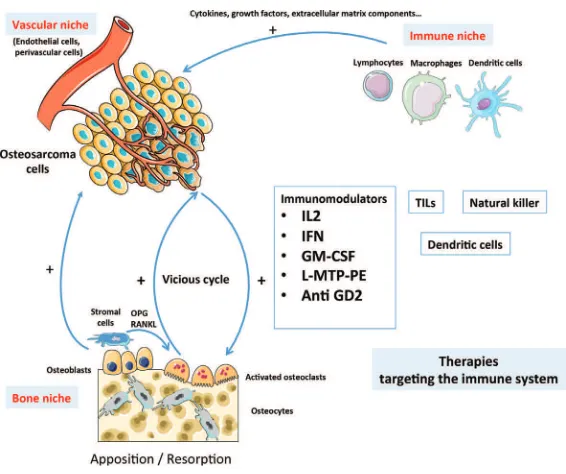
OPG RANK RANKL provoking exacerbated local bone remodelling Figure 1 As a result
numerous factors initially trapped in this matrix are released which in turn stimulate sarcoma cell proliferation leading to the establishment of a vicious cycle between bone and tumour cells These events are associated with early and late events in the metastatic process by promoting the neoangiogenesis and extravasation of tumour cells , But until today
the characterisation of the microenvironment of OS has not been fully documented , ].
The immune niche with its huge cell diversity including more speci cally tumour in ltrating lymphocytes TILs and tumour associated macrophages TAMs regulates the OS micro
-environment , TAMs exert di erent e ects on tumour development because of their
polarisation In oncology M polarised macrophages are considered to be anti tumour e ec
-tors and M polarised macrophages are de ned as pro tumour modula-tors as they increase the neoangiogenic process – The density of TAMs is correlated with tumour cell pro
-liferation invasion metastasis and poor prognosis in various epithelial and haematological cancers and in bone metastases ].
2. The immune niche in osteosarcoma
As said above the niche of OS is composed of a complex network of diverse cells which interact together by direct contacts or in an autocrine paracrine endocrine manner involving cytokines and growth factors This chapter will focus speci cally on the main cellular pro
-tagonists lymphocytes macrophages and the principal associated cytokines
Tumour in ltrating lymphocytes TILs
Heterogeneity of tumour cells with various osteosarcoma sub entities further complicates identi cation of robust biomarkers with broad clinical application Analysis of the tumour microenvironment in patients with a variety of haematological pathologies and solid tumours such as bone metastases and soft tissue sarcomas has revealed that a major subset of tumours shows evidence of a T cell in ltrated phenotype , Selected T lymphocytes migrate from
secondary lymphoid organs to the tumour sites and invade the tumour tissues They are com
[image:4.482.100.383.68.305.2]-posed of various T lymphocyte subpopulations which exhibit highly speci c immunological
Figure 1. Osteosarcoma and its niches In osteosarcoma the microenvironment plays a pivotal role in the pathogenesis
reactivity compared to circulating and non in ltrating lymphocytes The nal immune response resulting from the activation of T lymphocytes is complex and depends on the nature of these T cells e g Treg CD + and the presence of the other immune protagonists
such as macrophages
As other immune cells lymphocytes seem to play an essential role in osteosarcoma growth and prognosis but publications reporting this population in OS remain rare , , ]. The
presence of T lymphocytes in human OS tissues was previously studied by Trieb et al by immunohistochemical techniques Phenotypic analyses have revealed that the in ltrat
-ing lymphocytes into OS were CD +and CD + At this time human CD +Treg was
unknown and not included in the study which did not detect any correlation of TILs with OS outcome A few years later Theoleyre et al supported the presence of speci c T subpopula
-tions in OS TILs isolated from OS samples exhibited lytic activityin vitro which were appar
-ently no e cient in patients The study of the microenvironment has a strong impact on targeted patient treatment for which li le progress has been achieved since introduction of neo adjuvant chemotherapy years ago Prognostic biomarkers for risk strati cation at the time of diagnosis are missing and are a major drawback in clinical testing of novel thera
-peutic agents Alternatively analysis of the tumour microenvironment for osteosarcoma out
-come related biomarkers might be less dependent from the osteosarcoma subtype Recently Fri sching et al have reported for the rst time CD +FOXP +ratio as strong prognostic fac
-tor at time of OS diagnosis pointing out the functional key role of Treg in OS pathogenesis Multivariate analysis showed that this novel parameter was independent from tumour metas
-tasis and response to neoadjuvant chemotherapy and could be validated in an independent patient cohort with current state of diagnosis and treatment of OS It has been suggested in other solid tumours e g colon cancers that intensity of tumour microenvironment in l
-tration with T cells especially cytotoxic tumour in ltrating CD +T cells CD +TILs allows
more powerful prognostic staging than traditional staging The characterisation of this simple immune system based biomarker has been termed the immunoscore and this is currently tested for some tumours in a multicenter study , ].
Lymphocytes are immune cells regulated by diverse cytokines in particular the triad OPG RANK RANKL which represents a se ing up a fertile soil for cancer cells as well 9 Bone
remodelling results from a balance between two opposite cellular activities i osteoblasts in charge of the synthesis of new organic extracellular matrix which will become progressively mineralized and ii osteoclasts specialised in the degradation of the mineralised extracellular matrix process named bone resorption Osteoclastogenesis and osteoclast activities are regu
-lated by a master cytokine called NF B Ligand RANKL member of the tumour necrosis factor TNF superfamily o cial TNF nomenclature TNFSF 9 RANKL is a soluble and
or membrane cytokine expressed by osteoblasts and stromal cells binds to RANK a membrane receptor expressed at the surface of mature osteoclasts and their precursors RANKL binding to RANK induces speci c NF B dependent signal transduction pathways and stimulates osteo
the osteoclast osteoclast precursor membrane is a negative regulator of RANKL RANK acti
-vation see review in Ref 9 It is widely accepted that the multiple components of the bone
niche e g soluble factors extracellular matrix strongly contribute to the bone tumour initia
-tion and the metastatic process , RANKL in uences the microenvironment of cancer
cells by acting on the local immunity Indeed the major role of RANKL in the immune system has been initially identi ed in RANKL knockout mice in which the development of secondary lymphoid organs was impaired especially the lymph nodes but also at the central level where the maturation of thymic epithelial cells necessary for T cell development was a ected
33 RANKL is also involved in the modulation of the immune response by inducing T cell
proliferation 34 and dendritic cells survival Indeed activated T cells through RANKL
expression stimulate dendritic cells expressing RANK to enhance their survival and thereby increase the T cell memory response 34 More recently Khan et al demonstrated that RANKL
blockade can rescue melanoma speci c T cells from thymic deletion and increases anti tumour immune response as shown in melanoma 35 In Mori et al reported for the rst time
functional RANK expression in human OS cells strengthening the involvement of the RANK RANKL OPG axis in OS 36, 37 Moreover in animal OS models OPG gene transfer prevents
the formation of osteolytic lesions associated with OS development in reducing the tumour incidence and the local tumour growth leading to a fourfold increase in mice survival days post implantation 38 This opened a new door of novel therapeutic approaches for OS
Tumour associated macrophages TAMs
The mononuclear phagocyte system is composed by heterogeneous populations participating in the body s rst line of defence against pathogens and parasites 39]. This system includes
cells circulating cells into the body uids such as monocytes and integrates resident cells such as macrophages dendritic cells DC and their precursors located in the bone marrow Their production and activities are controlled by numerous cytokines and growth factors but are more speci cally regulated by the two ligands of macrophage colony stimulating fac
-tor M CFR cFMS or CD M CSF or CSF and interleukin IL , ].
TAMs are the predominant leukocytes in ltrating solid tumours and can represent up to of the tumour mass These cells play a pivotal role in tumour behaviour illustrated by the signi cant link between TAM number and density and the prognosis , 43, 44 Whereas
TAMs can exert anti tumour activities the ambiguous role of macrophages in tumour pro
-gression is re ected in the nding that TAMs can also actively contribute to each stage of cancer development and progression 45 Macrophage subtypes are conventionally classi ed
in M considered as the classical population and M identi ed as an alternative subpopula
-tion in link to their di erentia-tion activa-tion state However if the parallel between M and M can be drawn with the Th and Th T lymphocyte classi cation Th Th cells do not regulate macrophage polarisation On the contrary macrophage subtypes are versatile are non permanent cell populations initiate and in uence T lymphocyte polarisation resulting in di erential immune response e g Th response against virus and bacteria Th response against parasites 46 Indeed M and M macrophages are characterised by speci c pro les
of infections and anti tumour activities On the opposite M macrophages constitute a het
-erogeneous population M a b and c inducing a Th immune response and secreting IL IL and IL M macrophages are pro angiogenic pro brotic and pro tumorigenic The exact role of macrophages in OS is still unclear and controversial Some studies have de ned TAMs as anti tumour e ectors Buddingh et al thus demonstrated that higher TAM in ltration was associated with be er overall survival in high grade osteosarcoma However the authors did not observe any di erences between metastatic and non metastatic osteosar
-comas and TAMs exhibited both M and M characteristics 47 On the contrary the impact
of macrophages in tumour development has been also suspected Lewis and Pollard distin
-guished the anti tumour M macrophages from M macrophages leading to tumour growth and invasion angiogenesis metastasis and immune suppression OS development may thus be accompanied by a switch in the phenotype of in ltrating TAMs from anti metastatic M macrophages to pro metastatic M macrophages This hypothesis is in agreement with
the in vivo work described by Xiao et al who showed a switch in macrophage subpopu
-lations in a mouse model of human osteosarcoma from M macrophages during the rst week of tumour growth to M macrophages after weeks 48 In addition Pahl et al
demonstrated that human M like macrophages can be induced to exert direct anti tumour activity against osteosarcoma cells mediated by TNF and IL 49 In the same manner
Ségaliny et al demonstrated that osteosarcoma cells expressed IL increasing the recruit
-ment of M polarised macrophages into the tumour tissue which correlates with tumour vascularization and the metastatic process TAMs accumulate in tumour microenviron
-ment and according to their M or M phenotype contribute to tumour growth angiogenesis and metastasis RANK is present at the cell membrane of monocytes macrophages and RANKL acts as chemoa ractant factor for these cells M subtype is strongly associated with the angiogenic process and interestingly RANK is mainly expressed by M macrophage subtype 53 RANK RANKL signalling in M subtype modulates the production of chemo
-kines promoting the proliferation of Treg lymphocytes in favour of an immunosuppressive environment 54 In breast carcinoma RANKL is mainly produced by CD +CD + T
lym-phocytes expressing Foxp and corresponding to Treg lymlym-phocytes In this context a vicious cycle is established between TAMs Treg and tumour cells resulting in the tumour growth the spreading of cancer cells and the ampli cation of the metastatic process 55].
Recent therapeutic developments based on the regulation of the immune system of osteosarcoma immunomodulating drugs
The therapeutic protocol currently used for osteosarcoma was established by Rosen et al at the end of the s 56 It comprises preoperative neoadjuvant chemotherapy associating
mainly four drugs doxorubicin cisplatin methotrexate and ifosfamide 57 and followed by
surgical removal of all detectable disease including metastases and postoperative adjuvant chemotherapy preferably within the se ing of clinical trials 58 OS is considered resistant to
applicable doses of radiation 59, Supplemental therapeutic approaches such as chemoem
-bolisation or angioem-bolisation thermal ablation radiofrequency ablation and cryotherapy are experimental or palliative 59 Unfortunately patients who are diagnosed with meta
improvements in survival seen over the past years Several reports have underlined the therapeutic value of using immunotherapies or immunomodulatory based therapies for osteosarcoma , –64 In this context the number of new drugs activating the immune
system has exploded in the last years and numerous phase I and II clinical trials are in progress in osteosarcoma Figure 1 In this chapter the most recent therapeutic develop
-ments targeting the regulation of T lymphocytes and macrophages will be exposed
2.3.1. T-cell therapies
Detection of speci c T lymphocyte populations in the tumour microenvironment and in human tumour tissues de nes an immunoscore and leads to patient strati cation based on this immunophenotyping These analyses have identi ed new predictive biomarkers and new therapeutic targets which have stimulated the development of immunotherapies 65].
2.3.1.1. Disialoganglioside (GD2)
Monoclonal antibodies targeted against cell surface antigens speci c to tumour cells have been proven to be e ective in patients with breast cancer lymphoma and neuroblastoma
66–68 Usually these bispeci c antibodies are engineered antibodies linking a tumour anti
-gen recognition domain to a second domain that activates a receptor on immune e ector cells typically T cells The expression of the glycosphingolipid GD is restricted to the central and peripheral nervous system skin melanocyte and mesenchymal cells located in the stroma
69– In addition to the healthy tissues GD was detected in neuroblastomas melano
-mas sarco-mas lung and central nervous system tumours in which a variable number of cancer cells express this antigen –75 Based on this relative restricted distribution GD
targeting appeared very quickly as an interesting immunotherapy especially for high risk neuroblastomas for which anti GD antibodies improved signi cantly patient survival 68, 76 In patients with stage IV neuroblastoma anti GD antibody ch has been shown to
improve EFS e ectively when given in the se ing of minimal residual disease The rationale for using this antibody in patients with OS lies in that of osteosarcoma express GD 77].
Consequently given the success of anti GD mAb therapy in neuroblastoma studies explor
-ing the use of these mAbs in OS are underway 78 Current trials include the GD mAbs
humanized F NCT and NCT and hu K A NCT ].
2.3.1.2. Nivolumab
Nivolumab is an immunomodulator which acts by blocking the activation of the pro
-grammed cell death PD receptor induced by one of its two ligands PD L on activated T cells 79 Numerous preclinical investigations have demonstrated that inhibition of the
solid tumours and sarcomas including osteosarcoma A total of patients will be enrolled and treated with Nivolumab IV over minutes twice a month Courses repeat every days in the absence of disease progression or unacceptable toxicity
2.3.2. Immune and dendritic cell vaccine
Dendritic cells have the speci c ability to initiate and modulate adaptive immune responses This speci city associated with their role in antigen presentation has led to their use in vaccine approaches in cancer Matured autologous dendritic cells loaded with tumour lysates derived from tumour tissue were used as the vaccine product In a pre clinical model of osteo
-sarcoma it has been demonstrated that killer dendritic cells were able to induce an adaptive anti tumour immune response with a decrease in tumour development after cross presentation of the tumour cell derived antigen 83 A phase I clinical trial demonstrated the feasibility and
good tolerance of dendritic cells pulsed with MAGE A MAGE A and NYESO full length peptides in combination with decitabine Anti tumour activity was observed in some patients
84 In osteosarcoma patients were vaccinated with tumour lysate pulsed dendritic
cells but evidence of a clinical bene t was observed in only two of these patients 85]. These
authors concluded that osteosarcoma patients may be relatively insensitive to DC based vac
-cine treatments A new clinical trial was initiated enrolling patients year with con rmed sarcoma either relapsed or without known curative therapies and treated with autologous den
-dritic cells pulsed with tumour lysate NCT is a pilot trial Pilot Study of Expanded Activated Haploidentical Natural Killer Cell Infusions for Sarcomas NKEXPSARC analys
-ing the e ect of donor NK cells on clinical response determined by imag-ing About patients aged months years will be included between and The patients will receive lym
-phodepleting chemotherapy with cyclophosphamide day followed by udarabine days and each patient will receive IL day before infusion of the NK cell total six doses
2.3.3. Mifamurtide (liposomal-muramyl tripeptide phosphatidyl-ethanolamine L-MTP-PE)
As it has been discussed above the density of TAM is linked to a poor diagnosis In osteosar
-coma Buddingh et al showed that macrophages exhibit M and M phenotypes and demon
-strated a link between M macrophages and angiogenesis Similarly in preclinical models of osteosarcoma the recruitment of the M subtype is correlated with tumour angiogenesis and lung metastasis 47, ].
L MTP PE is a synthetic analogue of muramyl dipeptide of the bacterial cell walls which was identi ed as a powerful activator or monocyte macrophage lineage Indeed L MTP PE induces the expression of pro in ammatory mediators such TNF IL IL lympho
-cyte function associated antigen LFA and intercellular adhesion molecule ICAM leading to an M macrophage response The therapeutic interest of L MTP PE was widely studied in osteosarcoma 86, 87 The largest clinical experience with combination chemo
-therapy and L MTP derives from the Intergroup osteosarcoma study No di erence in survival was found for patients who received ifosfamide in addition to the standard three drug chemotherapy doxorubicin cisplatin and methotrexate But this study did sug
between the two groups of treatment concerning the patients with metastatic disease with
-out L MTP versus with L MTP p Based on these results the European Medicines
Agency granted L MTP an indication for the treatment of non metastatic osteosarcoma in the American Food and Drug Administration FDA did not L MTP is also approved for use in Turkey Mexico and Israel Recently Biteau et al have proved the e cacy of association of zoledronate and L mifamurtide combination in osteosarcoma This association induced an additional and in some cases synergistic inhibition of primary tumour progression 89].
2.3.4. Inhaled granulocyte-macrophage colony stimulating factor (GM-CSF)
GM CSF is one of the master regulators of myeloid cell lineage by controlling their di eren
-tiation proliferation and activities Indeed this growth factor exerts immunomodulatory and immunostimulatory activities by stimulating the functional activities of neutrophil granulocytes but also of macrophages and DC More speci cally GM CSF promotes the recruitment and cyto
-toxic functions of macrophages stimulates natural killer and dendritic cells and consequently upmodulates the number of CD T lymphocytes Arndt et al have recently performed a phase I clinical trial using inhaled GM CSF in patients with rst isolated pulmonary recurrence of OS Unfortunately even though the clinical studies demonstrated the safety of administered GM CSF e g aerosolized delivery no biological bene t e g local immunomodulation in lung metastases or improved clinical outcome was demonstrated A future larger prospective ran
-domised trial may demonstrate improved outcomes in OS patients probably , ].
Conclusion
The therapies focused on the immune niche partially represent the potential therapeutic tar
-gets available for OS nowadays Blood vessels bone cells and tumour cells are targeted as well in the current clinical trials However in the future the key to success will lie in be er understanding and characterisation of the disease leading to be er patient strati cation and consequently to personalised medicine
Acknowledgements
This work was supported by the Bone Cancer Research Trust UK research project number
Author details
Marie Françoise Heymann and Dominique Heymann Address all correspondence to m heymann she eld ac uk
References
Fidler IJ The pathogenesis of cancer metastasis the seed and soil hypothesis revisited Nat Rev Cancer
Paget S The distribution of secondary growths in cancer of the breast Cancer Metastasis Rev
Plaks V Kong N Werb Z The cancer stem cell niche how essential is the niche in regu
-lating stemness of tumour cells Cell Stem
Ordóñez Morán P Huelsken J Complex metastatic niches already a target for therapy Curr Opin Cell Biol
Iwasaki H Suda T Cancer stem cells and their niche Cancer Sci
Basak GW Srivastava AS Malhotra R Carrier E Multiple myeloma bone marrow niche Curr Pharm Biotechnol
Wan L Pantel K Kang Y Tumour metastasis moving new biological insights into the clinic Nat Med
Landskron G De la Fuente M Thuwajit P Hermoso MA Chronic in ammation and cytokines in the tumour microenvironment J Immunol Res
Renema N Navet B Heymann MF Lezot F Heymann D RANK RANKL signalling in cancer Biosci Rep e
Grimaud E Soubigou L Couillaud S Coipeau P Moreau A Passuti N et al Receptor activator of nuclear factor kappa B ligand RANKL osteoprotegerin OPG ratio is increased in severe osteolysis Am J Pathol
Ungefroren H Sebens S Seidl D Lehnert H Hass R Interaction of tumour cells with the microenvironment Cell Commun Signal
Zhu L McManus MM Hughes DPM Understanding the biology of bone sarcoma from early initiating events through late events in metastasis and disease progression Front Oncol
Alfranca A Martinez Cruzado L Tornin J Abarrategi A Amaral T de Alava E et al Bone microenvironment signals in osteosarcoma development Cell Mol Life Sci
Ando K Heymann MF Stresing V Mori K Rédini F Heymann D Current therapeutic strategies and novel approaches in osteosarcoma Cancers
Endo Munoz L Evdokiou A Saunders NA The role of osteoclasts and tumour associ
-ated macrophages in osteosarcoma metastasis Biochim Biophys Acta
Theoleyre S Mori K Cherrier B Passuti N Gouin F Rédini F et al Phenotypic and func
-tional analysis of lymphocytes in ltrating osteolytic tumours use as a possible thera
Gordon S Martinez FO Alternative activation of macrophages mechanism and func
-tions Immunity
Lewis CE Pollard JW Distinct role of macrophages in di erent tumour microenviron
-ments Cancer Res
Qian BZ Pollard JW Macrophage diversity enhances tumour progression and metasta
-sis Cell
Rogers TL Holen I Tumour macrophages as potential targets of bisphosphonates J Transl Med
Criscitiello C Viale G Gelao L Esposito A De Laurentiis M De Placido S Santangelo M Goldhirsch A Curigliano G Crosstalk between bone niche and immune system osteoimmunology signaling as a potential target for cancer treatment Cancer Treat Rev
Fri sching B Fellenberg J Moskovszky L Sápi Z Krenacs T Machado I Poeschl J Lehner B Szendrõi M Bosch AL Bernd L Csóka M Mechtersheimer G Ewerbeck V Kinscherf R Kunz P CD +FOXP +ratio in osteosarcoma microenvironment separates survivors
from non survivors a multicenter validated retrospective study Oncoimmunology e
Adams S Gray RJ Demaria S Goldstein L Perez EA Shulman LN Martino S Wang M Jones VE Saphner TJ Wol AC Wood WC Davidson NE Sledge GW Sparano JA Badve SS Prognostic value of tumour in ltrating lymphocytes in triple negative breast cancers from two phase III randomized adjuvant breast cancer trials ECOG and ECOG J Clin Oncol
Sorbye SW Kilvaer T Valkov A Donnem T Smeland E Al Shibli K Bremnes RM Busund LT Prognostic impact of lymphocytes in soft tissue sarcomas PLoS One
e
Rosenberg SA Progress in human tumour immunology and immunotherapy Nature
Trieb K Lechleitner T Lang S Windhager R Ko R Dirnhofer S Evaluation of HLA DR expression and T lymphocyte in ltration in osteosarcoma Pathol Res Pract
Galon J Pages F Marincola FM Angell HK Thurin M Lugli A Zlobec I Berger A Bifulco C Bo i G et al Cancer classi cation using the Immunoscore a world wide task force J Transl Med
Mlecnik B Tosolini M Kirilovsky A Berger A Bindea G Meatchi T Bruneval P Trajanoski Z Fridman WH Pages F et al Histopathologic based prognostic factors of colorectal cancers are associated with the state of the local immune reaction J Clin Oncol
predominantly expressed in T cells isadendritic cells peci c survival factor J Exp Med
Yasuda H Shima N Nakagawa N Mochizuki SI Yano K Fujise N Sato Y Goto M Yamaguchi K Kuriyama M Kanno T Murakami A Tsuda E Morinaga T Higashio K Osteoclast di erentiation factor is a ligand for osteoprotegerin osteoclastogene
-sis inhibitory factor and is identical to TRANCE RANKL Proc Natl Acad Sci U S A
Ikeda T Kasai M Utsuyama M Hirokawa K Determination of three isoforms of the receptor activator of nuclear factor kappa B ligand and their di erential expression in bone and thymus Endocrinology
Mueller CG Hess E Emerging functions of RANKL in lymphoid tissues Front Immunol
Akiyama T Shimo Y Yanai H Qin J Ohshima D Maruyama Y Asaumi Y Kitazawa J Takayanagi H Penninger JM Matsumoto M Ni a T Takahama Y Inoue J The tumour necrosis factor family receptors RANK and CD cooperatively establish the thymic medullary microenvironment and self tolerance Immunity
Anderson DM Maraskovsky E Billingsley WL Dougall WC Tometsko ME Roux ER Teepe MC DuBose RF Cosman D Galibert L A homologue of the TNF Receptor and its ligand enhance T cell growth and dendritic cell function Nature
Khan IS Mouchess ML Zhu ML Conley B Fasano KJ Hou Y Fong L Su MA Enhancement of an anti tumour immune response by transient blockade of central T cell tolerance J Exp Med
Mori K Rédini F Gouin F Cherrier B Heymann D Osteosarcoma current status of immunotherapy and future trends Oncol Rep
Mori K Le Go B Berreur M Riet A Moreau A Blanchard F Chevalier C Guisle Marsollier I Léger J Guicheux J Masson M Gouin F Rédini F Heymann D Human osteosarcoma cells express functional receptor activator of nuclear factor kappa B J Pathol
Lamoureux F Richard P Wi rant Y Ba aglia S Pilet P Trichet V Blanchard F Gouin F Pitard B Heymann D Redini F Therapeutic relevance of osteoprotegerin gene therapy in osteosarcoma blockade of the vicious cycle between tumour cell proliferation and bone resorption Cancer Res
van Furth R Cohn ZA The origin and kinetics of mononuclear phagocytes J Exp Med
Taylor PR Gordon S Monocytes heterogeneity and innate immunity Immunity
Heymann D Interleukin an enigmatic cytokine IBMS BoneKey
Bingle L Brown NJ Lewis CE The role of tumour associated macrophages in tumour progression implications for new anticancer therapies J Pathol
Zhang QW Liu L Gong CY Shi HS Zeng YH Wang XZ Zhao YW Wei YQ Prognostic signi cance of tumor associated macrophages in solid tumor a meta analysis of the lit
-erature PLoS One e
Laoui D Van Overmeire E De Baetselier P Van Ginderachter JA Raes G Functional relationship between tumor associated macrophages and macrophage colony stimulat
-ing factor as contributors to cancer progression Front Immunol
Mills CD Kincaid K Alt JM Heilman MJ Hill AM M M macrophages and the Th Th paradigm J Immunol
Buddingh EP Kuijjer ML Duim RA Bürger H Agelopoulos K Myklebost O et al Tumour in ltrating macrophages are associated with metastasis suppression in high grade osteosarcoma a rationale for treatment with macrophage activating agents Clin Cancer Res
Xiao Q Zhang X Wu Y Yang Y Inhibition of macrophage polarization prohibits growth of human osteosarcoma Tumour Biol
Pahl JHW Kwappenberg KM Varypataki EM Santos SJ Kuijjer ML Mohamed S et al Macrophages inhibit human osteosarcoma cell growth after activation with the bacterial cell wall derivative liposomal muramyl tripeptide in combination with interferon J Exp Clin Cancer Res
Ségaliny AI Mohamadi A Dizier B Lokajczyk A Brion R Lanel R et al Interleukin promotes tumour progression and metastatic process in osteosarcoma through induc
-tion of angiogenesis and macrophage recruitment Int J Cancer
Cook J Hagemann T Tumour associated macrophages and cancer Curr Opin Pharmacol
Breuil V Schmid Antomarchi H Schmid Alliana A Rezzonico R Euller Ziegler L Rossi B The receptor activator of nuclear factor NF kappa B lignad RANKL is a new che
-motactic for human monocytes FASEB J
Kambayashi Y Fujimura T Furudate S Asano M Kakizaki A Aiba S The possible interaction between receptor activator of nuclear factor kappa B ligand expressed by extramammary paget cells and its ligand on dermal macrophages J Invest Dermatol
Fujimura T Kambayashi Y Furudate S Asano M Kakizaki A Aiba S Receptor activator of NF kappa B ligand promotes the production of CCL from RANK M macro
-phages J Invest Dermatol
Rosen G Tan C Sanmaneechai A Bea ie EJ Jr Marcove R Murphy ML The ratio
-nale for multiple drug chemotherapy in the treatment of osteogenic sarcoma Cancer
Bacci G Longhi A Fagioli F Briccoli A Versari M Picci P Adjuvant and neoadjuvant chemotherapy for osteosarcoma of the extremities year experience at Rizzoli Institute Eur J Cancer
Chou AJ Geller DS Gorlick R Therapy for osteosarcoma where do we go from here Paediatr Drugs
Errani C Longhi A Rossi G et al Palliative therapy for osteosarcoma Expert Rev Anticancer Ther
Schwarz R Bruland O Cassoni A Schomberg P Bielack S The role of radiotherapy in oseosarcoma Cancer Treat Res
Roberts SS Chou AJ Cheung NK Immunotherapy of Childhood Sarcomas Front Oncol
DeRenzo C Go schalk S Genetically modi ed T cell therapy for osteosarcoma Adv Exp Med Biol
Li Z Potential of human T cells for immunotherapy of osteosarcoma Mol Biol Rep
Tarek N Lee DA Natural killer cells for osteosarcoma Adv Exp Med Biol
Gajewski TF Schreiber H Fu YX Innate and adaptive immune cells in the tumor micro
-environment Nat Immunol
Coi er B Lepage E Brière J et al CHOP chemotherapy plus rituximab compared with CHOP alone in elderly patients with di use large B cell lymphoma N Engl J Med
Piccart Gebhart MJ Procter M Leyland Jones B et al Trastuzumab after adjuvant che
-motherapy in HER positive breast cancer N Engl J Med
Yu AL Gilman AL Ozkaynak MF et al Anti GD antibody with GM CSF interleu
-kin and isotretinoin for neuroblastoma N Engl J Med
Hersey P Jamal O Henderson C Zardawi I D Alessandro G Expression of the ganglio
-sides GM GD and GD in tissue sections of normal skin naevi primary and meta
-static melanoma Int J Cancer
Martinez C Hofmann TJ Marino R Dominici M Horwi EM Human bone marrow mesenchymal stromal cells express the neural ganglioside GD a novel surface marker for the identi cation of MSCs Blood
Cheung N Kushner B Yeh S Larson S F monoclonal antibody treatment of patients with stage neuroblastoma a phase II study Int J Oncol
Cheung N Lazarus H Miraldi FD et al Ganglioside GD speci c monoclonal antibody F a phase I study in patients with neuroblastoma and malignant melanoma J Clin Oncol
Heiner JP Miraldi F Kallick S et al Localization of GD speci c monoclonal antibody F in human osteosarcoma Cancer Res
Cheung NKV Canete A Cheung IY Ye JN Liu C Disialoganglioside GD anti idiotypic monoclonal antibodies Int J Cancer
Cheung N KV Cheung IY Kushner BH et al Murine anti GD monoclonal antibody F combined with granulocyte macrophage colony stimulating factor and cis reti
-noic acid in highrisk patients with stage neuroblastoma in rst remission J Clin Oncol
Roth M Linkowski M Tarim J et al Ganglioside GD as a therapeutic target for anti
-bodymediated therapy in patients with osteosarcoma Cancer
Gorlick R Janeway K Lessnick S Randall RL Marina N COG Bone Tumor Commi ee Children s Oncology Group s blueprint for research bone tumors Pediatr Blood Cancer
Hamanishi J Mandai M Matsumura N Abiko K Baba T Konishi I PD PD L block
-ade in cancer treatment perspectives and issues Int J Clin Oncol
Shen JK Cote GM Choy E et al Targeting programmed cell death ligand in osteosarcoma an auto commentary on therapeutic potential Oncoimmunology
e
Zheng W Xiao H Liu H Zhou Y Expression of programmed death is correlated with progression of osteosarcoma APMIS
Constantino J Gomes C Falcão A Cruz MT Neves BM Antitumor dendritic cell based vaccines lessons from years of clinical trials and future perspectives Transl Res
Chauvin C Philippeau JM Hémont C Hubert FX Wi rant Y Lamoureux F Trinité B Heymann D Rédini F Josien R Killer dendritic cells link innate and adaptive immunity against established osteosarcoma in rats Cancer Res
Krishnadas DK Shusterman S Bai F Diller L Sullivan JE Cheerva AC George RE Lucas KG A phase I trial combining decitabine dendritic cell vaccine targeting MAGE A MAGE A and NY ESO for children with relapsed or therapy refractory neuroblas
-toma and sarcoma Cancer Immunol Immunother
tumour lysate pulsed dendritic cell vaccination in patients with relapsed osteosarcoma Clin Transl Oncol
Kleinerman ES Jia SF Gri NJ Seibel NL Benjamin RS Ja EN Phase II study of liposomal muramyl tripeptide in osteosarcoma the cytokine cascade and monocyte activation fol
-lowing administration J Clin Oncol
Ando K Mori K Corradini N Redini F Heymann D Mifamurtide for the treatment of nonmetastatic osteosarcoma Expert Opin Pharmacother
Meyers PA Schwar CL Krailo MD Healey JH Bernstein ML Betcher D et al Osteosarcoma the addition of muramyl tripeptide to chemotherapy improves overall survival a report from the children s oncology group J Clin Oncol
Biteau K Guiho R Chatelais M Taurelle J Chesneau J Corradini N Heymann D Redini F L MTP PE and zoledronic acid combination in osteosarcoma preclinical evidence of positive therapeutic combination for clinical transfer Am J Cancer Res
Lamplot JD Denduluri S Qin J Li R Liu X Zhang H Chen X Wang N Pra A Shui W Luo X Nan G Deng ZL Luo J Haydon RC He TC Luu HH The current and future therapies for human osteosarcoma Curr Cancer Ther Rev
Arndt CA Koshkina NV Inwards CY Hawkins DS Krailo MD Villaluna D Anderson PM Goorin AM Blakely ML Bernstein M Bell SA Ray K Grendahl DC Marina N Kleinerman ES Inhaled granulocyte macrophage colony stimulating factor for rst pulmonary recurrence of osteosarcoma e ects on disease free survival and immu
-nomodulation A report from the Children s Oncology Group Clin Cancer Res