https://doi.org/10.1051/0004-6361/201833459 c
ESO 2018
Astronomy
&
Astrophysics
Testing general relativity with geodetic VLBI
What a single, specially designed experiment can teach us
O. Titov
1, A. Girdiuk
2, S. B. Lambert
3, J. Lovell
4, J. McCallum
4, S. Shabala
4, L. McCallum
4, D. Mayer
2,
M. Schartner
2, A. de Witt
5, F. Shu
6, A. Melnikov
7, D. Ivanov
7, A. Mikhailov
7, S. Yi
8, B. Soja
9,
B. Xia
6, and T. Jiang
61 Geoscience Australia, PO Box 378, Canberra, ACT 2601, Australia
e-mail:[email protected]
2 Department of Geodesy and Geoinformation, Research Group Advanced Geodesy, TU Wien, Gusshausstraße 27-29/E120.4, Wien
1040, Austria
3 SYRTE, Observatoire de Paris, Université PSL, CNRS, Sorbonne Université, LNE, Paris, France 4 University of Tasmania, Private Bag 37, Hobart, Tasmania 7001, Australia
5 Hartebeesthoek Radio Astronomy Observatory, PO Box 443, Krugersdorp 1740, South Africa 6 Shanghai Astronomical Observatory, 80 Nandan Road, Shanghai 200030, PR China
7 Institute of Applied Astronomy, Kutuzov Embankment, 10, Saint-Petersburg 191187, Russia
8 National Geographic Information Institute, Space Geodetic Observatory, PO Box 30060, Sejong, South Korea 9 Jet Propulsion Laboratory, California Institute of Technology, 4800 Oak Grove Drive, Pasadena, CA 91109, USA
Received 21 May 2018/Accepted 26 June 2018
ABSTRACT
Context.We highlight the capabilities of geodetic VLBI technique to test general relativity in the classical astrometric style, i.e. measuring the deflection of light in the vicinity of the Sun.
Aims.In previous studies, the parameterγwas estimated by global analyses of thousands of geodetic VLBI sessions. Here we estimate γfrom a single session where the Sun has approached two strong reference radio sources, 0229+131 and 0235+164, at an elongation angle of 1–3◦
.
Methods.The AUA020 VLBI session of 1 May 2017 was designed to obtain more than 1000 group delays from the two radio sources. The solar corona effect was effectively calibrated with the dual-frequency observations even at small elongation.
Results.We obtainedγwith a greater precision (0.9×10⁻⁴) than has been obtained through global analyses of thousands of standard
geodetic sessions over decades. Current results demonstrate that the modern VLBI technology is capable of establishing new limits on observational tests of general relativity.
Key words. astrometry – techniques: interferometric – gravitation
1. Introduction
Very long baseline interferometry (VLBI) measures the diff er-ence in arrival times (known as group delay) of radio waves at two radio telescopes from distant radio sources with a pre-cision of 20–40 ps (Schuh & Behrend 2012). The observations are carried out at two frequency bands: 2.3 GHz (S-band) and 8.4 GHz (X-band); the lower frequency is used to calibrate iono-spheric fluctuations inX-band data. By combining many years of observations, this technique is capable of producing very accu-rate positions of the reference radio sources; for example, the error floor of the current realization of the fundamental celestial reference frame, the ICRF2, is 40µas (Fey et al. 2015). For one standard single geodetic VLBI experiment, positions of radio sources are estimated with an accuracy of about 0.1–1 mas.
In accordance with general relativity (Einstein 1916) the radio waves slow down due to the gravitational potential of the Sun (known as the Shapiro effect; see Shapiro 1964,
1967), making VLBI a useful tool for testing general relativity by means of the parameterized post-Newtonian (PPN) formalism
(Will 1993). Nevertheless, the accuracy of the PPN param-eter γ obtained from absolute or differential VLBI obser-vations (Fomalont et al. 2009; Lambert & Le Poncin-Lafitte 2009, 2011) is lower than the current best limit of (2.1 ± 2.3)×10−5 based on the Cassini radio science experiments (Bertotti et al. 2003) by an order of magnitude. The upper limits on the parameter γ have been improved substantially over the past 30 yr (Robertson & Carter 1984;Robertson et al. 1991; Lebach et al. 1995; Fomalont & Kopeikin 2003), but some authors (Shapiro et al. 2004;Lambert & Le Poncin-Lafitte 2009) have found degradation in the estimates ofγwith elon-gation, and have suggested that this systematic effect may limit the improvement in the VLBI-derivedγupper limits, despite the dramatic growth in the number of observations in recent decades. The current paper focuses on radio source approaches at angular distances less than 3◦from the centre of the Sun in order to measure the light deflection effect at the highest magnitude, and thus to avoid a possible bias caused by observations at larger elongations. We report on a special VLBI session, AUA020, that was run in May 2017 and on the single-session estimates ofγ.
Open Access article,published by EDP Sciences, under the terms of the Creative Commons Attribution License (http://creativecommons.org/licenses/by/4.0),
2. Data
The gravitational delay calculated as the difference between two Shapiro delays (Kopeikin 1990;Klioner 2003;Soffel et al. 1991;
Petit & Luzum 2010) is given by
τgrav =
(1+γ)GM c3 ln
|r1|+|r1·s| |r2|+|r2·s|
, (1)
whereGis the gravitational constant,M is the mass of deflect-ing body,cis the speed of light in vacuum,sis the unit vector in the direction of the radio source, and r1 and r2 are geocentric
distances of the two radio telescopes. The gravitational delay is linked to the light deflection angle (Titov & Girdiuk 2015) which has previously been observed with optical experiments (Dyson et al. 1920).
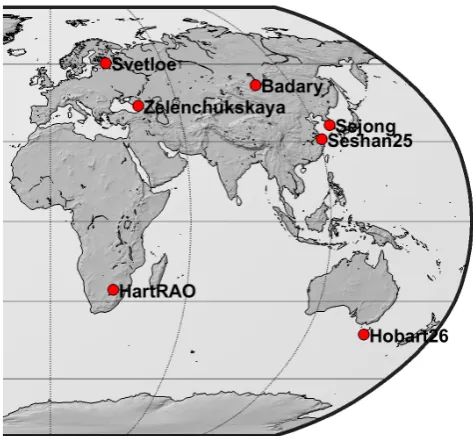
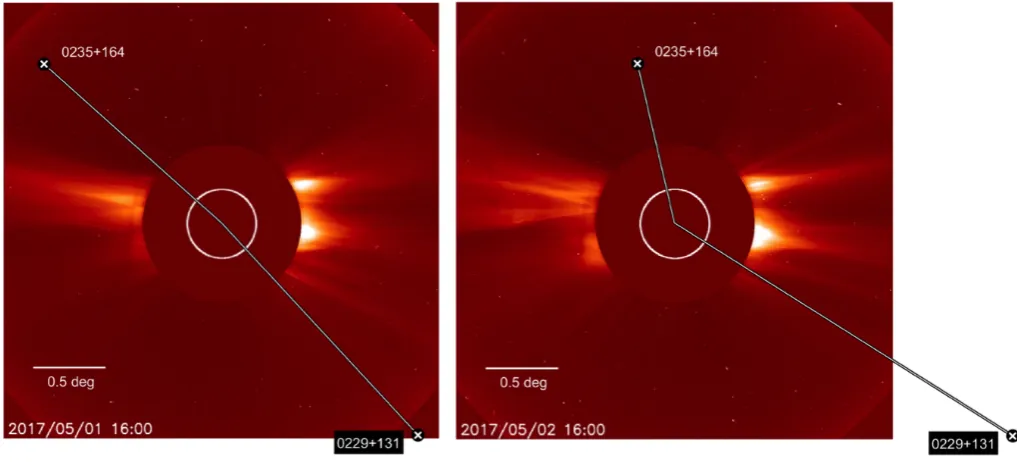
A dedicated geodetic VLBI experiment (AUA020, 01–02 May, 2017, part of the AUSTRAL programme) was scheduled to probe the gravitational delay effect using a network of seven radio telescopes (Svetloe, Zelenchukskaya, Badary, HartRAO, Seshan25, Sejong, and Hobart26) as shown in Fig.1. Two radio sources 0229+131 and 0235+164 were observed at a range of angular distances from 1.15◦ to 2.6◦ from the Sun. The posi-tion of the two radio sources with respect to the Sun at the start of the experiment is shown on Fig.2. A serious issue with this configuration is the solar thermal noise that penetrates to the sig-nal through the side lobes, and could cause loss of data due to striking the signal-to-noise ratio. To overcome the problem, it is necessary to:
(1) select strong radio sources with larger correlated flux density in both frequency bands;
(2) use large radio telescopes with narrow side lobes and better sensitivity; and
(3) use the highest possible data rate recording (e.g. 1 Gbps) to gain a better signal-to-noise ratio over the same integration time.
The schedule of AUA020 was designed to gain as many obser-vations of the two encountered radio sources as possible. The previous attempts to observe reference radio sources close to the Sun used the standard scheduling strategy of geodetic experi-ments. In this mode all sources around the sky are observed a few times over 24 hours to provide a homogeneous sky coverage for each one-hour time span. Therefore, the total number of delays of the sources within 2◦of the Sun was about 10–20 per session. The current schedule was specially prepared using the geode-tic VLBI scheduling and analysis software VieVS (Böhm et al. 2018). From 16 to 22 UT, 1 May the standard geodetic mode was used. From 22 UT, 1 May to 15 UT, 2 May the schedule was focused on 0229+131 and 0235+164 repeating the follow-ing pattern:
1) scan of 0229+131; 2) scan of 0235+164;
3) two standard geodetic scans to improve the sky coverage; 4) start over again with 0229+131, and so on.
[image:2.595.312.549.83.301.2]During the final hour from 15 UT until 16 UT, 2 May the stan-dard geodetic scheduling mode was applied again. The idea was that using this fixed pattern there would be a short slew time between 0229+131 and 0235+164, which increases the total number of scans. Using the strategy, 0235+164 was scheduled 108 times with 846 observations and 0229+131 was scheduled 109 times with 821 observations. Therefore, in spite of a sub-stantial loss of data, the total number of good delays exceeded 1000, making the session outstanding for the testing of general relativity.
Fig. 1.Geometry of the AUA020 session network.
The target radio source 0229+131 is a defining source of the ICRF2 whose position is given with an accuracy close to the ICRF2 noise floor of 40µas. The position of the second target 0235+164 is less accurate by a factor of five, but still at the level of the ICRF2 median error and significantly less that 1 mas. Both sources are compact and their structure indices measured at the time of the ICRF2 work were 2.4 and 1.3, respectively (Ma et al. 2009), ensuring a structure delay lower than 2 ps (Fey & Charlot 1997).
3. Analysis
For the purpose of cross-checking the results and testing their robustness, we processed the VLBI session AUA020 within two independent teams with two independent geodetic VLBI analy-sis software packages. The duplication of the analyses with two software packages also allowed to use some specific options that are available in only one of them. The first analysis package is OCCAM (Titov et al. 2004), which implements the least-squares collocation method (Titov 2000) for calibrating the wet tropo-sphere fluctuations, and which accounts for the mutual correla-tions between observables.
The second package is Calc/Solve (Ma et al. 1986), devel-oped and maintained by the geodetic VLBI group at NASA GSFC, which uses classical least-squares. The modelling of intraday variations of the troposphere wet delay, clocks, and troposphere gradients is realized through continuous piecewise linear functions whose coefficients are estimated every 10 min, 30 min, and 6 h, respectively.
orienta-Fig. 2.Geometry of the radio sources close to the sun at the start (left) and at the end (right) of VLBI session AUA020 with respect to a LASCO C2 image of the solar corona (Brueckner et al. 1995). The Sun is hidden behind the occultation disc of the coronagraph, with the white inner circle representing the limb of the Sun. The field of view is 1.5◦
[image:3.595.42.551.85.316.2]elongation.
Table 1.Estimates ofγ−1 for the session AUA020, in units of 10−4,
along with the sessionχ2and the postfit rms delayrin ps.
γ−1 σγ χ2 r
10−4 10−4 All stations
OCCAM
All scans 0.56 1.15 0.34 28 0235+164 1.34 1.58 0.34 28 0229+131 −1.54 3.41 0.34 28 Both 0.53 1.14 0.34 28 With Sejong downweighted
All scans 0.91 0.94 0.27 21 0235+164 1.64 1.29 0.27 21 0229+131 0.32 2.83 0.27 21 Both 0.89 0.94 0.27 21 Calc/Solve
All sources −0.22 1.10 0.84 26 0235+164 1.85 1.48 0.84 26 0229+131 −6.84 2.53 0.84 26 Both −0.26 1.09 0.84 26
tion parameters were taken from the IERS EOP 14 C 04 data and the IAU 2000A/IAU 2006 nutation and precession models (Mathews et al. 2002;Capitaine et al. 2003). Since VLBI mea-surements of the nutation leaves residuals with respect to IAU 2000A of about 0.2 mas in rms due to various mismodelled and unmodelled nutation components (Dehant et al. 2003), we esti-mate offsets to the celestial pole coordinates.
Radio source positions were fixed to the ICRF2 coor-dinates (Fey et al. 2015). This option, which constitutes one important difference between our analysis strategy and
Lambert & Le Poncin-Lafitte (2009), was used because source coordinates are unlikely to vary during the 24 h of the session, in contrast to the 0.1 mas scale displacements of the radio centre of many radio sources that are observed in long-term VLBI anal-yses and associated with intrinsic phenomena (Fey et al. 1997;
MacMillan & Ma 2007) or the Galactic aberration (Kovalevsky 2003), which could impact the adjustment ofγ.
Though all standard geodetic parameters were estimated using all scans, the parameter γ, whose adjusted values are reported in Table1, was estimated alternatively using all scans and using only scans relevant to either 0229+131 (within 2–3◦ of the Sun), 0235+164 (within 1–2◦to the Sun), or both sources.
4. Results
The uncertainties onγreported in Table1lie between 0.9×10⁻⁴ and 4×10⁻⁴. Our estimates therefore appear as precise as those
obtained from global solutions using thousands of VLBI experi-ments (Lambert & Le Poncin-Lafitte 2009,2011). The best for-mal error is about two times lower whenγis fitted to the obser-vations of the radio source that is two times closer to the centre of the Sun (0235+164) than to that of its counterpart (0229+131). Using all scans returns a result similar to using only scans rele-vant to 0229+131 and 0235+164, and confirms that only sources at small elongation can efficiently constrain the PPN parame-ter. The solutions from the two software packages are consistent within the standard errors. The difference of postfit rms between OCCAM and Calc/Solve might find its origin in the different modelling of the nuisance parameters (stochastic versus CPWL function). No large systematics are detected except a 2.7σ devia-tion in the Calc/Solve solution when only 0229+131 is used. The origin of this difference is unclear: as both solutions started from the same a priori, the issue could be in the estimation method or in the handling of troposphere/clock parameters.
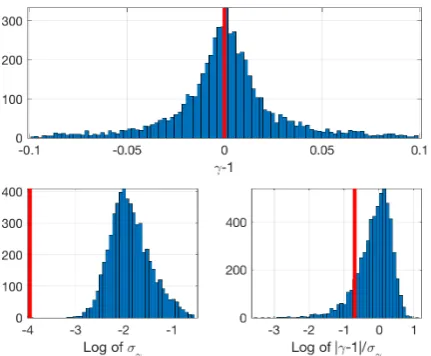
Fig. 3.Distributions of (top) estimates ofγ−1, (bottom left) their formal errors, and (bottom right) normalized estimates ofγ−1 for all of the geodetic VLBI sessions. The vertical red bar stands for the results of the AUA020 session.
For the purpose of comparing the AUA020 session with other standard geodetic VLBI sessions, we estimated γ with Calc/Solve using the parameterization described above for each of sessions of the full geodetic VLBI data base made available by the International VLBI Service for geodesy and astrometry (IVS,
Nothnagel et al. 2017) since 1979. The session list includes both single- and multi-baseline networks (at the exclusion of inten-sive sessions). The median postfit rms is 27 ps, which is close to the postfit rms of the AUA020 session. The distribution of the obtained values ofγ−1 is shown in Fig.3along with dis-tributions of errors and normalized estimates. The distribution of errors in log-scale is slightly asymmetric, exhibiting a “tail” on its right side that might correspond to results from sessions not designed for precise astrometry. Nevertheless, assuming a Gaussian shape, the log-scaled distribution peaks at 10−2with a σof∼0.5. This makes the error estimate from AUA020, which is two orders of magnitude less, somewhat outstanding. The bot-tom right panel of Fig.3shows that most of the sessions do not bring severe systematics, the estimates ofγbeing unity within the formal uncertainties; session AUA020 is part of the session group that presents the lowest systematics.
We also processed solutions parameterized as in
Lambert & Le Poncin-Lafitte (2009, 2011), thus estimating γ as a global parameter over the same 6301 sessions, totaling 12.6 million ionosphere-free group delays. A priori positions for radio sources were taken from the ICRF2 (Fey et al. 2015) and a no-net rotation constraint was applied to the defining sources. The postfit rms delay of the solution is 26 ps and its χ2 per degree of freedom is 1.00. We obtained γ − 1 = (2.72 ±0.92)× 10−4, which is a slight
improve-ment with respect to Lambert & Le Poncin-Lafitte (2011) mainly due to the ∼5.3 million observations accumulated since that work. Removal of the session AUA020 led to γ−1=(2.57±0.97)×10−4, showing that AUA020 marginally, but still at a detectable level, improves the formal error at the level of 5×10⁻⁵. However, these global solutions exhibit system-atics at the level of 2–3σthat may have their origin in spurious or unmodelled deformations of the celestial reference frame arising for example from declination-dependent errors asso-ciated with the global network north–south asymmetry or the influence of troposphere gradient modelling (Mayer et al. 2017), or other effects not yet addressed (e.g. Galactic aberration).
5. Discussion and conclusion
Although we have detected no systematics onγwithin 10−4, sev-eral potential sources of error have to be considered.
The effect of the plasma of the solar corona on the VLBI observations was corrected to first order by a linear combina-tion of the group delays inS and X bands. In order to inves-tigate the magnitude of higher order dispersive effects, higher order terms were computed according toBassiri & Hajj(1993). The coronal electron densityNe was parameterized by a radial
power law, depending on the electron density N0 at the Sun’s
surface, the radial falloffparameterβ, and the distance from the Sun’s centrer in solar radii:Ne(r) = N0r−β. We used the
val-ues N0 = 0.57×10¹²m−3 andβ = 2, which were estimated
from dual-frequency VLBI observations during 2011 and 2012 (Soja et al. 2014). Since the solar conditions during 2011 and 2012 were closer to a solar maximum (Soja et al. 2016) than during AUA020 on May 1, 2017, the selected model can be con-sidered a worst case scenario. Additionally, a dipole model of the background solar magnetic field was assumed with the field strength of 10−3 Tesla at the poles. Using these models for the
electron density and magnetic field, both terms of second and third order (proportional to the inverse third and fourth power of frequency, respectively) turned out to be well below 0.1 ps for the differential observations of VLBI, and thus negligible. A more sophisticated calibration could possibly be achieved by using more rigorous electron density and magnetic field mod-els, taking into account regional differences. However, due to the small magnitude of the higher order terms, it is unlikely that such an effort would change the results concerning the relativis-tic investigations presented in this study.
Furthermore, we investigated the effect of ray path separation on the dispersive delay corrections. Following (Tyler et al. 1977; in particular, their Fig. 4), the different refractivity in theS and
Xbands causes a ray path separation of about 150 km at an elon-gation of 1.2◦(4.5 solar radii). Assuming a projected baseline in radial direction from the Sun of 6000 km, the difference in ray separation is about 1 km between the rays to the two stations. Using the same model for the solar corona electron density, as mentioned above, we compute a dispersiveXband group delay of 7.05 mm for the ray path closer to the Sun and 6.97 mm for the ray path 6000 km further out. The differential delay is thus below 0.1 mm for this scenario, and should be even smaller for the actual observations during AUA020.
While the systematic effects based on radial or dipole mod-els of the corona appear to be negligible, individual group delay observations are affected by random scatter caused by small-scale coronal structure and temporal variations thereof. Since these perturbations do not systematically affect the observations, we assume that they cancel out over the period of observations (17 h with observations angularly close to the Sun). Since the ray paths to the radio sources 0235+164 and 0229+131 within small solar elongation happened to be in quiet regions (see Fig.2), the scatter was small enough that precise group delays could be suc-cessfully determined at such small elongations.
The major source of stochastic noise in VLBI measurements resides in the unknown wet troposphere delay. The difference between VLBI estimates of the wet troposphere delay and inde-pendent radiometer data appears to stay within 3 mm, or 10 ps (Titov et al. 2013) suggesting that the impact of the wet tropo-sphere delay on the astrometric light deflection angle estimation near the Sun is negligible.
demonstrated here that the elongation of 1◦is favourable for suc-cessful observations even for a radio source of moderate flux density. Obviously, a further reduction in the elongation requires a trade-offbetween the higher flux density of a potential candi-date to be observed and exponential growth of the thermal noise reaching the receivers. The flux should be strong enough to pass through the medium surrounding the Sun without dissipation. Since there is no way to make an absolutely reliable prediction about the activity of the solar corona in a particular area near the solar limb, it is necessary to try to schedule an experiment using the best possible initial conditions. Taking the best candidate for this kind of experiment, the best known radio source is 3C 279 (J1256−0574), which combines a small ecliptic latitude of 0.2◦ and flux density that is ten times stronger than for 0229+131 and 0235+164. As the signal-to-noise ratio grows proportionally to the correlated flux density, the exponential increase of the ther-mal noise is likely to be compensated. Therefore, it appears rea-sonable to track the radio source 3C 279 in the range from 0.5◦ to 1.0◦from the centre of the Sun. A successful detection of the signal at 0.5◦would immediately result in an improvement of the uncertainties onγof a factor of two. Another experiment includ-ing 15 radio telescopes to observe the radio source 3C 279 at the same high data recording rate will collect at least 5000 single observations near the Sun (as the number of baselines increases from 21 to 105) with better precision for each single observation than during the May 2017 experiment. Overall, a total improve-ment of the uncertainty on γ of a factor of ten is expected, enabling us to challenge the current limit imposed by the Cassini radio science experiment ofBertotti et al. (2003), although the
Gaiaastrometry on solar system objects is expected to deliver an accuracy of 10−6(Mignard & Klioner 2010;Hees et al. 2018).
Acknowledgements. This paper is published with the permission of the CEO of Geoscience Australia. B. Soja’s research was supported by an appointment to the NASA Postdoctoral Program, administered by Universities Space Research Association, at the Jet Propulsion Laboratory, California Institute of Technol-ogy, under a contract with National Aeronautics and Space Administration. The experiment made use of an ad-hoc VLBI network which consists of Badary, HartRAO, Hobart26, Sejong, Seshan25, Svetloe and Zelenchukskaya stations. The data correlation was performed at the Shanghai VLBI Correlator, hosted and operated by the Shanghai Astronomical Observatory (SHAO) of the Chi-nese Academy of Sciences (CAS). We are grateful to D. Gordon (GSFC) for the post-processing reduction of the AUA020 data and to E. Fomalont whose careful review helped in improving this manuscript.
References
Altamimi, Z., Rebischung, P., Métivier, L., & Collilieux, X. 2016,J. Geophys. Res., 121, 6109
Bassiri, S., & Hajj, G. A. 1993,Manuscripta Geodetica, 18, 280
Bertotti, B., Less, L., & Tortora, P. 2003,Nature, 425, 374
Böhm, J., Werl, B., & Schuh, H. 2006,J. Geophys. Res., 111, b02406
Böhm, J., Böhm, S., Boisits, J., et al. 2018,PASP, 130, 044503
Brueckner, G. E., Howard, R. A., Koomen, M. J., et al. 1995,Sol. Phys., 162, 357
Capitaine, N., Wallace, P. T., & Chapront, J. 2003,A&A, 412, 567
Dehant, V., Feissel-Vernier, M., de Viron, O., et al. 2003,J. Geophys. Res., 108, 2275
Dyson, F. W., Eddington, A. S., & Davidson, C. 1920,Phil. Trans. R. Soc. London, Ser. A, 220, 291
Einstein, A. 1916,Ann. Phys., 354, 769
Fey, A. L., & Charlot, P. 1997,AJ, 111, 95
Fey, A. L., Eubanks, M., & Kingham, K. A. 1997,AJ, 114, 2284
Fey, A. L., Gordon, D., Jacobs, C. S., et al. 2015,AJ, 150, 58
Fomalont, E. B., & Kopeikin, S. M. 2003,AJ, 598, 704
Fomalont, E., Kopeikin, S., Lanyi, G., & Benson, J. 2009,AJ, 699, 1395
Hees, A., Le Poncin-Lafitte, C., Hestroffer, D., & David, P., 2018,IAU Symp., 330, 63
Kalnay, E., Kanamitsu, M., Kistler, R., et al. 1996,Bull. Am. Meteorol. Soc., 77, 437
Klioner, S. A. 2003,AJ, 125, 1580
Kopeikin, S. M. 1990,Sov. Astron., 34, 5
Kovalevsky, J. 2003,A&A, 404, 743
Lambert, S. B., & Le Poncin-Lafitte, C. 2009,A&A, 499, 331
Lambert, S. B., & Le Poncin-Lafitte, C. 2011,A&A, 529, A70
Lebach, D. E., Corey, B. E., Shapiro, I. I., et al. 1995,Phys. Rev. Lett., 75, 1439
Lyard, F., Lefevre, F., Letellier, T., & Francis, O. 2006,Ocean Dyn., 56, 394
Ma, C., Clark, T. A., Ryan, J. W., et al. 1986,AJ, 92, 1020
Ma, C., Arias, E. F., Bianco, G., et al. 2009,IERS Technical Note, 35
MacMillan, D. S., & Ma, C. 2007,J. Geod., 81, 443
Mathews, P. M., Herring, T. A., & Buffett, B. A. 2002,J. Geophys. Res., 107, ETG 3
Mayer, D., Boehm, J., Krasna, H., & Landskron, D. 2017,A&A, 606, A143
Mignard, F., & Klioner, S. A. 2010,IAU Symp., 261, 306
Nothnagel, A., Artz, T., Behrend, D., & Malkin, Z. 2017,J. Geod., 91, 711
Petit, G., & Luzum, B. 2010,IERS Technical Note 36(Frankfurt am Main: Verlag des Bundesamts für Kartographie und Geodäsie),179
Robertson, D. S., & Carter, W. E. 1984,Nature, 310, 572 EP
Robertson, D. S., Carter, W. E., & Dillinger, W. H., 1991,Nature, 349, 768 EP
Schuh, H., & Behrend, D. 2012,J. Geodyn., 61, 68
Shapiro, I. I. 1964,Phys. Rev. Lett., 13, 789
Shapiro, I. I. 1967,Science, 157, 806
Shapiro, S. S., Davis, J. L., Lebach, D. E., & Gregory, J. S. 2004,Phys. Rev. Lett., 92, 121101
Soffel, M. H., Wu, X., Xu, C., & Mueller, J. 1991,AJ, 101, 2306
Soja, B., Heinkelmann, R., & Schuh, H., 2014,Nat. Commun., 5, 4166 EP
Soja, B., Heinkelmann, R., & Schuh, H., 2016, inIAG 150 Years, eds. C. Rizos, & P.Willis (Cham: Springer International Publishing),611
Titov, O. 2000,IERS Technical Note, 28, 11
Titov, O., & Girdiuk, A. 2015,A&A, 574, A128
Titov, O., & Stanford, L. 2013. in21st Meeting of the European VLBI Group for Geodesy and Astronomy, Espoo, Finland, March 5–8, 2013, eds. N. Zubko, & M. Poutanen,Reports of the Finnish Geodetic Institute, 151
Titov, O., Tesmer, V., & Boehm, J. 2004, inInternational VLBI Service for Geodesy and Astrometry 2004 General Meeting Proceedings, eds. N. R. Vandenberg, & K. D. Baver,267
Tyler, G. L., Brenkle, J. P., Komarek, T. A., & Zygielbaum, A. I. 1977,J. Geophys. Res., 82, 4335