in Modal Logic
Davide Grossi
Institute of Logic, Language and Computation
[email protected]
Abstract
The present paper applies well-investigated modal logics to provide formal foundations to specific fragments of argumentation theory. This logic-driven analysis of argumentation allows: first, to systematize several results of argumentation theory reformulating them within suitable formal languages; second, to import several techniques (calculi, model-checking games, bisimulation games); third, to import results (completeness of ax-iomatizations, complexity of model-checking, adequacy of games) from modal logic to argumentation theory.
Contents
1 Introduction 2
2 A modal toolkit for argumentation 3
2.1 Argumentation models . . . 3
2.2 A basic modal logic for argumentation . . . 4
2.2.1 Language. . . 5
2.2.2 Semantics. . . 5
2.2.3 Axiomatics. . . 6
2.2.4 Meta-theoretical results. . . 6
3 Doing argumentation inK−1: basic notions 6 3.1 Acceptability, conflict-freeness and admissibility . . . 7
3.2 Complete and stable extensions . . . 8
3.3 Characteristic functions andK−1 . . . . 9
4 Argumentation inK∀ : universal modality 11 4.1 LogicK∀ . . . 11
4.1.1 Language. . . 11
4.1.2 Semantics. . . 11
∗
4.1.3 Axiomatics. . . 12
4.1.4 Meta-theoretical results. . . 12
4.2 Doing argumentation inK∀ . . . 12
5 Argumentation inKµ: least fixpoints 14 5.1 Characteristic functions and fixpoints . . . 14
5.2 Aµ-calculus for argumentation . . . 14
5.2.1 Language. . . 14
5.2.2 Semantics. . . 15
5.2.3 Axiomatics. . . 15
5.2.4 Meta-theoretical results. . . 16
5.3 Doing argumentation inKµ . . . 16
6 Dialogue games via semantic games 17 6.1 Evaluation game forK∀ . . . 17
6.2 Games for model-checking extensions . . . 20
6.3 Model-checking games vs. dialogue games . . . 21
7 When are two arguments the same? 22 7.1 Indistinguishability of arguments inK∀ . . . 22
7.2 Total bisimulation games. . . 24
8 Discussion 25 8.1 Preferred extensions in modal logic? . . . 26
8.2 Related work. . . 26
9 Conclusions and future work 27
A Basics of argumentation theory 29
B Completeness of logicK−1 30
C A formal proof of theFundamental Lemma 31
1
Introduction
The paper presents a study in the formal foundations of abstract argumentation theory as introduced in [11] by applying methods and techniques borrowed from modal logic [1]. The paper shows how standard results in argumentation theory obtain elegant reformulations within well-investigated modal logics. This allows to import a number of techniques (e.g., calculi, logical games) as well as results (e.g. completeness, complexity, adequacy) from modal logic to argumentation theory, and to do that essentially for free. Also, as it is often the case in the cross-fertilization of different formalisms, such perspective opens up interesting lines of research which were thus far hidden to the attention of argumentation theorists.
simple but yet unexplored idea which consists in viewing Dung’s abstract argu-mentation frameworks as Kripke frames (W,R) [1]. Modal languages are logical languages which are particularly suitable for talking about relational structures [2] so, from the point of view of this paper, Dung’s argumentation frameworks are nothing but Kripke relational frames where the set of argumentsAis the set of modal statesW, and the attack relationis the accessibility relationR. The entire content of the paper hinges on this simple observation.
The paper presupposes some knowledge of modal logic as well as of ar-gumentation theory. However, the latter is briefly recapitulated in Appendix
A. The remainder of the paper is structured as follows. Section2introduces a well-known modal logic—logicKwith converse relation—as a logic for talk-ing about argumentation frameworks. Section3uses this logic to formalize a first set of argumentation-theoretic notions such as acceptability, complete and stable extensions. The exposition of such notion will as much as possible stick to [11], in order to emphasize the easiness of modal languages in capturing the natural intuitions backing argumentation theory. As we will see, how-ever, the formalization of such notions can be done only in the meta-language. Section4moves on by introducing the further expressivity needed to express argumentation theory in the object language. This enables the possibility of us-ing calculi to derive argumentation-theoretic results such as the Fundamental Lemma [11], and import complexity results concerning, for instance, checking whether an argument belongs to the stable extension of a framework under a given labeling. Along the same line, Section5tackles the formalization of the notion of grounded extension withinµ-calculus. In Section6semantic games are studied for the logic introduced in Section 4 which provide a systemati-zation of dialogue games as model-checking games. Finally, Section7tackles the question—not yet addressed in the literature on argumentation theory—of when two arguments, or two argumentation frameworks, are “the same”. In order to shed light on this question the model-theoretic notion of bisimulation is deployed and bisimulation games are introduced as a procedural method to check the “behavioral equivalence” of two argumentation frameworks. Related work as well as gaps in the present state of this study are discussed in Section8. Conclusions follow in Section9where future research lines are also sketched.
2
A modal toolkit for argumentation
This section introduces the modal view of argumentation theory investigated in the paper.
2.1
Argumentation models
Definition 1(Argumentation models). LetPbe a set of propositional atoms. An argumentation modelM=(A,I)is a structure such that:
␐ A=(A,)is an argumentation framework;
␐ I:P−→2Ais an assignment fromPto subsets of A.
The set of all argumentation models is calledA. A pointed argumentation model is a pair(M,a)whereMis an argumentation model and a an argument.
Argumentation models are nothing but argumentation frames together with a way of “naming” sets of arguments or, to put it otherwise, of “labeling” arguments. In other words, they make explicit the language which is used for talking about sets of arguments. The fact that an argumentabelongs toI(p) in a given modelM, which in logical notation reads:
(A,I),a|=p (1)
can be interpreted as stating that “argumentahas propertyp” , or that “pis true ofa”.
By substituting atom p in Formula 1 with a Boolean compound ϕ (i.e.,
ϕ:=p∧q) we can say that “abelongs to both the sets calledpandq”, and the same can be done for all other Boolean connectives. The following example applies this insight to argumentation labeling functions [5].
Example 1. (Argument labelings as argumentation models) In argumentation theory, a labeling function [5] is a function l:{1,0,?} −→A from the set of three labels{1,0,
?}—intuitively in, out, undecided—to the set of arguments A.
From a logical point of view, such a function is equivalent to a valuation function
I:P−→2Awith the further constraint that each argument can get at most one label
which, in propositional logic, amounts to the following formula:
Label:=(1∧ ¬0∧ ¬?)∨(¬1∧0∧ ¬?)∨(¬1∧ ¬0∧?).
As a consequence, a frameworkAwith a labeling function is nothing but an
argumen-tation model M = (A,I)s.t. M |= Label. We will come back later to the sort of
labeling used in argumentation theory to characterize extensions, and show that they can be characterized by modal formulae.
FormulaLabelin the example is just a propositional formula but what is typically interesting in argumentation theory are statements of the sort: “argu-mentais attacked by an argument in a setϕ”; “argumentais defended by the setϕ”, or, “ϕattacks an attacker of argumenta”. These are modal statements, and in order to express them, it suffices to introduce a dedicated modal operator h iwhose intuitive reading is “there exists an attacking argument such that”. The next section introduces the kind of formal language needed for expressing them.
2.2
A basic modal logic for argumentation
2.2.1 Language.
Let us now formally introduce the modal language we are going to work with, which we callLK−1. It consists of a countable setPof propositional atoms, the set of Boolean connectives{⊥,¬,∧}, and the set of modal operators{hi,h i}. The set of well-formed formulaeϕis defined by the following BNF:
LK−1 :ϕ::=p| ⊥ | ¬ϕ|ϕ∧ϕ| hiϕ| h iϕ
wherepranges overP. The other standard boolean connectives{>,∨,→}, and the modal duals{[],[ ]}are defined as usual.
We can now express that “aattacks an argument belonging to a set called
ϕ” (Formula2), that “ais attacked by an argument in a set calledϕ” (Formula
3), or that “a reinstatesan argument inϕ” (Formula3) in the sense that it attacks an attacker of aϕargument, or that “aisdefendedby the setϕ” (Formula3):
(A,I),a |= hiϕ (2)
(A,I),a |= h iϕ (3)
(A,I),a |= hihiϕ (4) The next section makes these intuitive readings exact by defining the formal semantics ofLK−1in terms of argumentation models.
2.2.2 Semantics.
The formal semantics ofLK−1
is defined as usual via the notion of satisfaction of a formula in a model.
Definition 2(Satisfaction forLK−1in argumentation models). Letϕ∈ LK−1. The
satisfaction of ϕby a pointed argumentation model(M,a)is inductively defined as
follows:
M,a6|=⊥
M,a|=p iff a∈ I(p), for p∈P M,a|=¬ϕ iff M,a6|=ϕ
M,a|=ϕ1∧ϕ2 iff M,a|=ϕ1andM,a|=ϕ2 M,a|=hiϕ iff ∃b∈A: (a,b)∈ andM,b|=ϕ M,a|=h iϕ iff ∃b∈A: (a,b)∈−1 andM,b|=ϕ
As usual, the truth-set ofϕin modelMis denoted||ϕ||M.1 We say that: ϕis valid in
an argumentation modelMiffit is satisfied in all pointed models ofM, i.e.,M |=ϕ;
ϕ is valid in a classM of argumentation models iffit is valid in all its models, i.e.,
M|=ϕ. All definitions are naturally generalizable to sets of formulaeΦ.
Let us comment upon the two modal clauses. A formulahiϕis satisfied by argumentain modelMif and only if there exists an argumentbsuch thata
attacks bandbbelongs to the set||ϕ||M. Conversely, a formulah iϕis satisfied by argumentain modelMif and only if there exists an argumentbsuch thata
is attackedbybandbbelongs to the set||ϕ||M. In other wordsh iis interpreted on the inverse−1of the attack relation.
Definition2provides a structured way to define sets of arguments by means of expressions ofLK−1
. If an argument belongs to a set specified byϕinM, that isa∈ ||ϕ||M, then we writeM,a|=ϕand we say thatasatisfiesϕor thatais a
ϕ-argument.
The set of formulaeϕ of LK−1
such that A |= ϕ, defines logic K−1. Such
logic contains all the truths concerning argumentation frameworks which can be expressed inLK−1
. The next section introduces a Hilbert calculus for this logic.
2.2.3 Axiomatics.
LogicK−1is axiomatized by the following set of schemata and rules:
(Prop) propositional schemata (K) [i](ϕ1→ϕ2)→([i]ϕ1→[i]ϕ2)
(Conv) ϕ→[i]¬[j]¬ϕ (Dual) hii ↔ ¬[i]¬ϕ
(MP) if `ϕ1→ϕ2and `ϕ1thenϕ2 (N) if `ϕthen `[i]ϕ
withi,j∈ {, }. We have the following result.
2.2.4 Meta-theoretical results.
We have the following results:
␐ LogicK−1is sound and strongly complete with respect to the class Aof
all argumentation models under the semantics given in Definition2(see AppendixBfor a the proof).
␐ The satisfiability problem ofK−1 is P-reducible to the one of K in the
presence of a background theory [14], which is known to be EXP-complete [22].
In the next section the logic just introduced is used to start off with a first formalization of some basic argumentation-theoretic notions.
3
Doing argumentation in
K
−1: basic notions
How much of abstract argumentation can be done withinK−1? The present
3.1
Acceptability, conflict-freeness and admissibility
Given an argumentation modelM, an argument is said to be acceptable with
respect to a set||ϕ||inMif and only if for all argumentsbattackingathere exists oneϕ-argumentcs.t.cattacksb. That is:
M,a|=[ ]h iϕ (5)
In other words, formula [ ]h iϕstates that for any attack onathere exists a reinstatement from a||ϕ||-argument.
Similarly, we can express that a set of arguments||ϕ|| is acceptable with respect to a set of arguments||ψ|| in modelM. This holds if and only if all argumentsain||ϕ|| are acceptable with respect to||ψ||. That is to say, ||ϕ|| ⊆ ||[ ]h iψ||, which in modal logic corresponds to the statement of the following global property:
M |=ϕ→[ ]h iψ (6)
To put it otherwise, formulaϕ→[ ]h iψstates that the set of arguments||ϕ||is able to defend all its members from the attack of other arguments (which are also possibly in||ϕ||). The notion of self-acceptability is therefore straightforwardly defined:
M |=ϕ→[ ]h iϕ (7)
Global properties of models such as Formulae6 and7 are typical example of the type of notions playing a central role in argumentation theory.
Other global properties of argumentation models which play a key role in Dung’s theory are conflict-freeness and admissibility. A set of arguments||ϕ||is said to beconflict freeinMiffno argument in||ϕ||attacks any argument in||ϕ||:
M |=ϕ→ ¬hiϕ (8)
That is to say, ||ϕ||is conflict-free if and only if either an argument does not satisfyϕor, if it is aϕ-argument, then it does not attack anyϕ-argument. It is a matter of direct application of the semantics to prove the following fact.
Fact 1(Equivalence ofand for conflict-freeness). LetMbe an argumentation
model. It holds that:
M |=ϕ→ ¬hiϕ ⇐⇒ M |=ϕ→ ¬h iϕ
Proof. [Left to right] We proceed per absurdum.TakeM |= ϕ → ¬hiϕand supposeM 6|=ϕ→ ¬h iϕ. It follows that there exist argumentsaandbsuch that b aand M,a |= ϕ. However, from the assumption we have that if M,a|=ϕ, then for all argumentsbsuch thatab,M,b|=¬ϕ. We thus obtain a contradiction. [Right to left] An analogous argument per absurdum can be
used.
So, as we might expect, conflict-freeness can be equivalently described either by thinking in terms of arguments attacking other arguments, or by thinking in terms of arguments being attacked by other arguments.
Acceptability and conflict-freeness together determine theadmissibilityof a set of arguments. A set||ϕ||is admissible inMif and only if it is acceptable in Mwith respect to itself, that is, if and only if the following validity holds:
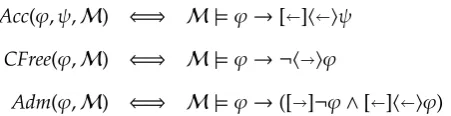
Acc(ϕ, ψ,M) ⇐⇒ M |=ϕ→[ ]h iψ
CFree(ϕ,M) ⇐⇒ M |=ϕ→ ¬hiϕ
Adm(ϕ,M) ⇐⇒ M |=ϕ→([]¬ϕ∧[ ]h iϕ)
Table 1: Acceptability, conflict-freeness and admissibility inLK−1
which, by propositional logic, is equivalent to the following slicker formulation:
M |=ϕ→([]¬ϕ∧[ ]h iϕ) (10)
Formulae9and10state that the set ofϕ-arguments is such that all its arguments attack arguments that do not belong to||ϕ||, and all arguments attacking its arguments are reinstated by otherϕ-arguments. If this holds for aϕin , in an argumentation modelM, then||ϕ||is admissible inM.
Table1recapitulates the formalization inK−1 of self-acceptability,
conflict-freenes and admissibility. All such notions can be captured as validities ofLK−1 formulae in the argumentation model at issue.
3.2
Complete and stable extensions
In [11], the “solution” of an argumentation framework is a set of arguments which can be considered as a “rational position” to be held according to some kind of precisely defined notion of rationality. Two of such solution concepts are the so-calledcompleteandstableextensions.
Given an argumentation modelM, a complete extension ofMis a set||ϕ|| which is admissible inMand is such that any argument which is acceptable for||ϕ||inMbelongs to||ϕ||. InLK−1
this becomes:
M |= ϕ→([]¬ϕ∧[ ]h iϕ)∧([ ]h iϕ→ϕ) (11)
which, by propositional logic, is equivalent to:
M |= (ϕ→[]¬ϕ)∧(ϕ↔[ ]h iϕ) (12)
So, a set ofϕ-arguments is a complete extension of an argumentation modelM iffsuch set is conflict-free inM(first conjunct of Formula12) and it is equivalent to the set of arguments it defends (second conjunct of Formula12).
We can similarly capture the notion of stable extension for a given argu-mentation modelM. According to Dung,||ϕ||is a stable extension if and only if||ϕ||is the set of arguments which is not attacked by||ϕ||, that is:
M |=ϕ↔ ¬h iϕ (13)
Table2recapitulates the semantic definitions of completeness and stability in
[image:8.595.186.412.141.199.2]Fact 2(Stability implies admissibility). LetM=(A,I)be an argumentation model.
It holds that:
Stable(ϕ,M)=⇒Adm(ϕ,M).
Proof. [Stable(ϕ,M) =⇒ CFree(ϕ,M)] We proceed per absurdum. Consider M |=ϕ ↔ ¬h iϕand suppose there existsa∈ Asuch thatM,a|= ϕ∧ hiϕ. Then there existsb∈Asuch thatabandM,b|=ϕ, which is impossible since M,b |= ¬h iϕ by assumption. [Stable(ϕ,M) =⇒ Acc(ϕ, ϕ,M)] We proceed again per absurdum. Consider the contrapositive of Formula 13, i.e., M |= ¬ϕ ↔ h iϕ, and suppose there existsa∈ Asuch thatM,a|= ϕ∧ ¬[ ]h iϕ. It follows that there exists ab ∈ A such thata band M,b |= ¬ϕ∧[ ]¬ϕ. From this, by our assumption, it follows thatM,b |=h iϕ∧[ ]¬ϕ, which is
impossible.
Fact2shows how model-theoretic properties ofK−1reflect basic theorems of
abstract argumentation. It is worth noticing that the proof of this fact cannot be carried out as a derivation withinK−1 since it lacks the necessary expressivity
to represent validity within a model as a formula in the object language (e.g., the universal modality [1]). A more expressive logic where this can be done is exposed in Appendix. Here we have opted for a simpler formalism which can better illustrate the methodology behind our work.
3.3
Characteristic functions and
K
−1Each argumentation frameworkA=(A,) determines acharacteristic function
cA : 2A −→ 2Asuch that for any set of arguments X,cA(X) yields the set of
arguments inAwhich are acceptable with respect toX, i.e.,{a∈ A| ∀b ∈ A: [ba⇒ ∃c∈ X:cb]}.2 Does logicK−1have a syntactic counterpart of the characteristic function? The answer turns out to be yes.
LetL[ ]h i
be the language defined by the following BNF:
L[ ]h i:ϕ::=p| ⊥ | ¬ϕ|ϕ∧ϕ|[ ]h iϕ where p belongs to the set of atomsP. Notice that L[ ]h i
is the fragment of LK−1
containing only the compounded modal operator [ ]h i. LetA+ = (2A,∩,−,∅,c
A) be the power set algebra on 2Aextended with operatorcA, and
consider the term algebraterL[ ]h i = (L[ ]h i,∧,¬,⊥,[ ]h i). Finally, letI∗ : L[ ]h i−→2Abe the inductive extension of a valuation functionI:P−→2A
2It might be worth mentioning the following. LetcA(A) be the set of images obtained by applyingcAto 2A. It is easy to show thatSni=1cA(Xi)=cA(Sni=1Xi) and its dual hold forXi⊆A.
So,cA(A) forms a complete lattice of sets [9]. Such a lattice is also bounded bycA(∅) andA.
Complete(ϕ,M) ⇐⇒ M |=(ϕ→[]¬ϕ)∧(ϕ↔[ ]h iϕ)
Stable(ϕ,M) ⇐⇒ M |=ϕ↔ ¬h iϕ
according to the semantics given in Definition3. We can prove the following result.
Theorem 1(cAvs. [ ]h i). LetM=(A,I)be an argumentation model. Function
I∗is a homomorphism fromterL[ ]h itoA+.
Proof. The case of Boolean connectives is trivial. It remains to be proven that for anyϕ:||[ ]h iϕ||M=cA(||ϕ||M).It suffices to spell out the semantics of [ ]h i recalling that =−1:
||[ ]h iϕ||M = {a∈A| ∀b:a b,∃c:b candc∈ ||ϕ||M}
= {a∈A| ∀b:ba,∃c:cbandc∈ ||ϕ||M} = cA(||ϕ||M).
This completes the proof.
Theorem1shows that the complex modal operator [ ]h i, under the seman-tics provided in Definition2, behaves exactly like the characteristic function of the argumentation frameworks on which the argumentation models are built. To put it yet otherwise, formulae of the form [ ]h iϕdenote the value of the characteristic function applied to the set ofϕ-arguments.
From Theorem1 it becomes thus clear that: a self-acceptable set of argu-ments||ϕ||is a set for which [ ]h iincreases, i.e.,||ϕ|| ⊆ ||[ ]h iϕ||(Formula
5); an admissible set of arguments||ϕ||is a conflict-free set for which [ ]h iis increasing (Formula9); a complete extension||ϕ|| is a fixpoint of [ ]h i, i.e., ||ϕ||= ||[ ]h iϕ||(Formula11). All such statements are counterparts of state-ments to be found in [11]. We can now study the properties of [ ]h iϕby resorting to the semantics ofK−1.
Fact 3(Model-theoretic properties of [ ]h i). LetM=(A,I)be an
argumenta-tion model andMs=(As,I)a serial argumentation model, that is, such that−1in
Asis serial. It holds that, for anyM,M∗
:
Monotonicity: M |=ϕ1 →ϕ2=⇒ M |=[ ]h iϕ1 →[ ]h iϕ2
Normality: Ms|=ϕ→ ⊥=⇒ Ms|=[ ]h iϕ→ ⊥
Proof. [Monotonicity] Let us proceed per absurdum, assuming thatM |=ϕ1 →
ϕ2 andM 6|= [ ]h iϕ1 → [ ]h iϕ2. This latter means that there existsa∈ A
such that M,a |= [ ]h iϕ1∧ h i[ ]¬ϕ2 which in turn implies the existence of b ∈ A such that M,b |= h iϕ1 ∧[ ]¬ϕ2. Given the assumption this is impossible. [Normality] It can be proven directly. AssumeMs|=ϕ → ⊥and Ms|=[ ]h iϕ. It follows thatMs|=[ ]h i⊥which is impossible since−1is
serial inMs. HenceMs|=[ ]h iϕ→ ⊥. Monotonicity guarantees that the set of arguments reinstating arguments in a given set||ϕ||grows if||ϕ||grows. Normality states that in a serial argumenta-tion model the set of arguments which is acceptable with respect to the empty set, i.e.,||⊥||, is empty.3
3It might be instructive to notice that seriality implies non well-foundedness since if
−1
is serial, every argument has a
−1
4
Argumentation in
K
∀: universal modality
The previous section has introduced a modal logic for talking about the rela-tions of “attacking” and “being attacked by”. However, as shown in Table1
and2, and on the ground of Fact1, the only relation occurring in the formal-ization of the argumentation theoretic notions considered is the relation , i.e., “being attacked by”. In this section, we restrictK−1to its “being attacked by”
fragment—thus allowing only theh iand [ ] modal operators—and extend it with the universal modality [1]. The resulting system is nothing butK∀
, that is, the minimal normal modal logicKextended with the universal modality.
4.1
Logic
K
∀LogicK∀
is a well-investigated system. In this section we recapitulate its se-mantics, axiomatics and some of its meta-logical properties.
4.1.1 Language.
As anticipated above, the language ofK∀
is a standard modal language built on the set of atomsPby the following BNF:
LK∀:ϕ::=p| ⊥ | ¬ϕ|ϕ∧ϕ| h iϕ| h∀iϕ
wherepranges overP. The other standard boolean connectives{>,∨,→}, and the modal duals{[ ],[∀]}are defined as usual.
LogicK∀is therefore endowed with modal operators of the type “there exists an argument attacking the current one such that”—h i—and “there exists an argument such that”—h∀i—together with their duals.
4.1.2 Semantics.
The semantics ofK∀ extends the one ofK−1 (Definition2) with the clause for the universal modality.
Definition 3(Satisfaction forLK∀ in argumentation models). Letϕ∈ LK∀. The
satisfaction of ϕby a pointed argumentation model(M,a)is inductively defined as
follows (Boolean clauses are omitted):
M,a|=h iϕ iff ∃b∈A: (a,b)∈−1 andM,b|=ϕ M,a|=h∀iϕ iff ∃b∈A:M,b|=ϕ
We say that: ϕis valid in an argumentation modelMiffit is satisfied in all pointed
models ofM, i.e.,M |= ϕ;ϕis valid in a classMof argumentation models iffit is valid in all its models, i.e.,M|=ϕ. All definitions are naturally generalizable to sets of
formulaeΦ.
In words, whatK∀
adds toK−1is existential and universal quantification via
4.1.3 Axiomatics.
The logicK∀
is axiomatized as follows:
(Prop) propositional tautologies (K) [i](ϕ1→ϕ2)→([i]ϕ1→[i]ϕ2)
(T) [∀]ϕ→ϕ (4) [∀]ϕ→[∀][∀]ϕ (5) ¬[∀]ϕ→[∀]¬[∀]ϕ (Incl) [∀]ϕ→[i]ϕ (Dual) hiiϕ↔ ¬[i]¬ϕ withi∈ { ,∀}.
4.1.4 Meta-theoretical results.
We list the following known results, which are relevant for our purposes.
␐ LogicK∀
is sound and strongly complete for the classAof argumentation frames [1, Ch. 7].
␐ The complexity of deciding whether a formula ofLK∀
is satisfiable is EXP-complete [17].
␐ The complexity of checking whether a formula ofLK∀
is satisfied by a pointed modelMis P-complete [16].
4.2
Doing argumentation in
K
∀We have now a calculus which fits very well with argumentation models. The present section shows how such calculus, and its semantics, can be concretely deployed to express basic notion of argumentation theory in a formal language, and consequently obtain formal proofs of theorems of argumentation theory.
LogicK∀
is expressive enough to capture the following notions in the object-language.
Acc(ϕ, ψ) := [∀](ϕ→[ ]h iψ) (14)
CFree(ϕ) := [∀](ϕ→ ¬h iϕ) (15)
Adm(ϕ) := [∀](ϕ→([ ]¬ϕ∧[ ]h iϕ)) (16)
Complete(ϕ) := [∀]((ϕ→[ ]¬ϕ)∧(ϕ↔[ ]h iϕ)) (17)
Stable(ϕ) := [∀](ϕ↔ ¬h iϕ) (18) These definitions restate the meta-language definitions summarized in Tables1
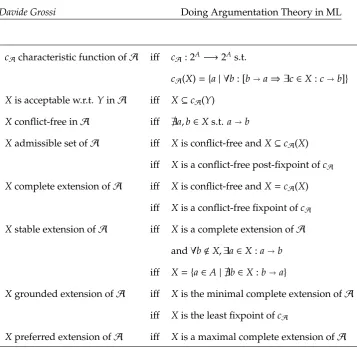
and2. Let us explain them in details again. A set of argumentsϕis acceptable with respect to the set of arguments ψ if and only allϕ-arguments are such that for all their attackers there exists a defender inψ(Formula14). A set of argumentsϕis conflict free if and only if allϕ-arguments are such that none of their attackers is inϕ(Formula15). A set of argumentsϕis admissible if and only if it is conflict free and acceptable with respect to itself (Formula16). A set
the set of arguments all the attackers of which are attacked by someϕ-argument (Formula17). Finally, a setϕis a stable extension if and only if it is equivalent to the set of arguments whose attackers are not inϕ(Formula18). The adequacy of these definitions with respect to the standard ones (see TableAin Appendix
A) is easily checked.
Example 2. (Argumentation labelings in K∀
) According to [5], a labeling function is acomplete labelingif and only if the following holds for each argument: a) an argument is labeled1, i.e., in, iffall its attackers are labeled0, i.e., out. b) an argument is labeled0, i.e., out, iffthere exists at least one attacker labeled1. The reformulation of a)-b) inK∀
goes as follows:
[∀]((1↔[ ]0)∧(0↔ h i1)∧Label) (19)
whereLabelis the propositional formula described in Example1. So, a valuationIon
an alphabet containing1,0and?is a complete labeling for an argumentation framework
A iff the model (A,I) satisfies Formula19. Also, it is a matter of propositional
reasoning to see that Formula19is equivalent to the following formula:
Compl(1)∧[∀]((0↔ h i1)∧Label) (20)
In words, this means that a function I on an alphabet containing 1, 0 and ?is a
complete labeling ofAif and only if the model(A,I)makes1to be a complete extension
(Formula17) and evaluates the labels0and?accordingly. We obtain therefore a direct correspondence between complete labelings and complete extensions. The same could be done for stable extensions.
LogicK∀
has therefore sufficient expressive power to capture a number of central results of argumentation theory. In this section we provide a sample of such results taken from [11], formalized and proved withinK∀
.
Theorem 2(Fundamental Lemma). The following formula is a theorem ofK∀
: Adm(ϕ)∧Acc(ψ∨ξ, ϕ)→Adm(ϕ∨ψ)∧Acc(ξ, ϕ∨ψ) (21)
Sketch. A full formal derivation is given in AppendixC.
Notice that Theorem2is, in fact, a generalized version of the Fundamental Lemma proven in [11]. It states that ifϕis admissible and bothψandξ are acceptable with respect to it then alsoψ∨ξis admissible andξis acceptable with respect toϕ∨ψ.
We provide one more example of theorems of abstract argumentation which can be obtained as formal theorems ofK∀
.
Theorem 3(Stable implies admissible and complete). The following formulae are theorems ofK∀
:
Stable(ϕ)→Adm(ϕ) (22)
Stable(ϕ)→Complete(ϕ) (23)
Proof. Formula22follows from Fact2and the completeness ofK∀
. Formula23
is a direct corollary of Formula22, the definition ofStable(ϕ), the definition of
Formulae22 and23 state well-known facts about the relative strength of admissible, complete and stable extensions. Other results can be formalized along the same lines. What this section aimed at showing is that, already within a rather standard modal systems such asK∀, quite many notions and results of abstract argumentation can be accommodated. The next section shows what kind of modal machinery is needed to capture the notion ofgrounded extension
which we have not yet discussed.
5
Argumentation in
K
µ: least fixpoints
The present section shows what kind of modal machinery is needed to capture the notion of grounded extension left aside in Section2. In [11], the grounded extension is defined as the smallest fixpoint of the characteristic function of an argumentation framework (see TableA).
5.1
Characteristic functions and fixpoints
Let us go back for a moment to logicK−1, and to the way its [ ]h i-formulae
for-malizing the notion of characteristic function of a given argumentation model (Section3.3). Carrying on with the analogy, we have that a formulaϕis a [ ]h i -fixpoint for an argumentation modelMif and only ifM |=ϕ↔[ ]h iϕ. We have the following.
Corollary 1(Existence of [ ]h i-fixpoints). For every argumentation modelM,
there exist a greatest and a least[ ]h i-fixpoint.
Proof. The result follows from Theorem1and Fact3via a direct application of the Knaster-Tarski fixpoint theorem4onter
L[ ]h i =(L[ ]h i,∧,¬,⊥,[ ]h i). LogicK−1does not have the necessary expressive power to talk about
great-est and least fixpoints for [ ]h i. In the next section, we take the fragment of
K−1and enhance it with fixpoint operators, thus moving into the realm of the
so-calledµ-calculi [4].
5.2
A
µ
-calculus for argumentation
The present section introduces theµ-calculus in the context of argumentation theory.
5.2.1 Language.
As already noticed at the beginning of Section 4, we can profitably restrict LK−1
to its “being attacked” partK, that is, only to operatorsh iand [ ]. We introduce the least fixpoint operator µon the top of this language, obtaining the languageLKµdefined via the following BNF:
wherepranges overPandϕ(p) indicates thatpoccurs free inϕ(i.e., it is not bounded by fixpoint operators) and under an even number of negations.5 In general, the notationϕ(ψ) stands forψoccurs inϕ. The usual definitions for Boolean and modal operators can be applied. Intuitively,µp.ϕ(p) denotes the smallest formulap such thatp ↔ ϕ(p). This intuition is made precise in the semantics ofLKµgiven in Definition4. The greatest fixpoint operatorνcan be defined fromµas follows:νx.ϕ(x) :=¬µx.¬ϕ(¬x).
5.2.2 Semantics.
The semantics ofµ-calculi is most perspicuously given in an algebraic fashion, which is what we do in the next definition.
Definition 4(Satisfaction forLKµ in argumentation models). Letϕ∈ LKµ. The satisfaction of ϕby a pointed argumentation model(M,a)is inductively defined as
follows:
M,a6|=⊥
M,a|=p iff a∈ I(p), for p∈P M,a|=¬ϕ iff a<||ϕ||M
M,a|=ϕ1∧ϕ2 iff a∈ ||ϕ1||M∩ ||ϕ2||M
M,a|=h iϕ iff a∈ {b| ∃c:b c&c∈ ||ϕ||M} M,a|=µp.ϕ(p) iff a∈\{X∈2A| ||ϕ||M[p:=X] ⊆X}
where||ϕ||M[p:=X]denotes the truth-set ofϕonceI(p)is set to be X. As usual, we say
that:ϕis valid in an argumentation modelMiffit is satisfied in all pointed models of M, i.e.,M |=ϕ;ϕis valid in a classMof argumentation models iffit is valid in all its
models, i.e.,M|=ϕ. All definitions are naturally generalizable to sets of formulaeΦ. We have now all the logical machinery in place to express the notion of grounded extension. Set ϕ(p) := [ ]h ip, that is, take ϕ(p) to be the modal version [ ]h iof the characteristic function, and apply it to formulap. What we obtain is a modal formula expressing the least fixpoint of a characteristic function, that is, the grounded extension:
Grounded:=µp.[ ]h ip (24) Notice that, unlike the notions formalized in Formulae14-18, the grounded ex-tension of a framework is always unique and does not depend on the particular labeling of a given model.
5.2.3 Axiomatics.
The standard axiomatics for theµ-calculus built on modal systemKsuffices for our purposes. LogicKµ is axiomatized by the following rules and axiom
5This syntactic restriction guarantees that every formulaϕ(p) defines a set transformation which preserves⊆, which in turn guarantees the existence of least and greatest fixpoints by the
schemata.
(Prop) propositional schemata
(K) [ ](ϕ1→ϕ2)→([ ]ϕ1→[ ]ϕ2)
(Fixpoint) ϕ(µp.ϕ(p))↔µp.ϕ(p)
(MP) if `ϕ1→ϕ2and `ϕ1thenϕ2 (N) if `ϕthen `[ ]ϕ
(Least) if `ϕ1(ϕ2)→ϕ2then `µp.ϕ1(p)→ϕ2
So, the axiomatics ofKµconsists of the axiom systemKaxiomatizingh iplus schema Fixpoint and rule Least. Let us have a closer look at what they state. Axiom Fixpoint just states that µp.ϕ(p) is indeed a fixpoint since a further application ofϕstill yieldsµp.ϕ(p) and vice versa. Instead, ruleLeast guarantees that µp.ϕ(p) is in fact the least fixpoint by imposing that ifϕ2 is
provably a pre-fixpoint ofϕ1, thenµp.ϕ1(p) provably impliesϕ2.
5.2.4 Meta-theoretical results.
We list some relevant known results.
␐ Logic Kµ is sound and complete for the class A of all argumentation models under the semantics given in Definition4[27]. Notice however that, unlikeK−1andK∀
, the given axiomatics ofKµis not strongly complete since it is obviously not compact.
␐ The satisfiability problem ofKµis decidable [23].
␐ The complexity of the model-checking problem forKµis known to be in NP∩co-NP [16]. However, it is known that the model-checking problem for a formula of sizemand alternation depthdon a system of sizenis
O(m·nd+1) [13], where the alternation depth of a formula ofLKµ is the maximum number ofµ/¬µ¬alternations in a chain of nested fixpoints.
5.3
Doing argumentation in
K
µLike in Section4.2we give a couple of examples of the kind of argumentation-theoretic results formalizable inKµ.
Theorem 4(Grounded extension is conflict-free). The following formula is a va-lidity ofKµ:
Grounded→ ¬[ ]Grounded (25)
Proof. Consider Formula24and proceed per absurdum. Take an argumentation modelMsuch thatM |=µp.[ ]h ip∧ ¬[ ]¬(µp.[ ]h ip). By the Definition4 we obtain thatM |=µp.[ ]h ipand that there exist a argumentsa,bsuch that
a bandM,b |= µp.[ ]h ip while alsoM,a |= µp.[ ]h ip. We distinguish two cases: 1) there exists a finite chain (a b b1 . . . bn) of successors
starting from a; 2) there exists an infinite such chain. If 1) is the case, then M,bn|=[ ]ϕfor anyϕ. Since bothM,a|=µp.[ ]h ipandM,b|=µp.[ ]h ip, thenM,bn−1 |=µp.[ ]h ip which, by Definition4, means that for anypsuch
anyϕM,bn |=[ ]ϕand hence thatM,bn−1 |=h i[ ]¬p. If 2) is the case, then
we show that||µp.[ ]h ip||M=∅. This is the case since the two following sets are both pre-fixpoints but they have empty intersection: {c ∈ A|a 2m c}and {c ∈ A|b 2m c}where 2m denotes reachability via in an even number of
steps. We thus obtain a contradiction.
Like Theorem 1, Theorem 4 provides a modal logic formulation of an argumentation-theoretic result.
As to the complexity of model-checking grounded extensions, it turns out to be tractable.
Theorem 5 (Model-checking grounded extensions). Given an argumentation model M, it can be decided in polynomial time whether an argument a belongs to
the grounded extension ofM, that is, whetherM,a|=µp.[ ]h ip.
Proof. Sinceµp.[ ]h iphas alternation depth 0, by the result reported in Section
5.2.4, it follows that model-checkingµp.[ ]h ipcan be done inO(m·n) where
mis the size ofµp.[ ]h ipandnthe size ofM.
6
Dialogue games via semantic games
The proof-theory of abstract argumentation is commonly given in terms of dialogue games [21]. The present section shows how modal semantics supports a general setting for the development of proof procedures based on games [18]. In particular we will focus on the so-calledevaluation gamesormodel-checking gameswhere a proponent or verifier (∃ve) tries to prove that a given formulaϕ holds in a pointaof a modelM, while an opponent or falsifier (∀dam) tries to disprove it.
The present section will describe the evaluation game for K∀
which is a straightforward extension of the evaluation game forKbut which, to the best of our knowledge, has not yet been investigated. For an exposition of evaluation games forKµwe refer the reader to [26].
6.1
Evaluation game for
K
∀We now introduce the game-theoretical semantics [18] of logicK∀
placing it in the context of abstract argumentation. The notation is borrowed from [26].
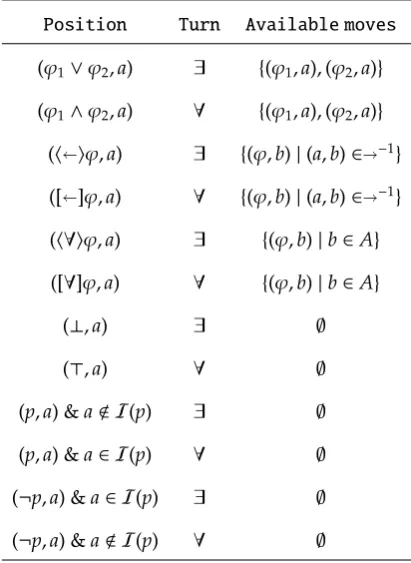
Such a game is a graph game, that is, a game played by two agents on a directed graph, where each node—called position—is labelled by the player that is supposed to move next. The structure of the graph determines which are the admissible movesat any given position. If a player has to move in a certain position but there are no available moves, then it loses and its opponent wins. In general, graph games might have infinite paths, but this is not the case in the game we are going to introduce. A match of a graph game is then just the set of positions visited during play, that is, a complete path through the graph. Here is the formal definition of the evaluation game forK∀
.
Definition 5 (Evaluation game forK∀
). Given a formula ϕ ∈ LK∀
, and an ar-gumentation modelM, the evaluation game E(ϕ,M)is defined by the following
Position Turn Available moves
(ϕ1∨ϕ2,a) ∃ {(ϕ1,a),(ϕ2,a)}
(ϕ1∧ϕ2,a) ∀ {(ϕ1,a),(ϕ2,a)}
(h iϕ,a) ∃ {(ϕ,b)|(a,b)∈−1}
([ ]ϕ,a) ∀ {(ϕ,b)|(a,b)∈−1}
(h∀iϕ,a) ∃ {(ϕ,b)|b∈A} ([∀]ϕ,a) ∀ {(ϕ,b)|b∈A}
(⊥,a) ∃ ∅
(>,a) ∀ ∅
(p,a) &a<I(p) ∃ ∅
[image:18.595.193.399.137.419.2](p,a) &a∈ I(p) ∀ ∅ (¬p,a) &a∈ I(p) ∃ ∅ (¬p,a) &a<I(p) ∀ ∅
Table 3: Rules of the evaluation game forK∀
.
Players: The set of players is{∃,∀}. An element from{∃,∀}will be denoted P and its
opponent P.
Game form: Thegame formofE(ϕ,M)is defined by the rules given in Table3.
Winning conditions: Player P wins if and only if P has to play in a position with no available moves.
Instantiation: The instanceof gameE(ϕ,M)with starting point(ϕ,a)is denoted E(ϕ,M)@(ϕ,a).
The important thing to notice is that positions of the game are pairs of a for-mula and an argument, and that the type of forfor-mula in the position determines which player has to play: ∃if the formula is a disjunction, a box, a false atom or⊥, and∀in the remaining cases.6
We can now define the notions of winning strategies and positions.
played from position (ϕ,a). Such a strategy is winning for P if and only if, in any match played according to the strategy, P wins. A position(ϕ,a)inE(ϕ,M)is winning forP if and only if P has a winning strategy inE(ϕ,M)@(ϕ,a). The set of
winning positions ofE(ϕ,M)is denoted WinP(E(ϕ,M)).
From the point of view of game theory [20], the game described in Definition
5and with the winning conditions introduced in Definition6is a two-players zero-sum game. Such games have the property that P wins if and only if
Plooses (zero-sum), and that they are determined, that is, each match has a winner [28].
It now remains to be proven that the game just introduced is adequate with respect to the semantics of K∀
. To put it otherwise, we have to prove that if ∃ always wins then the formula defining the game is true at the point of instantiation, and that if a formula is true at a point in a model, then∃always wins the corresponding game instantiated at that point.
Theorem 6 (Adequacy of the evaluation game forK∀
). Let ϕ ∈ LK∀
, and let
M=(A,I)be an argumentation model. Then, for any argument a∈A, it holds that: (ϕ,a)∈Win∃(E(ϕ,M))⇐⇒ M,a|=ϕ.
Proof. We proceed by induction on the lengthlofϕ.
Base. l=0. We have four cases:
␐ ϕ=>. Straightforward since (ϕ,a) is then always a winning position for ∃.
␐ ϕ=⊥. Straightforward since (ϕ,a) is then never a winning position for ∃.
␐ ϕ=p. It follows that ifa∈ I(p) then (ϕ,a) is a winning position for∃and ifa<I(p) then (ϕ,a) is not a winning position for∃.
␐ ϕ=¬p. The converse argument applies.
Step. l > 0. The induction hypothesis is that for any subformulaψ ofϕ of lengthl−1, and for anyb∈A, (ψ,b)∈Win∃(E(ψ,M))⇐⇒ M,b|=ψ. We have the following cases:
␐ ϕ=ψ1∧ψ2. From left to right. Assume (ϕ,a)∈Win∃(E(ϕ,M)). Now,ϕ
is a conjunction, hence it is∀’s turn to move. It follows that (ψ1,a) and (ψ2,a) are both winning positions for∃in the corresponding games. By
induction hypothesis, we thus haveM,a|=ψ1andM,a|=ψ2. From right to left. AssumeM,a|=ϕ. It follows thatM,a|=ψ1andM,a|= ψ2. By induction hypothesis we obtain that both (ψ1,a) and (ψ2,a) are winning
positions for∃, and thus so is (ϕ,a).
␐ ϕ = ψ1 ∨ψ2. From left to right. Assume (ϕ,a) ∈ Win∃(E(ϕ,M)). It
is∃’s turn to move, so one of (ψ1,a) and (ψ2,a) should be a winning position in the corresponding game. Assume WLOG it to be (ψ1,a). By
induction hypothesis it follows thatM,a|= ψ1 and thereforeM,a|= ϕ. From right to left. AssumeM,a|=ϕand assume WLOG thatM,a|=ψ1. By induction hypothesis we obtain that (ψ1,a)∈Win∃(E(ψ1,M)). Sinceϕ
is a disjunction, it is∃’s turn to move and therefore we conclude (ϕ,a)∈
∃ wins!
∀wins! ∀
∀ ∃wins!
∃ ∃
∀
∀
∀
a
b
Labeled Nixon Diamond
p
(
p
∧
[
∀
](
p
↔ ¬$
!
%
p
)
, a
)
([
∀
](
p
↔ ¬#
!
$
p
)
, a
)
(
p
↔ ¬"
!
#
p, a
)
(
p
↔ ¬"
!
#
p, b
)
(
¬
p
∨ ¬"
!
#
p, a
)
(
p
∨ "
!
#
p, a
)
(
¬!
!
"
p, a
)
(
¬
p, a
)
(
p, a
)
[image:20.595.149.438.125.300.2](
p, b
)
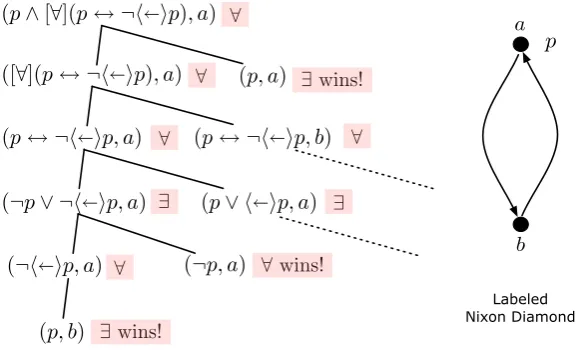
Figure 1: Game for stable extensions in the 2-cycle with labeling (valuation) function.
␐ ϕ=h iψ. From left to right. Assume (ϕ,a)∈Win∃(E(ϕ,M)). It is∃’s turn to move. It follows that there is a position (ψ,b) such thata band such that is a winning position for∃. By induction hypothesis we conclude that M,b|=ψand henceM,a|=h iψ. From right to left. AssumeM,a|=ϕ. It follows that there existsbsuch thata bandM,b|=ψ. By induction hypothesis we have that (ψ,b)∈Win∃(E(ψ,M)). But it is∃’s turn to move,
hence we conclude (ϕ,a)∈Win∃(E(ϕ,M)).
␐ ϕ=[ ]ψ. From left to right. Assume (ϕ,a)∈Win∃(E(ϕ,M)). It is∀’s turn
to move. It follows that for allb∈Asuch thata b(ψ,b)∈Win∃(E(ψ,M)).
From this, by induction hypothesis, we conclude that for allb∈ Asuch thata b,M,b |= ψ. From right to left. AssumeM,a |= ϕ. It follows that for allb∈Asuch thata b,M,b|=ψ. By induction hypothesis we thus obtain that for allb ∈ A, (ψ,b) ∈ Win∃(E(ψ,M)). This proves that (ϕ,a)∈Win∃(E(ϕ,M)).
␐ ϕ=h∀iψ. Similar to the case forϕ=h iψ. ␐ ϕ=[∀]ψ. Similar to the case forϕ=[ ]ψ.
This completes the proof.
In the next section we illustrate how this type of semantic games can be used as a general setting for games checking whether an argument of a given framework belongs to a specific extension under a given labeling.
6.2
Games for model-checking extensions
Adm: E(ϕ∧Adm(ϕ),M)@(ϕ∧Adm(ϕ),a)
Complete: E(ϕ∧Complete(ϕ),M)@(ϕ∧Complete(ϕ),a)
Stable: E(ϕ∧Stable(ϕ)),M)@(ϕ∧Stable(ϕ),a)
Grounded: E(Grounded,M)@(Grounded,a)
Table 4: Games for admissible, complete, stable and grounded sets.
question among argumentation theorists for a while [8]. Such a game neatly follows as the evaluation game for formulaStable(Formula18) ofK∀
.
Example 3(Model-checking the Nixon diamond). LetA=({a,b},{(a,b),(b,a)})
be an argumentation framework consisting of two arguments a and b attacking each other (i.e., the Nixon diamond), and consider the labelingIassigning1to a and0to
b (top right corner of Figure1). We now want to run an evaluation game for checking whether a belongs to a stable extension corresponding to the truth-set of1. Such game is the gameE(1∧Stable(1),(A,I))initialized at position(1∧Stable(1),a). That is, spelling out the definition of Stable(1): E(1∧[∀](1↔ ¬h i1))@(1∧[∀](1↔ ¬h i1),a). Such a game, played according to the rules in Definitions5and6, gives rise to the tree partially depicted in Figure1.
In the previous section and in the example we have focused only on logicK∀
. However, logicKµcan also be given an analogous game-theoretical semantics, which delivers the type of logic games necessary to check whether an argument
ain a given modelMbelongs to the grounded extensionµp.[ ]h ip. We do not work out the details here and we refer the reader to [26].
In general, evaluation games permit us to give a systematic presentation of games for checking membership of an argument to admissible sets, as well as complete, stable and grounded extensions by instantiating a gameE(ϕ,M) at the given argument whereϕexpresses the to-be-checked set or extension. Such systematization is provided in Table 4. Notice that what changes is only the modal formula inputted in the game.
Now the natural question arises of what is the precise relationship between the games just exposed and the dialogue games normally studied in the lit-erature on argumentation theory (see, for instance, [21]). The next section is concerned with this question.
6.3
Model-checking games vs. dialogue games
In model-checking games you are given a modelM=(A,I), a formulaϕ and an argumenta, and∃ve is asked to prove thatM,a|=ϕ. In dialogue games, the check appointed to∃ve is inherently more complex since the input consists there of only an argumentation frameworkA, a formulaϕand an argumenta. ∃ve is then asked to prove that there exists a labelingIsuch that (A,I),a|=ϕ. This is not a model-checking problem but a satisfiability problem in a pointed frame [1] which, in turn, is essentially a model-checking problem in monadic second-order logic: “A |=∀p1, . . . ,pn¬STa(ϕ)?” wherep1, . . . ,pn are the atoms occurring inϕandSTa(ϕ) is the standard translation ofϕrealized in statea.7
To conclude, we might say that the games defined above provide a proof procedure for a reasoning task which is computationally simpler than the one tackled by standard dialogue games. It should be noted, however, that this is no intrinsic limitation to the logic-based approach advocated in the present paper. Model-checking games for monadic second-order logic (or rather for appropriate fragments of it) would accommodate dialogue games in their en-tirety, lifting the sort of systematization they enable—in the form exemplified by Table4—to dialogue games.
7
When are two arguments the same?
Since abstract argumentation neglects the internal structure of arguments, the natural question arises of when two arguments can be said to be equivalent, or be “the same”, from the point of view of argumentation theory. Such a notion of equivalence will necessarily be of a structural nature and, to be of any inter-est, be weaker than plain isomorphism. The study of a notion of equivalence for argumentation has not received attention yet by the argumentation theory community, except for one recent notable exception [19], which defines a no-tion of strong equivalence for argumentano-tion frameworks, borrowed from the analogous notion developed in logic programming.
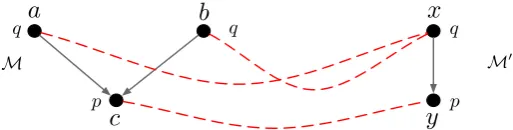
Modal logic offers a readily available notion of structural equivalence, the notion of bisimulation (with all its variants) [1,15]. This section sketches the use of bisimulation for argumentation theoretic purposes. To illustrate the issue we use a simple motivating example depicted in Figure2. We have two labelled argumentation frameworks which both contain an argument labeledp
which is attacked by some arguments labelledq. Now the question would be: are the twop-arguments equivalent as far as abstract argumentation theory is concerned? The answer is yes, and the next sections explain why.
7.1
Indistinguishability of arguments in
K
∀It is well-known that logic Kµ is invariant under bisimulation. It is, in fact, the bisimulation-invariant fragment of monadic second-order logic [26]. In the present section we will focus on the specific notion of bisimulation which is tailored toK∀
, also calledtotal bisimulation.
We briefly recapitulate the notion of bisimulation [1,15] presenting it in an argumentation-theoretic flavor.
a
x
y
c
b
M M!
p
q
p
[image:23.595.168.425.125.190.2]q q
Figure 2: Two (totally) bisimilar arguments (c and y) in two argumentation models.
Definition 7(Total bisimulation). LetM=(A,,I)andM0=
(A0,
0,I0
)be two argumentation models. A bisimulation betweenMand M0
is a non-empty relation Z⊆A×A0
such that for any aZa0
: Atom: a and a0
are propositionally equivalent; Zig: if a b for some b∈A, then a0
b0
for some b0∈
A0
and bZb0
; Zag: if a0
b0
for some b0∈
A then a b for some i
¯nA and aZa
0
. Atotal bisimulationis a bisimulation Z⊆A×A0
such that its left projection covers A and its right projection covers A0
. When a total bisimulation exists betweenMand M0we write(M,a)-(M0,a0).
Now, since logicK∀ is invariant under total bisimulation [1] and logicKµ
under bisimulation [15], we obtain a natural notion of “sameness” of arguments, which is weaker than the notion of isomorphism of argumentation frameworks. If two arguments are “the same” in this perspective, then they are equivalent from the point of view of argumentation theory, as far as the notions expressible in those logics are concerned. In particular, we obtain the following simple theorem for free.
Theorem 7(Bisimilar arguments). Let(M,a)and(M0,
a0
)be two pointed models, and let Z be a total bisimulation betweenMandM0
. It holds that:
M,a|=CFree(ϕ)∧ϕ ⇐⇒ M0,a0|=CFree(ϕ)∧ϕ M,a|=Adm(ϕ)∧ϕ ⇐⇒ M0,a0|=Adm(ϕ)∧ϕ M,a|=Complete(ϕ)∧ϕ ⇐⇒ M0,a0|=Complete(ϕ)∧ϕ
M,a|=Stable(ϕ)∧ϕ ⇐⇒ M0,a0|=Stable(ϕ)∧ϕ M,a|=Grounded ⇐⇒ M0,a0|=Grounded.
Proof. Follows directly from the fact that bisimulation impliesKµ-equivalence [15], and total bisimulation impliesK∀
-equivalence [1].
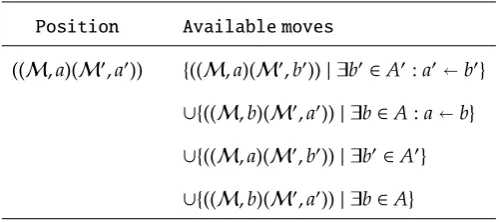
Position Available moves
((M,a)(M0,
a0
)) {((M,a)(M0,
b0
))| ∃b0∈
A0
:a0
b0}
∪{((M,b)(M0,
a0
))| ∃b∈A:a b} ∪{((M,a)(M0,
b0
))| ∃b0∈
A0}
∪{((M,b)(M0,
a0
[image:24.595.172.422.136.247.2]))| ∃b∈A}
Table 5: Rules of the bisimulation game forK∀
7.2
Total bisimulation games
We can associate a game to Definition7. Such game checks whether two given pointed models (M,a) and (M,a0
) are bisimilar or not. The game is played by two players: Spoiler, which tries to show that the two given pointed models are not bisimilar, andDuplicator which pursues the opposite goal. A match is started by S, then D responds, and so on. If and only if D moves to a position where the two pointed models are not propositionally equivalent, or if it cannot move,Swins. The following definition describes formally the game just sketched.
Definition 8(Bisimulation game forK∀
). Given two pointed modelsMandM0
, thetotal bisimulation gameB(M,M0
)is defined by the following items.
Players: The set of players is{D,S}. An element from{D,S}will be denoted P and
its opponent P.
Game form: Thegame formofB(M,M0
)is defined by the rules given in Table5. Turn function: If the round is evenSplays, if it is oddDplays.
Winning conditions: S wins if and only if either D has moved to some position
((M,a)(M0,
a0
)) where a and a0
do not satisfy the same labels, or D has no available moves. OtherwiseDwins.
Instantiation: TheinstanceofB(M,M0)with starting position((M,a)(M0,a0))is
denotedB(M,M0)@(a,a0).
So, as we might expect, positions in a (total) bisimulation games are pairs of pointed models, that is, the pointed models thatDtries to show are bisimilar. It might also be instructive to notice that such a game can have infinite matches, which, according to Definition8are thus won byD.
From Definition8we obtain the following notions of winning strategies and winning positions.
Definition 9 (Winning strategies and positions). A strategy for player P in an instantiated gameB(M,M0
)@(a,a0
(M, c)(M!, y)
(M, c)(M!, y) (M, c)(M!, x)
(M, c)(M!, y)
(M, b)(M!, y) (M, b)(M!, y)
(M, b)(M!, x)
(M, b)(M!, y)
(M, a)(M!, x)
Dwins!
Dwins!
Swins! (M, a)(M!, x)
(M, b)(M!, x)
(M, b)(M!, x) (M, b)(M!, y)
S
D
S
D
[image:25.595.149.445.123.322.2]S
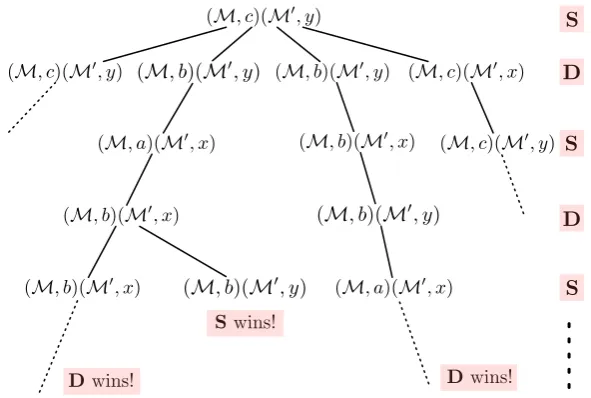
Figure 3: Part of the total bisimulation game played on the models in Figure2.
B(M,M0)iswinning forP if and only if P has a winning strategy inB(M,M0)@(a,a0).
The set of all winning positions of gameB(M,M0)for P is denoted by WinP(B(M,M0)). Also in the case of (total) bisimulation games we have an adequacy theorem.
Theorem 8(Adequacy of total bisimulation games). Take(M,a)and(M0,
a0
)to be two argumentation models. It holds that:
((M,a)(M0,a0))∈WinD(B(M,M0))⇐⇒(M,a)-(M0,a0).
Proof. The proof is standard and we refer the reader to [15].
In other words,D has a winning strategy in the total bisimulation game B(M,M0
)@(a,a0
) if and only ifM,aandM0,
a0
are totally bisimilar. The follow-ing example illustrates how a total bisimulation game concretely looks like.
Example 4(A total bisimulation game). Let us play a total bisimulation game on the two modelsMandM0given in Figure2. A total bisimulation connects c with
y, and a and b with x. Part of the extensive bisimulation gameB(M,M0)@(c,y)is
depicted in Figure3. Notice thatDwins on those infinite paths where it can always duplicateS’s moves. On the other hand, it looses for instance when it replies to one ofS’s moves((M,b)(M0,
x))by moving in the second model to argument y, which is labelled p while b is not.