INQUISITIVE SEMANTICS AND THE PARADOXES
OF MATERIAL IMPLICATION
MSc Thesis
(Afstudeerscriptie)
written by Pawel Lojko
(born May 1st, 1987 in Szczecin, Poland)
under the supervision of Dr. Floris Roelofsen and Prof. Dr. Jeroen Groenendijk, and submitted to the Board of Examiners in partial
fulfillment of the requirements for the degree of
MSc in Logic
at the Universiteit van Amsterdam.
Date of the public defense: Members of the Thesis Committee:
August 27, 2012 Dr. Paul Dekker
Prof. Dr. Jeroen Groenendijk Prof. Dr. Benedikt Loewe Dr. Floris Roelofsen Dr. Katrin Schulz
Abstract
The Paradoxes of Material Implication concern entailments which are valid according to Classical Propositional Logic but which contradict universal linguistic intuitions. These contradictions constitute one of the best-known objections to the classical truth-functional account of indicative conditionals. In this thesis we give an Inquisitive Semantic account of the Paradoxes of Material Implication. We focus on the sixteen paradoxical inferences that can be found in the literature. We formalize, motivate and discuss two inquisitive systems: Basic Inquisitive Semantics and Radical Inquisitive Semantics. Fur-ther, we compare the Basic Inquisitive Semantic and the Radical Inquisitive Semantic account of the Paradoxes of Material Implication with the accounts given by Lewis’ Strict Conditional Logic S2, Stalnaker’s Conditional Logic C2, Update Semantics and Relevance Logic B. We also discuss the extent to which the inquisitive account of implication reflects the philosophical under-pinnings of different non-classical accounts.
Acknowledgments
I am grateful to my mom Malgorzata Lojko and my sister Olga Lojko for all their support not only during the write-up of the thesis, but also during the whole master’s programme. For they have always had faith in me and without their patience and love I would not be able to be where I am now.
I would like to thank my supervisors Floris Roelofsen and Jeroen Groe-nendijk for all their help and encouragement; for all the time they spent on reading my drafts and the multitude of useful comments I received from them. I am especially grateful for some of the fruitful and stimulating dis-cussions we have had. I would also like to thank Frank Veltman for his constructive feedback concerning some of the sections of the thesis. Finally, I am indebted to Ulle Endriss, for all the pieces of advice he gave me as my academic mentor.
Many thanks to all my friends from the Master of Logic and outside. Thank you for all banters, discussions and great memories. In particular, I would like to thank Maja Jaakson, Katya Garmash, Lieselotte Kreuk, Alessandra Marra, Sylvia Pauw, Alwin Blok, Nal Kalchbrenner, Hraban Luyat and Alex Perrone. If it were not for you guys, I would go insane before finishing the MSc in Logic. Special thanks to Maja Jaakson, who I owe many beers for all the times she went over the grammar and the style of my papers.
I would also like to express my sincere gratitude to Frans de Klein. He made me understand more than any of the teachers I have ever had. His help and advice were invaluable to me.
Last but not least, I would like to thank the Huygens Scholarship Pro-gramme for supporting me during my studies in the Netherlands.
Contents
1 Inquisitive Semantics 5
1.1 The Classical Proposition . . . 5
1.2 The Inquisitive Twist . . . 7
1.3 Basic Inquisitive Semantics . . . 10
1.3.1 Issues and States . . . 10
1.3.2 Propositions . . . 11
1.3.3 Support and Propositions Expressed by a Sentence . . 13
1.4 BIS Examples . . . 18
1.5 The Radical Twist . . . 19
1.6 Radical Inquisitive Semantics . . . 21
1.7 RIS Examples . . . 27
2 Paradoxes of Material Implication and Non-Classical Logics 30 2.1 Paradoxes of Material Implication . . . 32
2.2 Non-Classical Semantics . . . 34
2.2.1 Strict Conditional Logic . . . 34
2.2.2 Conditional Logic . . . 37
2.2.3 Update Semantics . . . 42
2.2.4 Relevance Logic . . . 45
2.3 S2, C2, US, B: Results . . . 49
3 BIS, RIS and the Paradoxes of Material Implication 51 3.1 BIS and Paradoxical Inferences . . . 51
3.4 BIS and RIS: Results . . . 62
4 Analysis 64 4.1 Summary of the Results . . . 64
4.2 Approaches . . . 66
4.2.1 Strict Conditional Logic Approach . . . 67
4.2.2 Conditional Logic Approach . . . 68
4.2.3 Update Semantics Approach . . . 70
4.2.4 Relevance Logic B Approach . . . 71
4.2.5 Inquisitive Semantics . . . 71
4.3 Comparison . . . 74
4.3.1 Strict Conditional Logic . . . 75
4.3.2 Update Semantics . . . 75
4.3.3 Conditional Logic . . . 76
4.3.4 Relevance Logic B . . . 77
4.3.5 Concluding Remarks . . . 78
4.4 Criticism . . . 79
4.4.1 The First Criticism . . . 79
4.4.2 The Second Criticism . . . 82
4.4.3 Final Remarks . . . 85
5 Conclusion 86 A Appendix 90 A.1 Strict Conditional Logic Proofs . . . 90
A.2 Conditional Logic Proofs . . . 102
A.3 Update Semantics Proofs . . . 107
A.4 Relevance Logic B Proofs . . . 112
“If and suppose - two small words, but nobody has ever been able to explain them” - Jack Johnson
Formal semantics attempts to model natural language and formalize the ways in which we communicate. Over the past several decades, many logical theories have been put forth with the aim of providing us with an adequate model of our language uses. Inquisitive Semantics is an example of one of the most recent developments. It departs from the classical tradition in semantics, in which the meaning of a sentence consists only in its informative content. Instead, it proposes to ameliorate the classical understanding of a proposition by acknowledging its inquisitive content. Such an “inquisitive twist” results in a new logical framework that provides us with new theorems and new insight into our uses of natural language.
A departure from a long-established tradition is generally met with a significant amount of doubt. There are many things that can go wrong and the prospective benefits of the new framework need to considerably outweight both its own disadvantages and the advantages of the framework we started with. In general, the deeper and the more varied the arguments for the new system, the better its chances of success and the bigger the probability of moving a step closer towards finding the optimal model of the phenomena we are interested in.
Inquisitive Semantics was developed mostly at the University of Ams-terdam over the past decade. Despite its novelty, Inquisitive Semantics has managed to inspire researchers from several countries spread across Europe, America and Asia. Interest in the framework resulted in many developments, shedding light both on the nature of the system and the phenomenon it seeks to capture. To date, the semantic features of the propositional system are fully developed, the pragmatic underpinnings of the new framework have been specified and the system’s algebraic features have been spelled out. The speedy development of Inquisitive Semantics and the attention it has attracted internationally are a testament to its viability and potential. All of the advantages over the classical semantics and the rival systems are not fully spelled out, though. The framework still needs additional motivation.
plication with other non-classical approaches. We will argue that Inquisitive Semantics provides a better treatment of implausible material implications than classical semantics does. Furthermore, we will demonstrate that Radical Inquisitive Semantics allows one to account for more paradoxical inferences than any of the other systems. Last but not least, we will suggest that as Inquisitive Semantics gives an intuitive and non-ad hoc treatment of the Paradoxes of Material Implication, it can be seen as being advantageous over other systems considered.
In order to cogently resolve the matter in question, the thesis will be divided into five sections.
1. The first part of the thesis provides an introduction to propositional Inquisitive Semantics. We will restate, discuss and motivate inquisitive semantics. Furthermore, we will also discuss a not yet fully formalized extension of Inquisitive Semantics—Radical Inquisitive Semantics— and formalize additional notions which prove useful in realizing the objectives of the thesis.
2. The second part introduces paradoxical material implications and dis-cusses different approaches towards these paradoxes. We do this by considering 16 paradoxical inferences. These inferences will be used as a benchmark that will allow us to compare different models of natural language implication. In this chapter we also introduce the semantics of S2, C2, US and B. Finally, we summarize the account of the Paradoxes of Material Implication given by these logics in a table.
3. The third part demonstrates the inquisitive treatment of the paradox-ical inferences. We will prove that Inquisitive Semantics effectively ac-counts for some of the paradoxical entailments and discuss the extent to which Basic Inquisitive Semantics and Radical Inquisitive Semantics are successful in accounting for all of the problematic cases.
4. The fourth part compares the inquisitive approach to resolving the Paradoxes of Material Implication with classical and non-classical ap-proaches. On the basis of this comparison, we will also analyze the role of different semantic definitions in the inquisitive treatment of the paradoxical implications in question.
CHAPTER
1
Inquisitive Semantics
Inquisitive Semantics enriches one of the most basic notions of classical se-mantics: that of a proposition. As pointed out in the introduction, this allows one to enrich the classical, purely informative meaning of a sentence with its inquisitive content. In order to fully grasp the subtleties of the in-quisitive framework, it is useful to depart from the classical understanding of a proposition and then describe the semantics underlying the new frame-work. Such an approach highlights the key element of the new system and more clearly explicates its assumptions. After the description of Basic In-quisitive Semantics, we will consider a recent extension, Radical Inquisitive Semantics. This system proposes an even more fine-grained notion of mean-ing which characterizes positive, negative and issue-dispellmean-ing responses to a sentence uttered. Most importantly, RIS allows for differentiation between the rejection of a proposal made by uttering a sentence and the rejection of the supposition behind the sentence uttered.
1.1
The Classical Proposition
The classical notion of a proposition is exemplified by Stalnaker’s 1978 article “Assertion” [41]. We will draw from this article in discussing the motivations for the classical treatment of propositions and natural language discourse. We will also contrast this classical view with the inquisitive one.
proposi-that “The class is at 10AM”, one communicates proposi-that it is the case proposi-that the class is at 10AM. Or, more specifically, one communicates that this sentence correctly describes the world as being this way and not the other, e.g., in which the class is at 11AM. Thus, a proposition can be seen as dividing the ways in which the world could be and could not be. By these means, it is classically assumed one understands a proposition expressed by a sentence when one knows when the sentence corresponding to it is true and when it is false. Consequently, when one engages in a conversation, one tries to dis-tinguish between the ways things could have been and could not have been and decide upon different alternative descriptions of the world in order to arrive at the most plausible conclusion. In logic it is common to refer to these different alternative descriptions as possible worlds, viz. the ways the world could be. A proposition expressed by a sentence is then understood as a function from possible worlds to truth values. Thus, when one makes an assertion, one expresses a proposition and limits the range of possible worlds to the ones in which this proposition is true. So to speak, the proposition is a rule for picking a set of possible worlds such that the sentence corresponding to it is true in these worlds.
This account and understanding of a proposition gives rise to the following view on discourse. In a conversation assertions are made and accepted and thus the set of possible worlds compatible with propositions expressed by assertions made is reduced. As the conversation proceeds, individuals further continue to narrow down the set of alternative descriptions of the world with the intention to locate the actual state—the instantiation of how the world really is—among a set of alternative descriptions of the world that is narrow enough for their purposes.
of a conversation.
The inquisitive semantic enterprise does not question the appropriateness of classical theory in modeling these situations. It is rather based on the ob-servation that argumentation makes a small class of our language use and it is by no means an exhaustive and paradigm example of it. More specifically, there are many other ways we use our language that cannot be modeled as argumentation, e.g., interviews, interrogations and even the majority of everyday conversations. These uses of natural language are rather an inter-play between questions and answers and not only assertions. On the basis of this, inquisitive semantics postulates that natural language discourses are rather an interplay between the inquisitive content (requests for information) and assertive content and that this interplay allows one to proceed with the conversation and limits the set of alternative descriptions which correctly describe our actual world.1
1.2
The Inquisitive Twist
Based on the previous analysis of the classical view on discourse and proposi-tion, inquisitive semantics aims at developing a model that would account for the shortcomings of the classical picture and thus, provide a better model of natural language discourse. There are two key observations made by Inquis-itive Semantics. The first is comprised in the claim that there is “no sharp distinction between assertions, inquisitive sentences, and questions, non-informative sentences” ([22], pp. 2). The second observation is that proposi-tions are better accounted for asproposalsto change the information assumed by a discourse in one or more ways.
The first observation, that one can give a single semantic treatment of indicatives and interrogatives, can be seen as being rooted in observations made by Grice. For Grice notices that “a standard employment of ‘or’ is in the specification of possibilities (one of which is supposed by the speaker to be realized, although he does not know which one)” ([28], pp. 13). More specifically, as noticed by [22], it seems that certain indicatives invite the same responses as interrogatives:
1The fact that the class of natural language uses that can be correctly modeled by
The class is either at 10AM or at 11AM. (1.1) Is the class either at 10AM or at 11AM? (1.2)
The class is at 10AM. (1.3)
In the above example it is possible for the inquisitive content of (1.1) and (1.2) to coincide. This is further visible if we imagine (1.1) and (1.2) as being uttered in a conversation; (1.3) seems to be a correct response to either of them. Thus, it seems to be that both (1.1) and (1.2) invite the same response from the conversational interlocutors. This points to the fact that natural language does not seem to have a separate semantic treatment for some of the questions and interrogatives. Consequently, this motivates postulating a single semantic object containing inquisitive and informative content. An example of such an object is (1.1), which can be viewed as a hybrid sentence (i.e., a sentence that both provides some information and invites some information).
On the other hand, the inquisitive treatment of propositions as propos-als stems from the fact that Inquisitive Semantics considers a discourse not purely as an exchange of assertions, but rather as “a cooperative process of raising and resolving issues” ([14], pp. 1). This treatment is motivated by the intuitive observation that a conversation is an exchange of information in which generally one requests some information (i.e., raises an issue) and expects ones interlocutor to contribute to resolving an issue by providing some relevant information. To illustrate this point, consider the following example:
- Do we have the class at 10AM or 11AM? (1.4)
- The class is at 10AM. (1.5)
In this common situation the first speaker proposes 2 alternative ways of up-dating the common ground of the conversation2 and requires his interlocutor to provide him with enough information to decide between them. The in-terlocutor, in order to answer the question, decides between the alternatives
2In line with Stalnaker, the common ground is understood as the body of information
suggested by the first speaker. To be more specific, it is intuitive to treat (1.4) as expressing a proposal to update the common ground of a conver-sation. The proposition expressed by (1.4) invites a response that would determine the time of the class. (1.4) is a question, since it only presupposes that the class is either at 10AM or at 11AM and simply requires information. That is, it asks for a response which would resolve whether the class is at 10AM or at 11AM and thus update the common ground of the conversation. (1.5) on the other hand, is an assertion: it provides exactly one update of the common ground and resolves the issue raised in (1.4).
What seems to follow from this analysis is that it seems to be very in-tuitive to model propositions as sets of sets of possible worlds, rather than only sets of possible worlds. This allows us to correctly account for questions exemplified by (1.4). This is because we can model the proposition expressed by (1.4) as just consisting of 2 sets of possible worlds: one in which it holds at every world that the class is at 10AM and the other in which it holds at every world that the class is at 11AM. It also allows us to correctly ac-count for (1.5), as we can model the proposition expressed by it as a set of possible worlds in which at every world it holds that the class is at 10AM. Hence, by these means Inquisitive Semantics in its simplest form provides a very plausible and appealing interpretation of propositions as proposals to update the common ground of a conversation. Under this interpretation, questions propose at least two ways of updating the common ground and assertions give one proposal to update the common ground of a conversation and hence can be seen as simply suggesting to add their informative con-tent to the common ground. Based on this alteration of the definition of a proposition, a proposition expressed by a sentence can be seen as capturing both the information it provides and the information it requests from other conversational participants.[7]3
While the description of inquisitive propositions as pursued above can be seen as a plausible indication of motivations for the inquisitive treatment of a proposition, it does not specify which propositions are expressed by which sentences. Given the characterization of the new notion of a proposition, we need to give an account of how to determine propositions corresponding to
3More specifically we can think of the inquisitiveness of a proposition as its potential
more complex sentences than the ones mentioned in examples considered so far. Thus, we need to give a formal definition of Inquisitive Semantics.
1.3
Basic Inquisitive Semantics
In semantics, the standard way of accounting for the meaning of complex sentences is in terms of a recursive definition. This approach allows one to give an account of the meaning of every sentence in terms of its simpler con-stituents. Following this approach, Inquisitive Semantics defines the meaning of sentences recursively in terms of support at states. Then, the proposition expressed by a sentence θ, can be just taken to be the set of all states sup-porting θ. An example of one recursive way of accounting for the meaning of all inquisitive sentences and then propositions is given by [37]. Under this approach a proposition is a persistent set of sets of possible worlds, where persistence is a property of sets of sets of possible worlds which guarantees that whenever a set of possible worlds supports a sentence, so do all of its subsets.4 We will proceed by outlining the formal framework of Inquisitive
Semantics and then motivating and describing its features.
1.3.1
Issues and States
Two basic ingredients of Inquisitive Semantics are issues and states.
Definition 1 (States) Let P be a finite set of propositional letters and ω be the set of all possible words, i.e., ω:={0,1}P. A state is a subset of ω, i.e., any set of possible worlds σ⊆ω.
The idea behind the notion of a stateσis to encode the information that the actual world is among the possible worlds in σ. Notice that for a state
σ, we can think of its subsets as enhancements ofσ which give more detailed information concerning where the actual world might lie.
Definition 2 (Enhancement) A stateτ is called an enhancement ofσ if and only if τ ⊆σ.
Notice that given a context specified by σ, one can also try to locate the actual world within σ with more precision. Thus, one can suggest en-hancements of σ that locate the actual world with sufficient precision and
4This section is based on [7] and [37]; the persistency requirement will be motivated in
request an answer that would allow one to decide between them. The seman-tic content of such a request for information is referred to as an issue over σ
- denotedI, which corresponds to a non-empty set of enhancements of σ. In this setting it is also natural to think of an issue over σ as being downward closed and as forming a cover over σ. When considering the downward clo-sure requirement, notice that ifτ is an enhancement of σ then so is τ0 ⊆ τ. This is because, ifτ already locates the actual world with sufficient precision then an even more precise enhancement that also contains this world cannot fail to do so. When considering the requirement for I to form a cover of
σ, notice that the information contained in σ does not preclude any possi-ble world w ∈ σ from being the actual world. Thus, it follows that for any possible world inσ, the issue raised byI must also contain an enhancement which contains it. Otherwise I precludes a possible world, which may well be the actual world given the information in σ.
Definition 3 (Issues) Let σ be a state. I is an issue over σ if and only if: 1. I is a non-empty set of enhancements of σ;
2. I is downward closed, i.e., if τ ∈ I and τ0 ⊆τ, then τ0 ∈ I; 3. I forms a cover of σ, i.e., SI
=σ.
Given the definition of an issue I, it is also useful to define a response that allows us to decide between the enhancements suggested by I, i.e., the situation in which one settles the issue raised by I.
Definition 4 (Settling an issue) Let σ be an information state, τ an en-hancement of σ and I an issue over σ. Then, τ settles I if and only if
τ ∈ I.
1.3.2
Propositions
Given the definition of the basic ingredients of the inquisitive framework presented in the previous subsection, we are now in a position to state the definition of an inquisitive proposition. A more refined version of a proposi-tion expressed by a sentence will be given in the next subsecproposi-tion.
Fact 1 Proposition is a non-empty downward closed set of states.
Notice that the definition of an inquisitive proposition allows us to encode two key ingredients of inquisitive meaning. For one, an inquisitive proposi-tion A encodes the enhancement of the common ground of the conversation specified by S
A, i.e., the information it proposes to enhance the common ground with. But, it also specifies an issue over τ = S
A. This is in line with our previous observations: when one utters a sentence, one proposes to update the common ground of the conversation and specifies an issue over the suggested update. In other words, in uttering a sentence one can provide and can request information. Furthermore, since an issue over a state σ is just a set of enhancements over σ and since every enhancement denotes a set of possible worlds, it follows that a proposition A is a set of states. By these means, we can take every state contained in a proposition to specify one piece of information; namely, that the actual world is among the possible worlds in that state. Every proposition can then be viewed as an invitation to specify which of these states correctly describes the actual world.
Let us discuss the downward closure requirement in greater detail in or-der to see why it is plausible from a philosophical point of view, to take propositions to have this feature.
LetA be a proposition over σ, I be the issue embodied by A, R ∈ I be an issue-settling piece of information. Then it follows that any issue-settling piece of information which is more informative than R also settles the issue raised in I; for if R locates the actual world with sufficient precision, then so does its restriction. Thus, since by the definition R ∈ I corresponds to some state α ∈A, it follows that any subset of α is a set of possible worlds in A (i.e., A is a downward closed set of states).
resolving pieces of information.5.
1.3.3
Support and Propositions Expressed by a
Sen-tence
With the basic features and notions involved in Basic Inquisitive Semantics in place, we can proceed to the specification of which propositions are expressed by which sentences. Inquisitive Semantics defines the meanings of sentences recursively via the notion of support and evaluates sentences at states σ. Then, it takes the proposition expressed by a sentence θ to be the set of all states supporting θ.
Definition 6 (Language) Let P be a finite set of propositional letters. We denote by LP the set of formulas built from letters inP using the connectives
∧,∨,¬,→,⊥.
Definition 7 (Support in BIS)
σ |=p iff ∀v ∈σ : v(p) = 1 for atomic p
σ |=⊥ iff σ =∅
σ |=¬θ iff σ |=θ →⊥
σ |=θ∨σ iff σ |=θ or σ |=θ σ |=θ∧ψ iff σ |=θ and σ |=ψ
σ |=θ→ψ iff ∀τ ⊆σ: if τ |=θ then τ |=ψ
The first clause states that a stateσsupports an atomic sentencepiffpholds at every possible world in this state.
The second clause states that a state σ supports ⊥ iff σ is the empty set. The third clause states that a state σ supports a negation ¬θ iff the only substate of σ that supports θ is the empty set.
The fourth clause states that a state σ supports a disjunction iff it supports one of the disjuncts.
The fifth clause states that a state σ supports a conjunction iff it supports both of the conjuncts.
The sixth clause states that a stateσ supports an implicationθ →ψ iff every substate of σ that supports θ also supports ψ.
The above definition gives rise to the following fact about the support relation, which can be established by a straightforward induction on the complexity of θ.
Fact 2 (Persistence) Let σ be a state and θ a formula in L. If σ |=θ, then for all τ ⊆σ τ |=θ.
The inquisitive semantic clauses allow us to define proposition expressed by a sentence.
Definition 8 (Proposition) The proposition expressed by θ, denoted [θ], is the set of all states supporting θ.
Notice that since ∅ supports every proposition, i.e ∀θ, ∅ |= θ, it follows that propositions are non-empty set of states. Notice also that the definition of a proposition implies that propositions satisfy the persistency condition. This is because whenever a proposition contains a stateσ, it also contains all of its substates and hence is a downward closed set of states. This matches our earlier observations concerning propositions in section 1.3.1. Hence, the semantic clauses involved in inquisitive semantics give an adequate model of propositions. Furthermore, properties of inquisitive propositions expressed by a sentence also exemplify the inquisitive interpretation of uttering a sen-tence. Namely, that when one utters a sentence, one provides information that at least one of the bits of information contained in the proposition con-tains the actual world; and one requests that the conversational participants establish which bit of information this is.
As pointed out before, in uttering a sentenceθ one provides the informa-tion that the actual world is among the worlds supporting θ, i.e., worlds w
s.t. {w} |=θ. This demonstrates that the informative content of a proposi-tion expressed by θis embodied by the union of states supporting θ. We will denote this set of possible worlds inf o([θ]).
Definition 9 (Informative Content of a Proposition) Informative content of a proposition [θ] - inf o(θ) corresponds to the union of states supporting θ, i.e., inf o([θ]) =S
[θ].
Definition 10 (Issue Raised by [θ]) Let θ be a formula in L. The issue I
raised by the proposition [θ] is an issue over inf o([θ]).6
Definition 11 (Inquisitive Content of a Proposition) Inquisitive content of a proposition is the issue raised by [θ].
This also allows us to introduce a classification of propositions expressed by sentences:
Definition 12 (Informative Proposition) We call a proposition [θ] informa-tive iff its informainforma-tive content does not coincide with ω, i.e., inf o([θ])6=ω. Definition 13 (Inquisitive Proposition) We call a proposition [θ]inquisitive iff the issue raised by [θ] is not settled by its own informative content. That is iff inf o([θ])∈/ [θ].
Definition 14 We call a proposition [θ]hybrid iff it is both informative and inquisitive.
All of the above definitions give a way of determining the meaning of every proposition. For the purpose of clarity it is worth to discuss them in relation to the kinds of sentences that are in L.
Atomic Sentences. The proposition expressed by an atomic sentence p
corresponds to a persistent set of states in which p holds at every possible world. Thus, in order to determine the meaning of a proposition [p] we need to determine the truth set |p| and then construct [p] by taking all subsets where p holds classically. Notice that the informative content of [p] corre-sponds to |p| 6= ω and that |p| ∈ [p]. Hence, the proposition given by an atomic sentence is informative and non-inquisitive.
Negated Sentences. In order to determine the meaning of a proposition expressed by ¬θ, we gather all states σ s.t. their only substate supporting θ
is the empty set. Notice that a proposition expressed by ¬θ might contain only the empty state. This is the case if there are no states s.t. they do not support θ, i.e., θ is a tautology. Similarly as in the previous clause, it also follows that the informative content of a negated sentence ¬θ corresponds to its classical meaning|¬θ|, and|¬θ| ∈[¬θ]. Hence, the proposition expressed
6Note that the specification of which issue is raised exactly by [θ] is determined by
a negation of a sentence θ is non-inquisitive and as long asθ is not a contra-diction it is also informative.
Disjunction. In order to determine the proposition expressed by a disjunc-tion θ∨ψ, we need to collect all states that support θ and all states that support ψ (so to speak create one set of states in [θ] and one set of states in [ψ]). This guarantees that the set of states corresponding to θ∨ψ is per-sistent. Furthermore, notice that in general the proposition corresponding to disjunction tends to be both inquisitive and informative. Consider, for instance, a disjunction of two atomic sentences p∨q. Notice that the issue raised byp∨qcorresponds to the set of downward closed sets{P(|p|),P(|q|)}7
and does not contain the set|p| ∪ |q|(hencep∨qis inquisitive). Furthermore, it also follows that p∨q is informative, sinceS
[p∨q]6=ω. Following Grice’s observation, in Inquisitive Semantics, disjunction is treated as the main se-mantic feature that introduces inquisitiveness. For notice that it gives us a straightforward way of modeling questions. Consider the following ques-tion: “Is the class at 10AM?”?. Then, Inquisitive Semantics allows us to model this question as p∨ ¬p, where p corresponds to the sentence “Class is at 10AM”. Furthermore, since the proposition expressed by p∨ ¬pis con-stituted by the set of downward closed sets {P(|p|),P(|¬p|)} and hence is inquisitive (since |p| ∪ |¬p|=ω /∈ {P(|p|),P(|¬p|)}), it correctly models the inquisitive nature of questions. That is, it models questions as requests for information and not only as proposals to add their informative content to the common ground. For notice that inf o(p∨ ¬p) =ω and hence by asking
? one does not eliminate any possible worlds.
Conjunction. In order to define a proposition expressed by a conjunction of sentences θ∧ψ we take the states supporting bothθ and ψ. Notice that if one of the conjuncts is inquisitive, then the conjunction might also be inquis-itive. Intuitively, this can be seen as a sensible definition by considering the following simple example (p∨ ¬p)∧(q∨ ¬q) (which e.g. corresponds to a sen-tence “Does Alexandra live in Amsterdam and does Ben live in Utrecht?”). Notice that the inquisitive content of this proposition corresponds to four downward closed sets of possible worlds: P(|p∧q|) (Alexandra lives in Ams-terdam and Ben lives in Utrecht),P(|p∧¬q|) (Alexandra lives in Amsterdam and Ben does not live in Utrecht), P(|¬p∧q|) (Alexandra does not live in Amsterdam and Ben lives in Utrecht) and P(|¬p∧ ¬q|) (Alexandra does not live in Amsterdam and Ben does not live in Utrecht). Finally notice that the informative content of this conjunction corresponds to ω and hence an inquisitive conjunction may not be informative.
Implication. In order to determine the proposition expressed by an im-plication θ → ψ we need to collect all states σ s.t., whenever any of their subsets supports the antecedent, it also supports the consequent. Hence, such a definition of implication guarantees that after an update with θ→ψ, whenever one updates the common ground of the conversation with a piece of information s.t. the antecedent is supported by it, then the consequent will be supported by it as well. Such a definition of implication reflects the fact that implication may behave inquisitively. In order to see this, con-sider the following sentence “If Pete plays the piano, Sue or Mary will sing.” This sentence can be modeled as p → (q ∨r) and, by definition, corre-sponds to all states σ s.t. σ |= p → q or σ |= p → r ?. Notice that since
inf o([p→(q∨r)] =|p→q| ∪ |p→r| and |p→q| ∪ |p→r|∈/ [p→(q∨r)] (by ?), it follows that this sentence is inquisitive. This correctly reflects the intuition that when someone utters “If Pete plays the Piano, Sue or Mary will sing”, one invites a response that would allow one to establish whether Sue will sing if Pete plays the piano or whether Mary will do so.8
Last but not least, it is important to define the notion of entailment. The semantic definitions involved in the Basic Inquisitive Semantics give rise to the following definition of entailment:
Definition 15 (Entailment) Entailment is defined in terms of support. Namely,
θ |=ψ iff for all states σ: if σ |=θ, then σ |=ψ.
N.B. by these means the definition of inquisitive entailment gives rise to a new notion of logical entailment. Namely, the one in which θ |= ψ iff whenever θ is settled, so isψ.
Thus, the inquisitive proposition suggested by inquisitive semantics, ap-pears to account for all propositional sentences in our language not only in terms of their informative content, but also in terms of their inquisitive con-tent. By these means, the shift from the classical picture of a proposition as sets of possible worlds to persistent sets of sets of possible worlds allows us to give a more complete account of the meaning expressed by sentences and the role that sentences play in natural language discourse.
8Basic Inquisitive Implication is also motivated by general algebraic concerns. As
1.4
BIS Examples
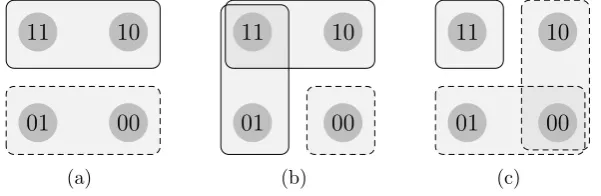
For the purpose of the clarity of exposition, it is useful to discuss an example of an inquisitive sentence in more detail. Consider the following figure, which schematically demonstrates the behavior of disjunction in classical semantics (a); and in Basic Inquisitive Semantics ((b) and (c)). For the sake of sim-plicity, we limit ourselves to the consideration of maximal states supporting a sentence in (b) and (c), i.e., states which are not properly included in any other state.
11 10
01 00
(a)
11 10
01 00
(b)
11 10
01 00
[image:22.595.145.448.271.382.2](c)
Figure 1.1: Disjunction
In the figure above, dots correspond to sets of possible worlds. Each dot contains two numbers. The first number denotes the truth value of pand the second number denotes the truth value of q. The shaded area indicates the extensional meaning of a given proposition, i.e., the sets of possible worlds that correspond to the possible worlds where the sentence corresponding to a given proposition holds.
Consider (a), which corresponds to the classical disjunction p∨q. The meaning of the classical disjunction corresponds to the union of the truth sets of the disjuncts; hence|p∨q|=|p| ∪ |q|. Thus, the proposition expressed by the classical disjunction is constituted by a single set of possible worlds s.t. p or q holds at any of them. Clearly, this is reflected in figure 1, since the meaning of the proposition expressed by p∨q is represented as one set of possible worlds containing all (11)-worlds, (01)-worlds and (10)-worlds.
Consider (b), which corresponds to inquisitive disjunction. Notice that
inquisitive and informative aspects of the disjunctionp∨qin BIS demonstrate its hybrid nature: on the one hand, it is inquisitive (it invites a response that would allow us to decide between the sets of possible worlds denoted by it) and on the other it also is informative (it suggests to reject some of the possible worlds.) Hence, this formalism is in line with our observations in Section 1.2. Last but not least, the requirement for the sets of states to be persistent guarantees that any more fine-grained response to an issue raised is also modeled. An example of a more fine-grained response, i.e., a response that provides more information than is sufficient to resolve the issue raised, is a state containing only (01)-worlds.
Consider (c), which is also an instantiation of inquisitive disjunction. It corresponds to (p→q)∨(q→p). Notice that the first disjunct corresponds to the downward closed set of states s.t. it is not the case that p holds at them and q does not and the second disjunct corresponds to the downward closed set of states s.t. it is not the case that q holds at them and p does not. Thus, the proposition expressed by (p→q)∨(q →p) invites a response that would allow one to decide between these two states. Similarly as in (b), the issue-resolving responses correspond to all of the subsets of states in (c).9
Notice, however, that the disjunction corresponding to (p→ q)∨(q →p) is no longer informative; it only invites a response that would allow to decide between the disjuncts and does not eliminate any set of possible worlds. This demonstrates that, depending on the sentence involved, inquisitive disjunc-tion may or may not be informative.
1.5
The Radical Twist
One of the extensions of Basic Inquisitive Semantics is Radical Inquisitive Semantics. The key difference between the Radical and Basic Inquisitive System lies at the discourse level. RIS enriches the framework of Basic In-quisitive Semantics by allowing for a more detailed account of responses to a sentence uttered. Rather than understanding natural language discourse only as an exchange of information, Radical Inquisitive Semantics interprets it as a cooperative process in which issues are raised and resolved by means of positive, negative andissue-dispellingresponses made to proposals to change the common ground. Issue-dispelling responses, however, correspond neither to Basic Inquisitive Semantic negations of sentences nor to positive responses to sentences; rather, they allow us to specify more fine grained distinctions, where one can negate the supposition behind an uttered sentence.
As pointed out above, at the discourse level, the key postulate of RIS is that participants in a conversation raise and resolve issues by making negative, positive and issue-dispelling responses to proposals to update the common ground. Thus, conversational participants may propose to change the common ground in one or more ways and may react to suggested changes in a variety of ways. In order to see this in greater detail, consider the following conversation between four people: A, B, C and D.
• A: “If Pete plays the piano, will Sue sing?”
• B: “Yes, if Pete plays the piano, Sue will sing”
• C: “No, if Pete plays the piano, Sue will not sing.”
• D: “Well, Pete will not play the piano”
In this conversation person A asks other participants a question whether it is the case that if Pete plays the piano, Sue will sing. Person B, then replies that this is the case, i.e., she claims that if Pete plays the piano, Sue will sing. Notice that person B simply gives a positive response, she accepts the proposal made by A. On the other hand, person C disagrees with person B. She still accepts the proposal made by A, however she does not think that Sue will sing if Pete plays the Piano. Last but not least, person D dispels the proposal made by A and the responses made by B and C. She thinks that the supposition behind A’s utterance does not hold and dispels the issue raised by A. Importantly, D’s issue-dispelling response does not contradict B’s and C’s responses; it only questions the supposition behind them. Interestingly, this reading of B’s disagreement with C, can be seen as being further motivated by Ramsey’s observation that “If two people are arguing “If p will q?” and are both in doubt as to p, they are adding p hypothetically to their stock of knowledge and arguing on that basis about q; so that in a sense “If p,
q” and “If p, ¬q” are contradictories” ([35], pp. 155). This can be seen as a further motivation for RIS’ enrichment of the responses to a sentence uttered, since neither in Classical Logic nor in BIS, B’s and C’s responses contradict each other. Furthermore as BIS allows us to model only positive and negative responses to a sentence, this also demonstrates the novelty of RIS’s framework, i.e., the issue-dispelling responses that are not negations of positive nor negative responses and that do not correspond in any systematic way to the positive and negative responses.
that as the conversation proceeds, raised and resolved issues as well as neg-ative and positive responses made allow us to limit the set of possible words to the most plausible ones and thus reach the most likely conclusion.
1.6
Radical Inquisitive Semantics
In this section we will give a formal definition of RIS and discuss this system in detail. Similarly as in BIS, we will give recursive definition of the meaning of sentences in RIS. Furthermore, we will discuss semantic clauses and define additional notions that turn out to be vital in understanding this refinement of BIS. Most importantly we will highlight the new behavior of implication and the role of issue-dispelling responses.
Radical Inquisitive Semantics is stated recursively in terms of support and rejection.
Definition 16 (Language) Let P be a finite set of propositional letters. We denote by LP the set of formulas built from P using the connectives
÷,∧,∨,→.
RIS is determined by the satisfaction pair|=+ (support) and|=− (reject)
and a recursive definition as:10
Definition 17 (Support in RIS)
σ |=+p iff v(p) = 1 for any v ∈σ
σ |=−p iff v(p) = 0 for any v ∈σ σ |=+÷θ iff σ|=− θ
σ |=−÷θ iff σ|=+ θ
σ |=+θ∧ψ iff σ|=+ θ and σ|=+ ψ
σ |=−θ∧ψ iff σ|=− θ or σ |=− ψ σ |=+θ∨ψ iff σ|=+ θ or σ |=+ ψ
σ |=−θ∨ψ iff σ|=− θ and σ|=− ψ
σ |=+θ →ψ iff ∀τ ⊆σ.(τ |=+ θ implies τ |=+ψ)
σ |=−θ →ψ iff ∃τ.(τ |=+ θ and ∀τ0 ⊇τ.(τ0 |=+ θ implies σ∩τ0 |=− ψ))
A state σ rejects an atomic sentence p iff p does not classically hold at any possible worlds in σ.
A state σ supports a sentence÷θ iff σ rejects θ. A state σ rejects a sentence ÷θ iff σ supports θ.
A state σ rejects a sentence θ∧ψ iff σ rejects θ or σ rejects ψ. A state σ rejects a sentence θ∨ψ iff σ rejects both θ and ψ.
A state σ rejects a sentence θ → ψ iff there is a set of possible worlds τ
s.t. for every extension of it restricted to σ: if this extension supports the antecedent, then it rejects the consequent.
Support and rejection clauses allow us to determine the meaning of every proposition and counter-proposition.
Definition 18 The proposition expressed by θ, denoted [θ]+, is the set of all
states supporting θ.
Definition 19 The counter-proposition expressed by θ, denoted [θ]−, is the set of all states rejecting θ.
Definition 20 (Entailment+) For any two sentences θ and ψ, θ |=
+ ψ iff
every state that supports θ also supports ψ, i.e ∀σ: (σ|=+ θ⇒σ |=+ ψ).
Definition 21 (Entailment−) For any two sentences θ and ψ, θ |=− ψ iff every state that rejects ψ also rejects θ, i.e ∀σ: (σ |=− ψ ⇒σ |=− θ).
Definition 22 (RIS Entailment) For any two sentence θ and ψ, θ |=RIS ψ if and only if θ|=+ψ and θ |=− ψ.
Note that, by the definition of the rejection clause for an atomic sentence, rejection of an atomic sentence corresponds to the negation of an atomic sen-tence in BIS. However, it is generally not the case that [θ]+ = [θ]. For notice
that [÷(p∧q)]+6= [¬(p∧q)], since the former consists in a set of downward closed sets{P(|¬p|),P(|¬q|)}, whereas the latter in a set of downward closed sets {P(|¬p| ∪ |¬q|)}.
The definition of Entailment+ is a RIS-equivalent of entailment in BIS. As both of the entailments aim at modeling the positive responses, they are concerned with support relations between states and sentences. Similarly to the BIS case, θ |=+ ψ holds if and only if ψ is settled wheneverθ is.
requiring that every state which rejects the premises also rejects the conclu-sion, we require that every state that rejects the conclusion also rejects the premises. This reflects the intuition that a sentence θ Entails− a sentence
ψ if and only if it is easier to reject θ than ψ. Notice that this is the case iff every state that rejects ψ also rejects θ, i.e., a set of states rejecting ψ
corresponds to some set of states rejecting θ. Thus, we can define negative entailment also in terms of the positive entailment: ÷ψ |=+ ÷θ. The
nega-tive entailment gives rise to a new relation between sentences, which concerns the informativeness andinquisitiveness of their negative responses. Hence it requires that, in order to conclude that the rejection of a sentence θ entails the rejection of a sentence ψ, we need to guarantee that negative responses toψ are at least as informative as negative responses to θand that whenever a negative response settles the rejection of ψ, it also settles the rejection of
θ.
RIS entailment is then defined in terms of these two entailment relations. One sentence radically entails the other iff the support and the reject en-tailment hold between them. As will become clear by our analysis of the paradoxical inferences in Chapter 3, RIS entailment seems to give rise to a weaker notion of validity than BIS, as it not only concerns positive responses to uttering a sentence, but also negative responses.
Definition 23 (Informative Content of a Counter-Proposition) The infor-mative content of a counter-proposition[θ]−corresponds to the union of states rejecting θ, i.e., inf o([θ]−) = S
[θ]−.
Definition 24 (Informative Counter-Proposition) A counter-proposition is informative if and only if its informative content does not coincide with ω.
Definition 25 (Issue Raised by [θ]−) Let θ be a formula in L. The issue
I raised by a counter-proposition expressed by a sentence θ is an issue over
inf o([θ]−).
Definition 26 (Inquisitive Content of a Counter-Proposition) The inquisi-tive content of a counter-proposition [θ]− is the issue raised by [θ]−.
Definition 27 (Inquisitive Counter-Proposition) A counter-proposition is inquisitive if and only if the issue raised by [θ]− is not resolved by its own informative content, i.e., inf o([θ]−)∈/[θ]−.
with the definitions from BIS, give a way of determining the meaning of ev-ery proposition and counter-proposition. For classificatory purposes, we will examine the new semantic features of RIS in greater detail. Since the se-mantic definitions of the support clauses are common between BIS and RIS for all connectives apart from ‘÷’, we will focus on the description of the rejection clauses in RIS and clauses for ‘÷’.
Atomic Sentences. A counter-proposition for an atomic sentence p cor-responds to a persistent set of states s.t. p is rejected by them. Thus, in order to determine the meaning of a counter-proposition corresponding to an atomic sentence p, we need to determine the classical truth set |¬p| and then construct [p]− by taking all subsets of this truth set. This definition mirrors the intuition that we can reject the claim that p, by pointing to any counter-possibility s.t. p does not classically hold at any possible world in it. E.g., when someone says “Sue will sing”, we can reject that proposal by giving a negative response of the form: “Because of the weather Sue does not feel so good and she will not sing”. Furthermore, it follows that the counter-proposition for an atomic sentence is always informative but never inquisitive.
Inverted Sentence. The inverted sentence in RIS is analogous to BIS’s negation. The proposition expressed by an inverse of θ, ÷θ, consists in all negative responses to θ. Thus, in order to determine the proposition ex-pressed by ÷θ we gather all states rejecting θ. The key difference between the proposition expressed by an inverse of θ and the proposition expressed by ¬θ is that the former can be inquisitive whereas the latter is never in-quisitive. This reflects the fact that the inquisitive content of the proposition [÷θ]+may differ from the inquisitive content of the proposition [¬θ]. To
illus-trate this point, consider negative responses to a sentence “Sue will not sing and dance”. Notice that if one claims that “Sue will not sing and dance” and expects that some people may reject this statement, one generally predicts that people would do so by saying “No, Sue will sing” or by saying that “No, Sue will dance” or by giving any more informative reply. This is correctly modeled in Radical Inquisitive Semantics since if pcorresponds to “Sue will sing” and q corresponds to “Sue will dance”, then ÷(p∧q) corresponds to the downward closed set{P(|¬p|),P(|¬q|)}. However, in BIS¬(p∨q) corre-sponds to a downward closed set {P(|¬p| ∪ |¬q|)}. This points towards the fact that RIS and BIS may give different results concerning the propositions expressed by sentences. For notice that in our example, BIS treats the re-jection of the disjunction of two atomic sentences as non-inquisitive whereas RIS treats it as being inquisitive.
states which support θ. This reflects the intuition that we can reject a sen-tence ÷θ by specifying a state that supports θ. For instance, a negative response to a sentence that “It is not the case that you will clean your room or do the dishes.”, is a positive response to it, e.g., “I will do the dishes and take the rubbish out, because my mother told me so”. Notice that all possible positive responses to this sentence correspond to the proposition expressed by θ. Hence, negative responses to an inversion of a sentence are equivalent to positive responses to this sentence.
Disjunction. The counter-proposition for disjunction is constituted by all states s.t. they reject both of the disjuncts. This reflects the intuition that when we reject a disjunction, we do so by rejecting both of the disjuncts. For instance, when one says “The class is either at 10AM or at 11AM”, we usually reject it by saying “No the class is neither at 10AM nor at 11AM”, “No, the class is at 1PM”, and so on.
Conjunction. In order to determine the counter-proposition for conjunc-tion θ∧ψ we need to first collect all states that reject θ and all states that reject ψ (so to speak create one set of states [θ]− and one set of states [ψ]−). Notice that this shows that the counter-proposition to a conjunction θ ∧ψ
is inquisitive in nature. That is, the negative responses that are elicited by a conjunction invite a response that would allow us to determine which of the conjuncts is rejected. Notice, that the inquisitive treatment of negative responses to a sentence also demonstrates one of the key differences between the proposition corresponding to BIS’s ¬(p∧q) and the counter-proposition corresponding to (p∧q). Namely, the former is not inquisitive, whereas the latter is.
Implication. The counter-proposition for an implication includes all states which contain at least one maximal enhancement supporting the antecedent11,
such that this enhancement also rejects the consequent. This does justice to the intuition that, if we update the common ground with a rejection of an implication, we want to make sure that there is one way of supporting the antecedent such that it always guarantees that the consequent is rejected. To see this consider the following example: “If you play football, you will be tired”. Then one can reject this conditional statment by saying “No, if I play football, I will not be tired” or by giving any more informative response, e.g., “No, if I play football and my mom gives me a lift to the field, I will defi-nitely not be tired”. This is in line with the radical inquisitive modeling, since the first reply corresponds to the maximal enhancement supporting the
tecedent and rejecting the consequent; whereas the second reply corresponds to a more informative enhancement that supports the antecedent.
Such a definition of the rejection of an implication also gives a straight-forward model of some additional phenomena, namely the rejection of the supposition behind the conditionalandthe contradiction of the proposal made by the conditional. To see this consider the following example: “If you play football or basketball, you will be tired”. The ways in which one can reject this conditional fall into two main classes. On the one hand, one can give a reply along the following lines: “No. If I play football(/basketball), I will not be tired”. On the other hand, one can reply “No. It is not the case that I will ever play football or basketball”. Notice that the first reply rejects the proposal made by the conditional statement; it rejects that the claimed dependency between the antecedent and the consequent holds. Notice also that such a rejection of the proposal made by a conditional statement corre-sponds to all states which support the antecedent non-trivially and support an update of the common ground which is of the form ‘one of the maximal enhancements supporting the antecedent⇒rejection of the consequent’. On the other hand, notice that the latter reply corresponds to an update of the common ground which is of the form ‘rejection of the antecedent’. More specifically, this observation gives rise to a more refined ternary character-ization of responses in RIS, where one can make a positive response and support the proposal made by the sentence uttered; e.g. reply
• “Yes, if I play football , I will be tired or if I play basketball I will be tired.”
One can give a negative response to an issue raised by uttering a sentence; e.g. reply
• “If I play football, I will not be tired”
And one can also give an issue-dispelling response and reject the supposition behind the sentence; e.g. reply
• “No. It is not the case that I will ever play football or basketball”12
12Notice also that issue-dispelling responses both support and reject the proposal made
by uttering a sentence. Hence, the range of responses definable in RIS allows us to give a more detailed classification of responses to sentences. More specifically, we can think of the issue-dispelling responses to a sentenceθ, denoted [θ]+−, as the ones s.t. they both support and reject the proposal made by utteringθ, i.e., [θ]+−={σ∈ω|σ∈[θ]+ and σ∈[θ]−}.
We can also think of purely negative responses to a sentenceθas the ones that reject but do not support θ - i.e., the ones contained in [θ]− \[θ]+−; and purely positive responses to a sentence θ as the ones that support but do not rejectθ - i.e., the ones contained in [θ]+\[θ]+
This analysis, coupled with the semantic features of inversion matches our earlier observations and allows us to reject the conditional statement by giv-ing responses of the followgiv-ing kind: ‘one of the enhancements supportgiv-ing the antecedent ⇒ rejection of the consequent’ and ‘rejection of the antecedent’. Thus, we can reject an implication by either giving a negative response or by giving an issue-dispelling response. The fact that inquisitive semantics allows us to model these effectively can be seen as constituting yet another case for the inquisitive enterprise. This feature of inquisitive semantics will also turn out to be vital in accounting for some of the paradoxes of material implication that will be discussed in the coming sections.
1.7
RIS Examples
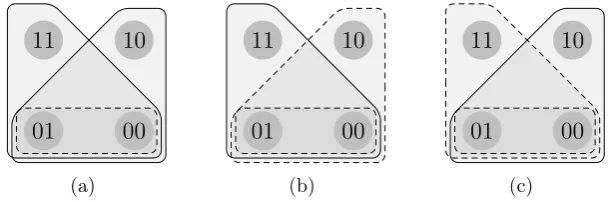
As in the Basic Inquisitive Semantics Section, for the purpose of the clarity of exposition, it is useful to discuss some further examples. We will consider 6 examples. In Figure 1.2, we will highlight the behavior of negative responses to a sentence and in Figure 1.3, we will discuss the issue-dispelling responses. For the purpose of simplicity and clarity of exposition, let us assume that there are no other propositional letters apart from p and q and let us limit ourselves to the consideration of maximal states supporting a sentence.
11 10
01 00
(a)
11 10
01 00
(b)
11 10
01 00
[image:31.595.148.449.440.538.2](c)
Figure 1.2: Support and Rejection in RIS.
The schematics of the figure are almost the same as in the previous figure on page 18. In comparison to the previous figure, the key difference concerns the set of possible worlds denoted by the dotted lines. This set of possible worlds corresponds to a negative response to a sentence in question.
set of states s.t. pdoes not hold at them, i.e., a state containing (01)-worlds, a state containing worlds; and a state containing (01)- as well as (00)-worlds. Furthermore, since the informative content of a counter-proposition [p]−is equivalent to|¬p|, it follows that the counter-proposition to an atomic sentence is not inquisitive.
Consider (b), which corresponds to a proposition expressed by a dis-junction p∨q, and a counter-proposition to this sentence. Notice that the proposition expressed by p∨q is still inquisitive and informative. On the other hand, the counter-proposition corresponding to p∨q is not inquisitive and is only informative. This is because the counter-proposition in (b) is constituted by the downward closed set of states s.t. both p is false and q is false, i.e., the states containing (00)-worlds.
Finally, consider (c), which corresponds to a proposition expressed by
p∧q. In this case the proposition expressed by this sentence corresponds to the downward closed set of states, s.t. both p and q hold at them. Notice that the counter-proposition to an issue raised byp∧q comprises two states: one that contains all sets of states s.t. p is false at them, and the other that contains all sets of states s.t. q is false at them. This demonstrates the key difference between the proposition expressed by a classical negation and the radical inquisitive proposition expressed by an inversion of a sentence: in RIS, negative responses do not correspond to the classical negation of a sentence. This is because a negative response to a sentence in RIS can correspond to several states, whereas classical negation of a sentence is always constituted by a single set of possible worlds. On the other hand, this also demonstrates a difference between supporting a negation of a conjunction and rejecting a conjunction. For notice that (c) demonstrates that the latter can be inquisitive in nature while the former is not.
11 10
01 00
(a)
11 10
01 00
(b)
11 10
01 00
[image:32.595.144.450.549.650.2](c)
Figure 1.3: Issue-Dispelling Responses
the situation resulting from uttering a sentence from the beginning of this section, i.e., “If Pete plays the piano, will Sue sing?”. Notice that states supportingp→qand states supportingp→ ÷qcorrespond to two classes of positive responses that one can give to this sentence. Notice further, that the counter-proposition to this sentence is constituted by the downward closed set of states containing possible worlds s.t. they rejectp. However, any state rejecting p is among the states supporting p → q and p → ÷q. Thus, ÷p
both supports and rejects p → (q ∨ ÷q), i.e., ÷p |=+ p → (q∨ ÷q) and
÷p |=− p → (q∨ ÷q). Hence, one of the features of the reject and support entailments in RIS is that they are not mutually exclusive. Notice also that in BIS [¬(p → (q ∨ ¬q))] = {∅}. This demonstrates more directly that negative responses in BIS are not always equivalent to negative responses in RIS. On the other hand, (b) and (c) correspond to propositions and the counter-propositions to p→q (“If Pete plays the piano, Sue will sing”) and
CHAPTER
2
Paradoxes of Material Implication and Non-Classical
Logics
The Paradoxes of Material Implication concern entailments which are valid according to the classical framework but which contradict universal linguis-tic intuitions. These contradictions are based on very strong and general intuitions about how we use our language and are commonly agreed to con-stitute a significant problem for the classical semantics. In particular, by these means the Paradoxes of Material Implication raise concerns regarding the appropriateness of the classical recursive truth definition of a proposition and, more specifically, the understanding of English conditional in terms of material implication. Historically, the investigation of the Paradoxes of Ma-terial Implication lead to the development of many non-classical semantic systems, such as conditional semantics and relevance semantics. Given this very general understanding of these Paradoxes, in this section, we will intro-duce and consider approaches to these problematic inferences from Classical Logic as given by Conditional Logic, Update Semantics, Strict Conditional Logic and Relevance Logic. We will do so first of all by discussing the ma-terial implications in question, then by providing a short introduction to different non-classical systems, and finally by demonstrating which problem-atic inferences hold in which logic. We will summarize the results in a table; the proofs of all results can be found in the Appendix.
other non-classical accounts of the conditional with the classical material interpretation of the conditional.
The difference between indicative and counterfactual conditionals is a very subtle one, with a significant number of “fuzzy cases” and no widespread philosophical agreement on the exact definitions to be employed (see [3]). For the purpose of our discussion it is sufficient to understand indicative conditionals as the ones in which both the antecedent and the consequent contain verbs in the indicative mood. Notice that by these means neither the antecedent, nor the consequent contains would, which occurs commonly in counterfactual conditionals. Following this very general definition, an ex-ample of English indicative conditional that we are concerned with is “If you understand this introduction, then it was sufficiently clear.” and an example of conditional sentences that we will not be considering in our discussion is “If this introduction were not clear enough, then I would jump of a cliff ”. Hence, the indicative conditionals usually concern only what is/wasthe case and not what would have been.
Before we proceed to the introduction of different non-classical logics, let us recap the classical material interpretation of the indicative conditional. The classical understanding of θ → ψ is solely truth-functional. That is, it is characterized by the claim that the truth-values of θ and ψ are necessary and sufficient to determine the truth-values of English indicative conditionals. According to this account, the meaning of an indicative conditional θ → ψ
is equivalent to it is not the case that θ and not ψ and there are no other semantic properties which contribute to its meaning. Such a stance is referred to as the horse-shoe ‘⊃’ account of English conditional.
2.1
Paradoxes of Material Implication
As pointed out in the introduction we assume a very broad understanding of the Paradoxes of Material Implication. Under this understanding we con-sider all material implications that lead to counterintuitive results as being instances of the Paradoxes of Material Implication. On the one hand, such a broad perspective allows us to highlight different problems of material impli-cation, whereas on the other, it also allows us to highlight different properties of logics in question. By these means the paradoxes below will be used as a benchmark that will allow us to compare different models of natural lan-guage implication. For the purpose of clarity, in Chapter 4 we will specify which implications are originally referred to as instances of the Paradoxes of Material Implication, and which ones are referred to differently. In our discussion of the Paradoxes of Material Implication, we will consider the following paradoxes:
1. p|=q→p
2. ¬q |=p→q
3. p→s|= (p∧q)→s
4. |= (p∧ ¬p)→q
5. |=p→(q∨ ¬q) 6. |=p→(q →p) 7. p∧q|=p→q
8. |= (p→q)∨(q →p) 9. ¬p|= (p→ ¬p) 10. p→q, q →s|=p→s
11. |=p→(q →q)
12. (p∧q)→s|= (p→s)∨(q →s) 13. (p→q)∧(s→t)|= (p→t)∨(s→q) 14. ¬(p→q)|=p
16. p→q|=¬q→ ¬p
The implausibility of these paradoxes is demonstrated by the following natural language examples:
1) I will be the new president tomorrow. Therefore, if I die today, I will be the new president tomorrow.
2) I will not win the election today. Therefore, if I win the election today, I am a ham sandwich.
3) If the weather is nice tomorrow, I will play cricket. Therefore, if the weather is nice tomorrow and I die today, I will play cricket.
4) If I am European and non-European, then I am a ham sandwich. 5) If pigs can fly, then I am a logic student or not.
6) If I go to the cinema tomorrow, then if I die today, I will go to the cinema tomorrow.
7) It is sunny but windy. Hence, if it is sunny, then it is windy.
8) If I am in Europe then I am in America or if I am in America, then I am in Europe.
9) The class is not at 10AM. Hence, if the class is at 10AM, then it is not at 10AM.
10) If I win a million dollars, I will quit my job. If I quit my job, I will lose my apartment. Hence, if I win a million dollars, I will lose my apartment. 11) If I eat nuts, then if John won the election, he won the election.
12) If you press switch A and press switch B, then the light will go off. Hence, if you press switch A the light will go off or if you press switch B the light will go off.
13) If John is in Amsterdam, he is in the Netherlands and if John is in Warsaw, he is in Poland. Hence, if John is in Amsterdam he is in Poland or if John is in Warsaw he is in the Netherlands.
14) It is not the case that if there is a good God, then the prayers of evil people will be answered. Hence, there is a good God.
15) It is not the case that if I die today, I will see sunlight tomorrow. Hence, I will not see sunlight tomorrow.
16) If we take the car then it won’t break down en route. Hence, if the car does break en route, we did not take it.1
is because, the intuitions concerning the implausibility of these inferences are sometimes mixed, and it is not uncommon that people find these inferences quite intuitive. Nevertheless, it is worthwhile to include these inferences in our discussion as they highlight several aspects of logic and properties of im-plication. For instance, inferences (5) and (11) are the instances of natural language implications in which the antecedent is notrelatedto the consequent in any way. Such an independence of the antecedent and the consequent is very often deemed to be undesirable. Similarly these two examples demon-strate a highly disputed rule, namely that a necessary proposition follows from anything at all. The instance (10) seem to be counterintuitive as it might have true premises and a false conclusion. In particular, this condi-tional statement seems to be counterintuitive, as it seems to be very implau-sible that I will lose the apartment despite the fact that I have enough money to afford it. (10) is also an instance of one of the properties of conditionals, namely transitivity.
2.2
Non-Classical Semantics
In this section we will introduce and discuss the non-classical semantic sys-tems and their approaches to the Paradoxes of Material Implication from the previous section. We will give an introduction to Strict Conditional Logic S2, Conditional Logic C2, Update Semantics and Relevance Logic B. We will explain the semantics of these logics in detail with a special focus on implica-tion. The description of these logics developed in this section will constitute the basis for the evaluation of the paradoxical inferences in the Appendix and the comparison in the Analysis Chapter.
2.2.1
Strict Conditional Logic
One of the logics developed to deal with the paradoxes of material implication is Clarence Irwing Lewis’ non-normal modal logic S2 [24] [31]. In this logic Lewis suggests that paradoxes of material implication occur because material implication is too contingent upon the state of affairs. Thus, it is highly likely that material implication is not sufficient to model the behavior of English indicative conditionals effectively in situations involving uncertainty or logi-cally contingent situations. Lewis suggests that, in modeling the conditional, we should also look at the alternatives to the actual world which we consider possible. Based on this observation, Lewis proposes that the proper modeling of implication is the one which involves some notion of necessity - namely