H Y P O T H E S I S
Open Access
Interaction-based evolution: how natural
selection and nonrandom mutation work
together
Adi Livnat
Abstract
Background: The modern evolutionary synthesis leaves unresolved some of the most fundamental, long-standing questions in evolutionary biology: What is the role of sex in evolution? How does complex adaptation evolve? How can selection operate effectively on genetic interactions? More recently, the molecular biology and genomics revolutions have raised a host of critical new questions, through empirical findings that the modern synthesis fails to explain: for example, the discovery ofde novogenes; the immense constructive role of transposable elements in evolution; genetic variance and biochemical activity that go far beyond what traditional natural selection can maintain; perplexing cases of molecular parallelism; and more.
Presentation of the hypothesis: Here I address these questions from a unified perspective, by means of a new mechanistic view of evolution that offers a novel connection between selection on the phenotype and genetic evolutionary change (while relying, like the traditional theory, on natural selection as the only source of feedback on the fit between an organism and its environment). I hypothesize that the mutation that is of relevance for the evolution of complex adaptation—while not Lamarckian, or “directed” to increase fitness—is not random, but is instead the outcome of a complex and continually evolving biological process that combines information from multiple loci into one. This allows selection on a fleeting combination of interacting alleles at different loci to have a hereditary effect according to the combination’s fitness.
Testing and implications of the hypothesis: This proposed mechanism addresses the problem of how beneficial genetic interactions can evolve under selection, and also offers an intuitive explanation for the role of sex in evolution, which focuses on sex as the generator of genetic combinations. Importantly, it also implies that genetic variation that has appeared neutral through the lens of traditional theory can actually experience selection on interactions and thus has a much greater adaptive potential than previously considered. Empirical evidence for the proposed mechanism from both molecular evolution and evolution at the organismal level is discussed, and multiple predictions are offered by which it may be tested.
Reviewers: This article was reviewed by Nigel Goldenfeld (nominated by Eugene V. Koonin), Jürgen Brosius and W. Ford Doolittle.
Keywords: Adaptive evolution, Neutral theory, Sex and recombination, Epistasis, Junk DNA,de novogenes, Transcriptional promiscuity, Mutation bias, Evolvability
Correspondence: [email protected]
Department of Biological Sciences, Virginia Tech, Blacksburg, VA, 24061, USA
Background
To explain adaptive evolution, we still use today ideas from the foundations of the modern evolutionary syn-thesis formed in the 1920s and 1930s. Yet there has been a sea of change in the empirical realities since then. The molecular biology and genomics revolutions have occurred and brought with them fundamental new empirical findings. Some of these findings were sim-ply unexpected from traditional theory and are unen-gaged by it, including the discovery in the 1960s of far more genetic variance than could be subject to selection according to traditional theory [1,2], and ENCODE’s very recent finding that the majority of the human genome is biochemically active [3]. From the perspective of tra-ditional theory, we are now forced to predict that much of this activity is just “biochemical noise” and not really part of the organism, again because traditional natural selection cannot act on so much evolving matter and for other important reasons [4-8]. Other empirical find-ings have been more directly challenging. Consider for example de novo genes (e.g., [9-13])—genes that pre-sumably have arisen “out of thin air” by a sequence of random mutations that came together into a new functioning gene, including signals for transcription and translation and even alternative splicing [11]. This de novoformation takes place even though traditional nat-ural selection could not have acted on this sequence of mutations until the gene was already complete (sub-stantial enough to be active), in clear contradiction with what Jacob justifiably predicted to be impossible [14]. Also challenging to traditional theory are findings of such fundamental significance for our understand-ing of evolution as the evolutionary organizunderstand-ing of more than 1500 genes into a new genetic network underly-ing a novel, complex adaptation by transposable elements [15]. Whether for these or other reasons, a sense of curiosity about the new empirical reality has been con-veyed by such luminaries as Doolittle [16], Graur and Li [17], Wagner [18], Fedoroff [19], West-Eberhard [20] and others.
In light of these findings, it is commonly assumed that traditional natural selection operates to the extent that it can, and that originally neutral mutations account for anything that selection does not account for. But this modern approach leads to a deep inconsistency. The original idea of natural selection and random mutation, implicit in Fisher’s work [21], was to minimize the amount of “work” done by chance in the evolution of adapta-tion and let natural selecadapta-tion do the job of evolving an adaptation by pulling out from the noise the supposed slightly beneficial mutations and causing them to accu-mulate inexorably toward the evolution of adaptation. It is inconsistent to invoke this idea, which attempted to mini-mize the amount of evolutionary work done by fortuitous
chance, while at the same time allowing for an unspec-ified number of originally neutral mutations to play an inherent role in the evolution of adaptation, as is cur-rently done for example in the case of de novo genes. Indeed, there is no quantification of the amount of chance that we call upon to explain the evolution of adapta-tion (namely the chance that is involved in the arising of accidental mutations and in random genetic drift, to the extent that the latter is invoked)—a deep problem not yet addressed at all by the whole body of population genetics.
This paper holds that the key to solving the fundamen-tal problems brought about by the molecular biology and genomics revolutions is to go back and revisit some fun-damental old problems in evolutionary theory that have been open since before even the rise of molecular biol-ogy itself. Attending to these old open problems, we may be able to offer a deep change to the core of the theory of natural selection that will reconnect the theory better to the evidence available today. I will begin by discussing two fundamental unresolved problems, namely the role of sex in evolution and how selection on interactions between alleles of different genes can play an evolution-arily constructive role. I will show that, in fact, these two problems are different aspects of one and the same thing.
The theory will be proposed verbally, and not math-ematically, because it is not clear that traditional mathematical tools are immediately suitable for its mathematization. The price of accepting the benefit of unification—where the problems of sex, interactions and the lack of quantification of chance in traditional theory are addressed in one—will be to accept that what we know regarding how evolution happens is merely the tip of the iceberg. An outline of the main points is given in the summary section.
Fundamental problems in traditional evolutionary theory: sex and interactions
The most obvious effect of sex is that it creates an expo-nentially large number of different potential combinations of alleles at different loci—indeed it makes individuals unique. When biologists are asked what the role of sex is in evolution, they often say that from a given number of alle-les at different loci it creates this almost endalle-less number of different genetic combinations; and since natural selection operates on genetic variation, this “increased variance” facilitates evolution. But the insufficiency of this explana-tion is well known to investigators of the evoluexplana-tion of sex and recombination [24]. What is the point of creating, by the shuffling of genes, a variety of genetic combinations that will be tested by natural selection? One may wish to say that, among the many combinations, particularly good ones will be found that would not have existed otherwise. But in saying this, a basic point is forgotten: these combi-nations of alleles at different loci are not heritable. Just as sex brings them together, so too it breaks them down.
Consistent with this point, the core of the Fisherian the-ory of adaptive evolution, which forms an essential part of the modern synthesis of evolution [21], is structured in a way that makes these combinations of alleles as complex wholes inessential: following it, population geneticists have often assumed that each allele can have a selective value in and of itself—it can be a “good” or a “bad” muta-tion (“beneficial” or “deleterious”) with little consideramuta-tion of the genetic context [25]. This way an allele is “blind” to the particular combinations it goes through. Selection operates statistically on each allele independently of other alleles, because any given allele makes essentially the same additive contribution in different individuals toward the numerical sums that are those individuals’ “fitness values”. Alleles pass each other like ships in the night as they move through the population [26], and the population is treated as a collection of allele frequencies, each for an independent, essentially non-interacting locus [21]. While Fisher did discuss interactions both within and between loci, even in the context of recombination [21], those were not part of his core process of adaptive evolution, which was instead based on independent (or “additive”) effects of separate loci.
However, this way of thinking has left the role of sex a mystery. Notice that the same beneficial or deleterious mutations could have arisen and been favored or disfa-vored in a sexual as well as an asexual population. By providing a basic mechanism for evolution that works with or without sex, the Fisherian theory has created a view of evolution where sex is not really essential. Since then, investigators only proposed subsidiary and circum-scribed benefits that sex may bring on top of an evolution-ary mechanism that can work essentially without it (e.g., [26-30]). But all such “bonuses” proposed so far require rather specific conditions [31], and, even considering all of these bonuses together, it is not clear that their collection forms an appealing way of explaining the near-ubiquity of sex [32,33].
Wright never accepted Fisher’s conceptualization of evolution. Wright believed that genes interacted in com-plex networks and that likewise alleles at different loci must interact with each other to generate any notable evo-lutionary change [34-36]. The notion of selection acting on each allele in and of itself seemed to him fundamentally insufficient for explaining the evolution of complex adap-tation [36]. Note, however, that an interaction between alleles at different loci cannot be persistently selected on, according to the traditional view, precisely because sex disassembles such combinations of alleles, as discussed. Instead of selection, Wright proposed in his shifting bal-ance theory that the basis for an adaptive complex of genes will first arise by chance (after the constituent alleles at different loci have not only arisen by chance, but have also spread by random genetic drift in a given subpopulation), and then natural selection will come to bear on the process by simple (non-interactive) improvements and by helping to spread the constituent alleles from the given subpopu-lation to other subpopusubpopu-lations through migrants [34,35]. This theory required stringent conditions on the pop-ulation structure [37,38], attempted to obtain the basis for a new complex adaptation by pure chance, and has not been uniformly accepted [38,39]. Thus, in distinction from selection on separate genetic effects and the sup-posed chance formation of the basis for beneficial genetic interactions by random genetic drift, we still do not have a theory for how selection on genetic interactions can be at the core of the adaptive evolutionary process.
in the traditional way. This will take a sweeping change of outlook, which at first appears to be itself impossi-ble: I will posit that mutation is nonrandom, and show that this solves the problem from the traditional the-ory that combinations of alleles cannot have a lasting effect. This appears impossible at first because we are cor-rectly trained to avoid Lamarckian transmission [40] and Lamarckian “directed mutation” as possible explanations for evolution at the general level [22,23]. But the nonran-dom mutation discussed here will not be of these kinds. The “nonrandomness” I will refer to is emphatically not the one where mutation is more likely to occur in an envi-ronment where it increases fitness, and is therefore not the one disallowed by traditional theory [17,22,23].
Selection on interactions can drive evolution when mutation is nonrandom
Let us develop the concept of nonrandom mutation here carefully from square one. By “nonrandom mutation” we will mean that the mutation that drives evolution is not accidental—it is not an unintended disruption of the genetic code, caused for example by external agents or by oxidative stress (although mutations of such kinds do hap-pen and can lead to disease). We will take this to mean that the mutation that drives evolution is the result of an organic process that belongs to the organism.
If so, then like all other biological processes that belong to the organism, this process must be specified by the genes. These genes interact, as genes always interact in the determination of a trait, except that, while a classical trait is something that serves in the survival and repro-duction of the organism, here we are talking about a trait whose end result is genetic change. While genes interact and lead to a classical trait like the ear, here genes interact and cause genetic change.
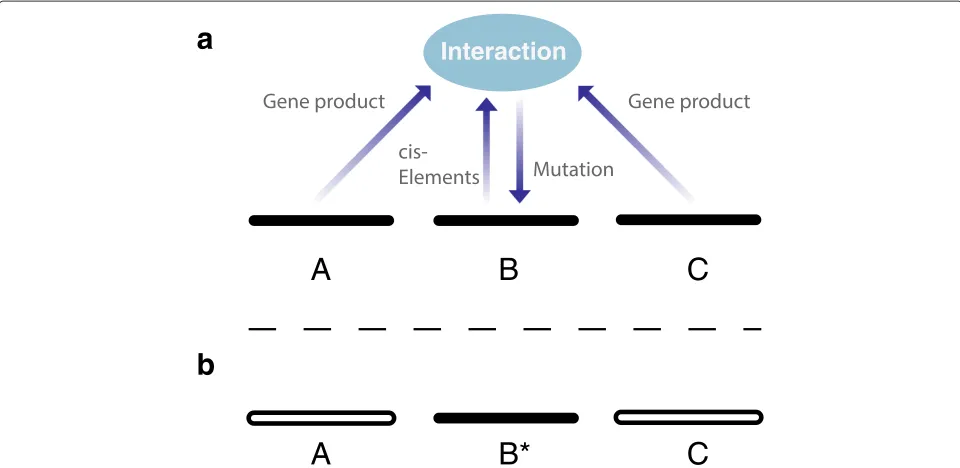
Given that genes interact in the determination of genetic change, and keeping the assumption that their alleles interact, this means that the mutation that drives evolu-tion is a process that combines informaevolu-tion from alleles at multiple loci and writes the result of the combination operation into one locus—the locus being changed by mutation (Figure 1a). (Also if multiple loci are changed at once, information is combined from multiple loci to enact these multiple changes.) By combining information from alleles at multiple loci into one locus, this operation cre-ates from the combination of alleles a piece of information that is not broken by the sexual shuffling of the genes, and is therefore heritable (Figure 1b). (It creates an allele, and this is an elementary unit for the shuffling; the shuffling breaks only combinations of alleles). This means that com-binations of alleles at different loci do have an effect that lasts through the shuffling: they transmit information to
Interaction
A
B*
C
A
B
C
a
b
future generations through the mutations that are derived from them.
This general-level point is as simple as it is crucial: if mutation is nonrandom, then selection on interactions has a hereditary effect. While selection on combinations means that successful combinations survive and repro-duce preferentially, the writing of mutation takes these successful combinations and makes heritable mutations from them that will be transmitted to the next genera-tion. Thus, natural selection on genetic combinations and nonrandom mutation work together.
Interestingly, there have always been only two main ways of thinking about adaptive evolution (though more if we consider smaller variants and less influential streams): One has been the Darwinian theory of natural selec-tion, which was turned into the neo-Darwinian theory of natural selection and random mutation (ns/rm) in the 1920s and 1930s. In this theory, differential survival and reproduction is the source of feedback that allows the fit between an organism and its environment. The other has been the Lamarckian-transmissionist one, which holds that the organism is somehow able to sense what is needed for improvement in terms of the fit to the environment and then is able to change the hereditary material in a way that improves this fit, thus transmitting the improvement to the next generation. This Lamarckian-transmissionist option is not only impossible as a general-level expla-nation for evolution [40], but, interestingly, if it were possible, its action would have rendered selection redun-dant [41]. Therefore, the Lamarckian kind of nonrandom mutation on the one hand, and natural selection on the other hand, are rival hypotheses. We can now see that the theory presented here is a third alternative, distinct from the above two. The nonrandom mutation considered here and natural selection are complementary, in diamet-ric opposition to the above rivalry. Differential survival and reproduction is the source of feedback on organismal fit to the environment. Nonrandom mutation collects this feedback in a manner that allows natural selection to act on genetic interactions. Thus, selection on the organism as a unified whole is possible.
The theory just proposed connects empirical facts at a deep level. It explains sex while making a substantial statement about the empirical nature of mutation: the mutation that drives evolution is nonrandoma—it is an organic process that belongs to the organism. Evidence and predictions regarding this statement will be discussed later (see the section “Evidence from and predictions for molecular evolution”), after further theory is developed that will make them clearer.
In the following sections I will discuss the prevalence, origin and maintenance of sex, the nature of the evolution of complex adaptation at the phenotypic level, and how they connect to the above. The reader who is primarily
interested in the molecular side of this theory may skip to the section “A more detailed look into the new theory ’’.
Sex as a matter of necessity for evolution
Having described the core of the theory we can now expand on our empirical view. I use Barton and Charlesworth’s [24] evolutionary definition of sex as the shuffling of genes among individuals that leads to the creation of offspring that are genetically different from their parents. According to this most basic evolutionary-biological definition, sex is nearly universal [24]: it occurs in plants and animals by syngamy, in fungi via the fusion of hyphae and in bacteria by conjugation and other means [33,42]. Many species are capable of reproducing both sexually and asexually, but because their bouts of sex-ual reproduction keep their genes shuffled, they will be considered sexual here. We will consider “asexual” those species in which the shuffling of genes does not occur. Those are the obligate asexuals.
Several important facts can now be pointed out. First, obligate asexuals are very rare. For example, Vrijenhoek [43] estimated that about 1 in 1000 animal species is an obligate asexual. Second, they appear to be headed toward ultimate extinction without leaving descendant species behind. This point has been inferred from their phyloge-netic distribution: they inhabit small, recent, sparsely dis-tributed twigs on the tree of life, which is consistent with the idea that they occasionally arise as terminal offshoots from sexual species (sexuals are the source and asexuals are the sink) [44-48]. Indeed, their structure shows that they are recent derivations from sexual ancestors: selfing plants still have reproductive structures that have served them in sexual reproduction in recent evolutionary times [49]. Given this evidence (see further discussion in the next section), we can infer that the immortal part of the tree of life is sexual.
Interestingly, and consistent with the above, Stebbins concluded from extensive studies of plant morphology that asexuals are incapable of true evolutionary innovation [49]. In accord with Stebbins [49], they have often been called “evolutionary dead ends”. We must also ponder the great extent of adaptive structure and effort devoted to implementing the shuffling of genes throughout the bio-logical world. From flowers to butterflies to human behav-ior, we do not need science to tell us that sex forms an important part of the biological world. Indeed, it is inter-twined with biological structure and function down to the molecular level, where meiosis involves extremely com-plex molecular machinery that implements the shuffling of genes.
matched in terms of this ubiquity and importance. In this part of the tree of life, it can only be matched by such things as reproduction per se, metabolism in general, and the existence of the genetic code itself. Importantly, these phenomena are parts of the fundamental frame-work of life. They are not there because their “benefits outweigh their costs”; they are simply necessary. They are part of the definition of the process, as we do not contemplate biological evolution without some kind of a conveyor of hereditary information, without reproduction or metabolism. In accordance with the evidence, these are the “peer phenomena” of sex; and in keeping with a parsi-monious picture, I hold that like its peer phenomena, sex is also a matter of necessity for evolution, a part of the infrastructural group.
Now note that the principle that sex is a matter of necessity for evolution, based on empirical facts, is con-sistent with the new theory of evolution just proposed, but is inconsistent with traditional theory. It is consis-tent with the new theory because this theory argues that genetic combinations are a matter of necessity for evolu-tion (selecevolu-tion operates on them), and sex creates these combinations. It is inconsistent with traditional theory as already discussed—the Fisherian theory offers a way of understanding evolution that takes sex conceptually out of the level of the essentials.
A prediction following work from Meselson’s lab
The contrast just mentioned renders particularly impor-tant the empirical question surrounding the putative ancient asexuals. It has been thought for a while that some asexuals may have evolved and diversified substantially, giving rise to asexual clades, the most famous example being the bdelloid rotifers. Since no one has observed these minute organisms in the act, they have been thought to have evolved and diversified asexually for more than 35 million years, giving rise to 4 orders, 18 genera and 363 “species” according to one report [50]. The possibility that there are such exceptions to the rule of asexuals as dead-ends has not been a fundamental problem for the tradi-tional theory. Under the traditradi-tional theory, sex is not part of the evolutionary infrastructure but a bonus for which various separate reasons have been proposed, each with its own specific conditions required. Thus, if an ancient and diversified asexual clade is observed, it can always be argued that it does not satisfy any of the requirements for sex without violating the core of traditional theory (see Judson and Normark [50] for a discussion of this topic). Indeed, the problem lies more in the other direction: one may ask why there are not many more putative ancient asexuals, as no clarity is given from traditional theory over why the specific conditions required for the various bonuses proposed would sum up to cover nearly all of nature.
However, for the theory presented here, the existence of an ancient, diversified asexual clade would be a fatal prob-lem; because it would show that true evolution can happen without sex, thus refuting the new theory. This raises a prediction. According to the theory presented here, all the putative diversified asexual clades are false examples in the following sense: if their members have undergone sub-stantial adaptive evolution and diversification, they have done so in a sexual state. Two possibilities that are in accord with this prediction are that most of their mem-bers are still sexual today, or that a sexual core exists [51] from which asexuals are continually spun off due to hybridization or other reasons. According to both of these possibilities, even if we have not yet observed mechanisms of sexual shuffling of genes in these organisms, they are out there to be found, and so if we look for them we will find them, according to this theory.
It is of interest, therefore, that Meselson recently reported [52,53] that, having set to prove once and for all that the bdelloid rotifers are asexual, his lab seemed to have found the opposite: genetic analysis shows homolo-gous gene shuffling in bdelloid rotifers. However, we still do not know how they do it—by what mechanisms they exchange genes or what triggers their elusive bouts of gene exchange. Assuming this result, not yet published at the time of writing, holds, one prediction of the theory presented here is already underway to being confirmed. Beyond this case, there are a couple of dozen other cases of putative ancient asexual clades [50], which provide opportunity to test, and refute, this theory.
Sex predates asex
As soon as one proposes the principle that sex is a matter of necessity for evolution, a question comes up: If evo-lution started in an asexual state, with sex emerging at a later point, then evolution was already taking place before sex. This in turn would mean that sex is not necessary for evolution.
Indeed, discussions of the origin of sex have often been couched implicitly or explicitly in terms of “why did sex arise?” (presumably from asex) and “what benefit did it bring that gave it the advantage and led to its prevalence?” [24,46]. This discourse shows that there has been a tacit assumption that sex arose from asex, and that it outcom-peted asex because its “advantages” outweighed its “costs”. If it arose from asex, this implies that it is not a matter of necessity, as just mentioned; and if it succeeded because its “benefits outweighed its costs”, then it is not a matter of necessity—it is not a member of the infrastructural group, to which this balance of costs and benefits is not applied.
fact that the sexual mechanisms of today appear complex does not mean that they have always been so. In fact, if we ask ourselves what sex is at the most basic level, we will find that it is merely the mixing of genetic material. So even if we push the conversation all the way back to the so-called “primordial soup”—an era of utter speculation— we will find no reason to insist that this primordial soup must have been asexual. The free mixing of compounds that the image of the “primordial soup” entails could just as well have been a “sexual beginning”. Indeed, all that we see from present evidence is that asexuals arise from sexu-als; and that the asexuals are less complex than the sexuals because they are “broken sexuals”—sexuals with a miss-ing piece in them. The hidden assumption that life started asexually must be exposed, because it has no empirical basis. Instead, the theory presented here is supportive of pioneering theories of Woese [54], Brosius [55,56] and Vetsigian et al. [57] on rampant gene exchange in early life, and of Williams’s and others’ views that sex is original [48].
An adaptation evolves by convergence on the population level
I will now describe the second point of the theory: if evo-lution is based on interactions, then a trait arises not by sequential addition of one change at a time, each service-able on its own, but by gradual stabilization of the trait as a complex whole—by a process of convergence on the population level, as defined below.
For a trait to be part of the long-term process of adap-tive evolution—in such a manner that it is not transient, but rather further adaptive evolution can be based on it—we expect it to ultimately belong to all the individ-uals in the population or species of interest (even if we are interested only in the population of individuals of a particular morph or sex). How does a new trait come to be shared by all individuals in a given population? The Fisherian theory has a ready mechanism for it: A new allele arises by random mutation that has a phenotypic meaning and a fitness value in and of itself. It makes the same change in the phenotype regardless of the partic-ular individual genetic combination it is in. If this allele is “beneficial”, it will spread by traditional natural selec-tion from the one individual in which it arose to the many, bringing along with it the change that it causes in the phenotype to the whole population. Thus the popula-tion comes to share this change. Then, another beneficial allele will arise in some individual, spreading and bring-ing its own change to all, and so on and so forth. It is very easy to see here how the population comes to share a new trait.
However, if evolution is based on interactions, and inter-actions are not heritable in the same way that a Fisherian allele is, how does the population come to share a new trait?
Let us define a trait on a population level as some-thing that belongs to all individuals in the population or species of interest and thus does not change much as we move from one generation to the next through the sexual shuffling. (Note that this definition defines the trait on a population-level. One can still talk about a “trait” that belongs to an individual, or an individ-ual variant. But an evolved adaptation is shared among individuals, and is captured by our definition of a trait). Now, consider the genetic differences between indi-viduals in a population at some arbitrary generation, generationt0. Over the generations, some of thet0 alle-les become fixed, others become extinct, and thus the genetic differences oft0gradually disappear (even as they give rise to new differences in the meantime in accord with the theory presented here, as will be seen in the next section). This means that the effect of the sexual shuffling on the phenotype that is due to the interac-tions between these genetic differences of t0 gradually becomes smaller. This means that the parents of gener-ationtx and their offspring in generationtx+1gradually become more similar to each other as far as the pheno-typic differences caused by the genetic variance oft0are concerned, asx is increased. The differences oft0 have been removed, and something has become stable in the genes.
We must conclude from the above that the evolution of an adaptation occurs by convergence on the level of the population as a whole. It is a process of stabilization. (I use the word “convergence” here not in its evolutionary jargon meaning but in its dictionary meaning of “mov-ing toward union or uniformity” [58] or, in the verb form “converge”, “gradually change so as to become similar or develop something in common”, or “come together from different directions so as eventually to meet” [59]). Inter-estingly, this gradual stabilization on the population level in the long term of what previously used to vary fits much better with Darwin’s own observations on variance [60] than the so-called “neo-Darwinian” (the traditional) theory does.
The writing of mutation provides the physical basis of convergence
Note that we have just derived the fact that evolution hap-pens by convergence on the level of the population as a whole from the fact that evolution is based on interac-tions (that combinainterac-tions of alleles, and sex, are matters of necessity for evolution). Interestingly, though the writing of mutations was derived independently from the same fact, we can now see that it helps us understand the physical basis of convergence. Thus, the two independent derivations come together.
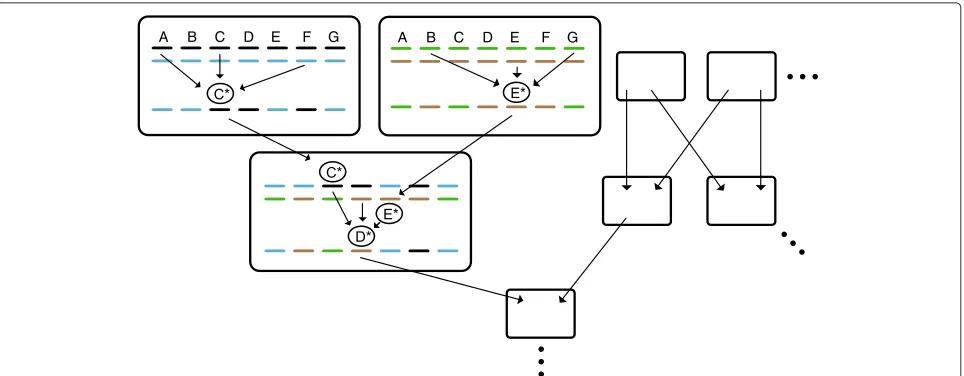
I argued that the writing of mutations combines mul-tiple pieces of information from alleles at mulmul-tiple loci as it puts them into one mutation—into one locus. Now, many such writing acts take place across the genome and over the generations, and a new allele that is the out-come of the writing in one generation is part of the input into the writing in another (it is at the tip of the writ-ing “funnel” in one generation and part of the funnel’s base in another). Thus, if we take the many writing acts across the genome and over the generations together, we can see that each allele in a late generation traces its ori-gin to many alleles at different loci in a sufficiently remote early generation (much like an individual in a sexual pop-ulation traces its origin to many ancestors in a sufficiently remote early generation) (Figure 2). This means that, the farther we get in time from the early generation, the more the basis of information in the early generation comes to be shared by individuals. In other words, the popu-lation is converging, and the writing, by actually putting information from different individual combinations (and
from different loci) together, provides the basis for this convergence.
Note that the writing acts are connected in a network: they represent a flow of information over the generations from many loci into one and from one to the many. This flow converts information from a state where it is unstable under the shuffling of genes to a state where it is sta-ble under this shuffling, and the result is the writing of a genetic network.
Obligate asexuality evolves by “breakage”
The empirical evidence fitting with the principle that sex is a matter of necessity for evolution provides empirical support for my theory, as discussed. Additional evidence from the topic of sex comes from the question of its main-tenance. The reduction principle [32,61-63]—one of the most robust findings of theoretical population genetics in the 20th century—shows that, in a world consistent with the modern synthetic view, it would be hard for the sexual recombination rate to be maintained rather than be reduced. This has been an important, negative result showing a difficulty in explaining sex in a straightforward manner from a traditional perspective.
However, if sex is necessary for the evolution of complex adaptation, and this evolution happens by convergence, then there is a barrier to evolving obligate asexuality, because the closer the population gets to obligate asexu-ality, the less it is able to further evolve adaptively in this direction (or in any direction). This leads to the inter-esting prediction that the process of adaptive evolution toward asexuality will slowly grind to a halt and will not
A B C D E F G A B C D E F G
reach the pure asexual state. Therefore, if there are obli-gate asexual species, it is not long-term adaptive evolution that led to them, but some kind of “breakage” of the sexual mechanism.
This constitutes a very different approach than available so far to the question of how sex is “maintained” despite its “costs” [24]. I have claimed earlier that it is incorrect to discuss sex as something whose “costs” and “benefits” determine its existence, because it is a matter of necessity. And here I claim that it is not actively “maintained”, but rather no substantial adaptive evolution occurs without it, and so obligate asexuality cannot gradually and adaptively evolve. It can only arise non-adaptively. The rest of this section will consider evidence and predictions regarding this point.
Note that, among vertebrates, all known unisexual lin-eages according to Avise [64] have arisen from hybridiza-tions, which is a sudden, breakage event. Indeed, it is thought that hybridization probably disrupted the meiotic operations by reducing chromosomal homology enough to disrupt synapsis [64-67]. While this fact is in accord with the new theory as just stated, in retrospect, one may try to argue that it is consistent with the traditional one too, because if sex is already well established in two sep-arate sexes, then it is hard to see how it will evolve into asex except by breakage. Let us therefore take the battle to the flowering plants: there, most species are capable of both selfing and outcrossing (selfing being akin to asex-uality). According to traditional theory, the entire range from pure selfing to pure outcrossing is open to them, and adaptive evolution should be able to push species all the way to pure selfing or pure outcrossing [68]. Indeed, from that theory, based on inbreeding considerations, the paper that initiated the modern interest in this field predicted that pure selfing and pure outcrossing are the only stable equilibria under adaptive evolution [68]. But that approach gives no clear reason why there are over-whelmingly more species at the outcrossing end of the spectrum than at the selfing end [69-74]. This empiri-cal fact supports the theory proposed here while standing uncomfortably with the traditional one. That is, accord-ing to my theory, evolution in a mixed selfaccord-ing-outcrossaccord-ing system is possible, but pure selfing can only be reached by breakage. Pure selfing is rare because it requires break-age, which can occur only under very specific conditions. (In the unisexual vertebrates, for example, it has been argued that the hybridizing species need to be genetically close enough to produce a viable hybrid but far enough to disrupt meiosis [43,75] and/or satisfy more specific restrictions [76].)
To be sure, other explanations have been offered in the plant-mating literature for the lack of pure asex-uals (e.g., [77-84]), but the explanation proposed here is both simpler and more general. Indeed, it predicts
residual outcrossing in regular biparental inbreeding ani-mal species, which goes beyond hermaphrodites.
Because the new theory holds that obligate asexuality is arrived at by breakage, it predicts the lack of fine-tuned adaptations ensuring obligate asexuality. In contrast, from traditional theory, one would expect adaptations for pure asex in like manner as for pure sex. This suddenly renders of particular importance the empirical question of what obligate selfers are like. Pannell [85] mentions two notable examples of obligate selfers. One example involves the loss of males in populations or species of androdioecious animals. In these animals, such as the mangrove killi-fish (Kryptolebias marmoratus) orCaenorhabditis elegans [85], individuals are either male or hermaphrodites that can mate with males but not with each other [86-88]. Loss of males in such a situation leads to obligate asexuality. But notice that this loss of males is not a long-term adaptive evolutionary process, but a situational event. It can occur, for example, due to the absence of males from a founding population. Even if it is assumed, hypothetically, that the loss of males is due to selection favoring hermaphrodites and leading to the loss of an allele for male determina-tion [89], this is still a short-term, populadetermina-tion dynamical process where no evolution of new adaptations or struc-tures occurs. Only the simple loss of preexisting parts of the sexual machinery occurs, which does not contradict the theory proposed here. This case can be classified as a breakage event, broadly construed, and does not pro-vide an example of gradual adaptive evolution of new structures.
The other example concerns the cleistogamous plants, and provides a test-case for the theory proposed here. In these plants, some flowers never open, and only selfing can occur within them. Most cleistogamous species have both closed and open flowers [90-92], and it has been suggested that the closed ones provide a cheap supply of seeds and reproductive assurance under unfavorable conditions (see [90] and references therein). The closed flowers have adaptive modifications to facilitate selfing [90,91] and, according to the present theory, these adap-tive modifications can evolve in a mixed mating state, i.e., while the species has both open and closed flowers and reproduction both by selfing and by outcrossing occurs. Of interest are the ∼10% of cleistogamous species that have only closed flowers at present [92]. If their complete lack of open flowers arose by adaptive evolution, it would refute the present theory; if it arose by breakage it would support it.
favorable environments [90-92]. Thus, it is possible that the loss of an environmental condition causes a transition from partial to complete cleistogamy without adaptive evolution occurring. Furthermore, genetic deterioration, perhaps even due to insufficient pollination in a mixed-mating state, could be another reason for the failure of flowers to open. It is interesting that the failure of flow-ers to open could be the reason for the switch to complete cleistogamy, because it means that the biological nature of this prominent case of obligate asexuality makes an allowance for the present theory, whereas from traditional theory there is no reason why the nature of the situation would be as it is. (The point is the mechanistic nature of an adaptation and the breaking of it: the breaking of the process of the opening of a flower in a partially cleistoga-mous species will make the flower not open—it will make cleistogamy complete. Compare the situation to that of the true, complex and fine-tuned adaptation that is self-incompatibility [93,94]. There, breakage would only lead to less, not more, of what that adaptation provides.)
Detailed studies of the history and nature of adaptation of complete cleistogamous species and other pure asex-uals can serve as empirical test cases of the theory pre-sented here. At most, this theory may be consistent with very limited evolutionary modifications in a pure asex-ual state, perhaps due to residasex-ual writing activity inherited from sexual ancestors, and those limited modifications may tend to show simplification and destruction of parts. But it does not allow for the evolution of a novel, complex adaptation in a purely asexual state. In contrast, observa-tions of breakage of various kinds in the evolution of pure asexuality would support the theory presented here. Note that the fact that the examples considered either explicitly fit or potentially fit with breakage is consistent with the present theory and has no general explanation from the traditional theory.
To clarify, my theory does not argue that no degree of selfing can evolve adaptively [95,96]. It only argues that pure asex cannot evolve in this manner. One can think of it as follows: according to my theory, if there is an “objective” that an evolving adaptation maximizes, it is the extent of participation in the sexual population; not simply the expected number of surviving offspring without regard to their sexuality. Under the right conditions, a high rate of selfing may maximize the bottom-line participation of a lineage in the sexual population; but pure selfing fails in this objective. The conditions that have been found to be empirically associated with increased selfing may be inter-preted from this perspective without further change. The situation is analogous to the choice between saving versus spending in economic models [97], or the choice between investing in survival vs. reproduction in life history theory [98]. Given the right conditions, saving more can lead to an overall greater consumption over time, and investing
more in survival may lead to a greater number of surviv-ing offsprsurviv-ing at the bottom line. But it is not a solution to spend nothing; it is not a solution to not reproduce at all; and by analogy, pure asex is not an outcome of adaptive evolution, according to the theory presented here.
In sum, it can be concluded that the entire traditional conceptualization of sex needs to be changed:
a) Sex is necessary for evolution, it is not a “bonus”. b) Sex cannot evolve from asex and never did. c) Sex (as opposed to pure asex) is not actively
maintained under some cost–benefit balance as previously discussed. Rather, pure asex arises only through breakage and never through gradual adaptive evolution.
Empirically, the process of the evolution of adaptation looks like convergence
The process of convergence described here fits better than traditional theory with what the evolution of adaptation looks like empirically. A single example will be given here, from one of the best studied cases of the phenotypic evolution of complex adaptation [99].
Sand wasps (Bembicinae; previously Nyssoninae) dig a long, narrow tunnel into the ground at the end of which they construct a cell or a complex of cells where they lay their eggs and provision their larvae. Their parasites, cer-tain groups of flies and parasitoid wasps, aggressively seek their nests to lay their own eggs in them, for example by flying over the ground, constantly tapping the soil with their antennae. In many sand wasp species, a behavior has evolved where the sand wasp digs one or more false bur-rows that extend from nearby the real nest entrance into the ground. They leave these decoys’ entrances open, and the real entrance closedb.
tunnels appear regularly and are pronounced, and they generally have a time and a place of focused construction. In a word, the operation is sharp, like clockwork; and it is far more similar among individuals. Since it is standard to infer from a transitional series of contemporary variants to the evolutionary process of one variantc, this evidence suggests that the process of the evolution of this complex adaptation has been a process of convergence on the pop-ulation level—a process of stabilization—where the trait as a whole evolved from a state of high variance to a state of low variance.
This stabilization and sharpening of the trait as a whole clearly fits with the process of convergence predicted by the theory presented here, but it is not inherent to tradi-tional theory. Investigators have tried to explain stabiliza-tion without invoking nontradistabiliza-tional theory by invoking two separate traditional selective forces: one selecting for traits themselves, and one selecting for the stabilization of traits, the latter being called “stabilizing” or “canalizing” selection [20,102-104]. The view from my theory is sim-pler: it holds that there is but one process—that of con-vergence and stabilization on the population level. There is no need for a separate force of traditional selection for stabilization. Stabilization is an automatic concomitant of the process described here.
A more detailed look into the new theory The writing phenotype evolves, and the writing and performing phenotypes share alleles
I argued that the writing of mutations is an organic pro-cess that belongs to the organism. Let us call it henceforth the “writing phenotype”. While traditional theory has had only one kind of phenotype, which we will call here the “performing phenotype”, here we have two: the writing and the performing phenotypes. Let us now derive further theoretical points about how they work.
First, if the writing phenotype is like the performing phenotype, being coded by genes and alleles, then, like the performing phenotype, it must also be evolving.
Second, the writing and the performing phenotypes are obviously different. One implements genetic change, and the other is responsible for survival and reproduction. But although they are different, we can quickly see that they must be sharing alleles, as will now be explained.
As just noted, the writing evolves, and we can now add that it needs to evolve under the influence of natu-ral selection. Otherwise, how could it ever get feedback from the outside world, and how could it be different from random mutation indefinitely, when the performing phe-notype clearly changes vastly through the eons in accord with the environment? Without a source of feedback on this outside world and the organism ever-changing with it, mutation must eventually become accidental to the organism. (With no flow of information from B to A, and
no predetermination of both B and A by C, A must be random to B).
Now, by definition, the effect of selection is registered in the frequencies of performing alleles. Therefore, if the writing phenotype evolves under the influence of selec-tion, it means that performing alleles influence the writing phenotype. If they influence the writing phenotype they participate in the writing. Therefore, performing alleles are also writing alleles.
There is another way to derive the same point. The writ-ing solves the problem that combinations under selection must have an effect. To solve this problem, it must be that a combination of performing alleles at different loci is taken and an allele is derived from it. This means that per-forming alleles are inputs into the writing—they affect the writing operation. But if they affect the writing operation, they are writing alleles too.
Thus from both directions we see that the writing phe-notype and the performing phephe-notype share alleles. But the alleles do not mean the same thing to them. The alle-les’ full meaning is generated by the way they modify the taxonomically-shared part of the writing phenotype and the taxonomically-shared part of the performing pheno-type respectively, which are different.
We obtain the following picture: Alleles participate in the writing of alleles, and alleles are selected. The writing performs an operation, whose inputs are alleles and whose output is an allele. The writing itself always evolves.
This concise statement is what we are led to, and it deserves much reflection. A concrete example will help to explain the idea that the same alleles, and therefore the same genes, can participate pleiotropically in both the writing and performing phenotypes. According to the the-ory proposed here, the TRIM5 andCypA genes, which participate in the performing phenotype, also participated in complex genetic activity in the germline that eventually led to their fusion [105,106], indeed to their independent fusion in different monkey lineages [105,107-112].
It necessarily follows from the points above that the writing always evolves along with the evolution of the adaptation. It accumulates information from selection, and the alleles that it generates are specific to the evo-lutionary times. But it is never “ahead of ” selection—it never takes upon itself the forbidden role of producing something known in advance to increase fitness—it never replaces natural selection in its role.
general hypermutability speeds up ns/rm-based evolution and thus hastens the arrival of a solution at a time of need (reviewed and criticized in [114])d. “Cranes” such as the hypothesized temporary general hypermutability system would be of long-term evolutionary benefit but are not themselves evolving along with any specific adaptation evolving at present, and therefore are not tailored to any particular adaptation, and still rely on traditional ns/rm to do the “work” of evolving an adaptation. They are thus “add-ons” to the traditional perspective, and they are not easy to justify from that perspective, because the benefit they bring is a long-term, evolutionary one. In contrast, the writing phenotype is not generic. It evolves along with the adaptation. It is therefore specific to the adaptation and the evolutionary times, and only thanks to its evolu-tion the adaptaevolu-tion can evolve. Thus, the theory presented here emphatically agrees with Koonin’s conclusion that evolvability can evolve [115], however, it proposes that evolvability reflects the evolution of the writing pheno-type. This is a far more direct explanation for evolvability than high-level selection.
Interestingly, Wagner has already noted that one of the most interesting things that transposable elements demonstrate vividly is that the options available for genetic evolutionary change are specific to the evolution-ary times [18]. In a sense, I am generalizing Wagner’s deep insight here from transposable elements to the entire writing phenotype.
We can conclude that the writing phenotype and the performing phenotype evolve together. Indeed, their coevolution explains how they relate to each other syntactically—they never “lose track” of each other. Non-random mutation is neither a Lamarckian-transmissionist “seer” that usurps the role of natural selection nor an “add-on” on top of traditional selection. It is a continu-ally evolving system that sits at the heart of the adaptive evolutionary process.
The new theory predicts that genetic activity implementing the writing of mutations exists in the germline
Several easy predictions now follow from the above. First, for the writing of mutations to have an evolution-ary effect, it obviously needs to take place in the germline. This means that there must be biochemical activity in the germline responsible for the writing of mutation. To con-tinue the example from the previous section, it has been noted thatCypAis highly expressed in the germline, and that this may have contributed to the independent arising of theTRIM5–CypAgene fusion in at least two different monkey lineages [106,116]. While from a traditional per-spective we could stop the intellectual inquiry here, and assume that this germline activity is simply an accidental situation, the theory proposed here considers this situa-tion to be the result of a long-term evolusitua-tion of the writing
phenotype, essential for the long-term evolution of the performing phenotype (they coevolve, as stated). In other words, we are dealing here not with accidental boundary conditions, but with evolved writing activity.
Second, according to my theory, alleles from different loci must interact in the determination of mutation. Thus, mutation determination is complex—genes must inter-act in the germline in the determination of mutation, enabling the fact that alleles interact. The determination of mutations cannot be exclusively simple, single-locus based.
Third, because the performing and the writing pheno-types are different, but they share alleles (meaning, the same genetic difference that plays a role in the perform-ing phenotype also plays a role in the writperform-ing phenotype, though this genetic difference has different phenotypic meanings in these two phenotypes), the same alleles will participate in biochemical activities in both germline and soma, but those activities will be different. Hence, genetic activity observed in the germline should not be imme-diately assumed to be serving the performing phenotype of the germline—it could be writing activity. Further-more, this activity may involve somatic performance genes.
Genetic evolutionary trends exist on all timescales
The writing phenotype can be understood better by anal-ogy to the performing phenotype. Four-legged animals use their legs for locomotion by pressing them against the ground. In this general sense, quadrupeds are all simi-lar. But this general description is filled with detail as we move to finer taxonomic levels: horses gallop, rabbits hop. The details continue to be filled as we get to the indi-vidual level. Indiindi-viduals can have shorter or longer limbs, different proportions of fore and hind limbs, different details of their muscular activation, etc. These individual-level details, though small in comparison to the general mode of locomotion, are very important—they are the individual-level variation that is the basis of natural selec-tion. Thus, note that there is a spectrum of contributions to the performing phenotype, including a basis that is per-sistent and slowly changing, and is generally defined, as well as ever increasing detail that distinguishes between ever finer taxonomic entities and evolves on ever shorter timescales.
whose characteristics begin to define the range of possi-ble mutations in a very general sense. Further along the spectrum we find that different taxonomic groups have somewhat different methods of gene duplication and dif-ferent transposable elements, for example, further delim-iting the range of possible mutations. And at the far end of this spectrum, writing events in a particular individual are defined in a perfectly concrete manner—these are the particular mutations occurring in the individual. Accord-ing to the new theory, the details on the individual level are important: they are nonrandom (because mutation is nonrandom), and they enable interaction-based evolution by natural selection.
Note that, whether we take the traditional standpoint or the new standpoint, we must accept that there are ever finer specifications of the range of possible mutations. But while the traditional theory must draw a line at some point and say that “up to this point the machinery defines the range of mutations, and beyond this point mutation is random”, the theory proposed here refuses to draw such a line, and completes the spectrum by saying that mutation is determined by the writing phenotype all the way up to the individual level, and is individual-specific, just like the performing phenotype is. We may call this “individually determined mutation”.
Note also that the line drawn by traditional theory is arbitrary. From a traditional standpoint, we start by assuming that there is a genetic code. Then we add that there is replication or other error, hence point muta-tion. To account for new genes, needed for the evolution of complexity, it was added that whole gene duplication exists [117]. But now we must assume that we are lucky enough that the genetic system is constructed in such way that gene duplication exists, but that this extraordinar-ily important machinery of gene duplication [118] must be applied here and there by chance. There is theoreti-cal arbitrariness in saying that, up to here the range of mutation is constrained by the system, and beyond here it is not constrained at all, when no reason is given for why such a dividing line should be placed at one point rather than another. Indeed, the more we study the situ-ation empirically, the more we see finer determinsitu-ation of the range of mutations. Gene duplication is strongly influ-enced by the location of segmental duplications/low copy repeats (see the section “Evidence from and predictions for molecular evolution”); the location of segmental duplications/low copy repeats is strongly influenced by the location of transposable elements (see the section “Evidence from and predictions for molecular evolution”); and the location of transposable elements is strongly influ-enced by various sequence characteristics. The dividing line between “mechanistic” and “random” keeps being pushed back. Here I argue that there is no such line. Any line would be arbitrary. The removal of this arbitrary line
is an independent point of entry into the new theory, because by removing it, we immediately get to individually determined mutation.
Now consider the existence of the genetic code; the fact that the “error rate” in replication supposed under the ran-dom mutation view is not too high and not too low, so that it allowed evolution; the fact that the genetic system is structured such that whole gene duplication, neces-sary for long-term evolution, is possible, etc. From the traditional perspective, we are lucky that all these things exist, so that evolution as we know it is possible. The existence of these phenomena cannot be easily explained under the traditional theory, because from that theory we normally take them as given and do not begin to think about evolution before we imagine them in place (we do not normally think of them as evolving) (see [57] for an opposing, nontraditional view, consistent with the present work). We cannot say that they are explained by the ben-efit they bring to evolution in the long term, because traditional theory can only explain the evolution of traits based on short-term, individual-level advantage [6,16]. Indeed, these phenomena are rather parts of the evo-lutionary “infrastructure”. Since we cannot explain their existence by the traditional process, from the traditional view we can only say that they appeared by chance or by an unknown process outside of the theory. This leaves us with a number of fundamental biological phenom-ena which phenom-enable evolution but are not explained by the traditional evolutionary process.
One possibility is to apply high-level selection to this gross problem [8,119]. However, the whole situation is seen differently from the perspective of the theory pre-sented here. Even though the theory prepre-sented here, like the traditional one, cannot explain in detail how these phenomena arose and their current form, the theory pre-sented here inherently includes a mechanism that sup-ports their existence and evolution. Namely, mutations are effected by a writing phenotype. Since this phenotype obeys the same rules of biological structure as the per-forming phenotype, as explained above, it has long-term enabling effects on evolution (in addition to short-term ones). This succinctly provides a framework for under-standing these phenomena’s long-term effect on evolu-tion, which the traditional theory does not. That is, these phenomena define the range of mutations, and are part of the writing phenotype. This framework is entirely differ-ent from both sides of the levels-of-selection debate.
time in a somewhat persistent manner, giving rise to some degree of “directionality” in genetic evolution. I predict that this directionality will be observed in the form of hith-erto unexplained long-term genetic evolutionary trends. These trends do not define the evolutionary changes completely. They are rather filled with detail at finer tax-onomic scales. And although they constitute a certain amount of internal guiding to genetic evolution, this inter-nal guiding does not work by itself, but only together with natural selection, and is in fact itself the result of past selection and writing.
Context-dependent selection participates in the formation of the phenotypic meaning of an allele
When selection operates on interactions—meaning it is context dependent—then the change in the frequency of an allele is inconsistent in its direction, because this change depends on the context of other alleles, which is itself changing at the same time. The dynamics of allele frequencies are nonlinear.
Context-dependent selection has two interesting conse-quences. The first concerns the phenotypic meaning of an allele.
In the traditional mindset, we think of effective selec-tion as acting mostly on independent alleles. To be pre-cise, random mutation arises that interacts with the fixed genetic background but not with concomitant alleles at other loci, and in that interaction with the fixed genetic background it has its own phenotypic meaning that is complete at the moment of the arising of this mutation and that is unchanging throughout the period of its selec-tion. All that remains for natural selection to do is to check whether this mutation is “good” or “bad” in and of itself. Thus, in the random mutation case, selection is an external judge of a phenotypic meaning formed at random before selection takes place.
In stark contrast, under context-dependent selection, the phenotypic meaning of a spreading allele (an allele whose frequency is increasing, albeit inconsistently) depends on which other alleles are spreading. But which other alleles are spreading is affected by selection on interactions. Therefore, natural selection affects the phe-notypic meaning of an allele—it participates in forming this meaning. Thus, according to my theory, selection is not an external judge of a pre-made phenotypic meaning, but is an active participant in the formation of it. This alone means that the phenotypic meaning of a mutation is not random to natural selection, because information from natural selection is already in it. Selection is inside, not outside, the process of formation of the phenotypic meaning of an allele.
At the beginning of this paper we found that the need for selection on interactions to have an effect is answered by the writing of mutations—by genetic change having
a mechanistic and organic basis, and in that sense being nonrandom. Now we have just derived from selection on interactions that selection participates in the for-mation of the phenotypic meaning of an allele, which shows that the phenotypic meaning of genetic change is not random. Interestingly, these two points naturally come together, defining nonrandom mutation from above and below.
What appears neutral under the assumption of additive alleles can actually experience selection on interactions
The second point of interest that follows from context-dependent selection concerns the neutral theory. Haldane’s [120] calculation of the “cost of natural selec-tion” was an important reason behind the advent of the neutral theory [121]. This calculation had put a severe limit on the rate of substitution that could be driven by traditional natural selection, and the actual rate of sub-stitution [122] as well as the amount of present genetic variation [1,2] later discovered vastly exceeded this expectation [121]. Hence Kimura proposed that the vast majority of mutations are simply not under selection and just drift to either fixation or extinction [121].
However, the theory presented here holds that selection operates on interactions; and since Haldane’s calculation was based on traditional assumptions, here it simply does not apply. Moreover, when selection acts on interactions, alleles exhibit inconsistent change in frequency, which may appear to us as drift. In other words, alleles that appear to be drifting may actually be experiencing selec-tion on interacselec-tions. What looks neutral through the lens of the traditional, additive-effect–based theory may not be neutral from a selection-on-interactions view. This does not mean that traditional drift cannot exist in addition to selection on interactions, however, it does suggest that so-called “neutral” matter can be subject to selection and thus has a vast adaptive potential.
Evidence from and predictions for molecular evolution
We may categorize mutation into two high level cate-gories: rearrangement mutation and point mutation. I will discuss them below in turn.
Rearrangement mutation is nonrandom
are guided to their places of action by DNA sequences [123-125].
Four main categories of mechanisms of rearrangement are: non-allelic homologous recombination (NAHR), non-homologous end-joining (NHEJ), replication-based mechanisms (RBMs) and transposition.
NAHR [126] occurs when sufficiently long non-allelic sequences of high homology align and cross over. When this crossing over is between homologous chromosomes or sister chromatids, the result is a duplication and/or deletion of the sequences between the non-allelic homol-ogous sequences and of one of the non-allelic sequences. If it is between repeats on the same strand that align as the strand coils, there are two options: if the repeats are in direct orientation, the result is a deletion (transposable elements are often precisely excised in this way [17]); if they are inverted, the result is an inversion. And if this crossing over occurs between repeats on non-homologous chromosomes, the result is a translocation. Notably, dupli-cations, deletions, inversions and translocations of whole genes would not have been possible without a mechanism to enact them, and there is elegance in the mechanism of homology and recombination that is able to produce quite different outcomes based on different parameters of the situation, and that indeed is also the basis of sexual recombination.
The regions of sufficient homology are usually pro-vided by low copy repeats (LCRs) or segmental duplica-tions (SDs)—terms that are used interchangeably, though defined originally independently using somewhat differ-ent parameters (SDs were defined as segmdiffer-ents ≥ 1 kb in size and ≥ 90% sequence identity [127], and LCRs were defined as intrachromosomal duplications ≥ 10 kb in size and ≥ 97% in sequence identity [128]). It is thought that ∼5% of the human genome consists of LCRs/SDs, and they are particularly prevalent in pericen-tromeric and subtelomeric regions (reviewed in [129]). NAHR can also occur between tandem duplications, and more rarely between repetitive sequences, which are shorter and much more numerous in comparison to LCRs/SDs (transposable elements constitute about half of the human genome). In this case, the repetitive sequences are expected to be closer to each other as compared to the LCRs/SDs that cause NAHR, and the rearrangements tend to be smaller [123,124].
NAHR is not random. Not only does it require the bio-logical mechanisms of crossing over to be implemented, the LCRs/SDs specify the locations where it usually takes place, and it is often recurrent [123]. Indeed, the break-points are further specified within the LCRs/SDs, where they are clustered in narrow hotspots, often nearby DNA sequences such as direct and inverted repeats, which form hairpins, cruciforms and other non-B DNA structures, known to induce double-strand breaks (DSBs) involving
enzymatic processes [123,130-132]. Their precise loca-tions can be very close to meiotic recombination hotspots [133], implying the sharing of features with meiotic recombination hotspots [134] (reviewed in [123]), which are known to be associated with consensus sequences and more (reviewed in [135]; to be discussed later). Fur-thermore, the non-allelic sequences causing NAHR have functional relatedness: they share long sequence homol-ogy, and we know that sequence defines function; and the recombining LCRs/SDs need to be sufficiently close to each other (the more so the smaller they are) (reviewed in [123-125]), either by simply being nearby on the chromo-some or because the three-dimensional structure of the DNA brings them together from regions that are remote in two dimensions, and we know that closeness in two dimensions as well as in three dimensions is to some degree related to function [125].
Non-homologous end-joining (NHEJ) is able to recog-nize two ends of DNA (double stranded), modify them and join them together. If the two ends come from two distant points rather than one, a deletion or inversion occurs [136]; and if they come from one point, but double-strand break homologous repair is performed before the end joining, it can lead to duplication [137,138]. NHEJ is nonrandom: it occurs in hotspots (e.g., [137]), though they do not cluster as sharply as in NAHR [123]. These hotspots are often within repetitive elements such as LINE andAluand near sequence motifs that can curve DNA and cause DSBs, and one of the breakpoints in a rear-rangement event is often found within a LCR (though the LCR is not necessary for homology in this case) (see [124] and references therein). Thus, local genome architecture influences the occurrence of these events.