School of Computing and Information Systems
"Forensic Computing: Exploring Paradoxes"
An investigation into challenges of digital evidence and
implications for emerging responses to criminal, illegal
and inappropriate on-line behaviours
by
Vlastimil Broucek
Grad.Dip.Sci.(IT),
MSc(Prague)
Submitted in fulfilment of the
requirements for the Degree of
Doctor of Philosophy
This dissertation contains no material which has been accepted for the award of
any degree or diploma by the University or any other institution, except by way
of background information and duly acknowledged in the thesis, and to the best
of the candidate's knowledge and belief no material previously published or
written by another person except where due acknowledgment is made in the
text of the thesis.
This thesis may be made available for loan and limited copying in accordance
with the Copyright Act 1968.
Vlastimil Broucek
Abstract
This research thesis explores technical, legal and organisational challenges of
digital evidence and the implications of their inter-relationships for responses
to criminal, illegal and inappropriate on-line behaviours. From a forensic
computing perspective the solutions to these challenges have tended to focus
on discrete sets of technical, legal or organisational issues individually. Lack of
understanding of the inter-relationships between these issues is inhibiting the
development of integrated and coordinated solutions that can effectively
balance requirements for the generation of legally admissible digital evidence,
e-security and privacy. More significantly, this research highlights that the
fragmented nature of these discrete approaches may be impairing the overall
effectiveness of the responses developed.
The methodological framework underpinning this exploratory research adopts
a subjective ontology and employs an interpretative epistemology. The
research strategy involves the examination of three cases on technical, legal
and organisational challenges of digital evidence respectively. Each case is
analysed independently and the interpretation and discussion adopts a forensic
computing perspective to interpret and discuss the inter-relationships across
these areas and to explore the implications for digital evidence and the
underlying problematic on-line behaviours. Case A examines the validity of
quantitative data collected by running a network intrusion detection system
(NIDS) SNORT on University network. Case B examines an Australian
Federal Court case illustrating legal arguments applied to digital evidence, its
discovery and presentation. Case C examines the Cyber Tools On-line Search
for Evidence (CTOSE) project highlighting the difficulties of developing and
implementing organisational level processes for digital evidence handling.
Analysis of Case A involves descriptive statistical analysis of network data and
reveals significant problems with the validity and quality of the data. The
results of the case analysis show that data collected by SNORT are not
reveals that the data sets collected may be flawed, erroneous or already have
been tampered with. Despite significant fine tuning, SNORT continued to
generate numerous false positive alerts and/or wrongly identified sources of
attacks. This case highlights that intrusion detection systems can play an
important role in protecting information systems infrastructure, but to be
effective they require the attention of highly trained security personnel/system
administrators. These personnel also need to engage in regular monitoring and
analysis of alerts and other log files, and to ensure regular updating of the rule
sets used by these systems.
Analysis of Case B reveals the impact of legal misconceptualisations about the
nature of digital systems on court decisions and on the generation of legal
precedents that have potentially broader social implications. The results of the
analysis reveal serious flaws in understanding amongst all participants in the
case over the nature of digital evidence and how it should best be collected,
analysed and presented. More broadly, the judgement also appears to have
worrying implications for individual privacy and data protection.
Analysis of Case C highlights the practical challenges faced at the
organisational level in the implementation of models and tools for digital
evidence handling. The analysis highlights that models and tools that have been
developed for handling digital evidence are by their very nature and
complexity highly problematic to adopt and utilise in organisational settings.
A key element that continues to inhibit their use is the lack of early and
comprehensive end-user education. The results from this case highlight the
critical need for organisations to have greater 'forensic readiness' for dealing
with criminal, illegal or inappropriate on-line behaviours.
Interpretation and discussion of the analyses from the three cases adopts a
forensic computing perspective and focuses on the nature of the
inter-relationships between the issues identified in each case. From this perspective
the discrete approaches adopted in each case limit an appreciation of the
interplay that because of the nature of digital environments continues to have
serious implications for each of these areas. More specifically, this
interpretation and discussion reveals how and why this continued
fragmentation of discrete approaches is impairing the overall effectiveness of
the responses developed. A consequence of this is the lack of integrated and
coordinated solutions that would effectively balance requirements for legally
admissible digital evidence, effective e-security and data privacy.
At the broadest level, this research reveals these complex inter-relationships
and confirms that they are likely to continue into the future as a result of
uncoordinated research and development. The underlying paradoxes prevalent
within the forensic computing domain result from the different concerns,
interests and expectations of stakeholders and the nature and foci of research
and development in each domain. This in turn ultimately leads to developments
that are beneficial for improved performance in one area and at the same
moment creates new challenges and inhibitors in another area. These
circumstances have the on-going potential to trigger 'chain reactions' that
ultimately may lead to more significant challenges than the problems they
solve.
This research also reveals that the digital domain itself is also intimately related
to the physical world where corroborative evidence and conventional
investigative techniques have an equally important role to play. Ultimately, it is
human behaviours that create these ongoing opportunities, challenges and
risks. As a result, 'forensic readiness' also implies being able to grapple with
moral, ethical and even political dimensions of these debates across the 'last
mile' connection between digital behaviours and identifiable citizens.
In this context, forensic computing emerges as an approach that does not
advocate for stronger laws, stricter technical systems and/or organisational
protocols per se, but rather for the beginning of dialogue amongst these
different requirements. In responding to the complex inter-relationships
of their specific aims and objectives as well as the broader context, if we are to
avoid the on-going 'band-aid' approaches.
This research thesis concludes that there is no easy solution to resolve the
inter-relationships and paradoxes inherent within forensic computing issues.
However, by recognising that these paradoxes exist, how they work and what
their impacts are, measures can be developed to reduce their negative effects.
In this regard, coordinated academic research is contributing to the emergence
of cohesive and holistic approaches to understanding, implementing and
Acknowledgments
This thesis is dedicated to my darling wife Paula, for her love, inspiration and
never ending support and encouragement to finish this thesis even at times
personally very difficult for her. I would have never finished this thesis without
her never ending support and optimism.
I gratefully acknowledge the considerable support and assistance of my
supervisors, Associate Professor Paul Turner, Professor Chris Keen and Dr
Stephen Chau, all from University of Tasmania. I am particularly indebted to
Associate Professor Paul Turner for his words of encouragement and support at
various times throughout my research. His collegial approach, friendship, never
ending optimism and reassurance to continue and finish this PhD research will
always be remembered.
I would also like to acknowledge the valuable advice, many ideas and
encouragement received from my colleagues at the European Institute of
Computer Antivirus Research (EICAR), Digital Forensic Forum (DFF),
Tasmanian Institute of Law Enforcement Studies (TILES) and many others.
The list is too long to name them all.
Finally, I would like to thank the anonymous reviewers from the Boards of
Editors/Reviewers of:
• The 5th Australian Security Research Symposium (Perth, Australia, 2001)
• The Journal Of Information Warfare (2001)
• The 2002 Information Resources Management Association International
Conference (Seattle Washington, USA, 2002)
• 3rd International System Administration and Networking (SANE)
Conference (Maastricht, The Netherlands, 2002)
• The 11th Annual EICAR Conference (Berlin, Germany, 2002)
• The Current Security Management & Ethical Issues of Information
Technology. Hershey, PA 17033-1117, USA: IGP/1NFOSCUIRM Press
• The Cyber Tools On-line Search for Evidence (CTOSE) Conference
(Namur, Belgium, 2003)
• The 12th Annual EICAR Conference (Copenhagen, Denmark, 2003)
• The 4th Australian Information Warfare and IT Security Conference
(Adelaide, Australia, 2003)
• 1st Australian Computer, Network & Information Forensics Conference
(Perth, Australia, 2003)
• The 13 th Annual EICAR Conference (Luxembourg, Grand Duchy of
Luxembourg, 2004)
• The International Review of Law, Computers & Technology (2004)
• The Computer Law & Security Report (2005)
• The 14th Annual EICAR Conference (Saint Julians, Malta, 2005)
• The International Scientific Journal of Computing (2005)
• The 15 th Annual EICAR Conference (Hamburg, Germany 2006)
• The Journal in Computer Virology (France, 2006 and 2007)
• Digital Forensic Forum Conference (Prague, 2007)
who have provided valuable feedback on published papers relating to this PhD
Contents
1
Introduction 171.1 Background 18
1.1.1 Technical Area 20
1.1.2 Legal Area 21
1.1.3 Organisational Area 21
1.2 The Research Problem 22
1.2.1 The Research Questions 23
1.2.2 The Research Objectives 23
1.2.3 The Research Scope 24
1.3 Justification for the Research 25
1.4 Summary of other Chapters 26
2 Literature Review 29
2.1 Introduction 29
2.2 Information Society and Risks of Computer Misuse 30
2.2.1 Growth of Computer Misuse 32
2.2.2 Classification of Computer Misuse 33
2.3 Definitions and Models of Forensic Computing 36
2.3.1 Simple Models 44
2.3.3 Complex Models 45
2.4 Information Systems and Technology Issues 48
2.4.1 Distinguishing Computer Security from Forensic Computing 48
2.4.2 Intrusion Detection Systems (IDS) 51
2.4.3 Log Files as a Source of Forensic Data 60
2.4.4 Anti-forensics 66
2.5 Legal Aspects and Dimensions 68
2.5.1 Risks and Challenges: the Law and Digital Data 69
2.5.2 Forensic Computing and the Law 73
2.5.3 Some Other Dude Did It (SODDI) 77
2.6 Organisational Challenges and Issues 78
2.6.1 Organisations, Digital Data and End Users 79
2.6.2 Forensic Computing and Organisational Responses 82
2.7 Emerging Trends 85
2.7.1 Antivirus Research 85
2.7.2 Computer Security 87
2.7.3 Cyber Crime 88
2.8 Summary Reflection on the Chapter 90
3 Research Methodology 91
3.1 Introduction 91
3.2.1 Ontology 92
3.2.2 Epistemology 93
3.3 Research Strategy 93
3.4 Research Design 93
3.4.1 Technical Data Collection for Case A 94
3.4.2 Legal Court Documentation for Case B 94
3.4.3 Organisational Data from CTOSE Project for Case C 94
3.5 Approach to Data Analysis 95
3.5.1 Case A - SNORT 95
3.5.2 Case B - MP3 96
3.5.3 Case C - CTOSE 96
3.6 Approach to Interpretation and Discussion 96
3.7 Summary Reflection on the Chapter 97
4 Data analysis Case A — SNORT 98
4.1 Introduction 98
4.2 SNORT Data Collection Experience 101
4.3 Analysis of Data Collected for Case A 105
4.3.1 Example of Alarm Analysis 107
4.3.2 Analysis of Collected 'traffic' Data 110
4.4 Analysis and Discussion of Case A 112
4.6 Summary Reflection on the Chapter 118
5 Data Analysis Case B — MP3 119
5.1 Introduction 119
5.2 Descriptive Analysis of Case B 120
5.2.1 Subject of Dispute 122
5.3 Complexity of Issues and Implications for Stakeholders 124
5.4 Preliminary Findings for Case B 126
5.5 Summary Reflection on the Chapter 128
6 Data analysis Case C - CTOSE 129
6.1 Introduction 129
6.2 CTOSE Development 131
6.3 CTOSE Outputs 132
6.3.1 The Software Prototypes 137
6.4 Preliminary Findings for Case C 141
6.5 Summary Reflection on the Chapter 142
7 Interpretation and Discussion: Forensic Computing Perspective 143
7.1 Introduction 143
7.2 Interpretation across three Cases 144
7.2.1 Key Inter-relationships and Digital Evidence 145
7.3 Discussion of Findings 153
8 Conclusion and Future Work 163
8.1 Introduction 163
8.2 Synthesis of Findings 163
8.2.1 Technical Area 163
8.2.2 Legal Area 164
8.2.3 Organisational Area 165
8.2.4 Forensic Computing Perspective 166
8.2.5 Conclusion 167
8.3 Limitations of the study 168
8.4 Future Work 170
Bibliography 172
List of Figures
Figure 1: Matrix of behaviours and types of computer misuse (adapted from
Hannan, Frings, et al., 2003) 36
Figure 2: Forensic Computing Domain 39
Figure 3: Nucleus of Digital Forensic Research (from Palmer, 2001) 41
Figure 4: SourceFire's 3D approach (from
http ://www. source fire. co m/products.html) 58
Figure 5: Adapted from Farmer and Venema (2000) 60
Figure 6: False Positive versus Positive Alerts 106
Figure 7: Alarm Raised by SNORT 108
Figure 8: Hexadecimal output using tethereal 108
Figure 9: Hexadecimal output using tcpdump 108
Figure 10: Verbose output using tethereal 110
Figure 11: Most verbose output using tcpdump 110
Figure 12: FTP session analysis using ethereal 111
Figure 13: FTP session (data) analysis using ethereal 112
Figure 14: Electronic Evidence Specification Model (EESM) 133
Figure 15: CTOSE Project 135
Figure 16: CTOSE Phases of Response 136
Figure 17: Fragment of the Process Model 138
Figure 19: C*CAT's Web Based Interface, part 1 139
List of Tables
Table 1: Suitability Guidelines for Digital Forensic Research (adapted and
extended from Palmer (2001)). 43
1 Introduction
"Many criminal investigations will include computers at some point in the case. Murder and rape suspects may, through a search warrant, have their email and Internet activities analyzed to find evidence about their motives or hiding locations. Corporations investigate computers when an employee is suspected of unauthorized actions. Fraud investigations collect transaction history evidence from servers. It is
_
therefore important that a process model for the digital investigation exists and that it easily interacts with the physical investigations that have long existed" (Carrier & Spafford, 2003).
This research thesis explores technical, legal and organisational challenges of
digital evidence and the implications of their inter-relationships for responses
to criminal, illegal and inappropriate on-line behaviours.
This research involves an investigation of three independent cases that focus on
the technical, legal and organisational challenges of digital evidence
respectively. Each case is analysed independently and the interpretation and
discussion explores the inter-relationships between the cases and their
implications for ongoing responses to problematic on-line behaviours and the
discipline of forensic computing.
This chapter provides a summary of the background to the thesis and identifies
the primary research questions and research objectives. It also highlights the
contribution that this research makes to the theory and practice of forensic
computing and provides a summary of the other chapters in the thesis.
More specifically, the first part of this chapter provides a background to the
area of forensic computing and highlights the adoption of a forensic computing
perspective and how this re-positions both the problems and solutions
experienced in relation to digital evidence in each of the three areas (technical,
legal and organisational). This research reveals a lack of coordination amongst
address problematic on-line behaviours. More significantly, the forensic
computing perspective adopted highlights how the nature of digital evidence
and these problematic behaviours create inter-relationships that challenge the
very solutions developed in each discrete area.
The second part of this chapter describes the research problem and presents the
primary research questions and research objectives. In addition, this section
also describes the scope of the research.
The third part of this chapter presents the justification for this research and
summarises the contributions made at the substantive, methodological and
theoretical levels.
The final part of this chapter provides a summary outline of the thesis structure
and its chapters.
1.1 Background
In exploring the technical, legal and organisational challenges of digital
evidence and the implications of their inter-relationships for responses to
criminal, illegal and inappropriate on-line behaviours, this thesis adopts a
forensic computing perspective. Forensic computing has become the focus of
considerable academic and industry attention in the last ten years and has
usefully been defined by Broucek and Turner (2006) as:
"the processes or procedures involving monitoring, collection, analysis and presentation of digital evidence as part of `a priori' and/or 'post-mortem' investigations of criminal, illegal or other inappropriate on-line behaviours."
By adopting a forensic computing perspective, this research has been able to
illuminate the inter-relationships amongst discrete approaches to the challenges
Forensic computing perspective is primarily concerned with generating a true
and accurate picture of activities, timelines and events that have occurred on
hosts, networks and in applications, to be in a position to validate whether
criminal, illegal or other inappropriate on-line behaviours have occurred.
At one level, the forensic computing perspective is somewhat technical in its
approach; however, it is this very perspective that enables the illumination of
differences in approach, definitional ambiguities, and understandings amongst
technical, legal and organisational experts. By highlighting the persistence of
these differences amongst experts from different disciplines, it becomes
possible to account for the continued lack of coherence in responses to the
challenges faced.
More broadly, forensic computing can be seen as being similar to forensic
medicine, forensic psychology and other 'forensic' disciplines. However, of
course, the nature of the subject matter that forensic computing deals with —
digital data and corroborative information — makes it very different. For
example, while the subject matter of a discipline like forensic medicine is
physically tangible, i.e. a human body or part thereof, the subject matter of
forensic computing tends to be more intangible in its nature. It is difficult to
'touch' data travelling over the Internet or through wireless networks and
although it is possible to touch a physical computer, it is again very difficult to
inspect, observe or 'touch' the actual data stored on that computer.
Additionally, the data in computers and other digital communication devices
and networks are in the form of binary code rather than in human readable
form.
Forensic computing is also often incorrectly understood as computer forensics.
However, computer forensics is primarily focused on the usage of computing
technology to support conventional human forensic work. In this context,
computers are used to help in other forensic disciplines — for matching DNA,
stored in databases and retrieved by computers as part of forensic
examinations.
This thesis concentrates on forensic computing or as it is increasingly being
referred to by the terms e-forensics and digital forensics.
The next three subsections provide a very brief introduction to some of the
challenges being faced and responses being developed to problematic on-line
behaviours within technical, legal and organisational areas.
1.1.1 Technical Area
Criminal, illegal and inappropriate on-line behaviours are most often
considered to be problems for computer security, military intelligence and
cyber-policing experts. Problematic on-line behaviours that involve computer
misuse (e.g. malware, hacking) and/or are assisted by computer (e.g. internet
paedophilia, fraud) have led to an explosion of industry, government and
academic research, development and commercial activity (Denning, 1999;
Etter, 2000a, 2000b, 2000c).
As a result, developments in the technical area of computer security, for
example antivirus software, continue to occur rapidly both in the commercial
and open source arenas. It is, however, important to recognise that the drivers
for new developments vary between researchers and commercial operators.
Indeed, it has been argued that despite numerous new products emerging on to
the market, most commercial vendors are reactive to problems rather than
proactive (Broucek & Turner, 2005b, 2006).
Additionally, developments in these technical areas tend to focus exclusively
on improving technical capabilities of the tools such that questions around
1.1.2 Legal Area
In contrast to the speed of development in the technical area, developments in
the legal area remain relatively slow and tradition bound. While national and
international frameworks do exist to address some of the challenges posed by
digital technologies and the Internet, the practice of law within the court
systems exhibit considerable variation.
Aside from problems of applicable law or the technological neutrality of
particular legal codes, problems exist with legal professionals understanding of
digital technology when making analogies with pre-existing case law. The
digital domain poses significant conceptual challenges to notions of chain of
evidence, chain of custody, original versus copy and legal admissibility.
Additionally, responses in these legal areas have often ignored how changes in
one area of digital information law have direct or indirect consequences for the
balance of rights in another area of information law. For example, it has been
argued that strengthening digital intellectual property rights can have negative
consequences for personal privacy and information access (Samuelson, 2002).
1.1.3 Organisational Area
With developments in electronic commerce, organisations have been quick to
recognise the commercial opportunities provided by the Internet. However,
most have become aware of the risks posed by criminal, illegal or inappropriate
on-line behaviours by their employees, customers or criminals. In particular,
organisations remain concerned about fraud, defamation and loss of reputation,
financial loss and the loss of a competitive edge.
In response to the above mentioned issues, organisations have developed
policies and procedures to safeguard themselves. However, it can be seen that a
lack of understanding of the nature of digital information and users' on-line
behaviours often means these approaches compound the very problems that
Additionally, regardless of the effectiveness of organisational approaches, there
remains a strong tendency to 'pull the plug' when problems are detected rather
than to engage in a systematic investigation, collection and analysis of digital
evidence of the on-line behaviours that have occurred (Leyden, 2000; Maher,
2001; Microsoft, 2000; Microsoft UK website Hacked - VIGILANTe
Statement," 2001; Mitnick, 2000; Rohde, 2000).
1.2 The Research Problem
As indicated above, digital technologies and the Internet open up potential risks
from problematic on-line behaviours that have become the focus of interest for
technical, legal and organisational researchers and practitioners. While each set
of responses face difficult challenges to overcome, it is only by adopting a
forensic computing perspective that the implications of a lack of coordination
amongst these responses can be investigated.
Forensic computing requires a multidisciplinary approach (Broucek & Turner,
2001a, 2001b) and itself continues to be the subject of much debate concerning
definitions, models and approaches. Broucek and Turner (2001b) presented an
initial taxonomy of the field and this was later developed and extended
(Hannan, Turner, & Broucek, 2003). Other models and definitions have been
developed by other players, for example by First Digital Forensic Research
Workshop (Palmer, 2001) and by EU funded project CTOSE (CTOSE, 2003;
Urry & Mitchison, 2003). These models and definitions also reflect the
ongoing debates inherent within the root disciplines that contribute to its
multi-disciplinary nature.
Most significantly, a forensic computing perspective allows for an examination
of each specific area and its response to problematic on-line behaviours as well
as providing a conceptual framework within which to explore the implications
of their inter-relationships. The lack of coordination and fragmentation that
appears evident is caused by the fact that each area is grappling with its own
problems, issues and challenges. The researchers and practitioners in each of
area 'better'. Unfortunately, by making improvements in one area, another area
may be negatively affected and suffer significantly, thereby diminishing the
overall effectiveness of the responses (Broucek & Turner, 2005a, 2005b).
This research thesis aims to explore the problems and challenges in each area,
the responses being developed in each area and the implications of the
inter-relationships across these areas for digital evidence and the underlying
problematic on-line behaviours.
1.2.1 The Research Questions
To address the research problem identified above, two research questions were
formulated:
Research Question 1: What are the key technical, legal and organisational
challenges of digital evidence?
Research Question 2: What inter-relationships exist between technical, legal
and organisational approaches and what implications do these have for the
responses being developed?
1.2.2 The Research Objectives
A review of the research literature presented in Chapter 2 reveals that there has
been limited academic research into technical, legal and organisational
challenges of digital evidence and/or the implications of their
inter-relationships for responses to criminal, illegal and inappropriate on-line
behaviours. There are large numbers of publications and ongoing research
projects within each area (technical, legal, organisational); however, to date
there appears to be limited research investigating questions of digital evidence
or inter-relationships amongst the responses being developed. In answering the
research questions above, this thesis has the following research objectives:
• Identify the key technical, legal and organisational challenges of digital
• Determine the inter-relationships between the technical, legal and
organisational approaches;
• Understand the key tensions and contradictions within and between each
area in relation to digital evidence and problematic on-line behaviours;
• Explore the implications of these inter-relationships for emerging responses
to criminal, illegal and inappropriate on-line behaviours;
• Identify potential solutions balancing the interests of privacy of the
individual, security for the network and the demands of the courts for
legally admissible evidence.
1.2.3 The Research Scope
To answer the research questions and satisfy the research objectives detailed
above, the scope of this research involves the conduct of three independent
case studies, each analysing challenges of digital evidence within technical,
legal and organisational areas respectively. Following independent analysis of
each case this research adopts a forensic computing perspective to interpret and
discuss their inter-relationships and to explore the implications for emerging
responses to criminal, illegal and inappropriate on-line behaviours.
In the technical area, Case A concentrates on an examination of data collected
by the open source Intrusion Detection System (IDS) called SNORT. This IDS
was at the time of conducting the experiment considered to be the best IDS
available in the world. Case A focuses on an Intrusion Detection System partly
because of the strong public disagreement between two leading experts
(Sommer (1998b) and Stephenson (2000a, 2000b)) about the usability of IDS
for collection of digital evidence (Broucek & Turner, 2003c).
In the legal area, Case B concentrates on an examination of an Australian legal
case - Sony Music Entertainment (Australia) Limited v University of Tasmania
heard in the Federal Court of Australia. This case was selected mainly because
it involved the University of Tasmania (the host institution of the researcher)
making access to detailed information on the case more available (Broucek,
In the organisational area, Case C concentrates on organisational experience of
a European methodology developed for digital evidence acquisition (CTOSE).
This case was selected because of an opportunity to participate as a
collaborating researcher in the European project developing the methodology
(Hannan, Turner, et al., 2003).
1.3 Justification for the Research
The information society is based on computers and networked communication
technology. The Internet is increasingly accessible and is being adopted and
utilised by all sectors of society. For example, in Australia, "the rate of access has quadrupled in recent years, from 16% of Australian households in 1998 to 64% in 2006-07" (Australian Bureau of Statistics, 2008).
This increased use of network technologies creates both greater opportunities
and greater risks to individuals, organisations, governments and society as a
whole. Unfortunately, some users engage in problematic on-line behaviours.
These criminal, illegal or inappropriate on-line behaviours can be deliberate or
accidental and have the potential to do more than simply challenge computer
security. They also have implications for the privacy of individuals and for
organisational and legal responses to them and the acquisition of evidence of
these behaviours.
At the substantive level, this thesis contributes three case studies specifically
focused on the challenges of the digital evidence. By adopting a forensic
computing perspective this research also illuminates the range of
inter-relationships that exist across the cases and the implications that these pose for
the way in which potential future solutions may be developed that more
effectively balance a range of requirements.
At the methodological level, this thesis illustrates the utility of the forensic
computing perspective for revealing complex inter-relationships across
individual areas of knowledge that are not immediately evident to experts
At the theoretical level, this thesis contributes to an improved understanding of
complex nature of digital evidence and on-line behaviours as well as pointing a
way forward through the inherent paradoxes that exist within the digital
domain and its links with the 'real' world.
Accordingly, this thesis aims to contribute to an enhanced understanding of the
challenges faced and to the future development of more holistic responses that
more effectively balance the interests of privacy of the individual, security for
the network and the demands of the courts for legally admissible evidence.
1.4 Summary of other Chapters
Chapter 2 presents a review of existing literature relevant to the research. The
chapter presents literature relating to:
• Information society and risk of computer misuse;
• Definitions and models of forensic computing;
• Intrusion detection systems;
• Information systems and technology issues;
• Legal aspects and dimensions; and
• Organisational challenges and issues.
Finally, the chapter presents literature on emerging trends that has been
published subsequent to the completion of case study analyses.
The number of publications relevant to this research has significantly increased
since 2001 when this research started. As a result, it is acknowledged that the
literature review identifies only the key trends and directions across the three
domains (technical, legal, organisational) with the aim of highlighting potential
intersections that are then explored through the case studies.
Chapter 3 presents the research method used to conduct this research. The
methodological framework underpinning this exploratory research adopts a
subjective ontology and employs an interpretative epistemology. The research
organisational challenges of digital evidence respectively. Each case is
analysed independently. The interpretation and discussion adopts a forensic
computing perspective to interpret and discuss the inter-relationships across
these areas and to explore the implications for digital evidence and the
underlying problematic on-line behaviours. Case A examines the validity of
quantitative data collected by running a network intrusion detection system
(NIDS) SNORT on a university network. Case B examines an Australian
Federal Court case illustrating legal arguments applied to digital evidence, its
discovery and presentation. Case C examines the Cyber Tools On-line Search
for Evidence (CTOSE) project highlighting the difficulties of developing and
implementing organisational level processes for digital evidence handling.
Chapter 4 provides analysis of Case A. The analysis involves descriptive
statistical analysis of network data and reveals problems with the validity and
quality of the data. The results of the analysis show that data collected by
SNORT are not sufficient to track and trace the sources of the attacks. The
analysis also reveals that the data sets collected may be flawed, erroneous or
already have been tampered with. Despite significant fine tuning, SNORT
continued to generate numerous false positive alerts and/or wrongly identified
sources of attacks. This case highlights that intrusion detection systems can
play an important role in protecting information systems infrastructure, but to
be effective they require the attention of highly trained security
personnel/system administrators. These personnel also need to engage in
regular monitoring and analysis of alerts and other log files, and to ensure
regular updating of the rule sets used by these systems.
Chapter 5 provides analysis of Case B. The analysis of the case reveals the
impact of legal misconceptualisations about the nature of digital systems on
court decisions and on the generation of legal precedents that have potentially
broader social implications. The results of the analysis reveal serious flaws in
understanding amongst all participants in the case over the nature of digital
broadly, the judgement also appears to have worrying implications for
individual privacy and data protection.
Chapter 6 provides analysis of Case C. The analysis highlights the practical
challenges faced at the organisational level in the implementation of models
and tools for digital evidence handling. The analysis highlights that models and
tools that have been developed for handling digital evidence are by their very
nature and complexity highly problematic to adopt and utilise in organisational
settings. A key element that continues to inhibit their use is the lack of early
and comprehensive end-user education. The results from Case C highlight the
critical need for organisations to have greater 'forensic readiness' for dealing
with criminal, illegal or inappropriate on-line behaviours.
Chapter 7 provides an interpretation and discussion of the complete data set.
The interpretation of the data brings together analyses conducted in Chapters
four to six.
The interpretation and discussion of the analyses from the three cases adopts a
forensic computing perspective and focuses on the nature of the
inter-relationships between the issues identified in each case. From this perspective
the discrete approaches adopted in each case limit an appreciation of the
complex interplay between technical, legal and organisational factors. This
interplay continues to have serious implications for each of these areas because
of the nature of digital environments. More specifically this interpretation and
discussion reveals how and why this continued fragmentation of discrete
approaches is impairing the overall effectiveness of the responses developed. A
consequence of this is the lack of integrated and coordinated solutions that
would effectively balance requirements for legally admissible digital evidence,
effective e-security and data privacy.
Chapter 8 provides the conclusions of this research. A synthesis of the main
findings of the research is presented, along with a brief discussion of the
2 Literature Review
"The persistence of data, however, is remarkable. Contrary to the popular belief that it's hard to recover information, it 's actually starting to appear that it's very hard to remove something even if you
want to. The unrm/lazarus combination is a fine, if a bit unsettling, trash can analyzer. And while the results can be spotty for simple single file 'undeletion', robbing graves for fun and profit can be a lucrative
venture for an aspiring forensic analyst. Indeed, when testing this software on a disk that had been used for some time on a Windows 95 machine, then reinstalled to be a firewall using Solaris, and finally converted to be a Linux system, files and data from the prior two installations were clearly visible. Now that's data persistence!" (Farmer, 2001)
2.1 Introduction
This chapter provides a review of literature relevant to this research. There
exist substantial bodies of academic and commercial literature of relevance to
this research. In the discipline of computer science research relating to
computer security, antivirus software, cyber crime and cyber terrorism have
increased significantly over the last ten years. The organisational and legal
aspects of computer security as well as research exploring broader social and
privacy impacts of the information society have also increased dramatically. As
a result, it is acknowledged that the literature review identifies only the key
trends and directions across the three domains (technical, legal, organisational)
with the aim of highlighting potential intersections that are then explored
through the case studies'.
The first section provides information about the information society and the
influence of the growing availability of the Internet for the growth in risks of
computer misuse. It also provides a classification of computer misuse that has
been used through this research.
The second section discusses various definitions and models of forensic
computing as they have been developed by various researchers and forums.
The third section provides an overview of Intrusion Detection Systems and
research on them current at the time of the conduct of Case A data collection
and analysis.
The fourth section introduces key technological issues faced in information
systems and computer security, and in particular the use of log files as a source
of forensic data.
The fifth section discusses legal aspects and dimensions of forensic computing,
including privacy concerns.
The sixth section introduces literature relevant to a consideration of key
organisational challenges and issues with networked computer systems and the
Internet.
The final section of this chapter presents literature on emerging trends that has
been published subsequent to the completion of case study analyses.
2.2 Information Society and Risks of Computer Misuse
The information society refers to the idea of a society in which information
plays a significant economic, political and cultural role. This idea also
acknowledges the central role of information technology in such a society, and
this transformation is leading to the replacement of the 'industrial society'.
Terms such as knowledge society, information revolution and network society
are frequently used interchangeably with the term information society
Unsurprisingly, debates continue on the idea of the 'information society' and
there remains no universally accepted definition. Fortunately, most authors do
agree that this social transformation started in the 1970s and that it continues to
change the ways in which contemporary societies work. There is a large
amount of literature discussing the evolution and definition of the information
society, for example by Richta (1977), Webster (1997) and Touraine (1988).
One useful broad definition comes from a report by European Union
High-Level Expert Group, defining the Information Society as
"The society that is currently being put in place, where low-cost information and data storage and transmission technologies are in general use. The generalisation of information and data use is being accompanied by organisational, commercial, social and legal
innovations that will profoundly change life both in the world of work and in society generally." (European Commission, 1997)
Increased access to the Internet and to networked technologies has brought
enormous opportunities for businesses, governments and citizens. On the other
hand it also brings an increase in challenges and risks faced by the society.
Debates about ownership, control, censorship and commercialisation of the
Internet are becoming more and more prevalent (Heller, 2008; Wu, 2003;
Zittrain, 2008). There are reasonable fears that if the network becomes too
regulated and/or privately owned, the growth of it and the benefits of it to the
society will be slowed down. Indeed, the 'gridlock economy paradox' as
defined by Heller (2008) argues, the Internet can even be stopped. Authors like
Wu (2003) and Zittrain (2008) argue that developments related to 'Internet
network neutrality' may even lead to the 'death' of the Internet. This threat to
the 'neutrality of the web' is so strong, that Internet Freedom Preservation Act
Bill 2009 ("Internet Freedom Preservation Act," 2009) has been introduced in
the House of Representatives on 31 July 2009. This is a third attempt for such
2.2.1 Growth of Computer Misuse
The most visible risk to the information society, however, is the rapid growth
in computer misuse and e-crime that has resulted from the increased number of
ways that individuals and groups can engage in criminal, illegal or
inappropriate on-line behaviours (Denning, 1999; Etter, 2000a, 2000b, 2000c).
It is difficult to obtain accurate and reliable data on the scale and cost of these
activities due to the fact that companies chose not to publish such data to
protect their interests. As an example, even as early as 2004, the survey from
the Australian Computer Emergency Response Team (Australian Computer
Emergency Response Team, 2004) estimated that computer attacks on the
integrity, availability and confidentiality of networks and systems in Australia
had increased to over $15 million in 2004 up 20% on 2003. This survey at the
time also indicated that:
• Malware in the form of viruses, worms or trojans was the most common
form of attack and the cause of the greatest financial losses. The majority of
attacks were also sourced externally;
• The second most significant cause of financial losses were the theft of
laptops and the abuse/misuse of computer network access or resources;
• The two most significant factors contributing to susceptibility to harmful
electronic attacks were un-patched or unprotected software vulnerabilities
and inadequate staff training and education in security practices.
While the upward trajectory of these figures is alarming in itself, it is likely
that the current reality is considerably more serious due to the incidence of
non-reporting (AusCERT suggests this may be as high as 75% of incidences)
and/or non-detection (Etter, 2001). Unsurprisingly, the increasing incidence of
e-crime and computer misuse has stimulated strong demand from public and
private sector organisations for effective ways to respond. This demand has
contributed to a diverse range of research and development into technical,
At one level, the rapid developments occurring in each of these areas are
mostly laudable and exciting, but there is now increasing recognition that the
development of truly effective defensive and offensive solutions will require
the integration of insights from each area. While the complexity of specific
issues within each area partly explains the limited collaboration that has
occurred to date between researchers, it is also clear that it is inhibiting the
development of the integrated solutions and skills that will be required to
effectively balance needs for network security, individual privacy and the
generation of legally admissible digital evidence. More significantly, there is
growing proof to suggest that a consequence of this 'riding furiously in all
directions' without an awareness of how developments in one area interact
with developments in another is actually impairing the overall effectiveness of
the responses developed (Broucek & Turner, 2001a, 2001b; Broucek, et al.,
2005; Hannan, Frings, Broucek, & Turner, 2003; Hannan, Turner, et al., 2003).
2.2.2 Classification of Computer Misuse
To be able to examine the inter-relationships of technical, organisational and
legal responses to computer misuse and e-crime it is useful to firstly classify
the types of the misuse and the nature and seriousness of associated
behaviours.
While existing mechanisms for addressing conventional societal misconduct
(including law enforcement, education and security) remain relevant in the
digital domain, there are also unique challenges for the investigation of
behaviours in cyber-space because of the numerous ways in which individuals
and/or groups can use digital technologies to engage in criminal, illegal or
inappropriate on-line behaviour. As with conventional investigations when a
computer incident occurs there is a need to assess its extent and effect and to
rectify any damage caused. However, there may also be the need to gather
evidence to identify the perpetrators and their 'intent' as a basis for future
responses. From a forensic computing perspective it is these digital evidence
between them and an identifiable perpetrator, questions over the chain of
custody, the determination of where the e-crime/misuse has occurred and
questions on applicable law and legal admissibility that pose the most
challenging technical, organisational and legal questions.
In responding to these questions, an important component in ensuring the
effective identification of the type of forensic evidence required and the best
methods for its collection, analysis and presentation is the ability to classify the
type of misconduct as early in the investigation as possible. In this regard, one
classification approach based upon the identification of behaviours
cross-referenced with types of misuse was developed by Broucek and Turner (2001a,
2001b) and explored in Harman, Frings et al (2003). The behaviours are
identified as: criminal, illegal or inappropriate. This reflects the varying levels
of seriousness of any behaviour committed and the likely penalties that will
result from any investigations (i.e. criminal prosecution, civil proceedings or
organisational censure or dismissal). The types of computer misuse identified
are divided into two categories:
• Computer misuse, and
• Computer supported (or aided, assisted) misuse.
The first category involves misuses that
"encompass all offences against the confidentiality, integrity and availability (CIA) of computer data and systems. Examples include illegal access to computer systems or malicious code-writing" (Rathmell & Valeri, 2003).
In this case the evidence collected will need to prove that the activities were
intended to result in a specific criminal, illegal or inappropriate result.
The second category is defined as crimes that
being, executed via the Internet, computer-related venue (e-mail, newsgroups, internal networks) or other technological computing advancement. For example, intellectual property rights infringement (e.g. digital music and software piracy) and payment system frauds (e.g. credit card fraud via the Internet" (Rathmell & Valeri, 2003).
In this case the evidence collected will need to prove that the delivery was
intentional and the content of the transmission was not altered from the sender
to the recipient.
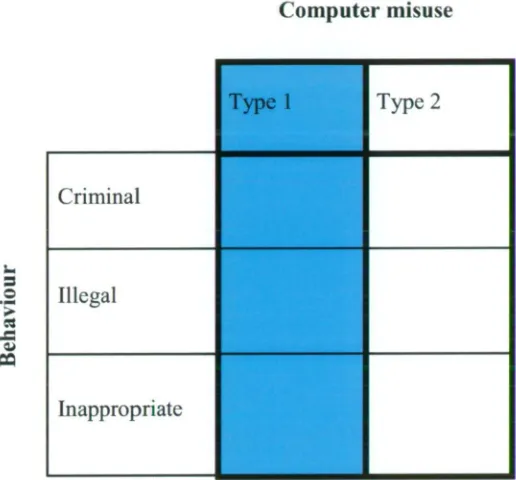
Another way to classify computer misuse is to adopt matrix of behaviours and
types of computer misuse developed by Hannan, Frings, et al. (2003). In this
approach, criminal, illegal and inappropriate behaviours are ranked on their
severity and then two types of computer misuse are defined.
Type 1 is defined as
"misuse arising from the generation, collection, storage, manipulation or distribution of data that itself constitutes a criminal, illegal or inappropriate behaviour" (Hannan, Frings, et al., 2003)
and Type 2 is defined as
By putting the behaviours and types of computer misuse together, the Matrix is
created as displayed in Figure 1.
Computer misuse
Type 1 Type 2
Criminal
Illegal
[image:36.564.169.427.147.387.2]Inappropriate
Figure 1: Matrix of behaviours and types of computer misuse (adapted from Hannan, Frings, et al., 2003)
2.3 Definitions and Models of Forensic Computing
Before exploring definitions and models of forensic computing, it is useful to
explore approaches to the definition of digital evidence. Unfortunately, the
same definitional problems that appear to hamper development in forensic
computing also apply to the definition of digital evidence (DE).
Digital evidence has been previously defined by several authors. Casey (Casey,
2000) defines DE as
"any and all digital data that can establish that a crime has been
committed or can provide a link between a crime and its victim or a
The definition proposed by Standard Working Group on Digital Evidence
(SWGDE) is narrower and emphasizes the legal dimension of digital evidence
defining it as
"information of probative value stored or transmitted in digital form. "(Scientific Working Group on Digital Evidence (SWGDE) &
International Organization on Computer Evidence (IOCE), 2002)
Other attempts at digital evidence definition have been made by Chisum (1999)
who again has an inclusive definition of
"any data stored or transmitted using a computer that supports or refutes a theory on how an offence occurred or addresses critical elements of the offence such as intent or alibi".
Interestingly, two of the most eminent researchers in the forensic computing
domain have adopted Casey's broad definition in their work (Carrier &
Spafford, 2003).
Attempts at defining digital evidence were also made in the European Cyber
Tools On-line Search for Evidence (CTOSE) project (CTOSE, 2003; Un-y &
Mitchison, 2003). This project is examined in detail in Chapter 6. This
definitional ambiguity appears to relate to the technical, organisational or legal
backgrounds of the authors and again highlights the challenges facing forensic
computing resulting from its multi-disciplinary roots.
Academic research publications on forensic computing and its definition first
began to appear at the end of 1990s (Bates, 1997, 1998). From the beginning,
definitional difficulties were obvious as illustrated by the two different
approaches adopted by McKemmish (1999) and Farmer and Venema (1999),
respectively.
McKemmish (1999) defines forensic computing as
and then continues by defining four key elements of forensic computing as:
o "identification of digital evidence, o preservation of digital evidence, o analysis of digital evidence, and o presentation of digital evidence."
This clearly demonstrates the author's law enforcement background and clear
interest in legally acceptable evidence.
Dan Farmer & Wietse Venema, two well known computer security experts,
started running forensic computing classes around the same time and for that
purpose defined forensic computing as
"gathering and analyzing data in a manner as free from distortion or bias as possible to reconstruct data or what has happened in the past on a system" (Farmer & Venema, 1999).
This definition completely ignores any mention of the legal acceptability of the
evidence produced. This is in spite of the fact that forensic computing by the
nature of the word 'forensic' implies "used in or connected with a court of law" (Hanks, 1991).
Subsequent to these definitions, Palmer (2001) provided a much broader
definition containing implied criticism of both previous approaches because of
their overly narrow focus (legal or technical).
"the use of scientifically derived and proven methods toward the preservation, collection, validation, identification, analysis,
interpretation, documentation and presentation of digital evidence derived from digital sources for the purpose of facilitating or furthering the reconstruction of events found to be criminal, or helping to
The fact that several different definitions emerged at about the same time
illustrates the 'youth' of forensic computing and the need for a conceptual
framework to reduce confusion and frustration for researchers attempting to
explore forensic computing and the inter-disciplinary dimensions of issues
related to identification, collection and analysis of computer evidence.
Broucek and Turner (2001a, 2001b) contributed to the development of this
conceptual framework by assessing the range of topics and viewpoints
intersecting in the research space central to the developing discipline of
forensic computing. They developed a preliminary taxonomy for forensic
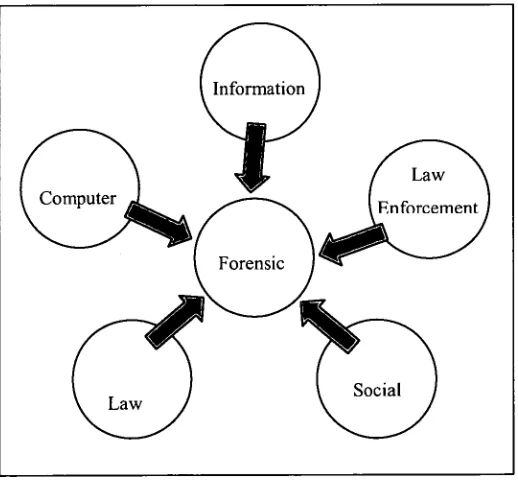
computing and identified four major constituent disciplines — computer
science, law, information systems and social science. Subsequent work
expanded this list to include law enforcement and the basic taxonomy of the
forensic computing domain is illustrated in Figure 2 (Broucek & Turner,
[image:39.566.111.370.383.624.2]2001a, 2001b; Hannan, Frings, et al., 2003; Hannan, Turner, et al., 2003).
Figure 2: Forensic Computing Domain
Based on this research work, Broucek and Turner developed their own
"Processes or procedures involving monitoring, collection, analysis and presentation of digital evidence as part of 'a priori' and/or 'post-mortem' investigations of criminal, illegal or other inappropriate on-line behaviours" (Broucek & Turner, 2006).
This definition encompasses the fact that forensic computing is and will be
used not only in criminal cases, but also in civil cases and other avenues where
digital evidence will be required. It also encompasses fact that it is not
necessarily enough to conduct 'post mortem' analysis of existing data, but also
'a priori' data will be needed to provide evidence.
It should however be noted that this taxonomy and definition are by no means
the only attempts to define the domain. Indeed, as a result of collaborative
work at the First Digital Forensic Workshop (DFRWS) in 2001, an entirely
different approach based not on constitute disciplines but rather specific fields
of computer forensic activity led to the development of an alternative model
referred to as the 'Nucleus of Digital Forensic Research'. This model is
LUIVP,ILYIE
Figure 3: Nucleus of Digital Forensic Research (from Palmer, 2001)
Interestingly, both the 'taxonomy' and 'nucleus' frameworks emphasize the
need to stimulate cooperation and collaboration amongst the various disciplines
and fields concerned with forensic computing issues. The same urgency to
support interaction and collaboration has also been suggested by Spafford
(cited in Palmer, 2001, P. 7). Spafford argues that it is necessary to:
• Abandon current 'band aid approaches' to forensics. The same approach
was and still is often observed in the security world — the security elements
are added into the existing or new systems, instead of designing the
systems with security already built in;
• Know exactly how much information and what type of it needs to be
collected for further analysis in particular circumstances; and
• Understand social aspects of 'the game'.
"All aspects of the problem are essential. Therefore, it is imperative that each collaborates with the other. Researchers, investigators, legislators, and jurists must all work toward a central goal. This requires constant discussion within groups that have representation from all essential parties" (Palmer, 2001, p. 8).
The significance of these remarks is that despite their apparent conformity and
agreement, an academic analysis of the work arising from, for example the
First Digital Forensic Research Workshop, reveals the markedly different aims,
goals and objectives underpinning the approaches of different domain experts.
As the presentations of the main speakers at the DFRWS workshop illustrate
(i.e. Eugene Spafford representing academic research and government, Charles
Boeckman representing DOD Operations, Chet Hosmer representing
Commercial Tools development, David Baker representing Critical
Infrastructure Protection and John Hoyt representing Law Enforcement), the
different underlying positions can be summarised as follows:
• Law enforcement agencies appear primarily interested in gathering
evidence that can later be used for prosecution. It is worth pointing out that
such evidence must follow rules of evidence established by particular
jurisdictions to maintain evidential integrity (chain of custody) and that the
digital evidence should form a part of the 'whole case' such that
non-technical elements are also taken into account;
• Business requirements are more or less driven by economic pressures of
remaining viable and competitive;
• Academics are interested in exact, scientific methods and data and in the
advancement of new knowledge; and
• Military and Information Warfare Operations are mainly interested in what
is referred to as Defensive Information Operations (DIO). DIO represents a
multi-disciplinary approach to protecting digital systems. It includes
Communication, Computer, Information and Operational Security as well
The main differentiation of defence operation requirements from those in
law enforcement is willingness of DIO to sacrifice absolute and/or even
measurable accuracy for quickness in order to serve a mission's timeline.
The result of DIO is research conducted in defence operations concentrated
mainly on three areas (Optimisation of data collection; minimisation of data
corruption or destruction risks; Accommodation of operational time
constraints).
Table 1, adapted and extended from Palmer (2001), clearly demonstrates that
investigators from each area deploy different paradigms when approaching
forensic computing and its analysis. Furthermore, it appears that researchers
also attempt to do this in different environments and/or timeframes.
Significantly, it is suggested that Law Enforcement is only interested in
'post-mortem' while all the other players tend to anticipate and try to take an action
to thwart a possible threat even before it happens including such factors as
financial cost, reputation, service availability.
Area Primary Objective Secondary
Objective
Environment - Time Frames
Law Enforcement Prosecution After the act/post-mortem
Military IW Operations
Continuity of Operations
Prosecution Real Time
Business and Industry
Availability of Services
Prosecution Real Time
Academics Advancement of Knowledge
Dissemination of Knowledge
[image:43.571.111.490.404.575.2]Variable: Subject to Externalities
Table 1: Suitability Guidelines for Digital Forensic Research (adapted and extended from Palmer (2001)).
It is noticeable that the approach advocated by DFRWS can be directly linked
to models that subsequently emerged focused on how to respond in
conducting/implementing forensic computing investigations. Broadly these
models can be divided into three categories Simple, Advanced and Complex.
2.3.1 Simple Models
Arising directly out of the DFRWS was the development of 7 step linear model
for the conduct of forensic computing investigations:
• Identification;
• Preservation;
• Collection;
• Examination;
• Analysis;
• Presentation; and
• Decision.
Reith, Carr, and Gunsch (2002) extended this model to nine steps and called it
the Abstract Digital Forensic Model. The nine steps included are:
• Identification;
• Preparation;
• Approach Strategy;
• Preservation;
• Collection;
• Examination;
• Analysis;
• Presentation; and
• Returning Evidence.
These models concentrate on processing digital evidence. They do not identify
flow in investigation, do not include issues like chain of custody and different
requirements and needs of different groups of users as defined above and in
2.3.2 Advanced Models
Carrier & Spafford (2003) after analysis of several other models developed
their 'Integrated Digital Investigation Process (IDIP)'. This model is based on
crime scene theory for physical investigation. They argue that this investigation
process has been refined over time through its use in thousands of
investigations, and as such, is the most suitable model upon which to establish
a model for digital investigations. As a result their model is based on the
assumption that the computer should be treated as a separate crime scene to the
extent that they use the analogy that the computer should be treated the same as
a "body at the murder scene". (Carrier & Spafford, 2003, p. 18).
Carrier & Spafford's model has been extended by Baryamureeba & Tushabe
(2004) with their Enhanced Digital Investigation Model (EDIP). The EDIP
expands the DIP to enable 'tracing back' in order to address the issues of
digital investigations in networked and wireless environments. However, even
with this enhanced model it is useful to consider how far the physical
investigation analogy can be pushed given the challenges of incidental/multiple
digital copies of any individual data element and the capacity of systems to
'tamper' with data during analysis (Broucek & Turner, 2005a, 2005b, 2006).
2.3.3 Complex Models
More complex model/framework has been developed by the European project
Cyber Tools On-line Search for Evidence (CTOSE). Discussion of this model
has been widely published and it has been examined in depth in the following
papers (Broucek & Turner, 2004a; Broucek, et al., 2005; CTOSE, 2003;
Leroux & Perez Asinari, 2003; Sato, Broucek, & Turner, 2005; Urry &
Mitchison, 2003). In summary, the CTOSE model was developed as a high
level tool aimed to assist companies or other individuals/groups to respond
correctly during the investigation and analysis of on-line behaviours in order to
generate legally admissible evidence. The CTOSE approach was an attempt to
develop an 'expert system' to guide users (for example, a company's security