A Method for Knowledge Discovery
and Development with Health Data
A dissertation submitted to the Faculty of Science, Engineering and Technology, University of Tasmania in fulfilment of the requirements for the Degree of Doctor
of Philosophy.
Tristan Ronald Ling
BComp (Hons, First Class)
ii
Declaration of Originality and Access Authority
This thesis contains no material which has been accepted for a degree or diploma by the University or any other institution, except by way of background information and duly acknowledged in the thesis, and to the best of the my knowledge and belief no material previously published or written by another person except where due acknowledgement is made in the text of the thesis, nor does the thesis contain any material that infringes copyright.
This thesis may be made available for loan and limited copying in accordance with the Copyright Act 1968.
Tristan Ronald Ling
iii
Statement of Ethical Conduct
The research associated with this thesis abides by the international and Australian codes on human and animal experimentation, the guidelines by the Australian Government's Office of the Gene Technology Regulator and the rulings of the Safety, Ethics and Institutional Biosafety Committees of the University.
Tristan Ronald Ling
iv
Abstract
v
Acknowledgements
This work would not have been possible without the support of a huge number of people. Thanks must go to the staff of the Royal Hobart Hospital, Austin Health, and the TAHS study, for allowing access to their databases and for seeing potential in the analysis. Special thanks go to the respiratory specialists at the Royal Hobart for always being open, helpful, and willing to educate.
Special thanks also go to Stephen Giugni and the members of the CSIRO’s Tasmanian ICT Centre, without whose support, interest, provoking discussions, and funding, this project would never have come as far as it has.
The researchers of the Menzies Research Institute and the University of Tasmania’s School of Medicine also deserve enormous thanks. Every one of the (very many) people that were consulted in some manner about the project were helpful, friendly, and supportive, even in the face of endless requests, buggy software, terrible presentations, and even when they could not spare any time.
My supervisory team have been exceptional, and deserve exceptional acknowledgement. I simply could not have produced this thesis without them. To Dr Byeong Ho Kang: I sincerely thank you for the opportunities you have afforded me, for providing motivation when it was needed, and most of all for having faith in me. Without your support in particular, I would not have this thesis. To Dr David Johns: enormous thanks for your enthusiasm and support, even when I know at many times I was making no sense at all. Whenever I ran into problems that seemed to me insurmountable, you always came through and had everything running smoothly. I cannot imagine how I could have done this without you. To Dr Justin Walls: you astound me with your work ethic and capacity to rapidly assess a situation and find a solution. I have learned an incredible amount from you during our meetings, and you have never failed to identify and resolve the most important issues (often before I even understood them). You have provided me with impeccable advice, support, guidance, and frankly, something to aspire to. Thank you very much.
vi hilarity, and much, much more besides, you have helped me through like no one else, and I thank you hugely for that.
I would also like to acknowledge the role that my many and varied friends have played in the progress of this project. I particularly would like to thank Pops, for always knowing what I’m thinking, Princess for reading my thesis even without any prawns in it, Adam for being the most enthusiastic person I have ever met (and the best coconut player going around), Kingus for being Kingus, and Jamie for following a football team that we can always beat. To the nerds of clan FGI (and drnuk too I suppose): Dabe, Manny, Duncan, Mick, Anthony, and Smurf; and to the card players at lunch: Matt, Rob, Joel, and to everyone else that is not already mentioned (sorry), thank you very much for making my life as incredibly enjoyable as it has been. I have had the most amazing amount of fun, and it is all because of you.
To my family, I offer more thanks than I can give. You have all supported me in everything I have done, and I appreciate that more than I could ever tell you. Mum and dad, thank you so much. Noggin and Boo, Tanya and Richard: thank you, I really hope to see you all soon.
vii
Table of Contents
Chapter 1 Introduction ... 1
1.1 Thesis Structure... 2
Chapter 2 Literature Review ... 5
2.1Knowledge Discovery ... 5
2.1.1 History and Context ... 6
2.1.2 Components of Knowledge Discovery ... 7
2.1.2.1 Understanding the Domain and Data ... 9
2.1.2.2 Analysis of the Data ... 12
2.1.2.3 Interpreting Results and Applying Discoveries ... 12
2.2Knowledge Acquisition ... 13
2.2.1 History ... 14
2.2.1.1 Expert Systems ... 14
2.2.2 Knowledge Acquisition Methods ... 17
2.2.2.1 Classification Rules ... 17
2.2.2.2 Decision Trees ... 20
2.2.2.3 Case Based Reasoning ... 22
2.2.2.4 Ripple Down Rules ... 24
2.2.3 Knowledge Comparison ... 40
2.3Data Analysis ... 43
2.3.1 Data Mining ... 44
2.3.2 Machine Learning ... 45
2.3.2.1 History ... 45
2.3.2.2 Machine Learning Drawbacks ... 46
2.3.3 Data Mining and Machine Learning Methods ... 47
2.3.3.1 Statistical Methods ... 47
2.3.3.2 Information Theory ... 48
2.3.3.3 Rule Induction ... 50
2.3.3.4 Decision Trees ... 51
2.3.3.5 Case Based Reasoning ... 53
2.3.3.6 Clustering ... 54
2.3.3.7 Association Rule Mining ... 56
2.3.3.8 Neural Networks ... 59
2.3.3.9 Bayesian Classifiers ... 60
2.3.3.10 Genetic Algorithms ... 61
2.4 Results Analysis ... 63
viii
2.5.1 Medical Knowledge Discovery ... 64
2.5.1.1 Difficulties in the Domain ... 64
2.5.1.2 Computational Studies into Medical Knowledge ... 68
2.5.2 The Lung Function Domain ... 69
2.5.2.1 Lung Function Experts ... 70
2.5.2.2 Lung Function Data ... 71
2.5.2.3 Standardisation of Knowledge ... 78
2.5.2.4 Lung Function Computational Studies ... 79
2.6 Summary ... 86
Chapter 3 An Expert System for Lung Function Interpretation ... 89
3.1 Introduction ... 89
3.2 Methodology ... 91
3.2.1 Lung Function Resources ... 91
3.2.1.1 Data ... 91
3.2.1.2 The Experts ... 94
3.2.2 MCRDR Implementation... 96
3.2.2.1 Standard Features ... 96
3.2.2.2 Novel Features ... 97
3.3Results and Discussion ... 108
3.3.1 Knowledge Base Consolidation ... 108
3.3.2 The Expert System ... 111
3.3.2.1 Accuracy ... 111
3.3.2.2 Rule Creation... 112
3.3.2.3 Classifications ... 121
3.3.2.4 Cornerstone Cases ... 125
3.3.3 Impact of Validation ... 128
3.3.3.1 Cornerstone Cases ... 128
3.3.3.2 Statistical Tools ... 129
3.3.4 Impact of Implementation Restrictions ... 129
3.3.4.1 Rule Creation... 129
3.3.4.2 Rule Conditions ... 130
3.3.5 Rule-Based Thinking ... 130
3.3.5.1 Misunderstanding the rule structure ... 132
3.3.5.2 Irreparable Mistakes ... 133
3.3.6 Interface Issues ... 135
3.3.7 Multiple Experts ... 136
3.3.7.1 Identified Errors ... 136
3.3.7.2 Identified Conflicts ... 137
ix
3.4 Conclusions ... 139
Chapter 4 Knowledge Discovery and Development ... 141
4.1 Introduction ... 141
4.2Methodology ... 143
4.2.1 Structure ... 143
4.2.2 Data Analysis ... 144
4.2.2.1 Case Set Statistics ... 144
4.2.2.2 Rule Statistics ... 145
4.2.2.3 Statistics and Measurements ... 146
4.2.2.4 Knowledge Discovery Process ... 150
4.2.3 Testing the Method ... 152
4.2.3.1 Clinical Studies ... 152
4.3 Results and Discussion ... 174
4.3.1 Difficulties in Evaluation ... 174
4.3.2 Evaluation of Approach ... 176
4.3.2.1 Discovered Knowledge ... 176
4.3.2.2 Efficiency of Analysis ... 179
4.3.2.3 Significance of Discovered Knowledge ... 180
4.3.2.4 Knowledge Acquisition ... 184
4.4 Conclusions ... 187
Chapter 5 Knowledge Comparisons and a Tool for Learning and Assessment ... 190
5.1 Introduction ... 190
5.2 The Learning Process and Constructivism ... 191
5.3 Methodology ... 193
5.3.1 Knowledge Consolidation ... 193
5.3.1.1 Testing ... 193
5.3.1.2 Equating Classifications ... 194
5.3.1.3 Quantified Comparison ... 194
5.3.1.4 Interface ... 195
5.3.1.5 Conflict Identification and Resolution ... 195
5.3.2 A Learning Tool ... 197
5.3.2.1 Compact Knowledge Acquisition... 197
5.3.2.2 Testing ... 197
5.4Results ... 199
5.4.1 Expert Knowledge Consolidation ... 199
5.4.1.1 Equating Classifications ... 199
5.4.1.2 Comparing Results ... 202
5.4.1.3 Evidence-based Conflict Resolution ... 206
x
5.4.2.1 Student 1 ... 207
5.4.2.2 Student 2 ... 210
5.4.2.3 Student 3 ... 216
5.4.2.4 Student 4 ... 220
5.5 Discussion ... 224
5.5.1 Knowledge Consolidation ... 224
5.5.1.1 Equating Classifications ... 224
5.5.1.2 Quantified Comparisons and Conflict Identification ... 227
5.5.1.3 Conflict Resolution ... 228
5.5.2 Teaching and Learning ... 229
5.5.2.1 Practical Experience ... 230
5.5.2.2 Knowledge Comparisons ... 232
5.6 Conclusions ... 239
Chapter 6 Summary ... 241
6.1 Further Work ... 243
6.2 Conclusion ... 244
References ... 246
Appendix A – Additional Data Analysis Tables and Figures ... 262
Appendix B – Pre and Post Knowledge Acquisition Questionnaires ... 264
xi
Figures
Figure 1-1: The structure of the methods presented in this thesis... 3
Figure 2-1: The Steps of KDD (Fayyad, et al., 1996a) ... 8
Figure 2-2: A sample rule, translated into pseudo-code, demonstrating incorporation of domain knowledge to identify useful knowledge (Piatetsky-Shapiro & Matheus, 1994) ... 10
Figure 2-3: An example decision tree for choosing a positive (P) or negative (N) result based on weather conditions (Quinlan, 1986) ... 21
Figure 2-4: The Case Based Reasoning Process (Aamodt & Plaza, 1994) ... 23
Figure 2-5: An RDR Knowledge Base. If classification E is reached incorrectly (i.e. if a case does not have attribute z, nor v, but has attribute t), then an exception rule will be added in the blue node. If no classification is reached, a new rule will be added in the green node. ... 26
Figure 2-6: An RDR Knowledge Base presented as a list of rules with correction trees ... 27
Figure 2-7: A MCRDR KBS. The highlighted boxes represent the rules that are satisfied for the case [a,c,d,e,f,h,k]. The final classifications are classes 2, 5 and 6 (Kang, et al., 1995)... 31
Figure 2-8: PUFF sample report output (Aikins, et al., 1983) ... 81
Figure 3-1: The methods presented in this thesis; the highlighted section shows the components presented in Chapter 3 ... 90
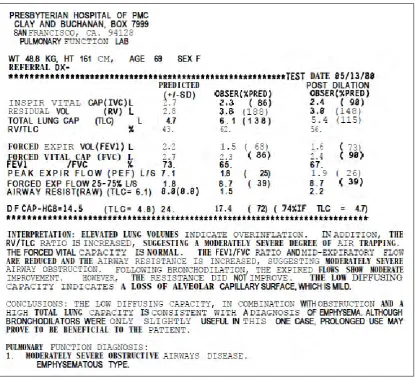
Figure 3-2: Sample lung function report... 93
Figure 3-3: Contributors to each knowledge base ... 96
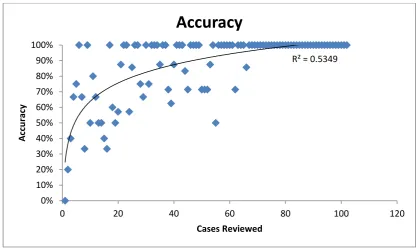
Figure 3-4: Accuracy of system as more cases are reviewed ... 112
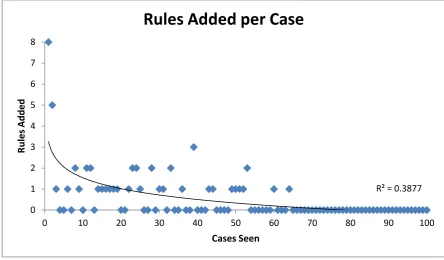
Figure 3-5: Rules added per case ... 113
Figure 3-6: Time taken per case ... 114
Figure 3-7: Time taken to define rules, with a 10-based moving average ... 115
Figure 3-8: Conditions per rule for the independent knowledge base, with new root-level rules, exception rules and stopping rules identified... 116
Figure 3-9: Conditions per rule for the collaborative knowledge base ... 118
Figure 3-10: Number of cases covered by each rule, in the independent knowledge base, with identified outliers indicated in red ... 119
Figure 3-11: Number of cases covered by each rule, added the by the second and third experts, with identified outliers indicated in red ... 120
Figure 3-12: Numbers of cases having each quantity of classifications ... 121
Figure 3-13: Frequency of number of rules for each classification ... 122
Figure 3-14: Number of classifications given to each reviewed case ... 126
Figure 3-15: Frequency of number of classifications per case for the TAHS data ... 127
Figure 3-16: Frequency of number of classifications per case for non-TAHS data... 128
Figure 4-1: The methods presented in this thesis; the highlighted section shows the components presented in Chapter 4 ... 142
Figure 4-2: Simplified structure of the knowledge discovery process ... 143
Figure 4-3: Partial screenshot of the case set search and statistics screen ... 145
Figure 4-4: A small selection of attribute statistics ... 150
Figure 4-5: Computational Process of the Exploratory Analysis Component ... 151
xii
xiii
Tables
Table 2-1: The three situations in which new rules can be added to a knowledge base (Kang, et al., 1995) ... 32 Table 4-1: Statistics are calculated for these lung function attributes ... 148 Table 4-2: Numbers of subjects, out of 485, matching different ATS/ERS reversibility criteria in Agahi’s study (Agahi, 2007) ... 153 Table 4-3: Ratios of subjects in Agahi’s study with different reversibility criteria (Agahi, 2007) ... 153 Table 4-4: Number of subjects, out of 2963, matching different ATS/ERS reversibility criteria in this study ... 154 Table 4-5: Ratios of subjects in this study with different ATS/ERS reversibility criteria ... 154 Table 4-6: Numbers of cases belonging to various classes (number in parentheses is the confidence measure that the two are related, or, the ratio of the class within the class under consideration) ... 155 Table 4-7: p-sgain scores for cases with FEV1 Reversibility and FVC Reversibility (indicates, for a
given class, how many more cases have the second class than expected, shown as the number of cases and as a percentage of the class) ... 156 Table 4-8: Distribution of relevant classes for different ATS/ERS reversibility criteria, with confidence factor for the association, derived from the binomial distribution ... 157 Table 4-9: Relationship for FEV1/FVC Reversibility classes, with and without Obstruction, to Low
DLCO ... 158
Table 4-10: Attributes indicated as related to the FEV1 Reversibility class ... 159
Table 4-11: Classes showing the strongest association to cases with FEV1 Reversibility, for the 150
cases with Obstruction... 160 Table 4-12: Some of the attributes indicated as most related to the FEV1 Reversibility class, for the
150 cases with Obstruction ... 161 Table 4-13: Classes showing the strongest association to cases with FVC Reversibility, for the 108 cases with Obstruction... 162 Table 4-14: Some of the attributes indicated as most related to the FVC Reversibility class, for the 108 cases with Obstruction ... 162 Table 4-15: Significant differences between attribute means for cases with FEV1 Reversibility and
xiv
Chapter 1
Introduction
Data is currently being generated at an unprecedented and ever increasing rate (Hilbert & López, 2011): it seems that new electronic records are created about us every day. Much of this data is accumulated and archived for a variety of reasons; key amongst these is the hope that an analysis will reveal patterns, which can aid in future decision-making (Witten & Frank, 2005; D. Zhang, Zhou, & Nunamaker Jr, 2002). Unfortunately the data is often of such volume that analysis is difficult and time consuming (Dai, Yang, Wu, & Hung, 2008).
Computational methods have been developed to assist in this analysis, under the headings of knowledge discovery and data mining. Knowledge discovery is the computer-aided process of finding new knowledge by analysing a set of data (Goebel & Gruenwald, 1999), and has seen a growth of popularity and development parallel to the growth of computing technology since the 1970s (Frawley, Piatetsky-Shapiro, & Matheus, 1992; Tukey, 1977). Data mining methods are computational algorithms which extract patterns from sets of data (Witten & Frank, 2005), representing the core of a knowledge discovery method; however it has long been identified that this is only one component in a much larger process, including components such as preparing the data for analysis, and interpreting the mined patterns to identify new knowledge (Fayyad, Piatetsky-Shapiro, & Smyth, 1996b).
A significant contributor to the difficulty of acquiring existing knowledge is that people with detailed expertise have very limited availability, given a typically high demand to apply their knowledge in practical situations. The efficiency of acquiring knowledge can be improved by taking input from multiple experts; however, this presents the potential for conflicts between different experts' opinions. Resolving these conflicts correctly and to both groups' satisfaction may not only beneficial to the development of a strong base of knowledge for data analysis, but may also be beneficial for improving the knowledge of the experts involved.
Once acquired, computer encoded knowledge can also be applied in a variety of ways. Expert systems are computer systems that can reproduce human expertise and apply it to complex tasks (Bobrow, Sanjay, & Stefik, 1986; B. G. Buchanan, et al., 1983; Luconi, Malone, Morton, & Michael, 1984). In this study, the method of acquiring expert knowledge is not tied to the knowledge discovery process, allowing the application of the acquired knowledge base as an expert system to assist in the interpretation of complex data.
The medical field presents unique challenges and benefits for knowledge discovery (Cios & Moore, 2002a). Archives of medical data are continually being added to, as the analysis of this data can provide solutions to the singularly important problems of life and death (Cios & Moore, 2002a; Roddick, Fule, & Graco, 2003). For these reasons the application of knowledge discovery methods are particularly relevant. However, analysing medical data is difficult as the data is complex, including a large number of measurements of a variety of types. Analysing the data is particularly difficult as extensive existing knowledge is needed to make meaningful interpretations of the data (Cios & Kacprzyk, 2001; Cios & Moore, 2002a; Prather, et al., 1997).
1.1
Thesis Structure
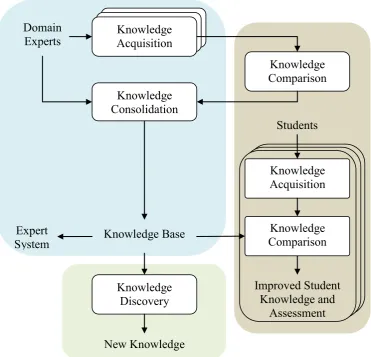
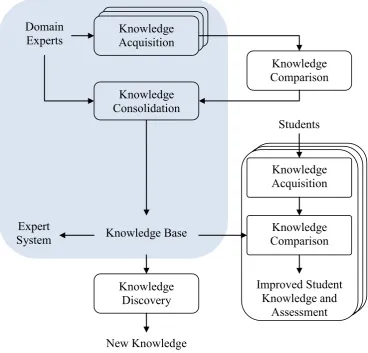
acquisition method (Kang, 1996; Richards, 2009), with some enhancements to provide additional data-based validation. A new method is also presented for quantifiably comparing multiple MCRDR knowledge bases and assisting in conflict resolution. The acquired and consolidated knowledge base is applied in numerous ways: as an expert system; to the discovery of new knowledge from a large compiled dataset; and as a teaching and assessment comparison for acquired student knowledge. These components and their interaction are described in Figure 1-1. The methods have been tested in the medical field of lung function, through the use of a compilation of archived databases.
Figure 1-1: The structure of the methods presented in this thesis
Chapter 2 reviews relevant literature in knowledge discovery, knowledge acquisition, and the application of these methods to the field of lung function and the wider medical domain. Chapter 3, described by the upper-left blue segment in Figure 1-1, presents the process of knowledge acquisition and knowledge
Knowledge Acquisition
Knowledge Consolidation
Knowledge Discovery Domain
Experts
Students
Expert
System Knowledge Base
New Knowledge
Knowledge Comparison
Knowledge Acquisition
Knowledge Comparison
Improved Student Knowledge and
Chapter 2
Literature Review
Discovering new knowledge from data is a complex process involving many stages. This study presents an approach to knowledge discovery that focuses on the initial stages of identification and incorporation of existing knowledge. As such, this chapter will be devoted to an analysis of the previous research in the area of knowledge discovery, with a focus on knowledge acquisition methods, defining both the goals of the various fields of research and what methods are available to achieve them. As much of the work carried out in this study is focused on the study of lung function, a section is also devoted to explaining relevant research in that area, and the details that make this field a complex, interesting, and potentially valuable one to study.
2.1
Knowledge Discovery
The stated goal of finding new knowledge from data falls under the blanket term of
knowledge discovery. In the most general terms, the field of knowledge discovery describes methods for finding new information about a subject, using some combination of recorded data on the subject and knowledge about that data (Goebel & Gruenwald, 1999). Ostensibly, the field therefore includes any method that can derive new data; but with the vast amount of archived electronic data available for analysis, and constantly being added to, the term is almost exclusively used to denote research into the development of computerised methods for data analysis and logical inference. These computerised methods are the focus for the majority of this section.
There are various terms used to summarise the field, each with its own connotations: knowledge discovery, knowledge discovery from databases (KDD), and more recently knowledge discovery and data mining (KDDM) are approximately synonymous; for a more in-depth examination of the differences between these terms, the reader is referred to Kurgan and Musilek’s paper (Kurgan & Musilek, 2006). This study will use the term knowledge discovery for simplicity, although the intended meaning is perhaps closer to KDDM as described by Kurgan and Musilek.
the value of one data element is exactly double that of another; a less specific expectation that, for a wide distribution of data, one data element will have a negative correlation with another; that the concept represented by one data element is a sub-concept of the concept represented by another data element; or any other similar relationship. Fayyad et al qualified this definition by saying that they considered a data pattern to be knowledge if it exceeded an interestingness threshold, adding that their definition is ―by no means an attempt to define knowledge in the philosophical or even the popular view‖, and is purely a practical definition for finding effective results (Fayyad, Piatetsky-Shapiro, & Smyth, 1996a). Nevertheless, this definition seems to have been largely accepted in the knowledge discovery literature (Fayyad, et al., 1996b; McGarry, 2005; Pohle, 2003; Prather, et al., 1997; Stumme, Wille, & Wille, 1998). While there are many other definitions of knowledge (Cassam, 2009; Ortega y Gasset & García-Gómez, 2002; Pears, 1971; Piaget, 1972; Zagzebski, 1999), we will restrict ourselves to the definition described here, with the qualification of Fayyad et al, as it is relevant to the knowledge acquisition and discovery tasks. Following this definition, computational knowledge discovery is the process of analysing data to find new, useful information about the topic that data is describing. Knowledge is considered new if it was not previously known to the person analysing the results of the knowledge discovery. Information is generally defined as any data that has some meaning, and therefore usefulness. Again, this implies the inclusion of a person who is interpreting the data. For philosophical discussions on these points see the aforementioned treatises; but the role of a person in knowing information and interpreting data will be discussed further throughout this work.
2.1.1
History and Context
1996a), and an enormous increase in the quality of data recording and storage (Hilbert & López, 2011). With strong business successes for simple data analysis tools, there was also a significant rise in the quantity of data being stored: with most enterprises hopeful that an analysis of their business data could reveal ways for them to improve their outputs, processes, and income (Goebel & Gruenwald, 1999). With this explosion of data, there was a similar increase in knowledge discovery research; particularly into methods to analyse and derive information from large databases (Fayyad, et al., 1996a; Frawley, et al., 1992).
Within knowledge discovery, those methods which focused on database analysis became known as Knowledge Discovery in Databases (KDD) methods (Frawley, et al., 1992), a name first established by the first KDD workshop in 1989 (Piatetsky-Shapiro, 1990). The name was chosen to indicate that their goal was to take large amounts of data and discover knowledge (Fayyad, et al., 1996a), not just more data as in the case of data mining methods (which will be discussed in section 2.3.1, later in this chapter).
By the late nineties, research and development of KDD methods was a significant and growing field. Goebel and Gruenwald conducted a study of 43 different KDD software products, far from a complete list, and stated that ―despite its rapid growth, KDD is still an emerging field‖ (Goebel & Gruenwald, 1999).
KDD methods, in fact most knowledge discovery methods, follow a standard pattern for considering data. The data is broken into cases, typically consisting of a single transaction, event, or entity under study. The different pieces of information that make up the case are called its attributes (Witten & Frank, 2005). For example, a set of cases which represent books may have the attributes title, author, and price (although there will usually be many more attributes). Each case is defined by the values it has for the set of attributes – continuing the example, a particular case (book) may have the values: title: ―A Tale of Two Cities‖; author: ―Charles Dickens‖; price: $21.00. From here onwards, any use of the words case and attribute will likely be referring to these conventions.
2.1.2
Components of Knowledge Discovery
presented the first of these, a 9-step, iterative model for effective knowledge discovery. In brief, the defined stages were: developing an understanding of the domain and the goal of the knowledge discovery; gathering a dataset; cleaning and pre-processing the data; selecting a subset of the attributes to be examined; matching the data and goals to suitable data mining methods; selecting a data mining method to use; running the data mining method with the data; interpreting the mined patterns to discover the identified knowledge; and consolidating and acting upon the discovered knowledge (Fayyad, et al., 1996b). This process was partially summarised in the diagram presented in Figure 2-1. It is clear from this that the data mining stage is only one step in the overall process and that all other steps are required for the method to be successful (Fayyad, et al., 1996b).
Figure 2-1: The Steps of KDD (Fayyad, et al., 1996a)
All subsequent models could be said to conform to the general structure described by Fayyad et al, although there are numerous distinctions of varying magnitude. In 2006 Kurgan and Musilek performed a detailed examination and comparison of the various models available, including those developed for both industry and research purposes, and presented a generic model based on the models considered. The 6 steps detailed in this generic model were (Kurgan & Musilek, 2006):
Understanding the domain
Understanding the data
Preparing the data and selecting a data mining method
Performing the data mining
Consolidating the discovered knowledge and applying it
A comparison between this model and the model of Fayyad et al finds relatively minor differences, primarily only in the emphasis and segmentation of different components: in particular, the generic model incorporates steps 3-6 into a single step. This thesis utilises the steps of the generic model when describing the process of knowledge discovery, although with different terminology at times.
2.1.2.1
Understanding the Domain and Data
The first steps in the process are some of the most vital, as the existing knowledge that is identified about the domain has a significant impact on every other stage: the selection, pre-processing, and cleaning of the data can be improved by having a better understanding of how the attributes relate; the data mining process can be improved as identifying the relationships that already exist can provide additional data to analyse; the interpretation of results is easier as new patterns can be related to existing patterns and presented in more understandable terms; and finally the establishment and understanding of existing knowledge can be used to determine how the new knowledge can be integrated, which areas it affects and how it might be used. These benefits are, after all, why this is the first step of the process. Despite this usefulness however, it has often been noted this step is often overlooked (Fayyad, et al., 1996b; Piatetsky-Shapiro, 1990; Pohle, 2003).
which is itself a subjective term dependent on a human expert (Freitas, 1999; Liu, et al., 1997; Pohle, 2003).
Approaches to Including Knowledge
Despite the identified importance of domain knowledge, few studies have expanded on how it can be successfully incorporated (Sinha & Zhao, 2008). This section will examine those methods that have been developed.
In a 1994 study, Piatetsky-Shapiro examined a method for using domain knowledge to identify which results were actionable, and what the impact of such an action might be. This allowed the list of potentially interesting results to be minimised by evaluating which results might lead to a useful outcome. The knowledge was incorporated in the form of rules added by a domain expert, identifying relevant attribute values, and a level of deviation from an expected value, culminating in a descriptive conclusion and a probability of success to allow a ranking of usefulness; an example is provided in Figure 2-2 (Piatetsky-Shapiro & Matheus, 1994).
Figure 2-2: A sample rule, translated into pseudo-code, demonstrating incorporation of domain knowledge to identify useful knowledge (Piatetsky-Shapiro & Matheus, 1994)
In 1996 Liu et al proposed a method whereby a user can define General Impressions (GI) to describe non-specific knowledge about a domain: for example, ―Savings > → Yes‖ would be used in a loan decision system to imply that having a large amount of savings would lead to being granted a loan, even though the user cannot put an exact number on how large an amount is required. This would then be used to evaluate the surprisingness or unexpectedness of a generated rule, by
if measure = payments_per_case
sector = surgical_admission
measure value increased by more than 10%
then recommend:
A study is suggested for discretionary and high-cost surgery.
lowering the interestingness of a rule if it conforms to an already supplied GI (Liu, et al., 1997).
More recently, some studies have been published examining the problem. In 2008 and 2009, Marinica et al described three types of knowledge used in data mining: domain knowledge, describing the data; user beliefs, relating to the user’s expectations about knowledge that might be discovered; and a series of operators defining specific types of user expectation. Marinica et al proposed that domain knowledge be incorporated through ontologies, following Gruber’s definition of ontology (Gruber, 1993). The user’s expectations are defined by rule schemas, consisting of an association or an implication between ontology concepts, which essentially describe groups of potential rules. The user can then use a set of operators to define their specific expectations for each rule schema, describing whether any rules of that form should be ignored, or ascribed a certain level of interest. The approach has been tested with two simple ontologies and datasets, and the work is ongoing (Marinica & Guillet, 2009; Marinica, Guillet, & Briand, 2008).
Also in 2008, Kotsifakos et al proposed a similar approach for using ontologies. In this study, Kotsifakos et al assert that methods such as Liu’s and Piatetsky-Shapiro’s are impractical as the user is required to provide a set of expectations each time an analysis is to be performed. The method validates potential rules by checking that the attributes used in the rule are connected, based on the concept structures defined in the ontology; the rule is rejected if no such link is presented, or if the attribute concepts are too far away from the main ontology node. The study notes that this may reduce the potential of discovering truly new and unexpected knowledge. On a generated set of 25 rules, this method automatically selected as interesting the same 5 rules as an expert manually selected (Kotsifakos, et al., 2008).
acquisition task. This is supported by recent studies which identified that most data mining techniques are not practical for many real domains because of the quantity of knowledge required (Adejuwon & Mosavi, 2010; C. Zhang, et al., 2009). It is suggested that the task of acquiring an expert’s knowledge about a complex domain, and their expectations about the impact of every potentially interesting combination of attributes, presents a more costly task than has been typically indicated in the literature; and for complex domains, such as medical areas, an impractical solution. Literature regarding the difficulties with knowledge acquisition, and a description of various methods developed in that field, will be discussed in section 2.2.
2.1.2.2
Analysis of the Data
The analysis of the data, or the data mining component, is the crux of a knowledge discovery method. As such it is usually given the most attention of any of these components; although it has been estimated that the data mining step only constitutes 15% to 25% of the overall work (Brachman & Anand, 1996). This step contains some sort of process that takes in data, and returns information derived from or about that data. Typically it seeks to identify patterns in the data, which can be interpreted to identify relationships that represent the knowledge that the method is trying to discover (Fayyad, et al., 1996b). However, the methods for doing this tend to produce a large amount of extraneous information: without an effective assessment of these results to determine their meaning, usefulness and applicability, the results are often meaningless and unusable (Goebel & Gruenwald, 1999; Piatetsky-Shapiro, 2000). This step will be covered in more detail in section 2.3.
2.1.2.3
Interpreting Results and Applying Discoveries
2005). A related problem is the incorporation of newly discovered knowledge into a knowledge base, or assisting the user in identifying how to apply the new knowledge (Pohle, 2003). The process of discovering new knowledge, and having this knowledge directly incorporated into the process of discovering new knowledge, has been identified as a major goal for knowledge discovery systems, but one that is an open problem (Matheus, et al., 2002). A 2006 study used fuzzy ontologies to discover patterns, where elements could be matched to multiple concepts, each to differing degrees of confidence. This approach was described as occasionally making the resultant patterns more understandable for the user, but did not resolve the issue (Escovar, Yaguinuma, & Biajiz, 2006). These steps are considered again briefly in section 2.4.
2.2
Knowledge Acquisition
Identifying and formalising existing knowledge is a vital step which can completely alter how effective the knowledge discovery process will be. Many studies have highlighted the importance of this stage, and often also mentioned the lack of effort applied in this area (Brachman & Anand, 1996; Fayyad, et al., 1996b; Piatetsky-Shapiro, 1990; Thearling, 1998). Effectively identifying what is already known can dramatically improve the end results by ensuring that the process is not simply rediscovering knowledge that is already known. Also, increasing the base of knowledge to search from can, depending on the method used, increase the sophistication of what can be gleaned (Fayyad, et al., 1996b; Ordonez, 2006). It is worth considering however that the usefulness of existing knowledge can be dependent on the type of knowledge that is being searched for and the extent of knowledge already known: if too much emphasis is placed on using existing knowledge, this can constrain the search and thus reduce the range of knowledge that can be discovered. At times, it is desirable to utilise knowledge discovery methods which are unconstrained by any existing patterns and conventional wisdom (Piatetsky-Shapiro, 1990).
by identifying case groupings and sub-groupings; inferring further information; and identifying and correcting errors within the data.
The process of collecting existing knowledge almost invariably involves a human with expertise in the area, as it is ultimately human knowledge which the method is trying to extend. The task then becomes one of converting human knowledge into a format usable by the knowledge discovery process, typically some form of software. In computing, the field of knowledge acquisition is concerned with methods that do exactly this – convert human knowledge or expertise into a machine-usable, reproducible format (Liou, 1990).
2.2.1
History
Knowledge acquisition has been defined as the process of ―extracting, structuring, and organising knowledge from human experts so that the problem-solving expertise can be captured and transformed into a computer-readable form‖ (Liou, 1990). Another way to express this idea is that knowledge acquisition is the process of modelling human expertise about a subject.
The field arose from work towards building Artificial Intelligence (AI). In the 1950s and 1960s there was the beginning of an understanding of the power of computational systems and the benefits they could provide in automation of tasks. However, due to the high cost of developing new systems, there was much discussion on how a computer might be made that could learn new tasks easily; particularly systems that could learn independently, without human direction (Friedberg, 1958; McCarthy, Hayes, & SCIENCE., 1968; M Minsky, 1961). These studies laid the foundations for many modern knowledge acquisition, machine learning, and expert systems techniques.
2.2.1.1
Expert Systems
1988; Lederberg, Feigenbaum, & CALIF., 1967). The first example of this is the development of the DENDRAL system (Lederberg, et al., 1967), widely regarded as the first example of an expert system: software which can reproduce human expertise for complex tasks (Bobrow, et al., 1986; B. G. Buchanan, et al., 1983; Luconi, et al., 1984). The tasks performed by these systems are typically something that most people cannot perform, one which requires special training or study: hence the word expert. Expert systems have also been defined as requiring problem-solving abilities, to distinguish them from knowledge-based systems (Davies & Darbyshire, 1984), which are described as any repository of knowledge. However, as the functional difference between the two often only depends on the interface used to access them, and the situations in which they are accessed, the two terms are often used synonymously. Many have further determined that an important feature of an expert system is that it has the ability to explain its reasoning: the theory behind this ultimately coming from Plato’s definition of knowing (B. G. Buchanan, 1986; Davis, Buchanan, & Shortliffe, 1977).
Expert systems are occasionally intended to replace a human expert in performing a task, and while it is debatable that this is the ultimate goal of all expert systems research, it is much more common for them to be deployed to assist experts in their work; in which case they have the more specific name of an expert support system
(ESS).
History of Expert Systems
Given the success of the method in assisting the organic chemists, this approach was widely adopted and produced many more expert systems in the 1970s and 1980s, with significant literature regarding the process and how it could be defined and improved. In 1986 Buchanan published a list of expert systems in routine use or field testing, along with a bibliography of expert systems literature; some 46 systems and 374 publications respectively (B. G. Buchanan, 1986).
With the extensive research and development in the area, the components of the expert system model became better defined. The compiled knowledge became known as the knowledge base: a collection of heuristics or classification rules, built by a person known as the knowledge engineer. The knowledge engineer was someone with programming proficiency in the language and structure of the system, who could interview or observe the expert performing their task and translate the task into the rules that the system could use. A programmer was also required to construct the inference engine which could infer, based on given data and the knowledge base, what the response should be. The front-end became known as an
expert system shell: an interface for users, often the experts themselves, to be able to input the data being examined and receive the system’s responses.
learned into something the system could use. This interaction between expert, knowledge engineer and knowledge base became known as the ―knowledge acquisition bottleneck‖, as it was considered the most expensive and difficult component of expert systems development (B. G. Buchanan, et al., 1983; Lenat, Prakash, & Shepherd, 1985).
2.2.2
Knowledge Acquisition Methods
With the recognition that knowledge acquisition was the most critical component in the development of expert systems, many approaches were explored. This led to a widely branching field of methods for knowledge acquisition and expert system development. This section will explore the major developments in knowledge acquisition technology and how they have been applied.
2.2.2.1
Classification Rules
As the first successful expert system, DENDRAL provided the standard template for expert systems until the 1980s. DENDRAL’s approach to knowledge acquisition involved a programmer, later known as a knowledge engineer, interviewing experts and encoding their expertise as rules (B. G. Buchanan & Sutherland, 1968). These rules were described as heuristic rules by the developers to indicate that they are not absolute laws or complete definitions: rather they are guidelines or suggestions that, through inferencing, typically lead to correct results (B. G. Buchanan & Sutherland, 1968).
These heuristic rules are an example of what are more commonly known as classification rules; and they are one of the first, and in many ways the simplest, of the data modelling and knowledge acquisition techniques. The term classification
A classification rule consists of one or more conditions, and a classification or conclusion. The classification is typically a name or number which is used to denote a given group of cases; such as in the DENDRAL system, each classification is an interpretation, or label, of what the case represents. Each condition in the rule consists of some statement describing a type of case, usually in the form [attribute name] [operator] [value], for example: Author (attribute) is (operator) ―C. Dickens‖ (value).
It should be noted that there are many other terms used to describe different implementations of rules, for example production rules or inference rules; however in practice the rules take the same form. The differentiation comes in their application: an inference rule is one which is used to derive new information, which can then be used to cause another rule to activate, and so on until no more rules activate: at which point some of the additional information provided by the rules is presented as the classification (Witten & Frank, 2005). Although the term classification rule is used here, it is intended to cover each of these different named rules, all of which follow a very similar pattern.
The most common source for classification rules are human experts. Rules are usually easy to create and understand, often being close to literal natural language statements, and as such were very popular early in knowledge acquisition research and are still commonly used today (Davis, et al., 1977; Stansfield, 2009). The expert examines the dataset and creates rules which classify cases based on the values of the set attributes. For example, all cases with a sufficient value for attribute A, and where attribute B is negative, should have conclusion 1 (if A>30 AND B<0 then 1).
Another major advantage for using these rules is that they represent discrete pieces of knowledge; which allows new knowledge to be added simply by adding more rules, rather than rewriting significant portions of code; and allows modification of existing rules (B. G. Buchanan & Sutherland, 1968; Davis, et al., 1977).
A criticism of rule-based systems was that they lacked flexibility in their conclusions, and could not be applied to many real-world problems, especially reasoning problems, because facts and data are rarely certain (Zadeh, 1979). This led to further development by adding Bayesian probabilities (discussed in section 2.3.3) and fuzzy logic (in which a classification is provided a confidence, between 0 and 1, rather than simply being present or not present). Each method gave alternative means of adding likelihoods or certainty factors to knowledge and to classifications, greatly improving the applicability and usefulness of results; however this came at the cost of more complex inferencing and knowledge acquisition (Duda, Hart, & Nilsson, 1976; Zadeh, 1979).
the result of any other rule. This process was facilitated by the cornerstone case
system, whereby any case that caused the inclusion of a new rule would be stored; whenever a new rule was to be tested it would have to be compared to every cornerstone case to ensure that it did not match and change the results for the previously reviewed cornerstone cases – an exhausting process (Compton & Jansen, 1989). As a result of these acquisition and maintenance difficulties, the knowledge acquisition component became accepted as being the bottleneck in expert systems development (B. G. Buchanan, et al., 1983; Lenat, et al., 1985; Walser & McCormick, 1977), and alternatives to rule-based system knowledge acquisition began to be explored.
2.2.2.2
Decision Trees
Figure 2-3: An example decision tree for choosing a positive (P) or negative (N) result based on weather conditions (Quinlan, 1986)
Decision trees had already existed before the 1980s; initially they had simply been considered a poor alternative to rule-based systems, due to the structure being more difficult to understand and define than classification rules, and more difficult to maintain (Hart & Center, 1977). For a time decision trees were still considered an unviable option, denounced by some as not worthy of being called an expert system (Hayward, 1985). However, given the knowledge acquisition problems faced by the alternative methods of the time, decision tree development was renewed; particularly after the creation of Quinlan’s C4.5 algorithm for induction of decision trees (Quinlan, 1986).
C4.5 became a popular method because it helped ameliorate the knowledge acquisition bottleneck. Rather than trying to collate and store an expert’s knowledge, with C4.5 the expert looked through a large set of data and classified it; then the method used statistical methods to derive a decision tree that was correct for all (or as much as possible) of the data. This had the potential to greatly reduce the time required to acquire expert knowledge, particularly if such a classified dataset were already available (Quinlan, 1986). However the acquired knowledge takes little advantage of the knowledge that the expert has, and is unlikely to accurately represent any of the decisions which the expert makes; which was the source of much of the criticism from rule-based systems researchers (Duda & Shortliffe, 1983; Hayward, 1985; Prerau, 1985). While the decision tree could still provide an explanation of why it chose a particular classification, such a response may not have any meaning to an expert, who used an entirely different approach to their task; and
outlook
humidity windy
sunny rain
P overcast
N P N P
for a task of realistic size and complexity, the decision tree can become very large and convoluted, such that a trace of which decisions led to the classification would be almost meaningless. Another drawback is that the inevitable maintenance is a difficult process (Quinlan, 1987; Witten & Frank, 2005). For these reasons, decision trees are an effective method to use for some problems, producing a system that can complete tasks effectively with minimal development expense; but in most cases are an ineffective knowledge acquisition tool.
2.2.2.3
Case Based Reasoning
Another knowledge acquisition approach developed at around the same time is case based reasoning (CBR). CBR shifted the focus on the components of knowledge from the role of inferencing to the role of memory, basing decisions on past experiences rather than incremental logical inference (Kolodner, Simpson, & Sycara-Cyranski, 1985). This approach was developed from work in cognitive sciences by Schank on the nature and role of memory (Schank, 1980). In CBR knowledge is represented by a set of stored cases and a set of defined classifications or solutions. In some domains, this approach has been found to be closer to the manner in which experts already consider their domain; and hence knowledge acquisition is an easier process for the expert (Kowalski, 1991).
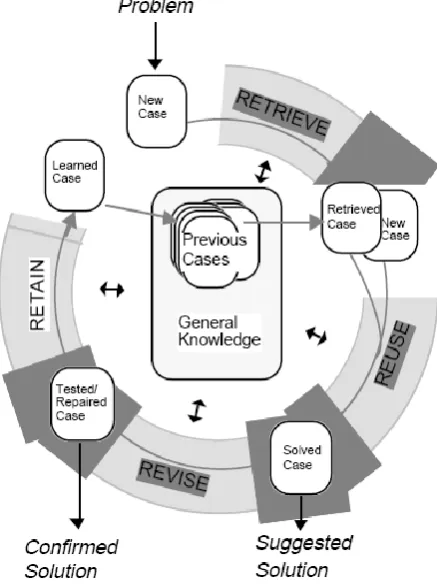
The fundamental procedure for CBR methods is that each successfully solved or classified case is stored, along with how it was solved. Then, when any new case is examined, the system need only find the most similar case and apply the same solution. If necessary, the retrieved solution can be revised to fit this new case; and once solved, the case and its solution are stored (Kolodner, 1992).
stored cases and changing which classifications apply to it (Kolodner, 1991). This process is shown in Figure 2-4.
Figure 2-4: The Case Based Reasoning Process (Aamodt & Plaza, 1994)
This approach can be divided into two distinct categories: precedent-based CBR and problem-solving CBR (Rissland & Skalak, 1989). Precedent-based CBR focuses on identifying similar past cases and using them as evidence to justify using a given solution; whereas problem-solving CBR focuses on the solutions used and adapting the existing solutions to fit the new case (Barletta & Mark, 1988).
to be a further knowledge acquisition step for the knowledge of what constitutes similar cases.
There is also some difficulty in easily influencing the results that the method provides (Féret & Glasgow, 1997; Golding & Rosenbloom, 1996; Kolodner, et al., 1985; Manago, et al., 1993; Yamaguti & Kurematsu, 1993). It should also be noted that the expert is necessarily involved in the process, to review the solution and revise it if necessary, which generally makes maintenance of adding to the knowledge base quite simple; although this again depends on how the system is implemented. Similarly, CBR meets the criteria of being able to explain its result, albeit in a slightly different manner to previous methods: the CBR system can show its reasoning by presenting the past cases that were used to generate that classification, and the attributes that were used to identify the two cases as most similar (Kolodner, 1992).
A drawback of CBR is that the knowledge base is entirely dependent on previously seen examples which may only represent a small subset of the dataset, rather than representing the entire domain (Chi & Kiang, 1991). While this can often be said of any technique using a dataset, it is particularly apparent in CBR due to the method being based entirely on the cases themselves: the knowledge for how to correctly resolve case types not yet seen cannot be entered into the system.
2.2.2.4
Ripple Down Rules
Similar ideas to Schank’s cognitive science studies led to other developments in knowledge acquisition. At around the same time as CBR was being formalised, a method with similar attributes was being developed which significantly reduced the problems associated with the knowledge acquisition bottleneck.
could be guaranteed to be correct, with most rules subject to revision given enough time in use; some rules were even removed entirely at a later point by different experts (Compton & Jansen, 1989). They proposed that the knowledge that experts provide during knowledge acquisition is rarely, if ever, a complete representation of their understanding, but rather just a justification for why their conclusion is correct, in the context of the current case (Compton & Jansen, 1989). This was an alternative explanation for the extensive maintenance that was always necessary with rule-based systems.
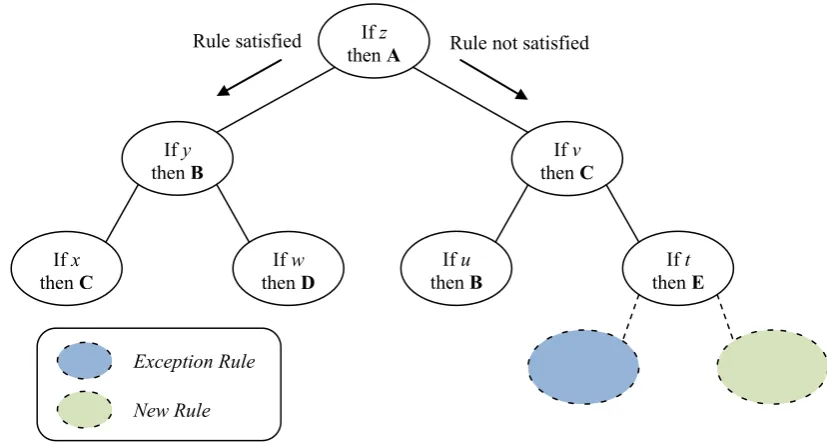
In order to resolve this problem they proposed a new method of structuring and maintaining rule-based systems, based on the idea that knowledge was context-dependent and would require maintenance. The rules in a RDR knowledge base are structured in a binary tree, in which each node contains one rule. RDR knowledge acquisition functioned in a similar manner to the maintenance of a typical rule-based system: the system would be presented with a case, which it would attempt to produce a classification for based on its knowledge base and provide its reasoning. The expert would examine the result, and if they disagreed with the system’s conclusions, the system would be updated with a new rule. The difference is the manner in which the rule is added:
If the system had no classification for the rule, then the expert would simply
add a rule with the correct classification, justifying why the case should have that conclusion. This rule would be added in a node as the child to the right of the rightmost node in the tree.
If the system reached an incorrect classification, the new knowledge is added in
the context of the incorrect rule, as this is the situation in which the expert is being asked to justify their classification: the rule is added as the child to the left of the incorrect rule, as an exception to the incorrect rule.
Figure 2-5: An RDR Knowledge Base. If classification E is reached incorrectly (i.e. if a case does not have attribute z, nor v, but has attribute t), then an exception rule will be added in the blue node. If no classification is reached, a new rule will be added in the green node.
When considering what results the knowledge base can determine about a case, the first rule considered is the top level of the tree; if it is satisfied, then the child rule on the left branch is considered. If the top level rule is not satisfied, the child on the right hand branch is considered. This continues until no further child nodes’ rules are satisfied, or no further child nodes exist. The case is classified according to the classification associated with the node whose rule was last satisfied (Compton & Jansen, 1989). This structure ensures that any new rule will not interfere with any rule other than that it was added to correct: removing the necessity for a knowledge engineer to laboriously check that new rules do not break existing knowledge and allowing knowledge acquisition and maintenance to be carried out by the expert as the system is in use.
An alternative way of considering the structure is shown in Figure 2-6. In practice, the tree is typically heavily weighted on one side, as more new rules are typically required than corrections (Compton, et al., 1991). Because of this it might be easier to consider an RDR tree as a list of rules, each with a correction tree branching from them.
If z then A
If y
then B then C If v
If x
then C then D If w then B If u then E If t Rule satisfied Rule not satisfied
Figure 2-6: An RDR Knowledge Base presented as a list of rules with correction trees
A further advantage of this structure was that no knowledge engineering was required; the expert’s justifications were simply added directly to the knowledge base as rules, without an engineer laboriously checking that existing rules were still valid. RDR achieved this by maintaining evidence for the knowledge base: the case used to define each rule was associated with that rule and called the cornerstone case. Whenever a rule was found to classify a case incorrectly, and the expert offered a justification for why it was wrong, that justification was compared against the cornerstone case for the system’s rule. If the new rule changed the classification for that cornerstone case, this was indicated to the expert. The expert was then required to provide further details justifying the different classifications for the two cases, or to accept that the previously seen case was incorrectly classified.
This new method was applied to redeveloping the GARVAN-ES1 expert system, and it was found to require no knowledge engineering: the expert’s rules were simply added directly, not requiring any validation. This resulted in ―knowledge acquisition at least 40 times as fast as that required for a conventional version of the same knowledge base, with the same knowledge engineer/expert involved‖ (Compton, et al., 1991). While an increase in efficiency would be expected, due to previous experience developing the same expert system, this is a very substantial improvement.
If z then A
If y then B
If v then C
If x
then C then D If w
If u then B
If t then E Rule
satisfied
Rule not satisfied
Although the knowledge base can be confusing to view in this structure, the system can still easily provide explanations for its classifications by tracing back the path through the tree and providing the rules at each node. Such rule traces are often better descriptors of the knowledge as the rules are exactly as entered by the expert, containing no extra conditions added for engineering reasons (Compton, et al., 1991). It was also noted that this approach automatically, if gradually, discovers tacit knowledge: knowledge that experts hold but which they find difficult to express, or are not consciously aware of outside of the specific context in which the knowledge applies (Richards & Busch, 2003).
PEIRS
Possibly the most well-known RDR health expert system, and perhaps the best known RDR system in any domain, is the Pathology Expert Interpretative Report System (PEIRS). PEIRS was an expert system for interpreting chemical pathology reports, and was an early and major success with the RDR methodology (Compton, et al., 1992; Kang, Compton, & Preston, 1995). It established a knowledge base of thousands of rules by having multiple experts interact with it directly over a period of a few years. It achieved an accuracy rate estimated to be greater than 95%, for over 20% of the pathology domain: an impressive feat making it one of the largest and most successful expert systems in routine use at the time (Compton & Edwards, 1994). This early success was later built on with commercial applications, particularly with further developments to the RDR method (Compton, Peters, Edwards, & Lavers, 2006).
Drawbacks
will always use the first classification that it reaches (Compton, Kang, Preston, & Mulholland, 1993). This related to a further problem: the knowledge base did not allow true inferencing, as each rule would only be considered once (if at all), with only the first classification reached being provided as the result (Compton, et al., 1993).
RDR Modifications
As RDR represented a significant improvement in knowledge acquisition and maintenance, the method was applied and modified in many ways, each overcoming some flaw. Gaines developed a method for automatically inducting a ripple down rules knowledge base, in the same way as C4.5 could induct a decision tree (B. Gaines & Compton, 1992) – this will be discussed further in section 2.3.2. The lack of true inferencing in the RDR method led to a number of modifications, to allow the method to be applied to configuration tasks. Recursive RDR used several (8) individual RDR knowledge bases, each contributing a part of the final configuration solution. The results of these knowledge bases could also be used as data for the other knowledge bases, allowing a kind of inferencing (Mulholland, Preston, Sammut, Hibbert, & Compton, 1993).
Nested RDR (NRDR) provided a similar solution, by allowing the expert to define a separate RDR knowledge base for each concept. This concept knowledge base would then decide whether that concept was applicable to the current case or not. Thus each concept could be used as a condition in rules defining other concepts: as the RDR knowledge base produces a single classification, the value for this classification can be used as a rule condition (Beydoun & Hoffmann, 2000). Both Recursive RDR and Nested RDR provided a solution to the problems raised by configuration problems, but had their own drawbacks (Bindoff, 2010).
typical example of the cases that usually provide that classification: if the new case has a value for an attribute that is not present in the cases that have been confirmed with the classification, the expert is flagged that the classifications may be wrong and should be checked. Successful tests led to a conclusion that this is a useful aid in knowledge acquisition (Compton, et al., 1996).
Multiple Classification Ripple Down Rules
The most significant problem with RDR was that it could only provide a single classification; this was particularly evident as the domains in which it had first been applied were both multiple classification problems (Compton, et al., 1993; Kang, et al., 1995). This was a topic of much discussion in the early 1990s, and soon an adaptation of the RDR technique was developed, named multiple classification ripple down rules (MCRDR) (Compton, et al., 1991; Kang & Compton, 1992; Kang, et al., 1995).
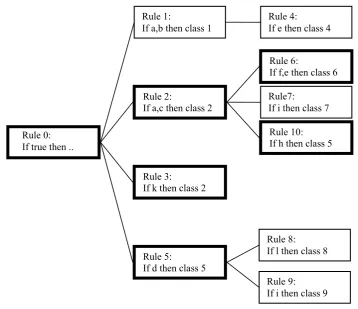
The problem was resolved by generalising the binary tree structure to an n-tree. When a classification is found it is recorded, but the search through the tree is continued. In this structure, all children nodes represent exceptions rather than just the leftmost node, and new (independent) rules are added as siblings at the top level of the tree.
Figure 2-7: A MCRDR KBS. The highlighted boxes represent the rules that are satisfied for the case [a,c,d,e,f,h,k]. The final classifications are classes 2, 5 and 6 (Kang, et al., 1995)
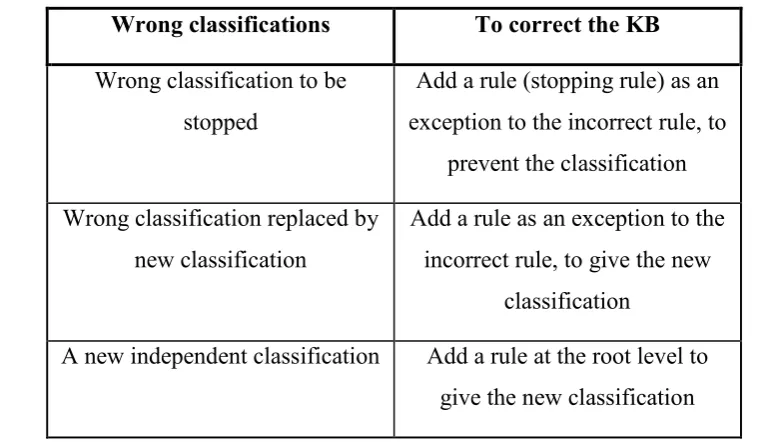
This structure maintains the acquisition of knowledge in context; but certain changes needed to be made to the knowledge acquisition process to support them. Adding a new classification to a case is straightforward: the rule is added at the top level of the tree, as a sibling to the other top-level rules. Correcting a rule is also simple, being quite similar to single classification RDR (SCRDR): the new rule is added as a child to the incorrect rule (i.e. in the context that it is required); and as with SCRDR, the rule only needs to be sufficient to differentiate a case from the parent rule as it will only be considered within that context. Allowing multiple classifications also presented a third option during knowledge acquisition: a classification may be wrong or extraneous, requiring no classification to replace it but nevertheless being incorrect. In this situation the expert defines what was named a stopping rule. This is identical to an exception rule in all ways, except that it has no classification. The rule is added in the context of the incorrect or extraneous classification, and its conditions are defined by the expert as an explanation of why the given classification should not appear for the current case. Table 2-1 below
Rule 0: If true then ..
Rule 1:
If a,b then class 1
Rule 2:
If a,c then class 2
Rule 3:
If k then class 2
Rule 5:
If d then class 5
Rule 4: If e then class 4
Rule 6:
If f,e then class 6 Rule7:
If i then class 7
Rule 8: If l then class 8
Rule 9: If i then class 9
summarises these three situations, and the appropriate action to take (Kang, et al., 1995).
Wrong classifications To correct the KB
Wrong classification to be stopped
Add a rule (stopping rule) as an exception to the incorrect rule, to
prevent the classification
Wrong classification replaced by new classification
Add a rule as an exception to the incorrect rule, to give the new
classification
[image:46.595.133.521.116.337.2]A new independent classification Add a rule at the root level to give the new classification
Table 2-1: The three situations in which new rules can be added to a knowledge base (Kang, et al., 1995)
The allowance of multiple classifications also impacted the ensured validity of an RDR knowledge base. In single classification RDR any new rule only needs to be checked against the cornerstone for the rule it is correcting, and new rules do not need to be checked at all, as the rule will only ever be applied within the context of the other rule firing or no rules firing respectively. As MCRDR does not stop checking rules after a single classification however, the addition of a new rule can potentially affect the results for many cornerstone cases. To resolve this, the new rule needs to be checked against any cornerstone case which could reach the context in which the rule is added: in other words, all cases which satisfy all of the antecedents of the new rule. If any cornerstones which match all antecedent rules also match the new rule, this must be brought to the expert’s attention as it indicates a knowledge acquisition error: either the new rule is lacking some knowledge, and needs to be refined so it can differentiate between the cornerstone cases’ classifications and the new classification; or the cornerstone case was originally misclassified and should in fact have the new classification.