ELECTRICITY PRICES
1973-1978
eurostat
DE EUROPÆISKE FÆLLESSKABERS STATISTISKE KONTOR STATISTISCHES AMT DER EUROPAISCHEN GEMEINSCHAFTEN STATISTICAL OFFICE OF THE EUROPEAN COMMUNITIES OFFICE STATISTIQUE DES COMMUNAUTÉS EUROPEENNES ISTITUTO STATISTICO DELLE COMUNITÀ EUROPEE
BUREAU VOOR DE STATISTIEK DER EUROPESE GEMEENSCHAPPEN
LuxembourgKirchberg, Boîte postale 1907 — Tél. 4 3 0 1 1 Télex: Comeur Lu 3 4 2 3
1049 Bruxelles, Bâtiment Berlaymont, Rue de la Loi 2 0 0 (Bureau de liaison}— Tél. 7 3 5 8 0 4 0
Denne publikation kan fås gennem de salgssteder, som er nævnt på omslagets tredje side ι dette hæfte
Diese Veröffentlichung ist bei den auf der dritten Umschlagseite aufgeführten Vertnebsburos erhaltlich.
This publication is obtainable from the sales agents mentioned on the made backcover.
Pour obtenir cette publication, prière de s adresser aux bureaux de vente dont les adresses sont indiquées à la 3e page de la couverture
Per ottenere questa pubblicazione, si prega di rivolgersi agli uffici di vendita ι cui indirizzi sono indicati nella 3'1
pagina di copertina
ELECTRICITY PRICES
1973-1978
PRIX DE L'ÉNERGIE ÉLECTRIQUE
This publication is also available in the following languages: Cette publication est éditée aussi dans les versions suivantes:
DE/IT: ISBN 92-825-1632-6
Cataloguing data can be found at the end of this volume Une fiche bibliographique figure à la fin de l'ouvrage
Reproduction of the contents of this publication is subject to acknowledgement of the source La reproduction des données est subordonnée à l'indication de la source
Printed in Belgium 1980
Contents
Page
I. Introduction 5
II. Conditions and methods 7
1. Scope of the study 7
2. Locations 7 3. Standard consumers 8
4. Definition of prices recorded 10
III. Production and consumption of electricity 11
IV. Units of value 17
V. Electricity prices in the different countries 23
1. F.R. GERMANY 23 a) Organization 23 b) Regulations 24 c) Taxes 25 d) Household prices — tariffs 25
e) Household prices — analysis 26 f) Industrial prices — tariffs 28 g) Industrial prices — analysis 28
2. FRANCE 30 a) Organization 30 b) Regulations 30 c) Taxes 30 d) Household prices — tariffs 31
e) Household prices — analysis 32 f) Industrial prices — tariffs 33 g) Industrial prices — analysis 36
3. ITALY 38 a) Organization 38
b) Regulations 39 c) Taxes 39 d) Household prices — tariffs 40
e) Household prices — analysis 41 f) Industrial prices — tariffs 42 g) Industrial prices — analysis 44
e) Household prices — analysis 48 f) Industrial prices — tariffs 49 g) Industrial prices — analysis 49
5. BELGIUM 51 a) Organization 51 b) Regulations 51 c) Taxes 52 d) Household prices — tariffs 52
e) Household prices — analysis 53 f) Industrial prices — tariffs 54 g) Industrial prices — analysis 55
6. LUXEMBOURG 57 a) Organization 57 b) Regulations 57 c) Taxes 57 d) Household prices — tariffs 58
e) Household prices — analysis 59 f) Industrial prices — tariffs 60 g) Industrial prices — analysis 61
7. UNITED KINGDOM 63 a) Organization 63 b) Regulations 64 c) Taxes 64 d) Household prices — tariffs 64
e) Household prices — analysis 65 f) Industrial prices — tariffs 66 g) Industrial prices — analysis 67
8. IRELAND 70 a) Organization 70 b) Regulations 70 c) Taxes 70 d) Household prices — tariffs 70
e) Household prices — analysis 71 f) Industrial prices — tariffs 72 g) Industrial prices — analysis 73
9. DENMARK 75 a) Organization 75 b) Regulations 75 c) Taxes 76 d) Household prices — tariffs 76
e) Household prices — analysis 77 f) Industrial prices — tariffs 78
g) Industrial prices — analysis 80
VI. Community comparison and conclusions 81
Statistical annex Tables
1-27 Electricity prices for households and industry by location 28 PPS conversion tables and GDP price indices
29-34 Community comparison in PPS
Graphs
I. Introduction
As a further part of its efforts to collect and analyse consumer prices for energy in the Community, the Statistical Office of the European Communities is publishing for the first time a study on electricity prices, thus filling a gap in the statistical data made available to date in the energy sector.
The complexity of the tariff structures, which differ from one country to another, and the special procedures to be followed in the survey delayed the setting up and the monitoring of a harmonized survey ensuring a valid and meaningful comparison between statistical series compiled over a long period.
This study follows the same principles, uses the same general methods and covers the same cities as the studies on gas prices, which have already appeared in a number of publications. It is thus part of a wider statistical whole. Like the study on gas, it considers the situation mainly from the consumer's point of view and attempts to give as realistic a picture as possible by showing the prices which would actually be paid by the final consumer in specific locations and under conditions of supply which represent situations encountered frequently. The choice of the standard categories of consumers is based on the criterion of statistical representativeness in all the countries of the Community.
This publication does not merely present statistical results but gives as comprehensive a picture as possible in that it:
— shows the structure and organization of the electricity industry;
— presents a fairly extensive time series going back to the last energy crisis, thus making it possible to monitor price trends during an interesting period;
— outlines the tariff systems currently in force, showing the various components of prices and thus making it possible for readers to calculate alternative prices;
— reviews the range of taxes imposed on electricity sales;
— analyses the results from different angles: trends, differences from one region to another, tariff differentials, etc.;
— presents an international comparison of price levels in the Community based on a new and original approach.
A study of this type entailed long and difficult surveys, carried out by the Centre Interuniversitaire pour les études de la consommation privée (CIEC) in Brussels.
The definitions and basic concepts used in these surveys were coordinated by the Union Interna-tionale des Producteurs et Distributeurs d'Energie Electrique (UNÍPEDE), whom we wish to thank for the valuable help they willingly gave us in a spirit of full cooperation. A very considerable amount of work was carried out in each country by the electricity companies and the professional associations in an atmosphere of perfect understanding, which thus facilitated the desired harmonization of the survey at Community level. This was achieved as a direct result of their constructive and helpful cooperation. We should like to take this opportunity to thank all those who took part in this work.
II. Conditions and methods
1. SCOPE
The study covers the nine member countries of the European Community; results are presented in the following order: Federal Republic of Germany, France, Italy, Netherlands, Belgium, Grand Duchy of Luxembourg, United Kingdom, Ireland and Denmark.
The reference period is 1 9 7 3 - 1 9 7 8 , i.e. six price surveys based on the situation at the beginning of each year.
As regards consumers, the study considers all types of customers supplied through the public distribution network with low, medium and high voltage electricity. In the interests of simplified presentation, consumers are subdivided into t w o groups, one for domestic and the other for industrial users. The survey does not cover major industrial consumers:
(1) who themselves produce part of their electrical energy requirement;
(2) who purchase electricity under special contract terms because of their exceptionally high power requirements and consumption demand.
These exceptions are mainly steelmaking and chemical enterprises, enterprises engaged in the production of aluminium and other metals by electrolysis, railways, etc.
These enterprises always consume over 10 million kWh annually. They are f e w in number, but nevertheless consume an appreciable part of the total electrical energy supplied.
2. LOCATIONS
In order to reflect as accurately as possible the real position of consumers, it seemed advisable to record prices at selected locations, i.e. towns and conurbations, rather than give average prices per country or per region.
The choice of location is decided by several criteria, viz. population, economic importance, different tariff districts, even geographical coverage of a country, harmonization with the locations used in statistics relating to the prices of other sources of energy, particularly gas.
In certain countries, the tariffs and therefore the prices are valid for a whole region. These cases are listed below.
28 locations were thus chosen to represent the Community:
Federal Republic of Germany: Hamburg, Hanover, Dusseldorf, Frankfurt/Main, Stuttgart, Munich, Western Zone, Southern zone
Netherlands:
Belgium:
G.D. of Luxembourg: United Kingdom: Ireland:
Denmark:
Rotterdam (GEB) North Holland (PEN) North Brabant (PNEM)
the country as a whole (standard national tariff) Grand Duchy (CEGEDEL)
London, Glasgow, Leeds, Birmingham Dublin
Copenhagen (KB), North Zealand (NESA)
3. STANDARD CONSUMERS
In order to stick to a consumer-based approach, it was decided not to quote average prices, by sub-divisions or categories, as these are always difficult to interpret. A pragmatic approach was thus adopted, taking the 'standard consumer' as a reference point:
(1) representing current and therefore widespread patterns (modes of distribution);
(2) corresponding to clear-cut consumption conditions which are interesting from the point of view of tariffs charged;
(3) applying to all countries and throughout the reference period, which is the only way of guaran-teeing comparability in space and in time.
The choice of standard consumers was based on a statistical analysis of the distribution of consumption and the number of subscribers. The standard consumers are defined by specific consumption patterns as shown below.
Domestic uses: (supply of low voltage)
Standard category consumer
Da Db Dc De
Annual consumption
Total (of which night)
kWh 600
1 200 — 3 500 (1 300)
20 000 (15 000)
Approximate subscribed demand
kWh < 3
3-4 4-9
>9
Sta
50 m2 70 m2 90 m2 120 m2
ndard dwelling
2 rooms-t- kitchen 3 rooms+kitchen 4 rooms+kitchen 5 rooms+kitchen
As a guideline these standard consumers may be expected to possess the following household facilities and appliances:
Da Lighting, radio, television, refrigerator, small electrical appliances1
Db as for Da + washing machine or dishwasher
Dc as for Db with washing machine and dishwasher + storage water heater
De 'all-electric' system with water heater and electrical central heating operating on a storage basis
The maximum subscribed demand is the maximum quarter-hourly offtake recorded in one year and expressed in kilowatts (kW). The annual load factor or the maximum subscribed demand time determines the regularity of consumer offtake of electrical energy from the grid during the year. The longer this time the more even the pattern of consumption during the 8 760 hours of the year. It indicates the number of hours in which the consumer can maintain his annual consumption level at a
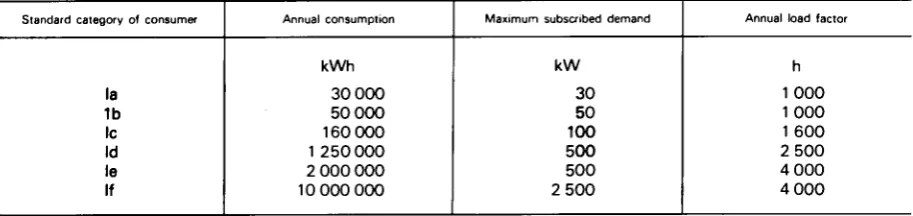
Industrial uses (supply of medium or high voltage)
Standard category of consumer
la 1b Ic Id le If Annual consumption kWh
30 000
50 000 160 000
1 250 000
2 000 000
10 000 000
Maximum subscribed demand
kW 30 50 100 500 500
2 500
Annual load factor
h
1000 1000
1 600
2 500
4 000
4 000
demand level permanently equal to maximum demand. Additional details are sometimes needed as regards the application of tariffs.
— In the case of tariffs based on the power used in half an hour, the maximum demand of the standard consumer is multiplied by a coefficient of 0.98.
— In the case of tariffs based on power expressed in kVA this adjustment is made by dividing the standard consumer's maximum demand in kW by the coefficient COS φ: 0.90-0.95.
[image:11.595.65.522.96.204.2]— In the case of tariffs based on integrated readings of power offtake taken in respect of time-units shorter than the year, the subscription charge has been multiplied by the following coefficients:
Table of power correction coefficients
Standard consumers la lb Ic Id le If Annual load factor
1 000 h 1 600 h 2 500 h 4 000 h
Maximum monthly demand 0.81 0.83 0.85 0.90 Maximum two-monthly demand 0.83 0.85 0.87 0.91 Maximum three-monthly demand 0.86 0.88 0.90 0.95 Average of the three highest values for maximum monthly demand 0.94 0.95 0.96 0.98 Average of the two highest values for maximum monthly demand 0.96 0.97 0.98 0.99 Annual maximum demand (basic principle} 1 1 1 1
A harmonized table showing consumption during 'off-peak' periods has also been compiled in order to be able to calculate prices evenly when tariffs vary according to times of day (e.g. lower tariff during the night).
Table of consumption during off-peak periods
Standard la lb Ic Id le If Annual load factor h 1000 1000
1 600
2 500
4 000
4 000
Annual consumption 1000 kWh 30 50 160
1 250
2 000
10 000
Percentage of consumption charged at off-peak rates according to the average daily duration of off-peak periods 7 h 0 0 7 16 22 22 8 h 0 0 8 18 25 25
9 h 10h 11 h
0 0 0 0 0 0 10 12 14 21 24 27 29 33 37 29 33 37
[image:11.595.60.523.388.499.2]The percentage consumed during off-peak periods obviously depends on the load factor. The more evenly demand is distributed, the greater the consumption during off-peak periods, e.g: during the night.
The other special conditions encountered in certain tariff structures are outlined in the chapters devoted to tariffs in the sections by country, e.g. extra off-peak hours at weekends and on public holidays, or seasonal breakdown of consumption for which there is not a uniform classification for each country but the real condition relevant to each one.
4. DEFINITION OF PRICES RECORDED
The figures show the prices actually paid by consumers. These prices include the meter rental, the standing charges and the commodity rates. They do not include connection charges. The figures give the unit prices paid per kWh of electricity consumed. The unit price is obtained by dividing the total amount paid by the user for the standard annual consumption in question by the number of kWh consumed.
The prices are recorded and calculated according to the tariffs, conditions and rules in force at the beginning of each year. This means that any changes in the tariff structure during the year are not taken into account, i.e. no price weighting is applied to the year.
Tariffs which were applied only to a negligible number of users or not at all have been disregarded and, where several tariffs were possible, the tariff recorded is the one most favourable to the consumer.
In the case of a consumer having two separate meters (e.g. one for night tariff and one for daytime tariff), the price reflects total consumption.
No account has been taken of special tariff or supplementary arrangements which may exist for reactive power.
Three figures are shown in each case: — the price net of tax
— the amount of tax
— the selling price (inclusive of all taxes).
The taxes included here are those levied directly on the sale of electricity to the consumer. Taxes levied upstream of this, e.g. direct company taxes or income tax, which obviously contribute to manufacturing costs, are not shown separately in this study. The sum total of the taxes shown here corresponds to value added tax, taxes on consumption, local taxes and duties levied at the time of sale.
In general, value added tax is deductible for supplies to commerce and industry.
The results for each country are given in national currency at current values, i.e. these are therefore nominal values. For the purposes of international comparison, it was necessary to use a represen-tative common monetary unit which would create a minimum of distortion in both space and time. In this respect, the present study introduces a number of innovations which are outlined and explained below.
III. Production and consumption of electricity
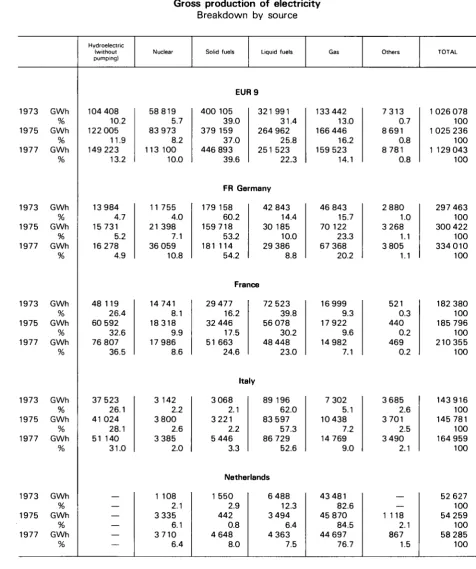
The aim of this chapter is to summarize the main data on production and consumption of electricity in the Community, and provide a breakdown by country and main characteristics for the years covered.
The data is that of the energy balance sheets published (with definitions) in the Energy statistics yearbook 1973-77 (EUROSTAT 1979).
A first table (A) shows gross production of electricity, i.e. the total production of all producers, i.e. public services and industrial self-producers alike. A breakdown is made by sources of energy used to produce electricity:
hydroelectric (natural source) nuclear
solid fuels (coal, lignite, coke, etc.) liquid fuels (gas/diesel oil, fuel oil, etc.)
gas (refinery gas, natural gas, coke-oven gas, blast furnace gas) other (e.g. household waste, industrial waste, geothermal)
Table Β gives final consumption of electricity broken down into three main user groups: — households (including agriculture)
— industry
— commerce, administration, etc. (excluding transport).
Although the dividing line between industry and other non-domestic consumers (small businesses, craft industry, commerce, etc.) is blurred, this table gives a fairly good general idea of the size of the main groups of users.
Final consumption by definition excludes the consumption of the energy sector, the power required for pumping and grid losses. The difference between the gross production tables and the final consumption table is therefore due to external trade, pumping, the energy sector and transmission and distribution losses.
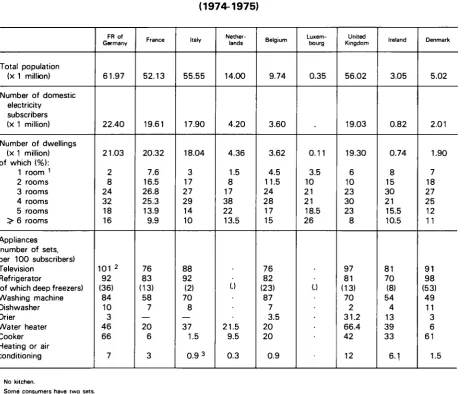
To round off this information, some data on the structure of households have been collected in harmonized form in respect of the nine member countries of the Community. These data have a bearing on electricity consumption, in that they classify accommodation according to the number of rooms and the electrical facilities and appliances of domestic subscribers. These data are given in Table C on page 15.
It was not possible to collect homogeneous information on the structure of electricity consumption in industry. The little information available will be included, when considered relevant for the purposes of this study, in the individual country chapters.
TABLE A
Gross production of electricity
Breakdown by source
1973 1975 1977 1973 1975 1977 1973 1975 1977 1973 1975 1977 1973 1975 1977 GWh % GWh % GWh % GWh % GWh % GWh % GWh % GWh % GWh % GWh % GWh % GWh % GWh % GWh % GWh % Hydroelectric (without pumping) 104 408 10.2 122 005 11.9 149 223 13.2 13 984 4.7 15 731 5.2 16 278 4.9 48 119 26.4 60 592 32.6 76 807 36.5 37 523 26.1 41024 28.1 51 140 31.0 — — — — — Nuclear 58819 5.7 83 973 8.2 113 100 10.0 11 755 4.0 21 398 7.1 36 059 10.8 14 741 8.1 18318 9.9 17 986 8.6 3 142 2.2 3 800 2.6 3 385 2.0 1 108 2.1 3 335 6.1 3710 6.4
Solid fuels Liquid fuels
EUR 9 400 105 39.0 379 159 37.0 446 893 39.6 321 991 31.4 264 962 25.8 251 523 22.3 FR Germany 179 158 60.2 159718 53.2 181 114 54.2 42 843 14.4 30 185 10.0 29 386 8.8 France 29 477 16.2 32 446 17.5 51 663 24.6 72 523 39.8 56 078 30.2 48 448 23.0 Italy 3 068 2.1 3221 2.2 5 446 3.3 89 196 62.0 83 597 57.3 86 729 52.6 Netherlands 1 550 2.9 442 0.8 4 648 8.0 6 488 12.3 3 494 6.4 4 363 7.5 Gas 133 442 13.0 166 446 16.2 159 523 14.1 46 843 15.7 70 122 23.3 67 368 20.2 16 999 9.3 17 922 9.6 14 982 7.1 7 302 5.1 10 438 7.2 14 769 9.0 43 481 82.6 45 870 84.5 44 697 76.7 Others 7313 0.7 8691 0.8 8781 0.8 2 880 1.0 3 268 1.1 3 805 1.1 521 0.3 440 0.2 469 0.2 3 685 2.6 3 701 2.5 3 490 2.1 — 1 118 2.1 867 1.5 TOTAL 1026 078 100 1025 236 100
1 129 043
1973 1975 1977 GWh % GWh % GWh % Hydroelectric (without pumping) 171 0.4 248 0.6 224 0.5 Nuclear 76 0.2 6 784 16.6 11 939 25.5
Solid fuels Liquid fuels
Belgique 5 242 12.9 6 557 16.0 9 562 20.4 21 332 52.5 15 692 38.4 14 881 31.7
GD. of Luxembourg
Gas 13571 33.4 11 440 28.0 10 141 21.6 Others 223 0.5 162 0.4 123 0.3 TOTAL 40615 100 40 883 100 46 870 100 1973 1975 1977 1973 1975 1977 1973 1975 1977 1973 1975 1977 GWh % GWh % GWh % GWh % GWh % GWh % GWh % GWh % GWh % GWh % GWh % GWh % 57 4.0 70 6.6 86 7.5 3 886 1.4 3 795 1.4 3 9 1 9
1.4 644 8.8 521 6.9 747 8.3 24 0.1 24 0.1 22 0.1 — — — — — 27 997 10.0 30 338 11.2 40 021 14.2 — — — — — — — — — — 12 0.9 19 1.8 7 0.6 385 27.4 287 27.3 212 18.6 United Kingdom 172 922 61.5 168 639 62.3 181 764 64.5 72 100 25.6 58 083 21.4 49 507 17.6 Ireland 1 831 24.9 1 864 24.8 2 2 1 9
TABLE Β
Breakdown of final consumption of electricity
GWh (10'kWh) 1972 1973 1974 1975 1976 1977 1972 1973 1974 1975 1976 1977 1972 1973 1974 1975 1976 1977 EUR-9 217 250 233 815 244 694 253 062 262 559 274 052 409 773 444 163 453 701 423 583 459 679 467 821 158 327 172 543 172 147 182 170 197 384 208 118 Fr of Germany 55 667 60 152 68 834 67810 72 112 75 183 125 051 137012 140 544 128 112 139 556 139713 51 233 55 463 56210 58 118 64 098 68 673 France 26610 30 169 33 043 38 164 43 109 47 529 79 098 84813 88 788 82 024 87 540 89 544 Italy 23 648 25 750 27 332 27 878 30 074 31 890 72 286 77 289 80 298 76 455 84 630 86 721
Netherlands Belgium
Households 10010 10 959 11 242 12 438 13511 13633 Industry 21 494 22712 24 337 22 933 24 389 26 455 6 125 6 645 7 255 7 955 8 770 9611 20 483 22 469 23 545 20 201 22 355 22 754 Luxembourg 196 218 250 285 320 355 2211 2 365 2 755 2 360 2 476 2 397
Commerce, handicraft, administration, etc.
TABLE C
Structure of households (1974-1975)
Total population (x 1 million)
Number of domestic electricity
subscribers (X 1 million)
Number of dwellings (x 1 million) of which (%): 1 room 1 2 rooms 3 rooms 4 rooms 5 rooms > 6 rooms
Appliances (number of sets, per 100 subscribers) Television
Refrigerator
(of which deep freezers) Washing machine Dishwasher Drier
Water heater Cooker Heating or air conditioning FR of Germany 61.97 22.40 21.03 2 8 24 32 18 16 101 2 92 (36) 84 10 3 46 66 7 France 52.13 19.61 20.32 7.6 16.5 26.8 25.3 13.9 9.9 76 83 (13) 58 7 — 20 6 3 Italy 55.55 17.90 18.04 3 17 27 29 14 10 88 92 (2) 70 8 — 37 1.5 0.9 3 Nether-lands 14.00 4.20 4.36 1.5 8 17 38 22 13.5 (.) 21.5 9.5 0.3 Belgium 9.74 3.60 3.62 4.5 11.5 24 28 17 15 76 82 (23) 87 7 3.5 20 20 0.9 Luxem-bourg 0.35 0.11 3.5 10 21 21 18.5 26 (.) United Kingdom 56.02 19.03 19.30 6 10 23 30 23 8 97 81 (13) 70 2 31.2 66.4 42 12 Ireland 3.05 0.82 0.74 8 15 30 21 15.5 10.5 81 70 (8) 54 4 13 39 33 6.1 Denmark 5.02 2.01 1.90 7 18 27 25 12 11 91 98 (53) 49 11 3 6 61 1.5
1 No kitchen,
2 Some consumers have two sets.
J Air conditioning.
IV. Units of value
Since 1973, there has been a period of monetary instability. National currencies have undergone fluctuations which have distorted both statistics expressed in currencies and international price comparisons. New solutions are required for this new problem and are of particular relevance to this survey of electricity prices.
Electricity prices were first calculated and presented in national currencies whose real value — or purchasing power — depreciates to a greater or lesser degree in the course of time because of the general trend towards inflation. These price measurement units are therefore not stable, in contrast to scientific quantitative units which have a fixed definition and a constant value. A kilowatt hour represented exactly the same amount of energy in 1973 as in 1978, whereas the Lira, for example, would not buy the same quantity of goods or energy in 1973 as in 1978. Consequently, the unit price of energy expressed in a national currency conceals an unstable ratio which is gradually eroded in the course of time. There is therefore a problem of comparability in time.
In addition, comparisons between countries of prices expressed in national currencies necessitate conversion into a common unit. There is no doubt that the usefulness of market exchange rates for this conversion is declining, resulting in a problem of comparison between countries.
A solution therefore has to be found to this dual problem in the form of a common unit which will permit comparisons of price levels with the minimum of distortion between countries and periods of time.
In theory a number of different units could be used: — US dollar
— European Currency Unit (ECU) — hour of work
— purchasing power unit.
US DOLLAR
Since 1973, it has no longer been possible to consider the US Dollar as a stable reference unit as its exchange rates with the major world currencies have been floating since that date. This would not be too serious if the Dollar were not shaken by rapid and violent fluctuations. The use of the Dollar at the market exchange rate leads to large distortions. The fluctuations of the European currencies are added to the Dollar's own fluctuations which are the result of financial, political, economic and even speculative phenomena outside Europe.
ECU
The European Currency Unit reduces the distortions mentioned above but does not eliminate them. In particular, the use of market rates to calculate the ECU produces fluctuations of the monetary parities which are influenced by international commercial transactions and capital movements. The latter have been particularly noticeable since 1973. The use of a unit influenced by international transactions therefore appears incompatible with the measurement of relative prices on internal markets. Calculations show that comparisons of price levels in ECUs give a picture very similar to that obtained using the Dollar.
HOUR OF WORK
The hour is a unit of time which has no intrinsic value. It must therefore be given an 'economic value' defined according to certain criteria. It is at this stage that the difficulties become apparent. From the outset, there are two conflicting viewpoints: an hour of work may be defined either as the average hourly labour cost or as the average hourly earnings of paid workers, sometimes with contradictory results. In both cases, the problems regarding scope and definition are difficult to solve in practice. Without entering into details which would be beyond the scope of this survey, it may be said that the definitions are not comparable because of the differences in the systems of remuner-ation, work organizremuner-ation, taxremuner-ation, social security, etc.
The calculations rapidly become extremely complex and require a large volume of detailed statistics which are not always available. Moreover, the calculations cover only a proportion of wage and salary earners who are not representative of all the consumers aimed at in this survey.
To summarize, it may be said that a comparison of price levels expressed in hours of work is in fact equivalent to establishing a ratio between two different structures: the salary structure and the energy price structure (in this case, electricity prices). These two structures are independent in time and space and the ratio between them will therefore vary without any correlation. Thus one would not be measuring the relative price levels of energy, but the trend in the ratio between two independant structures.
PURCHASING POWER UNIT
The purchasing power unit is a unit of measurement of values which takes into account the relative purchasing power of the currencies of the countries being compared. Such a unit therefore elimi-nates under- and over-estimates of exchange rates on the international market and is based on the price levels of the countries concerned. It shows the purchasing capacity of each currency in relation to that of other currencies.
Although such a unit is not perfect, it produces minimum distortion in time and between countries. After careful study, this unit was adopted for the international comparison of electricity prices and will therefore be described in greater detail below.
PURCHASING POWER STANDARD (PPS)
The purchasing power parity is the ratio between two currencies which shows, for example, the number of BFRs equivalent to one DM. A Purchasing Power Standard was defined in order to facilitate comparison between countries and with the European Currency Unit.
It is defined as follows: The purchasing power parity rate between the Purchasing Power Standard and each national currency expresses the number of national currency units required to purchase in each country of the Community the same volume of goods and services as would be obtained with one Purchasing Power Standard in the Community. The PPS is fixed in such a way that the GDP of the European Community expressed in PPSs is identical to that expressed in European Currency Units (ECU). The PPS is therefore defined both:
— in terms of the basket of goods and services which formed the Community GDP for 1975 (economic definition);
— and in terms of the basket of currencies of the Member States fixed by decisions of the Commission and Council and calculated at the average exchange rates for 1975 (monetary definition).
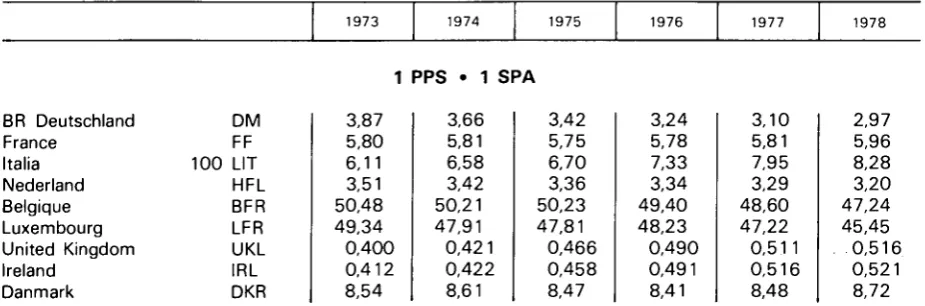
The purchasing power of the PPS, defined using 1975 as the base year, varies from time to time according to the evolution of prices. The current PPS will therefore have a purchasing power equal to that of the PPS of 1975 divided by the GDP price index (base year 1975=100). There is therefore a relationship between the PPS and GDP and this is useful for economic analyses and especially for this study. It is possible to establish for any period under consideration the purchasing power parity rates between the currency of each Member State and the current PPS relating to the total flow of goods and services which constitute GDP. The parities have been calculated from the basic parities of some 1 000 goods and services, comprising 700 products included under the final consumption of households, 200 under gross fixed capital formation and 100 under collective consumption of general government. The conversion factors between national currencies and PPS for the years 1973 to 1978 inclusive, which are covered by this study are given in Table No 28 in the Annex.
PRICES IN 'CONSTANT' CURRENCY UNITS
The table of conversion factors discussed in the previous chapter gives the chronological price series in current PPSs.
These current PPSs are comparable spatially but still contain distortions in time because of inflation in the nine member countries of the Community. An adjustment or 'deflator' must be used in order to ensure the stability of the currency unit in time.
This deflator has the effect of compensating for monetary erosion. The deflator chosen is the implicit price index of gross domestic product (GDP). This index is consistent with the definition of the PPS unit and thereby offers a positive advantage.
1973 has been chosen as the base year for this survey. Using the GDP price index it is therefore possible to calculate a new chronological series expressed in the 'constant' currency units of a base year. The GDP price indices for each country in the Community are given in Table No 28 in the Annex.
The calculation is carried out as follows:
(1) The current prices in national currency in the chronological series are divided by 100th of the GDP implicit price index for each year under consideration;
(2) This deflated series is converted into PPSs using the conversion factor for the base year 1973.
In this way, one obtains a chronological price series in 'constant' PPSs using the base year 1973 and adjusted for inflation in each country.
CHRONOLOGICAL PRICE SERIES
On the basis of the description given above, the results of this survey of electricity prices in the Community are presented using three chronological series:
( D A series at current prices in the national currency of each country (Tables 1 to 27 in the Annex). This series allows regional comparisons within a country and comparisons in time at face value (apparent price).
(2) A series in current PPSs (Tables 29, 30, 32 and 33 in the Annex) which allows international comparisons of price levels at a given date.
(3) A series in 'constant' PPSs (tables 31 and 34), using the prices for the base year 1973, which allows comparisons both between countries and in time. It is with this series that it is possible to carry out a comparative analysis of price trends in Community countries.
COMPARISON BETWEEN THE UNITS PPS AND ECU
To conclude this section, electricity selling prices in the Community are compared in terms of Purchasing Power Standards (PPS) and European Currency Unit (ECU). In order to avoid having too many tables, two examples were chosen, one for household uses (standard category of consumer Db) and the other for industrial uses (standard category of consumer Ic). However, the results obtained apply to all the prices recorded in the study.
These examples bring out two special features in 1978:
— the spread of prices expressed in ECU is far greater than that of prices expressed in PPS; — the ranking order of locations is not the same (changes of position for Copenhagen, London,
Dublin and Milan).
In 1973, the spread of prices was more or less the same, irrespective of whether the PPS or the ECU was used.
The prices expressed in ECU are distorted by monetary fluctuations and the instability of the exchange market — both of which have become serious problems since 1973. It is acknowledged in particular that the market exchange rates overvalue the Danish and German currencies and under-value the Italian lire and the pound sterling. This too is brought out by the ranking order of the locations on the basis of selling prices.
1978 Selling prices
PPS. ECU/100 kWh
Location Düsseldorf Paris Milan Rotterdam Brussels Luxembourg London Dublin Copenhagen
1 - Household uses standard consumer Db
PPS 8.27 7.36 4.30 7.46 9.55 7.15 7.13 6.56 5.32 ECU 9.46 7.59 3.34 8.58 11.21 8.08 5.80 5.40 6.56
2 - Industrial uses standard consumer Ic
PPS 7.08 4.81 5.45 6.71 7.30 4.62 5.59 6.48 5.47 ECU 8.11 4.96 4.23 7.72 8.57 5.22 4.55 5.33 6.74
Order of selling prices 1978
Location Brussels Düsseldorf Rotterdam Paris Luxembourg London Dublin Copenhagen Milan Brussels Düsseldorf Rotterdam Dublin London Copenhagen Milan Paris Luxembourg
According to PPS
Order 1 1 2 3 4 5 6 7 8 9 ; 1 2 3 4 5 6 7 8 9
Percentage of the highest price
- Household uses
-100 86.6 78.1 77.1 74.9 74.7 68.7 55.7 45.0
> Industrial uses
-100 97 92 89 76.6 75 74.6 66 63.3 Location
According to ECU
Order
• standard consumer Db
Brussels Düsseldorf Rotterdam Luxembourg Paris Copenhagen London Dublin Milan
standard consumer Ic
Brussels Düsseldorf Rotterdam Copenhagen Dublin Luxembourg Paris London Milan 1 2 3 4 5 6 7 8 9 1 2 3 4 5 6 7 8 9
V. Electricity prices in the different countries
1. FEDERAL REPUBLIC OF GERMANY
(a) Organization
The production and distribution of electricity is carried out by a large number of enterprises operating, in accordance with legal obligations, under their own responsibility according to the principles of open competition and free enterprise. The 27.7 million customers are supplied by approximately 1000 enterprises, of which 674 supply over 99% of electricity delivered via the national grid. 322 enterprises have their own production plant and 35 of these account for 89% of gross electricity production by state-run power stations (269.3 TWh in 1977, 283.7 TWh in 1978). Many industrial enterprises help to meet the electricity requirement by transferring electricity into the national grid (20.4 TWh in 1977, 23 TWh in 1978). Moreover, these enterprises generate electricity for their own requirements. All in all, one-fifth of consumption is self-produced in the power stations of the industrial sector (60.6 TWh in 1977, 63 TWh in 1978) and the federal railways (5.4 TWh in
1977, 5.7 TWh in 1978).
The legal configuration of these enterprises is variable. There are judicially independent enterprises and judicially non-independent enterprises. The former include all types permitted under German law, particularly joint stock companies, limited liability companies, private companies or partnerships. The biggest are generally joint stock companies, while the smallest are often private companies or partnerships.
Broadly speaking, two-thirds of the capital of German electricity companies is held by public law bodies (central government, federal government, districts and municipalities). Wholly private enter-prises do not account for a major share of power supply. A special feature is the high percentage of mixed economy enterprises in which private capital is juxtaposed with public law bodies.
99 mixed economy enterprises « 9 5 % public capital, < 7 5 % private capital) provide 69% of electricity supplies;
438 public enterprises provide 28.2% of electricity supplies; 137 private enterprises provide 2.8% of electricity supplies.
Enterprises can be subdivided into three levels according to their supply function: local, regional and 'interconnected'. Certain enterprises occupy two or three of these levels at the same time. Local enterprises are chiefly municipal undertakings which supply a municipality or a town with elec-tricity and, very often, with gas and water; they receive their elecelec-tricity from other enterprises. The biggest have their own power stations or are co-owners of power stations.
The regional enterprises—approximately 40 relatively large enterprises—supply vast predominantly rural areas. They cover over half the country directly, but supply a bare third of the population. They deliver over a quarter of total electricity. There are nine 'interconnected' type enterprises which, between them, have a large productive capacity and operate in close conjunction with one another at national and European levels via the very high voltage grid. As a rule, these supply other enter-prises and a great many tariff and contract customers.
The eight enterprises observed during the survey rank among the 43 biggest and between them account for 5 3 % of the country's total electricity supplies. This survey has examples of all three levels—Local, regional and 'interconnected'.
As supply costs, which serve as the basis for price formation, differ according to the proximity of primary energy sources, according to the percentage of energy sources used and according to the transmission pattern (density of population and consumption, type of consumer, topography, etc.), there are corresponding differences in electricity prices. Distributor companies usually apply elec-tricity charges similar to those of their supplier companies.
(b) Regulations
(i) General
All enterprises in the Federal Republic of Germany are subject to state scrutiny through the respective Federal State (Bundeslander) intermediary bodies which control energy, prices and cartels.
Under the terms of the ' L a w on the production of energy' of 13 December 1935 (RGB 1 - IS. 1 4 5 1 , BGBl. Ill 752-1), enterprises supplying electricity are bound to connect all applicants to the grid and to supply electricity in accordance with their general conditions and tariffs (connection and sales obligation). This law gives substantial powers to the bodies controlling energy, inter alia as regards the construction, modernization, enlargement or decommissioning of installations. Electricity prices are subject to state control contrary to almost all other commodities. This means that changes in the commodity rates and standing charges for households must first be approved; changes in the basic prices for agricultural, commercial, professional uses, etc., as well as price arrangements under special contracts must be declared.
The law prohibiting restrictions on competition (GWB), version 4 April 1974 (BGBl. Ill 703-1) empowers the bodies controlling cartels to challenge any prices and conditions introduced by the enterprises considered as an abuse of their dominant share of the market. Other laws which have a significant bearing on electricity are:
— the federal law on emissions and consequent regulations on pollution; — law on nuclear energy;
— federal law on building and related regulations;
— laws on use of Community coal in electricity power stations (1st, 2nd and 3rd law of 1965, 1966 and 1974).
(ii) Households and other tariff-paying customers
The legal relationship between the distributors and households and all other customers who are subject to a low voltage tariff are set out in the ' General conditions governing distribution enter-prises supplying electricity from the low voltage grid' and in the general tariffs. Both have been published. These conditions require the enterprises to supply electricity.
The general tariffs are based on the ' Regulation governing the general tariffs for the supply of electricity (Federal regulation on tariffs)' (BTO Elt) which came into force on 1 January 1974. This regulation does not apply to electricity supplied by virtue of special agreements at special prices, e.g. for storage heating, as these are governed by non-tariff contract arrangements.
(iii) Contract industrial consumers and others
The legal relationship between distributors and contract consumers is governed by individual delivery contracts negotiated by the parties concerned.
General provisions are usually drawn up separately in the form of conditions. In the case of contracts conforming to the usual pattern, particularly up to a certain demand which can still be catered for by using medium voltage (approximately 20 kV), standard contracts are offered with terms and price arrangements which are the same for each enterprise concerned. This does not mean that customers may not be offered a choice of two or three price formulas for these standard contracts. Such contracts are subject to the terms of the Law on the general conditions of commerce (AGB) of 9 December 1976 (BGBl. I 3317).
(c) Taxation
VAT on electricity supplies in Germany is levied at its normally high rate. Up until the end of 1977, this rate was 1 1 % , rising to 12% as from 1 January 1978 and was calculated on the price exclusive of VAT. In the case of commercial and industrial consumers, this VAT is deductible. Since 1 January 1975 a supplementary standing charge (Ausgleichsabgabe) has been levied in accordance with the Law guaranteeing the use of Community coal in electricity power stations (3rd law). This tax was levied throughout Germany at a rate of 3.24% up until 31 March 1976, then at 4.5% up to 31 December 1977. As from 1 January 1978, different rates applied according to region but the Federal average was still 4.5%. On 1 January 1979 this Federal average rose to 6.2%, with the regional differences being maintained. The supplementary charge which is subject to VAT, is transferred to the Federal authorities in full by the enterprises concerned.
(d) Household prices — tariffs
There is a uniform structure of general tariffs for low voltage supply. The pattern of the tariffs is determined by the Federal regulation on tariffs (BTO Elt), which came into force on 1 January 1974 and replaced the 1938 regulation. All enterprises distributing electricity accordingly offer their customers a choice of three tariffs:1
— two basic tariffs with standing charges (I and II), with different commodity rates, the lower one corresponding to a higher standing charge;
— a tariff for low consumption;
— an off-peak tariff which is always combined with one of the previous tariffs.
Most customers are covered by one of the tariffs with standing charges. This consists of an annual standing charge and a price per kWh consumed. The standing charge comprises a connection charge and a charge for invoicing and meter reading. The connection charge, which usually accounts for the bulk of the standing charge, depends on the type of use: domestic, agricultural, commercial, professional and other. In the case of domestic uses, the number of rooms used or usable for accommodation is the yardstick (the annexes, i.e. corridor, bathroom, toilet, boxroom, are not counted; nor are rooms of less than 6 m2). In the case of rooms of over 30 m2, the equivalent of an
additional room is counted for each extra 30 m2 or part thereof. An extra charge may be made
above a given level of power, and also when heating or air-conditioning appliances are used, irrespective of their period of use. The use of such appliances is a function of climatic factors, unlike other domestic appliances, and they are switched on simultaneously by a large number of consum-ers (whence the danger of overloading the grid).
The invoicing and meter reading charges concern the meter and the costs incurred by the enterprise in invoicing and collecting; it depends on the type and the size of the meters.
When consumption is very low in relation to the size of the installation, the 'low consumption' tariff is advantageous. This tariff consists of a meter reading charge and a commodity rate which is higher
' Except for one enterprise which offers its domestic consumers a system of block tariffs.
than the tariff with standing charges in order to cover overheads. This tariff is seldom advantageous for households.
This off-peak tariff offers a price per kWh which is lower than tariff II with standing charge and it may be combined with the other tariffs. A separate meter is necessary to measure night consump-tion (off-peak hours). The duraconsump-tion of these off-peak periods depends on the load curves of the enterprises (at present 6-8 hours).
In addition to the basic system, enterprises usually offer special arrangements for heating and big storage water-heaters with prices per kWh even lower than those charged for off-peak electricity. These special rates are offered when capacity is released during off-peak hours, according to load curves and local conditions, so that electricity can be supplied without requiring additional invest-ment in the installations. However, certain technical conditions have to be satisfied and there is therefore no obligation to supply in this case.
Example of tariffs valid in January 1978 (Hanover) — prices excluding taxes
Standard Consumer
Da
Db
Dc
De
Tariff
I
I
l+off-peak hours
II+special contract
Monthly standing charge
Connection charge
5.90 DM (3 rooms)
6.80 DM (4 rooms)
7.70 DM (5 rooms)
17.30 DM (6 rooms)
Meter reading invoicing charge
2.00 DM '
2.00 DM '
4.00 DM 2
4.00 DM 2 5.00 DM 3
Commodity rate DM/kWh
0.12
0.12
day 0.12 night 0.07
day 0.09 night 0.042 4
' Single meter. 2 Two meters.
3 Additional charge for metering.
4 Special contract arrangements for storage heating.
(e) Household prices — analysis
The results are given in the tables and in graphs 1 to 4 in the annex.
Between 1973 and 1978 electricity prices for household use charged by the companies considered in the survey rose by 25 to 5 0 % . The sharpest increases came in 1974 and 1975 in the wake of the oil crisis. Since the beginning of 1976, prices exclusive of taxes have remained stable in nearly all cases. However, in 1978 a rise in the supplementary standing charge and in the VAT rate led to a slight increase in selling prices. However, this increase amounted to no more than a few percent. In half the locations* the highest rises affected small consumers. However, in the FR Germany, small consumers (Da) are only a small proportion of the total clientele.
The increases themselves varied from region to region, with resultant changes in the classification of the locations. Prices vary to such an extent that no one region can be said to be more expensive than another. This depends entirely on consumption and, consequently, on the tariff differential system. For instance, Hamburg was the least expensive location in 1973 for small consumers (Da,
Hamburg, Hanover, Frankfurt and Stuttgart.
Db), but one of the most expensive for major consumers (De, De). Be that as it may, prices often tend to be higher in the south (Stuttgart, Munich, South zone) than in the rest of the country. Another fact is that prices in the least populated areas (South zone) are higher than in the highly urbanized areas (west zone), thus reflecting distribution costs.
More broadly speaking, there is a link between price levels and average consumption per subscriber. The lower this consumption in a given region, the higher the tariffs in that region. The fact is that average consumption per household may differ substantially from region to region (approximately 2 000kWh/year in Munich and 4 000 in the west zone).
Regional price divergencies progressively widen as consumption increases. Between the most expensive and the least expensive locations surveyed in 1978, there is a 17% divergence in price for small consumers (Da, Db), for consumer category De a 23% divergence and for category De a 30% difference. However the latter case is due to electrical night storage heating for which the electricity is supplied at rates close to the cost of production. The 30% divergence noted between Hanover and the South zone is explained by the fact that Hanover is favoured by low-cost indigenous natural gas as an input to produce electricity whilst the South zone uses higher cost residual fuel oil as input. These regional price divergencies showed no sign of levelling off during the reference period.
Tariff differentials, in other words reducing the unit price by moving from a low consumption (600 kWh per day) to a high consumption (20 000 kWh of which 15 000 at night) resulted in a unit price reduction of 70-75% in 1978. This means that the price per kWh invoiced to a small consumer when applying the general tariffs is three times the price charged for storage central heating.
Summing up, the prices recorded in the Federal Republic of Germany cover a wide range according to location, type of consumer and period.
A tentative comparison can nevertheless be based on the price index for gross domestic product (GDP) and on average receipts.
1973 1974 1975 1976 1977 1978
GDP price index
100 106.9 114.1 117.9 112.1 125.2
Average receipts '
100 108 120.3 123.1 123.4
Da
100 103.2 131.3 135.1 136.7 139.2
Selling price (Düsseldorf)
Db Dc
100 100 104.3 112.7 127.5 133.6 132.6 141.5 134.2 143.2 136.5 145.8
De
100 100 118.9 128.5 135.5 139.4
Average receipts, inclusive of VAT. exclusive of the supplementary standing charge, for the Federal Republic of Germany as a whole.
The above table gives an example of selling prices in Dusseldorf. Calculations, however, were made for all the locations surveyed and the general conclusions drawn are the same.
Since 1974, selling prices of electricity have in all cases risen more than prices for goods and services in general (as represented by the GDP index). This means that electricity prices increased in real money terms between 1974 and 1978. This increase has not affected all consumers to the same degree because the price rises are often different for different consumer groups.
Average receipts have shown virtually the same trends as selling prices, i.e. sharp increase at the beginning of the reference period and more or less levelling off as from 1975. However, average receipts have risen less than selling prices. This lack of parallelism is caused by the growth in the average consumption of subscribers who benefit from tariff reductions.
(f) Industrial prices — tariffs
The structure of the price formula for medium and high voltage is fairly uniform in the Federal Republic of Germany. All enterprises offer a price formula with differentiated power charges and kWh prices for day and night. Some enterprises offer an additional formula for a low load factor involving no power charge. Most enterprises, however, offer a choice of a low load tariff or a high load tariff, sometimes in combination with the block tariff system. This gives medium voltage consumers in most regions a choice of t w o or three price formulas depending on their load factors.
(i) Formulas involving power charges
The parameter for calculating the power charge is as a rule the maximum subscribed power, usually based on an annual power consisting of the average of the t w o or three highest monthly power levels (actual power in k W or apparent power kVA). The power considered is usually measured on a quarter-hourly basis. Most formulas provide for a minimum charge which is payable according to the power available. Some price formulas provide for a rebate based on load factor.
Day and night commodity rates differ. The contract stipulates that the night rate operates from at least 10 p.m. to 6 a.m. Many enterprises, however, offer a longer night period, the duration of which is often longer in summer than in winter.
(ii) Block tariffs
These price formulas provide for a decreasing commodity rate depending on quantities and a rebate for a low load factor depending upon annual quarter-hourly maximum demand. For the same enterprise the contract stipulates night periods which are usually identical to those of the formulas which involve demand charges.
(g) Industrial prices — analysis
The results are given in the tables and in graphs 5 to 8 in the annex.
Only 5 of the 8 enterprises considered were able to give prices for standard consumers la and lb. This was because the tariff applicable to these consumers is, in the case of some enterprises, based on parameters not outlined in the definitions (e.g. low voltage delivery).
This gives rise to difficulties in comparing one location with another and also with the other industrial consumers (Ic ... If). The prices given for Hamburg for the la, lb categories in fact only cover a small proportion of the total clientele of these groups since the majority are supplied with low voltage electricity with a different tariff structure.
Furthermore, it is important to note that the prices indicated for Hamburg cover only tariffs without a reduction clause, according to the general definitions of the survey. In fact the majority of clients chose power reduction tariffs during peak-hours and are thereby rewarded with lower prices. Electricity selling prices during the reference period were subject to increases which varied according to region and consumer. As in the case of households, this upward trend peaked in 1974-75. Prices exclusive of taxes remained stable between January 1976 and January 1978 in certain locations (Hanover, Frankfurt, Stuttgart, Munich, South zone), where increases in the selling prices were due exclusively to changes in the taxes levied. The rates of increase recorded between 1973 and 1978 varied from 2 5 % to 6 7 % according to location. Only a small fraction of these rises were due to a rise in VAT—which increased by 1 % at the beginning of 1978. The relatively steep rise in prices noted for Hamburg derives from the fact that prices there were very low in 1973 which was the base year for the survey and for time-series comparison.
Since the increase in prices is very variable the classification of locations does not therefore remain stable. However, the prices recorded for Dusseldorf and the west zone are very close.
Regional price disparities appear important for small industrial consumers (la, lb) but this is due to the fact that the electricity supply conditions and tariff structures are dissimilar (see earlier remarks). For larger industrial users—price disparity between different regions is slighter (e.g. in the order of 20-30% for categories Ic and Id in 1978). Between 1973 and 1978 consumption progressively increased and regional price disparities decreased.
For the biggest standard consumer (If), the price gap between the most expensive and the least expensive locations (Hamburg and Hanover) closes to a mere 9% in 1978.
These regional price divergencies are not due solely to the type of fuel used to fire power stations, but also to the structure of the clientele (a high average consumption per industrial subscriber, with a good load factor, means lower prices as in the case of the west zone, Hanover and Frankfurt), and also to tariff policy.
The differential tariff system allowed for significant variations in rates throughout the reference period. Moving up from an average consumption (Ic) to a big consumption (If) means a unit price reduction of between 37% and 47% according to the location. The apparent differentials obviously increase if one includes small consumers (la and lb) in the calculation.
Despite these divergencies in prices and situations, a tentative comparison can be made between electricity selling prices, average receipts and GDP price indices.
1973 1974 1975 1976 1977 1978
GDP price index
100 106.9 114.1 117.9 122.1 125.2
Average receipts '
100 108 124.6 126.5 128.6
Ic
100 110.2 124.4 128.2 133.1 145.4
Selling price (Düsseldorf)
Id le
100 100 110.1 110.1 124.4 126.1 128.2 129.6 133.1 134.7 145.3 148.2
If
100 110.2 130.0 132.7 138.1 153.8
Industrial users, inclusive of VAT. exclusive of the supplementary standing charge, for the Federal Republic of Germany as a whole.
The example given in the table refers to Düsseldorf selling prices, comparable results and conclusions for all the other places considered.
but calculations show
Electricity selling prices since 1974 have risen a little more than goods and services as a whole as represented by the GDP price index.
Average receipts have on the whole risen slightly less than selling prices because of the growth in average consumption per subscriber (effect of the differential tariff system).
2. FRANCE
(a) Organization of the electricity industry
The production, transmission, distribution and sale of electricity were nationalized by a law of 8 April 1946, under which a national public cooperation, Electricité de France (EDF), was made responsible for the management of these activities. EDF does not have a total monopoly, the law providing for a number of exceptions with regard to both production and distribution. In the production sector, these exceptions apply, for example, to the industries which produce their o w n electricity and to the local authorities, provided that the electricity is not required for the public utility grid and an agreement is concluded with the EDF. Other exceptions are the power stations operated by the French Railways (SNCF), and the national coalmines. In the distribution sector, exceptions are the corporations set up by the local authorities (e.g. Strasbourg and Metz), semi-public companies with a majority public shareholding, and certain agricultural cooperatives. For example, the Strasbourg Electricity Company enjoys a certain measure of independence from the EDF, even though the latter holds 7 5 % of the capital.
In 1975, the independent producers—primarily the coalmines—accounted for 1 6 % of national production. On the other hand, the EDF's share of distribution is much higher, standing at 9 6 % in 1975. Independent production is subject to precise regulations regarding transmission and sales. In actual fact, the independent producers' plants are practically all connected to the EDF grid, this being, moreover, in their own interest.
(b) Regulations
The legal basis outlined by the law of 1946 provides for financial autonomy and, therefore, technical and commercial independence for the EDF. The corporation has to meet all operating, capital and investment costs and is liable for tax, and its financial management is subject to the usual rules of industrial and commercial companies.
The EDF's relations with the government entered a new phase as a result of the proposals contained in the April 1967 report on public undertakings, known as the NORA Report. A special agreement, called the standard contract, was concluded between the EDF and the government on 23 December 1970.
The aim of this agreement was to improve the industrial and commercial management of the corporation by reducing the administrative burden, with a view to supplying French industry with power at a competitive price. The efficiency of the corporation's management was to be assessed by the overall productivity of the factors of production, the proportion of capital expenditure financed from own resources, and the financial return on invested capital.
In accordance with these aims, Electricité de France is free to put forward proposals for tariffs and price levels. However, the public authorities have a sort of right of veto on these proposals, since any change has to be put into effect by joint decree of the Ministries of Industry and Finance. In the event of differences between the corporation's commercial policy and national economic policy, the government takes precedence and may impose a price freeze.
(c) Taxation
Electricity supplies are subject t o :
— value added tax (VAT), the rate during the period 1 9 7 3 - 1 9 7 8 being 17.6%. VAT is levied on all low, medium and high voltage supplies, on the basis of price exclusive of tax. In the case of industrial and commercial consumers, this VAT is deductible;
— specific local taxes: a municipal tax levied within statutory limits of between 0 and 8%, and a departmental tax levied within statutory limits of between 0 and 4 % ; these two taxes may be added together (Paris constitutes a special case with an exceptional rate of 13.2% for the municipal tax). They are assessed on the basis of the amount invoiced for kWh consumed, excluding standing charges. These taxes, which apply to low voltage supplies and consumption for lighting and heating of premises with high voltage supplies, are levied directly by the local authorities. The rates in the locations chosen for the survey are as follows:
Location
Lille Paris Marseilles Lyons Toulouse Strasbourg
Municipal tax
%
8 13.2
8 8 8 0
Department tax
%
1 —
4 —
2 4
Total
%
9 13.2 12
8 10 4
(d) Household prices — tariff structure
Standardization of the tariffs for low voltage supplies was begun in 1965 and resulted in the 'tarif universel' (standard tariff), which applies throughout the country to domestic users and farmers. This standard tariff offers several formulae based on the customer's power offtake. These are the 3 kW 'ménage', 6 kW 'confort', and 9 kW 'grand confort' tariffs, which comprise:
— a standing charge;
— a commodity rate per kWh, first block, a certain proportion of which is a fixed charge; — a commodity rate per kWh, second block, which is very much lower and does not include a fixed
charge.
For low consumption, there is a special tariff known as 'Tarif transitoire' for power consumption of up to 1 k VA.
In addition, there is the 'all-electric' tariff which has a two-tier structure. The fixed portion covers standing charges and there is no first block.
For customers using off-peak electricity (i.e. at night), there is an alternative 'double tarif'. This alternative comprises an increased standing charge and a reduced price per kWh for off-peak periods (8 hours at night), irrespective of consumption.
Example of the standard tariff (low voltage) — January 1978
Type of tariff
'Transitoire' 'Ménage' 'Confort' 'Gd confort'
'All-electric'
Subscribed power
kVA
1 3 6 9
18 1
Charges.
Single tariff
1.25 3.80 8.90 14.32
75.40
:F/month
Double tariff
10.83 17.53 23.91
91.70
Basic block kWh/month
12 30 40 50 —
Commodity rate, centimes/kWh
Basic block
51.61 54.79 53.98 53.98
Excess
39.13 19.53 18.72 18.72
18.42
Off-peak hours
10.99 10.99 10.99
10.99
Other levels of demand may be chosen: 12, 24, 30 and 36 kVA.
In accordance with the definitions of the standard consumers, the following tariffs were used as the basis
for the prices shown: Da 'Transitoire'
Db 'ménage', single tariff
Dc 'Confort', double tariff (with 1 300 kWh at night)
De 'All-electric', 18kVA, double tariff (with 15 000kWh at night).
These tariff structures are not index-linked, but the basic charges are revised from time to time to take account of changes in the costs of producing and distributing low-voltage electricity.
In Strasbourg, the standard national tariff is applied to consumers Da, Db and Dc. Prices under the tariff applied to De (all-electric, level 2) are, however, slightly lower than those charged in the rest of the country.
(e) Household prices — analysis
The results are given in tables 9 to 11 and graphs 9 and 10 in the annexe. The prices before tax are standard for the whole country, with the exception of those for standard consumer De in Strasbourg. As taxes remained unchanged throughout the period under review, they did not affect the trends in prices which, as in all the countries, are moving upwards. These increases are greatest for those with the highest consumption. Between 1973 and 1978, prices for standard consumer De went up by 88%, compared with 48% for Da, thus offsetting the effect of tariff differentials. In 1973, Da paid more than three times the unit price invoiced to De, whereas in 1978 this ratio had fallen to less than 2.5. Tariff differentials based on the volume of consumption are still, however, fairly pronounced — a factor which favours electric heating in particular.
The regional differences in prices are due solely to the municipal and departmental taxes (with the exception of the all-electric tariff in Strasbourg). As a result, Paris is the most expensive and Strasbourg the cheapest of the cities chosen for the survey. The difference between them amounts to 7% for Da-Dc and 16% for De.
The substantial increases between 1973 and 1975 were due to soaring costs, especially for fuels. Prices were then frozen by law, with the result that there were no changes between 1975 and 1976. This freeze merely had the effect of deferring the upward trends in prices. When it was lifted, price increases were necessary in order to offset the losses incurred during this period. This fact explains the shape of the curves in graph 9, i.e. a pattern of steep rises and plateaux.
A comparison between selling prices, the price index of gross domestic product (GDP) and average receipts brings a number of interesting facts to light.
1973 1974 1975 1976 1977 1978
GDP price index
100 111.1 125.8 138.3 150.5 164.8
Average receipts Ί
100 101.1 121.0 130.7 128.4
Da
100 103.6 122.1 122.1 139.0 148.1
Selling price (TNU=standard national tariff
Db
100 103.6 126.8 126.8 141.7 150.8
Dc
100 103.6 131.5 131.5 155.8 166.0
De
100 103.6 141.3 141.3 176.4 187.8
EDF, household customers, low voltage.
This table shows that the prices paid by small consumers (Da and Db) are not rising at the same rate as prices for goods and services in general (as represented by the GDP index); in other words, these consumers paid, in constant money terms, comparatively less for their electricity than in 1973.