Erlangen Programme at Large 3.2 Ladder Operators in
Hypercomplex Mechanics
V. V. Kisil
Abstract
We revise the construction of creation/annihilation operators in quantum mechanics based on the representation theory of the Heisenberg and symplectic groups. Besides the standard harmonic oscillator (the elliptic case) we similarly treat the repulsive oscillator (hyperbolic case) and the free particle (the parabolic case). The respective hypercomplex numbers turn out to be handy on this occasion. This provides a further illustration to the Similarity and Correspondence Principle.
Keywords: Heisenberg group, Kirillov’s method of orbits, geometric quantisation, quantum mechanics, classical me-chanics, Planck constant, dual numbers, double numbers, hypercomplex, jet spaces, hyperbolic meme-chanics, interference, Fock-Segal-Bargmann representation, Schr¨odinger representation, dynamics equation, harmonic and unharmonic oscil-lator, contextual probability, symplectic group, metaplectic representation, Shale-Weil representation.
1
Introduction
Harmonic oscillators are treated in most textbooks on quantum mechanics. This is efficiently done through creation/annihilation (ladder) operators [9, 3]. The underlying structure is the representation theory of the Heisenberg and symplectic groups [28, § VI.2], [34, § 8.2], [12, 8]. It is also known that quantum mechanics and field theory can benefit from the in-troduction of Clifford algebra-valued group represen-tations [20, 5, 4, 10].
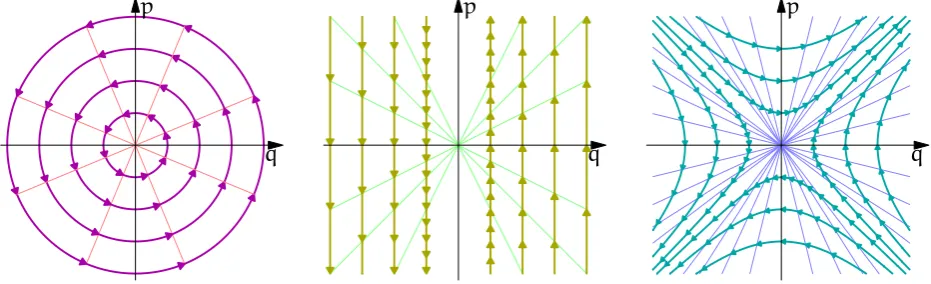
The dynamics of a harmonic oscillator generates the symplectic transformation of the phase space of the elliptic type. The respective parabolic and hyper-bolic counterparts are also of interest [37,§3.8], [35]. As we will see, they are naturally connected with the respective hypercomplex numbers.
To make this correspondence explicit we recall that the symplectic group Sp(2) [8,§1.2] consists of 2×2 matrices with real entries and the unit determi-nant. It is isomorphic to the group SL2(R) [28,13,30]
and provides linear symplectomorphisms of the two-dimensional phase space. It has three types of non-isomorphic one-dimensional subgroups represented by:
K =
cost sint
−sint cost
= exp
0 t
−t 0
,
t∈(−π, π]
, (1)
N =
1 t
0 1
= exp
0 t
0 0
, t∈R
, (2)
A =
et 0 0 e−t
= exp
t 0 0 −t
, t∈R
. (3)
We will refer to them as elliptic, parabolic and hy-perbolic subgroups, respectively.
On the other hand, there are three non-isomorphic types of commutative, associative two-dimensional algebras known as complex, dual and double numbers [38, App. C], [29, § 5]. They are represented by expressionsx+ιy, whereιstands for one of the hypercomplex units i,εor j with the prop-erties:
i2=−1, ε2= 0, j2= 1.
These units can also be labelled as elliptic, parabolic and hyperbolic.
In an earlier paper [25], we considered represen-tations of the Heisenberg group which are induced by hypercomplex characters of its centre. The ellip-tic case (complex numbers) describes the traditional framework of quantum mechanics, of course.
The representation with values in dual numbers provides a convenient description of the classical me-chanics. To this end we do not take any sort of semi-classical limit, rather the nilpotency of the imaginary unit (ε2= 0) performs the task. This removes the vi-cious necessity to consider the Planckconstant tend-ing to zero. Mixtend-ing this with complex numbers we get a convenient tool for modelling the interaction between quantum and classical systems [22, 24].
Our construction [25] provides three different types of dynamics and also generates the respec-tive rules for addition of probabilities. In this pa-per we analyse the three types of dynamics produced by transformations (1–3) from the symplectic group Sp(2) by means of ladder operators. As a result we obtain further illustrations to the following:
Principle (Similarity and Correspondence) [23, Principle 29]
1. SubgroupsK,N andAplay a similar role in the structure of the groupSp(2) and its representa-tions.
2. The subgroups shall be swapped simultaneously with the respective replacement of hypercomplex unitι.
Here the two parts are interrelated: without a swap of imaginary units there can be no similarity between different subgroups.
In this paper we work with the simplest case of a particle with only one degree of freedom. Higher di-mensions and the respective group of symplectomor-phisms Sp(2n) may require consideration of Clifford algebras [32].
2
Heisenberg group and its
automorphisms
Let (s, x, y), wheres,x,y∈R, be an element of the one-dimensional Heisenberg group H1 [8, 12]. Con-sideration of the general case of Hn will be similar, but is beyond the scope of present paper. The group law onH1 is given as follows:
(s, x, y)·(s, x, y) =
s+s+1
2ω(x, y;x
, y), x+x, y+y
, (4)
where the non-commutativity is due toω— the sym-plectic form onR2n [1,§37]:
ω(x, y;x, y) =xy−xy. (5) The Heisenberg group is a non-commutative Lie group. The left shifts
Λ(g) :f(g)→f(g−1g) (6)
act as a representation ofH1on a certain linear space of functions. For example, an action on L2(H, dg)
with respect to the Haar measure dg = dsdxdy is theleft regular representation, which is unitary.
The Lie algebra hn of H1 is spanned by left-(right-)invariant vector fields
Sl(r) = ±∂s,
Xl(r) = ±∂x−
1
2y∂s, (7)
Yl(r) = ±∂y+
1 2x∂s
onH1 with the Heisenbergcommutator relation
[Xl(r), Yl(r)] =Sl(r) (8) and all other commutators vanishing. We will some-time omit the superscriptl for left-invariant field.
The group of outer automorphisms ofH1, which trivially acts on the centre of H1, is the symplec-tic group Sp(2) defined in the previous section. It is the group of symmetries of the symplectic form
ω [8, Thm. 1.22], [11, p. 830]. The symplectic group is isomorphic to SL2(R) [28], [34, Ch. 8]. The explicit
action of Sp(2) on the Heisenberg group is:
g:h= (s, x, y)→g(h) = (s, x, y), (9)
where
g=
a b c d
∈Sp(2),
and
x y
=
a b c d
x y
.
The Shale-Weil theorem [8,§4.2], [11, p. 830] states that any representationρ¯h of the Heisenberg groups
generates a unitary oscillator (or metaplectic) rep-resentation ρSW¯h of Sp(2), the two-fold cover of the&
symplectic group [8, Thm. 4.58].
We can consider the semidirect product G =
H1×
| Sp(2) with the standard group law:&
(h, g)∗(h, g) = (h∗g(h), g∗g),
where
h, h∈H1, g, g∈Sp(2)& ,
Consider the Lie algebra sp2 of the group Sp(2). Pick up the following basis insp2 [34,§8.1]:
A=1 2
−1 0 0 1
, B =1 2
0 1 1 0
,
Z=
0 1
−1 0
.
The commutation relations between the elements are:
[Z, A] = 2B, [Z, B] =−2A, [A, B] =−1
2Z. (10) Vectors Z, B +Z/2 and −A are generators of the one-parameter subgroupsK,N andA (1–3) respec-tively.
Furthermore, we can consider the basis
{S, X, Y, A, B, Z}of the Lie algebragof the Lie group
G=H1×| &Sp(2). All non-zero commutators besides
those already listed in (8) and (10) are:
[A, X] = 1
2X, [B, X] =− 1
2Y, [Z, X] =Y; (11) [A, Y] =−1
2Y, [B, Y] =− 1
2X, [Z, Y] =−X. (12) The Shale-Weil theorem allows us to expand any rep-resentationρ¯h of the Heisenberg group to the
repre-sentation ˜ρ¯h=ρ¯h⊕ρSW¯h of groupG.
Example 1 Let ρ¯h be the Schr¨odinger representa-tion [8,§1.3] ofH1 in L2(R), that is [25, (3.5)]:
[ρχ(s, x, y)f](q) =e2πi¯h(s−xy/2)+2πixq·
f(q−¯hy). (13)
Thus the action of the derived representation on the Lie algebra h1 is:
ρh¯(X) = 2πiq, ρ¯h(Y) =−¯h
d dq,
ρ¯h(S) = 2πi¯hI. (14) Then the associated Shale-Weil representation of
Sp(2)inL2(R)has the derived action, cf. [35, (2.2)],
[8,§4.3]:
ρSW¯h (A) = −
q
2 d dq −
1 4,
ρSW¯h (B) = −
¯
hi 8π
d2
dq2 −
πiq2
2¯h , (15) ρSW¯h (Z) =
¯
hi 4π
d2
dq2 −
πiq2
¯
h .
We can verify commutators (8) and (10–12) for op-erators (14–15). It is also obvious that in this repre-sentation the following algebraic relations hold:
ρSW¯h (A) =
i
4π¯h(ρh¯(X)ρ¯h(Y)−
1
2ρ¯h(S)) = (16) i
8π¯h(ρh¯(X)ρ¯h(Y) +ρ¯h(Y)ρ¯h(X)), ρSW¯h (B) =
i
8π¯h(ρh¯(X)
2−
ρ¯h(Y)2), (17)
ρSW¯h (Z) =
i
4π¯h(ρh¯(X)
2
+ρ¯h(Y)2). (18)
Thus it is common in quantum optics to namegas a Lie algebra with quadratic generators, see [9,§2.2.4].
Note that ρSW¯h (Z) is the Hamiltonian of the
har-monic oscillator (up to a factor). Then we can con-siderρSW¯h (B) as the Hamiltonian of a repulsive
(hy-perbolic) oscillator. The operator ρSW¯h (B−Z/2) =
¯
hi 4π
d2
dq2 is the parabolic analog. A graphical
repre-sentation of all three transformations is given in Fi-gure 1, and a further discussion of these Hamiltoni-ans can be found in [37,§3.8]. An important obser-vation, which is often missed, is that the three lin-ear symplectic transformations are unitary rotations in the corresponding hypercomplex algebra. This means that the symplectomorphisms generated by operatorsZ,B−Z/2,B within timetcoincide with the multiplication of hypercomplex numberq+ιpby
eιt[23, §3], which is just another illustration of the Similarity and Correspondence Principle.
q
p
q
p
[image:3.595.51.517.603.745.2]q
p
Example 2 There are many advantages of consid-ering representations of the Heisenberg group on the phase space [12, §1.7], [8, §1.6], [6]. A convenient expression for Fock-Segal-Bargmann (FSB) represen-tation on the phase space is [25, (3.2)]:
[ρF(s, x, y)f](q, p) = e−2πi(¯hs+qx+py)· (19)
f
q−¯h
2y, p+ ¯
h
2x
.
Then the derived representation ofh1 is:
ρF(X) = −2πiq+
¯
h
2∂p,
ρF(Y) = −2πip−
¯
h
2∂q, (20)
ρF(S) = −2πi¯hI.
This produces the derived form of the Shale-Weil rep-resentation:
ρSWF (A) =
1
2(q∂q−p∂p),
ρSWF (B) = −
1
2(p∂q+q∂p), (21)
ρSWF (Z) = p∂q−q∂p.
Note that this representation does not contain the pa-rameter ¯h, unlike the equivalent representation (15). Thus the FSB model explicitly shows the equivalence of ρSW¯h1 andρ
SW ¯
h2 if¯h1¯h2>0 [8, Thm. 4.57].
As we will also see below, the FSB-type represen-tations in hypercomplex numbers produce almost the same Shale-Weil representations.
3
Ladder operators in
quantum mechanics
Let ρ be a representation of the group G =
H1×
|Sp(2) in a space& V. Consider the derived
rep-resentation of the Lie algebra g[28, §VI.1] and de-note ˜X =ρ(X) for X ∈ g. To see the structure of the representation ρwe can decompose the spaceV
into eigenspaces of the operator ˜X for some X ∈g. The canonical example is the Taylor series in complex analysis.
We are going to consider three cases correspond-ing to three non-isomorphic subgroups (1–3) of Sp(2) starting from the compact case. Let H = Z be a generator of the compact subgroup K. Cor-responding symplectomorphisms (9) of the phase space are given by orthogonal rotations with
matri-ces
cost sint
−sint cost
. The Shale-Weil
representa-tion (15) coincides with the Hamiltonian of the har-monic oscillator.
Since this is a double cover of a compact group, the corresponding eigenspaces Zv˜ k = ikvk are
parametrised by a half-integer k ∈ Z/2. Explicitly for a half-integerk:
vk(q) =Hk+1 2
2π
¯
h q
e−πh¯q 2
, (22)
where Hk is the Hermite polynomial [8, § 1.7],
[7, 8.2(9)].
From the point of view of quantum mechanics and representation theory (which may be the same), it is beneficial to introduce the ladder operators L±, known ascreation/annihilation in quantum mechan-ics [8, p. 49] orraising/loweringin representation the-ory [28,§VI.2], [34,§ 8.2], [3]. They are defined by the following commutation relations:
[ ˜Z, L±] =λ±L±. (23) In other words, L± are eigenvectors for operators adZ of the adjoint representation ofg[28,§VI.2].
Remark 1 The existence of such ladder operators follows from the general properties of Lie algebras if the Hamiltonian belongs to a Cartan subalgebra. This is the case for vectors Z and B, which are the only two non-isomorphic types of Cartan subalgebras insl2. However, the third case considered in this pa-per, the parabolic vectorB+Z/2, does not belong to a Cartan subalgebra, yet a sort of ladder operators is still possible with dual number coefficients. More-over, for the hyperbolic vector B, besides the stan-dard ladder operators an additional pair with double number coefficients will also be described.
From the commutators (23) we deduce that ifvk
is an eigenvector of ˜Z thenL+vk is an eigenvector as
well:
˜
Z(L+vk) = (L+Z˜+λ+L+)vk =
L+( ˜Zvk) +λ+L+vk =
ikL+vk+λ+L+vk=
(ik+λ+)L+vk. (24)
Thus the action of ladder operators on the respective eigenspacesVk can be visualised by the diagram:
(25)
There are two ways to search for ladder operators: in (complexified) Lie algebras h1 and sp2. We will consider them in sequence.
3.1
Ladder operators from the
Heisenberg group
a=λ+b, −b=λ+a.
The equations have a solution if and only ifλ2++ 1 =
0, and the raising/lowering operators areL± = ˜X∓
i ˜Y.
Remark 2 Here we have an interesting asymmet-ric response: due to the structure of the semidirect productH1×|Sp(2) it is the symplectic group which&
acts onH1, not vise versa. However, the Heisenberg group has a weak action in the opposite direction: it shifts eigenfunctions of Sp(2).
In the Schr¨odinger representation (14) the ladder operators are
ρ¯h(L±) = 2πiq±i¯h
d
dq. (26)
The standard treatment of the harmonic oscillator in quantum mechanics, which can be found in many textbooks, e.g. [8, § 1.7], [9, § 2.2.3], is as follows. The vectorv−1/2(q) =e−πq
2/¯h
is an eigenvector of ˜Z
with the eigenvalue −i
2. In addition v−1/2 is an-nihilated by L+. Thus the chain (25) terminates to the right and the complete set of eigenvectors of the harmonic oscillator Hamiltonian is presented by (L−)kv−1/2with k= 0,1,2, . . .
We can make a wavelet transform generated by the Heisenberg group with the mother waveletv−1/2,
and the image will be the Fock-Segal-Bargmann (FSB) space [12], [8, § 1.6]. Since v−1/2 is the null
solution of L+ = ˜X −i ˜Y, then by the general re-sult [26, Cor. 24] the image of the wavelet transform will be null-solutions of the corresponding linear com-bination of the Lie derivatives (7):
D=Xr−iYr= (∂
x+ i∂y)−πh¯(x−iy), (27)
which turns out to be the Cauchy-Riemann equation on a weighted FSB-type space.
3.2
Symplectic ladder operators
We can also look for ladder operators within the Lie algebra sp2, see [23, § 8]. Assuming L
+ 2 =
aA˜+bB˜ +cZ˜ from the relations (10) and defining condition (23) we obtain the linear equations with unknowna,bandc:
c= 0, 2a=λ+b, −2b=λ+a.
The equations have a solution if and only if λ2++
4 = 0, and the raising/lowering operators areL±2 = ±i ˜A+ ˜B. In the Shale-Weil representation (15) they turn out to be:
L±2 = ±i
q
2
d dq +
1 4
− ¯hi
8π d2
dq2 −
πiq2
2¯h =
− i
8π¯h
∓2πq+ ¯hd dq
2
. (28)
Since this timeλ+= 2i the ladder operatorsL±2
pro-duce a shift on the diagram (25) twice bigger than the operatorsL± from the Heisenberg group. After all, this is not surprising since from the explicit rep-resentations (26) and (28) we get:
L±2 =−
i 8π¯h(L
±)2
.
4
Ladder operators for the
hyperbolic subgroup
Consider the case of the Hamiltonian H = 2B, which is a repulsive (hyperbolic) harmonic oscilla-tor [37, § 3.8]. The corresponding one-dimensional subgroup of symplectomorphisms produces hyper-bolic rotations of the phase space. The eigenvectors
vμ of the operator
ρSW¯h (2B)vν =−i
¯
h
4π
d2 dq2 +
πq2
¯
h
vν = iνvν,
are Weber-Hermite (or parabolic cylinder) functions
vν=Dν−1 2
±2eiπ4
π
¯
hq
, see [7,§8.2], [33] for fun-damentals of Weber-Hermite functions and [35] for further illustrations and applications in optics.
The corresponding one-parameter group is not compact and the eigenvalues of the operator 2 ˜B are not restricted by any integrality condition, but the raising/lowering operators are still important [13,
§ II.1], [30, § 1.1]. We again seek solutions in two subalgebrash1 andsp2 separately. However, the ad-ditional options will be provided by a choice of the number system: either complex or double.
4.1
Complex ladder operators
Assuming L+h = aX˜ + bY˜ from the
commuta-tors (11–12), we obtain the linear equations:
−a=λ+b, −b=λ+a. (29)
The equations have a solution if and only ifλ2+−1 =
0. Taking the real rootsλ=±1 we obtain that the raising/lowering operators areL±h = ˜X ∓Y˜. In the
Schr¨odinger representation (14) the ladder operators are
L±h = 2πiq±¯h
d
dq. (30)
The null solutions v±1
2(q) = e
±πi ¯
hq
2
to operators
ρSW¯h (2B) with the eigenvalue±
1
2. However the im-portant distinction from the elliptic case is that they are not square-integrable on the real line anymore.
We can also look for ladder operators within the
sp2, that is in the form L+2h = aA˜+bB˜ +cZ˜ for
the commutator [2 ˜B, L+h] = λL +
h. We will get the
system:
4c=λa, b= 0, a=λc.
A solution again exists if and only if λ2 = 4. Within complex numbers we get only the values
λ=±2 with the ladder operatorsL±2h=±2 ˜A+ ˜Z/2,
see [13,§II.1], [30,§1.1]. Each indecomposableh1
-or sp2-module is formed by a one-dimensional chain
of eigenvalues with a transitive action of ladder op-eratorsL±h orL±2hrespectively. And we again have a quadratic relation between the ladder operators:
L±2h= i 4π¯h(L
± h)
2
.
4.2
Double ladder operators
There are extra possibilities in the context of hyper-bolic quantum mechanics [17,16,18]. Here we use the representation ofH1induced by a hyperbolic charac-ter ejht = cosh(ht) + j sinh(ht), see [25, (4.5)], and obtain the hyperbolic representation ofH1, cf. (13):
[ρjh(s, x, y) ˆf](q) = e
jh(s−xy/2)+jxq·
ˆ
f(q−hy). (31) The corresponding derived representation is
ρjh(X) = jq,
ρjh(Y) = −h
d
dq, (32) ρjh(S) = jhI.
Then the associated Shale–Weil derived representa-tion ofsp2 in the Schwartz spaceS(R) is, cf. (15):
ρSWh (A) = −
q
2 d dq−
1 4,
ρSWh (B) =
jh
4 d2
dq2 −
jq2
4h, (33) ρSWh (Z) = −
jh
2 d2 dq2 −
jq2
2h.
Note that ρSWh (B) now generates a usual harmonic
oscillator, not the repulsive one likeρSW¯h (B) in (15).
However, the expressions in the quadratic algebra are still the same (up to a factor), cf. (16–18):
ρSWh (A) = −
j 2h(ρ
j h(X)ρ
j h(Y)−
1 2ρ
j
h(S)) = (34)
− j
4h(ρ
j h(X)ρ
j
h(Y) +ρ j h(Y)ρ
j h(X)),
ρSWh (B) =
j 4h(ρ
j h(X)
2−
ρjh(Y) 2
), (35)
ρSWh (Z) = −
j 2h(ρ
j h(X)
2
+ρjh(Y)2). (36)
This is due to the Principle of similarity and corre-spondence: we can swap operators Z and B with simultaneous replacement of hypercomplex units i and j.
The eigenspace of the operator 2ρSWh (B) with
an eigenvalue jν are spanned by the Weber-Hermite functionsD−ν−1
2
±
2
hx
, see [7,§8.2]. Functions
Dν are generalisations of the Hermit functions (22).
The compatibility condition for a ladder operator within the Lie algebrah1will be (29) as before, since it depends only on the commutators (11–12). Thus we still have the set of ladder operators correspond-ing to valuesλ=±1:
L±h = ˜X∓Y˜ = jq±h
d dq.
Admitting double numbers, we have an extra way to satisfyλ2= 1 in (29) with valuesλ=±j. Then there is an additional pair of hyperbolic ladder operators, which are identical (up to factors) to (26):
L±j = ˜X∓j ˜Y = jq±jhd
dq.
PairsL±h and L±j shift eigenvectors in the
“orthogo-nal” directions changing their eigenvalues by±1 and
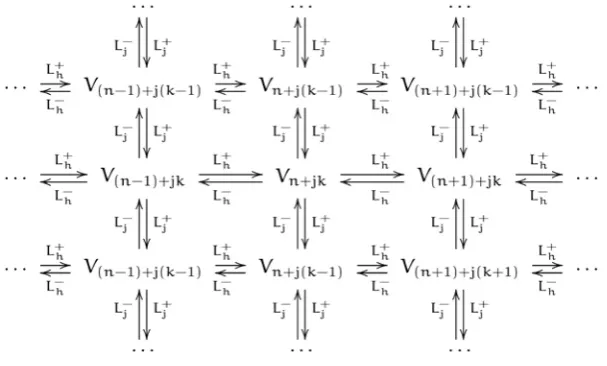
±j. Therefore an indecomposable sp2-module can be parametrised by a two-dimensional lattice of eigen-values in double numbers, see Table 1.
The following functions
v±1h 2
(q) = e∓jq2/(2h)= coshq
2
2h∓j sinh q2
2h, v±1j
2
(q) = e∓q2/(2h)
are null solutions to the operators L±h and L±j ,
re-spectively. They are also eigenvectors of 2ρSWh (B)
with eigenvalues∓j 2 and∓
1
2, respectively. If these functions are used as mother wavelets for the wavelet transforms generated by the Heisenberg group, then the image space will consist of the null-solutions of the following differential operators, see [26, Cor. 24]:
Dh = Xr−Yr= (∂x−∂y) +
h
2(x+y),
Dj = Xr−jYr= (∂x+ j∂y)−
h
Table 1: The action of hyperbolic ladder operators on a 2D lattice of eigenspaces. OperatorsL±h move the eigenvalues by 1, making shifts in the horizontal direction. OperatorsL±j change the eigenvalues by j, shown as vertical shifts
for v±1h 2
and v±1j 2
, respectively. This is again in line with the classical result (27). However annihilation of the eigenvector by a ladder operator does not mean that the part of the 2D-lattice becomes void, since it can be reached via alternative routes. Instead of mul-tiplication by a zero, as happens in the elliptic case, a half-plane of eigenvalues will be multiplied by the divisors of zero 1±j.
We can also search ladder operators within the algebra sp2 and admitting double numbers we will
again find two sets of them [23,§3]:
L±2h = ±A˜+ ˜Z/2 =
∓q
2 d dq∓
1 4−
jh
4 d2
dq2 −
jq2
4h =−
j 4h(L
± h)
2
, L±2j = ±j ˜A+ ˜Z/2 =
∓jq
2 d dq∓
j 4 −
jh
4 d2
dq2 −
jq2
4h =−
j 4h(L
± j )
2
.
Again these operatorsL±2h and L±2h produce double shifts in the orthogonal directions on the same two-dimensional lattice in Tabular 1.
5
Ladder operator for the
nilpotent subgroup
Finally, we look for ladder operators for the Hamil-tonian ˜B+ ˜Z/2 or, equivalently, −B˜+ ˜Z/2. It can be identified with a free particle [37,§3.8].
We can look for ladder operators in the represen-tation (14–15) within the Lie algebrah1 in the form
L±ε =aX˜ +bY˜. This is possible if and only if −b=λa, 0 =λb. (37) The compatibility condition λ2 = 0 implies λ = 0 within complex numbers. However, such a “ladder”
operator produces only the zero shift on the eigen-vectors, cf. (24).
Another possibility appears if we consider the rep-resentation of the Heisenberg group induced by dual-valued characters. On the configurational space such a representation is [25, (4.11)]:
[ρεχ(s, x, y)f](q) = e 2πixq
1−εh
s−1
2xy
·
f(q) +εhy 2πif
(q). (38)
The corresponding derived representation ofh1 is
ρph(X) = 2πiq, ρph(Y) = εh
2πi d
dq, (39) ρph(S) = −εhI.
However the Shale-Weil extension generated by this representation is inconvenient. It is better to consider the FSB-type parabolic representation [25, (4.9)] on the phase space induced by the same dual-valued character, cf. (19):
[ρεh(s, x, y)f](q, p) =e−2πi(xq+yp)· (40)
(f(q, p) +εh(sf(q, p) + y 4πif
q(q, p)−
x
4πif
p(q, p))).
Then the derived representation ofh1 is:
ρph(X) = −2πiq−
εh
4πi∂p,
ρph(Y) = −2πip+ εh
4πi∂q, (41)
An advantage of the FSB representation is that the derived form of the parabolic Shale–Weil representa-tion coincides with the elliptic one (21).
Eigenfunctions with the eigenvalue μ of the parabolic Hamiltonian ˜B+ ˜Z/2 =q∂p have the form
vμ(q, p) =eμp/qf(q), (42)
with an arbitrary functionf(q).
The linear equations defining the corresponding ladder operator L±ε = aX˜ +bY˜ in the algebra h1
are (37). The compatibility conditionλ2= 0 implies
λ = 0 within complex numbers again. Admitting dual numbers, we have additional values λ =±ελ1
withλ1∈Cwith the corresponding ladder operators
Lε± = ˜X∓ελ1Y˜ =−2πiq−
εh
4πi∂p±2πελ1ip=
−2πiq+εi
±2πλ1p+
h
4π∂p
.
For the eigenvalueμ=μ0+εμ1 withμ0,μ1∈Cthe
eigenfunction (42) can be rewritten as:
vμ(q, p) =eμp/qf(q) =eμ0p/q
1 +εμ1
p q
f(q) (43)
due to the nilpotency ofε. Then the ladder action of
L±ε isμ0+εμ1 →μ0+ε(μ1±λ1). Therefore, these
operators are suitable for buildingsp2-modules with a one-dimensional chain of eigenvalues.
Finally, consider the ladder operator for the same elementB+Z/2 within the Lie algebrasp2.
Accord-ing to the above procedure we get the equations:
−b+ 2c=λa, a=λb, a
2 =λc, which can again be resolved if and only if λ2 = 0. There is the only complex rootλ= 0 with the corre-sponding operatorsL±p = ˜B+ ˜Z/2, which does not
af-fect the eigenvalues. However the dual number roots
λ=±ελ2 withλ2∈Clead to the operators
L±ε =±ελ2A˜+ ˜B+ ˜Z/2 =±
ελ2
2 (q∂q−p∂p) +q∂p.
6
Conclusions: similarity and
correspondence
We wish to summarise our findings. Firstly, the ap-pearance of hypercomplex numbers in ladder opera-tors for h1 follows exactly the same pattern as was
already noted forsp2 [23, Rem. 32]:
• the introduction of complex numbers is a neces-sity for the existenceof ladder operators in the elliptic case;
• in the parabolic case, we need dual numbers to make ladder operatorsuseful;
• in the hyperbolic case, double numbers are not required neither for the existence or for the us-ability of ladder operators, but they do provide an enhancement.
In the spirit of the Similarity and Correspondence Principle we have the following extension of Prop. 33 from [23]:
Proposition Let a vector H ∈ sp2 generate the subgroupK, N or A, that is H =Z, B+Z/2, or
2B, respectively. Let ι be the respective hypercom-plex unit. Then the ladder operators L± satisfying the commutation relation:
[H, L±2] =±ιL±
are given by:
1. Within the Lie algebra h1: L± = ˜X∓ιY .˜
2. Within the Lie algebrasp2: L±2 =±ιA˜+ ˜E. Here
E∈sp2 is a linear combination ofBandZ with the properties:
• E= [A, H]. • H = [A, E].
• Killings formK(H, E)[19,§6.2] vanishes. Any of the above properties defines the vector
E∈span{B, Z} up to a real constant factor.
It is worth continuing this investigation and describ-ing in detail hyperbolic and parabolic versions of FSB spaces.
Acknowledgement
I am grateful to the anonymous referees for their helpful remarks.
References
[1] Arnol’d, V. I.: Mathematical methods of clas-sical mechanics. Graduate Texts in Mathemat-ics, vol. 60, New York : Springer-Verlag, 1991. Translated from the 1974 Russian original by K. Vogtmann, A. Weinstein, Corrected reprint of the second (1989) edition.
[2] Azizov, T. Ja., Iohvidov, I. S.: Linear operators in Hilbert spaces with G-metric, Uspehi Mat. Nauk 26(1971), no. 4 (160), 43–92.
[3] Boyer, Ch. P., Miller, W., Jr.: A classification of second-order raising operators for Hamiltoni-ans in two variables,J. Mathematical Phys. 15
(1974), 1 484–1 489.
[4] Cnops, J., Kisil, V. V.: Monogenic functions and representations of nilpotent Lie groups in quan-tum mechanics, Math. Methods Appl. Sci. 22
[5] Constales, D., Faustino, N., Kraußhar, R.: Fock spaces, Landau operators and the time-harmo-nic Maxwell equations, Journal of Physics A: Mathematical and Theoretical 44(2011), no. 13, 135 303.
[6] de Gosson, Maurice A.: Spectral proper-ties of a class of generalized Landau opera-tors, Comm. Partial Differential Equations 33
(2008), no. 10–12, 2 096–2 104.
[7] Erd´elyi, A., Magnus, W., Oberhettinger, F., Tri-comi, F. G.: Higher transcendental functions. Vol. II. Melbourne : Robert E. Krieger Pub-lishing Co. Inc., Fla., 1981. Based on notes left by Harry Bateman, Reprint of the 1953 original.
[8] Folland, G. B.: Harmonic analysis in phase space.Annals ofMathematics Studies, vol.122, Princeton : Princeton University Press, NJ, 1989.
[9] Gazeau, J.-P.: Coherent States in Quantum Physics.Wiley-VCH Verlag, 2009.
[10] G¨unther, U., Kuzhel, S.: PT-symmetry, Car-tan decompositions, Lie triple systems and Krein space-related Clifford algebras, Journal of Physics A: Mathematical and Theoretical 43
(2010), no. 39, 392 002.
[11] Howe, R.: Roger Howe, On the role of the Heisenberg group in harmonic analysis,
Bull. Amer.Math. Soc. (N.S.) 3 (1980), no. 2, 821–843.
[12] Howe, R.: Quantum mechanics and partial dif-ferential equations, J. Funct. Anal. 38 (1980), no. 2, 188–254.
[13] Howe, R., Tan, E. Ch.: Non-abelian harmonic analysis: Applications of SL(2,R). New York : Universitext, Springer-Verlag, 1992.
[14] Hudson, R.: Generalised translation-invariant mechanics. D. Phil. thesis, Oxford : Bodleian Library, 1966.
[15] Hudson, R.: Translation invariant phase space mechanics, Quantum theory: reconsideration of foundations – 2, 2004, pp. 301–314.
[16] Khrennikov, A. Yu.: Hyperbolic quantum me-chanics, Dokl. Akad. Nauk 402 (2005), no. 2, 170–172.
[17] Khrennikov, A.: Hyperbolic Quantum Mechan-ics,Adv. Appl. Clifford Algebr.13(2003), no. 1, 1–9 (English).
[18] Khrennikov, A.: Hyperbolic quantization, Adv. Appl. Clifford Algebr. 18 (2008), no. 3–4, 843–852.
[19] Kirillov, A. A.: Elements of the theory of rep-resentations. Berlin : Springer-Verlag, 1976. Translated from the Russian by Edwin He-witt, Grundlehren der MathematischenWis-senschaften, Band 220.
[20] Kisil, V. V.: Clifford valued convolution opera-tor algebras on the Heisenberg group. A quantum field theory model. Clifford algebras and their applications in mathematical physics, proceed-ings of the Third international conference held in Deinze, 1993, pp. 287–294.
[21] Kisil, V. V.: Analysis in R1,1 or the princi-pal function theory, Complex Variables Theory Appl.40(1999), no. 2, 93–118.
[22] Kisil, V. V.: A quantum-classical bracket from
p-mechanics, Europhys. Lett. 72 (2005), no. 6, 873–879.
[23] Kisil, V. V.: Erlangen program at large – 2 1/2: Induced representations and hypercom-plex numbers,submitted(2009).
[24] Kisil, V. V.: Computation and dynamics: Clas-sical and quantum,AIP Conference Proceedings 1 232(2010), no. 1, 306–312.
[25] Kisil, V. V.: Erlangen Programme at Large 3.1: Hypercomplex representations of the Heisenberg group and mechanics,submitted (2010).
[26] Kisil, V. V.: Covariant transform, Journal of Physics: Conference Series, 284(2011), no. 1, pp. 9.
[27] Kisil, V. V. Erlangen programme at large: an Overview, Rogosin, S. V., Koroleva, A. A. (Eds.): Advances in applied analysis. Imperial College Press, 2011, p. 1–65.
[28] Lang, S.: SL2(R), Graduate Texts in Mathemat-ics.vol.105, New York : Springer-Verlag, 1985. [29] Lavrent’ev, M. A., Shabat, B. V.: Problemy gidrodinamiki i ih matematiqeskie mode-li. (Russian) [Problems of hydrodynamics and
their mathematical models], Moscow : Second, Izdat. “Nauka”, 1977.
[30] Mazorchuk, V.: Lectures on sl2-modules. World Scientific, 2009.
[31] Niederer, U.: The maximal kinematical invari-ance group of the free Schr¨odinger equation,
[32] Porteous, I. R.: Clifford algebras and the clas-sical groups, Cambridge Studies in Advanced Mathematics, Cambridge : Cambridge Univer-sity Press, 1995, vol.50.
[33] Srivastava, H. M., Tuan, V. K., Yakubo-vich, S. B.: The Cherry transform and its re-lationship with a singular Sturm-Liouville prob-lem,Q. J. Math. 51(2000), no. 3, 371–383. [34] Taylor, M. E.: Noncommutative harmonic
anal-ysis, Mathematical Surveys and Monographs.
vol. 22, Providence : American Mathematical Society, RI, 1986.
[35] Torre, A.: A note on the general solution of the paraxial wave equation: a Lie algebra view,
Journal of Optics A: Pure and Applied Optics 10(2008), no. 5, 055 006 (14 pp).
[36] Torre, A.: Linear and quadratic exponential modulation of the solutions of the paraxial wave
equation,Journal of Optics A: Pure and Applied Optics 12(2010), no. 3, 035 701 (11 pp). [37] Wulfman, C. E.: Dynamical Symmetry. World
Scientific, 2010.
[38] Yaglom, I. M.: A simple non-Euclidean geome-try and its physical basis. New York : Springer-Verlag, 1979. An elementary account of Galilean geometry and the Galilean principle of relativ-ity, Heidelberg Science Library, Translated from the Russian by Abe Shenitzer, With the edito-rial assistance of Basil Gordon.
Vladimir V. Kisil
E-mail: [email protected]
http://www.maths.leeds.ac.uk/∼kisilv/