Outsourcing Modular Exponentiation
Jothi Rangasamy and Lakshmi Kuppusamy
Society for Electronic Transactions and Security (SETS), Chennai, India {jothiram,lakshdev}@setsindia.net
Abstract. We investigate the problem of securely outsourcing modular exponentiations to a single, malicious computational resource. We revisit recently proposed schemes using single server and analyse them against two fundamental security properties, namely privacy of inputs and ver-ifiability of outputs. Interestingly, we observe that the chosen schemes do not appear to meet both the security properties. In fact we present a simple polynomial-time attack on each algorithm, allowing the mali-cious server either to recover a secret input or to convincingly fool the client with wrong outputs. Then we provide a fix to the identified prob-lem in theExpSOSscheme. With our fix and without pre-processing, the improved scheme becomes the best to-date outsourcing scheme for single-server case. Finally we present thefirst precomputation-free single-server algorithm,πExpSOS forsimultaneous exponentiations, thereby solving an important problem formulated in [6].
1
Introduction
The problem of securely offloading cryptographic computations from a (compar-atively) weak device to a more powerful device has been considered since many years [1] but the need for such a solution has been increasing rapidly [10][9][8][11]. A low-cost RFID tag is a natural example as it has limited computing resources but will benefit from running cryptographic protocols [18]. Proliferation of the us-age of mobile applications adds one more scenario wherein outsourcing resource-consuming cryptographic tasks to a third-party is desirable.
The growing utilisation of cloud services such as Dropbox, Google and Ama-zon Cloud Drives has raised concerns about the availability and integrity of the data being handled and stored. By using cryptographic primitives such as prov-able data possession [2] and proofs of retrievability [3], these service providers could convince their clients that the actual data given by clients has been re-trieved entirely. However, during this process, the clients have to engage in per-forming computationally-intensive operations to verify the claims of their storage providers and this is not practically viable for many devices in use today. Among complex cryptographic operations, modular exponentiation is invariably the pre-dominant and core operation; that is, to computeua modpwith a variable base
1.1 Related Work
The problem of secure delegation of crypto computations to (untrusted) helpers has been considered in various contexts[1,10,9,8,11,17,24]. In particular, the idea of secure delegation of modular exponentiation can be attributed to the work of Schnorr [21,22] as he was the first to propose speeding up modular expo-nentiations in cryptography. However it has not received formal treatment until Hohenberger and Lysyanskaya [12] developed a formal security framework for secure outsourcing of cryptographic computations to untrusted servers in 2005. In secure outsourcing scenario, preserving the secrecy of the inputs and/or out-puts is vital. Hence, in Hohenberger-Lysyanskaya formalism, secrecy is the first notion an outsourcing algorithm should aim to satisfy. The second security no-tion, namely verifiability addresses the correctness of the output of the powerful helper/server. Hohenberger and Lysyanskaya also presented a scheme for out-sourcing modular exponentiation to two non-colluding servers. This approach was improved in [6] and further in [15] with better verifiability results.
Designing an efficient algorithm using single untrusted (cloud) server for securely outsourcing (multi-)modular exponentiation has been a perennial prob-lem. Towards solving this, Wanget al.presented (at ESORICS 2014) an efficient protocol to outsource modular exponentiation to asingle untrusted server [23]. They also presented a generic protocol for outsourcing multi-exponentiations to a single server. However Chevalieret al. [7] presented a lattice-based attack on Wang et al. scheme recovering the secret exponent. Independently, Kiraz and Uzunkol designed an outsourcing scheme but requires an additional sub algorithm[14]. In 2017, Cai et al. [5] proposed a new scheme using redundant inputs but with increased communication complexity undesirably. Recently, Li
et al.[16] have come up with a novel approach of using logical divisions twice for the given inputs. Then Zhou et al.[25] proposed a new scheme, which they call ExpSOS, using special ring structure ofZN with the goal of eliminating the (de
facto) preprocessing and achieving near-full verifiability simultaneously. To the best of our knowledge,ExpSOSis the only single-server algorithm which does not require resource-demanding pre-processing techniques such asRandin [4].
1.2 Our Contributions
Contributions of the paper is two-fold. We first present practical attacks on three recent single-server algorithms and then we resolve the issue with theExpSOS scheme, making it the best to-date scheme for this purpose.
First we show that the CExp scheme due to Li et al.[16] is unfortunately
zero verifiable, instead of the authors’ claim of satisfying the full verifibility. We demonstrate how to manipulate the outputs so that the delegator can be tricked by 100% into accepting false outputs .
unfortunatelytotally unverifiable, instead of having the verifiability probability 1− 1
n2 which is ≈0.99996 for n= 160. The result is applicable to theSmExp
scheme proposed by Caiet al.for the case of simultaneous exponentiation. Thirdly, we describe an attack on the ExpSOS scheme of Zhou et al.[25] on its second invocation with the same secret exponent. The scheme will leak the exponent if it is used again, invalidating the claimed secrecy guarantee. The demonstrated attack extends to the other versions of the ExpSOS scheme in [25].
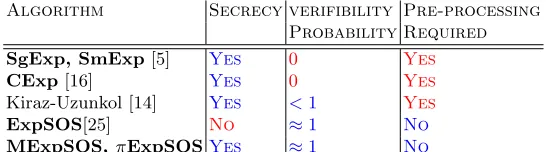
Our last and main contribution are new single-server algorithms for secure outsourcing of single and simultaneous modular exponentiations. For single ex-ponentiation case, our algorithm is obtained by modifyingExpSOS. The mod-ified scheme, which we call MExpSOS becomes the most efficient and simple scheme available in the related literature in addition to eliminating thememory requirement and the substantialcomputational cost of the precomputation step. Finally, we present an elegant algorithm,πExpSOSextendingMExpSOSfor simultaneous multiplications. The πExpSOS algorithm is near error-free and preprocessing-free and hence is the first of its kind in the literature. Our obser-vations are summarised in Table 1.
Algorithm Secrecy verifibility Pre-processing
Probability Required
SgExp, SmExp[5] Yes 0 Yes
CExp[16] Yes 0 Yes
Kiraz-Uzunkol [14] Yes <1 Yes
ExpSOS[25] No ≈1 No
MExpSOS,πExpSOSYes ≈1 No
Table 1.Single server based outsourcing algorithms and their properties
Outline. The paper is organised as follows. The Hohenberger-Lysyanskaya secu-rity model is recalled in Section 2. In Section 3 we observe weaknesses in recent single-server based outsourcing schemes. In Section 4 we propose a re-designed ExpSOSscheme and prove that it satisfies security notions: secrecy and verifi-ability and Section 5 concludes the paper.
2
Security Definitions
Adversarial behaviour. Assume that an algorithm Alg is run by two par-ties: a computationally weak and trusted party C (i.e., a client) who invokes a computationally powerful and untrusted party U through oracle queries. An outsource-secure implementation of an algorithmAlg=CU is specified by (C,U). whereC carries out the tasks by invokingU.
Hohenberger and Lysyanskaya modelled adversaryA = (E,U0) and its be-haviour in two parts: (i) the adversarial environmentEsimulated to send/submit inputs toAlg; (ii) a malicious oracleU0 simulated to mimicU.E andU0 can es-tablish a direct communication channel only before agreeing on a joint initial strategy after which the only way they can communicate is by passing the mes-sages through a channel re-directed/monitored byC.
Input/output specifications.The following are the forms of information the algorithm’s input/output may have:
Secret information possessed byC;
Protected information known to bothCandE but unknown toU0.This
pro-tected information is categorized depending upon the honest or adversarial generation of inputs;
Unprotected information known toC, E andU0.
Definition 1. (Algorithm with IO-outsource)The outsource algorithmAlg
obeys the input/output specification if it accepts five inputs and produces three outputs. The honest entity generates the first three inputs and the last two inputs are generated by the environmentE.The first three inputs can be further classified based on the information about them available to the adversary A = (E,U0).
The first input is the honest, secret input which is unknown to both E and U0.
The second input is the honest, protected input which may be known by E, but is protected from U0. The third input is the honest, unprotected input which may be known by both E andU0. The fourth input is the adversarial, protected input which may be known by E, but is protected from U0. The fifth input is the adversarial, protected input which may be known byE,but is protected from
U0.Similarly, the first, second and third outputs are called secret, protected and unprotected outputs respectively.
2.1 Outsource-security definitions
The following are the security requirements an outsource algorithm should sat-isfy:
– verifiability. The malicious oracleU0 does not gain any knowledge about the inputs toAlg even when it mimics the behaviour of U to C. In the formal definition it is assumed that a simulatorS2exists without having access to the secret/protected inputs and simulates the view ofU0.
The following Definitions 2, 3, 4 and 5 are reproduced from [12].
Definition 2. (Outsource-security) [12] A pair of algorithms (C,U)is said to be an outsource-secure implementation of an algorithmAlgwith IO-outsource if:
Correctness CU is a correct implementation of Alg.
Security For all probabilistic polynomial-time adversaries A = (E,U0), there
exist probabilistic expected polynomial-time simulators(S1,S2)such that the
following pairs of random variables are computationally indistinguishable.
Pair One (E learns nothing): EVIEWreal∼EVIEWideal.
The real process: This process proceeds in rounds. Assume that the honestly generated inputs are chosen by a process I. The view that the adversarial environment obtains by participating in the following process:
EVIEWireal={istatei, xi hs, x
i hp, x
i hu
←I 1k, istatei−1 ;
estatei, ji, xi
ap, xiau, stopi
←E1k,EVIEWi−1
real, x i hp, xihu
;
tstatei, ustatei, yi s, yip, yiu
← CU0(ustatei−1)
tstatei−1, xji
hs, x ji
hp, x ji
hu, x i ap, xiau
:
estatei, yi p, yiu
}
EVIEWreal= EVIEWirealifstop
i= TRUE.
In roundi, The adversarial environment does not have access to the honest inputs(xi
hs, x i hp, x
i
hu)that are picked using an honest, stateful processI.The environment based on its view from last round, chooses the value of itsestatei variable that is used to recall what it did next time it is invoked. Then, among the previously generated honest inputs, the environment chooses a input vec-tor(xjhsi, xhpji, xjhui)to give it toCU0
.Observe that the environment can specify the index ji of the inputs but not the values. The environment also chooses the adversarial protected and unprotected inputxiap and xiau respectively. It also chooses the boolean variable stopi that determines whether round i is the last round in this process.
Then,CU0 is run on inputs(tstatei−1, xji hs, x
ji hp, x
ji hu, x
i
ap, xiau)wheretstatei−1 isC’s previously saved state . The algorithm produces a new statetstateifor
C along with the secretyi
s, protectedypi and unprotectedyiu outputs. The or-acleU0 is givenustatei−1 as input and the current state in saved inustatei. The view of the real process in roundiconsists of estatei,and the valuesyi p and yi
view in the last round.
The ideal process:
EVIEWiideal={
istatei, xihs, xihp, xi hu
←I 1k, istatei−1
;
estatei, ji, xi ap, x
i
au, stop
i
←E1k,EVIEWi−1
ideal, x i hp, x
i hu
;
astatei, ys, yi ip, yi u
←Alg
astatei−1, xji hs, x
ji hp, x
ji hu, x
i ap, xi
au
;
sstatei, ustatei, Yi p, Y
i
u, replace
i
← SU10(ustatei−1)
sstatei−1, xji hp, x
ji hu, x
i ap, x
i au, y
i p, y
i u
;
zi p, z
i u
=replacei Yi
p, Y i u
+ 1−replacei
yi p, y
i u
:
estatei, zp, zi i u
}
EVIEWideal= EVIEWiidealifstop
i= TRUE.
This process also proceeds in rounds. The secret inputxihsis hidden from the stateful simulator S1. But, the non-secret inputs produced by the algorithm
that is run on all inputs of roundiis given toS1. Now,S1 decides whether
to output the values(yi
p, yui)generated by the algorithmAlg or replace them with some other values(Yi
p, Yui).This replacement is captured using the indi-cator variablereplacei∈ {0,1}.The simulator is allowed to query the oracle
U0 which saves its state as in the real experiment.
Pair two (U0 learns nothing): UVIEW
real∼UVIEWideal.
The view that the untrusted entity U0 obtains by participating in the real
process is described in pair one.UVIEWreal=ustateiif stopi= TRUE.The ideal process:
UVIEWiideal={
istatei, xi hs, x
i hp, x
i hu
←I 1k, istatei−1
;
estatei, ji, xi
ap, xiau, stopi
←E1k, estatei−1, xi hp, x
i hu, y
i−1
p , yui−1
;
astatei, yi s, y
i p, y
i u
←Algastatei−1, xji
hs, x ji
hp, x ji
hu, x i ap, x
i au
;
sstatei, ustatei
← S2U0(ustatei−1)
sstatei−1, xji
hu, x i au ; ustatei }
UVIEWideal= UVIEWiidealifstop
i= TRUE.
In the ideal process, the stateful simulatorS2 is given with only the
unpro-tected inputs(xihu, xiau), queriesU0.As before,U0 may maintain state. Definition 3. (α−efficient, secure outsourcing)[12] A pair of algorithms
(C,U)is said to be an α−efficient implementation of an algorithm Algif (C,U)
is an outsource secure implementation of algorithmAlg and for all inputsx,the running time ofCis≤anα−multiplicative factor of the running time ofAlg(x) Definition 4. (β−verifiable , secure outsourcing)[12] A pair of algorithms
from its advertised functionality during the execution ofCU0
(x),Cwill detect the error with probability ≥β
Definition 5. ((α, β)−outsource-security)[12]A pair of algorithms (C,U)is said to be an(α, β)−outsource-secure implementation of an algorithmAlgif they are bothα−efficient and β−checkable.
3
On Recent Single-server Outsourcing Schemes
This section presents security issues with three single-server algorithms proposed in 2017; They are 1) Li et al. scheme (CExp), 2) Caiet al. scheme (SgExp) and 3) Zhouet al. scheme (ExpSOS).
3.1 Li et al. Scheme (CExp) and Its Weakness
First, we present Liet al.scheme briefly and then show its security weakness of not achieving full verifiability as claimed by the authors.
CExp Algorithm We use the same notations followed by Li et al. [16] to
describe their outsourcing algorithm. Let N = pq for two large primes p and q. Let CExp be an algorithm which outputsudmodN upon acceptingu∈
Z∗N
and d∈Z∗φ(N) as inputs. The assumption is that the inputs uanddare secret or (honest/adversarial) protected. Hence the inputs need to be computationally blinded (masked) by the delegatorCbefore passing them to the untrusted server U.
Masking the Inputs. To mask the inputs, the algorithm CExp uses
prepro-cessing techniqueRandNfor efficient generation of pairs of the form (x, xemod N) for a fixede. (For more details about the description, analysis and effi-ciency of these pre-processing techniques, please refer to [4, Section 2] and [20].)
The client C runs RandN to generate four pairs (g1, g1e),(g2, g2e),(g3, g3e), (g4, g4e). Let v1 = ge1modN, w1 = g2emodN, v2 = ge3modN, and w2 = ge
4modN. To logically split base u and exponent d into random looking pieces, the first logical divisions are done as follows:
ud=v1cr11w1w`1(wk1g2)t1, (1) wherec1 =g1/g2, r1 =d−e, w =u/g1, t1 =r1−e andd=`1+k1t1. For second logical divisions,Ccomputes an integerasuch thatad≡1 modφ(N). Then C computes ramodN for a randomly chosen r ∈ {2,10} and sets
u0=u·ra.
Queries to U. C queriesU in random order as follows: 1. (r1, c1)→cr11;
2. (r1, c2)→cr21; 3. (`1, w)→w`1; 4. (k1, w)→wk1; 5. (`1, w0)→(w0)`1; 6. (k1, w0)→(w0)k1.
Verifying the correctness of U’s outputs. The clientC checks whether
r v1cr11w1w`1(wk1g2)t1
?
=v2cr21w2(w0)`1((w0)k1g4)t1 (3) Recovering ud modN. If the above check passes,Ccomputes the result as
ud=v1cr11w1w`1(wk1g2)t1. (4) OtherwiseC outputs error message.
Attack on CExp Algorithm Li et al. claim that their algorithm CExp is
1-verifiable; that is, it allows the client C to verify the outputs returned by U with probability 1.We show that with a minimal effort,U can cheatCwith the malformed outputs and henceCExpoffers unfortunately 0-verifiability.
The attacker’s strategy is to identify and segregate just 2 out of 6 queries for which the exponent is same. For instance, letU choose (r1, c1) and (r1, c2). Note that this separation is easier since each base value ci is distinct and does
not appear twice. Now the maliciousU manipulates the outputs corresponding to these two queries only by multiplying them with a random δ ∈ {1, N} and proceeds as follows.
1. (r1, c1)→δcr11; 2. (r1, c2)→δcr21; 3. (`1, w)→w`1; 4. (k1, w)→wk1; 5. (`1, w0)→(w0)`1; 6. (k1, w0)→(w0)k1.
After receiving the outputs,Cchecks if r v1δcr11w1w`1(wk1g2)t1
?
=v2δcr21w2(w0)`1((w0)k1g4)t1.
Or equivalently, rδud =? δ(u0)d.
3.2 Cai et al. Scheme (SgExp) and Its Weakness
For the single untrusted server model, Cai et al. [5] proposed two algorithms to securely outsource single and simultaneous modular exponentiations with verifiability probability being close to 1.We show in this section that both their variants fail to detect wrong values output by the malicious server.
SgExp Algorithm We use the same notations followed by Caiet al.to describe their outsourcing algorithmSgExp.
Masking the Inputs. To mask the inputs, the algorithmSgExp used the
pre-processing techniquesBPV+ orSMBLto generate four pairs (α, gα), (β, gβ),
(, g),(θ, gθ) denoted by A, B, C and D respectively. Letw =u/A modp
andv=u/C modp. ThenC representsuin the following two ways: – ua= (Aw)a=gaαwa=gβgγwa modp,where γ= (aα−β) modq;
– ua= (Cv)a=gava=gθgτva modp,whereτ= (a−θ) mod q. To implicitly maska in wa and va,C randomly choosesi, j such that 2i 6=
2j< aand computes
– a1=a−2i – a2=a−2j.
Queries to U. CrunsBPV+orSMBLto generate 8 pairs (t1, gt1),(t2, gt2) and (s1, gs1),(s2, gs2)· · ·(s6, gs6). ThenCqueryUin random order after choosing m1,· · ·mi−1, mi+1,· · ·mj−1, mj+1,· · ·mn as follows:
– (gt1, γ/t
1, p)→gγ; – (wgs1, a
1, p)→R11=wa1gs1a1 ; – (gs3,s1a1−s2
s3 , p)→R12=g
s1a1−s2 ; – (gt2, τ /t
2, p)→gτ; – (vgs4, a
2, p)→R21=va2gs4a2 ; – (gs6,s4a2−s5
s6 , p)→R22=g
s4a2−s5 ; – (m1,2)→m[1] =m21;
– (m2,22)→m[2] =m42; – · · ·
– (w,2i)→m[i] =w2i; – · · ·
– (v−1,2j)→m[j] =v−2j ; – · · ·
– (mn,2n)→m[n] =m2
n
n ;
Verifying the correctness of U’s outputs. The clientC computes
wa1 =R
11(R12gs2)−1 va2 =R
21(R22gs5)−1 and checks whether
Bgγwa1m[i]m[j] modp≡? Dgτva2 modp (5) Recovering ua. If the above check passes,C computes
ua≡Bgγwa1m[i] modp.
Attack on SgExp Algorithm Cai et al. claim that their algorithm SgExp
preserves secrecy and the client C can verify the outputs returned by U with probability 1−1/n2.We show that even a minimal effort from U could lead to cheating the clientC with the malformed outputs and henceSgExp is unfortu-nately 0-verifiable.
The attacker’s strategy is to identify and segregatenout ofn+ 6 queries for which the first argument is a power of 2.Then the attacker forms two bins; to fill nnumber of queries of the form 2i in one bin and the remaining 6 queries in the other bin. Note that this kind of separation of n+ 6 queries is possible as exponent is a power of 2 in n queries. After segregation of n queries, the adversary manipulates the outputs of remaining 6 queries only by multiplying them with a randomδ∈Gand proceeds as follows.
– (gt1, γ/t
1, p)→δgγ; – (wgs1, a
1, p)→R11=δwa1gs1a1 ; – (gs3,s1a1−s2
s3 , p)→R12=δg
s1a1−s2 ; – (gt2, τ /t
2, p)→δgτ; – (vgs4, a
2, p)→R21=δva2gs4a2 ; – (gs6,s4a2−s5
s6 , p)→R22=δg s4a2−s5; – (m1,2)→m[1] =m21;
– (m2,22)→m[2] =m42; – · · ·
– (w,2i)→m[i] =w2i; – · · ·
– (v−1,2j)→m[j] =v−2j; – · · ·
– (mn,2n)→m[n] =m2
n
n ;
After receiving the outputs,Ccomputes wa1 =δR
11(δR12gs2)−1=R11(R12gs2)−1 va2=δR
21(δR22gs5)−1=R21(R22gs5)−1 and checks
Bδgγwa1m[i]m[j] modp=? Dδgτva2 modp. (6)
Since the check has been passed,Cfinally computes the undesired output: ua=Bδgγδwa1m[i] modp6=Bgγwa1m[i] modp.
3.3 Zhou et al. Scheme (ExpSOS) and Its Weakness
ExpSOS Algorithm LetN be either a prime number or an RSA modulus and u, a∈ZN.The aim of the clientCis to computeuamodN keeping the variable
valuesu, a andua secret. The client runs the oracleU whose task is to return
ij modkon input (i, j, k).In order to maintain the secrecy of uandathey are
computationally masked before being given as input toU.
Masking the Inputs. To mask the inputs, the clientCgenerates a large prime p and calculates L = pN keeping N and p secret from the server U. By choosing the random integersk1, k2, t1, t2, r such thatt1, t2≤b,(whereb is a security parameter)C calculates the following:
1. A1=a+k1φ(N) 2. A2=t1a+t2+k2φ(N) 3. U =u+rNmodL.
Queries to U. C queriesU in random order as follows: 1. (U, A1, L)→R1
2. (U, A2, L)→R2.
Verifying the correctness of U’s outputs. The clientC checks whether
Rt1 1 ·u
t2 ≡? R
2 modN. (7)
Recovering ua. If the above check passes,C computes
ua ≡R1 modN. (8)
OtherwiseC outputs error message.
Attack on ExpSOS Algorithm The first generic algorithm for outsourcing
variable-exponent variable-base modular exponentiation using only a single un-trusted server was due to Wang et al. [23]. In [7] Chevalier et al. presented a lattice-based attack on Wanget al.’s scheme recovering the secret exponent when it appears again in another invocation. In this section, we follow the approach of Chevalieret al.and describe a similar attack onExpSOSwhen the same secret exponent is used in two or more runs. In fact we will show that an exponent in
ExpSOScan be recovered in polynomial time when two exponentiations having
the same exponent are outsourced to the serverU. The assumed scenario is evi-dent from the first application proposed in [25, Section VI.A] to securely offload Inner Product Encryption for Biometric Authentication [13].
The considered attack scenario is the following: The client wants to compute ua modNfirst and (u0)a modN later. Let (U, A
1, A2) and (U0, A01, A02) be the queries toU corresponding to two exponentiations such that
A1=a+k1φ(N);A2=t1a+t2+k2φ(N) and
A01=a+k3φ(N);A02=t3a+t4+k4φ(N).
Remark 1. The above attack breaks the secrecy of other versions ofExpSOSin [25]. In fact it is applicable even for ExpSOS under honest-but-curious server model in [25, Section III.C]. The malicious server could act benignly in com-puting the required values but can learn silently any reused secret exponent. In the next section we attempt to thwart this attack under malicious server model since there is no efficiency gain to consider having the semi-honest server.
4
Our Algorithms for Single and Simultaneous
Exponentiations
We first present the algorithm for single exponentiation by revising theExpSOS
algorithm and then extend the resulting algorithm for simultaneous exponenti-ations.
4.1 Improved ExpSOSScheme for Single Exponentiation
In this section we present an improved ExpSOS algorithm which resists attack described in Section 3.3. We use the same notations from Section 3.3 used to describe theExpSOSalgorithm.
The MExpSOS Algorithm LetN be either a prime number or an RSA mod-ulus and u, a ∈ZN. The aim of the clientC is to compute ua modN keeping
the variable valuesu, aandua secret.
Masking the Inputs. To mask the inputs, the clientCgenerates a large prime pand calculatesL=pN to keepN and psecret from the serverU. Select a random r such that N0 = rN is fixed for all invocations. By choosing the random integersk1, k2, t1, t2 such that t1, t2 ≤b (where b is a security parameter),C calculates the following:
1. a1=a−t1 2. A1=a1+k1φ(N) 3. A2=t2a+k2φ(N) 4. U =u+N0 modL
Queries to U. C queriesU in random order as follows: 1. (U, A1, L)→R1
2. (U, A2, L)→R2
Verifying the correctness of U’s outputs. The clientC checks whether
(R1ut1)t2 modN ?
=R2 modN (9)
Recovering ua. If the above check passes,C computes
Remark 2. The performance gain of the above algorithm is that instead of a
full modular exponentiation(on the size of an RSA private key, for example), the client device needs to do 2smaller exponentiations with size comparable to the security parameter. Moreover the communication cost and the overhead for the third-party server are not prohibitive compared to the previously-known algo-rithms. Hence the proposed solution shall directly produce speed-ups in practice. Lemma 1. (Correctness). In the malicious model, the algorithms(C,U)are cor-rect implementation of MExpSOS.
Proof. Whenever U returns R1 and R2, C computes ut1 on its own and then raising the value R1ut1 modN to the power t2. Then the resultant (R1ut1)t2 modN is compared withR2.If the equality holds, thenC computes the desired resultua =R
1ut1 modN. ut
In the following theorem, we show that (C,U) is an outsource-secure implemen-tation of MExpSOSusing Hohenberger-Lysyanskaya security model for a single malicious server. [12].
Theorem 1. (Privacy) In the one malicious program model, the algorithms
(C,U)are an outsource-secure implementation of MExpSOS.
Proof. Assume that A= (E,U0) be a probabilistic polynomial time (PPT) ad-versary which interacts with the PPT algorithmCin the one malicious program model.
Pair One:(E learns nothing) EVIEWreal∼EVIEWideal
If the input (u, a, N) is honest, protected or adversarial protected, the simu-latorS1 behaves the same way as in the real experiment. If the input is honest and secret, then S1 ignores the received input in the ith round. The goal of S1 in thisith round is to query U
0
with the inputs (U∗, A∗1, A∗2, L∗) such that the inputs U∗, A∗1, A2∗ and L∗ are chosen at random by S1. After receiving the outputs,S1 saves both the states ofS1 andU
0 .
In real process, all the inputs that occur in the queries are re-randomized to give computational indistinguishability. Whereas S1 always set the queires to U0 with the random input values. Hence the input distributions to U0 are computationally indistinguishable both in the real and ideal process.
Pair Two: (U0 learns nothing): UVIEWreal∼UVIEWideal :
Let S2 be a PPT simulator that behaves in the same manner regardless of whether the input is honest, secret or honest, protected or adversarial protected. That is, S2 ignores the actual input in theith round and set the queries toU
0
with the random value. Then S2saves not only its state but alsoU 0
experiment, the simulatorS2always query the values selected uniform at random from the same distribution. Hence UVIEWireal∼UVIEWiideal for each roundi. By the hybrid argument, it is easy to see that UVIEWreal∼UVIEWideal. ut
Theorem 2. (verifiability) In the one malicious program model, the above al-gorithms (C,U)are an (3 + 1.5(logt1+ logt2),1−1/2b)-outsource-secure
imple-mentation of MExpSOS.
Proof. The computation of modular exponentiationua modNwithout
outsourc-ing requires roughly 1.5 loga modular multiplications (MM) using square and multiply method. As discussed in [25], the computational overhead to calculate φ(N), L and N0 becomes negligible when the client C runs MExpSOS multi-ple times. The following paragraph shows that with outsourcing, the modular exponentiation computation is reduced to 3 + 1.5(logt1+ logt2) modular multi-plications: the computation ofA1andA2during the masking step requires two modular multiplication altogether. Then the verification step requires one mod-ular exponentiation (ut1), one modular multiplication (R
1ut1) and one modular exponentiation ((R1ut1)t2). Thus our algorithm MExpSOS requires 3 modular multiplications and twob−bit modular exponentiations. Therefore our algorithm (C,U) is an (1
2logba)−efficient implementation ofMExpSOS.
On the other hand the two outputs sent byU are verified as in Equation 11. The serverU can trick the clientC if it correctly guessest2as in the following:
– Assume that the maliciousU setsA1 asA1+θ andA2 asA2+θ – Then the Equation 11 becomes
(UA1+θut1)t2 ≡UA2+θ modN
ua1t2+θt2ut1t2 ≡ut2a+θ modN
uat2uθt2 ≡ut2a+θ modN
If the valuet2 is correctly guessed then the adversary can computeuθt2 and setA1asA1+θandA2 asA2+θt2to pass the verification. Ift2 is guessed with probability 1/bandθt2is inserted accordingly in one out of two queries sent in random order, the malicious server can pass the verification step with false outputs with probability 21b.Hence our algorithm is a (1− 1
2b)-verifiable
implementation ofMExpSOS.
The proof of the theorem completes by combining the above arguments. ut
4.2 New Algorithm for Simultaneous Exponentiation
The πExpSOS Algorithm Let us follow the notations used to describe the
MExpSOSalgorithm. Let N be either a prime number or an RSA modulus and
ui, ai ∈ ZN fori = 1, . . . , n. In order to maintain the secrecy ofui andai, i=
1, . . . , nthey are computationally masked before being given as input toU. Masking the Inputs. To mask the inputs, the clientCgenerates a large prime
pand calculatesL=pN to keepN and psecret from the serverU. Select a random r such that N0 = rN is fixed for all invocations. By choosing the random integers k1i, k2i(i = 1, . . . , n) andt1, t2 such that t1, t2 ≤ b,C calculates the following fori= 1, . . . , n:
1. a1i=ai−t1
2. A1i=a1i+k1iφ(N)
3. A2i=t2ai+k2iφ(N)
4. Ui=ui+N0 modL
Queries to U. C issues 2nqueries toU in random order as follows: 1. (Ui, A1i, L)→R1i
2. (Ui, A2i, L)→R2i
Verifying the correctness of U’s outputs. The clientC checks whether
"n
Y
i=1 R1i(
n
Y
i=1 ui)t1
#t2
modN =?
n
Y
i=1
R2i modN (11)
Recovering ua. If the above check passes,C computes n
Y
i=1 uai
i ≡
n
Y
i=1 R1i(
n
Y
i=1
ui)t1 modN (12)
OtherwiseC outputs error message.
Lemma 2. (Correctness). In the malicious model, the algorithms(C,U)are cor-rect implementation of πExpSOS.
Proof. WheneverU returnsR1i and R2i fori= 1. . . n,C computes (Q n i=1ui)t1
on its own and then raising the valueQn
i=1R1i(Q n
i=1ui)t1 modN to the power
t2.Then the resultant (Q
n
i=1R1i(Q n
i=1ui)t1)t2 modNis compared withQ n i=1R2i.
If the equality holds, thenC computes the desired result Qn
i=1u
ai
i ≡
Qn
i=1R1i(Q n
i=1ui)t1 modN. ut
In the following theorem, we show that (C,U) is an outsource-secure implemen-tation of πExpSOS using Hohenberger-Lysyanskaya security model for a single malicious server. [12].
Theorem 3. (Privacy) In the one malicious program model, the algorithms
(C,U)are an outsource-secure implementation of πExpSOS.
Theorem 4. (verifiability) In the one malicious program model, the above al-gorithms (C,U) are an (5n−2 + 1.5(logt1+ logt2),1−1/2b)-outsource-secure
implementation of πExpSOS.
Proof. The computation of modular exponentiation Qn
i=1u
ai
i modN without
outsourcing requires roughly 1.5nlogamodular multiplications (MM) using square and multiply method. Outsourcing the modular exponentiation computation re-duces the cost to 2n+ 3(n−1) + 1.5(logt1+ logt2) + 1 modular multiplications as detailed below: the computation ofA1i and A2i during the masking step
re-quires 2nmodular multipications altogether. Then the verification step requires n−1 modular multiplications to computeQn
i=1ui, one modular exponentiation
to compute Qn
i=1u
t1
i , n−1 modular multiplications to compute
Qn
i=1R1i, one
modular multiplication to computeQn
i=1R1iQ n i=1u
t1
i , one modular
exponentia-tion to compute (Qn
i=1R1iQ n i=1u
t1 i )
t2andn−1 modular multiplications to
com-puteQn
i=1R2i.Thus our algorithmπExpSOSrequires 2n+ 1 + 3(n−1) = 5n−2
modular multiplications and 2 b-bit modular exponentiations. Therefore our al-gorithm (C,U) is an (1
2logba)−efficient implementation ofπExpSOS.
On the other hand the 2noutputs sent byU are verified as in Equation 11. The server U can trick the client C if it correctly guess t2 as in explained in Theorem 2 with probability 1/b. Thus an adversary can pass the verification step with false outputs with probability 21b.Hence our algorithm is a (1− 1
2b
)-verifiable implementation of πExpSOS. The proof of the theorem completes by
combining the above arguments. ut
5
Conclusion
The need for reducing cost of cryptographic computations is growing especially in the case of devices having resource scarcity. We reviewed several algorithms for offloading single and simultaneous modular exponentiations to a single untrusted helper. InCExpandSgExpalgorithms, we demonstrated that the falsified val-ues of a malicious server could go undetected by the client in the verification and hence the client outputs the unintended value. ForExpSOS, we presented a practical attack revealing the secret exponent challenging the claimed secu-rity guarantees. We then proposed modifications to theExpSOSalgorithm and proved that the resulting algorithmMExpSOSmeets the fundamental security requirements of the Hohenberger-Lysyanskaya security model. We finally solved an intriguing problem underlined in [6] by proposing πExpSOS, the most ef-ficient to-date algorithm using single untrusted (cloud) server for securely out-sourcing (multi-)modular exponentiation. Our proposal being near error-free and preprocessing-free is of both theoretical and practical interest.
References
2. Ateniese, G., Burns, R., Curtmola, R., Herring, J., Kissner, L., Peterson, Z., Song, D.: Provable data possession at untrusted stores. In: Proceedings of the 14th ACM Conference on Computer and Communications Security. pp. 598–609. CCS ’07, ACM, New York, NY, USA (2007),http://doi.acm.org/10.1145/1315245. 1315318
3. Bowers, K.D., Juels, A., Oprea, A.: Proofs of retrievability: Theory and im-plementation. In: Proceedings of the 2009 ACM Workshop on Cloud Comput-ing Security. pp. 43–54. CCSW ’09, ACM, New York, NY, USA (2009), http: //doi.acm.org/10.1145/1655008.1655015
4. Boyko, V., Peinado, M., Venkatesan, R.: Speeding up discrete log and factoring based schemes via precomputations. In: Nyberg, K. (ed.) Advances in Cryptology – Proc. EUROCRYPT ’98. LNCS, vol. 1403, pp. 221–235. Springer (1998),https: //doi.org/10.1007/BFb0054129
5. Cai, J., Ren, Y., Huang, C.: Verifiable outsourcing computation of mod-ular exponentiations with single server. International Journal of Net-work Security 19(3), 449–457 (May 2017), http://ijns.jalaxy.com.tw/ download_paper.jsp?PaperID=IJNS-2015-12-05-1&PaperName=ijns-v19-n3/ ijns-2017-v19-n3-p449-457.pdf
6. Chen, X., Li, J., Ma, J., Tang, Q., Lou, W.: New algorithms for secure outsourcing of modular exponentiations. In: Foresti, S., Yung, M., Martinelli, F. (eds.) Proc. ESORICS 2012, LNCS, vol. 7459, pp. 541–556. Springer (2012)
7. Chevalier, C., Laguillaumie, F., Vergnaud, D.: Privately outsourcing exponentia-tion to a single server: Cryptanalysis and optimal construcexponentia-tions. In: Askoxylakis, I.G., Ioannidis, S., Katsikas, S.K., Meadows, C.A. (eds.) Proc. ESORICS 2016, Part I. LNCS, vol. 9878, pp. 261–278. Springer (2016),https://doi.org/10.1007/ 978-3-319-45744-4
8. Gennaro, R., Gentry, C., Parno, B.: Non-interactive verifiable computing: Out-sourcing computation to untrusted workers. In: Rabin, T. (ed.) IACR CRYPTO 2010. LNCS, vol. 6223, pp. 465–482. Springer (2010)
9. Girault, M., Lefranc, D.: Server-aided verification: Theory and practice. In: Roy, B.K. (ed.) IACR ASIACRYPT 2005. LNCS, vol. 3788, pp. 605–623. Springer (2005) 10. Golle, P., Mironov, I.: Uncheatable distributed computations. In: Naccache, D. (ed.) Topics in Cryptology - CT-RSA 2001, The Cryptographer’s Track at RSA Conference 2001. LNCS, vol. 2020, pp. 425–440. Springer (2001)
11. Green, M., Hohenberger, S., Waters, B.: Outsourcing the decryption of ABE ciphertexts. In: USENIX Security Symposium 2011. USENIX Association (2011), https://www.usenix.org/publications/proceedings/?f[0]=im_group_ audience%3A277
12. Hohenberger, S., Lysyanskaya, A.: How to securely outsource cryptographic com-putations. In: Kilian, J. (ed.) IACR TCC 2005. LNCS, vol. 3378, pp. 264–282. Springer (2005)
13. Kim, S., Lewi, K., Mandal, A., Montgomery, H., Roy, A., Wu, D.J.: Function-Hiding Inner Product Encryption is Practical. Cryptology ePrint Archive, Report 2016/440 (2016), accepted at SCN 2018.https://eprint.iacr.org/2016/440 14. Kiraz, M.S., Uzunkol, O.: Efficient and verifiable algorithms for secure
outsourc-ing of cryptographic computations. International Journal of Information Security 15(5), 519–537 (Oct 2016),https://doi.org/10.1007/s10207-015-0308-7 15. Kuppusamy, L., Rangasamy, J.: Crt-based outsourcing algorithms for modular
16. Li, S., Huang, L., Fu, A., Yearwood, J.: CExp: secure and verifiable outsourcing of composite modular exponentiation with single untrusted server. Digital Commu-nications and Networks 3(4), 236–241 (2017)
17. Matsumoto, T., Kato, K., Imai, H.: Speeding up secret computations with insecure auxiliary devices. In: Goldwasser, S. (ed.) IACR CRYPTO 1988. LNCS, vol. 403, pp. 497–506. Springer (1988)
18. McLoone, M., Robshaw, M.J.B.: Public key cryptography and rfid tags. In: Pro-ceedings of the 7th Cryptographers’ Track at the RSA Conference on Topics in Cryptology. pp. 372–384. CT-RSA’07, Springer-Verlag, Berlin, Heidelberg (2006), http://dx.doi.org/10.1007/11967668_24
19. Miller, G.L.: Riemann’s hypothesis and tests for primality. In: Rounds, W.C., Mar-tin, N., Carlyle, J.W., Harrison, M.A. (eds.) Proc. ACM Symposium on Theory of Computing (STOC) 1975. pp. 234–239. ACM (1975)
20. Nguyen, P.Q., Shparlinski, I.E., Stern, J.: Distribution of modular sums and the security of the server aided exponentiation. In: Proc. Cryptography and Compu-tational Number Theory Workshop. pp. 257–268. Birkh”auser (2001)
21. Schnorr, C.P.: Efficient identification and signatures for smart cards. In: Brassard, G. (ed.) IACR CRYPTO ’89. LNCS, vol. 435, pp. 239–252. Springer (1990) 22. Schnorr, C.P.: Efficient signature generation by smart cards. J. Cryptology 4(3),
161–174 (1991)
23. Wang, Y., Wu, Q., Wong, D., Qin, B., Chow, S., Liu, Z., Tan, X.: Securely out-sourcing exponentiations with single untrusted program for cloud storage. In: Kuty lowski, M., Vaidya, J. (eds.) Proc. ESORICS 2014. LNCS, vol. 8712, pp. 326–343. Springer (2014),http://dx.doi.org/10.1007/978-3-319-11203-9_19 24. Wu, W., Mu, Y., Susilo, W., Huang, X.: Server-aided verification signatures:
Def-initions and new constructions. In: Baek, J., Bao, F., Chen, K., Lai, X. (eds.) ProvSec 2008. LNCS, vol. 5324, pp. 141–155. Springer (2008)