coalitional games with transferable utilities. White Rose Research Online URL for this paper: http://eprints.whiterose.ac.uk/89743/
Version: Submitted Version
Article:
Bauso, D., Reddy, P.V. and Basar, T. (2011) Lyapunov stochastic stability and control of robust dynamic coalitional games with transferable utilities. (Unpublished)
[email protected] https://eprints.whiterose.ac.uk/
Reuse
Unless indicated otherwise, fulltext items are protected by copyright with all rights reserved. The copyright exception in section 29 of the Copyright, Designs and Patents Act 1988 allows the making of a single copy solely for the purpose of non-commercial research or private study within the limits of fair dealing. The publisher or other rights-holder may allow further reproduction and re-use of this version - refer to the White Rose Research Online record for this item. Where records identify the publisher as the copyright holder, users can verify any specific terms of use on the publisher’s website.
Takedown
If you consider content in White Rose Research Online to be in breach of UK law, please notify us by
arXiv:1106.1933v2 [cs.GT] 23 Apr 2012
Lyapunov stochastic stability and control of
robust dynamic coalitional games with
transferable utilities
Dario Bauso, P. Viswanadha Reddy, Tamer Bas¸ar,
Abstract
This paper considers a dynamic game with transferable utilities (TU), where the characteristic
function is a continuous-time bounded mean ergodic process. A central planner interacts continuously
over time with the players by choosing the instantaneous allocations subject to budget constraints.
Before the game starts, the central planner knows the nature of the process (bounded mean ergodic),
the bounded set from which the coalitions’ values are sampled, and the long run average coalitions’
values. On the other hand, he has no knowledge of the underlying probability function generating
the coalitions’ values. Our goal is to find allocation rules that use a measure of the extra reward
that a coalition has received up to the current time by re-distributing the budget among the players.
The objective is two-fold: i) guaranteeing convergence of the average allocations to the core (or a
specific point in the core) of the average game, ii) driving the coalitions’ excesses to an a priori given
cone. The resulting allocation rules are robust as they guarantee the aforementioned convergence
properties despite the uncertain and time-varying nature of the coaltions’ values. We highlight three
main contributions. First, we design an allocation rule based on full observation of the extra reward
so that the average allocation approaches a specific point in the core of the average game, while
the coalitions’ excesses converge to an a priori given direction. Second, we design a new allocation
rule based on partial observation on the extra reward so that the average allocation converges to the
Preliminary conference versions of this work were presented in Allerton 2010 [5] and CDC 2010 [6]. The authors would
like to thank Ehud Leher and Eilon Solan for their support in exploring connections with approachability and attainability.
D. Bauso is with Dipartimento di Ingegneria Chimica, Gestionale, Informatica e Meccanica, Universit`a di Palermo, Italy,
email:[email protected]
P.V. Reddy is with GERAD and HEC Montreal, email:[email protected]
T. Bas¸ar is with Coordinated Science Laboratory, University of Illinois at Urbana-Champaign, Urbana, IL, USA, e-mail:
core of the average game, while the coalitions’ excesses converge to an a priori given cone. And
third, we establish connections to approachability theory [9], [18] and attainability theory [4], [19].
Keywords Coalitional games with transferable utilities; allocation processes;
approacha-bility theory; Lyapunov stochastic staapproacha-bility.
I. INTRODUCTION
Coalitional games with transferable utilities (TU), introduced first by Von Neuman and
Morgenstern [25], have recently sparked much interest in the control and communication
engineering communities [21]. In essence, coalitional TU games are comprised of a set of
players who can form coalitions and a characteristic function associating a real number with
every coalition. This real number represents the value of the coalition and can be thought of
as a monetary value that can be distributed among the members of the coalition according to
some appropriate fairness allocation rule. The value of a coalition also reflects the monetary
benefit demanded by a coalition to be a part of the grand coalition.
This paper considers a dynamic TU game, where the characteristic function is a bounded
mean ergodic process. Bounded means that the characteristic function takes values in a convex
set according to an unknown probability distribution. Mean ergodic means that the expected
value of the coalitions values at each time coincides with the long term average. With the
dynamic game we associate a dynamic average game obtained by averaging over time the
coalitions’ values, and assume that the core of the average game is nonempty on the long run.
Given the above dynamic TU game, a central planner interacts continuously over time with
the players by choosing the instantaneous allocations subject to budget constraints. Before
the game starts, the central planner knows the nature of the process (bounded mean ergodic),
the bounded set and the long run average coalitions’ values. On the other hand, he has no
knowledge of the underlying probability function generating the instantaneous coalitions’
values. Our goal is to find allocation rules that use a measure of the extra reward that a
coalition has received up to the current time by re-distributing the budget among the players.
The objective is two-fold: i) guaranteeing convergence of the average allocations to the core
(or a specific point in the core) of the average game, ii) driving the coalitions’ excesses
to an a priori given cone. The resulting allocation rules are robust as they guarantee the
aforementioned convergence properties despite the uncertain and time-varying nature of the
In the context of coalitional TU games, robustness and dynamics naturally arise in all the
situations where the coalitions values are uncertain and time-varying, see e.g., [7]. Robustness
has to do with modeling coalitions’ values as unknown entities and this is in spirit with some
literature on stochastic coalitional games [23], [24]. However, we deviate from the latter works
since the probability function generating the random coalitions values is unknown, and this is
more in line with the concept of Unknown But Bounded (UBB) variables formalized in [8].
It is worth to mention that this formulation shares some common elements with the recent
literature on interval valued games [1], where the authors use intervals to describe coalitions
values quite similar to what is done in this paper. The interval nature of coalitions’ values
arises generally due to the optimistic and pessimistic expectations of the coalitions [11] when
cooperation is achieved from a strategic form game. We also note some differences in that
we focus here more on the time-varying nature of the coalitions’ values. In doing so, we also
link the approach to the set invariance theory [10] and stochastic stability theory [20] which
provides us some nice tools for stability analysis (see, e.g., the use of a Lyapunov function
in the proof of Theorem 4.1).
Bringing dynamical aspects into the framework of coalitional TU games is an element in
common with other papers [13], [16], [17]. The main difference with those works is that
the values of coalitions are realized exogenously and no relation exists between consecutive
samples.
Convergence conditions together with the idea that allocation rules use a measure of the
extra reward that a coalition has received up to the current time by re-distributing the budget
among the players are a main issue in a number of other papers [2], [12], [15], [18], [22] as
well. However, this paper departs from the aforementioned ones mainly in that dynamics in
those works is captured by a bargaining mechanism with fixed coalitions’ values while we
let the values be time-varying and uncertain. This last element adds some robustness to our
allocation rule which has not been dealt with before.
The main contribution of this paper is captured by the following three results. First, we
design an allocation rule based on full observation of the extra reward so that the average
allocation approaches a specific point in the core of the average game, while the coalitions’
excesses converge to an a priori given direction. Second, we design a new allocation rule
to the core of the average game, while the coalitions’ excesses converge to an a priori
given cone. Convergence of both allocation rules is proved via Lyapunov stochastic stability
theory. And third, we establish connections of the Lyapunov stochastic stability theory to the
approachability theory [9], [18] and attainability theory [4], [19].
A few other contributions of the paper are the definition of average game, whose role
becomes fundamental when the coalitions’ values variations are known with delay by the
planner; the reformulation of the problem as a network flow control problem, where the
allocation rule turns into a robust control policy is a novel aspect, with the importance of
such a reformulation lying in the fact that we can prove the convergence of the allocations
using the strong tools of the Lyapunov stochastic stability theory; and finally, the idea of
turning a coalitional TU game set up into a control theoretic problem is a novel one, which
represents, by far, the main characteristics of this work.
The paper is organized as follows. In Section II, we formulate the problem. In Section III,
we present the basic idea of our solution approach. In Section IV we state the three main
results of this work and postpone the derivation of such results to Section V. In Section VI,
we provide some numerical illustrations. Finally, in Section VII, we draw some concluding
remarks.
Notation. We view vectors as columns. For a vector x, we use xi or [x]i to denote its ith
coordinate component. For two vectors x and y, we use x < y (x ≤ y) to denote xi < yi
(xi ≤ yi) for all coordinate indices i. We let xT denote the transpose of a vector x, and
kxkn denote its n-norm. For a matrix A, we use aij or [A]ij to denote its ijth entry. We use
|aij| to denote the absolute value of scalar aij. Given two sets U and S, we write U ⊂ S
to denote that U is a proper subset of S. We use |S| for the cardinality of a given finite
set S. Let Φ be a closed and convex set in Rm, we use P(y) to denote the projection of any point y ∈ Rm onto Φ (closest point to y in Φ). We also denote by ∂Φ the boundary of
Φ and ny the outward normal for any y ∈ ∂Φ. We use dist(y,Φ) to denote the euclidean
distance between point y and set Φ. Given a set N of players and a function η : S 7→ R
defined for each nonempty coalition S ⊆ N, we write < N, η > to denote the transferable
utility (TU) game with the players’ set N and the characteristic function η. We let ηS be
the value η(S) of the characteristic function η associated with a nonempty coalition S ⊆
n
x∈R|N|
P
i∈N xi =ηN,
P
i∈Sxi ≥ηS for all nonempty S ⊂N
o
. Also,R+ denotes the
set of nonnegative real numbers. Given a random vector ξ the notation E[ξ] denotes its
expected value. Given a random process {v(t)} we denote by ˜v(t) = R0tv(τ)dτ, its integral and v¯(t) = ˜v(tt) its average up to time t.
II. MODEL AND PROBLEM FORMULATION
In this section, we formulate the problem in its generic form and elaborate on the role of
information. Let N = {1, . . . , n} be a set of players and S ⊆ N the set of all (nonempty)
coalitions arising among these players. Denote by m = 2n − 1 the number of possible
coalitions. We assume that time is continuous and use t∈R+ to index the time slots.
We consider a dynamic TU game, denoted < N,{v(t)} >, where {v(t)} is a continuous
flow of characteristic functions. The flow {v(t)} describes a bounded mean ergodic process.
By bounded we mean that given a bounded convex set V ∈ Rm and a probability function
P ∈ ∆(V), where ∆(V) is the set of probability functions on V, then for all t ∈ R+ each
random variable v(t) takes values in V ∈ Rm according to probabilityP as expressed in (1); by mean ergodic we mean that its expected value coincides with the long term average as in
(2):
v(t)∈ V ⊂ Rm
, for all t∈R+ (1)
E[v(t)] =limτ→∞v¯(τ), for all t∈R+. (2)
Thus, in the dynamic TU game < N,{v(t)}>, the players are involved in a sequence of
instantaneous TU games whereby, at each timet, the instantaneous TU game is< N, v(t)>
with v(t) ∈ V for all t ≥ 0. Further, we let vS(t) denote the value assigned to a nonempty
coalition S ⊆N in the instantaneous game < N, v(t)>.
With the dynamic game we associate a dynamic average game < N,{v¯(t)} > and an
instantaneous average game at time t≥0, < N,v¯(t)>.
The motivation of formalizing the above dynamic TU games is in that such games represent
a stylized model of all those scenarios where the coalitions’ values vary with time.
We assume that the core of the average game is nonempty on the long run. We will see
that without this assumption the problem under study has no solution. Thus, denote by vnom
the (long run) average coalitions’ values, namely, vnom := limt→∞v¯(t) and let C(vnom) be
Assumption 1: (balancedness) The core of the average game is nonempty in the limit: C(vnom)6=∅.
We can view the above assumption as introducing some steady-state (average) conditions on
a game scenario subject to instantaneous fluctuations. However, note that we do not make
assumptions regarding the balancedness of the instantaneous games which is the case with
[7]. Thus, the core of the instantaneous game can be empty at some time t.
Given the above dynamic TU game, a central planner interacts continuously over time with
the players by choosing the instantaneous allocations denoted by a(t)∈Rn. We assume that
the allocations are subject to the following budget constraints.
Assumption 2: (bounded allocation) The instantaneous allocation is bounded within a
hyperbox in Rn
a(t)∈ A:={a∈Rn: amin ≤a≤amax},
with a priori given lower and upper bounds amin, amax ∈Rn.
As regards the information available a priori (before the game starts) to the central planner,
we assume that he knows the nature of the process {v(t))} (bounded mean ergodic), the
bounded set V and the long run average coalitions’ values vnom. The latter is the same as
saying that he knows the expected coalitions’ values for all t ∈ R+. On the other hand, he
has no knowledge of the underlying probability function P.
Assumption 3: (on available information) The planner knows vnom.
Beside this, during the game the central planner also observes the extra reward of the
coalitions up to t and for all t ∈R+. Given this, and in line with a number of other papers
[2], [12], [15], [18], [22], our goal is to find allocation rules that use a measure of the extra
reward that a coalition has received up to the current time by re-distributing the budget among
the players. To do this, a first step is to define excesses for the coalitions. For any coalition
S ⊆N, we define excess (extra reward) at time t ≥ 0 as the excess at time t = 0 plus the
difference between the total integral reward, given to it, and the integral value of the coalition
itself, i.e.,
ǫS(t) =
X
i∈S
˜
ai(t)−v˜S(t) +ǫS(0).
Furthermore, assuming without loss of generality ǫS(0) = 0, we say that S is in excess at
of coalitions’ excesses, formally given as:
ǫ(t) ={ǫS(t)}N⊇S6=∅.
We are interested in answering two main questions for this class of games.
• Question 1: Are there allocation rules such that the average allocations converge? If
yes, let us denote by A0 the set where the average allocations converge to. Can we
make it converge to the core of the average gameA0 ⊆C(vnom)? Can we guarantee the
convergence to a specific point of the core, call it nominal allocation anom, that we have
a priori selected?
• Question 2: Are there allocation rules such that the coalitions’ excesses ǫ(t) converge
to an a priori given cone Σ0, say for instance the nonnegative m-dimensional orthant
Rm
+, or any direction αt for t≥0 with fixed α∈Rm+?
To motivate the above questions think of a situation where the objective of the central
planner is to maintain the stability of grand coalition in an average sense, while controlling
the coalitions’ excesses at each time t ∈R+.
We are now in the position of providing a formal and generic statement of the problem.
Henceforth, we use the symbol w.p.1 to mean “with probability one”.
Problem 2.1: Find an allocation rule f : Rm → A ∈Rn, such that if a(t) = f(ǫ(t)) then
i) limt→∞¯a(t)∈ A0 ⊆C(vnom) w.p.1, and ii) limt→∞ǫ(t)∈Σ0 ⊆Rm+ w.p.1.
Observe that because of the random nature of the coalitions’ values v(t), both the excesses
ǫ(t)and the allocationsa(t)are random and as such we look at the convergence of¯a(t)w.p.1.
Essentially, we require that the probability of ¯a(t) converging in the limit to A0 ⊆C(vnom)
is 1. Similarly for ǫ(t) and Σ0. This type of convergence is also known as almost sure
convergence [20].
We will show that if the planner has full observation of ǫ(t)at every time t then the above
problem is solvable even under the very strict condition of A0 = anom and Σ0 = αt t ≥ 0
with fixed α. Conversely, if the planner has partial observation ofǫ(t) in that he only knows
the sign of each component of ǫ(t), then the problem is still solvable but under the relaxed
A. Motivations
Dynamic coalitional games capture coordination in a number of network flow applications.
Network flows model flow of goods, materials, or other resources between different
produc-tion/distribution sites [3]. We next provide a supply chain application that justifies the model
under study.
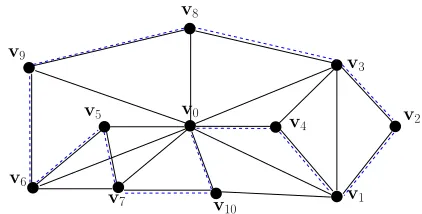
A single warehouse v0 serves a number of retailers vi, i = 1, . . . , n, each one facing a
demand di(t) unknown but bounded by pre-assigned values dimin ∈ R and dmaxi ∈ R at any
time period t ≥ 0. After demand di(t) has been realized, retailer vi must choose to either
fulfill the demand or not. The retailers do not hold any private inventory and, therefore, if they
wish to fulfill their demands, they must reorder goods from the central warehouse. Retailers
benefit from joint reorders as they may share the total transportation cost K (this cost could
also be time and/or players dependent). In particular, if retailer vi “plays” individually, the
cost of reordering coincides with the full transportation cost K. Actually, when necessary a
single truck will serve only him and get back to the warehouse. This is illustrated by the
dashed cycles(v0,v8,v0), (v0,v9,v0), and(v0,v10,v0)in the network of Figure 1. The cost
of not reordering is the cost of the unfulfilled demand di(t).
v3
v4
v1 v0
v2
v5
v6
v7
v8
v9
v10
(a) Five trucks (cycles) leaving v0 and serving coalitions
{v1, . . . ,v4}, {v5, . . . ,v7}, {v8}, {v9}, and {v10}
re-spectively.
v3
v4
v1 v0
v2
v5
v6
v7
v8
v9
v10
(b) One single truck (cycle) leavingv0 and serving
[image:9.612.317.528.430.537.2]coali-tion{v1, . . . ,v10}.
Fig. 1. Example of a distribution network
If two or more retailers “play” in a coalition, they agree on a joint decision (“everyone
reorders” or “no one reorders”). The cost of reordering for the coalition also equals the total
transportation cost that must be shared among the retailers. In this case, when necessary a
single truck will serve all retailers in the coalition and get back to the warehouse. This is
Figure 1(a). A similar comment applies to the coalition{v5,v6,v7}and the cycle(v0,v5,v6,v7,v0)
in Figure 1(a). The network topology in Figure 1(a) describes the existing coalitions. This
is clear if we look at the subgraph induced by the vertex-set {v1, . . . ,v10} (all vertices
exceptv0) and observe that such a subgraph has 5 connected components, i.e., {v1, . . . ,v4},
{v5, . . . ,v7}, {v8}, {v9}, and {v10} and that each component corresponds to an existing
coalition. The cost of not reordering is the sum of the unfulfilled demands of all retailers.
How the players will share the cost is a part of the solution generated by the bargaining
process.
Conversely, the subgraph induced by {v1, . . . ,v10} in Figure 1(b) has a single connected
component which means that all retailers “play” in the grand coalition and as such one single
truck (cycle) will leave v0 and serve all of them before returning to v0. This is represented
by the dashed cycle (v0,v4, . . . ,v10) in the same figure.
The cost scheme can be captured by a game with the set N = {v1, . . . ,vn} of players
where the cost of a nonempty coalition S ⊆N is given by
cS(t) = min
(
K,X
i∈S
di(t)
)
.
Note that the bounds on the demand di(t) reflect into the bounds on the cost as follows: for
all nonempty S ⊆N and t ≥0,
min
( X
i∈S
K, dmini
)
≤cS(t)≤min
(
K,X
i∈S
dmaxi
)
. (3)
To complete the derivation of the coalitions’ values we need to compute the cost savings
vS(t) of a coalitionS as the difference between the sum of the costs of the coalitions of the
individual players in S and the cost of the coalition itself, namely,
vS(t) =
X
i∈S
c{i}(t)−cS(t).
Given the bound forcS(t) in (3), the valuevS(t)is also bounded, as given: for any S⊂N
and t≥0,
vS(t)≤
X
i∈S
min{K, dmaxi } −min
(
K,X
i∈S
dmini
)
.
Thus, the cost savings (value) of each coalition is bounded uniformly by a maximum value.
Introducing time aspects into a static TU game opens the possibility for modeling aspects
dynamic coalitional game description should capture these features. In a repeated joint
replen-ishment game as the one discussed above, allocation rules having the properties formalized
in Problem 2.1, encourage patient retailers to “play” in the grand coalition, to coordinate
their replenishment policies and therefore to reduce total transportation costs. We say patient
retailers since condition i) in Problem 2.1 guarantees convergence to core on the long-run,
i.e., in an average sense. Condition ii) has the meaning of bounding the excesses during the
transient (before convergence occurs).
III. FLOW TRANSFORMATION BASED DYNAMICS
The basic idea of our solution approach is to recast the problem into a flow control one.
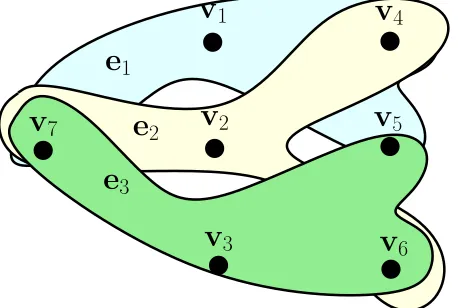
To do this, consider the hyper-graph H with vertex set V and edge set E as:
H:={V, E}, V ={v1, . . . ,vm}, E :={e1, . . . ,en}.
Figure 2 depicts an example of hypergraph for a 3-player coalitional game. The vertex setV
has one vertex per each coalition whereas the edge set E has one edge per each player. A
v
1v
2v
3v
4v
5v
6v
7e
1e
3 [image:11.612.194.423.407.561.2]e
2Fig. 2. HypergraphH:={V, E}for a3-player coalitional game.
generic edge i is incident to a vertex vj if the player i is in the coalition associated to vj.
So, incidence relations are described by matrix BHwhose rows are the characteristic vectors
cS ∈ Rn. We recall that the components of a characteristic vector cS
i = 1 if i∈S andcSi = 0
if i /∈ S. The flow control reformulation arises naturally if we view allocation ai(t) as the
corresponding vertex vj. In view of this, allocation in the core translates into over-satisfying
the demand at the vertices. Specifically,
a(t)∈C(v(t)) ⇔ BHa(t)≥v(t), (4)
with the last inequality satisfied with the equal sign due to the efficiency condition of the
core, i.e, Pi=1ai(t) =vm(t), where vm(t) denotes the mth component of v(t) and is equal
to the grand coalition value vN(t). Now, since v(t) is unobservable by the planner at time t,
we need to introduce some allocation error dynamics which accounts for the derivatives of
the excesses. Since ǫ(t) represents the coalition excess, we have:
˙
ǫ(t) =BHa(t)−v(t), v(t)∈ V. (5)
Note that the above differential equation admits a solution at least in the sense of Filippov
[14]. From (4) and by averaging and taking the limit in (5), we can reformulate Problem 2.1
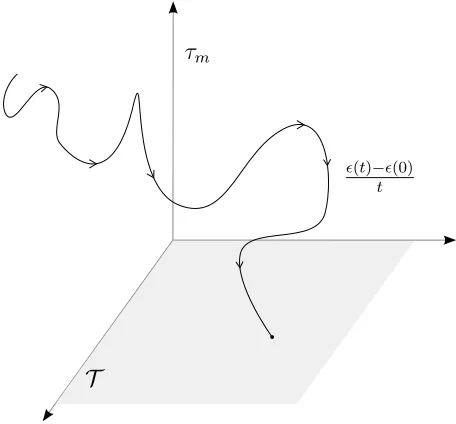
as a flow control problem where a controller wishes to drive the quantitylimt→∞ ǫ(t)−tǫ(0) to
the target set T, defined below, w.p.1 (see, e.g., Fig. 3):
T :={τ ∈Rm: τm = 0, τj ≥0, ∀j = 1, . . . , m−1}.
Note, τm = 0 due to efficiency of allocations.
τm
T
ǫ(t)−ǫ(0)
[image:12.612.191.419.447.659.2]t
Remark 3.1: Driving the average allocations to a particular pointanom ∈ A0 ⊆C(vnom)
re-sults in reaching a specific point in the target setT. To see this, note that whenlimt→∞a¯(t) =
anom we have T ∋BHanom−vnom≥0 due to the property of the core. Thus, we also have
that limt→∞ ǫ(t)−tǫ(0) is driven to the point BHanom−vnom ∈ T.
The inequality condition in (4) is transformed into equality type by introducing, from standard
LP techniques,m−1surplus variables (one per each coalition other than the grand coalition).
This increases the dimension of the control space of the planner from m to n+m−1 and
the dynamics (5) can be rewritten as follows:
˙
x(t) =Bu(t)−v(t), v(t)∈ V (6)
where B =
BH
−Im−1
0
∈ Rm×n+m−1. Variable x(t) represents the state of the system and captures deviation from the balanced system, i.e., the system characterized by anom and
vnom. We introduce the set of feasible controls as:
U :=u(t)∈Rn+m−1 :u(t) = [aT
(t) sT(t)]T, a(t)∈ A, s(t)≥0 . (7) Toward the reformulation of the problem as a stochastic stabilizability one, we introduce the
following preliminary result.
Lemma 3.1: If the variablex(t) is asymptotically stable almost surely, i.e., (8) holds true, then the average allocations converge to the core of the average game w.p.1. as expressed by
(9), and the excesses converge to the cone Rm+ w.p.1. as described in (10):
lim
t→∞x(t) = 0, w.p.1. (8) lim
t→∞¯a(t)∈C(vnom), w.p.1 (9) lim
t→∞ǫ(t)∈R
m
+, w.p.1. (10)
Proof: To see why (8) implies (9), observe that iflimt→∞x(t) = 0w.p.1. thenlimt→∞ x(t)−tx(0) = 0 w.p.1. and therefore, by integrating and dividing byt in (6) also limt→∞Bu¯(t)−¯v(t) = 0
w.p.1. The latter can be rewritten as limt→∞Bu¯(t) = vnom w.p.1, and as from (7) s¯(t) =
BH¯a(t)−¯v(t)≥0andvnomis balanced by Assumption 2 then we conclude thatlimt→∞¯a(t)∈
C(vnom) w.p.1.
To see why (8) implies (10), observe that if limt→∞x(t) = 0 w.p.1., from (7) and under
It is worth noting that condition (9) is part of Problem 2.1. In other words when solving
Problem 2.1 we always guarantee (9). If this is clear then, we can use the above lemma to
rephrase Problem 2.1. In doing this we need to make a partial distinction between cases i)
and ii). More specifically, case ii) where A0 =C(vnom) can be restated as follows:
Find u(t) :=φ(x(t))∈U such that lim
t→∞x(t) = 0 w.p.1. (11)
Note that if we wish to reach a specific pointanom then the condition (9) is only necessary
and the resulting problem is a stricter version of (11).
IV. MAIN RESULTS
In this section we present the three main results of this work. The first one relates to the
case where the planner has full observation on x(t) in which case the average allocation
can be driven to a specific point in the Core of the average game. The second result applies
to the case where the planner has partial observation on x(t), and convergence to the Core
can still be guaranteed but not to a specific point of the Core. The third result highlights
connections of the implemented solution approach to the approachability principle [9], [18]
and attainability principle [4], [19].
A. Full information case
In this section, we solve Problem 2.1 with A0 = anom and Σ0 = αt, t ≥ 0 with fixed α
under the assumption that the planner has full observation of the excesses ǫ(t) and therefore
x(t) as well. We recall that inferringx(t) from ǫ(t)is possible as the surplus s(t) is selected
by the planner. As we have said before, the problem that we solve is a stricter version of (11).
This version derives from augmenting the state of dynamics (6) as explained in the rest of this
section. Before introducing the augmentation technique let us assume that the fluctuations of
the coalitions’ values around the meanvnom are independent of the state x(t). We formalize
this in the next assumption where we denote by∆v(t) =v(t)−vnom the above fluctuations.
Assumption 4: The statex(t)and the coalitions’ values fluctuations∆v(t)are independent. Introducing the fluctuations ∆v(t) allows us to rewrite dynamics (6) in a more convenient
way. To do this, note first that, as u(t) = [a(t)T s(t)T]T and from Bu
nom = vnom, if anom
∆u(t) =u(t)−unom. Dynamics (6) can be rewritten as follows:
˙
x(t) =Bu(t)−v(t) = Bu(t)−(vnom+ (v(t)−vnom)) =Bu(t)−vnom−∆v(t)
= B(u(t)−unom)−∆v(t) =B∆u(t)−∆v(t)
We mentioned before that we will focus on a stricter version of (11). We do this by augmenting
the state as shown next. First, denote byB†a generic pseudo inverse matrix ofB and complete
matrices B and B† with matrices C and F such that
B C h
B† F
i
=I. (12)
Then, building upon the new square matrix
B
C
, let us consider the augmented system
˙
x(t) = B∆u(t)−∆v(t)
˙
y(t) = C∆u(t). (13)
Here we assume that v(t) is independent of y(t) as well. After integrating the above system
(see (14), right) we define a new variablez(t) as follows:
z(t) =h B† F
i
x(t)
y(t)
,
x(t)
y(t)
= B C
z(t). (14)
It turns out that to drive x(t) to zero w.p.1, and obtain unom as average allocation on the
long run, we can rely on a simple function φˆ(.), which depends on z(t). Before introducing
this function, for future purposes observe that the dynamics for z(t) satisfies the first-order
differential equation:
˙
z(t) = h B† F i
x˙(t)
˙ y(t)
= h B† F i
B
C
∆u(t)− h
B† F i
∆v(t)
0
= ∆u(t)−B†∆v(t).
(15)
Let ∆umin and ∆umax be the minimal and maximal values of ∆u(t) for the following
˙
x(t) =B∆u(t)−∆v(t)
˙
y(t) =C∆u(t) v(t)
u(t)
ˆ φ(z(t))
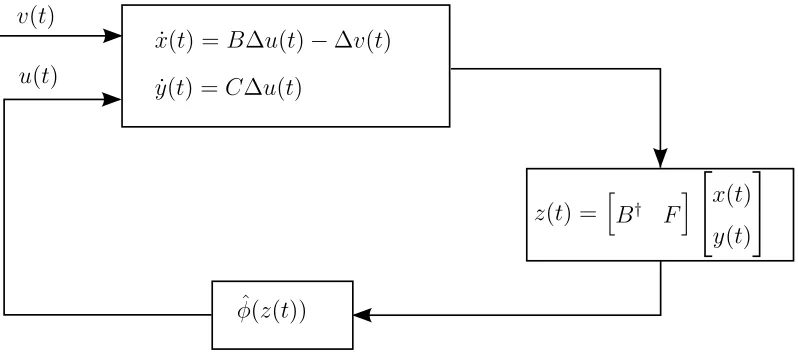
z(t) =hB† Fi
x(t)
y(t)
[image:16.612.109.508.78.254.2]
Fig. 4. Dynamical System
as:
ˆ
φ(z(t)) :=unom+ ∆u(t)∈U, ∆u(t) =sat[∆umin, ∆umax](−z(t)), (16) where with sat[a,b](ξ) we denote the saturated function that, given a generic vector ξ and
lower and upper bounds a and b of same dimensions as ξ, returns
sat[a,b](ξ)=.
bi for all i ξi > bi
ai for all i ξi < ai
ξi for all i ai ≤ξi ≤bi
.
Now, taking the controlu(t) = ˆφ(z(t)), we obtain the dynamic systemz˙(t) =Bφˆ(z(t))−v(t)
as displayed in Fig. 4. With the above preamble in mind, we are ready to state the following
convergence property.
Theorem 4.1: Using the controllerφˆ(z(t)), as in (16), we have limt→∞z(t) = 0 w.p.1 and
therefore limt→∞u¯(t) =unom.
In the next corollary, we use the previous result to provide an answer to Problem 2.1.
Corollary 4.1: The state x(t) is driven to zero w.p.1 as expressed in (11), the average allocation converges to the nominal allocation i.e.,limt→∞a¯(t) =anom, w.p.1 and the excesses
converge to the direction Σ0 =αt with α =snom, i.e., limt→∞ǫ(t)∈Σ0.
Proof: This is a direct consequence of the result proved in the previous theorem. From
(14), and [B† F] being a non singular matrix, we have lim
previous theorem we also have limt→∞u¯(t) = unom. Since u(t) = [aT(t) sT(t)]T, we have
that limt→∞¯a(t) =anom and limt→∞ǫ(t) = ˜s(t) =snomt.
To summarize, in the full information case, the controller u(t) defined by (16) induces an
allocation sequence a(t) such that the average¯a(t) converges to A0 =anom and the excesses
approach snomt.
B. Partial information case
In the previous section we observed that if the planner has full observation of the excesses
and therefore of x(t) then he can design an allocation rule so that the average allocations
are driven to anom and the excesses approach snomt. In this section, we solve Problem 2.1
with A0 = C(vnom) and under the assumption that the planner has partial observation of
x(t). In particular, we assume that the planner observes the sign of x(t) for all t ∈ R+. An
information structure based on the sign of x(t) has an oracle-based interpretation which we
discuss in detail in Subsection IV-B1.
Similarly to the previous section, suppose that we know a particular allocation anom in
the core C(vnom), and let us study the convergence properties of the average allocations.
In particular, using an allocation rule u(t) = φ(x(t)), we require that x(t) satisfying the
dynamics x˙(t) =Bφ(x(t))−v(t), converge to zero in probability. In this section, we state
the second main result of this work which provides a solution to Problem 2.1 with partial
information structure. To do this, let us denote again by B† a generic pseudo inverse matrix
of B and take a feasible allocation unom such that
Bunom =vnom:= lim
t→∞v¯(t), unom ∈U.
Also, for future purposes, define a function φˆ(.), which depends only on the sign of x(t), as
follows:
ˆ
φ(sgn(x(t))) :=unom+ ∆u(t)∈U, ∆u(t) =−δB†sgn(x(t)). (17)
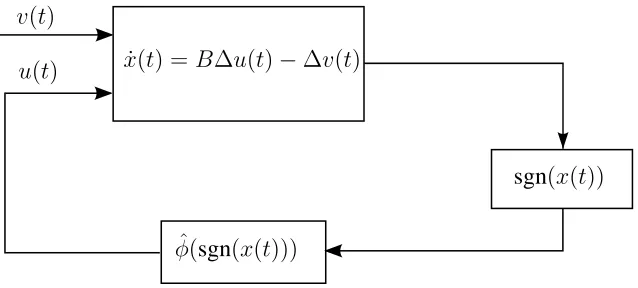
Now, taking the controlu(t) = ˆφ(sgn(x(t))), we obtain the dynamic systemx˙(t) =Bφˆ(sgn(x(t)))−
v(t) as displayed in Fig. 5. Now, we state the following convergence property.
Theorem 4.2: Using the controlleru(t) = ˆφ(sgn(x(t)))as in (17) we havelimt→∞x(t) = 0
w.p.1.
Corollary 4.2: The average allocation converges to the core of the average game as in (9)
˙
x(t) = B∆u(t)−∆v(t) v(t)
u(t)
ˆ
φ(sgn(x(t)))
[image:18.612.149.468.77.221.2]sgn(x(t))
Fig. 5. Dynamical System
Proof: Direct consequence of Theorem 4.2 and Lemma 3.1.
1) Oracle-based interpretation: In this subsection we elaborate more on the partial
infor-mation structure. In particular, we highlight how the feedback on state x(t) can be reviewed
as the result of an oracle-based procedure. To see this, assume that the planner knows the
sign of x(t). Since x(t) = (ǫ(t)−s˜(t))−(ǫ(0)−x(0)), sgn(x(t)) reflects over-satisfaction
of coalitions with respect to the threshold s˜(t). In particular, take without loss of generality
ǫ(0), x(0) = 0, then with reference to component j, the sign of xj(t) yields:
sgn(xj(t)) :=
1 ǫj(t)>s˜j(t)
0 ǫj(t) = ˜sj(t)
−1 ǫj(t)<s˜j(t).
(18)
To summarize, we can think of a situation where the planner approaches an oracle that tells
him the sign ofx(t). Sinces(t)is chosen by the planner for everyt, the accumulated surplus,
˜
s(t), is given as an input to the oracle. The oracle returns “yes” if the actual excess is greater
thans˜(t)and “no” otherwise. The use of an oracle is an element in common with the ellipsoid
method in optimization and with a large literature [26] on cutting planes.
Recall that nonnegativeness of the threshold has its roots in the feasibility conditionu(t)∈
U for all t ≥0 with feasible set U as in (7).
Nonnegativeness of the threshold provides us with a further comment on the information
available to the planner. Actually, from the first condition in (18), we can conclude that
coalitions associated to a positive statex(t)are certainly in excess. This is clear if we observe
content available to the planner as follows, where S is the generic coalition associated with
component j:
sgn(xj(t)) :=
1 then coalition S in excess
−1,0 nothing can be said.
Trivially, the development in the full information case in Section IV-A, which is all based
on control strategy (16), fits the case where x(t) is revealed completely. In this last case, the
fact that the planner knows x(t) implies that he knows ǫ(t) as well. Also, it is intuitive to
infer that in this last set up, exact knowledge ofx(t)can only influence positively the planner
in terms of speed of convergence of allocations to the core of the average game.
Remark 4.1: As the planner knows a priori the nominal game and a corresponding nominal
allocation vector, a natural question that arises is why one has to design an allocation rule
as given by (16) and (17) instead of a stationary rule φˆ(.) = unom. The rules given by (16)
and (17) intuitively translate to meeting the demands of coalitions in an average sense. This
feature reflects patience aspect of coalitions in a dynamic setting, i.e., even if a demand is
not met instantaneously a coalition is willing to wait and stay in the grand coalition as the
demand is fulfilled in an average sense.
C. Connections to Approachability and Attainability
1) Approachability: Approachability theory was developed by Blackwell in 1956 [9] and
is captured in the well known Blackwell’s Theorem. Along the lines of Section 3.2 in [18],
we recall next the geometric (approachability) principle that lies behind Blackwell’s Theorem.
The goal of this section is to show that such a geometric principle shares striking similarities
with the solution approach used in the previous sections.
To introduce the approachability principle, let Φbe a closed and convex set in Rm and let
P(y)be the projection of any point y∈Rm (closest point to y in Φ). Also denote by y¯ k the
average of y1. . . , yk, i.e., y¯k =
Pk t=0yt
k and let dist(¯yk,Φ) be the euclidean distance between
point y¯k and set Φ.
Lemma 4.1: (Approachability principle [18]) Suppose that a sequence of uniformly bounded
vectors yk in Rm satisfies condition (19),
[¯yk−P(¯yk)]T[yk+1−P(¯yk)]≤0, (19)
Now, to make use of the above principle in our set up, let us consider the discrete time
analog of the excess dynamics (6):
xk+1 =xk+B∆uk−∆vk,
and define a new variable yk =xk−xk−1 so that we can look at the sequence of yk in Rm.
Likewise, consider the discrete time version of control (17) as displayed below:
ˆ
φ(sgn(xk)) :=unom+ ∆uk ∈U, ∆uk =−δB†sgn(xk−x0). (20)
We are now in a position to state the main result of this section.
Theorem 4.3: Using the controller uk= ˆφ(sgn(xk−x0)) as in (20) we have that
i) the vector 0 is approachable by the sequence y¯k,
lim
k→∞y¯k= 0, w.p.1, (21)
and therefore
ii) the average allocations converge to the core of the average game,
lim
k→∞¯ak ∈C(vnom), w.p.1. (22)
The strength of the above result is in that it sheds light on how the convergence problem
dealt with in this work has a stochastic stability interpretation as well as an approachability
one.
Remark 4.2: (Continuous-time approachability) We can reformulate Theorem 4.3 in the
continuous time. To see this, let us first define y(t) := ˙x(t). Next we need to derive the
continuous time version of (19). To this aim, lett →r(t) be a differentiable continuous time
variable and let z(t) = r(t)−tr(0), so tz˙(t) +z(t) = ˙r(t). Discrete time versions are given as
zk = 1krk and zk+1 = k+11 rk+1. The approachability principle is given as
[zk−P(zk)]T [φ−P(zk)]≤0
where φ= (k+ 1)zk+1−kzk. In continuous time the above condition translates to
[z(t)−P(z(t))]T [φ−P(z(t))]≤0
and φ = (t + ∆t)z(t + ∆t)− tz(t) = t(z(t+ ∆t)−z(t)) + ∆tz(t + ∆t). We see that
φ
∆t =t
z(t+∆t)−z(t)
∆t +z(t+ ∆t). Further, as∆t→0we havelim∆t→0 φ
∆t =tz˙(t) +z(t) = ˙r(t).
The approachability principle in continuous time can then be reproposed as
which constitutes the continuous time version of (19). If Φ = {0} we have P(z(t)) = 0
and zT(t) ˙r(t) ≤ 0. Now, taking r(t) = x(t) we see that z(t) is the average of y(t). Then
condition (23) guarantees that z(t) converges to zero as well as y¯(t). But this implies that
limt→∞ x(t)−tx(0) = 0 and therefore from Lemma 3.1 we arrive at (9) which represents the
continuous time version of (22).
2) Attainability: Attainability is a new notion developed in [4], [19] in the context of
2-player continuous-time repeated games with vector payoffs. Attainability finds its roots in
transportation networks, distribution networks, production networks applications. The main
question is the following one: “Under what conditions a strategy for player 1 exists such that
the cumulative payoff converges (in the lim sup sense) to a pre-assigned set (in the space of
vector payoffs) independently of the strategy used by player 2”.
Attainability shares similarities with two main notions in robust control theory [10]. The first
notion is called robust global attractiveness and refers to the property of a set to “attract”
the state of the system under a proper control strategy and independently of the effects
of the disturbance. The second notion is referred to as robustly controlled invariance and
describes the property of a set to bound the state trajectory under a proper control strategy
and independently of the effects of the disturbance. Both notions are used in the following
formalization of the attainability principle. The principle is accompanied by a sketch of the
proof but no formal proof is reported as attainability is the main focus of another paper
and here it is just auxiliary to the solution of our main problem and also because the
aforementioned two notions are well known in robust control theory. We refer the readers to
[10] and [4], [19] for further details.
Let Φ be a closed and convex set in Rm and consider a differentiable continuous-time
variable t 7→y(t) taking value in Rm for all t≥0.
Lemma 4.2: (Attainability principle [4], [19]) Suppose that the differentiable
continuous-time variablet 7→y(t) satisfies conditions (24)-(25),
[y(t)−P(y(t))]T[ ˙y(t)−P(y(t))]<0, y(t)6∈Φ (24)
nT
y(t)[ ˙y(t)−P(y(t))]≤0, y(t)∈∂Φ, (25)
then limt→∞dist(y(t),Φ) = 0.
Essentially, condition (25) is strictly related to the subtangentiality conditions as formulated
controlled invariant sets. We provide a geometric perspective on such a condition in Fig. 7(b).
Consider a 2 player continuous-time repeated game and lety(t)be the cumulative payoff up
to timet. Denote by Y the set of possible instantaneous vector payoffs, call them y˙(t), for a
fixed strategy of player 1 and for varying strategy of player 2. Condition (25) is equivalent
toY ⊂H− :={y ∈Rm|n
y(t)y˙(t)≤0}and guarantees that the cumulative payoff up to time t+dt(dt is the infinitesimal time interval) y(t+dt) does not quit Φ.
As regards condition (24), suppose without loss of generality thatΦ := {x∈Rm|V(x)≤
ˆ
κ} for a fixed scalar κ. Condition (24) establishes that the set Φ = {x ∈ Rm|V(x) ≤ κˆ}
for any scalar ˆκ satisfying ˆκ > κ is a contractive set. By contractive set we mean that it is
invariant and, whenever the state is on the boundary, the control can “push it towards the
interior”. This is illustrated in Fig. 7(a). Let Y and y(t) have the same meaning as before.
Condition (24) establishes that Y ⊂ H− := {y ∈ Rm|[y(t)−P(y(t))]Ty˙(t) < 0} which
implies that dist(y(t+dt),Φ)< dist(y(t),Φ) and therefore Φis robustly attractive.
y(t)
y(t+dt)
˙
y(t)
Φ
H−
H+
Y
P(y(t))
(a) Robust global attractiveness: condition (24).
y(t)
y(t+dt) ˙
y(t)
Φ
H−
H+
Y
ny(t)
[image:22.612.117.302.370.515.2](b) Robust control invariance: condition (25).
Fig. 6. Geometric representation of conditions (24) and (25).
Based on the above lemma, we can rephrase Theorem 4.2 as follows.
Theorem 4.4: Using the controller u(t) = ˆφ(sgn(x(t))) as in (17) we have that the vector
V. DERIVATION OF THE MAIN RESULTS
A. Proof of Theorem 4.1
This proof is derived in the context of Lyapunov stochastic stability theory [20]. We start
by observing that using u(t) = ˆφ(z(t)) we have:
˙
z(t) = Bφˆ(z(t))−v(t). (26)
Consider a candidate Lyapunov function V(z(t)) = 1 2z
T(t)z(t). The idea is to show that
E[ ˙V(z(t))]<01 for all t≥0. Actually, the theory establishes that if the last condition holds true, then V(z(t))is a supermartingale and therefore by the martingale convergence theorem
limt→∞V(z(t)) = 0 w.p.1 (almost surely). To see that E[ ˙V(z(t))] < 0 is true, observe that
from (15) we have
E[ ˙V(z(t))] = E[zT(t) ˙z(t)]
= E[zT(t)∆u(t)]−E[zT(t)B†∆v(t)] = E[zT(t)sat(−z(t))]<0,
where conditionE[zT(t)B†∆v(t)] = 0 is a direct consequence2 of the assumption that∆v(t) is independent of x(t) and y(t). But the above condition implies that limt→∞V(z(t)) = 0
w.p.1 and therefore also limt→∞z(t) = 0 w.p.1. So far we have proved the first part of the
statement, i.e., that the dynamic system (26) converges to zero w.p.1. For the second part,
after integrating dynamics (15), we have
lim
t→∞ Rt
0[∆u(τ)−B
†∆v(τ)]dτ
t = limt→∞
z(t)−z(0) t = 0.
This last condition together with the assumption vnom := limt→∞v¯(t) yields lim
t→∞ Rt
0 B
†∆v(τ)dτ
t = limt→∞ Rt
0∆u(τ)dτ
t = 0
from which we can conclude limt→∞u¯(t) = limt→∞ Rt
0unom+∆u(τ)dτ
t = unom as claimed in
the statement.
1
Stochastic stability involves time derivative of the expectation of V(x(t)). However, since V(.) is non-negative and
smooth, the limit and expectation can be interchanged by using the dominated convergence theorem [27].
B. Proof of Theorem 4.2
Consider a candidate Lyapunov function V(x(t)) = 12xT(t)x(t). The idea is to show that
E[ ˙V(x(t))]<0 for all t ≥0. For this to be true, it must be
E[ ˙V(x(t))] = E[xT(t) ˙x(t)]
= E[xT(t)Bu(t)]−E[xT(t)v(t)]
= E[xT(t)Bunom] +E[xT(t)B∆u(t)]−E[xT(t)vnom]−E[xT(t)∆v(t)]
| {z }
=0
= E[xT(t)B∆u(t)]<0.
where condition E[xT(t)∆v(t)] = 0 is a direct consequence of Assumption 4. But the above
conditionE[xT(t)B∆u(t)]<0 is satisfied since B∆u(t) =−δsgn(x), which in turn implies
E[xT(t)B∆u(t)] =
E[−δkx(t)k1]<0.
Then we obtain thatlimt→∞V(x(t)) = 0 w.p.1 and therefore alsolimt→∞x(t) = 0w.p.1 and
this concludes the proof.
C. Proof of Theorem 4.3
We first prove that (21) implies (22). Invoking the discrete time reformulation of Lemma 3.1,
we can infer that limk→∞ xk−kx0 = 0 w.p.1. implies limk→∞¯ak ∈C(vnom), w.p.1. Observing
that y¯k = xk−kx0 then we can conclude that limk→∞y¯k = 0 w.p.1 implies limk→∞¯ak ∈
C(vnom), w.p.1.
We now prove that using the controlleruk = ˆφ(sgn(xk))as in (20) then (21) holds true. To
see this, let us invoke the approachability principle in Lemma 4.1 and observe that a sufficient
condition for approachability ofy¯k to0is y¯Tkyk+1 ≤0for all k. This is evident if we take set
Φincluding only the zero vector,Φ = {0}, and thusP(¯yk) = 0 in (19). For the present case,
using the definition of yk, condition y¯kTyk+1 ≤ 0 would be 1k(xk−x0)T(xk+1−xk) ≤ 0,
which implies(xk−x0)TB∆uk−(xk−x0)T∆vk≤0 for allk. Taking the expectation, from
Assumption 4 we know that E[(xk−x0)T∆vk] = 0 and so we can write
E[(xk−x0)TB∆uk−(xk−x0)T∆vk] = E[(xk−x0)TB∆uk]
= E[(xk−x0)TB(−δB†sgn(xk−x0))]≤0.
From the above condition we derive that y¯T
kyk+1 ≤ 0 w.p.1 for all k and this concludes our
D. Proof of Theorem 4.4
Let us invoke the attainability principle in Lemma 4.2 and observe that a sufficient condition
for x(t) to attain 0 w.p.1 is that
E[xT(t) ˙x(t)]<0, x(t)6= 0 (27)
E[ ˙x(t)] = 0, x(t) = 0. (28)
This is evident if we take setΦincluding only the zero vector,Φ ={0}, and thusP(x(t)) = 0
in (24) and (25). Now, observe that condition (27) is equivalent to condition E[ ˙V]<0 used
in the proof of Theorem 4.2. Condition (28) is also satisfied assgn(0) = 0and this concludes
our proof.
VI. NUMERICAL ILLUSTRATIONS
Consider a 3 player coalitional TU game, so m = 7, with values of coalitions in the
following intervals:
v({1})∈[0,4], v({2})∈[0,4], v({3})∈[0,4],
v({1,2})∈[0,4], v({1,3})∈[0,6],
v({2,3})∈[0,7], v({1,2,3})∈[0,12].
The convex set V is then a hyperbox characterized by the above intervals. From Assumption
3, the planner knows the long run average game, i.e., limt→∞¯v(t) = vnom. Without loss of
generality we take the balanced nominal game be asvnom = [1 2 3 4 5 6 10]T. In other words,
during the simulations we randomize the instantaneous games v(t)∈ V so that it satisfies the
average behavior given by:
lim
t→∞ 1 t
Z t
0
v(τ)dτ =vnom. (29)
Next, we describe an algorithm to generate P∈ ∆(V) and therefore v(t)∈ V such that the
above condition holds true.
By construction,vnom is in the relative interior of the convex hull generated by the columns
of the matrixR. If an instance of the gamev(t)is chosen asriwith probabilitypi from the pair
(R, p), Assumption 3 is satisfied. For simulations we ran the algorithm10times to generate10
Algorithm
Input: Set V and value vnom.
Output: Probability function P∈∆(V) to generate v(t)∈ V.
1 : Initialize Generate m random points, ri ∈ V ⊂ Rm, i =
1,2,· · · , m,
2 : Solve R.p=vnom, with R= [r1, r2,· · · rm],
3 : If p≥0 and 1Tp >0, then go to (4) else go to (1),
4 : Rescale R as R= 1TpR and p as p= p
(1Tp),
5 : If ri ∈ V, i= 1,2,· · ·, m, then go to (6) else go to (1).
6 : STOP
Matlab randsrc function) to realize v(t). The step size is set to ∆ = 0.05. The results
are averaged over the 10 pairs. The nominal choice of allocations and surplus is taken as
unom = [2.5 3 4.5 1.5 1 1.5 1.5 2 1.5]T. It can be verified that Bunom =vnom.
Full information case: The saturation thresholds ∆umin and ∆umax are chosen so as to
ensure u(t) ∈ U. This condition translates into Umin ≤ unom +sat[∆umin
, ∆umax
] ≤ Umax.
Denote 1 as a vector with all entries equal to 1. For the instantaneous game a negative
allocation/surplus is not allowed, so Umin ≥0·1. Further, an allocation/surplus greater than
the value of grand coalition is not allowed, so Umax ≤ vnom(N)·1. For the given game
parameters, we see that the lower and upper thresholds for the saturation function are −1
and 5.5, respectively. Next, we present the performance results of the robust control law
given by equation (16). From Theorem 4.1, limt→∞z(t) converges to zero w.p.1 and as
a result limt→∞ x(t)−tx(0) converges to zero. Fig. 7(a) illustrates this behavior for the first
component of coalition {1,2}. Further, by Corollary 4.1, the same control law ensures that
the average allocations converge to the nominal allocations in the long run, in other words
limt→∞¯a(t) =anom and Fig. 7(b) illustrates this behavior.
0 500 1000 1500 2000 2500 3000 3500 4000 4500 5000 −5 −4 −3 −2 −1 0 1 2 3 4
5x 10
−3
t– Allocation epoch
x{ 1 , 2 } ( t ) − x{ 1 , 2 } (0 ) t
(a) Plot of x{1,2}(
t)−x{
1,2}(0)
t
0 500 1000 1500 2000 2500 3000 3500 4000 4500 5000
−0.05 −0.04 −0.03 −0.02 −0.01 0 0.01 0.02 0.03 0.04 0.05
t– Allocation epoch
¯ a1(t)−a1nom
¯ a2(t)−a2nom
¯ a3(t)−a3nom
[image:27.612.330.516.89.241.2](b) Plot oflimt→∞¯a(t)−anom
Fig. 7. Performance of the control law given by (16).
translates to Umin ≤ unom+δB†sgn(x) ≤ Umax. We observe − P
j|B
†
ij| ≤ B†sgn(x)
i ≤
P
j|B
†
ij|. A conservative estimate of δ is obtained as Umin ≤ unom ±δmaxi{
P
j|B
†
ij|} ≤
Umax. For m = 7, we have maxi{
P
j|B
†
ij|} = 2.11. For the instantaneous game a negative
allocation/surplus is not allowed, so Umin ≥ 0.1. Furthermore, an allocation/surplus greater
than the value of grand coalition is not allowed, so Umax ≤ vnom(N).1. We chose δ = 1,
which satisfies the above stated requirements. Next, we present performance results of the
0 500 1000 1500 2000 2500 3000 3500 4000 4500 5000
−5 −4 −3 −2 −1 0 1 2 3 4
5x 10
−3
t– Allocation epoch
x{ 1 , 2 } ( t ) − x{ 1 , 2 } (0 ) t
(a) Plot of x{1,2}(
t)−x{
1,2}(0)
t
0 500 1000 1500 2000 2500 3000 3500 4000 4500 5000
−0.05 −0.04 −0.03 −0.02 −0.01 0 0.01 0.02 0.03 0.04 0.05
t– Allocation epoch
¯ a1(t)−a1nom
¯ a2(t)−a2nom
¯ a3(t)−a3nom
[image:27.612.329.516.497.644.2](b) Plot oflimt→∞a¯(t)−anom
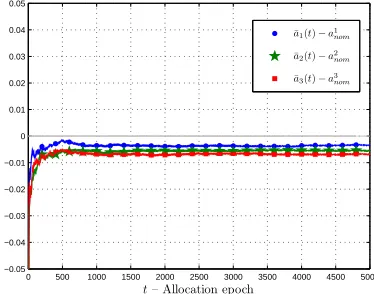
robust control law given by equation (17). From Theorem 4.2, x(t) converges to zero in
probability with a specific choice of control law and as a result limt→∞ x(t)−tx(0) converges
to zero. Fig. 8(a) illustrates this behavior for the first component of coalition {1,2}. Further,
by Corollary 4.2, the same control law ensures that the average allocations converge to the
core C(vnom) and from equation (17) it is clear that the instantaneous allocations lie in a
neighborhood of nominal allocations. As a result there is uncertainty in the convergence of
average allocations towards nominal allocations on the long run and Fig. 8(b) illustrates this
behavior.
VII. CONCLUSIONS
In this paper we studied dynamic cooperative games where at each instant of time the
value of each coalition of players is unknown but varies within a bounded polyhedron.
With the assumption that the average value of each coalition in the long run is known with
certainty, we presented robust allocations schemes, which converge to the core, under two
informational settings. We proved the convergence of both allocation rules using Lyapunov
stochastic stability theory. Furthermore, we established connections of Lyapunov stability
theory to concepts of approachability and attainability. The control laws or allocation schemes
are derived on the premise that the GD knows a priori, the nominal allocation vector. If this
information is not available then the problem can be treated as a learning process where
the GD is trying to learn the (balanced) nominal game from the instantaneous games. The
allocation rules designed in this paper assure stability of the coalitions in average, and as a
result capture patience and expectations of the players in an integral sense. The modeling
aspects of generic dynamic coalitional games are open questions at this point of time.
REFERENCES
[1] S.Z. Alparslan G¨ok, S. Miquel, and S. Tijs, “Cooperation under interval uncertainty”, Mathematical Methods of
Operations Research, vol. 69, no. 1, 2009, pp. 99–109.
[2] T. Arnold., U. Schwalbe, “Dynamic coalition formation and the core”, Journal of Economic Behavior and Organization,
vol. 49, 2002, pp. 363–380.
[3] D. Bauso, F. Blanchini and R. Pesenti, “Optimization of Long-run Average-flow Cost in Networks with time-varying
unknown demand”, IEEE Transactions on Automatic Control, vol. 55, no. 1, pp. 20-31, 2010.
[4] D. Bauso, E. Lehrer, and E. Solan, “Attainability in Repeated Games with Vector Payoffs”, arXiv:1201.6054v1, 29
[5] D. Bauso and P. V. Reddy, “Learning for allocations in the long-run average core of dynamical cooperative TU Games”,
in Proc. of the 48th Annual Allerton Conference on Communication, Control, and Computing, University of Illinois,
USA, Oct. 2010, pp. 1165-1170.
[6] D. Bauso and P. V. Reddy, “Robust allocation rules in dynamical cooperative TU Games”, in Proc. of the 49th IEEE
Conf. on Decision and Control, Atlanta, Georgia, USA, Dec 2010, pp. 1504–1509.
[7] D. Bauso and J. Timmer, “Robust Dynamic Cooperative Games”, International Journal of Game Theory, vol. 38, no.
1, 2009, pp. 23–36.
[8] D. P. Bertsekas and I. B. Rhodes, “On the Minimax Reachability of Target Sets and Target Tubes”, Automatica, vol.
7, pp. 233–241, March 1971.
[9] D. Blackwell, “An analog of the minimax theorem for vector payoffs”, Pacific J. Math., vol. 6, no. 1, 1956, pp. 1–8.
[10] F. Blanchini, “Set invariance in control – a survey”, Automatica, vol 35, no. 11, 1999, pp. 1747–1768.
[11] L. Carpente, B. Casas-Mndez, I. Garca-Jurado and A. van den Nouweland “Coalitional Interval Games for Strategic
Games in Which Players Cooperate”, Theory and Decision, vol. 65, no. 3, 2008, pp. 253-269.
[12] J.C. Cesco, “A convergent transfer scheme to the core of a TU-game”, Revista de Matem´aticas Aplicadas, vol. 19, no.
1-2, 1998, pp. 23–35.
[13] J.A. Filar and L.A. Petrosjan, “Dynamic Cooperative Games”, International Game Theory Review vol. 2, no. 1, 2000,
pp. 47–65.
[14] A.F. Filippov, “Differential equations with discontinuous right-hand side”, Amer. Math. Soc. Transl. (Orig. in Russian
in Math. Sbornik 5 pp.99-127 (1960)) vol. 42, 1964, pp. 199-231.
[15] J. H. Grotte, “Dynamics of cooperative games”, International Journal of Game Theory, vol. 5, no. 1, 1976, pp. 27–64.
[16] A. Haurie, “On some Properties of the Characteristic Function and the Core of a Multistage Game of Coalitions”,
IEEE Transactions on Automatic Control, vol. 20, no. 2, 1975, pp. 238–241.
[17] L. Kranich, A. Perea, H. Peters, “Core concepts in dynamic TU games”, International Game Theory Review, vol. 7,
2005, pp. 43–61.
[18] E. Lehrer, “Allocation Processes in Cooperative Games”, International Journal of Game Theory, vol. 31, 2002, pp.
341–351.
[19] E. Lehrer, E. Solan, and D. Bauso, “Repeated Games over Networks with Vector Payoffs: The Notion of Attainability”,
in Proc. of the Int. Conf. on NETwork Games, COntrol and OPtimization (NetGCooP 2011), 12-14 Oct. 2011, Paris.
[20] K. A. Loparo, X. Feng, “Stability of stochastic systems”, In The Control Handbook. CRC Press, 1996.
[21] W. Saad, Z. Han, M. Debbah, A. Hjørungnes, T. Bas¸ar, “Coalitional game theory for communication networks: A
tutorial”, IEEE Signal Processing Magazine, Special Issue on Game Theory, vol. 26, no. 5, 2009, pp. 77–97.
[22] A. Sengupta, K. Sengupta, “A property of the core”, Games and Economic Behavior, vol. 12, 1996, pp. 266–273.
[23] J. Suijs and P. Borm, “Stochastic Cooperative Games: Superadditivity, Convexity, and Certainty Equivalents”, Games
and Economic Behavior, vol. 27, no. 2, 1999, pp. 331–345.
[24] J. Timmer, P. Borm, and S. Tijs, “On three Shapley-like solutions for cooperative games with random payoffs”,
International Journal of Game Theory, vol. 32, 2003, pp. 595–613.
[25] J. von Neumann, and O. Morgenstern, Theory of Games and Economic Behavior, Princeton, NJ: Princeton Univ. Press,
Sept. 1944.
[26] L. A. Wolsey and G. L. Nemhauser, “Integer and Combinatorial Optimization”, Wiley-Interscience, June 1988.