This is a repository copy of Resource determinants of strategy and performance: The case of British exporters.
White Rose Research Online URL for this paper: http://eprints.whiterose.ac.uk/86724/
Version: Accepted Version
Article:
Beleska-Spasova, E., Glaister, K.W. and Stride, C. orcid.org/0000-0001-9960-2869 (2012) Resource determinants of strategy and performance: The case of British exporters.
Journal of World Business, 47 (4). pp. 635-647. ISSN 1090-9516 https://doi.org/10.1016/j.jwb.2011.09.001
Article available under the terms of the CC-BY-NC-ND licence (https://creativecommons.org/licenses/by-nc-nd/4.0/)
Reuse
This article is distributed under the terms of the Creative Commons Attribution-NonCommercial-NoDerivs (CC BY-NC-ND) licence. This licence only allows you to download this work and share it with others as long as you credit the authors, but you can’t change the article in any way or use it commercially. More
information and the full terms of the licence here: https://creativecommons.org/licenses/
Takedown
If you consider content in White Rose Research Online to be in breach of UK law, please notify us by
Resource determinants of strategy and performance:
The case of British exporters
Elena Beleska-Spasova
(Corresponding author)
Lecturer in International Business
School of Management, Henley Business School University of Reading
Henley-on-Thames, Oxon, RG9 3AU, UK Tel. +44 (0) 118 378 7194
Fax: +44 (0) 114 222 3348
Keith W. Glaister
Dean and Professor of International Strategic Management The Management School
The University of Sheffield 9 Mappin Street Sheffield, S1 4DT, UK Tel. +44 (0) 114 22 23364 Fax: +44 (0) 114 222 3348
Chris Stride
Statistician, Institute of Work Psychology The University of Sheffield
Abstract
This study adopts the RBV of the firm in order to identify critical
advantage-generating resources and capabilities with strong positive export strategy and
performance implications. The proposed export performance model is tested
using a structural equation modeling approach on a sample of 356 British
exporters. We examine the individual as well as the concurrent (simultaneous)
direct and indirect effects of five resource bundles on export performance. We
find that four resources/capabilities: managerial, knowledge, planning, and
technology, have a significant positive direct effect on export performance,
while relational and physical resources exhibited no unique positive effect. We
also find that the firm‟s export strategy mediates the resource-performance
nexus in the case of managerial and knowledge-based resources. The
theoretical and methodological grounding of this study contributes to the
advancement of export related research by providing better specification of the
nature of the effects – direct or indirect – of particular resource factors on
export performance.
Resource determinants of strategy and performance:
The case of British exporters
Introduction
Empirical evidence suggests that in times of economic slowdown many firms,
adversely affected by the recession, intensify their exporting efforts (Rao,
Erramilli, & Ganesh, 1990). The economic and financial crisis of 2008/2009
has brought some of the toughest economic conditions many businesses have
had to face in quite some time. The shrinking of domestic economies has
forced many firms to seek relief by considering overseas markets. Given the
increasing competition in international markets at a time when there is a
falling demand due to the economic recession worldwide, it is important for
firms to understand their key competitive advantages, and transform them into
a successful strategy to produce favourable export performance outcomes.
In an attempt to deal with the consequences of the recession (shrinking
domestic markets, falling GDP and rising unemployment), and given the
potential benefits of exporting, many national governments are also under
increasing public pressure to actively look for ways to help smaller businesses
initiate or expand their exporting activities. In order to create effective export
support programs it is important for the policy-makers to understand the
factors that enable exporting firms to compete successfully in the international
This study aims to contribute to this debate, and influence initiatives
that may follow, by identifying the critical advantage-generating resources and
capabilities with strong positive export strategy and export performance
implications. How some firms achieve superior international performance
relative to others in the same market is one of the critical issues in
international strategic management. This issue is also inextricably bound up in
questions such as why firms differ, how firms choose strategies, and what is
the main source of competitive advantage that generates superior performance
in the international context. The proponents of the resource-based view (RBV)
suggest that the idiosyncratic, immobile strategic resources owned or
controlled by a firm are its source of competitive advantage (Penrose, 1959;
Wernerfelt, 1984). Firms will have a different mix of resources/competencies
and resource/competence gaps, and their strategic responses to these allow for
the possibility of different paths to growth and internationalization (Bell,
Young, & Crick, 1998), and consequent heterogeneity in the international
performance of firms.
Drawing on the RBV of the firm we develop and test a relational
model of the firm‟s resources, export strategy and export performance. The
empirical validation of the proposed model and its hypothesised relationships
addresses a number of research gaps in the existing export performance
literature. First, there is a lack of empirical validation of RBV-grounded
RBV-anchored research has put forward a number of theoretical export performance
models, but very few attempts have been made to test these models
empirically (Wernerfelt, 1984; Collis, 1991; Mahoney and Pandian, 1992;
Fahy, 2002). Furthermore, this study tests the model on an original set of
primary data while most of the previous studies derive their findings from
secondary data or by aggregating findings from previous studies. For example,
Aaby and Slater‟s (1989) “Strategic Export Model” is based on a synthesis of
the findings of 55 empirical papers published between 1978 and 1988. More
recently, Wheeler, Ibeh and Dimitratos (2008) proposed an integrative
resource-based framework of export performance reflecting the aggregate
findings from 33 export performance studies undertaken among UK firms
during the 1990–2005 period.
Second, the review of the relevant literature indicates that there is a
lack of published studies that investigate and empirically validate the
resource-performance relationship on a comprehensive pool of firm-specific
resources and capabilities. Empirical studies of the above and other complex
models have been conducted mostly by focusing on a single resource or a
group of resources, the choice determined by the focus of the study (for
example, innovation focused studies primarily consider advanced technology
resources and capabilities).
Third, given the limited research employing comprehensive sets of
concurrent (simultaneous) relationship of resources with export strategy and
export performance. Prior empirical studies have been conducted mostly by
focusing on the individual relationships of a single resource or a group of
resources. We maintain that it is equally important to assess the relationship
between a specific resource and the firm‟s export strategy and export
performance relative to and whilst controlling for the impact upon strategy and
export performance of the levels of all other resources owned or controlled by
the firm.
Fourth, even though the mediating role of export strategy in the
resource-performance relationship has been advanced and well-argued in a
number of studies, the empirical validation of this proposition is very limited.
In this study, we investigate and empirically validated the extent to which
export strategy mediates the effects of the firm-specific resources and
capabilities upon export performance.
This study addresses these research gaps by making the following
contributions. First, it advances and empirically validates a resource-based
integrative framework of export performance that encompasses a
comprehensive list of firm-specific resources and capabilities, compiled from
prior empirical evidence of their relationship with export strategy and export
performance, grouped into five factors – managerial resources,
knowledge-based resources, organizational resources and capabilities, relational
well as concurrent relationships of these resource factors with export strategy
and export performance. Third, we investigate the degree of the mediating
influence of export strategy on the resource-performance relationship.
In the next section we provide an overview of the theoretical context of
the RBV, outline the proposed model and develop the hypotheses of the study.
The paper proceeds with a description of the sample and methodology, results,
discussion and implications.
Resources, capabilities, strategy and export performance
Edith Penrose, one of the first scholars to recognize the importance of
resources for the firm‟s competitive advantage and performance, defined a
firm as a collection of productive, heterogeneous physical and human
resources it owns or controls (Penrose, 1959). The RBV stream of strategy
research is based on the assumptions that firms within an industry are
heterogeneous with respect to the resources they control, and that these
resources are not perfectly mobile across firms, making the heterogeneity
sustainable and long lasting (Barney, 1991). Not all resources have equal
strategic importance or the potential to be a source of sustainable competitive
advantage for the firm. Advantage-generating resources, according to Barney
(1991), must have the following four attributes: (1) they must be valuable and
unique to the firm; (2) they must be in short supply or rare; (3) they must be
Resource asymmetries generate resource-based competitive advantage and
become the driving factor of the firm-level performance differences.
Prior RBV anchored research has put forward a number of theoretical
export performance models but very few attempts have been made to test
these models empirically (Wernerfelt, 1984; Collis, 1991; Mahoney and
Pandian, 1992; Fahy, 2002). Wheeler et al., (2008) employed a resource-based
framework in integrating and interpreting influences on export performance
identified in 33 export performance studies undertaken in the UK between
1990 and 2005. Their analysis of the aggregate empirical evidence indicates
that certain firm-specific resources are consistently found to have positive
implications for firm performance. The overall empirical evidence suggests
that the following capabilities and resources have a critical influence on export
performance: the management‟s experiential, orientational and attitudinal
resources; organizational capabilities in export knowledge and planning;
product innovation and service delivery; and the ability to leverage
strategically-important relational resources. The inclusion of relational
resources enhances the explanatory power of the RBV concept by bridging the
internal-external divide. RBV grounded models continue to be refined and
empirically tested with varying degrees of support for their central
propositions (Newbert, 2007). This study extends the existing empirical
literature by testing a resource-based model of export performance.
The central proposition of the RBV is that a firm‟s superior performance
relative to the performance of other firms in the same market can be achieved
by acquiring, managing and exploiting unique firm-specific resources. RBV
has proven to be a sound theoretical base for developing and testing export
models. Building on the propositions and findings of the earlier studies, a
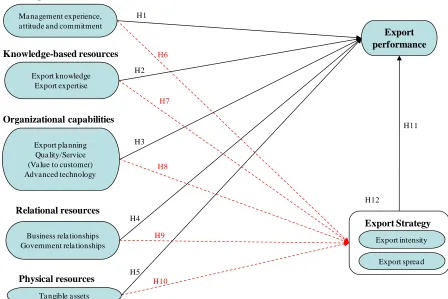
resource-based model of export performance is presented in Figure 1. This
model extends the earlier work in three ways. Firstly, it integrates and
simultaneously tests the effects upon performance of a far wider pool of
firm-specific resources than the majority of prior studies. Secondly, it examines the
relative importance of different resources and resource bundles and their
relationship with the export strategy and performance of the firm. Finally, it
investigates the extent to which export strategy mediates the effects of these
resources upon export performance.
[Insert Figure 1 Here]
Resources and export performance
The export performance of a firm reflects a firm-specific behaviour in
leveraging its resources and capabilities in an international context at a given
point of time. Firm export performance is regarded as one of the key
indicators of the success of a firm‟s export operations, and has been an
extensively studied phenomenon. Numerous studies have been conducted
pertaining to provide a better understanding of the factors (firm- or
exporting a successful venture. Since the pioneering work of Tookey (1964) in
identifying export success factors, the relationship between export
performance determinants and export outcomes has been the subject of
analysis in over one hundred empirical studies (Katsikeas, Leonidou, &
Morgan, 2000). In an extensive literature review, Gemunden (1991) counted
over 700 variables that were advanced and analysed as determinants of export
performance. In general, the export performance determinants are viewed as
either external, environmental influences (managerially uncontrollable, such
as industry characteristics, domestic and foreign market characteristics) or as
internal influences, often labelled as managerially controllable factors (Aaby
and Slater, 1989; Zou and Stan, 1998; Katsikeas et al., 2000).
Studies examining the internal factors are also grounded in the RBV
approach. Over the past 40 years researchers have identified and tested a
number of internal influences. Following the logic and findings of earlier
models in this study the firm-specific resources are grouped into five resource
groups as presented in Figure 1. These are managerial resources,
knowledge-based resources, organizational capabilities, relational resources, and physical
resources. The categorization of the factors into the five groups was also
undertaken by making clear distinction between what constitutes a resource
and a capability. The distinction was made by employing Hall‟s (1992)
definition of capabilities as what the firm „does‟ as opposed to what it „has‟.
firm-specific factors that are largely seen as more dynamic,
knowledge/process-based aspects of resources (Foss, 1997), or services obtained from resources
(Penrose, 1959). Capabilities are often differentiated as accumulated
knowledge and skills that enable the firm to utilize and enhance the value of
its resources (Murray, Gao & Kotabe, 2011). Furthermore, empirical evidence
suggests that in an international context firm capabilities are more important
than resources in explaining heterogeneous export performance (Hall, 1992;
Fahy, 2002; Kaleka, 2002).
Previous research has found strong evidence of a significant
relationship between each of the resource factors in the framework outlined
above and the firm‟s international performance. Examples include: the top
management‟s knowledge and experience of, and attitudes and commitment
to, international activities (Reid, 1983; Aaby and Slater, 1989; Oviatt and
McDougall, 1994; Zou and Stan, 1998; Jones, 1999; Katsikeas et al., 2000;
Ibeh and Young, 2001; Ibeh, 2003; Ibeh and Wheeler, 2005; Maurel, 2009;
Stoian, Rialp, & Rialp, 2011); export market knowledge, and export expertise
(Kogut and Zander, 1992; Conner and Prahalad, 1996; Grant, 1996; Morgan,
Zou, Vorhies, & Katsikeas, 2003; Stoian et al., 2011); export planning
capabilities (Cavusgil and Nevin, 1981; Madsen, 1987; Aaby and Slater,
1989; Bell, 1995; Zou and Stan, 1998; Etemad and Lee, 2003; Dhanaraj and
Beamish, 2003; Ibeh and Wheeler, 2005;), marketing mix competences (Aaby
capabilities (McGuinness and Little, 1981; Burton and Schlegelmilch, 1987;
Madsen, 1989; Cavusgil, Zou, & Naidu, 1993; Styles and Ambler, 1994;
Rodriguez and Rodriguez, 2005); business and government relational
resources (Madsen, 1987; Coviello and Munro, 1997; Srivastava, Shervani, &
Fahey, 1998; Zou and Stan, 1998; Crick and Jones, 2000; Etemad and Lee,
2003; Ray, Barney, & Muhanna, 2004; Ibeh and Wheeler, 2005; Styles,
Patterson, & Ahmed, 2008; Lages, Silva, & Styles, 2009); and physical
resources (Penrose, 1959; Bilkey, 1978; Reid, 1983; Miesenbock, 1988; Ford
and Leonidou, 1991; Chetty and Hamilton, 1993; Zou and Stan, 1998; Ibeh
and Wheeler, 2005).
Hence we hypothesise:
Hypothesis 1: Management resources will have a significant positive effect
on a firm’s export performance.
Hypothesis 2: Knowledge-based resources will have a significant positive
effect on a firm’s export performance.
Hypothesis 3: Organisational capabilities will have a significant positive
effect on a firm’s export performance.
Hypothesis 4: Relational resources will have a significant positive effect
on a firm’s export performance.
Hypothesis 5: Physical resources will have a significant positive effect on
The mediating influence of export strategy
Resources and export strategy
For a firm to outperform its competitors it must display a consistency between
its resources and the environment as well as between its resources and the
strategic choices it makes (Fahy, 1998). Each strategic approach will place
unique demands on the firm‟s resources. For example, drawing on the RBV of
the firm, Dhanaraj and Beamish (2003) developed a causal model of
resources, export strategy and export performance. The tests of the causal
relationships demonstrated that enterprise resources, technological intensity
and firm size are good predictors of export strategy, and export strategy was
shown in turn to positively influence firm performance in the case of U.S. and
Canadian exporters. Bell, McNaughton, Young and Crick (2003) found that
differences in motivation, objectives, and knowledge intensity influence the
strategic approaches adopted by firms in the case of SMEs. Collis‟ (1991)
study of the global bearings industry indicated that the performance of certain
firms was related to their possession of key resources, that structural changes
were made to facilitate resource development and that an organization‟s
heritage constrained its strategic choices.
In the international business literature, and in our proposed
resource-strategy-performance model (Figure 1), the export strategy construct is
represented by two measures: export intensity (the percentage share of the
number of countries the firm currently exports to). Export intensity has been
employed more as a performance indicator than strategy measure in many of
the export models advanced in prior studies (Gemunden, 1991). However, a
high share of foreign sales in the total sales of a firm does not actually say
how successful that company‟s international operations are. It merely shows
that the firm has a higher degree of internationalization and hence it could be
argued that it is actually an outcome of that firm‟s international strategy –
growth-oriented firms will have a higher degree of export intensity (Dhanaraj
and Beamish, 2003). Export spread (export market scope) is considered a good
indicator of a firm‟s choice of market expansion and geographic
diversification strategies (regional or concentration strategy versus global or
spread strategy). The concentration of resources and marketing efforts on a
relatively small number of foreign markets is an indication of execution of
market concentration strategy, and the spread of resources and activities across
as many markets as possible implies execution of market spreading strategy.
Viewed in this way, export intensity and export spread are indicators
representing the outcomes of a firm‟s export strategy.
The proposed model treats export strategy as a mediating construct
shaped by the firm‟s resources, which in turn has a direct impact on export
performance. Building on Penrose (1959) and consequent RBV theoretical
resources and capabilities detailed above will all have a direct impact upon a
firm‟s export intensity and export spread.
Hence we test the following hypotheses:
There is a significant positive relationship between:
Hypothesis 6: Managerial resources and the firm’s export strategy
(quantified by export intensity and spread).
Hypothesis 7: Knowledge-based resources and the firm’s export
strategy.
Hypothesis 8: Organisational capabilities and the firm’s export
strategy.
Hypothesis 9: Relational resources and the firm’s export strategy.
Hypothesis 10: Physical resources and the firm’s export strategy.
Export strategy and performance
Having a defined export strategy or any form of strategic orientation in
planning and organizing for exporting seems to have beneficial implications
for export performance (Aaby and Slater, 1989; Zou and Stan, 1998; Dhanaraj
and Beamish, 2003; Ibeh and Wheeler, 2005). For example, Aaby and
Slater‟s (1989) “strategic export model” implies that a firm‟s competences and
strategy have a direct and significant influence on their performance, whereas
firm characteristics are less important. The choice of a specific exporting
to be mostly insignificant (Madsen, 1987; Zou and Stan, 1998). The export
strategy in our model has two strategic concepts: export intensity and export
spread.
The relationship between the export intensity (degree of
internationalization) and a firm‟s export performance is a well-researched
topic resulting in inconsistent and contradictory findings, ranging from
positive relationship to negative linear relationships, and non-linearity in the
form of U-shaped, inverted U-shaped, and horizontal S relationships (Li,
2005; Contractor, 2007; Ruigrok, Amann, & Wagner, 2007). There is also
considerable empirical evidence of the impact of a specific export strategy
(market concentration or market spreading) on the export performance of the
firm, with contradictory evidence as to which strategy results in better
performance (Hirsch and Lev, 1973; Tookey, 1975; Hamermesh, Anderson, &
Harris, 1978; Attiyeh and Wenner, 1981; Piercy, 1981; Cooper and
Kleinschmidt, 1985; Lee and Yang, 1990; Marandu, 2009). The general
assertion is that conceptually, increasing internationalization should enhance a
company‟s performance since it enables optimization of the cost/benefit ratio
of internationalization and maximizes its performance (Contractor, 2007;
Hennart, 2007). In order to validate these findings we test the following
hypotheses:
Hypothesis 11: A firm’s export strategy (export intensity and spread)
Hypothesis 12: Export strategy (export intensity and spread) will
mediate the relationship between a firm’s resources and the firm’s
export performance.
Data collection and analysis
Sample and data collection
The sampling frame for this study was compiled from the British Exporters
Database (BED) 2007 (www.exportuk.co.uk). This database was validated by
cross-referencing it with the TradeYorkshire Business Database (UK Trade &
Investment), and the list of winners of the Queen‟s award for excellence in
exporting for the previous five years. In selecting the sampling frame the
following search criteria were applied: firms should be current exporters, they
must have been active exporters in the last five years or longer, and they
should be both independent and indigenous.
Given the nature of the information requested, the export
manager/director was deemed to be the most suitable source and was therefore
the primary target to receive the survey. For companies without a designated
export manager, the top executive of the company was contacted. Based on
the above criteria the search procedure generated a list of 1,505 indigenous
British exporting companies with data on their top management and their
personal e-mails. A pilot survey, sent to ten managing directors of exporting
companies across the UK, randomly selected from the sampling frame, was
sources of bias. Pilot respondents were asked for feedback regarding the
clarity of the terminology used, any ambiguity of the questions and concepts
investigated, and the ease of completion. Their comments indicated that the
research questions were relevant, with terminology and concepts both
appropriate and clear.
The primary dataset was collected at the firm level via an
internet-based survey questionnaire, designed and conducted adhering to the principles
of the Tailored Design Method (TDM) proposed by Dillman (2000). The use
of an Internet based survey was deemed the most time- and cost-effective tool
for administering the survey questionnaire to a sample of this size and type.
Participants, especially privately owned firms, were expected to be highly
sensitive to requirements to disclose their financial data, particularly objective
data. Hence, in order to reduce the risk of a low response rate, participants
were asked for relative data about their sales and profitability.
After three rounds of contact attempts, 356 completed surveys were
received, resulting in an effective response rate of 23.7%. Non-response bias
was assessed by the use of wave analysis, in which first-wave responses are
compared with second-wave answers (Armstrong and Overton, 1977). In this
survey, 191 firms responded to the first e-mail contact, with 165 responding
only after receiving a second or third e-mail request. To examine the
relationships between response time and key study variables (such as number
t-tests were employed. There was no evidence of any significant relationships
at the p < 0.05 level between study variables and wave of response. Within the
356 completed surveys there was a very minor amount of missing data across
the survey items (< 15 cases for any one item), with no evidence of
non-random item non-response.
Measures
Based on a comprehensive literature review, a list of the potential resources
conceptualized and empirically tested in RBV studies over the past 40 years
was compiled. The broader view of resources is frequently used
interchangeably with terms and concepts such as “competences”,
“capabilities”, or “dynamic capabilities”, which are largely seen as more
dynamic, knowledge/process-based aspects of resources (Foss, 1997), or
services obtained from resources (Penrose, 1959). Some researchers consider
resources (tangible and intangible) and capabilities as two distinct sources of
competitive advantage, with capabilities being more important than resources
in explaining firms‟ heterogeneous export performance (Hall, 1992; Fahy,
2002; Kaleka, 2002). In this study, particular attention was paid to making a
clear distinction between firm-specific resources and firm-specific
capabilities.
Considering the empirical evidence of the relationship between each
resource/capability and both export strategy and export performance, this
common classification used by the RBV scholars and our hypothesised
structure, these 37 resources were grouped into five sets, namely: physical,
managerial, organizational, relational, and knowledge-based resources. Full
details of these 37 resources and their categorization are given in Appendix 1.
We measured the extent of each of these 37 firm-specific resources using
perceptual measures, asking the manager to appraise the firm‟s
ownership/control of each resource, via a Likert-type five-point response
coding ranging from „strongly disagree‟ (1) to „strongly agree‟ (5). The use of
perceptual measures in combination with Likert-type scales is a common
practice in the export literature, as it has been proven to be successful in
improving response rates, particularly in the case of smaller firms which are
more reluctant to disclose their factual data (Dhanaraj and Beamish, 2003;
Zou, Taylor, & Osland, 1998).
The extensive array of indicators employed in the export performance
literature is a reflection of the difficulties in accessing export performance data
as well as the on-going search for consistent and comprehensive measures. For
example, Katsikeas, Leonidou and Morgan (2000), in their analysis of 100
export-related articles identified 42 different performance indicators (23
economic, 14 non-economic, and 5 generic). Measures of export performance
are usually categorized into two broad groups: (i) financial/economic
measures (sales-related indicators, profit-related indicators, or market
export success, achievement of export objectives, satisfaction with export
performance, or strategic export performance). While in the early empirical
studies export performance was operationalized as a unidimensional or
single-item measure (Gemunden, 1991), the more recent research has advanced more
complex export performance constructs in the form of multidimensional,
multi-item measures (Zou et al., 1998; Lages and Lages, 2004).
Recognizing the reluctance of the privately owned companies to
disclose financial data (Brouthers and Xu, 2002), data on export performance
was derived from measures reflecting the manager‟s perception of the level
and the relative importance of the firm‟s export performance over the past five
years, specifically by employing the EXPERF scale developed by Zou et al.
(1998). It may be argued that this composite, three-dimensional scale
comprising financial and strategic export performance measures, and measures
of satisfaction with the export venture, bridges the divide between other
objective and subjective performance measures. This scale has been
empirically validated in a cross-national study of U.S. and Japanese exporters
(Zou et al., 1998) as well as in a study of the UK and Australian exporters
(Styles, 1998), strengthening its value as a valid generalized export
performance measure. It consists of eight items, each assessed using a
five-point response coding ranging from „strongly disagree‟ (1) to „strongly agree‟
The export strategy in our model is measured by two strategic
concepts, most often used in the exporting literature: export intensity and
export spread. The firm‟s export intensity was measured as a percentage share
of the export sales in the total annual sales of the firm. Export spread was
measured by the number of countries the firm currently exports to.
Control variables. Regardless of the firm-specific advantage-generating
resources, other firm-specific factors may have an effect on the
resource-performance relationship, such as size of the firm and the firm‟s export
experience. Firm size was measured in terms of the number of employees,
collected as categorized by the EU definition of SMEs, where a firm
employing less than 250 employees was considered a small and medium size
firm (SME), and a firm with more than 250 employees was labelled as a large
firm. Export experience was measured by a five category ordinal variable,
which, given the relatively small number of cases in each of the four
categories under a decade‟s experience, and after examination of its
relationship with the outcome to ensure that critical information was not being
lost, was dichotomized into less experienced exporters with less than 10 years
exporting experience, and more experienced exporters with 10 or more years
of exporting experience.
Statistical analysis
To explore and validate the grouping of our items measuring resources (37
measurement of distinct underlying constructs, we derived a preliminary
measurement model for them using Exploratory Factor Analysis (EFA) on one
randomly-selected half of the data. We then validated this using Confirmatory
Factor Analysis (CFA) on the other half of the data in order to sidestep the
upward bias on measures of fit caused by building and testing a model on the
same set of data. Having finalised an appropriate measurement model, this
was followed by a series of supplementary analyses to examine different
aspects of the model‟s validity (structural, convergent and divergent) and the
internal consistency reliability of each scale.
After checking basic sample properties of, and correlations between
the emergent resource and export performance factors, measures of export
strategy and control variables, we then proceeded to test our hypotheses by
extending our measurement model to a structural equation model (SEM)
incorporating the export strategy variables as mediators of a causal
resource-performance relationship, with the addition of control variables for size and
export experience.
Our modelling strategy was based on a „top down‟ approach, starting
with a full model (model A), containing direct and indirect (via strategy) paths
from each resource factor to performance, enabling the testing and comparison
of unique direct resource-performance, resource-strategy,
strategy-performance and indirect resource-strategy-strategy-performance effects. The indirect
a resource variable and a strategy variable, and that strategy variable and
performance (Sobel, 1982; Bollen, 1989; Muthen and Muthen, 2004). The
path coefficients, the strength of the indirect effects between resources and
export performance via the strategy variables determine the extent to which
each resource-performance relationship was independent of, partially
mediated by, or fully mediated by strategy. We then tested two restricted
versions of the full model; a model (B) where all paths between resources and
performance were fixed equal (testing the equality of resource-performance
effects), and a further fully-mediated model (C), with direct
resource-performance paths removed. Model comparison tests were performed to
ascertain the extent to which resource-performance effects varied and/or were
fully mediated.
The CFA and SEM analyses described above were performed using
path analysis software Mplus, with Full Information Maximum Likelihood
estimation used to fit the models. The p < 0.05 level of statistical significance
was used throughout, with one-tailed tests of path coefficients employed
where hypotheses were directional.
Results
Sample description
Of the firms who responded, 267 (75%) were manufacturing companies, with
the remainder from service industries. Almost 90% of the firms were small
years of export experience. Their main export region was Europe (57%), with
the rest split roughly equally between North America, Asia-Pacific and Other
regions. Almost half of the firms (45%) in the sample earned more than 50%
of their revenues from exports, with 60% exporting to more than 10 different
countries, and 31% to more than 30.
Deriving the measurement model
For the exploratory factor analysis on one „construction‟ half of our data,
principal-axis factoring (PAF) was utilized as the extraction method, with the
number of factors determined by consulting both the scree plot and with
reference to Kaiser‟s „eigenvalue > 1‟ criterion, and with an oblique rotation
applied to aid interpretation of the resulting solution (Conway and Huffcutt,
2003). After the removal of several items, which either cross-loaded or had
very low loadings, including all five items measuring physical resources, a
clear 9-factor solution was found from the remaining 32 items. All factor-item
loadings were greater than 0.40, the communalities for all items were above
0.46, and the factors together explained 69 percent of the shared variance.
This emergent model revealed distinct patterns in the loadings of the
resources and export performance items across the nine factors that were
consistent with the theoretical propositions for four of the five resource
bundles in our model. As expected, items measuring managerial resources
grouped together as indicators of a single factor. Items representing
such capabilities, namely advanced technological capabilities, quality
product/service capabilities, and export planning capabilities. Likewise, the
knowledge-based resources and relational resources bundles each split into
two sub-groupings; those measuring export expertise, versus those indicating
export knowledge, and those focusing on business relationships versus items
which measured the relationship with government. All eight export
performance items loaded highly on a single factor. Our proposed 9-factor
measurement model for our items was then tested on the other random
„validation‟ half of the data using Confirmatory Factor Analysis. The solution
( 2 = 721 on 427 df) suggested a relatively good fit to the data as judged by the range of key fit indices recommended by Hu and Bentler (1998);
specifically CFI = 0.92; TLI = 0.91; RMSEA = 0.06; SRMR = 0.06. We then
reverted to use of the whole sample, and the internal consistency reliability of
each of the groupings („scales‟) of items suggested by the item-factor
breakdown of this measurement model was assessed. The Cronbach‟s alpha
coefficients for all 9 scales were more than adequate, with all values greater
than 0.75, and no instances of item removal improving the consistency of a
scale. The results of these exploratory and confirmatory factor analyses and
the reliabilities of the resulting scales of items are summarised in Table 1.
[Insert Table 1 Here]
As recommended by Podsakoff, MacKenzie, Lee, and Podsakoff
items to check whether variance in the data can be largely attributed to a
single factor i.e. the potential existence of substantial common-method
variance; however this resulted in a substantially poorer fit to the data ( 2 = 3880; df = 463; CFI = 524; TLI = 0.490; RMSEA = 0.150; SRMR = 0.117).
Likewise, we examined the convergent and divergent validity of these nine
factors using the „average variance extracted‟ (AVE) method of Fornell and
Larcker (1981). The criterion for convergent validity, that the AVE scores of
each scale (the average communalities) are all above the benchmark of 0.50,
was comfortably achieved (see Table 2). Similarly, Fornell and Larcker‟s
(1981) criterion for divergent validity was satisfied, the variance shared
between any pair of factors (the squared inter-factor correlations) was always
less than the lowest AVE score for any pair of factors.
[Insert Table 2 Here]
The physical resources items failed to group into a clearly identifiable
factor at the exploratory factor analysis stage and so were excluded from the
measurement model. In fact the wording of these items indicates a focus on
five distinctly different physical resources, so it is unsurprising to find only
weak to medium correlations amongst them (r < 0.35); in fact, taken together
they possess an index-like quality. As a result of this, and to ensure that
physical resources were included in the subsequent structural equation
items, and use the resulting observed variable as a predictor representing a
„physical resources index‟.
The observed mean scale scores of each resource dimension within our
model (calculated over the whole sample, and also given in Table 1) indicate
that, on average, the firms within this sample agree with statements regarding
themselves as having organizational capabilities in providing good quality
goods and customer service, capable management resources, significant export
expertise and knowledge, good business relationships, and sufficient physical
resources. Their perceptions regarding their advanced technology and export
planning capabilities were inclined towards neutrality, and they tended to
disagree with positive statements with respect to their government links.
Before constructing the structural equation model, we examined the
correlations shared within the 9 factors resulting from the measurement model,
and the observed physical resources index (see Table 2). Each resource factor
(and the physical resources index) shared a positive correlation with the export
performance factor, with all but one of these coefficients being of medium to
large size (0.18 < r < 0.64). These provide initial support for hypotheses 1 to
5, i.e. that each of the five resource groups will have a significant positive
effect on export performance. Correlations between resources were all
positive, and almost all of medium to large size, but, with a maximum of r =
0.66, did not approach the benchmark limit of 0.85 for viably distinct factors
Structural Equation Model
The measurement model outlined above was extended into a series of
structural equation models (A, B and C), with the eight resource factors and
the observed physical resources index as potential antecedents and the export
performance factor as an outcome. We introduced two variables representing
export strategy, specifically export intensity and export spread, as potential
mediators of resource-to-performance effects; and also two dichotomous
variables for company size and export experience, to control for the effects of
these potentially confounding background variables upon export performance.
Model A, the full model, tests concurrent (i.e. simultaneous) effects of
resources on export performance, both direct effects, and indirect effects via
strategy. As presented in Table 3, this model showed a good fit to the data ( 2 = 1197; df = 543; CFI = 0.917; RMSEA = 0.061; SRMR = 0.058). The
model‟s path coefficients are presented in Table 4 and the results are
summarised below. A graphical representation of the model, omitting
non-significant paths and item-factor loadings for reasons of simplicity,
practicality and ease of interpretability, is given in Figure 2.
[Insert Table 3 Here]
[Insert Table 4 Here]
The path coefficients from model A indicate strong positive effects of
management resources, knowledge-based resources (export knowledge, export
expertise), organisational capabilities (specifically advanced technology
capabilities), and of export strategy (both spread and intensity) upon export
performance, giving support for hypotheses 1-3 and 11. Management
resources, export knowledge, and export expertise also exhibit positive effects
on export strategy, primarily on spread, supporting hypotheses 6 and 7. The
two control variables, export experience and firm size, have a significant
positive impact on export strategy (except for the insignificant negative
size-export intensity relationship), but do not have a direct effect upon size-export
performance.
The effects of management resources and export knowledge are both
direct ( = 0.345, p < 0.05; = 0.215, p < 0.05, respectively) and indirect via
strategy, primarily via export spread ( '= 0.183, p < 0.05; '
= 0.057, p < 0.05,
respectively). Export expertise impacts upon performance only indirectly ( '
=
0.050, p < 0.05), whereas technology capabilities have only a direct impact
upon performance ( = 0.140, p < 0.05), and do not operate via strategy. We
thus have partial support for hypothesis 12, in that three of the four
resource-performance effects detected have, at least in part, indirect (mediated) effects
via strategy.
Though physical and relational resources shared medium to strong
0.38 and r = 0.21 respectively), once the effects of other resources were held
constant, neither had a significant positive impact upon performance or
strategy. Indeed, the path coefficient from government relational resources to
export spread indicated the possible existence of a negative relationship.
To supplement these analyses, restricted models B and C were then
fitted to the data. Model B, a restricted version of model A with paths between
resources and performance, and between resources and strategy fixed equal
across resources (i.e. the effect of each resource on the outcome is the same)
offered a poorer fit to the data ( 2 = 1340; df = 567; 2 = 143; p < 0.05). Likewise, model C, which restricts model A to a fully-mediated model by
removing all direct paths from resources to performance, whose substantially
increased model chi-square statistic indicated a poorer fit than model A ( 2 =
1280; df = 552; 2
= 83; p < 0.05). The fit statistics for each model and
comparison tests against the full model are summarised in Table 3. Together
these results indicating that both direct and indirect relationships between
resources and performance did indeed occur (i.e. there was no full mediation),
and that these relationships were differential in size. Specifically, managerial
resources have a more powerful effect upon performance than
knowledge-based resources or organisational capabilities, which in turn have more of an
impact than physical or relational resources.
This study‟s novel evidence of significant direct and indirect (via export
strategy) effects that managerial resources exhibited on export performance
reinforces the argument that management‟s knowledge of, experience in and
attitude towards international ventures is one of the key success factors in the
firm‟s international operations. Furthermore, our findings of the effects on
strategy and export performance of management-related resources and
capabilities extend the findings of previous export related research (Aaby and
Slater, 1989; Chetty and Hamilton, 1993; Ford and Leonidou, 1991; Leonidou
and Katsikeas, 1996; Zou and Stan, 1998) by providing novel empirical
evidence of the critical role of management resources relative to the other
firm-specific factors. Namely, when the resource-performance relationships
were tested concurrently, the results implied that, among all the tested
resource factors, management resources have the strongest direct effect on
export strategy and the strongest direct (and indirect) effect on export
performance. A knowledgeable and experienced management team enhances
the firm‟s export performance both indirectly by creating and executing
profitable export strategies and directly by successfully managing day-to-day
international operations. Capable management resources also strengthen the
ability of the firm to spread its operations across a wider geographic area and
enter an increasing number of foreign markets.
The findings from this study also contribute to the advance of the
proposition that heterogeneity in knowledge-based resources is a significant
source of variation in firm performance (Grant, 1996; Kogut and Zander,
1992; Morgan et al., 2003). We found that export market knowledge (i.e.
information about the export markets, customers, competitors, channels and
other players in the target market) had a significant positive effect on the
firm‟s export performance both directly and indirectly through export strategy.
An in-depth knowledge of a foreign market reduces the liability of foreignness
that enables the firm to choose a strategy based on an optimal fit between its
firm-specific advantages and foreign market characteristics. Furthermore, a
good understanding of the foreign market environment (formal and informal)
and its key players facilitates a successful implementation of the chosen
strategy yielding positive performance results.
These findings also endorse the widely held belief that experiential
knowledge (export expertise) about foreign markets and operations is a driver
of the firm‟s international expansion strategy (Cavusgil, 1984; Johanson and
Valhne, 1990). Substantial international experience does not automatically
(directly) generate positive export outcomes. It does so indirectly through
export spread strategy which is consistent with the stage theory where
internationalization is seen as a sequential, staged process contingent on the
incremental international market knowledge and experience of the firm. The
accumulated knowledge through experience in one market reduces the psychic
new international venture in new foreign market/s (Johanson and
Wiedersheim-Paul, 1975), i.e. increasing the export spread of the firm. Export
spread in turn exhibits a significant direct positive effect on export
performance.
A number of observations can be made based on the findings on
organizational capabilities. It emerged that the firm‟s marketing mix
capabilities (product/service quality, adaptation, delivery) do not have a
significant impact on export performance. The neutral effects of these
variables, evident also in previous studies, reflect the on-going debate on the
marketing mix importance for export performance (Zou and Stan, 1998).
However, the importance of a firm‟s technology capabilities received positive
support in our study. Possession of advanced technology was found to have a
significant positive effect on export performance outcomes but not on or
through any extent of export strategy, i.e. possession of advanced technology
does not improve the firm‟s export performance by enhancing either its export
intensity or market spread. This exclusively direct effect of advanced
technology capability on performance reinforces the argument that technology
is recognized as one of the driving forces of product mobility across national
borders (Buckley and Casson, 1991) primarily because of the high costs
associated with its development. Rapid internationalization, regardless of the
firm‟s choice of entry mode (export intensity) or number of target foreign
associated with R&D, improves the cost/benefit ratio of the firm‟s
international expansion and hence has a direct positive effect on the firm‟s
performance.
When considered alone, a firm‟s relational and physical resource
showed significant positive correlations with performance. When these effects
were tested simultaneously with the effects of the other resources, the
relational and physical resources of the sample firms have less of an impact
upon export performance than the other resources and capabilities considered.
Contrary to some prior findings (Srivastava et al., 1998; Etemad and Lee,
2003) the results indicate that relational resources such as the exporting firm‟s
capability in managing and leveraging business and government network
relationships appear not to be perceived to play an important role in achieving
positive export performance outcomes. This finding could be partially
explained by the nature of the sample. Namely, among British managers
networking is apparently not perceived as an advantage-generating
opportunity and hence the ability to leverage strategically-relevant relational
“capital” to access and exploit external advantage-generating resources seems
to have less important performance-enhancing effects relative to the other
resources and capabilities.
The findings with respect to physical resources support previous
evidence that resource availability in the form of production capacity,
firm‟s intangible advantage-generating resources in the global environment
(Fahy, 2002). Physical resources are more readily available and easy to access
or substitute, i.e. a need for extra capacity could be relatively easily met by
outsourcing arrangements or alternative distribution channels. Hence, these
resources are perceived as less critical for the firm‟s export performance
relative to the scarce, more valuable and harder to imitate or substitute
resources, such as advanced technology or capable managers.
This study extends prior research by identifying the mediating role of
the export strategy in aspects of the resource-performance relationship.
Managerial and knowledge-based resources have been shown to have a
significant direct positive influence on export strategy (represented by export
intensity and export spread), and export strategy in turn has evident significant
direct impact on the firm‟s export performance. The effect of export expertise
in particular exists primarily through export strategy, specifically spread,
whereas managerial resources and export knowledge retain direct effects upon
export performance in addition to that manifested through strategy. These
findings imply that the mere possession of certain advantage-generating
resources and capabilities would not automatically yield better performance
unless they are translated into adequate strategies.
Another major contribution of this study is in providing fresh empirical
evidence that resources and capabilities are two distinct concepts. The
resulted in eight discrete factors, which made a clear distinction between
resources and capabilities. These findings provide a new contribution to the
argument advanced in prior research that resources (tangible and intangible)
and capabilities are two distinct sources of competitive advantage (Hall, 1992;
Fahy, 2002; Kaleka, 2002). Contrary to the views advanced in prior research
that the capabilities of firms are more important than resources in explaining
firms‟ heterogeneous export performances (Hall, 1992; Fahy, 2002; Kaleka,
2002), the findings in this study imply that managerial resources have the
strongest positive relationship, both direct and indirect, with export
performance. One possible explanation could be the nature of the sample firms
– exporters. Namely, prior evidence indicates that in the case of smaller
international firms, such as exporters, the management is considered to be the
key driving factor of the internationalization process and its outcomes, and as
such to be more important than the other firm-specific resources and
capabilities.
Contributions, implications and limitations
The theoretical and methodological grounding of this study contributes to the
advancement of export related research in the following aspects: one, by
providing better specification of the nature of the effects – direct or indirect –
of particular resource factors on export performance (Zou and Stan, 1998);
two, by conducting exploratory as well as confirmatory factor analysis to
modelling to improve validity, reliability and error levels; and three, by
employing multiple measures of export performance, including subjective
options like perceived satisfaction with the export performance (Sousa, 2004).
This study advances the RBV of the firm as a valuable theoretical framework
in identifying critical advantage-generating resources and capabilities with
strong positive export performance implications. The main findings of this
study that make a novel contribution to the RBV grounded export performance
research may be summarised as follows.
First, the findings show that not all resources have equal strategic
importance or have the potential to be a source of successful export
performance. The assessment of the concurrent effects of all observed
resource variables on export performance revealed a set of particular
resources/capabilities that possess the VRIS attributes (valuable, rare,
imperfectly imitable, and hard to substitute). This research identified the
following firm-specific resources and capabilities as advantage-generating
factors among the sample of surveyed British exporters: managerial resources,
knowledge-based resources (both expertise and knowledge) and technology
capabilities. All four of these resources/capabilities are either skill-based or
knowledge/process-based resources and capabilities and as such have high
levels of tacitness, complexity and dynamism, and consequently are
firm-specific and difficult to duplicate. These resources generate resource-based
performance differences (Barney, 1991). This study therefore provides fresh
empirical support for the RBV propositions.
Second, the findings imply that advantage-generating resources and
capabilities have both direct and indirect (via export strategy) positive effects
on export performance. Three of these four resources and capabilities were
found to have a significant positive direct (concurrent) effect on export
performance. Furthermore, managerial resources and knowledge-based
resources (both export knowledge and export expertise) were found to have
positive indirect effects on export outcomes via export strategy.
Third, it was observed that the firm’s export strategy has a positive
effect upon the firm’s export performance. The findings show that export
strategy, measured by export spread and export intensity, has a significant
direct positive effect on export outcomes as well as indirect influence via full
or partial mediation of the relationships between specific resources and export
performance. We can argue that a possession of an adequate export strategy
not only reinforces the positive impact of the firm‟s critical advantage
-generating resources on performance but some of those effects are only viable
via an executed strategy.
Fourth, the findings show that resources and capabilities are two
distinct sources of competitive advantage and successful performance. The
results of the exploratory and confirmatory factor analysis provide new
are two distinct concepts. Furthermore, their unique (i.e. independent) effects
upon export performance, and the variation of these effects between direct
paths and indirect paths via strategy, point towards their discrete significance
for the firm‟s export strategy and export performance.
This paper offers fresh evidence on the importance of key resources
and capabilities in facilitating successful export performance with both
managerial and policy implications. The study‟s findings could be used as a
set of benchmarks by exporters in assessing the composition of their array of
resources and capabilities and in identifying the critical resource/competences
gaps that may constrain their international expansion and success.
Growth-oriented exporters that seek to expand their operations into new markets need
to prioritize their investment in managerial staff that would possess
pro-exporting attributes such as international orientation and experience. They
should aim toward having an export capable top management by both
enhancing the skills of the existing management through training and
international exposure and by acquiring new experienced and internationally
oriented managers.
The study‟s findings also highlight the importance of particular
knowledge-based resources and organizational capabilities. Success-oriented
exporters need to have an established firm-level knowledge base for gathering
market intelligence (i.e. information about the export markets, customers,
so an efficient knowledge-sharing mechanism within the firm. The observed
significant positive effects of advanced technology capabilities on export
performance suggest that export-oriented firms would significantly benefit
from a strategic investment in advancing product and process technologies.
This direct positive relationship, with no mediating effect by strategy, implies
that technologically advanced exporters are able to generate superior export
performance from their international operations independent of the exporting
strategy they execute.
One area of concern worth discussing is the negative effect detected
between the relational resources (networking capabilities) among the exporters
in our sample, and their export spread. It seems that exporters do not perceive
business and government relationships as advantage-generating and hence
investable assets. The strong negative relationship between government
relationships and the firm‟s expansion and spread strategies may be a signal
that government export development programmes are perceived to be actually
stalling instead of accelerating the internationalization activities of firms.
Policy makers could employ the study‟s findings as valuable
guidelines in directing their export support policies and programmes. The
observed significance of the managerial resources, know-how and
organizational capabilities should assist policy makers in developing specific
capacity building programmes that would enable exporters to bridge the
training to develop and enhance exporter‟s international management skills,
export planning competencies, support R&D initiatives or acquisition of new
technology, and providing foreign market intelligence. Government export
developing programmes are often criticized for doing “too little, too late”
hence this capacity building assistance should be timely and customized to the
specific resource deficiencies of different sectors or geographic regions.
The limitations of the study should be noted. Particular
resource-performance implications identified as significant in this study may be
country-specific and diverse national settings may produce different
advantage-generating resources as critical influences on internationalization
strategies and performance. Relational resources, for example, were perceived
as non-significant by our sample of British exporters, while a majority of prior
research had found them to be one of the critical advantage-generating and
export performance-enhancing factors (Madsen, 1987; Coviello and Munro,
1997; Zou and Stan, 1998, Crick and Jones, 2000; Kaleka, 2002; Ray et al.,
2004; Ibeh and Wheeler, 2005, Styles et al., 2008). Our data are also
cross-sectional, and industry specific effects may be mitigated. Different industry
sectors have been found in prior studies to have distinct resource/competences
advantages in global settings. Testing the proposed RBV grounded integrative
resource-performance model in different national settings or on industry
specific samples will help generalise the findings. Finally, this study does not
regulatory and economic framework of the export markets may have
location-specific export performance implications not addressed in this study.