“To deliver the best for
looked after children,
the state must be a
confident parent . . .”
IN LOCO PARENTIS
Celia Hannon
Claudia Wood
Louise Bazalgette
Comparisons between looked after children and the rest ofthe population have consistently shown that care leavers are one of the most vulnerable and disadvantaged groups in society. But assuming that the care system is wholly
responsible for this disadvantage, and is therefore ‘failing’ all those who enter care, is both overly simplistic and counter-productive.
Through an in-depth review of existing data and research studies,In Loco Parentisshows that there are a number of factors that influence outcomes among children in care, not least their pre-care experiences; and that looked-after
children, far from being a homogeneous group, enter care for a variety of reasons and have very different needs. Using new quantitative analysis of the costs associated with good and poor care journeys, In Loco Parentisdemonstrates the significant gains to be made by minimising delay and drift, promoting stability in placements and supporting young people’s transitions to adulthood.
Drawing on primary research with looked after children, care leavers and foster carers as well as case studies of good practice cross the UK, the report sets out recommendations to de-stigmatise care as a source of family support and ‘taper’ the edges of the system so that care is not used as an all-or-nothing intervention. The report demonstrates that what matters most is building a care system which is sufficiently proactive and responsive to provide the right kind of support for children and their families at every stage.
Celia Hannon is head of the Capabilities Programme at Demos. Claudia Wood is an associate of Demos. Louise Bazalgette is a researcher at Demos.
In Lo
co P
ar
entis
|
Celia Hannon · Claudia W
oo
d · Louise Bazalgette
own lives. Our vision is of a democracy of powerful citizens, with an equal stake in society.
Demos has several core research programmes in 2010: Capabilities, Citizenship, Security, Economic Life, Progressive Austerity and Extremism. We also have two political research programmes: the Progressive Conservatism Project and Open Left, investigating the future of the centre-Right and centre-Left.
In all our work we bring together people from a wide range of backgrounds to develop ideas that will shape debate in the UK and beyond, and engage a broad and diverse audience worldwide.
ISBN 978 1 906693 46 6 Series design by modernactivity Typeset by Chat Noir Design, Charente Printed by Lecturis, Eindhoven
Set in Gotham Rounded and Baskerville 10
the copyright. We therefore have an open access policy which enables anyone to access our content online without charge.
Anyone can download, save, perform or distribute this work in any format, including translation, without written permission. This is subject to the terms of the Demos licence found at the back of this publication. Its main conditions are:
· Demos and the author(s) are credited
· This summary and the address www.demos.co.ukare displayed · The text is not altered and is used in full
· The work is not resold
· A copy of the work or link to its use online is sent to Demos
You are welcome to ask for permission to use this work for purposes other than those covered by the licence. Demos gratefully acknowledges the work of Creative Commons in inspiring our approach to copyright. To find out more go to
Acknowledgements 7
Executive summary
9Introduction
31Section 1 The purpose and impact of care
411 The purpose of care
432 The care population
533 Does care ‘fail’?
61Section 2 What works for children in care?
734 Early or decisive entry to care
795 High quality and stable placements
836 Supported transitions from care
99Section 3 Areas in need of reform
1097 Delay in entering care
1138 Instability in the care journey
1219 An abrupt exit from care
135Section 4 Care journeys and costs
14511 Later life costs: the cost of outcomes to
age 30
155Section 5 What next for care?
16912 Recommendations for systemic reform
17113 Recommendations for early intervention and
less delay
18314 Recommendations for stability during care
19715 Recommendations for supported
transition to independence
213Conclusion
229Appendix 1 Data sources to establish a realistic
care journey for child A and B
231Appendix 2 Basic costs to children’s social
care of case management processes for a
looked-after child in foster care (outside
London)
239Appendix 3 Evidence to explain child B’s
outcomes
241Appendix 4 The costs of adult outcomes for
child A and child B
243Notes 247
Acknowledgements
We are very grateful to all those at Barnardo’s who made this project possible, in particular Enver Solomon, Julian Walker, Pam Hibbert and Martin Narey.
The care journey costings contained in this report would not have been possible without the important work of researchers at the Centre for Child and Family Research at Loughborough University. We are especially grateful to Jean Soper, Lisa Holmes and Harriet Ward for collaborating with us on this element of the project.
To build a rounded picture of the care system it is vital to listen closely to the views of looked after children and care leavers, so our thanks go to those who took the time to share their thoughts and personal stories with us. Foster carer and residential staff were similarly generous with their time, and we benefited greatly from their first hand knowledge. Our thanks also go to all the professionals, practitioners and the staff in local authorities who helped us to arrange case study visits and interviews; including those in Northern Ireland and Scotland.
Throughout this report we draw heavily on the extensive research that has been conducted by academics and experts who have studied the care system over many years. Without this rigorous body of evidence we would know far less about what works for looked after children than we do today. We have endeavoured to represent this research as accurately as possible but apologise for any omissions. We are similarly grateful for the input of the many experts, policymakers and academics who gave us feedback and advice, in particular; Caroline Abrahams, Liz Cooke, Nina Biehal, Mike Stein, John Simmonds, Julie Selwyn and Madeleine Tearse.
At Demos, Howard Reed worked closely with us on developing the quantitative dimension of the research. During the writing process we also received invaluable support and feedback from Julia Margo, Sonia Sodha, Kitty Ussher, Richard Reeves and Jen Lexmond. We were also able to draw on
The text was expertly copy edited by Susannah Wright. As ever, all errors and omissions are our own.
Executive summary
In media debate and policy discussions the care system is frequently described as failing. This negative view of care in England and Wales is closely related to how it is evaluated and the way that data on young people’s outcomes is misinterpreted – both of which tell a misleading story about its impact. In reality, there is a dissonance between the evidence on the impact of care, and the public perception of the system. Currently, this stigmatisation of the care system, combined with concern about the upfront costs to the state, means that some children who might benefit from the care system do not do so.
Children enter care for a variety of reasons and go on to have very different journeys while they are there. If the care system is to be successful, it needs to be flexible and responsive enough to address the needs of individual children, their carers and their birth families. When the care system is used effectively in this way it can be a powerful tool for improving the lives of vulnerable children and young people.
A strong body of evidence and our own primary research shows the most positive experiences of care, and the best outcomes for looked-after children, to be associated with the following three factors:
· early intervention and minimum delay · stability during care
· supported transitions to independence
Section 1 The purpose and the impact of care
Broadly speaking, there has been a ‘pendulum’ movement in the history of the care system between two approaches. The first approach sees the purpose of care as supporting families and enabling children to remain with or return to their birth parents (a ‘preventative’ approach). According to the second approach, the purpose of care should to be to safeguard children and provide them with permanency beyond the birth family (a ‘permanency’ approach). Both of these philosophies are rooted in the idea that children’s exposure to public care should be minimised.
In practice there will always be a group of children for whom prevention from entering care or permanent solutions such as adoption are not realistic outcomes. Instead of oscillating between these positions of ‘prevention’ and ‘permanency’ we should aim to use public care far more proactively to:
· provide support to families as soon as they need it rather than waiting until they reach crisis point
· achieve early permanency for those children who cannot return to their families
· provide stability for those children and young people for whom a permanent solution is not desirable or feasible
The care population
Children enter care for a variety of reasons and have very different needs and characteristics when they arrive. If we are to understand the many purposes served by the care system, we must be aware of the heterogeneous nature of the care population:
· Over the past 30 years, the numbers of children in care in absolute terms has gradually fallen. Between 1994 and 2004 there was a slight rise in the number of children in care; this was due to fewer children entering care but those that did tending to stay for longer.
· The care careers and placements of children vary considerably according to the age of the child and their age at entry, their reasons for entry, and their behaviour and needs.
· Many children entering care are over the age of 10, and many will only have a short stay in care. Consequently, a child’s pre-care experience is one of the most important influences on their care journey. Evidence suggests that many of the children and young people who eventually become looked after already have a high level of mental and physical health problems at their point of entry to care.
The complex makeup of the care population reaffirms the range of purposes the system serves and the limitations inherent in pursuing a ‘one size fits all’ approach.
Does care ‘fail’?
Society’s view of whether care is, at the most simplistic level, ‘good’ or ‘bad’ exerts considerable influence over the use of care in practice. The mistaken belief that care consigns all looked-after children to a lifetime of underachievement and poor outcomes creates a culture of uncertainty, increasing delay and leading to instability later on. To challenge these misconceptions we need to recognise the following:
· The way that we measure and present looked-after children’s ‘outcomes’ is flawed.
· There is now a substantial body of academic evidence that provides a longer-term and more nuanced perspective on looked-after children’s lives, taking into account the nature of their pre-care experiences and comparing them with more appropriate control groups.
· This evidence shows that care can be a positive intervention for many groups of children.
the child, we should differentiate between types of care journey and identify the factors that do impact on children’s wellbeing.
Section 2 What works for children in care?
Child development literature tells us that if children are to develop in a psychologically healthy way and develop the important character traits and skills they need to succeed in life (such as application, self-regulation, empathy and resilience), they need to experience:
· a secure attachment
· ‘authoritative’ parenting that provides a combination of
‘responsiveness’ and ‘demandingness’ (or warmth and consistent boundaries)
· stability
A care system that promotes stability, resilience and healthy psychological development for looked-after children, should be based around an early or decisive entry to care (where
appropriate), stable and high-quality placements that provide good parenting and are responsive to the child’s needs, and a supported transition to independent adulthood.
Early or decisive entry to care
Academic evidence shows that there is a strong association between children’s age of entry to care, the likelihood that they will experience emotional and behavioural difficulties and their chance of achieving stability in care. Some groups of children whose entry to care is delayed by indecision or drift are at risk of experiencing:
These findings emphasise the need to avoid delay in intervening and to initiate permanency plans for children as early as possible if it is unlikely they will be able to return to their family, although it should be noted that entry to care at a younger age is clearly not appropriate in many circumstances.
High quality and stable placements
Stability can promote resilience for looked-after children in two respects: by providing the young person with a secure
attachment (which can also reduce the likelihood of placement breakdown), and by providing continuity in other areas of the child’s life, such as their school and their friendship group.
Placement stability and attachment
Attachment and placement stability are strongly linked. Evidence suggests that adoption provides children who are to be looked after in the long-term with the best opportunities to develop attachment. However, adoption is only suitable for a small proportion of looked-after children and most are placed with foster carers (73 per cent in 2009). Factors that contribute to children developing secure attachments with their carers and feeling stable and secure in their placements are:
· ‘sensitive parenting’
· a combination of warmth and consistent boundaries being set
Stability and educational attainment
Being able to stay at the same school and avoid disruption to their education has a strong association with educational attainment for looked-after children. Care leavers who go on to higher education are more likely to have had stable care experiences, continuity in their schooling, to have been encouraged by their birth parents, and to have been assisted by their foster carers in their schooling.
Stability and mental health
Emotional and behavioural problems have a strong association with placement breakdown. Placements may disrupt if children’s carers feel unable to cope with their challenging behaviour. Placement instability can then exacerbate children and young people’s mental health problems, increasing their vulnerability to further placement breakdown. Children need to receive high quality emotional and professional support and stable place-ments from the start of their care journeys to address these problems and build their resilience.
Supporting stable placements
To reduce the risk of placement breakdown it is essential that adequate support is provided to looked-after children and their carers. Some adoptive parents may require a level of support that is comparable to foster carers. Forms of support valued by foster carers in our primary research included specialist training, social work support, and access to short breaks from caring.
Placement stability and quality
Listening to looked-after children
Ensuring that looked-after children’s views are listened to and that they are able to influence care planning will make it more likely that children’s placements meet their emotional needs and is also likely to reduce placement disruption.
Smooth exit and supported transitions
There are four factors that can significantly improve a young person’s experience of leaving care and give young people a chance of better adult outcomes: the age at which young people leave care; the speed of their transition; their access to
preparation before leaving care and support after leaving care; and maintaining stability and secure attachments after leaving care.
The age at which a young person leaves care
Looked-after children who leave care early, for example at 16, tend to do less well than those who leave care later. Evidence suggests they have a higher instance of substance abuse, homelessness, unemployment and poor educational outcomes. Young people doing well with their careers tended to have left care later.
The speed of transition
If we are to promote resilience in looked-after children and young people, there needs to be more recognition of the nature and timingof young people’s transitions from care, including the psychological space needed to cope with the significant changes taking place in their lives.
Preparation before and support after leaving care
A number of studies have associated positive outcomes for care leavers with:
· receiving adequate planning and preparation before leaving care, so they had developed strong life and social skills
· having a positive sense of their own wellbeing
· having a network of informal support, including family and friends
· having access to ‘good’ housing on leaving care: those who failed to secure good housing arrangements early on tended to fare worse over the follow-up period
· having good-quality support in accommodation after leaving care
To support positive outcomes for care leavers and build their resilience, the care system must provide emotional preparation before they leave care and continued emotional support throughout young people’s transition to independence. The stress and depression reported by many care leavers may be linked to the rapid series of changes and the withdrawal of support that many experience at this time. Stable housing in particular has been identified as a critical element for a successful transition from care. Supported accommodation could provide care leavers with an important ‘middle way’ between care and complete independence.
Research suggests that some care leavers suffer from a ‘cluster’ of negative outcomes that are mutually reinforcing, for example substance misuse, emotional and behavioural
difficulties and offending. Those with such difficulties will often face further problems in areas such as housing, career,
occupation and general wellbeing. This suggests that support for care leavers once they have left care needs to be carried out holistically. Care leavers have identified holistic services, multi-agency leaving care teams and third sector ‘one-stop shops’ as a helpful and accessible type of support.
Stability and attachments
provide care leavers with an important source of ongoing support.
Section 3 Areas in need of reform
As we outline in section 1, there is no ‘typical’ care journey; looked-after children’s experiences before and during care are diverse and not allchildren will have experience of the issues outlined below. However, evidence from academic sources and our primary research shows that some poor care experiences are all too common and need to be addressed.
Delay in entering care
Pre-care experiences
Evidence suggests that provision of early family support remains patchy and dependent on the culture of individual local
authorities, which have very different interpretations regarding the ‘right’ amount of support a family should receive before their child is placed in care, and indeed the ‘right’ moment at which a child should be taken into care. This means that in some cases children go into care because they have too little family support, when this might have been easily avoided, while in others too muchemphasis on keeping the family together can lead to a delay of the inevitable.
The point of entering care – delays in the process
Taking a child into care is a complex administrative and legal process, which means delay can occur at a number of stages. Resource pressures exacerbate this problem. For those children coming from situations of abuse or neglect, such delays may result in an increased risk of mental health or emotional and behavioural problems. Children entering care at an older age are also less likely to be adopted or to secure a stable placement.
The role of our philosophical approach to care
the individual unit – while in some other European countries, children are seen as ‘social goods’ – part of society and its wider responsibility. This means taking children from the family normally only occurs when all other options have been deemed to fail. This philosophy of so-called ‘last resortism’ can create administrative delay in care proceedings as social work teams must prove beyond all reasonable doubt that a child had to be removed from their birth family. In some cases this may lead to children being taken into care too late, when significant problems have developed, and when their chances of a stable placement are greatly reduced.
Instability in the care journey
Multiple placements
In 2009 10.7 per cent of children had three or more placement moves in a year, while 67 per cent were in a long-term placement (defined at more than 2.5 years). There was significant local variation, with nine local authorities having 15–19 per cent of their children experiencing three or more placements in a year. In our interviews with children in care and care leavers, many young people reported having experienced up to ten placement moves, short term, emergency placements, and sudden
unexpected moves. The frequency with which social workers changed was also felt to be destabilising. One study found that 43 per cent of placement moves were initiated and planned by the local authority, and were often resource or practice-led, as a result of a shortage of suitable placements or lack of planning.
Failed attempts at family reunification
A lack of placement support
Many placements end in an unplanned way; this breakdown may result from lack of support, particularly mental health support. The support given by child and adolescent mental health services (CAMHS) to children in care – foster and residential care – and to adopted children is patchy, with many local authorities having no teams in place dedicated to helping children in care or those who had been adopted. This lack of coherent mental health support is particularly concerning when we consider that several studies have established poor mental health as both a cause and a result of children having unstable care journeys.
A lack of choice
The national shortage of foster carers and foster care placements means that some children do not have an adequate choice of placement. This can increase the risk of instability because placements that are not properly matched are more likely to break down, or because social workers may need to place children in short-term placements before an appropriate long-term placement can be identified.
Instability in residential care
An abrupt exit from care
The transition from care to independence is a critical period for young people, and needs to be handled carefully to prevent a traumatic break from the stability and attachments formed during care. The following areas are in need of reform:
An abrupt and compressed transition from care
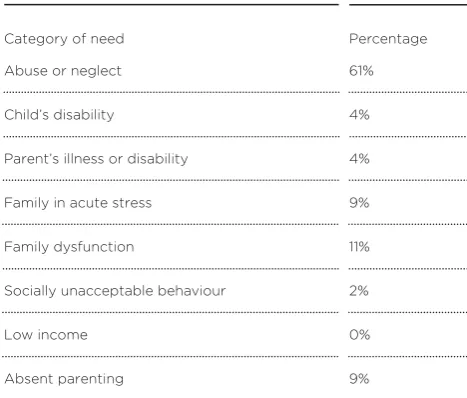
Every year, around 6,000 looked-after children leave care for good; 21 per cent are 16, 17 per cent are 17 and 61 per cent are 18. This ought to be compared with the average age when young people leave home in the general population: 24. This means a significant proportion of young people are still leaving care prematurely to live alone in private accommodation, ill prepared for the realities of adult life. In addition to the departure from care being premature for many young people, the process itself is compressed. The speed with which a young care leaver finds themselves ‘independent’ has been reported to be traumatic for many, as they are ill prepared practically and emotionally for what this transition entails.
A lack of transition support
The ‘cliff edge’ style of transition from care is all the more concerning because care leavers are not given adequate practical, emotional and financial care and support once they leave care. A number of surveys carried out with care leavers found that many are in unstable and poor quality housing.
The importance of mental health support
Section 4 The cost of care journeys and later life
outcomes
The failure to provide looked-after children with a stable, high quality experience of care will not only result in a less positive care journey for them, but can also lead to escalating costs to children’s services. To illustrate this problem we have modelled and costed two exemplar care journeys, which typify the best and the worst of the current system. They do not attempt to prove that certain care journeys causecertain outcomes, so it is important to note that we have not attempted to prove causality at any stage. These exemplar journeys are therefore only designed to illustrate the costs associated with two experiences at each end of the spectrum.
One journey is designed to reflect the experience of the very top range of 5–10 per cent of children in care who are fortunate enough to have long-term, stable placements and supported transitions; the other reflects the 5–10 per cent of children who have a journey characterised by instability, disruption and abrupt exits. We drew on DCSF data from the Department for Children, Schools and Families (DCSF; now the Department for Education) about looked-after children to build these journeys, and used a number of small scale academic studies to identify the associations (but not causality) between the factors of late entry, poor mental health, instability and late exit.
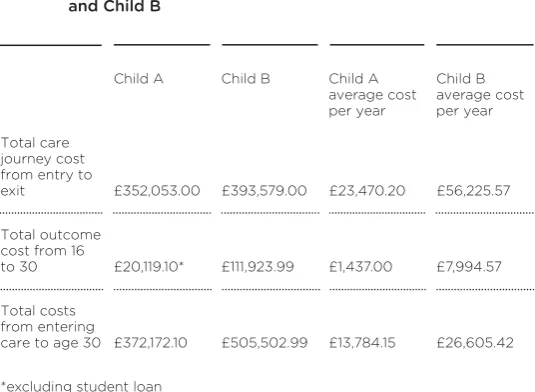
In comparing the costs to children’s services for two exem-plar care journeys (‘child A’ and ‘child B’) we found the following:
· The variation in costs is significant: the stable care journey cost £352,053 over a 14-year period, while the unstable care journey cost £393,579 over a 7-year period (a difference of £41,526). · This translates to a much larger difference in annual costs per
year (£23,470.20 for child A and £56,225.57 for child B) once their length of stay in care is taken into account (15 versus 7 years).
· There is a cost of £32,755.37 more per year for childB’s care journey than for child A’s
moves, but more importantly, we identify a cyclical escalation of poor care experience and costs: a child with a delayed entry into care is less likely to maintain a stable placement, which is associa-ted with poorer mental health and potentially behavioural problems, which in turn may undermine placement stability. This cycle leads to a need for increasingly costly support. Of course, it is also important to note that children will enter care for a range of different reasons and have widely differing personal characteristics – child A’s journey would not be applicable in many instances.
We also went on to consider the adult outcomes that might be associated with each scenario (again causality was not proven) to estimate their possible costs to the state up to age 30:
· Child A leaves care at 18, following a stable placement, with good qualifications.
· Child B leaves care at 161/2, has no qualifications, and has mental
health problems.
Rather than starting their adult costs at different points, the analysis begins at age 16. This is because although both children are still technically in care at this point, their costs to the state (as distinct from the costs of their care to children’s services) begin at 16, as this is the end of their compulsory schooling. Assumptions about adult outcomes for child A and child B:
· We assume child A lives outside London, where she stays at school to 18, then attends a university to age 21, living away from home. On graduating, she finds a job and is employed at an average starting salary.
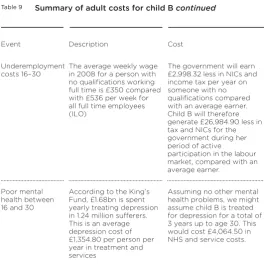
· We assume child B also lives outside London. She leaves school at 16 with no qualifications, and moves out of her care placement at 161/2. We know from her care journey (above) that she is likely
to have mental health problems. Based on a range of national data, we are able to estimate the risks of child B being unemployed during her life, and a range of costs associated with this.
· ‘Child A’, may cost the state £20,119.10 by age 30 if she goes on to university and secures a graduate job.
· ‘Child B’ may cost the state £111,923.99 if she experiences unemployment, underemployment and mental health problems. · Between age 16 and age 30 there is a difference between Child
A’s and Child B’s costs to the state of £91,804.89.
The difference here can be attributed in large part to the very different mental health and educational attainment out-comes associated with the two care journeys. The main costs of child A are associated with a young person attending university after care, which only happens in the minority of cases.
In reality, most children in care will experience something between these two extreme examples of care journeys. However, in demonstrating the significant range of care journeys and types of outcomes that the current care system is capable of producing, we hope to show not only that there is considerable room for improvement, but more importantly that this improvement is eminently attainable.
With this in mind, we should consider the range of adult outcomes than can be achieved by today’s care system, from those children who have a positive, nurturing care experience and go on to university and a successful life, through to those who end up more or less dependent on the state and health services. In total the difference could be £133,330.89 per child to age 30 if we take both the costs of the care journey and outcomes into account. As there are currently nearly 61,000 children in care, the contrast between the two creates a powerful argument for investing in good care experiences to avoid greater costs now and in the future.
Section 5 What next for care?
While recent reforms have done much to improve the framework and legislation surrounding the care system they have not gone far enough in tackling the parenting deficit in the lives of many looked-after children.
What must care achieve?
Although children come into care for different reasons, at different ages, and for different periods of time, there is no reason why all children, when living away from their families, should not benefit from warm relationships and a sense of stability. It is for this reason that we differentiate between
permanence(which would imply a permanent care solution or adoption) and stability. While the latter may be delivered effectively through the former, we should also bear in mind that when a permanent care solution is not viable, stability can and should still be sought.
Drawing on best practice and case studies, the following recommendations, therefore, all seek to create permanency (where appropriate), stability of good quality placements and continuity of support. These can be achieved in very different ways at each phase of a care journey – from entry, during and at exit. Given the current fiscal climate, we have not included a number of recommendations that would have been more costly, and we have instead focused on changes that we believe would provide a high impact for the costs involved. In some cases recommendations are close to cost-neutral. Given the escalating spending associated with poor care journeys we believe that the relatively modest investment we propose in particular areas makes economic sense, and will help to make the care system more sustainable in the future.
Systemic reform
the care system to generate positive outcomes leads to its poor use, and its poor use is associated with poor outcomes. Poor outcomes reinforce the underlying lack of confidence in the system. However, in spite of popular misconceptions, the care system as it currently stands can and does create stable, nurturing environments. To promote positive outcomes more consistently for young people Demos believes that the following shift in our approach to care is necessary:
1 A more pro-active, positive use of care
Demos urges the government to adopt a more confident stance on the capacity of the care system to achieve positive outcomes. We should create a new virtuous circle – one where care is used earlier and more effectively and in turn becomes more effective.
2 Care as family support and early intervention projects
Corporate parenting and birth parenting should not always be seen as mutually exclusive. The state should be recognised as capable of acting as a ‘parallel parent’ for children and families who need such ongoing support. The government must embark on a concerted effort to destigmatise care as a form of family support. We set out in our specific recommendations below how parallel parenting could work in practice for some families with packages of ‘support care’.
3 Improved data on children in care
We currently compare children from backgrounds of
longitudinal data that links looked-after children’s pre-care and in-care experiences to their later life outcomes.
4 A better understanding of placement and care journey costs
Value-added and longitudinal measures of children’s outcomes may help change perceptions of the care system, but will not drive real reform unless spending decisions at local level change. To achieve this, local authorities need a better understanding of the outcomes of different types of care placement, and of the costs associated with these placements. We suggest local authorities look to the cost calculator for children’s services (CCFCS)1 developed at Loughborough University to break down their costs more accurately.
However, annual budgeting may make it difficult to take into account longer term outcomes or attribute cost savings to them, and may also make it difficult for authorities to under-stand how placement delays generate costs over time. There are reports that some children’s services departments have already shifted to multi-year spending plans (in line with the compre-hensive spending review) allowing annual budgets to be carried over from year to year. Multi-year spending plans are an impor-tant step in the right direction, and where appropriate other Local Authorities should use these to manage annual budgets more flexibly for looked-after children. Some children’s services departments have already shifted their annual budgets to multi-year cycles, in line with multi-multi-year children and young people’s plans and the comprehensive spending review, which is an important step in the right direction.
Demos is also making a number of targeted recommenda-tions, set out below.
Recommendations for early intervention and less delay
1 Demos recommends there should be a government audit of local authority policies on managing their care populations and research into associated child outcomes.
making ‘support care’ arrangements matching foster carers and families more widely available.
3 Demos recommends there should be a statutory duty on local authorities to offer family group conferencing.
4 Demos calls for the government to provide seed funding for con-current planning in local authorities wishing to pilot the service. 5 Demos calls for a renewed government focus on adoption
timeliness and a DfE review of the 12-month target. 6 Demos recommends that all local authorities consider
establishing permanency planning tracking panels.
Recommendations for stability
7 Demos recommends that the DfE makes mental health assessments of children entering care mandatory, using a standardised multi-disciplinary measure.
8 Demos calls for the Children’s Workforce Development Council (CWDC) to include mental health training in training standards for foster and residential care workers.
9 Demos recommends that primary care trusts commission on-site CAMHS support for children in residential care and residential staff.
10 Demos recommends that local authorities make short breaks and placement support workers available to foster carers on request.
11 Demos proposes introducing social pedagogy training in CWDC standards in order to spread existing good practice in residential care work.
12 Demos calls on the DfE to amend care planning guidance to ensure there are fewer failed reunifications, and to introduce better resourced and time limited reunification plans.
Recommendations for supported transition to independence
13 Demos recommends that looked-after children teams and 16 plus teams shadow one another before and after transition.
15 Demos urges the government to raise the care leaving age to 18 and asks the DfE to support flexible approaches to allow young people to stay on in placements to 21.
16 Demos recommends that DfE amends transition support guidance to prioritise emotional and mental health support. 17 Demos recommends that DfE guidance explicitly applies the
resilience model to transition planning, and independent reviewing officers are trained accordingly.
18 Demos calls for the wider availability of supported
accommodation through commissioning and active promotion by government and local authorities.
19 Demos recommends floating support services are made more readily available by local authorities, and calls for the government to create a statutory ‘right to return’ for all care leavers.
Conclusion
Every child is different and will need something different from the care system; from a short break away from home to a lifelong adoptive placement. By no means do we underestimate the difficulty of meeting the needs of each individual child, and of making the right decisions at key moments in that child’s life. Nevertheless, a shift of resources and investment to the beginning of a child’s care journey could have real long-term benefits for that child, and minimise the costs associated with unstable placements.
In the context of the immediate resource constraints confronting central and local government, the interventions and recommendations outlined in this publication should be seen as part of a long-term, ongoing project to raise standards in the care system. But we also believe that the escalating costs associated with poor care journeys and placement disruption have short-term resource implications for local authorities, meaning there are cost savings attached to better care journeys in the here and now.
Introduction
By presenting young people in and leaving care solely as ‘victims’ of systems that fail them, we risk ignoring and undermining the role they themselves play in their own futures, and the resilience that many possess.
Sonia Jackson2
The British care system is mired in the language of failure. Social workers and directors of children’s services are regularly described as ‘incompetent’,3while the care system itself is promoting an underclass and ‘blighting’ the life chances of care leavers.4In the public consciousness this idea is reinforced by the reporting of poor outcomes for children who pass through the care system. But how correct is this view, and what are the consequences of regarding care as a damaging intervention to be avoided?
In Loco Parentisshows the care system can be an effective tool and should be used earlier and more proactively. The negative perception of care in England is closely related to how it is evaluated and the way that data on young people’s outcomes is misinterpreted – both of which tell a misleading story about its impact. Acknowledging that some elements of public care do have a positive impact is far from arguing that that the care system is good enough. Of course it is right to demand better for one of the most disadvantaged and vulnerable groups in society. There are groups of children who are still let down by the parenting they receive from the state, and many problems in our care system persist. But one of the unintended consequences of labelling care ‘a failure’ is that in so doing we compound those problems in our system.
away from home. In some cases this exposes children to abusive or neglectful situations for longer. As a result some groups of children enter the system at an older age with more entrenched emotional and behavioural difficulties, and they are less likely to find a stable placement or permanent alternatives such as adoption. Further oscillations in and out of care contribute to this instability and poorer outcomes in academic attainment and wellbeing. These outcomes confirm the assumption that care is damaging, undermining our confidence in the system still further and establishing a vicious cycle.
In England this cycle is also fuelled by our unease about the idea of the state taking on the ‘parenting’ role. This can be traced back to a strong belief in the primacy of the birth family, a view which is stronger in the UK than in, for example, some Scandinavian countries. The oxymoronic term ‘corporate parenting,’ now commonly used to describe public care,
perfectly expresses this unease. Understandably, we struggle with the idea that the ‘corporate’ state should be drawn into the intimate arena of family relationships. This historical reluctance to intervene in the private sphere of family life has manifested itself in confusion about the purpose of public care in England.
Over recent decades we have moved between two policy-making positions: supporting children to remain in the family home or taking more children into care with the aim of finding them permanent solutions such as adoption as quickly as possible.
This ‘pendulum effect’ has afflicted children’s social services for decades, leading to fluctuations in the size of the care population, usually in reaction to a child’s death from abuse or neglect, a damning review or the exposure of failing services. Whether the state prioritises a preventative ‘birth family is best’ approach or safeguarding at any given moment in time is often related to where we are in this unstable cycle. Considering this, it is perhaps unsurprising that huge variation persists in the cultures of different local authorities and the type of services they provide.
circle into a virtuous circle – re-casting the care system as a proactive tool which candeliver for children – to identify where and how it succeeds and replicate that success elsewhere. The first step towards doing so is differentiating between the many types of journey looked-after children experience. Care is not a homogenous intervention and the care population is
characterised by huge diversity. Consequently, we should not regard care as ‘all or nothing intervention’. The system should be used to achieve early permanency for those children for whom it is appropriate, stability for when a permanent solution is not possible, and to deliver early family support before a child’s development is affected.
An important moment for care
Over the past decade the government has done much to improve legislative frameworks and the quality of placements so that children in and leaving care are supported with better planning, educational facilities and accommodation. The true impact of this activity may not be apparent for several years to come. In this respect the ‘corporate’ dimension to the parenting role has been heavily invested in, with a particular focus on new guidelines, structures and safeguarding processes. The larger challenge of addressing the parenting dimension of the ‘corporate parent’ role has still to be met. Far less attention has been paid to parenting deficit in children’s lives and enabling them to form enduring attachments while in care, although it is this resilience which will underpin other positive outcomes throughout their life.
The fiscal pressure on the system will also be stepped up by the influx of children into care following the death of Baby Peter, and the renewed emphasis on safeguarding. The case led to an immediate 40 per cent surge in referrals to the courts to take children into care. Latest quarterly figures from Cafcass, the Children and Family Court Advisory and Support Service, suggest that although the initial increase in referrals has levelled off, it has still settled at historically higher levels. The courts received 2,185 section 31 care applications from October to December 2009, up 21 per cent on the same quarter in 2008.6As safeguarding, family support and looked-after children services are funded from the same children’s services budget, the shift to child protection could lead to a diversion of resources away from families in need of support services and children who are already
in care. In meeting these new demands, the care system will find itself needing to do more with less.
However, the temptation to intervene later and cut
frontline spending for vulnerable children and families would be a counter-productive cost cutting exercise. In this report we look at the evidence on children that come into care later with higher levels of need, and go on to have unstable care journeys which are more expensive. For care leavers in later life we show the wide disparity between the low costs to the state for those who exit care with qualifications and good mental health, versus the considerable cost to the state when a young person leaves with neither of those things. If we do not meet the needs of vulnerable children today through focused family support or high quality placements, we will foot the bill in the future.
This report
Social services always say that our lives were not good with our parents and that’s why we ended up in care so, therefore, they should be giving us the same opportunities like every other kid. They should be giving us at least what they think our parents couldn’t give us.
Guiding the next phase of reform should be the principle that when the state acts in loco parentisit should be providing the same quality of care that birth parents would hope to give their own children. This ideal should continue to be a driver of innovation and higher standards. With this report we aimed to raise the status of care as a positive option for children and a less stigmatised source of support to their families.
However, there are some policy areas that we do not interrogate in depth with this report, such as safeguarding, the questions confronting the future of the social work profession and court processes. All of these issues also shape a child’s care journey, but are undergoing considerable reform at present and demand detailed assessment in their own right. It should also be noted that we deal only with the care system in England and Wales, and that the system of local authority care, although sharing many common features, operates differently in Scotland and Northern Ireland. We do draw comparisons with Scotland and Northern Ireland but do not seek to address those nations as separate systems.
We will look at the interventions, strategies and innova-tions which could deliver a good care journey to a greater proportion of the care population. We also look to existing academic research, which tells us a great deal about the ingre-dients of a good care experience and the impact on children. We ground our recommendations in our own primary research with experts, looked-after children, carers and care leavers. We find that the following three factors are key ingredients of a positive (and often less costly) care journey:
· early intervention or less delay · stability
· supported transitions to independence
We consider what the care system would look like if it were reconfigured to avoid delay, instability and abrupt exit, in order to support the lifelong relationships that looked-after children need to sustain them as they move into adulthood.
Box 1 Methodology
1 Literature reviews of domestic and international evidence
The first phase of the project was to carry out a literature review of the more recent body of research (academic literature, policy documents and research by third sector organisations and others) on looked-after children, identifying the most prominent themes for the domestic (English and Welsh) care system. Our desk-based research also included:
· a review of international practice in care in Northern Ireland, Scotland, Denmark, Germany, France, Finland, Spain, Sweden, Hungary and Australia
· a review of children in care legislation
· a review of consultations with children in care and care leavers over the past decade
· a review of academic studies (both domestic and international) that sought to identify the outcomes that are associated with different types of care journey
2 Expert interviews
We discussed our emerging thinking, informed by our desk-based research, and sought feedback and ideas for further areas of investigation from a number of policy and academic experts. These included:
· Mary Sainsbury, Centre for Excellence and Outcomes in Children and Young People’s Services (C4EO) and Social Care Institute for Excellence (SCIE)
· Sonia Jackson, Institute of Education
· David Holmes, British Association for Adoption and Fostering (BAAF)
· Lucy Sweetman, Sharn Bowley and Linda Briheim-Crookall, Catch 22 and National Care Advisory Service (NCAS) · Robert Tapsfield, fostering network
· Harvey Gallagher and Matthew Huggins, Care Matters Partnership
· Dionne Baptiste, Centrepoint
· Mike Stein, Social Policy Research Unit (SPRU), York University
· Nina Biehal, SPRU, York University · Ian Sinclair, SPRU, York University
· Yvette Stanley, Director of the Merton Council Children, Schools and Families Department
· Deirdre Coyle, Health and Social Care Northern Ireland
3 Domestic case studies
Based on our scoping work and discussions with experts, we visited or spoke to people in a number of projects and services to identify areas of good practice and innovation. These included:
· Essex County Council Social Pedagogy Project
· Whistler Walk residential children’s home, Kensington & Chelsea
· concurrent planning projects – Brighton & Hove and Devon local authorities and Coram in London
· Hackney local authority social pedagogy pilots and reclaiming social work scheme
· Horizon’s Centre care leaver support, Ealing · Placement Support Service, East Sussex · Merton local authority, family support activities
4 International scoping
5 Focus groups and interviews
The Demos team conducted primary research with care leavers, looked-after children and foster carers in nine local authority areas (Kensington and Chelsea, Tower Hamlets, Tunbridge Wells, Derby, Haringey, Richmond, Ealing, Barking and Dagenham, and East Sussex).
We conducted four focus groups with foster carers, in four different local authority areas, involving 26 carers in total. We asked them about their motivation for becoming foster carers; their role and professional status; how they work with other agencies; what causes placements to break down; which types of support they receive or would like to receive; and for their feedback on a number of our policy proposals.
We carried out semi-structured interviews in groups with 37 young people (23 care leavers and 14 looked-after children) ranging from age 7 to age 21, in five different local authorities. We asked about their experiences of care and opinions from the perspective of stability, continuity, attachments and transitions to independence.
6 Quantitative analysis
Demos carried out a substantial body of work to design two exemplar care journeys which represented the two extremes of experiences within the system. We constructed these care journeys on the basis of evidence about how particular experiences of care (eg age of entry, stability and age of exit) are associated with certain pathways through the care system. We then worked in partnership with Harriet Ward, Jean Soper and Lisa Holmes from the Centre for Child and Family Research (CCFR) at Loughborough University to cost these care journeys using their cost calculator for children’s services. This tool was developed by Ward and colleagues in consultation with staff from social service departments in six local
activities, which vary according to placement type, frequency and duration of placements, and characteristics of the child.
To calculate an estimated cost for each of our exemplar care journeys, we put data on the children’s characteristics (eg whether they have additional support needs such as emotional and behavioural difficulties or a disability), the number and type of placements they received and any other services they received into the cost calculator. This tool was then able to attribute an average unit cost to each of the case management processes that took place, and to any additional services provided by other agencies (eg CAMHS). The costs associated with each placement were then aggregated to calculate an estimated total cost for each of the care journeys.
Demos then went on to cost potential adult outcomes to age 30, based on the possible academic achievements and mental health of the children who had experienced these two exemplar journeys. We did this by using a number of national data sources including the Annual Survey of Hours and Earnings and Labour Force Survey to establish a relationship between qualifications and earning and risk of unemployment, and combining this data with current levels of employment support allowance, national insurance, income tax and so on to estimate costs of different levels of labour market activity. We limited our analysis to employment, earnings and mental health, and did not include possible offending behaviour, teen pregnancy or softer outcomes that might be associated with academic attainment and mental health.
In all cases, however, it is important that we did not establish causality between being in care and adult outcomes.
7 Policy seminar
1
The purpose of care
A tension that runs right through the history of child care is between the aim of protecting children and young people from ill-treatment and undesirable influences and the ideal of family preservation and reunification.
Sometimes the first objective is uppermost, sometimes the second, in a process that has often been likened to the swing of a pendulum.
Sonia Jackson7
A historical division regarding the purpose of care is one of the principal causes of the lack of clarity about its usethat we see today. Very broadly speaking, two views have vied for dominance since the late nineteenth century, and still characterise modern philosophical debates about the use of care:
· The purpose of care should be support families and enable children to remain with or return to their birth parents (a ‘preventative’ approach).
· The purpose of care should to be to safeguard children and provide them with permanency beyond the birth family (a ‘permanency’ approach).
child’s death or other scandal) means that the English care system today does not serve either purpose as well as it might.
The care system first evolved from the workhouses and the Poor Law of 1834. At that time those children who were received into care were rarely returned to their parents, and continuing contact between them was rare; ties were often permanently severed.8The Curtis report of 1946, followed by the Children Act 1948, established the basis of the care system as we know it today and since then the ‘balance of policy has tipped back and forth between attempts to improve the care system and attempts to keep children out of it’.9Into the 1960s the idea that children’s departments should work to support families began to gain credibility, and the 1963 Children and Young Person’s Act for the first time authorised local authorities to spend resources to prevent children having to enter care.10
The movement towards children’s services working to keep families together was briefly reversed in the mid-1970s with the death of Maria Colwell, who died after being returned to her family from care. Two influential publications about the impact of drift and impermanence in the care system were also
published in 1973: Children Who Wait and Beyond the Best Interests of the Child.11The latter outlined the concept of the ‘psychological parent’ for young children who had been removed from their parents. It argued that the child treated as their substitute parent whoever was providing day-to-day care for them and transferred their attachment accordingly. The implication was that
placements away from home should be given longer-term security and permanency.12In an introduction to Children Who
Wait, Roy Parker wrote about the fate of those children who were unable to find permanency in care but were unlikely to be reunified with their family either:
interests of the child in long term care are likely to be best served by a firm commitment on the part of those in a position of responsibility to some course of deliberate action.13
The profile of today’s care population (see chapter 2) means that many children now looked after by the state still fall into the category identified above. The blinkered pursuit of ‘birth family is best’ or a ‘permanency’ approach is as unlikely to serve this group well today as it was 30 years ago. In an attempt to address these problems the 1975 Children Act required local authorities to become adoption agencies, made it easier to dis-pense with parental consent,14and attempted to strike a balance between the ‘needs of children for security and a psychological parent, the rights of birth parents and the role of the local authority’.15However, the act was only ever partly implemented.16
In the years that followed the idea of care as ‘service to parents’ was promoted most strongly by the Children Act 1989 (see box 2), which introduced the idea of local authorities working in partnership with parents, with court action representing a last resort. It also introduced the category of ‘children in need’ and a statutory duty on the local authority to provide them and their family with support services – although no extra money was made available for local authorities to carry out these duties at the time.17This fact, combined with an increasing emphasis on child protection in recent decades, meant that in reality ‘family support’ took a back seat to safeguarding in most areas.18This continues to have an important impact on the care population today, as Rowlands and Statham explain:
The purpose of care today
Today, the decline in the use of care as family support is reflected in the reduction in voluntary care arrangements for older children. Where once children used to account for two-thirds of children in care they now represent only one-third of those in the care system.20But the belief that children should remain in their birth families remains, an approach that is bolstered by the resource implications of taking a child into care. Here we can see the divergence between philosophy about the purpose of care (‘birth family is best’) and practice (with limited family support actually being made available to parents in difficulty).
There will always be a group of children (as identified in the above quote from Children Who Wait) who will not be well served by preventative strategies to stop them from entering care or permanent solutions such as adoption. This report emphasises the proactive and flexible use of public care, to achieve early permanency for those children for whom it is appropriate, stability for children where a permanent solution is not possible, and early family support for children on the cusp of care or when reunification with their birth parents is in their best interests. Family support measures aiming to ‘prevent’ entry to care can only be justified if they directly benefit the welfare of the child: prevention should not be a goal in itself. As we will explain in chapter 3, minimising a child’s exposure to care is not always in a child’s best interests.
Local variation in the use of care
However, the historical legacy of confusion about the purpose of care has had a lasting impact. Considerable local variation continues to be a stubborn characteristic of today’s care system. On the basis of the findings presented to them, the Care Matters working group on the future of the care population concluded that ‘the care system might more realistically be viewed as being not one but 150 different systems’. They expressed concern that
this high level of inter-authority variation is as likely to mean children who should be in care are being left at home in potentially dangerous situations for far too long, as it is to mean that many children made the subject of Care Orders should have been left at home with more intensive support
programmes.21
This variation can be seen most clearly by looking at how many children are in care in each area – which cannot be entirely explained by local socio-economic disadvantage: there are 13 children per 10,000 of population in care in Rutland, compared with 221 per 10,000 in the City of London. The national average number of children in care per 10,000 of population is 55.22The variations in the use of care extends to the type of placements that local authorities opt to provide; the proportion of the care population in residential care varies significantly between local authorities (from 4 per cent to 28 per cent). Deloitte also found significant variation in the number of children in residential care by region. London and the North West place 24 per cent and 17 per cent respectively of the total number of children in residential care, while five regions place 10 percent or less of the total number of children in residential care.23
Looked at from a historical perspective the existence of different local cultures and approaches to the purpose of care is entirely unsurprising. That some emphasise prevention and ‘birth family is best’, and others stress safeguarding can be traced back to the swinging of the ‘pendulum’ over recent decades. The perceived cost disincentive associated with intervening earlier has also influenced the local authority use of care, although as we show in section 4, this is something of a false economy.
Box 2 Landmarks in the last decade of policy
The Children Act 1989 and 2004
The Children Act 1989 established the general duty of local authorities in England and Wales to safeguard and promote the welfare of children within their area who are in need. There was a clear promotion of parental responsibility in this act, with local authorities specifically tasked with promoting ‘the upbringing of children by their own families if safe to do so’ and working in partnership with parents. While the local authority can seek a court order when compulsory action is in the best interest of the child, the first option must be to work with the parents by voluntary arrangement unless to do so would clearly be placing the child at risk of significant harm.
The act also focused on court proceedings – a court can make an order to remove a child from his family only if it is better for the child than making no order, and the child’s welfare must be the paramount consideration. The act also introduced the principle that delay in court proceedings is harmful to the child.
The Children Act 2004 did not change the functions of the 1989 act, but made a lot of changes to the delivery to promote far more cross-departmental working. It required local authorities to lead on integrated delivery through multi-agency children’s trusts and local safeguarding boards; to draw up a single children and young people’s plan; to appoint a
This act underpinned the 2004 Every Child Matters strategy, which presented a much wider cross-agency
programme aimed at promoting the five outcomes for children – being healthy; staying safe; enjoying and achieving; making a positive contribution; and achieving economic wellbeing.26
The Children (Leaving Care) Act 2000
The Children (Leaving Care) Act 2000 introduced the personal adviser role to support care leavers. Personal advisers develop Pathways plans with care leavers to meet their support needs and help them prepare for independent living. They plan for personal support, accommodation, education and training, employment, family and social relationships, practical and other skills, financial support, health needs and contingency planning. Leaving care teams may also have specialist workers in areas such as mental health, accommodation or employment.
The act took a more prescriptive approach to the local authority’s responsibilities for care leavers, in that it required local authorities to provide services in many cases where before they had only discretion but not a duty to provide them. Also, the types of services and the upper age limits for which they were responsible were also extended. pathway plans are for all over 16s until they are 21, or longer if they are in education. The main aims of the act were:
· to delay young people’s discharge from care until they are prepared and ready to leave
· to improve the assessment, preparation and planning for leaving care
· to provide better personal support for young people after leaving care
· to improve the financial arrangements for care leavers
New local authority duties included that they should:
· assess and meet needs
· provide personal advisers for all over 16s
· give assistance to achieve goals agreed in pathway plans
· give support and accommodation
· provide financial support
· keep in touch with care leavers until they are at least 21
Children and Young Persons Act 2008
In November 2006, the government published the green paper
Care Matters: Transforming the lives of children and young people in care, alongside papers from four working groups established to investigate best practice in making provision for looked-after children.
Following a period of consultation, these papers fed into the June 2007 white paper, Care Matters: Time for change. This set out the government’s plans to improve outcomes for looked-after children and care leavers. The white paper was fairly comprehensive and radical in some ways (see below for a full summary of proposals).
The Children and Young Persons Act 2008 reformed the statutory framework for the care system in England and Wales by implementing the proposals in the white paper that required primary legislation. The act also included provisions on the wellbeing of children and young people, private fostering, child death notification to local safeguarding children boards and appropriate national authorities, the powers of the secretary of state to conduct research and applications for the discharge of emergency protection orders.
The act:
· makes provision to enable local authorities to delegate local authority functions in relation to looked-after children to providers of social work services and (following the pilot stage) places a general duty on the secretary of state to promote the wellbeing of children in England
· amends the duties of local authorities in relation to the appointment of independent reviewing officers (IROs); adds to the functions of IROs; and provides powers for the appropriate national authority to establish a new national IRO service independent of local authorities in England and Wales
· places a new duty on local authorities to appoint a
representative to visit all looked-after children, wherever they are living, and provides a power to extend the duty to other groups of children who were looked after but have ceased to be so
· extends the duty on local authorities to appoint an
independent person to visit, befriend and advise any looked-after child if doing so is in the child’s interests
· places a duty on governing bodies of maintained schools to designate a member of staff as having responsibility for promoting the educational achievement of registered pupils at the school who are looked after
· extends the duty on local authorities to appoint a personal adviser and keep the pathway plan under regular review to care leavers who are over 18 and who start or resume a programme of education or training after the age of 21 but under the age of 25 years
· requires local authorities to pay a bursary to a former care leaver who goes on to higher education
· extends the powers of local authorities to make cash payments to children in need and their families
· makes provision to enable registration authorities to issue compliance notices to children’s home providers who are failing to meet required standards and to serve a notice preventing new admissions
· extends the period within