Evaluation of Increased Flexibility for
14 to 16 Year Olds Programme:
The Second Year
Sarah Golden, Lisa O’Donnell and Peter Rudd
Evaluation of Increased Flexibility for
14 to 16 Year Olds Programme:
The Second Year
Sarah Golden, Lisa O’Donnell and Peter Rudd
National Foundation for Educational Research
The views expressed in this report are the authors’ and do not necessarily reflect those of the Department for Education and Skills.
page ACKNOWLEDGEMENTS i
EXECUTIVE SUMMARY iii
1. INTRODUCTION 1
1.1 Background 1
1.2 Aims and objectives 2
1.3 Research methods 2
1.4 Structure of the report 6
2. THE IMPACT OF THE INCREASED FLEXIBILITY PROGRAMME ON
SKILLS AND ATTITUDES 9
2.1 School and college staff’s views of the impact of IFP 10 2.2 Progress towards qualifications 15
2.3 Development of skills 18
2.4 Students’ attitudes to learning 22
3. THE IMPACT OF THE INCREASED FLEXIBILITY PROGRAMME ON
STUDENTS’ PLANS FOR PROGRESSION 29
3.1 Students’ plans for progression 30 3.2 Influences on students’ plans for future progression 41 3.3 Views of admissions staff in higher education institutions 44
4. THE EXPERIENCE OF PARTICIPATING IN THE INCREASED
FLEXIBILITY PROGRAMME 51
4.1 Approaches to delivering IFP 52
4.2 Timetabling IFP 55
4.3 Learning support for students 60 4.4 Involvement of employers in IFP 67 4.5 Employers’ experiences of IFP and working with schools and
colleges 70
5. MANAGING THE IFP PARTNERSHIP 79
5.1 Working in partnership 80
5.2 Funding and costs 84
5.3 Staffing and staff development 87 5.4 Impact of the second cohort on managing the partnership 93 5.5 Challenges and future developments 101
6. CONCLUSIONS AND POLICY IMPLICATIONS 107
6.1 Conclusions 107
6.2 Policy implications 110
APPENDIX A: Representativeness of responding students and
schools 113
APPENDIX B: Factor analysis of student attitudes 121
ACKNOWLEDGEMENTS
The authors would like to express their thanks to the members of the project steering group and, in particular, Maura Lantrua, the project manager at DfES, for their ongoing guidance and support.
We are indebted to the representatives of the Lead Partners, partner providers and schools who responded to the questionnaires and gave generously of their time in interviews, and we are grateful to the students who completed the questionnaires and provided an insight into their experience of participating in the Increased Flexibility Programme. We also appreciate the time given by employers and representatives of Higher Education Institutions whose interviews made a valuable contribution to the evaluation.
EXECUTIVE SUMMARY
Introduction
The Increased Flexibility for 14-16 year olds Programme (IFP) was introduced in 2002 by the Department for Education and Skills (DfES) in order to ‘create enhanced vocational and work-related learning opportunities for 14-16 year olds who can benefit most’. Partnerships between a Lead Partner, which was usually a college of Further Education, partner schools and sometimes other providers such as training providers and employers, were formed in 2002 to achieve this aim. A first cohort of Year 10 students embarked on two-year vocational courses, including NVQs, other VQs and new GCSEs in vocational subjects, in the autumn term of 2002. The IFP was subsequently expanded to a second cohort of Year 10 students in autumn 2003 and a third in 2004. For each cohort, about 300 partnerships have supported the learning of around 40,000 young people in Years 10 and 11.
The partnerships aimed to raise the attainment of the students who participated in the Programme. They also aimed to increase students’ skills and knowledge, develop their social learning and increase retention in education and training after 16. They are working towards a set of national targets relating to achievement of qualifications, post-16 progression and attendance. The DfES commissioned the National Foundation for Educational Research (NFER) to undertake an evaluation of the first and second cohorts of IFP students. This summary presents the main findings from the follow-up surveys of a sample of Year 11 students, schools and colleges and training providers which were undertaken in spring 2004. Further details of the surveys are provided at the end of the summary.
Key findings
♦ Students who participated in IFP had benefited from accessing a broader
curriculum and, on the whole, were on target to achieve their qualifications. The majority (82 per cent) planned to progress into further education or training after school.
♦ There was evidence that the students surveyed had developed their social
skills, including in relation to working with adults, their confidence in their employability skills, including inter-personal and communication skills, and their abilities such as their problem-solving skills. The survey also revealed that they had a more positive attitude towards school than they had in Year 10.
♦ Fifty-six per cent of the students said that their IFP course had helped them
♦ A third (33 per cent) of colleges and training providers, and 30 per cent of
schools, said that they worked with employers to support the delivery of IFP. Around a third (35 per cent) of students said that they had visited an employer as part of their course. This was a greater proportion than in 2003. The most common use of employers was for one-off visits and as visiting speakers, although there were instances of blocked work placements and regular work placements.
♦ Nearly all of the schools and colleges and training providers surveyed
were involved in the second cohort of IFP. It was evident that in many cases, they had built on their experience of the first cohort and had adapted their criteria and processes for identifying students to participate. They had also increased the involvement of colleges and training providers in identifying the students. In addition, most had increased the amount of information they shared about students both before and during the course.
THE IMPACT OF THE IFP
Progress towards qualifications
In general, students were said to be making satisfactory progress towards achieving their qualifications in the view of school and college and training provider staff. However, some students were said to be behind target and the evidence from the surveys suggests that some were finding it increasingly challenging to complete the work in the time allocated. At the time of the surveys students had yet to complete their qualifications, and their achievements and the extent to which the IFP has met its target will be the focus of future analyses.
Impact on social skills
The majority of students who had participated in IFP appeared to have developed their social skills in the course of the two-year programme. The majority of participating students and the majority of staff in schools and colleges and training providers said that the IFP had enhanced students’ ability to work with adults. In addition, more students in 2004 said that they felt confident working with students from other schools than said so in 2003.
Impact on employability skills
More students indicated that they were confident in relation to a range of employability skills in 2004 than in 2003. These included the skills required to gain a job, interpersonal skills and team working and problem-solving skills. This change was more noticeable among students who had visited an employer as part of their IFP course.
Impact on attitudes
of their involvement in IFP on their attitudes. In particular, they said that IFP had helped them gain confidence in finding out what they were good at and trying new things and that they were more able to see the value of learning in school and qualifications.
Impact on plans for progression
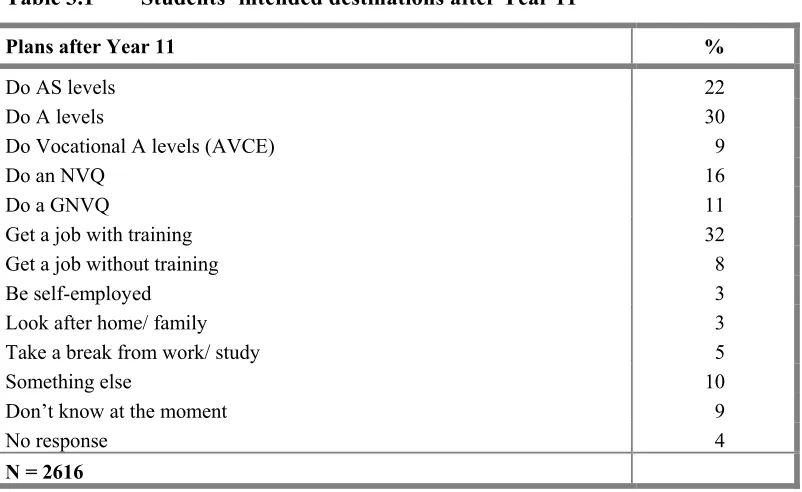
The majority (82 per cent) of students intended to progress onto further education and training after Year 11, which exceeds the target for the IFP of 75 per cent. Most students planned to embark on A levels, but the interest in the vocational route, which may have led these students to participate in IFP, is reflected in the third of students who planned to start a job with training after Year 11.
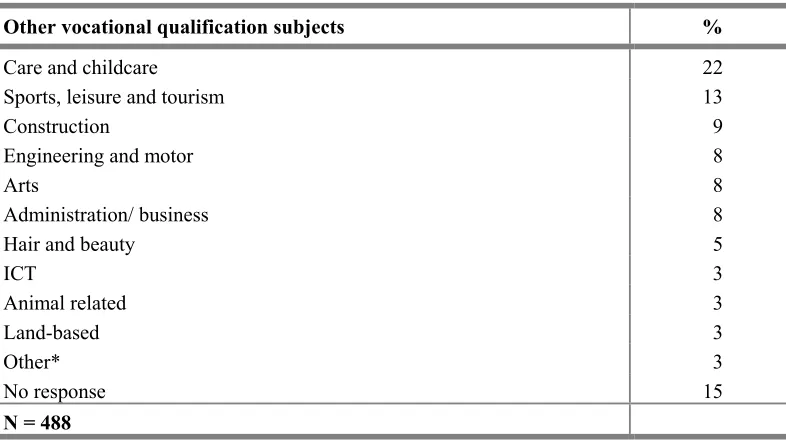
Students’ continuing interest in the vocational area they engaged with through IFP, is reflected in the finding that two-fifths (40 per cent) of students intended to take a qualification post-16 that was in the same vocational area as their IFP course. This was particularly the case among students who were intending to take NVQs or GNVQs after Year 11. Half of the students (56 per cent) said that their experience of IFP had influenced their decision about their post-16 destination and a similar proportion (54 per cent) had found their college or training provider tutor helpful in making their decision.
Impact on working in partnership
The majority of the schools (86 per cent) and the colleges and training providers (92 per cent) surveyed, indicated that their involvement in IFP had led to more effective partnership working between their organisations. In addition, it appeared that contact between organisations had become more frequent and more informal, as the partnerships matured. In addition to this informal contact, partnerships appear to have increasingly introduced formal mechanisms for sharing information about the progress of individual students while they participated in IFP.
EXPERIENCE OF IMPLEMENTING IFP Approaches
The approaches adopted to delivering IFP continued to differ within partnerships and between partnerships. Half of the colleges and training providers surveyed (55 per cent), and a quarter (27 per cent) of schools, used more than one approach to delivery in terms of the location of study for their students.
Timetabling
lessons, including core subjects, as a result of participating in IFP. Most of these students, however, said that they did not experience any difficulty in catching up work they had missed.
Learning support
In the majority of schools, students who were participating in IFP were said to be receiving ongoing support from the Connexions Service or mentors. Moreover, the proportion of schools where this was the case was greater in 2004 than 2003. In the majority of schools (62 per cent) a member of staff accompanied students to their off-site location and typically supported the tutor with classroom management, observed delivery or provided one-to-one support for individual students.
In 39 per cent of the colleges and training providers, students were said to have access to the learning resource centre. However, half of the students surveyed said that they did not use the learning resource centre and a fifth did not use ICT facilities at the external provider to do coursework or search the internet.
Employers
There were some indications of an increase in the use of employers among the organisations surveyed and more of the students surveyed in 2004 said that they had visited an employer as part of their IFP course than had said this in 2003. Half (51 per cent) of schools and 62 per cent of colleges and training providers said that their links with employers were more effective this year than last, and the responses of around half of the students surveyed indicated that their visits had been a valuable learning experience.
Managing the programme
Around two-thirds (64 per cent) of Lead Partners and 54 per cent of the schools surveyed, said that they had subsidised the IFP. While for around half (46 per cent) of the respondents in college and training provider organisations, the amount of time they had to coordinate IFP was sufficient, this was said by only 25 per cent of schools. Time to maintain contact with partners, and in the case of schools, to oversee student welfare, was identified as a major requirement.
Staffing and staff development
Second cohort
Nearly all of the schools and colleges and training providers surveyed were involved in the second cohort of IFP. It was evident that, in many cases, they had built on their experience of the first cohort and had adapted their criteria and processes for identifying students to participate. They had also increased the involvement of colleges and training providers in identifying the students. In addition, most had increased the amount of information they shared about students both before and during the course.
Involvement in the second cohort was said to have impacted positively on relationships between schools and colleges and training providers, but was felt by some to have had a negative impact on timetabling, resourcing, staffing and transporting students.
Challenges and future developments
Although the schools and colleges and training providers surveyed were predominantly positive about IFP provision, they outlined some issues and areas for future development. The main challenges associated with implementing IFP which were identified concerned the management of the programme, the funding and costs of delivery, timetabling provision and selecting students. Ensuring that partnerships have sufficient time to plan their provision through timely confirmation of funding and ensuring that they have sufficient and sustainable funding, could usefully contribute to future development of the programme. Involving all partners in the selection of students to participate could help to ensure that, in the future, appropriate students embark on courses which meet their needs.
Conclusions and policy implications
Overall, involvement in IFP appears to have been successful for many students in developing their social skills, their confidence in their employability skills, and in their own abilities, such as working on their own and solving problems, and on their attitudes towards school and learning. The majority (82 per cent) of the students surveyed in spring 2004 intended to progress into further education or training after the end of Year 11.
Participating in IFP had led to more effective partnership working between schools and colleges and training providers, in the view of the majority of those surveyed, and the partnerships appeared to have matured during the second year of the programme. The introduction of a second cohort was said to have contributed to consolidating the partnerships.
Summary of research methods
A representative sample of around 5,600 students in Year 10, and their associated schools and colleges and training providers, responded to a baseline survey in the spring term of 2003. These students and organisations were sent follow-up questionnaires in the spring term of 2004 when the students were in Year 11. The data presented in this summary is based on responses from:
♦ 2,616 students who replied in both 2003 and 2004 ♦ 248 schools, 115 of whom replied in 2003 and 2004
♦ 78 colleges and training providers, 62 of whom replied in both years: 61 of
1. INTRODUCTION
1.1 Background
Throughout the 1990s, there was a growing recognition in government that the standard educational interventions adopted in schools were not meeting the needs of all young people. The Green Paper: 14─19: extending opportunities, raising standards (2002) set out a proposal to further increase curriculum flexibility in order to enable pupils to learn at a pace which is appropriate to them and pursue individually focused programmes to help them meet their potential. The Green Paper also announced the introduction of GCSEs in vocational subjects. These are intended to provide young people, whose needs have not fully been met by the National Curriculum, the opportunity to achieve vocational qualifications with parity of esteem with existing ‘academic’ qualifications.
In response to the Green Paper, the Increased Flexibility for 14-16 year olds Programme (IFP) was introduced in 2002. This is a £120 million programme which aims to ‘create enhanced vocational and work-related learning opportunities for 14-16 year olds of all abilities who can benefit most’ – including provision of the GCSEs in vocational subjects. A total of 269 partnerships have been established to achieve this aim. Each of these has a ‘Lead Partner’, the majority of which are further education (FE) colleges. The partnerships involve links with schools and, in some instances, other training providers and employers. Funding to support these partnerships is channelled through Local Learning and Skills Councils (LLSCs) who also have responsibility for monitoring the process.
In November 2002, it was announced that further funding would be made available to the IFP in 2003-2005 and subsequently for 2004 to 2006. This funding enabled a second and third cohort of 14-16 year olds to become involved in the programme from September 2003 and September 2004.
The IFP partnerships have established links with around 2000 schools and are providing courses to meet the needs of about 40,000 Year 10 students in each cohort who then continue into Year 11. The partnerships aim to fulfill the objectives of the IFP. These are to:
♦ raise the attainment in national qualifications of participating pupils ♦ increase young people’s skills and knowledge
♦ improve social learning and development
In meeting these objectives, the partnerships are working towards a set of targets that are as follows:
♦ one-third of the young people involved in IFP should gain at least one
GCSE in a vocational subject at Level 2 (over and above their predicted GCSEs)
♦ one-third of students should gain at least one NVQ at Level 1 (over and
above their predicted GCSEs)
♦ three-quarters of IFP participants should progress into further education or
training
♦ attendance rates of the young people involved should match that of the
average key stage 4 cohort.
The DfES has commissioned the NFER to undertake a national evaluation of the first and second cohorts of IFP students to examine the extent to which the aims and objectives of the IFP are being met.
1.2 Aims and objectives
The evaluation of the first cohort aims to:
♦ assess the effectiveness and cost effectiveness of the implementation of the
IFP, and identify those delivery models and implementation practices and strategies that appear to be most and least successful
♦ evaluate the extent to which the IFP has fulfilled its national aims,
objectives and targets
♦ as part of this, assess the impact of vocational qualifications and new
work-related learning opportunities on young people’s skills, knowledge, attitudes, attendance, attainment and post-16 progression.
The research methods, which were adopted for the evaluation, are outlined below.
1.3 Research
methods
In order to achieve the aims and objectives detailed above, the evaluation drew on a range of research methods. These included:
♦ A baseline data collection exercise which identified the schools and
♦ Baseline and follow-up surveys of a representative sample of around
11,500 students and their associated 450 schools and 130 providers of vocational courses, including Lead Partners.
♦ Data on the attendance, achievements and destinations post-16 of the
sample of students, collected from their schools
♦ A programme of case studies in nine partnerships which entailed
interviews with Lead Partners, tutors, school staff and students, undertaken in spring 2003 and spring 2004.
♦ Programmes of telephone interviews conducted with 100 parents of IFP
participants, with 26 employers who had supported the delivery of IFP and with staff in nine Higher Education Institutions (HEIs).
This report presents the findings from the follow-up surveys of students, schools, colleges and training providers, and the interviews with employers and HEI representatives which will be discussed in more detail below. In addition, it draws on the findings of the evaluation thus far which include analyses of the baseline,1 the case-study visits,2 and the baseline surveys.3
1.3.1 Follow-up surveys of students, schools, colleges and training providers
A sample of 11,438 students was drawn to represent the population of 28,885 Year 10 students who were identified by their schools in autumn 2002 as participating in IFP. The 446 schools and 132 colleges and training providers who were associated with these 11,438 students were selected to form a sample of IFP partnerships. A total of 80 Lead Partners were included in the sample of 132 providers and at least one partnership in each of the 47 LLSC areas was selected.
These students, schools and colleges and training providers were sent a questionnaire in spring 2003 and a total of 5,824 student questionnaires, 299 schools questionnaires and 90 questionnaires for colleges and training providers were returned. In spring 2004, a follow-up questionnaire was dispatched to the schools and colleges and training providers in the sample and to the students who had replied to the baseline questionnaire. The students’ questionnaires were distributed by staff in the schools they attended. A small number of students were not sent a follow-up questionnaire where they were known to have discontinued their involvement in IFP. Similarly, in a few schools all of the students had discontinued their involvement and, in these
1
GOLDEN, S., NELSON, J., O’DONNELL, L. and RUDD, P. (2004). Evaluation of Increased Flexibilities for 14 to 16 Year Olds Programme: Profile of Partnerships and Students 2002 and 2003 (DfES Research Report 558). London: DfES.
2
GOLDEN, S., NELSON, J., O’DONNELL, L. and RUDD, P. (2004). Implementing the Increased Flexibility for 14 to 16 Year Olds Programme: the Experience of Partnerships and Students (DfES Research Report 562). London: DfES.
3
cases, the schools were not sent questionnaire. The surveys yielded the following response rates:
♦ 2,616 students questionnaires (47 per cent of 5,576 sent) ♦ 248 school questionnaires (58 per cent of 428 sent)
♦ 78 college and training provider questionnaires (59 per cent of 132 sent) of
which 61 were from Lead Partner organisations.
Throughout this report, in addition to presenting the responses in 2004, comparisons are made with the responses of the same students, schools and colleges and training providers in 2004 with their responses in 2003. The responses of the students in 2003 which are reported are of the sub-sample of 2,616 who replied in both years which may differ slightly from the responses of the 5,824 students reported previously. The responding students in 2004 did not differ noticeably from their peers who responded in 2003 although, as detailed in Appendix A, those who responded in 2004 were slightly more likely to have achieved Level 5 or above in their key stage 3 assessments than those who responded in 2003. Comparisons of the responses of colleges and training providers in both years are based on 62 respondents who provided data in 2003 and 2004 and where comparisons of the responses of schools in both years are provided, this is based on a sub-sample of 115 schools who responded in 2003 and 2004.
Overall, as discussed in detail in Appendix A, the 2,616 students who responded to the survey in 2004 were broadly representative of all students although a slightly higher proportion of females and those with no special needs provision responded than were in the sample and a higher proportion of students who had achieved level 5 and above at key stage 3 in English, Maths and Science. A lower proportion of Year 11 respondents were in receipt of free school meals compared with the sample. Some differences emerged in the types of qualifications which students themselves identified that they were pursuing through IFP and the qualifications identified by their schools, as detailed in Appendix A. It is likely that these discrepancies are due to students and school staff’s understanding of the titles of vocational qualification and students not making a distinction between new GCSEs in vocational subjects and their other GCSEs.
The questionnaires to students contained many of the same questions as the previous questionnaire in order to compare their responses in Year 10 to their views in Year 11. In addition, the questionnaire included questions about the impact of IFP and the students’ future plans. More specifically, the questions related to:
♦ Students’ views on taking courses away from school ♦ Whether they missed lessons due to their IFP involvement ♦ Their views on the qualification they were taking
♦ Their experience of visiting an employer
♦ Their perspectives of the impact of their IFP course on their attitude to
learning and plans for the future
♦ Their views on school and learning ♦ Their plans after the end of Year 11 ♦ Their perspectives on employability skills.
The questionnaires to schools and colleges and training providers also contained many questions which were on the 2003 questionnaire. Additional questions, which related to the impact of IFP and the effect of having two cohorts of IFP students, were added. In more detail, the questionnaires contained questions relating to:
♦ The way in which IFP courses were delivered, including the extent of
shared delivery and the involvement of employers
♦ The costs of delivering IFP including the extent of subidisation by schools
and providers
♦ Communication and partnership working between partners ♦ The management and coordination of IFP
♦ Staffing and staff development
♦ The impact of IFP on students and on their organisations
♦ The effect of having two cohorts of students and the extent to which their
experience of the first cohort affected their approaches with the second.
employees and four had 10 to 49 employees. One company had fewer than ten employees. The sectors represented can be grouped as follows:
♦ Health, care and childcare – 11 companies
♦ Manufacturing – six companies including two who were in engineering
manufacture
♦ Leisure services – three companies ♦ Land-based and mining – three companies ♦ Airports – two companies
♦ Social housing – one company.
As the employers who were interviewed were supporting the delivery of IFP courses, the sectors which they represent may reflect the vocational areas which the students were engaged in through the programme. The sample of employers did not seek to be representative of all employers who were involved in IFP but rather provide an insight into the experience of these organisations in working with schools and colleges to support students aged 14 to 16 in their vocational choices.
Telephone interviews were also carried out with representatives of the admissions services in nine HEIs, between August and November 2004. These included three HEIs that were Lead Partner organisations in IFP partnerships and six HEIs that had been identified through the research visits to case-study partnerships. Although none of these six HEIs were actively involved in IFP provision, they were identified as having non-IFP-related links with IFP schools and/or colleges. All but one of the HEIs involved were post-1992 institutions and all offered degree courses in broadly vocational areas. These interviews sought to explore HE staff’s perspectives on the vocational route into HE and the potential relationships between this and IFP and the new GCSEs in vocational subjects.
1.4 Structure of the report
Chapter 2 examines the evidence of the impact of the IFP on students. It presents school and college staff’s perceptions of the impact of IFP in students and their organisations. The chapter focuses on the impact on the skills and attitudes of the young people who participated in the IFP including their personal and social skills and employability skills. The extent of any change in students’ attitudes to learning, and their progress towards their qualifications by the spring term of Year 11 are discussed.
chapter also present the views of HEI admissions staff on the vocational route into HE.
Chapter 4 explores the experience of participating in IFP from the perspectives of colleges and training providers, schools and students. The approaches adopted to delivering IFP, and the issues around incorporating such provision into the timetable and the impact on missing lessons, are discussed. The experience of providing learning support for IFP students, and their experience of support are presented. The chapter concludes by outlining the extent of employer involvement in supporting IFP and presents the perspectives of employers who had been involved.
Chapter 5 outlines the management of IFP which underpins the delivery and outcomes. The experience of working in partnership between schools and colleges and training providers is discussed. The funding and costs associated with delivering IFP are outlined and the staff development provided is presented. The chapter concludes by presenting schools’ and colleges’ and training providers’ perspectives on the impact of a second cohort on managing the partnership, the challenges encountered and views on the future developments of the partnerships.
2. THE IMPACT OF THE INCREASED
FLEXIBILITY PROGRAMME ON SKILLS
AND ATTITUDES
Key findings
♦ The positive impact of IFP on students particularly related to enabling
students to access an alternative curriculum, helping them to make decisions about their post-16 transition and developing their ability to work with, and relate to, adults. IFP was also reported to have had a positive impact on students’ attitudes and behaviour.
♦ A further positive impact of IFP was on the development of more effective
partnerships between schools and colleges and training providers. IFP also appeared to have met its aims of enabling students to access a broader range of qualifications and ways of working and had improved the status of vocational learning in schools.
♦ Students in most IFP partnerships were reported by school and college staff to be on target or ahead of target to achieve their qualifications. However, in around half of schools and two-thirds of colleges and training providers, some students were said to be behind target to achieve their qualifications.
♦ Although the majority of students indicated that their qualification was
taught at an appropriate level, the small proportions who found it all difficult or boring all of the time had increased in the second year of their programme. The pressure of completing the qualification in Year 11 may be reflected in the response of a third of students who said that they needed more time, most commonly in order to complete the work.
♦ Students who participated in IFP said that they had developed their ability
to work with adults. Their responses in both years of the surveys indicated that in Year 11 they were more confident about working with other students than they had been in Year 10.
♦ Students who studied away from school at an external provider were
generally positive about the experience. The majority felt comfortable, were not nervous, thought that they were treated as an adult and felt that the atmosphere was relaxed.
♦ In Year 11 more students indicated that they were well-behaved and liked
going to school than had said this in Year 10. Although they remained as likely to say that they were sometimes bored by lessons overall, students were generally more positive about school and more confident in their abilities in Year 11.
♦ The majority of young people said that the IFP course had a positive impact on them. In particular it had helped their confidence in terms of finding out what they were good at, feeling able to achieve more, and being able to try new things. Students were also positive about the impact on their views of the value of learning in school and gaining qualifications.
One of the objectives of the IFP is to increase young people’s skills and knowledge. This chapter:
♦ examines students’ progress towards their qualifications
♦ explores the extent to which their personal and social skills developed ♦ examines the extent of change in their employability skills and attitudes to
learning.
2.1 School and college staff’s views of the impact of IFP
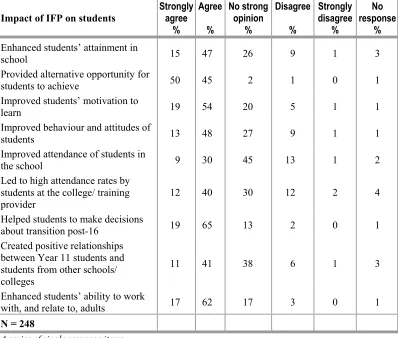
When asked about their views of the impact of the IFP on Year 11 students, school staff were generally very positive, as can be seen in Table 2.1. Nearly all (95 per cent) of the school staff who responded to the survey indicated that the IFP had provided an alternative opportunity for these students to achieve and fulfil their potential. Indeed, half of the respondents strongly agreed that this was the case. A total of 84 per cent of school staff agreed or strongly agreed that the IFP had helped students to make decisions about transition post-16, while 79 per cent felt that the programme had enhanced students’ ability to work with, and relate to, adults. Just less than three quarters (73 per cent) of the respondents indicated that the IFP had improved students’ motivation to learn. Less commonly, school staff agreed that the IFP had enhanced students’ attainment in school (62 per cent) and had improved the behaviour and attitudes of students (61 per cent). School staff were least likely to agree or strongly agree that the IFP had improved the attendance of students in school (39 per cent).
the open-ended question this year also reported that the IFP had helped with post-16 transition and preparedness for work (28 per cent) and had contributed to students’ personal development (28 per cent). A total of 24 per cent of school staff felt that one of the main successes of the IFP had been increasing students’ motivation to learn, which again, had been identified as one of the main aims of the programme.
Table 2.1 Views on impact of IFP on Year 11 students: School staffs’ responses
Impact of IFP on students Strongly agree
% Agree % No strong opinion % Disagree % Strongly disagree % No response %
Enhanced students’ attainment in
school 15 47 26 9 1 3
Provided alternative opportunity for
students to achieve 50 45 2 1 0 1
Improved students’ motivation to
learn 19 54 20 5 1 1
Improved behaviour and attitudes of
students 13 48 27 9 1 1
Improved attendance of students in
the school 9 30 45 13 1 2
Led to high attendance rates by students at the college/ training provider
12 40 30 12 2 4
Helped students to make decisions
about transition post-16 19 65 13 2 0 1
Created positive relationships between Year 11 students and students from other schools/ colleges
11 41 38 6 1 3
Enhanced students’ ability to work
with, and relate to, adults 17 62 17 3 0 1
N = 248
A series of single response items
Due to rounding, percentages may not always sum to 100
Source: NFER evaluation of Increased Flexibility Programme: Survey of Schools 2004
provide a more accurate reflection of the impact on the students than the college tutors given the limited amount of time that the students spend taking courses at their college provider. Nevertheless, respondents in college and training providers may be reporting changes in students’ behaviour when they were attending an external provider.
College staff’s responses to an open-ended question about the most positive outcomes of the IFP also reflected those given by school staff. The main successes of the programme for students identified by college staff were:
♦ accessing an alternative curriculum/ learning environment (53 per cent) ♦ help with post-16 transition and preparedness for work (40 per cent) ♦ personal development (23 per cent)
♦ motivation to learn (23 per cent).
Table 2.2 Views on impact of IFP on Year 11 students: College staffs’ responses
Impact of IFP on students Strongly agree
%
Agree
%
No strong opinion
%
Disagree
%
Strongly disagree
%
No response
%
Enhanced students’ attainment in
school 22 51 23 0 0 4
Provided alternative opportunity
for students to achieve 58 40 0 0 0 3
Improved students’ motivation to
learn 36 46 15 1 0 1
Improved behaviour and attitudes
of students 27 53 15 4 0 1
Improved attendance of students
in the school 18 36 40 4 0 3
Led to high attendance rates by students at the college/ training provider
21 46 22 8 1 3
Helped students to make
decisions about transition post-16 35 50 14 0 0 1
Created positive relationships between Year 11 students and students from other schools/ colleges
23 42 26 8 0 1
Enhanced students’ ability to
work with, and relate to, adults 28 58 12 0 1 1
N = 78
A series of single response items
Due to rounding, percentages may not always sum to 100
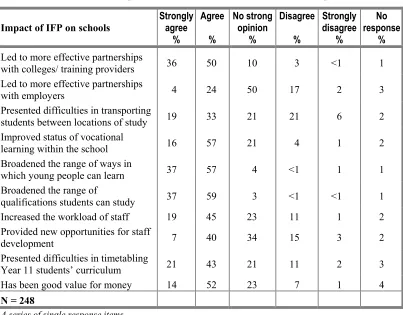
School and college staff were also asked about their perceptions of the impact of the IFP on their organisations. Table 2.3 shows the responses of the school staff, while Table 2.4 gives the responses of the college staff.
Table 2.3 Views on impact of IFP on Schools: School staffs’ responses
Impact of IFP on schools
Strongly agree % Agree % No strong opinion % Disagree % Strongly disagree % No response %
Led to more effective partnerships
with colleges/ training providers 36 50 10 3 <1 1
Led to more effective partnerships
with employers 4 24 50 17 2 3
Presented difficulties in transporting
students between locations of study 19 33 21 21 6 2
Improved status of vocational
learning within the school 16 57 21 4 1 2
Broadened the range of ways in
which young people can learn 37 57 4 <1 1 1
Broadened the range of
qualifications students can study 37 59 3 <1 <1 1
Increased the workload of staff 19 45 23 11 1 2
Provided new opportunities for staff
development 7 40 34 15 3 2
Presented difficulties in timetabling
Year 11 students’ curriculum 21 43 21 11 2 3
Has been good value for money 14 52 23 7 1 4
N = 248
A series of single response items
Due to rounding, percentages may not always sum to 100
Source: NFER evaluation of Increased Flexibility Programme: Survey of Schools 2004
The great majority of the school staff who responded to the survey agreed or strongly agreed that the IFP had broadened the range of qualifications students can study (96 per cent) and the range of ways in which young people can learn (94 per cent). A substantial majority also indicated that the programme had led to more effective partnerships with college and training providers (86 per cent) and that it had improved the status of vocational learning within the school (73 per cent). The financial cost of achieving this broader curriculum through working in partnership did not appear to be considered exceptional in the view of two-thirds of school respondents, who agreed that IFP offered good value for money. However, it is worth noting that interviews with tutors and teachers in the case-study partnerships revealed that staff often took into consideration the value of the outcomes for students when assessing value for money.
indicated that the IFP had increased the workload of staff in the school, and the same proportion reported that the IFP had presented difficulties in timetabling Year 11 students’ curriculum. Furthermore, just over half (52 per cent) agreed that the IFP had presented difficulties in transporting students between locations of study.
[image:27.612.108.519.259.618.2]In response to an open-ended question about the most positive outcomes of the IFP for schools, developing vocational learning and a broader curriculum was the most commonly identified outcome (42 per cent), followed by having more positive students in the school (23 per cent) who were more motivated and less disaffected, and developing external links (21 per cent).
Table 2.4 Views on impact of IFP on Colleges: College staffs’ responses
Impact of IFP on colleges Strongly agree
% Agree % No strong opinion % Disagree % Strongly disagree % No response %
Led to more effective partnerships
with schools 51 41 5 1 0 1
Led to more effective partnerships
with employers 4 13 59 19 1 4
Presented difficulties in transporting students between locations of study
24 35 23 14 3 1
Enhanced the status of colleges and training providers among schools
22 58 12 8 0 1
Broadened the range of ways in
which young people can learn 49 50 0 0 0 1
Broadened the range of
qualifications students can study 54 44 1 0 0 1
Increased the workload of staff 26 53 13 8 0 1
Provided new opportunities for
staff development 28 63 6 1 0 1
Presented difficulties in
timetabling programmes 28 39 21 8 4 1
Has been good value for money 18 41 24 8 5 4
Contributed to the widening
participation strategy 44 49 6 0 0 1
N = 78
A series of single response items
Due to rounding, percentages may not always sum to 100
Source: NFER evaluation of Increased Flexibility Programme: Survey of Colleges 2004
college staff also reported that the IFP had contributed to the widening participation strategy. It is interesting to note that the college respondents were much more likely to agree or strongly agree that the IFP had provided new opportunities for staff development (91 per cent, compared with 47 per cent of school staff). However, they were also more likely to report that the programme had increased the workload of staff (79 per cent, compared with 64 per cent of school respondents). College staff (and school staff) were less likely to report that the IFP had led to more effective partnerships with employers (17 per cent of college staff, compared with 28 per cent of school staff).
In response to an open-ended question, the most commonly identified successes of the IFP for colleges were:
♦ developing external links (45 per cent) ♦ staff development (21 per cent)
♦ enhanced student recruitment (21 per cent).
2.2 Progress towards qualifications
At the time of the survey, in the first half of the spring term 2004, the majority of the school staff reported that at least some of the students were on target to achieve their qualification, with 71 per cent indicating that some students were on target and 23 per cent reporting that all IFP students were on target to achieve their qualifications. Only three per cent of school respondents stated that none of the students were on target to achieve their IFP qualification.
Indeed, in just over a third of schools (34 per cent), staff indicated that some IFP students were ahead of target, although 39 per cent reported that none of the IFP students in their school were ahead of target. The main reasons given by school staff for students being ahead of target were that they:
♦ were motivated and worked hard on their course (50 per cent) ♦ enjoyed and valued their course (17 per cent)
♦ received good quality teaching (ten per cent).
of the poor quality teaching they had received (nine per cent), because the course was the wrong choice for them (eight per cent) and because the GCSEs in vocational subjects were too difficult for students (seven per cent).
Table 2.5 Views on whether students are on target to achieve IFP qualifications: Schools’ responses
Students are: All IFP
students Some IFP students students No IFP response No
On target to achieve 23 71 3 4
Ahead of target to achieve 0 34 39 27
Behind target to achieve 2 49 27 21
N = 248
A series of single response items
Due to rounding, percentages may not always sum to 100
Source: NFER evaluation of Increased Flexibility Programme: Survey of Schools 2004
As Table 2.6 shows, the responses of the college staff were broadly similar to their colleagues in schools, with the majority (80 per cent) of colleges and training providers indicating that some students were on target to achieve their qualifications. The reasons given by college staff for students being ahead of target were also similar to those given by school staff – the students were motivated and had worked hard (53 per cent), and the students were of an appropriate ability for the course (19 per cent). The main reasons given by college staff for students being behind target were that the ability level of students was not appropriate to the course they were taking (29 per cent), students had poor attendance (26 per cent) and students lacked interest in their IFP course (20 per cent).
Table 2.6 Views on whether students are on target to achieve IFP qualifications: Colleges’ responses
Students are: students All IFP Some IFP students students No IFP response No
On target to achieve 12 80 1 8
Ahead of target to achieve 0 46 23 31
Behind target to achieve 1 69 14 15
N = 78
A series of single response items
Due to rounding, percentages may not always sum to 100
Source: NFER evaluation of Increased Flexibility Programme: Survey of Colleges 2004
The surveyed students were generally positive about the courses they were studying through the IFP, and felt that they were taught at a level appropriate to them. The majority (81 per cent) of the young people said that they had found some aspects of their course easy and some aspects difficult. This suggests that, for most students, the qualifications matched their ability. Smaller proportions of respondents reported that their course was either all easy (13 per cent) or all difficult (four per cent). These proportions are broadly similar to the proportions of students who made these responses last year, when they were in Year 10. However, the proportion of IFP participants who found all aspects of their course difficult had increased from two per cent when they were surveyed in Year 10.
The majority of students (61 per cent) also reported that they found some aspects of their course interesting and other aspects boring. Nearly a third (30 per cent) of the young people indicated that they found the whole of their course interesting, although this proportion had decreased from 37 per cent when these students were surveyed in Year 10. Only seven per cent of respondents found all aspects of their course boring, but this proportion had increased from four per cent in Year 10.
The extent to which students found their IFP course easy or difficult differed according to certain background characteristics. Overall, it appeared that students who found their IFP courses easy were more likely to be those who:
♦ were male
♦ were undertaking NVQs or other VQs ♦ had a tendency to prefer college to school ♦ had a positive attitude to school
♦ were confident in their abilities.
There were also differences in the students who found their course interesting, compared with those who found it boring. Students who found their course interesting were more likely to be those who:
♦ were working towards NVQs or other VQs ♦ had a lower attainment at key stage 3
♦ were recognised as having some form of Special Educational Need (SEN) ♦ were taking their IFP course at college
♦ had a tendency to prefer studying at college to school
When asked about their views of the amount of time they spent on their IFP courses each week, just over half of the students (53 per cent) felt that it was about right. However, 37 per cent of students stated that they would like more time on their course, and a sub-group of 58 per cent of these young people stated that this was because they did not have enough time to do the work. This may reflect pressures on students as the course neared completion, as this was a notable increase from last year’s survey of these IFP students, when 36 per cent noted that they did not have enough time to complete the work. Furthermore, the proportion of students who reported that they wanted more time on their course because they enjoyed it had decreased from 59 per cent in Year 10 to 38 per cent in Year 11.
Only eight per cent of young people reported that they would like less time on their course. Of these 212 students, 61 per cent stated that this was because they did not enjoy their course, which was a notably higher proportion than in Year 10 (47 per cent). A third of the Year 11 students who reported that they wanted less time on their course indicated that this was because they were able to complete all the work and had spare time. This is a lower proportion than the 43 per cent of students who reported this in Year 10.
Further analysis of the data revealed that there were some differences in the background characteristics of students who wanted more or less time on their IFP course. Male students, those who preferred college to school, and students who preferred a practical approach to learning, were more likely than students overall to want more time on their course. It is worth noting that there were no significant differences in the qualifications that students were taking and the time they would like on their course. This reflects a change from last year when students taking NVQs and other VQ and GNVQ courses were more likely than those taking GCSEs in vocational subjects to want more time on their course. Some differences emerged in the characteristics of students reporting different reasons for wanting more or less time on their courses. For example, students who needed more time on their IFP course to complete their work tended to be those who were female, higher achieving students, and those who were taking GCSEs in vocational subjects. Future analyses will explore these findings in further depth and, for example, will assess whether there is any relationship between students’ perception of a lack of time to complete their work and their achievement on the IFP course.
2.3 Development of skills
2.3.1 Development of personal and social skills
other young people. The same proportion (47 per cent) stated that participating in the IFP had made them a more confident person.
Similarly, analysis of the responses of students who were pursuing their courses away from school revealed that, compared with when they were in Year 10, a higher proportion reported that they work well with students from other schools on the course (52 per cent, compared with 44 per cent in Year 10). In addition, a slightly higher proportion of Year 11 students felt that they fitted in with other students on the course (79 per cent, compared with 75 per cent in Year 10).
2.3.2 Development of employability skills
The 26 employers who had supported IFP through providing work placements for students, giving talks and hosting visits, outlined their requirements when recruiting young people. Eleven specified that they required young people to have GCSEs and seven identified the need for other qualifications such as NVQs. Three said that they did not look for qualifications. Employers looked for a range of skills depending on the occupation they were recruiting for including IT skills, basic English and numeracy skills and problem-solving skills. However, half of the employers across the sectors identified good communication skills as an important attribute in young people they considered recruiting. Young people’s attitude, motivation and appearance were also noted and half looked for aspects of a personality which were relevant to their work such as patience, a caring approach, enthusiasm and the ability to work under pressure. While eleven of the employers interviewed said that an individual’s qualifications, skills and characteristics were equally important considerations when recruiting, ten commented that the person’s characteristics were most important.
Table 2.7 Students’ views on work-related skills
Views on skills that are useful for getting a job
Very useful
%
Quite useful %
Not useful
%
Not sure %
No response
%
Being able to:
fill in an application form well 63 26 3 3 5
write a Curriculum Vitae (C.V.) 62 22 4 6 5
cope well in an interview 73 17 3 3 5
understand what you will need to do in that job 75 16 1 2 5
write clearly 48 39 4 4 5
speak clearly 64 26 2 2 6
do maths accurately 28 45 11 10 6
use a computer to find and present information 38 40 7 9 6
answer the ‘phone properly 40 36 10 8 5
deal with others (e.g. workmates, customers) 66 24 2 3 5
deal with people in authority 58 26 4 7 5
work in a team 67 23 2 3 5
use your initiative 66 23 2 4 6
turn up on time 79 12 2 1 5
dress appropriately 71 19 3 2 5
N = 2616
A series of single response items
Due to rounding, percentages may not always sum to 100
Source: NFER evaluation of Increased Flexibility Programme: Survey of Year 11 Students 2004
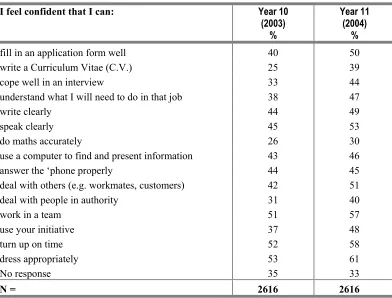
As Table 2.8 shows, students’ confidence in their abilities in all these work-related skill areas seemed to have increased over the past year. For example, compared with when they were in Year 10, a higher proportion of students this year reported that they were confident in their ability to:
♦ write a CV
♦ fill in an application form well ♦ cope well in an interview
♦ understand the requirements of a job ♦ speak clearly
♦ deal with others
Table 2.8 Students’ confidence in work-related skills: 2003 and 2004
I feel confident that I can: Year 10
(2003) %
Year 11 (2004)
%
fill in an application form well 40 50
write a Curriculum Vitae (C.V.) 25 39
cope well in an interview 33 44
understand what I will need to do in that job 38 47
write clearly 44 49
speak clearly 45 53
do maths accurately 26 30
use a computer to find and present information 43 46
answer the ‘phone properly 44 45
deal with others (e.g. workmates, customers) 42 51
deal with people in authority 31 40
work in a team 51 57
use your initiative 37 48
turn up on time 52 58
dress appropriately 53 61
No response 35 33
N = 2616 2616
More than one answer could be put forward so percentages do not sum to 100
Source: NFER evaluation of Increased Flexibility Programme: Survey of Year 11 Students 2004
Further analyses were carried out to explore whether visiting an employer as part of the IFP had any effect on students’ perceptions of which skills are useful for getting a job and on their confidence in their abilities in these skill areas. The analyses revealed that the young people who reported that they had visited an employer in Year 11 (907 students) were significantly more likely to indicate that certain skills were very useful for getting a job compared with those who had not visited an employer (1,462 students). These skills included being able to:
♦ write a CV ♦ speak clearly
♦ answer the telephone properly ♦ work in a team
♦ deal with others ♦ use initiative ♦ dress appropriately.
compared with those who had not visited an employer in Year 11. In particular, they were significantly more likely to report that they were confident in their ability in skills required to gain a job such as writing a CV, coping in an interview and dressing appropriately and in inter-personal skills such as speaking clearly, answering the telephone and dealing with others.
This suggests that the IFP students’ experience in a workplace had helped them to gain an insight into the particular skills that are most useful for gaining employment. It also seems that the students had gained experience in certain skills as part of their visits to employers, which had contributed to them feeling more confident in their abilities than IFP students who had not visited an employer.
2.4 Students’
attitudes to learning
As was found in the 2003 surveys, the majority of IFP students surveyed indicated that they responded to, and were motivated by, practical work. For example, 79 per cent of respondents stated that they learn best by doing something, whilst 72 per cent indicated that they prefer practical work to lots of writing. Further analysis of the data, using one of the student attitude variables constructed,4 revealed that male students, those undertaking NVQs and those studying at college were more likely to prefer a practical approach to learning.
The young people’s views on their experience of school and their lessons were mixed. Two-thirds (66 per cent) of respondents felt that school work was worth doing, and a slightly lower proportion (62 per cent) reported that they are well-behaved in school. This proportion had increased notably from when they were in Year 10 (62 per cent of Year 11 students reported that they were well-behaved, compared with 53 per cent when they were in Year 10). In addition, just over half (52 per cent) of the students reported that most of the time they liked going to school, and this proportion had increased slightly from 49 per cent in Year 10. However, 54 per cent of the students felt that some of the subjects they did in Years 7-9 were a waste of time, and this proportion had, in fact, increased from 46 per cent in Year 10. Similarly, although the majority (66 per cent) of students indicated that the courses they were taking will help them to get a good job, this proportion had decreased from 74 per cent when the students responded to this question in Year 10.
Table 2.9 shows that, when asked about their lessons at school, more than two-thirds of students indicated that they work as hard as they can in most or all of their lessons. However, three-quarters of the students reported that they often count the minutes until a lesson ends, for at least some of their lessons, and the
4
same proportion stated that they are bored in at least some of their lessons. There had been very little change in students’ responses this year compared with when they were in Year 10.
Table 2.9 Students’ views of lessons
Views of lessons
All lessons % Most lessons % Some lessons % Hardly any lessons % No lessons % No response %
I work as hard as I can in school 15 52 27 3 1 1
I often count the minutes until a lesson
ends 14 19 42 17 7 2
I am bored in lessons 7 16 52 19 4 2
The work I do in lessons is a waste of
time 3 6 29 31 27 3
The work I do in lessons is interesting 5 31 47 12 4 2
N = 2616
A series of single response items
Due to rounding, percentages may not always sum to 100
Source: NFER evaluation of Increased Flexibility Programme: Survey of Year 11 Students 2004
An overall analysis of students’ attitudes, using the attitude variables constructed,5 revealed some differences between the young people when they were in Year 10 and when they were in Year 11. Students appeared to have gained in confidence in their abilities and were more positive about school by Year 11, compared with their views in Year 10. More specifically, in 2004, the IFP students surveyed were significantly:
♦ more positive about school and its usefulness for the future, including the
extent to which their education had given them useful skills and knowledge and prepared them for adult and working life.
♦ more confident in their own abilities, including the ability to work on their
own and to solve problems.
However, the Year 11 students were less likely to prefer studying at college rather than school, and were more likely to have been late for lessons, and, in particular, to have truanted from school, compared with when they were surveyed in Year 10. These responses reflect the observations of school respondents, the majority of whom did not perceive a positive change in attendance.
Table 2.10 shows IFP students’ views on their education and their plans for the future, and illustrates that the young people were generally positive about how their education could help them with future employment. Although 37 per cent of respondents indicated that they cannot wait to leave school and get
5
a job, this proportion had decreased from 48 per cent in Year 10. This suggests that more students may now be carefully considering undertaking further learning after Year 11. Two-thirds of students agreed that the courses they are taking will help them to get a good job. However, this proportion had decreased from 74 per cent when the students were in Year 10. It is worth noting that it is not clear whether respondents were referring to their IFP course or the other courses they were studying at school when answering this question.
Table 2.10 Students’ views on education and the future
Views on education for me True
%
Not sure
%
Not true for me
%
No response
%
My parents want me to stay in education as long as
possible 51 28 18 2
I can’t wait to leave school and get a job 37 27 34 2
I think there is no point in studying subjects that don’t lead
to a qualification 45 30 23 3
I don’t think school subjects are much help in getting a job 16 34 47 2
I think I will need to know how to use a computer when I
get a job 47 31 19 2
I think the courses I am taking will help me get a good job 66 25 7 2
N = 2616
A series of single response items
Due to rounding, percentages may not always sum to 100
Source: NFER evaluation of Increased Flexibility Programme: Survey of Year 11 Students 2004
Further analysis was undertaken to explore the characteristics of students who tended to be more positive about school, using one of the attitude variables constructed. This revealed that, compared to the overall profile of respondents, students with the following characteristics were over-represented among those with more positive attitudes about school and its usefulness for the future.
Students who:
♦ were female
♦ were of Asian ethnic background
♦ had higher prior attainment at key stage 3 ♦ were not recognised as having a SEN ♦ were taking GCSEs in vocational subjects ♦ were studying their course at school.
Views on working away from school
For example, as Table 2.11 shows, more than four-fifths of the young people agreed that they felt comfortable and were not nervous when taking courses away from school. In addition, the majority felt that they were treated as an adult and that the atmosphere was more relaxed at the external provider. Overall, three-quarters enjoyed their course. These findings reflect the experience of students who participated in interviews,6 who valued and appreciated the approach of tutors and the alternative atmosphere and environment at their external provider.
Students were less sure that what they were doing out of school would help them understand their school work (30 per cent agreed). Only around a fifth of the young people studying out of school agreed that they can work more at their own pace at school than at the college or training provider, and that they find it easier to learn at school than the college or training provider.
Table 2.11 Students’ views of their course out of school
Views of course
Agree
% Not sure %
Disagree
%
No response
%
I feel comfortable at the college/training provider 84 10 4 2
I find it difficult to travel to the college/ training provider 9 11 77 3
I am only doing this course because it is better than being
at school all the time 16 18 62 4
I am nervous about the courses I am doing out of school 4 11 81 4
I enjoy the courses I am doing out of school 75 16 7 2
I fit in with the other students on the course 79 14 4 3
I do not enjoy working with adults from outside school 8 17 71 4
I think that what I am doing out of school helps me
understand my school work 30 37 29 4
I work well with students from other schools on the course 52 24 17 7
I feel I am treated more as an adult when I am at the
college/training provider 80 9 9 2
I find it easier to learn at school than the college/training
provider 19 34 44 3
I think that the college/training provider has a more
relaxed atmosphere than school 76 14 7 3
I can work more at my own pace at school than at the
college/training provider 20 30 47 3
N = 1244
A series of single response items
Due to rounding, percentages may not always sum to 100 A filter question: all those doing a course out of school
Source: NFER evaluation of Increased Flexibility Programme: Survey of Year 11 Students 2004
6
Generally the students studying out of school were slightly more positive about their views of the experience compared with when they were in Year 10. For example, as 81 per cent of the young people disagreed that they were nervous about studying out of school compared with 77 per cent in Year 10. However, a smaller proportion of the young people agreed that they enjoy the courses they are doing out of school than in Year 10 (75 per cent, compared with 82 per cent in Year 10).
Views on the impact of the IFP
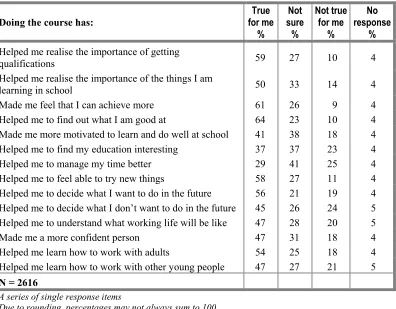
Young people were asked about their views of the impact of the IFP course on their attitudes to learning. Although many of the students felt unsure of the impact of the IFP at this stage, generally, the young people felt that doing the IFP course had had a positive effect on them. As can be seen in Table 2.12, more than half the IFP students felt that doing their course had:
♦ helped them to find out what they are good at ♦ made them feel that they can achieve more
♦ helped them realise the importance of getting qualifications ♦ helped them to feel able to try new things
♦ helped them to decide what they want to do in the future ♦ helped them to learn how to work with adults
♦ helped them realise the importance of the things they are learning in
Table 2.12 Students’ perceptions of the impact of their course
Doing the course has: for me True
%
Not sure %
Not true for me
%
No response
%
Helped me realise the importance of getting
qualifications 59 27 10 4
Helped me realise the importance of the things I am
learning in school 50 33 14 4
Made me feel that I can achieve more 61 26 9 4
Helped me to find out what I am good at 64 23 10 4
Made me more motivated to learn and do well at school 41 38 18 4
Helped me to find my education interesting 37 37 23 4
Helped me to manage my time better 29 41 25 4
Helped me to feel able to try new things 58 27 11 4
Helped me to decide what I want to do in the future 56 21 19 4
Helped me to decide what I don’t want to do in the future 45 26 24 5
Helped me to understand what working life will be like 47 28 20 5
Made me a more confident person 47 31 18 4
Helped me learn how to work with adults 54 25 18 4
Helped me learn how to work with other young people 47 27 21 5
N = 2616
A series of single response items
Due to rounding, percentages may not always sum to 100
A total of 2,544 respondents answered at least one item in this question
Source: NFER evaluation of Increased Flexibility Programme: Survey of Year 11 Students 2004
Further analysis, which entailed constructing two student attitude variables from this data,7 enabled an exploration of the reported impact on students with different background characteristics.
An examination of the characteristics of students who felt that doing their IFP course had given them an increased respect for education (for example, by helping them to realise the importance of getting qualifications) revealed that, compared to the overall profile of respondents, students with the following characteristics were over-represented among those whose respect for education had increased.
Students who:
♦ had some form of special educational need ♦ had lower prior attainment at key stage 3 ♦ were not taking GCSEs in vocational subjects ♦ preferred studying at college than school ♦ were confident in their abilities
7
♦ preferred a practical approach to learning
♦ had chosen their course because it was related to a career they were
interested in
♦ had not been told to do their course by the school.
A similar analysis revealed that students with the following characteristics were over-represented among those who felt that their IFP course had helped to prepare them for work (for example, by helping them understand what working life will be like).
Students who:
♦ were taking NVQs or other VQs
♦ had some form of special educational need ♦ h