Administative Support Staff in
Schools: Ways Forward
Katy Greene, Barbara Lee,
Ellen Springall and Rachael Bemrose
National Foundation for Educational Research
Research Report No 331
Administrative Support Staff in
Schools: Ways Forward
Katy Greene, Barbara Lee, Ellen Springall and Rachael Bemrose
National Foundation for Educational Research
The views expressed in this report are the authors' and do not necessarily reflect those of the Department for Education and Skills.
© Queen’s Printer 2002. Published with the permission of DfES on behalf of the Controller of Her Majesty's Stationery Office. Applications for reproduction should be made in writing to The Crown Copyright Unit, Her Majesty's Stationery Office, St Clements House, 2-16 Colegate, Norwich NR3 1BQ.
Contents
Page No.
1 Introduction to the research 1
1.1 The context for the research 1
1.2 Aims and objectives of the research 2
1.3 Methodology 3
1.4 The research activities and the participants 3
1.4.1 Review of literature 3
1.4.2 Exploratory case studies 3
1.4.3 Questionnaire surveys 4
1.4.4 Case studies of good practice 7 1.4.5 Analysis of pupil performance data 8
1.5 This report 8
2 The school approach to administrative tasks 11
2.1 Background 11
2.2 Survey findings 12
2.3 Case study findings 13
2.4 Key issues/findings 18
3 The numbers and roles of administrative staff 21
3.1 Background 21
3.2 Survey findings 25
3.3 Case study findings 27
3.4 Key issues/findings 31
4 Funding for administrative tasks to be carried out 33
4.1 Background 33
4.2 Overall funding 34
4.2.1 Survey findings 34
4.3 Priorities if funding for administrative support were increased 38
4.3.1 Survey findings 38
4.3.2 Case study findings 40
4.4 Key issues/findings 43
5 Administrative tasks carried out by teaching staff 45
5.1 Teacher tasks/school tasks 45
5.2 Teaching staff and administrative tasks 46
5.2.1 Background 46
5.2.2 Survey findings 47
5.2.3 Case study findings 47
5.3 School heads of department/curriculum coordinators and 49 administrative tasks
5.3.1 Background 49
5.3.2 Survey findings 50
5.3.3 Case study findings 51
5.4 Perceived appropriateness of administrative tasks for teaching 53 staff and heads of department/curriculum coordinators
Page No.
5.4.2 Survey findings 54
5.4.3 Case study findings 58
5.5 Changes in the amount and type of administrative tasks 60 undertaken by teachers
5.5.1 Background 60
5.5.2 Survey findings 60
5.5.3 Case study findings 62
5.6 New administrative tasks 63
5.6.1 Survey findings 63
5.6.2 Case study findings 65
5.7 The main sources of teachers’ administrative tasks 66
5.7.1 Background 66
5.7.2 Survey findings 69
5.7.3 Case study findings 73
5.8 Key issues/findings 73
6 The delegation of administrative tasks 77
6.1 Administrative tasks being carried out for teaching staff 77
6.1.1 Background 77
6.1.2 Survey findings 79
6.1.3 Case study findings 80
6.2 Tasks teachers have recently delegated 82
6.2.1 Survey findings 82
6.2.2 Case study findings 83
6.3 Teachers’ use of time released 86
6.3.1 Background 86
6.3.2 Survey findings 86
6.3.3 Case study findings 89
6.4 Tasks teachers would like to delegate 91
6.4.1 Background 91
6.4.2 Survey findings 91
6.4.3 Case study findings 92
6.5 Obstacles to delegation 93
6.5.1 Background 93
6.5.2 Survey findings 93
6.5.3 Case study findings 96
6.6 Key issues/findings 100
7 Training 103
7.1 Background 103
7.2 Identification of training needs 103
7.2.1 Survey findings 103
7.2.2 Case study findings 105
7.3 Training opportunities for administrative staff 107
7.3.1 Survey findings 107
7.3.2 Case study findings 109
7.4 ICT training 109
Page No.
7.4.2 Survey findings 109
7.4.3 Case study findings 111
7.5 Training in how to delegate 111
7.5.1 Background 111
7.5.2 Case study data 111
7.5.3 Key issues/findings 112
8 The use of ICT for administrative purposes 113
8.1 Background 113
8.2 The impact of ICT on the tasks administrative staff carry out 114
8.2.1 Case study findings 114
8.3 Impact of ICT on teachers’ administrative tasks 115
8.3.1 Survey findings 115
8.3.2 Case study findings 119
8.4 Access to ICT for administrative tasks 121
8.4.1 Survey findings 121
8.4.2 Case study findings 123
8.5 Key issues/findings 124
9 Impact of reallocation of administrative tasks 125
9.1 Impact on headteachers and teachers 125
9.1.1 Background 125
9.1.2 Survey findings 125
9.1.3 Case study findings 128
9.2 Impact on pupil performance 131
9.2.1 Background 131
9.2.2 Survey findings 132
9.2.3 Case studies 135
9.3 Performance data 136
9.3.1 National data 137
9.3.2 Headteachers 138
9.3.3 Teachers 138
9.3.4 Curriculum coordinators and heads of department 138
9.3.5 Bursars and administrators 139
9.4 Impact on administrative staff 139
9.4.1 Survey findings 139
9.4.2 Case study findings 140
9.5 Key issues/findings 143
10 Summary of findings, conclusions and recommendations 145
10.1 Introduction 145
10.2 Summary of findings 146
10.2.1 Administrative tasks carried out by teachers 146 10.2.2 Support provided by administrative staff to teachers 147 10.2.3 Roles of administrative staff 148
10.2.4 How teachers use time released 150
Page No.
10.3 Recommendations for future practice 152
References 155
Appendices 159
Acknowledgements
The project team would like to thank all those who participated in the research. In particular, we are grateful to the school staff who were interviewed in Phase 1 case studies, those who responded to the questionnaire survey, and those who participated in the Phase 2 case studies.
1
Introduction to the research
1.1 The context for the research
The use of administrative support staff in schools has increased significantly in recent years and there has been much discussion of their role and the tasks they could or should be carrying out. At the time when the current research was commissioned the Department for Education and Skills (formerly DfEE) had introduced a number of strategies designed to ease the bureaucratic burden of teachers, thereby releasing time for them to devote themselves to their key task of teaching. The Better Regulation Task Force made a number of recommendations on reducing ‘Red Tape Affecting Head Teachers’ (Cabinet Office, 2000), and in small schools, extra funds were made available through the Small Schools Fund (formerly the Administrative Support Fund for Small Schools (ASFSS)). For all schools, advice and recommendations on reducing the administrative tasks carried out by teachers and headteachers have been forthcoming from several sources.
The role of administrative support staff has usually been discussed in the context of reducing teachers’ workload and in 2001 the Government commissioned PricewaterhouseCoopers to conduct an independent study into this very issue. Amongst the findings and recommendations in the resulting report are references to the contributions which are or could be made by administrative staff.
Another change which has come about is the Government pledge to increase the number of trained bursars (or equivalent administrative staff) and to ensure that they have opportunities for training and development. The National College for School Leadership is currently developing a pilot training scheme for bursars.
The teachers’ unions and UNISON have also been very involved in investigating questions of teacher workload and the most appropriate use of non-teaching staff, with a particular emphasis on the role of classroom assistants.
• the innovative uses of non-teaching staff in primary and secondary schools (Mortimore et al.,1992)
• reducing the bureaucratic burden on teachers (Coopers and Lybrand, 1998)
• the use of associate staff in schools, including the use of clerical or office staff (NUT, 1998)
• the role of the bursar (O’Sullivan et al.,2000)
• working with support staff: their roles and effective management in schools
(Kerry, 2001).
It is within this context that the DfES commissioned the National Foundation for Educational Research to carry out research into the role of administrative support staff and the impact of their work on teachers and pupils.
1.2 Aims and objectives of the research
The aims of the research were to establish:• the impact of administrative support in schools
• how teachers employ any time released by the presence of extra administrative
support
• how the effective use of administrative support, including teacher time released, can best be used to support pupil attainment.
The specific objectives which the research was designed to meet were as follows:
• to establish the full range of roles that additional administrative support staff play in schools
• to establish how administrative staff support teachers in their work
• to identify how teachers utilise the time released by the presence of extra
administrative support staff
• to establish how this extra time is best used to support pupil attainment
• to identify the extent of the impact on pupil performance that extra administrative support can have
1.3 Methodology
In order to meet the aims and objects outlined, the team carried out a number of research activities:
• a review of research literature
• case studies
• school and teacher surveys
• an analysis of performance data.
It was envisaged that each element would contribute a particular set of data to the research findings: the literature review would ensure that the proposed investigation built upon any existing research into the issues; the case studies would explore in detail the different approaches adopted by schools and the effects on schools, teachers, support staff and pupils; the questionnaire surveys would provide a national overview of approaches taken by schools; the analysis of performance data would help to explain the evidence arising from the surveys.
1.4 The research activities and the participants
Details of each of the research activities are provided below with information on the numbers of people involved in each one.
1.4.1 Review of literature
In order to have a context for the research the team carried out a review of relevant literature relating to policies, practices and research. A summary report on the initial findings was presented to DfES in November 2000. As further policy decisions have been made, other actions taken and further research undertaken, so the team has continued to add to the review. The references to such literature have been included throughout this report, related to the findings from the current research, rather than in a separate section.
1.4.2 Exploratory case studies
school, face-to-face interviews were carried out with a range of staff in order to elicit different perspectives. This included:
• the headteacher or another senior member of staff
• heads of department in secondary schools and subject or key stage coordinators in primary and special schools (or other appropriate teacher)
• subject or classroom teachers
• administrative staff.
These case studies were designed to explore staff experiences and perceptions in relation to a wide range of issues concerning administrative tasks. All interviewees, headteachers, heads of department, teachers and administrative support staff, were asked broadly the same questions although the focus reflected their particular role in school. They were asked:
• what they considered to be administrative tasks
• if there had been any changes in their workload in the last year
• whether administrative support time had been monitored
• for examples of approaches adopted where administrators were supporting
teachers
• about the role of ICT in their work
• about the impact of administrative support on teachers and pupil performance
• if they had any related training requirements.
Interviewees were also given the opportunity to add further information that they felt was relevant.
The data from the case studies were analysed and an interim report on the findings was presented to DfES in May 2001. A summary of the main themes discussed in that report is provided in Appendix 1.
1.4.3 Questionnaire surveys
secondary schools, 600 primary schools and 200 special schools. The sample of schools took account of the size of the schools as it was important to ensure that sufficient small schools (that is, those eligible to received the Small Schools Fund) were included. Details of the sample can be found in Appendix 1.
Each school was sent questionnaires for:
• the headteacher
• the bursar/school administrator
• a head of department/subject coordinator
• one or two class/subject teachers (primary schools) and two or three subject
teachers (secondary schools)
Instrument Type Headteacher Questionnaire Bursar/Administrator Questionnaire Coordinator/Head of Department Questionnaire Teacher 1 Questionnaire Teacher 2 Questionnaire Teacher 3 Questionnaire
Sample Allocated Returned completed
Allocated Returned completed
Allocated Returned completed
Allocated Returned completed
Allocated Returned completed
Allocated Returned completed
Primary 600 205
34%
600 182
30%
600 126
21%
600 155
26%
562 60
11%
0 0
Secondary 600 142
24%
600 150
25%
600 120
20%
600 167
28%
600 111
19%
471 45
10%
Special 200 78
39%
200 80
40%
200 44
22%
200 58
29%
193 24
12%
As the table shows, rates varied between ten per cent and 40 per cent. Overall, the response rate of at least one questionnaire returned from each school was close to 50 per cent, a perfectly acceptable response rate. However, the level of response may have been affected by the timing of the survey, since many teachers are occupied with key stage assessments, GCSE examinations and parental reporting procedures during the summer term. The project team received a number of phone calls and letters providing reasons why school staff were unable to participate. These reasons included staffing and workload issues, the introduction of new initiatives taking up teacher time and summer term tasks as mentioned above.
The questionnaires all covered similar topics, although not all participants were asked about all topics. The questions were tailored towards the post held by the respondent and the phase in which they worked. Topics covered across all questionnaires comprised the following:
• the school approach to administrative tasks
• numbers and roles of administrative staff
• administrative tasks carried out
• delegation of administrative tasks
• changes in levels of administration and types of tasks
• use of ICT for administrative tasks and training for such use
• training for administrative staff
• administrative tasks and teaching staff
• funding for administrative tasks to be carried out
• personal and school information.
1.4.4 Case studies of good practice
the Small Schools Fund; use of ICT; shared administrative staff; multi-skilled support staff; good communication processes between teachers and administrative staff. The size of school was also a factor as it was hoped that one or more of the schools would be receiving the Small Schools Fund.
In each school, interviews were held with the headteacher, a head of department or subject coordinator, one or more teachers and one or more members of the administrative support staff. The issues explored with schools in these case studies were of two kinds:
• those which covered all the aspects of the school’s organisation of administrative tasks, following on from the information provided in the questionnaire
• those which focused on particular points of interest in that school, which had been raised in the questionnaires.
The findings from these case studies and illustrative material have formed the basis for most of the qualitative findings presented in the report. However, where appropriate, examples of effective practice found in the exploratory case studies have also been used.
1.4.5 Analysis of pupil performance data
An additional task carried out by the team (the project statistician, in particular) was to make comparisons between the levels of pupil performance in small schools (that is, those receiving the Small Schools Fund) and those in larger schools. Regression analysis was also carried out to investigate whether responses to the questionnaire questions were affected by the size of school (and therefore funding) and the overall levels of performance. The results of these analyses are referred to in Chapter 9.
1.5 This
report
2
The school approach to administrative
tasks
2.1 Background
The research by Coopers and Lybrand (1998) recognised the importance of good school organisation in helping to reduce the administrative workload of teachers. They argued that schools need to ensure that they actively seek to reduce any unnecessary administrative tasks which teachers are presently required to carry out and manage those administrative duties which are unavoidable. They concluded that
‘most teachers … receive little or no administrative or clerical support to underpin their job. They do all their clerical work themselves’. One of the report’s recommendations states that schools should consider the use of administrative assistance to reduce the remaining bureaucratic burden on teachers.
The use of administrative support staff to reduce the workload of teachers was also discussed in the research carried out by the NUT in 1998. This research found that the extent to which clerical staff were able to offer administrative support to teaching staff varied widely across schools, and in particular across phases, with primary teaching staff less likely to have access to administrative assistance than their secondary colleagues. The report went on to state that primary teachers were in no less need of, or entitled to, administrative assistance (NUT, 1998).
The research also found that those schools with a coherent administrative support system had certain common features:
• the school had a policy for such support
• staff within the office were earmarked for this particular function or were
organised as a separate section of the office
• departments received allocated and timetabled time for departmental
administration
• teachers knew the arrangements and could allocate tasks without having to
Kerry (2001) stated in his research of effective management of administrative support staff that the role of such staff needs to be better developed and managed by those with leadership responsibilities (that is, headteachers, the senior management team (SMT) and teachers).
In support of other research in this area, the study by PricewaterhouseCoopers (2001a) found that those schools highlighted as demonstrating best practice had developed a strategic approach to administrative support. Their findings were based on fieldwork in over 100 schools and discussions with a variety of national and local bodies. The PricewaterhouseCoopers study concluded that many administrative tasks which teachers and headteachers currently complete could be successfully undertaken by administrative support staff. Moreover, it is how administrative support is organised in schools which is crucial in determining whether administrative support can be directly accessible to teachers.
Additionally, the PricewaterhouseCoopers study argued that there is a range of time-intensive tasks currently being undertaken by teachers and senior managers which could be successfully undertaken by administrative support staff. The research found that effective support occurred in secondary schools where administrative support staff were allocated and managed by the subject area or faculty. The PricewaterhouseCoopers study also found that teachers would benefit if administrative support were available before and after school. Additionally, in primary and special schools, teachers would benefit if administrative support were to be made available at specific points in the school week.
2.2 Survey
findings
Table 2.1 Written guidelines on the administrative tasks carried out (Secondary School Administrators)
%
Yes 22
No 76
Missing 3 (N=151)
Because percentages are rounded to the nearest integer, they may not sum to 100
Table 2.2 Written guidelines on the administrative tasks carried out (Primary School Administrators)
%
Yes 20
No 75
Missing 4
(N=183)
Because percentages are rounded to the nearest integer, they may not sum to 100
Table 2.3 Written guidelines on the administrative tasks Carried out (Special School Administrators)
%
Yes 21
No 79
(N=80)
Because percentages are rounded to the nearest integer, they may not sum to 100
Administrative support staff were asked to return a copy of their current job description with the questionnaire. The job descriptions showed that administrative support staff undertook a wide range of roles and responsibilities. Secondary school administrators undertook a wider range of roles and responsibilities than their primary and special school counterparts (see Appendix 2).
2.3 Case study findings
Secondary
Two secondary schools were visited in the second phase of this research project. Secondary schools tended to employ a greater number of administrative support staff who had roles relating to specific school tasks. An example can be found in Case Study B:
Case study B
In this school there are eight roles which have a purely administrative function and a further five roles that have an element of administrative support. The headteacher felt that the staff handbook contained information on how and when teachers could access administrative support, but did feel that systems for processing administrative requests were largely informal and were responsive to changes that took place. For example, one member of the administrative support team responsible for curriculum support was expected to support teachers, but a different part of her job had grown and made demands on her time. Despite this, teachers were able to access administrative support in a number of ways. For example, reprographics staff undertook photocopying for members of the teaching staff, the examinations officer was able to take the pressure of running exams from the teaching staff, and the librarian did a lot of work to help teaching staff. The headteacher and SMT had the support of the school secretary who was also described as fulfilling the role of the headteacher’s personal assistant. Additionally, following a complete review of schemes of work carried out in the last 12 months, administrative support staff did all the word processing and photocopying associated with schemes of work, whilst teachers continued to provide the content.
The headteacher had recently reorganised the teams in the school and some teams now had a mixture of teaching and administrative staff. He felt that this helped all staff to fulfil the needs of the school more effectively.
Case study A
This school is a split site school, with a growing 6th form. The school had just appointed a part time administrator and librarian post in the 6th form. There were two people in these posts, providing a total of 25 hours per week administration and 25 hours librarian time a week. Across the whole school there had been some changes to administrative support hours, but nothing significant.
One teacher at this school noted that how and when teachers could access support for photocopying was clearly outlined in the reprographics system handbook. However, teachers required other tasks to be completed immediately.
Primary
In the three primary schools visited in the second phase of the research project there were some differences in how administrative support was organised in the school. However, in all of them there had been some degree of reorganisation. Across the three schools it appeared that the headteachers had benefited most from this reorganisation. For example, case study C shows how the headteacher had reallocated some administrative tasks to administrative support staff.
Case study C
The current headteacher had been appointed in January 2001 and had introduced a reorganisation of administrative support in April 2001 by creating two new posts: a full time Office Manager and a part time School Secretary. Before the appointment of the new headship and the two new administrative posts, the old headteacher had undertaken all of the administration himself.
Case study D
classroom assistant two mornings a week. The School Secretary reported undertaking general school administrative tasks and tasks for the headteacher. For example, the headteacher wrote the school reports, policies, headteacher’s report to the governors and the school secretary word processed them and up-dated them accordingly. Teachers completed their own records, reports, work sheets, assessments and so on.
In both of the above schools administrative support staff had allocated time slots in which they completed specific administrative tasks, however these tended to be general school administrative tasks and tasks associated with the headteacher’s role rather than timetabled support for teaching staff.
Case study E
This school is small primary school in a city in the North West of England. In October 2000, the part time administration officer retired, and for five months the school was without administrative support. During this time the headteacher took on the responsibility for administrative tasks. At the same time the school was inspected, and it was reported that the headteacher was doing too much work. As a result a full time administration officer was appointed in April 2001. The headteacher felt that she would increasingly be able to delegate administrative tasks to the administration officer as she became more familiar with the role. The administrative officer undertook finance-related general school administrative tasks and tasks for the headteacher.
Special
One special school was visited during the second phase of this research project. Interestingly, this school had provided administrative support for tasks associated with Beacon status.
Case study F
This special school employed four members of staff who had an administrative support role. These included a personal assistant to the headteacher, a general clerical assistant, a part time administrative assistant and a part time librarian.
The general clerical assistant provided administrative support to the teaching staff. For example, teachers could access administrative support for general word processing and schemes of work. This provision was on an informal basis, i.e. there were no set times during the school week where teachers could access this support, or any written guidelines which the teachers could follow. However, one of the senior management team, who acted as the beacon coordinator, did receive secretarial support for administrative tasks associated with this role.
Evidence from the six case studies showed that many headteachers undertook routine administrative tasks and that administrative systems were often reorganised in a way that mainly supported the headteacher and SMT. In general, none of the schools visited reported having a formal system or set of guidelines for administrative support which teaching staff could follow. Nor did any of the schools plan to introduce one.
Some teaching staff reported that they were unaware that they could access the administrative support staff for their own administrative duties and some teaching staff felt reluctant to access this support. They reported that they thought the administrative staff were employed to provide administrative support to the headteacher and SMT. For example, on the one hand, a teacher in Case Study E reported ‘The Admin Officer is helpful, but she is mainly employed to support the headteacher’. On the other hand, most headteachers expressed a desire for the teaching staff to use the administrative support staff more frequently. This raises an issue about the levels of communications on the usage of administrative support between the headteacher and teaching staff.
is the goodwill of the teaching and administrative staff which enables tasks to get completed.
Moreover, teachers may be reluctant to access administrative support because they feel that it forms part of their teaching role. For example, one teacher in case study F, a special school, reported that her heaviest administrative workload was a spin off from teaching, in that most administrative paperwork was associated with pupil-centred data-gathering tasks. She felt that administrative support staff were not well placed to help with this type of task. This view was further supported by a teacher in case study C, who had only been teaching for four years. She said: ‘Admin is part of my job and I don’t really question it. I think most teachers think this way’.
Another issue that arose throughout the case studies was a culture of reluctance to use administrative support. Many teachers’ explained that they felt uncomfortable or embarrassed about accessing such support through the school office. For example, teacher in case study A, stated ‘I wouldn’t like to delegate admin tasks to office staff…I would be adding extra pressure on them’. One teacher in case study E stated that ‘In order to get teachers to accept that it is OK to delegate there needs to be transitional period’. This suggests that schools and teachers need to adopt new strategies if they are to encourage a culture change in the way teachers manage administrative paperwork. For example, the same teacher added ‘There is not enough time to explain thoroughly want you want, therefore it is easier to do it yourself. However, if it were possible to delegate photocopying it would require you to be more organised and efficient at deciding what to photocopy rather than doing it on an ad hoc basis’. If teachers were clear about what and when they delegated aspects of tasks to administrative support staff and this was seen to be acceptable practice then more teachers would feel comfortable about delegating appropriate tasks to others.
2.4 Key
issues/findings
Findings from the survey and case studies showed that:
• Many schools operated an informal, ad hoc administrative system. However, the
systems to be in place in larger schools. Smaller schools tended to rely more on teamwork and informal procedures.
• Job descriptions for administrative support staff existed in many schools.
• Most schools did not have written guidelines on how and when teachers could
access administrative support. Secondary schools were more likely than primary or special schools to have staff handbooks providing some guidance on administrative arrangements.
• Secondary schools employed proportionately more administrative support staff
than primary and special schools.
In particular, findings from the case studies showed that:
• In some secondary schools administrative support was allocated to specific
departments or faculties.
• There was a greater need for formal administrative systems in larger schools.
• There had been some degree of reorganisation of administrative support in
primary schools, often enabling more support to be provided for the headteacher.
• Primary schools had allocated time slots for general school administrative tasks and/or tasks for the headteacher.
• Administrative support staff mainly undertook tasks on behalf of headteacher and SMT.
• Many teachers were either unaware of the availability of, or reluctant to access administrative support.
3
The numbers and roles of administrative
staff
3.1 Background
State schools are increasingly complex organisations with a diverse range of demands being placed on them. In answer to this, some schools have recruited new administrative staff to particular roles, either as part of a long-term plan, or as a temporary measure to fulfil a specific need.
Estelle Morris, the Education and Skills Secretary, stated in her speech to teachers at the Social Market Foundation (Morris, 2001), that the number of support staff had grown rapidly over recent years and now included a range of roles. She also argued that headteachers need to deploy strategies which can liberate teachers from tasks they do not need to be doing which will help them concentrate on improving pupil achievement.
One example of how this can be achieved was illustrated by a case study in the
‘Bureaucracy Cutting Toolkit’ research, where a school had employed a copy typist for 60 hours as a one-off exercise to enter all the pupils’ options, class and set lists into an appropriate database (DfEE, 1999b). Another school in the same study had recruited an administrative assistant to each of the seven faculties. The assistants each worked 14 hours a week, and had core duties of reprographics, ordering materials, basic administration and data collection and returns (DfEE, 1999b).
New roles
It is clear from previous research that some schools are actively changing the role and function of administrative support staff to fit in with the changing demands of headteachers and SMT. Two key roles that have emerged in state schools include the role of the bursar and personal assistant.
Bursarship
Schools, 15 per cent of primary and 46 per cent of secondary schools had added a bursar to the staff, as a member of the schools’ senior management team (Maychell, 1994). A recent analysis of the job descriptions of 34 school bursars found that the role comprised administrative, management and leadership elements (O’Sullivan et al., 2000). The specific administrative tasks found by the research to be part of the role of bursars included:
• providing documentation and assistance to the schools’ auditors
• assisting with administrative arrangements in connection with the appointment of teaching staff
• keeping and maintaining all school accounts and preparing income and
expenditure accounts and balance sheets.
As more schools have developed a strategic approach to school management, the nature of the bursar’s role has changed and developed. O’Sullivan et al., (2000) argue that the state school bursar role ranges from that of administrator/finance officer through to school business manger. They identify four models that outline the structure of the bursarship and its relationship with other managers and leaders in the school.
• Administration manager: the bursar is not a member of SMT, but rather they are seen as servicing the needs of teachers and management staff on request. Although they may be seen as being able to provide information relevant to the educational decision making process, they are seen as not having any relevant expertise in understanding the learning processes, as they are not teachers.
• Support services manager: the bursar is an advisor to SMT, but still seen as subordinate to teaching staff. The bursar is usually the leader of the support staff. There are power struggles over the status of bursars as formal participants in the strategic planning team.
support staff with some human resource management responsibilities for teaching staff. A key part of the role is managing outsourced contracts.
• Education resource manager: this is an emerging position. The bursarship is integral to SMT, the position is equivalent, or higher than, that of deputy head. The bursar is responsible for all human resource management as well as all functions that affect the provision of a high quality learning environment.
O’Sullivan et al., (2000) argue that the bursar can evolve into a school leader, with a valuable role to play in the school management team. Moreover, they see that underpinning the role of the bursarship is a contribution to the success of teaching and learning in the school. It is also clear that the increasing professionalisation of bursarship will mean that the bursar’s potential contribution as a member of senior management has significant implications for the future role of the headteacher.
More recently The White Paper, Schools: Achieving Success, December 2001 announced more support for teachers in and out of the classroom. This includes 1,000 more trained bursars over the next three years (England. Parliament. HoC, 2001).
Personal assistants
Recent research on teacher workloads by PricewaterhouseCoopers (2001a) found that headteachers’ workload can be reduced significantly by the employment of a personal assistant to undertake high level administrative duties. The study found that whilst many secondary schools already had such posts, most primary headteachers have limited access to this kind of support. There would therefore be significant gains for them in terms of managing their workload if they were able to employ personal assistants with these specialist skills. The study also found that those headteachers who had already employed a personal assistant indicated that these staff were crucial in supporting them in their school leadership role and assisting with the management of their own workload. Headteachers would need to decide how this role could be integrated with other office-based functions and the existing role of the school secretary/school administration officer. The size of the school would have an impact on whether the post would be full time or part time.
Other existing support posts
3.2 Survey findings
In the NFER survey headteachers were asked to give information on the number of administrative staff currently working in their school, the number of full time equivalent staff (FTE), and the range of positions held. Tables 3.1 to 3.3 below show that primary school teachers are less likely to have administrative support than their secondary school colleagues. This factor supports the findings of the NUT survey (1998).
3.1 The number of administrative staff currently working in school (Secondary Schools)
%
2 1 3 1 4 8 5 16 6 13 7 13 8 9 9 8 10 6
Over 10 21
Missing 4 (N=143)
Because percentages are rounded to the nearest integer, they may not sum to 100
As well as asking about the number of administrative staff employed in schools, headteachers were also asked about the number of full-time equivalent (FTE) posts in schools. The most common response in secondary schools was four FTEs.
Of those secondary schools that responded to the questionnaire, the most common positions that headteachers listed included:
• administrative/clerical assistant
• headteacher’s personal assistant/secretary
• bursar/registrar
• finance officer/financial clerk
• secretary
• office manager/head of administration
3.2 The number of administrative staff currently working in school (Primary Schools)
%
1 35 2 43 3 17 4 4 6 1 (N=208)
Because percentages are rounded to the nearest integer, they may not sum to 100
Of those primary schools that responded to the questionnaire, the most common positions that headteachers listed included:
• administrative/clerical assistant
• administrative/clerical officer
• secretary
• headteacher’s personal assistant/secretary
Headteachers were asked to list the number of full time equivalents (FTEs). The number of FTEs ranged between 0.0 and 5.5. One FTE was the most common response in primary schools.
Table 3.3 The number of administrative staff currently working in school (Special Schools)
%
1 12 2 45 3 31 4 10 6 3 (N=78)
(Because percentages are rounded to the nearest integer, they may not sum to 100)
The range of positions held by the administrative staff at the schools varied. Of the special schools who responded, 64 per cent stated that they had an administrative/clerical assistant. Other administrative posts that were mentioned included administrative/clerical officer (45 per cent); headteacher’s personal assistant/secretary (22 per cent); and Bursar (17 per cent).
3.3 Case study findings
The arrangements found in the case study schools clearly reflected the findings of the survey: that the most common administrative positions included an administrative assistant/officer, school secretary and headteacher’s personal assistant. In addition, secondary schools tended to employ a bursar/accountant who undertook finance- related tasks. In one of the secondary schools, the headteacher was supported by a personal assistant. This was also the case in the special school. In primary schools the school secretary or office manager acted as personal assistant to the headteacher.
Secondary schools
The case studies found that secondary schools employed a greater number of administrative support staff. Some of the administrative support staff had a clear role allocation. For example, in the two schools below photocopying was undertaken by a member of staff in the reprographics section. In addition, one school employed an examinations officer and an individual responsible for admissions to the school.
Case study A
The administrative support team was made up of school secretary, finance officer, secretary/receptionist on front desk, part time reprographics person. The off-site 6th form also had 25 hours a week administrative support. The School Support Manager managed these roles.
In this school, the School Support Manager was a member of SMT. This position fits
in with the ‘school business manager’ category which O’Sullivan et al (2000)
Case study B
The headteacher reported that there were certain roles that were purely administrative. These included an accountant, bursar, 0.7 FTE examinations officer, headteacher’s secretary, secretary for curriculum support, school receptionist and two members of reprographics and an individual who was responsible for admissions. There were also positions which had an element of administrative support. These included the librarian in the learning resource centre, an ancillary member of staff in the learning resource centre, learning support assistants, laboratory technicians, and a technician in the technology department.
The school was in the process of putting in a bid for specialist status and this would provide additional support for teachers.
In this school, the accountant was a member of the leadership team, but not a member of SMT. This fits in with the ‘support services manager’ role that O’Sullivan et al
described. The accountant did feel able to discuss things as part of the decision making process. The role of bursar in this school had grown from a secretarial position, supporting what the PricewaterhouseCoopers study (2001a) found in some secondary schools. However, it was the accountant who mainly undertook the bursarial tasks.
Primary schools
Case study C
The school employed two members of administrative support staff, a full time office manager (37 hours a week over 52 weeks) and a part time school secretary (18 hours a week, term time only). The Office Manager’s main responsibility was acting as the headteacher’s personal assistant. Her other duties involved organising and monitoring the school budget, monitoring attendance and keeping personnel data up to date. The School Secretary was responsible for the general administration of the school office. This might include word processing, filing, inputting data, photocopying, and contacting parents. She provided some administrative support to teaching staff, although this appeared to be on an informal and random basis. She had specific tasks to complete on Friday of each week, however these were general school administrative tasks rather than time allocated to supporting teaching staff.
Interestingly, a teacher at this school reported that she felt happier delegating some administrative tasks to the classroom assistant (CA), rather than to the office staff. (Evidence of this was also found in Phase 1 of the case studies.) The teacher was could not explain why she felt happier delegating to a CA except that she felt it was not appropriate to ask office staff to do her photocopying.
Case study D
Case study E
The school employed a full time administrative officer (35 hours a week over 52 weeks) and a part time clerical officer (20 hours a week over 40 weeks). The Administrative Officer undertook finance-related tasks, word processing, inputting data, and writing to parents. She acts as a filter to the headteacher and undertook a lot of administrative tasks for the deputy headteacher. She undertook some tasks for teachers, such as ordering classroom resources, some word processing (although not as much as for the headteacher), contacting parents, booking staff development events, creating and inputting spreadsheets for curriculum areas. The Administrative Officer also worked closely with the Assessment Coordinator (a teacher) on inputting pupil data.
The Clerical Officer photocopied documents for meetings and information for staff. Teaching staff did their own photocopying, although the Clerical Officer would get test materials ready at examination time.
The headteacher in Case Study E reported that she would have liked to appoint a personal assistant who would be responsible for filing, maintaining a diary and generally organising the headteacher’s day. However, because it was a small school she felt that this was not financially possible at that time. She would have also liked to appoint someone to do photocopying, as teachers currently spent a huge amount of time photocopying literacy support materials. In addition, the headteacher reported that searching for funds could take up a lot of her working day. However, if a grants officer were appointed he or she could spend time getting external funding for all of the schools in the local area. She felt that this would take away some of the workload from headteachers and SMT.
Special school
In this special school the one full time administrative position was used to mainly support the headteacher. This was typical of the small schools visited in the case studies.
Case study F
The school, which is a Beacon school, employed a full time personal assistant to the headteacher, a part time administrative officer/financial administrator, a part time general clerical officer/ICT unqualified teacher, a part time administrative assistant and a part time librarian.
The personal assistant post had not always been a full time position, but it had increased over the last two years as demands for documentation had increased. Administrative support staff generally undertook general school administrative tasks or tasks on behalf of the headteacher.
Evidence from the case studies showed that administrative posts are increasingly becoming full time positions. This raises issues relating to the training of new and existing staff. These are discussed more fully in Chapter 7.
3.4 Key
issues/findings
Findings from the survey and the case studies showed that:
• Secondary schools employed proportionately a greater number of administrative
support staff than primary schools.
• The majority of schools in all phases employed an administrative assistant/officer.
• In secondary schools, new administrative positions included that of bursar and
personal assistant to headteacher.
In particular, findings from the case studies showed that:
• Administrative posts in all phases of schools were increasingly becoming full time positions.
• Administrative support staff employed in larger secondary schools were more
• The role of bursars in secondary schools comprised administrative, management and leadership elements.
• In small primary schools the school secretary or office manager acted as a
personal assistant to the headteacher.
• Some teachers preferred to delegate administrative tasks to a classroom assistant rather than office staff.
• Primary school teachers had less administrative support than their secondary
school colleagues.
• One teacher wanted more non-contact time rather than additional administrative
4
Funding for administrative tasks to be
carried out
4.1 Background
The Small Schools Fund (formerly the Administrative Support Fund for Small Schools, (ASFSS)), supported through the Standards Fund, was introduced to help small schools (fewer than 600 pupils in secondary schools, fewer than 200 pupils in primary schools, and fewer than 75 pupils in special schools) employ more administrative support staff, provide ICT equipment and the required training, supply cover costs and the purchase of bursarial service. This support was intended to enable teachers and headteachers to carry out their professional paperwork. The value of the fund was increased from £20 million in 1999-2000 to £60 million in 2000-2001.
Resources for administration are clearly important: a 1999 survey of primary headteachers’ views on current issues in education asked them to select up to three options to indicate how they would spend a hypothetical five per cent increase in their school budget. Thirty per cent of the 347 headteachers responding to the survey selected the option to purchase increased administrative/secretarial staff, indicating that this was an area that they felt would benefit from increased funding (Felgate and Kendall, 2000).
4.2 Overall
funding
4.2.1 Survey findingsEvidence from Phase 1 case studies showed that headteachers retained overall control of administrative tasks related to the school finance. Thus the questionnaire survey asked headteachers for information about the main sources of funding for administrative support staff. However, it was suggested that they ‘might like to complete this questionnaire in conjunction with a member of the administrative staff’ (questionnaire to headteachers).
Seventy three per cent of primary headteachers reported that the main source was the core school budget. The same source was reported by 72 per cent of secondary school headteachers and 68 per cent of special school headteachers. The funding of administrative support resources also tended to come from the core school budget.
Headteachers were also asked about the proportion of total funding available to schools spent on administrative staff. Tables 4.1 to 4.3 below show that the majority of schools in all phases spent between two and five per cent of the total school budget on administrative staff.
Table 4.1 Proportion of the total school budget spent on administrative staff (Secondary School Headteachers)
%
less than 2 per cent 7
2-5 per cent 54
6-10 per cent 23
11-20 per cent 8
Missing 8
(N=143)
Because percentages are rounded to the nearest integer, they may not sum to 100
Table 4.2 Proportion of the total school budget spent on administrative staff (Primary School Headteachers)
%
less than 2 per cent 22
2-5 per cent 55
6-10 per cent 13
Missing 11
(N=208)
Because percentages are rounded to the nearest integer, they may not sum to 100
Thirty nine per cent of primary headteachers said this amount was about right, 55 per cent said it was too little, and one per cent said it was too much.
Table 4.3 Proportion of the total school budget spent on administrative staff (Special School Headteachers)
%
less than 2 per cent 33
2-5 per cent 55
6-10 per cent 4
11-20 per cent 1
Missing 6
(N=78)
Because percentages are rounded to the nearest integer, they may not sum to 100
Headteachers were also asked to comment on their reasons for saying whether the proportion of total spending on administrative support was about right, too little, or too much. Primary, secondary and special school headteachers gave the following reasons for their answers:
• overall budget was too small
• more staff/time needed to cope with administrative demand
• need to allow teachers to concentrate on teaching
• high quality administration was vital to school success
• can only manage when there was no illness or emergencies amongst staff
• too much when you want/need more teachers.
Table 4.4 Small Schools Fund (Secondary School Headteachers)
%
Yes 22
No 74
Not sure 2
Missing 2
(N=143)
Because percentages are rounded to the nearest integer, they may not sum to 100
Table 4.5 Small Schools Fund (Primary School Headteachers)
%
Yes 50
No 47
Not sure 2
Missing 1
(N=208)
Because percentages are rounded to the nearest integer, they may not sum to 100
Table 4.6 Small Schools Fund (Special School Headteachers)
%
Yes 80
No 14
Not sure 5
Missing 1
(N=78)
Because percentages are rounded to the nearest integer, they may not sum to 100
Of those headteachers who responded to this questionnaire special schools and primary schools were more likely to be in receipt of the Small Schools Fund. This was partly due to the numbers of schools in the sample falling into the ‘small’ category, as explained in Appendix 1 (Section A1.3).
Table 4.7 How the Fund had been used (Secondary School Headteachers)
% To increase the time allocation of existing administration staff 77
To appoint additional administration staff 61
To enhance the ICT resources used for administration 32
To pay for training for administrative staff 10
To purchase bursarial services 10
To provide supply cover for headteacher/teaching staff to carry out professional paperwork tasks
7
Other 7 (N=31)
Survey participants were able to give more than one response
Table 4.8 How the Fund had been used (Primary School Headteachers)
% To increase the time allocation of existing administration staff 81
To provide supply cover for headteacher/teaching staff to carry out professional paperwork tasks
48
To provide secretarial/administrative support for yourself/SMT. 35
To appoint additional administration staff 28
To enhance the ICT resources used for administration 23
To pay for training for administrative staff 20
To provide opportunities to mentor/monitor colleagues 14
To purchase bursarial services 12
Other 4 (N=103)
Survey participants were able to give more than one response
Table 4.9 How the Fund had been used (Special School Headteachers)
%
To appoint additional administration staff 44
To enhance the ICT resources used for administration 34
To provide supply cover for headteacher/teaching staff to carry out professional paperwork tasks
26
To pay for training for administrative staff 24
To provide secretarial/administrative support for yourself/SMT 18
To purchase bursarial services 10
To provide opportunities to mentor/monitor colleagues 2
Other 5 (N=62)
Survey participants were able to give more than one response
Thirty four per cent of special school headteachers reported that they had used the fund to enhance ICT resources for administration. The use of ICT for administrative tasks is discussed more fully in Chapter 8.
In addition, headteachers were asked if the overall amount spent on administration throughout the school in 2000-2001 had changed in relation to 1999-2000. Eighty three per cent of secondary school headteachers, 63 per cent of primary school headteachers and 64 per cent of special school headteachers said that the overall amount spent on administration throughout the school year had increased that year.
4.3 Priorities if funding for administrative support were
increased
4.3.1 Survey findings
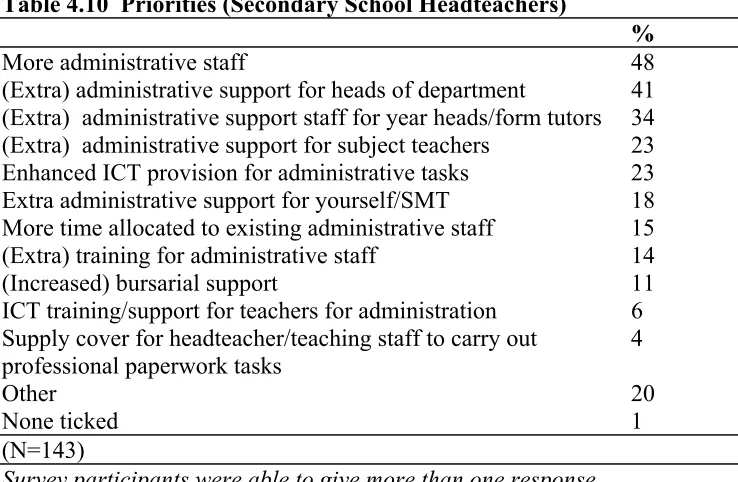
Table 4.10 Priorities (Secondary School Headteachers)
%
More administrative staff 48
(Extra) administrative support for heads of department 41
(Extra) administrative support staff for year heads/form tutors 34
(Extra) administrative support for subject teachers 23
Enhanced ICT provision for administrative tasks 23
Extra administrative support for yourself/SMT 18
More time allocated to existing administrative staff 15
(Extra) training for administrative staff 14
(Increased) bursarial support 11
ICT training/support for teachers for administration 6
Supply cover for headteacher/teaching staff to carry out professional paperwork tasks
4
Other 20
None ticked 1
(N=143)
Survey participants were able to give more than one response
[image:46.595.89.458.91.332.2]‘Other’ priorities included better or more accommodation.
Table 4.11 Priorities (Primary School Headteachers)
%
More time allocated to existing administrative staff 44
Supply cover for headteacher/teaching staff to carry out
professional paperwork tasks 33
More administrative staff 32
Extra administrative support for yourself/SMT 25
Enhanced ICT provision for administrative tasks 22
(Extra) administrative support for curriculum coordinators 21
(Extra) administrative support for class teachers 19
(Increased) bursarial support 16
(Extra) training for administrative staff 14
ICT training/support for teachers for administration 8
(Extra) administrative support staff with pastoral
responsibilities 3
Other 16 (N=103)
Survey participants were able to give more than one response
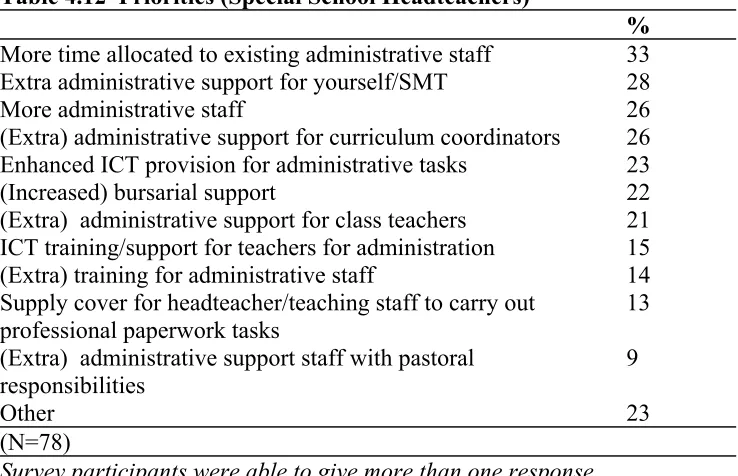
Table 4.12 Priorities (Special School Headteachers)
%
More time allocated to existing administrative staff 33
Extra administrative support for yourself/SMT 28
More administrative staff 26
(Extra) administrative support for curriculum coordinators 26
Enhanced ICT provision for administrative tasks 23
(Increased) bursarial support 22
(Extra) administrative support for class teachers 21
ICT training/support for teachers for administration 15
(Extra) training for administrative staff 14
Supply cover for headteacher/teaching staff to carry out professional paperwork tasks
13
(Extra) administrative support staff with pastoral
responsibilities 9
Other 23 (N=78)
Survey participants were able to give more than one response
‘Other’ included better and more accommodation for administrative staff.
The tables showed that whilst secondary school headteachers had spent the Small Schools Fund on increasing the time allocation of existing administrative staff, they would appoint more administrative staff if funding to support administrative functions were increased by five per cent. Primary school headteachers would like to continue to fund the time allocation of existing administrative staff and provide supply cover for themselves and teaching staff. Special school headteachers would like to fund extra administrative support for themselves and SMT.
School administrators were also asked to comment on what would be their priorities for spending; results mirrored those of the headteachers. Among secondary school administrators 54 per cent stated that they would like more administrative staff. Fifty three per cent of primary school administrators stated that they would like more time to be allocated to existing administrative staff. This priority was indicated by 49 per cent of special school administrators.
4.3.2 Case study findings
finance officer or bursar. In small schools with only one administrator, the financial tasks were shared between the headteacher and administrator. For this reason researchers directed questions relating to finance to the headteacher and administrator.
Secondary schools
Neither of the two secondary schools visited in the second phase of case study visits was in receipt of the Small Schools Fund. In case study A, administrative support was funded through the school budget with an allocated amount each year being spent on administrative support. Although Case Study B also funded administrative support through the school budget there was no specific amount targeted each year for administrative support. Additionally, the School Support Manager in Case Study A indicated that if given the opportunity the school would appoint additional administrative support staff to help teachers.
Primary schools
Two out of the three primary schools visited were in receipt of the Small Schools Fund. Both schools used the fund to increase the time allocation of existing administrative staff.
Case study D
In this small village primary school the Small Schools Fund had enabled the school secretary to work an extra 3 hours a week over 40 weeks. During this time she operated the Bank Account for Schools Scheme. A parent used to undertake this activity.
Case study E
The Small Schools Fund enabled the headteacher to extend the existing part time administrative officer to a full time post. The Clerical Officer was paid for out of the school budget.
Special school
administrative staff. However, the special school visited in the second phase of the research project had used the money to appoint an additional member of staff with some degree of administrative responsibility.
Case study F
This school had received the Small Schools Fund which had mainly been spent on additional literacy support (ALS). However, some of the funds had been used to appoint a part time librarian (12 hours a week) who had a joint librarian/administrative support role.
Administrative support staff were also asked how they would spend the administrative support budget if given more money. Three administrative support staff highlighted the low pay of support staff. One member of the support staff argued that ‘why don’t we get more money for working hard…’ Many of the administrative support staff interviewed felt that they were increasingly taking on more responsibilities yet their pay did not reflect this. Although they did not have teaching qualifications and experience, they felt that they fulfilled important functions and added value to the school. Moreover, some felt that their managerial skills were not being taken into account. For example, one member of staff noted that members of SMT got
‘handsomely paid’, but did not have any managerial training or experience. This could lead to a divide between teachers and support staff.
identified as being strongly linked to pupil performance (PricewaterhouseCoopers, 2001b).
4.4 Key
issues/findings
Findings from the survey showed that:• Headteachers spent between two and five per cent of the total funding available on administrative staff.
• Headteachers preferred to spend the Small Schools Fund on increasing the hours
of existing staff (also supported by case studies).
Findings from the case studies showed that:
• Bursars in larger secondary schools undertook finance-related tasks, whereas
finance-related tasks were shared between the headteacher and the administrator in smaller schools.
• Some administrative staff, particularly in secondary schools, felt their skills were undervalued.
• Some administrative staff felt underpaid.
• Administrative support staff identified problems with the current state of the
5
Administrative tasks carried out by teaching
staff
5.1 Teacher tasks/school tasks
As outlined in Chapter 2, there is a wide range of structures in place in schools for dealing with administrative tasks. However, a broad distinction that can be applied to all schools is between those tasks associated directly with the work carried out by teaching staff, and those tasks associated with the wider management of the school. The former are largely carried out by teaching staff, although may to some extent be delegated to other school personnel (the extent and nature of such delegation is considered in the following chapter). The second group of tasks identified are mostly carried out by staff employed as administrators, within the school office.
The focus of the remaining sections of this chapter, and this study as a whole, are the administrative tasks being carried out by teaching staff within schools, or those tasks for which they have responsibility, but have delegated. However, it is important to recognise the significance of the office-based school administrative tasks, both in terms of their strategic importance to the running of the school, and as part of an overall understanding of the context within which teaching administration is carried out. The previous section has outlined the structural implications of the distinction between teaching and office-based administrative tasks (as defined above). This section serves to underline this distinction, before the main discussion of administrative tasks and teaching staff.
5.2 Teaching staff and administrative tasks
5.2.1 BackgroundResearch published in 1998 by Coopers & Lybrand identified a range of activities carried out by teachers, which could be more appropriately performed by others. Other studies have supplied similar lists (Downes et al., 2000; NUT, 1998) to that provided by Coopers & Lybrand, which is as follows:
• collecting money
• chasing absences
• bulk photocopying
• copy typing
• standard letters
• attendance analysis
• copying out lists
• preparing report sets
• processing exam marks
• administering work experience
• administering/clerking examinations
• administering the pastoral system
• administration of progression
• IT/AV/multimedia systems technician.
5.2.2 Survey findings
All teaching staff who took part in the survey reported on the administrative tasks they carried out. The tasks described by teachers were largely similar to those discussed in previous research (as outlined above). Teachers participating in the survey were asked to indicate the frequency with which each task was carried out. The main tasks reported by teachers as being carried out on a daily basis were registration; preparing resources/materials; photocopying; marking; and lesson planning. The main weekly task was lesson planning. On a termly basis teachers prepared IEPs; administered, monitored, and reviewed SEN; prepared report sets; administered examinations/ assessments; processed examinations/national curriculum marks; analysed pupil performance data; and undertook work relating to school policy making/target setting.
Teachers also reported that they carried out a considerable number of tasks outside of school hours. For example: contacting parents; lesson planning; photocopying; preparing resources/materials; marking; preparing IEPs; administering SEN; and analysing attendance data were all done either before or after the set sc