Research Report No 122
National Traineeships: An
Evaluation of the Development
and Implementation Phase
Mike Everett, Trinh Tu and Anne Caughey MORI
The Views expressed in this report are the authors' and do not necessarily reflect those of the Department for Education and Employment.
© Crown Copyright 2000. Published with the permission of DfEE on behalf of the Controller of Her Majesty's Stationery Office. Applications for reproduction should be made in writing to The Crown Copyright Unit, Her Majesty's Stationery Office, St Clements House, 2-16 Colegate, Norwich NR3 1BQ.
TABLE OF CONTENTS
Page Number
1 SUMMARY 1
2 INTRODUCTION AND OBJECTIVES 7
2.1 The introduction of National Traineeships 7
2.2 What is a National Traineeship? 7
2.3 Current position 8
2.4 The MORI evaluation 8
2.5 Presentation and interpretation of the data 11
2.6 Structure of the report 13
3 PROFILE OF EMPLOYERS AND TRAINEES 15
3.1 Employer survey 15
3.2 Trainee survey 15
4 OVERALL VIEWS ON NATIONAL TRAINEESHIPS 19
4.1 Trainees’ evaluation of National Traineeships 19
4.2 Employers’ evaluation of National Traineeships 21
4.3 Advocating National Traineeships 21
5 THE FRAMEWORKS 25
5.1 Current position 25
5.2 Establishing the frameworks 30
5.3 Key skills 31
5.4 Employed status 34
5.5 What would have happened without National Traineeships? 36
6.1 Contracting arrangements 39
6.2 Method of delivery 40
6.3 Location of off-the-job training 41
6.4 Time spent receiving off-the-job training 42
6.5 Satisfaction with off-the-job training 42
6.6 Trainees’ evaluation of the training given by employer 43
6.7 Length of training 44
6.8 Salary 44
6.9 Training allowance 45
7 MARKETING 47
7.1 Sources of information 47
7.2 Key selling messages 49
7.3 The relationship with Modern Apprenticeship 52
7.4 The relationship with the New Deal 53
7.5 The relationship with Other Training 53
8 RECRUITMENT 55
8.1 Employers’ evaluation of recruitment 55
8.2 Sources of recruitment 55
8.3 Minimum qualifications required 55
8.4 Tests and interviews 56
8.5 Positions recruited 56
9 FUNDING ARRANGEMENTS 57
9.1 TEC funding arrangements 57
9.2 NTOs’ views of funding 57
9.3 Employers’ views of funding 58
10 PLANS & EXPECTATIONS 59
10.1 NTOs 59
10.2 TECs 59
10.3 Training providers and Employers 60
10.4 Trainees 60
12 CONCLUSIONS 63
APPENDICES 1
A Overall methodology 1
B Interviews with NTOs, TECs and the Careers Service 3
C Depth interviews with Training Providers 4
D Focus groups with trainees 5
E Postal survey of trainees 6
F Sample profile - Trainees 9
G Telephone survey of employers 10
H Sample profile - Employers 12
1 SUMMARY
MORI was commissioned by the Department for Education and Employment (DfEE) to carry out an evaluation of National Traineeships (NTrs). The main aims of the evaluation were to identify:
• key strengths and weaknesses of the initiative in its early stages
• examples of effective practice to disseminate to other TECs, NTOs, Careers Services, training providers and employers
• issues which need to be resolved for the future development of the initiative.
Additionally, the project examined the relationship between NTrs and Modern Apprenticeships (MAs) and NTrs and New Deal.
This final report presents the findings from both phases of the research. Phase 1 of the research - interviews with NTOs, TECs, Careers Services and employers took place at the end of 1997 and beginning of 1998. Phase 2 of the research - interviews with the same NTOs, TECs and Careers Services took place at the end of 1998 and beginning of 1999, along with 27 depth interviews with training providers and two focus groups with trainees. Surveys of employers of National Trainees (215) and trainees (900) were also conducted at the beginning of 1999.
The introduction of National Traineeships
National Traineeships were introduced from September 1997 as the result of the ‘Review of 16-19 qualifications’ by Sir Ron Dearing (16-1996). Since 16-1997, interested National Training Organisations (NTOs1) have been developing National Traineeship frameworks in conjunction with Training and Enterprise Councils (TECs).
Satisfaction with National Traineeships
What emerges from the evaluation is a generally positive picture but with a number of issues which need to be addressed.
Employers and trainees are mainly positive about their experiences of NTrs; the majority say they would recommend NTrs to their friends and colleagues (72% of trainees and 89% of
1
employers). Over three quarters of trainees (77%) are satisfied with their NTr compared with one in ten (8%) who are dissatisfied.
It is the opportunity to learn real skills in the workplace that appeals most to young people about NTrs. In contrast, poor pay is consistently mentioned as a major source of dissatisfaction.
Trainees with employed status and those with below Level 2 qualifications on entry are more likely than average to feel positive about their experiences of NTrs. However, the latter group are also more likely to say they had planned to apply for a job with training on leaving school (50% vs. 41% overall).
In contrast, trainees doing communication/business support/administration frameworks are more likely to feel dissatisfied with their NTr (19% vs. 12% overall). However, a significant proportion of these trainees also have at least a Level 2 qualification on entry (50% vs. 36% overall).
The large majority of trainees currently doing a NTr expect to complete the programme (92%). Three fifths (61%) expect to stay with their employer after they complete/leave the programme.
The picture is equally positive among employers. Almost two-thirds agree that compared with previous training at this level, NTrs offer a more broad based training programme (64% agree), is more effective in raising skills level (64%) and is more beneficial to their industry as a whole (63%).
Frameworks for National Traineeships
Overall, the development of the frameworks is felt by participants to have been a success. This success has been helped substantially by the experience of developing MA frameworks. However, the findings from the interviews with NTOs and TECs indicate that, at the time of fieldwork, there were wide variations in take-up of NTrs between framework sectors, as well as between TECs.
Delivery
For almost two-thirds of employers (64%), training is being delivered through a combination of on- and off-the-job. A third (35%) are using exclusively on-the-job training.
The majority of employers and trainees who experience off-the-job training are satisfied with this aspect of the programme (74% and 63% respectively). One in eight employers (13%) are dissatisfied; this falls to 7% among trainees.
Among the minority of employers who are dissatisfied with off-the-job training, the most common complaint is that the teaching is of poor quality, or that the courses are out-of-date or take too long (39%).
Key skills
In Phase 1 of the evaluation, a number of NTOs felt that there was a lack of enthusiasm among some employers to the concept of key skills being provided as part of the training. NTOs continue to believe that key skills, particularly IT and application of number, remain an outstanding issue for employers in some sectors. They feel that these employers remain unconvinced about the relevance of key skills, and the levels at which they are pitched, in relation to their business. They are concerned that this will make it difficult to recruit employers onto NTrs.
By contrast, these views are not shared by the majority of employers in the survey. However, these employers have signed up to NTrs and this may explain why they are generally receptive towards key skills.
Examples of how some sectors are trying to address the issues relating to key skills are listed under ‘Examples of effective practice’.
Employed status
Most TECs continue to take the view that they will aim for employed status wherever possible.
status2. Trainees with employed status are generally more positive about their experiences on NTr than those without.
Relationship with Modern Apprenticeship and with New Deal
It is still too early to comment on whether the introduction of NTrs has led to a fall in the numbers recruited onto the MA. This is partly because take-up of NTrs has been relatively slow as TECs have been focusing on other priorities. However, the general feeling is that employers are likely to adopt a more cautious approach to MA recruitment by putting young people onto NTr in the first instance and converting them later on if appropriate. If this happens then it may be harder for TECs to meet their MA targets, although the number of MA ‘early leavers’ (which has been identified by a number of TECs as a problem) may also decline.
Some TECs and NTOs are also concerned that employers and training providers may put even those young people who are suited to the MA on NTr first, to reduce the risk of them not completing their training, as has happened in some cases with MA.
Most TECs and NTOs are marketing MAs and NTrs together so that the possibility of progression from NTr to MA is made clear. However, very few have thought about progression other than for marketing purposes as conversion will only begin to become a major issue later on this year.
It was not anticipated that NTr would have a direct impact on New Deal or vice-versa, because the two initiatives had different target groups on the whole - mainly 16-18 year olds for NTrs; 18-24 and unemployed for at least 6 months for the New Deal. However, it was not known whether employers would alter their recruitment practices in response to NTrs and New Deal. At the time of the study, the key players interviewed were not aware of New Deal having an impact on the numbers recruited onto NTrs.
Examples of effective practice
Some examples of how sectors are trying to address the issues relating to key skills include:
• incorporating key skills into the regular assessment of NVQs - although still having the key skills separately accredited
2
• running key skills workshops aimed at employers to show them how to fill gaps where key skills can not be integrated with the NVQ/or on-the-job training
• having key skills monitored by local assessors who meet one-to-one with the young person. The assessors help the young person recognise opportunities in the work place for key skills development. They also organise group training off-the-job, three or four times a week, starting with communication skills, then building up to IT and finally application of number.
The evaluation has also identified key messages that employers and trainees best respond to. According to NTOs and TECs, the messages that employers best respond to are:
• NTrs are national training programmes that have been developed specifically for the industry concerned
• it can be tailored to meet the needs of their businesses. The messages that trainees best respond to are:
• NTrs offer training in the workplace
• they will receive nationally recognised qualifications which will help to enhance their employment prospects.
This is consistent with the attitudes expressed by trainees in the quantitative survey.
Sources of information about National Traineeships
NTOs and TECs continue to use a wide range of marketing activities to recruit employers and young people for NTrs, although the general feeling is that awareness among employers is still low.
The employer survey shows that a significant minority (34%) are dissatisfied with the level of publicity/advertising about NTrs. However according to NTOs and TECs, the response among employers that have been targeted has been positive.
Recruitment
Two-thirds of employers (67%) have been able to recruit the exact number of trainees which they had planned. A fifth (21%) say that they have not been able to recruit as many as planned compared with 5% who have recruited more than planned.
Half of the employers in our sample (52%) expect to recruit more National Trainees at their establishment in the next 12 months.
The base is too small to enable analysis by employee size and/or sector.
Acknowledgements
We would like to thank the TECs, NTOs and Careers Service staff who helped us with our evaluation, and to all the employers, training providers and trainees who gave up time to participate in our surveys.
London, 1999 Mike Everett
MORI/11523 Trinh Tu
2 INTRODUCTION
AND
OBJECTIVES
2.1 The introduction of National Traineeships
National Traineeships were proposed in the ‘Review of 16-19 qualifications’ by Sir Ron Dearing (1996)to replace Youth Training. These proposals received strong support from both employers and training practitioners. As a consequence, National Traineeships were introduced from September 1997. The new Labour Government has continued to support and develop these proposals and they now form part of the Investing in Young People initiative. Since 1997, interested NTOs3 have been developing National Traineeship frameworks in conjunction with TECs.
2.2 What is a National Traineeship?
National Traineeships aim to provide a high quality work-based route for young people with skills and qualifications linked to the national qualifications framework. The government’s contribution to funding is via TECs. The design and content criteria for NTrs are:
• a core element specifying the minimum outcomes of training including:
− NVQ2 (or equivalent where no NVQ is available)
− all key skills, normally at level 2, unless strong countervailing evidence from industry that a different level is appropriate - communication, number and IT to be separately certificated
− compulsory qualifications required by the sector e.g. First Aid Certificate, Health and Safety requirements
• optional elements including:
− training over and above the core which will assist the young person to progress to a Modern Apprenticeship or otherwise in the sector e.g. through additional GNVQ/NVQ units.
3
2.3 Current
position
The first frameworks were approved in Summer 1997. Currently, 47 frameworks have been approved. The number of trainees recruited by the end of December 1998 totalled 30,000.
2.4 The MORI evaluation
MORI was commissioned by the DfEE to carry out an evaluation of National Traineeships. The main aims of the evaluation were to identify:
• key strengths and weaknesses of the initiative in its early stages
• examples of effective practice to disseminate to other TECs and NTOs
• issues which need to be resolved for the future development of the initiative.
Additionally, the project examined the relationship between National Traineeships, Modern Apprenticeships, and the New Deal.
This evaluation consists of a number of phases which are summarised in the diagram opposite. More details on methodology can be found in the Appendices.
NTOs and TECs
This part of the study consisted of case studies in a number of sectors. These sectors were grouped into two - in the first, interviews were carried out with NTO and TEC staff; in the second, just NTO staff. The sectors were chosen to represent a range of industry sectors and likely sizes of the NTr programme. The group 1 and 2 sectors were as follows:
Group 1 Group 2
Retail/Distribution Road Haulage
Health and Social Care Polymers
Business Administration Steel
Meat Photography
Information Technology Ceramics
Sport and Recreation Security
The stages of the evaluation
Timing
Phase 1
Baseline case studies November 1997 -
- NTOs February 1998
- TECs
- Careers Services
Phase 2
Follow-up case studies
- NTOs October 1998 -
- TECs January 1999
- Careers Services
Phase 3
Participant surveys
- trainees January 1999 -
- employers February 1999
Interviews with
training providers
Focus groups with
trainees
Careers Service
Interviews were carried out with five Careers Services linked to Group 1 sectors in Phase 1. In Phase 2, only two of these Careers Services took part. Therefore, the findings from the Careers Service interviews must be interpreted with caution.
Training providers
In total 27 interviews were conducted with private training providers, FE colleges and Group Training Associations who are delivering NTrs. These were chosen to ensure that a range of locations and frameworks were covered.
More background details on the training providers interviewed can be found in the Appendices.
Employers
A telephone survey of employers who had recruited a National Trainee was conducted between 15 January - 1 February 1999. The sample was drawn from DfEE’s database of trainees in September 1998. This database contained contact details of employers and training providers for each trainee but did not distinguish between the two. Consequently, contact details of organisations that were likely to be employers (as opposed to training providers) were manually selected from the database. In total, details of 570 establishments were drawn from the database of which 368 were eligible to participate. In total, 225 interviews were achieved. The valid response rate is 58%.
Given the way in which the sample was drawn, the results of the employer survey should be treated as indicative rather than as representative of employers who have experience of National Trainees. In addition, the relatively small sample size means that sub-group analysis are limited.
Trainees
Two focus groups with trainees were conducted in Essex and Doncaster between December 1998 - January 1999.
Trainees were recruited by training providers and represented the following sector frameworks:
• Retail/Distribution
• Customer service
• Business & Administration.
A postal survey of trainees in England and Wales was also conducted between 4 January - 3 February 1999. The sample was provided by DfEE and contained details of all trainees on their database in September 1998. The survey comprised a census of trainees on the database. In total, 3,412 questionnaires were sent to trainees; 929 completed questionnaires were returned to MORI within the fieldwork period giving a valid response rate of 27%.
The data have been weighted by gender, age, length of time on NTr and framework sector in line with known population characteristics, extracted from DfEE’s database of National Trainees (as of September 1998). Thus the findings are representative of National Trainees on DfEE’s database in September 1998. However, there were insufficient numbers (28 responses) to allow analysis by ethnic origin.
More details on methodology and response rate for both surveys are contained in the Appendices.
2.5 Presentation and interpretation of the data
Quantitative
When interpreting the findings it is important to note that the results are based on a sample of the population, and not on the entire population. Consequently, the results are subject to sampling tolerances, and not all differences between sub-groups (eg. small vs. large employers, trainees with employed status vs. those without, etc.) are therefore significant. A detailed guide to statistical significance is contained in the Appendices.
Throughout this report, the percentages quoted are weighted percentages whilst the base refers to the unweighted base.
Where percentages do not add up to 100%, this is due to multiple answers, computer rounding or to the exclusion of ‘don’t know’ and/or non-response. Throughout the tables, an asterisk (*) denotes a value of less than 0.5 but greater than nought.
Manufacturing, Construction & Industrial
Agriculture & commercial horticulture Construction Agriculture & garden machinery Steel
Engineering manufacture Electricity supply Electrical & electrical servicing Knitting, lace etc.
Polymers Master bakers
Glass Clothing
Surface coatings Motor trade
Food & drink
Communication, Business Support & Administration
Business administration Telecommunications
IT Accountancy
Consumer Services Childcare
Travel agents Operating department practice
Residential estate agency Health & social care
Hairdressing Horses
Hospitality Animal care
Security Sports & recreation
Retail & Distribution
Retail Floristry
In addition, trainees’ qualifications prior to starting NTrs were grouped under the following three headings:
At least one Level 2
qualification
Below Level 2 qualifications Other types of vocational
qualifications
5 or more GCSEs (grades A-C) Less than 5 GCSEs (grades A-C) Intermediate/Advance GNVQ GCSEs below grade C
Qualitative
Qualitative research provides depth and understanding to the experiences of a group of NTOs, TECs, training providers and Careers Service staff. It does not, and nor is it intended, to provide representative results.
2.6 Structure of the report
The rest of the report covers the following topics:
Section 3 - profile of employers and trainees
Section 4 - employers’ and trainees’ overall views on NTrs
Section 5 - key audiences’ views on the frameworks
Section 6 - issues relating to delivery
Section 7 - marketing
Section 8 - recruitment
Section 9 - funding arrangements
Section 10 - plans and expectations
Section 11 - suggestions for improvement
Section 12 - conclusions.
3
PROFILE OF EMPLOYERS AND TRAINEES
3.1 Employer
survey
Employer profile
Just under half of the employers surveyed (47%) have less than 10 employees (ie. those who are not on temporary and/or fixed term contracts). Two-fifths (44%) have between 10-99 employees and one in twelve (8%) have 100 or more employees.
Two fifths of the businesses interviewed (41%) are private limited companies and 22% are sole traders. One in six (16%) are public limited companies and 12% are partnerships.
Current Status of trainees
The large majority (83%) currently have young people on NTrs; the remainder did have National Trainees, but do not at present (17%).
Of those employers currently with National Trainees, two fifths (44%) have one trainee and similar proportions have 2-5 trainees (43%). One in eight (13%) have more than five trainees.
A fifth (21%) also have trainees doing a Modern Apprenticeship and just 9 employers interviewed have trainees on New Deal.
3.2 Trainee
survey
Just under three-quarters of the trainees in our sample (73%) were still doing a NTr at the time the survey took place (January - February 1999). One in ten trainees (9%) say they have completed their NTr and one in seven (15%) left their NTr without finishing it.
Trainees currently doing their NTr
Among the trainees who are still doing their NTr (73% of the sample), over a third (35%) are located in companies with less than 10 employees, 45% are in companies with 10-99 employees and 31% are in larger companies.
The majority of these trainees (72%) have been on their NTr at least six months, including 16% who have been on their NTr more than 9 months.
A significant minority of trainees (37%) are doing consumer services frameworks. A quarter (24%) are doing retail/distribution and a fifth each are doing manufacturing/construction/ industrial (20%) and communications/business support/administration frameworks (18%).
Early leavers
One in seven of the trainees in our sample (15%) left their NTr without finishing it. Around three in ten of these trainees each were doing retail/distribution and consumer services frameworks (31% and 29% respectively). Trainees doing manufacturing/construction/industrial and communication/business support/administration frameworks account for smaller proportions of early leavers (20% each).
Two-fifths of early leavers (38%) were on the programme for less than three months and an additional 32% stayed less than 6 months. Three in ten (30%) were on it for six months plus, including nine per cent who stayed over a year.
Activity pre-NTr
Prior to starting their NTr, half of all the trainees in our sample4 were at school or college; over a third (36%) were doing GCSE courses and 14% were doing GNVQ/other vocational courses.
Over a quarter (27%) were in employment including a fifth (22%) who were in employment without training. Trainees doing retail/distribution frameworks are most likely to say they were in employment without training (33%). These trainees are also more likely than average to be aged 19 plus (44% vs. 26% overall).
Small minorities were either unemployed after leaving school (7%) or were doing a Modern Apprenticeship/other TEC supported training (6%).
Qualifications pre-NTr
The trainees in our sample had gained a wide range of qualifications prior to starting their NTr. However, the majority (56%) had below Level 2 qualifications.
Over a third (36%) had at least a Level 2 qualification, including a quarter (25%) with 5 or more GCSEs (grades A-C). Trainees doing communication/business support/administration frameworks are more likely than average to have 5 or more GCSEs (grades A-C) (38% vs. 25% overall).
Small minorities had other vocational qualifications (2%) or did not give an answer (5%).
Career plans
In their last compulsory year at school, two-fifths of all trainees in our sample (41%) had planned to apply for a job with training on leaving school; those with below Level 2 qualifications are more likely than average to have considered this option (50%).
A third (32%) had planned to continue with full-time education; this rises to 52% among those with Level 2 qualification(s) and above. Among these trainees, the most commonly mentioned reasons for choosing a NTr instead are that they changed their mind/did not like the course they were doing (15%), it came with the job/employer suggested it (15%), and they wanted work
4
experience and a salary (13%).
4
OVERALL VIEWS ON NATIONAL TRAINEESHIPS
This section looks at employers’ and trainees’ evaluation of National Traineeships.
The survey findings show that, on the whole, both of these groups are positive about their experiences of NTrs; the majority say they would recommend NTrs to their friends and colleagues.
4.1 Trainees’ evaluation of National Traineeships
Over three quarters of trainees (77%) are satisfied with their NTr, including 34% who are very satisfied. Less than one in ten (8%) are dissatisfied, and 12% do not have strong opinions either way. Satisfaction is slightly higher among trainees with employed status than those without (79% vs. 73%). However, trainees doing communication/business support/administration frameworks are more likely than average to feel dissatisfied with their NTr (14% vs. 8% overall).
The findings from the survey and focus groups with trainees consistently show that it is the opportunity to learn real skills in the workplace that appeals most to these young people about NTrs. For example, nine in ten trainees (90%) say that it is the chance to learn real skills in the workplace that attracted them to enrol on a NTr, including 73% who said this attracted them ‘a lot’.
The findings from the focus groups also revealed that many trainees felt that for them, a NTr is a better approach to learning compared with full-time education because there are no exams, more personal support from tutors and they can learn at their own pace. These trainees regard NTrs as a ‘good opportunity’ and a ‘second chance for someone who didn’t do as well at school’.
This is consistent with the survey findings which show that trainees with below Level 2 qualifications on entry are more positive about their experiences on NTr than those with higher level qualifications (83% vs. 70% satisfied).
However, some trainees in the focus groups felt that NVQs are generally perceived as of less value than GCSEs.
Figure 4.1.1: Trainees’ satisfaction with National Traineeships
Disagree (%) Agree (%)
All trainees 8% 77% 6%
12%
79%
73%
With employed status Without employed status
How satisfied are you with your NTrs? Q18
Base: All trainees who are/were doing a NTr (900)
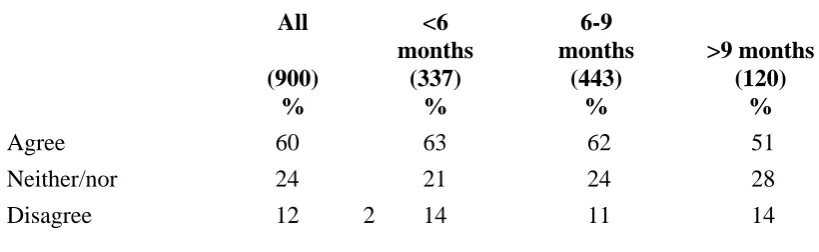
Table 4.1.2: Expectations of National Traineeships by length on programme
Q15b The NTr is better than I thought it would be
Length of time on National Traineeships
All
(900)
<6 months
(337)
6-9 months
(443)
>9 months (120)
% % % %
Agree 60 63 62 51
Neither/nor 24 21 24 28
Disagree 12 2 14 11 14
Base: All trainees who are/were doing a NTr (900)
Again those with below Level 2 qualifications on entry are generally more positive about their experiences on NTr. In contrast, those doing communication/business support/administration frameworks are more likely to feel the NTr has not met their expectations (19% vs. 12% overall). However, a significant proportion of these trainees also have at least a Level 2 qualification on entry (50% vs. 35% overall).
[image:24.595.110.520.434.560.2]amount of work involved. In addition, poor pay is consistently mentioned as a major source of dissatisfaction, although the quantitative findings show that trainees doing communication/ business support/administration frameworks are more likely than average to say they are unhappy with poor pay. Thus the increasing weight of the training and the continuance of low levels of pay as training proceeds may help to explain why trainees’ views become less positive once they have been on the programme for more than 9 months.
4.2 Employers’ evaluation of National Traineeships
The picture is equally positive among employers. Almost two-thirds agree that compared with previous training at this level, NTrs offer a more broad based training programme (64% agree), is more effective in raising skills level (64%) and is more beneficial to their industry as a whole (63%).
The base is too small to enable analysis by employee size and/or sector framework.
4.3 Advocating National Traineeships
Trainees
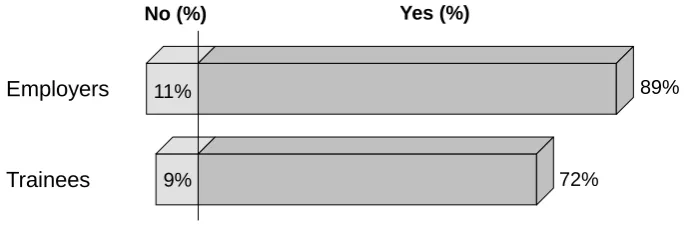
The majority of trainees (72%) would recommend a NTr to their friends compared with 9% who would not. Trainees doing consumer services frameworks are more likely than those doing communications/business support/administration frameworks to recommend the programme (77% vs. 66%). This is consistent with the findings that trainees doing communications/business support/administration frameworks are, on average, more dissatisfied with their NTr.
Again there are differences in opinions according to whether a trainee has employed status; those with employed status are more likely to recommend the programme than those without (76% vs. 63%). Likewise, those with below Level 2 qualifications on entry are also more likely to recommend the programme (77%). These findings are consistent with these groups’ generally more positive attitudes towards their NTr.
Figure 4.2.1: Employers’ evaluation of National Traineeships
Compared with previous training at this level, NTrs . . . . . Q32
Base: All employers (225)
. . . offer a more broad based training
programme 12%
Disagree (%) Agree (%)
64%
17%
19%
64%
63%
. . . is more effective in raising skill levels . . . prove more beneficial to your industry as a whole
Table 4.3.1: Willingness to recommend National Traineeships by length on Programme
Length of time on NTr
Base All (900) % <6 months (337) % 6-9 months (443) % >9 months (120) %
Yes 72 74 73 65
No 9 6 10 13
Don’t know 16 17 15 18
Not stated 3 3 3 4
Base: All trainees who are/were doing a NTr (900)
Trainees give a wide range of reasons for recommending a NTr to their friends. Common mentions are that it allows them to gain qualifications and work experience, and leads to better job prospects. As we discuss in Section 7.2, these are also factors that influence trainees’ decisions to do a NTr in the first place.
[image:26.595.96.518.440.588.2]reasons given are that it is poorly paid, they are not given enough help and support from their employer, and they do not feel they learn much at college. As already mentioned, low pay was also voiced as a major source of dissatisfaction by a large number of trainees during the focus groups.
Similarly, among those trainees who leave the programme without completing it (15% of the sample) it is the second commonly mentioned factor for abandoning the programme (mentioned by 27% of early leavers). The most common mention is because they wanted to take up a different job (35%) - see Section 3.2.
Employers
The vast majority of employers (89%) would recommend NTrs to other employers in their industry.
The most common reasons for recommendation are that the employer has had positive experience of similar scheme(s) in the past (24%) and because it offers on-the-job training which meets their requirements (20%). Other reasons relate to the opportunities for young people; giving young people prospects for the future (20%), a chance (16%) and a basic foundation (16%).
[image:27.595.145.489.614.727.2]For those few employers who would not recommend NTrs to other employers (11%), the most common reason given is poor quality of off-the-job training. The base is too small to enable analysis by employee size and/or sector framework.
Figure 4.3.2: Advocating National Traineeships
Employers
No (%) Yes (%)
Would you recommend NTrs to your friends/other employers in your industry?
Q29/35
Base: All employers (225)/trainees who are/were doing a NTr (900)
Trainees
11% 89%
5 THE
FRAMEWORKS
This section explores the views of NTOs, TECs, training providers and employers towards the frameworks and focuses on the key issues that were highlighted in Phase 1, namely key skills and employed status. Also discussed is the background on how the frameworks were established and the relationships between key players.
5.1 Current
position
NTOs
The NTOs are generally satisfied with the frameworks, but feel that there is insufficient feedback to make a definitive judgement yet. Some NTOs are currently conducting a review of Modern Apprenticeship frameworks, and there are no plans make changes to the NTr framework until this review is completed.
In Phase 1 of the evaluation, a number of NTOs felt that there was a lack of enthusiasm among some employers to the concept of key skills being provided as part of the training. These NTOs continue to believe that some employers in their sector remain unconvinced about the relevance of key skills, and the levels at which they are pitched, in relation to their business. They are concerned that this will make it difficult to recruit employers onto NTrs. This view is echoed by many of the training providers we interviewed (see Section 5.3).
At the time of interview (October 1998 - January 1999), the number of trainees recruited ranged from zero in some sectors to 500. A number of NTOs said that they could not provide this information because they had not received details on starts from the DfEE. As we later discuss, this is still one area in which NTOs would like to see further improvements made. However, NTOs now receive monthly reports from the DfEE database on National Traineeships starts and leavers.
Training providers
Training providers are generally positive about the quality of the frameworks although they do acknowledge that it does vary between sectors. Around half of those interviewed were involved in drawing up the frameworks.
ensuring that areas such as the foundation training, NVQ and key skills are all covered. They are also seen as sufficiently flexible whilst tailored to a national standard. On the negative side, some feel that certain frameworks are too prescriptive, setting out unit by unit targets, and that the issue of key skills is still proving to be a difficulty, both in terms of getting employers on board and in delivery (see Section 5.3).
Employers
Our survey of employers shows that the large majority (84%) have not experienced any problems with the content of the frameworks; just one in six (16%) have experienced problems. However, given that the survey was conducted in the early stages of the initiative these findings should be treated as indicative of progress to-date.
Employers who are offering both on- and off-the-job training are more likely to have encountered problems than those offering on-the-job training only (20% vs. 6%).
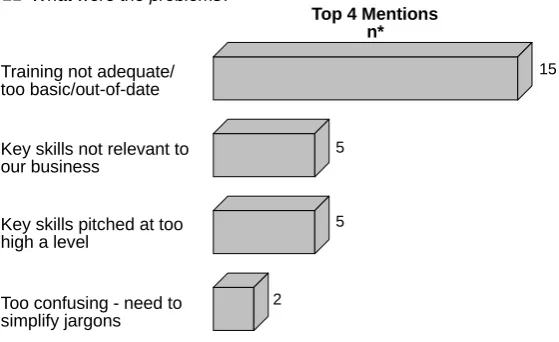
For those who have experienced problems (16% of the sample), the most common reason is that the training is not adequate, both in terms of the level at which it is pitched and the depth of coverage, or is out-of-date (mentioned by 15 employers).
TECs
Generally the TECs we spoke to have received most of the frameworks although many continue to focus mainly on those frameworks that they consider to be in ‘priority sectors’. This has caused resentment among some NTOs who have attributed their lack of progress to the lack of interest, and subsequent funding from TECs. However, some NTOs feel that this is beginning to change and that TECs are starting to express interest in their framework.
A number of the TECs we spoke to had not recruited as many National Trainees as they had anticipated. Some acknowledged that they had not pushed NTrs forward as much as they did for the MA, in the perceived absence of specific targets from some Government Offices. Others mentioned the lack of funding as a contributing factor.
Table 5.1.1: Problems with content of the training - Employers
Q20 Have you experienced any problems with the content of the training in NTr?
Base:
All (225)
Delivery of Training on-the-job only
(78)
With on-and-off- the-job
% % %
Yes 16 6 20
No 84 94 80
[image:31.595.97.377.374.545.2]Base: All employers (225)
Figure 5.1.2: Problems with content of the training - Employers
Base: All employers who have experienced problems with the content of the training (36) * : Figures refer to number of responses and not percentages
What were the problems? Q21
Training not adequate/ too basic/out-of-date
Key skills not relevant to our business
Key skills pitched at too high a level
Too confusing - need to simplify jargons
15
5
5
2
Top 4 Mentions n*
Having said that, the level of success in recruitment does vary between TECs. Generally, the more successful TECs are those that have:
• actively promoted NTrs to training providers from the start
• pushed NTr as the preferred option for all new starts for Level 2 training
The construction and engineering frameworks continue to give concern to a number of TECs and training providers because of the large amount of off-the-training involved which is both costly and difficult to deliver. Some TECs want the GNVQ requirement in the construction framework to be made optional.
Some training providers are also having difficulties convincing employers to accept the off-the-job element of the engineering foundation. They would like to see the amount of off-the-off-the-job training reduced or at the very least, to shift some of the delivery to on-the-job. One training provider mentioned that unless this happens, the temptation will be to put trainees on the engineering manufacturing route which requires a shorter foundation training.
The Engineering NTO is aware of these difficulties. They have developed a manufacturing (engineering) framework which they hope will address some of these issues.
Relationships between NTOs and TECs
The relationships between NTOs and TECs remains largely unchanged from Phase 1 with both types of organisation continuing to focus on a small number of prospective partners. Existing relationships continue to be close but there are limited instances of new relationships forming. Relationships tend to be close where:
• the NTO is regarded as a priority sector by TEC
• there is a nominated contact at TEC with the relevant industry background
• there is an established relationship from the MA development.
Both NTOs and TECs continue to express a desire for more consistent administration from each other, for example issuing similar forms for registration and certification.
One NTO has also expressed concerns that some TECs are issuing a summary of the framework rather than the full document. They are not happy with this arrangement because the summaries are based on the TEC’s interpretation of the framework.
Training Providers’ views of NTOs and TECs
working relationships with the TEC although a small number would like to receive more information and updates from their TEC.
Training providers’ relationships with NTOs vary. Some have regular contacts with NTOs whilst most tend to ring only when they have a query. Many are satisfied with this arrangement but some would like to receive more updates on changes to frameworks.
In terms of familiarising themselves with the frameworks, many training providers say they received little or no help from the TEC or NTO, although several say they did not seek help.
Employers’ views of NTOs and TECs
[image:33.595.94.475.468.576.2]Employers are also generally positive about their interaction with TECs and NTOs. Among those who have received help from the TEC (83% of the sample), the majority (76%) are satisfied with the help given. Slightly fewer have received help from the NTO (73%), although those who have are generally satisfied (69%).
Figure 5.1.3 Employers’ satisfaction with NTOs and TECs
Satisfaction with . . . Q31
Base: All employers who have received help from TEC (186) and NTO (164)
Help received from TEC Help received from NTO
10% 13% 76%
13% 18% 69%
Dissatisfied Neither/nor/no opinion Satisfied
Relationships with the Careers Service
interest in NTrs.
However, the Careers Service staff interviewed in Phase 1 pointed out the difficulties they face in receiving information from a large number of sectors - in addition to the details they receive about other post-16 options. They accepted that face-to-face contact is the best way to communicate and promote NTrs but felt that this is difficult given the resource constraints and other priorities that organisations faced.
5.2 Establishing the frameworks
Overall, the development of the frameworks is felt by participants to have been a success. This success has been helped substantially by the experience of developing MA frameworks.
Frameworks were generally designed with the help of a development/steering group consisting of NTO, TEC and employer representatives. In a number of sectors, training providers were also involved at this initial stage. Most of these groups were formed out of similar groups that had been set up to develop MAs. In the vast majority of cases, participants said that these groups had worked successfully with each type of organisation bringing their own perspective.
One of the key lessons learnt from the development of MAs was the need to involve employers at the earliest possible stage in the framework discussions and this was a point that had been taken on board by all of the case study sectors. The views of employers were considered essential in terms of developing a framework that would meet the industry’s needs. A couple of NTOs sent out questionnaires to employers to help inform framework development, all had employer representatives on the development groups. Some NTOs were also keen for the perspective of young people to inform their discussions - and one had a group looking solely at these issues.
I think the important thing is to involve employers in the design to make sure that it is going to meet their needs, but also wherever possible, to take advice from schools and young people themselves in the design. In other words, to satisfy the two key parties involved - the employer and young people - to make sure it's meeting both their needs
NTO
Where sectors have involved Careers Service staff in their framework development groups they have found their input valuable. The marketing materials in a number of sectors were thought to have benefited considerably from Careers Service input.
I think it's advisable, careers people have the interests of the young people at heart, and they do bring some interesting things to the table, so I think they should be involved
TEC
However, this was much easier to do in those sectors where the industry is concentrated in one geographical area. This meant that the Careers Services who should be involved could be identified and the Careers Services themselves were likely to have specific knowledge about the opportunities for young people within the sector.
For large sectors, with employers based across the country, identifying an appropriate Careers Service representative to take part was more difficult. In addition, once such an individual(s) had been chosen, they were unlikely to be in a position to feedback information to all Careers Services around the country.
5.3 Key
skills
The issue of key skills has been the major challenge in developing the frameworks. The specific difficulties include:
• deciding the appropriate level of key skills - particularly in terms of IT and application of number
• the need to get key skills certificated separately rather than as an integral part of the relevant NVQ
• some employers felt that the level set exceeds their requirements in certain occupations
• concerns over the capability of training providers (mainly private sector providers) to deliver the required level of key skills - particularly those without experience of MAs
As with the MA, the issue of key skills, whilst accepted in principle, has been a problem. We don't think that a lot of employers have woken up to the idea of what key skills are all about, and there is a view that key skills have come about by the failure of the education system, and after levels and targets are set, employers are saying - why are we getting involved with this? Surely youngsters should have these skills after 10 years of school
NTO
Table 5.3.1 shows the key skill requirements for our case study sectors. This shows that IT and application of number are the key skills most likely to be required at Level 1 rather than Level 2. This is because in these areas there was a strong view that requiring young people to reach Level 2 would be beneficial neither to the employer or the young person as the skill levels are not required by the trainee in their day-to-day work.
A number of NTOs believe that the concept of key skills being provided as part of the training continues to be resisted by employers. This view is echoed by the training providers interviewed. Although they are supportive of the concept and recognise that they add value to existing qualifications, in practice they are concerned about the relevance of key skills and the levels at which they are pitched in some sectors (particularly in relation to IT and the application of number). Where this is the case, getting employers to accept key skills has been difficult. Some TECs believe that employers’ reactions to key skills are, to a large extent, determined by when the concept is introduced to them. These TECs have learnt from their experiences of the MA that employers are more likely to be receptive towards key skills if they are made aware of the requirements at the outset, rather than be told about it after they have taken on the trainee(s).
The results from the employer survey show that the majority of employers in our sample are receptive towards the concept of key skills. However, this is perhaps to be expected given that these are employers who have recruited National Trainees.
Only four percent of the employers in our sample say they could not see any benefit in the key skills aspect of the NTr framework. One in eight employers (13%) could not give an answer.
Table 5.3.1: Case study sectors and key skill requirements
Communication
Application of Number IT
Working with others Improving own Learning and Performance Problem* Solving
IT 2 2 2/3a 2 2
Photography 2 2 2 2 2
Sport 2 2 2 2 2
Business Administration
2 1 2 2 2
Health and Social Care
2 1 2 2 2
Polymers 2 2 1 2 2
Engineering5 2 2 1 2 2
Retail 2 1 1 2 2
Security 2 2 1
Road Haulage 2 1/2a 1/2a
Meat 2 1 1 2 b 2 b 2 b
Steel 2 1 1 c c
Ceramics 1 1 1 1b 1 b 1 b
* not accredited by NCVQ - treated as VQ units a level related to strand of framework followed b optional
c available on employer request
Among the small proportion of employers who have experienced problems with the content of the training (16% of the sample), only a small minority mentioned key skills as the causal factor; five employers say that key skills are not relevant to their business and the same number say they are pitched at too high a level. The majority (73%), however, are satisfied with the help they have received in delivering key skills. One in seven (15%) are dissatisfied and 12% did not have strong feelings either way.
5
The findings from the two focus groups we conducted with trainees also show that there is recognition of the importance of key skills, both to the individual and to the employer. The trainees we spoke to felt that all the key skills are relevant to their work as ‘it is what you’ve got to do in real life’.
Some examples of how sectors are trying to address the issues relating to key skills include:
• incorporating key skills into the regular assessment of NVQs - although still having the key skills separately accredited
• running key skills workshops aimed at employers to show them how to fill gaps where key skills can not be integrated with the NVQ/or on-the-job training
• having key skills monitored by local assessors who meet one-to-one with the trainee. The assessors help the trainee recognise opportunities in the work place for key skills development. They also organise group training off-the-job, three or four times a week, starting with communication skills, then building up to IT and finally application of number.
5.4 Employed
status
The issue of whether or not young people should be required to have employed status while on a NTr caused some difficulty between TECs and NTOs in the early stage. Some NTOs were concerned that too rigid a requirement for employed status may deter some employers from taking on more young people. However, a point made by some of our Careers Service interviewees, and supported by a number of both TECs and NTOs in Phase 1, was that employed status is important in terms of marketing NTrs to young people. There was a general agreement that without employed status, some of the target client group may be attracted to take jobs without formalised training programmes because of the higher wages these jobs pay.
The results from the trainee survey support the view that employed status is an important marketing factor, although there are other factors that are considered important by a greater number of trainees (Section 7.2).
Most TECs continue to take the view that they will aim for employed status wherever possible. Where it is not possible to offer employed status at the outset, some TECs are looking for conversion fairly quickly – one TEC wants employed status to be granted within six months. It has become less of an issue among NTOs, although some feel that TECs are still pushing too hard for employed status.
[image:39.595.144.435.375.534.2]Three in ten of the employers in our sample (30%) say they grant employed status to their trainees from the beginning of the NTr and an additional 26% on achievement of NVQ Level 2. One in seven (14%) grant employed status after a trial period/at the end of the first year and 16% say young people are already employed when they start. Three per cent say that they never offer employed status and the same proportion say it depends on individual ability/at the employer’s discretion.
Figure 5.4.1 Employers’ award of ‘employed status’
Base: All employers (225)
At what stage are most National Trainees given formal employee status? Q28 30% 26% 16% 14% 3% 3% At commencement of NTr
On achievement of NVQ Level 2
Already employed when started NTr
Never - we don't offer employed status At end of first year/trial period
Down to individual/our discretion
The majority of the trainees (70%) have employed status6, although this falls to 61% among trainees who have been on the programme less than 6 months. However, over seven in ten of the trainees in our sample (72%) have been on their NTr at least 6 months. Trainees in companies with 100 plus employees are also less likely to have employed status (58%).
As can be seen throughout the report, trainees with employed status are generally more positive about their experiences on NTr than those without.
6
5.5 What would have happened without National Traineeships?
In phase 1 of the evaluation, TECs and NTOs were asked what would have happened to Level 2 training if NTrs had not developed. Most thought that Level 2 provision would have improved but that it would not necessarily have been linked so strongly to key skills. In some sectors (e.g. retail, road haulage, sport and recreation and photographic processing), Level 2 occupations represent the bulk of the industry – NTrs are therefore viewed as meeting the needs of a large number of employers. It was hoped that NTr will actually increase the number of employers and employees training to this level.
The findings from the employer survey show that although the majority of employers agree that NTr has improved the quality of training at Level 2 (63% agree vs. 15% disagree), opinion is divided on whether more trainees have been recruited, both overall (44% agree vs. 38% disagree) and into new occupations (43% agree vs. 35% disagree).
However, employers are more likely than not to agree that NTrs have replaced training that would have taken place anyway (56% agree vs. 34% disagree), although they clearly recognise that NTr has improved the quality of training at this level.
Overall the majority of employers (76%) agree with at least one of the (first) three statements on Figure 5.5.1. A quarter (24%) agree with two of these statements and similar proportions agree with all three (25%).
Figure 5.5.1: Employers’ views of National Traineeships
. . . improved the quality
of training at this level 15%
Disagree (%) Agree (%)
63% 38%
34%
44%
56%
How strongly do you agree or disagree with these statements? Q18
Base: All employers (225)
. . . resulted in more trainees being taken on than would have been otherwise . . . resulted in trainees being taken on in new occupations
35% 43%
. . . replaced training that would have taken place anyway
NTrs have . . .
Figure 5.5.2: Previous requirements for NVQ Level 2
Base: All employers (225)
How did you meet your requirements for this type of trainees (ie. NVQ Level 2 skills) before the introduction of NTr?
Q7 40% 20% 8% 6% 4% 4% 11% In-house/company training scheme Youth training/Training credits
Training provided by external organisations Modern Apprenticeship Promoted less skilled workers
Recruited fully trained workers
[image:41.595.101.523.470.747.2]6
DELIVERING THE FRAMEWORKS
This section starts by looking at the current contracting arrangements between TECs and training providers and employers, and then focuses on the methods of delivery and trainees’ and employers’ reactions to them. Details on trainees’ pay and training allowance are discussed towards the end of the section.
6.1 Contracting
arrangements
Generally, delivery arrangements are based on those already in place for MAs and Other Training (OT)7. The majority of TEC contracts are with training providers. Where direct contracting with employers already exists these are being continued, although some of the TECs we spoke to do not offer this option to employers.
[image:43.595.94.415.481.684.2]This is consistent with the findings from the employer survey which show that almost two-fifths of employers (38%) are contracted with a private training provider for NTrs. A quarter (27%) are contracted with their local college and a fifth (19%) contract directly with a TEC.
Figure 6.1.1: Contracting arrangements - Employers
Base: All employers (225)
What type of organisation are you contracted with for NTr? Q10
38%
27%
19%
5%
2%
3%
7% A private training provider
Local colleges
TEC
Other
Group Training Association
Chamber of Commerce
Don't know
7
A number of the training providers interviewed say that they normally win a contract to deliver NTrs from the TEC and then find employers to provide places. The number of trainee places on offer are set either by the TEC, in negotiation with the TEC, or as part of the TEC contract. Contracts are generally sector specific, although a small number of training providers have just an overall target for NTrs.
Approaches to recruiting employers vary between providers; some approach suitable employers in their areas, other rely on existing contacts or for employers to contact them.
6.2 Method of delivery
For almost two-thirds of employers (64%), training is being delivered through a combination of on- and off-the-job, although the majority of these employers (83%) say that less than a quarter of training is delivered off-the-job. A third (35%) are using exclusively on-the-job training.
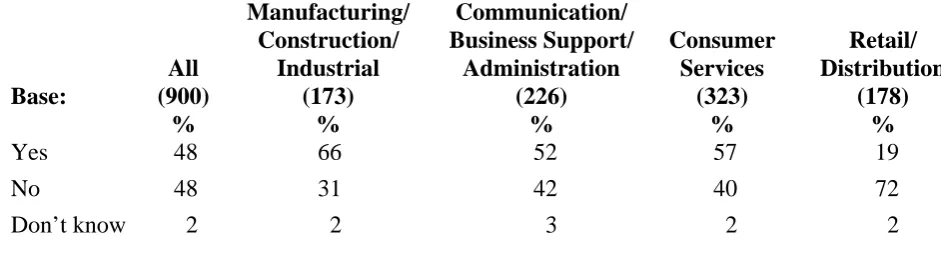
[image:44.595.99.570.547.675.2]Significantly fewer trainees say they receive off-the-job training as part of their NTr (48%). Trainees who have been on the programme less than 6 months are significantly more likely than those who have been on it longer to say they receive off-the-job training (63% vs. 42%). This figure is, therefore, consistent with the findings that a large proportion of the trainees in the sample have been on their NTr at least 6 months (72%).
Table 6.2.1: Method of delivery - Trainees
Q7a Do you receive any off-the-job training as part of your NTr?
Framework Sector
All
Manufacturing/ Construction/
Industrial
Communication/ Business Support/
Administration
Consumer Services
Retail/ Distribution
Base: (900) (173) (226) (323) (178)
% % % % %
Yes 48 66 52 57 19
No 48 31 42 40 72
Don’t know 2 2 3 2 2
Base: All trainees who are/were doing a NTr (900)
combination of on- and off-the-job training (81% vs. 64% overall).
There are also variations by employee size. Trainees in small companies (less than 10 employees) are more likely than those in larger ones to say they receive off-the-job training (55% vs. 48%).
6.3 Location of off-the-job training
Among the trainees who receive off-the-job training, the majority (81%) say it is conducted away from their employers’ premises. These are mainly held at a college of Further Education (48%) or a private training centre (42%). Only seven per cent mentioned a training centre run by their employer.
FE Colleges are more commonly mentioned by trainees doing manufacturing/construction/ industrial frameworks (64%). In contrast, those doing retail/distribution frameworks are more likely to receive their off-the-job training at a private training centre (65%). Training centres run by the employer is most commonly mentioned by trainees doing communication/business support/administration frameworks (14%).
[image:45.595.136.459.512.710.2]
These findings are consistent with the employer survey which show that local colleges and private training providers deliver the majority of off-the-job training (59% and 39% respectively). Three per cent of employers use an in-house training centre.
Figure 6.3.1: Location of off-the-job training
Base: All employers (144) and trainees (394) who say training involves off-the-job training
59%
39%
3%
43%
42%
7% Local colleges
In-house training centre Private training provider
6.4 Time spent receiving off-the-job training
Two-thirds of trainees (67%) say their off-the-job training takes place as regular day release and one in ten (11%) say it is one continuous block. A fifth (20%) say it is a combination of these, although this rises to 28% among trainees in companies with at least 10 employees. In contrast, regular day release is more commonly mentioned by trainees in smaller companies (73%). There are no significant differences by sector framework.
The majority of these trainees (69%) have spent less than a quarter of their time receiving off-the-job training so far, including three percent who have not received any. A fifth (20%) have spent between a quarter to half of their time and eight per cent have spent at least half of their time receiving off-the-job training. Trainees with employed status have generally spent less time receiving off-the-job training than those without.
Nearly two-thirds (64%) of those who currently receive off-the-job training think that the amount of time they spend doing this is unlikely to change in the near future. Around one in seven (15%) think it is likely to increase and eight percent think the opposite. One in six (12%) are not sure.
6.5 Satisfaction with off-the-job training
[image:46.595.108.446.578.694.2]The majority of employers and trainees who experience off-the-job training are satisfied with this aspect of the programme (74% and 63% respectively). One in eight employers (13%) are dissatisfied; this falls to 7% among trainees.
Figure 6.5.1: Satisfaction with off-the-job training
Employers
Dissatisfied (%) Satisfied (%)
74%
63%
Trainees
Base: All employers who says training involved off-the-job training (144) Base: All trainees who are/were doing a NTr (900)
13%
These views are consistent with the findings from the focus groups with trainees; many were very positive about their off-the-job training. They felt that it gave them the chance to consolidate what they learnt on-the-job. In addition, they were happy with the support they were getting from their course tutors as the following quote illustrates:
If you don’t understand something, you know you can go to your trainer and they’ll help you.
Trainee, Business and Administration, less than 6 months on NTr
However, a number of trainees complained that their Training Plan was not user friendly - ‘They use really long words’. Consequently they are more reliant on their tutor to explain it to them.
Trainees in small establishments (under 10 employees) are generally more satisfied with this aspect of their training than those in larger establishments (72% vs. 58%). Trainees who were previously in employment without training are least likely to feel satisfied with the training given by their training provider/college (52% satisfied).
Among the minority of employers who are dissatisfied with off-the-job training (13% of the sample), complaints about the courses are the most common reasons for dissatisfaction. Dissatisfied employers feel that the training is not adequate, both in terms of the level at which it is pitched and the depth of coverage, are out-of-date or take too long (39%). A fifth (22%) complain that teaching is of a poor, or inconsistent, standard. Others complain that they have to re-train young people on-site or that they learn more on-site anyway (28%). In the same vein, 17% feel that there is not enough practical training and too much theory.
6.6 Trainees’ evaluation of the training given by employer
The majority of trainees (65%) are also satisfied with the training given by their employer. Less than one in ten (8%) are dissatisfied and 7% do not have strong opinions either way.
Figure 6.6.1 Trainees’ evaluation of training given by employer
8%
Dissatisfied (%) Satisfied (%)
62%
11%
Base: All trainees who are/were doing a NTr (900)
All trainees
Framework
- Manufacturing/ construction/industrial
- Consumer services
- Retail/distribution - Communication/ business support/admin
9% 68%
55% 6%
68%
56% 6%
6.7 Length of training
Two-thirds of employers (65%) expect their trainees to take between six months and two years to complete their NTr. Just seven per cent expect training to be completed within six months and twice as many (13%) expect it to last between two and three years. Eight percent say it varies by trainee.
Employers with trainees doing manufacturing/construction/industrial frameworks are more likely to expect training to last longer (38% expect training to last between two and three years).
6.8 Salary
We asked both employers and young people about the salary that trainees receive. Their responses, shown on the following page, should be treated with caution. This is because there are a number of difficulties involved in asking these audiences questions about pay. For example, DfEE management data indicates that some trainees and employers are confusing salary with training allowance - two-fifths of trainees without employed status say they are getting a salary and one in seven trainees with employed status (14%) say they are getting a training allowance. As we later discuss, these discrepancies appear to have made little difference to the overall results. Nevertheless, they highlight the need to treat these results with caution.
Of those who know what their trainees are paid (64% of the sample), almost three in ten (28%) say that the weekly gross wage is £26-£50; this rises to 31% among trainees doing consumer services frameworks. A third (33%) say that the sum is £51-£75. A fifth (21%) say they pay £76-£100, and 19% over £100. The average weekly wage is £78.
The majority of employers (58%) say that they don’t know what they expect to pay their trainees once they complete their NTr.
Of those who give a figure (40% of the sample), half (51%) expect to pay their trainees between £76-£125 and 45% say they expect to pay £126 plus. Only three per cent say £75 and less. The average weekly gross wage that employers expect to pay on completion of the NTr is £137.70.
We also asked trainees about their salary and training allowance. Two-thirds (66%) say they receive a salary from the company they are working for. Significantly fewer (25%) say they receive a training allowance. Although some trainees appear to have wrongly evaluated the source of their payments, this appear to have made little difference to the overall results.
Among those who say they receive a salary (66% of the sample), nearly a fifth (18%) say their weekly gross wage is £50 or less. An additional two-fifths (40%) say they receive £51-£100 per week, 28% mention £101-£200 and four per cent say they receive more than £200.
Trainees doing retail/distribution frameworks are significantly more likely to say their weekly gross wage is more than £100 than those doing consumer services frameworks (39% vs. 25%).
6.9 Training
allowance
Among those trainees who say they receive a training allowance (25% of the sample), two-fifths (39%) say it is paid by their employer. A fifth (21%) say it is paid by the training provider/ college and 15% mention the TEC.
The large majority of trainees (77%) say they receive more than £35 per week. Only thre