International Journal of Innovative Technology and Exploring Engineering (IJITEE) ISSN: 2278-3075, Volume-8 Issue-10, August 2019
Abstract--The objective in this paper is to analyze the structural complexity of the non-binary coded modulation schemes for transmission over the digital communication channels which are band-limited and subjected to Intersymbol Interference (ISI). The design of reduced complexity M-QAM Coded Modulation schemes are analyzed algebraically. The performance is demonstrated through simulation.
Index Terms—M-QAM; Reduced-Complexity; Structural-Complexity; non-binary; Analyze.
I. INTRODUCTION
High data-rate and high-gain modulation schemes are essential for advanced digital transmission systems. As a result, Trellis Coded Modulation (TCM) has evolved. It provides increased power efficiency and bandwidth efficiency over the un-coded modulation scheme, without demanding for the extra transmission power or bandwidth.
Some of its applications are: wired and wireless land communication systems, satellite communications, Spatial Modulation, MIMO, High density Subscriber Loops, WiMAX, magnetic recording and memory writing. Digital technologies of the current era enhanced the applications of TCM either as a component code in concatenated coding systems or directly. Hence newer inventions towards the TCM schemes and its decoding strategies are an essential of the current research scenario.
This paper has been organized as follows: Section I contain introduction, Section II explains the Trellis Code generator. In section III, combined trellis structure due to intersymbol interference (ISI) effect explained. Section IV explains Truncated Trellis. In section V decoding strategies are explained. Section VI covers results and conclusions.
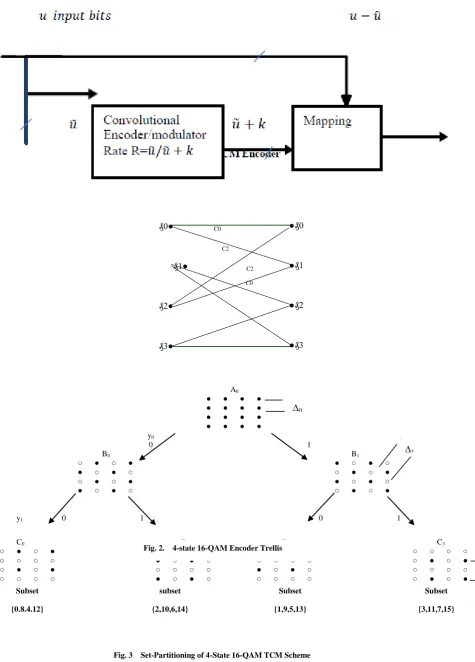
II. TRELLIS CODE GENERATOR/MODULATOR Design structure of trellis coded modulation reveals that it is a non-binary modulation technique integrated with mapping, shown in Fig.1. For ‘u’ information bits under transmission, there are ‘k’ number of redundant bits added by the encoder in a predefined pattern so that number of signals are available for transmission.
A convolutional encoder is one of the essential components internally, receiving input bits and generates +k) coded bits. There are ‘γ’ number of delay elements which decides the encoder states, .
Revised Manuscript Received on August 05, 2019.
Vanaja Shivakumar*, department of Electronics and Communication Engineering, CMR Institute of Technology, Bengaluru, India. Email: [email protected]
The Trellis Encoder output sequence enters the signal mapper which does the job of generating an integer ‘α’ from the possible numbers which is the index of one of the signal points of the constellation used for transmission. Number of Encoder States (1)
= Number of Trellis States
Constraint Length of the encoder = γ (2) Trellis Coded sequence (3) Signal Constellation size = Ϻ = (4) The encoded bits define the subset of the signal constellation from which one signal point is selected for transmission by the un-coded bits combination. This process is called set-partitioning, shown in Fig.3. It is an inherent procedure in TCM due to which the Euclidean distance among the signal points of a subset is maximized. The mapped signal and the encoder state transitions at any discrete time ‘n’ is a function of the input sequence and the encoder state.
The encoder has memory and hence will have graphical representation, called trellis. The states are represented as a node in the trellis.
From each node there are transitions, each carry one subset of signals. It says that there are parallel paths each transition carry. The Fig.2 shows the trellis of 4-state encoder for 16 number of trellis encoded quadrature amplitude modulated signals transmission.
III. TRANSMISSION ON BAND-LIMITED ISI CHANNEL
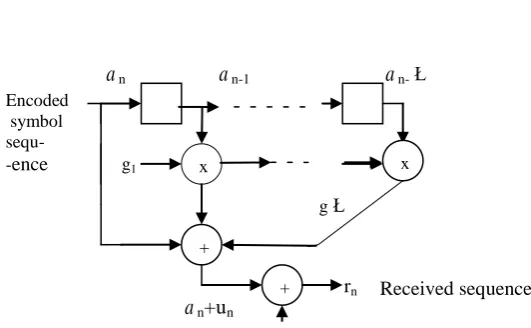
When the communication channel is a band-limited ISI channel, equivalently it can be represented as a linear system. The resulting discrete time model of the communication system as a linear filter is shown in Fig.4.
Assuming the channel memory length as Ł, each of the encoder states is associated with number of ISI states. The trellis of the system is the combination of the encoder trellis and the ISI states trellis, called Super Trellis, ƛ. The number of states of super trellis, , is, as in:
(5)
and (6) In reality the decoder structure becomes complicated. An
alternate solution is the truncated ISI channel memory length approach.
In the following analysis, input is 3-bits per symbol interval transmission, channel ISI length is 2, and Ϻ=16. At any discrete time ‘n’, the input sequence Xn is, as in:
Reduced Complexity Trellis for Coded
Modulation on Channels Subjected to ISI
Input , (7) Encoder next state is, as in:
(8)
Let
Now, next state of the combined ISI-Code trellis
(9)
The trellis code of is , where, as in:
(10)
Therefore, in terms of
X
n, the next state is, as in:(11)
IV. TRUNCATED COMBINED ISI-CODE TRELLIS When the channel memory length to is treated as less significant, where , the number of ISI states associated with each state of the encoder decreases, accordingly, the complexity of the receiver decreases Fig.5. Now the number of states in the combined trellis are where
= ≤ (12)
The reduced states of the truncated trellis
,
for (13)
where
(14)
V. DECODING STRATEGIES
Decoding of the noisy TCM signals received on AWGN channel is done by the Soft Decision Viterbi Algorithm (SOVA) for the Maximum-Likelihood Estimation of the signal sequence (MLSE). The SOVA is an iterative process, in each iteration it traces the trellis structure of the encoder/modulator to search for the optimum transmitted signal sequence path, called survivor path. It computes the distance between the received noisy signal sequence and the reference as per the predefined structure of the encoder design. The computations become complicated as M value
increases and the encoder states. In reality, reduced complexity trellis structures are
considered for transmission, and, accordingly decoding algorithm becomes less complicated. If metric computation, the iterative computation of the algorithm during nth interval is given by
(15)
(16)
=1 2 (17)
The computational complexity in equation (15) is valid if only Gaussian noise affect the channel. The complexity increases as given by the equation (16) due to cancellation of ISI. When truncated channel trellis is considered the ISI cancellation in the second term of the equation (17) is executed for Q intervals only. And the previous symbols ISI effect for the length Q to l is cancelled from the history of symbol detection.
VI. RESULTS AND CONCLUSIONS
International Journal of Innovative Technology and Exploring Engineering (IJITEE) ISSN: 2278-3075, Volume-8 Issue-10, August 2019
A0
● ● ● ●
● ● ● ● ● ● ● ● ● ● ● ● y0
0 1
B0 B1
○ ● ○ ● ● ○ ● ○
● ○ ● ○ ○ ● ○ ●
○ ● ○ ● ● ○ ● ○
● ○ ● ○ ○ ● ○ ●
y1 0
1 0 1
C0 C1 C2 C3
○ ● ○ ● ○ ○ ○ ○ ● ○ ● ○ ○ ○ ○ ○
○ ○ ○ ○ ● ○ ● ○ ○ ○ ○ ○ ○ ● ○ ●
○ ● ○ ● ○ ○ ○ ○ ● ○ ● ○ ○ ○ ○ ○
○ ○ ○ ○ ● ○ ● ○ ○ ○ ○ ○ ○ ● ○ ●
Subset subset Subset Subset
{0.8.4.12} {2,10,6,14} {1,9,5,13} {3,11,7,15}
Fig. 3 Set-Partitioning of 4-State 16-QAM TCM Scheme ●₰0
●₰1
●₰2
●₰3 ₰0● C0
C2
₰1● C2
C0
₰2●
₰3●
Fig. 2. 4-state 16-QAM Encoder Trellis
∆2 ∆0
[image:3.595.62.538.58.721.2]10 11 12 13 14 15 16 17 18 19 20 10-5
10-4
10-3
10-2
10-1
CH32: g0=.7746 g1=.4472 g2=.3872 g3=.2236
Coded.ISI.free
Coded.Truncated.Combined.MLSE Uncoded.Truncated.MLSE
Er
ror
E
ve
nt
Pr
ob
ab
ilit
y
SNR in dB
1
n
= ( )B0{C0,C2} (00) ₰0 ●
B0{C0,C2} (10) ₰1 ●
B1{C1,C3} (01) ₰2 ●
B1{C1,C3} (00) ₰3 ●
B2{C2,C4} (01) ₰4 ●
B2(C2,C0} (10) ₰5 ●
B3{C3,C1} (01) ₰6 ●
[image:4.595.127.393.74.238.2]B3{C3,C1} (01) ₰7 ●
Fig.5 8-state Truncated Combined ISI- Code trellis for
4-state 16-QAM TCM , channel memory length Ł=2, truncated length Q=1 +
x g1
a
na
n-1a
n- Ł+
a
n+unwn rn
g Ł
x
AWGN samples
Encoded symbol sequ- -ence
Received sequence
10 11 12 13 14 15 16 17 18 19 20
10-5
10-4
10-3
10-2
10-1
CH31: g0=.7071 g1=.5 g2=.3872 g3=.3162
Coded.ISI.free
Coded.Truncated.Combined.MLSE Uncoded.Truncated.MLSE
Er
ro
r E
ve
nt
Pr
ob
ab
ilit
y
SNR in dB
Fig. 4 Combined Encoder-channel model(FSM)
[image:4.595.73.492.183.714.2]International Journal of Innovative Technology and Exploring Engineering (IJITEE) ISSN: 2278-3075, Volume-8 Issue-10, August 2019
Author-1 Photo REFERENCES
1. Ungerboeck. G., “Trellis-Coded Modulation with Redundant Signal Sets -Part I: Introduction,” IEEE Commun. Mag., Vol. 25, No. 2, pp. 5-21, Feb 1987.
2. Eyuboglu M.V. and Qureshi S. U. H., “Reduced-State Sequence Estimation with Set Partitioning and Decision Feedback,” IEEE
Trans. Commun., Vol. 36, pp. 13-20, Jan. 1988. 3. Chevillat P. R. and Eleftherious. E., “Decoding of Trellis-Encoded
Signals in the Presence of Intersymbol Interference and Noise,” IEEE
Trans. Commun., Vol. COM-37, No. 7, pp. 669-676, July 1989. 4. Eyuboglu M.V. and Qureshi S.U.H., “Reduced-State Sequence Estimation for coded Modulation of Intersymbol Interference Channels,” IEEE J. Selected Areas in Communications., Vol. 7, pp. 989-995, Aug 1989.
5. R. Raheli; A. Polydoros; Ching-Kae Tzou, “Per-Survivor Processing: a general approach to MLSE in uncertain environments,” IEEE Transactions on Communications, Volume: 43, Issue: 2/3/4, Feb./March/April 1995.
6. Albert M. Chan, Gregory W. Wornell, “A class of Block-Iterative Equalizers for Intersymbol Interference Channels: Fixed Channel Results,” IEEE Trans. on Commun., Vol. 49, No.11, Nov. 2001. 7. Qi Wang, Lei Wei, and Rodney A. Kennedy, “Iterative Viterbi
Decoding, Trellis Shaping, and Multilevel Structure for High-rate Parity-Concatenated TCM,” IEEE Trans. Commun., Vol. 50, No. 1,pp. 48-55, Jan 2002.
8. Maunder. R. G., Kliewer. J., S. X. Ng, Wang. J., Yang. L -L., Hanzo. L., “Joint Iterative Decoding of Trellis-Based VQ and TCM,” IEEE Transactions on Wireless Communications, Vol. 6, pp. 1327-136, April. 2007.
9. Fabian Schuh and Johannes B. Huber, “Low Complexity Decoding for Higher Order Punctured Trellis-Coded Modulation Over Intersymbol Interference Channels,” IEEE Trans. Commun., Vol. 43, Issue 2/3/4, 27 May, 2014
10. V. Prasanth, Rubbia Tasneem, “Speed and Power Optimization of FPGA’S Based on Modified Viterbi Decoder,” International Journal of Advanced Research in Electrical, Electronics and Instrumentation Engineering, ISSN Online (2278-8875), Print (2320-3765), Vol.3, Issue 11, Nov.14
AUTHORSPROFILE