International Journal of Innovative Technology and Exploring Engineering (IJITEE) ISSN: 2278-3075, Volume-8 Issue-8, June 2019
An Energy Efficient Data Aggregation Technique
Using Multi-Sink Infrastructure in Heterogeneous
Wireless Sensor Network
S Anuradha, D Sreenivasa Rao
Abstract: The energy consumption of sensors adjacent to sink or upon critical paths remains excessively fast along with additional drawbacks in wireless sensor networks using single sink node. Therefore, we propose Energy-efficient secondary level base station (EE-SLB) based data aggregation in wireless sensor network. Multi-sink infrastructure permits sensor nodes for choosing various sink nodes with respect to their individual situation compared to single-sink topology. As a result, the usual transmission distance amid sensor nodes as well as sink nodes may be decreased. The benefits of dispersion, stability as well as robustness are given by the deployment of multi-sink nodes.
Keywords: Wireless sensor networks, Clustering, TDMA, Network code method, Energy level routing, Secondary level base station, mobile agent, Data aggregation, Data integrity.
I. INTRODUCTION
A WSN includes a huge quantity of minute and small power sensor nodes that remain aimlessly or physically arranged above an unattended objective area. WSNs guarantee possible submissions in atmosphere monitoring, disaster alerting systems, healthcare, defence investigation as well as reconnaissance systems [1]. Nevertheless, the major limitation of WSNs is restricted power sources of the sensor nodes. Consequently, energy preservation of the sensor nodes remains the utmost stimulating concern for the extended course of WSNs. Many concerns are assumed for this resolution which comprises low-power radio communication hardware [2], energy-aware medium access control (MAC) layer protocols [3,4], etc. Moreover, energy efficient clustering as well as routing algorithms [5, 6] remains the supreme capable regions that are assumed broadly by the way. Within a dual-tier WSN, sensor nodes remain distributed into numerous collections termed as clusters. Each single cluster has a leader recognised by means of a cluster head (CH). The entire sensor nodes identify local information and later forward that one towards their resultant CH. At that time, the CHs combine the local information and lastly direct it towards the base station (BS) otherwise through additional CHs. The performance of a cluster-built WSN is presented in Figure. 1. Clustering sensor nodes consumes the resulting benefits: (1) it allows information collection at cluster head towards discarding the redundant as well as uncorrelated information; here, in the above-mentioned preserves energy of the sensor nodes.
Revised Manuscript Received on June 07, 2019.
S Anuradha, Department of ECE, JNTUH, Hyderabad, India.
Dr.D. Sreenivasa rao, Department of ECE, JNTUHCEH, Hyderabad, India.
[image:1.595.315.547.430.536.2](2) Routing may be accomplished definitely since only CHs are necessary for maintaining the local route arrangement of additional CHs and therefore require small routing information; this in turn progresses the scalability of the network expressively. (3) The above-mentioned similarly maintains communication bandwidth as the sensor nodes just interconnect by their CHs and therefore stops interchange of redundant messages amongst themselves.Nevertheless, CHs withstand certain additional amount of work assured by means of their participant sensor nodes as they obtain the sensed information from their participant sensor nodes, combine them as well as interconnect it towards the BS. Furthermore, in several WSNs, the CHs remain commonly elected amongst the usual sensor nodes that may die quickly for this added amount of effort. In this perspective, numerous investigators [7-11] have offered the usage of certain distinctive nodes named as gateways that remain delivered by additional energy. These gateways perform similar to cluster heads and remain accountable for the identical performance of the CHs. Thus, gateways as well as CHs remain employed conversely in the remainder of the paper.
Figure 1: A Wireless sensor network model
1. In larger networks, the distance between SINK and CHs are more.
2. As a result, the mobile agents have to travel longer distances, which is also depleting energy at mobile agents.
3. Long distance travel may increase the delay in delivering the data to BS.
In Multi-hop LEACH offered by Fan et al. [12], energy effectiveness has remained enhanced as multi-hop routing occupies smaller amount of energy than direct information towards the BS openly, particularly in huge sensor systems every CH chooses the adjoining CH in single hop series by means of its succeeding hop. However the major disadvantage of multi-hop LEACH and certain additional solutions which simply combined clustering and multi-hop transmission [13–14] is that CHs around the SINK tends to include great relay traffic and the nodes would expire shortly, therefore reducing the lifetime of the network. Here exist certain resolutions that target at exploiting the interval till the leading node turn out of energy in addition to the work towards reducing energy consumption [15–16]. The difficulty of these max-min lifespan routing procedures is that they may not safeguard energy on the base of complete system measure. Preserving energy aimed at the complete system remains more significant compared to that of distinct node in a big measure sensor system. Finally, though there exists a proportion of investigation effort on energy-aware routing in sensor systems, limited preceding mechanisms has deliberated the objectivity in energy consumption amongst sensor nodes.In some cases, particularly in large networks, the moving agent has to travel for longer distances which seriously affect the network performance in terms of delay and energy consumption. So here we introduce secondary level base station to reduce the travel time of the moving agents as well as to reduce the energy consumption. Here our paper presents three objectives performing which is shown below:
1) Data gathering between CHs and member nodes using energy aware routing protocol.
2) Involving Secondary Level Base station (SLB) in the network.
3) Mobile Agent is used to collect maximum data in routing and send it to near BS.
II. EXISTING WORK
On behalf of dynamic grouping of wireless sensor systems, [17] have offered an evolutionary aware routing protocol (EAERP). In selecting a customary of effective group heads commencing the standard sensor nodes and complete non-CH sensor nodes define adjoining CH towards joining, here the writers have prepared a challenge for minimizing the energy consumption all over the system. Furthermore, EAERP involves re-clustering in every single round for rotating the additional load of CH. Miserably, being an integrated method; EAERP involves complete system data in every single round aimed at re-clustering. Singh [18] and [19] have employed the PSO for CH selection amongst the usual sensor nodes and do not pay attention towards the cluster establishment. PSO as well as ant colony optimization (ACO) are employed in WSNs aimed at additional optimization difficulties correspondingly and they can remain found in [20], [21], and [22]. Nevertheless, not a bit of the exceeding procedures deliberate the overhead of the information routing
in group establishment stage. Moreover, none of them excludes [23] attention on cluster establishment by means of nature-motivated method. Numerous workings have remained projected aimed at CH collection. Nevertheless, collection of the CHs simply cannot practice the groups. Here exists no nature-stimulated grouping procedure such as PSO that deliberates cluster establishment instead of CH assortment aimed at WSNs for the finest of our understanding. In [24], author’s contribution towards EECCP is to further influence the calculation ability of sensor nodes in computing and considering a joint optimization of both computation as well as communication energy across mobile wireless sensor node for transferring and processing sensor data and distribute results to suitable parties. To the best of knowledge, this is the primary effort that considers sensor node as a service and realize cooperative calculating in MWSN. Its limitation includes the computational cost of this algorithm is very high and increases the overhead. Also, the candidate node (CN) selection affects overall energy consumption. In [25], a secured recoverable CDA scheme in heterogeneous WSN was proposed by author. In this method, only a common node can produce valid cipher text if not the node is compromised as the basis for producing cipher texts is only shared in-between the node as well as the base station that remains useful to avoid DoS attacks near the base station as specified previously. In order to protect the data privacy as well as recoverability, we use a symmetric HEBDA scheme. The base station can acquire overall original information and implement arbitrary aggregation operations. Additionally, we apply an effective signature scheme supporting batch verification that not only delivers data reliability check, but moreover can obtain in-network false data filtering as well as approved aggregation. Its limitation includes that, data aggregation creates overhead when an enormous amount of data are collected from a huge amount of sensor nodes.In [26], a Novel energy aware hierarchical cluster-based routing protocol (NEAHC) was proposed by the author for extending the lifespan of the WSNs by combining clustering technique as well as an optimal relay selection procedure. The objective is to find an optimal routing path from the source towards the destination by favoring the maximum remaining battery power, minimum energy consumption in multi-hop path, as well as optimum fairness among sensor nodes. Its limitation increase the work load among the cluster head nodes and energy is depleted more quickly in the CH nodes, which leads to frequent re-clustering and CH rotation. Also this method would increase the traffic at the nodes surrounding near to the sink node.
III. PROPOSED FRAMEWORK
International Journal of Innovative Technology and Exploring Engineering (IJITEE) ISSN: 2278-3075, Volume-8 Issue-8, June 2019
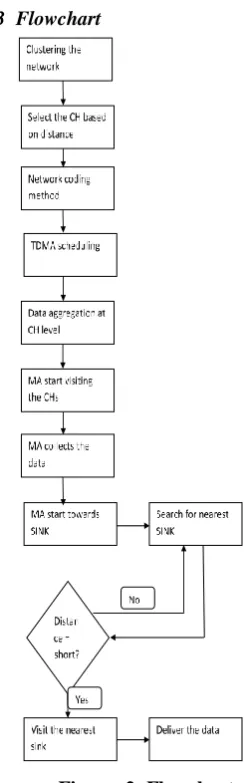
The data integrity is nothing but ensuring the sent data is received without any loss or any alteration and also to check the authenticity of the data at the receiver side. The working process of proposed method shows in figure 2.In this paper, to simplify scheduling for the mobile agent, we accept that the information gathered by sensor nodes remains the deferral tolerant information, i.e., they can wait for the mobile agent to arrive and lift them up. Here mobile agent receiving data, send it to base station. In this paper, mobile agent will deliver the data to secondary level base station, in case primary base station is not nearby. As a result, maximum data delivery progresses in network. Here cluster head node forwards the data towards nearest base station so time saving in routing level.We consider the network remains collected of N sensor nodes, represented as: 1 2 {s1, s2, s3……..Sn} correspondingly. They unceasingly supervise their adjoining atmosphere and remain equally distributed in a rectangle field. There exist k sink nodes (or Base Station, BS) that have remained arranged by indiscriminate location, signified by means of 1 2 BS1, BS2….BSk}. We build the succeeding suppositions:Entire nodes remain heterogeneous and fixed after the deployment. The sink node remain pre-located in the sensing field indiscriminately. Nodes may modify their transmitting power along with the relative distance towards its receiver and Links remain there uniformly.In every cluster there exists only one cluster head. The additional nodes in similar cluster direct information towards the cluster head. At that moment, cluster head forwards combined information towards the aforementioned significant sink. Firstly, information combination decreases traffic load. Additionally, the cluster heads located in similar mode compares itself with the probabilistic deployment in LEACH. The aforementioned remains additionally relevant on behalf of the large-scale deployed networks. Lastly, it may extend the network lifespan, by means of a majority of nodes near the communication module aimed at comparatively lengthy period. We will then select every single cluster head once similarly distributing the sensing field into numerous identical regions. We define every single cluster head using its residual energy since the network remains deliberated towards being heterogeneous. We motivate the sensor node Si
that is placed at the center of each cluster, when the selection process starts. The aforementioned remains considered by means of the cluster head. In the vicinity of radius R, it transmits single message. Aimed at the struggle of the cluster head, this message wishes towards motivating additional nodes. The aforementioned comprises the node’s id as well as the aforementioned residual energy. Though the external nodes stay futile, only in the communication range, the nodes may obtain the message and turn out to be dynamic. If any node Sj consumes greater residual energy compared to Si, it
turns out to be a new cluster head applicant and transmits novel message by its individual data towards others. If Sj consumes equivalent residual energy by Si, then relate the ID,
then the node by a lesser ID succeeds. If Sj consumes lesser residual energy compared to Si, the aforementioned still transmits the message of Si. When the assessment remains achieved, the unselected node turn out to be idle once more. Entire nodes in the cluster must be paralleled merely one time. Thus, the node is selected as cluster head by the leading residual energy. The cluster-selection procedure may be expressed in the same way to find MAX (Eresidual).
3.1 Inter cluster routing
The cluster heads must send collected data towards sink nodes after the data fusion. We can make better usage of the secondary level-sink topology. Every single cluster head chooses one optimum sink individually in our procedure. Our topmost interest is to minimize the energy consumption. For any cluster head CH, the energy consumption towards sink: BS is represented as E (CH, BS). Its calculation follows the energy model. E (CH, BS) == d (CH, BS), where d is the distance between the CH and BSFrom the above mentioned formula we can observe that the energy consumption i.e., E (CH, BS) is reduced if the distance, d (CH, BS) between CH and BS is low. In this scenario, the data from cluster head can be sent directly towards the sink node within single hop. Hence, we must compare the distances from every cluster head towards various sinks and then select the shortest path. In this manner, the cluster head will determine the optimal sink with minimum energy consumption.
3.2 Intra cluster routing
Sensor nodes in the identical cluster transmit information straightly towards the cluster head in numerous clustering procedures. Certain sensor nodes might consume relatively huge quantity of energy because of long-distance communication owing towards the point of their numerous locations. As a result, we fix a multi-hop routing protocol. Aimed at every participant node Si in single cluster, the energy consumption charges towards sending information openly towards its cluster head CHsi remains characterized by means of E (Si, CHSi)Meanwhile, it remains promising
that Si attempts towards finding additional sensor node Sj to forward information for saving energy through openly avoiding communication by CHSi.En route for delivering a
l-length packet towards the cluster head and the energy consumption E(Si, Sj, CHSi) remains intended in this manner
as well as the optimal relay node remains defined grounded on the least assessment of E(Si, Sj, CHSi) where and
differ in dissimilar circumstances along with the energy model.E(Si, S, CHsi) = Etx ( l,d, (Si,Sj) + Erx (l) + Etx ( l, d,
(Sj, CHSi))Every single Si selects Sj by the least value of E(Si,
Sj, CHSi) by means of the relay node if needed.E (Si, CHSS)
= Min (E (Si, Sj, CHSi))Nevertheless, the sink nodes remain
accidentally situated in our procedure. Hence, certain nodes might consumption a smaller amount of energy by transmitting information openly towards the sink instead of towards its cluster head. Therefore it remains essential for comparing E (Si, CHSi) as well as E (Si, BSk) and decides the
ultimate route.Aimed at easiness, the intra-cluster procedure can remain expressed as towards finding MIN (E (Si, CHSi),
3.3 Flowchart
Figure. 2: Flowchart of Proposed system
IV. RESULT AND DISCUSSION
A. Simulation Environment & Parameters
The simulation environment parameters are summarized in table 1 and considered as default values unless otherwise specified in the paper.
Table 1
The Simulation Environment Parameters
PARAMETER VALUE
Application Traffic CBR
Transmission rate 1000
bytes/0.1 ms
Radio range 250m
Packet size 1000 bytes
Initial energy 100j
Simulation time 10s
Number of nodes 77
Area 1000x500
Grid size 50m
No. Clusters 8
Base stations 2
Routing protocol AODV
Routing methods EE-SLB,
EE-CCP, HEBDA, NEAHC
In this paper, we consider that 77 sensor nodes are
randomly spread over a 1000x500m2 field. In this paper, we accept that no gap is present in the detecting field and static sensors remains equal in their abilities. In the meantime, we assume that the mobile agent is located initially in the top-left corner of the two-dimensional territory and its coordinates are (50 m, 50 m). After cluster head collecting the data from cluster member, the mobile agent initiates its periodical movement from beginning point and running towards to cluster heads and finally returns. Table1 presents the system parameters utilized in our simulations.
B. Performance metrics
The performance of the proposed optimal solution is evaluated via simulation results using Network simulator-2. Number of simulation experimentations has been conducted to calculate the performance of our algorithm. For evaluating the performance of our proposed algorithm, we use key metrics named energy consumption, delay and throughput based on which the performance from first deployment till the last node is carried out.
[image:4.595.305.550.294.424.2]Figure. 3: Network deployment
Figure 3 demonstrates that all nodes are placed in the network (1000x500m) and the deployment of nodes is properly done in the network. At this point, the entire nodes that are represented are on the basis of random topology values and it should mention the overall properties of NAM window.
Figure. 4: Cluster level routing
[image:4.595.308.548.485.617.2]International Journal of Innovative Technology and Exploring Engineering (IJITEE) ISSN: 2278-3075, Volume-8 Issue-8, June 2019
Figure. 5: Mobile agent collection
Figure 5 represents the data collection of mobile agent. In NAM, node 75 is considered as mobile agent and it starts moving towards the CH and collects data from all the cluster heads.
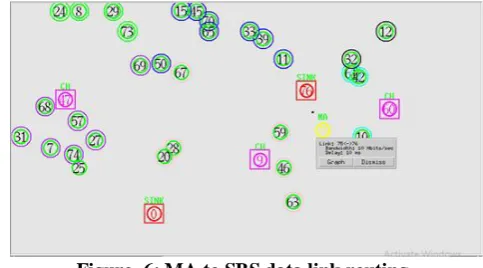
Figure. 6: MA to SBS data link routing
Figure 6 represents the data link between the mobile agent and secondary level BS. Here we consider node 0 as primary base station, as it is located at far distance from the mobile agent. Therefore, we choose secondary level base station to collect the data from mobile agent. Here Bandwidth and delay demonstrates the data transmission between two nodes in average time.
[image:5.595.46.288.48.188.2]Figure. 7: MA to SBS data processing
[image:5.595.306.543.49.206.2]Figure 7 demonstrates the data level routing process between MA and SBS (secondary Base station). Here CBR indicates traffic level protocol and measures the number of iterations, dual communication, packet size, and time interval. In this NAM, node 76 is considered as SINK (secondary BS).
Figure. 8: Delay performance in network
We define that processing delay denotes the execution time versus varying delay in network. Figure 8 represents the delay of sensor node that is processing the data and it is much lower compared to others, since it allocates the traffic load through the CHs in the network to balance their transmission charge. But after few rounds, it rises rapidly due to the rise in transmission cost as some number of CHs reaches their level and starts data transmission directly towards the BS. If there exist long distance communication between CH and BS, mobile agent moves towards to CH and collects the data and gets it back to BS.
Figure. 9: Energy consumption in network
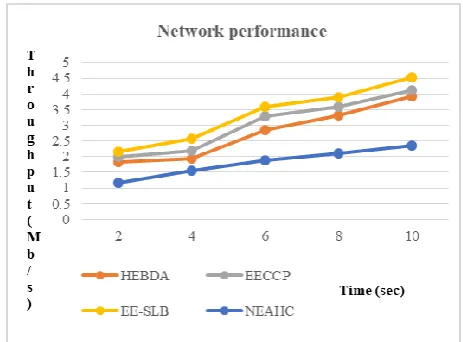
[image:5.595.52.294.238.372.2] [image:5.595.308.547.364.524.2] [image:5.595.55.294.463.589.2]Figure. 10: Network performance
Figure 10 represents the overall network performance. Here, the number of data packets received by the BS in EE-SLB is higher at all times compared to existing methods. The average number of data packets received by BS and their network performance is computed using various number of sensor nodes as well as estimates how much data is to be stored in each sensor node for future transmission purpose. Secondary level BS is helpful for increasing the data in network in the proposed system.
V. CONCLUSION
The main design encountered in routing protocol aimed at WSNs is efficient energy usage as well as operational network lifespan. This paper defines the benefits of the secondary level base station in the network. The projected EE-SLB protocol precedes the benefits of clustering as well as secondary level base station towards optimizing the energy consumption in intra cluster routing. Simulation result proves that proposed EE-SLB outperforms equivalent procedures similar to EECCP, HEBDA as well as NEAHC protocols in terms of energy consumption and data distribution. In this paper, 38% improvement of the proposed method over the existing methods considered is observed with respect to the performance parameters given.
REFERENCES
1. Akyildiz,I.F.,etal..Wirelesssensornetworks:asurvey.Comput.Netw.38,
393–422. 2002.
2. Calhoun,B.H.,etal..Designconsiderationsforultra-lowenergywireless
microsensor nodes.IEEETrans.Comput.54,727–740, 2005.
3. Ahmad,A.,etal..MAClayeroverviewforwirelesssensornetworks.In:CNC
S 2012,pp.16–19, 2012.
4. Aykut,Y.M.,etal..QoSawareMACprotocolsforwirelesssensornetworks:a
survey.Comput.Netw.55,1982–2004, 2011.
5. Abbasi,A.A.,Mohamad,Y..Asurveyonclusteringalgorithmsforwireless
sensor networks.Comput.Commun.30,2826–2841, 2007.
6. Kemal,A.,Mohamed,Y..Asurveyonroutingprotocolsforwirelesssensorne
tworks.AdHocNetw.3,325–349,2005.
7. Gupta,
G.,Younis,M.,2003.Load-balancedclusteringofwirelesssensornetworks. In: IEEEICC2003,pp.1848–1852, 2003.
8. Low, C.P.,etal..Efficient load-balanced clustering algorithms for
wireless sensor networks.Comput.Commun.31,750–759, 2008.
9. Ataul,B.,etal..Ageneticalgorithmbasedapproachforenergyefficient
routing intwo-tieredsensornetworks.AdHocNetw.7,665–676, 2009.
10.Kuila,P.,Jana,P.K..Improvedloadbalancedclusteringalgorithmforwireles
s sensor networks.In:ADCONS2011,LNCS7135,pp.399-404, 2012. 11.Kuila, P., Gupta, S.K, Jana, P.K., A Novel evolutionary approach for
load balanced clustering problem for wireless sensor networks. Swarm Evol. Comput. 12, 48-56.
12. Fan X N, Song Y L. Improvement on LEACH protocol of wireless
sensor network. Proceedings of the 2007 International Conference on Sensor Technologies and Applications (SensorComm’07), Oct 14−20, 2007, Valencia, Spain. Piscataway, NJ, USA: IEEE, 2007: 260−264.
13. Priyankara S, Kinoshita K, Tode H, et al. A clustering/multi-hop hybrid
routing method for wireless sensor networks with heterogeneous node types. Proceeding of the 2010 IEEE GLOBECOM Workshops (GC Wkshps’10), Dec 6−10, 2010, Miami, FL, USA. Piscataway, NJ, USA: IEEE, 2010: 207-212
14. Javaid N, Aslam M, Djouani K, et al. ATCEEC: a new energy efficient
routing protocol for wireless sensor networks. Proceedings of the 2014 IEEE International Conference on Communications (ICC’14), Jun 10−14, 2014, Sydney, Australia. Piscataway, NJ, USA: IEEE, 2014: 263−268.
15. Van Giang D, Taleb T, Hashimoto K, et al. A fair and lifetime-maximum
routing algorithm for wireless sensor networks. Proceedings of the IEEE Global Telecommunications Conference (GLOBECOM’07). Nov 26−30, 2007, Washington, DC, USA. Piscataway, NJ, USA: IEEE, 2007: 581−585.
16. Zhang L, Chen S G, Jian Y, et al. Maximizing lifetime vector in wireless
sensor networks. IEEE/ACM Transactions on Networking, 2013, 21(4): 1187−1200.
17. Enan,A.,etal..Energy aware evolutionary routing protocol for dynamic
clustering of wireless sensor networks.SwarmEvol.Comput.1,195–203, 2011.
18. Singh,B.,Lobiyal,D.K..Energy-aware cluster head selection using
particle
swarmoptimizationandanalysisofpacketretransmissioninWSN.Procedia Technol.4,171–176, 2012.
19. Abdul,L.N.M.,etal..Energy-aware clustering for wireless sensor
networks using particleswarmoptimization.In:IEEEPIMRC,pp.1–5,
2007.
20. Saleem,M.,etal..Swarm intelligence based routing protocol for wireless
sensor networks:surveyandfuturedirections.Inf.Sci.181,4597–4624,
2011.
21. Kulkarni,R.V.,etal..Particleswarmoptimizationinwireless-sensornetwor
ks:a
briefsurvey.IEEETrans.Syst.,Man,Cybern.–PartC:Appl.Rev.41,262–26 7, 2011.
22. Zungeru,A.M.,etal..Classicalandswarmintelligencebasedroutingprotoco
ls for
wirelesssensornetworks:asurveyandcomparison.J.Netw.Comput.Appl. 35, 1508–1536, 2012.
23. Kuila,P.,Gupta,S.K.,Jana,P.K..Anovelevolutionaryapproachforload
balanced clustering problem for wireless sensor networks. Swarm Evol. Comput. 12,48–56, 2013.
24. Z. Sheng, C. Mahapatra, V. C. M. Leung, M. Chen and P. K. Sahu, "Energy Efficient Cooperative Computing in Mobile Wireless Sensor Networks," in IEEE Transactions on Cloud Computing, vol. 6, no. 1, pp. 114-126, 1 Jan.-March 2018. Doi: 10.1109/TCC.2015.2458272. 25. Hong Zhong, Lili Shao, Jie Cui, Yan Xu, “AN efficient and secure
recoverable data aggregation scheme for heterogeneous wireless sensor networks”, Volume 111, Janguary, 2018, pages 1-12. Doi:
https://doi.org/10.1016/j.jpdc.2017.06.019.
26. Wang Ke, Ou Yangrui, Ji Hong, Zhang Heli, Li Xi, “ Energy aware hierarchical cluster-based routing protocol for WSNs”, Volume 23,
Issue 4, August 2016, Pages 46-52.