ISSN 2348 – 7968
763
Exploration of Solution Behaviour of Potassium Halides in Mixtures Of L-
Proline And Water At 298.15, 308.15 And 318.15 K
Mahendra Nath Roy*, Partha Sarathi Sikdar and Pritam De
Department of Chemistry, University of North Bengal, Darjeeling 734013, India.
ABSTRACT
Apparent molar volume (V) and viscosity B-coefficients were estimated for potassium
chloride, potassium bromide and potassium iodide in aqueous mixture of L- proline from measured solution density (ρ) and viscosity (η) at 298.15, 308.15 and 318.15 K at various electrolyte concentrations. The experimental density data were evaluated by Masson equation and the derived data were interpreted in terms of ion–solvent and ion–ion interactions. The viscosity data has been analyzed using Jones–Dole equation and the derived parameters, B and A, have also been interpreted in terms of ion–solvent and ion–ion interactions respectively. The structure-making or breaking capacity of the electrolyte under investigation
has been discussed in terms of sign 0/
V T P
.
Keywords: potassium chloride, potassium bromide and potassium iodide, L-proline,
ion-solvent interaction
1. Introduction
ISSN 2348 – 7968
764
therefore it is used in many biotechnological reactions [4]. It has been found by a number of workers [5–7] that the addition of an electrolyte could either make or break the structure of a liquid. As the viscosity of a liquid depends on the intermolecular forces, the structural aspects of the liquid can be inferred from the viscosity of solutions at various electrolyte concentrations and temperature.
In this paper we have attempted to report the limiting apparent molar volume ( 0
V
),experimental slopes (SV* ) and viscosity B-coefficients for potassium chloride, potassium
bromide and potassium iodide in aqueous mixture of L- proline at 298.15, 308.15 and 318.15 K. Since potassium ion being a common cation for all of the electrolytes under investigation, the present work enables us to have a qualitative comparison of the role of anion in aqueous L-proline in terms of various derived parameters obtained from viscosity (η) and density (ρ) measurements.
2. Experimental Methods
2.1. Materials
L-proline ( SD. Fine Chemicals) was purified by standard methods [8]. The purity of the solvent was checked by measuring the viscosity (η) and density (ρ) at 298.15 K which was in good agreement with the literature values. Doubly distilled, degassed and deionised water with a specific conductance of 1×10⁻⁶ Ω−1 cm−1 was used. Potassium chloride, potassium bromide and potassium iodide (Sigma-Aldrich, Germany) were purified by re-crystallizing twice from conductivity water and then dried in a vacuum dessicator over P2O5 for 24 h
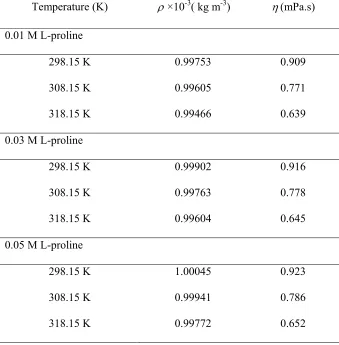
before use. The experimental values of viscosity (η) and density (ρ) of aqueous mixtures of 0.01 M , 0.03 M and 0.05 M L-proline at different temperatures are listed in Table 1.
2.2.Apparatus and procedure
Densities (ρ) were measured with an Anton Paar density-meter (DMA 4500M) with a
precision of 0.0005 g/cm3. The calibration was done by double-distilled water and dry air and
uncertainty in density was ±0.00005 g cm−3.
ISSN 2348 – 7968
765 density and viscosity values from the literature [9-11]. The uncertainty in viscosity measurements is within ±0.003 mPa.s. The mixtures were prepared by mixing known volume of pure liquids in airtight-stopper bottles and each solution thus prepared was distributed into three recipients to perform all the measurements in triplicate, with the aim of determining possible dispersion of the results obtained. Adequate precautions were taken to minimize evaporation loses during the actual measurements.
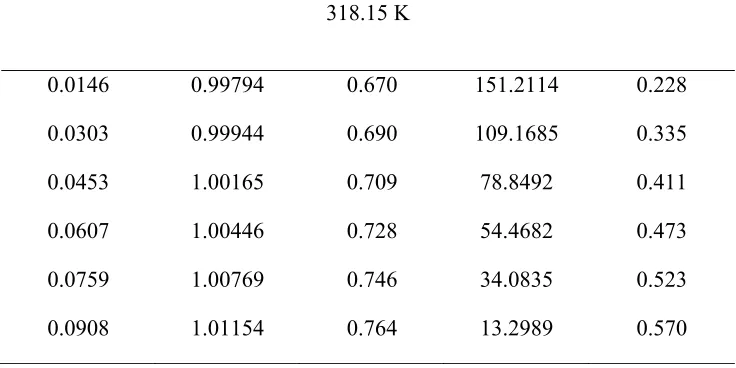
The electrolyte solutions studied here were prepared by mass and the conversion of molality into molarity was accomplished [3] using experimental density values. The experimental values of concentrations (c), densities (ρ), viscosities (η), and derived parameters at various temperatures are reported in Table 2.
3. Results and Discussion
3.2.Density calculation
The apparent molar volumes (V) were determined from the solution densities using the
following Eq. [3]:
/ / (1)
V M
c
where M is the molar mass of the solute, c is the molarity of the solution; ρ0 and ρ are the
densities of the solvent and the solution respectively. The limiting apparent molar volumes
0
V
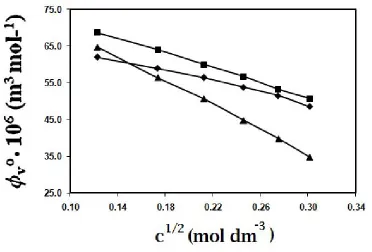
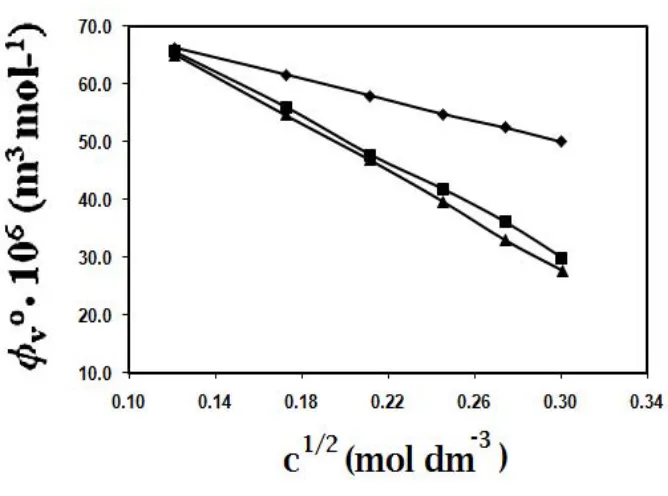
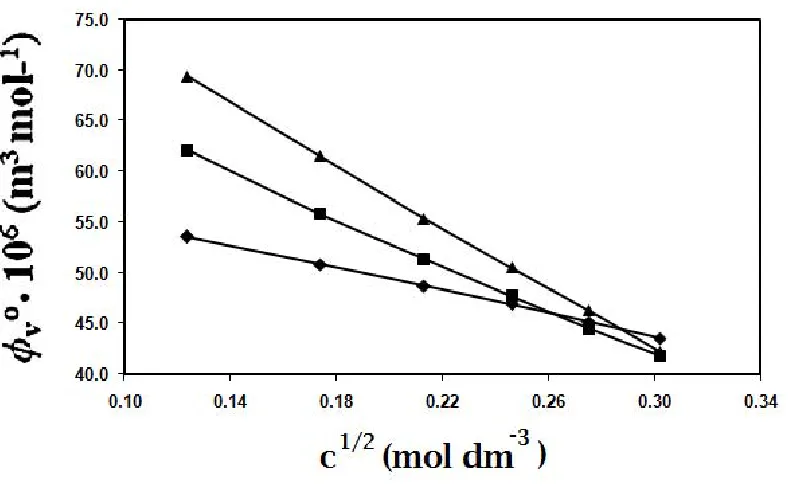
were calculated using a least-square treatment to the plots of V versus √c using thefollowing Masson equation [12]:
V V0SV*c (2)where ( 0
V
) is the apparent molar volume at infinite dilution and (SV* ) is the experimental slope. The plots of ( 0V
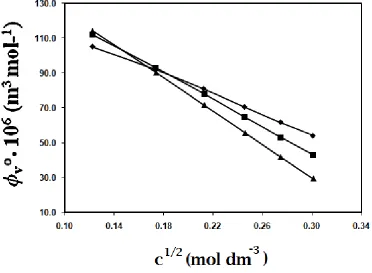
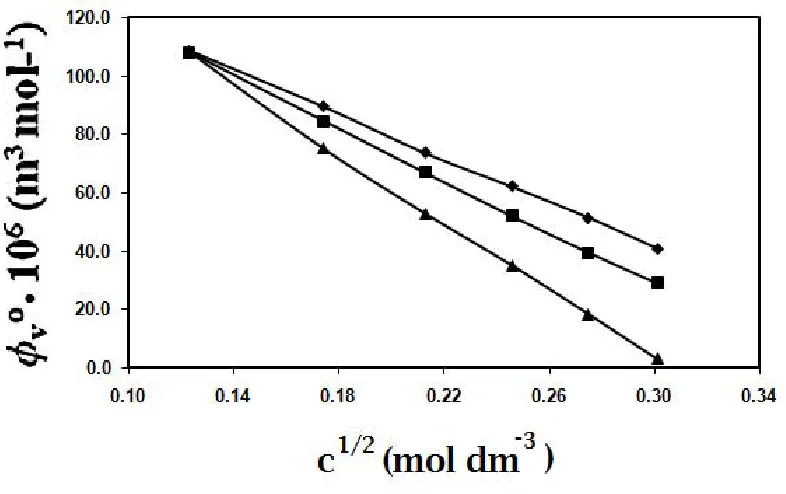
) against square root of molar concentration (√c) were found to belinear as depicted graphically in Figs. 1–9 with negative slopes. Values of 0
V
ISSN 2348 – 7968
766 In these systems the ion–solvent and ion–ion interactions can be interpreted in terms of structural changes between various components of the solvent and solution systems. 0
V
can be used to interpret ion–solvent interactions. Table 3 showed that 0V
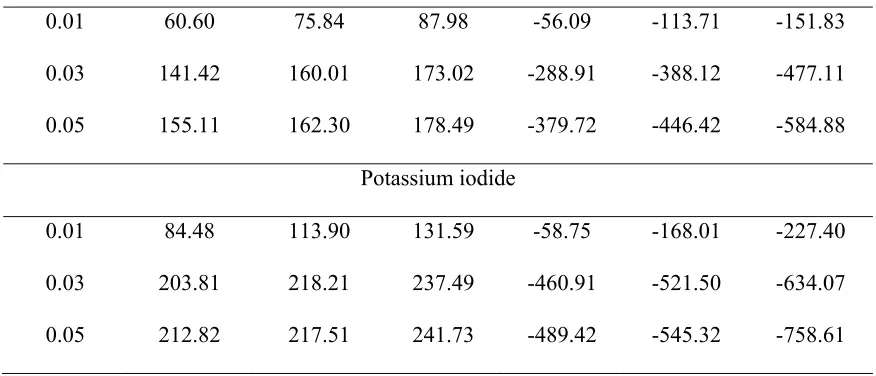
values are generally positive and increase with a rise in both the temperature and amount of L-proline in the mixtures. This indicates the presence of strong ion–solvent interactions and these interactions are further strengthened at higher temperatures and higher molar mass of L-proline in the mixtures, suggesting larger electrostriction at higher temperatures and in enhanced amount of L-proline.A perusal of Table 3 also reveals that the SV*values are negative for all the solutions
at all the experimental temperatures and SV* values decrease as the experimental temperature
and amount of L-proline in the mixtures increases. Since SV* is a measure of ion–ion
interactions, the results indicate the presence of weak ion–ion interactions in the solutions at all the experimental temperatures and these interactions further decrease with a rise in temperature and increase in molar mass L-proline in the mixtures. In other words, it may be said that the solvation of electrolyte/ions increases with the increase of L-proline content in water. This is probably due to more violent thermal agitation at higher temperatures, resulting in diminishing the force of ion–ion interactions (ionic-dissociation) [13]. This suggests that ion–solvent interactions dominate over ion–ion interactions in all the solutions and at all experimental temperatures.
The variation of 0
V
with temperature of potassium chloride, potassium bromide andpotassium iodide in aqueous mixture of L- proline follows the polynomial,
1 2 2
0 (3)
0
V a a T a T
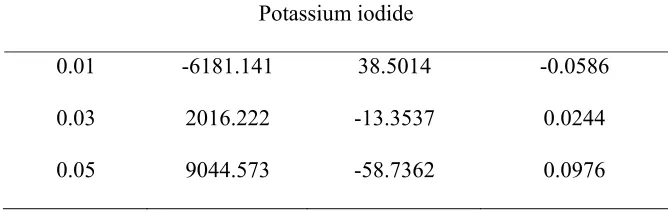
over the temperature range under study where T is the temperature in K. Values of coefficients of the above equation for potassium chloride, potassium bromide and potassium iodide in aqueous mixture of L-proline are reported in Table 4.
The apparent molar expansibilities ( 0
E
) can be obtained by the following equation:
E0
V0/T
P a1 2a T2 (4)The values of 0
E
for different solutions of the studied electrolytes at 298.15, 308.15 and 318.15 K are reported in Table 5. From the table it is evident that the values of 0E
ISSN 2348 – 7968
767 potassium chloride increases with the increase in the amount of L-proline in the mixture. However, for potassium bromide and potassium iodide the 0
E
values were found to be rather complicated to explain. During the past few years it has been emphasized by a number ofworkers that SV*is not the sole criterion for determining the structure making or breaking
tendency of any solute. Hepler [14] developed a technique of examining the sign of
0
/
E T P
for the solute in terms of long-range structure-making and breaking capacity
of the electrolytes in the mixed solvent systems. The general thermodynamic expression used is as follows
0
2/ 2 (5)
E T P a
If the sign of 0
/
E T P
is positive or small negative [15,16] the electrolyte is a structure
maker and when the sign of 0/
E T P
is negative, it is a structure breaker. As is evident
from Table 5, the electrolyte under investigation generally acts as a structure breaker.
The viscosity data of solutions for the electrolytes in 0.01 M, 0.03 M, 0.05 M L-proline have been analyzed using Jones–Dole [17] equation:
/ 01 /
c A B c (6)where η0 and η are the viscosities of the solvent and solution respectively. A and B are the
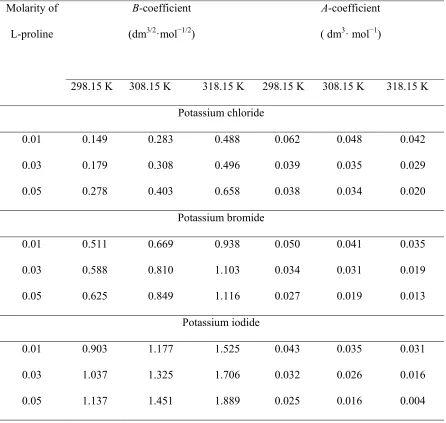
coefficients estimated by least square method and are reported in Table 6. From the table it is evident that the values of the A-coefficient are very small for all the solutions under investigation at all experimental temperatures. These results indicate the presence of weak ion–ion interactions, and these interactions further decrease with both rise of experimental temperatures and amount of L-proline suggesting an increase in ion–solvation. Interestingly, values are found to be smallest for potassium iodide and hence it may be concluded that solubility in aqueous L-proline solutions is maximum for potassium iodide and minimum for potassium chloride.
The effects of ion–solvent interactions on the solution viscosity can be inferred from the B-coefficient [18,19]. The viscosity B-coefficient is a valuable tool to provide information concerning the solvation of the solutes and their effects on the structure of the solvent. From
ISSN 2348 – 7968
768 bromide and potassium iodide in the studied solvent systems are more positive than A-coefficients, thereby suggesting the presence of strong ion–solvent interactions, and these type of interactions are strengthened with a rise in both temperature and amount of L-proline
in solutions. These conclusions are in excellent agreement with those drawn from 0
V
valuesdiscussed earlier. It has been reported in a number of studies [20, 21] that dB/dT is a better criterion for determining the structure-making/breaking nature of any solute rather than simply the value of the B-coefficient. It is found from Table 6 that the values of the B-coefficient increase with a rise in temperature (positive dB/dT) suggesting the structure-breaking tendency of potassium chloride, potassium bromide and potassium iodide in the solvent systems.
4 Conclusion
Extensive study of potassium chloride, potassium bromide and potassium iodide in
aqueous mixture of L- proline reveals that potassium iodide is more associated in L-proline
than the other two halides. The ion-association is found minimum in the case of potassium
chloride in L- proline. The said interaction of potassium bromidearises in the intermediary of
potassium iodide and potassium chloride. The present study reveals the predominance of
ion-solvent interaction over the ion-ion interaction in all the solution under investigation.
Acknowledgements
The authors are grateful to the UGC supported Major research project, Ref. No. RP/5032/FCS/2011 New Delhi for financial support in order to continue this research work.
ISSN 2348 – 7968
769
References
[1] Mc Dowali J.M., Vincent C.A. (1974) J. Chem. Soc., Faraday Trans. 1:1862–1868.
[2] Dack M.R.J., Bird K.J., Parker A.J. (1975) Aust. J. Chem. 28:955–963.
[3] Roy M.N., Sinha B., Dey R., Sinha A. (2005) Int. J. Thermophys. 26:1549–1563.
[4] Gröger H., Wilken J. (2001) Angewandte Chemie International Edition, Wiley Online Library
[5] Stokes R.H., Mills R.(1965) Int. Encyclopedia of Physical Chemistry and Chemical Physics.
[6] Nikam P.S., Mehdi H. (1988) J. Chem.Eng.Data 33:165–169.
[7] Nandi D., Roy M.N., Hazra D.K. (1993) J. Indian Chem. Soc. 70:305–310.
[8] Perrin D.D., Amarego W.L.F.(1988) Purification of Laboratory Chemicals, third ed. Great Britain.
[9] Sinha B., Dakua V.K. , Roy M.N. (2007) J. Chem. Eng. Data. 52:1768-1772 .
[10] Dean J.A.(1973) Lange’s Handbook of Chemistry, 11th ed. McGraw-Hill Book Company, New York,.
[11] Chatterjee B.D. (2006) J. Chem. Eng. Data. 51:1352-1355.
[12] Masson D.O. (1929) Phila. Mag. 8:218–226.
[13] Millero F.J. (1972) Structure and Transport Process in Water and Aqueous Solutions, R.A.Horne, New York.
[14] Hepler L.G. (1969) Can. J. Chem. 47:4613–4617.
[15] Sarkar B.K, Sinha B, Roy M.N. (2008) Russ. J. Phys. Chem 82:960–966.
[16] Parmar M.L., Banyal D.S. (2005) Indian J. Chem. 44A:1582–1588.
[17] Jones G., Dole M. (1929) J. Am. Chem. Soc. 51: 2950–2964.
[18] Millero F.J., (1971) Chem. Rev. 71: 147–176.
[19] Millero F.J., Lo Surdo A., Shin C. (1978) J. Phys. Chem. 82:784–792.
[20] Gopal R., Siddiqi M.A. (1969) J. Phys. Chem. 72:1814–1817.
[21] Saha N., Das B. (1997) J. Chem. Eng. Data 42:227–229.
Tables:
Table 1. Density (ρ, kg m−3) and viscosity (η, mPa.s) of aqueous mixtures of 0.01 M
ISSN 2348 – 7968
770
Table 2. The concentration (c), density (ρ), viscosity (η), apparent molar volume (V), and
1 2 0 1
/
( / )/ c of potassium chloride, potassium bromide and potassium iodide in different aqueous mixtures 0.01 M L-proline , 0.03 M L-proline, 0.05 M L-proline at different temperatures
Temperature (K) ×10-3( kg m-3) (mPa.s)
0.01 M L-proline
298.15 K 0.99753 0.909
308.15 K 0.99605 0.771
318.15 K 0.99466 0.639
0.03 M L-proline
298.15 K 0.99902 0.916
308.15 K 0.99763 0.778
318.15 K 0.99604 0.645
0.05 M L-proline
298.15 K 1.00045 0.923
308.15 K 0.99941 0.786
318.15 K 0.99772 0.652
c
(mol.dm−3)
ρ ×10-3
( kg m-3)
(mPa.s)
V ×106
( m3· mol−1 )
1 2 0 1 /
( / )/ c
(kg1/2 mol-1/2)
ISSN 2348 – 7968
771 298.15K
0.0151 0.99804 0.918 40.7724 0.081
0.0302 0.99862 0.923 38.4219 0.089
0.0452 0.99924 0.927 36.6533 0.093
0.0590 0.99985 0.931 35.1369 0.100
0.0752 1.00059 0.935 33.7388 0.104
0.0903 1.00132 0.938 32.4331 0.106
Potassium chloride in aqueous mixture 0.01 M L-proline
308.15K
0.0151 0.99651 0.779 44.1206 0.084
0.0302 0.99709 0.784 40.0940 0.097
0.0452 0.99773 0.789 37.3202 0.110
0.0590 0.99835 0.793 35.4719 0.117
0.0752 0.99914 0.798 33.3263 0.128
0.0903 0.99988 0.802 31.9725 0.134
Potassium chloride in aqueous mixture 0.01 M L-proline
318.15K
0.0151 0.99509 0.647 46.1479 0.102
0.0302 0.99565 0.653 41.7753 0.126
0.0452 0.99628 0.659 38.6617 0.147
0.0590 0.99693 0.664 35.9803 0.161
0.0752 0.99774 0.670 33.4493 0.177
ISSN 2348 – 7968
772 Potassium bromide in aqueous mixture 0.01 M L-proline
298.15K
0.0153 0.99853 0.922 53.5574 0.116
0.0303 0.99959 0.931 50.8657 0.139
0.0454 1.00071 0.940 48.7479 0.160
0.0607 1.00189 0.948 46.9048 0.174
0.0759 1.00311 0.957 45.1597 0.192
0.0912 1.00438 0.966 43.5138 0.208
Potassium bromide in aqueous mixture 0.01 M L-proline
308.15K
0.0153 0.99692 0.783 62.1030 0.126
0.0303 0.99796 0.792 55.8276 0.156
0.0454 0.99911 0.801 51.3776 0.183
0.0607 1.00036 0.810 47.6963 0.205
0.0759 1.00168 0.819 44.4546 0.226
0.0912 1.00305 0.828 41.8137 0.245
Potassium bromide in aqueous mixture 0.01 M L-proline
318.15K
0.0153 0.99542 0.651 69.3779 0.152
0.0303 0.9964 0.661 61.4873 0.198
0.0454 0.99754 0.671 55.3595 0.235
0.0607 0.9988 0.681 50.4901 0.267
ISSN 2348 – 7968
773 0.0912 1.00162 0.701 42.2061 0.321
Potassium iodide in aqueous mixture 0.01 M L-proline
298.15K
0.0151 0.99887 0.926 77.1285 0.152
0.0302 1.00029 0.941 74.3642 0.203
0.0451 1.00175 0.955 72.0751 0.238
0.0604 1.00329 0.968 70.1716 0.264
0.0755 1.00486 0.982 68.3442 0.292
0.0906 1.00647 0.995 66.6517 0.314
Potassium iodide in aqueous mixture 0.01 M L-proline
308.15K
0.0151 0.99714 0.788 93.7994 0.179
0.0302 0.99851 0.803 84.3485 0.239
0.0451 1.00001 0.818 77.8489 0.287
0.0604 1.00168 0.833 72.2998 0.327
0.0755 1.00341 0.847 67.9012 0.359
0.0906 1.00525 0.861 63.7203 0.388
Potassium iodide in aqueous mixture 0.01 M L-proline
308.15K
0.0151 0.99559 0.656 104.5438 0.217
0.0302 0.99691 0.672 91.3819 0.297
0.0451 0.99839 0.688 82.9873 0.361
ISSN 2348 – 7968
774 0.0755 1.00189 0.718 69.5956 0.450
0.0906 1.00387 0.733 63.5555 0.489
Potassium chloride in aqueous mixture 0.03 M L-proline
298.15K
0.0150 0.99921 0.923 61.9450 0.062
0.0301 0.99949 0.927 58.9421 0.069
0.0451 0.99984 0.931 56.3604 0.077
0.0603 1.00027 0.935 53.7704 0.085
0.0754 1.00075 0.938 51.5348 0.087
0.0907 1.00137 0.942 48.5495 0.094
Potassium chloride in aqueous mixture 0.03 M L-proline
308.15K
0.0151 0.99772 0.785 68.7139 0.073
0.0301 0.99795 0.790 64.0361 0.089
0.0451 0.99829 0.795 59.9847 0.103
0.0603 0.99871 0.799 56.6853 0.110
0.0754 0.99924 0.804 53.2104 0.122
0.0907 0.99979 0.808 50.6903 0.128
Potassium chloride in aqueous mixture 0.03 M L-proline
318.15K
0.0151 0.99619 0.652 64.8067 0.088
0.0302 0.99659 0.658 56.4412 0.116
ISSN 2348 – 7968
775 0.0604 0.99784 0.669 44.7281 0.151
0.0756 0.99866 0.675 39.7752 0.169
0.0907 0.99964 0.679 34.7144 0.175
Potassium bromide in aqueous mixture 0.03 M L-proline
298.15K
0.0150 0.99923 0.928 105.1030 0.107
0.0301 0.99983 0.938 92.0902 0.138
0.0452 1.00074 0.947 80.8570 0.159
0.0603 1.00193 0.956 70.5692 0.178
0.0754 1.00332 0.965 61.7272 0.195
0.0905 1.00486 0.975 54.1642 0.214
Potassium bromide in aqueous mixture 0.03 M L-proline
308.15K
0.0151 0.99774 0.790 111.9319 0.126
0.0302 0.99842 0.802 92.8868 0.178
0.0453 0.99948 0.812 78.0739 0.205
0.0604 1.00089 0.822 64.8203 0.230
0.0755 1.00258 0.832 53.1259 0.253
0.0906 1.00448 0.842 42.9908 0.273
Potassium bromide in aqueous mixture 0.03 M L-proline
318.15K
0.0151 0.99612 0.657 114.1186 0.152
ISSN 2348 – 7968
776 0.0453 0.99818 0.680 71.7285 0.255
0.0604 0.99985 0.691 55.7207 0.290
0.0755 1.00185 0.702 41.6985 0.322
0.0906 1.00412 0.713 29.3384 0.350
Potassium iodide in aqueous mixture 0.03 M L-proline
298.15K
0.0149 0.99928 0.934 148.6430 0.161
0.0302 1.00032 0.950 122.8749 0.214
0.0456 1.00180 0.965 104.7895 0.251
0.0604 1.00356 0.980 90.4247 0.284
0.0755 1.00571 0.996 76.8781 0.318
0.0906 1.00802 1.012 66.0675 0.348
Potassium iodide in aqueous mixture 0.03 M L-proline
308.15K
0.0149 0.99781 0.796 154.2313 0.190
0.0302 0.99878 0.813 127.9890 0.259
0.0456 1.00027 0.829 107.9414 0.307
0.0605 1.00225 0.845 89.2142 0.350
0.0756 1.00455 0.861 73.9113 0.388
0.0907 1.00701 0.879 61.9273 0.431
Potassium iodide in aqueous mixture 0.03 M L-proline
318.15K
ISSN 2348 – 7968
777 0.0302 0.99723 0.680 126.7934 0.312
0.0456 0.99899 0.697 101.1548 0.378
0.0605 1.00115 0.714 81.1575 0.435
0.0756 1.00374 0.731 63.5879 0.485
0.0907 1.00674 0.749 47.3012 0.535
Potassium chloride in aqueous mixture 0.05 M L-proline
298.15 K
0.0147 1.00058 0.931 66.1920 0.071
0.0298 1.00085 0.937 61.6009 0.088
0.0449 1.00122 0.942 57.8579 0.097
0.0602 1.00167 0.947 54.7120 0.106
0.0754 1.00215 0.952 52.4210 0.114
0.0904 1.00271 0.957 49.9364 0.123
Potassium chloride in aqueous mixture 0.05 M L-proline
308.15 K
0.0147 0.99955 0.794 65.5701 0.084
0.0298 0.99998 0.800 55.9323 0.103
0.0449 1.00064 0.806 47.6291 0.120
0.0602 1.00141 0.812 41.7613 0.135
0.0754 1.00234 0.817 36.1032 0.144
0.0903 1.00348 0.823 29.8654 0.157
Potassium chloride in aqueous mixture 0.05 M L-proline
ISSN 2348 – 7968
778 0.0147 0.99787 0.660 64.9810 0.101
0.0298 0.99833 0.667 54.6447 0.133
0.0449 0.99899 0.674 46.7675 0.159
0.0603 0.99985 0.681 39.6604 0.181
0.0754 1.00089 0.688 32.9022 0.201
0.0904 1.00199 0.695 27.6887 0.219
Potassium bromide in aqueous mixture 0.05 M L-proline
298.15 K
0.0152 1.00061 0.935 108.4123 0.105
0.0304 1.00135 0.945 89.2875 0.137
0.0454 1.00251 0.954 73.4616 0.158
0.0605 1.00389 0.964 61.9252 0.181
0.0756 1.00556 0.974 51.1534 0.201
0.0907 1.00753 0.983 40.6693 0.216
Potassium bromide in aqueous mixture 0.05 M L-proline
308.15 K
0.0152 0.99958 0.798 107.8545 0.124
0.0304 1.00046 0.809 84.4013 0.168
0.0454 1.00177 0.820 66.8686 0.203
0.0605 1.00345 0.830 52.0043 0.228
0.0756 1.00542 0.841 39.2430 0.254
0.0907 1.00756 0.851 28.8720 0.275
ISSN 2348 – 7968
779 318.15 K
0.0152 0.99789 0.664 108.0181 0.149
0.0304 0.99906 0.676 74.8907 0.211
0.0454 1.00072 0.687 52.7317 0.252
0.0605 1.00279 0.698 34.9094 0.287
0.0756 1.00533 0.709 18.0126 0.318
0.0907 1.00822 0.721 2.9450 0.351
Potassium iodide in aqueous mixture 0.05 M L-proline
298.15 K
0.0146 1.00065 0.941 152.2114 0.161
0.0303 1.00155 0.959 129.5148 0.224
0.0452 1.00301 0.976 109.0648 0.270
0.0607 1.00488 0.993 92.6019 0.308
0.0759 1.00713 1.009 77.4794 0.338
0.0908 1.00958 1.025 64.8759 0.367
Potassium iodide in aqueous mixture 0.05 M L-proline
308.15 K
0.0146 0.99962 0.804 151.6684 0.190
0.0303 1.00072 0.823 122.6546 0.270
0.0452 1.00236 0.841 100.5065 0.329
0.0607 1.00433 0.859 84.5345 0.377
0.0759 1.00688 0.876 67.0643 0.416
ISSN 2348 – 7968
780
Table 3.
Limiting apparent molar volumes ( 0 V
) and experimental slopes ( * V
S ) of potassium chloride,
potassium bromide and potassium iodide in different aqueous mixtures 0.01 M L-proline , 0.03 M L-proline, 0.05 M L-proline at different temperatures
Molarity of
L-Proline
0 V ×106
( m3· mol−1 )
* V
S ×106
(m2·mol−3/2
L1/2 )
298.15 K 308.15 K 318.15 K 298.15 K 308.15 K 318.15 K
Potassium chloride
0.01 46.56 52.19 56.59 -46.89 -68.46 -84.87
0.03 71.52 81.51 85.63 -73.76 -102.01 -167.33
0.05 77.16 89.67 90.59 -90.67 -196.92 -208.7
Potassium bromide
Potassium iodide in aqueous mixture 0.05 M L-proline
318.15 K
0.0146 0.99794 0.670 151.2114 0.228
0.0303 0.99944 0.690 109.1685 0.335
0.0453 1.00165 0.709 78.8492 0.411
0.0607 1.00446 0.728 54.4682 0.473
0.0759 1.00769 0.746 34.0835 0.523
ISSN 2348 – 7968
781
0.01 60.60 75.84 87.98 -56.09 -113.71 -151.83
0.03 141.42 160.01 173.02 -288.91 -388.12 -477.11
0.05 155.11 162.30 178.49 -379.72 -446.42 -584.88
Potassium iodide
0.01 84.48 113.90 131.59 -58.75 -168.01 -227.40
0.03 203.81 218.21 237.49 -460.91 -521.50 -634.07
0.05 212.82 217.51 241.73 -489.42 -545.32 -758.61
Table 4.
Values of the coefficients of Eq. (4) for potassium chloride, potassium bromide and potassium iodide in different aqueous mixtures 0.01 M L-proline , 0.03 M L-proline, 0.05 M L-proline at different temperatures
Molarity
of L-proline
a0
( m3· mol−1 )
a1
( m3· mol−1 K-1)
a2
(m3· mol−1 K-2)
Potassium chloride
0.01 -686.321 4.2917 -0.0062
0.03 -2922.861 18.7939 -0.0293
0.05 -5619.977 36.3861 -0.0579
Potassium bromide
0.01 -1817.842 10.9216 -0.0155
0.03 -2976.151 18.7747 -0.0279
ISSN 2348 – 7968
782 Potassium iodide
0.01 -6181.141 38.5014 -0.0586
0.03 2016.222 -13.3537 0.0244
0.05 9044.573 -58.7362 0.0976
Table 5.
Limiting partial molar expansibilities for potassium chloride, potassium bromide and potassium iodide in different aqueous mixtures 0.01 M L-proline , 0.03 M L-proline, 0.05 M L-proline at different temperatures
Molarity of
L-proline
0
E
( m3· mol−1 )
0/
E T P
( m3· mol−1 K-2 )
298.15 K 308.15 K 318.15 K
Potassium chloride
0.01 0.0595 0.47064 0.34664 -0.0124
-0.0586
-0.1158 0.03 1.3223 1.7363 0.1505
0.05 1.8603 0.7023 -0.4556
Potassium bromide
0.01 1.6789 1.3690 1.0589 -0.0310
-0.0558
0.0902 0.03 2.1379 1.5799 1.0220
0.05 0.3286 1.2306 2.1326
ISSN 2348 – 7968
783
0.01 3.5582 2.3862 1.2142 -0.1172
0.0488
0.1952 0.03 1.1960 1.6840 2.1720
0.05 -0.5373 1.4146 3.3666
Table 6. Values of A and B coefficients for potassium chloride, potassium bromide and
potassium iodide in different aqueous mixtures 0.01 M L-proline , 0.03 M L-proline, 0.05 M L-proline at different temperatures
Molarity of
L-proline
B-coefficient
(dm3/2·mol−1/2)
A-coefficient
( dm3· mol−1)
298.15 K 308.15 K 318.15 K 298.15 K 308.15 K 318.15 K
Potassium chloride
0.01 0.149 0.283 0.488 0.062 0.048 0.042
0.03 0.179 0.308 0.496 0.039 0.035 0.029
0.05 0.278 0.403 0.658 0.038 0.034 0.020
Potassium bromide
0.01 0.511 0.669 0.938 0.050 0.041 0.035
0.03 0.588 0.810 1.103 0.034 0.031 0.019
0.05 0.625 0.849 1.116 0.027 0.019 0.013
Potassium iodide
0.01 0.903 1.177 1.525 0.043 0.035 0.031
0.03 1.037 1.325 1.706 0.032 0.026 0.016
ISSN 2348 – 7968
784
Figures
:Figure 1: The apparent molar volume (
V) and the square root of concentrations (√c) forISSN 2348 – 7968
785
Figure 2: The apparent molar volume (
V) and the square root of concentrations (√c) forISSN 2348 – 7968
786
Figure 3: The apparent molar volume (
V) and the square root of concentrations (√c) forISSN 2348 – 7968
787
Figure 4: The apparent molar volume (
V) and the square root of concentrations (√c) forISSN 2348 – 7968
788
Figure 5: The apparent molar volume (
V) and the square root of concentrations (√c) forISSN 2348 – 7968
789
Figure 6: The apparent molar volume (
V) and the square root of concentrations (√c) forISSN 2348 – 7968
790
Figure 7: The apparent molar volume (
V) and the square root of concentrations (√c) forISSN 2348 – 7968
791
Figure 8: The apparent molar volume (
V) and the square root of concentrations (√c) forISSN 2348 – 7968
792
Figure 9: The apparent molar volume (