International Journal of Innovative Technology and Exploring Engineering (IJITEE) ISSN: 2278-3075,Volume-8 Issue-12, October 2019
Abstract: Rubber tires are produced excessively worldwide every year. It is not easy to remove rubber waste from environment because it causes environmental pollution and its decomposing takes long -time. The reuse of rubber is better than disposal. The waste rubber can be reuse as a coarse aggregate in concrete. This rubber concrete has elastic properties and strong gravity they can also be used has light weight bricks because rubber is in light weight hence it can be replaced coarse aggregate in percentages the weight of concrete reduced. The rubber replaced concrete can be study by conducting experiments on rubber replaced concrete cubes the experimental testes want to conduct on concrete are compressing test, split tensile test and flexible test. The number of unused tires from different types of vehicles increasing rapidly his one of the main environmental problems today. About 1 billion garbage tires thrown away every year, and it is estimated that about 1.2 billion will pass each year. In this study mechanical properties of rubber we came to know that the rubber aggregate using in concrete have an equal strength of ordinary concrete by adding rubber aggregates the weight of the concrete decreases and it can also use as low weight bricks.
Key Words: Compressing strength, Tensile strength, Flexural strength and Rubber.
I. INTRODUCTION
Billions of waste rubber tires are available worldwide. These waste rubber tires cannot be burned or fill in the ground easily because it causes environmental pollution. There is no other use of these waste tires. So scientist found a solution of these waste rubber tires. More than 1.2 billion of waste rubbers, only were remaining 3-15% of rubber recycling in rubber industry and gets tires. So reusing rubber would be a better choice. Since rubber waste cannot be decompose easily in the environment. So the use of rubber in concrete decreases environmental damage of earth. First investigations should start on rubber concrete that testes will conducted on rubber concrete whether rubber will be bounded with concrete. In this testes rubber tires his cut into small pieces and mix it with concrete in percentages of 20, 25, 30.And make the concrete cubes then tests will be conducted on concrete such as compressing test, split tensile test and flexible test to know about properties of rubber concrete and find ideal
Revised Manuscript Received on October 05, 2019.
D.Ajay Kumar, is M.Tech student in determent of civil engineering in Institute of Aeronautical Engineering, Dundigal Hyderabad, Telangana.
N.Venkat Rao, working Associate professor in the department of Civil Engineering in Institute of Aeronautical Engineering, Dundigal Hyderabad, Telangana.
Dr. Ram Mohan Rao Papolu, working as Professor and Head of the department in Civil Engineering department in Institute of Aeronautical Engineering, Dundigal Hyderabad, Telangana.
replacement rate extreme quality and compare it to typical M30 grade concrete value.
The rubber tire in concrete tests can be used to find the strength of concrete mixed with rubber chips. The quality that strengths of rubber mixing with concrete can be identified to develop the rubber aggregates with concrete. Finding the results that improve strengths of concrete. Assume the compressing strength, tensile strength and flexural strength will be made as the standard of M30 grade concrete suitable rubber aggregates are mixed with concrete in percentages of 20%, 25%, 30%. By that we can find the strength of concrete in different percentages. By using rubber in concrete we can find the elastic properties of the concrete strength increases by adding rubber. By reuse of rubber in concrete reduce the rubber waste in environment that can reduce environmental pollution.
In this experimental work the split rubber aggregates were replaced by natural aggregates with 0 % substitution in percentage of 20,25 and 30.Cerium oxide smoke is replaced with 10% cement to improve adhesion between the cement and rubber. The evaluation of cement his tested to know about the properties of concrete such as compression strength, flexural strength, and tensile strength. Usability of fresh concrete was monitored by adding coarse aggregate, fine aggregate, and some amount of rubber replaced by coarse aggregate with partial replacement for parting reducing compressive strength of rubber mix concrete. These rubber mix concrete used for non-primary building applications that requires moderate to low compressive strength. The overall result used to study the recycling of rubber from rubber tire can be reuse as a practical replace of natural coarse aggregate in concrete structures.
Rubber tire cuts in 2D and 3D angular shapes the rubber his mixed has coarse aggregate in cement concrete. This mixture his designed according to Indian standard specifications 10262:2009 and IS 456:2000 combine cement coarse aggregate and fine aggregate. My experimental study uses in combination with M30.
II. MATERIALS
The materials used for concrete placement in this test were binders, fine aggregates, coarse aggregates, crumb tire pieces & water.
A.
CementCement is a substance that curves various materials together by curing them. It is a material with solid properties, so it can be used to mineral portion.
Concrete is limited to materials
Affect of Waste Tyre Rubber Recycle Properties
of Concrete by Partial Replacement of Coarse
Aggregate with Rubber
with Rubber
that are neutralized by stones, sand, blocks etc. Cement 53grade level ordinary Portland Cement his used as per Indian standards 10262:2009 and 456:2000.
B. Coarse aggregates
It is a polymer material mostly attached to above 4.75 MM IS screen and contains only fingerers materials his fallen after the slaves. According to the source material size should not less than 4.75 mm his described as coarse material using in construction.
According to the size of the coarse aggregate is graded like 8 mm,40 mm,20 mm,16 mm AND 12.5 mm etc. Example a grades aggregate of normal size 20 mm means mostly which passes from 20 mm sieve from major portion.
C. Fine aggregates
It this aggregate type most of the aggregate which passes from IS 4.75 mm sieves. It means most of the fine aggregate which passes from below 4.75 mm is called has fine aggregate. According to the source of fine aggregate may be described by its size fine aggregates it can be described has coarse sand, medium sand and fine sand. The IS specification classifies fine collection divided in 4 categories based on its classification as a fine aggregate for zone one and zone four classifications. The 4 phase zones gradually move from zone one to zone four, 90-100% of good resources pass through a 4.75 mm IS screen and 0-15% pass through is 150 screen microns depending on the classification field. Usually sand, crushed sand and stone sand are used as fine aggregate in construction.
D. Sand
Sand is an important engineering material in concrete works, sand his used as a fine aggregate. Sand is a form of silica and may be argillaceous, siliceous according to composition. Natural sand is formed from weathering of rocks and various sizes or grades depending on the intensity of weathering. The sand may be of sharp, angular and rounded.
All the sand grains should pass through sieve 4 and 16 microns. However, very fine grains should not be in sand grains having two versions grains they must be unequal size in
sand or be well stored to obtain the thick motor. All sand grains should pass in between 4 Microns and 16 Microns sieve. A cumulative percentage of the quantity held added and divided by 100 to give the fine sample. The amount of sand dunes lower gravity values indicates the presence of finer grains and vice versa.
E. Waste tyre rubber
Petrol was used of asphalt. In this process, ground rubber particles are added to the hot mixture finely combines a frying class friction type mixture. This process often called dry, typically uses of rubber particles about 20 mm to 30 mm. Asphalt is mixed where ground rubber particles are inserted as coarse aggregate in concrete. Rubber has lower specific gravity than solid components of concrete.
F. Water
The water is used for mixing and starch of concrete the water must be neat and free from amounts of alkalis acid, oil, salt, organic matter, plant growth and other materials that can harm to the bricks, stone, concrete, and steel. Water his main mixture which his mixed with cement forms a paste that binds the aggregates together. The role of water is very essential because water cement ratio his most important for preparation of concrete. When water is too much added in concrete then shrinkage became more there is a possibility of cracks.
III. METHODOLOGY
A. Mix Proportions
Normal ratio of M 30 grade concrete mixture was used according to IS 456:2000. The concrete is made as per the ratios of 1:2.21:3.09 (cement: coarse aggregate: fine aggregate) by weights. As part of the M30 grade mix design assembled between 10 mm and 20 mm in size. For better processing in area.
Rubber particles can be replaced by special samples with natural particle in place of coarse aggregate in following percentages 20, 25 and 30. The strength of the test samples can be recognized by following tests compression test, split tensile test, flexible test.
The compression test of concrete cubes mixed with rubber aggregates can be tested on the compression testing equipment machine to identify the strength of rubber concrete. Size of the cube moulds is 150*150*150 length, width, height. With this dimensions of mould we calculate strengths of the cubes by the formula compressive strength = load/area. Where load his load taken from compression machine, area of the cube where length*width*height.
International Journal of Innovative Technology and Exploring Engineering (IJITEE) ISSN: 2278-3075,Volume-8 Issue-12, October 2019
rubber can be tested with tensile testing machine to identify the tensile strength of rubber concrete. The dimensions of the cylinder is 300*150 height, diameter. The dimensions of the mould used to calculate the strength of cylinder by formula tensile strength=force/area. Where load taken by cylinder tensile testing machine and area of the cylinder where
2πrh+2πr2 where h is height of the cylinder, r is radius of
cylinder.
The flexural strength of concrete can be done on beam mixed with rubber can be tested on flexural testing machine to know the strength of concrete. The dimensions of the beam are 150*150*700 height, width, length. With this dimensions of mould we calculate strengths of the beams by the formula flexural strength=3FL/2wd2 . Where F is the force acting on the beam, L his the length of the beam, the width of the beam, d is the depth of the beam.
B. Chemical composition of rubber
Table 1: Polynesian Rubber Formula Chemical composition Percentage(%) Styrene Butadiene Rubber 46 Carbon black 44 Zinc oxide 1.4 Extender oil 1.7 Accelerator 0.6
Sulfur 0.7
Stearic acid 0.5
IV. RESULTS AND DISCUSSION
[image:3.595.306.546.47.369.2]A. Compression Test
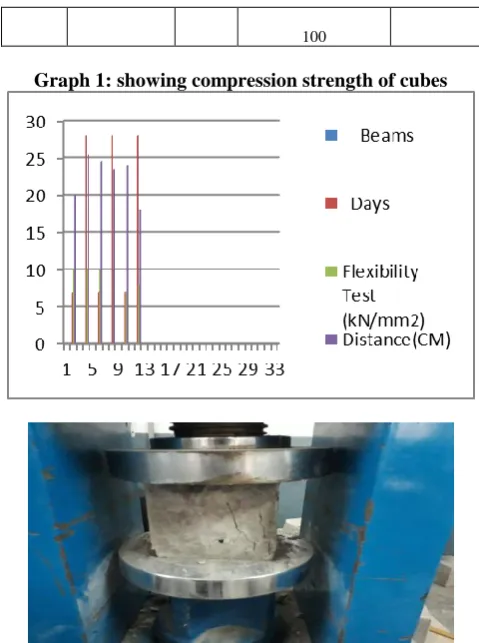
Table 2:compression test values S.No Cubes Days Compression Test
(N/mm2)
Average
1
20% of Crumb Rubber in Replacement
of course aggregates
7
145
156 175
150
28
245
181 140
160
2
25% of Crumb Rubber in Replacement
of course aggregates
7
120
170 185
205
28
245
208 220
160
3
30% of Crumb Rubber in Replacement
of course aggregates
7 50 58.33
70
55
28
160 140
160
100
Graph 1: showing compression strength of cubes
Figure 1:compressive strength test on concrete cubes
By adding 20% of the rubber aggregates in place of coarse aggregate in the concrete compression strength of the concrete his high for 28 days of concrete.
The 30% of rubber aggregate in place of coarse aggregate for 7 days has low compression strength.
[image:3.595.47.292.416.785.2]with Rubber
Table 3: Split Tensile Test valuesS.No Cylinders Days Split Tensile Test (N/mm2)
Average
1
20% of Crumb Rubber
in Replacem
ent of course aggregates
7 65 70
75
28
65 70
75
2
25% of Crumb Rubber
in Replacem
ent of course aggregates
7
67.5 58.75
50
28 55 62.5
70
3
30% of Crumb Rubber
in Replacem
ent of course aggregates
7 25 27.5
30
28 62.5 63.75
65
[image:4.595.306.540.61.635.2]Graph 2: Showing Tensile strength of cylinders
Figure 2: Testing tensile strength on concrete cylinders The split tensile test cylinder of rubber aggregate 30% in concrete for 28 days having high strength.
The split tensile test of cylinder of rubber aggregate 30% in concrete for 7 days having low strength.
C. Flexibility Test
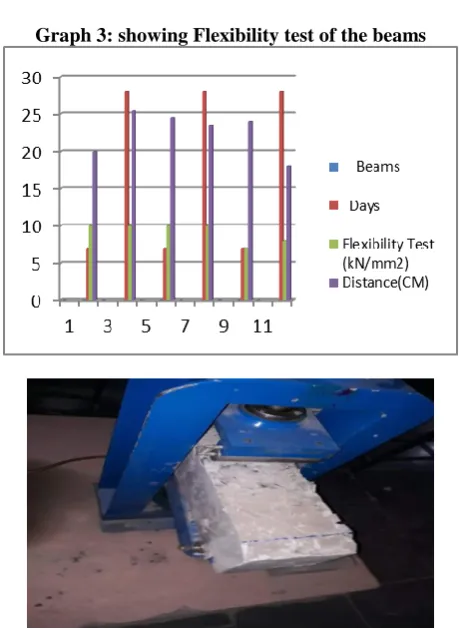
Table 4: Flexibility Test Values
S.No Beams Days Flexibility Test (kN/mm2)
Distance (cm)
1
20% of Crumb Rubber
in Replacement
of course aggregates
7 10 20
28 10 25.4
2
25% of Crumb Rubber
in Replacement
of course aggregates
7 10 24.5
28 10 23.5
3
30% of Crumb Rubber
in Replacement
of course aggregates
7 7 24
28 8 18
Graph 3: showing Flexibility test of the beams
[image:4.595.311.541.339.654.2]International Journal of Innovative Technology and Exploring Engineering (IJITEE) ISSN: 2278-3075,Volume-8 Issue-12, October 2019
V. CONCLUSION
The conclusions are made on the above work of rubber aggregates.
1. The specific pressure and high density of rubber densities we have been observed that lower than natural or by adding more than rough materials. The density of concrete reduces as the use of rubber compression increase .this leads to decrease the weight of the structure. However the tensile strength decrease and the strength of concrete increase by usage rubber tire aggregates. 2. Waste rubber tires can be used in concrete as rubber
aggregate replacing coarse aggregate in concrete by percentages.
3. Rubber can be used in non-bearing components i.e. light weight concrete walls and lightweight structures. Therefore rubber mixes concrete his alternative to low unit mass, medium strength etc.
4. It his adjustable rubber mix concrete can be used in construction such as sidewalls and unsupported walls. 5.From the test results it finds that the rubber has low bound
strength which is related to the strength of concrete.
REFERENCES
1. IS: 10262-2009 & IS:456:2000 For mix design.
2. Jessica Helmin Crump-rubber as a substitute aggregate in concrete published by Milwaukee School of Engineering, 2010. 3. ISO 15825:2004, Rubber compounding ingredients-carbon black-Determation of aggregate size distribution by disc centrifuge photo sedimentary.
4. Comparative study of natural and recycle aggregates book by gagandeep.
5. T. R. Naik and R. Siddique, Properties of Concrete Containing Scrap Tire Rubber, Feb.
6. Eldin, N.N., and Senouci, A.B. “Rubber-tire Particles as Concrete Aggregate.
7. Materials in Civil Engineering, ASCE, 5(4), 1993, 478–496. ] 8. Lee, B.I.., Burnett, L., Miller, T., Postage, B. and Cuneo, J.,
1993, “Tyre rubber/cement matrix composites”, Journal of Materials Science Letters, 12, pp. 967-968.
9. Estimate Engineering properties of concrete by the partial replacement of natural river sand by robo sand IJCIT 2018 vol 9 issue page 737-743 by N.Venkat Rao.
10.Rubberized Concrete design, testing, properties, modeling book by Siringi Gideon Publisher: LAP Lambert Academic Publishing.
11.Rubber Recycle by Sadhan K. De, Avraam Isayev, Klementina
Khait.
12.Rubber aggregate in concrete Jorge de Brito department of civil engineering architecture and georesources and nabajyoti saikia Faculty and science and technology Kaziranga University jorhat, Assam India.
AUTHORS PROFILE
D.Ajay Kumar, is M.Tech student in department of Civil Engineering in Institute of Aeronautical Engineering, Dundigal Hyderabad, Telangana.
N.Venkat Rao, working Associate professor in the department of Civil Engineering (Autonomous), Dundigal, Hyderabad. He obtained Masters from jntu, Hyderabad. He
published more 30 papers in both International and national journals and conference, His area of research is material, concrete, special concrete.