• No results found

The Influence of Deep Cryogenic Treatment (DCT) on the Mechanical Behaviour of Aluminium Metal Matrix Composites

N/A
N/A
Protected

Academic year: 2020

Share "The Influence of Deep Cryogenic Treatment (DCT) on the Mechanical Behaviour of Aluminium Metal Matrix Composites"

Copied!
7
0
0

Loading.... (view fulltext now)

Full text

(1)

The Influence of Deep Cryogenic Treatment (DCT)

on the Mechanical Behaviour of Aluminium Metal

Matrix Composites

D.PrasannaVenkatesh, P.Shanmughasundaram

Abstract: The outcome of cryogenic treatment (CTT) on the mechanical behaviour of Al alloy LM 25, LM25+5% fly ash and LM25+10%fly ash composites was investigated. Cryogenic treatments were performed with threedifferent soaking periods (0 hr (Untreated), 12hr, 24hr) ata constant cryogenic temperature of -196°C. After the CTT, the mechanical behaviour of the materials was measured. It is obvious that LM25+10% fly ash composites exhibitbetter mechanical properties than the LM25 and LM25+10% fly ash composites.As cryogenic soaking period increases mechanical properties of the MMCs tend to increase too. The effect of fly ash mass percentage and cryogenic soaking period on the mechanical behaviour of materials was studied by using Taguchi and Analysis of Variance (ANOVA).

Keywords: cryogenic treatment, fly ash reinforced LM 25 composites, cryogenic soaking period, mechanical behaviour, Taguchi, ANOVA.

I.INTRODUCTION

M

aterial researchers arefulfilling the need of the engineering industries in synthesizing materials in order to accomplish the desired properties to enhance efficiency and reduce the cost [1].The usage of aluminum alloys has been gradually increasing in the automotive industry to decrease the weight of vehicles, whichenhances the efficiency and reduces the exhaust pollutants. The shortcomings of Al alloys are lower yield strength and higher wear rate. Deep Cryogenic Treatments (DCTs) can be employed to enhance the mechanical as well as tribological properties of the Al alloys.

One of the benefits of deep CTT is that the micro structural changes take place in the whole bulk material instead of merely onthe surface. Deepcryogenic-treated materials can be employed in the manufacture of structural components.Volker Franco Steieret al. [2] examined the impact of CTT on the wear of the Al alloy 6061.The results demonstrated theCTT-enhanced wear resistance of the aluminum alloy. Gu et al. [3] analyzed the influence of CTT on hardness and wear behaviour of Ti-Alalloy for biomedical applications. The hardness of the treated material increased due to the increase of dislocation density and twins.

Revised Manuscript Received on July 22, 2019. * Correspondence Author

D. PrasannaVenkatesh, Research Scholar, Department of Mechanical Engineering, Karpagam Academy of Higher Education, Coimbatore - 641021, India. Email: [email protected]

Dr. P.Shanmughasundaram, (Corresponding Author), Department of Automobile Engineering, Karpagam University, Coimbatore (Tamil Nadu), India. E-mail: [email protected]

Bouzadaet al. [4] examined the effect of DCT on the properties of the AA7075-T6 metal alloy. Various authors have made research and found an increase in the mechanical properties after DCT. Susheel Kalia [5] reviewed It was found composites. Lulayet al. [6] examined the effect of CTTs on 7075 aluminum alloy. It was reported that no considerable

the effect of CTT on some metals, alloys, plastics and effect was noted on the mechanical properties on account of a 2-hr CTT. A little improvement in tensile strength and a slight drop in hardness wereobserved on account of 48 hr of CTT. Singla et al. [7] assessed the cryogenic processing of the materials and manufacturing.

Jiang et al. [8] examined the influence of CTT on the mechanical properties of Al alloy 3102. DCTcouldenhance the yield strength along withdeclinein the elongation of the Al-alloy. Wang et al. [9] studied the impact of CTT on the mechanical behaviour of Al alloy 2A11. Results showed that cryogenic treatment could improve the mechanical properties of aluminum alloy. Taskesenet al. [10] analyzed the effect of CTT on the ageing behaviour of Al 7075-B4C

composites. The hardness of the cryogenically-treated specimens increases considerably.Kumar et al. [11] analyzed the impact of DCT on the wear rate of AISI D3 Die Steel using statistical tools.

Rasool et al. [12] examined the DCT of Al-SiC Composite. They reported that the treated specimens haddemonstrated an enhanced compressive strength. Lulayet al. [13] evaluatedthe outcome of CTT on Al 7075. Zhang et al. [14] analyzed the tensile strength of 3104 aluminum alloy processed by homogenization and CTT. Slatter and Thornton [15] studied the cryogenic treatment of engineering materials. They reported that the term ‘cryogenic’ relatedto very low temperatures and hada broad range of applications in medical, electrical and electronic fields. Thornton et al. [16] studied the impact of CTT on the wear behaviour of the materials.Soaking temperature anddurationwere the important factors which decided the quality of the cryotreated materials. The total cost of cryogenic cycle dependedon the soaking time[17].

A very limitedquantum of work has been reported about the cryogenic treatment of Al alloys and metal matrix composites. From the literature review, it is observed that there is no apparent understanding regarding the contribution of cryogenic soaking period on the mechanical behaviour of the materials.Various research findings show that a systematicprocedure has to be carried out in cryogenic treatment. In this study, the effect of CTT on the mechanical behaviour of LM25 aluminum

alloy,LM25+5% fly ash and

(2)

compositeshas beenstudied by using Taguchi and Analysis of Variance (ANOVA).

II.MATERIALS AND METHODOLOGY A.Materials

Commercial LM25 aluminum alloy, LM25+5% fly ash and LM25+10% fly ash compositeswerechosen for this study.LM25 casting alloy was mainly used where the high strength and resistance to corrosion are important considerations.Thechemicalcompositionof the untreated as- cast LM25 sample is representedinTable1.

Table- 1: Chemical Composition of LM25 Aluminium Alloy

Element Actualvalue

(%)

Element Actual

value (%)

Silicon 6.5 Zinc 0.06

Iron 0.4 Titanium 0.012

Copper 0.1 Tin 0.01

Manganese 0.2 Lead 0.1

Magnesium 0.05 Aluminium Remainder

Nickel 0.09

B.Fabrication of composites

Al alloy LM25 was selected as the matrix and fly ash

particles (100 microns) were used as the

reinforcement.LM25+5% fly ash and LM25+10% fly ash MMCs were manufactured through combined stir and squeeze casting techniqueas shown in figure 1.

Composites were fabricated through squeeze casting process, which has the advantages of both stir casting and gravity die casting.Squeeze casting process eliminatedthe shrinkage and gas porosities. High dimensional accuracy, near net shaped,couldbe obtained. Composite melt was prepared by stirring and poured into the mould which was maintained at a temperature of 350°C. Pressure (50 MPa) was applied by preheated diefor 60 seconds till solidification was finished.

Fig. 1. Schematic of Squeeze casting setup

C.Cryogenic treatment

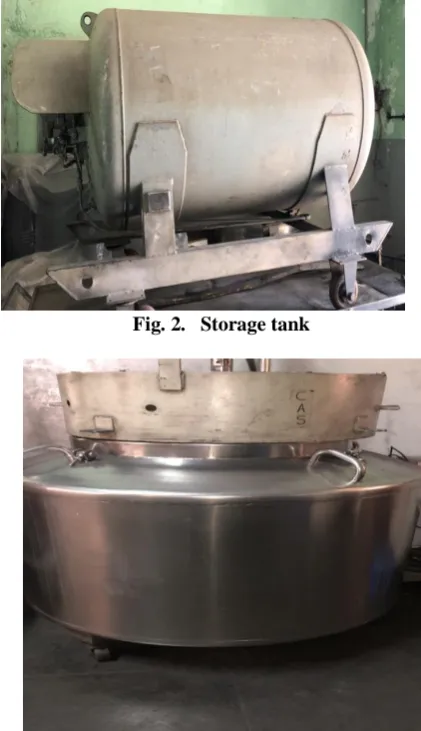
Test specimens of LM25 aluminum alloy, LM25+5% fly ash and LM25+10% fly ash compositeswere subjected to deep cryogenic treatment. It was done by keeping the specimens in a liquid N2 chamber as shown in figure 2 for

two different lengths of time: untreated (0 h), 12hr and 24hr.

[image:2.595.316.527.124.490.2]

Cryogenic treatment was performed to assess the soaking effects on the mechanical behaviour of the materials. No post-processing was done after the cryogenic treatment. Figure 2 shows the cryogenic liquid storage tank and Figure 3 the processing chamber where the work piece is soaked in liquid nitrogen at -196 °C.

[image:2.595.58.280.530.678.2]

Fig. 2. Storage tank

Fig. 3.Processing chamber

D.Micro structural Examination

(3)
[image:3.595.53.289.48.342.2]

Fig. 4. Microstructure of the LM 25 alloy before deep cryogenic treatment

Fig. 5. Microstructure of the LM 25 alloy after deep cryogenic treatment

E. Mechanical Properties

[image:3.595.307.543.154.292.2]

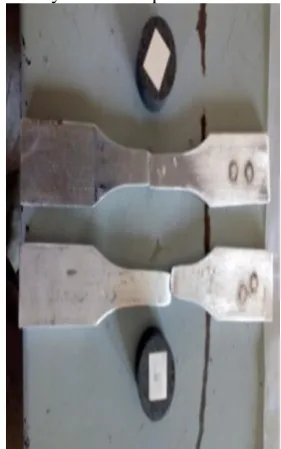
Mechanicaltestingwasdone in line with ASTME8-82 at a room temperatureemploying universal testing machine. Tensile, yield, hardness, and elongation of cryogenic treated LM 25 and LM 25 fly ash MMCs are given in Figures. 7, 8, 9 and 10respectively.A few samples are shown in fig. 6.

Fig. 6. Tested specimens after deep cryogenic treatment 1. Hardness

Fig. 7illustrates the effect of fly ash weight percentage and cryogenic soaking period on the hardness of LM25 fly ash composite. The increase in hardness was found to be 7.84% when the fly ash weight percentage was increased from 5 to 10wt% at the cryogenic soaking period of 24 hrs. The enhanced hardness was due to the addition of fly ash particles, which acted as hurdle to the travel of dislocation

with the Al matrix. The hardness also increasedwith the increase in cryogenic soaking period toa significant extent. When the cryogenic soaking period was increased from 0 hrs (untreated) to 24 hrs,the hardness of the LM 25+10% fly ash composite increased by 14.5 % i.e., from96 BHN to 110 BHN. It can be attributed to the fact that cryogenic thermal treatment results in fine and well-distributed precipitates[18].

Fig. 7. Effect of cryogenic soaking period on the hardness of LM 25 and MMCs

[image:3.595.308.549.345.479.2]

2. Tensile strength

Fig. 8. Effect of cryogenic soaking period on the tensile strength of LM 25 and MMCs

From Fig. 8, it is evident that the LM 25 +10% fly ash composite exhibits higher tensile strength than the base alloy and LM 25 + 5% fly ash composite irrespective of cryogenic soaking period. Theimprovement in the tensile strength is highly influenced by the incorporation of reinforcement particles and formation of magnesium oxide and magnesium silicide at the interface between the phases of matrix and reinforcement [19-20].

[image:3.595.99.240.439.664.2]
(4)

3. Yield strength

Fig. 9. Effect of cryogenic soaking period on the yield strength of LM 25 and MMCs

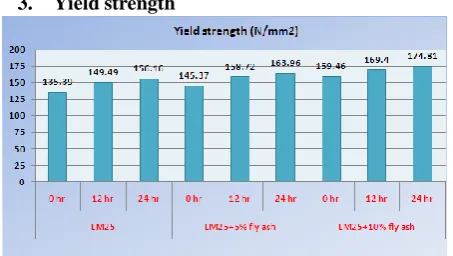
Fig.9illustrates the yield strength of LM25 and LM 25- fly ash composites with two different and varying compositions of fly ash and cryogenic treatment soaking periods.It may be inferred from the figure that, when the fly ash weight %is increased from 5 wt% to 10 wt%, the yield

strength increasesfrom 163.96 N/mm2 to

174.81N/mm2withthe soaking period ofabout 24 hrs.

If the cryogenic soaking period is increased from 12 hrs to 24 hrs,the yield strength of the LM 25+10% fly ash composite increasesfrom 163.96 to 174.81N/mm2an increase

of6.62%.

4. Elongation

[image:4.595.56.283.67.195.2]

Fig.10 shows the elongation of LM25 and LM 25- fly ash composites with two different and varying compositions of fly ash and cryogenic treatment soaking periods. It can be noted that when the fly ash weight % is increased from 5 wt% to 10 wt%, elongation tends to decrease from 2.65 to 2.60 % with thesoaking duration of about 24 hrs.

Fig. 10. Effect of cryogenic soaking period on the elongation of LM 25 and MMCs

On the otherhand, the elongation of the LM25 and LM 25- fly ash composites tends to drop when the specimens are subjected to cryogenic treatment. The elongation of LM 25- 10% fly ash composite is the lowest (δ=2.60%) when the soaking period is about 24 hrs compared to untreated specimens. However,its tensile and yield strengths are significantly higher than those of the untreated specimens. The increase in thetensile and yield strengths of the LM 25- 10% fly ash compositespecimens donot enhance at the expense of drop in the elongation as it decreases by2.25%.

III. STATISTICAL ANALYSIS

A. Taguchi Method

Taguchi’s technique is a capable method forfinding the optimum level of process factors that have an effect on the performance of the process. Mathematical relation of the S/N ratio for “Larger is better” is given in the equation (i).

𝑆

𝑁= −10 log (

1

𝑛∑

1

𝑦𝑖2

𝑖 ) Eq. 1

Where, y is the measured data and n is the number of tests.

Table- 2: Parameters and levels

Level A- Material

B- Cryogenic Soaking time (hrs)

I LM25 2

II LM25+10% fly ash

12

III LM25+10% fly ash

[image:4.595.311.548.311.536.2]

24

Table- 3: Response table for Signal to Noise Ratios – Larger is better (Hardness)

Level A- Material

B-Cryogenic Soakingperiod (hrs)

1 39.09 38.87

2 39.57 39.82

3 40.27 40.25

Delta 1.18 1.38

Rank 2 1

Table- 4: Response table for Signal to Noise Ratios – Larger is better (Tensile strength)

Level A- Material

B-Cryogenic Soaking period

(hrs)

1 44.86 45.1

2 45.59 45.69

3 46.29 45.95

Delta 1.43 0.86

Rank 1 2

Table- 5: Response table for Signal to Noise Ratios – Larger is better (Yield strength)

Level A- Material

B- Cryogenic Soaking period (hrs)

1 43.33 43.31

2 43.85 44.03

3 44.49 44.34

Delta 1.16 1.03

[image:4.595.54.286.454.608.2]
(5)
[image:5.595.132.545.67.440.2]

Table- 6: Measured values and S/N ratios for mechanical properties

Exp.No

A- Material

B- Cryogenic Soaking period (hrs)

Measured Values Signal to Noise ratio

Hardness TS

YS

(N/mm2) Hardness TS YS

(N/mm2)

1 1 0 81 167.59 135.39 38.1697 44.48496 42.6317

2 1 12 93 175.26 149.49 39.3697 44.87366 43.4922

3 1 24 97 182.36 156.16 39.7354 45.21859 43.8714

4 2 0 87 182.25 145.37 38.7904 45.21335 43.2495

5 2 12 97 191.87 158.72 39.7354 45.66014 44.0126

6 2 24 102 197.3 163.96 40.172 45.90254 44.2948

7 3 0 96 190.31 159.46 39.6454 45.58923 44.053

8 3 12 104 212.51 169.4 40.3407 46.54759 44.5783

9 3 24 110 217.09 174.81 40.8279 46.7328 44.8513

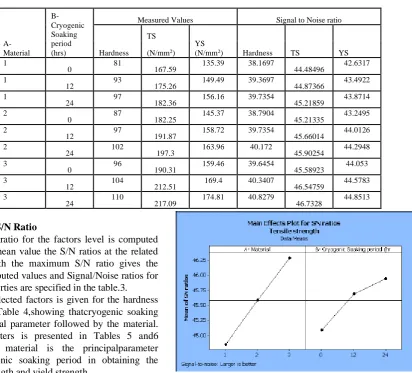
1. Results of S/N Ratio

The Signal/Noise ratio for the factors level is computed by considering the mean value the S/N ratios at the related level. Parameter with the maximum S/N ratio gives the desired quality.Computed values and Signal/Noise ratios for the mechanical properties are specified in the table.3.

The ranking of selected factors is given for the hardness of the materials in Table 4,showing thatcryogenic soaking period is the principal parameter followed by the material. Ranking of parameters is presented in Tables 5 and6 revealing that the material is the principalparameter followed by cryogenic soaking period in obtaining the enhancedtensile strength and yield strength.

Fig. 11. Response diagram of S/N ratios for hardness

[image:5.595.50.292.449.643.2]

Figure 11 shows that optimum levels of the parameters in attaining the maximum hardness areLM25+10% fly ash MMC (material) and cryogenic soaking period (24hrs). A similar tendencyis seen for the tensile strength (figure 12) and yield strength (figure 13) of the materials.

Fig. 12. Response diagram of S/N ratios for Tensile strength

Fig. 13. Response diagram of S/N ratios for Yield strength

[image:5.595.309.546.469.646.2]
(6)

Table- 7: ANOVA analysis for Hardness

Parameter DoF SS F-Value P value Pc

A- Material 2 258 129 0 42.15

B-Cryogenic

soaking period

(hrs) 2 350 175 0 57.19

Error 4 4 1 0.65

Total 8 612 100

2. Results of ANOVA

Table- 8: ANOVA analysis for Tensile strength

A- Material 2 1494.97 40.47 0.002 70.16

B- Cryogenic soaking period (hrs) 2 561.75 15.21 0.014 26.36

Error 2 73.88 3.46

Total 8 2130.61

Table- 9: ANOVA analysis for Yield strength

A- Material 2 657.87 152.24 0.000 55.38

B- Cryogenic soaking period (hrs) 2 521.24 120.62 0.000 43.88

Error 2 8.64 0.72

Total 8 1187.76 100.00

Analysis of variance was carried out for determining the percentage contribution of the parameters using the software package MINITAB. The analysis is presented for hardness, tensile strength and yield strength in tables 7, 8, and 9 respectively. The value of P (probability value) is given for each parameter. If the P-value is below 0.05, the factoris statistically important.

P values for materials and cryogenic soaking period are below 0.05, which are significant factors. In Anova table, the contribution of each parameter on the mechanical properties of the specimens is given in terms of percentage. Anova table 7 shows that the cryogenic soaking period (57.19%) is the major contributing parameter followed by the material (42.15%) influencing the hardness of the specimens. It isconcluded from Anova table 7 that material (70.16%) is the major contributing parameter followed by cryogenic soaking period (26.36%) forinfluencing the tensile strength of the specimens.A similar tendencyis observed for the yield strength.

IV.CONCLUSION

The outcome of cryogenic treatment on the properties of the materials was analyzed and the following outcomes were obtained.The results indicate that deep CTT specimens led to an improved hardness and tensile strength. The increase in the hardness of the LM 25- 10% fly ash composite was found to be approximately 14.5% after the cryogenic treatment.The materials processed by the cryogenic treatment exhibited consistent tensile strength. In other words, both the tensile and the yield strength of the LM 25- 10% fly ash composite improved withcryogenic treatment without the sacrifice of elongation. Material (70.16%) was the major contributing parameter followed by cryogenic soaking period (26.36%) for influencing the tensile strength of the specimens. A similar trend was observed for the yield strength. Hence, it can be concluded that cryogenic soaking

period has to be optimized to attain the desired mechanical properties.

REFERENCES

1. R. Rajesh, “Effect of Chemical Treatment on the Mechanical

Properties of Palm Fiber Reinforced Polymer composites”, Research

Journal of Science and Engineering Systems, vol.1, 2017, pp.8-18.

2. Volker Franco Steier, Edgar SobralAshiuchi, Lutz Reißig, and José

Alexander Araújo, “Effect of a Deep Cryogenic Treatment on Wear and Microstructure of a 6101 Aluminum Alloy,” Advances in Materials Science and Engineering, vol. 2016.

3. K. Gu, J. Wang, and Y. Zhou, “Effect of cryogenic treatment on wear

resistance of Ti-6Al-4V alloy for biomedical applications,” Journal of the Mechanical Behavior of Biomedical Materials, vol. 30, 2014, pp. 131–139.

4. F.Bouzada, M. Cabeza, P. Merino, and S.Trillo, “Effect of Deep

Cryogenic Treatment on the Microstructure of an Aerospace

Aluminum Alloy,” Advanced MaterialsResearch, vol.445, 2012,

pp.965– 970.doi:10.4028/www.scientific.net/amr.445.9, (2012).

5. Susheel Kalia, “Cryogenic Processing: A Study of Materials at Low

Temperatures,”Journal of Low Temperature Physics,

vol.158, 2010, pp 934–945.

6. K. E. Lulay, Khan, Khalid; and D.Cyaaya, "The Effect of Cryogenic

Treatments on 7075 Aluminum Alloy,"Engineering Faculty

Publications and Presentations, 2002.

http://pilotscholars.up.edu/egr_facpubs/2

7. A.K.Singla, J.Singh and V. S. Sharma, “Processing of materials at

cryogenic temperature and its implications in manufacturing: A

review”, Materials and Manufacturing Processes,2018,pp.1–

38.doi:10.1080/10426914.2018.1424908, (2018).

8. X.Q.Jiang, N. Li, H.He, X. J.Zhang, C.C.Li, and H.Yang, “ Effect of

Cryogenic Treatment on Mechanical Properties and Microstructures

of 3102 Al-Alloy,”

MaterialsScienceForum,vol.546- 549,2007,pp.845–848.doi:10.4028/www.scientific.net/msf.546-549.845.

9. J. J. Wang, X. D Xue, Z. Q. Yang, H. Zhang, , and Y.Zhou, “ Effect

of Cryogenic Treatments on Mechanical Properties of 2A11

Aluminum

Alloy,”AdvancedMaterialsResearch,vol.146- 147,2010,pp.1646–1650.doi:10.4028/www.scientific.net/amr.146-147.1646.

10. A. Taskesen , S. Aksoz , A. T. Ozdemir , “The effect of cryogenic treatment on ageing behaviour of B4C reinforced 7075 aluminium

composites,” Kovove Mater, vol. 55 ,2017,pp. 57–67 DOI:

(7)

11. S.Kumar, M. Nagaraj, N.K. Khedkar and A.Bongale, “Influence of deep cryogenic treatment on dry sliding wear behaviour of AISI D3 die steel,”Materials Research Express,vol.5,2018, doi:10.1088/2053-1591/aadeba.

12. M. S.Rasool, M. S. M. Aripin, S.Thamizhmanii, S. B.Hasan and

D.Sathiaraj, “Deep Cryogenic Treatment on Aluminum Silicon Carbide (Al-SiC) Composite,”AdvancedMaterialsResearch,vol.383- 390,2011,pp.3320–3324.doi:10.4028/www.scientific.net/amr.383-390.3320, (2011).

13. K. E. Lulay ,K. Khan,D. Chaaya , “The effect of cryogenic treatments

on 7075 aluminum alloy,” Journal of Materials Engineering and

Performance, Vol. 11(5) , 2002, pp 479–480.

14. W.Zhang, P. Bai, J.Yang, H. Xu, J.Dang and Z.Du, “Tensile behavior

of 3104 aluminum alloy processed by homogenization and cryogenic treatment,”Transactions of Nonferrous Metals Society of China, vol.24(8),2014,pp.2453–2458.doi:10.1016/s1003-6326(14)63370-7.

15. T.Slatter and R.Thornton, “Cryogenic Treatment of Engineering

Materials,” Comprehensive Materials Finishing, vol.2, 2017, pp.421– 454. doi:10.1016/b978-0-12-803581-8.09165-7.

16. R.Thornton., T.Slatter and H.Ghadbeigi, “Effects of deep cryogenic

treatment on the dry sliding wear performance of ferrous

alloys,”Wear, vol.305 (1-2), 2013, pp.177–

191.doi:10.1016/j.wear.2013.06.005.

17. Anil Kumar Singla, Jagtar Singh and Vishal S. Sharma, “Processing

of materials at cryogenic temperature and its implications in manufacturing: A review,”Materials and Manufacturing Processes, 2018, pp.1-38,. DOI: 10.1080/10426914.2018.1424908.

18. M.Araghchi, H. Mansouri, and R.Vafaei, “Influence of cryogenic

thermal treatment on mechanical properties of an Al–Cu–Mg alloy,”Materials Science and Technology, Vol.34 (4), 2017,pp.468– 472.doi:10.1080/02670836.2017.1407553.

19. Shanmughasundaram, Palanisamy, “Investigation on the Wear

Behaviour of Eutectic Al-Si Alloy- Al2O3 - Graphite Composites

Fabricated through Squeeze Casting,” Materials Research, Vol.17 (4), 2014, pp.940-946.

AUTHORSPROFILE

PrasannaVenkatesh, PhD Research Scholar, Department of Mechanical Engineering, Karpagam Academy of Higher Education, Coimbatore - 641021, India.

Dr. P.Shanmughasundaram born in Kalangal, Coimbatore, Tamilnadu, India, received his A.M.I.E (India) degree in Mechanical Engineering and A.M.I.E (India) degree in Production Engineering from Institution of Engineers (India). He received Master’s Degree M.E (Refrigeration and Air conditioning) from Coimbatore Institute of Technology, India. He obtained Doctoral degree in the Mechanical Engineering from PSG College of Technology, Anna University, Chennai. He has an experience of about 20 years in teaching various subjects of Mechanical and Automobile Engineering. He has produced 5 PhDs and he is guiding 8 PhD scholars. To his credit, he has 60 International peer reviewed Scopus and SCI Journal publications. He has authored a book chapter in Elsevier publication. He is the reviewer of more than 25 Scopus and SCI International Journals. His areas of interest are Metal Matrix Composites, Tribology and Optimization techniques. He has organized 1 International Conference, 6 National conferences and 15 National level workshops. He is a member of Society of Automotive Engineers (SAE), Fellow of Institution of Engineers (India), life member of Indian Society for Technical Education and Tribology Society of India.

Figure

Fig. 2.   Storage tank
Fig. 6. Tested specimens after deep cryogenic treatment  1. Hardness
Table- 2: Parameters and levels B- Cryogenic
Fig. 13. Response diagram of S/N ratios for Yield strength

References

Related documents

Compounds such as atranorin, zeorin, salazinic acid and norstictic acid are common in many species of Heterodermia.. The presence of these secondary metabolites might be

This is based on the Novel Partial product Generation method using Higher radix-256 Booth encoding (NPGHB) which reduces the number of partial product rows by 8-fold.. Hence

in a Case Previously Reported as "Nutritional Anemia in an Infant Responding to PERNICIOUS ANEMIA IN AN EIGHT YEAR OLD GIRL: Additional

Efficient method for rapid multiplication of clean and healthy willow clones via in vitro propagation with broad genotype

After Day, in the lighting of Moon Night wakens under a prayer to call hush to Day, time to commune. with Night, windswept under

However, including soy- beans twice within a 4-yr rotation decreased cotton seed yield by 16% compared to continuous cotton across the entire study period ( p < 0.05); whereas,

National Conference on Technical Vocational Education, Training and Skills Development: A Roadmap for Empowerment (Dec. 2008): Ministry of Human Resource Development, Department

Product Name Technical Licences Technical Licenses Required/ Optional GIS 8.0 Required GIS_INTERACTIONSERVICE 8.0 Required ics_custom_media_channel 8.0