Abstract: E-learning mode of education is rapidly progressing due to the advancements in education delivery through internet and web innovation. Learning can be beneficial and enhanced by considering the qualities of learner such as knowledge level, cognitive ability, psychological style and learning style facilitating illustrations. Diverse learners have distinctive intellectual and learning abilities. Learning style, which refers to the learners favored approach to learning, is a standout as vital amongst the other parameters for deciding the individual difference of learner. The present work deal with the critical assessment of the I2A2 learning styles model through the I2A2 questionnaire. 147 learners showed up for this assessment and an experimental study was conducted in e-learning environment and the findings were categories using parameter such as reason, method, learner type, age-group, learner level, subject field/area, and learning style preferences through the modality of I2A2 learning style model.
Index Terms: learning style, e-learning, cognitive style, learner characteristics, adaptivity.
I. INTRODUCTION
Throughout the years, several studies have demonstrated escalated advance in providing education through e-learning mode. This is due to quick progression in the computer technology and web development. Numerous e-learning frameworks have been created to provide learning in light of learner preferences and individual traits. E-learning mode of education not just offers customized learning environments; but also can be utilized for tutoring heterogeneous gathering of learners [1]. Different learners have different knowledge and have their own distinct knowledge level, learning objectives perceptions about the subject area, learning styles, and characteristics [2]-[3].
To oblige learner, most educational institutions offer e-learning framework that empowers the learner to download learning material and take part in interactive sessions, for example, live courses and discussions. Most e-learning frameworks provide comparable e-learning tools to course planners, for example, wiki, glossary devices and learner profile highlights. The learning material conveyed by the e-learning framework to the learner assumes that each learner learns in same manner utilizing common learning material and advance towards achieving lesson objectives along with their associates. E-learning frameworks are constrained in terms of providing personalization to their learners and consider a "fits for all types" mindset. The fundamental issue
Revised Manuscript Received on December 22, 2018.
is that learners have the distinct background, knowledge level, learning skills, motivation and subsequently, every learner has diverse necessities and way of learning. Numerous learners encounter disappointment with such type of frameworks and get exhausted as they progress through their learning cycle since the material is static, and not sensitive to the need of the learner [4]. A conceivable cure is the Adaptive Educational System (AES), which negates the learning management system approach of "fits for all types".
There has been a clear enhancement in learner’s accomplishment levels where learners are instructed in view of their analyzed learning styles in face-to-face teaching. Learning style is best portrayed as the appropriate way in which learners most productively and successfully see, process, store and review what they are endeavoring to learn. Learning style models have been explored and utilized by educationalists for a long time. There is a wide range of learning style models exists in the literature [5], [6], and [7]. Because of the success of different learning style models in recognizing how a learner learns, educationalists have attempted to consolidate these models into adaptive hypermedia frameworks. Kolb and Felder-Silverman have been utilized their learning model successfully in engineering education, while Honey & Mumford learning style model has been utilized as a part of business and administration training [8]. To further improve its adequacy, and perspectives, learner modeling is likewise considered. For instance, the student’s individual profiles, for example, sex, age group, knowledge level and progress made during learning are consolidated into adaptive educational systems.
In this paper, section 2 introduces some related work based on learning style models. Section 3 describes the I2A2 learning style model with learning style dimensions and recommended pedagogy style corresponding to each dimension. Section 4 describes the methodology or framework to identify the learning style of learner. Section 5 outlines the results and discussions, and section 6 presents the conclusion and future recommendation of the work.
II. RELATED WORK
A. Learning Style
Learning style is characterized as the attributes, qualities, and preference in the way individuals get and process the data [9].
Assessment of Learning Style of Learner using
I
2
A
2
Learning Style Model
Published By:
Blue Eyes Intelligence Engineering It recommends that each individual has a distinct particular
style or set of strategies employed while learning. Many explorers have since quite a while ago attempted to relate personality traits of learners' to educating and learning the style. It can likewise be characterized as the way a learner collects, processes and comprehends the data. In this way, the learning style gives instructors an overview of the need and preferences of the individual learner.
There exist several learning styles models in the literature, each proposing diverse depictions and characterizations of learning types. Individuals have different learning styles and these individual differences turn out to be much more important to provide personalized learning. Honey and Mumford [18] characterized a learning style as being 'a depiction of the states of mind and conduct which decide a given learner’s favored approach to learning'. A few reviews reports that learners learn in varied ways, based on personal learning attributes and everybody has a distinct learning style [19], [20]. These investigate demonstrate likewise that matching learners learning styles with the learning material is an important component that affects as to learning result. Various examinations demonstrate that the learner’s performance will be improved if the teaching material is aligned to the learning style of learner.
There are several reviews that demonstrate the utilization of an adaptive education hypermedia in view of learning style in instructing or learning particularly for higher level education [10], [11]. According to [15], directed an experimental test for a gathering of 68 college students who were selected in the Principle of Management subject [12]. They utilized Kolb style of learning to quantify learning style preferences of learners. The learners' navigational conduct was always observed and logged. Learning styles of learner are considered as one of the variables impacting learner accomplishment. Learning styles is one of the subjects of studies by analysts and instructive researchers [13] since the 1940s.
Cofield et al. [14] distinguished over 70 models of learning styles. Moreover, a ton of research has been conducted in the most recent 30 years in various models of learning styles. For instance, as expressed by Cofield et al. [14], around 2000 articles have been composed identified with the MBTI model and above 1000 research article have been composed about the Kolb model. Hence, when a teacher's tutoring style facilitates learning style of a learner’s; this influences the learner’s understanding and enhances the learning capacity of the learner. Until today, a lot of research works has been reported about the learners learning styles and developed a decent arrangement of learning style models however there does not appear to be any understanding of acknowledgment of anyone hypothesis [21]. There have been several models for characterizing and measuring learning styles, proposed, for example, Kolb's survey [22], Honey and Mumford's poll [20], Keefe's survey [23], The MBTI poll [24], Felder and Solman [25], [26] proposed a psychometric poll ILS questionnaire.
III. I2A2LEARNING STYLE MODEL
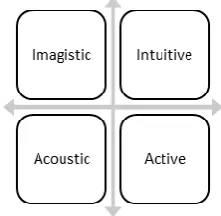
[image:2.595.370.481.317.425.2]I2A2 learning style model is an acronym of its four foremost learning style measurements, for example, Imagistic, Intuitive, Acoustic, and Active. Learners learn in multidimensional ways and individuals have different learning choices and characteristics as for taking in and process the information. In this sense, every learner has specific learning styles. Some like to learn in the speculative or in a hypothetical course like-through model, unique pictures, or thoughts while others slant toward a test or practical methodology with a couple of realities. Some understudy needs to take information ostensibly or imagistic - using diagrams, figure, chart, or pictures while others are comforted with checking out the addresses, watching accounts, and verbal delineation by someone. A couple of learners get a kick out of the opportunity to do the things first and after that inspected the result later. Such sorts of learners adequately take an enthusiasm to defy challenges and dynamic in nature. Therefore, there is the average assortment in the learning style of understudies. As to that, we proposed a novel learning style show.
Fig. 1- I2A2 Learning Style Dimensions (LSD)
I2A2 learning style model gives scores on each of these four learning style dimensions. Learners learning style preferences range from 1 to each of the 4 dimensions. In I2A2 learning style model, every learner has asked eighteen questions and he or she needs to pick at least one or more of the response that facilitates his or her relation to predefined learning style preferences. I2A2 four learning style dimensions are shown in Figure 1.
Imagistic Learner: Imagistic student reviews data best what they have seen: diagrams, plots, stream charts, courses of occasions, films, and shows. In case, something is basically said to them they will probably disregard it. Imagistic students need to imagine instructor's non-verbal correspondence and relate with outward appearance to thoroughly get a handle on the learning material. They are alright with classroom instructing, think in pictures, and may profit best from visual presentations including traces, outlined perusing materials, graphs, use of keen whiteboards, and composed notes.
A student who inclines towards such system loves to work with control point slide, web, records, vocabularies, and words. A basic distinction with a natural student is, they are more joyful with concentrate composed notes and material. Since words influencing an elucidation of them into what they to address effectively becomes alright for instinctive students.
Acoustic Learner: These students learn best through verbal address, trade of contemplations, conversing with individuals, and checking out what others have to state. Sound-related students interpret the basic implications of talk through checking out the voice tone, pitch, precision, and speed. These students as often as a possible preferred standpoint from perusing the content and notes checking out recorded notes, and information from compositions. Acoustics student gets the data through the gathering discourses, listening to a few stories from another individual, and communication with individuals or clarifying the things.
Active Learner: The psychological procedures by which information is seen and changed after some time into adapting, such kinds of students are an Active student. Dynamic student incorporates achieving something in the external world with the information—discussing it, illuminating it, or testing it some way or another. A "Functioning understudy" is someone who feels more noteworthy with, or is better at dynamic experimentation. Dynamic students learn best through hands-on exercise or activity based figuring out how to sit still for significant lots.
IV. METHODOLOGY
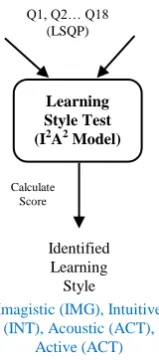
A prototype model of e-learning system has been developed, with an aim to customize it, as per the learning style of the individual learner. This is with a goal to develop an adaptive intelligent tutoring system that detects the learning style of learner and presents the learning material sequenced, accordingly. I2A2 learning style identifying model has been implemented in SeisTutor- Am adaptive intelligent tutoring system for Seismic data interpretation. Figure 2 presents the flow of I2A2 learning style question pool. I2A2 learning style model employs an 18-item questionnaire, which is administrated to the learner, and as per the responses of the learner, he/she is assigned different Learning Styles Dimensions (LSD) such as IMG-Imagistic, INT-Intuitive, ACO-Acoustics, and ACT-Active.
The I2A2 Learning Style Question Pool (LSQP) is an eighteen-inquiry pool intended to survey the inclinations of the four learning style measurements (Imagistic, Intuitive, Acoustic, and Active) of the I2A2 learning style model. When somebody attempts the I2A2 LSQP, a profile is made promptly with scores of every one of the four LSD, quickly clarifying of implications. The I2A2 LSQP is accessible for people for recognizing their learning style inclinations, instructors or understudies, who wish to use in the classroom educating or for examine reason. Each LSD is related to 18 questions, and every choice (a, b, c, or d) is comparing to one or other LSD. Every choice has a place with any of the learning style measurements and as needs be a score for the same is doled out. I2A2 LSQP is presented in Appendix I at the end of this paper.
V. RESULTS
[image:3.595.306.538.388.502.2]The results of the assessment of learner are presented in this section, where the I2A2 learning style model has been used to identify and recommend the learning style of learner. The I2A2 LSQP has been implemented over 147 prospective learners of different competency level and backgrounds. These 147 learners comprised of 89 (61%) male and 58 (39%) female participants as shown in Figure 3. The analysis of the I2A2 LSQP is done and results have been presented under the following headings, motivation, learner type, learner age-group, learner education levels/standards, subject area/field, and I2A2 learning style modality.
Fig. 3: Distribution of Learners
The main purpose of the study is to identify the learning style of learner and recommending to the learners and educators, which helps to improve the learning satisfaction by adapting the best suit learning contents. The learners were curious to know their learning style, factors which were motivating are presented in Table 1.
Table 1 – Motivation for appearing in I2A2 learning style model
Motivations To know the different modality of learning style
To know their learning style
To get the experience of an innovative learning style model
To know the degree of learning style dimensions
Learning Style Test (I2A2 Model) Q1, Q2… Q18
(LSQP)
Identified Learning
Style
Calculate Score
[image:3.595.110.190.599.780.2] [image:3.595.306.550.633.720.2]Published By:
Blue Eyes Intelligence Engineering Considering the learner types, the learner may be a student,
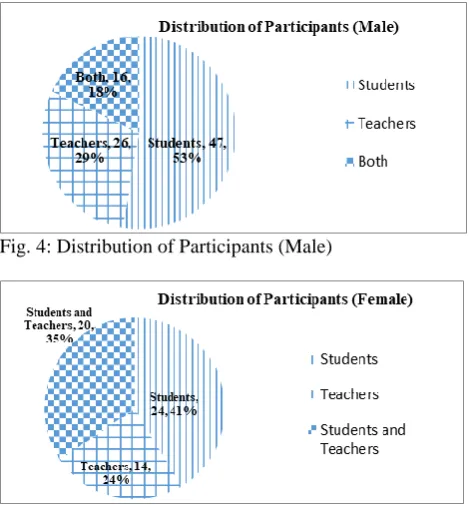
[image:4.595.302.547.51.169.2]teacher/educator, both student, and teacher, which defines the class/types of learner. Considering the male category of learners, Out of 89 male participants, 47(32.5 %) were students, 26(29%) were educator /teacher and rest 16(18%) were both teacher and student as shown in Figure 4. Out of 58 female participants, 24 of the learners (41%) were students, 14 of them (24%) were educator/teacher, and 20 of them (35%) were both teacher and student as shown in Figure 5.
[image:4.595.47.282.167.420.2]Fig. 4: Distribution of Participants (Male)
Fig. 5: Distribution of Participants (Female)
[image:4.595.302.546.313.432.2]Considering the age-group of learners, learners belonged to the different age group. 33 of the learners (22.44%) were below 18 years, 35 of the learners (26.53) were between 18-25 years of age, 28 of them (19.07%) were between 25-30 years of age, 21 of them (14.28%) were between 30-40 years of age and rest 30(20.41%) of them were above 40 years as shown in Figure 6.
Fig. 6: Distribution of age-group of learners
Considering the learner education level, 37 of the participants (42.50 %), were at the higher education/post-graduate level, 57(30%) were at the graduate/engineering level, 28 () were at the senior secondary education level and 11 (27.5 %) were at the secondary education level as shown in Figure 7.
Fig. 7: Distribution of Learners
Assessing the subject matter/area/field offered for learning, there was (n= 13; 8.84%) offered computer science, (n=39; 26.53%), were offered Engineering education making up the highest share, (n=25; 17.01%) were offered oil and petroleum, (n=30; 20.41%) were offered Geoscience, (n=13; 8.84%) were offered chemistry, (n = 17; 11.56%) offered mathematics, and some others were offered material in miscellaneous domain or independent of a particular domain as shown in Figure 8.
Fig. 8: Distribution of Learners
[image:4.595.305.545.528.650.2]Frequency distributions of different learning style detected in the present study have been presented in Figure 9. It can be concluded from Figure 9 that maximum responses belong to Acoustics (ACO) learning style, which occupies (n=1024; 39%) of the entire group of responses of uni-modal.
Fig. 9: Distribution of Learning Style
[image:4.595.47.284.528.647.2]VI. APPLICATION AND DISCUSSIONS
The I2A2 LSQP has various applications in our viewpoint. Initially, the LSQP will give the course to the teachers/instructors on the varying assortment of learning styles inside their learning classes and to empower them to design rule that tends to the adjusting needs of most of the student or understudies. In particular, finding a broad number of understudies with specific tendencies whose necessities are not being had a tendency to ought to get ready teachers to incorporate a couple of upgrades in their educating.
Second, it provides for student understanding of their possible learning characteristics and weaknesses. Various students who dependably encounter issues with specific course and instructors are inclined to put the blame totally for poor training and recognize no ethical commitment in regards to their mistake. Various different credits to the mistake thoroughly to their own specific inadequacies and take full commitments.
The I2A2 learning style model can be utilized in face-to-face/classroom teaching, corporates training, distance learning program and, online learning. This model can be useful to determine the learning style of the learner at any education level.
I2A2 recommendations for instruction and showing technique, this prescribes the right examination of understudy learning style, and the attractive planning of the learning condition and guides' scholarly style with such learning inclinations, is the best approach to empowering preparing and improving student execution and satisfaction.
VII. CONCLUSION AND FUTURE RECOMMENDATIONS
I2A2 learning style model has been implemented on 147 participants on a prototype e-learning environment. The purpose is to collect individual learning style and modality, to serve subject matter learning material in a manner that best suits the learner. The overall aim is to improve teaching effectiveness and promote learner satisfaction. Through the findings and discussion of experimental analysis recommendation and future scope have been proposed. Firstly, we might want to investigate the likelihood of utilizing intelligent reasoning methods to detect learners’ learning style with the framework instead of only making use of responses to the questionnaire. Secondly, there is an opportunity to explore the fusion of different learning style models for adjudging most appropriate learning style for a learner. This provision of mixed learning style model is likely to facilitate implementation of enhanced adaptivity in the educational system.
ACKNOWLEDGMENT
This research was supported by the Cognitive Science Research Initiative (CSRI), Department of Science and Technology project reference number SR/CSI/140/2013, New Delhi, India. The authors also thankful to the
REFERENCES
1. Chrysafiadi, K., & Virvou, M. (2012). Evaluating the integration of fuzzy logic into the student model of a web-based learning environment. Expert Systems with Applications, 39(18), 13127-13134. 2. Graf, S., & Liu, T. C. (2010). Analysis of learners' navigational behaviour and their learning styles in an online course. Journal of Computer Assisted Learning, 26(2), 116-131.
3. Graf, S., Liu, T. C., Chen, N. S., & Yang, S. J. (2009). Learning styles and cognitive traits–Their relationship and its benefits in web-based educational systems. Computers in Human Behavior, 25(6), 1280-1289. 4. Brusilovsky, P. (2004, May). KnowledgeTree: A distributed architecture for adaptive e-learning. In Proceedings of the 13th international World Wide Web conference on Alternate track papers & posters (pp. 104-113). ACM.
5. Felder, R. M., & Silverman, L. K. (1988). Learning and teaching styles in engineering education. Engineering education, 78(7), 674-681. 6. Kolb, D. A. (2014). Experiential learning: Experience as the source of
learning and development. FT press.
7. Honey, P., & Mumford, A. (1992). The manual of learning styles. 8. Van Zwanenberg, N., Wilkinson, L. J., & Anderson, A. (2000). Felder
and Silverman's Index of Learning Styles and Honey and Mumford's Learning Styles Questionnaire: how do they compare and do they predict academic performance? Educational Psychology, 20(3), 365-380. 9. Felder, R. M., & Spurlin, J. (2005). Applications, reliability, and validity
of the index of learning styles. International journal of engineering education, 21(1), 103-112.
10. Gilbert, J. E., & Han, C. Y. (1999). Adapting instruction in search of ‘a significant difference’. Journal of Network and Computer applications, 22(3), 149-160.
11. Mustafa, Y. E. A., & Sharif, S. M. (2011). An approach to adaptive e-learning hypermedia system based on learning styles (AEHS-LS): Implementation and evaluation. International Journal of Library and Information Science, 3(1), 15-28.
12. Liegle, J. O., & Janicki, T. N. (2006). The effect of learning styles on the navigation needs of Web-based learners. Computers in human behavior, 22(5), 885-898.
13. Liegle, J. O., & Janicki, T. N. (2006). The effect of learning styles on the navigation needs of Web-based learners. Computers in human behavior, 22(5), 885-898.
14. Zhang, L. F. (2000). Relationship between thinking styles inventory and study process questionnaire. Personality and Individual differences, 29(5), 841-856.
15. Coffield, F., Moseley, D., Hall, E., & Ecclestone, K. (2004). Learning styles and pedagogy in post-16 learning: A systematic and critical review.
16. Liegle, J. O., & Janicki, T. N. (2006). The effect of learning styles on the navigation needs of Web-based learners. Computers in human behavior, 22(5), 885-898.
17. Fleming, N., & Mills, C. (2010). VARK: A Guide to Learning Styles. 2001. Last accessed on, 30.
18. Fleming, N., & Baume, D. (2006). Learning Styles Again: VARKing up the right tree! Educational developments, 7(4), 4.
19. Honey, P., & Mumford, A. (1992). The manual of learning styles. 20. Montgomery, S. M. (1995, November). Addressing diverse learning
styles through the use of multimedia. In Frontiers in Education Conference, 1995. Proceedings. 1995 (Vol. 1, pp. 3a2-13). IEEE. 21. Honey, P., & Mumford, A. (1986). Using your learning styles. Peter
Honey.
22. Keegan, D. (2003). Pedagogy and support systems in e-learning. ZIFF PAPIERE 121.
23. Kolb, D. A. (1993). Learning-style inventory: Self-scoring inventory and interpretation booklet: Revised scoring. TRG, Hay/McBer. 24. Keefe, J. W. (1979). Learning style: An overview. Student learning
styles: Diagnosing and prescribing programs, 1, 1-17. 25. Myers, I. B. (1998). Introduction to type®. CPP.
26. Felder, R. M., & Soloman, B. A. (2000). Learning styles and strategies. At URL: http://www.engr. ncsu. edu/learningstyles/ilsweb. html.
27. Felder, R. M., & Soloman, B. A. (1999). Index of learning styles
(ILS). On-line at
Published By:
Blue Eyes Intelligence Engineering Appendix I
I2A2 Learning Style Question Pool (LSQP)
Q. 1. You and your friend are planning an outstation trip. None of you have been to the place earlier. How would you like to gather information about the place?
1. Requesting live demonstration by someone who visited that place. 2. Using written description of the place.
3. Route map of the place.
4. Listening from friends over telephonic conversation.
Q. 2. Suppose you are ailing from a fatal disease. How would you explain to the doctor?
1. Describe verbally what’s wrong with you 2. Use chart, diagram or show a picture 3. Use written description
4. Use a model to explain what was wrong
Q. 3. You are doing a group study on a topic. You most likely 1. Participate by exchanging your thoughts
2. Be a mute listener and observer 3. Interact using written material 4. Request short movie on that topic
Q.4. You are a learner and wish to get information on a new subject. You would prefer to
1. Use text book or written material 2. Get explained by friend or teacher 3. Use activity or experimental approach 4. Watch videos
Q.5. You are the Chief Executive Officer of a multinational and need to make a presentation on a new project. You prefer presentation to majorly comprise of
1. Charts, pictures, diagrams or maps 2. Short movie
3. Written instructions or manuals 4. Case studies or examples
Q.6. How do you remember any incident in your life? 1. What have you seen
2. What have you listened 3. What have you done 4. What have you read
Q.7. you are going to organize a get-together party for some colleagues at a restaurant. How would you order food?
1. Order most popular dish in that café or order what others are eating. 2. Order something that somebody had spoken to you about. 3. Select from the written description in the food menu or recipe of
dish
4. Using pictures of all the dishes
Q.8. when you need directions to an unknown place. You would prefer? 1. A clear and legible map
2. Written directions 3. Being told by someone
4. Need someone that will go with you
Q.9. you are planning to purchase a new motorcycle or car. How would you make your decision regarding the purchase?
1. Go through detailed written description of all features
2. By listening to someone who has experience regarding the said automobile.
3. Using test drive or checking all features 4. Using its looks, orientation, and design
Q.10. If you are presented with current sales data of a product of a multinational company and expected to predict the sales in the next month. You would prefer the data in?
1. charts, tables or graph
2. data represented in textual format 3. verbal description by someone 4. Demonstration of the explanation.
Q. 11. When reading a fiction and trying to analyze. You would prefer? 1. To think about the incidents and develop your own new theme 2. You will listen to the facts behind the story
3. Prefer reading something that teaches new fact
4. Prefer some statute, model or image that inferences the new fact Q. 12. You have been asked to perform in a cultural event in your college or at workplace. You would prefer?
1. To think on something new and perform it through acting 2. Prepare notes and come up with innovative idea 3. Prepare an activity, record it and play it to the audience 4. Prepare the task through a chart or figure and present
Q. 13. Suppose you have joined a project in a university and are working as part of a group. You would prefer that initially?
1. Someone comes up with a new idea and demonstrates it on a common platform
2. Everyone speaks out their idea
3. All share handout notes, written highlights or instructions 4. Showing model, picture or graph
Q. 14. You are working in a renowned automobile company and your manager has assigned you to create a model or design for a new car. How would you prefer to communicate about that model or design to your manager?
1. Through impressive charts or diagrams that explain all features in detail
2. Create a short video to explain all the functions of each part effectively
3. Prepare speech and play it for the manager to listen 4. Prepare a brief case study in the written forms
Q.15. when you attend a conference or a meeting. How would you remember the key points or the people that you interact with?
1. What was told to you
2. What was explained through demonstration 3. What was seen by you or how people looked like 4. The written description that was made available to you
Q.16. You have joined a school or university, what way of teaching, you would like to be used by the teachers?
1. Focused on experiments, group studies or hands on exercises 2. Written notes, books and reading work
3. Pictures, symbols, mind maps, or videos 4. Listening, talking or group learning
Q.17. When you have to advertise a product of a company. You would prefer 1. Using written description, list, manual or detailed features 2. Interaction with people or explaining features of product 3. Short video, action based charts or diagrams
4. Using a model or prototype of product for demonstration Q.18. When you are bored and want to be relax. You would prefer?