DISTRIBUTED HANDLER
ARCHITECTURE
Beytullah Yildiz
Submitted to the faculty of the University Graduate School in partial fulfillment of the requirements
for the degree Doctor of Philosophy
in the Department of Computer Science, Indiana University
ii
Accepted by the Graduate Faculty, Indiana University, in partial fulfillment of the requirements for the degree of Doctor of Philosophy.
Doctoral Committee ________________________________ Prof. Geoffrey C. Fox (Principal Advisor)
________________________________ Prof. Dennis Gannon
________________________________ Prof. David Leake
________________________________ Prof. Andrew Lumsdaine
iii
© 2007
iv
Acknowledgements
This dissertation has been achieved with the encouragement, support, and assistance I received from many remarkable people. I would like to offer my sincere gratitude to them.
First of all, I would like to thank my advisor Prof. Geoffrey C. Fox for his support, guidance and an exceptional research environment provided by him along the way of this endeavor. I deeply appreciate how much he contributed with his keen insight and extensive experience. His advice was always invaluable contribution to my academic life.
I would also like to thank the members of the research committee for generously offering time, support, guidance and good will throughout the preparation and review of this dissertation. I am very thankful to Prof. Dennis Gannon for his suggestions and remarkable inspiration, Prof. Andrew Lumsdaine for his constructive comments and Prof. David Leake for his rare combination of kindness and keen intellect.
I want to thank all former and current members of Community Grids Lab for the priceless moments that we shared together. I have had great pleasure of working with these wonderful people. I particularly thank Dr. Shrideep Pallickara and Dr. Marlon Pierce for their supports and productive discussions on various aspects of my research.
v
road of graduate studies also became pleasing with them. I also owe Dr. Sangyoon Oh special thanks for many enlightening discussions and conversations. I feel very grateful to Dan Amonett who proofread this dissertation with an incredible patience and thoroughness.
vi
Abstract
Over the last couple of decades, distributed systems have been demonstrated an architectural evolvement based on models including client/server, multi-tier, distributed objects, messaging and peer-to-peer. One recent evolutionary step is Service Oriented Architecture (SOA), whose goal is to achieve loose-coupling among the interacting software applications for scalability and interoperability. The SOA model is engendered in Web Services, which provide software platforms to build applications as services and to create seamless and loosely-coupled interactions. Web Services utilize supportive functionalities such as security, reliability, monitoring, logging and so forth. These functionalities are typically provisioned as handlers, which incrementally add new capabilities to the services by building an execution chain. Even though handlers are very important to the service, the way of utilization is very crucial to attain the potential benefits. Every attempt to support a service with an additive functionality increases the chance of having an overwhelmingly crowded chain: this makes Web Service fat. Moreover, a handler may become a bottleneck because of having a comparably higher processing time.
vii
TABLE OF CONTENTS
CHAPTER 1 INTRODUCTION ... 1
1.1 Motivation ... 5
1.2 Statement of problems ... 9
1.3 Why Distributed Handler Architecture (DHArch) ... 10
1.4 Design features ... 12
1.5 Contributions ... 16
1.6 Research questions ... 18
1.7 Methodology ... 19
1.8 Organization of dissertation ... 21
CHAPTER 2 BACKGROUND AND SURVEY OF TECHNOLOGIES ... 23
2.1 Handler structures ... 23
2.1.1 JAX-RPC ... 23
2.1.2 Apache Axis ... 25
2.1.2.1 Apache Axis 1.x ... 25
2.1.2.2 Apache Axis 2 ... 28
2.1.3 Web Service Enhancement (WSE) ... 32
2.1.4 DEN and XSUL ... 33
2.1.4.1 Differences ... 35
2.1.4.2 Strong points and advantages ... 36
2.2 Technologies ... 37
2.2.1 XML Parsers ... 37
2.2.2 NaradaBrokering ... 40
CHAPTER 3 DISTRIBUTED HANDLER ARCHITECTURE ... 43
3.1 General picture of Distributed Handler Architecture ... 43
3.2 Modules of Distributed Handler Architecture ... 46
3.2.1 Distributed Handler Manager (DHManager) ... 46
3.2.1.1 Gateway ... 47
3.2.1.2 Handler Orchestration Manager ... 48
3.2.1.3 Message Context Creator ... 48
3.2.1.4 Queue Manager ... 51
3.2.1.5 Messaging Helper ... 52
viii
3.2.2 Communication Manager... 56
3.2.3 Handler Executing Manager ... 60
3.3 Summary ... 62
CHAPTER 4 DISTRIBUTED HANDLER ORCHESTRATION ... 63
4.1 Workflow systems ... 64
4.2 Orchestration and its XML schema ... 68
4.3 Execution constructs ... 72
4.4 A handler execution scenario utilizing basic constructs ... 76
4.5 Interpretation of an orchestration document ... 80
4.6 Flexibility and policy schema ... 82
4.7 Summary ... 84
CHAPTER 5 DISTRIBUTED HANDLER ARCHITECTURE EXECUTION ... 86
5.1 Distributing handlers and possible environments ... 86
5.2 Execution ... 88
5.2.1 Message naming... 90
5.2.2 Message acceptance ... 91
5.2.3 Message selection ... 94
5.2.4 Sending messages to the distributed handlers ... 95
5.2.5 Message processing in the distributed handlers ... 101
5.3 Getting response back ... 102
5.4 Error handling for distributed handlers ... 104
5.5 Management of handler replicas ... 106
5.6 Security... 108
5.7 Reliability ... 111
5.8 Summary and conclusion ... 112
CHAPTER 6 MEASUREMENTS AND ANALYSIS ... 114
6.1 Performance measurements... 114
6.1.1 Handler configurations... 115
6.1.2 Environment ... 119
6.1.3 Individual execution times of handlers ... 120
6.1.4 Overall performance comparison for sequential and parallel execution .. 126
6.1.5 Summary ... 135
6.2 Overhead of distributing a handler ... 135
ix
6.2.2 Environments ... 137
6.2.3 Measurements ... 137
6.2.4 Summary ... 145
6.3 Scalability ... 146
6.3.1 Message rate... 146
6.3.1.1 Environment and methodology ... 146
6.3.1.2 Measurements ... 150
6.3.2 Scalability in the number of handlers ... 159
6.3.3 Summary ... 160
6.4 Deploying Web Services Resource Framework and Web Services Eventing . 161 6.4.1 Web Services Resource Framework (WSRF)... 161
6.4.2 Web Services Eventing (WS-Eventing)... 162
6.4.3 Environment ... 164
6.4.3.1 Deploying the specifications for Apache Axis ... 166
6.4.3.2 Deploying the specifications for DHArch ... 166
6.4.4 Results and analysis ... 167
CHAPTER 7 CONCLUSIONS AND FUTURE RESEARCH ISSUES ... 170
7.1 Thesis summary... 170
7.2 Answering the research questions ... 173
7.3 Future research ... 176
Appendix A Handler Orchestration Schema... 179
Appendix B Policy Schema ... 182
Appendix C An instance of the Handler Orchestration Document ... 184
Appendix D Web Service specifications and the SOAP parts being interested ... 187
Appendix E SOAP messages for WS-Resource Framework ... 190
Appendix F SOAP messages for WS-Eventing ... 205
x
LIST OF FIGURES
Figure 1-1 : A Simple Web Service Interaction ... 3
Figure 1-2: A simplified architecture of DHArch... 13
Figure 2-1 : JAX-RPC architecture... 24
Figure 2-2 : Client side Apache Axis handler architecture ... 26
Figure 2-3 : Service side Apache Axis handler architecture ... 26
Figure 2-4 : Information Model ... 29
Figure 2-5 : SOAP Processing Model ... 30
Figure 2-6 : Phase Module and Handler relation ... 31
Figure 2-7 : Axis2 Engine In and Out Flows ... 32
Figure 2-8 : Filter execution structure in WSE ... 32
Figure 2-9 : DEN: WS Processing in Grids ... 34
Figure 2-10 : A DOM Tree ... 38
Figure 2-11 : SAX shows the context to an application as a series of events ... 39
Figure 2-12 : StAX provides an event to an application ... 39
Figure 3-1: General Architecture of DHArch ... 45
Figure 3-2 : DHArch Gateway ... 47
Figure 3-3 : Distributed Handler Message Context ... 49
Figure 3-4 : DHArch Messaging Format ... 54
Figure 3-5 : DHArch Communication Manager ... 60
Figure 4-1 : Sequential Execution Petri net representation ... 73
Figure 4-2 : Parallel execution Petri net representation ... 74
xi
Figure 4-4 : Conditional execution Petri net representation ... 76
Figure 4-5 : A sample of a handler orchestration ... 77
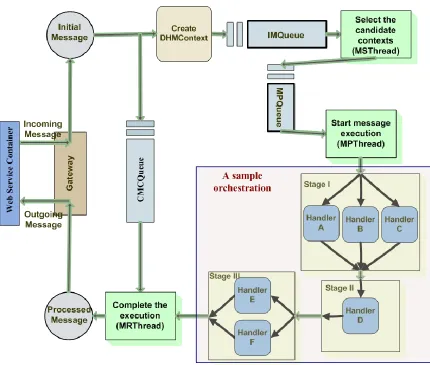
Figure 5-1 : A message execution ... 89
Figure 5-2: Sequential and parallel executions for Handler A and Handler B ... 93
Figure 5-3 : Message execution flow over Message Processing Queue (MPQueue) ... 98
Figure 6-1: Sequential handler configuration in Apache Axis ... 116
Figure 6-2 : Sequential handler configuration in DHArch ... 117
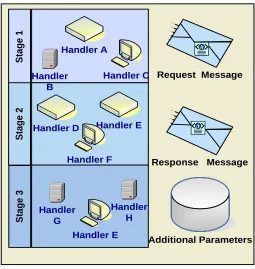
Figure 6-3 : A handler configuration with 3 stages ... 117
Figure 6-4 : A handler configuration with 3 stages ... 118
Figure 6-5 : A handler configuration with 2 stages ... 118
Figure 6-6 : A handler configuration with 1 stage ... 119
Figure 6-7 : The service execution times of the six handler configurations containing the five handlers in the multi-core system ... 128
Figure 6-8 : Standard deviations of the service execution times in the multi-core system ... 129
Figure 6-9: The service execution times of the six handler configurations containing the five handlers in the multiprocessor system ... 130
Figure 6-10 : Standard deviations of the service execution times in the multiprocessor system ... 131
Figure 6-11 : The service execution times of the six handler configurations containing the five handlers in the cluster utilizing Local Area Network ... 132
xii
Figure 6-13: The service execution times of the six handler configurations containing the five handlers in the single processor system ... 134 Figure 6-14: Standard deviations of the service execution times in the single processor system ... 134 Figure 6-15: Apache Axis sequential handler deployment to measure the overhead ... 136 Figure 6-16 : DHArch sequential handler deployment to measure the overhead ... 136 Figure 6-17: Comparison for the handler addition in Axis 1.x and DHArch for a multi-core system... 138 Figure 6-18 : Comparison for the handler addition in Axis 1.x and DHArch for a
xiii
xiv
LIST OF TABLES
Table 4-1: Simple elements in Orchestration Schema ... 70
Table 4-2 : Complex time element... 71
Table 4-3 : Handler Definition ... 71
Table 4-4 : The execution constructs ... 72
Table 4-5 : The sequential secution construct... 73
Table 4-6 : The parallel execution construct ... 74
Table 4-7 : The looping execution construct ... 75
Table 4-8 : The conditional execution construct... 75
Table 4-9 : A sequential execution serialization ... 77
Table 4-10 : A parallel execution serialization ... 78
Table 4-11 : A looping execution serialization ... 79
Table 4-12 : A conditional execution serialization ... 80
Table 6-1 : Handler list for the performance benchmarking ... 116
Table 6-2 : Individual handler execution times in Apache Axis for the multi-core system ... 121
Table 6-3 : Individual handler execution times in DHArch for the multi-core system .. 121
Table 6-4 : Individual handler execution times in Apache Axis for the multiprocessor system ... 122
Table 6-5 : Individual handler execution times in DHArch for the multiprocessor system ... 122
xv
Table 6-7: Individual handler execution times in DHArch for a cluster utilizing Local Area Network ... 124 Table 6-8 : Individual handler execution times in Apache Axis for the single processor system ... 124 Table 6-9 : Individual handler execution times in DHArch for the single processor system ... 125 Table 6-10 : Individual handler execution times in DHArch for the single processor system while the handlers are being executed concurrently ... 126 Table 6-11 : The elapsed time for the service execution and the standard deviation of the performance benchmark in the multi-core system ... 129 Table 6-12: The elapsed time for the service execution and the standard deviation of the performance benchmark in the multiprocessor system ... 131 Table 6-13: The elapsed time for the service execution and the standard deviation of the performance benchmark in the cluster utilizing Local Area Network ... 132 Table 6-14: The elapsed time for the service execution and the standard deviation of the performance benchmark in the single processor system... 133 Table 6-15 : DHArch execution results (in milliseconds) for the multi-core system while the number of handlers is increasing ... 138 Table 6-16 : Apache Axis execution results (in milliseconds) for the multi-core system while the number of handlers is increasing... 139 Table 6-17 : Overheads of a handler distribution in the multi-core system for the
xvi
Table 6-19 : DHArch execution results (in milliseconds) for the multiprocessor system
while the number of handlers is increasing... 140
Table 6-20 : Apache Axis execution results (in milliseconds) for the multiprocessor system for the increasing number of handlers in the execution path ... 140
Table 6-21 : Overheads of a handler distribution in the multiprocessor system for the increasing number of handlers in the execution path ... 140
Table 6-22 : Mean value of the overhead for the multiprocessor system ... 141
Table 6-23 : DHArch execution results (in milliseconds) for the system utilizing Local Area Network while the number of handlers is increasing. ... 142
Table 6-24 : Apache Axis execution results (in milliseconds) for the system utilizing Local Area Network while the number of handlers is increasing ... 142
Table 6-25 : Overheads of a handler distribution in a cluster utilizing Local Area Network for the increasing number of handlers in the execution path ... 142
Table 6-26 : Mean value of the overheads in a cluster utilizing Local Area Network ... 143
Table 6-27 : DHArch execution results (in milliseconds) for a single processor system while the number of handlers is increasing... 144
Table 6-28 : Apache Axis execution results (in milliseconds) for a single processor system while the number of handlers is increasing ... 144
Table 6-29 Overheads of a handler distribution for a single processor system for the increasing number of handlers in the execution path ... 144
Table 6-30 : Mean value of the overheads for the single processor system ... 145
Table 6-31 : Apache Axis sequential execution results in single machine ... 152
xvii
1
CHAPTER 1
INTRODUCTION
The computing environment has demonstrated an architectural evolution based on models including client/server, multi-tier, peer-to-peer and a variety of distributed systems. One recent evolutionary step is Service Oriented Architecture (SOA) whose goal is to achieve loose coupling among the interacting software applications for scalability and interoperability.
2
Why is interoperability so important? We can see its importance in our daily life. When we travel abroad we bring our laptop, cellular phone and our shaving kit. As we know, they need to be charged once they are used a certain amount of time. If a shopping center has not been visited to buy a converter, we would have wasted our energy by carrying those items because they became useless as a result of an incompatible plug.
If the world has a common standardized plug type, we would not have any problem when the devices need to be charged. Similarly, Web Service requires a common ground to offer interoperability. Hence, W3C defines Web Service to provide guidance:
―A Web service is a software system identified by a URI, whose public
interfaces and bindings are defined and described using XML. Its definition can
be discovered by other software systems. These systems may then interact with the
Web service in a manner prescribed by its definition, using XML based messages
conveyed by Internet protocols.‖
3
Figure 1-1 : A Simple Web Service Interaction
When we want to send an item by mail, we may request additional features from the post office. We prefer delivery confirmation for an important document. If the item is valuable, it is better to be insured. The post office basically delivers what we send. However, it offers additional capabilities to serve us better. Web Service Framework resembles it in many ways. It is simply a delivery of SOAP message.
One of the most crucial aspects of Web Service Framework is the utilization of the XML messaging. SOAP is an XML based data exchange format. The applications communicate by SOAP messages. Consequently, Web Service Framework heavily depends on SOAP processing. As a result, several Web Service containers, the middleware in Figure 1-1, has been introduced to take pressure off the applications. Their main goal is to hide the details of the SOAP processing from the users. The most popular containers are Apache Axis[5], Microsoft Web Service Enhancement[6] and IBM Websphere[7] .
The container architecture employs two main SOAP processing components, Web Service logic and handler. Handler is also called as filter. Web Service logic carries out the main task; it is a standalone application that is able to provide a service. On the other
SOAP Message Web Service
Middleware Web Service
Middleware
Web Service
Logic
4
hand, a handler is a supportive application. It contributes to a service with additional capabilities; such as reliability, security and logging.
Handlers offer new capabilities to services without increasing the complexity. Simplicity is a very crucial feature of applications. Handlers help to create Web Service so that the service acquires additional capabilities without touching the service implementation. Simplicity originates from very well known notion, divide and conquer.
The whole task is divided between handlers and the service endpoint. Instead of having a large, hardly manageable application, clearly separable smaller tasks are more plausible. This notion contributes to have a simpler, efficient and modular structure.
Despite the fact that handlers preferably deal with the header, they also have the ability to modify the SOAP body. Many WS-Specifications have been introduced so far. They are the efforts where the community sets the standards to have more interoperable systems[8]. Some of them are very good candidates to be handlers, especially, those dealing with the headers. On the other hand, these specifications do not necessarily work with only the header. Many of them also affect the SOAP body. More detailed information about the effect of WS specifications on the SOAP parts can be found in Appendix D.
5
Consequently, the handler concept makes Web Service Architecture more modular rich and efficient. Instead of having a hardly manageable big chunk of application containing both service logic and its necessary functionalities, separating the functionalities from the service logic architecturally sounds better. This design allows Web Services to acquire incrementally additive functionalities without touching the endpoint. Thus, Web Service acquires unlimited richness in terms of the capability and features.
1.1
Motivation
Apparently, handler is a crucial aspect of Web Service Architecture because of the key importance in the execution path. However, the way of utilizing handlers and their structures become important when the number of the necessary additive functionalities increases. The efficiency becomes essential when power hungry and time consuming applications are introduced in the execution pipeline as handlers. For instance, reliability adds significant amount of processing time. Similarly, security necessitates powerful machines to conclude its task in a reasonable duration. Any additional handler may make the response time of the service soar. Services exhibit a many-to-one feature; many clients may ask many requests from a single service. Thus, the service side is influenced more dramatically than the client side.
6
named as a Web Service becomes fat; while the service is acquiring new capabilities, the response time becomes longer and the management of the service becomes harder.
Secondly, a handler may cause a convoy effect. In an execution pipeline, a handler may delay the service processing due to the fact that its execution is too slow. In other words, a handler becomes bottleneck. This condition mounts the request messages waiting to be served in every second. The clients start waiting longer and longer.
Let‟s think about a highway, which has three lanes. And it is rush hour.
Everybody is driving to reach home and get relaxed as soon as possible. However, at some point, the road becomes narrow; it operates with two lanes. Since, it is peak time; the road capacity is not sufficient to serve the arriving cars. In every passing minute, the number of cars grows. The people start becoming distressed because they do not want to waste their time in the highway by just waiting. How can we solve the problem?
The first solution is to expand the narrow part of the road. Adding one lane to the narrow part will suffice. The second solution is to detour a portion of the traffic to a parallel road. We can utilize both approaches in the handler architecture. Replacing the narrow road resembles introducing new enhanced computing environments. Using the parallel road looks like offering concurrent execution for the handlers.
7
Application parallelism is not new idea; it has been utilized for decades. Hence, handlers can be executed concurrently. However, handler parallelism is not utilized in the conventional Web Service Architecture. The parallelism boosts the performance and provides very effective and powerful solution.
It is being observed that many new technologies are being introduced in every day. Recently, an enhancement in processor technology becomes popular. Multi-core processors are started being widely utilized; even personal computers leverages cores offering opportunity for parallel executions. This opportunity contributes to the parallel handler execution even without introducing any network latency.
Distribution of the applications is very crucial to improve performance and scalability. However, there are requirements to be able to benefit from it. The decision of a handler distribution is influential over the system performance. Moreover, the selection of the handlers running concurrently is very vital. The conditions and requirements of the distribution are necessarily needed to be investigated extensively.
Handler structure demands efficient handler orchestration because there are many applications to be managed. The handlers have to be orchestrated in a way that Web Service benefits most. The orchestration is especially essential when the handlers are distributed. It becomes inevitable, when the concurrency is launched for the handler executions.
8
Hence, they are very suitable to be used by the services and/or clients many times without complications. Even stateful handlers may become appropriate to be utilized repeatedly in certain conditions.
―There are two ways of constructing a software design. One is to make it so
simple that there are obviously no deficiencies; the other is to make it so
complicated that there are no obvious deficiencies. The first method is far more
difficult.‖
-- C. A. R. Hoare, The Emperor's Old Clothes
Charles Antony Richard Hoare states a very essential feature to design excellent software [9]. Having a clean separation between the components to build so simple software that there are obviously no deficiencies is the goal. Simplicity contributes to constructing modular and flexible applications. However, it is a challenging effort to build a perfectly flexible and modular system. So it is for the handlers.
Interoperability is one of the most important features of Web Services. It assists to build seamless communication among the applications. The messaging is the key aspect behind the interoperability because it decouples the components from each other. We questioned ourselves about why we cannot leverage the messaging for the handler execution too.
9
1.2
Statement of problems
Web Service Framework has very promising architecture offering an interoperable environment for distributed applications. One of the most crucial computing components of the services is the handler. Its execution has to be efficient, and effective. There are issues preventing this essential part of Web Services to gain its full capacity.
First of all, Web Services are increasingly becoming popular. They are utilized in the range from very simple application to very computation centric software systems. The computing power of the machines almost doubles every year following the projection of Moore‟s law[10], the network speed also catches up. Hence, the obtainable computing power increases steadily. Moreover, many other resources became accessible such as application software, storage, and sensor and so on. On the other hand, a conventional handler pipeline exploits a single machine. For this reason, we may hit a barrier if the handlers get complicated or more than a machine can handle. Web services are getting complex and requiring new features. Utilizing only one computing node prevents the services from taking off.
Secondly, the conventional handler structures are sequential. A chain of handlers processes the messages by passing them to each handler in an order. When a handler accomplishes its task, the next one receives it. However, there are many handlers that can be processed concurrently. The conventional handler architecture does not exploit this opportunity.
10
service, the usage of already deployed handlers is more reasonable. The conventional handler architecture can utilize only the handlers deployed locally for a service because of the handler chain structure.
Fourthly, conventional handler mechanisms provide static handler structure. When handlers are deployed, the execution sequence cannot be change on the fly. However, XML based computation allows us many opportunities such as context based processing; there are sufficient tools to improve the handler processing sequence. The mechanism needs an ability to adapt according to the changing conditions.
Finally, utilizing many handlers requires an efficient orchestration. The execution order of handlers is very important. The selection of the concurrent pairs and the sequence is vital for efficiency. There are many options, but not all of them offer the same benefits. Some might result in disastrous consequences.
1.3
Why Distributed Handler Architecture (DHArch)
Distribution is the key feature to utilize additional resources, either hardware or software. In a single memory space, available resources may not be possibly accessed; many of them are out there and reachable via suitable means. DHArch offers an environment to utilize additional resources by distributing the handlers. It breaks the boundaries that keep the handlers in a single memory space that locks the handlers as if they are in a cage.
11
and reduces the response time. DHArch offers an environment to benefit from the concurrency.
Since DHArch is able to distribute handlers into the different spaces, it improves the reusability. Handlers are deployed to well known addressable places that can be reached by many services and clients. They typically perform generic tasks such as security, monitoring, compression and so on. It does not matter who is requesting, they correctly perform the execution. Hence, it is very appropriate for a handler being used by many clients and services. DHArch is perfectly capable of achieving this mission.
Handler Distribution allows the replication of a handler. A handler can be duplicated and deployed to an addressable place. This notion can be utilized when a single handler cannot answer the request. DHArch is capable of providing a handler replication. The identical handlers can perform their own task independently in the DHarch handler execution environment.
A conventional handler execution mechanism employs a service specific handler sequence. In contrast, DHArch utilizes an individual handler execution sequence for every message. This attribute grants flexibility that every message may have its specific set of handlers. Moreover, this sequence can be modified on the fly. This characteristic of the DHArch contributes to adapt the execution according to the changing conditions.
12
Web Services, which exploit messaging, construct loosely coupled systems to enhance interoperability between applications. Similarly, handlers can profit from the messaging because it is innate for Web Service Framework. DHArch utilizes a Message Oriented Middleware (MOM)[11] for this purpose. MOMs are matured enough so that they guarantee message delivery. They offer asynchronous messaging. Additionally, using MOM for the internal messaging brings many benefits as by-products such as reliable and efficient delivery.
DHArch improves the scalability. Utilizing additional resources and introducing parallelism contributes to the handler execution. The usage of powerful machines or the distribution of the tasks among multi-core, multi processor or multiple machines causes the system to scale very well. Additionally, introduction of parallelism boosts the system performance. The throughput of a Service increases significantly.
1.4
Design features
Handlers are needed to build rich, modular, efficient and user friendly Web Service architectures. However, the way of using them is very critical. We contribute to the modularity, interoperability and responsiveness of the system by introducing a distributed approach for the handler architecture. A mechanism employing handler distribution is an outstanding solution. Disseminating the handlers among individual physical and/or virtual machines contributes to build more efficient, scalable and flexible structures.
13
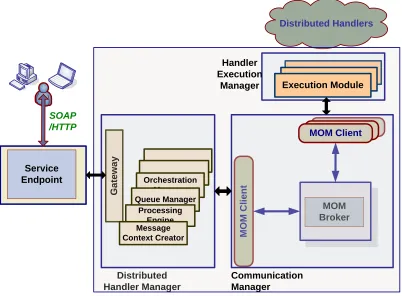
specifically the handler architecture. Hence, DHArch basically offers an efficient distributed environment for the handler executions.
DHArch has many features and capabilities. It has the ability to work with different SOAP processing engines. It is able to offer its capabilities to the Web Service containers. In other words, it can cooperate with other SOAP processing engines by exploiting a gateway. Gateway is an interface between DHArch and native SOAP processing engine.
DHArch achieves handler execution with its specific structures. Therefore, it is able to autonomously process the handlers. It does not necessarily need other systems. On the other hand, it makes the common handler interfaces available to offer flexibility for the deployment. This characteristic prevents the compulsory modification on the currently implemented handlers. For instance, Axis handler abstract class, BasicHandler, works perfectly within the DHArch. Therefore, an Axis based handler can be processed in DHArch without a modification.
Web Service Logic
`
Distributed Handlers SOAP
/HTTP
Distributed Handler Architecture
(DHArch)
G
a
te
w
a
y
14
DHArch is transparent to the users; the very vital feature of a Web Service interaction is not ignored while new capabilities are being introduced to Web Service Framework. The client is only aware of the address of the endpoint and the service definition; DHArch is not noticeable by the client. There is not any obvious distinction between conventional and DHArch utilized service usage in terms of the complexity of the accessibility.
Web Service Framework uses various transportation mechanisms and protocols. The Hypertext Transfer Protocol (HTTP) is the one mostly utilized. It is an application level generic stateless protocol for the distributed collaborative hypermedia information systems[12]. It provides a very suitable communication environment among the organizations; by utilizing HTTP, web services can work through many common firewall security measures among the different organizations and platforms without changing any firewall policies. However, it has also some limitations especially because of the request/respond paradigm. The request has to be followed with a response in HTTP. This results in unnecessary network usage for some cases. It does not support asynchronous messaging very well. It requires an upper level mechanism to handle asynchronous communications.
15
communication means to carry out critical tasks. It can also keep the messages until being delivered. Depending on the size of the message, thousands of messages can be queued to regulate the message flow.
In addition to the MOM utilization, DHArch uses its own structures to carry out the message execution. A context structure, Distributed Handler Message Context (DHMContext), assists to the distributed handler execution. Every request arriving to a Web Service endpoint is wrapped within this context. The flow structure, message and many other parameters are kept in the context to provide a convenient way of accessing to the required information during the execution.
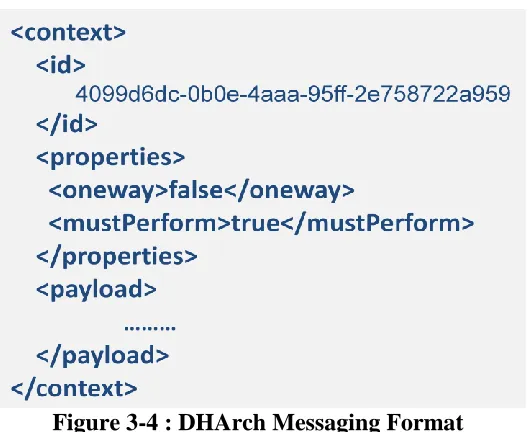
The message is not the only necessary entity being passed to a distributed handler. Handlers may require further information. Therefore, an XML based message format, DHArch Messaging Format (DMFormat), is created to carry the supplementary data. It basically corresponds to the Message Context objects of the conventional Web Service containers.
Many requests may overwhelmingly arrive to a service and cause it to drop requests. Conventional containers accept request messages if there are available threads to work for them. Otherwise, the requests are rejected. DHArch provides an improvement by introducing a queuing mechanism. It employs the queues to keep the necessary information and to regulate the message flow; they improve the throughput by accepting and storing the request during the peak times and processing them when the influx reduces.
16
stored and selected to be executed according to the queuing scheme. Since each message contains its own handler sequence, the engine controls whether the sequence is correctly executed. The responses are also kept track by the engine. When a message response is received, the corresponding message context is updated with the guidance of the engine.
For the handler sequence, DHArch utilizes its own orchestration mechanism. Orchestration is very essential to perform the operations correctly and efficiently. The requirement of the orchestration became inevitable when some of the handlers are working concurrently. DHArch introduces a mechanism separating the description from the execution in order to have efficient and effective execution. By doing so, the complexity of the engine is being able to be reduced while the orchestration description is providing very powerful expressiveness for the handler sequences. Without sacrificing efficiency, acquiring simplicity was very challenging. However, the separation helps to succeed in this goal.
Every handler is hosted by a Handler Execution Manager (HEManager), the distributed portion of DHArch. Without having a supportive environment, handlers cannot perform their tasks in the distributed fashion. They need to be assisted. HEManager is considered to build a suitable environment. Every distributed handler hires its own HEManager. The manager contributes to the handler execution in many ways; stretching out from negotiating with message delivery system to the creating necessary structures for a distributed handler.
1.5
Contributions
17
Concurrency is not a new concept. Many software applications perform concurrent execution. The aim is basically to enhance the efficiency by processing the applications concurrently. A handler can also benefit from being processed alongside another handler. Hence, DHArch possesses an ability to provide an environment for the parallel handler execution in an efficient way.
Moreover, DHArch offers an atmosphere to utilize effectively additional resources. Multi-core computers provide very promising environment for the handler execution. Moreover, the internet era hands over enormous amount of resources. While the network speed gets faster, the distributed resources become more available. During the period of Kbit/s and even Mbit/s in the network, handling the whole execution in a single system might be plausible. However, we are looking Gbit/s range nowadays. Transferring the applications to geographically distributed computing nodes has become more feasible. Hence, handlers can be delivered to the places where the resources are available. This capability feeds Web Service computation power with the tremendous additional resources.
18
Additionally, DHArch is able to update handler sequences on the fly. This capability is acquired by having a unique context structure for each message. The context contains the handler sequence. In contrast to the static approach, this sequence can be modified during the execution. Hence, in addition to utilization of an individual handler set with a specific sequence, the sequence can be updated when it is necessary.
Moreover, DHArch utilizes its unique orchestration module to support efficient and effective handler processing. The execution engine needs to be very efficient. Our motto is “so simple that there are obviously no deficiencies”. The complexity of the
engine must be reasonable. On the other hand, the description has to be able to express any handler sequence. Therefore, DHArch benefits from the separation of the description from the execution for the orchestration.
In order to investigate our architecture, we conducted extensive experiments. We provide detailed performance evaluation. Several systems and environments are utilized to reach a conclusion about the general characteristics of DHArch.
Finally, we have investigated Web Service containers such as Apache Axis and realized that they are a collection of handlers which are contributing SOAP processing. To do so, they are working in harmony. Although this dissertation targets user level handlers, this research provides seeds for the next generation Distributed Web Service Operating System.
1.6
Research questions
19
on. At some point, more must be done. New opportunities and requirements have brought new demands. People started looking for better solutions. Web Service Architecture has very promising features to answer the demands and requirements. It has two crucial computing components from user point of view: the service endpoint and handlers.
In this dissertation, we focus our attention to the handlers. We raise several questions in our minds. Is the conventional handler architecture enough? How can we improve the architecture? Why do we need to improve it?
While we are looking for the answers of these questions, we explore the following research questions:
– What does handler distribution require?
– What is the role of messaging? How can this very key supporter of an
interoperable system be utilized?
– How can we provide efficient and effective handler orchestration?
– How does distributed handler execution happen?
– Performance wise, is handler distribution plausible?
– Is there any overhead for the distribution?
– Does the handler distribution scale very well?
– What are the criteria for distributing a handler? What are the architectural
principles of the handler distribution? We answer these questions in Chapter 7.
1.7
Methodology
20
It is developed in an open and participatory environment. It implements Java Server Pages (JSP) and the servlet specifications from Sun Microsystem.
In order to use in measurements, we investigate the handlers. They can be classified in two categories; real handlers and the handlers created for the testing purpose. In the first category, there are specification implementations and general purpose handlers. Apache provides several WS-Specifications implementations, which is appropriate to be a handler such as WSS4J [16] for WS-Security[17], Sandesha[18] for WS-ReliableMessaging [19] and Apache WSRF[20] for WS-Resource Framework [21]. Additionally, Grid Community Lab at Indiana University successfully implemented WS-ReliableMessaging, WS-Reliability[22], WS-Notification[23] and WS-Eventing. Moreover, we created our own handlers. Some of these handlers are testing purposes and some others are generic capability handlers such as logging, monitoring, XML Converters, XML Modifiers, compressor/decompressor, and security related handlers.
We performed many experiments by utilizing several hardware configurations to figure out the behavior of Distributed Handler Architecture. DHArch is able to use multi-core and multiprocessor systems for additional computing resources. We also investigate the utilization of additional machines in LAN network.
21
1.8
Organization of dissertation
This dissertation contains seven chapters. We explain Web Service handler concept, the conventional architectures and the contributions we have provided. The research illuminates the path that the handler architecture will travel. The experience we gain warns the obstacles on the road and provides recommendations for those who want to go in this direction.
Summary of the dissertation is covered in CHAPTER 1. We briefly address why and how we have achieved this research. The Web Service handler notion is described at the beginning of the chapter. In the remainder, we provide the motivations behind this dissertation and architectural facts of the implementation. Finally, we raise questions about the issues that we investigate.
In CHAPTER 2, the related works and underlying technologies are explored. The conventional handler architectures are investigated in detail in the first half of the chapter. Moreover, a close project, from Extreme Lab at Indiana University, is examined because of importance of its contributions. Several technologies also find their place in the second half of the chapter because of their significance in this research.
The details of Distributed Handler Architecture (DHArch) are given in CHAPTER 3. DHArch has a modular structure so that it can be easily maintainable and improvable. At the beginning of the chapter, the big picture of architecture conveys the general idea and principles. The modules are explored in the remainder of the chapter.
22
briefly. We express the details of building constructs and the interpretation of orchestration documents during the execution in the remaining of the chapter.
The execution of Distributed Handler Architecture is discussed in CHAPTER 5. The message acceptance, distributed execution and receiving response cycle are explored in detail. The complementary features and capabilities are analyzed and necessary conclusions are driven in the last part of the chapter.
We collect the measurements in CHAPTER 6 and provide the detailed analysis for them. There are four experiment sub-sections. The first one contains the performance test results. They are gathered in various environments to figure out the behavior of DHArch. The second section investigates the overhead of the handler distribution in many environments. The third section provides the results for scalability. Lastly, we finalize the experiments by deploying the well-known WS-Specifications and gathering the performance results for the execution.
23
CHAPTER 2
BACKGROUND AND SURVEY OF
TECHNOLOGIES
2.1
Handler structures
We have investigated the related works that provide an execution environment for the Web Service handlers. We will discuss them in the remainder of this section.
2.1.1
JAX-RPC
24
protocol level mechanisms such as marshalling and un-marshalling. Additionally, WSDL-to-Java and Java-to-WSDL create mappings for the client and service. It also utilizes SAAJ API which provides a library to construct and manipulate SOAP messages with attachments [25].
Client Client Side JAX-RPC Service
Service Side JAX-RPC SOAP/
HTTP
Figure 2-1 : JAX-RPC architecture
JAX-RPC makes use of HTTP as an underlying transportation protocol. Utilizing HTTP protocol provides additional capabilities such as HTTP level session management and SSL base security.
JAX-RPC specification offers a handler structure that provides an environment to add new capabilities to Web Service endpoints. It has javax.xml.rpc.handler.Handler interface containing three methods: handlerRequest, handleResponse and handleFault. Users can also write customized handlers by using Javax.xml.rpc.handler.GenericHandler abstract class.
25
completing its security related tasks. Handlers are also able to be deployed to the response path. For instance, response messages can be monitored on the way through the client with a monitoring handler.
Several handlers can construct a handler chain in JAX-RPC. A chain may contain many handlers, whose executions are sequential. The execution order of the handlers needs to be defined while the service is being deployed. In other words, the deployment of the handlers is static; the execution path cannot be modified after being deployed.
2.1.2
Apache Axis
Apache Axis is currently the most dominant container in the Web Service community and has a plethora of applications developed around this container. There are two main versions, Apache Axis 1.x and Apache Axis 2.
2.1.2.1 Apache Axis 1.x
26
flexible. Since the message is already an XML document, serializers and deserializers are not needed.
Sender
Request path handlers SOAP/
HTTP M e s s a g e C o n te x t L a y e r
Response path handlers
C li e n t a p p li c a ti o n Target Axis Engine
Figure 2-2 : Client side Apache Axis handler architecture
Similar to JAX-RPC, Apache Axis 1.x facilitates the incremental addition of capabilities by leveraging handlers. Handlers provide new features to the clients and services. Figure 2-2 depicts the client side architecture. The requests are intercepted by handlers before the network and the responses from services are captured first by them.
Pivot
Request path handlers
SOAP/ HTTP M e s s a g e C o n te x t L a y e r
Response path handlers
L is te n e r Target Service Logic Axis Engine
Figure 2-3 : Service side Apache Axis handler architecture
27
the endpoint. When the endpoint finishes its tasks, the responses are sent back to the pivot handler.
There exist two types of handlers. The first type contains singleton handlers, which do not require a peer. They can be deployed to either client or service side. On the other hand, there are handlers that necessitate peers in the client and the service sides. This kind of handlers forms the second type. For instance, an encryption handler which encrypts messages coming from a client requires an inverse handler at the service side which performs the appropriate decryption. Client side handler peers are processed in the reverse order of the service side handler peers. For example, if a client processes handlers in the order of h1, h2 and h3, their counterparts in the service side are executed in the order of h3, h2 and h1.
When Apache Axis engine runs, it starts invoking a series of handler executions. Messages travel through a handler chain within a context, MessageContext. This context, which contains the message and additional information, is received by the handlers according to their positions in the execution chain. When a handler completes its execution, it passes the context back to the engine. The engine gives the context to the remaining handlers in the order that defines by the handler chain.
In Apache Axis 1.x, handlers can be transport-specific, service-specific or global. Hence, a message execution comprises three handler chains: transport, global and service. Custom handlers can be added to the Service-specific handlers.
28
2.1.2.2 Apache Axis 2
Apache Axis 2 provides a Web Service middleware that hides the complexity of SOAP processing from users. It has an extensible and modular architecture. The core modules are separable from the remaining modules so that the new modules can be added on the top of the core modules [28].
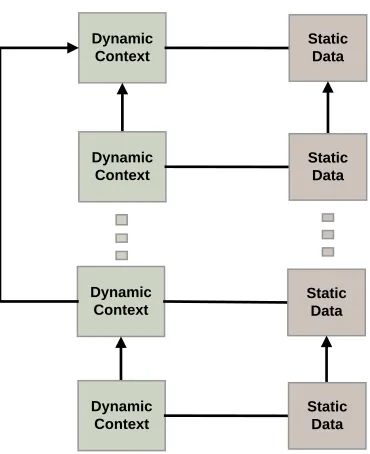
There are several core modules in Apache Axis 2. To handle information and keep the states, Apache Axis 2 defines an Information Module, depicted in Figure 2-4. Information module has a hierarchical structure that helps to manage the object lifecycles. It has two main hierarchies: contexts and description. The description hierarchy represents the static data that can be loaded from a configuration file. For example, service.xml stores the static information for Web Services. However, context hierarchy keeps the dynamic information that needs to be stored while execution continues. This structure is called a hierarchical structure because the context and description data are bounded with a key. When access to the data is required, an inquiry starts bottom to up. The lower level match is preferred to the upper level match. If data is not found in the lower level, it is searched in the upper level. This search continues to the top level. There is one down side of this approach; the search can take too long if the data, which is being searched, is not in the hierarchy[14].
Deployment module of Apache Axis 2 utilizes three level configuration structures: global, service and module. The corresponding configuration files are
29
[image:46.612.233.418.177.404.2]module.xml is checked and finally services.xml is utilized to finalize Axis configuration. The static context structure is built on the top of these configurations.
Figure 2-4 : Information Model
Since SOAP is the most important asset in the Web Service framework, the efficiency of the SOAP processing is very important for the overall performance. Therefore, Apache Axis 2 provides an efficient API, Axis Object Model (AXIOM). AXIOM is a lightweight XML info-set representation based on StAX (JSR 173) [29]. It is a standard streaming pull parser API. Contrary to the object model parser such as DOM, a pull parser does not create any object if it is not necessary. AXIOM utilizes caching; it allows creating and keeping objects for the pulled stream. Fortunately, this cashing can be turned off when it is not required to increase efficiency[30].
Dynamic Context
Dynamic Context
Dynamic Context
Dynamic Context
Static Data
Static Data
Static Data
30
Figure 2-5 : SOAP Processing Model
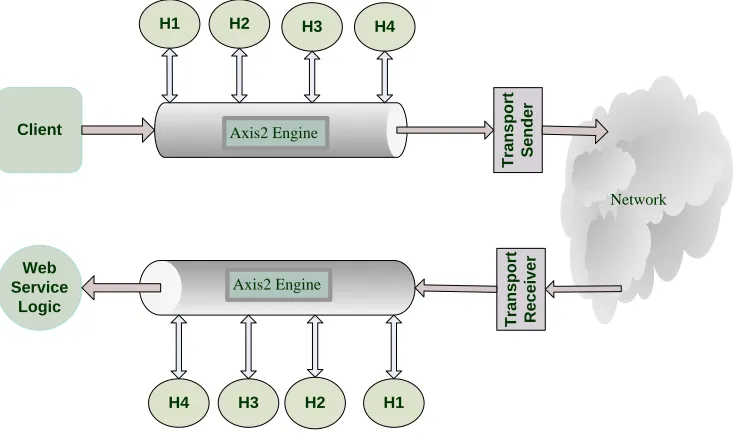
There are two basic actions in order to process SOAP messages in Apache Axis 2: sending and receiving SOAP messages. Apache Axis 2 basically views every transaction as a single SOAP processing. To implement a complex SOAP messaging, containing several messages, a top layered framework is necessary. Apache Axis 2 framework contains two pipes: IN and OUT. They may be combined to exchange messages. Figure 2-5 shows the traversal of a SOAP message. User application can create a SOAP request by using a client API. Before handing the message over transport sender, new capabilities can be added with the handlers. They provide extensibility to the SOAP processing model. They can intercept messages in either IN or OUT pipe.
H1 H4 Client H3 H2 T ra n s p o rt S e n d e r
H4 H3 H2 H1
31
Figure 2-6 : Phase Module and Handler relation
Additionally, Apache Axis 2 introduces an upper level abstraction on to top of handler layer: module. A module may contain a set of handlers and phase rules, depicted in Figure 2-6. In other words, it groups a set of handlers to provide a specific functionality. They are basically intended to implement Web Service Specification in a modular manner such as WS-Addressing [31] and WS-Reliable Messaging[32].
There are stages to arrange the order of the modules. These stages are called as phases. Phases and flows together manage the processing flow for a specific message, depicted in Figure 2-7. Apache Axis 2 contains predefined special handlers such as Dispatchers, Transport receiver and Transport sender. Similarly, several predefined special phases are also introduced: Transport, Pre-Dispatch, Dispatch, User defined and Message Processing phases in IN pipe and Message Initialization, User and Transport phases in OUT pipe. However, this mechanism is not fixed; it is extensible and user customized phases and handlers are allowed to be attached.
Module A
Module B
Phase I Phase II
H3
H1 H2
H4
32
Figure 2-7 : Axis2 Engine In and Out Flows
2.1.3
Web Service Enhancement (WSE)
Similar to Apache Axis, WSE supports Web Services by offering an environment for the supportive capabilities, which are called filters. The execution structure of the filters is very similar to that in Apache Axis. The architecture is depicted in Figure 2-8.
Client Service
Context Context
SOAP/ HTTP
Figure 2-8 : Filter execution structure in WSE
T r a n s p o r t
Axis2 Engine In-Flow
P r e D i s p a t c h D i s p a t c h U s e r D e f i n e d M e s s a g e P r o c e s s i n g M e s s a g e I n i t i l i z e
Axis2 Engine Out-Flow
33
Both Output and Input filters are capable of processing SOAP header and body. The real target is the header, though. WSE has already several build-in filters. However, customizable filters can be added. Filters can create a chain. In this chain, the intermediary information is passed between the filters by using a context, illustrated in Figure 2-8. The context provides an environment to share the properties and variables.
There is a difference in the message context structure between Apache Axis and WSE. MessageContext object in Apache Axis wraps a SOAP message and supplementary information. It is passed as a parameter through the handler chain. On the other hand, filters in WSE loads the information to the context object. The object does not contain the relevant SOAP message.
2.1.4
DEN and XSUL
XSUL is a modular Java Library to construct Web and Grid Services [33, 34]. It has been developed by Extreme Lab at Indiana University. It provides a framework for XML based processing and supports doc-literal, request-response and one-way messaging. Furthermore, it contains modules for a lightweight XML/HTTP invoker and processor. It also supports SOAP 1.1/1.2 and digital signatures. Moreover, it has an ability to provide dynamic service invocation.
34
The latest version of XSUL, XSUL2, allows a request goes through a chain of handlers until it reaches the destination. DEN by utilizing XSUL2 is able to separate the handlers from Web Service endpoint and distribute them as individual service nodes within a chain. The service nodes use a context to convey supplementary information for. A context stores intermediate processing results for the nodes. It is passed inside of the SOAP header through the handler chain.
Design of DEN is not restricted with only SOAP style Web Service interactions. It also utilizes generic HTTP commands such as GET. Moreover, XSUL2 offers an environment to benefit Web Service Definition Language (WSDL) by using GET command.
P1 Pt-1
P1
P1
Pt-1
Pt-1 WSD
Gateway
Web Service Logic
Grids and its services
with replications
Figure 2-9 : DEN: WS Processing in Grids
Additionally, DEN utilizes a table, a hash table with registered service names as keys and endpoint vectors as values, for the routing purpose. Endpoint vectors contain at least one reference. These vectors are bounded with either intermediary processing nodes or final destination of the interaction.
35
support of asynchronous messaging, a WS-Security implementation is divided into sub-atomic tasks and deployed as services. Some tasks are executed in a parallel manner to gain performance and to remove the bottleneck.
2.1.4.1 Differences
The differences can be categorized into two: conceptual and architectural differences. DEN and XSUL distribute handlers as Web Services. Each handler utilizes a WSDL to broadcast information about how to be communicated. On the other hand, DHArch keeps the status of handlers unchanged; they architecturally remain as handlers. The distributed handlers in DHArch do not prefer utilizing a WSDL to be communicated even though it is possible to do so. DHArch prefers using the handler interfaces of the underlying containers and its customized handler interfaces. Hence, a currently implemented handler can be easily deployable without any modifications.
The conceptual differences let the architectures evolve into different directions. Since DEN and XSUL exploit Web Service Framework to deploy handlers, it makes use of HTTP protocol for communication purposes. The handlers are orchestrated by using a routing table. In contrast, DHArch utilizes a MOM to provide communication between the distributed handlers. On the top of this communication mechanism, an orchestration module organizes the distributed handler execution.
36
2.1.4.2 Strong points and advantages
DEN and XSUL together target directly to the Web Service security processing steps without touching the Service logic at all. They tear and granulate the security processing node and deploy the security tasks as individual services. This approach sets an example to distribute the handlers as Web Services.
Utilizing Web Service approach for the handlers provides several benefits. The first benefit is to be able to remove bottlenecks from the SOAP processing pipeline with a very well-known style. Additionally, service based approach improves the interoperability of the deployment. Moreover, this approach is able to utilize the tools that have been already implemented for the Web Services. For instance, many service level orchestration tools can be easily utilized. On the other hand, DHArch follows a different approach to provide a scalable, efficient and modular environment for the handlers. It is basically a distributed Web Service Handler Container. It also removes the bottlenecks from SOAP processing pipeline by using additional resources and providing an environment for the concurrent execution. Additionally, DHArch is able utilizes a Message Oriented Middleware (MOM) for the transportation purpose. MOM is a powerful tool to provide asynchronous, reliable, efficient delivery mechanism. In addition to excellent messaging capability, it can provide a queuing mechanism for the handler execution to regulate the message flow.
37
Moreover, DHArch provides a control mechanism for the pipelined message executions. The number of executable messages is kept in optimum level to prevent the performance degradation because of too many messages processing in a moment.
DHArch utilizes a context that allows a message based execution. Every message may have an individual handler execution sequence; DHArch may employ a different handler execution sequence for each message. It is not centralized. Instead, the sequence that is kept in the context may differ from message to message.
While we were deciding about the best way of carrying the data to the distributed handlers, we conclude that having a format which wraps the SOAP message and additional data is more efficient. The whole SOAP message does not have to be parsed in order to get necessary information to carry out the distributed execution. The format should be simple but not have any deficiency. Hence, the specific messaging format, agreed between the computing nodes, is created.
2.2
Technologies
Since one of the most important assets of Web Services is SOAP, an XML document, parsers are necessary in many places. Moreover, messaging middleware is one of the crucial components of DHArch. It has to provide necessary capability for the transportation. Because of their importance, we will explain these technologies in the remainder of this section.
2.2.1
XML Parsers
38
parser returns a document object tree, depicted in Figure 2-10. We can randomly access any element because each element is entirely kept in the memory. This capability provides very efficient navigation mechanism over the document. Hence, it is very suitable parser if the document needs to be accessed many times. On the other hand, it is a relatively process intensive parser and requires large amount of memory. This situation worsens if the XML document gets bigger. It does not allow partial parsing to remove this bottleneck.
Figure 2-10 : A DOM Tree
On the other hand, SAX parser does not build a document object tree. Instead, it utilizes an event-driven push model. The parser reads a series of events from the XML document and pushes them to the event handlers. The context can be reached by using these event handlers, shown in Figure 2-11. SAX parser has low memory consumption because the whole document does not need to be loaded into the memory. SAX can handle a document whose size is bigger than the system memory. It also validates the XML document against XML schema. Moreover, it works faster than DOM parser. However, the document needs to be parsed repeatedly when the event states are not kept
Document
Element Element Attribute
39
for the later usage. Maintaining the events is left to the application. Therefore, it does not provide efficient XML parsing when the document needs to be accessed many times.
Figure 2-11 : SAX shows the context to an application as a series of events
StAX Parser provides a new parsing technique that utilizes an event driven model by pulling instead of pushing. It processes a request by returning the events as well as providing the relevant objects, depicted in Figure 2-12. StAX differs from DOM and SAX by specifying two parsing modules; curser an iterator module. Cursor module returns only events although iterator model provides objects. This allows creating an object if only it is necessary [36].
Figure 2-12 : StAX provides an event to an application
Performance wise, pull parser beats the previous parsers in most respects. For the limited memory environments pull parser is the most appropriate one because it requires very tiny memory space and can provides the object of the partial XML documents. If an
Foo.xml
SAX Parser Event
Handler
Show contents
Read Push Events
event
event
event
Foo.xml
StAX Parser Application
Provide contents
Read on
demand Pull Events
event
event
40
application does not require the validation of full document, entities, processing instructions or comments, pull parser looks to be best choice. The detailed performance results of various parser implementations are provided in an article, published by IBM [37]. XPP, an XML pull parser implementation by Extreme Lab at Indiana University, achieves very astonishing performance results[38].
2.2.2
NaradaBrokering
NaradaBrokering is a distributed brokering system that support centralized, distributed and peer-to-peer (P2P) interactions [39]. It have designed to operate on a large network of cooperating broker nodes, which are able to intelligently process and route messages while working with multiple underlying communication protocols. Broker is the smallest unit of the underlying messaging infrastructure. Broker nodes are organized in a cluster-based architecture that allows supporting large heterogeneous client configurations to scale in arbitrary size. NaradaBrokering imposes a hierarchical structure over the clusters. A broker is a part of cluster that is a part of super-cluster, which is also a part of super-super-cluster and so forth. These clusters consist of strongly connected brokers with multiple links to the brokers in the other clusters. This ensures alternative communication routes while a failure occurs. Every cluster unit employs a cluster controller node to provide a gateway to the other units