Abstract: The tremendous development in communication technology has led to the rise of a new topic called Big Data. Large Scale Wireless Sensor Network (LS-WSN) is one of the key contributors to big data that produce a remarkable amount of data. Data collection pose a number of challenges to Wireless Sensor Networks (WSNs). To overcome these challenges various energy efficient routing algorithms are proposed. An energy efficient algorithm is proposed in this paper for LS-WSNs. The establishment of clustering communication is based on the remaining energy of sensor nodes and distance among them. In the proposed technique, network lifetime is evaluated and enhanced. Utilizing the concept of density-based clustering communication, network lifetime is enhanced and hence minimized energy consumption. Simulation results indicate that the proposed approach enhanced the network lifetime and can be a useful approach for WSNs in military applications. The efficacy of proposed technique is demonstrated via experimental results in terms of network lifetime acquired in MATLAB.
Index Terms: Wireless Sensor Networks (WSNs), Big Data, Energy Efficiency, Clustering, Network Lifetime.
I. INTRODUCTION
Development in diverse fields of Information and Communication Technology (ICT) has resulted in a tremendous increase in data volume. In 2012, IBM published a report [1] according to which in the years 2010 and 2011, 90 percent of data was produced in the world. As a result of which, big data came into view as a highly acknowledged trend which is seeking focus from all sectors like government, industry, and academia [2]. Huge volume, high velocity and profoundly differing data resources of huge information make it challenging to accumulate, process, send and store enormous information by utilizing the existing innovations. Variety demonstrated that information involves generally differing structures, that is, information delivered from a general classification of sources like Machine to Machine, Radio Frequency Identification (RFID), Sensors, etc. Velocity is identified with information gathering, handling, and transmission speed. Volume uncovers that a lot of information needs to be gathered, analyzed and transmitted. Despite the fact that
Manuscript Received on May 09, 2019.
Quosain Jawhar, Department of Electronics & Communication Engineering, me, Chandigarh University, Mohali, India.
Khushal Thakur, Assistant Professor, Department of Electronics & Communication Engineering, me, Chandigarh University, Mohali, India.
Kiran Jot Singh, Assistant Professor, Department of Electronics & Communication Engineering, me, Chandigarh University, Mohali, India.
administrations like interpersonal organizations, cloud storage, network switches, and so forth are producing a colossal measure of information, sensors/RFID gadgets (for example thermometric sensors, barometrical sensors, proximity sensors, etc) additionally produce much volume of Big data. Oracle published a report [3] as indicated by which data generated by sensors and RFID devices are ventured to ascend to the order of petabytes. Subsequently, Large Scale Wireless Sensor Networks (LS-WSNs) are considered among numerous sources of Big Data. WSNs consist of numerous sensor nodes deployed either randomly or in a predetermined manner in an area. These nodes cooperatively monitor the environmental quantities, process the sensed data and send information of the monitored area to the base station (BS). Although WSNs, consisting of wireless sensor nodes, which are cheap, small in dimension, light weight and low power devices, enable multiple applications including environmental monitoring [4-5], military surveillance [6-7], health monitoring [8], agriculture surveillance [9-10] and many more [11]. The limited, mostly non-rechargeable power supplies degrade the network lifetime. Also, the amount of data to be transmitted is proportional to the energy consumption. In the big data environment (such as industries, borders, mountains and forests and so on), two major challenges are faced in gathering data from thousands of sensors. First, due to the limited wireless communication range, the network is partitioned into sub-networks. For example, sensor nodes deployed on one side of a mountain may be unable to communicate with the sensor nodes deployed on the other side. As a consequence, the restricted communication range may cause a hurdle in gathering data from all the sensors. Second, although an individual sensor node does not generate much significant volume of data, each sensor node needs sufficient energy to relay the data gathered from neighboring sensor nodes particularly in dense WSNs containing millions of nodes. To solve these challenges, energy efficient data gathering schemes need to be employed to gather high volume of data efficiently and disseminate it to the sink in order to minimize total energy consumption in the process of transmission. Katti et al. [12] proposed a data compression technique that has the ability of reducing the voluminous transmitted data. Even though this technique is easy to be implemented, the sensor nodes require to be equipped with high computational power and a huge volume of storage.
An Efficient Clustering Algorithm for Big Data
Gathering in Large Scale Wireless Sensor
Networks (LS-WSNs)
Moreover, the topology control strategies [13-14] can estimate the finest logical topology and minimize transmission of redundant data. The reduced redundant transmissions result in reduced wireless transmission energy. Flow control and routing schemes [15-16], in addition, select the route consisting of nodes with higher residual energy. However, these schemes are unable to handle divided network problems. In this paper, a framework is proposed that aims for border surveillance where millions of sensor nodes are randomly deployed. In such a random deployment scenario there might be some small areas with dense count of nodes and other areas with less count of nodes. Hence concept of density-based clustering communication is utilized. Previous research work utilized the concept of, increased cluster count lead to less energy consumption. However, in this paper, the idea that higher cluster count results in degraded performance is favored. The residual energy of sensor nodes and distance among them is used data transmission and reception process.A clustering algorithm is proposed to gather data for border surveillance application. In this algorithm, the election of Cluster Heads (CHs), Cluster Coordinators (CCOs), and Relay Nodes (RNs) is performed based on remaining energy of nodes. The proposed algorithm enhances energy conservation by sharing data burden on CHs, CCOs, and RNs for effective data collection. Simulation results reveal that our proposed scheme works well in terms of network lifetime. The rest of paper is presented as follows. Section II reviews the related work. In section III, proposed scheme is given. Section IV presents the simulation output and result discussion. Lastly, Section V concludes the paper.
II. LITERATUREREVIEW
WSNs have gained much attention from the past few decades because of its indispensable role in both civilian and military applications. However, very few works are there in analyzing large scale WSNs generating big data. Harb et al. [17] presented a concept for data reduction in densely distributed WSNs. A model called Pearson Coefficient model is developed which works in two levels, in the first level the collected data is compressed and in the second level K-means and TopK clustering methods are used to remove redundant data. Kim et al. [18] extended unicast m,k- firm stream to multicast m,k-firm stream which can be applied to multicast communication where many nodes are interested in receiving data packets from the sink node. Big Data-oriented Energy Aware Routing (BEAR) [19] is an energy-aware protocol which proves to be efficient in routing large volume of data and in enhancing network connectivity. Meng et al. [20] performed Bayesian-based trust management with traffic sampling that enhances trust management in an environment with high data traffic by detecting the malicious nodes and reduce the burden of handling high traffic of data. Lin et al [21] developed a new clustering method which divides the network area into fan-shaped clusters and provided two benefits: localized re-clustering process which minimize signaling cost, and robust routing scheme. Data aggregation approach used widely by many applications provide significant results in reducing the volume of big sensory data to be transmitted
III. DENSITYBASEDCLUSTERINGALGORITHM FORLS-WSNS
In this section, firstly the clustering problem is outlined. The network model is introduced in next sub-section followed by the overview of proposed algorithm.
A. Clustering Problem
In WSNs. the selection of the optimal scheme to collect the data, minimization of energy consumption and to find the location of data collection at one point needed to be resolved efficiently. These challenges resulted in two issues, how nodes are distributed into clusters and optimal cluster count. Since data transmission energy has a direct relationship with distance, a lot of energy is required in data transmission process when sending node is at a farther distance from BS. This problem can be solved either by utilizing relays selected in the path between source node and BS or by utilizing any shortest path routing algorithm. In densely deployed WSNs finding of the shortest path will be time- consuming thus the second approach is less optimal. The optimal approach is designing a transmission strategy to form the clusters and to ease multi-hop routing through load balancing on nodes. It will facilitate a reduction in transmission distance of far away, even though the distance of route calculated through the sum of all relay nodes selected in the path to BS can be more. The proposed technique utilizes hop-to-hop communication for data transmission.
B. Proposed Network Model
In the proposed algorithm, a network is considered which is comprised of BS located at the center of border field where thousands of sensor nodes randomly distributed in a target area. Each node computes its location by utilizing localization technology. Sensor nodes have restricted communication range, and hence communication is only possible if the nodes are in each other’s range. The proposed methodology suppose that network is deployed in large and dense area for border surveillance application. The network model is shown in Figure 1 where N number of sensor nodes are distributed randomly into the L×B target area. The area is firstly divided into M number of small grids of 50×50 with respect to the x and y-axis of the given area. The grids forming clusters are of two types, lightly dense with lesser count of nodes and heavily dense with higher count of nodes. Clusters are highlighted by dark black color. CHs, CCOs, and RNs are represented by blue, black and green colors respectively. CHs are elected in all the clusters. CCOs are elected in the clusters surrounding the BS for balancing the load of data received from boundary clusters and RNs are elected in heavily dense clusters. Each CCO collects data of clusters that are not close to the BS and forward the received data to BS. In heavily dense clusters RNs are elected for sharing the burden of data traffic.
C. Overview of the Proposed Algorithm
In this paper the proposed technique can be used for border surveillance application, where thousands of nodes are distributed randomly in a large field, it is highly possible that some regions are heavily dense and some are lightly dense in terms of node count. Therefore, this scenario has
inspired to propose an algorithm for handling lightly dense and heavily dense clusters in a network. The data transmission process is as follows:
1) In each cluster CH is selected. CCO is selected in the clusters that are near to BS and RN is selected in the heavily dense clusters. A threshold value is set for deciding lightly dense and heavily dense clusters as:
Thresh. Val.= Total no. of nodes/ Total no. of clusters (1) If no. of nodes in a cluster > Threshold
value, Indicates heavily dense
Otherwise lightly dense
[image:3.595.308.543.218.410.2]
Fig. 1: Data communication structure in the proposed algorithm
Table 1 Proposed Network Setup with respect to parameters
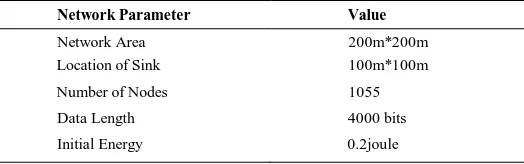
Network Parameter Value
Network Area 200m*200m
Location of Sink 100m*100m
Number of Nodes 1055
Data Length 4000 bits
Initial Energy 0.2joule
2) At regular intervals data from the nodes are gathered at the CHs.
3) Data received at CH is transmitted directly to the BS if BS is nearby otherwise via CCO elected in the clusters near to BS.
4) In heavily dense clusters RN is selected to share the burden of data traffic in that particular cluster.
5) If the energy level of CCOs, CHs and RNs is found less than the threshold at any time, then re-election is made based on residual energy.
[image:3.595.306.568.444.526.2]In the initial stage of transmission round, BS broadcast its information (RSSI), the information about clusters and CHid, CCOid, and RNid to all the sensor nodes (SN) and SNs calculate their information with the help of a localized algorithm. SNs calculate whether they can have direct transmission to BS or not. If SN and BS are in range, they can communicate directly otherwise via CH. The calculations are done based on the following equation [29]:
BSRSSI − NRSSI_BSi < NRSSI_ −NRSSI_min (2)
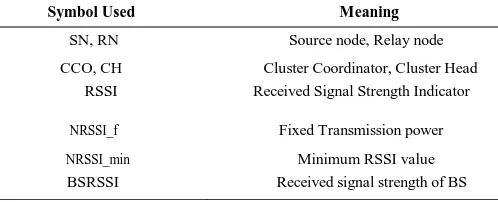
The symbols used in the proposed scheme and their meanings are given in Table 1.
Each CH transmit the data of its cluster and CCO balance the burden of a network by transmitting data of the cluster away from BS.
Election of RN, CCO and CH is done with the help of transmission algorithm. The election of RNs in the heavily dense clusters is based on minimum distance algorithm of LEACH [30] in which data of nodes is forwarded to CH if the distance to selected RN is more than CH.
Each SN compare its residual energy with other SNs and SN with the highest energy is elected as CH, SN with second energy is elected as CCO. In the developed scheme, energy is conserved in deciding which cluster non-cluster nodes belong to as clusters are pre-decided based on dimensions, as mentioned earlier. Also, CCO help in lowering the burden on CHs around the BS by forwarding the data to BS received from farther CHs.
After the cluster set-up phase, data is transmitted to BS. Each SN in all the clusters forward data to CH elected in the lightly dense cluster.
However, in heavily dense clusters if the distance between SN and CH is large data is forwarded to CH via RN elected in heavily dense clusters otherwise SNs have a direct transmission to CH.
[image:4.595.47.296.569.670.2]CH forwards data to BS if BS is near otherwise via CCO elected in BS’s nearby clusters. The transmission process and cluster configuration depend on distance and remaining energy of SNs.
Table 2 Symbols and their meanings used in our proposed approach.
IV. SIMULATIONRESULTS
An algorithm is developed in this paper for border surveillance application. The proposed algorithm is implemented and evaluated on MATLAB simulation platform. The performance evaluation is done in terms of network lifetime and for this purpose, the number of alive
nodes and number of dead nodes in the network is evaluated. Proposed algorithm,BDEG, and ERP protocols are used for data transmission to the BS. Table 1 shows the simulation parameters.
Network Lifetime: Network lifetime is defined as the time till first node death, or the time till 50 percent of the nodes die out or the time till the last node death. This parameter tells about the energy efficiency of nodes that is, an increase in energy efficiency leads to prolonged network lifetime.
Analysis of Network Lifetime: Various parameters such as imbalanced load, long-distance data transmission, etc. affect network lifetime. In proposed algorithm two communication strategies are selected, one for heavily dense clusters in which RNs are elected and other for lightly dense clusters where there are not RNs. Also, the burden of data coming from far away clusters is balanced by electing CCOs in the clusters surrounding BS which is located at the center of the target field. Multi-hop and multi-layer communication take place with the help of RNs, CCOs, and CHs which optimize energy consumption throughout the network. Distance for SNs has been decreased that is data transmission takes place at small distances and thus require small energy. For instance, in heavily dense clusters if SN has to send data to BS but BS is situated far away it will try to find its distance to CH. If the distance between SN and CH is larger, then SN transmits data to RN which further transmit to CH. The CH then forward gathered data to CCO of the cluster near to BS and finally to BS. Data communication in heavily-dense cluster occur as follows:
S R (3) Data communication in lightly-dense cluster occur as follows:
S (4)
For WSNs, developing a routing algorithm face a major constraint which is minimizing energy consumption, hence lifetime maximization. Fig. 2 shows network lifetime for three algorithms. It can be clearly observed that network lifetime for proposed algorithm (Red Color) is longer as compared to other algorithms as it transmits data for more than 7000 rounds which is more than BDEG (Black Color) and even more than ERP (Green Color) protocol. Both proposed algorithm and BDEG are stable in terms of dead nodes after 7711 and 5000 rounds of data transmission respectively, as compared to ERP in which nodes die very early and at most in 2000 rounds. This huge enhancement in network lifetime and optimization in network stability is because of employing two strategies for heavily dense and lightly dense clusters and load balancing (as all CHs and CCOs handle the burden of each cluster). When CH and CCO energy falls below the threshold value, other nodes with high residual energy play their role. In previous research works, CHs communicate directly with BS and cluster count is obtained on the basis of the algorithm used in LEACH protocol [31].
Symbol Used Meaning
SN, RN Source node, Relay node
CCO, CH Cluster Coordinator, Cluster Head RSSI Received Signal Strength Indicator
NRSSI_f Fixed Transmission power
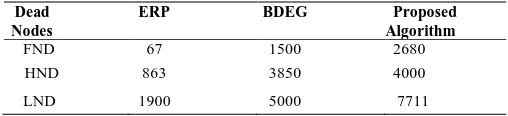
Also, an increased cluster count result in more energy conservation. But in the proposed scheme cluster count is 16 and data transmission takes place in multi-hop and multi-layer manner. The round history of dead nodes in terms of first node dead (FND), half node dead (HND) and last node dead (LND) in proposed algorithm, BDEG and ERP is presented in Table 3 according to which network lifetime enhancement is clearly observed.
Fig. 2:Comparison of Network Lifetime
Table 3 Round history of dead nodes
Dead Nodes
ERP BDEG Proposed
Algorithm
FND 67 1500 2680
HND 863 3850 4000
LND 1900 5000 7711
V. CONCLUSIONSANDFUTURESCOPE
In this work, the study and amendments are done on a wireless network that comprised of a large number of sensor nodes deployed randomly for military applications. An algorithm is proposed for border surveillance application. In the proposed approach the concept of density-based clustering communication is utilized and RSSI values determine direct or indirect communication of SNs and BS. The performance of the proposed approach is compared with a few other algorithms. The obtained simulation results prove the efficiency of proposed algorithm over traditional BDEG and ERP approach in terms of network lifetime. The obtained output concludes that the network lifetime of the proposed algorithm is 60% to 70% better than the lifetime of the BDEG and ERP approaches. Future work will focus on factors such as performance reliability, data delivery ratio, etc. For this purpose, the criteria for CH selection can be improved by enhancing the list of parameters like delay, congestion level on the route etc.
REFERENCES
1. IBM, “Four vendor views on Big Data and big data analytics: IBM,”
http://www- 01.ibm.com/software/in/data/bigdata/, Jan. 2012.
2. A. Divyakant, B. Philip, and et al., “Challenges and opportunities with Big Data,” 2012, a community white paper developed by leading researchers
across the United States. [Online]. Available:http://cra.org/ccc/docs/init/big data white paper.pdf.
3. Winter, R.: Big Data: Business Opportunities, Requirements, and Oracle's
Approach. Executive Report, Winter Corporation,1- 8(2011).
4. Alhmiedat, T.: A Survey on Environmental Monitoring Systems using
Wireless Sensor Networks. JNW, 10(11), 606-615(2015).
5. Adu-Manu, K. S., Tapparello, C., Heinzelman, W., Katsriku, F. A., & Abdulai, J. D.: Water quality monitoring using wireless sensor networks: Current trends and future research directions. ACM Transactions on Sensor Networks (TOSN), 13(1), 4(2017).
6. Azzabi, T., Farhat, H., & Sahli, N.: A survey on wireless sensor networks security issues and military specificities. In 2017 International Conference on Advanced Systems and Electric Technologies (IC_ASET) (pp. 66-72). IEEE (2017).
7. Ahmad, I., Shah, K., & Ullah, S.: Military applications using wireless sensor networks: A survey. Int. J. Eng. Sci, 6(6), 7039(2016).
8. Alemdar, H., & Ersoy, C.: Wireless sensor networks for healthcare: A survey. Computer networks, 54(15), 2688-2710(2010).
9. Joshi, P. P., Kanade, S. S., & Joshi, S. P.: Wireless sensor network and monitoring of crop field. IOSR Journal of Electronics and Communication Engineering (IOSR-JECE), 12(1), 23- 28(2017).
10. Deepika, G., & Rajapirian, P.: Wireless sensor network in precision agriculture: A survey. 2016 International Conference on Emerging Trends in Engineering, Technology and Science (ICETETS), 1-4(2016). 11. Prasad, P.: Recent trend in wireless sensor network and its applications: a
survey. Sensor Review, 35(2), 229-236(2015).
12. Katti, S., Rahul, H., Hu, W., Katabi, D., Médard, M., & Crowcroft, J.: XORs in the air: practical wireless network coding. IEEE/ACM Transactions on Networking (ToN), 16(3), 497-510(2008).
13. Miyao, K., Nakayama, H., Ansari, N., & Kato, N.: LTRT: An efficient and reliable topology control algorithm for ad-hoc networks. IEEE Transactions on Wireless Communications, 8(12), 6050-6058(2009). 14. Li, N., Hou, J. C., & Sha, L.: Design and analysis of an MST-based
topology control algorithm. IEEE Transactions on Wireless
Communications, 4(3), 1195-1206(2005).
15. S. He, S., Chen, J., Yau, D.K., & Sun, Y.: Cross-Layer Optimization of correlated data gathering in wireless sensor networks. IEEE Communications Society Conference on Sensor Mesh and Ad Hoc Communications and Networks (SECON), 1–9 (2010).
16. Chen, J., Xu, W., He, S., Sun, Y., Thulasiraman, P., & Shen, X.: Utility-based asynchronous flow control algorithm for wireless sensor networks. IEEE Journal on Selected Areas in Communications, 28(7), 1116-1126(2010).
17. Harb, H., Makhoul, A., & Jaoude, C. A.: A Real-Time Massive Data Processing Technique for Densely Distributed Sensor Networks. IEEE Access, 6, 56551-56561(2018).
18. Kim, B. S., Aldwairi, M., & Kim, K. I.: An efficient real-time data dissemination multicast protocol for big data in wireless sensor networks. Journal of Grid Computing, 1-15(2018).
19. Reshma, J., Kumar, T. S., Vani, B. A., & Sakthivel, S.: Big Data Oriented Energy Aware Routing for Wireless Sensor Networks. Mobile Networks and Applications, 1-9(2018).
20. Meng, W., Li, W., Su, C., Zhou, J., & Lu, R.: Enhancing trust management for wireless intrusion detection via traffic sampling in the era of big data. IEEE Access, 6, 7234-7243(2018).
21. Lin, H., Wang, L., & Kong, R.: Energy efficient clustering protocol for
large-scale sensor networks. IEEE Sensors Journal, 15(12),
7150-7160(2015).
22. Ren, M., Li, J., Guo, L., Li, X., & Fan, W.: Distributed Data Aggregation Scheduling in Multi- Channel and Multi-Power Wireless Sensor Networks. IEEE Access, 5, 27887-27896(2017).
23. Takaishi, D., Nishiyama, H., Kato, N., & Miura, R.: Toward energy efficient big data gathering in densely distributed sensor networks. IEEE Transactions on Emerging Topics in Computing, 2(3), 388-397(2014). 24. Rani, S., Ahmed, S. H., Talwar, R., & Malhotra, J.: Can sensors collect big
data? An energy- efficient big data gathering algorithm for a WSN. IEEE Transactions on Industrial Informatics, 13(4), 1961-1968(2017). 25. Zhou, F., Chen, Z., Guo, S., & Li, J.: Maximizing lifetime of
data-gathering trees with different aggregation modes in WSNs. IEEE Sensors Journal, 16(22), 8167-8177(2016).
26. Ang, K. L. M., Seng, J. K. P., & Zungeru, A. M.: Optimizing energy consumption for big data collection in large-scale wireless sensor networks with mobile collectors. IEEE Systems Journal, 12(1), 616-626(2018). 27. Abdelhakim, M., Liang, Y., & Li, T.: Mobile coordinated wireless sensor
[image:5.595.41.295.373.431.2]28. Yang, C., Liu, C., Zhang, X., Nepal, S., & Chen, J.: A time efficient approach for detecting errors in big sensor data on cloud. IEEE Transactions on Parallel and Distributed Systems, 26(2), 329- 339(2015). 29. Bellavista, P., Cardone, G., Corradi, A., & Foschini, L.: Convergence of
MANET and WSN in IoT urban scenarios. IEEE Sensors Journal, 13(10), 3558-3567(2013).
30. Khaday, B., Matson, E. T., Springer, J., Kwon, Y. K., Kim, H., Kim, S., ... & Woo, H. S..: Wireless sensor network and big data in cooperative fire security system using harms. 6th International Conference on Automation, Robotics and Applications (ICARA), 405-410(2015).
31. Heinzelman, W. R., Chandrakasan, A., & Balakrishnan, H.:
Energy-efficient communication protocol for wireless microsensor networks. Proceedings of the 33rd annual Hawaii international conference on system sciences (2000).
AUTHORSPROFILE
Quosain Jawhar received the Bachelors degree in Electronics and Communication Engineering from Baba Ghulam Shah University, J&K India. She is currently pursuing the Masters degree in Electronics and Communication Engineering from Chandigarh University, India. Her research interests include wireless communication, and sensor networks.
Khushal Thakur received the Masters degree in Electronics and Communication Engineering from Jaypee University of Information and Technology, India and Bachelors degree in Electronics and Communication Engineering from Himachal Pradesh University,India. He is currently pursuing Ph.D. degree from Chandigarh University , India and is working as Assistant Professor in Chandigarh University, India. He is working on low energy Bluetooth and massive MIMO technology. He has published 4 patents. His research interests include millimeter waves, wireless communication, and sensor networks.
Kiran Jot Singh received B.Tech and
M.Tech degree in Electronics and