Software Frameworks for Deep Learning at Scale
James Fox
Georgia Institute ofTechnology
[email protected]
Yiming Zou
Indiana UniversityBloomington
[email protected]
Judy Qiu
Indiana UniversityBloomington
[email protected]
ABSTRACT
The study and adoption of deep learning methods has led to significant progress in different application domains. As deep learning continues to show promise and its utilization matures, so does the infrastructure and software needed to support it. Various frameworks have been developed in re-cent years to facilitate both implementation and training of deep learning networks. As deep learning has also evolved to scale across multiple machines, there’s a growing need for frameworks that can provide full parallel support. While deep learning frameworks restricted to running on a sin-gle machine have been studied and compared, frameworks which support parallel deep learning at scale are relatively less known and well-studied. This paper seeks to bridge that gap by surveying, summarizing, and comparing frameworks which currently support distributed execution, including but not limited to Tensorflow, CNTK, Deeplearning4j, MXNet, H2O, Caffe, Theano, and Torch.
1.
INTRODUCTION
Deep learning has been quite successful in improving predic-tive power in domains such as computer vision and natural language processing. State-of-the-art performance in com-puter vision is driven by the convolutional neural network model, a special kind of feed-forward deep learning model. The high-level idea is to learn images filters for extracting meaningful features and predictions. On the other hand, natural language processing has had a lot of success apply-ing recurrent neural networks, a type of feedback model well-suited for learning order and context-sensitive sequences (as in natural languages).
As accuracies continue to increase in both domains, so do the complexity of network architectures and the size of the parameter space. Google’s network for unsupervised learn-ing of image features reached a billion parameters [22], and was increased to 11 billion parmeters in a separate experi-ment at Stanford [27]. In the NLP space, Digital Reasoning Systems trained a 160 billion parameter network [29] fairly recently. Handling problems of this size involves looking be-yond the single machine, which Google first demonstrated through its distributed DistBelief framework [21].
The goal of this paper is to survey the landscape of deep learning frameworks with full support for parallelization. Three levels of parallelization exist on the hardware level: within a GPU, between GPUs on a single node, and between
nodes. Two forms of parallelism also exist on the application level: model and data parallelism. Other aspects of frame-works include release date, core language, user-facing API, computation model, communication model, deep learning types, programming paradigm, fault tolerance, and visual-ization. This choice of criteria is explained in detail in Sec-tion 2. Tensorflow, CNTK, Deeplearning4j, MXNet, H2O, Caffe, Theano, and Torch do not necessarily encompass the entire space of frameworks for deep learning, but were se-lected by a combination of factors: their being open-source, level of documentation, maturity as a complete product, and level of adoption by the community. These frameworks, as well as some others not included in the Section 2 chart, are examined in detail in Section 3. Section 4 discusses finer points of parallelism and scalability in deep learning which may escape but are pertinent to the framework discussion. Section 5 offers concluding remarks.
2.
FRAMEWORK COMPARISON
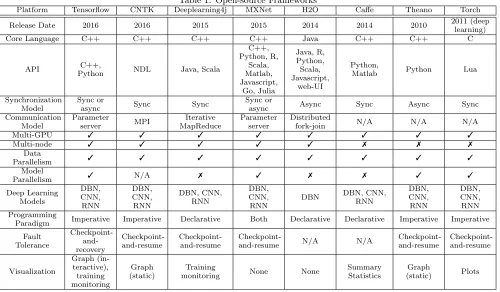
The relevance of release date, core language, user-facing APIs are self-explanatory. Synchronization model speci-fies the nature of data consistency through execution, i.e. whether updates are synchronous or asynchronous. In con-text of optimization kernels like stochastic gradient descent (SGD), synchronous execution has better convergence guar-antees by maintaining consistency or near-consistency with sequential execution. Asynchronous SGD can exploit more parallelism and train faster, but with less guarantees of con-vergence speed. Frameworks like Tensorflow and MXNet leave this tradeoff as a choice to the user.
The communication model tries to categorize the nature of across-machine execution according to well-known paradigms. There are three possible levels of parallelism at the hardware level: cores within a CPU/GPU device, across multiple de-vices (usually GPUs for deep learning), or across machines. Most lower-level library kernels (e.g. for linear algebra) are designed to use multiple cores of a device by default, so this is not a major point of comparison. At this point, all the frameworks also support parallelism across multiple GPUs. Theano and Torch do not yet support multi-machine paral-lelism.
Table 1: Open-source Frameworks
Platform Tensorflow CNTK Deeplearning4j MXNet H2O Caffe Theano Torch
Release Date 2016 2016 2015 2015 2014 2014 2010 2011 (deep
learning)
Core Language C++ C++ C++ C++ Java C++ C++ C
API C++,
Python NDL Java, Scala
C++, Python, R, Scala, Matlab, Javascript, Go, Julia Java, R, Python, Scala, Javascript, web-UI Python,
Matlab Python Lua
Synchronization Model
Sync or
async Sync Sync
Sync or
async Async Sync Async Sync
Communication Model Parameter server MPI Iterative MapReduce Parameter server Distributed
fork-join N/A N/A N/A
Multi-GPU 3 3 3 3 3 3 3 3
Multi-node 3 3 3 3 3 7 7 7
Data
Parallelism 3 3 3 3 3 3 3 3
Model
Parallelism 3 N/A 7 3 7 7 3 3
Deep Learning Models DBN, CNN, RNN DBN, CNN, RNN DBN, CNN, RNN DBN, CNN, RNN
DBN DBN, CNN, RNN DBN, CNN, RNN DBN, CNN, RNN Programming
Paradigm Imperative Imperative Declarative Both Declarative Declarative Imperative Imperative
Fault Tolerance Checkpoint- and-recovery Checkpoint-and-resume Checkpoint-and-resume
Checkpoint-and-resume N/A N/A
Checkpoint-and-resume Checkpoint-and-resume Visualization Graph (in-teractive), training monitoring Graph (static) Training
monitoring None None
Summary Statistics
Graph
(static) Plots
Deep learning models can be categorized into three major types: deep-belief networks (DBNs), convolutional neural networks (CNNs), and recurrent neural networks (RNNs). CNNs and RNNs were briefly described in the introduc-tion. DBNs are less domain-specific compared to CNNs and RNNs, and could be considered a precursor to CNNs, but are fundamental nonetheless.
Programming paradigm falls into the categories of imper-ative, declarimper-ative, or a mix of both. Conventionally, im-perative programming specifieshow a computation is done, where as declarative programming specifies what needs to be done. There is plenty of gray area, but the distinction is made in this paper based on whether the API exposes the user to computation details that require some understand-ing of the inner math of neural networks (imperative), or whether the abstraction is yet higher (declarative).
Fault tolerance is included for two reasons. Distributed ex-ecution tends to be more failure prone, especially at scale. Furthermore, any failures (not necessarily limited to dis-tributed execution) that interrupt training part-way can be very costly, if all the progress made on the model is simply lost.
Finally, UI/Visualization is a feature supported to very dif-ferent degrees across the frameworks studied. The ability to monitor the progress of training and the internal state of networks over time could be useful for debugging or hy-perparameter tuning, and could be an interesting direction. Tensorflow and Deeplearning4j both support this kind of visualization.
3.
FRAMEWORK DISCUSSION
3.1
Tensorflow
of data designated to be persistent, while the overall com-putation graph is restarted. In terms of other features, Ten-sorBoard is a tool for interactive visualization of a user’s network, and also provides time series data on various as-pects of the learning network’s state during training.
3.2
CNTK
Computational Network Toolkit (CNTK) was made open-source by Microsoft around January of 2016. It currently offers a high-level domain-specific language called NDK for implementing networks. The programming paradigm is ex-pressive, complete with vector, matrix, and tensor oper-ations [30] for specifying computoper-ations. CNTK generally treats a network as a directed graph, where nodes encapsu-late operations and edges for data flow, similar to Tensor-flow. There is also a special operator to handle feedback, supporting arbitrary recurrent neural networks [12]. MPI is used for distributed communication. Data parallelism is en-abled in a synchronous manner [9], for SGD [11]. However, support for model parallelism is not explicitly mentioned. Fault tolerance involves checkpoint-and-restart [5].
3.3
Deeplearning4j
Deeplearning4j is a Java-based deep learning library built and supported by Skymind, a machine learning intelligence company, in 2014. It is an open source product designed for adoptability in industry, where Java is very common. The framework currently interfaces with both Java and Scala, with a Python SDK in-progress. Programming is primar-ily declarative, involving specifying network hyperparame-ters and layer information. Deeplearning4j integrates with Hadoop and Spark, or Akka and AWS for processing back-ends. Distributed execution provides data parallelism through the Iterative MapReduce model [6]. Each worker processes its own minibatch of training data, with workers periodically ”reducing” (averaging) their parameter data. Deeplearn-ing4j hosts its own C++ based scientific computing library, which claims 2x or more speedup over Python’s Numpy li-brary on large matrix multiplies [10]. Fault tolerance is not mentioned, although Spark does have built-in fault tolerance mechanisms. One of Deeplearning4j’s features is out-of-the-box support for reinforcement learning using deep learning, a relatively recent application.
3.4
MXNet
MXNet became available in 2015 and was developed in col-laboration across several institutions, including CMU, Uni-versity of Washington, and Microsoft. It currently interfaces with C++, Python, R, Scala, Matlab, Javascript, Go, and Julia. MXNet supports both declarative and declarative ex-pressions; declarative in declaring computation graphs with higher-level abstractions like convolutional layers, and im-perative in the ability to direct tensor computation and con-trol flow. Data parallelism is supported by default, and it also seems possible to build with model parallelism. Dis-tributed execution in MXNet generally follows a parameter server model, with parallelism and data consistency man-aged at two levels: intra-worker and inter-worker [19]. De-vices within a single worker machine maintain synchronous consistency on its parameters. Inter-worker data consis-tency can either be synchronous, where gradients over all workers are aggregated before proceeding, or asynchronous, where each worker independently updates parameters. This
trade-off between performance and convergence speed is left as an option to the user. The actual handling of server updates and requests is pushed down to MXNet’s depen-dency engine, which schedules all operations and performs resource management [19]. Fault tolerance on MXNet in-volves checkpoint-and-resume, which must be user-initiated.
3.5
H2O
H2O is the open-source product of H2O.ai, a company fo-cused on machine learning solutions. H2O is unique among the other tools discussed here in that it is a complete data processing platform, with its own parallel processing engine (improving on MapReduce) with a general machine learn-ing library. The discussion will be limited to H2O’s deep learning component, available since 2014. H2O is Java-based at its core, but also offers API support for Java, R, Python, Scala, Javascript, as well as a web-UI inter-face [17]. Programming for deep learning appears declara-tive, as model-building involves specifying hyperparameters and high-level layer information. Distributed execution for deep learning follows the characteristics of H2O’s process-ing engine, which is in-memory and can be summarized as a distributed fork-join model (targeting finer-grained paral-lelism) [25]. Data parallelism follows the ”HogWild!” [26] approach for parallelizing SGD. Multiple cores handle sub-sets of training data and update shared parameters asyn-chronously. Scaling up to multi-node, each node operates in parallel on a copy of the global parameters, while parameters are averaged for a global update, per training iteration [17]. There does not seem to be explicit support for model par-allelism. Fault tolerance involves user-initiated checkpoint-and-resume. H2O’s web tool can be used to build mod-els and manage workflows, as well as some basic summary statistics, e.g. confusion matrix from training and valida-tion.
3.6
Caffe
Caffe is a framework for convolutional deep learning released by UC Berkeley’s computer vision community in 2014. It of-fers Python and Matlab API. Programming is highly declar-ative; creating a deep learning network involves specify-ing layers and hyperparameters, which are compiled down to a configuration file that Caffe then uses. In terms of other notable features, Caffe itself hosts a repository of pre-trained models of some popular convolutional networks such as AlexNet or GoogleNet. It also integrates support for data preprocessing, including building LMDB databases from raw data for higher-throughput, concurrent reading. While Caffe itself is restricted to intra-node parallelism, there are exter-nal offerings that integrate Caffe with distributed support. CaffeOnSpark is a Spark deep learning package released open-source in early 2016 by Yahoo’s Big ML team. The lan-guage interface for CaffeOnSpark is Scala (following Spark). Spark launches ”executors,” each responsible for a partition of HDFS-based training data and trains the data by running multiple Caffe threads mapped to GPUs [7]. MPI is used to synchronize executor’s respective the parameters’ gradi-ents in an Allreduce-like fashion, per training batch [1]. It does not seem that CaffeOnSpark presently offers any fault tolerance other than what comes with Spark.
Theano with deep learning support was released in 2010, supported by researchers from the University of Montreal. It’s implemented in C++ and integrates with Python. The programming model is strongly expressive, as Theano’s in-terface shares a lot in common with Python’s Numpy com-putation library [16]. Theano takes a symbolic represen-tation of operations and compiles them down to optimized C/C++ for CPU/GPU. There currently isn’t official sup-port for deep learning across machines, although there is for multi-GPU. Data parallelism [8] and model parallelism [14] are both supported at the application level; in the latter case, the user must explicitly specify data transfers. Paral-lelism in optimization algorithms like SGD are handled asyn-chronously. Users can checkpoint-and-resume workflows. Visualization does not seem to be an emphasized feature, but there is support for drawing static computation graphs via d3viz.
3.8
Torch
Torch was originally created in 2002, with deep learning sup-port available in 2011 [20]. Its core language is in C, with Lua as the user-facing scripting language. Programming in Torch is a mix of imperative and declarative, but overall leans more imperative with its support for computation-level operations. Like Theano, there isn’t yet support for machine-level parallelization. However, both data paral-lelism and model paralparal-lelism are support as library modules infbcunn, Facebook’s deep learning CUDA library extension [3]. Synchronization for data parallelism is synchronous [13]. Fault tolerance involves checkpoint-and-resume, while data plotting is the extent of visualization.
3.9
Additional Frameworks
Caffe, besides SparkOnCaffe, also has some other external extensions. FireCaffe [23] is a recent version created at UC Berkeley. Operating on the premise that deep learning scal-ability is dominated by communication overhead, FireCaffe uses a reduction-tree communication model, which is meant to be asymptotically faster than global synchronization via parameter server model. This work does emphasize having proper hardware, namely fast interconnects for communica-tion between devices. Experiments were ran on a 128-GPU cluster with Infiniband/Cray interconnect.
DIGITS [2], while not distributed, is an NVIDIA integration with Caffe that provides scalability across NVIDIA-GPUs. As a framework, or an extension thereof, one distinguish-ing feature is that programmdistinguish-ing is entirely through a GUI interface, making for highly declarative programming.
4.
SCALING DEEP LEARNING
Distributed frameworks exist under the basic premise that easily scaling up to more machines is important for scal-ing up to bigger problems. At the heart of this premise is being able to utilize parallelism effectively. While ex-ecution on more machines can help, there are also other important factors, namely the underlying hardware and ap-plication characteristics, which can escape the abstraction of a general-purpose framework. One example of this is the difference in Google’s and Stanford’s approaches in training a large-model convolutional auto-encoder network. Whereas Google’s seminal billion-parameter model was trained using thousands of machines for several days, Stanford demon-strated training a 11 billion-parameter version of a similar
model using a tiny fraction of the hardware in 3 days [18]. Stanford used a HPC cluster of 16 machines, with 4 NVIDIA GPUs each. Communication was via MPI on top of fast Infiniband interconnects. It turned out that the application characteristics, namely a convolutional neural network (with auto-encoding) with 200x200 images as input, limited the amount of model parallelism that could be extracted from mapping partitions of the images to different GPUs. There-fore, it seems that 16 machines, or 64 GPUs, was optimal enough.
Taking the hardware concept further, NVIDIA now has a state-of-the-art server (DGX-1) consisting of 8 Tesla P100 GPUs (over 28,000 CUDA cores), optimized for deep learn-ing [4]. The communication network features a direct-connect topology for inter-GPU communication. It is certainly pos-sible that such specialized hardware could sufficiently handle certain deep learning problems, at-scale, without the need of a second machine.
On the application side, it also is not necessarily the case that greater model size correlates with higher model accu-racy. In fact, a fairly state-of-the-art convolutional neu-ral network like GoogleNet [28] achieves similar accuracy to other networks that used far more parameters.
So while software frameworks for deep learning provide help-ful abstractions both for constructing networks and running them at scale, necessary attention must also be paid to un-derlying hardware and application-specific characteristics to effectively utilize parallelism.
5.
CONCLUSIONS
Tensorflow, CNTK, Deeplearning4j, MXNet, H2O, Caffe, Torch, and Theano were deep learning frameworks, chosen for their traction among other factors, for detailed study in this paper. They were compared according to a consis-tent set of characteristics, ranging from parallelism at the hardware and application level, to other information such as release date, core language, API, synchronization and communication models, programming paradigm, fault tol-erance, and visualization. These findings have been summa-rized in Table 1. Finally, while deep learning frameworks provide abstraction and many are designed to scale up to many machines, there is evidence that some deep learning problems can be solved efficiently and accurately without needing many machines, given the right utilization of spe-cialized hardware and attention to application-specific char-acteristics.
Acknowledgements
Partial support of NSF 39007 RaPyDLI and NSF 14-43054 SPIDAL is acknowledged.
6.
REFERENCES
[1] Caffeonspark open sourced for distributed deep... — hadoop at yahoo. http:// yahoohadoop.tumblr.com/post/139916563586/ caffeonspark-open-sourced-for-distributed-deep. (Accessed on 07/23/2016).
digits-deep-learning-gpu-training-system/. (Accessed on 07/28/2016).
[3] fbcunn - documentation. http://facebook.github. io/fbcunn/fbcunn/. (Accessed on 07/28/2016).
[4] Gp100 pascal whitepaper. https://images. nvidia.com/content/pdf/tesla/whitepaper/ pascal-architecture-whitepaper.pdf. (Accessed on 07/27/2016).
[5] An introduction to computational networks and the computational network toolkit.
http://www.zhihenghuang.com/publications/ CNTKBook-Draft0.7-2015-03-19.pdf. (Accessed on 07/27/2016).
[6] Iterative reduce with dl4j on hadoop and spark - deeplearning4j: Open-source, distributed deep learning for the jvm. http://deeplearning4j.org/ iterativereduce. (Accessed on 07/26/2016).
[7] Large scale distributed deep learning on hadoop... — hadoop at yahoo. http:// yahoohadoop.tumblr.com/post/129872361846/ large-scale-distributed-deep-learning-on-hadoop. (Accessed on 07/23/2016).
[8] mila-udem/platoon: Multi-gpu mini-framework for theano. https://github.com/mila-udem/platoon. (Accessed on 07/28/2016).
[9] Multiple gpus and machines microsoft/cntk wiki. https://github.com/Microsoft/CNTK/ wiki/Multiple-GPUs-and-machines. (Accessed on 07/27/2016).
[10] Nd4j’s benchmarking tool n-dimensional scientific com-puting for java.http://nd4j.org/benchmarking. (Ac-cessed on 07/26/2016).
[11] Powerpoint presentation. http://research. microsoft.com/en-us/um/people/dongyu/
CNTK-Tutorial-NIPS2015.pdf. (Accessed on 07/27/2016).
[12] Tensorflow meets microsofts cntk — the escience cloud. https://esciencegroup.com/2016/02/08/ tensorflow-meets-microsofts-cntk/. (Accessed on 07/27/2016).
[13] torch tutorial. http://learning.cs.toronto.edu/ wp-content/uploads/2015/02/torch_tutorial.pdf. (Accessed on 07/28/2016).
[14] Using multiple gpus theano 0.8.2 documenta-tion. http://deeplearning.net/software/theano/ tutorial/using_multi_gpu.html. (Accessed on 07/28/2016).
[15] M. Abadi, A. Agarwal, P. Barham, E. Brevdo, Z. Chen, C. Citro, G. S. Corrado, A. Davis, J. Dean, M. Devin, S. Ghemawat, I. J. Goodfellow, A. Harp, G. Irving, M. Isard, Y. Jia, R. J´ozefowicz, L. Kaiser, M. Kudlur, J. Levenberg, D. Man´e, R. Monga, S. Moore, D. G. Murray, C. Olah, M. Schuster, J. Shlens, B. Steiner, I. Sutskever, K. Talwar, P. A. Tucker, V. Vanhoucke,
V. Vasudevan, F. B. Vi´egas, O. Vinyals, P. Warden, M. Wattenberg, M. Wicke, Y. Yu, and X. Zheng. Ten-sorflow: Large-scale machine learning on heterogeneous distributed systems.CoRR, abs/1603.04467, 2016. [16] J. Bergstra, O. Breuleux, F. Bastien, P. Lamblin,
R. Pascanu, G. Desjardins, J. Turian, D. Warde-Farley, and Y. Bengio. Theano: A cpu and gpu math compiler in python. In S. van der Walt and J. Millman, editors,
Proceedings of the 9th Python in Science Conference, pages 3 – 10, 2010.
[17] A. Candel, V. Parmar, E. LeDell, and A. Arora. Deep learning with h2o, 2015.
[18] B. Catanzaro. Deep learning with cots hpc systems.
[19] T. Chen, M. Li, Y. Li, M. Lin, N. Wang, M. Wang, T. Xiao, B. Xu, C. Zhang, and Z. Zhang. Mxnet: A flexible and efficient machine learning library for heterogeneous distributed systems. arXiv preprint arXiv:1512.01274, 2015.
[20] R. Collobert, K. Kavukcuoglu, and C. Farabet. Torch7: A matlab-like environment for machine learning. In
BigLearn, NIPS Workshop, number EPFL-CONF-192376, 2011.
[21] J. Dean, G. Corrado, R. Monga, K. Chen, M. Devin, M. Mao, A. Senior, P. Tucker, K. Yang, Q. V. Le, et al. Large scale distributed deep networks. In Ad-vances in neural information processing systems, pages 1223–1231, 2012.
[22] J. Donahue, Y. Jia, O. Vinyals, J. Hoffman, N. Zhang, E. Tzeng, and T. Darrell. Decaf: A deep convolu-tional activation feature for generic visual recognition. InICML, pages 647–655, 2014.
[23] F. N. Iandola, K. Ashraf, M. W. Moskewicz, and K. Keutzer. Firecaffe: near-linear acceleration of deep neural network training on compute clusters. arXiv preprint arXiv:1511.00175, 2015.
[24] Y. Jia, E. Shelhamer, J. Donahue, S. Karayev, J. Long, R. Girshick, S. Guadarrama, and T. Darrell. Caffe: Convolutional architecture for fast feature embedding. InProceedings of the 22nd ACM international confer-ence on Multimedia, pages 675–678. ACM, 2014. [25] S. Landset, T. M. Khoshgoftaar, A. N. Richter, and
T. Hasanin. A survey of open source tools for machine learning with big data in the hadoop ecosystem.Journal of Big Data, 2(1):1–36, 2015.
[26] B. Recht, C. Re, S. Wright, and F. Niu. Hogwild: A lock-free approach to parallelizing stochastic gradient descent. InAdvances in Neural Information Processing Systems, pages 693–701, 2011.
[27] J. Schmidhuber. Deep learning in neural networks: An overview.Neural Networks, 61:85–117, 2015.
[29] A. Trask, D. Gilmore, and M. Russell. Modeling order in neural word embeddings at scale.