International Journal of Innovative Technology and Exploring Engineering (IJITEE) ISSN: 2278-3075, Volume-8 Issue-10, August 2019
Abstract: Now days the cost of construction is increasing day by day due to increase in the prices of the building materials. The main ingredients of the concrete are coarse aggregate, fine aggregate and cement. Every construction company mainly depends on these ingredients for the production of concrete. In the present scenario most of the research work is done on how to reduce the cost of construction by increasing the strength of the concrete. Depending up on the properties many of the waste materials are used in the concrete as the partial replacement of aggregates. Mostly fly ash ,rice husk ash and blast furnace slag are found to be suitable for replacing the fine aggregate partially in concrete. Agriculture is the major occupation of the people in India and coconut production is one of the major agriculture production in India. The shell of the coconut is an agricultural waste and requires large amount of area for its dumping after its usage. It causes environment pollution if it is not dumped properly and creates major problem. If this coconut shell is used as replacement for coarse aggregate in concrete it gives solution to the major environmental pollution. Experiments have done on the effect of partial replacement of coarse aggregate with coconut shell for different percentages and investigated the properties of this composite concrete In this study, for M20 and M25 grades concrete four different concrete mixes for each grade with various combinations of coconut shell of about 0%, 10%, 20% and 30% were prepared. For each concrete mix three sample specimens were casted. The main focus behind this study is to utilize the agricultural waste like coconut shells which are of low cost when compared to the coarse aggregates and thus giving rise to the topic of how to construct the structures within low cost. In this study a short term analysis, at 28 days, the nature of coconut shell aggregate concrete is studied by conducting some tests like compressive strength, workability tests and comparison of these results are made with the normal concrete. In order to maintain serviceability, durability and strength of the members all the necessary precautions are taken. Thus by adopting this concept it will be very much helpful for the civil engineers and especially the society to fulfill their basic needs like low cost housing.
Index Terms: Coconut Shell, Light Weight Concrete, Compressive Strength, Solid Waste
I. INTRODUCTION
Concrete, an important construction material consisting of cement, fine aggregate, coarse aggregate and water. It is one of the most important materials used in construction for more
Revised Manuscript Received on August 03, 2019.
M.Uday Bhaskar, Civil Engineering, Malla Reddy Institute of Technology, Hyderabad, India.
S.Manasa, Civil Engineering, Malla Reddy Institute of Technology, Hyderabad, India
Anith Kumar.T, Civil Engineering, Malla Reddy Institute of Technology, Hyderabad, India
than a decennium. It has been assessed that approximately 2.5 tons of concrete has been produced annually per capita. It is estimated that after 2020 the natural aggregate consumption will be in the range of 7-11 billion tones. Every year on an average of one billion tones of demolition and construction wastes are generated worldwide. This large scale depletion of aggregates and the large amount of wastes from demolition are filled in the land fill sites and causing damage to the environment by developing serious environmental problems and diminishing the public ambition for a society which is free from waste. The properties and appearance of the concrete is similar to that of lime stone which is available naturally. It is an artificial man made material comprising of mainly aggregates like gravel, sand and cement which is thoroughly mixed with water to form a strong bonding material. Due to the process of hydration the strength of the concrete increases as the time goes on and bears the loads. The coarse aggregate alone takes 50 % of overall self weight of the concrete. The usage of coconut shell in concrete as a coarse aggregate has never been done as a usual practice among the citizens, especially in the areas where the concrete of light weight is required for construction of simple non structural elements like non load bearing walls, strip footings etc..
a.Objective of the present work:
The main objective of this work is to evaluate the usage and advantages of coconut shell which is used as an alternative for the coarse aggregate in the concrete. Before using the coconut shell as a coarse aggregate its properties has to be known. The coconut shell has not been tried as an aggregate in structural concrete. The main focus of this work is utilization of coconut shell as a structural member.
It will be a milestone achievement for the small scale construction industries if the structural concrete of the light weight is developed from coconut shell, which is a agricultural waste and is available in large amounts locally. Therefore, the main intention of this experimental work is to find the viability of using coconut shell which is a solid waste in structural light weight concrete. The main objectives of this study are summarized briefly which is given below:
To evaluate the workability of CSAC for both M20 and M25 concrete mixes.
To find the strength of CSAC for M20 and M25 grade concrete mixes by conducting compressive strength test.
Concrete Mix Using Solid Waste Aggregates
(Coconut Shell Concrete)
II. LITERATUREREVIEW
R. Naga Lakshmi - An attempt has been made to determine the properties of the concrete by replacing 20% of the fly ash obtained from the Vijayawada thermal power station with cement and also replacing the coarse aggregate with coconut shell in various percentages like 10 %, 20 % & 30 % for the M25 grade concrete mix. The strength characteristics of M25 grade concrete are examined by conducting the various tests such as compressive strength test, flexure strength test, split tensile strength test for 14,28,56 days curing period and the obtained test results arte compared with the nominal concrete mix by following IS codal provisions. Various workability tests are conducted in order to maintain water cement ratio. It is concluded that the results obtained are closer to the results obtained from the conventional mix.
Olanipekun- Olanipekun has made an attempt on comparing the strength properties and analyzing the cost of concrete which is obtained by replacing coarse aggregate with the crushed coconut granules and palm kernels in the ratio of 0 %, 25 % and 50 % with conventional concrete of grades M20 and M25. A total of about 320 concrete cubes were casted and tested them in order to know their mechanical and physical properties. It is concluded that compressive strength of coconut shell is more than the compressive strength of palm kernel shell. But as the percentage of coconut shell is increasing the compressive strength of concrete is decreasing in both the grades of concrete. When coarse aggregate is replaced by coconut shell and palm kernel shell the cost of the concrete is reduced by 32 % and 44 % respectively.
Utsev,J.T.,Taku, J. K.- The coconut shells which are considered as an environmental pollutant are collected and burnt in order to produce ash of coconut shell. This ash is used as a pozolana and is replaced partially with cement in the production of concrete. By replacing the cement with coconut shell ash in various percentages of 0, 10, 20 and 30 percentage concrete cubes were prepared. These concrete cubes were cured for 7, 14 and 28 days and the various properties like density, compressive strength and setting time of the concrete are determined. The density of the concrete cube was greater than 2400 Kg/m3 for 15-20 % replacement. The compressive strength of the concrete for 7 days and 28 days is 13.52 N/mm2 and 32.81 N/mm2 respectively and thus meeting the requirements for using it as both heavy weight and light weight concrete. Finally it is concluded that OPC can be replaced with coconut shell ash up to 10-15 % and at this percentage it can be recommended to use it as light weight and heavy weight concrete.
Saravanan R – The coconut fibre was used in order to verify the mechanical, physical and fracture behaviour of reinforced cement concrete with coconut fibre and also gave a report on how the properties are enhancing for fly ash concrete mixed with natural coconut fibre. M20 grade concrete was prepared with the mix design of 1:1.5:2.8 with the water cement ratio of 0.46 by replacing cement. Finally it is concluded that there is an increase in the mechanical properties of the concrete by using coconut fibre in the concrete.
Sabarudin Bin Mohd and Siti Aminah Bt Tukiman- In their study they have utilized the naturally available materials like coconut shell and palm kernels. Six different
concrete mixes are prepared by partially replacing coarse aggregate with coconut shell and partially replacing fine aggregate with grained palm kernels in various percentages of 0 %, 20 %, 40 %, 60 %, 80 % and 100 %. For each concrete mix three different samples are prepared and various parameters like flexural strength, tensile strength, compressive strength, young’s modulus, durability and crack deflection behaviour are determined. The final conclusion given by them is when coconut shell and grained palm kernel shell combined together gives good results and can be effectively used as light weight concrete.
III. METHODOLOGY
Materials
In this work, Portland cement is used as binder, sand is used as fine aggregate and naturally available coconut shell and crushed granite are used as coarse aggregate and water for mixing the concrete.
Cement: Portland cement is the most common type of cement which is generally used in construction activities. This cement is made by heating limestone with other materials such as clay to 1450 °C in a kiln by a process known as calcination. This liberates CO2 from the calcium carbonate to form calcium oxide, or quicklime which then chemically combines with the other materials in the mix to form calcium silicates and other cementitious compounds. This result in the formation of harder substances called clinker which is further grounded with a small amount of gypsum into a powder form to make Ordinary Portland cement.
Coarse Aggregate: The particles which retain on the 4.75 mm sieve and can undergo 3 inches screen area are known as coarse aggregate. The coarser the aggregate the more economical will be the mix. Larger items can offers less area of the particles than constant volume of tiny items. Use of the utmost permissible size of the coarse aggregates permits a discount in cement and water needs.
Fine Aggregate: The particles which are passing through 4.75 mm sieve and retaining on 75 µ sieve the those particles are called as fine aggregates. Rounded shape fine aggregates are used in order to increase the workability.The main intention of using fine aggregates is to fill the voids in the concrete that are created by the coarse aggregate and can be effectively used as a workability agent.
International Journal of Innovative Technology and Exploring Engineering (IJITEE) ISSN: 2278-3075, Volume-8 Issue-10, August 2019
Then the required amount of crushed CS pieces are utilised for casting.
Water: Water in concrete always gets least importance and often ignored by the people at the time of construction. We should not forget that water is an integral part of construction and any kind of compromises in quality of water during construction may ruin all our efforts made at the time of construction.
Mix Design
Mix Design is carried out in B.I.S Method (Bureau of Indian Standards) As per IS 10262:2009
MIX DESIGN PROCEDURE FOR THE
CONCRETE OF GRADE M20: Parameters required
1. Slump - 75mm
2. Exposure condition - mild
3. Grade of concrete - M20
4. Specific gravity
i. Cement - 3.1
ii. Fine aggregate - 2.5 (zone3)
iii. Coarse aggregate - 2.7 (20mm size)
iv. Coconut shell aggregate - 1.43
Design
1. Target strength
fck l = fck +k×S = 20+1.65×4 =26.6N/mm2
Target mean strength = 26.6 N/mm2
2. Determination of W/C ratio
From IS 456:2000 (table 5) according to exposure condition and size of aggregates.
W/C = 0.55 Take W/C as 0.5 So, W/C = 0.5
3.Determination of water content
Table: Amount of water content to be utilized for aggregates of different sizes
Size of aggregate
(mm)
Amount of water (lts)
10 206
20 186
40 168
From table take water content = 186lts Correction of water = ((3/100) ×186) +186 = 191.6lts
So water content = 191.6 kg/m3
4.Determination of cement content
W/C = 0.5 191.6/0.5 = C
So cement content = 383.2kg/m3
5.Determination of volume of coarse aggregate
From IS: 10262:2009 table 3 take Coarse aggregate volume = 0.64m3 fine aggregate volume = 0.36m3
6.Calculation of volume of aggregates
Cement = (383.2/3.1) × (1/1000) = 0.123m3
Water = 191.6 × 10-3 = 0.1916 m3
Volume of (coarse aggregate + fine aggregate) = 1-(cement + water)
= 1- 0.315 = 0.684 m3
Coarse aggregate volume = 0.684×0.64×2.7×1000 = 1182kg/m3
Fine aggregate volume = 0.684×0.36×2.5×1000 = 616kg/m3
M20 grade concrete
% Replacement
0 10 20 30
Cement 383 383 383 383
Fine Aggregate 616 616 616 616
Coarse Aggregate 1182 1136 945.56 827.36
Coconut shell 0 62.5 125.19 187.79
Quantity of Material in Different Proportions per m3
The ratio of the mix is 1:1.6:3.08
(Cement: fine aggregate: coarse aggregate)
MIX DESIGN PROCEDURE FOR THE CONCRETE OF GRADE M25:
Parameters required
1. Slump - 100mm
2. Exposure condition - mild
3. Grade of concrete - M25
4. Specific gravity
i. Cement - 3.1
ii. Fine aggregate - 2.5 (zone3)
iii. Coarse aggregate- 2.7 (20mm size)
iv. Coconut shell aggregate - 1.43
Similar mix design procedure is followed as done for above M20 grade concrete and the results are as follows
M25 grade concrete
% Replacement
0 10 20 30
Cement 419 419 419 419
Fine Aggregate 590 590 590 590
Coarse Aggregate 1164
1047 930.7 814.36
Coconut shell
0 61.6 122.1 184.84
Water 197 197 197 197
Quantity of Material in Different Proportions per m3
The ratio of the mix is 1:1.4:2.7
(Cement: fine aggregate: coarse aggregate)
IV. RESULTSANDANALYSIS
Tests on Fresh Concrete
Slump Test:
[image:4.595.317.508.51.420.2]The most commonly used method for determining the workability of the concrete is slump cone test which can be done either in the field or in the laboratory. This method is not suitable if the concrete is very wet or very dry.
Table : Slump value for different percentage replacements in M20 grade concrete
Replacement in%
Slump Value in mm
0% 50
10% 30
20% 20
[image:4.595.46.260.405.586.2]30% 10
Table: Slump value for different percentage replacements in M25 grade concrete
Replacement in%
Slump Value in mm
0% 70
10% 50
20% 35
30% 20
From the above tables we can see that as the percentage replacement of coarse aggregates increases the workability decreases.
Compacting Factor Test:
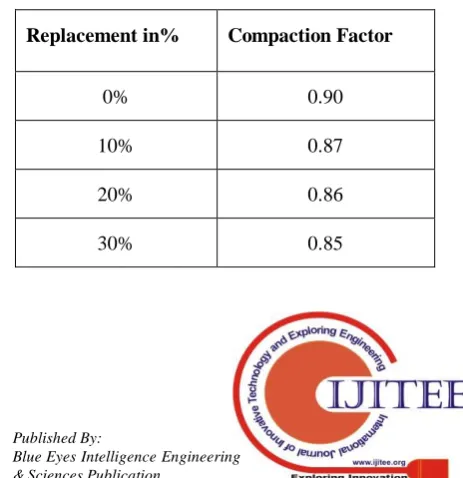
The most commonly used workability test in the laboratory is compaction factor test. The results of the compaction factor test are more accurate than the results obtained from the slump cone test. The main advantage of the compaction factor test is it can be effectively used for the concrete mixes of very low workability.
Table: Compaction factor values for different percentage replacements in M20 grade concrete
Replacement in% Compaction Factor
0% 0.90
10% 0.87
20% 0.86
[image:4.595.314.546.590.829.2]International Journal of Innovative Technology and Exploring Engineering (IJITEE) ISSN: 2278-3075, Volume-8 Issue-10, August 2019
Table: Compaction factor values for different percentage replacements in M25 grade concrete
Replacemen t in%
Compaction Factor
0% 0.86
10% 0.85
20% 0.84
30% 0.83
From the above tables we can see that as the percentage replacement of coarse aggregate with coconut shells increases the value of compaction factor value decreases. The compaction factor value is directly proportional to workability, so we can say that as the coconut shells % in concrete increases the workability decreases.
Tests on Hardened Concrete COMPRESSION TEST
In order to determine the compressive strength of the hardened concrete one of the most commonly used test is compression test. This test is conducted on the hardened concrete blocks by applying the loads gradually.
Table: Compressive strength of M20 grade concrete cubes after 28 days
S.No
Coconut Shell
(%)
Grad e
Load Crushing
in (KN)
Compressive Strength (N /
mm2)
1 0 % M20 246 24.6
2 10 % M20 227 22.7
3 20 % M20 219 21.9
4 30 % M20 206 20.6
Table: Compressive strength of M25 grade concrete cubes after 28 days
S.no
Coconut Shell
(%)
Grad e
Load Crushing
in (KN)
Compressive Strength (N
/ mm2)
1 0 % M25 293 29.3
2 10 % M25 274 27.4
3 20 % M25 262 26.2
4 30 % M25 254 25.4
V. CONCLUSIONS
The final conclusion drawn from this study is by replacing coarse aggregate with the coconut shell a low strength concrete is formed by light weight aggregates and meeting the requirements.
The present project work gives the following:
Results of experiments on compressive strength and workability for different mixes in which coarse aggregate is replaced by coconut shell in various percentages are showed and compared the results with conventional concrete. The results show that normal aggregate can be replaced with coconut shell aggregates but the performance of coconut shell concrete is little bit lower than the conventional concrete.
As the coconut shell replacement is increasing the voids in the concrete also increased. By replacing the coconut shell with 30 % then the voids were 40 % more than in the normal conventional concrete.
The compressive strength for 28 days of CS concrete for M20 grade was resulted as 24.6, 22.7, 21.9 and 20.6 N/mm2 for 0%, 10%, 20% and 30% replacement by coconut shell aggregate respectively and satisfying the conditions required for structural light weight concrete
The compressive strength for 28 days of CS concrete for M20 grade was resulted as 29.3, 27.4, 26.2 and 25.4 N/mm2 for 0%, 10%, 20% and 30% replacement by coconut shell aggregate respectively and satisfying the conditions required for structural light weight concrete.
If we use M20 grade concrete, the strength is greater than 20 N/mm2 up to 30 % replacement of coarse aggregate with CS, similarly for M25 grade concrete the strength is greater than 25 N/mm2 up to 30 % replacement of coarse aggregate.
So, we can replace the coarse aggregate with CS up to 30 %.
Recommendations for Further Studies
From the study as the percentage replacement of CS is increased the workability decreases, to increase the workability, we can add plasticizers and any other material to increase the workability.
As the replacement of coconut shell in concrete is increasing then the strength of concrete is decreasing. So in order to overcome this we can add 10 % of other ingredients like fly ash, rock powder etc to CS concrete and the experiments should be done.
Experiments should be done on split tensile strength and flexural strength.
REFERENCES
1. IS 456:2000 - Plain and reinforced concrete- Code of practice
2. IS 383:1970 - Specification for coarse and fine aggregate from natural sources for concrete
3. IS 516: 1959 - Methods of tests for strength of concrete. 4. IS 3025 - Water quality parameters for concrete. 5. IS 299 - Properties of cement.
6. IS 2387 - Tests of aggregate.
7. IS 10262: 2009 - Guidelines for concrete mix design proportioning. 8. Properties of concrete - A.M Neville (1997).
9. Concrete Technology by M.L.Gambhir 5th edition, 2013 and by M.S.Shetty.
10.Light Weight Aggregate Concrete – Science, Technology and Applications by Satish Chandra & Leif Berntsson.
11.Use of Recycled Materials in Building and Structures - Husson B, Clastres P.
12.Developing Lightweight Concrete Using Agricultural and Industrial Solid Wastes - Gunasekaran K, Kumar PS, (2008)
13.www.ijeijournal.com 14.www.docstoc.com
15.http://www.bgci.org/education/1685/ 16.http://www.ripublication.com/ijaer.htm 17.http://www.wikipedia.org
18.https://www.google.co.in
AUTHORSPROFILE
I Mr.M.Uday Bhaskar completed my M.tech in Structural Engineering from Mallareddy Institute of Technology college Affiliated to JNTU Hyderabad, secured 88.43 %, B.Tech in Civil Engineering secured 87.08% from Malla Reddy Institute of Technology college Affiliated to JNTU Hyderabad. I have completed my Intermediate from Sri Chaitanya Junior College secured 94.30% and schooling from SainikPuri High School, Telangana secured 87.33%. Technical wise I have knowledge in Auto CAD, Staad.Pro.
1. Successfully completed a project named as “PERFORMANCE OF GEOPOLYMER CONCRETE USING SILICA FUME FOR M60 GRADE”for the fulfillment of my Post Graduation.
2. Completed a project is named as “CONCRETE MIX USING SOLID WASTE AGGREGATES (COCONUT SHELL CONCRETE)” for the fulfillment of my Under Graduation.
3. I have published an International journal in IJRARTET with title STRENGTH BEHAVIOUR OF GEOPOLYMER CONCRETE USING SILICA FUME FOR M60 GRADE.
4. I have published an International journal in IJETER with title DURABILITY PROPERTIES OF GEOPOLYMER CONCRETE USING SILICA FUME FOR M60 GRADE.
5. I have published an International journal in IJMTER with title GEOPOLYMER CONCRETE BEAM ANALYSIS BY ANSYS SOFTWARE.
6. Participated in Two Day FDP on INNOVATIVE TECHNOLOGIES IN CIVIL ENGINEERING-ITCE 2K17 in MRIT College.
7. Participated in Two days National workshop on EARTHQUAKE- CIVIL ENGINEERING STRUCTURES-NDT perspective in KHIT College.
Working as Assistant Professor in Malla Reddy Institute of Technology.
I Mrs.S.Manasa completed my M.tech in Structural engineering from Malla Reddy Institute of Technology college Affiliated to JNTU Hyderabad, secured 80.00 %, B.Tech in Civil Engineering secured 78.00 % from Mallareddy Institute of Technology college Affiliated to JNTU Hyderabad. I have completed my Intermediate from Sri Chaitanya junior college secured 89.00% and schooling from Mother Theresa High School, Telangana secured 76.00%. Technical wise I have knowledge in Auto CAD, Staad.Pro.
1. Successfully completed a project named as “EFFECT OF CURING TYPE, AGGREGATE SIZE AND CONDITIONS ON PROPERTIES OF CONCRETE” for the fulfillment of my Post Graduation.
2. Completed a project is named as “ANALYSIS AND DESIGN OF G+3 BUILDING” for the fulfillment of my Under Graduation.
3. Participated in Two Day FDP on INNOVATIVE TECHNOLOGIES IN CIVIL ENGINEERING-ITCE 2K17 in MRIT College.
4. Participated in Two days National workshop on EARTHQUAKE- CIVIL ENGINEERING STRUCTURES-NDT perspective in KHIT College.
Working as Assistant Professor in Malla Reddy Institute of Technology.
I Mr. Anith Kumar.T completed my M.Tech in Transportation Engineering from DRK Engineering college Affiliated to JNTU Hyderabad, secured 74.66 %, B.Tech in Civil Engineering secured 70.00 % from Malla Reddy Institute of Technology and Science college Affiliated to JNTU Hyderabad. I have completed my Diploma from Government Polytechnic College, Nizambad secured 53.10 % and schooling from Raghava High School, Nizambad secured 63.50%. Technical wise I have knowledge in Auto CAD, Staad.Pro.
1. Successfully completed a project named as “PERFORMANCE AND COMPARISION OF STONE MATRIX ASPHALT WITH CELLULOSE FIBRE AND COIR FIBRE” for the fulfillment of my Post Graduation.
2. Completed a project is named as “ADDITION OF MUNICIPAL PLASTIC WASTE USING IN ROAD CONSTRUCTION” for the fulfilment of my Under Graduation.
3. Participated in Two Day FDP on INNOVATIVE TECHNOLOGIES IN CIVIL ENGINEERING-ITCE 2K17 in MRIT College.