Rochester Institute of Technology
RIT Scholar Works
Theses
Thesis/Dissertation Collections
11-3-1996
Two-dimensional spectrum estimation using the
radon transform
Jennifer Wideman
Follow this and additional works at:
http://scholarworks.rit.edu/theses
This Thesis is brought to you for free and open access by the Thesis/Dissertation Collections at RIT Scholar Works. It has been accepted for inclusion in Theses by an authorized administrator of RIT Scholar Works. For more information, please [email protected].
Recommended Citation
TWO-DIMENSIONAL SPECTRUM ESTIMATION
USING THE RADON TRANSFORM
by
Jennifer L. Wideman
B.A.
DePauw University
(1984)
A thesis submitted in partial fulfillment of the
requirements for the degree of
Master of Science in the
Chester F. Carlson Center for Imaging Science
in the College of Science
of the Rochester Institute of Technology
November 3, 1996
Signature of the Author
----,--
_
Accepted by_ _
H_ar~rY~E_._R_hO_d....!.Y
CHESTER F. CARLSON CENTER FOR IMAGING SCIENCE
COLLEGE OF SCIENCE
ROCHESTER INSTITUTE OF TECHNOLOGY
ROCHESTER, NEW YORK
CERTIFICATE OF APPROVAL
M.S. DEGREE THESIS
The M.S. Degree Thesis of Jennifer
L.
Wideman
has been examined and approved by the
thesis committee as satisfactory for the
thesis requirement for the
Master of Science degree
Dr. Roger
L.
Easton, Thesis Advisor
Dr. Zoran Ninkov
Dr. Harvey E. Rhody
THESIS RELEASE PERMISSION
ROCHESTER INSTITUTE OF TECHNOLOGY
COLLEGE OF SCIENCE
CHESTER F. CARLSON CENTER FOR IMAGING SCIENCE
Title of Thesis: Two Dimensional Spectrum Estimation Using The Radon Transform
I, Jennifer
L.
Wideman, hereby grant permission to the Wallace Memorial Library of
R.I.T. to reproduce my thesis in whole or in part. Any reproduction will not be for
commercial use or profit.
TWO-DIMENSIONAL SPECTRUM ESTIMATION
USING THE RADON TRANSFORM
by
Jennifer L. Wideman
Submittedto the
Chester F. Carlson Center for
Imaging
Scienceinpartialfulfillmentoftherequirements
fortheMasterofScience Degree
attheRochester Institute of
Technology
ABSTRACT
Analternative approachto two-dimensionalpower spectrum estimation
incorporating
theRadontransforminconjunction with each ofthe one-dimensionalperiodogram,
Blackman-Tukey,
andAutoregressiveparameter estimation algorithms isexamined. The Radontransformisusedtoexpress atwo-dimensionaldatasetintermsofitsprojectionsonto a set of one-dimensional radial
lines,
effectively reducingthe two-dimensionalestimationproblemtoaseries of one-dimensional problems. The resulting
two-dimensionalpowerspectrum estimates are comparedtotheknownpower spectrafora
varietyofdatatypes. The Radontransformapproach combined withautoregressive
parameter estimation can provide ahigh-resolutionpower spectrumestimate,effectively
surpassingtheresolutionlimitationsoftheFouriermethods withoutthecumbersome implementationsofthemoredirect highresolutionestimation methodsintwo
ACKNOWLEDGEMENTS
Severalindividualsand organizationshavemadecontributions
leading
tocompletion ofthisstudy.Firstand
foremost,
Iwishtothankmyfamily
fortheircontinuedpatience and support,particularly my husband
Dave,
andmychildrenBradley
andMichael.Withoutthecontributionsfrom my advisorycommittee,Dr.
Easton,
Dr.
Ninkov,
andDr.Rhody,
mystudies wouldundoubtedlyneverhave beencompleted. I particularlythankDr. Eastonforhiscontinued support and
tremendous insightandDr.
Rhody
forintroducing
metoMATLAB. Thecontributionsfromcomputer support personnel atRITandtheCenterfor
Imaging
Sciencewereinfinitely
valuablein addressingnumerous issues and obstaclesthroughoutthecourse ofthisstudy.Inaddition, Iamindebtedto theEastman Kodak Co.fortheir tuition
reimbursement program andtheirsupport of graduate studies.
Finally,
thegenerouscontributions of child carefromnumerouscaringand competentindividualsallowed methefreedomtopursuemy
studies. I particularlythank
Elaine, Kathy,
andTerrifor volunteeringtheirDEDICATION
To
Bradley
andMichael,
TableofContents
ListofFigures viii
ListofTables x
1.0 Introduction 1
2.0 Objectives 5
3.0 Background- Literature Review 6
3.1 NonparametricSpectrum Estimation Methods 7
3.1.1 Periodogram 7
3.1.2
Blackman-Tukey
Spectrum EstimationMethod 113.2 Parametric Spectrum Estimation Methods 12
3.2.1. The Autoregressive Model 14
3.2.2 AR Parameter Estimation 16
3.3 Two-dimensional Spectrum Estimation 22
3.3.1 Two-Dimensional Nonparametric Methods 23
3.3.2 Two-dimensional Parametric Methods 26
3.4 The Radon Transform Approach 30
3.4.1 DescriptionoftheRadon Transform 30
3.4.2 The Radon TransformandSpectrum Estimation 38
4.0 Approach 41
4.1 Two-dimensionaldatasets 43
4.2 Two-dimensionalspectrumestimation 53
4.3 The Radon Transform Approach 54
4.4 AssessmentofSpectrum Estimation Performance 58
4.4.1 ComparisonofSpectrum Estimation Approaches 58
4.4.2 Phase EstimationandImage Reconstruction 59
4.4.3 InvestigationofInterpolation Effects 60
5.0 Results 62
5.1
Feasibility
oftheRadon Transform Approach 655.2 Qualitative Performance Assessment 70
5.2.1 Data Set
#1,
"Sines"70 5.2.2 DataSet
#2,
"Rectangle"82
5.2.3 Data Sets
#4-#6,
"Sines+ARProcess"88 5.2.4 Data Sets#7&
#8,
"Child1"& "Child2"
91
5.3 Phase EstimationandImage Reconstruction 93
5.4 Interpolation Effects 100
6.0 ConclusionsandRecommendations 106
Appendix -- SoftwareListings
110
ListofFigures
3-1 Data Record Segmentation for Averaged Periodograms 10
3-2 An Autoregressive ModelofOrder 2 15
3-3 Sample Data SetfromSecond Order AR Process 15
3-4 Power Spectra ComputedfromEstimated AR Parameters 20
3-5 Integration Linesfor
Computing
aSingle Radon Transform Projection 313-6 Radon Transform Projections for Sinusoid 32
3-7 SinogramofRadon Transform Projections 35
3-8 SinogramandReconstructedRadon Transform for Sinusoid 35
3-9
Computing
2DFouriertransformfromtheRadon Transform 363-10 2D FFTandRadon/ID FFTofSinusoid 37
3-1 1 Spectrum EstimationfromRadon TransformandPeriodogram 38
3-12 Spectrum Estimation from Radon Transformand
Blackman-Tukey
Method 38 3-13 Spectrum Estimation from Radon TransformandARParameter Estimation 394-1 Power Spectrumof
"Sines"
Data
Set,
Computed from 2-D FFT 454-2 Power Spectrum Estimateof
"Rectangle",
Computedfrom2D FFT 464-3 Power Spectrum of"AR
Process",
Computedfrom known ARparameters 484-4 PowerSpectrum of"Sines+ARProcess" 48
4-5 Images: Data Set#7&
8,
"Child 1"and"Child
2"
50
4-6 Powerspectra computedfrom 2-D FFTof"Child1" and"Child2" 50
4-7 Exampleof rho-filter usedfor oversamplingcompensation 57 5-1 Spectrum Estimatesfor"Sines"
DataSet 67
5-2 Spectrum Estimatesfor "Rectangle"
DataSet 68
5-3 Spectrum Estimates for "ARProcess" Data Set 69
5-4 Spectrum Estimatefor"Sines"
--Radon/FFT,
1&45increments 72 5-5 Spectrum Estimate for"Sines"
--Radon/FFT,
45 and135projections 72 5-6 Spectrum Estimatefor"Sines"Radon/BTand2-D
Blackman-Tukey
75 5-7 Spectrum Estimates for "Sines"--Radon/AR;
p=5, p=10, and p=15 76 5-8 Spectrum Estimatefor"Sines"Radon/AR,
p=10,45
increments 78
5-9 Spectrum Estimatefor"Sines"
-Radon/AR,
p=10, 45and135projections 78 5-10 Spectrum Estimates for "Sines"
--Radon/AR,
128and256datapoints 80 5-11 SpectrumEstimatefor"Sines"--Radon/AR,
p=10, 45inc.,
128 datapoints 80 5-12 Spectrum Est. for"Sines"; Radon/AR,
128points;0, 45, 90,
and 135 81 5-13 Powerspectrumestimatesfor "Rectangle" fromRadon/AR 83 5-14 "Rectangle"spectrafrom Radon/per. &
Radon/AR,
beforereconstruction 85 5-15 Normalized Radon/ARspectrum estimatefor"Rectangle" 865-16 High-resolution Radon/ARpower spectrumestimatesfor "Rectangle" 87 5-17 "Sines+ARProcess"spectrum estimatesfrom2D FFT 89
5-18 "Sines+ARProcess"
5-19 Radon/ARSpectrumEstimatesfor "Child 1"
& "Child2" 92
5-20 Estimatedphase at pixel
(33,25)
vs. ARmodel order 955-21 Estimatedphase at pixel
(33,25)
vs. Angular inc. betweenprojections 955-22 Fourier Transformestimatefor dataset#10 96
5-23 Dataset
#10,
recreatedfromestimated spectrum 985-24 "ARProcess" recreatedfromRadon/ARestimatedspectrum 99 5-25 Interpolationeffectsfor "Single
Sinusoid";
original&recreateddatasets 1015-26 Fouriertransformof"SingleSinusoid" viaRadontransform 102 5-27 Fouriertransformof"SingleSinusoid" via simulatedRadontransform 104 5-28 "SingleSinusoid"
ListofTables
3-1 Levinson-Durbin Autoregressive Parameter Estimates 19 4-1 Periods& Azimuthal Angles for Twelve CosinesofDataSet #1 44 4-2 Periods & Azimuthal AnglesforThree Sinusoids ofData Sets#6-#8 49
5-1 DataSets& Spectrum Estimation Algorithms for
Feasibility
Demonstration 62 5-2 Variable Input Parameters for Spectrum Estimation Algorithms 631.0 Introduction
In
theory,
thepowerspectrumof a continuousfunctionisobtainedby
applicationoftheFouriertransformfollowed
by
a squared magnitude operation. Inpractice,however,
thecontinuousfunction isrepresented
by
adiscrete dataset obtained as a single realization ofthe combinationof a
(possibly)
deterministicprocess and a random process. Thecontinuous power spectrum mustthenbe estimatedfromthedataset
by
using anyof anumber of spectrum estimationtechniques.
Thefirst widelyused method of spectrum estimation wasthe periodogram, developed
by
Schusterin 1898 forthestudyof periodicitiesintheoccurrences ofsunspots
[Schuster,
1898].
Essentially
aFouriertransformofthedataset, thismethod was computationallyintensiveandthereforehadlimitedapplications priorto theadvent ofdigitalcomputers
andtheFast Fourier Transform
(FFT)
algorithmdevelopedby Cooley
andTukey
[1965].A latermethodof spectrumestimation,developed
by
BlackmanandTukey
[1958],
isbasedontheWiener-Khinchintheorem
describing
therelationshipbetweenthepowerspectrumandtheautocorrelationfunctionas aFouriertransformpair. Thismethodisan indirectapproachoffirstestimatinga series ofautocorrelationlags fromthedatasetand
thencomputingtheFouriertransformoftheautocorrelationfunction. The primary
advantage ofthismethodlies intheformoftheautocorrelationfunctionwhichgenerally
peaks attheoriginandrapidlyfallstozero.
Thus,
asmallersetof non-zerodatapointsBoththe periodogramandthe
Blackman-Tukey
methodshave become knownas classicalspectrum estimation methodsbecause
they
arebasedontheFouriertransform. Althougheachhasproven effective and useful inavarietyofapplications,
they
areboth limited inresolution
by
thesampling intervalusedin obtainingthedataset.Inthepursuit ofhigherresolution,a number of alternative methodshave been introduced.
Theso-called parametric methods arebasedon an assumptionthat thedatasetfitsa pre
determinedmathematical modeldefined
by
a set of unknown parameters. Atheoreticalexpressionforthecontinuous power spectrumintermsoftheseparameters is derived
fromthecharacteristics ofthemathematical model. The spectrum estimation problem
thenbecomes one ofestimatingthemodel parametersandsubstitutingtheseestimates
intothetheoreticalequationforthepower spectrum.
Threewell-known parametricmodels aretheautoregressive
(AR),
moving-average(MA)
and autoregressivemovingaverage
(ARMA)
models. Asindicatedby
thenomenclature,theARMAmodelismoregeneral,
incorporating
thecharacteristics ofboththeARandMAmodels. Althougheach ofthesemethodshasbeendemonstratedtobeeffectivein
powerspectrumestimation,theARmethodhastheadvantage ofusingaparameter
estimation algorithm
involving
alinearset of Yule-Walkerequationstoestimateboththemagnitudeand phase spectra.
Theextension of spectrum estimationforatwo-dimensionaldatasethas been
demonstrated for boththeFourierandtheparametricmethods. The separabilityofthe
theperiodogram andthe
Blackman-Tukey
methods. Aone-dimensionaltransformissimplyappliedtoeachdimensioninsuccessioninordertoobtainthetwo-dimensional Fouriertransform. Ofcourse, theresolutionlimitationsassociatedwiththe sampling
intervalandthesize ofthedataset remain.
Althoughtheparametric methods maypromisehigherresolution when appliedto
two-dimensional
data,
the taskofestimatingthemodel parameters canbecumbersome. Anextension ofthelinearYule-Walkerequations foruse in estimatingtheARparameters foratwo-dimensionaldatasethas beendiscussed intheliterature
[Marple, 1987], [Kay,
1988].
Analternative approachto two-dimensional spectrum estimationincorporatestheRadon
transform,a means ofexpressingatwo-dimensionaldatasetintermsofitsprojections
ontoa set of one-dimensional radial
lines,
tocompresstheproblemintoa series ofone-dimensionalspectrum estimation problems. Themotivationbehindthisapproachlies in
therelationship betweentheRadontransformandtheFouriertransformwherebythe
two-dimensional Fouriertransformcanbecomputed
by
application oftheRadontransform toatwo-dimensionaldatasetfollowed
by
one-dimensionalFouriertransformsalongtheradiallinesoftheRadontransform.
Clearly,
thismethod canbe appliedto theFouriermethods of spectrum estimation
by
simply replacingthe two-dimensionalFourier transformwiththeRadontransformand a sequence ofone-dimensionalFouriertransforms. Inaddition, theapplicationoftheRadontransforminconjunctionwiththe
one-dimensional parametric methods offersthepossibilityof astraightforwardestimation
Aseriesofdataprocessingalgorithmshas beenappliedtodatasets withknownpower
spectrainanefforttodemonstratethe
feasibility
oftheRadontransformapproachto two-dimensional spectrumestimation. The data processingincludedboththeFourierandparametric spectrum estimation methods. AlthoughtheRadontransformapproach used
inconjunctionwiththeperiodogram andthe
Blackman-Tukey
methods offered noimprovementsovertheirdirecttwo-dimensionalcounterparts,theRadon/ARapproach
successfullyproducedhigher-resolutionspectrumestimatesinselected cases.
However,
thebilinear interpolation implemented intheRadontransformcomputationandthe
spectrum reconstructionintroducecomputational errors whichlimittheperformance of
theRadon/ARapproach. Inaddition,care mustbetakenin selectingtheangular
separationbetween Radontransformprojections astoomanyprojectionsmayobscurethe
2.0 Objectives
Theobjectivesofthisproject wereto:
demonstratethe
feasibility
oftheRadontransformapproachto two-dimensionalspectrum estimation.
qualitativelycomparetheperformance oftheRadontransformapproachto that ofthe
directtwo-dimensionalspectrum estimation approach.
Theseobjectiveswere met
by
generatingpower spectrum estimatesfora series oftwo-dimensionaldatasets withknownpower spectra
by
using boththeRadontransformapproach anddirecttwo-dimensionalspectrum estimationtechniques. Appropriate
comparisonsbetweenpower spectrum estimates andknownpower spectra were madefor
3.0 Background - LiteratureReview
Before consideringtheapplicabilityoftheRadontransform to thefieldof spectrum
estimation,one mustfirst
develop
aknowledgeofthevarious spectrum estimationtechniquesavailableinbothone andtwo dimensions.
Historically,
observationsoftheperiodic nature ofthelengthofthe
day,
phasesofthe moon, andlengthoftheyearhaveresultedinthedevelopmentofthemoderncalendar and clock. Theperiodicities
governingtheseand avarietyof other phenomenainfieldssuch assonar, geophysics,
meteorology, climatology,oceanographyandastronomy may beexaminedthrough
spectrum estimates computedfroma set of observeddata. Inmostapplications, the data
measurements are
inherently
imbedded innoise,obscuring visibility oftheunderlyingperiodicities withinthedata. Spectrumestimation provides a means ofseparatingthe
strong
frequency
components withinthedatafromtheunderlyingnoise. Thiswidespread applicabilityof spectrum estimationhas ledto thedevelopmentof various
methods in bothone andtwo(or more) dimensions.
Theone-dimensional spectrum estimation methodshave beenseparated intotwo classes:
thenonparametric
(Fourier)
methods andtheparametricmethods, describedinsections 3.1 and3.2respectively. Theextension ofthesemethodstoatwo-dimensionaldatasetisdiscussed insection3.3 alongwithabrief descriptionof other2-D spectrum estimation
methods.
Finally,
adescriptionoftheRadontransformanditsapplicationtospectrum3.1 Nonparametric SpectrumEstimation Methods
Nonparametricspectrum estimationmethods,also referredtoasFourieror classical
methods,includetheperiodogramandthe
Blackman-Tukey
approaches. Bothofthesemethodshave beenwidelyusedfor decadesinavarietyof applications.
Consequently,
thenecessaryequationsanddiscussionsof advantages anddisadvantages are availablein
numeroustextsandjournalarticles. Ofparticularinterestarethetexts
by
StevenKay
[1988],
andR. B. BlackmanandJ. W.Tukey
[1958]
as well asthevideotutorialby
S.L. Marple [1990].3.1.1 Periodogram
Theperiodogramspectrum estimateforadiscrete datarecordx[n] oflength
N,
developedby
Schuster in 1898 forthestudyof sunspotperiodicities,isgivenby:2
PpER^f)
~ ~N-\
271ifn
^x[n]e
w=0
(3-1)
For
decades,
theperiodogramwastheonlyavailable methodforpowerspectrumestimation.
However,
its computationalintensity
prevented widespread use untiltheadventofthefastFouriertransform
(FFT)
algorithmdevelopedby
J.S.Cooley
andJ.W.Tukey
in 1965[Cooley,
1965]. WhentheFFTisused,the computationalefficiencythenThe primarydisadvantagesofthismethod aretheresolutionlimitof
A/
=\/2N imposedby
the Whittaker-Shannonsamplingtheorem[Goodman, 1968],
thepresence of sidelobesdueto theinherentwindowingofthe
data,
andtheunfortunatefactthattheperiodogramisaninconsistentestimator,
i.e.,
thevarianceoftheperiodogramdoesnotdecreaseasthesize ofthedatasetincreases.
Theinherentwindowing ofthedata isa result oftheimplicit infiniteextension ofthedata
setusingzero-valueddatapoints.
Essentially
theperiodogramanalysisisappliedtotheproduct ofthefunctionofinterestand a unit amplitude rectanglefunctionrepresenting
thedatawindow:
g(x)
=f(x)
xrect(x)
(3_2)
The resulting Fouriertransform
is,
therefore,a convolution ofthedesiredtransformand asinefunction (the Fouriertransformoftherectanglefunction):
G(^)
=F(^)*sinc(^)
(3.3)
Thisconvolution resultsinsidelobes or"leakage" of powerintoadjacent
frequency
regions.
Consequently,
thesidelobes of astrongfrequency
component can obscureweaker signalsatnearby frequencies.
By
selectingalternate datawindows,atrade-offcanbemadebetweenthebandwidthofthemainlobe
(resolution)
andthemagnitudeofOnewouldexpectthatanincrease inthelengthofthedatarecord wouldimprovethe
periodogram estimate ofthepowerspectrum.
Indeed,
theperiodogramisan unbiasedestimator andthemeandoesconvergeto the truepower spectrum asthenumberofdata
pointsincreases.
However,
becausethevariance oftheestimateis a constant[Kay,
1988],
theestimatoris inconsistent. Inordertodecreasethevarianceoftheperiodogramestimate, thespectrum estimatesfrommultipledatasetsmay be averaged.
Frequently,
themultipledatasets are obtained
by
subdividingtheoriginaldataset oflengthNintoKshorternon-overlappingdatasets oflength L
[Bartlett,
1948]. Theaveraged periodogramestimate isthengivenby:
K-\
PAVPER(f)
~~/
/p^RJf)
(3-4)
m=0where
PpEnif)
istheperiodogramoflength Lforthemthdataset2
3S(/>4
L
L-\
(3-5)
n=0However,
thecostofthisdecreasedvarianceisaninherent decrease inresolutionduetothesmoothingeffect ontheindividualperiodogramestimates.
Avariation oftheaveraged periodogramistheWelchmethodutilizingadatawindow
andoverlapping datablockstoachieve additional variance reduction
[Welch,
1967]. Inthis method, theoriginaldatarecord oflength N isagain segmentedintosmallerdata
records oflength
L,
allowingthedatarecordstooverlap. Adatawindowisappliedtoestimator. Thereductionoftheestimator varianceisa result oftheincreasednumber of
datarecordsobtained
by
allowingthesegmentstooverlap. ThesegmentationoftheoriginaldatarecordforboththeBartlettaveraged periodogramandtheWelchmethodis
illustrated inFigure 3-1. Aquantitativediscussionofthereductioninvarianceforthese
averagedperiodogram methodsis containedinthetext
by
Marple,
[1987].(a)
xx,x2,...,xL,...,xL,...x-iL; ..., x2L,~2
T
(b)
[x\,x2,
...,
xL\
[xL+i,xL+2,
... ,x2l]m
'L ' L ' L
+1 +2 +L
2 2 2
1
31 > N- +1
2
XIL >X3L ''X3I
+1 +2 +L
2 2 2
xN-L+\> XN
[xN-L+\
>xN-L+2' XN]
x
3L >x
3Z. >>* L
N- +1 N- +2 N
2 2 2
Figure 3-1: An illustration ofdatarecord segmentationforaveraged
periodograms.
(a)
Schuster'speriodogram uses a singledatarecord oflengthyV.
(b)
The Bartlettaveragedperiodogram usesthe samedatasegmentedintorecords oflength L.
(c)
The Welch averaged periodogram3.1.2
Blackman-Tukey
SpectrumEstimation MethodThespectrum estimation methoddeveloped
by
R. BlackmanandJ.Tukey
in 1958 isderived fromthewell-knownWiener-Khinchintheoremrelatingthepower spectrum and
theautocorrelationfunctionas aFouriertransformpair. The
Blackman-Tukey
powerspectrumestimateisgivenby:
M
Pbt(/)=
J^K-roe"2*'7"*
(3-6)
k=-M
where r^
[k]
istheautocorrelationfunctionestimator givenby:N-l-k
y\*[/i]x[
+Jfc]
for *=0,L...,JV-1 N ___'*=o
(3-7)
[-*]
for k=-(N-l),-(N-2),...,-l.
andw[k]isa real sequencetermed the
lag
window.Withthis method,thetaskbecomesone ofestimatingtheautocorrelationlagsand
deriving
thepower spectrum viatheFouriertransform. Therequired number ofautocorrelationlags dependsontheshape oftheautocorrelation
function,
andthusisdetermined
by
thechoice ofthelag
window. BeforetheintroductionoftheCooley-Tukey
FFTalgorithmin1965,
thecomputationalefficiency oftheBlackman-Tukey
estimator was a clear advantage whenonlyafewautocorrelation
lag
estimateswererequired.
However,
thedisadvantagesoftheperiodogram relatedtotheFouriertransformare stillresolutionlimitationof
A/
= 1/2 N andthe"leakage"into signal sidelobesdescribedby
equations
(3-2)
and(3-3). Inaddition,some autocorrelation sequence estimates can resultinnegative values ofthepower spectrum withthe
Blackman-Tukey
method[Kay
andMarple,
1981].3.2 Parametric Spectrum Estimation Methods
Inthepursuit ofhigherresolution, a number of parametricspectrum estimation methods
have been developed. Thepremise ofa parametric methodistheassumptionthat thedata
were generated
by
a process which canberepresentedby
a mathematical modelutilizinga set of parameters. Atheoreticalpower spectrum canthenbe derived fromthemodel
usingthemodelparameters. Theproblem ofestimatingthepower spectrumthen
becomesone ofestimatingtheparameters oftheassumed model.
Asubsetoftheseparametric methods aretheso-called rational models:moving average
(MA),
autoregressive(AR),
and autoregressivemovingaverage(ARMA). Thesemodelshave beenreferredtoas rational modelsdueto thefunctionalformofthetheoretical
ARMApower spectrum:
PARMA^e
)~b0+ble-m+---+bQe-iq(O 2
i
+ +...+e-v
(3-8)
P
wherethecoefficientsa,and
bt
describetherelationshipbetweensubsequentdatapointsandmaybeestimatedfromthedata. BoththeMAandtheARmodels are special cases
oftheARMAmodel. TheMAmodel, alsoknownastheall-zeromodel, assumes allthe
theAR
(all-pole)
model. Inwords, thepower spectrumPisthesquared magnitude of apolynomial fortheMAmodel,andtheinverseof a polynomialfortheARmodel.
The ARmodelhas beenselectedforthisinvestigation primarily for its abilitytodetect
narrow-bandsignals such as sinusoids.
Consequently,
theMAandARMAmodels willnotbe discussed in further detail. Additional informationonthesemodels canbe found
inthe texts
by Kay [1988]
andMarple[1987]
or articlesby
Kay
andMarple[1981],
3.2.1 The Autoregressive Model
As previouslystated, thepremise oftheARmethodistheassumptionthat thedatawere
generated
by
anautoregressive processdefinedby
a set of parameters. The accuracyof thisassumptiondeterminestheaccuracyoftheresultingpower spectrum estimate. Oncethis assumptionhasbeenmade, theproblemthenbecomesone ofestimatingthemodel
parametersforthegivendataset.
Anautoregressive processdeterminestheamplitude of each newdatapoint as a weighted
sum oftheamplitudesofthepreviousdatapoints:
x[h]=-__***["
-*]+[]
(3-9)
k=\
wherex[n]istheoutputsequence,a^isa set ofARparameters which servetoweightthe previousdatapoints,andu[n]isa white-noise
driving
sequence. Theorder ofthemodel intheautoregressive processisp,
themaximum value oftheindex k forwhich ak ^0.Althoughthisequationis similarinformtoalinearprediction
filter,
its interpretation isuniqueto theARprocess
[Marple,
1987]. Thedependenceoftheoutputsequenceon boththeinputdriving
sequence andtheprevious output valuesisdescribedpictorially inFigure 3-2. Inaddition, an exampleof adataset generated
by
anautoregressive processof order/?=2 is
shownin Figure 3-3. Theequationgoverningthisprocessisobtained
by
substitutingthetwoautoregressiveparameters, al =0.5 anda2 =
-0.25, intoequation
(3-9):
x[n]
= x[n-1]
+-x[n+
u[n]-Xi
ap )"'{%.
x[n-p] AR x[n-2]>x[n]
x[n-l]Figure 3-2: An Autoregressive ModelofOrder p
"(l) 1.16 10 0.5x1
KIM
0 62 -2.5 -3.84 0.5x|)&?
-.25xM
0.96 "(3) "(4) 0.07 5.04 0.5x|>&?
-1.26 -3.41 0.5x|>&?
0.85 0.35s
3.32 0.5x?
-.25x?
>
Figure 3-3: Sample datasetfroma second orderautoregressive
process with ax =0.5 and a2 =-0.25. Theprocessis initiatedatthe
leftwithx= 10 anddriven
Thenextstepin
defining
theARmodelistoderivethe theoreticalpower spectrumbasedontheARparameters. This derivation is includedina number oftextsand articles(e.g.
[Marple, 1987]
and[Kay, 1988])
and will notberepeatedherein. Thederivation,
basedon az-transform representationofthesystemtransfer
function,
resultsintheARpowerspectrum
density
p m
PqA
P
l
+y]ake-2nifkAt
(3-H)
k=\
where p^ isthevariance oftheinput
driving
sequence []. Withthisequationinhand,
theestimation ofthepower spectrumhas beenreducedto theestimation oftheAR
parameters andthevarianceofthewhite-noise
driving
sequence. Athoroughdescriptionofthewhite-noise
driving
sequence anditsroleintheautoregressive modelis containedinthepaper
by
Robinson [1982].3.2.2 AR Parameter Estimation
The literature pertainingtoautoregressivespectrum estimationincludesanumberof
methods for
determining
themodel parametersfroma set ofdata. Thepaperby
Roman[1981]
provides an overview of severalmethods,including
theYule-Walker,
maximumentropy
(Burg),
leastsquares,parameterestimation,and maximumlikelihoodmethods.Thechoice of method couldbe influenced
by
a number offactorsincluding
thedatarecord
length,
the signal-to-noiseratio, andthedesiredresolution.However,
theselectionfactorforthisstudywassimplythe extendibilityoftheYule-Walkermethodto two
Thepremise oftheYule-Walkermethodisthe
following
relationship betweentheautocorrelationofthedataset andtheARparameters:
r^im]
- >
Qkrxx \-m~
^]
for/w > 0k=\ p
/
<*krxx[-k] k=\+pa form= 0
form <0
(3-12)
r^i-m]
Selectionofthep+1 autocorrelationlagswithindices
[0,l,2,...,p]
resultsina system ofp+1 linearequations with p+1 unknowns referredto astheYule-Walkernormal
equations,expressedhere inmatrixform:
>xJ0]
rxx[-l]
rM
^[0]
rxx\P\
^[p-l]
rxx\rP\
fxxi-p
+l]
^[0]
"1
"Pco
a\
=0
\_aP
0
(3-13)
Theominoustaskofsolvingthissystem ofequationshas beensimplified
by
taking
advantage ofthehermitian Toeplitzcharacteristics oftheautocorrelationmatrix: the
matrix complex conjugatesymmetryandtheidenticalelementsalong anydiagonal. A
matrix equation ofthis type canbe solvedefficiently usingtheLevinson-Durbin
algorithm,originally developed
by
Levinson[1947]
forfilterdesignandpredictionundertheauspices oftheMIT Meteorological Projectandappliedto theARmodel
by
DurbinEachrecursionoftheLevinsion-Durbin algorithm involvescomputation ofalargerset of
autoregressive parameters and thecorresponding variancefortheinput
driving
sequence.Thenotation forthecomputed autoregressive parametersa^ indicates boththe recursion,
k,
andthe indexoftheARparameter,/. The Levinson-Durbinrecursive algorithmisinitialized
by
setting:__0_
(3_14)
'-(0)
and
of=(l-krK(0)
(3-15)
with therecursionfor
k=2,3,...,p
givenby
L
k-\
rM+
^a^rJk-l)
*
(3-16)
ki =
ak-u +akk^k-u-i
for/ =1,2,...,*- 1(3-17)
oJ=(l-|fl_|2)oL
(3-18)
Aclear advantage ofthe Levinson-Durbinalgorithmis itsrecursioninmodelorder,
particularlywhenthe ARmodel orderisunknown; inotherwords, theprocess of
generating theparameters foranARprocessoforderpalso producestheparametersfor
allthe lower-order ARprocesses. Therecursion isrepeated until thevariance ok is
constant
(att
=0). Asanexample,theLevinson-Durbin autoregressiveparameterestimatescomputed forthe64-point datasetofFigure3-3 are providedinTable
3-1.
Recall fromequation
(3-10)
that themodelorder isknown(p
=2)
and the autoregressiveparametersgoverningtheprocessarea\= 0.5 and
recursionisdictatedeither
by
preselectingthemodel order(ifknown)
orby
comparingthedifference betweencomputedvariancesfromsuccessiveiterations oftherecursionto
anarbitrarily smallnumber,
r,1 r,1
ck~Gk-\ < e. FortheexampleofTable
3-1,
therecursionwas allowedtocontinue untilthevariancedifferencewas smallerthans=
0.01,
althoughthemodel order wasknowninadvance.
akl ak2 ak3 ak4 ak5
k=\ 0.658
k=2 0.456
-0.307
k=3 0.426
-0.263 0.096
k=4 0.420
-0.246 0.068 -0.069
=5 0.421 -0.247 0.072 -0.072 -0.015
Table 3-1: Levinson-Durbin autoregressive parameter estimatesfor datagenerated
froman order2 autoregressiveprocess witha\ =
0.5andaj=
-0.25. Therecursion
wasterminatedwhenthedifference invariance waslessthan0.01.
Caremustbetakenin selectingthemodel orderastheARspectrum estimate willexhibit
spurious peaks when alargemodel orderischosen relativetothenumber ofdatapoints
[Kay
andMarple,
1981]. Thisisthebasisoftherecommendationby Kay
andMarplethat themaximummodel orderbe limitedtoone-halfthedatarecordlength.
Alternatively,
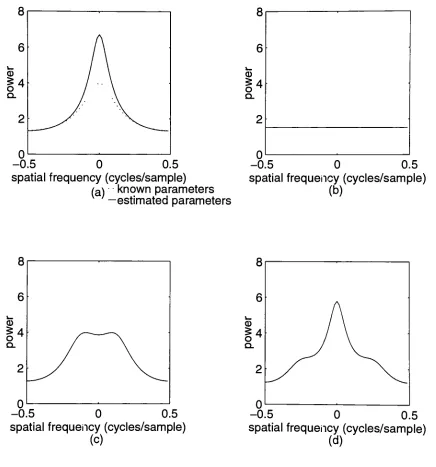
toofewautoregressive parametersmaynot yield anaccurate estimatewhenthe truepower spectrum contains sharppeaks. Asan
illustration,
considerthepowerspatial
frequency (cycles/sample)
(a)
known parameters-estimated parameters
-0.5 0 0.5
spatial
frequency (cycles/sample)
(b)
-0.5 0 0.5
spatial
frequency (cycles/sample)
(c)
-0.5 0 0.5
[image:31.552.60.496.97.564.2]spatial
frequency
(cycles/sample)
(d)
Figure 3-4: Power SpectracomputedfromestimatedARparameters.
(a)
Modelorderp=2, knownparametersaj =0.5 anda2=-0.25; estimated
parametersax =0.456 and
a2=-0.307,
(b)
modelorderp=l,at= 0.658(c)
model order p=3, i =0.426,
a2=-0.263 anda3=0.096(d)
modelorderFigure3-4. Boththeknownpower spectrum andthespectrum computedfromthe
estimated secondorderprocessexhibitthesame overall shape,Figure 3-4(a).
However,
thefirstorderestimateofFigure 3-4(b) isconstant,whilethehigherorder estimates of
Figure 3-4(c) and
(d)
exhibit split peaks or sidelobes.Anotherartifact associated withtheARspectrum estimationtechniqueistheoccurrence
ofspectralline splitting: theappearance oftwoor moredisplacedspectrallineswherea
single spectrallineshouldbeobserved. Ithas beenshown
by Kay
andMarple[1979]
thatspectralline splittingresults fromestimation errors whentheautocorrelationis
unknown and canbe alleviatedinsome cases
by
usingtheunbiased autocorrelationestimatorintheYule-Walkerequations.
Asidefromtheseartifacts, theARspectrum estimation methodhasprovided an
improvementovertheFouriermethodsintermsof resolution. Marpleobservedthat the
resolution performance oftheARmodel isas much asfourtimes thatoftheFourier
methodfora20dB SNR. Theresolutiondeclined for increasednoise,
illustrating
thesensitivityoftheARmethodto whitenoise
[Marple,
1978].AnotherimprovementovertheFouriermethodis inthenumber ofautocorrelationlags
required. In comparingtheARmethod withthe
Blackman-Tukey,
theARmethodhasbeenshowntorequirefewer lags forthesame resolution
[Kaven,
1978]. As indicatedby
the Yule-Walkerequations,onlytheautocorrelationlags r_
[m]
for\m\
<p arerequiredfor estimatingthespectrumof an
AR(p)
process. Whenthemodel order/?issmall, the3.3 Two-dimensional SpectrumEstimation
Theestimation ofspectraoftwo-dimensionalfunctions isofinterest inavarietyof
fields,
including
sonar, radar, geophysics, andimageprocessing. The approachestotwo-dimensional spectrum estimation presented intheliteraturecanbe divided into five basic
categories:
1. directestimationusing atwo-dimensionalFouriertransform,
2. zero-padding followed
by
atwo-dimensionalFouriertransform,3. dataextrapolationbasedon a mathematical model ofthe
data,
followedby
atwo-dimensionalFouriertransform,
4. hybridtechniqueswhich utilize aFouriertransforminonedimensionand a
one-dimensional high-resolutionspectrum estimation methodinthesecond
dimension,
and5. non-classicaldirecttwo-dimensionalmethods.
Aswiththeone-dimensionalmethods, the two-dimensionalmethods are describedina
numberof sources. Of primary interestarethetexts
by
Steven M.Kay
[1988]
andS.L.Marple,
Jr.[1987]
andthearticle writtenby
JamesH. McClellan [1982]. Abriefdescriptionoftheextension ofthenonparametricFouriermethodstotwo
dimensions,
including
thedataextrapolationtechnique, followsinsection3.3.1.Theso-calledhybridor separable spectrum estimationtechniquesusually employa
classicalFourierestimatorinone
dimension,
postponingthemagnitude-squaredoperation,and a modernhigh-resolutionmethodintheseconddimension
[McClellan,
methods isadequateinonedimension
(usually
temporal)
butnotintheseconddimension(usually
spatial). Avariation onthishybridmethodincludes dataextrapolationinthedimensionsubjectedto theFouriermethodbefore continuingwiththehigh-resolution
methodintheseconddimension
[Joyce,
1979].The directtwo-dimensionalmethodsincludetheparametric methods discussedearlier
(AR, MA,
ARMA)
as well asthemaximumentropy, minimumvariance,maximumlikelihood,
PisarenkoandProny'smethods. Theextensionoftheautoregressive spectrumestimatoris describedfurther insection3.3.2. The remainingtwo-dimensionalmethods
will notbe included inthisstudyoftheRadontransformapproach and arethereforenot
discussed further. Thereaderisreferredto the
literature,
specifically[Kay, 1988],
[McClellan, 1982],
[Lim andMalik,
1981]and [BarbieriandBarone,
1992]
foradditionalinformationand resources.
3.3.1 Two-DimensionalNonparametricMethods
Thespectrum estimationtechniquesutilizingatwo-dimensional Fouriertransformare
straightforwardextensionsoftheone-dimensionalFouriertransform technique. Fora
two-dimensional dataset
f(x,y),
theFouriertransformisgivenby
00 00
F(u,v)=
f
[f(x,y)e-2ni{xu+yv)dxdy
(3-19)
Sincethekernelofthis transformationis easilyseparable,the two-dimensionalFourier
transformcanbeimplementedas a series of one-dimensionaltransformsas shown:
-2ni(yv) F(>v)=
l
jf(x,y)e-2ni^dx
&
(3-20)
Theperiodogramestimate thenfollows
directly
asthesquared magnitude ofthisFouriertransform.
Justas withtheone-dimensionaldiscretetransform,theresolutionlimitsforeach ofthe
spatial
frequency
variables uand v aredeterminedby
thesamplingintervalsinthex and vdimensions,
respectively. Zero padding (the enlargement ofthedataset with zero-valueddata points) essentiallyallowsinterpolation betweenthespectrum amplitudes obtained
fromthetransformoftheunpaddeddataset. As such, this techniquedoesnot produce
newinformation but merelypresentstheinterpolatedspectrum values atsmallerintervals.
Dataextrapolationbasedon a mathematical modelfitto thedata
does, however,
servetoartificiallyextendthedataset. Applicationof atwo-dimensionalFouriertransform to
this larger dataset calculatesthespectrum at a smaller
frequency
intervalA/
=1/2 N ,thusprovidinghigherresolution. The accuracyoftheresultingpowerspectrumdepends
ontheproperties ofthemathematicalmodel chosentorepresentthedata. Data
extrapolation methods include independentextrapolationforeachdimension [Frostand
Sullivan
1979],
two-dimensionalextrapolationontheoriginaldataset[Frost, 1980]
andtwo-dimensionalextrapolation oftheautocorrelationfunction [Roucosand
Childers,
Extensionofthe
Blackman-Tukey
spectrum estimation methodto two dimensionsisalsostraightforward. Abiasedtwo-dimensionalautocorrelationfunction estimateisobtained
by
shiftingacopy intwodimensionsandsummingtheproducts:M-1-kN-l-l
}
J
x*[m,
n]x[m+k,n +l]
fork>0,l>0
rxx[kj]=<
MN
1
MN
m=0 n=0
M-\-kN-\
J
^
x*[m,n]x[m+k,n
+l]
fork>0,l<0
m=0 n=-l
(3-21)
The remainingautocorrelationfunctionestimates arebasedonthehermitian symmetry
propertyoftheautocorrelationfunction:
~*
?xx
[-k-1]
=^xx
[k, I]
for
k
<0,
/
>0
andk
<0,
/
<0
(3-22)
The
Blackman-Tukey
spectrumestimateisthengivenby
thetwo-dimensionalFouriertransformofthewindowed autocorrelationfunctionestimate:
K L
iW(/i,/2)=
j_
Yjw[kj]Pxx[kj]e~2nKM+f2l)
k=-K 1=-L
(3-23)
Thewindowfunction w[k,l] is includedas ameans ofweightingtheautocorrelation
functionvalues more
heavily
forsmalllag
values whichare computedfromthelargestnumber ofdatapoints. Theautocorrelationfunctionvaluesfor higher lags arecomputed
variability. Thewindowfunctionservestoeliminatethesevaluesfromtheestimationof
the powerspectrum, thusprovidinga spectrum estimate with alowervariance.
3.3.2 Two-dimensionalParametric Methods
Theextension oftheautoregressive spectrum estimation methodstotwodimensions
requires a parallel extension ofthemathematical modelrepresentingthedata. Recallthat
theone-dimensional model assumesthedatawas generated
by
an autoregressive processactingonthedata already
determined,
asdefined previously inequation(3-9).Ina single
dimension,
thedependenceof eachdatumon previousdatapointsisclear.However,
intwoor moredimensions,
thisrelationshiptopreviousdatapointsbecomesambiguous.
Consequently,
parametric modelsfortwo-dimensionaldatasetshave beendeveloped assumingthreedifferentprediction regions: causal, semicausal,and noncausal.
Eachoftheseregionsimposesa specific set of restrictions ontheindicesmand nforthe
ARparametersamnintherelationship
describing
theARprocess:x[i,j] =
-____amx[i
-m,j-n] +w[i,j]
(3-24)
m n
andthecorrespondingpower spectrumdensity:
P (f f)
AfiAfrPo
^ARUiU2)-2
l+
yya^e-2ni[fmAtl+f2nAt2]
m n
wherepffl isthe2-Dwhite noise variance.
Using
anoncausal,orfullplane,region ofsupport,theindicesmand nmaytakeonanyintegervalue,excluding
(m,ri)=(0,0),
resultinginadependenceof each outputpoint,x[i,j], onpotentiallyall otherdatapoints, asdetermined
by
thevalue oftheARparameteramn. MAandARmodelsassuminga noncausal support regionhavebeen described in
theliterature
by
JainandRanganath[1981]
andSharmaandChellapa [1986].Boththesemicausal and causal support regions
imply
adependenceof each samplex[i,j]on"prior" datapoints only. Thesemicausal region assumes causality in onlyone
dimension,
restrictingone oftheindices,
m orn, to onlynon-negative values whiletheremaining indexisunrestricted. Thisregion,thesymmetric
half-plane,
hasbeenusedinthestudy of2-D ARMA modeling
[Jain, 1981],
[JainandRanganath,
1981]. Theinterpretationofcausality intwodimensions allows either a non-symmetrichalf-planeor
a quarter-plane region of support. Themost stringentinterpretationofcausality allows
bothmand ntotakeononlynon-negativevalues,resulting inthefirst-quadrant
quarter-planesupport region. Similarsupport regions are alsodefined forthesecond,third, and
fourthquadrants. Itshouldbenotedthatall ofthese support regions excludetheorigin
sincetheoutput point cannot dependonitself. Thereaderisreferredto the text
by
Marple
[1987]
orthearticleby
Jain[1981]
formoredescriptionofthesesupport regions.Aswiththeone-dimensionalARspectrum estimationtechnique,thedefinitionof a
two-dimensional ARprocess andtheequationfor its correspondingpowerspectrum reduces
the spectrum estimationtask toone ofestimatingtheARmodel parametersfromagiven
dataset. Althoughalternative parameter estimation methodshave beenpresentedinthe
inthis studyutilizestheYule-Walkernormal equations fora2-D causalARprocess:
W
rt / iK
for[*.']
=
[0,0]
Z-Zr^-^-'-'-^'io
otherwise^
i i
wheretheindices / andyaredefined
by
anyofthequarter-plane or non-symmetrichalfplane support regions. Completedescriptionsofthe2-DYule-Walkerequationsfora
quarter-planesupport region andtheLevinson-typerecursive algorithmfor solvingthem
are containedinthe texts
by
Marple[1987]
andKay
[1988]. Itis importanttonotethattheseequations and algorithmcloselyparallelthosedescribed forthe 1-D ARspectrum
estimation methodin Section 3.2.2. Useofthismethodthereforeprovides alogical
Itisalso importanttonotethat therestrictionofcausality has beenshown to resultinan
ellipticallyskewed spectralresponsetoa single sinusoidinwhite noise. Acombined
quarter-planeARestimatordefinedas
1
1
+
1
'
ARCV/l'/2/ *AR1v/l'J2 /
"/U?2v/l'/2/
where
PAR
, is thefirstquadrant estimator
(3-27)
^4/?l(/l'/2)-
TJ2Pt
Pi Pi
m=0n=0
-2jii[/1mr1+/2nr2]
(3-28)
and
PAR2
isthe secondquadrantestimatorPar2
\f\^fl) ~TJ2p
CO0 p2
-27t/[^mr1+/2/.r2]
(3-29)
ni=ptn=0
has beenshowntoproduceacircularresponse to thesingle sinusoidinwhite noise
[Jacksonand
Chien,
1979]. JacksonandChien alsonotedtheoccurrence offewer3.4 The Radon Transform Approach
The Radon
transform,
introducedin 1917by
JohannRadon,
isa meansofexpressingatwo-dimensionalfunctionintermsofitsprojectionsonto a set of one-dimensional
lines,
enablingexaminationoftheinternalstructure of an object. Sinceits
introduction,
theRadontransformhasbeenusedina vastarrayofapplications,themostcommonly known
being
computerizedtomography
formedicalimaging
[KakandSlaney,
1988]. Itsapplicabilitytotheproblem of spectrum estimationisadirectresult oftherelationship
betweentheRadonandFouriertransformsdescribed herein. Amorethoroughdiscussion
oftheRadontransform,itsproperties,and applicationsiscontainedinthe text
by
Deans[1983],
which also contains a completeEnglishtranslationofRadon's 1917paper.3.4.1 Description oftheRadon Transform
Foratwo-dimensional
function,/Tx..y)>
theRadontransformoperator is definedas acomplete set oflineintegralsof/alongall possiblelinesL:
f{p,)
=0tf=\f{x,y)ds
(3.30)
L
whereds isanincrementallength alongtheline L defined by:
/?=
xcos^+>-sin^
(3-31)
Thusasingle projection oftheRadontransformisobtained
by
restricting <()to a singlevalue(|>i andcomputing line integrals alongalllinesperpendicularto theradialline at
Figure 3-5: Integration lines L for computinga singleRadon transformprojectionfor(j) =45 degrees.
In
theory,
theRadontransformof a continuousfunctionisalsocontinuousover allpossible values of and all linesLperpendicularto theradiallineat angle <f>. Inpractice
however,
thefunctiontobetransformedisadiscretematrix,orarray, of numbers. Thecomputedtransformwillthereforebeadiscreteapproximationto theRadontransformfor
theselected projection angles{. Asanexample,consider a sinusoidal functionwithin a
circular window as shownin Figure 3-6(a). The Radontransformprojection at =
0,
shownin Figure 3-6(b),is computed
by
simply summingoverthecolumns ofthematrix.Theperiodicnature ofthesinusoidisclearlyvisibleinthis projection;withthedecreased
amplitudeneartheedgesresultingfromthecircular window.
Similarly
the90projectioncanbecomputed either
by
summingovertherows ofthematrix orby
rotatingthematrixandsummingoverthe columns,Figure
3-6(c)
and(d). Once again,theimpactofthecircular windowisvisibleinthedecreasedamplitude neartheedges oftheprojection.
-1 0
100
-1 0
Figure 3-6: Radontransformprojectionsfora single sinusoid ina circular
window,
(a)
originaldataset,(b)
Radontransformprojectionfor =0,
0
Q.
E CO CO
4r
2
(1
1
o
WW
-2V
v
V
V
V
v
-4
-32 0
samples
(h)
31
Figure 3-6 (cont.):
(e)
sinusoid rotated30,
(f)
Radon transformfor<|> =30
constant value forthe90Radontransformprojection. Forall other projectionanglesthe
originalfunction /must berotated andfittoa set ofrectangularcoordinates before
column summationsmay be determined. Additionalrotations andRadontransform
projectionsfor
0
= 30and <f> =60are providedin Figure3-6(e)-(h).ThediscreteRadontransformismost
frequently
presentedinoneoftwoformats. Thesimplestpresentationisthe sinograminwhicheachRadontransformprojectionis
represented as a singlerow ofadigitalimage. Thesinogramcontainingthefour Radon
transformprojections ofFigure3-6 is the4-by-64matrixillustratedin Figure 3-7withthe
firstrowcontainingthe0projection. Other Radontransformprojectionsmay beincluded
inthis sinogram
by inserting
(0<<}><90)
orappending (<|>>90)
additionalrowsto thematrix, as required. Analternative presentationis thereconstructedtwo-dimensional
Radontransforminwhicheach projectionisfilteredtocompensatefor oversamplingnear
the origin,rotated to theappropriateangle, and summedintoa single matrix. As an
illustration,
180 Radon transformprojections ((j)=0,
1,
2,...,179)forthesinusoid of
Figure
3-6(a)
are presentedin bothformats,
thesinogram andthereconstructedtwo-dimensional transform, in Figure 3-8.
Analternative expressionfortheRadontransformutilizingthevectorx=
{x,y),
the unitvector =
(cos<{>,sin
<))),andemployingtheDiracdelta functiontoselecttheline
/?=
c|-x,isgivenby
/(M)
=J7W5(p-$-x)dx.
-10 0 10 20 30
samples
Figure 3-7: Sinogramwithfour Radontransformprojections forasingle
sinusoidina circular window. The fourrows representthe 64-point Radon
transform projectionsforprojectionangles =
0, 30, 60,
and90.-50 0 50 0 200 400
Figure 3-8: Radontransformforsinglesinusoidin circularwindow,
(a)
Sinogram forprojection angles<j> =0, 1, 2,
...179.(b)
Reconstructed
Asoutlined
by
Deans[1983],
thisformofthe Radontransformequation canbe usedtoexpressthetwo-dimensional Fouriertransformof
/(x)
intermsofthe Radontransformand a one-dimensional Fouriertransformalongtheradialdirection oftheRadon transform
as givenby:
F{s^)=)f{p,k)e-2^dp
(3-33)
Perhaps thisrelationship is betterunderstood
by
consideringthe twopathwaysleading
tothe two-dimensionalFouriertransformshown inthe
following
flowdiagram,
Figure3-9./(*,y)-><
Radon 1-DFourier Transform .
jF(n fc\ Transforms
OR
2-D Fourier Transform .
-*F{u,v)=
F{s
Figure3-9: Flow diagramfortwo-dimensional Fourier transform computationusingtheRadon transform.
Thetwo-dimensionalFouriertransformsobtainedalong these twopaths are
theoretically
equivalent whenthe input functionf{x,y)
iscontinuous, a sufficientthoughnotnecessarycondition.
However,
whentheinput function is adiscreterepresentation of acontinuousfunction
f{x,y),
thecomputedtransformfromeitherpathwaywillalsobeadiscreteapproximationof F(u,v). The differences betweenthese two representationsare
primarily due to theinterpolationbetween datapoints necessary in
fitting
thedatato arectangulargridforthe2-D Fouriertransformorthelines ofintegration fortheRadon
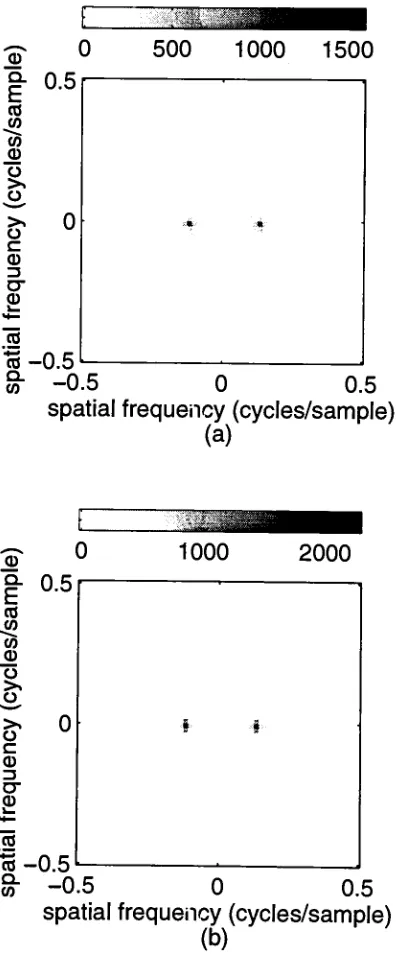
transform. The discrete Fouriertransforms forthesinusoidofFigure
3-6(a)
computedfromthe two-dimensional FFTandfromtheRadon transformandone-dimensionalFFTs
500 1000 1500
Q.
CO -0.5 0 0.5
spatial
frequency
(cycles/sample)
(a)
co -0.5
8"
-0.5 0 0.5
spatial
frequency
(cycles/sample)
[image:48.552.175.375.75.557.2](b)
Figure 3-10: Fouriertransformscomputedforasingle sinusoid in acircular
3.4.2 The Radon TransformandSpectrum Estimation
Applicationofthe Radontransform tospectrum estimationinconjunction withthe
classicaltechniquesis aclear extension oftherelationship betweentheRadontransform
andthe two-dimensionalFouriertransform. The alternative approachesusingtheRadon
transform inconjunctionwith theperiodogramandthe
Blackman-Tukey
methods areillustratedinthe
following
twoflowdiagrams,
Figures 3-11 and3-12.f(x,y)-><
Radon Transform
->/(p.O
1-DPeriodograms
)F(>5)
OR
2-DPeriodogram
F(u,v)
Squared Magnitude
,
p^fj
Figure3-11: Flow diagramforspectrum estimation
usingtheRadontransformand theperiodogram.
/U.y)--^>r_(/fc,/)->
Radon 1-DFourier Transform . /
_ _,\ Transforms
OR
2-D Fourier Transform
>->pBAfi,f2)
Figure 3-12: Flow diagramforspectrumestimation
usingtheRadontransformand the
Blackman-Tukey
method.
Theeffectiveness ofthe Radontransformapproachclearlydependson
fitting
therotateddatato a rectangulargridbothin computingtheRadontransformprojections andin
When utilizinganon-Fourierspectrum estimationtechnique,thereisnotwo-dimensional Fouriertransform to
directly
replaceusingtheRadontransformapproach.However,
itisareasonableexpectationthat theRadontransformmaybeusedtocompressthe
data,
orthe autocorrelation
function,
toa series of one-dimensional spectrum estimationproblems. Theflowdiagramshownin Figure 3-13 illustratestwoalternative approaches toARspectrumestimationusingtheRadontransform.
/M
ACF
*rxx{k'l)->
Radon Transform
-\
Solve 1-D Yule-Walker
Equations
OR
Solve 2-DYule-Walker Equations
OR
Radon
Transform >/ \ 1-DACF's
>f{P,x) *r{k)- Solve 1-D Yule-Walker
'^omn^PAR(fl,f2)
Figure 3-13: Flow diagram forspectrum estimation usingthe
Radontransformand autoregressive parameterestimation.
Itisnotclear whetherthepremise oftheARmodel stillholdstrueforeither ofthese Radontransformapproaches. Recallthemodel assumptionthat the originaldataset was
generated
by
anARprocessdefinedby
theparameters amn inequation(3-24). WhenThisinvestigationoftheRadontransformapproachto spectrumestimation addressesthe
feasibility
ofestimatingthepower spectruminconjunctionwiththe periodogram,theBlackman-Tukey,
andtheARparameter estimation routines. The algorithm chosenfortheauto-regressiveapproach isshownalongthebottompathofFigure 3-13 flow diagram
(Radon
transform,
1-DACF's,
1-D Yule-Walkerequations). Thealternative algorithms4.0 Approach
Theobjective of
demonstrating
thefeasibility
oftheRadontransformapproachtotwo-dimensional spectrum estimationwasaccomplished
by
processingtwo-dimensionaldatasetsusingdifferentspectrum estimation algorithmsandcomparingtheresultstothe
knownpowerspectrum. Inaddition, aqualitative performanceassessmentincluded
comparison ofthe spectrum estimatesfromtheRadontransformapproachtoestimates
generated from directtwo-dimensionalapproaches. Theprocedure isoutlinedinthe
following
steps:1. defineand generatetwo-dimensionalnoise-freedata
sets,
2. estimate powerspectrumusingtwo-dimensional spectrum estimationmodels,
3. estimate power spectrumusing Radontransformandone-dimensional
spectrum estimationmodels, and
4. compareestimatesfromRadontransformapproachto estimatesfromdirect
two-dimensionalmethods and/orknownpower spectra.
The
feasibility
demonstration includedthreetwo-dimensionaldata sets withwell-knownpower spectraas described in Section 4. 1. Inpart, thesedatasets were selectedto
examinetheabilityoftheRadontransformapproachtoproducehigh-resolutionestimates
andto detectanunderlyingautoregressive process. Powerspectrumestimatesforthese
datasets were generatedfrom directtwo-dimensionalmethods asdescribed in Section 4.2
as well as fromtheRadontransformapproachinconjunctionwiththeperiodogram,
Blackman-Tukey,
andARparameter estimation algorithmsdescribed in Section 4.3. Theresultingpowerspectrumestimateswere examinedfortheoverallformofthe
known
Withthe
feasibility
oftheRadontransformapproachestablished, a qualitativeperformance assessmentincludeda comparison of spectrum estimationapproaches,an
observationof phase estimation andimagereconstruction,as well as aninvestigationof
interpolationeffects ontheestimated spectrum asdescribed in Section 4.4.
Alldataprocessingwas completedusing
MATLAB,
aninteractiveprogrammingsystemdeveloped
by
The MathWorks,
Inc. SinceMATLABuses matrices and vectors asbasicprocessingelements, several spectrum estimation routines wereeasily implementedas
MATLABfunctionscontainedin M-files. Listings ofthesesupplementalMATLAB
4. 1
Two-dimensional
datasetsThe Radontransformapproachto two-dimensionalspectrum estimation was appliedto
sixtypes ofdatasets:
sinusoidaldata(datasets#1 & #1
1),
atwo-dimensionalrectanglefunction
(#2),
datagenerated
by
a causalautoregressiveprocess(#3),
linearcombinationsof sinusoidal and autoregressivedata
(#4, #5, ),
two8-bitimages(#7 &
#8),
andperiodicfunctions
(sinusoids)
definedby
discretedeltafunctions inthefrequency
domain (#9 & #10).Alldatasets were of size 64
by
64pixels.Withtheexception ofdatasets#7-#10,
thedatawere generatedusingone(or more) oftheMATLABroutines
'planewv', 'rect2',
and'ardata2'
aslistedinAppendix A. The'planewv'
routine generatestwo-dimensional
sinusoidaldatawith user-specified
frequency,
amplitude, phase, and,azimuthal angle.The'rect2'
functioncreates atwo-dimensionalrectanglefunctionwith auser-specified
widthin boththe
x-and y-dimensions.
Alternatively,
adatasetgeneratedby
afirst-quadrant,causalautoregressive process canbe obtainedfromthe'ardata2'
routineusing
theuser specified autoregressive parameters and aninputmatrix of randomnumbers.
The processingwas completedusing datasets with no additive noise inordertomeetthe
Data Set #1: "Sines"
This datasetconsistsof alinearcombination oftwo-dimensional bipolarcosines chosen
toillustratetheresolution performance of each spectrum estimation algorithm. Atotalof
twelvecosines of equal amplitudeand zero phase areincludedinthedataset. Theperiod
andazimuthal angleforeach cosine wave are listedin Table 4-1.
Period Azimuth Period Azimuth
(samples)
(degrees)
(samples)
(degrees)
la. 8 0 4a. 64/20 0
lb. 64/6 0 4b. 64/21 0
2a. 64/20 90 5a. 8 90
2b. 64/22 90 5b. 64/7 90
3a.
64/sqrt(72)
135 6a.64/sqrt(72)
453b.
64/sqrt(128)
135 6b.64/sqrt(98)
45Table 4-1: Period andAzimuthal Anglefor Cosines ofData Set #1
("Sines")
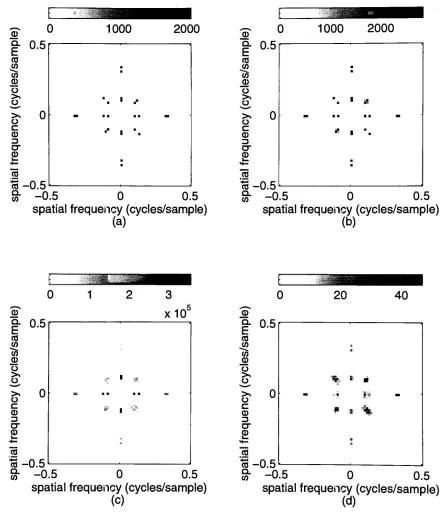
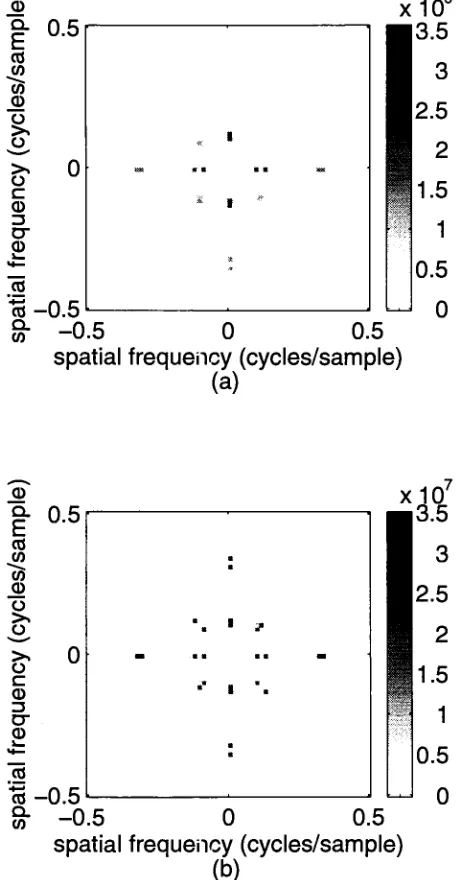
Thepower spectrum associated withthisdataset consists ofthe twelvepairsofdelta
functionsshowninthe
discrete,
gray-scale representation ofFigure 4-1. The deltafunctionpairs correspondingtosix ofthecosines are separatedfromanotherpairinthe
sampled
frequency
domainby
twosamples. The delta functionpairsfortheremainingcosineshavea
frequency
separationofonly onesample,beyondtheresolutionlimitof0 500 1000 1500 2000
-0.5 0 0.5
spatial
frequency (cycles/sample)
Figure 4-1: Powerspectrumfor
"Sines"
Data Set #2: Two-dimensionalRectangle Function
The seconddataset consistsof a unit-amplitude rectanglefunctionchosenforits
well-knownandrecognizableFouriertransform,thesinefunction. Thenon-zero portion of
therectanglefunction iscenteredinthematrix at pixel
(33,33)
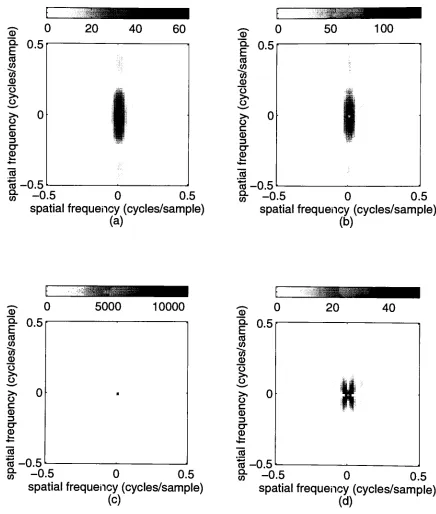
andhaswidths of16samplesalongthex-axis and4samples alongthey-axis. Thepower spectrum estimate
forthisrectanglefunctioncomputedusingthe2-D FFTisshownin Figure 4-2. As
expected, thecharacteristic shape ofthesinefunctionis easilyobservedinthis spectrum
estimate.
0 20 40 60
-0.5 0 0.5
spatial
frequency (cycles/sample)
Figure 4-2: Power Spectrum estimatefor"Rectangle"
function,
computedfromData Set #3: "ARProcess"
Thisdatasetcontainsdataobtained
by
applicationofa causal autoregressive processinthespatialdomaintoa64-by-64matrixof normally-distributed random numbers obtained
fromtheMATLABroutine'randn'. The ARprocessis defined
by
theparameters1 -0.5
p= -0.5 025 0
0.25 0 0
(4-1)
Sincethe autoregressive parameters are
known,
thepowerspectrum canbeeasilycomputedfromequation(3-25). The author-generatedMATLABroutine'arspec2'
providedinAppendix Acomputesthispower spectrum attheuser-specified number of
frequency
points. A64-by-64discrete,
gray-scale representation ofthepower spectrumcomputedfromthear parameters isshowninFigure 4-3.
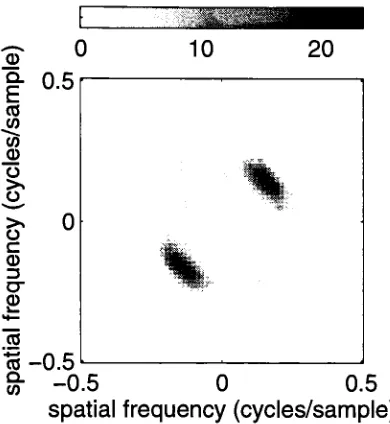
Data Set #4- #6: "Sines+AR
Process"
Thenextthreedatasets arelinearcombinationsofthe"ARProcess" datasetpreviously
describedandthree sinusoids withfrequenciesand azimuthal angles chosenforthe
locationoftheirspectral peaks. Thefirsttwosinusoidshave spectralpeaksalongthe
verticalandhorizontalaxes. The spectralpeaks associated withthethirdsinusoidare
located alongthe 45
radial lineinordertocoincidewiththepeaknon-zero regionsofthe
ARprocess spectrum shownpreviouslyinFigure4-3. Theperiods andazimuthal angles
Q.
CO -0.5 0 0.5
spatial
frequency (cycles/sample)
Figure 4-3: PowerspectrumofARprocess,computedfrom known
autoregressive parameters.
CO -0.5 0 0.5
[image:59.552.198.393.75.287.2]spatial
frequency
(cycles/sample)
Period
(samples)
AzimuthalAngle(Degrees)
6.4
3.2
64/sqrt(200)
0
90
45
Table 4-2: PeriodsandAzimuthal Angles for Three Sinusoids ofData
Sets #4- #6
A
discrete,
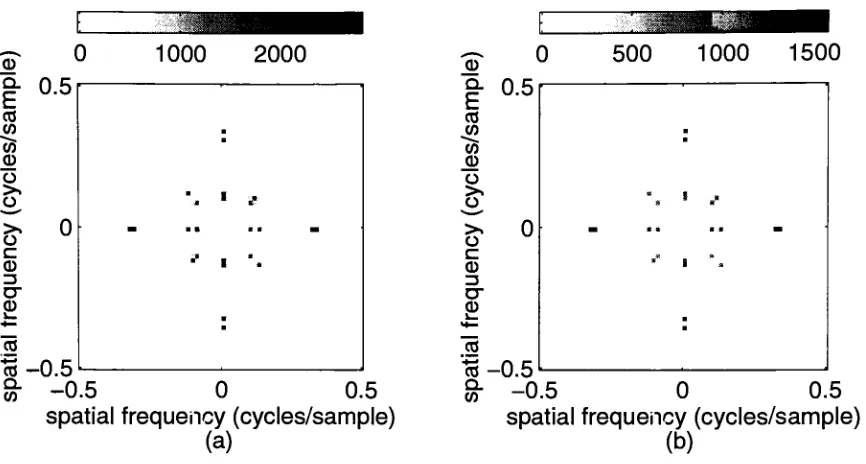
gray-scale representation ofthepower spectrumisshownin Figure 4-4. Itshouldbenotedthat thenon-zerodatapoints ofthe truepower spectrum ofthe
continuoussinusoids are infinitely-valued. Thefinitevalue assignedtothesepointsin
estimatingthepower spectrumisafunctionoftheamplitude oftheinputsinusoids. The
sinusoidsin datasets
4, 5,
and6 haveequal amplitudes of1.0, 0.5,
and0.25,
respectively.DataSet #7and#8: Images
Thetworemaining datasetsaredigitizedversionsoftwophotographs. The 8-bit images
"child 1" and"child2" showninFigure 4-5 were chosen as afirstattempt at
demonstrating
thefeasibility
ofutilizingtheRadontransformapproach with actualimagedata. Resultsobtainedfromprocessing these twoimagesare notconsideredtobe
representativeoftheresults obtainablefrom processingallimages. Sincethe truepower
spectrumofthecontinuous signalproducingeachoftheseimages isnotknownin
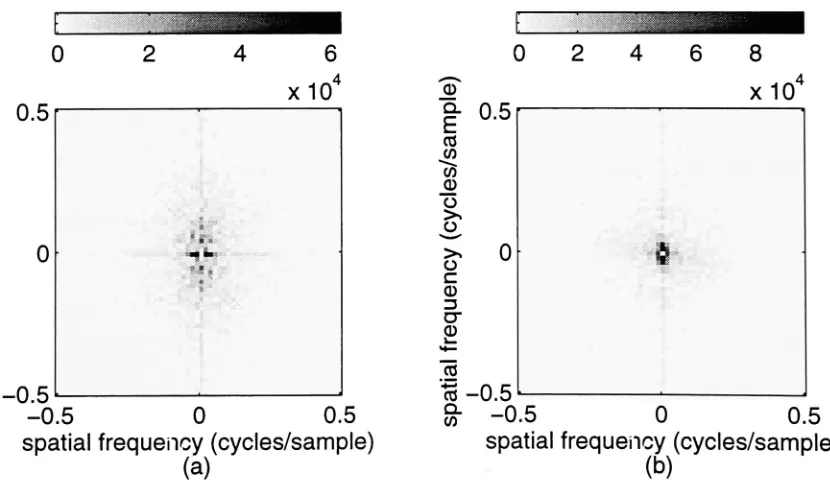
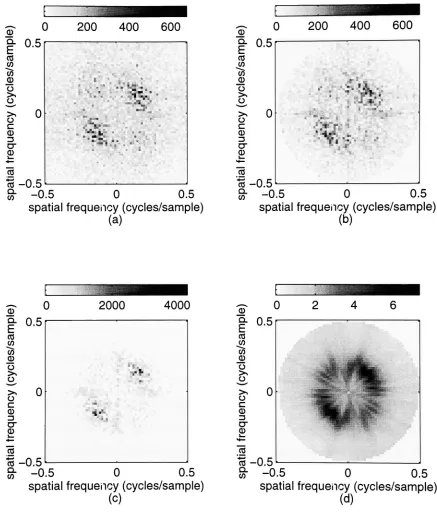
advance, thespectrum estimates obtainedfromthe2-D Fouriertransformsof eachimage
are providedinFigure4-6. Itshouldbenotedthatthelinesvisiblealongthehorizontal
and vertical axes ofthesespectrum estimates are a result oftheassumedperiodic nature
-100 0 100 -100 0 100
Figure4-5:
(a)
Dataset#7,
"Child1"(b)
Dataset#8,
"Child2"Q.
CO -0.5 0 0.5
spatial
frequency
(cycles/sample)
(a)
Q.
CO -0.5 0 0.5
spatial
frequency (cycles/sample)
(b)
Figure4-6: Powerspectracomputedfrom 2D FFT f