City, University of London Institutional Repository
Citation
:
Francis, J., Johnston, M., Robertson, C., Glidewell, L., Entwistle, V., Eccles, M. P. and Grimshaw, J. M. (2010). What is an adequate sample size? Operationalising data saturation for theory-based interview studies. Psychology & Health, 25(10), pp. 1229-1245. doi: 10.1080/08870440903194015This is the unspecified version of the paper.
This version of the publication may differ from the final published
version.
Permanent repository link:
http://openaccess.city.ac.uk/1732/Link to published version
:
http://dx.doi.org/10.1080/08870440903194015Copyright and reuse:
City Research Online aims to make research
outputs of City, University of London available to a wider audience.
Copyright and Moral Rights remain with the author(s) and/or copyright
holders. URLs from City Research Online may be freely distributed and
linked to.
What is an adequate sample size?
Operationalising data saturation for theory-based interview studies.
Jill J Francisa*, Marie Johnstonb, Clare Robertsona, Liz Glidewella, Vikki Entwistlec, Martin P Ecclesd and Jeremy M Grimshawe
a
Health Services Research Unit, University of Aberdeen, Aberdeen, United Kingdom;
b
School of Psychology, University of Aberdeen, Aberdeen, United Kingdom; cSocial
Dimensions of Health Institute, Universities of Dundee and St Andrews; dInstitute of Health
and Society, Newcastle University, Newcastle, United Kingdom; eOttawa Health
Research Institute, Institute of Population Health & Department of Medicine, University of Ottawa, Ottawa, Canada.
What is an adequate sample size? Operationalising data saturation for theory-based interview studies
Abstract
In interview studies, sample size is often justified by interviewing participants until reaching “data saturation”. However, there is no agreed method of establishing this. We propose principles for deciding saturation in theory-based interview studies (where conceptual categories are pre-established by existing theory). First, specify a minimum sample size for initial analysis (initial analysis sample). Second, specify how many more interviews will be conducted without new ideas emerging (stopping criterion). We demonstrate these principles in two studies, based on Theory of Planned Behaviour, designed to identify three belief categories (Behavioural, Normative, Control), using an initial analysis sample of 10 and stopping criterion of 3. Study 1 (retrospective analysis of existing data) identified 84 shared beliefs of 14 general medical practitioners about managing patients with sore throat without prescribing antibiotics. The criterion for saturation was achieved for Normative beliefs but not for other beliefs or study-wise saturation. In Study 2 (prospective analysis), 17 relatives of people with Paget’s disease of the bone reported 44 shared beliefs about taking genetic testing. Study-wise data saturation was achieved at interview 17. We propose specification of these principles for reporting data saturation in theory-based interview studies. The principles may be adaptable for other types of studies.
What is an adequate sample size for interview studies? Operationalising data saturation for theory-based content analysis
Background
In studies that use semi-structured interviews that are analysed using content analysis, sample size is often justified on the basis of interviewing participants until “data saturation” is reached. However, there is no agreed method of establishing when data saturation has been reached and so it is not clear what this means in practice. In this paper we propose a method for establishing and reporting how data saturation has been achieved in theory-based interview studies (i.e., in which conceptual categories are pre-established from existing theory). We suggest a set of systematic principles by which researchers can report their justification for the decision that an appropriate sample size has been attained in such interview studies. In addition, we suggest how this might be tested.
effective in eliciting participants’ experiences or views within these conceptual categories), it is likely that the content domain of the construct has been adequately populated (or saturated). Data saturation is an important concept as it addresses whether such a theory-based interview study is likely to have achieved an adequate sample for
content validity.
The question of sample size is also important because the use of samples that are larger than needed is an ethical issue (because they waste research funds and participant time) and the use of samples that are smaller than needed is both an ethical and a
scientific issue (because it may not be informative to use samples so small that results reflect idiosyncratic data and are thus not transferable, and may therefore be a waste of research funds and participant time).
present evidence to specify or defend the judgement that data saturation has been achieved in a way that is transparent to readers?
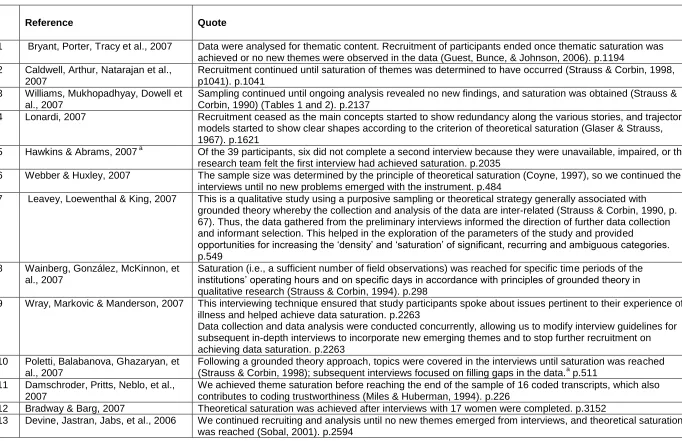
TABLE 1 HERE
The question addressed in this paper, then, is ‘What does it mean, in practice, to say that
NO new themes have emerged?’ If a second participant is very similar to the first insofar as s/he does not mention any new ideas, it is clearly not appropriate to stop interviewing after two interviews. Yet, how many interviews with no new ideas does it take before the researcher may be confident that no more importantly new ideas would be mentioned if more participants were sampled? The question might need to be answered differently depending on the research question and type of interview study. Some forms of analysis (e.g., grounded theory) seek to build theory by identifying constructs implied by the data and building them into a network of associations, whereas in theory-based content analysis, the researcher seeks to use the data to populate pre-specified theoretical
constructs with contextually relevant content. In this paper we focus on studies in which interviews are used to generate data to populate pre-specified theoretical constructs with contextually relevant content. We suggest some principles for deciding that data
The TPB provides a theoretical framework for predicting intentions and behaviour. It has received substantial empirical support from systematic reviews of correlational studies (e.g., Armitage & Conner, 2001) and experimental studies (e.g., Webb & Sheeran, 2006). TPB research uses standard methods (e.g., Francis, Eccles, Johnston, Walker, Grimshaw, Foy, et al, 2004) to operationalise the constructs in the model: Attitude (how much the person is in favour of performing a specified behaviour), Subjective Norm (how much the person feels pressure from social sources to perform the behaviour, or not), and Perceived Behavioural Control (how much the person feels that the behaviour is within his or her control). Each of these variables (Attitude, Subjective Norm and Perceived Behavioural Control, or PBC) is measured by asking participants to complete a questionnaire by reporting the extent to which they agree or disagree with items reflecting three kinds of specific beliefs. Behavioural beliefs (the perceived advantages and disadvantages of enacting the behaviour) are proposed determinants of Attitude. Normative beliefs (the individuals or social group perceived to exert pressure to enact the behaviour, or not) are proposed determinants of Subjective Norm. Control beliefs (the perceived factors that make it easier or more difficult to enact the behaviour) are proposed determinants of PBC.
‘salient’ Behavioural, Normative and Control beliefs. This is done by identifying the views or beliefs that are most frequently mentioned, independently, by participants, in response to open questions. For this reason, the studies reported here analysed data saturation for shared beliefs (i.e., mentioned by two or more participants), as idiosyncratic beliefs (i.e., mentioned by only one participant) were not likely to be relevant to most of the population from which the participants were drawn.
This theory-based approach thus differs importantly from other types of
qualitative research. First, in some studies, themes that appear to be ‘idiosyncratic’ within an initial sample might lead to further sampling of participants from potentially under-represented sub-groups for whom such themes might be important. Second, some studies explicitly search for contrasts within the sample in order to generate hypotheses about how individuals or sub-groups might differ. The principles for establishing data saturation that are proposed here do not apply to these other types of research. We
suggest, however, that the principles might be adaptable to these kinds of studies, because the question, when to stop sampling, may significantly influence research findings and therefore may require team decisions that have a clear justification. As indicated above, we first propose the principles within the less complex context of an interview study based on pre-specified theoretical constructs. As long as an appropriately diverse sample has been used, the principles may justify a claim that data saturation has been achieved.
Principles for specifying data saturation
as the initial analysis sample. The specific number will depend on the complexity of the research questions and of the interview topic guide, the diversity of the sample and the nature of the analysis (e.g., the number and likely dimensionality of the target constructs). Of course, sampling would be conducted according to pre-specified ‘stratification’ factors that are relevant to the study (e.g., age, gender, rurality, ethnicity). Otherwise, spurious early data saturation may be achieved due to spurious homogeneity of the sample. (If many stratification factors are likely to be relevant to the research questions, a larger initial analysis sample is likely to be needed.)
The second principle is that researchers should specify a priori how many more
interviews will be conducted, without new shared themes or ideas emerging, before the research team can conclude that data saturation has been achieved. We will refer to this as the stopping criterion. Analysis then proceeds on an ongoing basis until the stopping criterion is met.
To illustrate these two principles in the studies reported in the current paper, we specify the first two principles as follows (assuming two or three main stratification factors):
Initial analysis sample: At least 10 interviews will be conducted (with appropriate diversity sampling).
Stopping criterion: After 10 interviews, when three further interviews have been conducted with no new themes emerging, we will define this as the point of data
other groups of participants to sample, if analysis suggests that the stratification factors applied for the initial analysis sample may be inadequate.
In the interests of providing further deliberation, we offer additional principles. The third principle is that the analysis would ideally be conducted by at least two independent coders and agreement levels reported to establish that the analysis is robust and reliable. The fourth principle is that data saturation methods and findings ideally would be reported so that readers can evaluate the evidence. A priori criteria could be part of a paper’s Methods section. We will demonstrate these principles below.
An earlier attempt has been made to specify a sample size rule for interview studies that are not theory-based. Guest et al. (2006) conducted interviews in two African countries on the topic of social desirability behaviour and accuracy of self-reported sexual behaviour. They documented the progression of theme identification after successive sets of six interviews, until 60 interviews had been conducted. Ninety-two percent of all codes were identified after 12 interviews and 97% of the ‘important’ codes (operationalised as the number of individuals expressing the same idea) were identified within these 12 interviews. Guest et al. concluded that about 12 is a sufficient sample for interview studies analysed for emergent themes. However, they questioned the
transferability of their findings. Furthermore, there appeared to be no ‘development’ of the interview process; the topic guide did not evolve to explore emerging themes in greater depth during the course of the interview study. In that sense, the methods used by Guest and colleagues were more like the pre-determined, theory-based approach
saturation was reached; it was somewhere between seven and 12. In contrast to this approach, we propose a set of principles for establishing the appropriate sample size, together with ways to present data to support this judgement.
In this paper we report data from two studies to illustrate and critically examine these principles. The data are presented in the form of cumulative frequency distributions, showing which participants mentioned a ‘new’ idea (or belief or theme), that is, a belief not previously elicited. As the objective of each of the studies was to elicit beliefs relating to three theoretical constructs (Attitude, Subjective Norm and PBC), we test the criterion for data saturation both at the level of each individual construct and at the study-wise level.
Study 1. Content analysis of general medical practitioners’ beliefs about managing upper respiratory tract infections.
Background
This study used the Theory of Planned Behaviour to predict general medical practitioners’ (GPs’) intentions and behaviour relating to managing patients with upper respiratory tract infections (URTIs) without prescribing antibiotics. UK-based clinical guidelines recommend that GPs manage patient with URTI without prescribing
antibiotics. The data reported here relate to a retrospective re-analysis of the first phase of a larger study that is reported elsewhere (Eccles, Grimshaw, Johnston, Steen, Pitts, Steen, et al, 2007).
This study of the clinical behaviour of healthcare professionals used the Theory of Planned Behaviour (TPB; Ajzen, 1991) as a theoretical framework for predicting
questionnaire to measure three of the TPB constructs (Attitude, Subjective Norm and Perceived Behavioural Control), GPs were interviewed to identify their beliefs relating to managing patients with URTI without prescribing antibiotics. Interviews were conducted to elicit three kinds of beliefs: Behavioural beliefs, Normative beliefs and Control beliefs and the study team made the judgment that data saturation had been achieved. The objective of reporting the interview data here is to examine the sampling strategy used for this study and to find out (retrospectively) whether this judgment was consistent with the proposed principles for establishing data saturation.
Methods
Participants. Participants were 14 GPs (years in practice 4.5-25; 2 female; practising for 5-10 half-day sessions per week; from a range of regions in Scotland and north-east England). At the time, the research team felt that the first 10 participants (initial analysis sample) represented adequate diversity on these pre-specified stratification factors.
Materials. The interview topic guide was based on standard methods used for the TPB (Francis et al., 2004), i.e., questions about the advantages and disadvantages of managing patients with URTI without prescribing antibiotics, who might approve or disapprove of this behaviour; and what factors might make it easier or more difficult to do this.
Procedure.Semi-structured interviews, lasting approximately 40 minutes, were
conducted with individual participants. The interviews were audiorecorded, transcribed, anonymised and content analysed.
Analysis. Theory-based content analysis was conducted in three steps. First, one
the utterances of different participants into similar beliefs and used wording from the transcripts to describe each belief (“summary data”). Third, two judges independently coded each belief for the presence/absence of three kinds of belief: Behavioural belief, Normative belief and Control belief. Krippendorff’s alpha (Krippendorff, 2004) was used to describe agreement between judges at the third step, separately for each construct.
Data saturation analysis was conducted in four steps. First, data tables were constructed at the level of specific beliefs elicited for each individual. Second, summary tables were constructed for each of the three kinds of belief to display the beliefs that were mentioned by each participant interviewed. This summary table contained binary (yes/no) data presented sequentially and included idiosyncratic beliefs (i.e., beliefs that were not shared by at least two participants). (See Appendix for format of table.) Third, data from the summary tables were used to construct a series of cumulative frequency graphs, one for each type of belief (Behavioural, Normative and Control) and one line for ‘All beliefs’. These lines displayed, sequentially, the frequency with which each (shared) individual belief was mentioned by the 14 participants.
These cumulative frequency graphs were inspected to investigate: (a) the number of shared beliefs elicited by the initial analysis sample (which was set at 10); (b) the number of interviews required to meet the stopping criterion (which was set at three) for each construct, and overall; (c) whether any new shared beliefs emerged following three successive interviews with no new shared beliefs (for each construct and overall).
Results
Normative and Control beliefs. Krippendorff’s alpha reliability estimates (1000 bootstrap samples) were 0.67 for Behavioural beliefs, 0.93 for Normative beliefs and 0.63 for Control beliefs.
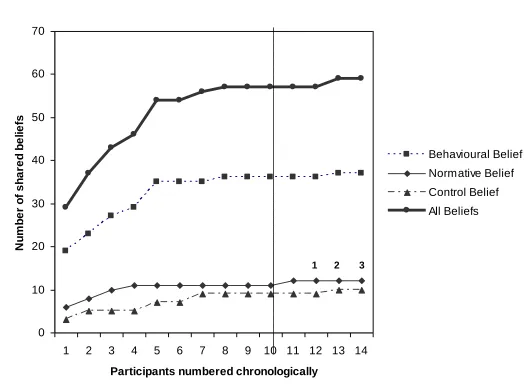
Summary data. Figure 1 presents cumulative frequency graphs for Participants 1 to 14, for the specific, shared beliefs about managing patients with URTI without prescribing antibiotics. The number sequence, “1 2 3” above a line highlights the application of the stopping criterion.
FIGURE 1 HERE
Construct-level saturation. From Figure 1, the line representing Behavioural beliefs shows that, when asked about advantages and disadvantages of managing patients with URTI without prescribing antibiotics, the first participant mentioned 19 distinct beliefs. After the fifth interview, 35 shared beliefs (i.e., beliefs mentioned by at least two
participants) had been elicited.
From Figure 1, the line representing Normative beliefs shows that, after 10 interviews, the initial analysis sample had yielded 11 shared beliefs. There was one new shared belief in Interview 11 but no new shared beliefs in Interviews 12, 13 or 14. Application of the stopping criterion thus suggests that construct saturation was reached after 14 interviews.The line representing Control beliefs shows that, after 10 interviews, the initial analysis sample had yielded nine shared beliefs and there were no new shared beliefs in interviews 11 or 12 but there was one new shared belief at interview 13. So applying the stopping criterion for construct saturation indicates that saturation was not achieved. No new shared Control beliefs were elicited at Interview 14 and there were 10 in total.
Study-wise saturation: all belief categories. Finally, the line representing all belief categories in Figure 1 shows that, after 10 interviews, the initial analysis sample had yielded 57 shared beliefs and there were no new shared beliefs in interviews 11 or 12. However, there were two new shared beliefs at interview 13. So applying the stopping criterion indicates that study-wise saturation was not achieved, despite the research team’s sense that data saturation had occurred.
However, this study was conducted before the proposed principles for establishing data saturation were devised. Fourteen interviews were conducted but two more
Study 2. Content analysis of beliefs about genetic screening for Paget’s disease of the bone
Background
This study investigated the acceptability of a potential genetic screening service for relatives of people with Paget’s disease of the bone (PDB; Langston, Johnston, Robertson, Campbell, Entwistle, Marteau, et al., 2006) using the Theory of Planned Behaviour. The aim of the interview study was to identify the beliefs of a sample of individuals who were genetic relatives of people affected by PDB, with respect to a specific behaviour, taking a genetic test. Following TPB methodology, these beliefs were then used to generate questionnaire items for a subsequent study.
Study 1 had identified that, despite the research team’s belief that saturation was achieved after 14 interviews, the 10+3 criterion for study-wise data saturation had not been met at that point. Study 2 used the stopping criterion for data saturation to decide the sample size in a contrasting sample.
Methods
Participants. Participants were 17 blood relatives (65% female) of people with a
confirmed diagnosis of PDB. Of these, 76% were first degree relatives (11 children and two siblings) and 24% were second degree relatives (3 grandchildren and 1 first cousin). The research team felt that the first 10 participants (the initial analysis sample)
Materials, Procedure Analysis. These replicated the methods of Study 1, except for one detail. In an attempt to improve the inter-rater reliabilities for Behavioural beliefs and Control beliefs, an explicit decision rule was applied by raters. Control beliefs were defined as antecedents, i.e., factors that might occur before the behaviour was performed (e.g., If I have no transport it will be more difficult for me to attend for a screening test). In contrast, Behavioural beliefs were defined as consequences, i.e., factors that might occur after the behaviour was performed (e.g., If I attend for a screening test I might worry about the result).
Results
Inter-rater reliability. Forty-four summary beliefs (both shared and idiosyncratic) were identified and independently coded (by JF and CR), as for Study 1. Krippendorff’s alpha reliability estimates (1000 bootstrap samples) were 0.85 for Behavioural beliefs, 1.00 for Normative beliefs and 0.86 for Control beliefs, indicating an improvement in inter-rater reliability with the application of the decision rule for distinguishing between
Behavioural beliefs and Control beliefs.
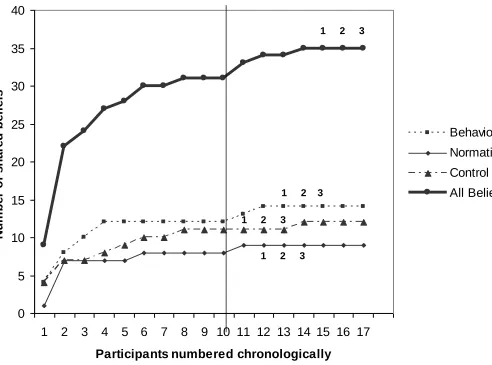
Summary data. Figure 2 presents cumulative frequency graphs for Participants 1 to 17, for the specific, shared Behavioural, Normative and Control beliefs, and all beliefs about attending a screening test for PDB. Again, the number sequence, “1 2 3” above or below a line highlights the application of the stopping criterion.
Construct-level saturation. Figure 2 shows that, when asked about advantages and disadvantages of taking a screening test for Paget’s disease, the first participant mentioned four distinct behavioural beliefs. After the fourth interview, 11 shared Behavioural beliefs had been elicited.
After 10 interviews, the initial analysis sample yielded 12 shared Behavioural beliefs. However, new shared beliefs were elicited in interviews 11 and 12. There were no new shared beliefs in interviews 13, 14 or 15, so applying the stopping criterion for construct saturation (i.e., three interviews with no new shared beliefs) indicates that saturation was achieved after 15 interviews. If sampling had ceased at this point, no shared Behavioural beliefs would have been missed compared with the data provided by the full sample of 17. In all, 14 shared behavioural beliefs were elicited.
From Figure 2, after 10 interviews, the initial analysis sample had yielded eight shared Normative beliefs. One additional belief was elicited at interview 11. Application of the stopping criterion thus suggests that construct saturation was reached after 14 interviews and, if interviewing had ceased at that point, no further Normative beliefs would have been missed (within the sample of 17).After 10 interviews, the initial analysis sample had yielded 11 shared Control beliefs. The criteria for saturation were met after 13 interviews, but if interviewing had ceased at that point, one further Control belief would have been missed (at interview 14).
Study-wise data saturation was achieved after 17 interviews, and so interviewing ceased at that point. The total number of shared beliefs elicited in the study was 35.
General Discussion
Specifying the principles of data saturation (purposive diversity sampling for a minimum of 10 interviews, three further consecutive interviews with no new themes and presentation of data sequentially as cumulative frequency graphs) enabled the Study 2 research team to agree, and report, the point at which data saturation was achieved, in a transparent and reliable manner (assuming appropriate conduct of the interviews and reliability of coding). By distinguishing between construct saturation and study-wise saturation it was possible to assess saturation and adequacy of sampling at different levels. This contrasts with Study 1, in which the study team had judged, subjectively, that saturation was achieved but retrospective application of the stopping criterion suggested that at least two more interviews would be necessary to demonstrate that the criterion had been met.
Thus, although the 10+3 criterion is not perfect, it appears to be a fairly effective guide (in the same way that the 0.05 significance criterion for quantitative studies allows that a Type 1 error may be made in approximately 5% of studies). We therefore suggest that this approach appears to be robust for these examples of theory-based analysis. The principles may be adaptable for using and testing in further studies based on different theoretical assumptions or addressing different kinds of research questions. Such parallels with the principles of quantitative research may strengthen some interview studies but may not sit comfortably with all epistemologies.
While the 10+3 criterion should be tested further, we suggest that some accepted convention for agreeing data saturation could be helpful. Like the 0.05 significance criterion for quantitative studies, such a convention would be somewhat arbitrary and may not be helpful for researchers who disagree with attempts to appraise qualitative research according to shared and/or explicit criteria. Other researchers might find it a useful point of reference for deciding when it was necessary to deviate from the
the behaviour, taking a genetic test for Paget’s disease. Yet, it is noteworthy that a similar sample size for the two studies generated these large differences in cognitive complexity of the content.
A similarity between the studies is that, despite contrasting types of behaviour and people sampled, the number of new beliefs elicited started to plateau after around six interviews (although we would not claim that saturation was reached at this point as the first six interviews generated only 92% and 86% of shared beliefs in Studies 1 and 2, respectively). It is likely that the use of purposive diversity sampling for the first 10 interviews contributed to achieving this plateau so early. This permits some confidence that setting the minimum sample size at 13 is very likely to capture almost all the beliefs relating to Attitude, Subjective Norm and Perceived Behavioural Control. Presentation of the data in a similar way for content analysis based on other theories could similarly help to assess which initial analysis sample size and stopping criterion are appropriate.
There are of course several limitations to the principles proposed here. First, the actual numbers proposed for the initial analysis sample and stopping criterion would require a body of evidence to demonstrate their appropriateness. Furthermore, it is
possible that the appropriateness of particular conventions might vary across studies with different objectives and using different theoretical constructs (but this is clearly testable). It is the principle of specifying a minimum number of interviews and then a further
number that generate no new ideas that we propose may be an important tool for
pre-empting interpretations are an essential part of the research process. Third, the analyses reported here assume clarity among the coders about what constitutes a single belief. This assumption appeared to be non-problematic in the special case of analysis based on the TPB but such judgements may not be as clear in other types of studies. This would be important in distinguishing between idiosyncratic and shared beliefs. For example, in a study investigating individuals’ perceived consequences of taking a screening test, the ideas “I might get twitchy about the results” and “I might get anxious about the results” might be regarded as the same belief. However, in a study to investigate the kinds of words that individuals use to describe their emotions about screening, these two utterances could demonstrate important differences.
Fourth, these criteria have been applied only to the particular type of research involving content analysis based on the Theory of Planned Behaviour. Whether the principles of data saturation that we propose are appropriate for application to other types of interview study (e.g., those using other theories, or grounded theory; Bryant &
Finally, we acknowledge that practical constraints involving research staff or timelines may make it not always possible to apply the proposed principles. Practical issues may restrict a research team’s ability to conduct ongoing analysis of interviews or to present the data in the ways we have illustrated. However, the principle of monitoring additional material that emerges in consecutive interviews may be helpful in managing the research process.
In conclusion, we offer the following recommendations for future interview studies that use theory-based content analysis. First, researchers could specify a priori
their criteria for study-wise data saturation in study protocols (deciding the size of the initial analysis sample and the stopping criterion) and report these criteria in publications (including publications of protocols). Second, data could effectively be organised and presented using cumulative frequency graphs, as illustrated here, to enhance the transparency and verifiability of the decision that saturation is achieved and to address different kinds of research topics (such as descriptions of the complexity or multifaceted nature of certain issues for certain participant groups). Third, a body of evidence could thereby be accumulated to establish a convention for decisions about sample sizes in different types of interview study. There is a need for further research to reflect on and develop this idea.
References (* denotes references included in the reported review (Table 1)). Ajzen, I. (1988). Attitudes, personality and behaviour. Milton Keynes; OUP.
Ajzen, I. (1991). The theory of planned behaviour. Organizational Behaviour and Human Decision Processes, 50, 179-211.
Armitage, C.J., & Conner, M. (2001). Efficacy of the Theory of Planned Behaviour: A meta-analytic review. British Journal of Social Psychology, 40, 471-499.
Bryant, A., & Charmaz, K. (eds), The SAGE handbook of grounded theory. Sage Publications; London.
*Bryant, J., Porter, M., Tracy, S.K., & Sullivan, E.A. (2007) Caesarean birth: Consumption, safety, order, and good mothering. Social Science & Medicine, 65, 1192-1201.
*Bugge, C., Entwistle, V.A., & Watt, I.S. (2006). The significance for decision-making of information that is not exchanged by patients and health professionals during consultations. Social Science & Medicine, 63, 2065-2078.
*Caldwell, P.H., Arthur, H.M., Natarajan, M., & Anand, S.S. (2007). Fears and beliefs of patients regarding cardiac catheterization. Social Science & Medicine 65, 1038-1048. *Damschroder, L.J., Pritts, J.L., Neblo, M.A., Kalarickal, R.J., Creswell, J.W., &
Hayward, R.A. (2007). Patients, privacy and trust: Patients’ willingness to allow researchers to access their medical records. Social Science & Medicine, 64, 223-235. *Devine, C.M., Jastran, M., Jabs, J., Wethington, E., Farell, T.J., & Bisogni, C.A. (2006).
Eccles, M.P., Johnston, M., Hrisos, S.,Francis,J., Grimshaw,J., Steen,N., Kaner, E.F. (2007). Translating clinicians' beliefs into implementation interventions (TRACII): A protocol for an intervention modeling experiment to change clinicians' intentions to implement evidence-based practice Implementation Science, 2, 27.
Francis, J.J., Eccles, M.P., Johnston, M., Walker, A.E., Grimshaw, J.M., Foy, R., et al. (2004). Constructing questionnaires based on the theory of planned behaviour. A manual for health services researchers. Centre for Health Services Research,
University of Newcastle upon Tyne, UK. ISBN 0-9540161-5-7 and www.rebeqi.org. Glaser, B.G., & Strauss, A. (1967). The discovery of grounded theory: Strategies for
qualitative research. Chicago, IL: Aldine.
Godin, G., & Kok, G. (1996). The Theory of Planned behaviour: A review of its
applications to health-related behaviours. American Journal of Health Promotion, 11, 87-98.
Guest, G., Bunce, A., & Johnson, L. (2006). How many interviews are enough? An experiment with data saturation and variability. Field Methods, 18, 59-82. *Hawkins, R.L., & Abrams, C. (2007). Disappearing acts: The social networks of
formerly homeless individuals with co-occurring disorders. Social Science & Medicine, 65, 2031-2042.
*Hsiao, A.F., Ryan, G.W., Hays, R.D., Coulter, I.D., Andersen, R.M., & Wenger, N.S. (2006). Variations in provider conceptions of integrative medicine. Social Science & Medicine, 62, 2973-2987.
Langston,A.L.,Johnston, M.,Robertson,C.,Campbell, M.K., Vikki A Entwistle, V.A., Marteau, T.M.,McCallum, M., & Ralston, S. H. (2006). Protocol for stage 1 of the GaP study (Genetic testing acceptability for Paget's disease of bone): an interview study about genetic testing and preventive treatment: would relatives of people with Paget's disease want testing and treatment if they were available? BMC Health Services Research, 6,71.
*Leavey, G., Loewenthal, K., & King, M. (2007). Challenges to sanctuary: The clergy as a resource for mental health care in the community. Social Science & Medicine, 65, 548-559.
*Lonardi, C. (2007). The passing dilemma in socially invisible diseases: Narratives on chronic headache. Social Science & Medicine, 65, 1619-1629.
*Murray, J., Banerjee, S., Byng, R., Tylee, A., Bhugra, D., & Macdonald, A. (2006).Primary care professionals’ perceptions of depression in older people: a qualitative study. Social Science & Medicine, 63, 1363-1373.
*Poletti, T., Balabanova, D., Ghazaryan, O., Kocharyan, H., Hakobyan, M., Arakelyan, K., & Normand, C. (2007).The desirability and feasibility of scaling up community health insurance in low-income settings—Lessons from Armenia. Social Science & Medicine, 64, 509-520.
*Ungar, W.J., Mirabelli, C., Cousins, M., & Boydell, K.M. (2006). A qualitative analysis of a dyad approach to health-related quality of life measurement in children with asthma. Social Science & Medicine, 63, 2354-2366.
*Wainberg, M.L., González, M.A., McKinnon, K., Elkington, K.S., Pinto, D., Gruber Mann, C., & Mattos, P.E. (2007). Targeted ethnography as a critical step to inform cultural adaptations of HIV prevention interventions for adults with severe mental illness. Social Science & Medicine, 65, 296-308.
*Wanich Bradway, C., & Barg, F. (2006). Developing a cultural model for long-term female urinary incontinence. Social Science & Medicine, 63, 3150-3161.
Webb, T. L., & Sheeran, P. (2006). Does changing behavioural intentions engender behavior change? A meta-analysis of the experimental evidence. Psychological Bulletin, 132, 249-268.
*Webber, M.P., & Huxley, P.J. (2007). Measuring access to social capital: The validity and reliability of the Resource Generator-UK and its association with common mental disorder. Social Science & Medicine, 65, 481-492.
*Williams, B., Mukhopadhyay, S., Dowell, J., & Coyle, J. (2007). From child to adult: An exploration of shifting family roles and responsibilities in managing
physiotherapy for cystic fibrosis. Social Science & Medicine 65, 2135-2146. *Wray, N., Markovic, M., & Manderson, L. (2007). Discourses of normality and
Figure 1. Cumulative frequency of shared behavioural beliefs, normative beliefs, control beliefs, and all beliefs elicited by interviews for the behaviour, ‘managing patients with
T a b l e 1 . P a p e r s p u b l is h e d i n S o c i a l Sc ie n c e a n d M e d ic i n e c o n t a in i ng r efer enc e to ‘da ta s atur ation’ (June 2006 – Sept 2007) .
Reference Quote
1 Bryant, Porter, Tracy et al., 2007 Data were analysed for thematic content. Recruitment of participants ended once thematic saturation was
achieved or no new themes were observed in the data (Guest, Bunce, & Johnson, 2006). p.1194
2 Caldwell, Arthur, Natarajan et al.,
2007
Recruitment continued until saturation of themes was determined to have occurred (Strauss & Corbin, 1998, p1041). p.1041
3 Williams, Mukhopadhyay, Dowell et
al., 2007
Sampling continued until ongoing analysis revealed no new findings, and saturation was obtained (Strauss & Corbin, 1990) (Tables 1 and 2). p.2137
4 Lonardi, 2007 Recruitment ceased as the main concepts started to show redundancy along the various stories, and trajectory
models started to show clear shapes according to the criterion of theoretical saturation (Glaser & Strauss, 1967). p.1621
5 Hawkins & Abrams, 2007 a Of the 39 participants, six did not complete a second interview because they were unavailable, impaired, or the
research team felt the first interview had achieved saturation. p.2035
6 Webber & Huxley, 2007 The sample size was determined by the principle of theoretical saturation (Coyne, 1997), so we continued the
interviews until no new problems emerged with the instrument. p.484
7 Leavey, Loewenthal & King, 2007 This is a qualitative study using a purposive sampling or theoretical strategy generally associated with
grounded theory whereby the collection and analysis of the data are inter-related (Strauss & Corbin, 1990, p. 67). Thus, the data gathered from the preliminary interviews informed the direction of further data collection and informant selection. This helped in the exploration of the parameters of the study and provided
opportunities for increasing the ‘density’ and ‘saturation’ of significant, recurring and ambiguous categories. p.549
8 Wainberg, González, McKinnon, et
al., 2007
Saturation (i.e., a sufficient number of field observations) was reached for specific time periods of the institutions’ operating hours and on specific days in accordance with principles of grounded theory in qualitative research (Strauss & Corbin, 1994). p.298
9 Wray, Markovic & Manderson, 2007 This interviewing technique ensured that study participants spoke about issues pertinent to their experience of
illness and helped achieve data saturation. p.2263
Data collection and data analysis were conducted concurrently, allowing us to modify interview guidelines for subsequent in-depth interviews to incorporate new emerging themes and to stop further recruitment on achieving data saturation. p.2263
10 Poletti, Balabanova, Ghazaryan, et
al., 2007
Following a grounded theory approach, topics were covered in the interviews until saturation was reached
(Strauss & Corbin, 1998); subsequent interviews focused on filling gaps in the data.a p.511
11 Damschroder, Pritts, Neblo, et al.,
2007
We achieved theme saturation before reaching the end of the sample of 16 coded transcripts, which also contributes to coding trustworthiness (Miles & Huberman, 1994). p.226
12 Bradway & Barg, 2007 Theoretical saturation was achieved after interviews with 17 women were completed. p.3152
[image:31.792.29.711.108.549.2]14 Ungar, Mirabelli, Cousins, et al., 2006
Saturation was achieved at 16 dyad interviews. p.2354
Enrollment continued until saturation occurred, which was achieved at 16 dyads. p.2355
Data collection and open coding continued until new information produced little or no change to data categories, i.e. until theoretical saturation was achieved (Sandelowski, 1995). This occurred when the 16th dyad interview was completed and analysed. p.2356
15 Rapley, May & Kaner, 2006 The analysis developed until category saturation was reached (i.e. interviews and analytic procedures yielded
no new material for analysis). The analysis was further developed and validated through the group interviews. p.2420
16 Bugge, Entwistle & Watt, 2006 Also, we did not sample to theoretical saturation, so it is possible that there are types of information that are
sometimes not exchanged— either in the settings that we have studied or in other contexts—that we have missed. p.2074
17 Murray, Banerjee, Byng, et al., 2006 Data collection proceeded concurrently with analysis until theoretical saturation was achieved, in other words,
until no new themes were emerging. p.1365
18 Hsiao, Ryan, Hays, et al., 2006 Theoretical saturation occurred after 50 interviews. p. 2975
a
This paper appeared to use this term as a within-participant term, i.e., the interviewer felt that it was appropriate to end the interview because the
FIGURE 1 0 10 20 30 40 50 60 70
1 2 3 4 5 6 7 8 9 10 11 12 13 14
Participants numbered chronologically
N u m b e r o f s h a re d b e li e fs Behavioural Belief Normative Belief Control Belief All Beliefs
_________________________________________
1 2 3
FIGURE 2 0 5 10 15 20 25 30 35 40
1 2 3 4 5 6 7 8 9 10 11 12 13 14 15 16 17
Participants numbered chronologically
N um be r of s ha re d be li e fs Behavioural Beliefs Normative Beliefs Control Beliefs All Beliefs
_________________________________________
1 2 3
1 2 3 1 2 3
1 2 3
APPENDIX. Summary (yes/no) data for all behavioural beliefs elicited by interviews for the behaviour, ‘taking a genetic test’.
Participants numbered chronologically 1 2 3 4 5 6 7 8 9 10 11 12 13 14 15 16 17 Total No of Beliefs
Testing would prevent/minimise symptoms of PDB 1 1 1 1 1 0 0 0 0 1 0 1 1 0 0 0 1 9
Testing can help others by advancing medical knowledge
(others outside own family) 1 0 0 1 0 1 0 1 1 0 1 0 0 1 0 0 0 7
Testing would be beneficial/protect members of own
family (current and future generations) 0 0 0 1 0 1 1 0 0 0 0 1 0 1 1 0 0 6
Testing can provide knowledge for how to take preventive
action/prepare for condition 0 1 1 1 0 1 1 1 1 0 1 0 1 0 1 0 1 11
Positive test result may create feelings of genetic blame 0 0 0 0 0 1 0 0 0 0 0 0 0 0 0 0 0 1
No disadvantages to testing 1 0 0 1 1 0 0 0 1 1 1 0 1 1 0 0 1 9
Prospect of positive test result would cause fear/worry 0 1 1 1 0 0 1 0 0 0 0 0 0 1 1 1 1 8
Positive test result would still leave uncertainty of
developing the condition 0 0 1 0 0 0 0 0 0 0 0 0 0 0 1 0 0 2
Testing can prevent the condition spreading to the skull 0 0 0 0 0 0 0 0 0 0 0 0 1 0 0 0 0 1
Testing should not have to be declared for insurance
purposes 0 1 1 0 0 0 0 0 0 0 0 0 0 0 0 0 0 2
Positive test result leaves knowledge of having an illness 0 0 0 0 0 0 0 1 0 0 0 0 0 0 0 0 0 1
Positive test result allows you to prepare for the future 0 0 0 0 0 0 0 0 0 0 1 1 0 0 0 0 0 2