Copyright © 1970 AmericanSocietyfor Microbiology Printed in U.S.A.
Bacteriophage
Tail
Components
II.
Dihydrofolate Reductase
in
T4D
Bacteriophage
L. M. KOZLOFF, C. VERSES, M. LUTE, AND L. K. CROSBY
DepartmentofMicrobiology, University of Colorado MedicalSchool, Denver, Colorado 80220
Received for publication 25 February1970
The protein componentoftheT-evenbacteriophage coat which binds the
phage-specific dihydropteroyl polyglutamate has been identified as the phage-induced
dihydrofolate reductase. Dihydrofolate reductase activity has been found in highly
purified preparations of T-even phage ghosts and phage substructures afterpartial
denaturation. The highest specific enzymatic activity was found in purified tail
platepreparations, and it was concluded that this enzyme was a structural
com-ponent of thephage tail plate. Phage viability wasdirectly correlated with the
en-zymological properties ofthe phage tail plate dihydrofolate reductase. All
reac-tions catalyzed bythis enzyme whichchanged the oxidation stateof the phage
di-hydrofolate also inactivated the phage. Properties of two T4D dihydrofolate
reductase-negativemutants,whl andwhl1,have been examined. Variouslines of
evi-dencesupportthe view that theproduct of thewhlocus ofthephagegenomeis
nor-mallyincorporatedinto thephage tailstructure.Theeffects of variousdihydrofolate
reductaseinhibitorsonphageassemblyininvitro complementationexperimentswith
various extracts of conditional lethal T4D mutants have been examined. These
inhibitors werefoundto
specifically
block complementationwhenaddedto extractswhich did notcontain preformed tail plates. Iftail plateswere present, inhibitors
suchasaminopterin, didnotaffectfurtherphageassembly.This specific inhibition
of tailplate formationin vitroconfirmstheanalyticalandgeneticevidence that this
phage-induced"early"enzymeisacomponentof the phage coat.
ThefindingthatT-evenphage infectioninduced
the formation of an unusual
dihydropteroyl
polyglutamate which was thenincorporated into
thephage tailstructure (16)leads directlyto the
problemofidentifying thephage protein binding
thisfolate derivative. It has been
pointed
out byBaker that folate derivatives, and
especially
those with several
glutamyl
residues,
can formextremely stable complexes with
proteins
(4).However, the properties and
specific
location ofthe phage dihydropteroyl polyglutamates
sug-gest thataspecificphageproteinmay beinvolved.
Among the virus-induced proteins formed after
infection which have ahigh affinity for
dihydro-folate is the enzyme dihydrofolate reductase (20,
22). We have reported brieflythat dihydrofolate
reductaseactivityis present inpreparations of
T-even phage ghosts (Verses et al., Bacteriol.
Proc., p. 163, 1968), and evidence will be
pre-sented now that the enzyme is a component of
thephagetailplate.
The conclusion that this enzyme is a phage
tail plate structural component is so unexpected
that,inadditiontoits presence andspecific
loca-tion, three additional confirmatory experiments
have been carried out. (i) It has been found that
the enzymological properties of dihydrofolate
reductase of whole phage are correlated with phage viability; changes in the oxidation state
of the phage dihydrofolateresult in phage
inac-tivation. (ii) The phage gene, wh, for
dihydro-folate reductase has been found to normally
controlthestructure ofthe tailplate asjudgedby
changes in the enzymatic, immunological, and
physical properties of phage wh mutants. (iii) In
vitro assembly of T4D, using the technique of
in vitro complementation of Edgar and his
colleagues (7, 14, 18, 27), has been found to be
sensitiveto the presence of inhibitors of
dihydro-folate reductase. The dihydro-folate antagonists appear
to be theinhibitors ofphage tail plate assembly.
MATERIALS AND METHODS
Preparation andpurificationofbacteriophagestocks,
ghosts, and substructures, and extracts of Escherichia
coliBinfected withT4D ambermutants. Most ofthe
biological materials and methods were identical
tothose used intheaccompanying paper (16).
Vari-ous T4D amber mutants were obtained from R. S.
Edgarand wereused inadditiontothosegiven earlier. 740
on November 11, 2019 by guest
http://jvi.asm.org/
BACTERIOPHAGE TAIL COMPONENTS. II
These mutants, which do not form tail plates under restrictive growth conditions (27), were N102 (gene 6), B16 (gene 7), B255 (gene 10), N67 (gene 25), N120 (gene 27), A452 (gene 28), B7 (gene 29), and S29 (gene 51). The amber phage mutantsweregrown
onthe permissive host,E.coliCR63, and were puri-fied by standard procedures. Extracts of the non-permissive host, E. coli B, infected with amber
mu-tants were prepared by procedures given by Edgar
and Wood (7) and by King (14).Theywerestoredat
-70 C and used in in vitro complementation
reac-tions in theusual manner. Net fold increase in phage titer after complementation was calculated as the final titer minus the original titer divided bythe origi-nal titer. The relative complementation in the
pres-ence of inhibitors was the ratio of the net fold in-creases (D. Shapiro andL. M.Kozloff,J. Mol. Biol.,
inpress).
Theorigin andpropertiesof T4Dwhl, apoint
mu-tant in the wh gene, have been described by Hall et
al. (10). They backcrossed this mutant twice with wild-type T4D andwebackcrossed ittwo moretimes against wild-type T4D. It is presumably identicalto
wild-type T4D in every gene exceptuh.Measurements
of dihydrofolate reductase activity after infection
with T4Dwhl confirmed that whl doesnot cause any increase in dihydrofolate reductase activity after infection of either E. coli B or E. coli CR63.
T4Dwhl 1, obtained from D. H. Hall (9), is an
amber mutantin the wh gene. Stocks of this amber
mutant were grown on the permissive strain of E.
coli CR63 (designatedT4whl1 (Cr63) or onthe
non-permissive strain ofE. coli B (designated T4Dwhll1
(B). Hall's (9) observations on the increase in
dihy-drofolate reductase activity after infection of E.
coliCR63, butnotafter infection ofE. coliB,were
confirmed. Additionalevidence on thenatureof this
amber whmutantispresentedlater.
Enzymatic assays. Dihydrofolate reductase was
assayed microspectrophotofluorometrically by
fol-lowing the decrease in fluorescence of reduced nico-tinamide adenine dinucleotidephosphate (NADPH).
Thereaction mixture was similar tothatused in the standard spectrophotometric assay of Mathews and Sutherland (22) andcontained 5jAmolesofphosphate
buffer (pH 7.5), 1.2,umoles ofNADPH, andvarious
amounts of protein in a final volume of 0.135 ml.
After allowing 3 min for temperature equilibration,
theNADPHwas added and the initialrateofchange of the NADPH fluorescence was measured. The
ex-citing light was 340 nm and the emitted light was
456 nm. The Aminco-Bowman
spectrophotofluorom-eter was modified by placing a heatingelement and
a thermister in the cuvette holder support and
con-necting it to a proportional temperature controller (Athena, model 51). Temperature was readily main-tained at 37 C. In some experiments, the change in
fluorescence was recorded withaSargentrecorder.
The fluorometric method could readily detect
amountsofenzymaticactivity 110to L 5of that
meas-urable in the standard spectrophotometric assay
(22). However, the fluorometric enzyme activity valueswere not constantfromdaytoday and
there-fore absolute rate measurements or standard units
ofenzyme activitywerenotcalculated. All values for enzymatic activity were relative and were compared to each other on agiven day.
T4D-induced dihydrofolate reductase was
par-tially purified by using a modification of the proce-dure of Mathews and Sutherland (22). The sonic extract of T4D-infected E. coli B was clarified, treated with streptomycin and ammonium sulfate (O to
60%SC),
and chromatographed on a calcium phosphate column; the peak fraction was used for theimmunological experiments.Thymidylate synthetase activity was also measured by a microfluorometric modification of the optical method of Mathews and Cohen (21), in which the rate of conversion of tetrahydrofolate to dihydro-folatewas followed. The assay mixture contained 5.3
MAmoles of tris(hydroxymethyl)aminomethane (Tris)
buffer (pH 7.4), 6.4 /,moles of 2-mercaptoethanol,
0.13 ,umoles of ethylenediaminetetraacetic acid
(EDTA), 210 ,umoles of formaldehyde, 3.2 jumolesof magnesium chloride, 0.0027 j,moles of tetrahydro-folic acid, 0.0067 ,umoles of deoxyuridine-5-phos-phate, and various amounts of enzyme in a final
volumeof 0.157 ml. The temperature was maintained
at 37 C, the exciting light was at 317 nm, and the emittedlightwasmeasured at 420 nm.
Disruption of phage with urea or formamide to
re-lease dihydrofolate reductase activity. Ghost prepa-rations weretreated with urea in the following man-ner.The ghosts (usually a total of5 X 1012 to 10 X
1012 particles) were initially incubated for 5 min at room temperature in 2.3 M urea in the presence of
4 X 10-s M dihydrofolate, 1.5 X 10⁻⁴ M NADPH,
0.15 M mercaptoethanol, and 0.075 NI phosphate at pH 7.5. A solution of 8 M urea was then added to
bring the final ureaconcentration to 6 M, and the
solution was incubated for 15 min more at room temperature and then for an additional 45 min at
37 C. The solution was then stored at -20 C.
Reagent grade formamide (25.2 M) was added to suspensions of phage ghosts in the presence of 0.05 Mphosphatebuffer (pH 7.5),0.02 Mmercaptoethanol,
and 5 X 10⁵ M dihydrofolate. The amount of
form-amiderequiredtoliberatethe enzymatic activity was foundtovarysharplywiththeconcentration of ghost protein. At concentrations above those found to be
optimal, enzymatic activity was lost. For solutions
containing a final concentration of2 mg/ml (1.3 X
1013 particles/ml), 1.4 M formamide was necessary;
for solutions containing 4 mg/ml, 2.3 M formamide
was required; and for solutions containing 6 mg/ml,
3.2 M formamide was required for optimum release.
It was also necessary to incubate the formamide-ghost suspensions at37 C for5 min to complete the
liberationoftheactivity.
Inactivation of bacteriophages by pyridine
nucleo-tides. It was necessary toincubate solutions
contain-ing reduced pyridine nucleotides under anaerobic
conditions to prevent air oxidation. In the initial experiments,thereactionwascarried out inevacuated
10-ml Thunberg tubes. The solution in the bottom
ofthe tubecontained50,Amolesofphosphate buffer,
(pH 7.5), 3mgofgelatin dissolvedin 0.5ml of 0.9% NaCl, andapproximately 1011 viable phage particles.
VOL.
5,7
1970 741on November 11, 2019 by guest
http://jvi.asm.org/
Weighted amounts of solid NADPH [or reduced
nicotinamide adenine dinucleotide (NADH)] were
placed in the side arm. The tubes were evacuated,
mixed, and incubated at 37 Cin awater bath. The
reaction was stopped bythe addition of 10volumes of cold tryptone broth. In later experiments, it was
found that incubations could be successfully carried
outin 3.0-ml tubes with mineral oil layered over the solution. Incubation ofphagewithoxidized pyridine
nucleotides suchasnicotinamide adenine dinucleotide phosphate (NADP+) or nicotinamide adenine
dinucleotide (NAD+) wascarriedoutin3.0-ml tubes
without amineraloil top layer.Intheseexperiments in which thechange in phage titer wasnot large,the number of dilution steps was kept to a minimum, and at least 400plaqueswerecounted per assay.
Preparation of antisera to T4D tail plates.
Approxi-mately20,gof T4D tail plates,takenfrom the peak
[image:3.487.107.396.342.532.2]tubeofthesecondsucrosegradient ofthepurification procedure described in the accompanying paper [see Fig. 6C (16)], plus 50% Freund'sadjuvant inatotal
volumeof0.2mlwasinjectedinto thepopliteal gland
ofa 2-kg New Zealand white rabbit. Three weeks later, 40pAgof tail plates in 0.4 mlof 10% Freund's
adjuvant was injected intramuscularly. Serum was
obtainedatvarious times and assayed for thekilling
titer for T4D by standard procedures; at 6 weeks after the first injection, the Kvalue for inactivation
was about 300 and it stayed atthis level for several months.
Chemical and other materials. Most of the reagents were similar to those employed in the accompanying paper (16). Chemically and enzymatically reduced NADPH, enzymatically reduced NADH, NADP+ NAD+, tetrahydrofolate, aminopterin, amethopterin, and dihydrofolate were from Sigma Chemical Co. Deoxyuridine-5-monophosphate was from Calbio-chem. The irreversible inhibitor of dihydrofolate reductase, compound 15f (a p-phenyl propionyl derivativeof 4,6 diamino-1,2dihydro-2,2-dimethyl-1
phenyl-S triazine with a terminal sulfonyl fluoride),
was agiftof B. R. Baker (5).
RESULTS
Dihydrofolate reductase activity in disrupted
phage and phage substructure preparations.
No dihydrofolate reductase activity could be
de-tected inpreparations of phageghosts, evenwith
the sensitive spectrophotofluorometric method,
unless the preparations werefirst treated with a
protein denaturant such as urea or formamide
(Fig. 1). Maximal dihydrofolate reductase
ac-tivitywasliberated in30min in 6 M urea at 37 C
and then remained constant. Iftheurea
concen-trationwasonlyraised to 3M,asmallfraction of
the activity found after 6 M treatment was
re-leased. In the absence of added dihydrofolate
0.2
E
0
c
0
c
z z
n
uJ
cYj
c]
0.41
0.61
0.81
1.01
1.21
1.4
0 1 2 3 4 5 0 1 2 3 4 5
M NU T ES
FIG. 1. Dihydrofolate reductase in T4D ghost preparations. (a) Ghosts were treated with 6 M urea
as described. Samples (0.1 ml) equal to 2 X 10¹² ghost particles were then added to the cuvette and
then5,moles of phosphate buffer (pH 7.5), 6.5 nmoles of dihydrofolate, I ,umole of mercaptoethanol, and
finally 22 nmoles of NADPH (TPNH) were added in afinal volume of 0.150 ml. The decrease in NADPH
fluorescence at 29.5 C was then determined. (b) The differentamounts of T4D ghost particles were treated
withdifferent concentrationsofformamide; 2.3 X 10²²particles were treatedfor 5 min at 37 C with 1.8 M
formamide in avolume of0.12 ml, whereas thesample containing 4.5 X 10¹² particles requireda
concentra-tion of 3.15 Mformamide (in a volume of 0.125 ml). The incubation with theformamide wascarriedoutin
the presence of 6 nmoles of dihydrofolate and 7.5 umoles of mercaptoethanol, and the reaction was
startedby the addition of0.01 ml ofa solution containing 30 nmolesof NADPH. The decrease influorescence
wasmeasuredat37 C.
T
2. 3x10¹²
K particles UREA TREATED
GHOSTS
2x10¹² / particles
!a)))
T4 D GHOS TS T4D GHOSTS
( b)
on November 11, 2019 by guest
http://jvi.asm.org/
BACTERIOPHAGE TAIL COMPONENTS. II
duringtreatment, 6 M (or3 M) ureadestroyedall
activity. Formamide treatment was also found
to liberate enzymatic activity from ghost
prepa-rations. The amount of formamide required to
release maximal enzymatic activity depended on
the amount of ghost protein present; excess
formamidedestroyed allactivity. The amountof
dihydrofolate reductase liberated, as determined
from the initial reaction rate, was proportional
tothenumber ofghostparticles used in the assay
system. Relative activities were always
com-pared onthesameday by usingidentical reagents.
Theformamidetreatment wasquickerand
some-whatmorereproduciblethanthe ureatreatment,
butappearedtoliberate lessactivity.
Althoughchickenliverdihydrofolatereductase
activity is stimulated by treatment with urea or
formamide (13), no similar effect on the
phage-induced enzyme has been found (22), and the
effect of urea and formamide onphage ghostsis
probably due to the disruption of its complex
quaternary structure and the release ofa buried
orconcealedenzyme.
Almostidentical levels ofdihydrofolate
reduc-tase activity were also found in urea-disrupted
T2L ghostpreparations.Inviewof the similarities
of
dihydrofolate
content of all of the T-evenphages (16) and the similarities of the reaction
with NADPH of all of the T-even phages (see
below),itseemslikelythat all T-evenphage
prepa-rations contain dihydrofolate reductase. Major
attention was paid to T4D becauseof the
avail-ability of both purified T4D tail substructures
(16) and of two dihydrofolate-minus mutants of
T4D.
Highly purified T4D tail substructures
ob-tained from lysates of ambermutants were also
analyzed for their
dihydrofolate
reductaseactivity.
Noactivity
was found in anysubstruc-tures until
they
were disrupted with 6 M urea.The correlation between enzyme
activity
andsedimentation
behavior for oneparticular
tailsubstructure, tail tube plus sheath
plus plate,
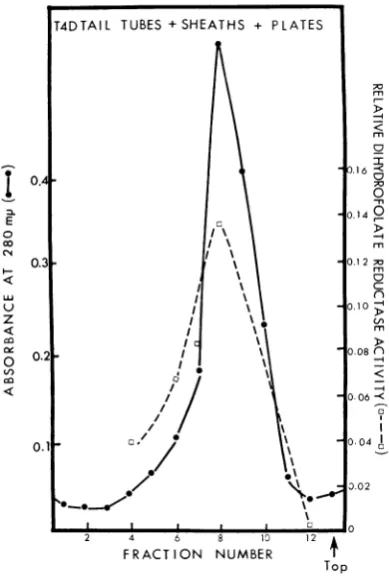
is shown in Fig. 2. Similar data were obtained
for the other tail structures, and it is apparent
that the enzyme behaves asa genuine tail
com-ponent
during
zonalcentrifugation.
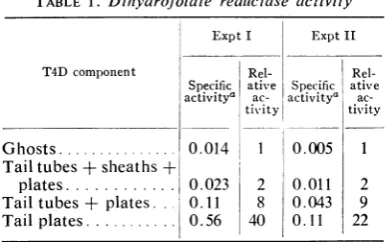
The resultsshownin Table 1 indicate thattail
substructures are enriched for
dihydrofolate
reductase and that the tail is the mostprobable
siteofenzymelocationonthe wholephage ghost.
Since thetailplate is 2 to 3% ofthe total mass
ofthe
ghost, essentially
all of the phageghost
enzymatic activity can be accounted for by the
activity
in its tail plate. It should also beem-phasized that the phage-specific dihydropteroyl
polyglutamate appearstobelocated atthe
junc-turebetween thetailplateandthetailtube
(16).
I
E
C)
co
CN a:)
LU
z C0
co
FRACTION NUMBER T
Top
FIG. 2. Sedimentation properties of the T4D tail substructure consisting of the tail tube plus sheath plus plate and its associated dihydrofolate reductase activity. Thepurified tail substructure was subjected
to zonal centrifugation (16), fractions were collected
and dialyzed, and the absorbance was determined for
each fraction. A 0.1-ml amount of tail substructure
solution of the absorbance giveninthe figure was treated with 6 Murea (finalvolumeduringtreatment,0.18 ml)
and then 0.05 ml was takenfor the standard
fluoro-metric assay.
Thymidylate synthetase, for which
dihydro-folateis acofactor, is also inducedby phage
in-fection (21), and the possibility was examined
that this protein might also participate in
dihy-drofolate binding. Phage ghosts and purified
tail plates (equivalent to 1012 particles in the
assay cuvette) were assayed for thymidylate
synthetase activity by using a highly sensitive
spectrophotofluorometric method. No activity
was found in undisrupted preparations, and
disruptionby 3 M or 6 M urea (using deoxyuridine
monophosphate as a protective cofactor) did not liberate any activity.
Phage viability and enzymological properties
ofphage dihydrofolate reductase. Although
there
is strong evidence that a phage-specific
dihydrop-teroyl polyglutamate is an integral part of the
tail of the virus particle (16), itwasstill possible
743
VOL. 5, 1970
on November 11, 2019 by guest
http://jvi.asm.org/
[image:4.487.244.439.58.347.2]TABLE 1. Dihydrofolate reduictase activity
Expt I Expt II
T4D component Rel-
Rel-Specific ative Specific ative activitya ac- activitya
ac-tivity tivity
Ghosts0... .014 1 0.005 1 Tail tubes + sheaths +
plates ... 0.023 2 0.011 2
Tail tubes + plates O.11 8 0.043 9
Tail plates 0.56 40 0.11 22
aAfter6Mureatreatment, defined astheinitial
rate of decrease of NADPH fluorescence in
arbitraryunits per milligram ofprotein. Usually
50 to 100 pg of protein was used per assay. All
dihydrofolate reductase assays for each
experi-ment were carried out on a single day. Separate
preparations ofT4Dghostsand tailsubstructures
were used forthe twoexperiments.
that the dihydrofolate reductase activity found
localized on tail plates might be an artefact.
Therefore, properties of the phage enzyme were
examined to determine whether its presence and
activity were essential to phage viability. Since
normally this enzyme catalyzes the reaction
NADPH + dihydrofolate > NADP'+
tetra-hydrofolate, the effects of NADPH, NADH,
NADP+,
and NAD+ on various phages were examined.Itwas found that all of theT-even phages
ex-amined were inactivated upon
incubation
withNADPH (Table 2). At pH 7.5, there was little
inactivation of T4D for the first2 to 3 hr (Fig.
3a, b, and c) and then the rate of inactivation
appeared logarithmic. Even when the
concentra-tion of NADPH was
increased,
therewasalwaysan initial lag in the inactivation curve. This
suggests that inactivation requires reduction by
more than one NADPH molecule. This would
bein agreement with the fact that T4D contains
severalmolecules ofdihydrofolate. Although the
initial lag made itimpossible tocalculate specific
rate constants, the reaction rate (as judged from
the logarithmic part of the curve) was very low
with less than 0.001 M NADPH, proportional
between 0.001 and 0.005 M NADPH, and
maxi-mal at 0.006 M or higher.
The properties of T4D phage inactivated by
NADPH were examined. All of the phage
par-ticles appeared morphologically normal in
elec-tron micrographs. However, the ability of these
phage particles to both adsorb to and kill their
host cells at 37 C was greatlyreduced. Accurate
measurements of adsorption and host cell killing
were difficult to makebecause of the effect of 02
TABLE 2. Iniactivationi of T-eveni bacteriophages
by NADPHa
Phage
~~~~~Plus
0.006Mf Phage . NADPH (%... inactivated)T2L... 58
T2H. 12
T4B.30
T4D. 57
T4Dwh .50
aAfter 6 hr at 37 C, at pH 7.5 in evacuated
Thunberg tubes.
FIG. 3. Iiiactivation of T4D by variouis redlced pyridinie nucleotides. (a) T4D was incuibated with two kinds of NADPH (TPNH) from P. L. Biocheemicals. (Onie prepared by chemical reductio,i aiid onie by reduction with isocitric acid dehiydrogeiiase.) The inicubationl was carried out inphosphate bufferatpH
7.5 inThunbergtubes inta37 Cwater bath. (b)T4D was
incubated as in (a) by using
enzymaticallj
prepared NADPH and NADH (DPNH). (c) T4D wvasincu-bated with NADPH under oil. At variouis times, 0.1-mlsampleswereremoved,addedto2.0mnlofbroth,
anid thenl treated with100%N 02 at 37C for 10 miii.
reversal at 37 C (Fig. 3c). These results do
indi-catethatNADPHreduction isprobably affecting
tailfunction.
The requirement for a stereospecific form of
the reduced NADPH isshown inFig. 3a.
Enzy-matically prepared NADPH, presumably in the
,3 configuration [by analogy to the known form
of the NADHwhichalsoinactivated phage (Fig.
3b) ], is considerably more active than chemically
preparedNADPH which is an equimolar mixture
oftheaand:stereoisomers. This stereospecificity
supports the view that viral inactivation is due
to an enzyme-catalyzed reduction and not to
744 VIROL.
on November 11, 2019 by guest
http://jvi.asm.org/
[image:5.487.260.452.59.158.2] [image:5.487.55.249.64.185.2]BACTERIOPHAGE TAIL COMPONENTS. II
someextraneous property ofthe NADPH
prepa-ration.
It has been reported by Mathews and Cohen
(20) that the virus-induced dihydrofolate
reduc-tase canreact with NADH as well as NADPH,
although at equivalent concentrations NADH
is only 14 as active. As shown in Fig. 3b,
enzy-matically prepared NADH (in the,
configura-tion) is about M as active as enzymatically
prepared NADPH in inactivating T4D. This
property supports the view that the enzyme in
phage tail plates may be the virus-induced
en-zyme.
The reversibility of NADPH inactivation by
both 02 and, more significantly, by large
quan-tities of one of the presumed products of the
enzymatic reaction was also examined. It was
found that treatment with 100% 02 at 37 C
revived a significant fraction of the inactivated
virus particles (Fig. 3c). At 4C,oxygentreatment
did not reactivate any virus particles. The total
phage reactivated was a function of the degree
of inactivation. Itseemslikelythat thereare
mul-tiple sites for reductionand thatonlyafter several
of them have reacted is the phage permanently
inactivated.
Itwasalso foundthat the initialphage
concen-tration greatly influenced the amount of phage
inactivatedbyNADPH. Forexample, with0.004
MNADPH and atan initialphage concentration
of 1012 particles perml, therewasrelatively little
inactivation (about 50%), whereasat2 x 108/ml
there was
99.9%
inactivation in 24 hr. Theseresults are in agreement with the concept that
NADPH/NADP+ determines the degree of
in-activation. At higher phage concentrations,
therewould bemuchmoreNADP+formed which
would inhibit further inactivation.
Although Mathews (19) was unable to detect
spectrophotometrically the reversibility of the
reduction of dihydrofolate by NADPH with
purified phage-induced dihydrofolate reductase,
the oxidation of tetrahydrofolate by NADP+
back to dihydrofolate has been shown with
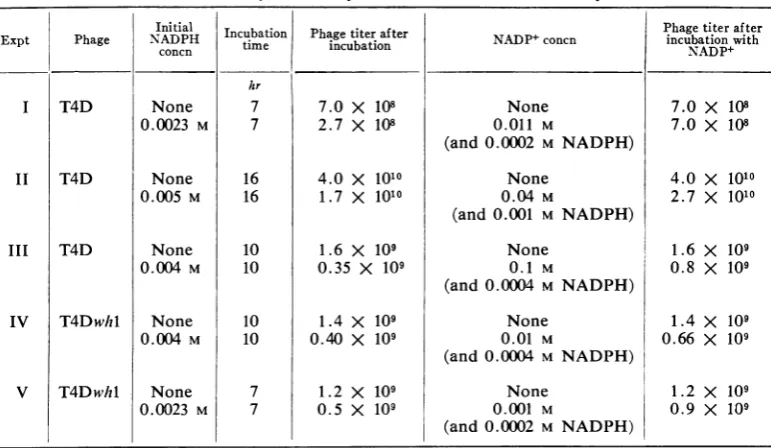
dihydrofolate from other sources (13). T4D and
T4Dwhl were first inactivated by NADPH and
thendiluted intoahigh concentration ofNADP+
so that the ratio of NADP+ to NADPH was
25-50to 1 (Table3). Under these circumstances,
the phage titer largely returned; for example,
in experiment 1, in which there was
60%
inac-tivation by NADPH, all of the inactivated virus
was reactivated uponsubsequent treatmentwith
NADPt. When a lower initial concentration of
T4D was incubated with NADPH (Fig. 4),
there was greater phage inactivation
(98%).
Upon subsequent treatment with NADP+, the
[image:6.487.56.442.377.601.2]phage titer increased 2.5-fold but most of the
TABLE 3. ReactivationbyNADP+ofT4D and T4Dwhl inactivatedbyNADPHa
Initial Incubation Phagetiter after Paettra e
Expt Phage NADPH time incubation NADP+concn incubation with
concn -icuatonNADP+
hr
I T4D None 7 7.0 X 10⁸ None 7.0 X 10⁸
0.0023 M 7 2.7 X 10⁸ 0.011 M 7.0 X 10⁸
(and 0.0002 M NADPH)
II T4D None 16 4.0 X 10¹⁰ None 4.0 X 10¹⁰
0.005 M 16 1.7 X 10¹⁰ 0.04 M 2.7 X 10¹⁰
(and 0.001 M NADPH)
III T4D None 10 1.6 X 10⁹ None 1.6 X 10⁹
0.004 M 10 0.35 X 10⁹ 0. 1 M 0.8 X 10⁹
(and 0.0004 M NADPH)
IV T4Dwhl None 10 1.4 X 10⁹ None 1.4 X 10⁹
0.004 M 10 0.40 X 10⁹ 0.01 M 0.66 X 10⁹
(and 0.0004 M NADPH)
V T4Dwhl None 7 1.2 X 10⁹ None 1.2 X 10⁹
0.00023 M 7 0.5 X 10⁹ 0.001 M 0.9 X 10⁹
(and 0.0002 M NADPH)
a In all of theseexperiments, theoriginal NADPHinactivationwas carriedout at37 Cunder oil in 0.05 M phosphatebuffer (pH 7.5).For reactivation, 1 volume ofthe
phage-NADPH
solutionwasadded to 5 to10volumes oftheappropriateNADP+solution,
and this second solutionwas incubated in airfor 16 hr at37 C.
VOL. 5, 1970 745
on November 11, 2019 by guest
http://jvi.asm.org/
8.0
6.0
4.0
2.C
I0
x 1.0
"0.8
a0.6
0.4
0.2
n1.
6 12 18 24 I! 0
HOURS
6
FIG.4.T4DphageinactivationbyNADPH (TPNH)
and reactivation by NADP+ (TPN+). T4D was
incu-bated under oil at 37 C with 0.0036M NADPH in
0.005Mphosphate buffer atpH 7.5 containing 2 mg
of gelatin per ml. Samples were removed at various
times, diluted, and assayed. The 25-hr sample was
dilutedI to4,000intoasimilarphosphate buffer
con-taining 0.036MNADP+yieldinga [NADP+/NADPH]
of4 X 104. This solution was then incubatedfurther
inairat37 C.
phage particles were apparently irreversibly
inactivated. This finding is similar to that
ob-served with reversal ofNADPH inactivation by
100% 02 and supports the view that there are
multiple sites for inactivation and that only
after several of them have reacted is the phage
permanentlyinactivated.
In control experiments, NAD+, at
concentra-tions equivalent to the NADP+ concentrations
used, was unable to reactivate NADPH-treated
T4D (or T4Dwhl) particles. An attempt was
also made to determine whether NADPI could
reactivate phage inactivated by reduction with
formamidine sulfinic acid (24). As expected,
afterchemicalreduction,incubation with NADPt
did notrevive the inactivated particles.
Mathews and Sutherland (22) reported that
they were unable to detect any ability of the
phage-induced dihydrofolate reductase to
re-duce folate to dihydrofolate with NADPH as
the reducing agent. However, dihydrofolate
reductase from other sources are known to
carry out this reaction (11, 12), and it has also
been reported that enzymes from yeast and
Streptococcus (3, 6) can readily catalyze not
only the reduction of folate to
dihydrofolate,
but also the reversal of that reaction which is
the oxidation of dihydrofolate by NADP+.
Presumably the reaction stopswhen only a
frac-tion ofthephage have been inactivated because
of the accumulation of NADPH. Figure 5
shows thatT4D isslowly inactivated byNADP+
but not by NAD+. When T4D inactivated by
NADP+ was treated with NADPH (NADPH/
NADP+ = 400), all ofthe phage were rapidly
reactivated. Continued incubation ofthese
reac-tivatedparticles with NADPH then,aspredicted,
again
caused phage inactivation.These effects ofpyridine nucleotides on phage
viability are summarized in Fig. 6. Although it
has not been possible to identify either the
"folate" or the
"H4-folate" presumably
pro-duced in these reactions, the similarity of these
reaction patterns to the known reactions
cata-10.4
9.(
N
o8.0
x
U
I-co 7.0
6.0
2 6 10 14 J 0246
[image:7.487.48.240.58.334.2]HOURS
FIG. 5. T4DphageinactivationbyNADP+ (TPN+)
andreactivationbyNADPH(TPNH). T4D was
incu-batedat37 C in air with0.036M NaDP+ in 0.03 M
phosphatebufferatpH 7.3containing2 mgofgelatin
perml.Sampleswereremovedatvarious times,diluted, andassayed. The 25-hrsample wasdilutedI to4,000 into a similar phosphate buffer containing 0.0036 M
NADPH giving a [NADPH/NADP+] of 450. This
solution was covered with oil and then incubated at
37C.
if
TPNH
+TPN+
/
\
Xo°~~
,
\
I~~~~*),,
JJ
DPN+
\ T 0
\
~~~~~~~~~
0 I
TPN+
+TPNH
0~~~~~~~~~~~~~~~~~~~~~~~~~~~~~~~~~~~~~~~~~~~~l
5
4
2
.1
0
0
A 3
746
.
on November 11, 2019 by guest
http://jvi.asm.org/
[image:7.487.252.442.307.538.2]BACTERIOPHAGE TAIL COMPONENTS. II
lyzed by dihydrofolate reductase (or folate
re-ductase) is apparent. The correlation between
the enzymological properties of dihydrofolate
reductase (plus its bond dihydropteroyl
poly-glutamate) and phage viability indicates that
the phage tail not only contains dihydrofolate
reductase but that it can function catalytically
to reduce and oxidize the phage-specific
dihy-drofolate. It should be noted here that
pre-vious experiments have demonstrated that phage
viability depended critically on the oxidation
state of this phage component (16). Further,
these experiments with the pyridine nucleotides
strongly support the earlier conclusion that
di-hydrofolate is buried or trapped in the phage
tail structure. Since oxidation results in a loss
of phage viability which can be reversed, this
means that the folate product of this reaction
mustremain in situ.
Properties of T4Dwhl. The properties of two
phage mutants, whl and whll, neither of which
induces production of active dihydrofolate
re-ductase,wereexamined. Nodihydrofolate
reduc-tase activity could be detected in intact or
disrupted T4Dwhl preparations by the
spectro-photofluorometric assay procedure. This
indi-catesthat the dihydrofolate reductase of normal
T4D particles was coded for by the phage wh
gene and raised the question of how a viable
phage particle could be formed in acell infected
withawhl phage. Various properties of T4Dwhl
particles suggested that these particles
con-tained a protein very much like the
phage-induced dihydrofolate reductase. (i) T4Dwhl
isapointmutant in the whgene andpresumably
produces an altered protein. (ii) T4Dwhl
par-ticles contained dihydropteroyl polyglutamates
innormalamounts (16). (iii) T4Dwhl was
inac-tivated by NADPH and reactivated by NADP+
(Tables 2 and 3) at ratescomparabletothe
reac-tion ofwild-type T4D. These observations
sug-gest that the whl phage mutant induced the
formation of a protein which resembled the
phage-induced dihydrofolate reductase in that
it bound dihydropteroyl glutamyl compounds
and also transferred electrons toand from
pyri-dine nucleotides but lacked the ability to
cata-lytically reduce free dihydrofolate. A protein
TPNH TP N+ T P N H TPN+
InactivLe - \< s2 Active neactive
Pha3ge Phacge Phage
[image:8.487.246.442.404.531.2]rFolate H2 Folate LH,-Folatel
FIG. 6. Effects of pyridine nucleotides on viability
of T4D bacteriophage. TPNH (NADPH); TPN+
(NADP+).
with these properties could presumably also
serve astructuralroleinthephagetail
plate.
To determine whether T4Dwhl tail
plates
contained aprotein similar totheT4D
dihydro-folate
reductase, immunological
measurementsof the presence of dihydrofolate reductase-like
antigens in T4D and T4Dwhl were carried out.
When antiserum prepared by injecting
highly
purified wild-typeT4D tail plates was added to
T4D, thephage wererapidly inactivated. Under
standard conditions (2), the K value was 280
(-20).It was also foundthat antiserum toT4D
plates markedly inhibited the enzymatic activity
of partially purified T4D dihydrofolate
re-ductase (Table 4). When the antiserum was
preadsorbed with eitherT4D or T4Dwhl ghosts,
similar amounts of antibody to dihydrofolate
reductase were removed. It can be concluded
that both T4D and T4Dwhl contain antigenic
determinants, presumably on their tail plates,
similar if not identical to those of the
phage-induced dihydrofolate reductase.
PropertiesofT4Dwhll. The properties of a wh
amber mutant, T4Dwhl1, were examined since
itcanproduceviable phage notonly after
infec-tion of the permissive strains of E. coli but also
after infection of the nonpermissive strain of
E. coli. Under these latter circumstances, no
phage induction of dihydrofolate can occur.
Nevertheless, it was found that T4Dwhl 1(CR63)
[image:8.487.43.235.562.606.2]and T4Dwhll(B) ghost particles both exhibited
TABLE 4. Presence ofdihydrofolate reductase-like antigens in T4D and T4Dwhl bacteriophages"
Purified T4D virus-induced dihydrofolatereductase (% Substances added activity)
Expt I Expt II
Normal rabbitserum 100 10(
Antiserum to T4D-tail
plates... 46 67
Antiserum preadsorbed
withT4D ghosts 61 82
Antiserum preadsorbed
withT4Dwhl ghosts.. 67 82
aA 0.05-ml amount of antiserum to T4D tail
plates, K = 289 (or normal rabbit sera) plus 0.1 ml of 0.05 M phosphate buffer (pH 7.5) was incu-bated at 25 Cfor30 minwith 0.05 ml ofsalineor
T4D (or T4Dwhl) ghostsequivalentto 1.4 X 10¹²
particles. These solutions were clarified at
20,000 X g for 2hr. A0.1-ml amountof the
super-natant solution was incubated with 0.01 ml of
purified T4D-induced dihydrofolate reductase
for 60 min at 28 C. A 0.02-ml amount was then
removed andassayed for dihydrofolatereductase
activity spectrophotofluorometrically.
VOL. 5, 1970 747
on November 11, 2019 by guest
http://jvi.asm.org/
dihydrofolate reductase activity after treatment
with formamide. The enzymatic activity per
particle for both types of preparations of
T4D-whll was identical to that obtained with
prepa-rations of wild-type T4D particles. It was also
found that T4Dwhl1(CR63) and T4Dwhl1(B)
were inactivated at identical rates by purified
hog kidney conjugase (see below; Table 5),
indicating that both phage types probably
con-tained the phage-specific pteroyl conjugate.
These observations are those expected for
T4Dwhl1(CR63), sinceE. coliCR63 possessesa
suppressor for the amber mutation and will
allow the synthesis of an enzyme very similar
to the normal phage-induced dihydrofolate
reductase. However, the presence of the same
amount ofenzymatic activity inpreparations of
T4Dwhl 1(B) suggests that in the absence of
phage-induced enzyme another dihydrofolate
reductase must be incorporated into the phage
structure. Theonly known sourceof thisenzyme
in E. coli B infected with T4Dwhl1 is the
pre-existing host dihydrofolate reductase. This
host enzyme has been partially characterized,
especially with regard to its differences from the
phage-induced enzyme (D. Shapiro and L. M.
Kozloff, J. Mol. Biol., inpress), and any phage
containing this bacterial enzyme as part of its
structure might be expected to have different
properties from both wild-typeT4Dand
T4Dwh-11 (CR63).
Some chemical and physical properties of
these phage strains are shown inFig. 7 and are
summarized in Table 5. All experiments shown
in Fig. 7 were repeated two or more times.
Although T4D, T4Dwhl, and T4Dwh/1l(CR63)
TABLE 5. Inactivationof T4Dand T4Dwh strainsby various treatments
Treatment Strain
Antiseraa Conjugasea Heata hydroxylamineN-methyl CdN(C)3-CdC)- NADPHNADHor NADPr T4D... 280 i 20 0.11 0.01 0.14 i 0.03 SeeFig 6b SeeFig.6c SeeFig.8 SeeFig.4 T4Dwhl ... 280 h 20 0.14 i 0.03 Identicalto Identicalto Identical to
T4D T4D T4D1
T4Dwhl1(CR63) 290 i 20 0.10 i 0.01 0.14 i0.03 Slower than Identicalto Identicalto Idetiticalto
T4D T4D T4D T4D
T4Dwhll(B)... 290 i 200.11 -4 0.01 0.07 -i+ 0.02 Identicalto Fasterthan Faster than Not
imiacti-T4D T4D T4D vated
aTheinactivationwithantiserum isgivenasstanidard K values(2).Theinactivation withpurified conjugase (15) orheat (1)
sgivenasthefirst-order reactionrateforthe linearportionof theinactivation.
HEAT -60' N-Me-NH20H QOJ1M
T4D hi](CR63)
a:TADTXD.d .61
T|DT41Dw(B) 44|
w~~~~ ~ ~ ~~~~~ 2TAD .h11 (CR63)
a. TAD .61~~T .sTADhD1h
MINUTES HOURS MINUTES
FIG. 7.Physical and chemical properties of T4D an2d T4Dwhlstrains. (a) HeatincactivationwascarriedoUtas
describedbyAdams (1); (b) inactivationby0.01MN-methyl hydroxylaminte (8) wascarriedoutin0.02uif
phos-phatebuffer (pH 6.6) containting 10- ,1 MgSO4at37C;(c) the procedure wasthatdescribedearlier (18).
748
on November 11, 2019 by guest
http://jvi.asm.org/
[image:9.487.53.449.408.610.2]BACTERIOPHAGE TAIL COMPONENTS. II
have identical
susceptibilities
to heatinactiva-tion, T4Dwhll(B)
wasmarkedly
more resistantto heat inactivation.
Further, T4Dwhll(B)
wasmore sensitive than the other three phages to
inactivation by Cd(CN)3-, a reagent known to
affect the
phage
tailtip (18). Onthe otherhand,T4Dwh11(CR63)
was more resistant than theother threetypesofphagestoinactivationby
N-methyl hydroxylamine, a reagent which also
reacts with the tail of the
phage
(18). Thisdif-ference in susceptibility to N-methyl
hydroxyl-amine indicates that
suppression
of this ambermutation by substitution of another amino acid
(presumably a serine residue) for the original
amino acid also
changes
theproperties
of thephage coat. Itisapparentthat the whllmutation
does affect the structure of the phage tail and
that the nature of the hostinwhich the phage is
assembled determines the
physical
and chemicalproperties of thephageproduced.
The interaction of
pyridine nucleotides
withthe different whll
preparations
was alsoex-amined. The reaction of
T4Dwhll(B)
ascom-pared to
T4D,
with NADPH and NADH at109
TPNH - pH7.3 DPNH - pH 7
108~ ~ ~ 0
T4D 0~~~~~T
T4D whil(B) N
F=-107 \
LU 0
< T4DwhllI(B)
10'
IL
pH 7.3 and at pH 5.0, is shown in Fig. 8. (Both
phage preparations were stable at either pH
in the absence of the reduced nucleotide.)
Under all conditions, T4Dwhll (B) was more
sensitive to inactivation than was T4D.
Unex-pectedly,itwasfound thatat pH 5.0 both phage
types were inactivated about four times more
rapidly than at pH 7.3. The typical initial lag
found at pH 7.3 was not observed at pH 5.0,
and the reaction appearedfirst order with time.
Since the optimum pH for either the
phage-induced or the host dihydrofolate reductase is
pH 7.0 to 7.5, the rapid inactivation at pH
5.0 must represent a property of the quaternary
structureof thephage tail plate.
The effect of NADP+ on T4Dwhll strains as
comparedto T4D was alsoexamined.
T4Dwhll-(CR63) was inactivated by NADP+ at a rate
equaltothatshown for wild-typeT4D inFig. 5.
Ontheotherhand,T4Dwhll (B) was notaffected
by
NADP+.
These results clearly indicate thatthe dihydrofolate reductase in T4Dwhl
1(B)
particles must be different from that found in
T4Dwhl 1(CR63) particles (or inT4Dparticles).
HOURS
FIG. 8. Inactivation of T4D and T4whll (B) by0.003M NADPH (TPNH)and0.003M NADH(DPNH).
Thephagewereincubated with the reducedpyridinenucleotideineither0.05Mphosphate buffer (pH 7.3) or0.05
sm acetatebuffer (pH 5.0) under oil.
749 VOL. 5, 1970
on November 11, 2019 by guest
http://jvi.asm.org/
[image:10.487.42.440.320.610.2]Table 5 summarizes the properties of T4D
andvarious T4Dwh strains.Itisapparent thatthe
phage wh gene controls not only theproduction
of dihydrofolate reductase but the phage tail
structure aswell, presumablybecause thisenzyme
is a tail component. The properties ofT4Dwhl
and T4Dwhll(B) indicate that dihydrofolate
reductase, or a protein structurally similar to
dihydrofolate reductase, must be a component
ofalltheT-evenphage
particles.
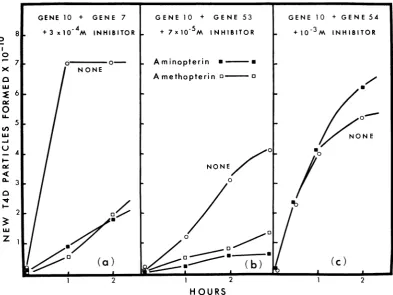
Inhibition of T4D tail plate assembly by
dihy-drofolate reductase inhibitors. The effects of
in-hibitors of dihydrofolate reductase on the in
vitro assembly ofT4D are shown in Fig. 9 and
10 and inTable 6. Extracts were made from E.
coli B afterinfection withvarious amber mutants
ofT4D defective in different genes required for
tail assembly (27). For example, the products
ofgene 7and gene 10 arerequired for tailplate
formation, and in vitro complementation
be-tween these two extracts allows first tail
plate
formation and
then,
afteranumber ofadditionalGene 10
AMINOPTERI N
2.5xlO-4M
20 NONE 2 0
1
l6
1612 5
x1I0
I4A
V,) LU.
8 ~~~~~~~~~~~8
I- 4 4
Lu Z
reactions, formation of infective phage (27).
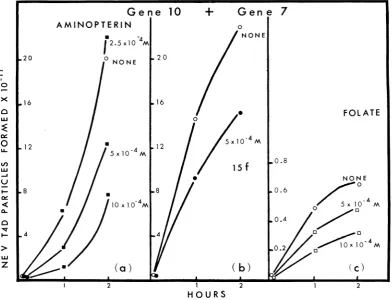
Figures 9 and lOa show that aminopterin and
amethopterin (11) are equally effective in
in-hibiting in vitro assembly between gene 10 and
7 extracts. As showninFig. 9a, theinhibition is
dependent on the amount of inhibitor added.
An irreversible inhibitor of dihydrofolate
re-ductase, compound
15f
described by Baker (5),andfolate,whichalsohas beenreported to be an
inhibitor of the phage-induced dihydrofolate
reductase (D. Shapiro and R. M. Kozloff,
J. Mol. Biol., in
press),
both inhibitedcomple-mentation between gene 10 and 7 extracts. But
compounds such as glutamate, p-amino-benzoyl
glutamate, and uracil, all at 10-3 M, did not
in-hibitcomplementation.
The effect of dihydrofolate reductase
inhibi-tors on complementation between various pairs
ofotherextractsofT4Dambermutantsis shown
inFig.
lOb
andlOc
andin Table 6.Complementa-tion between gene 10 and gene 53 was also
sensitive to inhibitors (Fig.
lOb).
But assembly [image:11.487.61.454.300.600.2]H OU RS
FIG. 9. Inhibitionof in vitrocomplementation betweenextracts made from amber T4Dgene-infectedE. coliB
and amber T4D gene 7-infectedE.coliBby three inhibitors ofdihydrofolatereductase;aminopterin, compound 1Sf, andfolate. The complementationreaction wascarried out as described in Materials and Methods. 1Sfis the
irreversibleinhibitor ofdihydrofolatereductasesynthesizedbyBaker et al. (5).
750
on November 11, 2019 by guest
http://jvi.asm.org/
VOL. 5, 1970
81
BACTERIOPHAGE TAIL COMPONENTS. II
751
0
°l 7 o-
Aminopterin
u-*rnX/ NONE
Mo
Aomethopterin
0LU U
0
5 L/) -J
A..
0 UNONE
0U
/
z 0~~~~~~~~~~~~~~~~~
0
0 0 0
(a)
(b)
(c)
12 12 12
[image:12.487.48.442.69.364.2]H OURS
FIG. 10. Inhibition by aminopterin and
amethopt~erin
ofin vitrocomplementationz
between extracts ofE. coliBmadewithdifferentamber T4D mutants. The
compkementation
wascarriedoutas describedin Materials andMethods.
ofT4D in mixtures of extracts of gene 10 and
gene 54 was notinhibited even in the presence of
10-3 Maminopterin (Fig. 10c). It should be noted
that gene 54 extracts contain preformed tail
plates. The effect of 10-3 M aminopterin on the
steps inT4D tail assembly is shown in Table 6.
Inall mutantpairs tested, aminopterin prevented
complementation only if no tail plates were
present in either of the extracts. These results
indicatethat only before dihydrofolate reductase
has been incorporated into the complex tail plate is the inhibitor able to bind to this protein and
preventits use for phage tail assembly.
The concentrations ofinhibitors necessary to
prevent complementations, such as the 10-3 to
104 M shown in Fig. 9 and 10 and in Table 6,
are much higherthanthe10-7 to 10-8 M
concen-trationsreported to be effective with the purified
phage-induced or bacterial enzymes (19).
How-ever, these extracts are known to contain high
concentrations of the phage-induced
dihydrop-teroyl polyglutamate, and dialysis to remove
thesecompounds inactivatedthe extracts. Under
these circumstances, it is impossible to predict
theconcentrationofinhibitor needed tocompete
with phage-induced compound to prevent
assembly.
Onthebasis ofthefinding thatallfour
inhibi-tors of dihydrofolate reductase tested, i.e.,
aminopterin, amethopterin, folate, and
com-pound
15f,
inhibitedassembly,
andonthefindingthat there is great
specificity
in the step in tailassembly which isinhibited, itcan beconcluded
that dihydrofolate reductase is involved in the
formation ofphagetailplates.
DISCUSSION
Theresultsof these studiesandthosein the
ac-companying paper (16) can be used to amplify
the scheme of T4D tail assembly proposed by
Wood et al. (27), as shown in
Fig.
11.During
normal T4D tail assembly, the product of the
phagewh gene isincorporated intothetail
plate.
This product need not be fully active
dihydro-folatereductase, asinthecaseof the
assembly
ofT4Dwhl, but itmust be abletobindthe
phage-induced dihydropteroyl polyglutamate and
prob-ably must be able to react with NADPH. In a
on November 11, 2019 by guest
http://jvi.asm.org/
TABLE 6. Inhibition ofT4D tailassembly reactionts by aminopterin
Expt
1 2 3 4 5 6 7
8 9 10
No recognizabletail
substructure
Tail plate
11 Tailplate + tail tube
12 Tail plate + tube +
sheath
13 Tail-fiberless
par-ticle
Extractsa
10 -7
10 + 7
10 + 7
10 + 26
10 + 6
10 + 53
7 + 26 7 + 48
7 + 54
10 + 54
10 + 18
54 + 23
X4E + 23
Relative
complemen-tation with aminopterin
0.4 0.4
0.2
0.4
0.1 0.6
0.4
1.0
0.9 1.6
aThe variation incomplementation between a
given pair of extracts without added inhibitor
on any day was +20~7. Equal portions of each extract and the control solution or the inhibitor
solutionweremixed and incubatedat30C.Inthe
control experiment (without inhibitor), either
10- M phosphate buffer atpH 7.4or10- M
gluta-mate at pH 7.4 was added. Immediately after
mixingand after 2 hrat30C, samplesweretaken,
diluted in tryptone broth, and assayed on CR63.
The netfold increase inphagetiter intheabsence
ofthe inhibitor for each experiment was:
experi-ment 1, 120; experiment 2, 54; experiment 3, 17; experiment 4, 3; experiment 5, 4; experiment 6,14; experiment 7, 2; experiment 8, 126; experiment9, 146; experiment 10, 36; experiment 11, 2;
experi-ment 12, 200; and experiment 13, 35. The final
concentration of aminopterin (adjusted to pH
7.4) was 10- M in all experiments, except for
experiment5withextracts10+6 whenitwas3X
1l- M, and for experiment6withextracts10+53
when it was 10-4 M.
most unusualcase ofan ambermutation, inthe
whgene whereno suitable phage protein is
pro-duced, another dihydrofolate reductase (most
likely the host enzyme) is incorporated into the
structure, producing aphagewith altered
pheno-typic properties (a new type ofhost-dependent
modification). The number of dihydrofolate
re-ductase molecules incorporated per tail plate is very difficult to determine. The amount of
ac-tivity liberated by urea or formamide is not too
helpful, since there is no way to estimate either
theefficiencyofenzymeliberation ortheamount
Mostcomplextail substructure present
wh
Ge.-rdhvd,f,1t3
WJI6,-7. - >
PJ cz *i o
F.1 AcdId
,.'. A. 4s~4-19 at,* 18_-_- T4D 37AIPI,ATE TAILFLATE
T UFE
FIG. 11. Tail assembly of bacteriophage T4D. The roles ofthtephage wh gene product, dihydrofolate re-ductase, and the binzding of the phage-induced dihy-dropteroyl polyglutamate are indicatedonz the scheme putforth by Woodetal. (27).
of enzyme which might be destroyed by the
de-naturing treatment. Based on the number of
di-hydropteroyl polyglutamates found in phage particles, there may be somewhere between two
and six enzyme molecules per tailplate.
The phage-induced pteroyl polyglutamate can
be added either before or after the tail plate is
assembled. None oftheproducts ofthe14 genes
(otherthan the whgene) neededfortailassembly
has beenidentified, andit ispossible that one of
these genes may induce the synthesis of the
enzymeneeded to form the phage pteroyl
poly-glutamate. Theadditionof tail tube toatail plate
containing the dihydropteroyl polyglutamate
effectively trapsthe pteroyl polyglutamate.
Fur-ther, tail and phage assembly is then no longer
sensitive to dihydrofolate reductase inhibitors
since these inhbitorscannot reactwith the
appro-priatesiteonthe enzyme. Itshouldbe noted that
the siteforpyridine nucleotide binding, however,
is availableto added reduced oroxidized
nucleo-tidesand that theglutamate residues ofthe folate
compound extend from the plate structure and
are susceptible to hydrolysis by added folicacid
conjugase.
Although dihydrofolate reductase and bound
dihydropteroyl polyglutamate are essential
ele-mentsofthe phage tail structure, their role in the
attachment and injection process is not certain.
Recently Simon and Anderson (25, 26) showed
that the tail plate undergoes a morphological
transition during interaction with the host cell.
One of the unusual properties ofdihydrofolate
reductase (J. Burchall, Fed. Proc. 25:277, 1966;
J. Burchall and M. Chan, Fed. Proc. 28:352,
1969) is that its conformation can be radically
alteredby cofactor attachment (23).Itmay bethis
property of the enzyme which is important for
phagephysiology.It canbesupposedthat the cell
leakage occurring immediately after phage
on November 11, 2019 by guest
http://jvi.asm.org/
[image:13.487.57.244.71.308.2]BACTERIOPHAGE TAIL COMPONENTS. II
tachmentliberates enough NADPHto reactwith
the phage tail plate dihydrofolate reductase,
re-ducing the dihydro-compound to the
tetrahydro-compound, and thatthis changeinoxidationstate
triggers first achangeintheconformation ofthe
phage enzyme and then amorphological change
in the phage tail plate. Preliminary experiments
onmorphological changes producedin thephage
tailsubstructureconsisting of plate plustube after
treatmentwith NADPH tend to support the
sup-positionthatdihydrofolatereductaseplays arole
inphage infection.
Finally, it may be emphasized that the use of
an "early" enzyme, formed within 1 to 2 min
afterinfection (20),as a componentofthephage
coatisnot in agreementwith thewidespreadview
that capsid components are only synthesized as
"late" proteins. Since this enzyme amounts to
onlyabout0.02% of the totalmassof thephage
coat, and indeed under unusual circumstances
may possibly be replaced by a host enzyme, it
clearlyrepresents a
special
case.ACKNOWLEDGMENTS
This investigation was supported by Public Health Service grants AI-06336 fromtheNationalInstitute ofAllergyand In-fectious Diseases and 5 TOI GM-01379 from the National Institute ofGeneralMedical Sciences.
LITERATURE CITED
1. Adams,A.1949. Thestabilityof bacterial viruses in solutions of salt. J. Gen. Physiol.32:579-594.
2. Adams, M. H. 1959. Bacteriophages, p. 461-466. Inter-sciencePublishers, Inc.,New York.
3. Albrecht,A.M.,F. K.Pearce,W. J.Suling,and D. J. Hutchi-son. 1969. Folate reductase and specific dihydrofolate reductaseoftheamethopterin-sensitivestreptococcusfaecium
var.durans.Biochemistry 8:960-967.
4. Baker, B. R. 1967. Modus operandi. II. Dihydrofolic
re-ductase,p. 192-266. In B. R. Baker(ed.), Designof active-site-directed irreversibleenzyme inhibitors. JohnWiley & Sons, Inc.,New York.
5. Baker,B.R. 1967. Irreversible enzyme inhibitors. CV. Dif-ferential irreversible inhibition of vertebrate dihydrofolic
reductasesby derivativesof 4,6-diamino-1,2-dihydro-2,2-dimethyl-l-phenyl-S-triazines substituted with a terminal
sulfonylfluoride.J.Med. Chem. 10:1113-1122. 6. Bush,M.E.,and K.0. Donaldson. 1965.Tetrahydrofolate
dehydrogenase from Bakers' yeast. Biochem. Biophys.
Res.Commun. 20:635-640.
7. Edgar, R. S., and W. B. Wood. 1966. Morphogenesis of bacteriophageT4inextractsof mutant-infected cells. Proc. Nat. Acad. Sci. U.S.A. 55:498-505.
8. Freese, E., E.Bautz-Freese, and E. Bautz. 1961. Hydroxyla-mine as a mutagenic and inactivating agent. J. Mol. Biol. 3:133-143.
9. Hall, D. H. 1967. Mutantsofbacteriophage T4 unable to induce dihydrofolate reductase activity. Proc. Nat. Acad. Sci. U.S.A. 58:584-591.
10. Hall, D. H.,I.Tessman, and0.Karlstrom. 1967. Linkage of T4 genes controlling a series of steps in pyrimidine bio-synthesis. Virology 31:442-448.
1I. Huennekens, F. M. 1963. The role of dihydrofolic reductase in the metabolism of one-carbon units. Biochemistry 2:151-159.
12. Huennekens, F. M. 1968.Folate and B12 compounds, p. 439-513. In T. P.Singer(ed.),Biological oxidation. Interscience Publisher, Inc., New York.
13. Kaufman, B. T. 1963. Activation of dihydrofolic reductase by urea andformamide.Biochem.Biophys. Res. Commun. 10:449-453.
14.King, J. 1968. Assembly of the tail of bacteriophage T4. J. Mol. Biol.32:231-262.
15. Kozloff, L.M., and M.Lute. 1965. Folic acid, a structural componentofT4bacteriophage.J. Mol. Biol. 12:780-792. 16. Kozloff,L.M.,M.Lute, L.K. Crosby, and N. Rao, V. A. Chapman, and S. S. DeLong. 1970. Bacteriophage tail components. I. Pteroyl polyglutamates in T-even bac-teriophages. J.Virol. 5:726-739.
17. Kozloff, L.M.,M. Lute, L. K. Crosby,R. Wong, and B. Stern. 1969. Critical arginine residue for maintaining the bacteriophage tailstructure. J. Virology. 3:217-227. 18. Kozloff, L.M., M.Lute,and K. Henderson. 1957. Viral
in-vasion.I.Ruptureofthiol ester bonds in the bacteriophage tail.J.Biol. Chem. 228:511-528.
19. Mathews, C.K. 1967.Evidence that bacteriophage induced dihydrofolate reductase isa viral gene product. J. Biol. Chem.242:4083-4086.
20. Mathews, C., and S. Cohen. 1963. Virus-inducedacquisition of metabolic function. VI. Dihydrofolate reductase, a newphage-inducedenzyme. J. Biol. Chem. 238:853-854. 21. Mathews, C. K., and S. S. Cohen. 1963. Inhibitionof
phage-induced thymidylatesynthetase by5-fluorodeoxyuridylate. J.Biol.Chem. 238:367-370.
22. Mathews, C. K., andK. E. Sutherland. 1965. Comparative biochemistry ofbacterial andphage-induceddihydrofolate reductases. J.Biol. Chem.240:2142-2147.
23. Mell,G.P.,N.Martelli,J.Kirchner, and F. M.Huennekens. 1968.Multiple forms ofdihydrofolatereductase. Biochem. Biophys. Res.Commun.23:74-79.
24. Shashoua, V. E. 1964. Formamidine sulfinic acid as a bio-chemicalreducingagent.Biochemistry 3:1719-1720. 25. Simon, L. D., and T.F. Anderson. 1967. The infection of
Escherichia coli byT2 and T4 bacteriophages as seen in the electronmicroscope. I. Attachment and penetration. Virology 32:279-297.
26. Simon, L. D., and T. F. Anderson. 1967. Theinfectionof Escherichiacoliby T2 andT4bacteriophagesas seen in theelectronmicroscope.II.Structureandfunctionof the baseplate.Virology 32:298-305.
27.Wood, W. B., R.S.Edgar, J.King,I. Lielausis,and M. Hen-ninger. 1968.Bacteriophage assembly. Fed.Proc. 27:1160-1166.
753
VOL. 5, 1970
![Fig. 6Cof (16)], plus 50% Freund's adjuvant in a totalvolume of 0.2 ml was injected into the popliteal gland a 2-kg New Zealand white rabbit](https://thumb-us.123doks.com/thumbv2/123dok_us/1621661.115274/3.487.107.396.342.532/freund-adjuvant-totalvolume-injected-popliteal-gland-zealand-rabbit.webp)