R-matrix electron-impact excitation data for the B-like
iso-electronic sequence
G. Y. Liang
1, N. R. Badnell
2, and G. Zhao
11 National Astronomical Observatories, CAS, 100012 Beijing, PR China 2 Department of Physics, University of Strathclyde, Glasgow, G4 0NG, UK
e-mail:[email protected]
Received 23 August 2012/Accepted 25 September 2012
ABSTRACT
We have carried-out parallel intermediate-coupling frame transformationR-matrix calculations for electron-impact excitation amongst the 204 close-coupling levels of the 2sx2py(x+y=3), 2s2{3,4}l, 2s2p{3,4}l, and 2p23lconfigurations for all boron-like ions from
C+to Kr31+. We have also included the configuration interaction due to the 2p24l, 2s3l3l and 2p3s3lconfigurations. A detailed
comparison has been made of the target structure and excitation data for four specific ions (viz., Ne5+, Ar13+, Fe21+and Kr31+) that
span the sequence, so as to assess the accuracy over the entire sequence. Effective collision strengths (Υs) are presented at temperatures ranging from 2×10²(z+1)2K to 2×10⁶(z+1)2K (wherezis the residual charge of the ions, i.e.Z−5). Detailed comparisons for the
(effective) collision strengths (Υs)Ωare made with the results of previous calculations for the four representative ions. Furthermore, we examine the iso-electronic trends of the effective collision strengths as a function of temperature.
Key words.atomic data – atomic processes – plasmas
1. Introduction
Emission lines of boron-like ions have been recorded in both ear-lier spacecraft (Malinovsky & Heroux1973; Huber et al.1973; Acton et al.1985) and more recent Hinode/EIS (Brown et al. 2008; Landi & Young 2009; Del Zanna 2012) solar observa-tions. The diagnostic usefulness of B-liken =2→n =2 tran-sition lines was first noted by Flower & Nussbaumer (1973) for several ions, viz. sodium, silicon, and sulphur. Later, Peng & Pradhan (1995) performed a systematic investigation for line in-tensity ratios of the boron-like iso-electronic sequence (includ-ing C II, N III, O IV, Ne VI, Mg VIII, Al IX, Si X, and S XII), and illustrated some line ratios that are sensitive to electron tempera-ture or electron density. The authors used data from anR-matrix calculation by Zhang et al. (1994), which included just then=2 configurations. However, Keenan et al. (2000,2002) noticed a slight error by Zhang et al. (1994) when including term coupling coefficients in theirR-matrix calculation. Keenan et al. (2002) re-calculated the excitation data amongst the fine-structure lev-els of then=2 configurations for Si X and S XII. The diagnos-tic line ratios involving those levels were re-examined by them also and applied to solar observations. Liang & Zhao (2008) furthermore applied the electron density diagnostic line ratio of two 3d−2p transition lines to stellar observations. However, the available excitation data forn = 2→ n = 3 transitions in the boron-like iso-electronic sequence are mainly from distorted-wave (DW) calculations, which omit the contribution from res-onances. In addition to the resonances attached to them, more highly excited states also contribute to lower-lying line ratios
These data are made available in the archives of APAP via http://www.apap-network.org, OPEN-ADAS via
http://open.adas.ac.ukas well as at the CDS via anonymous ftp tocdsarc.u-strasbg.fr (130.79.128.5)or via
http://cdsarc.u-strasbg.fr/viz-bin/qcat?J/A+A/547/A87
via cascades – see for example Del Zanna et al. (2012) and Foster et al. (2012), where R-matrix data were additionally sup-plemented by DW calculations.
For the astrophysically important Fe21+ ion, Badnell et al. (2001) performed a 204-level intermediate-coupling frame transformation (ICFT) R-matrix calculation, which included a much larger configuration interaction (CI) expansion. Recently, Liang et al. (2009a,2011) extended R-matrix calculations up ton = 3 and 4 for Si9+ and S11+ ions, respectively. Ludlow et al. (2010) performed Breit-Pauli R-matrix calculations for all ions of the argon isonuclear sequence. The boron-like case used a close-coupling expansion comprising the 2sx2py(x+y= 3), 2s2{3,4,5}l configurations. For other ions along this
iso-electronic sequence, the distorted-wave calculations performed by Zhang & Sampson (1994a,b) are still the main source of data for various modelling databases, e.g. Chianti v7 (Landi et al.
2012), AtomDB v21.
Here, we report on calculations for the electron-impact ex-citation of the boron-like iso-electronic sequence from C+ to Kr31+ ions that were made using the ICFT R-matrix method. This paper is part of our series of works on iso-electronic se-quences: Li-like, Liang et al. (2011); F-like, Witthoeft et al. (2007); Ne-like, Liang & Badnell (2010); and Na-like, Liang et al. (2009a,b). This work is part of the UK Atomic Processes for Astrophysical Plasmas (APAP) network2.
The remainder of this paper is organized as follows. In Sect. 2, we discuss details of the calculational method and pay particular attention to comparing our underlying atomic struc-ture results with those of previous workers. The model for the scattering calculation is outlined in Sect. 3. The excitation re-sults themselves are discussed in Sect. 4.
1 http://www.atomdb.org/ 2 http://www.apap-network.org
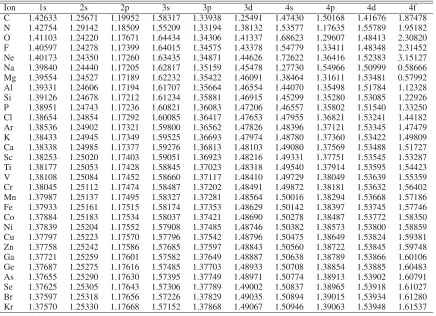
Table 1.Thomas-Fermi potential scaling factors used in our
autostructure
calculations (see text for details).Ion 1s 2s 2p 3s 3p 3d 4s 4p 4d 4f
C 1.42633 1.25671 1.19952 1.58317 1.33938 1.25491 1.47430 1.50168 1.41676 1.87478
N 1.42754 1.29142 1.18509 1.55209 1.33194 1.38132 1.53577 1.17635 1.55789 1.95182
O 1.41103 1.24220 1.17671 1.64434 1.34306 1.41337 1.68623 1.29607 1.48413 2.30820
F 1.40597 1.24278 1.17399 1.64015 1.34575 1.43378 1.54779 1.33411 1.48348 2.31452
Ne 1.40173 1.24350 1.17260 1.63435 1.34871 1.44626 1.72622 1.36416 1.52383 3.15127
Na 1.39840 1.24440 1.17205 1.62817 1.35159 1.45478 1.27730 1.54966 1.50999 0.58666
Mg 1.39554 1.24527 1.17189 1.62232 1.35422 1.46091 1.38464 1.31611 1.53481 0.57992
Al 1.39331 1.24606 1.17194 1.61707 1.35664 1.46554 1.44070 1.35498 1.51784 1.12328
Si 1.39126 1.24678 1.17212 1.61234 1.35881 1.46915 1.45299 1.35280 1.53085 1.22926
P 1.38951 1.24743 1.17236 1.60821 1.36083 1.47206 1.46557 1.35802 1.51540 1.33250
Cl 1.38654 1.24854 1.17292 1.60085 1.36417 1.47653 1.47955 1.36821 1.53241 1.44182
Ar 1.38536 1.24902 1.17321 1.59800 1.36562 1.47826 1.48396 1.37121 1.53345 1.47479
K 1.38433 1.24945 1.17349 1.59525 1.36693 1.47974 1.48780 1.37360 1.53422 1.49809
Ca 1.38338 1.24985 1.17377 1.59276 1.36813 1.48103 1.49080 1.37569 1.53488 1.51727
Sc 1.38253 1.25020 1.17403 1.59051 1.36923 1.48216 1.49331 1.37751 1.53545 1.53287
Ti 1.38177 1.25053 1.17428 1.58845 1.37023 1.48318 1.49540 1.37914 1.53595 1.54423
V 1.38108 1.25084 1.17452 1.58660 1.37117 1.48410 1.49729 1.38049 1.53639 1.55359
Cr 1.38045 1.25112 1.17474 1.58487 1.37202 1.48491 1.49872 1.38181 1.53632 1.56402
Mn 1.37987 1.25137 1.17495 1.58327 1.37281 1.48564 1.50016 1.38294 1.53668 1.57186
Fe 1.37933 1.25161 1.17515 1.58174 1.37353 1.48629 1.50142 1.38397 1.53745 1.57746
Co 1.37884 1.25183 1.17534 1.58037 1.37421 1.48690 1.50278 1.38487 1.53772 1.58350
Ni 1.37839 1.25204 1.17552 1.57908 1.37485 1.48746 1.50382 1.38573 1.53800 1.58859
Cu 1.37797 1.25223 1.17570 1.57796 1.37542 1.48796 1.50475 1.38649 1.53824 1.59381
Zn 1.37758 1.25242 1.17586 1.57685 1.37597 1.48843 1.50560 1.38722 1.53845 1.59748
Ga 1.37721 1.25259 1.17601 1.57582 1.37649 1.48887 1.50638 1.38789 1.53866 1.60106
Ge 1.37687 1.25275 1.17616 1.57485 1.37703 1.48933 1.50708 1.38854 1.53885 1.60483
As 1.37655 1.25290 1.17630 1.57395 1.37749 1.48971 1.50774 1.38913 1.53902 1.60791
Se 1.37625 1.25305 1.17643 1.57306 1.37789 1.49002 1.50837 1.38965 1.53918 1.61027
Br 1.37597 1.25318 1.17656 1.57226 1.37829 1.49035 1.50894 1.39015 1.53934 1.61280
Kr 1.37570 1.25330 1.17668 1.57152 1.37868 1.49067 1.50946 1.39063 1.53948 1.61537
2. Sequence calculation
The aim of this work is to performR-matrix calculations em-ploying the ICFT method (see Griffin et al.1998) for all boron-like ions from C+to Kr31+. The close-coupling (CC) expansion we used consists of the 2sx2py(x+y=3), 2s2{3,4}l, 2s2p{3,4}l,
and 2p23l(92 LS terms, 204 fine-structure levels) configurations.
The additional configuration interaction (CI) from the 2p24l,
2s3l3land 2p3s3l(71 LS terms, 160 fine-structure levels) con-figurations was included for the target structure used in the col-lision calculation.
2.1. Structure: level energies
The target wavefunctions (1s−4f) were obtained from
autostructure
(AS, Badnell 1986) using theThomas-Femi-Dirac-Amaldi model potential. Relativistic effects were included perturbatively from the one-body Breit-Pauli operator (viz. mass-velocity, spin-orbit and Darwin) without valence-electron two-body fine-structure operators. This is consistent with the operators included in the standard Breit-PauliR-matrix suite of codes. The radial scaling parameters, λnl (n = 1−4; l ∈ s,p,d, and f, were obtained separately for each ion by a three-step optimization procedure. In the first step, the weighted sum of all term energies of the 1s22sx2py(x+y = 3) configu-rations was minimized by varying theλ1s,λ2s andλ2p scaling
parameters. Then, the energies of the 1s22s23l and 1s22s24l
configurations were minimized by varying theλ3landλ4lscaling parameters, respectively. The resultant scaling parameters are listed in Table1. For lower charged ions,λ4f is far away from
unity. Tests show that it is insensitive to optimization and the atomic structure itself is insensitive to it.
A comparison of level energies is made with the experimen-tally derived data available from the compilation of NIST v43,
and with other theoretical results, for four specific ions (Ne5+, Ar13+, Fe21+, and Kr31+) that span the sequence, so as to
as-sess the accuracy of our present structure over the entire iso-electronic sequence – see Tables2−5. For many excited levels of then=3 and 4 complexes, the present AS calculation agrees to better than within 1% with the NIST v43recommended values
for the four ions. For levels ofn =2 configurations, the energy difference is less than 4%. For highly charged ions, this discrep-ancy becomes smaller. Therefore, we performed a calculation with level energy corrections to the diagonal of the Hamiltonian matrix before diagonalization for the 15 fine-structure levels of then=2 configurations of almost all ions over the iso-electronic sequence (except forZ = 29−35) and iterated to convergence. For those levels missing in the NIST compilation, we adopted the mean value of differences between our level energies and corresponding NIST values of the same configuration. The re-sultinge-vectors ande-energies were used to calculate the oscil-lator strengths and archived energies.
For Ne5+, Mitnik et al. (2001) performed a
multi-configuration Hartree-Fock (MCHF) calculation with three pseudo-orbitals (5s, 5p, and 5d) included, which shows a better agreement with NIST v4 data for the levels ofn = 2 configu-rations, see Table2. For higher excited levels ofn = 3 and 4 configurations, the two different sets of predictions agree better, to within 1%.
For Ar13+, a
grasp
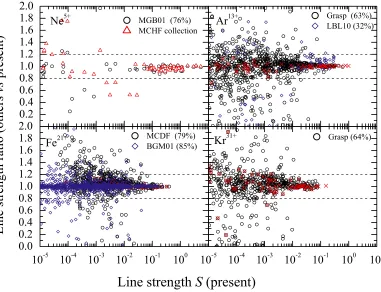
calculation is available, which included the 2sx2py (x+y = 3), 2s2{3,4,5}l, 2s2p{3,4,5}l, 2p2{3,4,5}lFig. 1. Comparison of line strengths (S) of electric-dipole transitions for ions spanning the sequence. For Ne5+, MGB01 corresponds to the MCHF calculation of Mitnik et al. (2001) for transitions among the lowest 20 levels, while “up-triangle” symbols correspond to the data from the MCHF/MCDF collection6. For Ar13+, comparisons are made with the
grasp
calculation by Aggarwal et al. (2005) and with theautostructure
calculation by Ludlow et al. (2010, hereafter LBL10) for all transitions amongst levels of then= 2 configurations. The “×” symbols denote transitions among the lowest 20 levels. For Fe21+, a comparison is made with the MCDF calculation (Jonauskas et al.2006) and that of Badnell et al. (2001, hereafter BGM01) for all transitions amongst levels of then=2 configurations. The “×” symbols are the same as for Ar13+. For Kr31+, we compare with thegrasp
calculation by Aggarwal et al. (2008). The horizontal dashed lines correspond to an agreement within 20%.The present AS calculation agrees well with the
grasp
calcula-tion, to within 1%, and even better than 0.5% for most levels, see Table3. In the work of Ludlow et al. (2010)4, the orbital scalingparameters were adjusted by hand to bring the calculatedn =2 level energies into close agreement with the NIST v4 experi-mental values. But our ab initio results agree much better with the NIST values for then = 3 and 4 levels. For compactness, we do not present their results in Table3. We do note that the Ludlow et al. (2010)R-matrix calculations covered the whole argon isonuclear sequence and so they were constrained to use a simplified structure. With an isoelectronic sequence, once we have determined the best approach to the structure for one ion, the same one works with little change for every other one of the sequence (excluding near neutral).
For Fe21+, Jonauskas et al. (2006) performed an unprece-dented large-scale calculation using the multi-configuration Dirac-Fock (MCDF) approach with the promotion of one, two, and three electrons fromn = 2 to all possible combinations of one, two, or three electrons in the shells up ton=3. The present AS level energies agree within 0.5% for all levels ofn =3 and 4 configurations. For low-lying levels ofn = 2 complex, the difference is still within 2%, see Table4. Badnell et al. (2001) performed a similar calculation to the present one, but without inclusion of 2s3l3land 2p3s3lconfigurations, again using the
4 Ballance provided us with their results for Ar13+in the adf04 file
format (priv. comm.).
autostructure
code5. Their resulting level energies show anexcellent agreement with the present ones. Due to the similarity of the two approaches, their results are not listed in Table4.
For the highly charged case of Kr31+, the most recent
theo-retical work is the fully relativistic
grasp
calculation performed by Aggarwal et al. (2008). Table5 shows that the present AS calculation agrees to better than 1% with thegrasp
calculation.2.2. Structure: line strength S
Another test of our structure calculation is to compare line strengths (Si j for a giveni← jtransition). In terms of the tran-sition energyEji(Ryd) for the j → itransition, the absorption oscillator strength,fi j, can be written as
fi j = Eji
3giS, (1)
and the transition probability or Einstein’sA-coefficient,Aji, as Aji(au) =12α3
gi
gj E2
jifi j, (2)
whereαis the fine structure constant, andgi,gjare the statistical weight factors of the initial and final states, respectively.
Figure1illustrates a graphical comparison of line strengths with previous calculations for electric-dipole transitions for the four representative ions. For the lower charged Ne5+ ion, 76%
5 Their resulting data are available from the Open-ADAS database in
of all possible transitions among the lowest 20 levels agree with the MCHF calculation (Mitnik et al.2001) to within 20%. Mitnik et al. (2001) demonstrated that the average difference is 24% be-tween their results and the data from MCHF/MCDF collection database6. We illustrate this comparison again by “up-triangle”
symbols in the top-left panel in Fig.1, which reveals a compa-rable level of agreement with that in Table 2 of Mitnik et al. (2001).
For Ar13+, the 460-level
grasp
calculation performed byAggarwal et al. (2005) is the largest-scale work for this ion to our best knowledge. We provide a comparison with their results, again in Fig.1. There are 63% of all electric-dipole transitions to levels ofn =2 configurations which agree to within 20% be-tween the two different calculations. For transitions among the lowest 20 levels, an even better (84%) agreement is found. The data from Ludlow et al. (2010) show a worse agreement with ours. There are only 32% of all available transitions ton=2 lev-els to agree within 20%. Even for transitions withinn=2 levels, the percentage is 53%. Their lack of an optimized structure is likely the cause. Additionally, their radiative decay rate (Aij) val-ues in adf04 file were scaled according the theoretical and NIST level energies. That might also contribute to some of the low percentage in the differences of dipole line strengths.
For Fe21+, the work of Jonauskas et al. (2006) is likley the
largest-scale calculation. The present AS calculation agrees with their results to within 20% for 79% of all electric-dipole transi-tions to levels ofn=2 complex. In comparison with the results of Badnell et al. (2001), 85% of all electric-dipole transitions to n=2 levels agree within 20%. This difference is attributed to the CI effect from the 2s3l3land 2p3s3lconfigurations included in
our AS calculation.
For the highly charged case of Kr31+, a comparison is made with the
grasp
calculation of Aggarwal et al. (2008). There are 64% of all transitions to levels ofn=2 that agree to within 20%. For transitions withinn=2 levels, the percentage is 92%.The scatter plots show that the deviations between the present AS calculation and various previous results are much stronger and more widespread for the weaker transitions than the strong ones, as expected.
Overall, the atomic structure of the ions spanning the se-quence is reliable, and the uncertainty in collision strengths (Ωs) due to inaccuracies in the target structure is correspondingly small.
3. Scattering
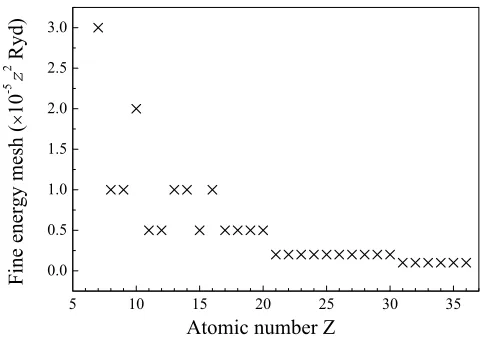
The present parallel ICFT R-matrix calculations employed 40 continuum basis orbitals per angular momentum to repre-sent the (N+1)th-electron over the sequence. All partial waves fromJ =0 to 41 were included explicitly and the contribution from higherJ-values was included using a “top-up” procedure (Burgess1974; Badnell & Griffin2001). The contribution from partial waves up to J = 12 included electron exchange while those fromJ = 13 to 41 were non-exchange, calculated using the exchangeR-matrix code in its non-exchange mode. For the exchange calculation, a fine energy mesh was used to resolve the majority of narrow resonances below the highest excitation threshold, which has been tested to be sufficient for the conver-gence of the effective collision strength, see Fig. 2. From just above the highest threshold excitation to a maximum energy of ten times the ionization potential for each ion, a coarse energy mesh (1.0×10⁻³z2Ryd, wherez=Z−5 is the residual charge
[image:8.595.312.553.73.242.2]6 http://nlte.nist.gov/MCHF/view.html
Fig. 2. Fine energy mesh employed in the outer region (exchange)
R-matrix calculation for each ion.
of ion) was employed. For the non-exchange calculation, a step of 1.0×10⁻³ z2 Ryd was used over the entire energy range.
Additionally, experimentally determined energies or adjusted energies were employed in the MQDT expressions used by the ICFT method to further improve the accuracy of the results, as was done for highly charged sulphur ions (Liang et al.2011). The lowest-lying 8 LS terms (15 IC levels) of then = 2 com-plex were corrected for almost all ions over the iso-electronic sequence, as explained in detail in the structure section.
As mentioned in the introduction, we wish to determine ex-citation data for the 204 CC levels of the 2sx2py (x+y = 3), 2s2{3,4}l, 2s2p{3,4}l, and 2p23l configurations. But for some ions, these do not correspond to the lowest energy 204 levels (92 LS terms). When this occurs, we include additional terms in the close-coupling expansion so that all 2p23llevels are still
in the close-coupling expansion and there are no “gaps” be-low them. For example, for N2+ and O3+, the 2p24s 4P/2P,
2p24p2S/4P/4D terms were included.
To take the contribution from higher electron energies to high temperature effective collision strengths into account, the infinite energy Born limits (non-dipole allowed) and line strengths (dipole allowed) from
autostructure
were used to obtain collision strengths (Ω) at higher energies according to the procedure defined by Burgess & Tully (1992). Theeffec-tive collision strengths at 13 electron temperatures ranging from 2×10²(z+1)2K to 2×10⁶(z+1)2K are produced as the end
product with ADAS adf04 format (Summers2004).
4. Results and discussions
4.1. Comparison with previous calculations
As in our other iso-electronic sequence work, we selected sev-eral transitions to test the original collision strength for four ions (Ne5+, Ar13+, Fe21+and Kr31+) spanning over the sequence. An extensive comparison for effective collision strength will be given by a scatter plot to test how far the reliability reaches.
Fig. 3. (Effective) collision strengths for Ne5+.Left: excitation from the 2s22p2P
1/2ground level to the 2s22p2P3/2level (1–2).Right: excitations
amongst all 15 levels of then=2 configurations at the temperature (Te=4.0×10⁵K) of peak fractional abundance in ionization equilibrium. The
(red) “×” marks the 1–2 excitation shown in the lefthand panel. Double-horizontal lines correspond to agreement within 20%.Notes: the collision strength of Mitnik et al. (2001) is a scanned picture.
Fig. 4.Comparison of effective collision strengths for Ar13+.Left: all excitations among the 15 levels of then=2 configurations at the temperature (Te=4.0×10⁶K) of peak fractional abundance in ionization equilibrium. The “×” symbol corresponds to the 2s22p2P3/2−2p3 2P3/2(1–15)
exci-tation shown in the righthand panel, which is linked for the two different previous calculations. Double-horizontal lines correspond to agreement within 20%.Right: the effective collision strength of the 1–15 transition as a function of temperature (K). ZGP94 and LBL10 correspond to the Breit-PauliR-matrix works of Zhang et al. (1994) and Ludlow et al. (2010), respectively.
agreement with this previous one, see left panel in Fig3. An extensive comparison of effective collision strength is given in the right panel of Fig.3for all excitations from levels of n = 2 configurations at a temperature of peak fraction in ionization equilibrium. About 73% of the excitations agree within 20%.
– Ar13+ The small-scale (n = 2) R-matrix calculation per-formed by Zhang et al. (1994) is extensively adopted by vari-ous databases, e.g. Open-ADAS7and Chianti v7 (Landi et al.
2012). Comparison with these data for all excitations among the 15 lowest-lying levels reveals that the previousR-matrix data are systematically lower than ours, and the deviations are stronger for weaker excitations, see Fig. 4. However, the data from the work of Ludlow et al. (2010) agree well
7 http://open.adas.ac.uk/
with ours even though only 36 IC levels of (1s2)2sx2py (x+y = 3), 2s2{3,4,5}l configurations were included in
their close-coupling expansion. Ninety percent of all tran-sitions within n = 2 levels agree to within 20%. For the 2s22p2P3/2−2p3 2P3/2(1–15) excitation, there is an obvious
bump in the present ICFTR-matrix calculation at temper-atures of 106−107 K, with the difference being up to∼3.5
when compared with Zhang et al.’s data. This is an obvi-ous enhancement due to resonances attached ton = 3 that were not included in the previous small-scale calculation. The good agreement with Ludlow et al.’s data also supports this.
– Fe21+After carrying out a level mapping procedure
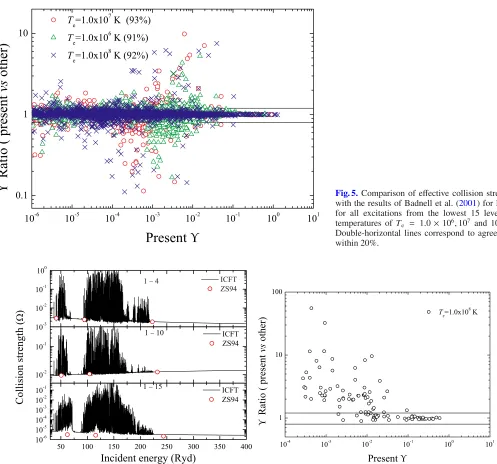
[image:9.595.59.543.344.518.2]Fig. 5.Comparison of effective collision strength with the results of Badnell et al. (2001) for Fe21+ for all excitations from the lowest 15 levels at temperatures ofTe = 1.0×106,107 and 108 K.
Double-horizontal lines correspond to agreement within 20%.
Fig. 6. (Effective) collision strengths for Kr21+.Left: present collision strengths for 2s22p2P
1/2–2s2p2 4P3/2(1–4), 2s22p2P1/2–2s2p2 2P3/2(1–10),
and 2s22p2P
1/2–2p3 2P3/2(1–15) transitions along with the distorted-wave calculation by Zhang & Sampson (1994a, ZS94).Right: ratio of effective
collision strength between the present ICFTR-matrix calculation and DW results available from the Open-ADAS database7at a temperature of
1.0×10⁸K. Double-horizontal lines correspond to agreement within 20%.
107K. Almost all excitations (93%) agree to within 20% for the two different calculations with a different target structure, see Fig.5. The differences between them and the widespread
agreement do not change much with increasing temperature. This results from the consistent resonance structure in the two calculations. Badnell et al. (2001) made a detailed as-sessment for their calculation with previous available data, therefore we will not repeat the comparison here.
– Kr31+ To our best knowledge, there are no R-matrix
ex-citation data available for this ion. Therefore, we com-pared the background of the present ICFTR-matrix calcula-tion with that from a distorted-wave calculacalcula-tion performed by Zhang & Sampson (1994a,b) for excitations from the ground level 2s22p2P
1/2. Figure 6 illustrates some
excita-tions from this comparison. The background of the collision strengths agrees well with the DW calculation. As expected,
the present effective collision strengthsΥare systematically higher than those from the distorted-wave approach due to the inclusion of resonances.
From the above comparison for the four specified ions (Ne5+,
Ar13+, Fe21+ and Kr31+) spanning the iso-electronic sequence, we believe the present ICFTR-matrix results (Ω andΥ) to be reliable. For ions near neutral (below O3+),R-matrix with pseu-dostates calculations are needed to consider ionization loss in the excitation, but ours are the best data available to date.
4.2. Trends of iso-electronic sequence
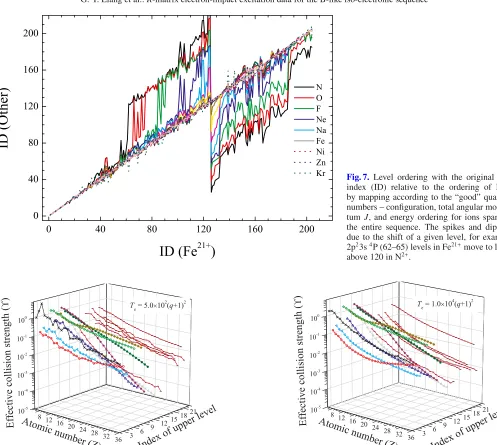
Fig. 7. Level ordering with the original level index (ID) relative to the ordering of Fe21+
by mapping according to the “good” quantum numbers – configuration, total angular momen-tumJ, and energy ordering for ions spanning the entire sequence. The spikes and dips are due to the shift of a given level, for example, 2p23s4P (62–65) levels in Fe21+move to levels above 120 in N2+.
Fig. 8.Effective collision strength (Υ) for excitations from the ground level to all 22 lowest-lying excited levels at temperatures ofTe=5×10²(q+
1)2and 1×10⁴(q+1)2K (hereq=Z−5) along the iso-electronic sequence.Notes: the index number refers to the ID number in the reference ion – Fe.
momentumJ, and energy ordering as a good quantum number for level matching in the comparison between different calcu-lations and the investigation of Υ along the iso-electronic se-quence, see Fig. 7. This satisfactorily eliminates uncertainty originating from the non-continuity of level-ordering along the sequence. We used Fe as the arbitrary reference ion for the level-ordering.
In Fig.8, we show the effective collision strengthΥat tem-peratures ofTe/(q+1)2 = 5 ×10² and 104 K along the
iso-electronic sequence for excitations from the ground level to the lowest-lying (in Fe21+) 22 excited levels. At the low temperature
of 5×10²(q +1)2 K, spikes and/or dips are observed at low charges for some transitions, e.g. 2s22p2P
1/2 → 2s22p2P3/2
(1−2). With increasing threshold energy, that is to higher excited levels, this irregularity becomes weaker and eventually disap-pears. At the high temperature of 1×10⁴(z+1)2 K, the spikes
and/or dips disappear, as expected, because the resonance con-tribution becomes weaker and eventually negligible.
5. Summary
We have performed 204-level ICFT R-matrix calculations for the electron-impact excitation of all ions of the boron-like iso-electronic sequence from C+to Kr31+.
Good agreement with the available experimentally derived data and the results of others for level energies and line strengths S for several specific ions (Ne5+, Ar13+, Fe21+, and Kr31+) span-ning the iso-electronic sequence, supports the reliability of our R-matrix excitation data. This was confirmed specifically by de-tailed comparisons ofΩand/orΥwith previousR-matrix calcu-lations, where available, for the four specific reference ions.
By excluding the level-crossing effects on theΥ, we exam-ined the iso-electronic trends of the effective collision strengths. As expected, a complicated pattern of spikes and dips ofΥ at low temperatures was noted again along the sequence as shown in our other series works.
The data are made available in the ADAS adf04 format (Summers2004) at the archives of the APAP2, OPEN-ADAS7
and will be included in the CHIANTI8database. At the APAP-network website2, the original collision strength also can be
made available.
In conclusion, we have generated an extensive set of reli-able excitation data with the ICFTR-matrix method for spec-troscopy/diagnostic research within the astrophysical and fusion communities. This will replace the data from DW and small-scaleR-matrix calculations presently used by these communi-ties, and it is expected to identify new lines and may overcome some shortcomings in present astrophysical modelling.
Acknowledgements. We thank Connor Ballance at Auburn University for help-ful comments. The work of the UK APAP Network is funded by the UK STFC under grant No. ST/J000892/1 with the University of Strathclyde. GYL acknowl-edges the support from the One-Hundred-Talents programme of the Chinese Academy of Sciences (CAS). G.Z. acknowledges the support from National Natural Science Foundation of China under grant No. 10821061.
References
Acton, L. W., Bruner, M. E., Brown, W. A., et al. 1985, ApJ, 291, 865 Aggarwal, K. M., Keenan, F. P., & Nakazaki, S. 2005, A&A, 436, 1141 Aggarwal, K. M., Keenan, F. P., & Lawson, K. D. 2008, At. Data Nucl. Data
Tables, 94, 323
Badnell, N. R. 1986, J. Phys. B: At. Mol. Opt. Phys., 19, 3827
Badnell, N. R., & Griffin, D. C. 2001, J. Phys. B: At. Mol. Opt. Phys., 34, 681 Badnell, N. R., Griffin, D. C., & Mitnik, D. M. 2001, J. Phys. B: At. Mol. Opt.
Phys., 34, 5071
8 http://www.chianti.rl.ac.uk/
Brown, C. M., Feldman, U., Seely, J. F., et al. 2008, ApJS, 176, 511 Burgess, A. 1974, J. Phys. B: At. Mol. Opt. Phys., 7, L364 Burgess, A., & Tully, J. A. 1992, A&A, 254, 436 Del Zanna, G. 2012, A&A, 537, A38
Del Zanna, G., Storey, P. J., Badnell, N. R., & Mason, H. E. 2012, A&A, 543, A139
Flower, D. R., & Nussbaumer, H. 1975, A&A, 45, 349
Foster, A. R., Ji, L., Smith, R. K., & Brickhouse, N. S. 2012, ApJ, 756, 128 Griffin, D. C., Badnell, N. R., & Pindzola, M. S. 1998, J. Phys. B: At. Mol. Opt.
Phys., 31, 3713
Huber, M. C. E., Dupree, A. K., Goldberg, L., et al. 1973, ApJ, 183, 291 Jonauskas, V., Bogdanovich, P., Keenan, F. P., et al. 2006, A&A, 455, 1157 Keenan, F. P., O’Shea, E., & Thomas, R. J. 2000, MNRAS, 315, 450 Keenan, F. P., Katsiyannis, A. C., Ryans, R. S. I., et al. 2002, ApJ, 566, 521 Landi, E., & Young, P. R. 2009, ApJ, 706, 1
Landi, E., Del Zanna, G., Young, P. R., et al. 2012, ApJ, 744, 99 Liang, G. Y., & Badnell, N. R. 2010, A&A, 518, A64 Liang, G. Y., & Badnell, N. R. 2011, A&A, 528, A69 Liang, G. Y., & Zhao, G. 2008, AJ, 135, 2291 Liang, G. Y., & Zhao, G. 2010, MNRAS, 405, 1987
Liang, G. Y., Whiteford, A. D., & Badnell, N. R. 2008, J. Phys. B: At. Mol. Opt. Phys., 41, 235203
Liang, G. Y., Whiteford, A. D., & Badnell, N. R. 2009a, A&A, 499, 943 Liang, G. Y., Whiteford, A. D., & Badnell, N. R. 2009b, A&A, 500, 1263 Liang, G. Y., Whiteford, A. D., & Badnell, N. R. 2009c, J. Phys. B: At. Mol.
Opt. Phys., 42, 225002
Liang, G. Y., Badnell, N. R., Zhao, G. 2011, A&A, 533, A87
Ludlow, J. A., Ballance, C. P., Loch, S. D., & Pindzola, M. S. 2010, J. Phys. B: At. Mol. Opt. Phys., 43, 074029
Malinovsky, M., & Heroux, L. 1973, ApJ, 181, 1009
Mitnik, D. M., Griffin, D. C., & Badnell, N. R. 2001, J. Phys. B: At. Mol. Opt. Phys., 34, 4455
Peng, J. F., & Pradhan, A. K. 1995, A&AS, 112, 151 Summers, H. P. 2004, The ADAS User manual version 2.6,
http://www.adas.ac.uk/
Witthoeft, M. C., Whiteford, A. D., & Badnell, N. R. 2007, J. Phys. B: At. Mol. Opt. Phys., 40, 2969