What is the Difference?
There was Always Lifelong
Learning
Zoltan Baracskai, Viktor Dörfler, Jaszmina Szendrey, Jolán Velencei
Article Info: Received 12 April 2014 Accepted 24 April 2014 UDC 316.74:001]:004 ; 001.895:316.752
Recommended citation: Baracskai, Z., Dörfler, V., Szendrey, J., Velencei, J. (2014). What is the Difference? There was Always Lifelong Learning.
International Scientific Journal of Management Information Systems, 9 (2), 03-09.
Summary
In this paper we start from examining the resource-based view (RBV), a widely accepted conceptual framework, and query its applicability in the very near future. Our initial point is that the notion of resources is automatically associated with the scarcity of resources; therefore RBV cannot serve as an appropriate framework in an era in which we have the abundance of the most important resource knowledge. This new era changes the conditions significantly, resulting in the loss of validity of the previously established framework. We cannot offer yet a comprehensive framework to replace RBV. What we try to achieve in this paper is to observe some prospective characteristics, some of which we can, at least partially, explain, others we cannot explain yet. In some instances we can only identify the problem, such as that we cannot possibly know what the ‘right knowledge’ will be in the near future. As it is all about learning, we bring together many different perspectives about learning in a transdisciplinary manner, in order to start identifying and clarifying reference points, which will characterize the new conceptual framework that we and many others will work on developing in the next few years.
Keywords
quasi-algorithmic process, resource-based view, knowledge-based view, passionate learner
1. Abundance of Knowledge in the F-Era
The search term "sustainable development" gives us 276 million (only 51.3 million without " ") hits in Google. We will not pretend that we can understand how the search engines produce these hits – what we can certainly see is that many people talk about these. We are always suspicious to find such salient popularity. In fact, what we suspect is that there may be no definition at all of the concept we were searching for. Therefore we examined several definitions, and on this basis we now suspect that there is something wrong with the premises.
An often used starting point, for instance in strategy, is the resource based view (RBV). RBV is a very successful conceptual framework, however, there is one potential problem we see when RBV is used for investigating knowledge-intensive phenomena, such as personal and organisational learning, the performance of knowledge workers, and so forth: the notion of resources is automatically associated with that of scarce resources. We believe that with regards to most resources, no one knows how scarce they are – but this is not where we intend to make a point. As we live in the "knowledge economy" and in the
"knowledge society", we are primarily interested in knowledge. We are not sure whether knowledge is a resource, but we certainly know that it is not scarce.
Some ten years ago we started to talk about the beginnings of the F-Era. Then we noted that it is important that ‘F’ comes after ‘E’, symbolising that the F-Era supersedes the E-Era. We emphasized that ‘F’ stands for ‘free’, as in freedom, and not for the zero price tag. We have been exploring a variety of dimensions of freedom as it is relevant for learning, such as the freedom of the learner and of the teacher, and thus started to sue the term F-Learning. Soon we realised that ‘F’ also stands for ‘flexibility’, which we found very relevant for online learning. Most recently, we decided that we need to add another meaning to ‘F’- Facebook. We are on the threshold of the F(acebook)-Era.
Zoltan Baracskai, Viktor Dörfler, Jaszmina Szendrey, Jolán Velencei
4
International Scientific Journal ofManagement Information Systems
a rule. Furthermore, the success stories actually still cannot tell us much about the effect of Facebook-philosophy on business. In this paper we are not interested in whether Starbucks has 37 or 38 million likes on its Facebook page1or whether this
has any significance or why it is important for them. We are not even questioning how they have nearly 38 million likes with under 20 million page views or what this signifies. Here and now, we are interested in how the Facebook-culture affects our learning. The Guardians of the old premises are resisting, at least for now, but in our estimation not for long. Whether we like it or not, the F(acebook)-Era has already started and it is changing not only how we learn but also what we learn.
“When we use Facebook, we attract new friends or form closer bonds with old ones. When we send a tweet through Twitter, we gain new followers. When we write a blog post, we get comments from readers or links from other bloggers. The Net’s interactivity gives us powerful new tools for finding information, expressing ourselves, and conversing with others. It also turns us into lab rats constantly pressing levers to get tiny pellets of social or intellectual nourishment” (Carr, 2010, p. 42). We do not see the problem of scarcity anywhere around. We continue to learn, just as before. But in different ways than before.
Today the Internet is overwhelming us with immense amounts of interesting bits and pieces of knowledge. But in spite of all the efforts, it is impossible to develop a taxonomy for these bits and pieces of knowledge. And even if someone succeeded developing a taxonomy today, it would be outdated tomorrow. With exponential growth of available knowledge, any perspective taxonomy can only have ephemeral validity. It is up to the person surfing on the Internet, browsing the available knowledge, to create a perceptual framework, a conception, valid only here and now, and filter the available knowledge, otherwise they will have in their minds the same sort of confusion and disorder as what we find on the Internet. But, of course, the surfers do not care about a valid taxonomy, they simply want knowledge that is of interest to them here and now and is valid here and now. The question is what to take from whom, and how to become mindful of the appropriateness (valid here and now for a particular purpose) of the new knowledge.
Observing decision takers we will see that free creation of knowledge and free flow of knowledge
1
https://www.facebook.com/Starbucks
confuse decision takers. Do we really need an abundance of alternatives to take a decision? In business schools it is (over)emphasized that we need to consider all the alternatives and then choose the best one. Only analysts and information systems vendors look forward to this: they hope to sell faster computers and improved methods of data analysis (see the bid data buzzword recently) – based on the premise that this would make it possible to consider and calculate all possibilities.
Here and now, we resist the temptation to engage in a discussion about whether everything can be calculated, we have done this many times before. Of course, it is also not possible to consider all the alternatives (from all the relevant aspects). The only ‘excuse’, business education accepts for not considering all the alternatives, is that we do not have sufficient time for that. Time certainly is a scarce resource. If we knew exactly what we wanted, and what we wanted was available, we would not need abundance of alternatives. However, decision making is a learning process. Perhaps if we are doubtful, the abundance of alternatives may help forming our expectations. Faster methods and computers cannot help with this. Recently in business ‘mandatory’ somehow became fashionable. Undeniably, this is more convenient for decision making: ones actually taking the decision whether to support what is mandatory or to rebel. Consequently, wisdom is replaced with obedience.
An organisation is a community of human beings and not a collection of human resources. Resources are things; they do not mind if they are not needed anymore. We are humans and human beings we do mind very much. We certainly can manage resources. Which is exactly why human beings should not be managed. Such vocabulary is humiliating. To label human beings ‘human resources’ or ‘human capital’ is perhaps even worse. And as we also want them to use their connections to the benefit of the organisation, we use the term ‘social capital’ as well – the possible associations can be feudalistic at best. Massive layoffs became commonplace since this vocabulary is used. It is easy to discard your resources and throw them away. Most still find it more difficult to get rid of human beings.
What is the Difference? There was Always Lifelong Learning
International Scientific Journal of
Management Information Systems
5
so improved the profitability. In the process you will probably ruin the company, but who cares… The profitability that kills the corporation (Mintzberg, 2007).
For most resources nobody knows how scarce they are. Since we live in a ‘knowledge economy’ and ‘knowledge society’ we are most interested in the wide problem area of shallow knowledge. Soon, both on the supply side as well as on the demand side we will find shallow knowledge and we need to be ready for that. The two of the greatest threats to the current view of the world are obviously the ‘impact of the highly improbable’, what Taleb (2007) calls the ‘unimaginable’ and the ‘impact of the Internet on our brains’, which Carr (2010) describes through the notion of ‘Shallows’.
Similarly, we are not sure that knowledge is a resource, but we can, at least temporarily, work for this concept. Sustainable development depends on the extent of ‘passionate amateurs’ liking the new knowledge. The premise of the era of knowledge abundance seems to be that the individual (as in member of species) of the knowledge/innovation-evolution becomes a passionate amateur. The viability of the new knowledge/innovation will significantly impact the sustainability of the organisation. Consequently, the problem of sustainability today can be defined with the following: We don’t know how many fans our innovation – our new knowledge – will have.
2. Learning in the Era of Abundance of Free Shallow Knowledge
In her book introducing a fresh look at decisions, Iyengar (2010) tells the story of how her parents’ marriage began with the two grandmothers sitting down for a cup of tea and agreeing that the families are getting along well and their grandchildren should get married. Her parents saw each other for the first time on their wedding day. Comparing arranged marriages with those who enter into marriage based on the ‘love at first sight’, she says: "Is it possible that love marriages start out hot and grow cold, while arranged marriages start cold and grow hot… or at least warm? This would make sense, wouldn’t it?".
We find it more difficult to master orientation in abundance than in scarcity. Lindstrom (2009) anticipates that the ‘brands of recession’ will survive after the crisis is over. If that is going to be the case it means that, once again, we are back to avoiding decisions in order to return to a narrow range of alternatives – to be associated with limited resources – where we find orientation to be easier.
Will this everlasting ‘come back’ finally stop just now?
Innovations – new knowledge – of the future are increasingly allowing consumers to add values that they desire and/or that they are able to add. This is the ‘non finito’ principle introduced to the innovation literature by May (2009) using the Renaissance sculpting technique as a metaphor. "Traditional approaches to business will collapse, and companies will have to develop innovative solutions. That will happen only when executives recognize a simple truth: Sustainability= Innovation" (Nidumolu, et al. 2009).
In order to achieve sustainable innovation we need to give up reliability. Many find giving up reliability hard. It is interpreted as giving up stability, giving up security. Some organisations publicly admit that reliability is the only thing they are interested in. Other tacitly behave the same way. Thus they deny themselves to be innovative. All the efforts of such organisations are directed towards maintaining the status quo, so that tomorrow would look like yesterday as they dread change. Futile endeavour to be sure. Moreover, such organisations are then surprised, even shocked, when someone shows up with a partially domesticated black swan. There are also organisations - ostriches that consciously act as if nothing is changing and nothing is going to change – although they know that this is not true – and consequently they work in ways that is completely incompatible with reality. (Baracskai, Velencei, 2011) In such organisations decision takers, dazed by reliability, create a culture of development projects for outcomes with little to no risk. According to Martin (2009) unreasonably many top managers have backgrounds in finance and thus they are keen on precisely calculating the future. For being innovative we have to give up reliability.
6
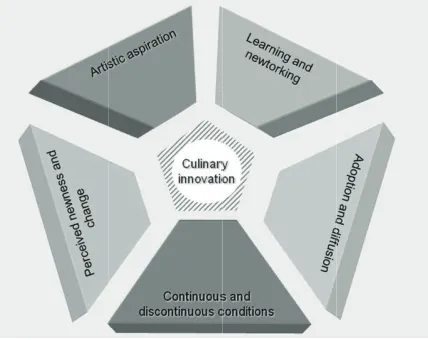
m T E r l n b v v k E v h w T w g p International Scien Management meaningless, The dilemma Era thus rema rather than pr looking for pr Innovation new high-tec business proc of innovation value (Dörfle excellent exam culinary idea culinary value on Figure 1.Figure 1 P
In the er opportunities validation. Ha sharing learn knowledge (B Era learning, validation of have inherite experimental First of all we course, some conditions ar world as well. One of consistency w for our conce The idea of in the notion o applying som which this generalisation of validity. T propose here
ntific Journal of Information Syst
such as profi a of the busin ains: Do we " recisely wrong recision want n less and less ch production cesses is more n will be: the er, 2010b; D mple of this n
is born and e" (Stierand &
Potential dimensio
Source: Stierand
ra of abunda , adding valu ave the suppo ned yet ho Baracskai, 200
the learning a heap of s ed the idea
sciences in e need to esc
elements can re meaningful
these is the which we cons
eption of loos nternal consist
f generalisatio me knowledge knowledge n is an attemp
The concept is different fr
tems
it of 150 ± 2 ness decision "want to be br
g?" (Taleb, 20 to avoid takin s means new p n processes. e promising. T creation of örfler et al., new approach transformed & Lynch, 2008
ons of culinary in d, Lynch, 2008
ance of know ue will be th orters of free ow to valid 8)? In our co g process is a
shallow know of validation
positivistic f ape from pos n be saved, bec
l in the non-e concnon-ept o sider necessary ely-structured tency is closel on, which re beyond the
is acquire pt to extend t of validatio rom all other
Zoltan Ba
200 million. taker in F-roadly right 007). Those ng decision. products or Innovating The essence new added 2010). An h is "how a into a new 8) as shown
nnovation
wledge and he focus of knowledge date (new) ontext of
F-actually the wledge. We n from the framework. sitivism. Of cause some -positivistic of internal y condition d validation. ly related to fers to the
domain in ed – i.e.
the domain on that we
approaches
aracskai, Viktor
to validatio abductive bi instance. Th approach t phenomenon or a single reasoning (n some discus the details o of what it m applies here Such approa organisation contradicts t as validation 3. Transd Learning Easily acces has created interesting k shallow oce specific know of the sha different fro shaft. The la while the for but can be e
When w knowledge approach somewhat ‘constructivi to be buildin (apart from would be a one by one big picture a during the sharper, mo the persona individual c learning. An the whole lif The foun the emergen knowledge i through an i the learner, the head of more preci learning, is n now) existin learner (Dör
r Dörfler, Jaszm
on: We sugg ig picture’ with his means th to validation n on the basi
user, throug not complete
sion about it), of innovation may become, e and now… ach to validat ns in their too much of w n, we call it qu
disciplinary
ssible ‘shallow the need for knowledge fro ean is very wledge from a allow knowled om the miner
atter is typical rmer is typical asily distracted we learn w
(Polányi, 19 to pedagog
differently ist’ may imply
ng knowledge m a pyramid
puzzle, to wh in time), but as a fuzzy m learning proc ore elaborate, al knowledge construction p nd this constr felong learning ndation of con nce of knowl
s not projecte intermediary, but the const f the learner. isely, the co nothing but re ng prior know
rfler, 2010a).
mina Szendrey, J
gest validatin hin the contex hat we conce
n as lookin is of a single gh a more o
ly tacit, as th , not being int
but in the ho and such val … (Baracskai e
tion is certain real-life con what is curren asi-validation.
y Approach
w knowledge a new approa om the infinite different fr a narrow shaf dge ocean i of the narrow lly analytical a lly passionate d.
we build ou 962). The c
gy consider than what y. It does not
e in a cumula another go hich new piec rather as seei ess at the beg cess the pictu
more detailed e is the re process throu ruction proce g, is personal. nstructivism i ledge accordin ed from some
received into truction proce In other wo onstruction p
estructuring th wledge in the
And this pro
Jolán Velencei
ng a ‘quasi-xt of a single eptualise our
ng into a organization or less tacit here will be terested in in olistic picture lidation only et al, 2011). nly useful for ntext. As it
ntly accepted .
h to
’ abundance ach. Angling ely wide and rom mining ft. The surfer
s also very w knowledge and focused, and curious, ur personal constructivist rs learning the term see learning ative process od example es are added ing the same ginning, and ure becomes d. Therefore esult of an
ugh lifelong ess and thus
s the idea of ng to which e source and, the mind of ess occurs in rds, perhaps process, i.e.
W r i r l n k i n i l T l n m w i p p H r i h b b k D m w m b
What is the Diff
the whole kn the whole reconstructed important as reconstruction lives. So inst new knowled existing, it is as constantly crucial role is knowledge, interpreted, ‘w new knowled itself in this p the time. Th continuous tr
If we imag small gears th learning proc there will be elements as w The human m a limited num 100,000, see limited numb not mean s elements, but magnitude, th with each oth that it takes a of business d image while, decision make
Problem qualify as no problem area discipline, the problem ar However, tac requires a interdisciplina had been s between, a ne a transdiscip business pro knowledge fr Dörfler & V approach to models, conc without imme
In order to may add value of learning. business prob
ference? There
nowledge of th personal d. The notion
s it tells us n of personal tead of pictur dge and addi
better to pict transforming. played by the by which within’ which dge is perform
process, beco herefore per ansition. gine the elem hat are constr cess, we will e prior eleme well, that cann mind has limit mber of elem
e.g. Mérő, 19 ber of links b
smaller numb t much smalle
han each ele her element). a great skill or decision makin , at the sam er seeing their
areas of bu o man’s land. as do not ey are somew reas are c ckling such in transdiscipl ary approach ubstantial kn ew discipline w plinary appro
oblem area rom different Velencei, 2005
business prob eptions, etc. f ersing ourselve o describe how e to innovatio The same w blems transcen
was Always Lif
he learner, wh knowledge n of lifelong s that this l knowledge l ring the mind
ng it to the ture personal . In this transf e (here and no new experi h the process med, and whi
ming someth sonal knowle ents of know ructed and lin l inevitably r ents, and pe not adapt to ted power. It ments (in the 990) and an between them ber than th er, as in severa
ement being Therefore, we art to portray ng without dis me time, en r own ‘mindse siness decisio . This means
fall within where in-betw called interd nterdisciplinary linary appr cannot exist, nowledge av would have em oach the no
are associ t disciplines 5). In a trans
blems we bor from various es in these dis w ‘non-target on we need a n way as our ap nds discipline felong Learning hich means is being learning is continuous lasts all our d receiving previously knowledge formation a ow) existing iences are sing of the
ch changes ing new all edge is in wledge to be
nked in the realise that erhaps new each other.
can handle e range of
even more m (this does hat of the
al orders of connected e could say y the reality storting the nabling the
et’.
on making s that such
and single ween. Such disciplinary.
y problems oach (an
as if there vailable
in-merged). In odes of a iated with (Baracskai, disciplinary rrow tools, disciplines, sciplines. customers’ new, model pproach to es, this new
g
[image:5.567.292.514.551.694.2]model of individual. T learning pro complex sys agents that interactions simultaneou all of these them one by interactions, different wa would have the process system (Min However unfulfillable possible, we account for such as in th and intuitive So we have t modelling: i even if it wa to build decomposab systems can separate co systems can ways, whic algorithmic. transpersona As an ill use a similar "how a culin new culinary range of k (Figure 2). W that the rese culinary inno
Figure 2
Manag
learning ne Therefore we cess we call ‘k stem there is
have multipl may happen sly (Waldrop, agents, and y one, and if
and we co ays in which
a chance to that describe nsky, 1988).
r, each of in complex e are not read
high-complex he case of min
e insights (Dö two reasons to t is impossib as done. How
approximate ble systems. n more or l omponents a n be describe ch is why Learning is al, quasi-algori lustration, Sti r transdiscipli nary idea is bo y value" in ha knowledge so What further earch approac ovations was a
Transdisciplina culinary in
International Scie gement Informat
eeds to tra envisage a t knowledge sha
a number of le interactions n in a varie 1993). If we if we could we could map ould underst h they intera develop an a es the functio f these co
systems. Eve dy to believe t
xity transient nd are intuitive örfler, Ackerm
o give up the le, and it ma wever, it is no e models
(Simon, 2 ess be taken and processe ed in almost
we label t then a trans ithmic proces ierand and L inary approac orn and transfo
aute cuisine, u ources of m r emphasises
ch for investi also transdisci
arity of the proble nnovations
entific Journal of tion Systems
anscend the transpersonal
aring’. In any independent s, and these ety of ways
could isolate d understand
p all of their tand all the
ct, then we algorithm of oning of the nditions is en if it was that it would
phenomena, e judgements mann, 2012).
idea of exact ay be useless ot impossible for near-2001) Such n apart into
es in such algorithmic them
quasi-sdisciplinary, s.
Lynch (2008) ch to explain ormed into a using a wide master chefs
the point is igating these iplinary.
em domain of
Zoltan Baracskai, Viktor Dörfler, Jaszmina Szendrey, Jolán Velencei
8
International Scientific Journal ofManagement Information Systems
4. Concluding Remarks
"Mathematicians will try to convince you that their science is useful to society by pointing out instances where it proved helpful, not those where it was a waste of time, or, worse, those numerous mathematical applications that inflicted a severe cost on society owing to the highly unempirical nature of elegant mathematical theories" (Taleb, 2007).
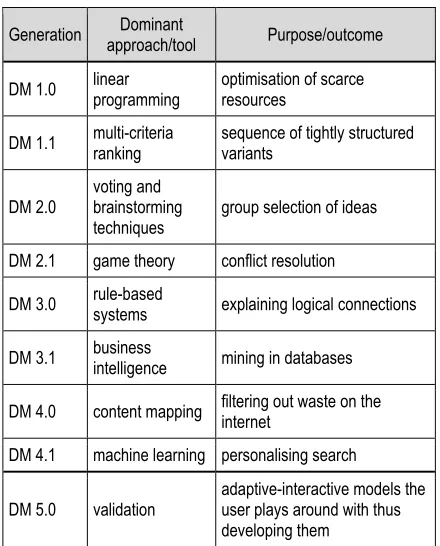
[image:6.567.57.277.311.584.2]In 2008 we attended a presentation by James G. March "Three Eras in Theories of Choice" (March, 2008). We were always reading his books with great interest, because he seems to have the widest view of the area we have been interested in for 35 years. In the table below (Table 1) we take March’s historic overview ending with the ‘the state of the art’, and speculate where the support of business decision making goes next.
Table 1 Generations of Decision Making and Support
Generation approach/tool Dominant Purpose/outcome
DM 1.0 linear programming optimisation of scarce resources
DM 1.1 multi-criteria ranking sequence of tightly structured variants
DM 2.0
voting and brainstorming
techniques group selection of ideas
DM 2.1 game theory conflict resolution
DM 3.0 rule-based systems explaining logical connections
DM 3.1 business intelligence mining in databases
DM 4.0 content mapping filtering out waste on the internet
DM 4.1 machine learning personalising search
DM 5.0 validation
adaptive-interactive models the user plays around with thus developing them
These generations in table 1 do not mean that a new generation replaces the previous one(s). Indeed, the tools of more recent generations may help improving the tools of the prior generations. Beyond that, and perhaps more importantly, they can help achieving better match between the tool and the domain of application. Certainly, some generations are very massive, they are becoming better and better in their domain of application, but sometimes they do not (want to) stop there. So we see serious validation problems. Applied
operational research is still faithful to the period 1, and many operational researchers prefer to see everything as an (hard) or problem. Psychologists often continue to believe only in the generation 2. The wave of knowledge management is still fighting for a stronger role in the generation 3. Passionate amateurs are suggesting that we are at the threshold of generation 4. For now, it is difficult to assess who will fight for the validation of the easily accessible shallow knowledge. Democratisation of the tools will enable millions of passionate amateurs to become new creators of values (Anderson, 2009).
The era of lifelong learning is not coming. It has been always here. Karl Marx had predicted a democracy in which the means of production would be accessible for everyone. Today, thanks to the Internet, anyone can access the most important means of production for free – at least this is the only possible conclusion if we accept that knowledge is the most important ‘resource’. The democratisation of the means of production creates a new generation of passionate amateurs(s) who have not yet had the opportunity to promote their innovations. In this paper we made tentative observations rather than presented details of measurements. We asked more questions than how many we answered. The reason is that our intended contribution is to be one of the first ones to make the readers think about how we will acquire new knowledge tomorrow.
References
Anderson, C. (2009). Free: The Future of a Radical Price. New York: Hyperion Books.
Baracskai, Z. (2008). Dileme donositelja poslovnih odluka. Zagreb: Sinergija.
Baracskai, Z., & Velencei, J. (2011). Vrhunske tehnologije vs. vrhunski nagovještaji. Svarog časopis za društvene i prirodne nauke, 3, 31-36. Baracskai, Z., Dörfler, V., & Velencei, J. (2005). Majstor i kalfa. Zagreb: Sinergija.
Baracskai, Z., Dörfler, V., Szendrey, J., & Velencei, J. (2011). Designing a ‘Strategic Partner’ School. IABE 2011 (pp. 55-64). Las Vegas: International Academy of Business and Economics.
Carr, N. (2010). The Shallows: What the Internet is Doing to Our Brains.
New York: W. W. Norton & Company.
Dörfler, V. (2010). Fit for innovation. In A. Jolly, The innovation handbook: How to profit from your ideas, intellectual property and market knowledge
(pp. 150-153). London: Kogan Page.
Dörfler, V. (2010). Learning Capability: The Effect of Existing Knowledge on Learning. Knowledge Management Research & Practice, 8 (4), 369-379. Dörfler, V., & Ackermann, F. (2012). Understanding Intuition: The Case for Two Forms of Intuition. Management Learning, 43 (5), 545-564. Dörfler, V., Baracskai, Z., & Velencei, J. (2010). Understanding creativity.
Transactions on Advanced Research, 6 (2), 17-25.
Lindstrom, M. (2009). Buyology: How Everything We Believe About Why
We Buy is Wrong. London: Random House Business Books.
What is the Difference? There was Always Lifelong Learning
International Scientific Journal of
Management Information Systems
9
of an Ancient Mariner (MOC Distinguished Scholar Address). Retrieved
March 16, 2014 from http://division.aomonline.org/moc/confmeet.htm Martin, R. (2009). The Design of Business: Why Design Thinking is the
Next Competitive Advantage. Boston: Harvard Business Press.
May, M. E. (2009). In pursuit of elegance: Why the best ideas have
something missing. New York: Broadway Books.
Mérő, L. (1990). Ways of Thinking: The Limits of Rational Thought and
Artificial Intelligence. New Jersey: World Scientific.
Minsky, M. (1998). The Society of Mind. New York: Simon & Schuster. Mintzberg, H. (2007). Productivity Is Killing American Enterprise. Harvard
Business Review, 85 (7), 25-31.
Nidumolu, R., Prahalad, C. K., & Rangaswami, M. R. (2009). Why sustainability is now the key driver of innovation. Harvard Business Review, 87 (9), 56-64.
Polányi, M. (1962). Personal Knowledge: Towards a Post-Critical
Philosophy. London: Routledge.
Simon, H. (2001). Complex Systems: The Interplay of Organizations and Markets in Contemporary Society. Computational & Mathematical
Organization Theory, 7 (2), 79-85.
Stierand, M., Lynch, P. (2008). The art of creating culinary innovations.
Paper presented at CHME Research Conference. Council for Hospitality Management Education, Glasgow.
Taleb, N. (2007). The Black Swan: The Impact of the Highly Improbable.
New York: Random House.
Villeret, B. (2009). Interview with Henry Mintzberg. Retrieved March 8, 2014 from
http://www.consultingnewsline.com/Info/Vie%20du%20Conseil/Le%20Cons ultant%20du%20mois/Henry%2520Mntzberg%20(English).html
Waldrop, M. (1993). Complexity: The emerging science at the edge of order
and chaos. New York: Simon & Schuster.
Zoltan Baracskai DoctuS Consulting Budapest Hungary
Email: [email protected]
Viktor Dörfler
University of Strathclyde Business School Glasgow
UK
Jaszmina Szendrey
University of Strathclyde Business School Glasgow
UK