R E S E A R C H A R T I C L E
Open Access
Tuberculosis active case finding in
Cambodia: a pragmatic, cost-effectiveness
comparison of three implementation
models
Richard James
1, Keovathanak Khim
2, Lydia Boudarene
1, Joanne Yoong
1,3, Chea Phalla
2, Saly Saint
4,
Pichenda Koeut
4, Tan Eang Mao
4, Richard Coker
5,6and Mishal Sameer Khan
1,5*Abstract
Background:Globally, almost 40% of tuberculosis (TB) patients remain undiagnosed, and those that are diagnosed often experience prolonged delays before initiating correct treatment, leading to ongoing transmission. While there is a push for active case finding (ACF) to improve early detection and treatment of TB, there is extremely limited evidence about the relative cost-effectiveness of different ACF implementation models. Cambodia presents a unique opportunity for addressing this gap in evidence as ACF has been implemented using different models, but no comparisons have been conducted. The objective of our study is to contribute to knowledge and methodology on comparing cost-effectiveness of alternative ACF implementation models from the health service perspective, using programmatic data, in order to inform national policy and practice.
Methods:We retrospectively compared three distinct ACF implementation models - door to door symptom screening in urban slums, checking contacts of TB patients, and door to door symptom screening focusing on rural populations aged above 55 - in terms of the number of new bacteriologically-positive pulmonary TB cases
diagnosed and the cost of implementation assuming activities are conducted by the national TB program of Cambodia. We calculated the cost per additional case detected using the alternative ACF models.
Results:Our analysis, which is the first of its kind for TB, revealed that the ACF model based on door to door screening in poor urban areas of Phnom Penh was the most cost-effective (249 USD per case detected, 737 cases diagnosed), followed by the model based on testing contacts of TB patients (308 USD per case detected, 807 cases diagnosed), and symptomatic screening of older rural populations (316 USD per case detected, 397 cases diagnosed).
Conclusions:Our study provides new evidence on the relative effectiveness and economics of three implementation models for enhanced TB case finding, in line with calls for data from‘routine conditions’to be included in disease control program strategic planning. Such cost-effectiveness comparisons are essential to inform resource allocation decisions of national policy makers in resource constraint settings. We applied a novel, pragmatic methodological approach, which was designed to provide results that are directly relevant to policy makers, costing the interventions from Cambodia’s national TB program’s perspective and using case finding data from implementation activities, rather than experimental settings.
Keywords:Tuberculosis, Cambodia, Cost-effectiveness, Case finding
* Correspondence:[email protected] 1
Saw Swee Hock School of Public Health, National University of Singapore, Singapore, Singapore
5Communicable Diseases Policy Research Group, London School of Hygiene & Tropical Medicine, Bangkok, Thailand
Full list of author information is available at the end of the article
Background
Tuberculosis (TB) control remains a critical global chal-lenge, becoming the leading cause of death from an infectious disease in 2014. TB principally affects adults in lower income countries, with 10.4 million new cases estimated in 2015, of which more than half occurred in people living in South-East Asia and Western Pacific re-gions [1]. The Directly Observed Therapy Short-course (DOTS) strategy to control TB was launched by the World Health Organisation (WHO) in the early 1990’s and was based on the premise that early detection and treatment of new cases would prevent spread and reduce the burden of disease. Global targets for the proportion of new TB cases detected and treated successfully under DOTS were set at 70 and 85% respectively. Despite decades of investment towards these targets and 100% DOTS coverage by 2004 [2], early case finding has been a key challenge for TB program implementers. Currently, an estimated 37% of TB patients globally remain undiag-nosed or are not reported [1], and prolonged delays to diagnosis are reported among some patients who do even-tually access DOTS services. In recent years, the WHO has raised concerns that the impact of current interven-tions to improve early detection of TB may have been saturated [3].
It is indeed likely that the current DOTS passive case finding (PCF) strategy, which relies on patients present-ing to the health facility for screenpresent-ing of their own accord, has limitations in contexts where primary health services are weak and awareness of TB is low; evidence from a multi-country analysis indicated that DOTS pro-grams may have no impact on improving case detection [4]. PCF approaches may be resulting in both missed diagnoses and delayed diagnosis, leading to transmission of infection, which would be consistent with the small (1–2% per annum) observed annual decline in incidence of TB [5, 6]. At the current rate of decline in incidence, it will take more than 150 years to meet the WHO targets of reducing TB deaths by 95% and incidence by 90%, compared to 2015. In light of this, there is a push for new models of case finding–collectively referred to as Active Case Finding (ACF) approaches- which involve specific out-reach activities by the health system and its staff, in order to identify and test patients who are either symptomatic or considered to be at higher risk of having TB [7, 8]. The advantages of ACF include not only that it potentially identifies TB cases which would not have been diagnosed without the intervention, but may also identify cases at an earlier stage than if relying on PCF alone, thereby reducing transmission [9].
Although referred to using the same terms, numerous different ACF implementation models exist, ranging from population-wide screening to targeted case-finding in high-risk groups [10]. Compared to PCF, ACF requires
higher investment and more human resources from National TB Programs, which is a major concern in resource-constrained settings [9]. Reviews of studies have shown that the mode of implementation of TB control activities has a large impact on cost-effectiveness, and researchers have highlighted the need for comparisons of different health service delivery models to inform planning and expansion of programmatic approaches to TB control. This is particularly true for ACF interventions. While glo-bally there is some research comparing ACF implementa-tion models and yields [11, 12], with a study in Zimbabwe finding that 77% of symptomatic, smear-positive study participants had their first investigation for TB through community-based ACF [12], there is very limited informa-tion about relative cost-effectiveness of different ACF strategies. A review of over one hundred ACF publications found that no studies conducted a cost effectiveness analysis using established guidelines [13].
Cambodia presents a unique opportunity for addressing this gap in evidence on relative cost-effectiveness of alter-native ACF implementation models. The country has one of the highest TB incidence rates in the region, at 380 per 100,000 population and approximately 40% of smear-positive patients remain undiagnosed [2]. Many different ACF interventions have been piloted in Cambodia since 2010 [14–17], and studies thus far have only looked at the cost effectiveness of a single ACF strategies [15, 18]. The National Center for Tuberculosis and Leprosy Control in Cambodia (CENAT), which is the government body responsible for resource allocation decisions on TB con-trol activities, highlighted the urgent need to compare ACF strategies in order to assess which models identify the largest number of new TB cases per unit of invest-ment. In close collaboration with, and in order to inform, CENAT policy makers, we conducted a pragmatic com-parison of the cost effectiveness of three large-scale ACF programs from a health system perspective. These programs have been piloted in Cambodia and decisions on scale up need to be made.
Methods
We compared three ACF programs using retrospective data on case-finding during the implementation period of the pilot program, and primary data collected on costs of implementation, as described below.
Selection of ACF models for comparison
We identified nine different approaches to delivering ACF services across the country by CENAT and various non-governmental organisations (NGOs): symptom screening in prisons; testing contacts of TB patients; testing patients with HIV; door to door symptom screening in urban slums; symptom screening focusing on elderly members of the community; and using commu-nity based volunteers for identification of symptomatic patients in rural areas.
For this study, we selected ACF interventions meeting the following criteria, to allow for a comparison across implementation approaches: large-scale (covering more than three districts), primarily targeting adults in the community, seeking to diagnose bacteriologically con-firmed (B+) cases using smear-microscopy or Xpert MTB/RIF (GeneXpert) and implemented for a similar time period (10–14 months). We identified three distinct ACF interventions implemented by different public health organisations for inclusion in the analysis. Imple-mentation approaches applied to deliver ACF services are summarized below and in Table 1. All interventions were initiated within a similar timeframe (2012–2013) and were funded through the same mechanism (TB REACH). They therefore followed similar reporting and compliance re-quirements and were independently assessed by an outside agency selected by the funder [19, 20].
Implementation aspects of ACF models compared
(1)Screening contacts of index cases (CENAT) [15]
The national TB program in Cambodia, CENAT con-ducted an ACF program for 10 months (2012–2013) in 15 operational districts (ODs), using a neighborhood and household contact tracing strategy. Any smear-positive TB cases registered for treatment during the preceding 2 years were located and their household contacts were referred for chest X-Ray (CXR) testing irrespective of presence or
absence of symptoms. In addition, people living in the neighbourhood of a confirmed TB case who demonstrated symptoms consistent with TB were referred for the same CXR testing. Community health workers, known as Village Health Support Group (VHSG), were responsible for referring individuals for CXRs. Any person with an abnormal CXR or with persistent symptoms suggestive of TB and a normal CXR underwent GeneXpert sputum testing alone in order to identify B+ TB cases.
(2)Screening of urban poor (HOPE) [14]
Sihanouk Hospital of Hope (HOPE) conducted ACF over a 14-month period (2012–2013), covering four ODs within Phnom Penh city. They targeted poor urban com-munities, which had a presumed higher prevalence of TB related to socioeconomic factors and reduced access to TB treatment. VHSG, managed by salaried ‘TB workers’, conducted verbal door to door symptom screening and sputum samples were requested from those reporting TB symptoms. Sputum samples were transported for smear-microscopy testing at referral hospitals and the HOPE hospital in Phnom Penh. GeneXpert and sputum culture were utilized when subjects were suspected of having HIV co-infection, being at higher risk of multi drug-resistant (MDR) TB and in those who were negative on microscopy but had persisting symptoms.
(3)Targeted screening in older rural population (CATA)
[image:3.595.56.538.568.733.2]The Cambodia Anti-Tuberculosis Association (CATA) organisation conducted a 12 month ACF program (2013–2014) covering five ODs. They focused, non-exclusively, on people aged 55 years or older, due to the known higher TB case notification rates in this age group [21]. CATA staff and OD TB focal persons worked with health center staff and VHSG to conduct verbal symptom screening and coordinate CXR and
Table 1Summary of TB Active Case Finding (ACF) strategies
CENAT HOPE CATA
Target groups Neighbourhood and household contacts of TB cases (registered within the last 2 years)
Populations in poor urban settlements, Phnom Penh
Older age (>55 yrs. old) and vulnerable groups
Key activities •Community health worker visited homes of TB patients registered within last 2 yrs.
•TB-officers and village-health-volunteers performed door to door symptom screening of 315,874 people
•Door to door screening of 68,486 people, focusing on older patients
•33,029 household contacts and
‘neighbourhood contacts’screened using CXR
•12,201 symptomatic patients identified •11,995 symptomatic patients referred for testing and provided transport costs if required
•3632 patients with abnormal CXR had a GeneXpert sputum test
•10,301 symptomatic patients tested with (LED fluorescence) microscopy
•11,650 underwent CXR screening
•1894 patient underwent GeneXpert testing •2518 had GeneXpert testing
GeneXpert testing in mobile units. Symptomatic patients attending screening at the health centres initially had CXRs and when features suggestive of TB were found, underwent GeneXpert testing. Patients identified with symptoms in remote areas who could not easily visit health centres were tested directly with GeneXpert.
Calculation of effectiveness
We defined the effectiveness of ACF interventions in terms of the number of new, adult TB cases diagnosed. To allow a comparison between interventions, we applied a standard definition to assess the number of new cases diagnosed: confirmed B+ cases based on smear-microscopy or GeneXpert testing, pulmonary TB, aged 15 or above.
We extracted data from internal reports, published pa-pers, as well the raw data on case finding activities from each program. Published research papers were available for two of the ACF strategies (HOPE [14] and CENAT [15]); the authors were contacted and they provided further reports as well as raw data for analysis. The unpublished reports examined included internal project narrative documents and results data, standardized TB REACH annual reports for each intervention and in-ternal budget information. Discussions were held with implementing staff for each intervention in person and on the phone to fully understand the implementation approach, before and after the data extraction process.
A standardized data extraction tool was used to extract data about the duration of activities, area of coverage and number of eligible B+ cases diagnosed by ACF intervention.
Costing of ACF implementation activities
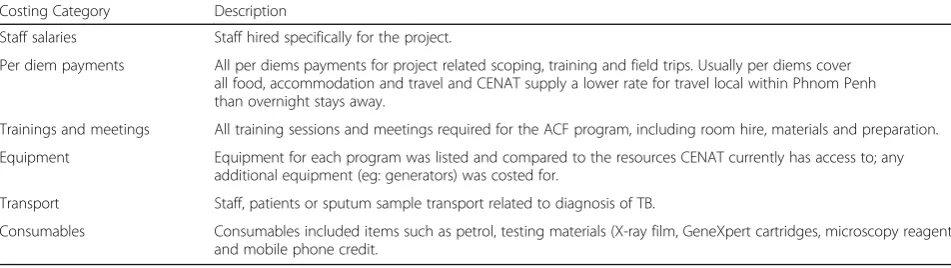
For each ACF project, we gathered detailed information about the activities conducted to diagnose new TB cases, including trainings and preliminary meetings prior to initiating ACF activities, in order to estimate costs of implementing the same activities from the health service (CENAT’s) perspective. First, interviews were conducted with key implementation staff involved in the ACF
activities of each organization (two per organization) to understand resources used, applying a standardised data collection template (Table 2); this was supplemented with data from official records and reports (including TB REACH yearly reports, internal reports and budgets). After resource information was gathered, follow up interviews were conducted with key personnel from each organisation to clarify and review the resourcing information compiled.
We then shared data on all the resources required by each ACF intervention with CENAT, who supplied their cost estimates for each type of resource, according to their budget predictions for the coming year (2016), this method, along with the exclusive use of USD dollars, avoided any need to adjust figures according to historic inflation or exchange rates, respectively.
Once we had a unit cost for all of the resources used and activities conducted we calculated the overall costs for each of the three strategies, from the perspective that activities would be conducted by CENAT as part of their programmatic strategy for TB control. If there were additional activities or trainings that CENAT would in-sist on as part of any ACF strategy they conducted - for example, training relevant staff on GeneXpert equip-ment - this was added to the budget for HOPE and CATA’s activities.
In addition to the costs incurred during the data col-lection period, the cost of all trainings and preliminary meetings for each program were calculated and in-cluded. The preparation and post data collection activities were not included as each organisation took variable lengths of time with overlapping resources for other activities, making the calculation of accurate times and costs for each activity difficult.
Cost effectiveness comparison
[image:4.595.57.533.599.733.2]We sought to estimate the cost per additional B+ case diagnosed for the three different ACF strategies, using a health system cost perspective based on the assumption that the ACF strategies would be implemented by CENAT. We assessed cost-effectiveness using the
Table 2Breakdown of cost categories used to analyse the ACF strategies
Costing Category Description
Staff salaries Staff hired specifically for the project.
Per diem payments All per diems payments for project related scoping, training and field trips. Usually per diems cover all food, accommodation and travel and CENAT supply a lower rate for travel local within Phnom Penh than overnight stays away.
Trainings and meetings All training sessions and meetings required for the ACF program, including room hire, materials and preparation.
Equipment Equipment for each program was listed and compared to the resources CENAT currently has access to; any additional equipment (eg: generators) was costed for.
Transport Staff, patients or sputum sample transport related to diagnosis of TB.
standard approach used by researchers and funders such as TB REACH, defining the cost per TB case detected as the total cost of activities related to diagnosis divided by the total number of TB cases diagnosed [22].
Assumptions
The method of analysis employed in this study as-sumes that the effectiveness achieved for each dollar spent is comparable between the programs, meaning there is an assumption of equivalent efficiency across the three implementing groups. A further assump-tion made in the comparison, is that the cases detected would not have been detected had the ACF activities not taken place. It should be noted that due to the different contexts of each strategy the consequences of this assumption is likely to vary between the programs.
Results
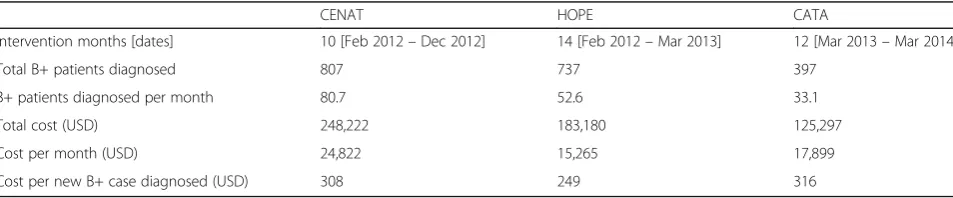
Our comparison of three distinct ACF models in Cambodia revealed that the cost per case detected was 249 USD, 308 USD and 316 USD, for the HOPE, CENAT and CATA ACF models, respectively (Table 3). HOPE’s program, working in poor urban areas of Phnom Penh, was the most cost-effective of the three, by a small margin, followed by the model of testing contacts of TB patients (CENAT) and the CATA model focusing on older rural populations.
CENAT’s ACF activities involved providing CXRs to 33,029 people and diagnosed 807 B+ patients. HOPE tested 10,301 symptomatic individuals using sputum microscopy and 1894 with GeneXpert, leading to 737 confirmed B+ cases. Finally, CATA focused on older rural subjects, providing 11,650 CXRs after verbal symp-tom screening with 2518 going onto have GeneXpert testing, leading to 397 confirmed B+ cases.
The costing analysis, summarized in Table 4, showed that the contact tracing ACF model implemented by CENAT had a total cost of USD 248,222, while HOPE and CATA’s models cost 183,180 and 125,297 respect-ively. Distribution of costs varied between ACF models, with HOPE spending a higher proportion on salaries than the other organizations, while CATA and
CENAT spent more on consumables. HOPE used some of its budget on equipment not routinely supplied by CENAT, which included mobile phones for their TB workers and cool boxes for sputum transportation.
Discussion
The results show that despite differences in implementation models and populations, cost-effectiveness of the three in-terventions was relatively similar, with HOPE being the most cost-effective at less than 250 USD per new case diag-nosed. The two rural programs of CENAT and CATA, which applied more costly diagnostic protocols involving chest x-rays, had very similar cost-effectiveness results, at USD 308 and 316 per case detected respectively.
Published ACF costs, per case detected, show that a wide range exists globally, from USD 108 in Cambodia (2010) [18] to USD 444–1493 in South Africa (2015) [23] and USD 1581–4000 in Russia (1995) [24]. TB REACH guidance suggests that the cost per additional case (those TB cases detected by the intervention above the local historical trend) detected and treated, for interventions they fund should be up to USD 350, however, this is a different measure to the costing in our study [1, 22].
[image:5.595.306.540.97.212.2]Increased case detection and high treatment success rates are the cornerstones of global TB control policy [1] and as one of the top 22 high burden countries, Cambodia has implemented multiple strategies to improve its case detection rate. This is the first cost-effective analysis dir-ectly comparing alternative models of ACF in Cambodia, and, to our knowledge, no similar comparison has been conducted in other high TB burden countries.
Table 3Cost effectiveness summary
CENAT HOPE CATA
Intervention months [dates] 10 [Feb 2012–Dec 2012] 14 [Feb 2012–Mar 2013] 12 [Mar 2013–Mar 2014]
Total B+ patients diagnosed 807 737 397
B+ patients diagnosed per month 80.7 52.6 33.1
Total cost (USD) 248,222 183,180 125,297
Cost per month (USD) 24,822 15,265 17,899
[image:5.595.59.536.633.732.2]Cost per new B+ case diagnosed (USD) 308 249 316
Table 4Cost breakdown of each ACF intervention
Budget Categories CENAT HOPE CATA
Staff salaries 32,700 (13) 85,060 (46) 19,880 (16)
Per diem payments 22,572 (9) 31,112 (17) 35,420 (28)
Trainings and meetings 61,474 (25) 20,255 (11) 11,502 (9)
Equipment 0 (0) 1360 (1) 0 (0)
Transport 840 (0) 10,940 (6) 3185 (3)
Consumables 130,636 (53) 34,453 (19) 55,310 (44)
Our study provides timely information in light of calls for cost-effectiveness data from ‘routine conditions’to be included when programmatic recommendations for TB diagnosis are made [25]. Such cost-effectiveness informa-tion is essential to inform resource allocainforma-tion decisions of national policy makers. Our method of analyzing the three ACF strategies was designed to provide data that is directly relevant to policy makers, taking a pragmatic ap-proach towards costing the interventions from Cambodia’s national TB program’s (CENAT’s) perspective and using case finding data from program activities, rather than experimental settings. It is important to consider that our analysis, by design, compares heterogeneous ACF models with different population characteristics, the most import-ant being a likely variable TB prevalence [22]. Different screening algorithms were used and the urban poor screening by HOPE used cheaper diagnostic techniques compared to the other two; thus the logistics and costs of each project varied. HOPE also focused exclusively on urban areas where the higher population density meant that larger numbers of people could be screened within a smaller geographical area.
A potential limitation relates to the estimation of costs by CENAT and an assumption that scale up of CATA and HOPE strategies by CENAT will be possible and provide the same efficiency, without substantial extra in-vestment in the current services and health centres. However, there were also advantages to the method employed for cost calculations, with the unit costs being standardized according to national program estimates. We acknowledge that reductions in patient costs owing to outreach activities are not accounted for, and that the cost-effectiveness comparison does not consider equity and accessing of hard to reach populations, which may justify a higher cost per case detected. Finally, we recognize that wider questions regarding ACF itself still remain and highlight that ACF strategies will only be effective if cases are identified early such that onward transmission is prevented. Thus, before launching into large ACF programs in resource-limited settings, prag-matic comparisons of different ACF models – looking not only at cost per case detected as we have done but also at forecasts of long term impact on TB incidence-are required to inform resource allocation decisions.
Conclusion
Alternative ACF implementation models for TB are be-ing introduced in numerous resource-constraint settbe-ings, but evidence on relative cost-effectiveness, which is essential to inform resource allocation decisions of national policy makers, is lacking. We applied a novel, pragmatic methodological approach to compare the cost-effectiveness of three ACF implementation models that had been implemented between 2012 and 2013 in
Cambodia, allowing the models to be ranked in terms of potential to identify the largest number of new bacteriologically-positive TB cases per unit of invest-ment. We found that implementation of ACF activities in urban areas was slightly more cost-effective than in rural areas, and that the pragmatic cost-effectiveness assessment approach provided information that was called for by local policy makers.
Abbreviations
ACF:Active case finding; CATA: The Cambodia Anti-Tuberculosis Association; CENAT: The National Center for Tuberculosis and Leprosy Control in Cambodia; CXR: Chest X-Ray; DOTS: Directly Observed Therapy Short-course; HOPE: Sihanouk Hospital of Hope; MDR TB: Multi drug-resistant tuberculosis; NECHR: The National Ethic Committee for Health Research; NGO: Non-governmental organisations; ODs: Operational districts; PSF: Passive case finding; TB: Tuberculosis; VHSG: Village Health Support Group; WHO: World Health Organisation
Acknowledgments
This study was funded through a grant from the National University of Singapore. We gratefully acknowledge the contributions of teams involved in the three ACF interventions we analyzed, including: Hope, Phnom Penh (Nathalie Lorent and Choun Kimcheng); CATA (Chry Monyrath and Mom Ky) and staff at the National Center for Tuberculosis and Leprosy Control, (CENAT) Phnom Penh for their support in data collection and analysis.
Funding
This study was funded through a grant from the National University of Singapore.
Availability of data and materials
Data is not publically available since we analysed data owned by implementing partners but can be shared by the corresponding author on reasonable request.
Authors’contributions
MSK conceived of the study. RJ, KK, MSK and CP collected the data. All authors contributed to the analysis and have been involved in drafting the manuscript or revising it critically for important intellectual content and have given final approval of the version to be published.
Ethics approval and consent to participate
The National Ethic Committee for Health Research (NECHR) Cambodia and the National University of Singapore Institutional Review Board provided ethical approval for this study.
Consent for publication Not applicable.
Competing interests
The authors declare that they have no competing interests.
Publisher’s Note
Springer Nature remains neutral with regard to jurisdictional claims in published maps and institutional affiliations.
Author details
1
Received: 3 February 2017 Accepted: 7 August 2017
References
1. Global TB Report. Global Tuberculosis Report 2016. World Health Organization, 2016. http://www.who.int/tb/publications/global_report/en/ Accessed 4 Apr 2017.
2. National Health Strategic Plan for Tuberculosis Control in the Kingdom of Cambodia 2011–2015. CENAT; National Centre for Tuberculosis and Leprosy Control (Cambodia) http://www.cenat.gov.kh/sites/default/files/files/ documents/files/StrategicPlan_2011-2015%20English%20Version%20FINAL. pdf. Accessed 26 May 2016.
3. Lonnroth K, Corbett E, Golub J, Godfrey-Faussett P, Uplekar M, Weil D, Raviglione M. Systematic screening for active tuberculosis: rationale, definitions and key considerations. Int J Tuberc Lung Dis. 2013;17:289–98. 4. Obermeyer Z, Abbott-Klafter J, Murray CJ. Has the DOTS strategy improved
case finding or treatment success? An empirical assessment. PLoS One. 2008;3:e1721.
5. Lönnroth K, Jaramillo E, Williams BG, Dye C, Raviglione M. Drivers of tuberculosis epidemics: the role of risk factors and social determinants. Soc Sci Med. 2009;68:2240–6.
6. Creswell J, Ottmani SE, Wei D, Sahu S, Lönnroth K, Uplekar MW. Programmatic approaches to screening for active tuberculosis. Int J Tuberc Lung Dis. 2013;17:1248–56.
7. World Health Organization. Systematic screening for active tuberculosis: principles and recommendations. World Health Organization; 2013. 8. Getahun H, Raviglione M. Active case-finding for TB in the community: time
to act. Lancet. 2010;376:1205–6.
9. Kranzer K, Afnan-Holmes H, Tomlin K, Golub JE, Shapiro A, Schaap A, Corbett E, Lönnroth K, Glynn J. The benefits to communities and individuals of screening for active tuberculosis disease: a systematic review [state of the art series. Case finding/screening. Number 2 in the series]. Int J Tuberc Lung Dis. 2013;17:432–46.
10. Morishita F, Furphy VB, Kobayashi M, Nishikiori N, Eang MT, Yadav RP. Tuberculosis case-finding in Cambodia: analysis of case notification data, 2000 to 2013. Western Pac Surveill Response J: WPSAR. 2015;6(1):15. 11. Corbett EL, Bandason T, Duong T, Dauya E, Makamure B, Churchyard GJ,
Williams BG, Munyati SS, Butterworth AE, Mason PR. Comparison of two active case-finding strategies for community-based diagnosis of symptomatic smear-positive tuberculosis and control of infectious tuberculosis in Harare, Zimbabwe (DETECTB): a cluster-randomised trial. Lancet. 2010;376:1244–53.
12. Adejumo A, Azuogu B, Okorie O, Lawal O, Onazi O, Gidado M, Daniel O, Okeibunor J, Klinkenberg E, Mitchell E. Community referral for presumptive TB in Nigeria: a comparison of four models of active case finding. BMC Public Health. 2016;16:1.
13. Golub J, Mohan C, Comstock G, Chaisson R. Active case finding of tuberculosis: historical perspective and future prospects. Int J Tuberc Lung Dis. 2005;9:1183.
14. Lorent N, Choun K, Thai S, Kim T, Huy S, Pe R, van Griensven J, Buyze J, Colebunders R, Rigouts L, Lynen L. Community-based active tuberculosis case finding in poor urban settlements of Phnom Penh, Cambodia: a feasible and effective strategy. PloS one. 2014;9(3):e92754.
15. Yadav RP, Nishikiori N, Satha P, Eang MT, Lubell Y. Cost-effectiveness of a tuberculosis active case finding program targeting household and neighborhood contacts in Cambodia. Am J Trop Med Hyg. 2014;90:866–72. 16. Thim S, Sath S, Sina M, Tsai EY, Delgado JC, Shapiro AE, Barry CE 3rd,
Glaziou P, Goldfeld AE. A community-based tuberculosis program in Cambodia. JAMA. 2004;292:566–8.
17. Morishita F, Eang MT, Nishikiori N, Yadav R-P. Increased case notification through active case finding of tuberculosis among household and Neighbourhood contacts in Cambodia. PLoS One. 2016;11:e0150405. 18. Eang MT, Satha P, Yadav RP, Morishita F, Nishikiori N, van Maaren P,
Weezenbeek CL. Early detection of tuberculosis through community-based active case finding in Cambodia. BMC Public Health. 2012;12:469. 19. Stop TB. About TB Reach background: http://stoptb.org/global/awards/
tbreach/about.asp 2016 Accessed 20 Feb 2016.
20. Cambodia Anti-Tuberculosis Association (CATA), STOP TB Partnership, 2014: http://www.stoptb.org/assets/documents/global/awards/tbreach/w3docs/ CAMBODIA%20ANTI-TUBERCULOSIS%20ASSOCIATION%20Cambodia.pdf. Accessed 22 May 2016.
21. Morishita F, Furphy VB, Kobayashi M, Nishikiori N, Eang MT, Yadav R-P. Tuberculosis case-finding in Cambodia: analysis of case notification data, 2000 to 2013. Western Pacific Surveillance Response J. 2015;6:15–24. 22. Nishikiori N, Van Weezenbeek C. Target prioritization and strategy selection
for active case-finding of pulmonary tuberculosis: a tool to support country-level project planning. BMC Public Health. 2013;13:97.
23. Sekandi JN, Dobbin K, Oloya J, Okwera A, Whalen CC, Corso PS. Cost-effectiveness analysis of community active case finding and household contact investigation for tuberculosis case detection in urban Africa. PLoS One. 2015;10:e0117009.
24. Migliori G, Khomenko A, Punga V, Ambrosetti M, Danilova I, Ribka L, Grzemska M, Sawert H, Raviglione M. Cost-effectiveness analysis of tuberculosis control policies in Ivanovo oblast, Russian Federation. Ivanovo tuberculosis project study group. Bull World Health Organ. 1998;76:475. 25. Cobelens F, van den Hof S, Pai M, Squire SB, Ramsay A, Kimerling ME. Which
new diagnostics for tuberculosis, and when? J Infect Dis. 2012;205:S191–8.
• We accept pre-submission inquiries
• Our selector tool helps you to find the most relevant journal
• We provide round the clock customer support
• Convenient online submission
• Thorough peer review
• Inclusion in PubMed and all major indexing services
• Maximum visibility for your research
Submit your manuscript at www.biomedcentral.com/submit